As world population hits 8 billion, China frets over too few babies
November 13, 2022
FILE PHOTO: People walk and ride vehicles along a street, amid the coronavirus disease pandemic, in Shanghai
BEIJING/HONG KONG (Reuters) – Chinese software developer Tang Huajun loves playing with his two-year-old in their apartment on the outskirts of Beijing but he said he is unlikely to have another child.
Such decisions by countless people like Tang will determine the course not only of China’s population but that of the world, which the United Nations says is projected to reach 8 billion on Tuesday.
Tang, 39, said many of his married friends have only one child and, like him, they are not planning any more. Younger people aren’t even interested in getting married let alone having babies, he said.
The high cost of childcare is a major deterrent to having children in China, with many families in an increasingly mobile society unable to rely for help on grandparents who might live far away.
“Another reason is that many of us get married very late and its hard to get pregnant,” Tang said. “I think getting married late will definitely have an impact on births.”
China was for decades preoccupied with the prospect of runaway population growth and imposed a strict one-child policy from 1980 to 2015 to keep numbers in check.
But now the United Nations expects China’s population will start shrinking from next year, when India will likely become the world’s most populous country.
China’s fertility rate of 1.16 in 2021 was below the 2.1 OECD standard for a stable population and among the lowest in the world.
The anguish of the coronavirus pandemic and China’s strict measures to stamp it out may also have had a profound impact on the desire of many people to have children, demographers say.
New births in China are set to fall to record lows this year, demographers say, dropping below 10 million from last year’s 10.6 million – which was already 11.5% lower than in 2020.
Beijing last year began allowing couples to have up to three children and the government has said it is working towards achieving an “appropriate” birth rate.
OLD PEOPLE, NEW PROBLEMS
For planners, a shrinking population poses a whole new set of problems.
“We expect the aging population to increase very rapidly. This is a very important situation facing China, different to 20 years ago,” said Shen Jianfa, a professor at the Chinese University of Hong Kong.
The proportion of the population over the age of 65 is now about 13% but is set to rise sharply. A declining labour force faces an increasing burden of looking after the rising numbers of old folk.
“It will be very high for some years,” Shen said of the proportion of elderly in the population. “That’s why the country has to prepare for the coming aging.”
Alarmed by the prospect of an ageing society, China has been trying to encourage couples to have more children with tax breaks and cash handouts, as well as more generous maternity leave, medical insurance and housing subsidies.
But demographers say the measures are not enough. They cite high education costs, low wages and notoriously long working hours, along with frustration over COVID curbs and the overall state of the economy.
A key factor is job prospects for young people, said Stuart Gietel Basten, professor at Hong Kong’s University of Science and Technology.
“Why would you have more babies when the people you have cannot even get jobs?”
(Reporting by Thomas Suen and Farah Master; Editing by Robert Birsel)
Finding safe haven in the climate change future: The Midwest
David Knowles, Senior Editor – November 12, 2022
This Yahoo News series analyzes different regions around the country in terms of climate change risks that they face now and will experience in the years to come.
As the negative consequences of rising global temperatures due to mankind’s relentless burning of fossil fuels become more and more apparent in communities across the United States, anxiety over finding a place to live safe from the ravages of climate change has also been on the rise.
“Millions and likely tens of millions of Americans” will move because of climate through the end of the century, Jesse Keenan, an associate professor of real estate in Tulane University’s School of Architecture, told Yahoo News.“People move because of school districts, affordability, job opportunities. There are a lot of drivers and I think it’s probably best to think about this as ‘Climate is now one of those drivers.’”
A building is surrounded by floodwater in 2019 in Atchison, Kan. (Scott Olson/Getty Images)
In late October, a report by the United Nations concluded that average global temperatures are on track to warm by 2.1 to 2.9 degrees Celsius by the year 2100. As a result, the world can expect a dramatic rise in chaotic, extreme weather events. In fact, that increase is already happening. In the 1980s, the U.S. was hit with a weather disaster totaling $1 billion in damages once every four months, on average. Thanks to steadily rising temperatures, they now occur every three weeks, according to a draft report of the latest National Climate Assessment, and they aren’t limited to any particular geographic region.
To be sure, calculating climate risk depends on a dizzying number of factors, including luck, latitude, elevation, the upkeep of infrastructure, long-term climate patterns, the predictable behavior of the jet stream and how warming ocean waters will impact the frequency of El Niño/La Niña cycles.
“No place is immune from climate change impacts, certainly in the continental United States, and throughout the U.S. those impacts will be quite severe,” Keenan said. “They will be more severe in some places and less severe in other places. Certain places will be more moderate in terms of temperature and some places will be more extreme, but we all share the risk of the increase of extreme events.”
In this installment, we look at a region that is already used to weather extremes and where, thanks to climate change, even more are coming into view.
The Midwest
Made up of eight states — Ohio, Michigan, Indiana, Illinois, Missouri, Iowa, Minnesota and Wisconsin — the Midwest has found itself over recent centuries at the intersection of warm, moist air from the Gulf of Mexico and frigid polar vortexes that dip south from Canada. As with other regions of the country, climate change is already upending weather patterns in the Midwest and will, in the years to come, alter precipitation trends, food production, humidity and overall heat in profound ways.
Of the top 10 counties rated safest to live in the Midwest when it comes to climate change risks, six — Menominee, Vilas, Winnebago, Shawano, Portage and Polk — are located in Wisconsin, according to a 2020 analysis by the New York Times and ProPublica based on findings provided by the Rhodium Group, a data analytics firm. The remaining four in the top 10 Midwestern counties — Keweenaw, Luce, Crawford and Alger — are found in Michigan.
Many other counties in those two states and in Minnesota also ranked highly based on a cumulative scale that examined six major categories — heat stress, humidity (“wet bulb”), wildfires, crop loss, sea level rise and overall economic damages — and two emissions scenarios, high and moderate.
While northern counties in the Midwest offer relative protection from climate change risks, those further south, such as Missouri’s Camden, Hickory, Wayne, Bollinger, Dunklin, Maries, Phelps and Ripley counties as well as Illinois’s Alexander and Pulaski counties, all ranked lowest in the region, in large part due to poor scores on farm crop yields, heat and wet-bulb effect.
The bones of a fish washed ashore lie in a field of destroyed soybeans next to the Missouri River near Omaha in 2019. (Johannes Eisele/AFP via Getty Images)
While many Americans may not yet be familiar with the term “wet bulb,” they certainly will in parts of the Midwest before long. It refers to a potentially fatal combination of hot temperatures and high humidity that conspire to prevent the body from being able to cool itself down through the evaporation of sweat. That dynamic explains why even excessive “dry heat” feels less oppressive than less severe temperatures coupled with high humidity.
NASA predicts that Midwestern states like Missouri and Iowa will “hit the critical wet-bulb limit” in the next 50 years, leading to higher rates of weather-related deaths.
On average, the Midwest can expect dramatic shifts in temperatures if emissions continue at their current pace that will have a wide range of negative effects on human health.
“Compared to other regions where worsening heat is also expected to occur, the Midwest is projected to have the largest increase in extreme temperature-related premature deaths under the higher scenario,” the Centers for Disease Control and Prevention states on its website. “Northern midwestern communities and vulnerable populations that historically have not experienced high temperatures may be at risk for heat-related disease and death.”
As temperatures continue to rise, the Midwest will also find itself dealing with poor air quality, a risk category not included in the New York Times/ProPublica rankings.
“Increases in ground-level ozone and particulate matter are associated with the prevalence of various lung and cardiovascular diseases, which can lead to missed school days, hospitalization, and premature death,” the CDC states. “In the absence of mitigation, ground-level ozone concentrations are projected to increase across most of the Midwest, resulting in an additional 200 to 550 premature deaths in the region per year by 2050.”
An American flag remains standing after a tornado tore through rural Kentucky. (Jeremy Hogan/SOPA Images/LightRocket via Getty Images)
The CDC also warns that some of the climate change consequences forecast to hit the Midwest, such as drought, severe flash flooding and diminished air quality, can cause mental health problems like anxiety. Kristi White, a clinical health psychologist in Minneapolis, has already been treating young adults for anxiety born of climate change.
“Some of the things in the patients that I work with are things like asthma exacerbation due to poor air quality from wildfires [and] concerns around the risk for heat-related illnesses during extreme heat waves,” White told Yahoo News earlier this year.
While the climate change risks to the Midwest and other regions of the country have long been predicted by climate scientists using computer modeling, there’s still a large element of surprise when it comes to pinpointing which parts of the region can expect to see extreme weather events and exactly how bad they will be.
Indeed, this summer it seemed as though 1-in-1,000-year rain events traveled in threes.
One increasingly glaring problem with rating extreme rainfall events in terms of their historical likelihood is that the changing climate has rendered such scales woefully out of date.
“If you build a statistical model based on a climate that no longer exists, it’s not going to be too surprising that it fails,” UCLA climate scientist Daniel Swain, who also consults for ClimateCheck, a company that provides climate change risk assessments on real estate nationwide, told Yahoo News. Most “hydrologic models and the Army Corps of Engineers” do not factor in the Clausius-Clapeyron equation, which describes the increase in atmospheric moisture that results from every degree of temperature rise, into their modeling, Swain added.
Simply put, more atmospheric moisture can result in more rainfall. Overall, the Environmental Protection Agency has found that rainfall across the Midwest has risen by 5 to 10% in the past 50 years on average. Though average annual rainfall won’t rise at an equal pace across the region, the trend line based on current greenhouse gas projections is clear.
A street is flooded after water from the Tittabawassee River breached a nearby dam in 2020 in Sanford, Mich. (Gregory Shamus/Getty Images)
“Precipitation in the Midwest is expected to become more intense, leading to increased flood damage, strained drainage systems, and reduced drinking water availability,” the EPA says on its website.
But the other major aspect of the Clausius-Clapeyron equation is that warmer temperatures dramatically speed up evaporation rates so that even when a region sees an uptick in the amount of annual precipitation, it remains susceptible to drought. In 2021, for instance, 27% of the Midwest experienced a drought, according to the National Oceanic and Atmospheric Administration, including 70% of Michigan and 57% of Iowa.
In 2022, despite record-setting rains in some states, large portions of Iowa, Missouri and Minnesota now find themselves in severe or extreme drought, according to the U.S. Drought Monitor.
To be sure, while the Upper Midwest — including northern Minnesota and Wisconsin and Michigan’s Upper Peninsula — offers cooler average temperatures than other parts of the region, it has also been warming fastest in the region in recent years. Ice on the Great Lakes continues to melt away earlier and wintertime average temperatures across the region have risen significantly. For a little while, that might all seem like good news, sparing residents from the unrelenting winters of past decades. But should emissions continue at their current levels, the changes to the Midwest will be jarring.
Ice forms along the shore of Lake Michigan as temperatures hang in the single digits on Jan. 26 in Chicago. (Scott Olson/Getty Images)
For Hoosiers, that will mean an increase from seven days per year of temperatures exceeding 95°F at present to between 50 and 89 of them by the end of the century. That heat will, in turn, further decrease crop yields for corn and soybeans, potentially upending a way of life.
In some ways, the Midwest epitomizes the folly of trying to outrun climate change. For every global warming advantage that is offered in places like northern Michigan and Wisconsin, other hazards are poised to present themselves. In its entry on the Midwest, the U.S. Climate Resilience Toolkit highlights those emerging risks.
“Climate change is expected to worsen existing health conditions and introduce new health threats by increasing the frequency and intensity of poor air quality days, extreme high temperature events, and heavy rainfalls; extending pollen seasons; and modifying the distribution of disease-carrying pests and insects,” the website states.
How climate change, rising sea levels are transforming coastlines around the world
Julia Jacobo, Daniel Manzo and Ginger Zee – November 7, 2022
Communities have gravitated toward the shore for thousands of years, building their lives in proximity to major waterways for easy access to trade, seafood and recreation.
But those who reside near coastlines will need to learn to adjust as climate change continues to create conditions that chip away at these malleable geological structures, according to experts.
One of the recurring topics of the 2022 United Nations Climate Change Conference taking place in Cairo, Egypt, is how climate change is currently affecting people around the world. As coastlines change and become battered by an increase in the number of severe weather events, homes — and, in some cases, entire communities — are being condemned as they become inundated with seawater the more the natural barriers are broken down.
PHOTO: A composite image shows the Rockaway boardwalk area after Hurricane Sandy, Oct. 31, 2012 (top) and a year later (bottom) in the Rockaway neighborhood of the Queens borough of New York, Oct. 20, 2013. (Spencer Platt/Getty Images, FILE)
The transformation of coastlines is constant. Coastal erosion is a natural part of the Earth’s cycle as strong waves continually crash against the shore. But as global temperatures warm and sea levels rise, the damage to the coast’s natural barriers is being exacerbated with each subsequent monster storm with tropical force winds or higher — which typically causes the most damaging events of erosion, scientists say.
As melting glaciers and ice sheets cause sea levels to rise, the ocean waves around the coast become more intense, Raphael Crowley, associate professor at the University of North Florida’s Engineering School of Sustainable Infrastructure and Environment, told ABC News.
In addition, gradual effects from day-to-day erosion reaching farther inland, such as land that was previously above sea level being underwater more, will weaken the structure of the coastlines even more — allowing for strong storms to do more damage when they pass through, Ronadh Cox, a professor of geology and mineralogy at Williams College in Williamstown, Massachusetts, told ABC News. Each high tide that reaches previously dry land has a cumulative effect on shoreline retreat and the associated erosion.
“So, everything from nuisance flooding associated with tides rising higher, to storm surges penetrating farther inland, all contribute to these effects of the coast,” Cox said.
PHOTO: A composite image shows the boardwalk washed away during Hurricane Sandy in the Rockaway neighborhood of the Queens borough of New York, Nov. 10, 2012 (top) and cars parked on the street in the Rockaway neighborhood, Oct. 19, 2013 (bottom). (Spencer Platt/Getty Images, FILE)
The types of natural infrastructures that can be destroyed are sand dunes, cliffs and even living shorelines, such as plants, marshes and oyster reefs — all of which can act as barriers to an influx of ocean water. A marsh measuring 15 feet deep can absorb about 50% of incoming wave energy, but these living barriers continue to dwindle, as well.
The deterioration of coastlines can also be impacted by the human tendency to develop right on top of them, according to experts.
As populations increase and more housing is built near the coast, oftentimes the coastal wetlands are drained to make room for development, Cox said.
PHOTO: (top) A man walks along the heavily damaged Rockaway beach, Nov. 2, 2012 (bottom) People walk down the beach in Rockaway neighborhood of the Queens borough of New York City, Oct. 23, 2013. (Spencer Platt/Getty Images, FILE)
When the barriers along the coastlines fail to keep ocean water out, it wreaks havoc on communities, Crowley said. Roads become impassable. Homes become at risk of being destroyed or even swept away in some cases of extreme storm surge — like what happened in parts of southwest Florida due to Hurricane Ian.
“The combined effect of all of these things, of course, is increased erosion, land loss and infrastructure loss,” Cox said.
Coastal erosion is already tallying up to about $500 million annually in property damage, according to the U.S. Climate Resiliency Toolkit, an online resource that compiles data from the U.S. federal government.
“The problem with coastal engineering is that coasts are constantly evolving,” Crowley said.
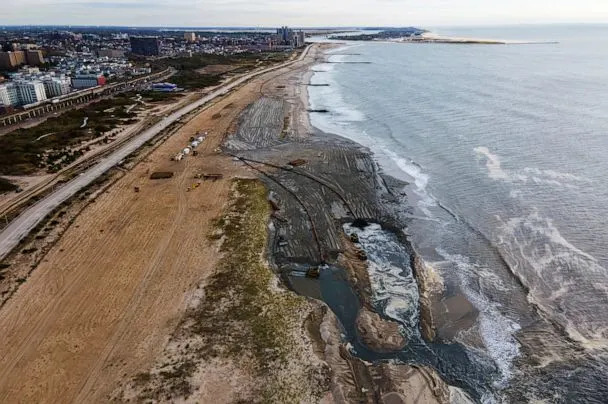
PHOTO: Contractors for the U.S. Army Corps of Engineers pump sand from the ocean floor onto the beach in the Rockaway Peninsula in New York City, Oct. 18, 2022. (Ted Shaffrey/AP, FILE)
If people want to live near the ocean, protection measures such as ensuring a high enough elevation and that there is a barrier between the structure and the water — such as a sand dune — should be implemented, Crowley said.
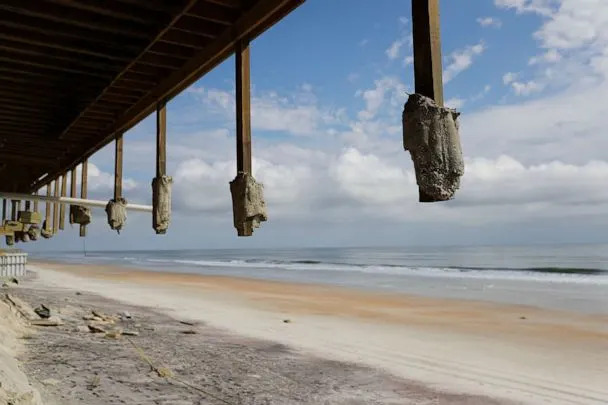
Severe storms can remove wide beaches in a single event. Following the passing of Hurricane Irma in 2017, Crowley witnessed what was previously a sand dune in north Florida’s Vilano Beach transformed into “a 40-foot cliff with a house hanging off of it,” he said. That structure was one of several dozen that Crowley knew would never be livable again, he said.
PHOTO: Support beams for a home’s deck are exposed after the sand below was eroded from Hurricane Irma in Vilano Beach, Fla., Friday, Sept. 15, 2017. (David Goldman/AP)
The research is suggesting that what was previously considered a once-in-a-generation storm, such as Ian, could start to occur more frequently, Crowley said.
In addition, Cox has witnessed famed coastal towns such as Nantucket and Martha’s Vineyard, both in Massachusetts, lose measurable levels of cliff retreat of several meters per year in some places, she said.
In Pinellas County, Florida, a half-foot of sea level rise in the past 50 years has led to the loss of 120 feet of beach, John Bishop, coastal management coordinator for the Pinellas County Government, told ABC News.
Sea levels have been rising about 3.5 millimeters per year since the early 1900s, Crowley said.
“It doesn’t sound like a lot, but then if you add that up over 100 years — that’s quite a bit of rise,” he said, adding that the rate of rise has since accelerated.
PHOTO: Contractors for the U.S. Army Corps of Engineers pump sand from the ocean floor onto the beach in the Rockaway Peninsula in New York City, Oct. 18, 2022. (Ted Shaffrey/AP, FILE)
In the next 30 years, sea level along the U.S. coastline is projected to rise, on average, 10 to 12 inches — the same amount it rose in the past century, according to a new report by the National Oceanic and Atmospheric Administration’s 2022 Sea Level Rise Technical Report. Experts believe the drastic rise will continue to exacerbate coastal erosion and the problems people living near the ocean will face.
About 2 feet of sea level rise along the U.S. coastline is increasingly likely between 2020 and 2100 because of emissions to date, according to the NOAA report. An additional 1.5 to 5 feet of sea level rise is possible by the end of the century should countries around the world fail to curb emissions, the report predicted.
A recent Pew poll concluded nearly eight in 10 voters said the economy will be “very important” to their voting decisions. Another such poll, by ABC News and Ipsos, showed that almost half of respondents cited either the economy or inflation as the issue about which they were most concerned. The poll indicated that concerns about the economy and inflation are “much more likely to drive voters towards Republicans.”
But that impulse is not only ill-considered, every bit of available evidence makes clear that the GOP is the wrong party to which to turn if you seek better U.S. economic performance in the future.
In fact, it is not close. When it comes to the economy, the GOP is the problem and not the solution. If anything, it is a greater obstacle to our economic well-being today than it has ever been.
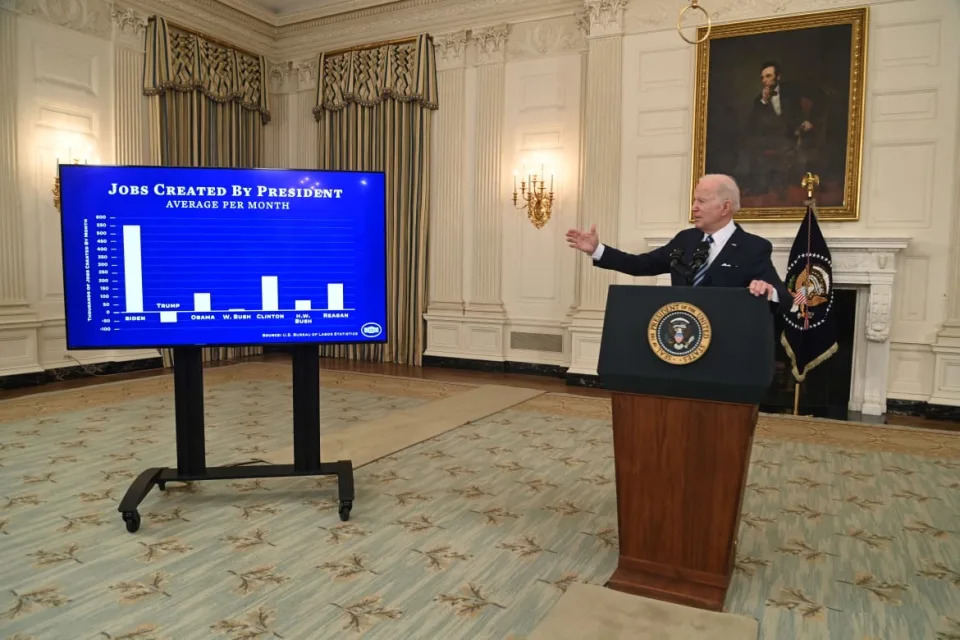
At the same time, the economic record of President Joe Biden and the Democrats is not just consistent—in creating jobs, reducing the deficit, and enhancing our competitiveness—during the past two years their record has been one of extraordinary, often record-breaking success.
History tells a very stark tale. Ten of the last 11 recessions began under Republicans. The one that started under former President Donald Trump and the current GOP leadership was the worst since the Great Depression–and while perhaps any president presiding over a pandemic might have seen the economy suffer, Trump’s gross mismanagement of COVID-19 clearly and greatly deepened the problems the U.S. economy faced. Meanwhile, historically, Democratic administrations have overseen recoveries from those Republican lows. During the seven decades before Trump, real GDP growth averaged just over 2.5 percent under Republicans and a little more than 4.3 percent under Democrats.
Drew Angerer/Getty
Republicans have also historically presided over huge expansions in the U.S. deficit, while Democrats (since Bill Clinton’s administration) have overseen dramatic deficit reduction. Ronald Reagan more than doubled the deficit from $70 billion to more than $175 billion. George H.W. Bush nearly doubled that to $290 billion. Clinton ended his administration with a $128.2 billion surplus.
George W. Bush inherited that… and left office with a record deficit of more than $1.4 trillion. Obama reduced that by very nearly $1 trillion. Each of Donald Trump’s last two years in office saw federal budgets with deficits of over $3 trillion. In fact, in total, the national debt rose almost $8 trillion during Trump’s time in office. According to ProPublica, it was the third biggest such increase in U.S. history—after George W. Bush and Abraham Lincoln during the Civil War years.
What about job creation?
The U.S. lost jobs under Trump and created relatively few under George W. Bush. Of the 14 presidents since World War II, seven were Democrats and seven were Republican. Of the seven with the highest job creation rates, six were Democrats. Of the seven with the lowest job creation rates, six were Republicans.
What about now? Biden and the current Democratic Congress have created more jobs than the past three Republican administrations combined.
Saul Loeb/Getty
The job creation rate in 2021 was the most ever in a single year. GDP growth in 2021 was the highest since 1984. This year, the unemployment rate fell to 3.5 percent, its lowest level in 50 years. As part of that, we are seeing record low unemployment for Blacks and Latinos.
Ok, you might say, but what about inflation?
Rising prices are a real problem for many Americans. But the origins of inflation have very little to do with the Biden administration or the Congress. Inflation is a global problem that is related, according to economists, primarily to supply chain problems associated with COVID, Vladimir Putin’s escalation of the war in Ukraine, and corporate profiteering.
What makes the Republican focus on this issue so shockingly hypocritical is that Trump’s mismanagement of the COVID crisis, his support for Putin, and Republicans’ protection of Big Oil (and big businesses) actually helped create the conditions that have driven prices up. Further, Republicans unanimously opposed every single measure by the Biden administration to reduce prices and help those hit by inflation—including the landmark Inflation Reduction Act’s efforts to lower drug costs and to help those hardest hit.
Meanwhile, the U.S. just reported stronger than expected growth in the last quarter and the price of gasoline, an oft-cited sign of inflation, has been falling for months.
At the same time, a substantial majority within the GOP have sought to block virtually every single new economic measure proposed or passed by Biden and the Democratic Congress. That includes the America Recovery Act that lifted millions out of poverty and drove job creation, the Chips and Science Act to enhance competitiveness, and even the so-called “Bipartisan Infrastructure Bill” which garnered the support of fewer than half of the GOP caucus in the Senate.
You might assume that if the GOP opposed these initiatives but were critical of what Biden was doing, that they had alternative plans that they have presented to the American people. But, you would be wrong. In fact, Senate Minority Leader Mitch McConnell has bragged that he would not even discuss his agenda until after the election. They have no inflation plan. And the plans they’ve said they admire—like that of the United Kingdom’s prime minister-for-a-second Liz Truss—have been a catastrophe.
The last time the Republicans were in charge, during the Trump years, they passed precisely one significant piece of economic legislation, a tax cut that benefited the very rich at the expense of everyone else and, as we have established, helped explode the federal budget deficit.
Republicans are just plain bad at managing the economy. They have been for as long as anyone who is alive can remember. And they continue to be—although they are achieving previously unattained new levels of cynicism and obstructionism that make the current crowd of Republicans look even worse than their very unsuccessful predecessors.
History and data make it clear that Democrats are good for the economy—while Republicans, especially the current Republicans in Congress, are not.
Up next for the Republicans are plans to cut Medicare and social security, plans to increase costs for average Americans on a wide variety of fronts, and they’re even contemplating reducing support for Ukraine—at a critical moment in its war to defend its democracy and stop the Russian aggression that threatens not only them, but the West.
Republicans have done a great job fooling voters into thinking that their simplistic economic philosophies of tax cuts and minimal regulation are “good for business.” But facts, history, and logic show otherwise.
If you care about the economy, want to fight inflation, want to create jobs, want a better life for your family, want to preserve democracy, and want to defend your fundamental rights, then you should vote for the Democrats.
He was accused of stealing huge amounts of water over 23 years. Here’s why no one noticed
Dale Kasler, Ryan Sabalow – November 1, 2022
JOHN WALKER / jwalker@fresnobee.com
California’s water police struggle to track where water is flowing and whether someone is taking more than they’re supposed to.
A criminal case unfolding in the San Joaquin Valley underscores how the federal government seems to have similar problems.
Prosecutors say they uncovered a massive water theft that went on for 23 years without anyone noticing.
Earlier this year a federal grand jury indicted Dennis Falaschi, the former general manager of the Panoche Water District in the western San Joaquin Valley, on charges of conspiracy, theft of government property and filing false tax returns.
Falaschi’s alleged crime stemmed from the federal government’s operation of the Central Valley Project, the system of reservoirs and canals that dates to President Franklin Roosevelt’s administration.
According to prosecutors, Falaschi engineered a brazen scheme to steal $25 million worth of water from the U.S. Bureau of Reclamation, operator of the Central Valley Project. More specifically, Falaschi stands accused of having his underlings siphon water from the Delta-Mendota Canal, the main conduit for delivering federal water to farms along the west side of the San Joaquin Valley and part of Silicon Valley.
He then billed Panoche customers for this stolen water and used the proceeds to pay “himself and other co-conspirators exorbitant salaries, fringe benefits and personal expense reimbursements,” the indictment says.
How Panoche Water District legal trouble started
Falaschi’s legal troubles began in 2017, when the state controller’s office released an audit showing that the financial controls at Panoche were too lax. Among other things, staffers were allowed to use district credit cards to buy Oakland A’s and Raiders season passes, and tickets to a Katy Perry concert.
A month later, Falaschi left Panoche. Then in 2018 the state attorney general’s office charged him and three other former district employees with embezzling $100,000 from Panoche and illegally burying toxic chemicals on district property. Prosecutors said Falaschi allegedly used the embezzled funds to buy a pair of slot machines and some kitchen appliances, among other things. That case is still pending.
The latest indictment covers a scheme that, according to prosecutors, began in 1992 and wasn’t discovered until April 2015 when a canal maintenance worker saw a whirlpool above the equipment that prosecutors say Falaschi had hidden in the canal to siphon off the water.
The theft lasted long enough to enable Falaschi to grab a total of 130,000 acre-feet of water — enough to fill about 13% of Folsom Lake, prosecutors said.
Last year district officials made a civil settlement over the missing water, agreeing to pay $7.5 million to the federal government and another $1 million to an umbrella agency, the San Luis & Delta-Mendota Water Authority, which buys water from the feds.
The indictment came months after the civil settlement. The grand jury says Falaschi had several of his employees install a valve mechanism in the canal — submerged below the water line — near the district’s headquarters in Firebaugh.
Falaschi, who now lives in Aptos, could receive up to 24 years in prison if convicted.
He has pleaded innocent to the criminal charges. In a statement, his Fresno lawyer Marc Days blasted the feds for prosecuting Falaschi “over a leak from the government’s rotted pipe which the government failed to repair,” and for relying on the statements of “unreliable and incompetent witnesses motivated by their own self-interest.”
Days said the amount of water the federal government accuses Falaschi of taking pales in comparison to some of the other leaks from the same canal.
He said area farm districts receive “massive amounts of unmetered water,” including one leak that Days alleges siphons off 200 cubic feet a second, an amount that in a year would surpass the water prosecutors allege Falaschi stole over those two decades. The federal government, Days claims, has known about the problems but fails to do anything to prevent them.
Mary Lee Knecht, a spokeswoman for the Bureau of Reclamation, declined comment because of the pending case.
Why missing water goes undetected
Falaschi’s successor at Panoche, Ara Azhderian, said it’s no secret that water goes missing throughout the Delta-Mendota system. Evaporation alone takes a significant toll, he said.
In fact, Azhderian said Falaschi’s alleged scheme likely went unnoticed for so long due to the sheer size of the Delta-Mendota Canal and the volume of water it delivers.
Two million acre-feet of water moves through the canal in a typical year, and the canal is nearly 117 miles long.
“When you think about the system and how long it is, how big it is,” he said, “… it was such a small amount in the scheme of things as to be undetectable.”
Others say the problems along the canal — whether through massive leaks or by alleged thefts — highlight just how difficult it is to keep tabs on the state’s most precious resource.
“We really don’t know where our water is going,” said Jeffrey Mount, a water expert at the Public Policy Institute of California. “Where it really breaks down for us now is in this ever-tightening water world where we’re having to deal with less. Major chunks of it, we don’t know where it goes and who’s using how much.”
Who we elect on Nov. 8 to send to Washington as the state’s first new U.S. senator in more than a decade will likely matter for generations to come.
Despite the muck that has been lobbed this election season, it is crystal clear to our board who between Congressman Tim Ryan and author and investor J.D. Vance is best suited to replace Republican U.S. Sen. Rob Portman.
With the U.S. Senate split 50-50 and few seats in play, Ohioans — many still feeling the impacts of the global COVID-19 pandemic — will help decide the Senate’s balance of power.
One thing is for sure, pocketbook issues will and should influence those decisions.
Culture wars may dominate most of the news out of the Ohio Statehouse, but Ohioans are far more concerned about putting food on the table and dealing with high prices than what bathroom a transgender child is allowed to use or whether or not a sixth grader can read Toni Morrison’s “The Bluest Eyes.”
Nearly a third of likely Ohio voters are primarily concerned about inflation and its effect on the economy than any other issue, according to a September USA TODAY Network Ohio/Suffolk University Political Research Center poll.
Columbus is seen as the state’s economic bright spot, but things do not shine even here for everyone.
More than 53% of likely voters who took part in that September poll said economic conditions here are “fair,” but 23% of voters called conditions “poor.”
Nearly 45% of those voters said their standard of living is worse now than four years ago. This comes as little surprise.
The things he has said about the economy are vague and out of a playbook that focuses on energy independence, bashing the Biden administration on spending and inflation and commending the Trump administration’s trade policy.
He’s been light on details and comprehension of what Ohioans need and want.
“I think this is largely a self-inflicted wound. Global commodity prices are always going to shift here and there in ways that you can’t control. But if you look at things like the Keystone pipeline, shutting down that on day one, if you look at the really low number of oil and gas permits the Biden administration has granted, I think that we’ve really shot ourselves in the foot when it comes to energy prices.”
Ryan has focused his economic message on finding bipartisan solutions, taking on China and stopping “stupid” political fights to end “decades of disinvestment, unfair trade and outsourcing, and policies that have boosted the wealthiest and the biggest corporations at the expense of working people.”
Ryan was asked how he would help Ohioans facing financial hardships during a joint meeting with members of our board and others in the USA TODAY Ohio Network.
Vance was invited but declined to participate in the meeting which included questions submitted by readers from around the state.
Ryan told our board that “political people” get themselves in trouble when they think that things are OK because fundamentals of the economy like wages and unemployment seem good.
Tax cuts are needed for individuals and small businesses because those fundamentals are not being felt by Americans, he said.
“We’ve been to all 88 counties. We are going everywhere. It can be a home health care worker, it can be a construction worker— the gas prices are crushing people (as well as) food and general supply chain stuff,” he said. “You have got to put money in people’s pockets right now.”
“Inflation is a global problem. It is a little bit better here than it is in other places, but that does not eliminate the fact that people are being hurt. (There should be) a straight tax cut. Do what we did with child tax credit, advance it. The earned income tax credit, advance it. And then a general tax cut.”
What about the culture wars and social issues?
J.D. Vance shakes hands with former President Donald Trump during a rally at the Delaware County Fairgrounds on April 23, 2022.
News out of Ohio’s Statehouse and words out of J.D. Vance’s mouth leave many with the impression that Ohio is more extreme on social issues than multiple polls indicate.
Ohio needs representation in Washington that appreciates and recognizes the richness and potential of all people — not just those of one particular party or the other.
The 38-year-old “Hillbilly Elegy” author once trashed Trump, but has bent over backwards to win favor with the Trump family. How deep is Vance’s devotion?
Vance, who has taken up for a host of extremists and been flippant about the Russia invasion of Ukraine, does not deserve to replace Portman, a fellow Republican, in the U.S. Senate.
He is no Howard Metzenbaum, George Voinovich, John Glenn, Sherrod Brown, Mike Dewine or Rob Portman.
As senators they worked across party lines in the name of Ohioans. They did not fling insults to win political points, peddle in the “great replacement theory” conspiracy that there is an immigrant invasion or imply a woman should stay with her abusive husband for the good of the kids.
Columbus and the rest of Ohio need a statesman who will stand up for the people of the state.
The 49-year-old, 10-term congressman ran against Democratic leader Nancy Pelosi in 2017 for House minority leader. He has publicly criticized her for a list of issues that include so-called ‘congressional day trading,’ House members using their positions to get rich in the stock market.
“I love the president,” Ryan said at the time. “He’s done a lot for manufacturing. He’s helped us in Youngstown, and he understands the value of manufacturing. But on this particular issue, he is not fully seeing what we should be doing with the American economy.”
What’s important to Ohio?
Ryan supports issues many Ohioans say are important to them: including expanding the economy and supporting seniors, abortion access, affordable health care including mental health, affordable housing, upholding democracy, ending racial disparities and increasing equality for those in the LGBTQ community.
During that recent meeting with the editorial boards, he expressed understanding that Ohio’s future growth cannot be placed squarely on the shoulders of Columbus, which is experiencing the challenges that come with rapid growth including an affordable housing shortage.
Representing forgotten Ohioans
When asked about the $20 billion Intelsemiconductor plant planned for Licking County, Ryan said he’d work with CEOs to make sure the prosperity spreads.
“We need you to locate these suppliers around the state. We have so many forgotten communities that have great people, great culture. Iconic cities,” he said.
He said he’d work with the governor and JobsOhio to help identify and secure the resources and infrastructure cities like Marietta and Portsmouth need to land big employers.
Ryan says he has met with people all over the state, including those in Republican leaning so-called red counties.
“We have to represent these people too … Go get their vote. Go tell them what you’re going to do for them. Go tell them you care about them. We’ve done that. That’s the kind of leader Ohio wants.”
A lot is at stake this election as Republicans and Democrats battle for control of the U.S. House and the Senate.
The person Ohio sends to Washington to replace Portman will help decide what we will become.
That person should be capable and willing to represent all of us.
That person should put the good of Ohioans above political aspirations and loyalty to party.
Endorsement editorials are our board’s fact-based assessment of issues of importance to the communities we serve. These are not the opinions of our reporting staff members, who strive for neutrality in their reporting.
Republicans Claim They Can Tame Inflation, but Economists Have Their Doubts
Jim Tankersley and Emily Cochrane – October 26, 2022
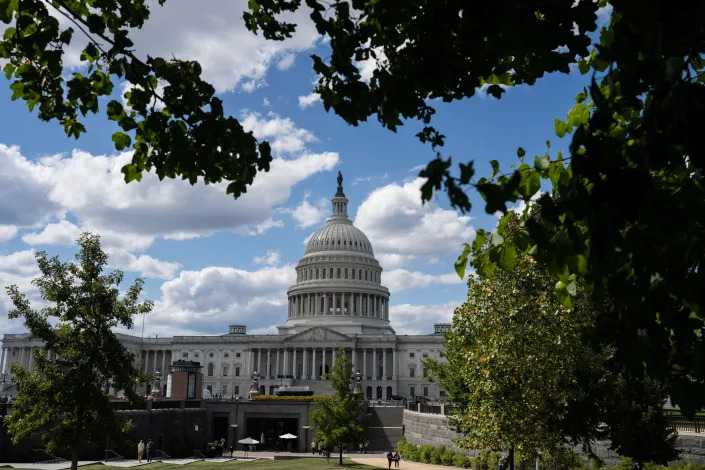
The U.S. Capitol Building in Washington on Sept. 27, 2022. (Haiyun Jiang/The New York Times)
WASHINGTON — Republicans are riding a wave of anger over inflation as they seek to recapture the House and the Senate this fall, hammering Democrats on President Joe Biden’s economic policies, which they say have fueled the fastest price gains in 40 years.
Republican candidates have centered their economic agenda on promises to help Americans cope with everyday price increases and to increase growth. They have pledged to reduce government spending and to make permanent parts of the 2017 Republican tax cuts that are set to expire over the next three years — including incentives for corporate investment and tax reductions for individuals.
They have vowed to repeal the corporate tax increases that Biden signed into law in August while gutting funding for the IRS, which was given more money to help the United States go after high-earning and corporate tax cheats.
“The very fact that Republicans are poised to take back majorities in both chambers is an indictment of the policies of this administration,” said Sen. Bill Cassidy, R-La., noting that “if you look at the spending that they did on a partisan basis, we certainly would be able to stop that.”
But while Republicans insist they will be better stewards of the economy, few economists on either end of the ideological spectrum expect the party’s proposals to meaningfully reduce inflation in the short term. Instead, many say some of what Republicans are proposing — including tax cuts for high earners and businesses — could actually make price pressures worse by pumping more money into the economy.
“It is unlikely that any of the policies proposed by Republicans would meaningfully reduce inflation in 2023, when rapidly rising prices will still be a major problem for the economy and for consumers,” said Michael R. Strain, an economist at the conservative American Enterprise Institute.
On Wednesday, Republicans on the House Ways and Means Committee held a virtual meeting where they detailed plans to make the 2017 tax law provisions permanent, billing the move as a crucial step toward improving the nation’s economy.
“As we look forward to the strong probability of an upcoming recession, there is new urgency to preserve these pro-growth policies,” said Rep. Vern Buchanan, R-Fla.
As they position themselves for the midterm elections, Republicans have also indicated that they might try to hold the nation’s borrowing limit hostage to achieve spending cuts. The debt ceiling, which caps how much the federal government can borrow, has increasingly become a fraught arena for political brinkmanship.
Multiple top Republicans have signaled that unless Biden agrees to reduce future government spending, they will refuse to lift the borrowing cap. That would effectively bar the federal government from issuing new bonds to finance its deficit spending, potentially jeopardizing on-time payments for military salaries and safety-net benefits, and roiling bond markets.
Biden has tried to push back against the Republicans and cast the election not as a referendum on his economic policies, but as a choice between Democratic policies to reduce costs on health care and electricity and Republican efforts to repeal those policies. He has accused Republicans of stoking further price increases with tax cuts that could add to the federal budget deficit, and of risking financial calamity by refusing to raise the debt limit.
“We, the Democrats, are the ones that are fiscally responsible. Let’s get that straight now, OK?” Biden said during remarks Monday to workers at the Democratic National Committee. “We’re investing in all of America, reducing everyday costs while also lowering the deficit at the same time. Republicans are fiscally reckless, pushing tax cuts for the very wealthy that aren’t paid for, and exploiting the deficit that is making inflation worse.”
The challenge for Biden is that voters do not seem to be demanding details from Republicans and are instead putting their trust in them to turn around an economy that voters believe is headed in the wrong direction. Polls suggest Americans trust Republicans by a wide margin to handle inflation and other economic issues.
In a nationwide deluge of campaign ads and in public remarks, Republicans have pinned much of their inflation-fighting agenda on halting a stimulus spending spree that began under President Donald Trump and continued under Biden, in an effort to help people and businesses survive the pandemic recession. Those efforts have largely ended, and Biden has shown no desire to pass further stimulus legislation at a time of rapid price growth.
Rep. Jason Smith of Missouri, the top Republican on the House Budget Committee, said in a statement that “the first step in combating inflation is to stop the historically reckless spending spree occurring under one-party Democrat rule in Washington, and that will only happen with a Republican majority in Congress.”
Economists largely agree that the Federal Reserve is most responsible for fighting inflation, which policymakers are trying to do with rapid interest rates increases. But they say Congress could plausibly help the Fed by reducing budget deficits, in order to slow the amount of consumer spending power in the economy.
One way to do that would be to significantly and quickly reduce federal spending. Such a move could result in widespread government layoffs and reduced support for low-income individuals — who would be less able to afford increasingly expensive food and other staples — and could prompt a recession.
“The amount of cuts you’d have to do to move the needle on inflation are completely off the table,” said Jon Lieber, a former aide to Sen. Mitch McConnell of Kentucky who is now the Eurasia Group’s managing director for the United States.
Still, Lieber said that likelihood would not sully the Republican pitch to voters this fall. “Midterm votes are a referendum on the party in power,” he said, “and the party in power has responsibility for inflation.”
Biden administration officials contend that the Republican plans, rather than curbing inflation, could worsen America’s fiscal situation.
Administration economists estimate that two policies favored by Republicans — repealing a new minimum tax on large corporations included in the Inflation Reduction Act and extending some business tax cuts from Trump’s 2017 legislation — could collectively increase the federal budget deficit by about $90 billion next year.
Such an increase could cause the Federal Reserve to raise rates even faster than it already is, further choking economic growth. Or, alternatively, it could add a small amount to the annual inflation rate — perhaps as much as 0.2 percentage points. Fully repealing the Inflation Reduction Act would also mean raising future costs for prescription drugs for seniors on Medicare, including for insulin, and potentially raising future electricity costs.
“Their plan to repeal the IRA and double down on the Trump tax cuts for the wealthy will worsen inflation,” said Jared Bernstein, a member of Biden’s Council of Economic Advisers. “On top of that, they’re also explicit that they’re coming for Social Security and Medicare, making this a terribly destructive agenda that starts by fighting the Fed and moves on to devastating vulnerable seniors.”
Conservative economists say the inflation impact of extending Trump’s tax cuts could be much smaller, because those extensions could lead businesses to invest more, people to work more and growth to increase across the economy. They also say Republicans could help relieve price pressures, by following through on their proposals to reduce federal regulations governing new energy development.
“Those things are going to be positive for investment, job creation and capacity” in the economy, said Donald Schneider, a former chief economist for Republicans on the House Ways and Means Committee and the deputy head of U.S. policy at Piper Sandler.
A budget proposal unveiled this year by the Republican Study Committee, a conservative policy group within the House Republican conference, included plans to permanently extend the Trump tax cuts and to impose work requirements on federal benefits programs, in hopes of reducing federal spending on the programs and increasing the number of workers in the economy.
“We know for a fact that federal spending continues to keep inflation high, which is why a top priority in next year’s Republican majority will be to root out waste, fraud and abuse of taxpayer money,” Rep. Kevin Hern, R-Okla., said in a statement. Hern, who helped devise the budget, called it “one of many proposals to address the dire situation we’re in.”
As they eye the majority, top Republicans have suggested that they will consider an economically risky strategy to potentially force Biden to agree to spending cuts, including for safety-net programs. Rep. Kevin McCarthy of California, who is the minority leader and is seen as the clear pick to be speaker should Republicans win control of the House, suggested to Punchbowl News this month that he would be open to withholding Republican votes to raise the federal borrowing limit unless Biden and Democrats agreed to policy changes that curb spending.
How to use that leverage has divided Republicans. Some, like Rep. Nancy Mace of South Carolina, who fended off a Trump-backed primary challenger, are supportive of that option.
But other Republicans — particularly candidates laboring to present a more centrist platform in swing districts held by Democrats — have shied away from openly supporting cuts to safety-net programs.
“Absolutely not,” Lori Chavez-DeRemer, a Republican and former mayor running in Oregon’s 5th Congressional District, said when asked if she would support cuts to Medicare and Social Security as a way to rein in federal spending. “Cutting those programs is not where I, as a Republican, see myself. I want to make sure that we can fill those coffers.”
‘Wonderful’ news: Fort Myers Beach rapidly restoring water service, whatever it takes
Phil Fernandez, Fort Myers News-Press – October 26, 2022
Fort Myers Beach Utilities Director Utilities Director Christy Cory and fellow departments heads, workers and leaders bore the brunt of frustration and anger last week from many of the nearly 200 at the Town Council’s first gathering since Hurricane Ian’s battering.
On Tuesday night, many of those same residents cheered Cory as she brought a surprising update to the council meeting on the rapid return of water service to Estero Island.
“As of today at close of business — and my guys are actually still out there — we had 62 side streets on. We had 51.2% of the island turned on,” Cory said.
“Say that again?” a voice blurted out.
“Your numbers are outstanding,” council member Jim Atterholt said, after the applause and whistling had subsided, and then occurred a half-dozen more times sprinkled with prolonged clapping, hurrahs and amens during a six-minute spurt as Cory spoke. “Your news is wonderful.”
That’s a dramatic surge from zero Friday morning on side streets.
“There’s two to three valves per side street. The debris is causing a little bit of a problem for us. I try to get the machines down there (to) get it out of the way so we can turn on a valve to a side street. Once we do that, then we immediately break up (to) individual” houses, Cory said. “I’m out there, my office staff is out there. We’re hitting each house individually because we’re watching (for) water coming out of the houses.”
“A case in point. We went to Bay Beach Lane today to get Bay Beach Lane turned on. It was a hot mess, for a lack of a better term. There was debris everywhere,” Cory said. “We are also repairing on the residents’ side just to try to get people’s water back to them. We’re just not repairing our side. We’re actually going onto property and helping people.”
That led to yet another eruption of cheers among the 150 or so at the makeshift setup inside the former SkipOne Seafood restaurant, 17650 San Carlos Blvd.
“We’re doing absolutely the best we can to get everyone water,” Cory said. “We’re out there at 5:45 (a.m.) with every one of my crew members. We start at daylight and we work until the sun goes down every single day. And we’ll continue to do that until every single resident on this island has water.”
With the previous complaints about the lack of service and too much caution and inspection as repairs continued, Mayor Ray Murphy and town council members had implored more creativity from Town Manager Roger T. Hernstadt and his team.
“If we feel that it’s safe, and we’re out there, and someone is home and we feel that it’s safe to turn on their water, we are doing so. Let me say that Roger has given me permission to do that,” Cory said. “If there’s a policy in place, I want to make it clear I didn’t go against that policy. Roger authorized me if I feel it’s safe as the director to turn on their water, I can do that.”
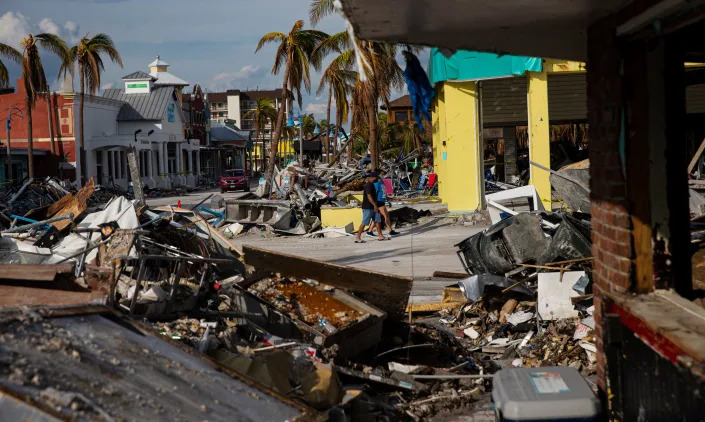
Times Square on Fort Myers Beach was destroyed in Hurricane Ian.
‘Literally, the street rose up’
But there are hazards.
“We went to Primo (Drive) to turn on that water, and the whole street, I mean, literally the street rose up, and we immediately shut it down,” Cory said. “I don’t want to devastate an area that’s devastated already. When it comes to a street like that, I want to keep moving but bring back my contractors to repair that, which they did today and that water’s turned on.
“So it’s just a matter of when we get to a street, then we have something like a main break. We had a valve blow up once the other day that basically comes out of the street.”
And then there’s the riskiness of residents turning on their own meters, Hernstadt said.
“We’ve had cases where people’s properties got flooded, and they’ll call us up, ‘My house is flooded.’ We don’t recommend you do that,” he said. “It’s wiser to turn on the meter when we’re there.”
Fort Myers Beach was destroyed by Hurricane Ian on Sept. 28, 2022. This is the Times Square area on October 14, 2022.
Cory said she understands inhabitants trying to get their lives closer to normal in any way they can.
“Previously, I would have told you not to touch that meter. Now, I’m just going to say, ‘If you want to turn on your water, you can go right ahead,'” Cory said. “If you could do that between sunrise and sunset, that would be amazing because the 1 a.m. (calls), phew.”
But while there’s some victory with water, it’s not like most residents who still have a standing structure could go home Tuesday night and repeatedly turn their lights on and off in celebration. A total of 177 buildings have been energized, according to FPL. The company continues to work with town officials on the more challenging mission of extending power, among the concerns raised Tuesday night by about a dozen speakers.
“There’s a big difference between electricity and water,” Cory said.
But Hernstadt said he’s working with staff to find ways to shorten the restoration process. It’s just a matter again of being careful on an island landscape covered in potential dangers after a storm that officially killed 118 Floridians, based on new state data Tuesday night. Lee County’s 57 leads, and Collier, Charlotte and Sarasota counties all lost eight lives each, second most.
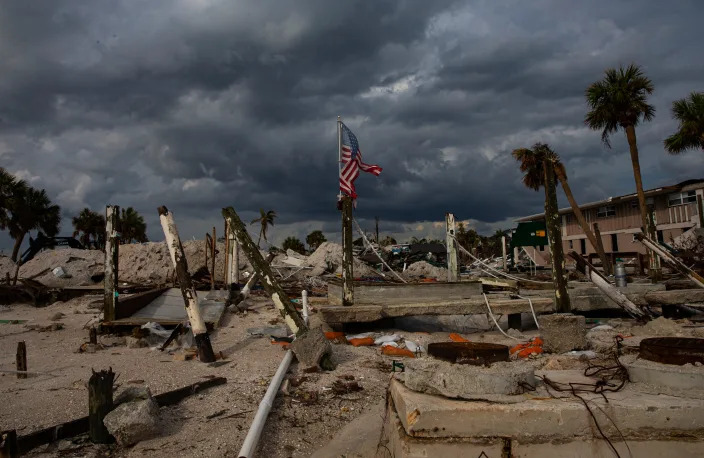
The Cottage Bar at Shuckers on Fort Myers Beach was destroyed in Hurricane Ian. An American flag was placed on one of the pilings that remains.
Threats remain: Leaking propane tanks
Threats to life continue a month after Ian’s Sept. 28 savagery of 15-foot storm surges and 155 mph winds that obliterated a majority of beachside dwellings and businesses.
“We are getting calls about underground propane tanks that are leaking, as people are cleaning up debris,” said Scott Wirth, Fort Myers Beach district chief of operations. “We have a hazmat team on the island that’s working with us in response so they’re there to help secure propane tanks that are leaking.”
Sinkholes and other obstacles also are in play.
“As you’re driving down the roads, you’ll see any kind of wash out,” Wirth said. “In some places that you see some of the road washed out, anticipate that there’s pockets of void spaces underneath the road. So if you see a washed out area, try to avoid it and go as far around it as you can, to avoid collapsing the road any further.”
The pier on Fort Myers Beach was destroyed in Hurricane Ian.
And residents are taking chances from a “life safety perspective” in some of their rebuild efforts.
“Unstable buildings — the work is continuing in these,” Wirth said, noting red or yellow placards. “These placards were put up by fire inspectors from around the state who came in and helped us inspect. (A) red placard means that there was something about your building that made it hazardous to be in, to the point where a certificate of occupancy provided for a commercial building has been revoked.”
Yellow’s a tad better.
“The yellow placard means your certificate of occupancy has been downgraded to a temporary certificate of occupancy. This building is safer to be in than one that is placarded in red,” Wirth said. “You’re working in that structure at your own risk. Those activities should be the types of things that would have to happen to get the building fixed until it can reach normal certificate of occupancy.
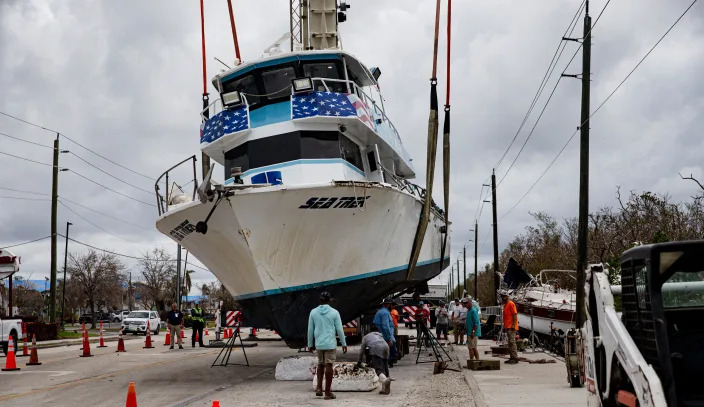
Crews using a crane removed the Sea Trek from the mangroves along San Carlos Boulevard on Tuesday, Oct. 18, 2022. A captain and a member of the crew were trying to save the boat during Hurricane Ian. As the storm surge from the storm rushed in, they ended up floating over the roadway and deposited in the mangroves. The hope is to repair the boat and return it to the water for working trips.
Other Beach updates from the town
• Inspections: Once electricity is restored in residential areas, residents need to get an inspection from a Florida licensed structural engineer and an electrician to get power. Both inspection reports need to be sent to buildingpermits@fmbgov.com, noting the address and the contractors’ Florida license number. In October, the town had processed 598 permits as of Tuesday. FPL is replacing meters on homes.
• Water service: Homes with potable water are under a mandatory boil notice, which will continue until samples show a return to safe drinking levels. All water used for consumption, cooking, making ice, washing dishes or brushing teeth must be brought to a rolling boil for at least one minute.
• Community Resource Centers: After being relocated from temporary town hall, there are two sites with hot meals from 11 a.m. to 5 p.m. daily and most other services 24 hours a day. Santini Marina Plaza, 7205 Estero Blvd., also features water, showers, laundry and restrooms. Diesel and regular unleaded fuel are available from 9 a.m. to 5 p.m. daily through Saturday. Fuel limits are 10 gallons per car and 15 per truck or SUV.
Beach Baptist Church, 130 Connecticut St., also provides access to ice, water, showers, laundry and restrooms as well as federal, state, local and non-profit partners, who are there from 9 a.m. to 5 p.m. daily. This includes FEMA Disaster Recovery Assistance Teams, Florida Department of Children and Families, and local and national non-profits.
• Mail pickup: Residents can pick up correspondence at the Fort Myers Processing & Distribution Center, 14080 Jetport Loop. For customers arriving by car, there is signage directing to a parking lot, where a mobile retail unit has been set up to assist in mailing and shipping needs, stamp and money order purchases and change of address requests. Hours: Monday through Saturday from 9 a.m. to 4:30 p.m.
• Early voting: Residents can vote at any of 12 sites in Lee County through Nov. 8 Election Day. Nearest to the beach include Wa-Ke Hatchee Park Recreation Center, 16760 Bass Road, Fort Myers; and Bonita Springs office for Lee County Elections office, 25987 S. Tamiami Trail, No. 105.
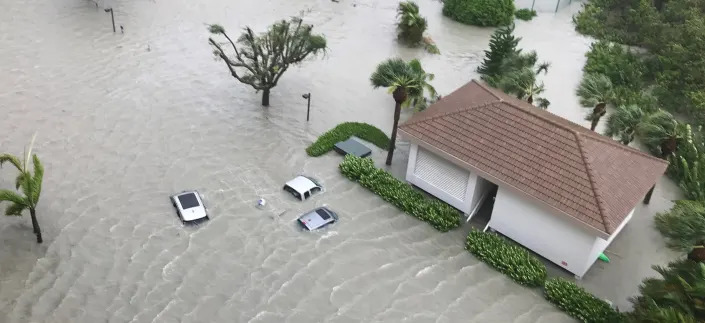
This parking lot near Naples Park flooded late Wednesday but by Thursday morning, the water had drained, leaving behind mud and debris.
• Damage assessments: In conjunction with the Army Corps of Engineers infrastructure assessment team and experts on design and construction, town building are conducting building assessments. The intent is to assess the habitability of a structure and recommend a rating of safe to enter, restricted use, or not safe to enter.
• Debris: Coordinating with Lee County, 168,397 cubic yards of debris had been collected as of Tuesday, or equal to more than 50 Olympic-sized swimming pools. It’s being deposited on the Bay Oaks recreational campus and Lovers Key. Some streets or homes may have been skipped due to obstruction from debris or parked vehicles in the right of way. As much as possible, debris should be pushed curbside.
• Fire inspection and permit fees suspended: The Board of Fire Commissioners and Fire Chief Ronald L. Martin have suspended fees into January.
• Roof permits: Access, complete and submit roof permits on the town’s website at www.fmbgov.com. Send questions to buildingpermits@fmbgov.com.
• Contractors: Use only licensed and registered contractors. A list of registered contractors of all types, including electrical, is on the Building Services page of the town’s website at www.fmbgov.com/building. Also available: the state’s database of licensed contractors at https://dcnonline.org/
Road leading to Vanderbilt Beach, Delnor Wiggins State Park and other Collier County venues remained closed Friday afternoon Oct. 14, 2022 in Hurricane Ian’s aftermath. Donations are being accepted at delnorwiggins.org to help pay for the wrecked Wiggins’ restoration, which officials say will take one to two years.
Where to find more help
At least three SBA Recovery Centers have been opened in Southwest Florida:
► The Naples Players, 701 Fifth Ave. S., Naples. Opens at 9 a.m. every day and closes at 4:30 p.m. Mondays and 5 p.m. Tuesday through Sunday.
► The Hub at SWFL Inc., 25071 Chamber of Commerce Drive, Bonita Springs. Hours are 9 a.m. to 5 p.m. Monday through Sunday.
► Kiwanis Club of Cape Coral, 360 Santa Barbara Blvd. S., Cape Coral. Times are 8 a.m. to 6 p.m. Monday through Thursday and closed on other days.
♦ President Biden has authorized Southwest Florida enterprises and private nonprofit organizations of any size to borrow up to $2 million to repair or replace damaged or destroyed real estate, machinery and equipment, inventory and other assets. Go to https://disasterloanassistance.sba.gov/
♦ Disaster loans up to $200,000 are available to homeowners to repair or replace damaged or destroyed real estate through FEMA or other agencies. Homeowners and renters are eligible for up to $40,000 to repair or replace damaged or destroyed personal property.
♦ The Florida Small Business Emergency Bridge Loan program provides short-term, zero-interest working capital loans to “bridge the gap” between the time a disaster impacts a business and when it can secure longer-term recovery funding, such as federally or commercially available loans. On Google, search “rebuild Florida business loan fund.”
♦ Disaster unemployment assistance is available to Florida businesses and residents. It’s for weeks of unemployment from Sept. 25 to April 1. For assistance call 1-800-385-3920, go to a local CareerSource Career Center or online to floridajobs.org.
Based at the Naples Daily News, Columnist Phil Fernandez (pfernandez@gannett.com) writes In the Know as part of the USA TODAY NETWORK. Support Democracy and subscribe to the paper.
Drought in the Great Plains and Midwest is getting more intense, federal report shows
Ben Adler, Senior Editor – October 26, 2022
A drought in the Great Plains and the Midwest has quickly grown in its size and severity in the last month, according to an update released Wednesday by the National Integrated Drought Information System (NIDIS). Currently, 60% of the North Central U.S. is in “moderate to exceptional drought” with 30% in “severe drought or worse” according to NIDIS, a division of the National Oceanic and Atmospheric Administration.
The worst-hit areas include Kansas, where 30% of the state is in exceptional drought, and Nebraska, which is 12% in exceptional drought. Smaller parts of Colorado, Missouri and South Dakota are as badly affected.
Drought conditions in July forced the state of Colorado to order an emergency public fish salvage for Queens Reservoir. (RJ Sangosti/MediaNews Group/Denver Post via Getty Images)
While the entire Midwest has been in a worsening drought for months, the western portions of the region — the Missouri River Basin and the Great Plains — have been hit the hardest. Water has dropped to “record low levels” on the Mississippi, Missouri and Ohio rivers, NIDIS reported, which has impeded boats and shipping. In total, 86% of the North Central U.S. is “abnormally dry” or worse.
“Over the last four weeks, many areas, particularly across the Midwest, have worsened by at least one drought category on the U.S. Drought Monitor and in some areas by two to three categories,” NIDIS reported in its update. “Drought has intensified most rapidly across southern Missouri, Kentucky, southern Illinois, southern Indiana, and northern Iowa.”
The water scarcity is causing dried-out soil — a major problem for the famously agricultural region, sometimes called “America’s breadbasket.” Last Saturday, Agence-France Presse reported that farmers in Kansas and Nebraska are “seeing crop yields in freefall, with some fields too damaged to harvest.” The Department of Agriculture recently lowered its projected yields of wheat, corn and soybeans.
“[Farmers] who are in their 70s and 80s are saying, you know, they haven’t even experienced anything like this in their lifetime,” Marc Ramsey, whose family has farmed in western Kansas for a century, told AFP. “So it’s pretty bad.”
A farmer harvests soybeans near Wyatt, Mo. (Scott Olson/Getty Images)
Droughts are increasingly common and more severe because of climate change, as warmer air causes greater evaporation and precipitation is affected by extremes of drought and heavy rain. The Midwestern drought has become worse in the last month due to light rainfall. Most of the region has received only between 5% and 50% of its normal precipitation.
“While the recent rapid intensification of drought has been most prominent across the Midwest, severe drought has persisted for up to two years across portions of the Missouri River Basin/Great Plains,” NIDIS noted.
The Midwest is not the only region in the country experiencing long-running drought. Much of the West is in the grip of a 22-year drought that is causing water levels in reservoirs on the Colorado River to drop to what the United Nations Environment Programme described in August as “dangerously low levels.”
Even typically wet regions such as the Northeast experienced drought this summer, which featured record-breaking heat waves, wildfires and droughts across the Northern Hemisphere. Dropping water levels in lakes and rivers due to droughts have also exposed long-buried secrets from bodies in Lake Mead in Nevada to dinosaur prints in Texas, Nazi warships in Serbia and ancient Buddhist statues in China.
Climate change is on the ballot in the midterm elections: Here’s what’s at stake.
Elizabeth Weise – October 22, 2022
With half of registered voters saying climate change is one of the most important issues in the upcoming midterm elections, could the results on Nov. 8 mean changes for U.S. policy regarding global warming?
A significant shift in the makeup of Congress would mostly involve delays rather than major legislation being rescinded. But time is of the essence as scientists continue to warn that without immediate and deep emission reductions across all sectors, limiting global warming to 1.5 degrees Celsius will soonbe “beyond reach.”
Democrats have set up several major climate change initiatives at the national level that Republicans would like to roll back. To do so, they will need a landslide victory — and even then hitting the undo button will be a challenge.
Five major climate initiatives are at stake as voters decide who controls the House and Senate, along with governor’s races and ballot initiatives across the nation.
Related video: Biden says he’ll use executive powers to fight climate change
Ad: 0:18 0:30 https://s.yimg.com/rx/martini/builds/51382509/executor.htmlScroll back up to restore default view.
Here’s a look at what the midterms mean for the climate:
‘Undo’ of Inflation Reduction Act still possible
Coming just 85 days after the most consequential piece of climate legislation ever passed in the United States, the outcome of the midterm elections are unlikely to erase key provisions of the Inflation Reduction Act unless Republicans gain a two-thirds majority in both the House and Senate.
The sweeping legislation includes record spending on clean energy initiatives. It also has measures to reduce prescription drug prices and to ensure large corporations pay income taxes.
The law was approved by the Senate on Aug. 7 in a party-line vote. To dismantle it would require passage of a new law to either repeal or replace it, a virtually impossible task given current political realities.
To overcome a veto by President Joe Biden, Republicans would have to gain a two-thirds majority in both houses of Congress, which is seen as unlikely.
The other truth in politics is that once a major bill such as the IRA is passed, the longer it is in effect, the less likely it is to be overturned.
“It’s hard to do big things and it’s hard to undo big things,” said Tiernan Sittenfeld, senior vice president for governmental affairs with the League of Conservation Voters.
Critical water rights decisions hang in the balance amid megadrought
Two governors’ races could affect the 40 million Americans who get their water under the century-old Colorado River compact.
A megadrought that’s lasted for 22 years has pushed the mighty Colorado River well beyond its limits. Scientists estimate about 40% of the drought is attributable to human-caused climate trends.
To deal with the extreme lack of water, the Department of the Interior took an unprecedented step earlier this year, demanding governors of the seven states that get water from the river come up with an emergency plan to drastically reduce use.
Interior was clear: If the governors of Wyoming, Colorado, Nevada, New Mexico, Utah, Arizona, and California didn’t come up with a proposal, the agency’s Bureau of Reclamation would do it for them.
There’s been no deal and things are now on hold as all of the states but Utah have governors’ races on November 8.
How things play out in two of those states, Arizona and Nevada, could delay a state-run plan, causing the Department of the Interior to step in.
In both states, Republicans with unorthodox water plans are polling well and could end up calling the shots.
In Arizona, Republican candidate Kari Lake wants to prioritize finding additional water supplies rather than conservation. Her major proposals to deal with the state’s water shortages are building a pipeline to bring water from the Missouri and Mississippi rivers or constructing seawater desalination plants.
But desalinization would raise costs significantly and a pipeline is likely politically unworkable.
Conservation is really the only option, said Eric Kuhn, former general manager of the Colorado River District.
“The water’s just not there,” he said.
In Nevada, Republican candidate and political firebrand Joe Lombardo says California gets too much water under current rules and the entire Colorado River Compact should be renegotiated.
That seems unlikely to happen. The Compact was ratified in 1922. To create a new one would require the approval of Congress, state legislatures and governors.
Whatever humans do, in the end Mother Nature calls the shots, said Kuhn, the co-author of “Science Be Dammed: How Ignoring Inconvenient Science Drained the Colorado River.”
“You can’t deliver more water than you have.”
Plan to make companies disclose climate data not finalized
In the financial world, a historic climate change rule that could significantly change what investors are told about companies’ risk is set to be finalized next year. A shift in the composition of Congress could throw up roadblocks, though might not derail it.
The Securities and Exchange Commission proposed the rule in March. It would require public companies to disclose the risks they face from global warming as well as disclosing their greenhouse gas emissions. The rule doesn’t require companies to change what they’re doing, only to make it known to potential investors.
Already at least 16 Republican state attorneys general have contested the proposed rule and it’s anticipated that multiple lawsuits will be brought against it.
Others believe it will survive opposition.
“This rule was built to survive legal challenges,” said Elizabeth Small, head of policy for CDP, a nonprofit that runs a voluntary climate disclosure system for companies.
Two states propose landmark climate initiatives
While several states and numerous counties and cities have various climate initiatives, two stand out because of the size and economic importance of the states contemplating them.
In California, Proposition 30 would increase by 1.75% the tax on people who make more than $2 million. The resulting money – as much as $5 billion per year by state estimates – would go toward building electric and hydrogen vehicle charging stations and wildfire suppression and prevention programs.
If California were a country, it would have the world’s fifth-largest economy, so what the state does matters. If it passes, the initiative could spur the adoption of zero-carbon vehicles and construction of infrastructure to support them, both electric and hydrogen, not just in California but across the United States.
Across the country in New York state, Proposal 1 would allow the state to issue $4.2 billion in bonds for environmental, natural resources, water infrastructure, and climate change mitigation projects.
The Clean Water, Clean Air, and Green Jobs Environmental Bond Act would pay for environmental improvements across the state, including $1.5 billion for climate change mitigation, $1.1 billion to restoration and flood risk reduction, $650 million to conserve open spaces and $650 million for water quality in resiliency infrastructure.
If the historically large measure results in the jobs and cleaner, healthier environment supporters say it will, it could encourage other states to take similar steps.
Agriculture at the center of another, bigger fight ahead
How these climate issues play out could set the stage for an even bigger fight expected to begin in earnest after the midterms.
Every five years since 1933, Congress passes a piece of legislation that touches almost every aspect of America’s agriculture and nutrition policy: the farm bill. Formally known as the Agriculture Improvement Act, in 2018 it cost $428 billion and is an enormous driver of what American grows and eats.
Agriculture accounts for 11% of total U.S. greenhouse gas emissions, according to the Environmental Protection Agency. Conservation and sustainability are expected to be big issues as the details of the next farm bill are hashed out.
“It could be a huge opportunity for advancing climate solutions,” said Sittenfeld. “There’s no overstating the potential for the farm bill as we have very ambitious goals for cutting climate emissions.”












 Scroll back up to restore default view.