Japan Has Millions of Empty Houses. Want to Buy One for $25,000?

The New York Times

Japan Has Millions of Empty Houses. Want to Buy One for $25,000?

Tim Hornyak – April 17, 2023
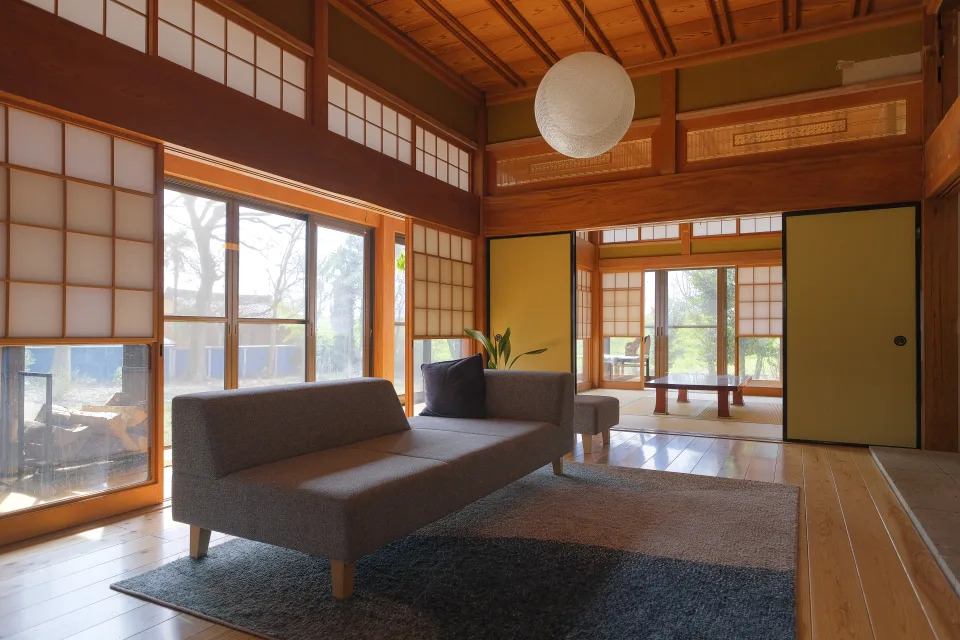
The interior of Jaya Thursfield’s remodeled home in Ibaraki, Japan, March 12, 2023. (Andrew Faulk/The New York Times)

When Jaya Thursfield found a house he wanted to buy in Japan a few years ago, friends and family told him to forget it. The place wasn’t worth the trouble, they said. After all, it stood in a forest of shoulder-high weeds after being abandoned about seven years earlier — one of the millions of vacant houses known as akiya, Japanese for “empty house” — throughout the country.

But Thursfield, 46, an Australian software developer, wasn’t deterred. Through the overgrown garden, he could see it was special: The black roof tiles cascaded down to slightly curving eaves that were much higher off the ground than those of most houses. The entrance hall had its own gable tile roof. If the 2,700-square-foot house looked more like a Buddhist temple than a farmhouse, it’s because it was built by a temple architect in 1989.

Thursfield and his Japanese-born wife, Chihiro, had moved to Japan from London in 2017 with their two young sons and a dream of buying a home with a big yard. The plan was to purchase a vacant lot and build a house on it, but land is expensive in Japan and their budget wouldn’t allow it. So they turned to the growing supply of abandoned houses, which are cheaper and often come with more land.

They’re far from the only ones.

“We would never have been able to afford a house of this quality and size if it wasn’t an akiya,” Chihiro Thursfield, 49, said. “And while many Japanese don’t like used homes, foreigners see a house that is cheap and are more willing to reuse and renovate to their tastes and budget.”

As Japan’s population shrinks and more properties go unclaimed, an emerging segment of buyers, feeling less tethered to overcrowded cities, is seeking out rural architecture in need of some love. The most recent government data, from the 2018 Housing and Land survey, reported about 8.5 million akiya across the country — roughly 14% of the country’s housing stock — but observers say there are many more today. The Nomura Research Institute puts the number at more than 11 million, and predicts that akiya could exceed 30% of all houses in Japan by 2033.

The Thursfields’ house, which sits among the paddies in southern Ibaraki Prefecture, about 45 minutes from central Tokyo, had been deserted after the previous owner’s family refused to inherit it upon the owner’s death. The local municipality took over the property and put it up for auction with a 5 million yen ($38,000) minimum bid, but it failed to sell.

When it landed on the block again, Jaya Thursfield decided to try his luck. After giving it a quick inspection with an architect friend and finding no major issues despite the years of neglect, he nabbed the house for 3 million yen, about $23,000.

Houses in Japan typically decrease in value over time until they are worthless — the cultural legacy of post-World War II construction and shifting building codes — with only the land retaining value. Owners feel little incentive to maintain an aging house, and buyers often seek to demolish them and start fresh. But that can be expensive.

Others aim to preserve what’s there.

“There was no way we wanted to knock it down and build something new. It was too beautiful. So we decided to renovate instead,” Thursfield said. “I’ve always been someone who likes to jump in the deep end, take a few risks and learn new things, so I was confident that we would manage somehow.”

Since buying the farmhouse in 2019, the couple has spent about $150,000 on renovations, and there’s more to do. Thursfield has documented the project on YouTube, drawing more than 200,000 subscribers.

While the Thursfields’ house had been abandoned by the previous owner’s heirs, some homeowners die without ever naming an inheritor. Others leave their properties to relatives who refuse to sell family land out of respect for their elders, leaving the house to wither.

“In rural areas, there is a long history of ancestral owners of akiya living in the houses and on the land,” said Kazunobu Tsutsui, a professor of rural geography and economics at Tottori University who lives in a renovated akiya built more than a century ago. “Therefore, even after moving to the city, families will not give up their akiya easily.”

Now officials on both local and national levels are taking steps to give them a push.

“Poorly maintained akiya can mar the scenery as well as endanger residents’ lives and property if they collapse,” said Kazuhiro Nagao, a city official in Sakata, along the west coast, where heavy snowfall can damage unattended structures. “We’re partly subsidizing demolitions, collecting neighborhood association reports on akiya, and trying to make owners aware of the problem by holding briefings.”

Although the akiya problem has not had a direct impact on sales in urban markets, where high-rises continue to go up, the potential hazards to communities posed by empty houses are growing along with their numbers, according to Akira Daido, chief consultant at the Nomura Research Institute’s Consulting Division.

Daido pointed to a recent legal revision that allows local authorities to effectively raise the property taxes on neglected houses if the owners ignore municipal requests to maintain or demolish them. In another sign of rising concern, the government has approved a plan by the city of Kyoto, where inventory is tight yet some 15,000 houses sit empty, to tax the owners of those empty homes — a first in Japan.

Akiya are increasingly seen not just as a threat to suburban and rural markets but to the emotional health of the country, sparking family disputes over inherited properties. That, in turn, has led to a cottage industry of akiya consultants like Takamitsu Wada, CEO of Akiya Katsuyo, who acts as a counselor for squabbling relatives, often urging them to act before their properties become a lost cause.

“In many cases, the parents die without making clear their wishes regarding the family home, or they develop dementia and find it difficult to discuss these things,” Wada said. “In such cases, the children may feel guilty about getting rid of the family home, and may often choose to leave it unoccupied.”

Municipalities across Japan are also compiling listings of vacant houses for sale or rent. Known as “akiya banks,” they are often bare-bones web pages with a few underwhelming photos. Some have partnered with private-sector companies like At Home, which currently lists akiya in 658 of Japan’s 1,741 municipalities.

“Akiya banks are run by municipal office workers, the majority of which often do not have any experience in real estate,” said Matthew Ketchum, a Pittsburgh native and co-founder of Akiya & Inaka, a Tokyo-based real estate consultancy. “The existing solutions do not align with the needs of modern buyers and sellers.”

Ketchum’s firm is one of several that have sprung up to capitalize on the akiya glut, matching vacant homes with curious buyers. Akiya & Inaka’s listings include a 2,195-square-foot home built in 1983 in the suburb of Hachioji, Tokyo, with a small garden and a reception room featuring a raised tatami floor, tokonoma alcove and a rare wickerwork ceiling of woven cedar. The property is listed at 36 million yen, about $272,000.

“Every Japanese agent we talked to advised us to demolish this place,” said the house’s owner, Takahiro Okada, 85, a retired journalist. He and his wife, Reiko, 86, had been renting out the house but decided to sell after their tenant left last year. Their children weren’t interested in it, so the property lingered. Different owners might have torn it down and sold the land.

“If we all do that, we’re losing Japanese culture,” Reiko Okada said. “When seen from an international perspective and through the eyes of foreigners, Japanese things can have inherent uniqueness and value.”

Ketchum and his partner, Parker J. Allen, said they’re now fielding about five times the number of inquiries as when they began in 2020.

“At first, we were getting most of our inquiries from Japan residents, Australians and Singaporeans,” Ketchum said. “That has changed now, with the vast majority of our international clients being based in the U.S.”

Many clients have been spurred by the pandemic, which “definitely changed the mindset of people living in Japan regarding the idea of rural living,” Allen said. “The fact that property in the Japanese countryside is by and large undervalued and there are viable properties that are almost turnkey has finally dawned on these people.”

One person it did not dawn on recently is Alex Kerr, an author and Japanologist originally from Maryland, who became an akiya owner in 1973 when he acquired an abandoned country house (known as a minka) in the mountains of Shikoku, the smallest of Japan’s four main islands, for $1,800.

Named Chiiori, or House of the Flute, the thatched-roof aerie is about 300 years old. Inside, it’s a shadowy space of polished wood floorboards, a large sunken irori hearth and giant overhead rafters wreathed in smoke. Outside, mist rises from the Kumatani River in the gorge below.

Kerr, 70, is the first to admit that akiya can be money pits. He has spent decades and roughly $700,000 (“about half” of which came from a government grant, he said) maintaining it, and now rents it out as a guesthouse. It’s one of about 40 derelict Japanese properties he has restored over the years, all the while preaching the importance of conservation and rural revitalization to municipalities, companies and homeowners who may not know what makes their properties special.

“Many cultures have wooden architecture, but when it comes to the techniques of carpentry, Japan overwhelmingly leads the world in joinery and use of materials, as well as use of space and choreography,” said Kerr, whose books include the memoir “Lost Japan.” “When it comes to old minka houses, you have all that, set in a natural environment, and within the context of being cheap. In the Cotswolds, wooden houses cost a fortune, but in Japan they’re being thrown away.”

But he has taken note as real estate companies have begun to snap up habitable antique houses and market them to non-Japanese luxury buyers. He also pointed to young international buyers opening Airbnb rentals in erstwhile akiya and attending events like minka conferences.

Last year, British videographer Sam King and his wife, Nanami Sakurai, fled Tokyo with the help of an architect who introduced them to an unlisted akiya in the mountains of Otsuki, 50 miles west of Tokyo.

The couple wanted to be “closer to nature on our days off,” King, 35, said. “We also could not afford to buy so much as a shoebox in the city, so the thought of being able to get somewhere with a lot more space was very appealing so we can start a family and also own pets without any trouble.”

The house, in a depopulated community of mostly older residents, had been abandoned for roughly two years after the death of its owner. The price was 12 million yen, or about $88,000.

Set in a garden among plum and kiwi trees, the cottage has traditional tatami mats, shoji-paper and fusuma sliding doors, chunky wooden cabinets and tokonoma alcoves. The previous owner left behind a trove of personal possessions — paintings of Mount Fuji, rolls of Japanese calligraphy, old tape players, kites, guitars, skis, crockery. The house is about 50 years old and needs to be updated to modern standards. King estimated that the initial renovations, such as redoing the kitchen and bathroom, will cost $20,000 to $30,000. It’s well worth it to escape the city.

“We’d like to improve upon it quite a bit as it’s going to be our home, so we’ll probably end up spending over $100,000 in total on the project,” he said. “But we’ll hopefully end up with our dream home.”


Supreme Court Justice Clarence Thomas has been reporting income from defunct real estate company

USA Today

Supreme Court Justice Clarence Thomas has been reporting income from defunct real estate company, report says

 Ken Tran, USA TODAY – April 17, 2023

As Supreme Court Justice Clarence Thomas is under heightened scrutiny for accepting lavish trips from a GOP billionaire megadonor, he also has been disclosing income from a now-defunct real estate company, The Washington Post reported.

Over the past two decades, Thomas has been reporting on required financial disclosures rental income from a family real estate company – but the company ceased operations  in 2006.

By itself, the disclosure could be chalked up as an inadvertent error. The original company, named Ginger, Ltd., Partnership, was taken over by a similarly named company, Ginger Holdings, LLC.

Here’s what you need to know. 

Supreme Court Justice Clarence Thomas has been under scrutiny for accepting lavish trips and other gifts from a Republican megadonor.
Clarence Thomas reported $270,000 to $750,000 from now-defunct company

The original company, a Nebraska real estate firm named Ginger, Ltd., Partnership, was created in the 1980s and  shut down in 2006. In its place, a new company, Ginger Holdings, LLC, was created and assumed control of the previous company, according to The Post.

On Thomas’ recent annual disclosure forms, the Supreme Court justice reported income of between $50,000 and $100,000 from Ginger, Ltd., Partnership, the older, now-defunct company, The Post reported. The forms make no mention of the newer company, Ginger Holdings, LLC.

Since 2006, according to The Post, Thomas reported receiving $270,000 to $750,000 from the older company, where it was described on his forms as “rent.”

Related: Supreme Court Justice Clarence Thomas says he wasn’t required to report trips with GOP donor

Associate Justice Clarence Thomas has been reporting rental income from a family real estate company that ceased operations more than 15 years ago, The Washington Post reported.
Thomas under scrutiny over relationship with GOP megadonor

Thomas’ financial disclosures entered the national spotlight again this month after ProPublica reported that he accepted multiple luxury vacations from Harlan Crow, a billionaire real estate magnate and GOP megadonor.

Along with his wife, Virginia “Ginni” Thomas, the two went on multiple vacations funded by Crow over the past two decades, including trips on his superyacht and stays at his private resort. Thomas did not mention the travel on his disclosure forms.

Thomas’ financial relationship with Crow went further. ProPublica also reported that Crow purchased three Georgia properties from the Supreme Court justice – transactions Thomas failed to note on his financial disclosure forms.

The ethics controversy extends to his wife,conservative advocate Ginni Thomas, who has been under scrutiny for reports about efforts to help former President Donald Trump overturn the 2020 election. Ginni Thomas led a conservative group that received almost $600,000 in anonymous donations, The Washington Post reported.

In a statement this month, Thomas acknowledged that he and his wife joined Crow on a number of “family trips” during the more than a quarter century they have known them. He described the couple as “among our dearest friends.”

“Early in my tenure at the court, I sought guidance from my colleagues and others in the judiciary, and was advised that this sort of personal hospitality from close personal friends, who did not have business before the court, was not reportable,” Thomas said.

He has not  responded to requests about the subsequent revelations.

Contributing: John Fritze

Supreme Court Justice Clarence Thomas and his wife, Ginni, leave funeral services for the late Justice Antonin Scalia in Washington in 2016.

Who says Florida property insurers aren’t taking new customers?

South Florida Sun Sentinel

Who says Florida property insurers aren’t taking new customers? See whether yours added or subtracted policies

Ron Hurtibise, South Florida Sun Sentinel – April 17, 2023

Apparently not all Florida-regulated property insurance companies are too financially troubled to take on new customers.

Thirty-two companies added customers between the second and third quarters of 2022, according to a South Florida Sun Sentinel analysis of market share data released by the Florida Office of Insurance Regulation.

A few companies added significant numbers of what are called personal residential policies that cover single-family homes, condominiums and even renters.

Of 18,243 new policies written by State Farm Florida, currently the third-largest carrier in the state, 8,595 were homeowner policies, 2,538 were new tenant policies, and 7,110 were new condo policies.

Castle Key Indemnity, a subsidiary of Allstate, added 8,508 new policies, including 3,987 homeowner policies and 3,805 tenant policies.

Edison Insurance, owned by Boca Raton-based Florida Peninsula, added 4,766 policies, of which 4,176 were homeowner policies.

The analysis suggests that reforms enacted in two special legislative sessions to reduce litigation against insurers — though disliked by plaintiffs attorneys, repair contractors and public adjusters — are encouraging carriers to expand their presence here.

Insurance insiders contacted for this report said it’s a promising sign that so many companies are deciding to take on new business.

Restrictions intended to reduce lawsuits against insurers that were enacted during two special sessions have given some companies confidence to expand in the state, said Mark Friedlander, communications director for the industry-funded Insurance Information Institute.

“The data shows some positive signs for Florida’s property insurance market,” Friedlander said in an email. “Several private insurers have indicated they are willing to take on more risk based on the property insurance reform that was passed in December and the new tort reform bill that was passed in March.

“Based on the Q3/Q4 2022 data, it appears a few insurers were willing to assume more risk even before the market reforms were enacted. Insurance agents are also starting to see more options when trying to place a customer’s business.”

The Sun Sentinel’s analysis compares market share data that insurance companies have tried to keep confidential over the past six years. Since 2017, more than 60 private-market companies, including most of the largest, have blocked quarterly release of their county-by-county and — until this year — statewide market data after State Farm won a court battle that allowed companies to declare the information a “trade secret.”

State Farm objected to county-level dissemination of its policy counts, saying it provided competitors with too much insight into markets where the company was targeting its marketing efforts.

But last May, lawmakers included, among reforms desired by insurers, the required disclosure of aggregated statewide policy data with no option to declare it a trade secret.

Formerly ‘trade secret’

The first statewide spreadsheet released under the new law disclosed policy counts, total premium collected, the value of insured property, cancellations, and other information, for the third quarter of 2022. The second release, for the fourth quarter, made it possible to compare which companies added and subtracted policies, as well as average policy costs and average value of property covered, between the third and fourth quarters.

Not surprisingly, insurers that posted significant policy count increases weren’t eager to share their reasons why. Insurers are generally tight-lipped about all aspects of their business.

“We can’t talk about our growth strategy but we can share that State Farm continues to maintain the financial strength to be there for our Florida customers,” a State Farm spokeswoman said by email.

Clint Strauch, president of Edison Insurance and Florida Peninsula, credited its professional network of agents, traditional underwriting practices and fiscal conservatism, “which gives us the financial ability to take on new policies.

He added, “We are bullish about the state of insurance in Florida, in light of the positive steps taken by the Governor and the Legislature to stabilize the market for all Floridians.”

Even as it revealed a number of companies willing to take on new business, the data comparison showed that an even larger number of companies continued to lose policies, either deliberately to reduce the amount of risk on their books and thus, their reinsurance costs, or because policyholders are shopping for lower prices, possibly from state-owned Citizens Property Insurance Corp.

Seventy companies saw reduced policy counts between the third and fourth quarters. Of them, 16 lost or shed more than 1,000 policies each.

Those companies are among the largest in the state, including the second-largest behind Citizens, Fort Lauderdale-based Universal Property & Casualty, which reported 23,100 fewer policies at the end of the fourth quarter compared to three months earlier.

Others were ASI Preferred (down 16,014), a subsidiary of Progressive, which last year announced plans to stop writing new policies in Florida; American Integrity (-7,051); Security First (-6,729); and Heritage Property & Casualty (-6,528).

Slide Insurance Co., which was founded by former Heritage CEO Bruce Lucas in early 2020, saw a 6,272-policy reduction. However, since Dec. 31, the company announced plans to add up to 91,000 policies covered by United Property & Casualty when that company went into dissolution in February.

Travis Miller, spokesman for Universal Property & Casualty, said it’s not accurate to assume that the company “shed” 23,100 policies.

“Instead, the data more simply shows that during the quarter, the reduction in (Universal’s) policies exceeded the number of new business policies it wrote,” he said by email. “An insurer can see reductions in its policy count for reasons beyond its typical renewal underwriting process.”

Many customers in the current climate of rapidly rising rates are comparative shopping, he said, including many with Citizens, which by law offers premiums below market rates to homeowners who cannot find comparable coverage that costs less than 20% more.

“To a lesser degree, some insureds also are making the difficult decision to forego coverage,” Miller said.

Those decisions can be inferred from the data that show the number of overall homeowner policies stayed relatively flat between the third and fourth quarters even though 57,004 single-family homes were sold between Oct. 1 and Dec. 31, according to the Florida Association of Realtors.

And Citizens, the “insurer of last resort,” added 73,617 personal residential policies in the fourth quarter, more than any single private-market company.

Citizens’ continued growth is a sign that insurance industry troubles persisted into the fourth quarter as it became the insurer of last resort for homeowners unable to find an affordable policy elsewhere.

The next set of data, for the first quarter, will show a similar increase for Citizens, according to data posted on the company’s website. But brightening conditions could begin to nudge policyholders back to private-market insurers, Friedlander said.

“We learned this week that more than 61,000 policies have been approved for take-out from Citizens by three Florida insurers — Monarch National Insurance, Florida Peninsula and Edison Insurance Co.,” he said.

Tallahassee-based Monarch National alone was approved to take out up to 46,218 policies, Citizens spokesman Michael Peltier said.

In addition, a new company has been approved by Florida regulators to enter the market: Tailrow Insurance is being launched by publicly traded HCI Group, which also owns Homeowners Choice and TypTap Insurance, and will begin writing new business this year, according to a consent order filed by the Florida Office of Insurance Regulation.

Both the Citizens takeouts and the newly launched Tailrow Insurance “are positive signs,” Friedlander said, adding, “It would not surprise us if some of the property insurers that posted a net decline in policies during 2022 begin to move in the other direction in 2023.”

More insurance availability if you can pay

Yet, increased availability of insurance is coming at higher prices, as policyholders hit hard by rate increases over the past two years can attest.

John Rollins, former chief risk officer at Citizens, notes that strong headwinds are still facing companies trying to secure required levels of reinsurance — coverage insurers buy to guarantee the ability to file all claims after a catastrophe — by June or July, ahead of the most active part of the hurricane season that begins around mid-August. Whatever they’ll end up having to pay will be passed along to their customers.

The reinsurance renewal period “by all accounts is set to feature the largest year-over-year price hikes in living memory,” Rollins said.

Gallagher Re, a global reinsurance broker, said reinsurance rate increases for catastrophe loss have ranged from 50% to 100% according to Artemis.bm, a website targeted to capital markets investors.

“This would make four years in a row of reinsurance prices ratcheting up — slightly at 2020 and 2021, 30% at 2022, and now this,” Rollins said. “Companies will pass through the costs in rate filings once they are clear, but nobody knows where the market will settle right now.”

Until the dust settles, “smart managers would not be adding policies,” he said.

Other observations

Tenant policies up: Even as the overall number of homeowner policies remained flat, the number of insurance policies purchased by renters increased statewide by 53,999 to 1.15 million at the end of the fourth quarter.

“The spike is not surprising as Florida’s rental market has become the most robust in the U.S.,” Friedlander said. “The cost of renters insurance is extremely reasonable for consumers and fairly low risk for insurers compared to property coverage. Most landlords required their tenants to have individual renters coverage, which is a very good thing.”

Tenant insurance is so cheap, there’s no excuse to forego it. The average annual premium, according to the data, was $200. The highest average premium, $13,643 was charged by a company that insures just 12 condos in the state, Pacific Indemnity Co., and the average insured value of those 12 condos was $1.2 million. The lowest average premium was $11 paid by 10,924 customers of Markel Insurance Co.

Homeowner premiums: Average homeowner premiums as of Dec. 31 ranged from a low of $346 for the 2,848 properties covered by Farmers Casualty to $51,823 for the 252 properties insured by Century-National.

The average homeowner premium increased from $2,908 to $3,026.

The average insured value of covered single-family homes — known in the industry as “exposure” — jumped from $624,126 on Sept. 30 to $641,253 on Dec. 31. The average exposure ranged from $12.7 million for each of five houses insured by Ace Insurance Co. of the Midwest to $285,823 for customers of White Pine Insurance Co.

Condos: The average cost to insure a condominium unit increased from $1,375 to $1,419 between Sept. 30 and Dec. 31. Because they are smaller and have common areas insured by separate commercial policies, it costs less to insure condo units. The highest average condo premium in Florida was $13,643 from American Home Assurance Company, while the lowest was $348 from Teachers Insurance Co., which insures exactly one condo unit in the state. The average insured value for condos increased from $154,431 on Sept. 30 to $156,777 on Dec. 31.

7 Reasons You Don’t Want To Retire in Florida

Go Banking Rates

7 Reasons You Don’t Want To Retire in Florida

Bob Haegele – April 17, 2023

Image Source / Getty Images/Vetta

For many people, retiring in Florida sounds like the dream. It allows them to escape the cold and snow they put up with for decades in the Northeast or perhaps other parts of the country. Instead of the biting cold and gray skies, you get nonstop sunshine and warm weather. Sounds like a great deal, right?

Perhaps. But there are also some potentially serious downsides of retiring in Florida. Of course, there are the snakes and gators and endless traffic, but there are also financial concerns. If you dream of retiring in Florida, here are some reasons you may want to reconsider.

Homes Can Be Expensive

Many states have watched their housing prices balloon over the past few years, thanks in part to a shortfall in new construction that dates back to the Great Recession. However, none have seen their housing prices skyrocket the way Florida has.

For example, housing prices increased by 22.7% from the year before as of the third quarter of 2022, according to Statista. The median home price in Orlando is $345,000, Redfin reports. So if you intend to retire in Florida, you’ll need to be financially prepared from the get-go.

Healthcare Can Be Costly

Florida has numerous excellent medical facilities where patients can receive top-quality care. As great as that is, though, healthcare can be costly in the Sunshine State. That’s especially problematic for retirees, who are more likely to need expensive medical care.

While Medicare does cover most medical expenses for retirees over 65, there may still be out-of-pocket costs. These include deductibles, premiums and co-pays. There are also costs like long-term care, dental care and vision care that are typically not covered. Plus, Florida’s aging population could further push prices upward for everyone.

Retirement Communities May Be Expensive

In addition to healthcare costs, there is also the cost of retirement communities, which is something many retirees eventually need. On the plus side, retirement communities offer many seniors a comfortable and welcoming lifestyle.

However, these communities can be expensive in Florida. The real cost might vary significantly depending on things like where the community is located and the fees it charges. But some retirement communities charge significant fees for maintenance, security and other services. If you see yourself living in one of these communities, investigate the rates in Florida.

You Might Get Hit by a Hurricane

Florida is known for being at risk for hurricanes, which can cause severe damage to property and be costly to repair. The risk can be significant depending on where you live in Florida. Plus, the risk of hurricane damage may increase due to climate change.

The Atlantic hurricane season runs from June 1st to November 30th, putting you at risk for a large portion of the year. This is one reason the average homeowner’s insurance premium is $1,981 in Florida, making it the 10th most expensive state in the country for homeowner’s insurance.

You May Need Flood Insurance

In much of the country, flood insurance isn’t something people think about as a necessity. But it’s often required in flood-prone areas, which includes much of Florida.

Homes with government-backed mortgages in high-flood-risk areas are required to have flood insurance. It isn’t federally required if you have a mortgage from a private lender, but they may still require it. The average cost of flood insurance in Florida is a little over $600. However, premiums may vary significantly depending on where you live and your property’s risk assessment.

Property Taxes Can Be High

The average property tax rate is 0.89% in Florida, which puts it right in the middle in terms of property tax rates. However, even Florida’s relatively modest property tax rate can still result in significant property tax thanks to the state’s rapidly rising home costs. For example, 0.89% paid on Florida’s median $345,000 home would equate to $3,070.50 in property taxes per year.

Plus, property tax rates may vary depending on where you live within the state. Property tax rates may vary by city, county and school district. This means you could end up paying even more in property taxes if you move to Florida.

Don’t Forget Sales Tax

One thing that sometimes draws people to Florida is its lack of income tax. On the one hand, this could be seen as a good thing for retirees, many of whom live on a fixed income. But don’t forget state and local sales tax, which is 7.02% in Florida. That can significantly impact retirees when they purchase goods and services.

One positive is that certain goods, such as groceries and prescription drugs, are exempt from sales tax in Florida. However, some jurisdictions might still add a tax on these items. The bottom line is that if you are flocking to Florida to escape income taxes, its sales taxes can quickly sour your plan.

Want a fixer-upper in Japan? You could nab one of millions of country houses for sale for just $25,000.

Business Insider

Want a fixer-upper in Japan? You could nab one of millions of country houses for sale for just $25,000.

Eliza Relman – April 17, 2023

Want a fixer-upper in Japan? You could nab one of millions of country houses for sale for just $25,000. Thatched roofed houses in a traditional village, Kyoto Prefecture, Miyama, Japan on August 9, 2018 in Miyama, Japan. Eric Lafforgue/Getty Images
  • Japan has a glut of abandoned homes in rural areas and small towns.
  • Government officials are auctioning them off for as little as $500.
  • Americans are getting in on the deal.

With home prices and rents increasingly unaffordable in the US, some Americans are looking for their dream homes abroad. In Japan, a growing portion of the country’s housing stock is unoccupied and increasingly attracting American buyers.

Japan has a glut of older, abandoned homes in rural areas, as Insider has previously reported. With the country’s population in decline, there simply aren’t enough people willing to purchase these houses.

The country has at least 8.5 million such “akiya,” the Japanese word for unoccupied home, according to government data from 2018. Some experts believe there are as many as 11 million empty houses. When owners of these traditional homes die, those who inherit the properties often don’t want them or are unable to maintain them. In Japan, land remains valuable, while houses lose value over time and are often torn down and rebuilt.

Government officials are concerned that growing numbers of akiyas are hurting their efforts to revitalize rural parts of the country. So they’re subsidizing renovations and selling homes often for around $25,000, and sometimes for as little as $500.

Americans are getting in on the deal. They’re increasingly buying up these houses and restoring them, the New York Times reported.

Matthew Ketchum, a Pittsburgh native who lives in Tokyo, is taking advantage of the akiya market in a different way. In 2020, he co-founded a real estate consultancy, called Akiya & Inaka, that markets and sells akiya and other traditional homes, the Times reported. Ketchum said he’s seen a strong growth in interest from American buyers.

“At first, we were getting most of our inquiries from Japan residents, Australians and Singaporeans,” Ketchum told the Times. “That has changed now, with the vast majority of our international clients being based in the U.S.”

Jaya and Chihiro Thursfield, whose experience Insider reported on in 2021, moved to Japan from London in 2017 and bought an abandoned akiya less than an hour outside Tokyo for $30,000, or three million Japanese yen, in 2019. They spent about $150,000 and two years renovating the home, where they’ve lived with their twin sons and cats since December 2020.

The Thursfields, who were also profiled by the Times, have documented their renovations on Youtube, where viewers can see how they transformed a home largely in disrepair into a beautiful, minimalist property.

“This was truly an abandoned house in terms of the declined inheritance and everything left behind by the previous owners,” Jaya, who’s Australian, told Insider.

Study warns critical ocean current is nearing ‘collapse.’ That would be a global disaster.

USA Today

Study warns critical ocean current is nearing ‘collapse.’ That would be a global disaster.

Doyle Rice, USA Today – April 11, 2023

Due to global warming, a deep ocean current around Antarctica that has been relatively stable for thousands of years could head for “collapse” over the next few decades.

Such a sudden shift could affect the planet’s climate and marine ecosystems for centuries to come.

So says a recent study that was published in the peer-reviewed journal Nature.

The cold water that sinks near Antarctica drives the deepest flow of a network of currents that spans throughout the world’s oceans, known as the overturning circulation. The overturning carries heat, carbon, oxygen and nutrients around the globe.

This in turn influences climate, sea level and the productivity of marine ecosystems. Indeed, the loss of nutrient-rich seawater near the surface could damage fisheries, according to the study.

‘Headed towards collapse’

This deep ocean current has remained in a relatively stable state for thousands of years, but with increasing greenhouse gas emissions and the melting of Antarctic ice, Antarctic overturning is predicted to slow down significantly over the next few decades.

“Our modeling shows that if global carbon emissions continue at the current rate, then the Antarctic overturning will slow by more than 40% in the next 30 years – and on a trajectory that looks headed towards collapse,” said study lead author Matthew England of the University of New South Wales in Australia.

Speaking about the new research, paleoclimatologist Alan Mix told Reuters “that’s stunning to see that happen so quickly.” Mix, a paleoclimatologist at Oregon State University and co-author on the latest Intergovernmental Panel on Climate Change assessments, who was not involved in the study, added “It appears to be kicking into gear right now. That’s headline news.”

‘Uncharted levels’: Gases fueling climate change still rising at an alarming rate, NOAA says

Atlantic current also affected

Such a collapse would also impact a nearby Atlantic Ocean current, known as the Atlantic Meridional Overturning Circulation, or AMOC, which transports warm, salty water from the tropics northward at the ocean surface and cold water southward at the ocean bottom.

This current includes the well-known Gulf Stream, which affects weather patterns in the U.S. and Europe. “The main issue for the AMOC at the moment is meltwater from Greenland, which slows that current,” England told USA TODAY.

Other studies in recent years about the AMOC drew comparisons to the scientifically inaccurate 2004 disaster movie “The Day After Tomorrow,” which used such an ocean current shutdown as the premise of the film. In a 2018 study, authors said a collapse was at least decades away but would be a catastrophe.

The Day after Tomorrow?: Study warns of ‘irreversible transition’ in ocean currents that could rapidly freeze parts of North America

An Antarctic "tidewater" glacier meets the ocean in this 2018 photo that also shows sea ice floating on the water's surface.
An Antarctic “tidewater” glacier meets the ocean in this 2018 photo that also shows sea ice floating on the water’s surface.
Cause of the current slowdown

What’s causing the currents to slow down and potentially collapse? “Climate change is to blame,” England wrote for the Conversation. “As Antarctica melts, more freshwater flows into the oceans. This disrupts the sinking of cold, salty, oxygen-rich water to the bottom of the ocean”.

Specifically, more than 250 trillion tons of that cold, salty, oxygen-rich water sinks near Antarctica each year. This water then spreads northward and carries oxygen into the deep Indian, Pacific and Atlantic Oceans.

“If the oceans had lungs, this would be one of them,” England said.

“Simply put, a slowing or collapse of the overturning circulation would change our climate and marine environment in profound and potentially irreversible ways.” he wrote.

Climate change and hurricanes: Climate change could push more hurricanes toward US coasts, new study suggests

How would it impact the US?

England told USA TODAY that the main impact for North America would be sea-level rise along the East Coast.

In addition, another impact of the collapse of the AMOC would be a transition to a more La Nina-like-state in the Pacific Ocean, England said. La Niña, a natural cooling of sea water in the tropical Pacific Ocean, affects weather and climate in the U.S. and around the world.

It tends to lead to worsening droughts and wildfires in the Southwest U.S., and more hurricanes in the Atlantic Ocean.

What can be done?

“Our study shows continuing ice melt will not only raise sea levels, but also change the massive overturning circulation currents which can drive further ice melt and hence more sea-level rise, and damage climate and ecosystems worldwide,” England wrote in the Conversation. “It’s yet another reason to address the climate crisis – and fast.”

Contributing: The Associated Press

Sea levels rising rapidly in southern U.S., study finds

Yahoo! News

Sea levels rising rapidly in southern U.S., study finds

Ben Adler, Senior Editor – April 10, 2023

Damage after Hurricane Ian Bonita Springs, Fla., Sept. 29, 2022
Damage after Hurricane Ian Bonita Springs, Fla., Sept. 29, 2022. (Sean Rayford/Getty Images)

A study published Monday finds sea-level rise along the coast of the southeastern United States has accelerated rapidly since 2010, raising fears that tens of millions of Americans’ homes in cities across the South will be at risk from flooding in the decades to come.

“It’s a window into the future,” Sönke Dangendorf, an assistant professor of river-coastal science and engineering at Tulane University, who co-authored the study that appeared in Nature Communications, told the Washington Post.

That paper and another published last month in the Journal of Climate find that sea levels along the Gulf Coast and the southern Atlantic Coast have risen an average of 1 centimeter per year since 2010. That translates to nearly 5 inches over the last 12 years, and it is about double the rate of average global sea-level rise during the same time period.

The Journal of Climate study found that the hurricanes that have recently hammered the Gulf Coast, including Michael in 2018 and Ian — which was blamed in the deaths of 109 Floridians last year — had a more severe impact because of higher sea levels.

“It turns out that the water level associated with Hurricane Ian was the highest on record due to the combined effect of sea-level rise and storm surge,” Jianjun Yin, a climate scientist at the University of Arizona and the author of the Journal of Climate study, told the Post.

Residents of Houston evacuate their homes after the area was flooded from Hurricane Harvey, Aug. 28, 2017
Residents of Houston evacuate their homes after the area was flooded from Hurricane Harvey, Aug. 28, 2017. (Joe Raedle/Getty Images)

Data from the National Oceanic and Atmospheric Administration (NOAA) show the water level at Lake Pontchartrain, an estuary bordering New Orleans, is eight inches higher than it was in 2006. Other cities threatened by rising oceans in the region include Houston, Miami and Mobile, Ala.

The centimeter-per-year rate is far faster than experts had expected, and it is more in line with projections made for the end of the century, Dagendorf said. High-tide flooding — when the tides bring water onto normally dry land on rain-free days — has more than doubled on the Gulf Coast and Southeast coast since the beginning of this century, according to NOAA. Recent years have seen records for high-tide flooding obliterated. The city of Bay St. Louis, Miss., went from three days of high-tide flooding in 2000 to 22 days in 2020.

A study by scientists with the University of Miami, NOAA, NASA and other institutions, which has not yet undergone peer review, found that the Southeastern sea-level rise accounted for “30%-50% of flood days in 2015-2020.”

“In low-lying coastal regions, an increase of even a few centimeters in the background sea level can break the regional flooding thresholds and lead to coastal inundation,” the study said.

Miami and New Orleans face greater sea-level threat than already feared

Miami and New Orleans face greater sea-level threat than already feared

Richard Luscombe – April 10, 2023

<span>Photograph: Wilfredo Lee/AP</span>
Photograph: Wilfredo Lee/AP

Coastal cities in the southern US, including Miami, Houston and New Orleans, are in even greater peril from sea-level rise than scientists already feared, according to new analysis.

What experts are calling a dramatic surge in ocean levels has taken place along the US south-eastern and Gulf of Mexico coastline since 2010, one study suggests, an increase of almost 5in (12.7cm).

That “burst”, more than double the global average of 0.17in (0.44cm) per year, is fueling ever more powerful cyclones, including Hurricane Ian, which struck Florida in September and caused more than $113bn of damage – the state’s costliest natural disaster and the third most expensive storm in US history, according to the National Oceanic and Atmospheric Administration (Noaa).

The University of Arizona study, published in the Journal of Climate and reported on Monday by the Washington Post, provides an alarming new assessment of a key ingredient of the escalating climate emergency, particularly in popular but vulnerable areas of the US where millions of people live.

Existing projections by Nasa show a sea-level rise up to 12in (30cm) by the middle of the century, with longer-range forecasts even more dire.

The Gulf region from Texas to Florida, and southern Atlantic seaboard will see most of the change, the agency says.

“The entire south-east coast and the Gulf Coast is feeling the impact of the sea-level rise acceleration,” the study’s author Jianjun Yin, professor of geosciences at the University of Arizona, told the Post.

“It turns out that the water level associated with Hurricane Ian was the highest on record due to the combined effect of sea-level rise and storm surge.”

The threat from rising oceans hangs over numerous centers of heavy population located on, or close to the coast. Miami, and Miami Beach, cities often cited as ground zero for the climate emergency, frequently see flooding during high tides. Property insurance rates throughout Florida, which Noaa says has experienced more than 40% of all US hurricane strikes, have soared in recent years.

The two most expensive hurricanes in US history, Katrina in 2005 and Harvey in 2017, ravaged New Orleans, Louisiana, and Houston, Texas, respectively,

Earlier this month, the Guardian carried an extract from a new book about how Charleston, South Carolina, is facing a “perfect storm” of rising sea levels and racism that leaves the city, in the view of many observers, living on borrowed time.

“What is likely to happen in Charleston is likely, absent a substantial shift in attitude, to happen in many other coastal cities around the globe,” wrote Susan Crawford, author of Charleston: Race, Water, and the Coming Storm.

The Post reported on a second study, published on Monday on nature.com, effectively mirroring the finding of the Arizona analysis that an “acceleration” of sea-level rise was under way.

Researchers at Tulane University, New Orleans, also note that the increase in the Gulf and south-eastern region is greater than the global average, a surge of greater than 0.4in per year they say is “unprecedented in at least 120 years”.

The study, which says the rise is “amplified by internal climate variabilities”, cites storms such as Katrina, and Hurricane Sandy in 2012, that “illustrate that any further increases in the rate of MSL [mean sea-level] rise, particularly rapid ones, threaten the national security of the US and hamper timely adaptation measures.”

Human activity in the Gulf region, which the researchers refer to as “vertical land motion” (VLM), has played a role, the study continues.

“It is well known that tide gauges in the Gulf of Mexico are subject to significant nonlinear VLM, likely related to oil, gas, or groundwater withdrawal. These nonlinear changes appear predominantly along the western portions of the US Gulf coast (Louisiana and Texas),” it says.

Fed Up With Mayhem, Miami Beach Wants to Tame Spring Break for Good

The New York Times

Fed Up With Mayhem, Miami Beach Wants to Tame Spring Break for Good

Patricia Mazzei – April 9, 2023

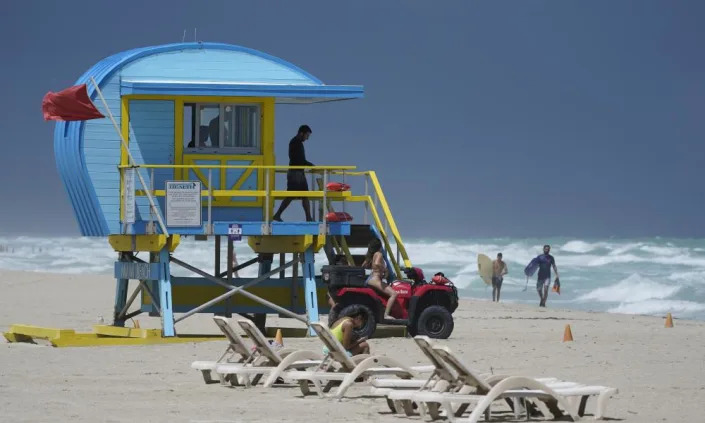
From left, Chandler Robinson, Sam Fisher and Alexis Illes play slam ball on South Beach in Miami Beach, Fla. on Friday, March 31, 2023, while vacationing from Orlando, Fla. (Scott McIntyre/The New York Times)

MIAMI BEACH — After two fatal shootings on Ocean Drive over a March weekend, Miami Beach leaders followed their recent playbook for dealing with raucous spring break crowds: a state of emergency, a midnight curfew and limited liquor sales.

Then, in a new and drastic step, the city commissioners announced a curfew for 2024, a full year in advance, and declared spring break on the sun-kissed streets of Miami Beach to be over.

“Miami Beach is shutting the door on spring break, once and for all,” Alex Fernandez, a city commissioner who sponsored a series of 2024 measures, said before the vote.

The decision, in the middle of the March and April season that is the most profitable time of the year for local businesses, has caused both relief and consternation over the possible loss of the throngs of visitors that have grown to overwhelm the city’s police and other public services — and of the money that those visitors spend on hotel rooms, nightclub cover charges and boozy cocktails.

Miami Beach both loves and hates its tourists, a conflicting sentiment that has long plagued officials as the city has evolved from a cocaine cowboy den in the 1980s to a high-fashion Riviera in the 1990s to what it is today: a glittering playground for affluent families making a home, foreigners chasing the sun and young American visitors who come looking for a good time. Some people, including the city’s mayor, want the partyers gone for good.

If Miami Beach is to be rebranded as less of a spring break destination and more of an arts, culture and health and wellness hub, some owners of bars, nightclubs and liquor stores worry that they will lose business. And some residents and officials fear losing the diversity and laid-back vibe that make Miami Beach Miami Beach.

“What we’re seeing is panic-stricken politicians who feel the need to do something,” Ricky Arriola, a city commissioner who voted against the 2024 curfew, said in an interview. “The heavy hand of government is being imposed on residents, our visitors and businesses, rather than doing the hard work of coming up with really strategic alternatives.”

Similar frictions between residents and visitors have afflicted other popular Florida spring break locales like Panama City Beach. Over time, Fort Lauderdale and other cities have pushed spring breakers out, in part by raising hotel rates and changing zoning laws to turn dive bars into more upscale establishments.

Miami Beach has been wrestling with its reputation as a party town. A judge recently upheld an ordinance imposing a partial 2 a.m. cutoff on alcohol sales for a South Beach neighborhood known as South of Fifth, now full of glimmering condos. The law had been challenged by Story, a nightclub that argued it could not survive if it could no longer sell alcohol until 5 a.m.

Patience has worn thin as spring break revelers, often partying with alcohol or drugs, have packed a roughly 10-block stretch of South Beach along the Atlantic oceanfront each season, leading to unpredictable situations that sometimes turn violent because so many people have guns, according to city leaders, police officers and business owners.

The two deadly incidents this year took place over the St. Patrick’s Day weekend, typically one of the busiest of the season. After the second, the city briefly imposed a midnight curfew.

Last year, two shootings on Ocean Drive led the city to set a midnight curfew. In 2021, Miami Beach made headlines when, in the middle of the coronavirus pandemic, the city marketed itself to visitors even though many nightclubs remained closed, leading to raucous street parties. Officials responded that year by imposing an 8 p.m. curfew.

The rowdy behavior in the streets and the curfews that result have hurt businesses year after year, said Joshua Wallack, the chief operating officer of Mango’s Tropical Cafe, an Ocean Drive institution for more than 30 years.

“When they go from a dangerous situation to complete lockdown, there is no business,” he said. “We’re just caught in the wake of how they handle it. The service industry and the hospitality industry, they get completely obliterated because it goes from having complete chaos to nothing.”

In the past, civil rights activists have complained about the city police department’s use of military-style vehicles, pepper balls and forceful crowd control tactics during spring break, which attracts many Black visitors to a city whose resident population is largely white. Glendon Hall, chair of the Miami Beach Black Affairs Advisory Committee, which was created two years ago, was embedded with police officers and the city’s “goodwill ambassadors” during spring break last month. He said in a statement that was read at a meeting Tuesday that he was pleased with how law enforcement handled the “massive crowds” this year and that there had been no major complaints from civil rights groups.

The Miami Beach Police Department made 573 arrests in March, a slight drop from 615 arrests in March 2022, according to Officer Ernesto Rodriguez, a department spokesperson. Police officers seized more than 100 guns this year, he added.

Despite the headlines about shootings and curfews, families, couples and small gaggles of friends strolled down the sidewalks of Ocean Drive on a Friday afternoon late last month. Marcus Benjamin, a 19-year-old college student from Chicago, said the city’s emergency measures had “not at all” affected his trip with two of his buddies.

“I’ve seen a lot of cops on the beach,” said one of his friends, Cameron Sasser, also 19. “But it’s about the same as other years.”

Still, most everyone in city leadership seems to agree that the chaotic spring break crowds have become too much. But when it comes to what to do about them, views differ.

Mayor Dan Gelber said spring break “doesn’t fit with a city that has so many residents.”

“South Beach has bars and restaurants,” he said, “but it also has elementary schools and churches and synagogues.” Some local residents and visitors who spend lavishly often avoid the city during spring break.

Some commissioners like Fernandez have said they want to keep spring breakers but not “lawbreakers” who follow them into the city.

“The worst thing that we can do is continue doing the same thing we’ve done now for several years in a row, which is knowing that we’re going to have an overcrowding of our city and waiting until the violent situation occurs — until the death occurs — to react,” he said in an interview. “It’s better to get ahead of the situation and impose the curfew and the restrictions now.”

In 2021, Miami Beach lost in court after the Clevelander Hotel sued the city over a law setting a 2 a.m. cutoff for alcohol sales. The judge ruled that the ordinance had not been properly enacted.

Under states of emergency during past spring breaks, increased regulations yielded little success in subduing the party scene, according to commissioners like Arriola, who would prefer to bring in a big organized event in March that would allow officials to set up barricades, ticketed entry and metal detectors around Ocean Drive roughly from Fifth to 15th streets.

“At least people that are celebrating spring break in a street party on Ocean Drive could have the comfort of knowing that there wouldn’t be any weapons in that area,” he said.

After seeing crowds grow for nearly two decades at another busy time of year, Memorial Day weekend, the city began in 2017 to host the Hyundai Air & Sea Show, which features the military. The event has displaced many of the partyers who used to gather for Urban Beach Week, celebrating hip-hop.

This year, a three-day festival in March on Ocean Drive and in nearby Lummus Park drew daytime visitors and, the police department said, helped tame spring break — but only until the festival’s music and other entertainment ended around 9 p.m. each day. Both of the shootings happened later at night.

Without a major event lined up for 2024, the city appears to be considering a spring break lockdown — something Wallack said would go too far. Miami Beach should be able to offer a multitude of activities, from arts to wellness to nightlife, without having to sacrifice one for another, he argued.

“This is a city,” he said.

And anyway, he added, “Good luck trying to lock down public beaches.”

Mobile home park residents form co-ops to save their homes

Associated Press

Mobile home park residents form co-ops to save their homes

Claire Rush – April 8, 2023

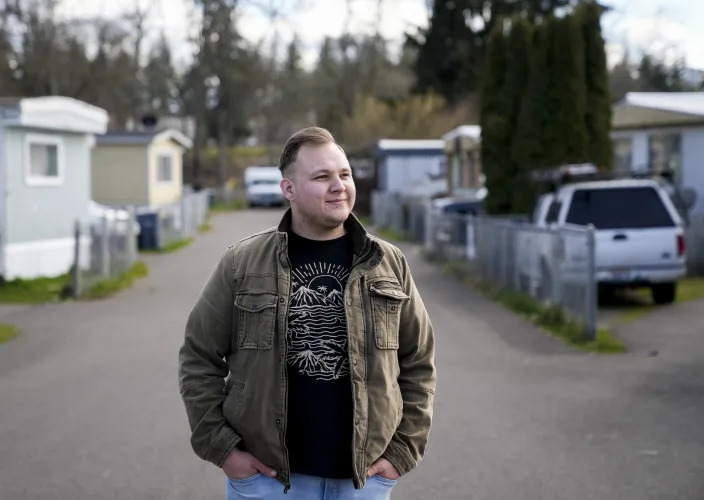
Resident and board member of the mobile home park Bob’s and Jamestown Homeowners Cooperative, Gadiel Galvez, 22, poses for a portrait in his neighborhood on Saturday, March 25, 2023, in Lakewood, Wash. When residents learned the park’s owner was looking to sell, they formed a cooperative and bought it themselves amid worries it would be redeveloped. Since becoming owners in September 2022, residents have worked together to manage and maintain the park. (AP Photo/Lindsey Wasson)
Resident and board member of the mobile home park Bob’s and Jamestown Homeowners Cooperative, Gadiel Galvez, 22, takes a walk in his neighborhood on Saturday, March 25, 2023, in Lakewood, Wash. When residents learned the park’s owner was looking to sell, they formed a cooperative and bought it themselves amid worries it would be redeveloped. Since becoming owners in September 2022, residents have worked together to manage and maintain the park. (AP Photo/Lindsey Wasson)
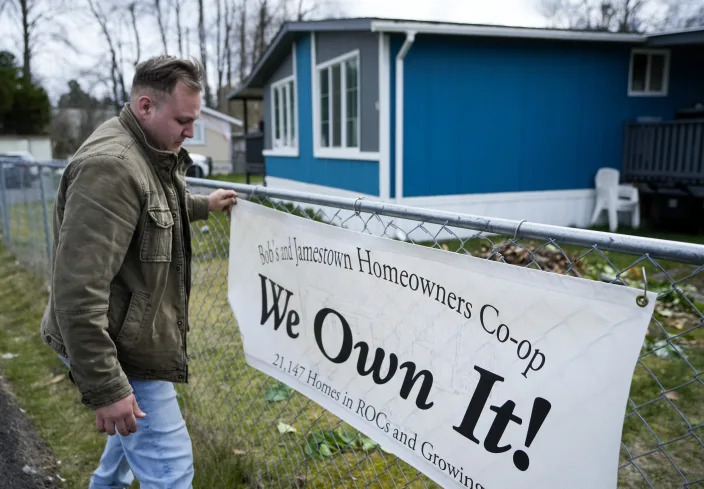
Gadiel Galvez, 22, adjusts a sign stating that his resident cooperative owns their mobile home park, Bob’s and Jamestown Homeowners Cooperative, in Lakewood, Wash., on Saturday, March 25, 2023. When residents learned the park’s owner was looking to sell, they formed a cooperative and bought it themselves amid worries it would be redeveloped. Since becoming owners in September 2022, residents have worked together to manage and maintain the park. (AP Photo/Lindsey Wasson)

PORTLAND, Ore. (AP) — When Gadiel Galvez learned that the owner of his mobile home park south of Seattle was looking to sell, he and other residents worried their largely Latino community would be bulldozed to make way for another Amazon warehouse.

So, they decided to form a cooperative and buy their park in Lakewood, Washington. With help from a nonprofit that advises communities like theirs and helps them secure loans, they bought it for $5.25 million. Since becoming owners in September, everyone’s worked to make improvements.

“Everybody thought, ‘You know what? … I’m going to make this place the best that I can,’” said Galvez, 22, who is a co-op board member. “Some people painted their homes, some people remodeled their interiors and exteriors, and some are working on their roofs.”

With rents rising at mobile home parks nationwide, advocates tout the cooperative model as a way to preserve one of the last affordable housing options for people with low- or fixed-incomes and to give them a greater voice in managing their parks.

So far these resident-owned communities are proving to be a reliable option. None of the more than 300 in the network of nonprofit ROC USA have defaulted or closed. One decided to sell back to the county housing authority it originally purchased from.

“They have a 100% track record of success, which tells you that it’s working for the residents,” said George McCarthy, president and CEO of the Lincoln Institute of Land Policy, a Cambridge, Massachusetts, think tank. “Resident ownership is an absolute bulwark against the intrusion of institutional capital in the market.”

The push to promote resident ownership comes as parks have become a favorite target of investment banks, hedge funds and other deep-pocketed investors.

Nearly a third of mobile home parks in the U.S. have been bought by such investors since 2015, lured by reliable cash flow and high returns from raising rents at nearly double the general rental market rate, McCarthy said.

“They’re trading on the desperation of people living in the parks,” he said. “There’s no place that they can take their homes if they can’t afford to keep paying the increasing rents.”

Park residents often own their home but rarely the land beneath it. So if a landlord raises rent, residents can be evicted or forced to sell their home. If a park is sold to be redeveloped, mobile homes that can’t be moved are demolished.

“Homelessness is really what residents are facing” if investors aggressively raise rents, said Victoria O’Banion, ROC Northwest’s marketing and acquisitions specialist.

At Rimrock Court in the central Oregon town of Madras, rent increased from $350 to $495 over five years. When the owner notified residents he planned to sell, they feared further increases — or worse, that it would be torn down to make way for apartments. So they decided to buy it.

“We were really worried about being forced out of our homes,” said Shawn King, who lives there with her husband on a fixed income and had experienced homelessness before.

To pay off the purchase loan, residents now pay $520 a month — a stretch, but one that comes with reassurance, King said.

“Just to have that peace of mind, to know that our rent is going to be locked in for awhile and not keep going up, and also knowing that our rent monies … are going back into the property, that is the cool part,” she said.

The required rent increase to go co-op was even steeper in Evergreen Village Cooperative in Mount Bethel, Pennsylvania, — from $460 a month to $750 to pay off the $12 million loan.

Still, more than two-thirds of residents voted in favor, figuring their rent would stabilize in the long run.

“We are not for profit. All the money that we get has to go back into the village and pay the mortgages off,” said Stephen Laclair, board president.

Evergreen Village has earmarked funds for improvement projects for the next decade, and this year plans to enhance the sewer plant and fix electrical issues, he said.

Co-ops can also provide social support to residents. At Liberty Landing Cooperative in Missouri, residents started a food pantry to help neighbors in need.

“If there’s a hardship, we’re willing to work with somebody. … It’s emotional when you find out that somebody’s lost their job, their child support … and they don’t know what to do,” said Kristi Peterman, the board vice president. “Our president likes to say: ‘If it doesn’t work for the poorest of us then it’s not going to work for anybody.'”

Despite the talk of better management and stronger community, most parks aren’t co-ops.

The country’s roughly 43,000 mobile home communities are home to 22 million people, according to the Manufactured Housing Institute, a national trade organization. But only about 1,000 are resident-owned, according to Carolyn Carter, deputy director at the National Consumer Law Center.

Some resistance comes from residents, many of whom are seniors and people with disabilities who may not want the responsibility of managing their park. Others argue rent control or stricter zoning regulations protecting mobile home parks from redevelopment are more effective.

“Zoning is critical. … That is what we ought to be fighting for everywhere,” said Jan Leonard, who lives in a park in Walla Walla, Washington, and worked with other residents to successfully push the city council to amend zoning codes to add mobile home parks as a land-use type.

Other residents considering buying their parks are running up against the same forces that make them popular with investors — a red-hot market and competition from private equity firms and other prospective buyers.

Sarah Marchant, vice president of Community Loan Fund, ROC USA’s New Hampshire affiliate, recalled Tara Estates, a 380-home park in Rochester. The steep $45 million asking price discouraged residents from organizing.

Another challenge is that few states provide funding for residents looking to buy their parks. The lack of grants can make it difficult for residents to finance large loans.

New Hampshire, Vermont, Rhode Island, Massachusetts, Colorado and Oregon are among states with laws that have been effective in helping residents buy their parks, the National Consumer Law Center said.

A new bill in Oregon would allocate $35 million in grants to help residents purchase their parks. Washington passed a bill last month requiring that landlords offer tenants a chance to compete to purchase their park. It also requires two years’ notice if a park will be closed, although that can be reduced if landlords financially compensate residents.

Mobile homes are “an important and affordable housing option for a lot of folks, especially older people aging in place, and we need to make sure it’s preserved,” said state Sen. Noel Frame, the Washington bill’s prime sponsor.

Some real estate groups and park owners argue the bill places an undue burden on landlords.

“If you want tenants to organize and make offers to purchase their communities … they should not wait until there’s a clock ticking,” said Robert Cochran, property manager of Contempo Mobile Home Park in Spokane.

Housing advocates say they hope that $225 million in recently approved federal funding may provide some relief for mobile home park residents. Starting this year, the money will be funneled through grants to states, resident-owned parks, nonprofits, and local and tribal governments to preserve mobile home communities and improve infrastructure.

King cherishes the mobile home that going cooperative at Oregon’s Rimrock Court saved from rent increases and a potential buyout by investors.

“It’s so hard to find affordable housing when you’re low income. To be able to own your own home is so empowering,” she said.

“It’s 600-square-feet. It’s not much, but it’s a castle to me.”

AP writer Michael Casey in Boston contributed.