Ady Barkan, Activist with ALS: Kill the GOP tax bill.

Activist Ady Barkan, who suffers from ALS, is fighting against the Republican tax bill and its potential slashing of the safety net to finance tax cuts for the rich.

“We can’t allow Donald Trump and his lying and selfish sons to rip families apart, to steal our money, to take our health care away,” says Ady. “It’s up to us to stand up.”

Watch the full interview: http://on.msnbc.com/2CmRD9Z

Activist with ALS: Kill the GOP tax bill and save my life

Activist Ady Barkan, who suffers from ALS, is fighting against the Republican tax bill and its potential slashing of the safety net to finance tax cuts for the rich."We can't allow Donald Trump and his lying and selfish sons to rip families apart, to steal our money, to take our health care away," says Ady. "It's up to us to stand up."Watch the full interview: http://on.msnbc.com/2CmRD9Z

Posted by All In with Chris Hayes on Thursday, December 14, 2017

Obstacles emerge as GOP races to tax finish

The Hill

Obstacles emerge as GOP races to tax finish


By Alexander Bolton, Naomi Jagoda and Scott Wong – December 14, 2017

A revolt from two Republican senators concerned about the Child Tax Credit and the absence of two more Republican senators because of illness has injected fresh uncertainty into the GOP’s tax bill push.

The Senate was expected to vote first on the $1.5 trillion tax package, but that is now in doubt as GOP leaders aren’t absolutely sure they’ll have enough votes early next week to pass it.

Leaders have little room for error. The Christmas recess is fast approaching and soon they will see their Senate majority fall by one vote because Democrat Doug Jones won the Alabama special election on Tuesday.

Jones could be sworn into office as soon as Dec. 26, though it’s more likely that he will be seated after New Year’s Day.

Sen. Marco Rubio (R-Fla.) lobbed a bomb into the final negotiations Thursday by threatening to vote against the bill unless it makes the Child Tax Credit more generous to people who don’t pay income taxes.

“Right now it’s only $1,100. It needs to be higher than that,” Rubio told reporters, referring to the amount of the credit that is refundable in the Senate-passed tax bill. The amount was indexed to inflation.

“I understand that this is a process of give and take, especially when there’s only a couple of us fighting for it,” he said. “Given all the other changes they’ve made in the tax code leading into it, I can’t in good conscience support it unless we are able to increase the refundable portion of it.”

Rubio is working with Sens. Mike Lee (R-Utah) and Tim Scott (R-S.C.), a member of the conference committee working on the final tax bill.

Lee’s office says he’s undecided about how to vote, pending the outcome of the Child Tax Credit debate, while Scott said, “I’m certainly interested in seeing it sweeter.”

Making the Child Tax Credit fully refundable would cost $87 billion over 10 years — a significant amount that won’t be easy to pay for. Negotiators are already straining to cover the costs of other fixes, such as lowering the top individual tax rate to 37 percent and allowing people to deduct up to $10,000 for state and local taxes.

It does not appear, however, that the Child Tax Credit will be indexed to inflation in the bill, which means middle-class families would likely see the benefit shrink in future years.

Republican leaders earlier this week said they planned to pass the revised tax bill through the Senate first and then through the House.

One reason they cited was that it would give them some breathing space in case the Senate parliamentarian ruled against some of the last-minute changes hammered out by negotiators in recent days.

But a Senate-first approach was thrown into doubt Thursday because of the debate over the Child Tax Credit and the prolonged absence of two senior lawmakers, Sens. John McCain (R-Ariz.) and Thad Cochran (R-Miss.).

McCain is at Walter Reed Medical Center receiving treatments from the side effects of cancer therapy, while Cochran is recovering from an operation to remove a lesion from his nose. Both of them missed every Senate vote this week.

A senior GOP aide said leaders can’t be completely sure that McCain will be back, given the severity of his illness, calling his possible absence next week, “a serious problem.

An aide to Cochran said his boss “is in Washington and expects to vote for the tax plan when it comes to the Senate next week.”

Speaker Paul Ryan (R-Wis.) told reporters Thursday that he now doesn’t know which chamber will move first on the tax bill, which means it may take Senate Majority Leader Mitch McConnell (R-Ky.) more time than expected to line up the votes.

Senate Republican Whip John Cornyn (Texas) confirmed Thursday evening that the timing of the bill is up in the air.

“That’s in some flux,” he said, but added, “in all likelihood, we’ll be voting on Tuesday.”

Cornyn expressed confidence that negotiators would be able to bring Rubio around to voting yes.

“We’re still working with him and expect to satisfy his concerns,” he said.

Cornyn also voiced confidence in McCain’s return.

“My expectation is he’ll be here. He’s resting up and so we hope to see him then,” he said.

Republicans control 52 Senate seats and can afford only two defections, as Democrats are expected to vote in unison against the legislation. Vice President Mike Pence would break a 50-50 tie.

Pence announced Thursday that he would delay a trip to Israel and Egypt next week in case his vote is needed.

Leaders lost one Republican, Sen. Bob Corker (R-Tenn.), when they first passed the bill through the Senate earlier this month, and he appears unlikely to back the final legislation.

Corker told reporters “the issues I had before are still there,” though he hasn’t ruled out voting for the bill when it comes back to the floor next week.

Sen. Susan Collins (R-Maine), another key swing vote, hasn’t yet committed to voting for the bill. She has expressed concern over the lowering of the top individual rate from 39.6 percent to 37 percent.

But Collins has won other major concessions, such as the $10,000 deduction for state and local taxes, as well as a promise from Pence and GOP leaders to pass legislation to subsidize insurance companies and set up high-risk insurance pools for sick people.

The various proposals to raise more revenue to offset the cost of tax relief could prove controversial.

Senate Finance Committee Chairman Orin Hatch (R-Utah) told The Washington Post Thursday that one option for saving money is to phase out the individual tax cuts in 2024, a year earlier than the original Senate bill envisioned. Other senators denied that the idea is under consideration, however.

Sen. Ron Johnson (R-Wis.) said the final bill will set higher tax rates for cash and assets that companies have stashed oversees — 15 percent for cash and 8 percent of other assets, rates higher than were set in the Senate- and House-passed bills.

Sen. Mike Rounds (R-S.D.) described some of the pay fors as “a little bit of spinach” for the business community, such as extending the timeline over which companies may write off certain assets.

House Ways and Means Committee Chairman Kevin Brady (R-Texas) said members of the conference committee would be able to sign or not sign the group’s report on Friday morning from 10 a.m. to 12 p.m.

He said the bill will be posted online for the public later in the day.

Peter Sullivan contributed. 

Parents mourn son’s ‘senseless’ and ‘horrific’ death following alleged hazing incident at LSU fraternity

ABC Good Morning America

Parents mourn son’s ‘senseless’ and ‘horrific’ death following alleged hazing incident at LSU fraternity

Catherine Thorbecke, Good Morning America     December 14, 2017
Watch: Family of LSU pledge killed in suspected hazing incident speaks out
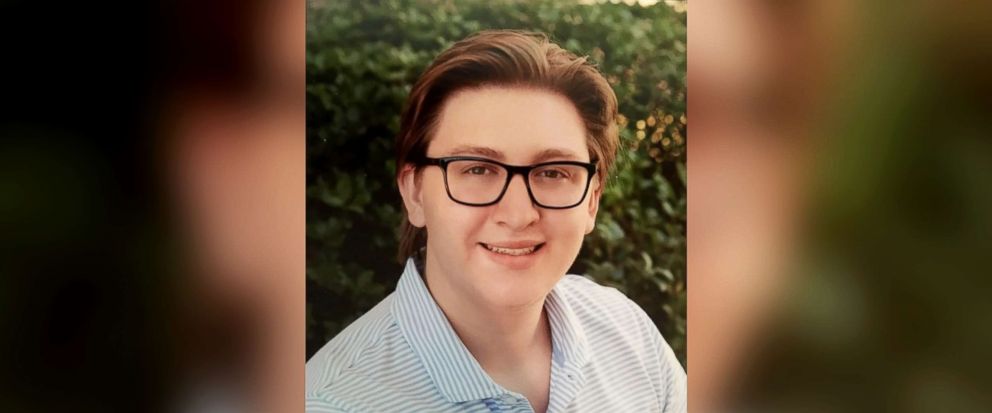
PHOTO: Maxwell Gruver is seen in this undated photo shared by his mother, Rae Ann Feldner Gruver, on Facebook on Sept. 14, 2017.Rae Ann Feldner Gruver via Facebook.  

The mother of the Louisiana State University student who died following an apparent hazing incident at a fraternity said she believes her son was murdered, telling ABC News, “Nobody can physically drink that much, you can’t, you have to be forced.”

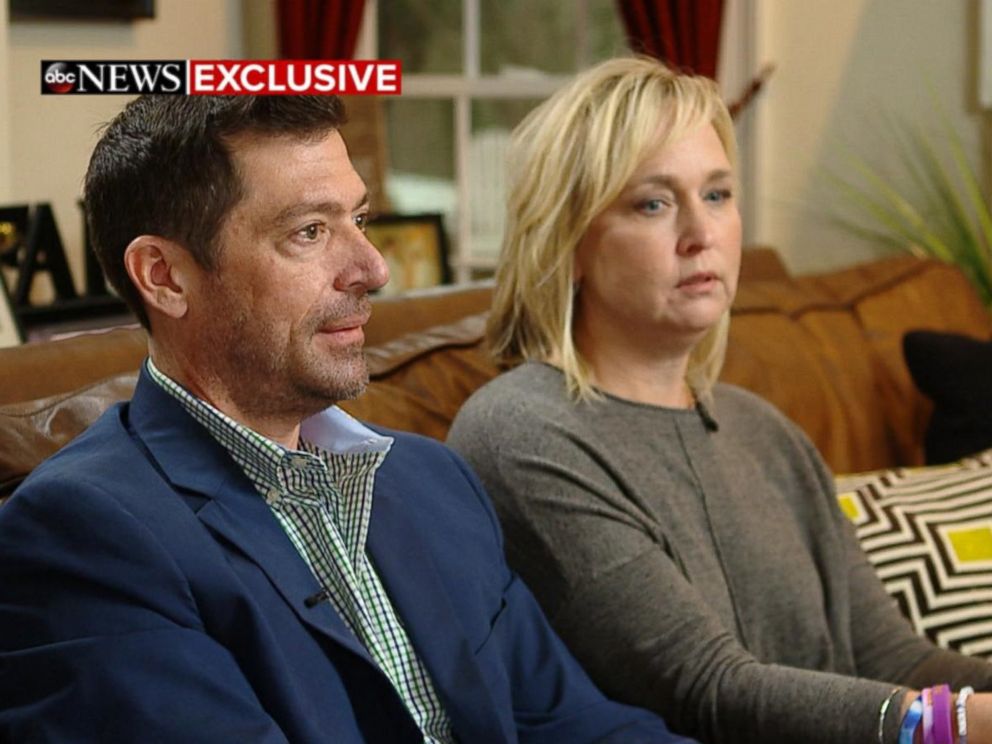
“This shouldn’t have happened,” Rae Ann Gruver said in an exclusive interview with ABC News’ Amy Robach three months after her son, Max Gruver, 18, died following a night of drinking and alleged hazing at the Phi Delta Theta fraternity’s LSU chapter.

PHOTO: Rae Ann Gruver and Stephen Gruver speak to ABC News Amy Robach about the death of their 18-year-old son, Max Gruver.ABC News. Rae Ann Gruver and Stephen Gruver speak to ABC News’ Amy Robach about the death of their 18-year-old son, Max Gruver.


On the night of September 13, Max Gruver and other fraternity pledges participated in a game dubbed “Bible Study,” where pledges were asked questions about the fraternity and ordered to drink alcohol if they answered questions incorrectly, according to an affidavit filed by LSU police in October.

Max Gruver was pronounced dead on September 14, according to authorities. A preliminary autopsy revealed that he had “a highly elevated blood alcohol level plus the presence of THC,” according to the East Baton Rouge Parish Coroner’s Office.

Details revealed from deadly night of alleged hazing at LSU fraternity

Phi Delta Theta fraternity shutters LSU chapter after pledge’s death

Stephen Gruver, Max’s father, told ABC News that they eventually found out that his son’s blood-alcohol level was .496, or approximately six times the legal limit.

“We learned that the hospital’s gauge stops at .46, it doesn’t go any higher,” Stephen Gruver said. “And that was the next day. So that night, I’m sure it was enough to kill you.”

Ten current and former fraternity members were arrested and face potential charges ranging from misdemeanor hazing to felony negligent homicide. The East Baton Rouge District Attorney’s office told ABC News on Wednesday that the defendants have yet to be formally charged and no pleas have been entered.

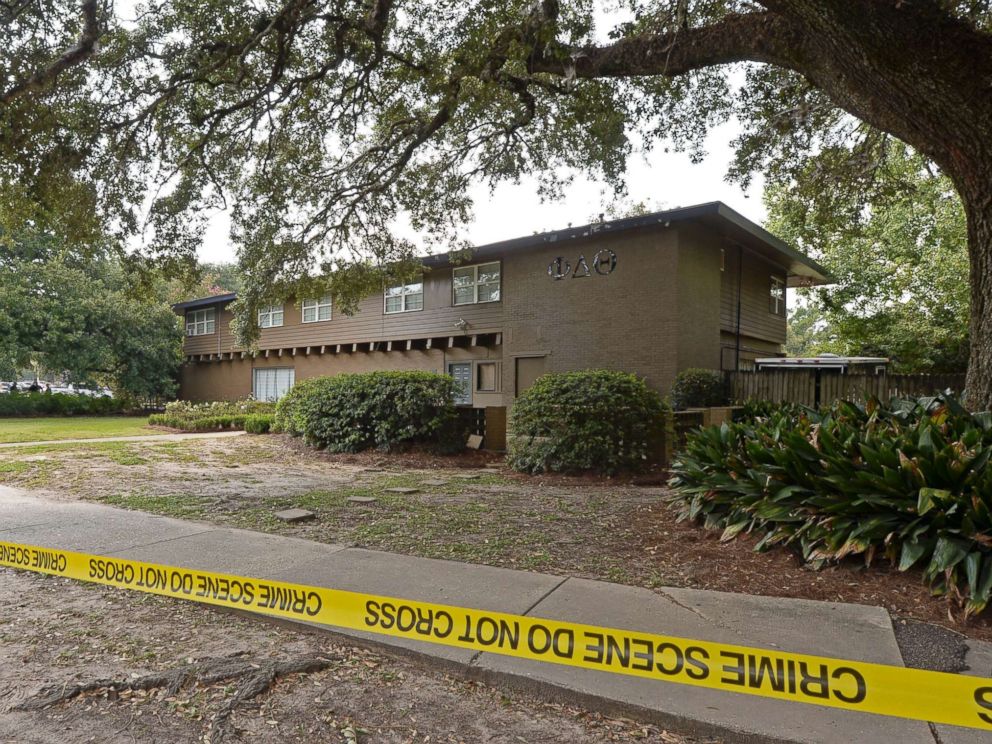
PHOTO: Louisiana State University Police investigating after a Phi Delta Theta fraternity pledge died on Sept. 14, 2017.Hilary Scheinuk/The Advocate via AP. Louisiana State University Police investigating after a Phi Delta Theta fraternity pledge died on Sept. 14, 2017.

When asked if she believed her son was murdered, Rae Ann Gruver responded “yes.”

“It’s senseless,” she added of the allegations that her son was forced to consume alcohol prior to his death. “I mean, how is making your brother do all these things, and humiliating somebody, a brotherhood?”

“How does that bond you?” she added. “That’s what I just don’t understand … It’s just horrific.”

Rae Ann Gruver added that they were initially encouraged by the research they had done about the fraternity their son chose to join.

“We went on the computer, we looked up on their national chapter,” she said, adding that it claimed to be a hazing- and alcohol-free environment.

She said they were initially unaware of any past reports of drinking and hazing at the fraternity, and thought “our son made a great decision with this fraternity.”

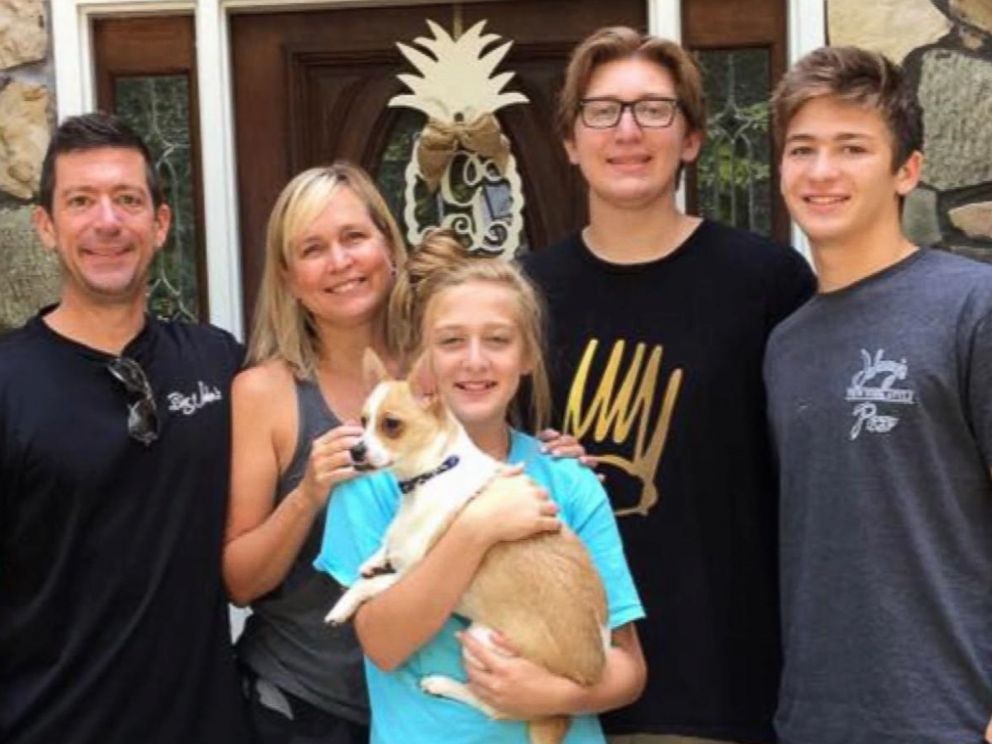
PHOTO: Rae Ann Gruver and Stephen Gruver pose with their children in this undated family photo.Rae Ann Gruver and Stephen Gruver pose with their children in this undated family photo.

“If we had found out just a year ago a fraternity had had a hazing incident, we might be like … with Max, like, ‘I don’t know that this is the one for you,'” she added.

Rae Ann Gruver recalled the last time she hugged her son, when she dropped him off at LSU on his freshman move-in day.

“I actually have a picture of the last hug of him and I,” Rae Ann Gruver said. Stephen Gruver added when they dropped him off at school they had no idea “that was the last time” they would see him alive.

Rae Ann Gruver said they are sharing their family’s heartbreak in order to prevent what happened to their son from happening to others, and called on students to speak up if they suspect something is off.

“They need to step up if they see something is wrong … Don’t be scared,” she said. “You could possibly be saving somebody’s life.”

The Phi Delta Theta fraternity has shuttered its LSU chapter and revoked its charter following Max Gruver’s death. The fraternity’s national chapter posted a statement on it’s website immediately following his death saying they “fully support local law enforcement in their decision to move forward and file charges against all of those alleged to be involved with the passing of Maxwell Gruver.”

A spokesperson for LSU told ABC News that a Greek Life Task Force has been established to investigate the school’s culture and environment and will write a report with recommendations for improvements by the end of January 2018. Meanwhile, Greek organizations can have registered, alcohol-free, on-campus events.

ABC News’ Emily Shapiro and Karma Allen contributed to this report

New York Post

Mom of ‘Bible study’ frat hazing victim: My son was murdered

By Jackie Salo      December 14, 2017

Mom of ‘Bible study’ frat hazing victim: My son was murderedRae Ann and Max GruverFacebook

The mom of a Louisiana State University student who reportedly died after a fraternity hazing event dubbed “Bible study” believes her son was murdered.

Max Gruver, an 18-year-old freshman, was found unresponsive in September following a Phi Delta Theta meeting where fraternity pledges were allegedly ordered to play a game involving excessive boozing, ABC News reported.

“Nobody can physically drink that much, you can’t, you have to be forced,” Rae Ann Gruver told ABC News.

While at the meeting, Max and other pledges were allegedly forced to drink when they answered questions in the game wrong, according to police.

The freshman was pronounced dead at a hospital the next morning after Phi Delta Theta members couldn’t tell if he was breathing on a couch at the fraternity house.

The hospital told his family that his blood-alcohol level when he arrived was about .496.

“We learned that the hospital’s gauge stops at .46, it doesn’t go any higher,” his dad Stephen Gruver told ABC News. “And that was the next day. So that night, I’m sure it was enough to kill you.”

When asked if his death was a murder, his mom said: “Yes, I believe so.”

Ten people are charged in his death with at least one suspect facing a negligent homicide charge. 

The Bombs, the Church, the City, the State

Esquire

The Bombs, the Church, the City, the State

What was Alabama back then? And what is Alabama right now?

Getty

By Charles P. Pierce      December 11, 2017

BIRMINGHAM, ALABAMA—There are certain iconic places from our history on which we can all pretty much agree—Bunker Hill, Fort McHenry, the Motown studios in Detroit and the Stax studios in Memphis. There are some iconic places from our history that are, at best, unsettling and, at worst, divisive as all hell. We saw that exercised over the past years in places like Liberty Place in New Orleans, where a monument to a successful act of white supremacist terrorism was finally moved into the obscurity it has long deserved.

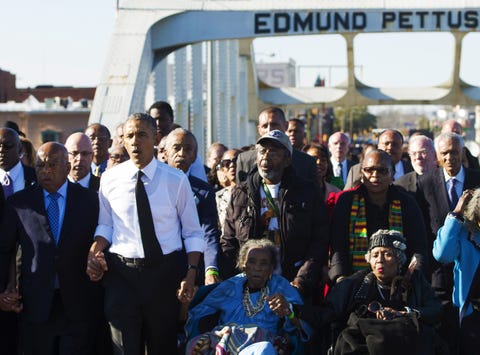
And then there are certain iconic places from our history that make us avert our moral inner eyes because, while we admire the people that made these places historic, we remain uncomfortable with the situations that made that courage necessary. They put a flinch in our historical memory. Since the 1950s, Alabama has been awash in these places. There is Montgomery, where the bus boycott began. There is the bus station in Anniston, where a mob tried to burn the Freedom Riders to death. There are the stops along Route 80, where the great march from Selma to Montgomery passed in 1965. There is the Edmund Pettus Bridge.

Getty

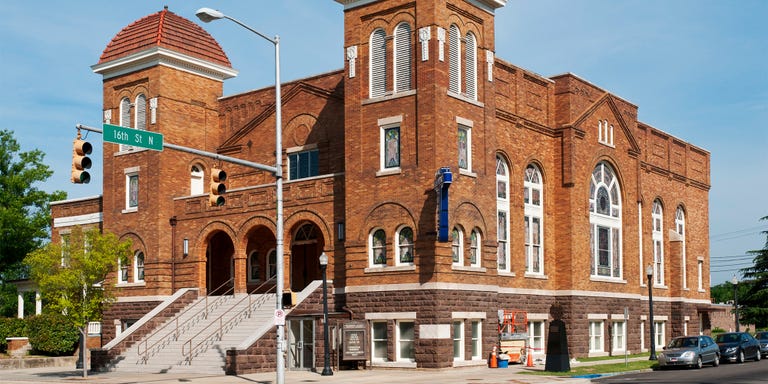
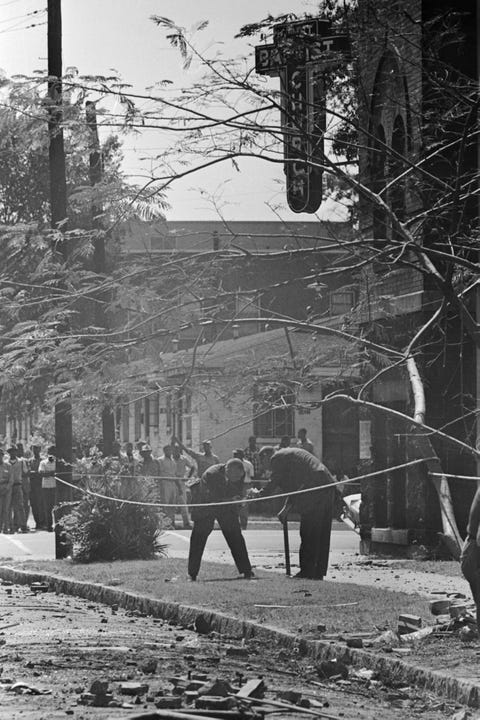
And there is the 16th Street Baptist Church here in Birmingham, which has been a gathering place for African-Americans since it was finished in 1911. Paul Robeson sang there. W.E.B. DuBois and Mary McLeod Bethune spoke there. And, at 10:22 a.m. on September 15, 1963, a Sunday morning, a group of four white supremacist terrorists planted 15 sticks of dynamite in the church and blew it up, killing four little girls and injuring at least 20 other parishioners, and converted the 16th Street Baptist Church into one of those places that all Americans of a certain age know about instinctively, and one of those places that many Americans talk about with a familiar flinch in their memory.

The flinch keeps too many of us from remembering that this was the third bombing in Birmingham over the previous 11 days, and that the campaign of destruction came in the wake of a federal court decision mandating the integration of Birmingham’s public schools. The flinch keeps us from remembering that the people of the church rebuilt it in less than a year, that a stained-glass window was donated by some people in Wales who were shocked and disgusted by something that had happened in America. The flinch never has left our national mind. It keeps us from remembering that the forces that brought down the walls of the church still maintain a certain destructive power. The flinch is caused by something real, something dark, something alive.

Getty

In the years between 1995 and 1997, the Department of Justice under Bill Clinton was examining a series of arsons that had struck largely African-American churches in the South. The head of the DOJ’s Civil Rights division was a Massachusetts lawyer named Deval Patrick. It was the largest DOJ investigation ever conducted, prior to the probe into the attacks of September 11, 2001. (The investigation resulted in more than 100 arrests, but no evidence of a conspiracy linking the attacks ever was found—which, in some ways, makes the whole thing worse.) During the course of that investigation, Patrick and his team picked up some information regarding suspects in the church bombing who never had been brought to justice.

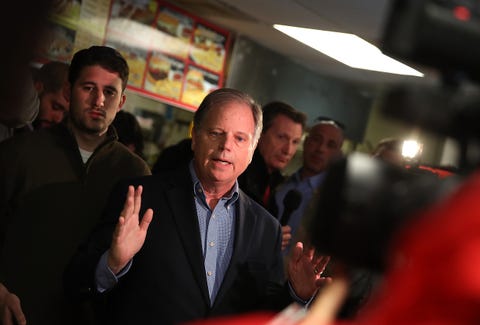
In 1977, a Ku Klux Klan member named Robert Chambliss had been tried and convicted for his part in the crime, but the FBI and other investigators long had been convinced that Chambliss hardly acted alone. Now, over 30 years later, the FBI went back through the vast files it had accumulated at the time of the bombing. Eventually, two aging Klansmen, Bobby Cherry and Thomas Blanton were arrested and tried for their part in the 16th Street Baptist Church bombing. The two were convicted. Cherry died in prison and Blanton is still there. The prosecutor who put them there was an assistant U.S. Attorney named Doug Jones. He looked at the two old murderers and the flinch was not in him. He put them away.

THE FLINCH IS CAUSED BY SOMETHING REAL, SOMETHING DARK, SOMETHING ALIVE.

On Sunday, in the middle of a crowd on the sidewalk in front of Jones’s Birmingham headquarters, a fine Stetson hat on his head, Armond Bragg was making a lot of noise, leading chants and cheers, and generally having a high old time for himself, listening to Senator Cory Booker. Bragg ran his own pest control business for 30 years until he retired. He did not go in much for politics until Barack Obama ran for president in 2008. Now, though, he has worked day and night for Doug Jones because Armond Bragg remembers when they called his town “Bombingham.” He is a member of the 16th Baptist Church, and, as such, he is not afflicted at all by the flinch.

“I’m a member of the 16th Street Baptist Church and Doug convicted the bombers there back during a time when that wasn’t popular to do, especially for a white man. Then, he prosecuted the guy who bombed the abortion clinic. (Eric Rudolph, who later bombed Olympic Park during the 1996 Olympic Games in Atlanta.) I’ve just been impressed with his career.

“It wasn’t popular to do back in the day. It’s not popular now. Look, you got a guy who’s running who’s got an impeccable record, when you look at his history. And we got on the other side, a guy who’s done everything wrong to tell you the truth. It’s a no-brainer, when you look at the records. When you look at the two individuals, there’s no comparison.

“Doug Jones has run an impeccable campaign. I mean, you can’t just reach for African-American votes. You got to reach into other communities, too. That’s what I think needs to be done. You got to have a man who can go into—well, ‘Flour Country,’ I guess we call it—and also come to the city. Somebody’s got to do that. Doug Jones is that man.”

Getty

In so many ways, while Roy Moore is running a ghost campaign, Doug Jones is running a haunted one. He called the entire city out on its flinch, and some people resent the hell out of the fact that he did. He called the anti-choice movement out on its toleration of its wilder fringes, and some people resent the hell out of that, too. But not all the ghosts in our history are evil. The spirits of Addie Mae Collins, Denice McNair, Carole Robertson, and Cynthia Wesley called out over the decades for the peace and the justice they deserved. In 2001, their cries finally were heard.

On his stump speech, Doug Jones often quotes, from memory, a passage taken from The Cure at Troy, Irish poet Seamus Heaney’s magnificent re-imagining of Sophocles’s ancient play, Philocetes.

History says, don’t hope on the side of the grave.’

But then, once in a lifetime, the longed for tidal wave of justice can rise up.

And hope and history rhyme.

Sometimes, that rhyme is an epic poem, an Iliad from inside a Birmingham jail. And sometimes, often, that rhyme is a nursery rhyme, sung by children playing hard at double-dutch, but only after Sunday school is over.

Respond to this post on the Esquire Politics Facebook page.

Jimmy Kimmel Shames the GOP for Not Funding CHIPS, Children Health Insurance Program.

ABC News

Jimmy Kimmel makes emotional return to Jimmy Kimmel Live with his son Billy by his side: “I was out last week because this guy had heart surgery, but look, he’s fine everybody!” http://abcn.ws/2yi3wuZ

Jimmy Kimmel makes emotional return to Jimmy Kimmel Live

Jimmy Kimmel makes emotional return to Jimmy Kimmel Live with his son Billy by his side: "I was out last week because this guy had heart surgery, but look, he's fine everybody!" http://abcn.ws/2yi3wuZ

Posted by ABC News on Tuesday, December 12, 2017

Watch this Republican senator try to explain why health care for 9 million children is losing funding.

Posted by Working Families Party on Tuesday, December 12, 2017

Welcome to the world’s first recycle mall.

EcoWatch

Welcome to the world’s first recycle mall. A mall that only sells recycled and repurposed items.

Read more on positive news for recycling: http://bit.ly/2BDzRSM

See More

Welcome to the world's first Recycle Mall!A mall that only sells recycled and repurposed itemsRead more on positive news for recycling: http://bit.ly/2BDzRSMvia Rob Greenfield

Posted by EcoWatch on Tuesday, December 12, 2017

Kenya’s Sarafu-Credit: Alternative Economies and Community Currencies Part 2.

Resilience

Kenya‘s Sarafu-Credit: Alternative Economies and Community Currencies Part 2.

By Niko Georgiades, originally published by P2P Foundation      December 7, 2017

Second of a three part series, Niko Georgiades takes on a journey through Greece’s post-capitalist alt. economy, this time by way of Kenya. Originally published in Unicorn Riot Ninja.

Athens, Greece – Experimenting with alternatives to capitalism has continued to become more popular as huge wealth divides devour chances of relieving poverty across the world. During the summer of 2017, a speaking engagement at the self-organized squat of Embros Theater in Athens, Greece, showcased alternatives to capitalism. In the second of our three part series on alternative economies and community currencies, we spotlight Kenya’s Sarafu-Credit.

Community currencies are types of complimentary currencies shared within a community that are utilized as a means of countering inequality, class, debt, accumulation, and exclusion.

With community currencies, lower-income communities are given the ability to improve living standards by building infrastructure sustainability through networks of sharing, providing access to interest-free loans, and increasing the economic viability of the community.

This is a major departure from conventional national currencies. Most are generated today through fractional reserve banking, wherein units (“broad money” or M3) are created at the bank when loans are instantiated and destroyed upon repayment.

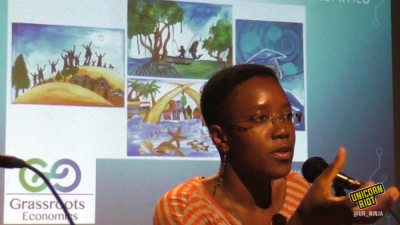
Caroline Dama, Board member of Grassroots Economics

During economic slowdowns including the US Great Depression, the “velocity of money” drops as fractional currency is unavailable. Locally issued “Depression Scrip” substituted for fractional money in the 1930s. Today alternative currencies that improve velocity of money by distributing credit creation power to the whole population are taking root in many countries.

The first speaker of the discussion at Embros Theater was Caroline Dama, a Board member of Grassroots Economics (GE). GE is a “non-profit foundation that seeks to empower marginalized communities to take charge of their own livelihoods and economic future” in Kenya.

Will Ruddick, who started the Eco-Pesa (no longer in circulation), a complementary and community currency, founded Grassroots Economics in 2010, which has created six networks of community currencies that now works with over twenty schools and twelve hundred businesses in Kenya.

In 2013, 200 businesses, 75% of which were owned by women, became part of the new self-organized and self-determined community currency, Bangla-Pesa, in Mombasa’s largest slum, Bangladesh.

Kenya’s government quickly saw the formation of these community currencies as a threat. Five individuals involved with Bangla-Pesa, including Will Ruddick and Caroline Dama, were implicated on charges of undermining the national currency, the shilling. They were all eventually cleared of all charges and the Sarafu-Credit system continues to break new boundaries and change the narrative of alternative economic systems.

Sarafu Credit – Bengla-Pesa

Drastic economic and social inequalities run rampant throughout Kenya as at least 46 percent of its population is living in poverty. With basic needs like clean water and healthcare becoming hard to attain, the Sarafu-Credit community currency system was created as a safety net for citizens to improve living conditions.

The word sarafu means currency in the Kiswahilli language. Sarafu-Credit is a system of community currencies used as a “regional means of exchange supplementing the national currency system.

The community in Bangladesh, the biggest slum in Kenya’s second largest city, Mombasa, is very poor and has little access to the shilling, the national currency. Caroline Dama, from GE, stated that the community is “able to come together and come up with a system to exchange our goods and services” using “community dollars.

These community currencies are complimentary with the national currency and Caroline stated that not all of them work towards abolishing the current currency or system, but that they are “trying to make sure that the community banks have a way to survive in times that they wouldn’t otherwise survive.

“it’s a form of community governance and self-taxation … the community has been able to come up with its own rules to solve its own problems.” – Caroline

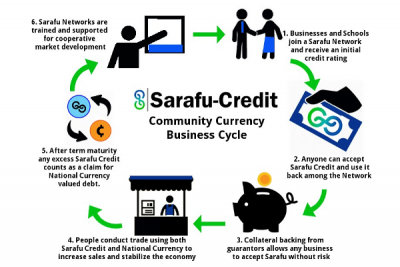
How the Sarafu-Credit system works

GE explains Sarafu-Credit as: “A network of businesses, schools, self-employed and informal sector workers form a cooperative whose profits and inventory are issued as vouchers for social and environmental services as well as an interest-free credit to community members. These vouchers circulate in the community and can be used at any shop, school, clinic or cooperative businesses and form a stable medium of exchange when the Kenyan Shilling is lacking. This injection of money into the community in the form of a community currency, based on local assets, increases local sales and helps directly develop the local economy. Sarafu-Credit, Grassroots Economics’ Kenyan Community Currency program, creates stable markets based on local development and trust.”

Caroline stated that only with a bottom-up approach can the community create economic equality. “Communities thrive when they are able to make their own decisions.”

Community currency gives that power to the people because they are talking to each other, they are able to exchange, and now they are meeting their basic needs, they have enough to sell and when they sell they can pool their resources together to build that better school.” – Caroline

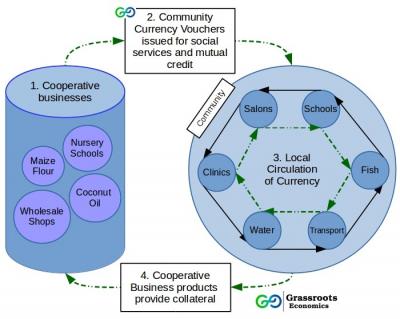
Graph of how the Community Currency Vouchers operates

If we have problems in the society we want to deal with … what we do, is we can come together as businesses instead of waiting for the government to do it for us”, said Caroline, who stressed the importance of self-determination and community empowerment.

The community currency vouchers are issued for social services and mutual credit for all sustainable needs of the community.  According to the Grassroots Economics website, “The community currency circulates around the community helping to connect local supply and demand for people who lack regular access to national currency.

Furthermore, Caroline gave an example of women in a village collectively working on projects together, like helping each other build new houses. They would make each person in their network a new house and they would gather the material needed to build the house from other cooperative businesses.

There was a lively discussion with plenty of questions after the presentation on Sarafu-Credit’s Bangla-Pesa. One of the many questions focused on hatching new ideas around sharing-based communities, instead of exchange based communities that could present inequalities based on the ability of services to exchange. Caroline said,

We are trying to move into a community whereby we are recognizing individual talents … that there is diversity in the community and that we should move away from the idea that we should monetize that. We try to live in a community that recognizes peoples needs, not monetizing them.” – Caroline

Grassroots Economics have created a .pdf with their user guide and have plenty of resources on their website. The video below shows how the Bangla-Pesa works.

To hear the full speech and question session of Sarafu-Credit click here.
For further reading on the Bangla-Pesa, here are a few attention-worthy papers:

Sen. Susan Collins (R-ME) Begins To Realize The Terrible Mistake She Made 

Daily Kos

Sen. Susan Collins (R-ME) Begins To Realize The Terrible Mistake She Made

By Dartagnan       December 08, 2017

WASHINGTON, DC - DECEMBER 5: Sen. Susan Collins (R-ME) walks to the Senate floor as she leaves a meeting with Senate Republicans on Capitol Hill, December 5, 2017 in Washington, DC. After the Senate passed their tax reform legislation last week, the next step will be a conference committee with members of the House to iron out the differences between the two bills. (Drew Angerer/Getty Images)No wonder she doesn’t look happy. She screwed Mainers and herself.

You may recall Senator Susan Collins (R-ME) basking in the limelight last week during the run-up to the GOP’s vote to ram through its catastrophic tax giveaway to corporations and other Billionaires at the expense of the rest of the American public.

As one of the so-called “moderate” Republicans, her vote was solicited with tender care by Mitch McConnell, the Senate Majority Leader, who apparently promised her that the American middle class might, just might still retain some meager crumbs left over from his Party’s loot-fest of the public treasury in the form of keeping their property tax and medical expense deductions. She also obtained an “assurance” from McConnell that a 4% cut to Medicare would certainly never be included in the final Bill, once it was reconciled with the version devised by the good, caring Republicans in the House. Hey, she had it in writing!

“There’s a real fear that the tax bill is going to trigger a 4% cut in Medicare,” Collins added. “I am absolutely certain that 4% cut in Medicare that I mentioned will not occur. I have it in writing from both the Speaker of the House Paul Ryan and also Senator Mitch McConnell.”

But even these tiny, miserable morsels casually tossed to ordinary Americans were coldly eliminated and deemed too much of a sacrifice to the Super-yacht class and their proxies in the Republican Congress:

News reports this week revealed that House Speaker Paul Ryan told congressional staff after the Senate vote that he was not a party to McConnell’s promise to pass the provisions that Collins demanded.

“She made a political error that’s going to cost Mainers and cost people across the country basic lifelines while [helping] the wealthy,” said [Marie Follaytar] Smith,” [an activist and co-founder of Mainers for Accountable Leadership].

In fact it’s absolutely clear that Medicare is next on the chopping block for Ryan’s willing executioners, precisely as a result of the tax scheme Collins voted for:

As the tax cut legislation passed by the Senate early Saturday hurtles toward final approval, Republicans are preparing to use the swelling deficits made worse by the package as a rationale to pursue their long-held vision: undoing the entitlements of the New Deal and Great Society, leaving government leaner and the safety net skimpier for millions of Americans.

Now faced with a severe backlash back home, the former It-girl with well-known aspirations for the Maine Governorship is feverishly backtracking on her blunder:

Republican Sen. Susan Collins said she may change her vote on the Senate tax bill if amendments she added are not included in the final bill.

Collins believes the amendments she added in the Senate version on property tax and medical expense deduction for retirement funding improved the bill and that in time, it will lower the debt.

But as she told WMTW’s media partner, WABI, if those changes are not included in the final package, she will consider changing her vote.

That’s what tends to happen when you have nine religious leader activists getting themselves arrested occupying your office back home to protest what can most charitably be described as your utter naiveté if not outright stupidity:

It was the second group of protesters this week to be arrested in the offices of Maine’s senior senator while urging her to reject the sweeping changes to the federal tax code that are presently being negotiated in Washington, D.C. On Monday, police arrested five protesters, who had staged a sit-in at Collins’ Bangor office.

But the problem for Collins is that the GOP doesn’t need her anymore. With Mike Pence available to break any ties, and Bob Corker (R-TN) the only recorded Republican “no” vote in the Senate, they already have the votes to pass this monstrosity without her, in whatever mutated form the House disgorges back.

Instead, when Collins comes home and settles down in front of the TV with a nice cup of cocoa this holiday season, she’ll be treated to this ad sponsored by a group called Save My Care:

“Senator Collins said Republican leaders promised her they would fix things,” the narrator intones, while headlines about resistance in the House to her bills flash on the screen. “Now we know they lied to her and Mainers will suffer the consequences.”

But had she done the right thing by her constituents to begin with instead of trusting in a Party that actively recruits child molesters into its ranks, she wouldn’t be in the position she finds herself now, when it’s too late.

Alabama’s poverty, sewage crisis ‘very uncommon in First World’

UPI

U.N. official: Alabama’s poverty, sewage crisis ‘very uncommon in First World’

By Ray Downs        December 10, 2017

Open sewage in rural Alabama has been blamed for spreading diseases like hookworm and E. Coli. Photo by Philip Alston/UN/Twitter

December 10, 2017 (UPI) — A United Nations official investigating poverty in the United States visited Alabama last week and said the poverty and sewage system problems there are some of the worst he has seen in the developed world.

“I think it’s very uncommon in the First World. This is not a sight that one normally sees,” said Philip Alston, the UN’s Special Rapporteur on extreme poverty and human right, AL.com reported. “I’d have to say that I haven’t seen this.”

Alston is on a 15-day trip of the United States to investigate poverty and visited several counties in Alabama’s “Black Belt” region, a mostly black region that hag long experienced poverty and racial segregation.

One of the issues Alston focused on was the longstanding sewage crisis there.

“Lowndes County in rural Alabama, I saw homes that are not connected to public sewage systems, whose owners can’t afford to install septic tanks,” Alston tweeted Friday. “Many resort to digging ditches & straight piping waste water to within meters of homes, posing serious health risks.”

Local resident and activist Aaron Thigpen has lived in the Black Belt region his entire life, according to AL.com. He showed Alston where he lives — an area where diseases like E. Coli and hookworm, which are both eradicated in most of the country, thrive because there is scarce access to clean drinking water due to the sewage problem.

“These two pipes are the raw sewage pipes coming from the house. And you’ve got your main water line here, and it may have a hole in it, so everyone gets sick all at once,” Thigpen said. “It’s really bad when you’ve got a lot of kids around like there are here. They’re playing ball and the ball goes into the raw sewage, and they don’t know the importance of not handling sewage.”

According to the 2017 Alabama Poverty Data Sheet, nearly 20 percent of Alabamians live below the federal poverty line; nine counties have a poverty rate higher than 30 percent; and the child food insecurity rate is 24 percent (the national average is 18 percent).

Alston said he wants his visit to increase awareness of poverty in the United States, including rural Alabama.

“The hope is that we’ll bring attention to [these problems], just like we bring attention to people who are being tortured,” he said.

Related UPI Stories

Poll: Medicaid recipients report poorest health

Study: Top 1 percent owns 40 percent of nation’s wealth, highest point in 50 years

HUD: Homeless numbers up for first time since 2010