How unhealthy is red meat? And how beneficial is it to eat vegetables? A new rating system could help you cut through the health guidelines

The Conversation

How unhealthy is red meat? And how beneficial is it to eat vegetables? A new rating system could help you cut through the health guidelines

Aleksandr Aravkin, Associate Professor of Applied Mathematics, University of Washington, Jeffrey Stanaway, Assistant Professor of Global Health and Health Metrics Sciences, University of Washington, and Christian Razo, Postdoctoral Fellow at the Institute for Health Metrics and Evaluation, University of Washington – October 21, 2022

The new rating system shows that eating the right amount of vegetables can lower your risk of heart disease by nearly 20%. <a href=
The new rating system shows that eating the right amount of vegetables can lower your risk of heart disease by nearly 20%. Westend61/Getty Images

The Research Brief is a short take about interesting academic work.

The big idea

We developed a new method for assessing health risks that our research suggests should make it a lot easier for people to determine which health advice to follow – and which to ignore. The approach, recently published in the journal Nature Medicine, offers a straightforward way for both policymakers and the general public to assess the strength of evidence for a given health risk – like consuming red meat – and the corresponding outcome – ischemic heart disease – using a rating system of one to five stars.

The system we developed is based on several systematic reviews of studies regarding risk factors like smoking and health outcomes such as lung cancer. Well-established relationships between risks and outcomes score between three and five stars, whereas cases in which research evidence is lacking or contradictory garner one to two stars.

In our analysis, only eight of the 180 pairs that we analyzed received the top rating of five stars, indicating very strong evidence of association. The relationship between smoking and lung cancer, as well as the relationship between high systolic blood pressure – the higher of the two numbers in a blood pressure reading – and ischemic heart disease were among those eight five-star pairs.

This rating system enables consumers to easily identify how harmful or protective a behavior may be and how strong the evidence is for each risk-outcome pair. For instance, a consumer seeing a low star rating can use that knowledge to decide whether to shift a health habit or choice.

In addition, we created an online, publicly available visualization tool that displays 50 risk-outcome pairs that we discussed in five recently published papers in Nature Medicine.

While the visualization tool provides a nuanced understanding of risk across the range of blood pressures, the five-star rating signals that the overall evidence is very strong. As a result, this means that clear guidelines can be given on the importance of controlling blood pressure.

Why it matters

Clear messages and evidence-based guidance regarding healthy behaviors are crucial. Yet health guidance is often contradictory and difficult to understand.

Currently, most epidemiological analyses make strong assumptions about relationships between risks and health outcomes, and study results often disagree as to the strength of risk-outcome relationships. It can be confusing for experts and nonexperts alike to parse through conflicting studies of varying strength of results and determine if a lifestyle change is needed.

This is where our method comes in: The star-based rating system can offer decision-makers and consumers alike much-needed context before headline-grabbing health guidance is dispensed and adopted.

For example, the average risk of ischemic heart disease with a blood pressure of 165 mmHG – or millimeters of mercury, the basic unit used for measuring pressure – is 4.5 times the risk of the disease with blood pressure of 100 mmHG; but this is just a single estimate. The relative risk of ischemic heart disease increases by more than four times across the blood pressure range, and there is inherent uncertainty in the estimate based on available data. The rating of five stars incorporates all of this information, and in this case means that relative risk of ischemic heart disease across the entire range of exposures increases by at least 85%.

On the other hand, take the example of red meat consumption. Consuming 100 grams of red meat per day – as opposed to none – results in a very modest (12%) increase in risk for ischemic heart disease. That’s why it scores a rating of just two stars, consistent with only a weak association.

People should be well aware of their levels of exposure to risks classified with three to five stars, such as systolic blood pressure. By monitoring and keeping one’s blood pressure as low as possible, a person can substantially reduce the risk of developing ischemic heart disease.

What’s next

Our hope is that decision-makers will be able to use our star rating system to create informed policy recommendations that will have the greatest benefits for human health. We also hope the public can use the ratings and the visualization tool as a way to more clearly understand the current level of knowledge for different pairs of health risks and outcomes.

This article is republished from The Conversation, an independent nonprofit news site dedicated to sharing ideas from academic experts. It was written by: Aleksandr AravkinUniversity of WashingtonChristian RazoUniversity of Washington, and Jeffrey StanawayUniversity of Washington.

Read more:

Jeffrey Stanaway receives funding from the Bill and Melinda Gates Foundation.

Aleksandr Aravkin and Christian Razo do not work for, consult, own shares in or receive funding from any company or organization that would benefit from this article, and have disclosed no relevant affiliations beyond their academic appointment.
Republicans plan to torpedo key Biden policies as polls predict midterm victory

The Guardian

Republicans plan to torpedo key Biden policies as polls predict midterm victory

Chris Stein in Washington DC – October 21, 2022

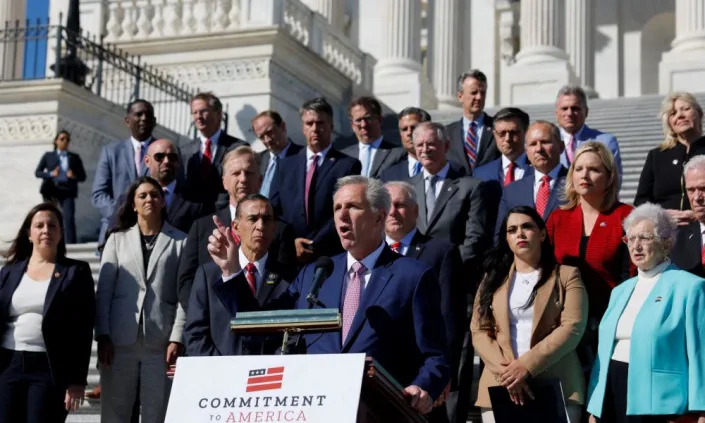
<span>Photograph: Evelyn Hockstein/Reuters</span>
Photograph: Evelyn Hockstein/Reuters

A standoff over the debt ceiling. Aid to Ukraine on the chopping block. And impeachment proceedings against homeland security secretary Alejandro Mayorkas – or perhaps even president Joe Biden himself.

With polls indicating they have a good shot of winning a majority in the House of Representatives in the 8 November midterms, top Republican lawmakers have in recent weeks offered a preview what they might do with their resurgent power, and made clear they have their sights set on key aspects of the Biden administration’s policies at home and abroad.

Related: Republicans aim to pass national ‘don’t say gay’ law

Kevin McCarthy, the top Republican in the chamber, this week signaled in an interview with Punchbowl News that if Congress is going to approve an increase in the amount the federal government can borrow – as it’s expected to need to by sometime next year – Republicans are going to want an agreement to cut spending in return.

“You can’t just continue down the path to keep spending and adding to the debt,” said McCarthy, who is likely to be elevated to speaker of the house in a Republican led-chamber. “And if people want to make a debt ceiling [for a longer period of time], just like anything else, there comes a point in time where, okay, we’ll provide you more money, but you got to change your current behavior.”

Asked if he might demand that Social Security and Medicare, the two massive federal retirement and healthcare benefit programs that are nearing insolvency, be reformed as part of debt ceiling negotiations, McCarthy replied that he would not “predetermine” anything.

But the California lawmaker warned that members of his caucus were starting to question the money Washington was sending to Ukraine to help it fend off Russia’s invasion. “Ukraine is important, but at the same time it can’t be the only thing they do and it can’t be a blank check,” he told Punchbowl.

Then there’s the question of if Republicans will choose to exercise the House’s powers of impeachment – as they did against Bill Clinton in 1998, and as Democrats did to Donald Trump in 2019 and 2021.

The prime target appears to be Mayorkas, whom Republicans have pilloried amid an uptick in arrivals of migrants at the United States’ border with Mexico. Yet another target could be Biden himself – as Jim Banks, chair of the conservative Republican Study Committee, which crafts policy for the party, suggested on Thursday.

Political realities may pose an obstacle to McCarthy and his allies’ ability to see their plans through. High inflation and Biden’s low approval ratings have given them momentum to retake the House, but their chances of winning a majority in the Senate are seen as a toss-up. Even if they did win that chamber, they’re unlikely to have the two-thirds majority necessary to convict Biden, Mayorkas, or whomever else they intend to impeach – or even the numbers to overcome Democratic filibusters of any legislation they try to pass.

Matt Grossman, director of Michigan State University’s Institute for Public Policy and Social Research, questioned the GOP’s willingness to legislate. The party’s plans, as outlined in the Commitment to America McCarthy unveiled last month, appear thin in comparison to similar platforms rolled out in 1994 and 2010, when Republicans again took back Congress’ lower chamber from Democratic majorities.

“There’s a longstanding asymmetry between the parties. Republicans legitimately want government to do less,” he said.

“They’re doing pretty well electorally without necessarily needing a policy agenda, and they’re tied to, kind of, defending the Trump administration or attacking the Biden administration. There’s not much of a felt need for a lot of policy.”

There are also signs of division within the party over how the GOP should use its new majority. In his interview with Punchbowl, McCarthy said he was against “impeachment for political purposes” and focused instead on addressing crime, border security and economic issues, all familiar themes for Republicans running this year.

The split was even more pronounced when it came to Ukraine. On Wednesday, Trump’s former vice-president Mike Pence called in a speech at influential conservative group the Heritage Foundation for Republicans to continue to support the country, saying “there can be no room in the conservative movement for apologists to” Russian president Vladimir Putin.

The day after, the foundation’s president Kevin Roberts put out a statement saying: “Heritage will vigorously oppose Washington’s big spenders who attempt to pass another Ukrainian aid package lacking debate, a clear strategy, targeted funding and spending offsets.”

Democrats are assured control of Congress until the end of the year, and have taken note of the apparent erosion of will to support Kyiv. NBC News reports they may push for another big military aid infusion in a year-end spending bill, intended to keep the Ukrainians armed for months to come.

It seems clear that Republicans will eventually coalesce behind a strategy to strong-arm the Biden administration for some purpose, but Grossman predicted the likely result would be similar to the 2013 government shutdown, when then president Barack Obama and the Democrats refused the GOP’s demands to dismantle his signature health care law.

“With McCarthy it just seems like he is a go along,” he said. “He’s going to be a go-along speaker and that’s going to be the case with a pretty fractious caucus.”

Photos show the Mississippi River is so low that it’s grounding barges, disrupting the supply chain, and revealing a 19th-century shipwreck

Business Insider

Photos show the Mississippi River is so low that it’s grounding barges, disrupting the supply chain, and revealing a 19th-century shipwreck

Morgan McFall-Johnsen, Paola Rosa-Aquino – October 21, 2022

man sits on rock watches people walk across exposed river bottom to big rock island in the mississippi river
Randy Statler sits on a rock to watch people walk to Tower Rock, an attraction normally surrounded by the Mississippi River and only accessible by boat, in Perry County, Missouri, on October 19, 2022.Jeff Roberson/AP Photo
  • The Mississippi River is receding to historic lows amid drought across the Midwest.
  • Barges are getting stuck on sandbars and forced to reduce their cargo, disrupting a critical shipping route.
  • The low waters also revealed human remains and a 19th-century shipwreck.

The waters of the Mississippi River have fallen to historic lows, driving a shipping and industry crisis in the heart of the US.

The Mississippi is a major channel for shipping and tourism, running from northern Minnesota down through the Midwest plains and emptying through Louisiana, with numerous tributaries stretching east and west. All that boat-based commerce relies on the river’s deep waters, which can accommodate hefty vessels carrying cargo like soybeans, corn, fertilizer, and oil, or cruise-line passengers.

tow trailing five barges floats under bridge in low river waters with exposed dirt banks
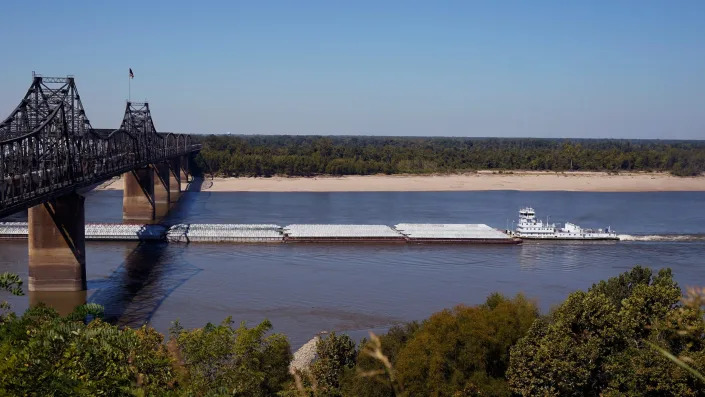
A barge tow floats past the exposed banks of the Mississippi River in Vicksburg, Mississippi, on October 11, 2022.Rogelio V. Solis/AP Photo

For the past month, though, the water has dwindled so low that ships are getting stuck in the mud and sandbars at the river bottom. The Coast Guard imposed new restrictions on how low ships and barges can sit in the water. The price of shipping goods along the river skyrocketed, The Wall Street Journal reported on Friday, and the US Army Corps of Engineers (USACE) began emergency dredging to deepen the river at more than a dozen key choke points, where a backup of about 2,000 barges built up.

A NASA satellite image from October 7 shows the parched river, with barges queued up along its shorelines.

satellite image mississippi river low levels with dry banks exposed barges lined up along shores
An image from a Landsat satellite shows the parched Mississippi River north of Vicksburg, Mississippi, on October 7, 2022.NASA Earth Observatory/USGS Landsat

“This is the most severe we’ve ever seen in our industry in recent history,” Mike Ellis, the CEO of American Commercial Barge Line, told CNBC on Wednesday.

satellite image mississippi river with arrows pointing to barges lined up on shore
A close look at the satellite image reveals barges waiting on the river’s shores.NASA Earth Observatory/USGS Landsat

“That’s a significant impact to our supply chain,” Ellis said, adding, “We can’t get the goods there.”

satellite image mississippi river with arrows pointing to barges lined up on shore
Even more barges were waiting in another part of the satellite image.NASA Earth Observatory/USGS Landsat

The water receded so much that it revealed human remains and a 200-year-old shipwreck along the river’s new banks. In Missouri, people are walking across the dry, exposed riverbed to an island that’s normally only accessible by boat.

man looks at wooden shipwreck on banks of low river waters
A man walking along the Mississippi River in Baton Rouge, Louisiana, stops to look at a shipwreck revealed by the low water level on October 17, 2022.Sara Cline/AP Photo

On the Louisiana coast, the river is so low that ocean water from the Gulf of Mexico began pushing upstream. USACE is racing to build a 1,500-foot-wide underwater levee to prevent saltwater from creeping further up the river, where it could contaminate drinking water, CNN reported on Tuesday. Already, there’s a drinking water advisory in effect for the coastal region of Plaquemines Parish.

Drought is drying the Mississippi River to record lows
paddlewheel boat full of windows passes between two bridges with low water on mississippi river
A passenger paddle wheeler passes between the river bridges in Vicksburg, Mississippi, on October 11, 2022.Rogelio V. Solis/AP Photo

Just a few months ago, the Mississippi River basin was flooding. This summer, historic rainfall caused flash flooding and overflowing rivers in Kentucky, St. Louis, Missouri, parts of Illinois, and Jackson, Mississippi.

Despite these extreme sporadic rainfall events, overall, the Midwest is in an abnormal drought. The Ohio River Valley and the Upper Mississippi aren’t getting enough rain to feed the giant river.

us drought map october 11 2022
US Drought Monitor

Up and down the Mississippi, waters have dropped to levels approaching the record low set in 1988. In Memphis, Tennessee, the waters plunged below that record on Monday, according to data from the National Weather Service.

“There is no rain in sight, that is the bottom line,” Lisa Parker, spokeswoman for the USACE Mississippi Valley Division, told the Journal. “The rivers are just bottoming out.”

dock full of boats sits on mud with river waters receding in the background
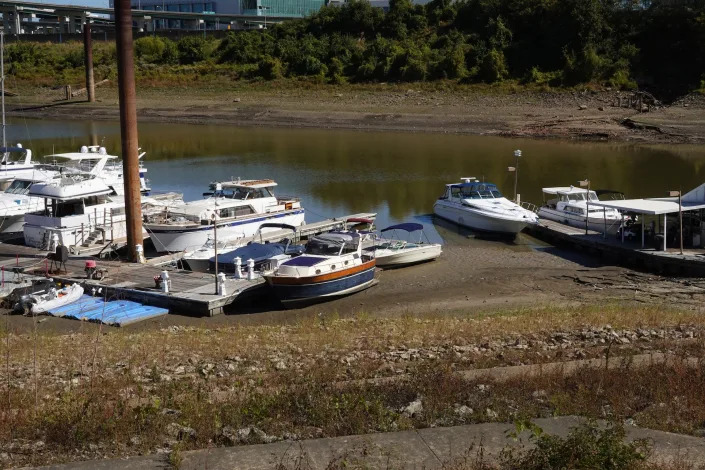
Boats rest in mud at Mud Island Marina as the water on the Mississippi River continues to recede in Memphis, Tennessee, on October 19, 2022.Scott Olson/Getty Images

Scientists must conduct rigorous analysis to attribute any single event to climate change. However, this year’s extreme conditions of both drought and floods is consistent with what scientists have been predicting and observing: Rising global temperatures are driving more weather variability in the central US, fueling both more severe droughts and one-off rainfall events.

That’s because climate change, driven by all the greenhouse gasses that humans have released into the atmosphere, is changing the planet’s water cycle. Rising temperatures are increasing water evaporation and changing the atmospheric and ocean currents that distribute moisture across the globe.

Droughts are unearthing relics and remains of the past
wooden remains of a ship in dry dirt near green grass and trees
The remains of a ship lay on the banks of the Mississippi River after recently being revealed due to the low water level, in Baton Rouge, Louisiana, on October 17, 2022.Sara Cline/AP Photo

The severe drought along the river is so intense that it uncovered a centuries-old shipwreck. In early October, low water levels revealed the old sunken ship along the banks of the Mississippi River in Baton Rouge, Louisiana. Archaeologists believe these remains are from a ferry that sunk in the late 19th or early 20th century, The Associated Press reported.

Though this is the first time the ship has been fully exposed, it’s not a new discovery. Small parts of the vessel emerged from low waters in the 1990s.

“At that time the vessel was completely full of mud and there was mud all around it so only the very tip tops of the sides were visible,” Chip McGimsey, Louisiana’s state archaeologist, told the AP. “They had to move a lot of dirt just to get some narrow windows in to see bits and pieces,” McGimsey said.

aerial photo show long wooden shipwreck on dry banks of low green river
A shipwreck is exposed along the banks of the Mississippi River due to low water levels, in Baton Rouge, Louisiana, on October 18, 2022.Stephen Smith/AP Photo

McGimsey thinks the ship could be the Brookhill Ferry, which carried people and possibly horse-drawn wagons across the Mississippi, until it sunk in a storm in 1915, according to news stories from the State Times archives.

The river’s receding waters also led to a more gruesome discovery. On Saturday, a Mississippi woman found human remains while searching for rocks with her family on the banks of the drought-stricken river. The remains included a lower jawbone, rib bones, and some unidentified bone pieces, Scotty Meredith, Coahoma County’s chief medical examiner, told CNN.

“Because these water levels are so low that we knew it was only a short matter of time before human remains were found,” Crystal Foster, the woman who found the remains, told WMC.

They are the latest in a bevy of discoveries to surface from receding waters. Over the summer, multiple set of remains were found in Nevada’s Lake Mead, which fell to historically low levels amid climate change-fueled drought.

But it’s not all bad news. Shrinking bodies of water could be a boon for experts tasked with solving missing persons cases, according to Jennifer Byrnes, a forensic anthropologist who consults with the Clark County coroner’s office, which reviews deaths in Lake Mead.

“A big body of water disappearing is going to help us, from a forensic perspective,” Byrnes told Insider.

Correction: October 21, 2022 —A photo caption in an earlier version of this story misstated the location of Vicksburg. The city is in Mississippi, not Louisiana.

Michigan family mourns loved one who came to Naples to help, acquires deadly infection

Naples Daily News

Michigan family mourns loved one who came to Naples to help, acquires deadly infection

Liz Freeman, Naples Daily News – October 20, 2022

A Michigan man who came to Naples to help a friend in the aftermath of Hurricane Ian died from a deadly bacteria that lives in standing water.

James Hewitt, of Jenison, Mich., fell in the water while helping a friend with his boat and he scratched his leg, according to FOX 17 in western Michigan.

He put anti-bacteria ointment on the wound and thought that was enough, his fiancé, Leah Dalano, told the news station.

Read more: Marco Island works fast to rebuild after Hurricane Ian

Ian damage: Damage from Hurricane Ian at $2.2 billion in Collier; more than 3,500 buildings face major damage

Also: Collier County beach advisories ending but debris remains hazardous from Ian

“He just helped so many people, that’s just what he wanted to do,” Delano told FOX17.

The hull of a sail boat destroyed by Hurricane Ian sits among other debris by Naples Bay near 10th Avenue South in Naples, FL, on Tuesday, October 4, 2022.

Hewitt went to a hospital after his leg had become swollen and he was in pain.

That’s when doctors diagnosed the infection as vibrio vulnificus, a bacteria found in warm salty or brackish waters that can enter the body through open wounds.

“It goes after your vital organs and it leaves you with horrible blisters near the area,” Delano told FOX 17.  “He got scratched on his leg and it was unrecognizable.”

Ribbons on cars: SWFL residents finding ribbons, markings on their damaged homes in Hurricane Ian aftermath

One of his sons, Kendall Smoes, posted on his Facebook page five days ago that his father fought hard but died peacefully with his family and his fiancé by his side. Smoes could not be reached for comment.

The state Department of Health in Collier put out an advisory Oct. 4 about the danger of vibrio vulnificus and how the bacteria can grow quickly. Sewage spills in coastal waters caused by Ian can increase the bacteria levels.

“Vibrio vulnificus can cause and infection of the skin when open wounds are exposed to warm sea water,” the advisory said. “These infections may lead to skin breakdown and ulcers. Anyone can get vibrio vulnificus infection; however infections can be severe for people with weakened immune systems, especially people who have chronic liver disease or take medications that lower the body’s ability to fight germs.”

Since the beginning of 2022, there have been three cases in Collier and 28 in Lee County. Statewide there have been 64 cases, according to the state health department’s reportable disease website.

There is one case of vibrio vulnificus reported this month in Collier that is tied to Ian, according to Kristine Hollingsworth, spokeswoman for the state health department in Collier

She could not disclose details. It is unrelated to the recent vibrio vulnificus death of Hewitt, who came to Naples from Michigan.

“The person from Michigan would count as a case for Michigan (state of residency), even though we did the investigation,” she said.

Vibrio vulnificus can invade the bloodstream, causing a severe life-threatening illness with symptoms like fever, chills, decreased blood pressure (septic shock), and blistering skin lesions.

It does not spread person-to-person. If someone is concerned that they may have been exposed to vibrio vulnificus and experiencing symptoms, they should seek medical care.

For more information, go to the Florida Department of Health at floridahealth.gov/diseases-and-conditions/vibrio-infections/vibrio-vulnificus/index.html

Study: Cancer-causing gas leaking from CA stoves, pipes

Associated Press

Study: Cancer-causing gas leaking from CA stoves, pipes

Drew Costley – October 20, 2022

Gas stoves in California homes are leaking cancer-causing benzene, researchers found in a new study published on Thursday, though they say more research is needed to understand how many homes have leaks.

In the study, published in Environmental Science and Technology on Thursday, researchers also estimated that over 4 tons of benzene per year are being leaked into the atmosphere from outdoor pipes that deliver the gas to buildings around California — the equivalent to the benzene emissions from nearly 60,000 vehicles. And those emissions are unaccounted for by the state.

The researchers collected samples of gas from 159 homes in different regions of California and measured to see what types of gases were being emitted into homes when stoves were off. They found that all of the samples they tested had hazardous air pollutants, like benzene, toluene, ethylbenzene and xylene (BTEX), all of which can have adverse health effects in humans with chronic exposure or acute exposure in larger amounts.

Of most concern to the researchers was benzene, a known carcinogen that can lead to leukemia and other cancers and blood disorders, according to the National Cancer Institute.

The finding could have major implications for indoor and outdoor air quality in California, which has the second highest level of residential natural gas use in the United States.

“What our science shows is that people in California are exposed to potentially hazardous levels of benzene from the gas that is piped into their homes,” said Drew Michanowicz, a study co-author and senior scientist at PSE Healthy Energy, an energy research and policy institute. “We hope that policymakers will consider this data when they are making policy to ensure current and future policies are health-protective in light of this new research.” 0:01 0:38 Scroll back up to restore default view.

Homes in the Greater Los Angeles, the North San Fernando Valley, and the San Clarita Valley areas had the highest benzene in gas levels. Leaks from stoves in these regions could emit enough benzene to significantly exceed the limit determined to be safe by the California Office of Environmental Health Hazards Assessment.

This finding in particular didn’t surprise residents and health care workers in the region who spoke to The Associated Press about the study. That’s because many of them experienced the largest-known natural gas leak in the nation in Aliso Canyon in 2015.

Back then, 100,000 tons of methane and other gases, including benzene, leaked from a failed well operated by Southern California Gas Co. It took nearly four months to get the leak under control and resulted in headaches, nausea and nose bleeds.

Dr. Jeffrey Nordella was a physician at an urgent care in the region during this time and remembers being puzzled by the variety of symptoms patients were experiencing. “I didn’t have much to offer them,” except to help them try to detox from the exposures, he said.

That was an acute exposure of a large amount of benzene, which is different from chronic exposure to smaller amounts, but “remember what the World Health Organization said: there’s no safe level of benzene,” he said.

Kyoko Hibino was one of the residents exposed to toxic air pollution as a result of the Aliso Canyon gas leak. After the leak, she started having a persistent cough and nosebleeds and eventually was diagnosed with breast cancer, which has also been linked to benzene exposure. Her cats also started having nosebleeds and one recently passed away from leukemia.

“I’d say let’s take this study really seriously and understand how bad (benzene exposure) is,” she said.

The real story behind America’s population bomb: Adults want their independence

USA Today

The real story behind America’s population bomb: Adults want their independence

Clay Routledge and Will Johnson – October 12, 2022

Declining birth rates are a major concern for the United States and many countries around the world, so we – an expert in existential psychology and an expert in pulsing public opinion – surveyed the Americans choosing not to have children to learn the reasons why.

Americans are having fewer children than are needed to keep population numbers stable.

Low birth rates are not only an American problem. In 2020, researchers at the University of Washington’s Institute for Health Metrics and Evaluation projected that the global fertility rate will drop below 1.7 by the end of this century. And countries such as Italy, South Korea, Spain and Thailand will lose more than half their population within the lifetimes of children being born this year.

Fear of not just climate change and affordable housing

Much of the conversation in the United States about this issue has focused on fears about the future of the world or major economic challenges. For instance, the threat of climate change and the affordability of housing are frequently referenced as reasons that Americans don’t want to have kids.

While those are concerns of course, when you look at the data, family planning appears to be influenced more by people’s personal views about the independent life they want to live than their worries about potential environmental or economic issues.

This has important implications for how we as a nation approach the demographic challenge of declining birth rates.

A Harris Poll found that of those without children, about half do not want to have a child in the future, while 20% remain unsure. The only factor that the majority (54%) of Americans who don’t want to have kids endorsed as influencing their decision was maintaining personal independence.

Specifically, we surveyed a representative sample of just over 1,000 U.S. adults about their future family planning. Of those without children, about half (52%) do not want to have a child in the future, while 20% remain unsure.

We then asked these individuals whether their decision to not have children was influenced by a wide range of factors. Only 28% of them reported that climate change influenced their decision to not have kids. Similarly, only 33% indicated that housing prices influenced their decision.

Other factors we asked about including the political situation in the United States (31%), safety concerns (31%), personal financial situation (46%) and work-life balance (40%) were endorsed by less than half of respondents.

The only factor that the majority (54%) of Americans who don’t want to have kids endorsed as influencing their decision was maintaining personal independence.

Chrissy Teigen’s Q&A with Feeding America: How can we help children who are going hungry?

Desire for personal independence is most powerful

Moreover, since respondents were able to indicate multiple reasons for not having kids, we also asked them which of those factors most influenced their decision. Further suggesting that this decision is more about personal preferences than other factors, we found that maintaining personal independence was reported as the most influential factor for more respondents than any other factor; 43% of those who considered independence to be a factor indicated that it was the most influential reason for not having kids.

For comparison, only 26% of those who considered climate change when deciding whether to have children reported that it was the most influential reason and only 9% of those who considered housing prices indicated such.

Americans may have multiple reasons for opting out of parenting, but their desire for personal independence is the most powerful one.

Children’s mental health: Alarm on children’s mental health has been ringing for decades. Too few have listened.

It is also worth noting that men and women were generally similar in their reasoning; 53% of females and 55% of males reported that their desire to maintain their personal independence influenced their decision to not have children. No other reason for not having kids was cited by a majority of men or women.

We shouldn’t oversimplify the story of why more and more Americans are choosing to not start families. It is undoubtedly complex and involves facets that public opinion surveys can’t fully capture. However, our results have important implications for cultural and political discussions around this issue.

Changes in public policy may not help

Perhaps most important, our findings suggest that public policy solutions are unlikely to have much impact on birth rates. Because Americans who are opting out of having children are more influenced by their desire to maintain their personal independence than concerns about climate change or affordable housing, or other issues such as work-life balance and safety, efforts to promote a more pro-natal society will need to be more cultural in nature.

More specifically, these efforts will need to address psychological needs related to individuals’ life goals and priorities.

How do we change people’s attitude about how children will affect their lives if they privilege personal freedom over other ideals? A good place to start is to focus on one of the most fundamental psychological needs, the need for existential meaning.

Humans are highly motivated to perceive their lives as meaningful. And it is when they perceive their lives as full of meaning that they are most mentally healthy, resilient, goal-driven, self-disciplined and self-reliant. In this way, meaning can be thought of as a key ingredient to achieving personal independence.

The Americans concerned about how having children may affect their personal independence may not realize that meaning is so empowering and that family is a fundamental source of meaning. For instance, surveys find that when people are asked what makes their lives feel meaningful, the most common response is family.

In addition, studies find that parents report higher levels of meaning than adults without children and have a greater sense of meaning when they are taking care of their children than when they are engaged in other activities.

Goldie Hawn on mental health issues: ‘Don’t turn a blind eye’ to kids

Cultural narratives that treat parenting as a threat to personal independence and a roadblock to a fulfilling life may contribute to declining birth rates more than many realize.

There are of course environmental, economic and other challenges that can make people worried about bringing another human into this world and that can make raising children difficult.

But this is not new. For much of our history, most humans lived far more perilous lives than we live today. Our challenge is less about our material conditions and more about our mindset.

If we want a world with more children, we are going to have to convince people that having and raising kids is a critical ingredient of, not a barrier to, the good life.

Republicans Plan to Use Debt Limit Leverage to Reduce Social Security, Medicare: Report

The Fiscal Times

Republicans Plan to Use Debt Limit Leverage to Reduce Social Security, Medicare: Report

Michael Rainey – October 12, 2022

Republicans in the House are planning to use a potential showdown next year over raising the federal debt limit to make changes in Social Security and Medicare, Bloomberg’s Jack Fitzpatrick reports.

The developing plan hinges on Republicans winning control of the House in the midterm elections, an outcome that is looking likely. Four GOP lawmakers who are vying for leadership of the House Budget Committee in the event of a Republican victory told Fitzpatrick that the need to raise the debt ceiling could give them the leverage they need to force Democrats to make concessions.

“The debt limit is clearly one of those tools that Republicans — that a Republican-controlled Congress — will use to make sure that we do everything we can to make this economy strong,” Rep. Jason Smith (R-MO), the senior Republican on the current Budget Committee, said.

Republicans are still discussing exactly what changes they might try to enact. “What would we consider a win?” said Rep. Lloyd Smucker (R-PA), who is interested in the top spot on the Budget Committee. “What would we consider to be a fiscally responsible budget?”

Although the details are still up in the air, one theme is clear: House Republicans want to reduce federal spending, and the major entitlement programs are a target. Rep. Buddy Carter (R-GA) Carter said that Republicans’ “main focus has got to be on nondiscretionary — it’s got to be on entitlements.”

Shrinking the safety net: One option reportedly being discussed is raising the eligibility age for Social Security and Medicare, the two largest mandatory spending programs. Each faces financial squeezes in the coming years as the baby boomers age and continue to retire. Under current rules, the Social Security system would be forced to cut benefits starting in 2034, while Medicare could run short of funds by 2028.

Earlier this year, the Republican Study Committee released a plan to raise the eligibility age for Social Security to 70 and the eligibility age for Medicare to 67. The increases would be phased in over time and once the target is reached, the eligibility age would then be indexed to life expectancy. The lawmakers also called for increased means testing in the Medicare program, and a privatization option for Social Security.

Other options being considered include more stringent work requirements and income limits for what Smith called “welfare programs,” including the Supplemental Nutrition Assistance Program more commonly known as food stamps. And new caps on discretionary spending could limit spending increases over 10 years.

One thing that won’t be cut: defense spending. Rep. Jodey Arrington (R-TX) told Bloomberg that he wants to cut nondefense spending in order to provide more money for the military.

Willing to risk “catastrophe”? Republicans say they are leery about pushing too far in their demands, but many experts think that any effort to use the debt limit as leverage in negotiations is unacceptably risky. Treasury Secretary Janet Yellen has warned that defaulting on U.S. debt payments — which would occur if the U.S. failed to raise the debt ceiling — would cause a “catastrophe” in the global economy.

Speaker Nancy Pelosi (D-CA) accused the GOP of taking huge risks in order to cut important social programs. “House Republicans are openly threatening to cause an economic catastrophe in order to realize their obsession with slashing Medicare and Social Security,” a Pelosi spokesperson told Bloomberg. “As House Republican leaders’ own words constantly reveal, dismantling the pillars of American seniors’ financial security is not a fringe view in the extreme MAGA House GOP, it is a broadly held obsession at the core of their legislative agenda.”

House Budget Committee Chair John Yarmuth (D-KY) also criticized Republican plans. “Holding the full faith and credit of the United States hostage to implement an extreme and unpopular agenda is not governing, it’s desperation,” Yarmuth said in a statement. “Congressional Republicans are so hellbent on gutting Social Security and ending Medicare as we know it that they are willing to risk economic catastrophe to get it done. This is a desperate attempt to shower the wealthy and big corporations with even more tax giveaways by intentionally sacrificing the needs of American families.”

Democrats do have one option for disarming Republicans ahead of a debt ceiling showdown: They could attempt to raise the ceiling on their own during the lame-duck session at the end of the year, potentially denying the GOP the use of that weapon. But both Yarmuth and Sen. Tim Kaine (D-VA) told Bloomberg there has been no discussion among Democrats about such a plan.

The bottom line: Taking a page from the tea party playbook from a decade ago, expect to see Republicans attempting to force spending reductions in the next Congress — reductions that could involve fundamental changes in the way the country’s top safety net programs operate.

Slavery is not gone, it has just moved out to sea

Yahoo! News

Slavery is not gone, it has just moved out to sea

Ian Urbina, Outlaw Ocean Project, Contributor – October 10, 2022

Workers on a fishing ship.
Cambodian migrant workers on a Thai fishing ship wait during an inspection. (Fábio Nascimento/The Outlaw Ocean Project, Thailand)

While forced labor still exists throughout the world, one place where it’s especially pervasive is the South China Sea — especially in the Thai fishing fleet, according to a 2016 investigation by the New York Times. Partly this is because in a typical year, Thailand’s fishing industry is short about fifty thousand mariners, according to the U.N. in 2014. As a result, tens of thousands of migrants from Cambodia, Laos and Myanmar are whisked into Thailand each year to make up this chronic shortfall. Then, unscrupulous captains buy and sell the men and boys like chattel.

With fewer fish close to shore, maritime labor researchers predict that more boats will resort to venturing farther out to sea, making the mistreatment of migrants more likely. The work aboard the fishing boats is brutal. And in this bloated, inefficient and barely profitable national fleet at a time of rising fuel prices, captains require crew members to simply do what they are told, and have little patience for complaints, no matter how long the hours, how little the food, or how paltry the pay. In short, these captains rely on sea slaves.

The Outlaw Ocean Project, a nonprofit journalism organization based in Washington, D.C., got onboard a Thai distant-water vessel that uses enslaved labor. There, three dozen Cambodian boys and men worked barefoot all day and into the night on the deck of a purse seiner fishing ship.

The third episode of the podcast series “The Outlaw Ocean,” from CBC Podcasts and the L.A. Times, tells the harrowing stories of sea slavery.

Rain or shine, shifts were between 18 and 20 hours long. At night, the crew members cast their nets when the small silver fish they target — mostly jack mackerel and herring — are more reflective and easier to spot in darker waters. During the day, when the sun is high, temperatures topped 100 degrees Fahrenheit, but the crew members worked nonstop. Drinking water was tightly rationed. If they were not fishing, the workers sorted their catch and mended their nets, which are prone to ripping.

One boy, his shirt smudged with fish guts, proudly showed off his missing two fingers, severed by a net that had coiled around a spinning crank. Cre members’ hands, which virtually never fully dried, had open wounds, slit from fish scales and torn from the nets’ friction. Infections are constant. Captains never lack amphetamines to help the crews work longer, but they rarely stock antibiotics for infected wounds.

A Cambodian worker on a Thai fishing ship.
A Cambodian worker on a Thai fishing ship. (Fábio Nascimento/The Outlaw Ocean Project, Thailand)

On boats like these, deckhands are often beaten for small transgressions, like fixing a torn net too slowly or mistakenly placing a mackerel into a bucket of sablefish. Dispatched into the unknown, they are beyond where society could help them, usually on so-called ghost ships — unregistered vessels that the Thai government has no ability to track. Deckhands typically do not speak the language of their Thai captains, do not know how to swim, and, being from inland villages, sometimes have never seen the sea before.

Virtually all of the crew has a debt to clear, part of their indentured servitude, a “travel now, pay later” labor system that requires working to pay off the money they often had to borrow to sneak illegally into a new country. The debt just becomes more elusive once they leave land.

There is a modern assumption, especially in the West, that we got rid of slavery. But debt bondage is still very much present. The Cambodian boys and men who are held captive are killed if they try to escape. This is what modern-day slavery looks like. Until we modernize our understanding of that, we won’t know how to identify it, much less do anything about it.

(Ian Urbina is the director of the Outlaw Ocean Project, a nonprofit journalism organization based in Washington, D.C., that focuses on environmental and human rights concerns at sea globally)

Patients in charge of the asylum: Another Challenge to New York’s Gun Law: Sheriffs Who Won’t Enforce It

The New York Times.

Another Challenge to New York’s Gun Law: Sheriffs Who Won’t Enforce It

Jesse McKinley and Cole Louison – October 9, 2022

Sheriff Robert Milby in his office in Lyons, N.Y., Sept. 15, 2022. (Lauren Petracca/The New York Times)

LYONS, N.Y. — Robert Milby, Wayne County’s new sheriff, has been in law enforcement most of his adult life, earning praise and promotions for conscientious service. But recently, Milby has attracted attention for a different approach to the law: ignoring it.

Milby is among at least a half-dozen sheriffs in upstate New York who have said they have no intention of aggressively enforcing gun regulations that state lawmakers passed last summer, forbidding concealed weapons in so-called sensitive areas — a long list of public spaces including, but not limited to, government buildings and religious centers, health facilities and homeless shelters, schools and subways, stadiums and state parks, and, of course, Times Square.

“It’s basically everywhere,” said Milby, in a recent interview in his office in Wayne County, east of Rochester. “If anyone thinks we’re going to go out and take a proactive stance against this, that’s not going to happen.”

On Thursday, a U.S. District Court judge blocked large portions of the law, dealing a major blow to lawmakers in Albany who had sought to blaze a trail for other states after the Supreme Court in June struck down a century-old New York law that had strictly limited the carrying of weapons in public. Between the court challenge and the hostility of many law enforcement officers, New York’s ambitious effort could be teetering.

The judge, Glenn T. Suddaby, agreed to a three-day delay of his order to allow an emergency appeal to a higher federal court. But even before Suddaby ruled, a collection of sheriffs from upstate New York were already saying they would make no special effort to enforce the law, citing lack of personnel, an overbroad scope and possible infringements on the Second Amendment.

Nationwide, conservative sheriffs have been at the front line of an aggressive pushback on liberal policies — often framing themselves as “constitutional sheriffs,” or as self-declared arbiters of any law’s constitutionality. Sheriffs in other states have also been part of efforts to prove a fallacious conspiracy theory that former President Donald Trump won the 2020 election.

In New York, dissent has walked a fine line between loud complaints and winking resistance, including pledges of selective — and infrequent — enforcement.

“I have to enforce it because I swore to uphold the laws, but I can use as much discretion as I want,” said Richard C. Giardino, the Republican sheriff in Fulton County, northwest of Albany. “If someone intentionally flouts the law, then they’re going to be handled one way. But if someone was unaware that the rules have changed, then we’re not going to charge someone with a felony because they went into their barbershop with their carry concealed.”

Such criticism has been heard from Greene County, in the Hudson Valley, to Erie County, home to Buffalo, the state’s second-largest city, as well as from groups like the New York State Sheriffs’ Association, which called the new law a “thoughtless, reactionary action” that aims to “restrain and punish law-abiding citizens.”

“We will take the complaint, but it will go to the bottom of my stack,” said Mike Filicetti, the Niagara County sheriff, who appends a Ronald Reagan quote to his emails. “There will be no arrests made without my authorization and it’s a very, very low priority for me.”

The law took effect Sept. 1, and, at least anecdotally, has been used only sparingly since. Jeff Smith, the sheriff in mostly rural Montgomery County, west of Albany, said his office has had no calls for enforcement of the new law, noting that “almost every household” in his jurisdiction had some sort of gun.

Smith, a Republican, said he understands the motives of lawmakers to quell violence and mass shootings, but that the gun law inadvertently targeted lawful gun owners.

“The pendulum swung way too far,” he said.

An element of the New York law makes it a crime to carry a firearm onto any private property, including homes, unless there is “clear and conspicuous signage” indicating that the owner allows such weapons. Some sheriffs have printed their own signs and distributed them to gun-friendly businesses and residents.

“I don’t think you could find one case in this country, in United States history, where a sign said ‘SCHOOL ZONE NO GUNS PERMITTED,’ and it stopped an active shooter,” said Giardino.

For supporters of the law, the opposition is insincere, considering that sheriffs’ demands for law and order are often coupled with complaints that the state is in disarray, that crime is rampant and that the Legislature has empowered lawbreakers.

“To turn around and say, ‘For the laws that we don’t like, or we may disagree with politically, we will refuse to enforce,’ to me is the height of hypocrisy,” said state Sen. Zellnor Myrie, a Brooklyn Democrat who voted for the bill.

John Feinblatt, the president of Everytown for Gun Safety, said sheriffs weren’t just endangering the public, they were also “endangering their colleagues in law enforcement.”

Myrie added that if sheriffs are angry, they should direct their ire at the Supreme Court, noting that the majority decision in the case, New York State Rifle and Pistol Association v. Bruen, was written by Justice Clarence Thomas, an avowed conservative — and specifically noted a historical basis for restrictions in “sensitive places.”

Kelly Roskam, the director of law and policy at the Johns Hopkins Center for Gun Violence Solutions, said that the Supreme Court left many unsettled questions that lower courts must address. One particular challenge is a lack of clarity in the court’s test for constitutionality: whether a sensitive place is identical to or sufficiently similar to one that existed at the time of the Second Amendment’s adoption in the late 18th century.

“We face different problems with firearms than those who ratified the Constitution did,” she said. “You’re likely to see challenges to these laws, and different judges will come to different conclusions.”

The nation has a long history of banning guns in certain places, said David Pucino, the deputy chief counsel at Giffords Law Center, which seeks to stem gun violence, with dozens of states restricting concealed weapons in places like airports, courthouses and locations that serve alcohol.

“The statements that we’ve been seeing here are ideological statements,” Pucino said of the sheriffs. “And that’s not an appropriate basis for a sheriff to enforce or not enforce laws.”

The dispute evinces a larger rift between Democratic lawmakers in Albany — heavily represented by downstate liberals — and more conservative law enforcement and elected officials upstate. The schism was intensified by the pandemic, with some sheriffs defying COVID-19 occupancy rules for Thanksgiving dinners in 2020, while other Republican county officials refused to abide by mask mandates in schools.

“The people who are doing this, a lot of them are New York City legislators and they don’t have a clue,” said Todd Hood, the sheriff of Madison County, east of Syracuse, who says that “firearms are what made our country great.”

“There are different people up here,” said Hood, a Republican. “It’s run totally different.”

Jeffrey A. Fagan, a law professor at Columbia University, said that Albany lawmakers and Gov. Kathy Hochul, a Democrat, performed a critical test of the Bruen decision’s limits, even if the law is overturned.

“What New York did in response to Bruen was just about as strong or any other state in the country,” he said. “The governor and the Legislature were sticking their chins out in service of making a very important point.”

For her part, Hochul says she and her staff consulted with a raft of state and county law enforcement officials before the gun bill’s passage. “It was an intense process, but it was necessary,” Hochul said in late August, on the eve of the law taking effect.

The rollout was not without hiccups, including concerns from some military re-enactors who have canceled events out of fear of running afoul of the new law. Officials in Adirondack Park, the 6-million-acre swath of greenery and small towns in the state’s North Country, also pressed Hochul on whether guns would be allowed there.

For his part, Milby, a Republican elected in November, reiterated that his officers, fewer than 100 in a county of nearly 100,000 people, would not be actively pursuing offenders of the new law, although they would respond to calls about concealed weapons if they came in.

More than anything, he said his office is getting “an awful lot of calls” from residents confused by the law, many of whom are “very pro-Second Amendment.”

“It’s basically been clear as mud since Sept. 1,” he said.

And as for who was to blame, Milby said the opinions in Wayne County were crystal clear long before Thursday’s decision.

“There’s a very strong sentiment in this county that the governor has just thumbed her nose at the Supreme Court, in what’s being touted as an unconstitutional conniption fit,” he said. “She’s absolutely overstepped.”

Research Shows Lung Health May Be the Number One Indicator of Living a Long, Healthy Life

Parade

Research Shows Lung Health May Be the Number One Indicator of Living a Long, Healthy Life—Here’s How To Improve Yours

Kaitlin Vogel – October 7, 2022

We all know the importance of brain health, gut health, and heart health, but when it comes to lung health, it’s probably not something many of us think too much about.

But according to research, your lung health can predict how long you live. One study that involved a 30-year follow-up found that there is a direct link between lung function and mortality.

In 1960 and 1961, researchers looked at 2,273 men and women between the ages of 15 and 96, gathering data on lifestyle, health and lung function. In 1990, a follow-up study showed which participants had died and their cause of death. Results showed that the 20 percent of men with the poorest lung function at the start of the study were more than twice as likely to have died compared to men with the best lung function. Women with the poorest lung function were more than one-and-a-half times more likely to have died.

Since lung health is key to living a long life, here are ways to keep yours healthy.

Why Lung Health Is Important

“Your lungs don’t just help you breathe—they also help to deliver oxygen to every organ in your body,” says Dr. Robert Goldber, MD, a pulmonologist with Providence Mission Hospital. “Plus, they help to remove carbon dioxide as you exhale—this is incredibly important to your overall health. And your lungs help to protect your airways from harmful irritants and substances.”

Having healthy lungs also helps to reduce your risk of developing severe complications of any illnesses that enter your respiratory system, such as the common cold, Dr. Goldberg adds. That’s why it’s important to keep them healthy by not smoking and avoiding exposure to indoor and outdoor pollutants that can cause respiratory damage, such as secondhand smoke and other chemicals. Get plenty of exercise and avoid outdoor activities on days when there is poor air quality.

Related: 13 Signs Your Lungs May Not Be Healthy

Signs of Poor Lung Health

One of the most important signs of poor lung health is having trouble breathing—this is incredibly serious, especially in older adults. It’s extremely important to contact your doctor immediately if it continues to be tough to breathe, as it could be a sign of asthma, lung cancer or chronic obstructive pulmonary disease (COPD), Dr. Goldberg explains.

COPD, which is a group of diseases including emphysema and chronic bronchitis, can cause a blockage in your airway and other breathing-related challenges.

Other poor lung health symptoms include a chronic cough or chest pain, wheezing, shortness of breath and coughing up blood. If you have any of these systems, make an appointment with your doctor, Dr. Goldberg adds.

How To Improve Your Lung Health
Steer clear of toxic pollutants

Healthy lungs can stay healthy by avoiding toxic inhalational agents including smoke, dust and other pathogens, Dr. Thomas Yadegar, MDpulmonologist, Medical Director of the ICU, Providence Cedars-Sinai Tarzana Medical Center, explains.

Engage in regular exercise and practice deep breathing techniques

Exercise and deep breathing exercises also promote healthy lung function. 4-7-8 breathing, where patients inhale deeply for four seconds, hold for seven seconds and exhale slowly for eight seconds, is a simple tool to help recruit more oxygenation, Dr. Yadegar states.

Wash your hands regularly

You can help to prevent respiratory infections, especially during cold and flu season, by regularly washing your hands with soap and water, avoiding large crowds and getting an annual flu shot, Dr. Goldberg explains. And, if do catch a cold or the flu, make sure to stay home to avoid exposing others to your illness.

Next up: The Best Foods for Healthy Lungs—And the Ones You Should Avoid

Sources
  • Chest: “Pulmonary function is a long-term predictor of mortality in the general population: 29-year follow-up of the Buffalo Health Study”
  • Dr. Robert Goldberg, a pulmonologist with Providence Mission Hospital
  • Dr. Thomas Yadegar, pulmonologist, Medical Director of the ICU, Providence Cedars-Sinai Tarzana Medical Center