I love living in Florida, but the sun-and-surf lifestyle eventually exacts a price
Ana Veciana -Suarez – October 7, 2022
For those who have spent most of their lives in Florida, as I have, the apocalyptic photos that emerged after Hurricane Ian are painfully familiar. The flooded roadways. The shattered storefronts. The flattened landscapes. The unending miles of debris. And more than 100 dead in my state alone.
I remember those horrors too well. I survived Hurricane Andrew, a Category 5, packed into a walk-in closet with seven other family members, including four terrified children. During that interminable night, I discovered that few things sound as scary as howling winds and splintering roof trusses. However, that wasn’t the worst part of the experience.
Rebuilding was. Gusts subsided and water receded but putting a life — and a home — back together took much longer. After Andrew, we were out of our house for almost seven months. The kitchen wasn’t done when we moved back, but I was desperate to return. I was very pregnant with my youngest and needed the semblance of a routine.
It would take well over a decade for my wider neighborhood to recover, and the experience marked me for life. I came away with a renewed respect for the wonder — and danger — of nature.
We’ve been through other hurricanes since 1992. Wilma, a Category 3, tore through the roof of our old house in 2005. That same year two other hurricanes — Rita and Katrina — slapped us hard, too. Then, in 2017, Irma flooded a trailer home we own on the state’s west coast. But none matched the fury of Andrew. I hope none ever do.
Nonetheless, Ian has been particularly difficult for me to process. Part of that dread, I think, is the path it was predicted to take. A son and a brother live in St. Petersburg, both a short walk from Tampa Bay. Another son lives south of Orlando. All would’ve gotten slammed had Ian not made landfall elsewhere.
They suffered minimal damage — water seeping through windows, a gate fence blown away — but nothing like the devastation in counties farther south. Some of our friends, on the other hand, weren’t so lucky. Those in Fort Myers and Naples have suffered huge property losses, and one farther inland in Bartow reported several trees down. We suspect that the quaint spots we like to visit on that side of the coast may never reopen. After all, calamities have a way of rearranging the map of entire towns.
So, yes, news of this kind should unsettle me, but there’s more to my disquiet than that. These hurricanes and several near-misses have forced me to reassess not only how I live but also where and why.
I claim residence in what one expert called “the most hurricane-ravaged state in the country.” There’s a good reason for that. We have 1,350 miles of coastline, second only to Alaska in that department. We also happen to stick out like a middle finger into warm, hurricane-feeding ocean waters. In short, we’ve got a target on our back.
That target — at least in terms of numbers — has only gotten bigger. Florida’s population has grown 60% since Hurricane Andrew, and most newcomers have settled along the coasts, where the scenery is amazing but also where hurricane forces can be most destructive. That sun-and-surf lifestyle eventually exacts a price.
Knowing this, I must ask myself the inescapable questions. Should I continue to live in a place where experiencing a monster storm (again) is just a matter of time? Are there better ways to build in the Sunshine State? How much risk am I willing to assume for a slice of paradise?
Arriving at the answers is turning out to be a lot harder than I thought.
I don’t care if Herschel Walker paid for an abortion or if he blew up the planet Alderaan
Rex Huppke, USA TODAY – October 6, 2022
There’s a report that Herschel Walker, the staunchly anti-abortion Republican running in Georgia’s Senate race, got a woman pregnant then paid for her abortion back in 2009.
Dana Loesch, a conservative radio host and former spokesperson for the National Rifle Association, put it best this week when she said: “I don’t care if Herschel Walker paid to abort endangered baby eagles. I want control of the Senate.”
Abortions are unacceptable – except for this one
Amen, sister. Abort those eagle babies! Like Loesch, I believe deeply in the sanctity of life and oppose all abortions – except for this one, which I will accept to prevent it from costing my party control of the Senate.
Republican U.S. Senate candidate Herschel Walker speaks at a rally in Athens, Ga., in May 2022.
The report came from The Daily Beast, and all they had to back it up was: a receipt from the abortion provider; a canceled check Walker sent to the woman five days after the procedure; and the get-well card Walker sent the check in. Walker denies the whole thing and claims he doesn’t know the woman, who, as The Daily Beast reported Wednesday, is also the mother of one of his children.
I’m going to have to side with Walker on this one, because I want my party in power and believe it’s a sin to use the word “hypocrisy.”
Control of the Senate is what matters here, and he played football!
As a matter of fact, I don’t think Loesch went far enough in defending Walker with her hypothetical eagle abortion clinic.
Like the many Republicans who’ve rushed in to stick up for Walker in the wake of the abortion news, I don’t care if the former football star is an ancient, trans-dimensional, shape-shifting entity of pure evil that takes the form of a clown named Pennywise and terrorizes a small town in Maine. I want control of the Senate, and I’m sure Walker regrets any past desire to feed on humans.
Republican Senate candidate Herschel Walker signs memorabilia for supporters in Columbus, Ga.
The destruction of a planet or two is fine if it leads to power
Heck, I don’t care if Walker oversaw the construction of a moon-size space station that blew up the 2-billion-person planet of Alderaan, then later got in an argument with his son and chopped his right hand off. We have to secure that Georgia Senate seat so we can stop President Joe Biden’s immoral agenda!
I’m not the least bit bothered if Walker, in the year 1219, let loose the Mongol hordes on the Khwarazmian Empire in Persia after the shah, Ala ad-Din Muhammad II, broke a treaty. Control of the Senate is of tantamount importance to the moral fabric of our nation.
Ruling Mordor isn’t so bad when you think about it
The possibility Walker may have been described in the epic Anglo-Saxon poem “Beowulf” as the monster Grendel, “accursed of God, the destroyer and devourer of our human kind,” doesn’t bother me a whip if it leads to a Republican becoming Senate majority leader. And the additional claims that he slaughtered the inhabits of the mead hall of Heorot, built by King Hrothgar? A minor detail if the power to cut corporate taxes is in play.
No, I see no logical or moral inconsistency between my firmly held religious beliefs and the lack of concern I would feel if I learned Walker had remained a noncorporeal evil for centuries before rising again in the land of Mordor and building the dark fortress Barad-dûr not far from Mount Doom. And if he gathered massive armies of orcs and trolls then tricked the elven-smith Celebrimbor into forging the Rings of Power? Well that’s a small price to pay to defeat Democratic Sen. Raphael Warnock, who is a pastor and has probably never paid to abort endangered baby eagles.
Basically, nothing matters as long as we win
The discovery that Walker is, in fact, the Dark Lord Voldemort, “He Who Must Not Be Named,” and is plotting, with the help of Death Eaters, to rid the world of Muggles, would in no way impact my support for a candidate whose qualifications include being somewhat famous.
The dark wizard Voldemort (Ralph Fiennes) lords over the wizarding world in “Harry Potter and the Deathly Hallows: Part I.”
I want control of the Senate. Getting Herschel Walker elected is key to that end. And if that means being OK finding out he once snapped his fingers while wearing the Infinity Gauntlet and instantly wiped out half of all life in the universe, well … so be it. I’m not about to let the morality I use to disguise my craven thirst for power get in the way of my craven thirst for power.
Hurricane Ian: residents return to battered homes as death toll rises
Richard Luscombe in Miami – October 6, 2022
Photograph: Rebecca Blackwell/AP
Residents of south-west Florida were on Thursday returning for a first look at damage wreaked on their homes by Hurricane Ian, as the storm’s death toll continued to rise and details emerged about the victims.
Inhabitants of Sanibel, Captiva and Pine Island were among the first to get a glimpse after authorities still searching for survivors from the 28 September storm gave the go-ahead for civilians to return.
A steady stream of residents arrived, mostly on small chartered motorboats, after sections of the Sanibel and Pine Island causeways, the only road links to the mainland, were swept away by 150mph winds and a 12ft (3.6 metres) storm surge.
“We feel, as a community, that if we leave the island, abandon it, nobody is going to take care of that problem of fixing our road in and out,” said a Pine Island resident, Leslie Arias.
The number of storm-related deaths rose to at least 101 on Thursday, eight days after the storm made landfall in south-west Florida. According to reports from the Florida medical examiners commission, 98 of those deaths were in Florida. Five people were also killed in North Carolina, three in Cuba and one in Virginia.
Ian is the second-deadliest storm to hit the mainland US in the 21st century after Hurricane Katrina, which left more than 1,800 people dead in 2005. The deadliest hurricane ever to hit the US was the Galveston Hurricane in 1900 that killed as many as 8,000 people.
But Ian’s fury makes it the deadliest storm to strike Florida since the Labor Day hurricane of 1935 claimed more than 430 lives.
The oldest victim of Ian was a 96-year-old man found trapped under a car in high water in Charlotte county, the medical examiners’ report said.
A 73-year-old man in Lee county “shot himself after seeing property damage due to the hurricane”.
In Manatee county, a 71-year-old woman died after being blown over: “The decedent was outside her residence smoking a cigarette when a gust of wind from the hurricane blew her off the porch and she subsequently struck her head on a concrete step.”
Most victims drowned, underlining that the storm surge was the deadliest part of the hurricane.
Not included in the report are five deaths in North Carolina, one in Virginia and three in Cuba, when Ian swept across the west of the island two days before gaining power in the warm waters of the Gulf of Mexico and slamming into the south-western Florida coast.
Authorities in Florida have been criticized for issuing evacuation orders too late, although Ron DeSantis, the Republican governor, and county officials have defended their actions.
DeSantis has claimed, falsely, that Lee county was not yet included in the National Hurricane Center’s (NHC) forecast track 72 hours before the storm hit, and that it was predicted instead to strike Tampa, about 120 miles north.
The NHC “cone of uncertainty” included parts of Lee county during that time frame, including Cayo Costa, where Ian made first landfall.
More than 215,000 customers remained without power across Florida, authorities said, while thousands of workers sought to repair grids.
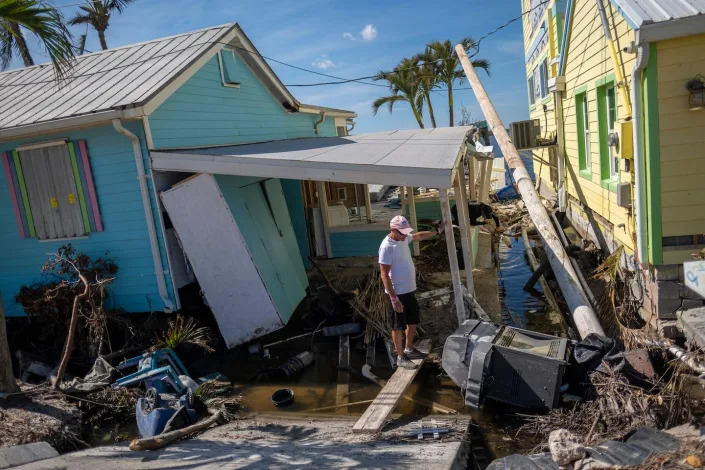
On Pine Island, piles of rubble and debris have replaced many homes, power lines and wooden poles littering yards and roadways.
In a visit to the worst-hit areas on Thursday, Joe Biden promised the resources of the federal government would be available “as long as it takes”. Some estimates have calculated the damage at $55bn.
The president met local residents, small business owners and relief workers in Fort Myers, praising the cooperation between state and federal agencies.
Noting that the recovery could take months or years, he said: “The only thing I can assure you is that the federal government will be here until it’s finished. After the television cameras have moved on, we’re still going to be here with you.”
DeSantis, seen as a potential rival to Biden in the 2024 presidential election, also struck a conciliatory tone.
“We are cutting through the red tape and that’s from local government, state government, all the way up to the president. We appreciate the team effort,” he said.
Hurricane risk might seem like the obvious problem, but there is a more insidious driver in this financial train wreck.
Finance professor Shahid Hamid, who directs the Laboratory for Insurance at Florida International University, explained how Florida’s insurance market got this bad – and how the state’s insurer of last resort, Citizens Property Insurance, now carrying more than 1 million policies, can weather the storm.
What’s making it so hard for Florida insurers to survive?
One is the rising hurricane risk. Hurricanes Matthew (2016), Irma (2017) and Michael (2018) were all destructive. But a lot of Florida’s hurricane damage is from water, which is covered by the National Flood Insurance Program, rather than by private property insurance.
Another reason is that reinsurance pricing is going up – that’s insurance for insurance companies to help when claims spike.
But the biggest single reason is the “assignment of benefits” problem, involving contractors after a storm. It’s partly fraud and partly taking advantage of loose regulation and court decisions that have affected insurance companies.
It generally looks like this: Contractors will knock on doors and say they can get the homeowner a new roof. The cost of a new roof is maybe $20,000-$30,000. So, the contractor inspects the roof. Often, there isn’t really that much damage. The contractor promises to take care of everything if the homeowner assigns over their insurance benefit. The contractors can then claim whatever they want from the insurance company without needing the homeowner’s consent.
If the insurance company determines the damage wasn’t actually covered, the contractor sues.
So insurance companies are stuck either fighting the lawsuit or settling. Either way, it’s costly.
Other lawsuits may involve homeowners who don’t have flood insurance. Only about 14% of Florida homeowners pay for flood insurance, which is mostly available through the federal National Flood Insurance Program. Some without flood insurance will file damage claims with their property insurance company, arguing that wind caused the problem.
How widespread of a problem are these lawsuits?
Overall, the numbers are pretty striking.
About 9% of homeowner property claims nationwide are filed in Florida, yet 79% of lawsuits related to property claims are filed there.
The legal cost in 2019 was over $3 billion for insurance companies just fighting these lawsuits, and that’s all going to be passed on to homeowners in higher costs.
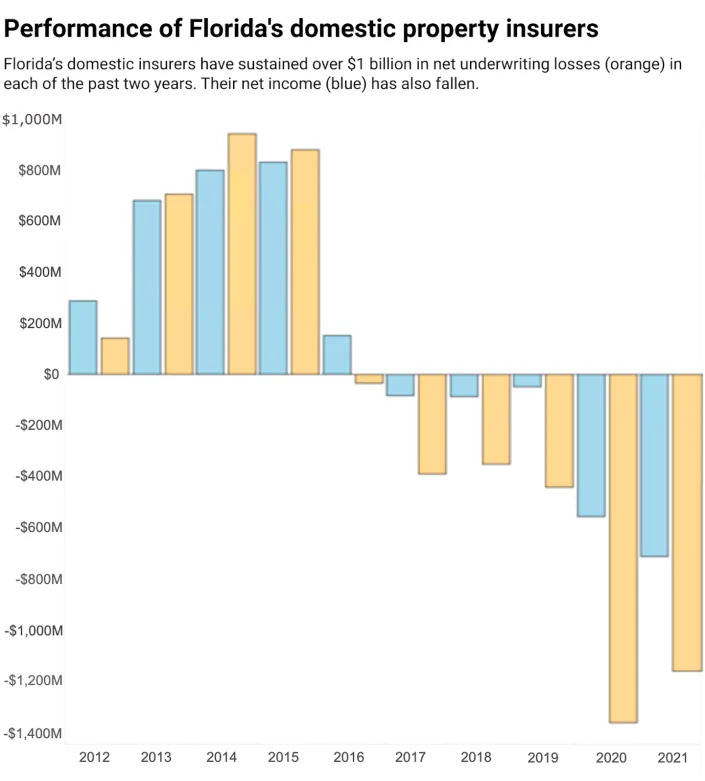
Insurance companies had a more than $1 billion underwriting loss in 2020 and again in 2021. Even with premiums going up so much, they’re still losing money in Florida because of this. And that’s part of the reason so many companies are deciding to leave.
Assignment of benefits is likely more prevalent in Florida than most other states because there is more opportunity from all the roof damage from hurricanes. The state’s regulation is also relatively weak. This may eventually be fixed by the legislature, but that takes time and groups are lobbying against change. It took a long time to pass a law saying the attorney fee has to be capped.
Thirty more are on the Florida Office of Insurance Regulation’s watch list. About 17 of those are likely to be or have been downgraded from A rating, meaning they’re no longer considered to be in good financial health.
‘Forever chemicals’ in deer, fish challenge hunters, tourism
Patrick Whittle – October 5, 2022
A 10-point white-tailed deer walks through the woods in Freeport, Maine, on Nov. 10, 2015. Wildlife agencies are finding elevated levels of PFAS chemicals, also called “forever chemicals,” in game animals such as deer, prompting new restrictions on hunting and fishing in some parts of the country. (AP Photo/Robert F. Bukaty, File)This photo provided by the National Wildlife Federation shows a sign warning hunters not to eat deer because of high amounts of toxic chemicals in their meat, in Oscoda, Mich., March 26, 2021. Wildlife agencies in some parts of the country are finding elevated levels of PFAS chemicals in game animals such as deer, prompting new restrictions on hunting and fishing. (Photo by Drew Younge Dyke, National Wildlife Federation via AP)
PORTLAND, Maine (AP) — Wildlife agencies in the U.S. are finding elevated levels of a class of toxic chemicals in game animals such as deer — and that’s prompting health advisories in some places where hunting and fishing are ways of life and key pieces of the economy.
Authorities have detected the high levels of PFAS, or per- and polyfluoroalkyl substances, in deer in several states, including Michigan and Maine, where legions of hunters seek to bag a buck every fall. Sometimes called “forever chemicals” for their persistence in the environment, PFAS are industrial compounds used in numerous products, such as nonstick cookware and clothing.
The U.S. Environmental Protection Agency launched an effort last year to limit pollution from the chemicals, which are linked to health problems including cancer and low birth weight.
But discovery of the chemicals in wild animals hunted for sport and food represents a new challenge that some states have started to confront by issuing “do not eat” advisories for deer and fish and expanding testing for PFAS in them.
“The fact there is an additional threat to the wildlife — the game that people are going out to hunt and fish — is a threat to those industries, and how people think about hunting and fishing,” said Jennifer Hill, associate director of the Great Lakes Regional Center for the National Wildlife Federation.
PFAS chemicals are an increasing focus of public health and environmental agencies, in part because they don’t degrade or do so slowly in the environment and can remain in a person’s bloodstream for life.
In Maine, where the chemicals were detected in well water at hundreds of times the federal health advisory level, legislators passed a law in 2021 requiring manufacturers to report their use of the chemicals and to phase them out by 2030. Environmental health advocates have said Maine’s law could be a model for other states, some working on their own PFAS legislation.
California Gov. Gavin Newsom, a Democrat, signed a bill in September that bans the chemicals from cosmetics sold in the state. And more than 20 states have proposed or adopted limits for PFAS in drinking water, according to the National Conference of State Legislatures.
More testing will likely find the chemicals are present in other game animals besides deer, such as wild turkeys and fish, said David Trahan, executive director of the Sportsman’s Alliance of Maine, a hunting and outdoors advocacy group.
The discovery could have a negative impact on outdoor tourism in the short term, Trahan said. “If people are unwilling to hunt and fish, how are we going to manage those species?” he said. “You’re getting it in your water, you’re getting it in your food, you’re getting it in wild game.”
Maine was one of the first states to detect PFAS in deer. The state issued a “do not eat” advisory last year for deer harvested in the Fairfield area, about 80 miles (129 kilometers) north of Portland, after several of the animals tested positive for elevated levels.
The state is now expanding the testing to more animals across a wider area, said Nate Webb, wildlife division director at the Maine Department of Inland Fisheries and Wildlife. “Lab capacity has been challenging,” he said, “but I suspect there will be more facilities coming online to help ease that burden — in Maine and elsewhere in the country.”
Wisconsin has tested deer, ducks and geese for PFAS, and as a result issued a “do not eat” advisory for deer liver around Marinette, about 55 miles (89 kilometers) north of Green Bay. The state also asked fishermen to reduce consumption of Lake Superior’s popular rainbow smelt to one meal per month.
Some chemicals, including PFAS, can accumulate in the liver over time because the organ filters the chemicals from the blood, Wisconsin’s natural resources department told hunters. New Hampshire authorities have also issued an advisory to avoid consuming deer liver.
Michigan was the first state to assess PFAS in deer, said Tammy Newcomb, senior executive assistant director for the Michigan Department of Natural Resources.
The state issued its first “do not eat” advisory in 2018 for deer taken in and near Oscoda Township. Michigan has since issued an advisory against eating organs, such as liver and kidneys, from deer, fish or any other wild game anywhere in the state. It has also studied waterfowl throughout the state in areas of PFAS surface water contamination.
The state’s expanded testing also has proven beneficial because it helped authorities find out which areas don’t have a PFAS problem, Newcomb said.
“People like to throw up their arms and say we can’t do anything about it. I like to point to our results and say that’s not true,” Newcomb said. “Finding PFAS as a contaminant of concern has been the exception and not the rule.”
The chemical has also been found in shellfish that are collected recreationally and commercially. Scientists from the Florida International University Institute of Environment sampled more than 150 oysters from around the state and detected PFAS in every one, according to their study in August. Natalia Soares Quinete, an assistant professor in the institute’s chemistry and biochemistry department, described the chemicals as “a long-term poison” that jeopardizes human health.
Dr. Leo Trasande, a professor of pediatrics at NYU Grossman School of Medicine who has studied PFAS, said the best way to avoid negative health effects is reducing exposure. But, Trasande said that’s difficult to do because the chemicals are so commonplace and long-lasting in the environment.
“If you’re seeing it in humans, you’re likely going to see the effects in animals,” he said.
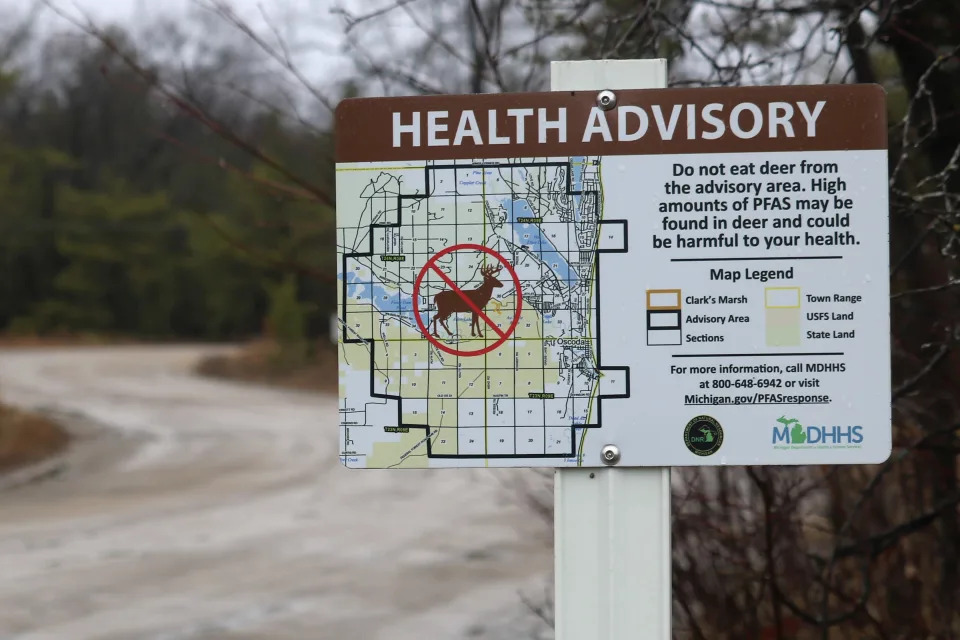
Wildlife authorities have tried to inform hunters of the presence of PFAS in deer with posted signs in hunting areas as well as advisories on social media and the internet. One such sign, in Michigan, told hunters that high amounts of PFAS “may be found in deer and could be harmful to your health.”
Kip Adams, chief conservation officer for the National Deer Association, said the discovery of PFAS in states like Maine and Michigan is very concerning to hunters.
“With the amount of venison my family eats, I can’t imagine not being able to do that,” Adams said. “To this point, everything we’ve done has been about sharing information and making sure people are aware of it.
Associated Press climate and environmental coverage receives support from several private foundations. See more about AP’s climate initiative here. The AP is solely responsible for all content.
‘Game changer’: Alzheimer’s drug lecanemab slows progression of disease in global study
Jayla Whitfield – Anderson, Nat. Reporter and Producer October 4, 2022
After losing three generations of his family to dementia, George Vradenburg co-founded UsAgainstAlzheimer’s, an organization dedicated to Alzheimer’s research.
In the past 40 years he has lost his grandmother, his mother and a sibling to the crippling disease. “And if we don’t pick up the pace on getting at this disease, it’s my kids and my grandkids that are right in the bullseye,” Vradenburg told Yahoo News. “I’m fighting for my family.”
Over 6 million Americans are living with Alzheimer’s, an incurable disease that affects the brain and causes loss of cognitive function over time. However, experts say there is hope on the horizon, after lecanemab, an experimental drug, slowed the cognitive decline of Alzheimer’s by 27% in a global clinical study.
The study was performed by two pharmaceutical research companies, Eisai and Biogen. They reported that their Clarity Ad Phase 3 clinical trial of lecanemab presented encouraging results in an 18-month trial. The clinical trial included 1,795 diverse patients with early-stage Alzheimer’s and showed “highly statistically significant reduction of clinical decline,” Eisai stated in a press release on Sept. 27.
Clinical research to develop a possible cure for Alzheimer’s and dementia in the lab. (Science Photo Library/Getty Images)
For many, this proves that the investments into dementia research are paying off. Annually, the federal government invests $3.1 billion in dementia research.
”This is a game changer. This is a drug that demonstrates in this large, diverse, phase 3 trial that by reducing amyloid and by reducing tau, there was a clinical benefit to modify the course of this disease,” Vradenburg said.
Amyloid and tau are two proteins in the brain that control thinking and memory. “This is the first time that a clinical trial has demonstrated [that] the reduction of amyloid and tau actually produces a clinical benefit,” he added. “This is historic.”
The trial also reported that 25% of the participants enrolled were from underrepresented populations. Maria Carrillo, the Alzheimer’s Association chief science officer, says diversity is a crucial factor to consider in any research. According to the Alzheimer’s Association, over 20% of Black Americans 70 and older are living with the disease, and they are twice as likely to get dementia.
“We’re very hopeful that as we get better at enrolling the right populations, as we get better at the science, we are able to actually see treatments come to the clinic and be accessible to people who may be able to benefit from them,” Carrillo said.
A man takes care of his father, who is suffering from Alzheimer’s. (Shutterstock)
While the impact of lecanemab seems positive, experts say Food and Drug Administration approval is crucial for the drug to become readily available to those who need it most.
“The company has announced that it will be filing not only with the FDA, but [also] with other countries and regulatory agencies. And we hope that soon, the FDA might have an expedited review of this drug,” Carillo explained.
In a press release, Eisai said it “aims to file for traditional approval in the U.S., and to submit marketing authorization applications in Japan and Europe by the end of Eisai FY2022, which ends on March 31, 2023.”
Biogen and Eisai have an application pending for accelerated FDA approval, and a decision is expected by early January.
Experts believe lecanemab will get FDA approval and Medicare coverage, unlike aducanumab, which is sold as Aduhelm, a prior Alzheimer’s drug from Biogen that was approved by the FDA but received limited Medicare coverage. “This drug [lecanemab] has a much larger trial, much more diverse trial, and much clearer evidence of clinical benefit,” Vradenburg explained.
But the side effects are concerning. “Lecanemab also has a similar profile of dangerous side effects related to brain swelling and brain bleeding that we see with Aduhelm, though lecanemab is probably a bit friendlier than Aduhelm on this front, in that ‘only’ 10% of patients in the high-dose groups showed these side effects [in the phase 2 trial],” Dr. Michael Greicius, a professor of neurology and neurological sciences at Stanford University in California, told Healthline.
A doctor reviewing brain scans. (Shutterstock)
If the drug is approved by the FDA, organizations like UsAgainstAlzheimer’s say they will push for Medicare coverage. “Medicare must cover it. Otherwise, we’re going to be waiting for another five or 10 years before a disease-modifying drug gets to work,” Vradenburg said. “This is an opportunity to change the course of our lives.”
But other experts raised concerns about the potential cost of the drug. Dr. Constantine Lyketsos, a psychiatrist who teaches at Johns Hopkins School of Medicine, told CNN he would be reluctant to prescribe lecanemab to a patient. “If it was a simple pill, if it wasn’t very expensive, I might,” he said.
CNN noted that aducanumab costs about $28,000 for a year of treatment. Eisai told the news outlet that lecanemab hasn’t been priced yet.
This year, more positive results are expected from additional clinical trials. In November, at a conference in San Francisco on the 15th annual clinical trials on Alzheimer’s disease, other companies working to combat the disease will share their findings. “We also expect that gantenerumab, from a company called Roche, will report next month their top level,” Carrillo said.
Several companies are researching how to stop the progression of the disease, as the number of Americans living with Alzheimer’s is projected to double, to 13 million, by 2050, according to the Alzheimer’s Association.
Even though this apparent breakthrough is not a cure, it could give those suffering with the life-threatening disease more time. “Slowing is really critical, especially earlier in the disease, when you can be more independent for a longer period of time,” Carrillo said.
Most importantly, “time with families, time to see a grandchild get married, have a bar mitzvah or confirmation — that time with family for an extra two to three years is priceless,” Vradenburg said.
Hurricane Ian aftermath: Tour of damage shows parts of Naples look like “a war zone”
Laura Layden, Naples Daily News – October 3, 2022
In a drive around the city, Naples Police Lieutenant Bryan McGinn pointed to some of the worst and costliest damage caused by Hurricane Ian.
On Friday, he whizzed around the city streets, as much as he could, driving through sludge, stopping at every dark traffic light and dodging clean-up and repair crews — and a slew of curious onlookers wanting to see the destruction for themselves.
Scene of Gulf Shore Boulevard North of stranded, flooded cars.
Sludge still filled much of the road, patio furniture lay tangled in the median, cars sat angled in front of condos, a sign of the powerful, unexpected surge that put them completely under water. A crooked boat sat in a parking lot, moved from its perch, with another halfway submerged in waters nearby.
A boat displaced from its dock on Gulf Shore Boulevard North.
Residents had started the clean-up, dragging everything from drenched carpet to soaked couches to the curb. Along with a snarl of landscaping.
Clearly, there’s much more work to be done in the Moorings, Park Shore and elsewhere in the city. With gobs of debris started to make it to the curb.
City residents are picking up the pieces from Hurricane Ian after extreme flooding.
Boats uplifted from their docks
At the Village Shops on Venetian Bay, business owners worked to deal with the mess, a stranded boat sat in the parking lot, with no name on it.
“Unfortunately, there was a lot of water surging,” McGinn said. “That storm came in real fast.”
It wasn’t just water that roared onto the shore in the city. It was loads of sand and sediment from the Gulf of Mexico and Naples Bay, which did plenty of damage of its own.
That sand and sediment turned into a slippery, sticky muck that covered city streets — and the insides of homes and businesses. Some have complained about its stench.
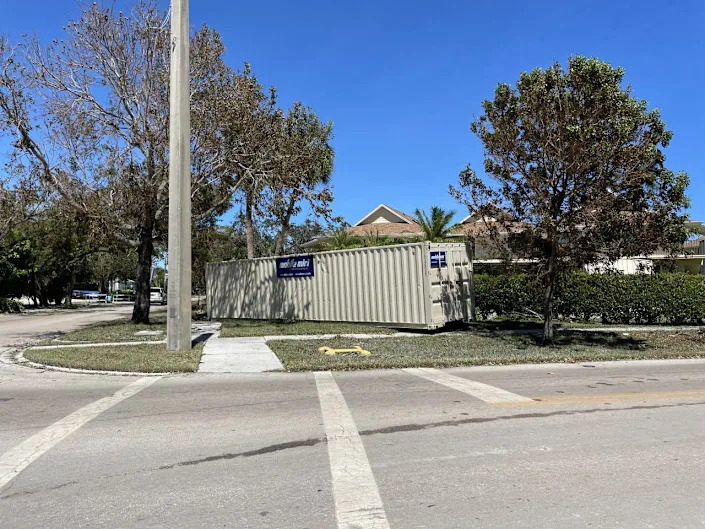
During the tour, McGinn pointed to an extra-wide, steel mobile mini storage container sitting near the intersection of 8th Street South and Broad Avenue, feet from the Cove Inn On Naples Bay, that mysteriously appeared there, likely from a construction site nearby, taking up the entire corner.
“That storage container doesn’t belong there,” he said.
Storage container deposited roadside by surging waters in Naples at 8th Street South and Broad Avenue South.
Its weight is in the thousands of pounds, showing the power of the surge.
In Crayton Cove, McGinn took a turn toward the City Dock, rebuilt a few years ago at a cost of $7 million. He happily reported it fared well.
Businesses are picking up the pieces
Nearby businesses, however, weren’t as lucky, including The Dock, a Naples landmark. It’s still standing, but crews worked busily to clean up its insides, which clearly saw a heavy impact from the storm surge.
Across the way, Napoli On The Bay, didn’t look so good either, with a water line stain halfway up the door.
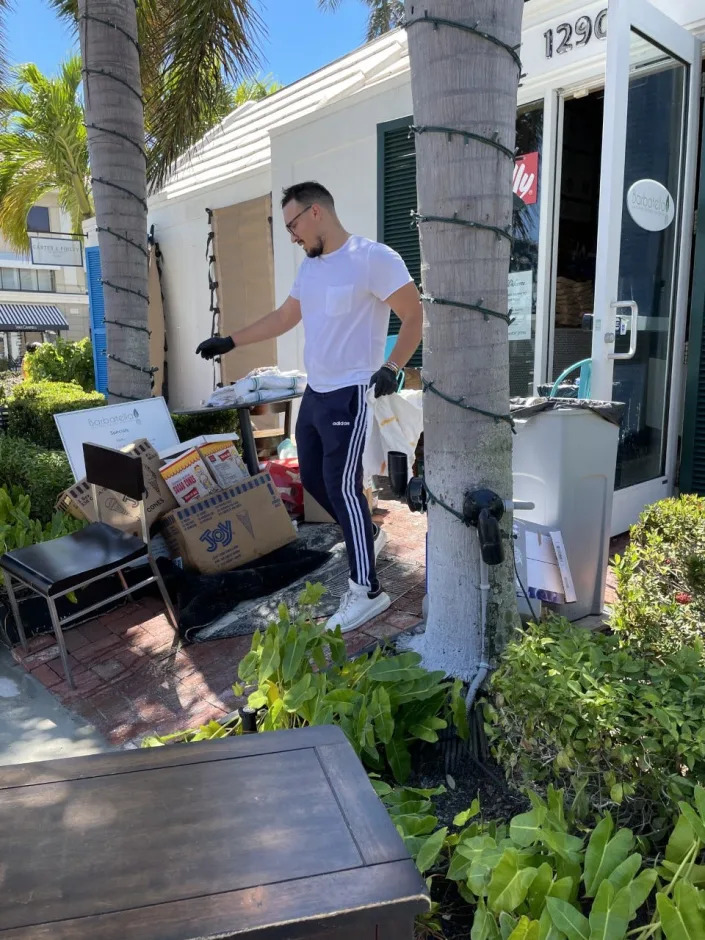
On Third Avenue South downtown, store owners scrambled to pick up the pieces. Chain saws roared, vacuum trucks rumbled as they sucked out water, and power washers echoed, as owners, employees and hired contractors worked to wash down all the sediment left behind on everything from parking lots to plant pots.
Water stains again showed just how high the water got.
Some business owners have lost virtually everything.
On Third Street and nearby Fifth Avenue South, shops, restaurants and other businesses have scrambled to reopen, if possible.
“Fortunately, our city is resilient,” McGinn said. “So, many business owners are making a push. They want to be able to help people. That’s what they do.”
Businesses are picking up the pieces on Third Street South in downtown Naples.
As soon as it could, Liki Tiki, the local “Tiki Bar” and classic BBQ restaurant on U.S. 41, reopened on Thursday, serving drinks only — because that’s all it could do.
“It was packed,” McGinn said. “It’s a good sight to see. It’s good camaraderie.”
Port Royal may have fared better than others
In Port Royal, known as one of the priciest neighborhoods in America, the damage didn’t seem as great. Signs of water intrusion were harder to spot, but landscaping took a hit, with a near-constant buzz of chain saws.
“A lot of these are new construction homes,” McGinn said. “So, maybe they did fare a little better.”
The Port Royal Club sustained damage.
Closer to the coast, surging waters forced some residents to their roofs, for higher ground, to wait out rescue crews.
“I’m sure there were lives lost,” McGinn said. “But we won’t know how many for some time. It’s hard to tell.”
Some of the stranded cars still spotted around the city, he said, are the result of residents driving around during the storm, failing to heed warnings. They had to walk or swim away, abandoning their vehicles, McGinn said.
“People were still out and about, not listening to shelter in place,” he said, or evacuation orders.
After the storm, vehicles blocking streets were taken to Baker Park, but eventually, the city ran out parking spaces for them.
Mansions on the Gulf could have seen extensive damage
On Gordon Drive, it’s hard to tell how much damage multimillion-dollar mansions sitting directly on the Gulf of Mexico took, but McGinn said the water and sand likely did a lot of damage to them.
Parts of Gordon Drive were still blocked on Friday, with piles of sand dropped by Ian still in the road.
Much of the city saw flooding.
“Even areas like Lake Park had several feet of water in their homes,” McGinn said, after the Gordon River flooded.
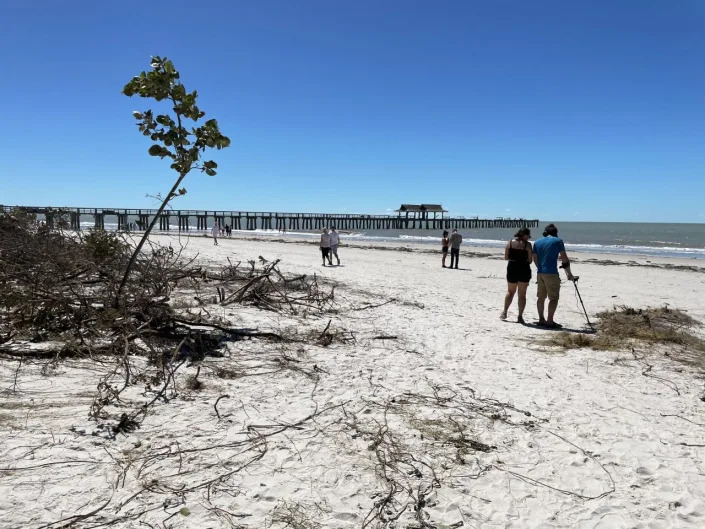
The Naples Pier is heavily damaged, but not destroyed.
“It’s sad,” McGinn said.
Treasure hunters and curious visitors at beach, near Naples Pier, damaged by Hurricane Ian, on Friday, Sept. 30, 2022.
While beach ends, or public access points, haven’t reopened, residents and visitors alike have flocked to them, to see the damages with their own eyes shooting photos and videos to document the storm.
“This is how well people listen,” McGinn said. “I get it. Everybody wants to see how the city of Naples fared. It all comes from a good place.”
At the Horizon Way beach access in Park Shore, he pointed to what looked like structural damage at St. Croix Club condominiums, but it was hard to determine the extent of it.
“That’s no bueno,” McGinn said.
Parts of Naples look like a “war zone”
In the Moorings area, Regency Towers looked like it took a heavy hit too — along with other condos and homes.
“It looks like a war zone up here,” McGinn said.
While water wiped out the contents of condos, homes and businesses, he said, structural damage might not be extensive since winds weren’t as extreme as with past storms.
“Their personal property is gone,” McGinn said. “But they can be replaced over time.”
Looking over all the damage in Naples, it’s hard to fathom how bad others had it just one county over, McGinn said.
“What’s crazy is we are not even the hardest hit area,” he said.
“If Republicans return to Washington’s business as usual, if we have no bigger plan than to be a speed bump on the road to America’s collapse, we don’t deserve to govern,” Scott wrote in the plan’s introduction. “We must resolve to aim higher than the Republican Congresses that came before us. Americans deserve to know what we will do.”
Scott’s decision to put his name to a series of specific proposals for what Republicans could and should do if they retake the Senate and House this fall stands in direct contrast to Senate Minority Leader Mitch McConnell, who has pointedly refused to offer an alternative policy agenda.
When asked last month what the GOP’s agenda would be if they took control of Congress, McConnell told reporters: “That is a very good question and I’ll let you know when we take it back.”
Scott seems to acknowledge the fact that he is rebelling against his party leadership, writing: “Like the ‘Contract with America’ before it, the Washington insiders will hate this plan.” (The Contract with America was the Republican agenda unveiled during the 1994 midterms, when the GOP won control of the House.)
Why did Scott do it then? Well, at least in part (a large part) because of politics. Scott, the former governor of Florida who was elected to the Senate in 2018, has his eye on bigger prizes. He’s currently serving as the chairman of the Senate Republican campaign arm and has done very little to knock down talk that he would be interested in a presidential bid down the line.
This plan feels like the sort of thing that could become the basis of a Scott presidential run, whether in 2024 or 2028.
So what’s actually in the plan? A fair amount of it is just red-meat rhetoric sure to make the base of the party happy. But amid the spin – and the attacks on Democrats, “wokeness” and the media – there are some actual policy proposals. Let’s go through them.
1. Kids in public schools would say the Pledge of Allegiance and be required to stand for the National Anthem. They also would have to “honor” the American flag.
2. The Department of Education would close. “Education is a state function,” wrote Scott.
3. The government would never be able to ask you to disclose your race, ethnicity or skin color “on any government form.” (On a related note, the US Census Bureau is on line one, Sen. Scott.)
4. The US military would engage in “ZERO diversity training” or “any woke ideological indoctrination that divides our troops.”
5. If a college or university uses affirmative action in admissions, it would be “ineligible for federal funding and will lose their tax-exempt status.”
6. “Strict” mandatory minimum sentences would be required in every case in which a police officer is seriously injured.
7. Any “attempt to deny our 2nd Amendment freedoms” would be strongly opposed.
8. The wall along the US southern border would be completed and named after former President Donald Trump.
9. Immigrants to the US would not be able to collect unemployment benefits or welfare until they have lived in the country for seven years.
10. So-called sanctuary cities would be stripped of all federal funding.
11. The federal budget would be balanced and, if not, members of Congress would not be paid.
12. All Americans would pay some income tax “to have skin in the game.” (At present, roughly half of Americans do not pay taxes because their taxable income doesn’t meet a minimum threshold.)
13. Federal debt ceiling increases would be prohibited unless accompanied by a declaration of war.
14. All federally elected officials, as well as all federal workers, would be subject to a 12-year term limit.
15 All federal legislation would have a sunset provision five years after it passes. (People currently on Social Security or Medicare might be particularly interested in that one.)
16. Funding for the IRS, as well as its workforce, would be cut by 50%.
17. Politicians would be banned from becoming lobbyists when they leave office.
18. Voter ID would become the law of the land. “All arguments against voter ID are in favor of fraud,” according to Scott.
19. Same-day voter registration would be banned.
20. “No federal program or tax laws will reward people for being unmarried or discriminate against marriage.”
21. No government form would offer options related to “gender identity” or “sexual preference”
22. Biological males would be banned from competing in women’s sports.
23. “All social media platforms that censor speech and cancel people will be treated like publishers and subject to legal action.”
24. No tax dollars could be used for “diversity training or other woke indoctrination that is hostile to faith.”
25. No dues would be paid to the United Nations or “any international organization that undermines the national interests of the USA.”
26. “The weather is always changing. We take climate change seriously, but not hysterically. We will not adopt nutty policies that harm our economy or our jobs.”
There’s more in there, but those are the main points.
It’s an attempt – both rhetorically and from a policy perspective – to make permanent many of the changes that Trump ushered in during his four years in office. It’s a promise of all the things you liked about Trump without some of the bombast and unpredictability. It’s a blueprint for Trumpism without Trump.
Facing a Dire Storm Forecast in Florida, Officials Delayed Evacuation
Frances Robles – October 1, 2022
Tristan Stout surveys damage to his father’s boat after it was thrown across the street as Hurricane Ian swept over San Carlos Island in Fort Myers Beach, Fla. on Friday, Sept. 30, 2022. (Jason Andrew/The New York Times)
FORT MYERS, Fla. — As Hurricane Ian charged toward the western coast of Florida this week, the warnings from forecasters were growing more urgent. Life-threatening storm surge threatened to deluge the region from Tampa all the way to Fort Myers.
But while officials along much of that coastline responded with orders to evacuate Monday, emergency managers in Lee County held off, pondering during the day whether to tell people to flee, but then deciding to see how the forecast evolved overnight.
The delay, an apparent violation of the meticulous evacuation strategy the county had crafted for just such an emergency, may have contributed to catastrophic consequences that are still coming into focus as the death toll continues to climb.
Dozens have died overall in the state, officials said, as Ian, downgraded to a post-tropical cyclone, moved through North Carolina and Virginia on Saturday, at one point leaving nearly 400,000 electricity customers in those states without power.
About 35 of Florida’s storm-related deaths have been identified in Lee County, the highest toll anywhere in the state, as survivors describe the sudden surge of water — predicted as a possibility by the National Hurricane Service in the days before the storm hit — that sent some of them scrambling for safety in attics and on rooftops.
Lee County, which includes the hard-hit seaside community of Fort Myers Beach, as well as the towns of Fort Myers, Sanibel and Cape Coral, did not issue a mandatory evacuation order for the areas likely to be hardest hit until Tuesday morning, a day after several neighboring counties had ordered their most vulnerable residents to flee.
By then, some residents recalled that they had little time to evacuate. Dana Ferguson, 33, a medical assistant in Fort Myers, said she had been at work when the first text message appeared on her phone Tuesday morning. By the time she arrived home, it was too late to find anywhere to go, so she hunkered down with her husband and three children to wait as a wall of water began surging through areas of Fort Myers, including some that were well away from the coastline.
“I felt there wasn’t enough time,” she said.
Ferguson said she and her family fled to the second floor, lugging a generator and dry food, as the water rose through their living room. The 6-year-old was in tears.
Kevin Ruane, a Lee County commissioner and a former mayor of Sanibel, said the county had postponed ordering an extensive evacuation because the earlier hurricane modeling had shown the storm heading farther north.
“I think we responded as quickly as we humanly could have,” he said.
Gov. Ron DeSantis and his state emergency management director also said the earlier forecasts had predicted the brunt of the storm’s fury would strike farther north.
“There is a difference between a storm that’s going to hit north Florida that will have peripheral effects on your region, versus one that’s making a direct impact,” DeSantis said at a news conference Friday in Lee County. “And so what I saw in southwest Florida is, as the data changed, they sprung into action.”
But while the track of Hurricane Ian did shift closer to Lee County in the days before it made landfall, the surge risks the county faced — even with the more northerly track — were becoming apparent as early as Sunday night.
At that point, the National Hurricane Center produced modeling showing a chance of a storm surge covering much of Cape Coral and Fort Myers. Parts of Fort Myers Beach, even in that case, had a 40% chance of a 6-foot-high storm surge, according to the surge forecasts.
Lee County’s emergency planning documents had set out a time-is-of-the-essence strategy, noting that the region’s large population and limited road system make it difficult to evacuate the county swiftly. Over years of work, the county has created a phased approach that expands the scope of evacuations in proportion to the certainty of risk. “Severe events may require decisions with little solid information,” the documents say.
The county’s plan proposes an initial evacuation if there is even a 10% chance that a storm surge will go 6 feet above ground level; based on a sliding scale, the plan also calls for an evacuation if there is a 60% chance of a 3-foot storm surge.
Along with the forecasts Sunday night, updated forecasts Monday warned that many areas of Cape Coral and Fort Myers had between a 10% and a 40% chance of a storm surge above 6 feet, with some areas possibly seeing a surge of more than 9 feet.
Over those Monday hours, neighboring Pinellas, Hillsborough, Manatee, Sarasota and Charlotte counties issued evacuation orders, while Sarasota County announced that it expected evacuation orders to be in effect for the following morning. In Lee County, however, officials said they were waiting to make a more up-to-date assessment the following morning.
“Once we have a better grasp on all of that dynamic, we will have a better understanding about what areas we may call for evacuation, and, at the same time, a determination of what shelters will be open,” the Lee County manager, Roger Desjarlais, said Monday afternoon.
But forecasters with the National Hurricane Center were growing more explicit in their warnings for the region. In a 5 p.m. update Monday, they wrote that the highest risk for “life-threatening storm surge” was in the area from Fort Myers to Tampa Bay.
“Residents in these areas should listen to advice given by local officials,” the hurricane center wrote. New modeling showed that some areas along Fort Myers Beach were more likely than not to see a 6-foot surge.
Ruane, the county commissioner, said that one challenge the county faced was that the local schools had been designed to be shelters and that the school board had made the decision to keep them open Monday.
By 7 a.m. Tuesday, Desjarlais announced a partial evacuation order but emphasized that “the areas being evacuated are small” compared with a previous hurricane evacuation.
The county held off on further evacuations, despite a forecast that showed potential surge into areas not covered by the order. Officials expanded their evacuation order later in the morning.
By the middle of the afternoon, Lee County officials were more urgent in their recommendation: “The time to evacuate is now, and the window is closing,” they wrote in a message on Facebook.
Katherine Morong, 32, said she had been prepared earlier in the week to hunker down and ride out the storm based on the guidance from local officials. The sudden evacuation order Tuesday morning left her scrambling, she said, as she set out in her car in the rain.
“The county could have been more proactive and could have given us more time to evacuate,” she said. On the road toward the east side of the state, she said, she was driving through torrents of rain, with tornadoes nearby.
Joe Brosseau, 65, said he did not receive any evacuation notice. As the storm surge began pouring in Wednesday morning, he said, he considered evacuating but realized it was too late.
He climbed up a ladder with his 70-year-old wife and dog to reach a crawl space in his garage. He brought tools in case he needed to break through the roof to escape.
“It was terrifying,” Brosseau said. “It was the absolute scariest thing. Trying to get that dog and my wife up a ladder to the crawl space. And then to spend six hours there.”
Some residents said they had seen the forecasts but decided to remain at home anyway — veterans of many past storms with dire predictions that had not come to pass.
“People were made aware, they were told about the dangers and some people just made the decision that they did not want to leave,” DeSantis said Friday.
Joe Santini, a retired physician assistant, said he would not have fled his home even if there had been an evacuation order issued well before the storm. He said that he had lived in the Fort Myers area most of his life, and that he would not know where else to go.
“I’ve stuck around for every other one,” he said.
The water rushed into his home around dusk Wednesday night, and Friday, there was still a high-water mark about a foot above the floor — leaving Santini a little stunned. “I don’t think it’s ever surged as high as it did,” he said.
Lee County is now an epicenter of devastation, with mass destruction at Fort Myers Beach, the partial collapse of the Sanibel Causeway and entire neighborhoods reduced to rubble. With water mains broken, the county utilities agency has advised residents to boil their water.
President Joe Biden said Friday that the destruction from the storm was likely to be among the worst in U.S. history.
“It’s going to take months, years to rebuild,” he said.
The US Navy said ‘traces’ of jet fuel were found in the water on the aircraft carrier USS Nimitz. A sailor says the problem was way worse.
Jake Epstein – October 1, 2022
Washing down on the flight deck of the aircraft carrier USS Nimitz.US Navy
The US Navy said it found only “traces” of jet fuel in the water on the aircraft carrier USS Nimitz.
But a sailor told Insider that they were exposed to an “unhealthy amount” of fuel and shared a photo as evidence.
They also said they didn’t immediately receive medical attention, despite health concerns.
The US Navy acknowledged recently that the water the crew of the aircraft carrier USS Nimitz uses to bathe and drink was contaminated by what it described as “traces” of jet fuel, but a sailor on the ship said the situation was worse than the service first let on.
The crew learned about two weeks ago that the water supply had a problem. Specifically, the water had become a troublingly discolored fluid with a bad smell, a sailor said. Testing found what the Navy said were “detectable traces” of hydrocarbons, a chemical component of jet fuel.
In a recent interview with Insider, a sailor aboard the ship described a situation that appears to be far worse than what was initially indicated by the Navy.
“We were exposed to an unhealthy amount of JP-5,” the Nimitz sailor, whose identity is known to Insider but is being withheld due to concerns about the possibility of retribution, said this week. JP-5, or jet-propellant-5, is a kerosene-based fuel that is used in military aircraft and is a go-to for the Navy’s carrier air wings.
Related video: The true cost of the most advanced aircraft carrier, USS Ford
https://s.yimg.com/rx/martini/builds/49027198/executor.htmlScroll back up to restore default view.
The sailor explained that although they and their shipmates drank and showered with the contaminated water, they were initially denied medical attention for issues that were believed to be related to their exposure to jet fuel.
After earlier Navy assurances there had been no ill effects, a spokesman for 3rd Fleet told Insider on Friday that five sailors have reported health issues that could be related to the contamination and that the ship’s leadership is monitoring the situation. In an overnight update, Insider was informed the number has since risen to 10.
Cmdr. Sean Robertson, a fleet spokesperson, told Insider on Friday that “if we receive any additional reports of potentially contaminated water, we will immediately investigate and take appropriate action to safeguard the crew.” The parents of the sailor Insider spoke with said at that time that the carrier’s medical team was still turning away some sailors.
Discovering jet fuel in the water
The sailor said they were first informed there was jet fuel in the water on the evening of September 16. A Navy spokesperson confirmed this date to Task & Purpose, one of the outlets that along with Navy Times first reported on the problem, and said that the crew “immediately took action.”
The sailor said that the ship’s commanding officer announced to the ship that night that jet fuel had been discovered in the water, stressing that the crew of roughly 3,000 should not drink it and that they should drink only distributed bottled water until they returned to port.
The sailor said that later that night, however, they were told by the ship’s executive officer and the commanding officer that the water was actually safe to drink and that there was nothing to worry about.
“It was not safe to drink,” the sailor said. “People believed the CO and XO, and people were showering in this stuff.”
On the morning of September 17, the aircraft carrier arrived at San Diego’s Naval Air Station North Island, and by noon, the carrier was connected to the local water supply. It wasn’t until that point that the Nimitz leadership reversed course again and said the water was actually unsafe to drink and shower in, the sailor said.
Throughout the night and through the morning, people were under the impression that the water was safe, despite indications that it wasn’t, the sailor said.
“Medical was refusing to see patients or acknowledge that anything going on with patients or different sailors had anything related to the JP-5,” the sailor said, adding that medical staff “refused” to note the JP-5 exposure in sailors’ records.
The Nimitz sailor said that one fellow service member was throwing up while another had a rash. In a separate interview with Insider, the sailor’s parents — whose identities are also known to Insider but are being withheld to protect the sailor — said they noticed their sailor had developed a dry cough after the exposure.
“Medical was telling us that it’ll just pass through you,” the sailor said. They said that after reviewing a safety data sheet, which has information about hazardous chemicals, and cross-referencing their jet fuel exposure, it was clear they should seek medical attention.
Sailors participate in a countermeasure wash down on the flight deck of the aircraft carrier USS Nimitz.US Navy
Testing the water
The sailor explained that when the ship’s water tanks were opened for inspection late on September 17, a “thick layer of JP-5 on top of the potable water” was found. The next step was trying to flush the jet fuel out of the system.
They said that starting the next day on September 18, crewmembers began conducting taste- and smell-tests of the ship’s water — a process that continued for at least the following 10 days and something the sailor described as a “big concern.”
Though Cmdr. Robertson did not say anything about taste testing, he did tell Insider that a “sniffer team” of Nimitz sailors has been tasked with checking out “hot spots,” areas with concerning odors.
The process described by the sailor involved filling and then dumping the water tanks and then sampling the water for jet fuel. In draining the tank, however, they frequently spotted the fuel leaving residue along the sides of the tank.
“So basically what we’re doing is draining the water out, filling it back up, and letting the JP-5 coat the sides of the tank,” the sailor said.
A Navy official told Insider that an initial test of water samples from September 19 did not “detect measurable amounts of fuel hydrocarbons.” The official said more testing on water samples from the Nimitz’s potable water tanks on September 21, however, did reveal “detectable traces of hydrocarbons.” The Navy did not disclose the specific amount detected.
But the sailor rejected the notion that there were only “traces” of jet fuel, pointing to the “thick layer” of fuel they saw on top of the water in samples.
The aircraft carrier was supposed to depart San Diego late last week, but it ended up staying in port. The sailor speculated that this may have been because of media coverage and attention, which they said is what initially triggered the laboratory tests — not the crew’s suspicion that there was still jet fuel in the water.
To highlight the visible impact of the jet fuel contaminating the water, the sailor’s family provided Insider with a screenshot of a text exchange between the parents and the sailor.
A screenshot of a text exchange with a photo of a sample of what a sailor said was water from the USS Nimitz contaminated with jet fuel.Courtesy photo
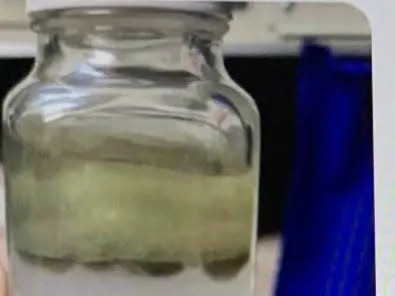
In the exchange is a photograph, shared with the sailor by a shipmate. The photo was taken shortly after it was first announced that there was jet fuel in the water, the sailor said, and appears to show a water sample — drawn from a water fountain — consisting of a thick, green, layer on the top and a murky, white layer on the bottom.
Working through the aftermath
The sailor said that as of this week, some of their fellow Navy sailors were still drinking and showering with the contaminated water because “we don’t have much of another option.”
The shore water looks clear and has gotten better, they said, but the smell and taste of jet fuel still lingers, as residual amounts continue to stick to the water tanks and piping.
“So the only way we can get all the contamination out of the tank is by completely draining it and scrubbing it, because the way JP-5 sticks to metal,” the sailor said.
Cmdr. Robertson told Insider in an email on Friday that the potable water system on the Nimitz continues to be evaluated so sailors get the “highest quality water” when the ship eventually leaves San Diego.
“The health and well-being of all of our Sailors is our top priority,” he added. “To that end, Nimitz leadership encourages the crew daily to report to medical immediately if they exhibit any illness or injury that could potentially be caused by exposure to contaminated water.”
As of Friday, Robertson said, 10 sailors have reported health issues that “could be associated with JP-5 ingestion, with no new reports in the last 24 hours.”
He said symptoms — which include headache, diarrhea, and rashes — were present between September 17 and September 26. None of those individuals are “currently reporting any symptoms that might be associated with JP-5 ingestion,” he said.
The parents of the sailor with which Insider spoke said in a separate interview that they have been reaching out to various lawmakers to try and voice their concerns, but they haven’t had much luck getting responses.
“Serving this country is a privilege,” one parent said. “But in return, I expect the leadership to support the soldiers and the sailors and to take care of them.”













 Scroll back up to restore default view.