‘Morning Joe’: Trump’s Constant Speech Gaffes Paint Him as ‘Deranged, Demented and Pathetic – Not to Mention Dangerous’ | Video
Sharon Knolle – March 4, 2024
“Morning Joe” hosts Mika Brzezinski and Joe Scarborough and commentator and “How the Right Lost Its Mind” author Charlie Sykes watched incredulously while playing clips from Donald Trump campaign rallies over the weekend that showed the former president appearing lost for words, mixing up Joe Biden and Barack Obama and referring to the country Argentina as “a great guy.”
After wrapping the montage of consistent speech gaffes, Sykes determined Trump to be “deranged, demented and pathetic” and that he “looks lost.”
Scarborough began the Monday segment by playing back a series of clips of Trump from rallies in North Carolina and Virginia where the GOP candidate said Argentina is “a big Trump guy. He loves Trump,” and added, “I took his call. Anybody that loves me, I like them.”
Trump had earlier mentioned Argentina’s president, Nicolás Maduro, by name, but in connection with Venezuela. He struggled to pronounce the name of the South American country. In another speech, Trump said he had spoken with the leader of the Taliban, who, he said, called him, “your highness.”
“He’s reading teleprompters and his mind still blanks out,” Scarborough said, pointing to occasions where Trump mixed up Obama and Biden. “It’s just so pathetic and sad. It’s a sad scene, to me, to see someone up on stage and blanking out.”
Scarborough continued, calling the 77-year-old politician as “an old man who is losing his ability to communicate.”
“Unfortunately, I’m not a psychiatrist,” Sykes chimed in. “What’s on display is, OK, Joe Biden is old, but the other guy is deranged, demented and pathetic, as you point out — not to mention, dangerous. And this is on display.”
The pundit then reflected on Trump being named the likely Republican presidential nominee over Nikki Haley as results for Super Tuesday come in later this week.
“As we’re sitting here talking about this, we’re less than 48 hours away from that guy clinching the Republican presidential nomination. The Republicans have one last out and they’re not going to take it,” he lamented. “They look at this guy — this is the extraordinary thing, is that Republicans look at him — and I don’t have to repeat all of the things, you know, he’s been found viable for rape, he’s facing 91 felony charges — you have this gaseous malice that you get from these gaffe-filled speeches, and they’re looking at him like, ‘Yeah, we’d like four more years of that.’”
“If there’s any upside here, it will be that Joe Biden can say, ‘Yeah, I’m old, I’m very stiff when I walk. But this guy is also old and he’s crazy and he’s dangerous and he is incoherent,’” Sykes added.
March 5 is Super Tuesday, in which 15 states — Alabama, Alaska, Arkansas, California, Colorado, Maine, Massachusetts, Minnesota, North Carolina, Oklahoma, Tennessee, Texas, Utah, Vermont and Virginia — hold primaries in the presidential election.
Watch the full “Morning Joe” segment in the video above.
Trump confuses Obama for Biden again at Virginia rally speech
Nina Lakhani – March 3, 2024
Donald Trump confused Barack Obama for Joe Biden at a rally in Virginia on Saturday, triggering further questions about the age of the likely Republican presidential nominee who has made a string of such gaffes.
It also comes at a time of similar concerns about Biden. At 77 and 81 respectively, Trump and Biden are the oldest people to run for the presidency in US history.
“Putin has so little respect for Obama that he’s starting to throw around the nuclear word. You heard that. Nuclear. He’s starting to talk nuclear weapons today,” said Trump, on Saturday night in Richmond.
The crowd reportedly went silent as Trump referenced Obama, who left office more than seven years ago. It’s the third time Trump has made the blunder in the past six months.
The former US president’s other gaffes include confusing his Republican rival Nikki Haley with the former House speaker Nancy Pelosi.
Haley, 52, who has defied Trump and several primary defeats to continue in the race for the Republican nomination, has tried to frame herself as the younger, healthier option – referring to Trump and Biden as Grumpy Old Men in her campaign ads.
Trump’s mistake came the day after Biden, twice confused Ukraine and Gaza as he announced that the US would airdrop humanitarian supplies to Palestinians in Gaza who are dying of starvation due to the Israeli bombardment and blockades.
“In the coming days, we’re going to join with our friends in Jordan and others who are providing airdrops of additional food and supplies into Ukraine,” Biden said on Friday. The US will “seek to open up other avenues into Ukraine, including possibly a marine corridor”, he added.
A White House official later clarified that Biden meant Gaza – not Ukraine. The gaffe had been changed in the transcript of his remarks.
Questions about Biden’s age have intensified in recent months.
The latest lapse came days after was declared “fit for duty” at his annual health check. The White House physician, Dr Kevin O’Connor, said Biden “fully executes all of his responsibilities without any exemptions or accommodations”.
A new New York Times/Siena College poll found that 73% of registered voters polled believe Biden is too old to be an effective president, including 61% of those who voted for him in 2020. Voters seem less bothered about Trump, who is just four years younger, with 42% of those polled saying he “just too old” to be an effective president.
While criticisms of the age issue on both sides are laced with political spin, age-related cognitive decline is real.
As a person gets older, changes occur in all parts of the body including the brain. According to the National Institute on Aging (NIA) certain parts of the brain shrink, including those important to learning and other complex mental activities; communication between neurons may be less effective; and blood flow in the brain may decrease.
Healthy older adults can however learn new skills, form new memories, improve vocabulary and language skills. The NIA is conducting research on so-called cognitive super-agers, the minority of octogenarians and nonagenarians whose memories are comparable to people 20 to 30 years younger.
Trump Is ‘Surrounded Entirely by Enablers’ Eager to Diminish Apparent Cognitive Decline, Jonathan Lemire Says
Benjamin Lindsay – March 4, 2024
MSNBC
Analyzing a series of public Donald Trump gaffes while he campaigned in North Carolina and Virginia over the weekend, Politico’s White House bureau chief Jonathan Lemire said Monday that the former president is “surrounded entirely by enablers” who are just “forging forward” through apparent cognitive decline.
“He’s surrounded entirely by enablers during this campaign and would be again if he were to be in the White House for a second time,” Lemire said on Monday’s “Morning Joe.” “There would be no guardrails, there would be no adults in the room, there would just be people doing what he wants.”
The conversation began with cohosts Mika Brzezinski and Joe Scarborough relentlessly replaying clips of Trump mixing up Barack Obama and Joe Biden, of him stumbling through the pronunciation of “Venezuela,” of him referring to the South American country Argentina as if it were a person and more.
“There is nobody around Donald Trump that can protect him from himself,” Scarborough said, indicating that even if the gaffes were signs of ailing health, the former president would likely hear nothing of it.
“He’s just not the same guy he was five, 10, even 15 years ago. Nobody’s saying he was a saint then, but we knew him, he’s radically different. You look at him talking radically different,” Scarborough continued. “You look at Jan. 6 — he had every single person in the White House begging him to stop the riot … Didn’t listen to anybody. He’s alone. So as we go through this sad scene, there is nobody that can take him off the stage and say, ‘You’re not well. You need to get checked and taken care of.’”
“To your point, he’s not the same guy,” Lemire added. “You can watch video footage of the 2016 campaign, some of his time in the White House. We played last week a clip from the debate between Trump and Biden back in 2020, and it was striking even then how much Trump has changed, how he’s aged. I mean, he is in his late 70s.”
Lemire then became confounded by the differences in public perception between President Biden’s aged state and Trump’s.
“He’s only a couple years younger than President Biden, and we’re seeing with more and more frequency, even as the media [is] full of polls and obsessions about President Biden’s age, it’s this — it’s Trump who day after day is showing the signs of age, but also pressure,” Lemire said. “Indeed, pressure because he is not getting as much of the share of the Republican vote as he would like — Nikki Haley even posting a win over the weekend. Pressure because of the money he now owes, nearly half a billion dollars in a couple cases in New York City. And pressure that his first criminal case, a case that could theoretically put him in prison, starts in just three weeks.
“We’re seeing it night after night on the rally stage where he seems to even just lose control of the English language … This is something that his team knows, but they’re just forging forward.”
Today’s Supreme Court is a threat to democracy — but activists plan to fight back
Paul Rosenberg – March 3, 2024
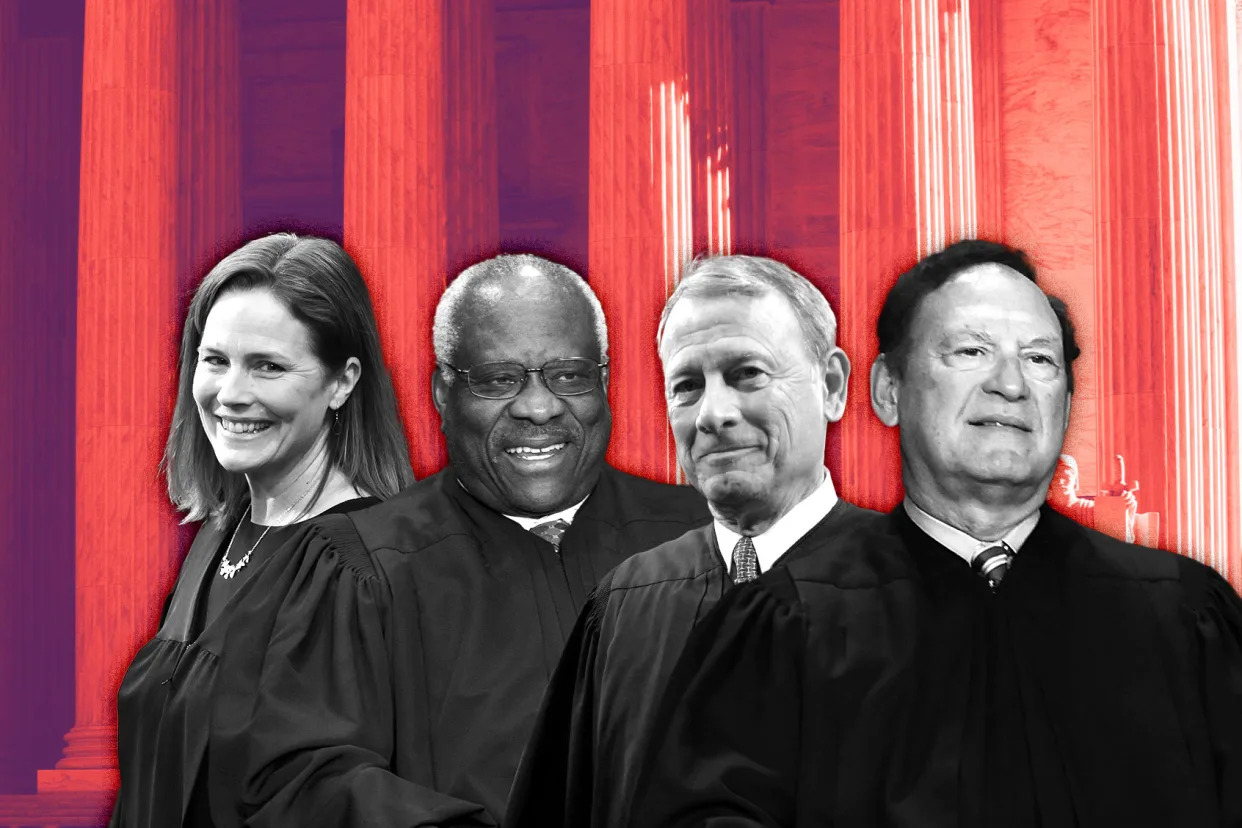
Amy Coney Barrett, Clarence Thomas, John Roberts and Samuel Alito Photo illustration by Salon/Getty Images
The Supreme Court is a supreme threat to American democracy. That was Abraham Lincoln’s view in light of the Dred Scott decision, expressed in his First Inaugural Address. And it was vividly illustrated after Lincoln’s assassination, when the Civil War amendments and civil rights legislation passed by Congress were effectively nullified by the Supreme Court, enabling former Confederates and other white supremacists to destroy the possibility of multiracial democracy for almost a century. “Our democracy suffers when an unelected group of lawyers take away our ability to govern ourselves,” as Harvard Law professor Nikolas Bowie wrote in 2021, based on his testimony before the do-nothing Presidential Commission on the Supreme Court of the United States.
Since then, the Court’s decision in Dobbs v. Jackson Women’s Health, which overturned the precedent of Roe v. Wade, has brought Bowie’s point home with a vengeance. But it’s not just about abortion. On guns, environmental protection, discrimination, labor rights, affirmative action, student debt relief and numerous other issues, Mitch McConnell’s court-packing scheme and Donald Trump’s appointments have succeeded in dramatically undercutting Americans’ people’s capacity for self-government and the promotion of “the general welfare” promised in the preamble to the U.S. Constitution.
While the electoral backlash against Dobbs has been heartening, that’s essentially a reaction to the most alarming and personally invasive Supreme Court decision, not a proactive effort to dismantle the source of the threat. That’s why the new online lecture and discussion course, “What to Do About the Courts,” feels so important: It’s an effort to begin laying the groundwork for fundamental court reform. It’s a collaboration between the Law and Political Economy Project and the People’s Parity Project which featured Bowie as its leadoff lecturer on Jan. 30. A second session, looking at the history of reform efforts, was held Feb. 20.
“This is really core to what our organizations are doing and how we’re thinking about the work that we need to be engaged in for many years to come,” PPP executive director Molly Coleman told Salon. The online venue, she said, made it possible to “open this up quite a bit more than if we had done this as an in-person meeting group on a law school campus.”
The discussion component is critical, according to LPEP executive director Corinne Blalock: “It really does reflect our theory of change and how we understand how ideas move in the world.”
“We didn’t want this to just be a lecture series,” Coleman added. “Court reform should be something that’s built by the people. Part of this project is thinking about how we end judicial supremacy, how we make sure that the people have power, and not just unelected, unaccountable judges. We would be remiss if that wasn’t modeled in our programming.”
For generations, Americans have largely been blind to the Supreme Court’s profoundly anti-democratic character, because under former Chief Justice Earl Warren, the court was instrumental in reversing the post-Reconstruction destruction of democracy, most notably with the landmark ruling in Brown v. Board of Education, which officially ended school segregation. But however significant Brown was in cultural and historic terms, in reality it only reduced segregation and certainly did not restore multiracial democracy. Congress began to do that with the 1965 Voting Rights Act — but nearly 50 years later, in Shelby County v. Holder, the Supreme Court undid much of that law and once again began undermining democracy.
The halo effect around the Supreme Court, resulting from the Brown decision and the Warren court’s legacy more broadly — which continued into the 1970s with Roe v. Wade — was finally shattered for most attentive Americans by the Dobbs decision in 2022. Now, perhaps, Bowie’s unheeded warning a year before that may get the hearing it deserves, fleshed out by a range of possible court reforms that have been considered, implemented in the past (the subject of the course’s second session) or modeled elsewhere by healthier democracies (the subject of its upcoming third one).
“Really thinking about transforming the court felt politically inconceivable a few years ago,” said Blalock. “There were certainly scholars who felt the urgency, but we needed the material stakes to really connect it to people’s lives. With all the atrocious things that the Supreme Court has done recently, that piece has sort of been done for us. So our role is helping people connect that to a set of political ideas.”
There’s another and perhaps larger concern, Blalock continued. “For everyone on the left or left of center who’s thinking about transformative change, whether it’s climate change, reproductive rights or labor, it feels like the Supreme Court is looming,” she said. “We felt that our two organizations were particularly well-suited to step in and help connect the dots.”
“Despite this moment where the Supreme Court is at the center of so many conversations, despite a lot of excitement and energy around the possibility of court reform, there is a lack of information about what court reform can look like,” Coleman added. “Even folks who are living and breathing this work in advocacy spaces might be talking about expansion or might be talking about ethics reform, but so many of these other reforms that have been tried in the past haven’t entered the mainstream conversation. We felt there was an important void to fill, to take some of these ideas that are being discussed in the legal academy or by historians and bring them to the mainstream of progressive organizing spaces.”
The series began with Bowie addressing the foundation of the problem: the wildly disproportionate power of the Supreme Court, where five individuals can effectively thwart the will of 340 million citizens. Because judicial supremacy is so deeply ingrained in our system, people tend to assume it’s enshrined in the Constitution. It’s not. Lawyers are taught that it derives from the Supreme Court’s legendary 1803 decision Marbury v. Madison, but they’re generally not taught the larger story that casts the decision in a questionable partisan light. One might describe it, in fact, as a judicial coup.
As Bowie recounted, when the Federalist government under President John Adams passed the wildly unconstitutional Alien and Sedition Acts in 1798, the opposing party led by Thomas Jefferson didn’t turn to the courts. “Federal judges were just as partisan, just as committed to stamping out political opposition, as anyone else,” Bowie said. “So Jefferson’s party ended up getting rid of this law not by going to court, but by winning an election.”
In the lame-duck session that followed Jefferson’s victory in the controversial election of 1800, Adams and the Federalists created a bunch of new federal courts and packed them with supportive judges. That included Adams’ appointment of John Marshall, the outgoing secretary of state, as chief justice of the Supreme Court. After that, Bowie said, Jefferson’s party proposed a bill to destroy or undo all these new courts, which led to fierce debate:
Federalists responded [that] federal courts need to have this power to strike down federal laws. If Congress can simply get rid of the courts, then federal courts won’t have this power anymore. And for Jefferson’s party in Congress, they thought the idea that federal courts would strike down federal laws was this crazy innovation. Just a really bad idea and obviously partisan in motivation. … They thought there was nothing in the Constitution that says a federal judge can strike down a federal law. It would be a really weird distribution of power to give federal judges this control.
In the wake of that debate, Bowie said, Marshall authored the famous majority opinion in Marbury v. Madison, which “effectively just parroted the Federalist position from Congress.” In short, the position held by a minority in Congress became the law of the land — and not on some narrow legalistic point, but on the fundamental question of who is allowed to interpret the Constitution.
That remained a purely theoretical issue for more than 50 years. “Marshall didn’t end up disagreeing with Congress about the constitutionality of any legislation for the remainder of his term,” Bowie said. Then came the 1857 Dred Scott decision, which struck down the Missouri Compromise and denied Congress the right to prohibit slavery in the nation’s territories. This became a defining issue for the newly-formed Republican Party, which didn’t just shrug and accept it. As Bowie put it, “They responded, ‘What is the court doing? The court should not have this power,’” and ran on a platform “that repudiated the court’s power to decide this constitutional question.” After Lincoln was elected in 1860, “he and Congress passed legislation that did precisely what the Supreme Court said Congress could not do.”
There was certainly much more to Bowie’s presentation — and much more Supreme Court mischief that undermined the rights of Black Americans for generations — but that should be sufficient to show that our meek modern-day acceptance of judicial supremacy rests upon a profound ignorance of our own history. Both Jefferson and Lincoln, revered today as the founders of our two major parties, vehemently rejected judicial supremacy. It’s time for 21st-century Americans to seriously consider doing the same — or at the very least, to place significant limitations on it. The question, of course, is exactly how to limit or replace judicial supremacy, and what specific reforms can get us there.
The February session of “What to Do About the Courts” began to answer those questions, looking into the history of court-disempowering reforms and proposals, with professors Samuel Moyn of Yale and William Forbath of the University of Texas. Moyn cited a number of reform ideas:
Popular overrides of court decisions by referendum, as proposed by Theodore Roosevelt in his 1912 third-party presidential campaign.
“Jurisdiction stripping,” meaning laws that limit the court’s jurisdiction over certain kinds of statutes.
A supermajority requirement, meaning a bare majority of five justices could not invalidate laws passed by Congress, as proposed by progressive Sen. William Borah in 1923.
Congressional authority to override any Supreme Court decision by a two-thirds vote, as proposed by Sen. Robert La Follette Sr. in his 1924 third-party presidential campaign.
Prohibiting federal court injunctions in labor disputes, as mandated by the 1932 Norris–La Guardia Act.
Forbath looked more closely at the history of labor law: how the growth of a national economy increased the use of secondary strikes and boycotts, how common law and the Sherman Anti-Trust Act were used to declare them illegal and how that, along with court-sanctioned state violence, “inspired a decades-long, high-profile campaign of official union defiance of anti-strike and anti-boycott decrees,” undergirded by “a richly elaborated moral and constitutional order, a rival order built on the First and 13th amendments.” That movement declared, Forbath said, that “courts were quite literally creating property rights in man and elevating property rights over human rights.”
During the 1920s, Forbath continued, there were “constant calls and dozens of bills and proposals for laws and amendments to the Constitution that would enact what we call court reform. They brought movement constitutionalism to the halls of Congress,” resulting in the aforementioned Norris-La Guardia Act, even before FDR’s New Deal. That came about in part, Forbath said, because the judiciary had “squander[ed] its own legitimacy. Too many working-class Americans had come to see the courts for what they were: They were the place where the ruling class went to rule, dispensing class-bound decisions in the name of the Constitution.”
That kind of keen historical awareness, vigilance and activism may well be needed today. Arguably that shouldn’t be difficult to ignite, given the current radical Supreme Court and its recent actions. It may be much more difficult to create a unified movement with a clear vision for change. Divisions. to be sure, existed in earlier eras as well. “Back in the early 20th century, there was a rift between Black freedom organizations like the NAACP and labor and progressives who were most invested in labor reforms,” Forbath said. While the latter groups wanted to disempower the courts, the Black freedom movement largely did not, because the courts — however inadequate they were — appeared to be its most reliable allies.
That particular division no longer applies, but there are undeniably different priorities for different constituencies that could fragment reform efforts. More broadly, Forbath asked: “Do we want movement justices and judges, as brash in their way as the right-wing movement justices today? Or do you want more technocratic judges, committed above all to judicial restraint and a fair reading of progressive statutes?” The answer is not immediately obvious.
The seminar’s next session, Blalock said, will be “on the international and comparative perspective, which helps make this all feel so much more doable, particularly when for so long these have been treated like radically fringe ideas. After that, we’re going to dig a little more into the weeds about what the options are [and] really walk through the specific nature of how the reform would work. The final session is going to be on how we build a movement around this. We’re bringing in Astra Taylor from the Debt Collective, in conversation with Sabeel Rahman, who comes from more the government policy side, to talk about how we take these ideas forward beyond the reading group.”
So far, the feedback has been “alarmingly positive,” Coleman said. “The biggest thing we’re hearing is that even current law students aren’t hearing these ideas on their campus. They really feel that they’re getting something unique in this space [and] they’re really excited to bring it back to broader communities.” Beyond law school campuses, there are leaders in progressive organizations who “want every single person they work with to be at the next iteration of the reading group,” she said. “People want more folks to know what conversations are happening. That’s been pretty exciting.”
While attorneys, law students and activists are important audiences for these ideas, there’s also a need for broader conceptual, narrative and communications work aimed at a general audience. The right has successfully unified under the rhetoric of constitutional “originalism,” regardless of how vacuous that idea is in practice (Salon stories here and here). Conservative power is grounded in conceptual simplicity, even though the right’s ideas have proven inherently inadequate to the complexity of the modern world. To counter it, liberals and progressives must address that complexity — real history and real science, not myths — while heeding Einstein’s advice: “Everything should be made as simple as possible, but not simpler.” In short, the progressive movement needs a counternarrative of its own, although identifying just one narrative might prove impossible.
One possible narrative, alluded to above, is to focus on the constitutional concept of “general welfare,” articulated in terms of public goods, an underlying logic laid out in Donald Cohen and Allen Mikalean’s 2022 book “The Privatization of Everything.” Another possibility is to focus on public health, which, as I argued in 2021, can “serve as a long-term, overarching framework to reframe our politics, to provide us with new common sense in addressing a wide range of diverse issues by highlighting common themes and connecting what works.”
Other narratives are surely possible. But it’s crucial that they encompass those four elements: common sense, a wide range of diverse issues, common themes and a pragmatic focus on what works. It’s no accident that the common law tradition encompasses those central themes. The promise of “What to Do About the Courts” is that history teaches us that change is possible and we can make it happen: Once legal scholars and activists on the left have fashioned the right framework, they believe they’ll have the wind at their backs.
The ‘uniparty’? Conservatives bash bipartisanship by attacking fellow Republicans
Sahil Kapur and Allan Smith – March 3, 2024
WASHINGTON — An empowered faction of Donald Trump – aligned Republicans is seeking to redefine dealmaking as an insult by deploying the term “uniparty” to attack colleagues who work with Democrats and strike deals that fall short of what their base wants.
The growing use of the word among the GOP’s ascendant culture warriors represents an effort by conservative lawmakers, activists and commentators to disparage bipartisan agreements on matters that have broad support in Congress like government funding, infrastructure spending and aid for U.S. allies like Ukraine.
Rep. Bob Good, R-Va., chair of the far-right Freedom Caucus, called the recent House passage of a bill to avert a partial government shutdown an example of a “uniparty vote,” with Republicans who “talk about spending cuts and talk about fiscal responsibility” but ultimately support compromise spending measures.
“The uniparty is when the rubber meets the road and Republicans and Democrats join hands to stick it to the American people,” Good told NBC News.
He added that “unfortunately, too many Republicans are all too eager” to compromise with Democrats.
While Republicans control the House, Democrats hold the Senate majority and the White House, where President Joe Biden on Friday signed into law the short-term funding bill that was negotiated with House Speaker Mike Johnson, R-La., to keep the government open.
House and Senate Republicans who have assailed the so-called uniparty — including Reps. Lauren Boebert of Colorado, Marjorie Taylor Greene of Georgia and Matt Gaetz of Florida, as well as Sens. Rick Scott of Florida and J.D. Vance of Ohio — all voted against the latest government funding bill.
The House voted 320-99 to pass the measure, followed by a 77-13 vote in the Senate — evidence that there is “absolutely” a “uniparty” in Washington, according to Boebert.
“It means Republicans who vote Democrat Light, who side with the other party because they are weak and refuse to take a stand,” she said in an interview. “Unfortunately, too many Republicans campaign as conservatives and govern like Nancy Pelosi.”
Vance, a leading critic of additional funding for Ukraine’s military effort, said he doesn’t know where the term “uniparty” came from but cited the recent debate over assisting Ukraine in fending off Russia as an example.
“Whether you call it a uniparty or something else, I do think it suggests something’s broken about our democratic process,” he said.
Where did the term come from?
The modern use of “uniparty” traces back a few years, though its roots run deeper. The term’s framing has long been a favorite of Steve Bannon, the former Trump White House official and right-wing media personality who has been deploying it for years. Trump himself has reposted items from supporters who use the descriptor on his Truth Social platform.
The right has previously embraced similar wording, like “regime,” which Florida Gov. Ron DeSantis used repeatedly during his 2024 presidential campaign to describe the federal government, and “drain the swamp,” a rallying cry during Trump’s 2016 campaign. There’s also “the cathedral,” a term used by some on the right to describe institutions they see as controlling acceptable political discourse.
Meanwhile, the left and third-party candidates have at times embraced similar terminology. An aide to former President Barack Obama described the foreign policy establishment as “the Blob,” while former Green Party presidential nominees Ralph Nader and Jill Stein have used “uniparty” in railing against the U.S. political system.
In the 2024 campaign, independent presidential candidate Robert F. Kennedy Jr. has invoked the term, including when he wrote in The Baltimore Sun last month that special interest groups “control our government to such an extent that — no matter which party is in charge — many Americans now refer to the two parties as the ‘uniparty.’”
Stefanie Spear, a Kennedy spokesperson, said in a statement that “more Americans of all political persuasions are recognizing that both establishment parties largely represent the same corporate interests.”
“The term uniparty is therefore quite natural, and Mr. Kennedy is pleased that it is gaining traction,” she said.
Sen. Rand Paul, the son of libertarian former Rep. Ron Paul of Texas, noted the third-party roots of the uniparty framework, saying, “There’s been a uniparty since I was a kid and would come up here in the 1970s.”
“Libertarians always used it when they were running as another independent party,” Paul, R-Ky., said in an interview. “Hadn’t been used as much within the Republican Party, but I think it’s catching on.”
Some Republicans dislike the framing
The term is most often used when discussing two distinct issues — funding for Ukraine and government spending. And the leader who finds himself most under attack on that front is Senate Minority Leader Mitch McConnell, R-Ky., who recently announced he will step down from leadership after the November elections.
McConnell has vociferously pushed for additional funding for Ukraine and, in a time of divided government, has been able to cut a series of deals with the Biden administration.
“Believe me, I know the politics within my party at this particular moment in time,” McConnell said during a portion of his Senate floor speech on Wednesday announcing his pending retirement that focused on the need for America to lead on the global stage. “I have many faults; misunderstanding politics is not one of them.”
Yet some Republicans, including those aligned with the lawmakers who voted against the short-term spending agreement and have pushed back on new funding for Ukraine, find the term odd.
“What, you can’t differentiate between a Democrat and Republican up here?” said Rep. Troy Nehls, R-Texas.
Asked why his colleagues are using the term, he replied: “I don’t know. I guess everybody’s gotta come up with something clever.”
And one Senate Republican aide, speaking on condition of anonymity, said they “don’t like the term, frankly.”
“I think it went from ‘the swamp,’ which I do like, to ‘the regime,’ which I like less, then ‘uniparty,’ which I like even less,” this person said. “And they all kind of mean the same thing. But I think it sounds increasingly nerdy and weird and people don’t really know what they mean.”
This person said they feel some lawmakers are using this language because it sounds “like a vaguely intellectual term, even though it’s not, actually.”
As for what separates “uniparty” initiatives from the kind of bipartisanship some of these right-wing lawmakers might take part in, this person said the distinction was simple: If leadership on both sides is for it, it’s “uniparty,” but if the leaders of both parties oppose it, it’s not.
Democrats continue to celebrate bipartisanship
Sen. Brian Schatz of Hawaii, a member of Democratic leadership, said the use of the term by certain Republicans highlights their interest in catering only to a narrow slice of the electorate.
“If they want to make it crystal clear that their coalition comprises 28% of the public, then I welcome that,” he said. “They are a minority and they are trying to turn the fact that their views are minority opinions into some sort of virtue. But the truth is that they’re way out of the mainstream, and any competent political party would not emphasize that point.”
Democrats have not hesitated to celebrate acts of bipartisanship, even when it leads to legislation or policies they consider imperfect.
“As I said directly to the speaker over and over and over again, the only way to get things done here is with bipartisanship, and this agreement is another proof point,” Senate Majority Leader Chuck Schumer, D-N.Y., said on the floor Thursday of the short-term government funding bill. “When bipartisanship is prioritized, when getting things done for the American people takes a high priority, good things can happen even in divided government.”
In a statement Wednesday, White House press secretary Karine Jean-Pierre used “bipartisan” three times in one sentence to describe the legislation.
“The bipartisan agreement announced today would help prevent a needless shutdown while providing more time to work on bipartisan appropriations bills and for the House to pass the bipartisan national security supplemental as quickly as possible,” she said.
Could it apply to Trump?
Rep. Tim Burchett, R-Tenn., framed his use of “uniparty” entirely around spending, using the term to describe “the group that always votes for more spending and more debt.”
“The letter beside their name does not matter: [They’re] Republicans that vote like Democrats and the Democrats that vote like Republicans,” Burchett said.
By that measure, the term could extend to Trump, whose policies in office led to increased spending and deficits, even when Republicans controlled both the House and Senate.
Former South Carolina Gov. Nikki Haley, who worked in the Trump administration as U.S. ambassador to the United Nations, has repeatedly brought up Trump-era spending on the campaign trail as she seeks to defeat her onetime boss for the GOP nomination.
“I would love to tell you that Joe Biden did that to us,” she said in South Carolina last month while expressing dismay over the national debt. “But I always have spoken to you in hard truths. And I’m going to do that with you tonight. Our Republicans did that to us too. You look at the fact that President Trump put us $8 trillion in debt in just four years. More than any other president.”
One word she did not use in describing that predicament: uniparty.
Trump’s White House Was ‘Awash in Speed’ — and Xanax
Noah Shachtman and Asawin Suebsaeng – March 3, 2024
If you ever looked at the actions of the Trump White House and wondered, ‘Are they on drugs?’ — the answer was, in some cases, yes. Absolutely, yes.
In January, the Defense Department’s inspector general released a report detailing how the White House Medical Unit during the Trump administration distributed controlled substances with scant oversight and even sloppier record keeping. Investigators repeatedly noted that the unit had ordered thousands and thousands of doses of the stimulant modafinil, which has been used by military pilots for decades to stay alert during long missions.
The report didn’t say why so many of those pills had been given out. But for many who served in the Trump White House, the investigation highlighted an open secret. According to interviews with four former senior administration officials and others with knowledge of the matter, the stimulant was routinely given to staffers who needed an energy boost after a late night, or just a pick-me-up to handle another day at a uniquely stressful job. As one of the former officials tells Rolling Stone, the White House at that time was “awash in speed.”
Knowledgeable sources say that samples of the stimulant were passed around for those contributing lines to major Trump speeches, working late hours on foreign policy initiatives, responding to Special Counsel Robert Mueller’s probe, coping with the deluge of media inquiries about that investigation, and so much more. (Trump’s campaign did not respond to an email seeking comment for this story.)
Modafinil — also known by its brand name, Provigil — wasn’t the only controlled substance that Trump officials young and old routinely acquired. “It was kind of like the Wild West. Things were pretty loose. Whatever someone needs, we were going to fill this,” one source with direct knowledge of the matter recalls.
The anti-anxiety medication Xanax was also a popular, easy-to-get drug during the Trump years, three sources tell us. Neither Xanax nor its generic, alprazolam, is mentioned in the Pentagon report, which notes that it is not a comprehensive list of the controlled substances ordered during the Trump years. Two people with direct knowledge of the situation recall senior officials getting Xanax from the White House Medical Unit — and sharing it with colleagues.
The Trump administration was well known for its chaotic, often-erratic approach to policymaking — and for its atmosphere of paranoia, where staffers regularly spilled their colleagues’ secrets and bureaucratic factions often spent as much energy attacking one another as addressing matters of state. It’s impossible to know how much of that was fueled by the widespread availability of drugs like Xanax and Provigil. But what’s clear is that there was a breakdown of medical standards and safeguards at the highest levels of the American government; some staffers even believed that confidential information about their mental health was at risk. With Trump pushing to return to power on an agenda even more vicious than his first, a full accounting of the misuse of powerful stimulants and sedatives by his staff isn’t just a matter of historical interest. It’s a preview of a very possible future.
During Trump’s presidency, two sources say, senior staffers would repeatedly down Xanax with alcohol. Such a combination increases the risk of “serious, life-threatening side effects,” according to the National Library of Medicine. Nevertheless, senior officials would use Xanax and alcohol together to soothe themselves while enduring the sky-high levels of stress that come with working at the highest pressure environment job in America — with the added pleasure of serving the whims of the infamously volatile, intemperate Trump.
As one former senior administration official puts it: “You try working for him and not chasing pills with alcohol.”
THE WHITE HOUSE MEDICAL UNIT has been handing out prescription medications to staffers for decades — especially when they’re traveling abroad, and need to combat jet lag. “I think any White House staff knows that overseas trips are very grueling,” Stephanie Grisham, Trump’s former White House press secretary, recalls. “For us, you’d be on a flight with a president who never sleeps, and then you hit the ground running in a foreign country, and you have to be alert and ready for the president and other foreign leaders.”
She describes a procedure broadly familiar to staffers across administrations: On overseas trips, physician to the president Dr. Ronny Jackson “would come around Air Force One asking Donald Trump’s senior staff if they needed anything. This included Provigil and [the sleep aid] Ambien, and he would hand them out, typically in the form of packets with two or three pills in them. When this happened on Air Force One, a nurse would be trailing him, writing down who got what.”
It’s back home where things got sloppier, the Defense Department investigation and our sources note. Pills were often handed out without a specific need or diagnosis. Black-and-white procedures that doctors and pharmacists routinely follow when prescribing controlled substances were ignored. Orders for pills were often written down incorrectly, or not at all. One former White House Medical Unit staffer told Pentagon investigators that the unit “work[ed] in the gray… helping anybody who needs help to get this mission done.” Another said, “Is it being done appropriately or legally all the time? No. But are they going to get to that end result that the bosses want? Yeah.”
So while prescription drugs have long been in the White House — John F. Kennedy reportedly took a cocktail of uppers and downers to fight back pain, and Richard Nixon allegedly took an anti-epileptic drug “when his mood wasn’t too good” — they have rarely been dispensed as widely as they were in the Trump years.
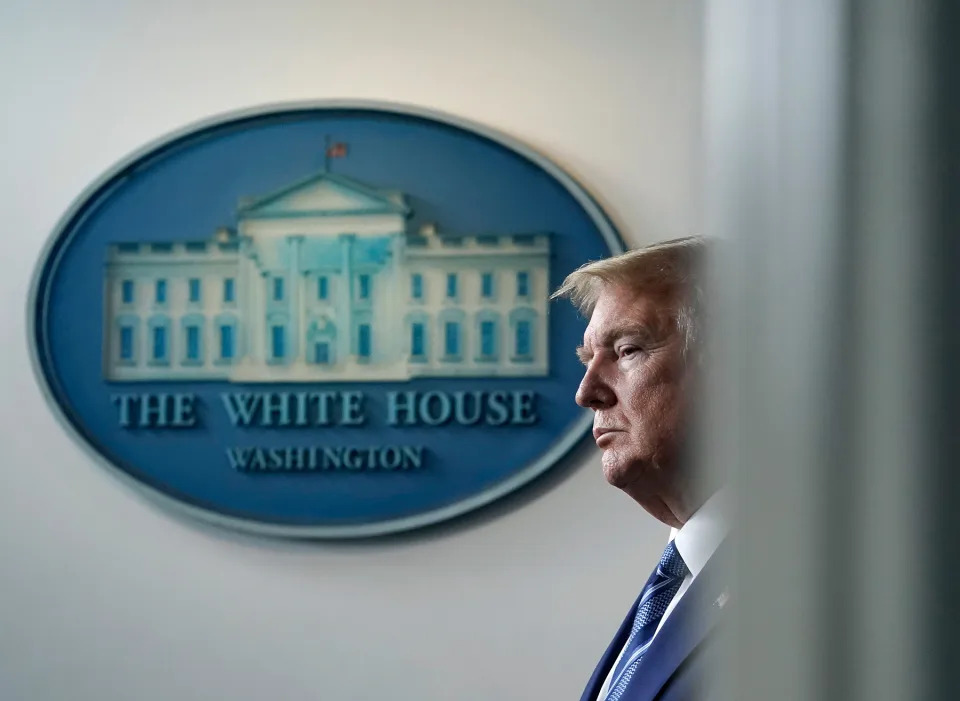
Then-President Donald Trump participates in a briefing at the White House on April 21, 2020.
The anything-anytime-anywhere approach inspired a sense of entitlement among Trump staffers. Some senior administration officials would casually mention their Xanax intake, one source with direct knowledge of the matter recalls. The source describes a time when an aide to Melania Trump walked into the White House Medical Unit and said, “‘Could you prescribe me Xanax.’ She just came in and demanded it.” The source wasn’t a doctor or pharmacist, however, and wasn’t allowed to prescribe the anti-anxiety drug. The source politely turned the aide down. “She stormed out,” the source says.
This is not, to put it mildly, how these drugs are ordinarily handled. “We tightly track controlled substances like this because they’re addictive or can cause overdoses,” says Dr. Beata Lewis, a psychiatrist based in Brooklyn. “It sounds like with all of these substances, people could get whatever they wanted. That puts people at risk for addiction.”
She adds: “The significant thing is these rules apply to everyone … except for the White House. It’s a culture of entitlement and being above the rules to the point of putting people in danger.”
There wasn’t much the medical unit staffers could do, even if they wanted to hold the line. Several told Pentagon investigators “they feared they would receive negative work assignments or be “fired” if they spoke out.
ADDING TO THE CLIMATE OF FEAR was the sense that even private therapy sessions would not be kept private in the Trump White House. The medical unit provided psychological counseling on request. But White House staffers were instructed to be on their guard. One former senior administration official tells Rolling Stone that within the first two years of the Trump presidency, they were warned by a colleague against divulging anything during a private White House medical session that they “would not want to be used against” them. At the time, this source notes, this puzzled the official, who was then told that under Trump, the office had a reputation for being more porous with private information “than you might expect.”
The former administration official didn’t think much of it at the time. The source shrugged the warning off as mere gossip and moved on. However, according to other individuals with intimate knowledge of the matter, it was hardly an idle rumor. Immediately after counseling sessions, therapists were pressed for information about what they were told.
“They’d say, ‘We need you to see this person.’ They’d walk me over there. I’d see this person. Then as soon as I got out, they would ask, ‘Hey what happened?’” one of these sources tells us. To this source, this was a blatant violation of patient confidentiality. The source would try to be as vague as possible in their responses to the questions, but in the Trump White House, “it was all kind of open kimono,” they say.
Keith Bass, who led the White House Medical Unit from 2017 to 2019, confirms that these sorts of debriefs did, in fact, happen after counseling sessions. But he says they never went into details; they were merely to determine whether a “medical/behavioral health event” would prevent a “military/DoD staff” member “from performing their duties or impac[t] their ability to maintain a [top secret] clearance while assigned to the White House,” Bass says in an email. “Detailed clinical notes were not required from the psychologist; only a broad overview to determine fitness for duty status.”
Our source says that’s not entirely accurate. For starters, these debriefs happened after therapy sessions with civilian staffers as well. And while the questions may have been “seemingly innocent,” the source says they could be seen as the start of a “slippery slope,” which would then “drif[t] down into asking for information that was not appropriate.”
The White House Medical Unit’s often casual approach to giving out controlled substances didn’t exactly inspire confidence. “The sloppiness around handing out medications had me highly concerned about the protection of behavioral health information — medical information at large. There was no protection of sensitive patient information, period,” the source says.
Any attempts to add more rigor were entirely unwelcome, the source adds. “The more I held to professional standards” — the more the source objected to the pressure to divulge details about therapy sessions, and to keep patient information private — the worse it got. White House staffers “ostracized me,” the source says. “Nobody would talk to me. The culture was toxic as fuck.”
MODAFINIL WAS DISCOVERED in the 1970s by French scientists and was first handed out to pilots to help keep them awake and on task in the 1991 Gulf War. The U.S. military started to use modafinil in earnest around the 2003 invasion of Iraq. At the time, it was heralded as a massive improvement over previous stimulants: stronger and more effective than caffeine, less physically addictive than amphetamines. “These medications aren’t stimulants like the old military ‘go pills,’ there are few if any side effects when taken as prescribed. They simply stave off drowsiness until the medication wears off, then you naturally fall asleep,” one knowledgeable source writes.
But that “taken as prescribed” caveat is crucial. When handed out willy-nilly, outside a doctor’s supervision, modafinil can pose serious risks, notes Dr. Rachel Teodorini, a researcher at London South Bank University’s division of psychology who has examined the drug and its effects. “If people have cardiovascular problems, heart problems, or blood pressure issues, it could cause things like strokes or heart attacks,” she tells us. And while modafinil doesn’t appear to physically hook patients, “there’s an element of at least psychological dependence. Tolerance builds up, and you need more and more.”
Modafinil tablets.
As a recent study in the journal Military Medicine notes, “although modafinil was initially said to comprise no risk for abuse, there are now indications that modafinil works on the same neurobiological mechanisms as other addictive stimulants.”
And just like with other stimulants, the overuse of modafinil can lead to the perceived need for anti-anxiety medications like Xanax. “Effectively, you’re using one drug to get you up and another to get you down,” Teodorini said.
Some former Trump staffers tell Rolling Stone they didn’t get these drugs directly from the White House Medical Unit. One former Trump White House aide concedes they “borrowed” some modafinil from “a friend,” who said they’d gotten it from the unit. “I had a lot going on in my life and I wanted some,” they say.
In other administrations, modafinil was used “99 percent of the time” for jet lag, one source notes. The Trump White House was a free-for-all. Two other sources each independently compared the White House during those years to college campuses where students cramming for finals or pulling all-nighters would pass around Adderall and other drugs, prescriptions be damned. But it wasn’t just the administration’s junior staffers — the recent college grads — who partook. The sources add that midlevel and certain senior officials — including those who reported to then-President Trump and First Lady Melania Trump — came to rely on modafinil, as well. The sources and former senior Trump officials, who all requested anonymity to discuss sensitive matters, recall instances of staff casually slipping the medical unit-provided stimulant to one another, in efforts to stay focused and help navigate the exhausting chaos of the Trump presidency.
It was “ironic” that Trump’s White House was “one place the war on drugs wasn’t being fought,” one of the former officials sardonically notes, given Trump and many of his lieutenants’ zeal for waging the internationalwar on drugs.
NEARLY EVERY SOURCE INTERVIEWED for this story traced the problems with the White House Medical Unit back to Jackson, who joined the team during the George W. Bush administration and became physician to President Barack Obama in 2013. Before then, he was known as an eccentric. Afterward, he became a menace, as several Defense Department investigations detail.
On a trip to Argentina in March 2016, one of those reports notes, Jackson’s “intoxicated behavior in the middle of the night, pounding on [a female subordinate’s] hotel room door, screaming, yelling, and overall loud behavior in his hotel room exhibited less than exemplary workplace conduct while on official travel to provide medical care for the President.” The Pentagon interviewed 60 of Jackson’s former subordinates; 56 “experienced, saw, or heard about [him] yelling, screaming, cursing, or belittling subordinates.” During a six-week stretch in 2018, a Defense Department hotline received 12 complaints” about Jackson. (Jackson’s office did not respond to a request to comment on this article.)
His nomination to become Secretary of Veterans Affairs that same year was derailed over accusations he handed out pills to White House staffers like a “candyman.” (In one case, a Senate report noted, medical staffers fell “into a panic” because he had given such “a large supply” of Percocet pain pills to a member of the White House Military Office.)
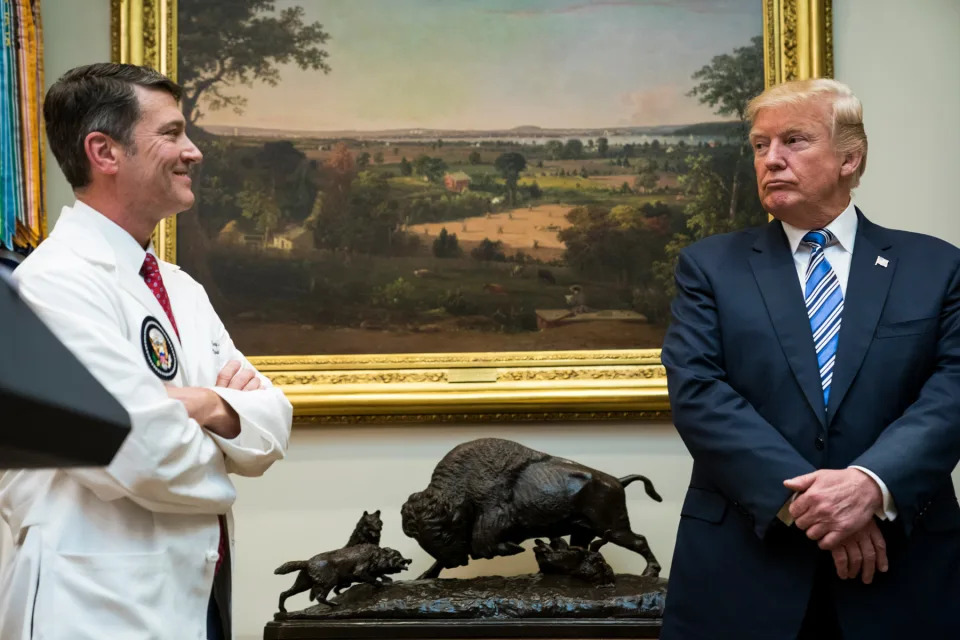
Then-President Donald Trump looks to White House physician Ronny Jackson during an event at the White House on Aug. 3, 2017.
Jackson briefly returned to the White House as Trump’s “chief medical adviser” in 2019 before running for Congress. But no matter what position he held, several sources tell us, his influence dominated medical care at the Trump White House, and Jackson’s “minions” and “loyalists” ran the White House Medical Unit in his stead. “Any practices existing at that time were all set up by Jackson, who’d been there for a dozen years. Though the med unit was led by an administrator, little happened without his say-so,” one of those sources say.
The source adds, “Unit leadership did slowly start making appropriate changes, but due to [the] complicated nature of missions, individual expectations within the organization, a self-imposed cone of silence and fear of being held liable for sins of the father, it took a long time to find the right way forward.”
OUR INTEREST IN THIS STORY was sparked, in part, by a handwritten ledger reprinted on page 14 of the January inspector general’s report: a tracking form for the controlled substances ordered by the White House Medical Unit. In addition to the thousands of pills of Ambien and Provigil listed are even more potent sedatives and pain pills: morphine, hydrocodone, diazepam and lorazepam (better known by their brand names, Valium and Ativan), fentanyl, and even ketamine.
Jackson, now a Republican congressman from Texas, told the Washington Post that his team prescribed narcotics “less than five times” across his tenure. And according to the paper’s sources, drugs like fentanyl were “kept on hand for extreme emergencies — such as a White House fence jumper impaling themselves on a spike.”
That’s a ridiculous example, a well-placed source tells us. “Someone just made up something. If there was a jumper, someone would call 911,” the source says. The jumper would then be transferred to a nearby civilian hospital.
But there was a grain of truth to the idea that the medical unit retained fentanyl and the like for extreme events. In the wake of the wars in Iraq and Afghanistan, there was a desire to bring the advances in battlefield medicine to the White House. If the president or vice president were to get shot in a remote location, far from any hospital, the unit’s physicians wanted to be able to insert a breathing tube into the VIP almost instantaneously, a process known as “rapid sequence induction and intubation.” Doing that requires sedating the patient in a hurry with powerful drugs.
“The unit employed the world’s standards in pre-hospital trauma care, as directed by the DoD’s Joint Trauma System & Committee on tactical-combat casualty-care guidelines. That includes the use of ketamine, fentanyl, etc. for pain management,” a second knowledgeable source writes. “The whole mission is contingency planning for providing most/best possible care for the worst/craziest scenarios.”
Needless to say, they never encountered a scenario that nuts. And we didn’t uncover any evidence that ketamine or fentanyl were handed out to White House staff the way Xanax and Provigil were.
But as the handwritten ledger shows — and our sources confirm — the medical unit’s procedures had grown so sloppy, so lax, that it’s impossible to prove the negative, that these sedatives and dissociatives weren’t given to White House staff. “In our analysis of the White House Medical Unit’s controlled substance records, we found that medications, such as opioids and sleep medications, were not properly accounted for,” the inspector general’s report reads. “These records frequently contained errors in the medication counts, illegible text, or crossed-out text that was not appropriately annotated.”
That might sound like minor errors in paperwork. They’re not. They’re the kind of transgressions that turn patients into addicts, and doctors into ex-doctors. “If you’re sloppy even a little bit with controlled substances, you’ll lose your [medical] license,” one source notes. Without proper record keeping, there’s no way to say just how much of the Trump White House was on drugs. There’s no way to tell how they might use — and abuse — prescription medications if they come back to power. “Nothing is written down,” another source says of the unit’s drug distribution during the Trump years, “because we will always get to yes.”
Trump warns of ‘languages coming into our country’ that ‘nobody’ has heard of
Alec Hernández, Jake Traylor and Katherine Koretski – March 3, 2024
Warning about the dangers of illegal immigration at the southern border has long been one of Donald Trump’s campaign mainstays, going back to the day he launched his first presidential bid. At the time, he said Mexico was sending “rapists” and people who were bringing “drugs” and “crime.”
But lately, the former president has seized on a new thing he says migrants are bringing: languages.
“We have languages coming into our country. We don’t have one instructor in our entire nation that can speak that language,” Trump said before a crowd of thousands of supporters at the Conservative Political Action Conference outside Washington, D.C., last month.
“These are languages — it’s the craziest thing — they have languages that nobody in this country has ever heard of. It’s a very horrible thing,” he added.
Trump repeated the comment the following week during an appearance at the southern border alongside Texas Gov. Greg Abbott, saying that migrants are entering the country speaking “truly foreign languages.”
“Nobody speaks them,” he said after a tour of the border in Eagle Pass.
And addressing a rally in Virginia Saturday night, Trump described New York classrooms as overwhelmed with “pupils from foreign countries, from countries where they don’t even know what the language is.”
“We have nobody that even teaches it. These are languages that nobody ever heard of,” he claimed.
It’s not entirely clear what languages Trump is referencing.
When asked to clarify Trump’s remarks, campaign spokesman Steven Cheung responded, “There are migrants invading from countries that we know nothing about, which is the point.” He did not respond to a follow-up question about what those countries are.
At campaign rallies, Trump routinely says he would carry out the largest domestic deportation operation in history if re-elected. Trump also vows to reinstate his infamous Muslim travel ban, expand it to include Gazan refugees, and incorporate “ideological screenings” for all immigrants. Trump has also claimed multiple times that immigrants are poisoning the blood of America, a comment President Joe Biden’s campaign likened to the rhetoric of Adolf Hitler.
The context behind Joe Biden, Donald Trump’s dueling immigration speeches at Texas border
Maria Ramirez Uribe – March 2, 2024
The two 2024 presidential election front-runners traveled to Texas on Thursday to deliver vastly different messages about a key election issue: immigration.
Former President Donald Trump stoked fear about the people crossing the southern U.S. border, citing recent high-profile criminal cases in which authorities charged immigrants who were in the U.S. illegally. President Joe Biden blamed Republicans for sidelining a Senate immigration bill he said would have given his administration the resources and powers needed to reduce illegal immigration.
Speaking at Eagle Pass, the epicenter of a feud between the state and the federal government, Trump joined Gov. Greg Abbott, the Border Patrol union’s leader and Texas National Guard members.
A few minutes after Trump spoke and about 300 miles south, Homeland Security Secretary Alejandro Mayorkas, U.S. Rep. Vicente Gonzalez, D-McAllen, and Border Patrol agents joined Biden as he spoke in Brownsville.
Trump spent the hours before his speech blasting Biden’s immigration policies over social media and in a Daily Mail article, seeking to position himself as the only person able to “stop Biden’s illegal immigrant invasion.”
At the end of his speech, Biden asked Trump to join him in getting Congress to pass the Senate border security bill.
“Instead of playing politics with the issue, why don’t we just get together and get it done,” Biden said.
PolitiFact listened to both presidential candidates. Biden overstated the authority provided to him in the border security bill. Trump made broad, often unsubstantiated statements about the migrants entering the U.S. and his administration’s immigration successes.
Here’s the context behind some of their statements:
Biden overstates possible effect of emergency authority in border security bill
The Senate bill “would also give me as president, or any of the next presidents, emergency authority to temporarily shut down the border between ports of entry.” — Biden in Brownsville
The Senate proposal, which failed 49-50, sought to enable the executive branch to block people from seeking asylum in between ports of entry if illegal immigration encounters reach certain levels.
That doesn’t mean people would stop coming to the border. A public health policy to mitigate COVID-19’s spread that was in place from March 2020 to May 2023 also largely blocked people from seeking asylum, but border encounters rose.
“There is this idea that we control how many migrants attempt illegal crossings. We do not,” Theresa Cardinal Brown, the Bipartisan Policy Center’s senior adviser for Immigration and border policy, previously told PolitiFact. “We control what happens once we encounter someone who has already crossed the border illegally.”
Under current immigration law, people on U.S. soil can seek asylum regardless of how they entered the country. The bill’s emergency authority tried to change that. But the government’s ability to quickly remove people from the U.S. would still hinge on its resources and other countries’ willingness to take back immigrants.
“In short, there is no authority that Congress could pass that would allow for a ‘complete and total shutdown of the border,’” Brown told us in February. “That’s just not how borders work in any real sense. Especially not our border with Mexico.”
Former President Donald Trump and President Joe Biden were both on the border Thursday, with Trump in Eagle Pass and Biden in Brownsville.
Trump leaves out context on migrants and crime, exaggerates his administration’s success
The person charged with a Georgia nursing student’s murder “is an illegal alien migrant who was led into our country and released into our communities by ‘Crooked Joe’ Biden.'” — Trump in Eagle Pass
Laken Riley, a 22-year-old University of Georgia nursing student, was killed while on a run Feb. 22. Authorities charged Jose Ibarra with the murder.
Ibarra, a 26-year-old from Venezuela, was stopped by U.S. Customs and Border Protection when he illegally crossed the border in September 2022, according to Immigration and Customs Enforcement. Ibarra was paroled in, allowing him to be released in the U.S. to await further immigration proceedings.
There is conflicting information on whether he was arrested in New York City. ICE told PolitiFact the New York Police Department arrested Ibarra on Aug. 31, 2023, and charged him with “acting in a manner to injure a child less than 17 and a motor vehicle license violation.” ICE said the police released him before immigration authorities were able to issue a detainer request for him. But NYPD told PolitiFact there were no arrests under the name “Jose Ibarra” in 2023.
Despite high-profile cases of crimes committed by, or charged to immigrants in the U.S. illegally, research shows that immigrants aren’t more likely to commit crimes than U.S.-born people. A 2023 Stanford University study found immigrants are 30% less likely to be incarcerated than people born in the U.S. Research published in 2024 by the libertarian Cato Institute found that in Texas, immigrants in the U.S. illegally have a lower homicide conviction rate than people born in the U.S.
“We ended catch and release.” — Trump in Eagle Pass
This is misleading and doesn’t reflect what happened. Republicans often use the term “catch and release” to describe immigration authorities stopping immigrants at the border and releasing them so they can await their court hearings outside of federal custody.
Both Democratic and Republican administrations have followed this practice for decades because there’s limited detention space and court rulings have capped how long someone can be held.
In January 2017, Trump signed an executive order to end “catch and release.” But a few months later, his own attorney general testified to the Senate that the practice continued because of the long case backlog and a shortage of immigration judges.
“We built 571 miles of border wall, much more than I promised I’d build.” — Trump in Eagle Pass
During his 2016 presidential campaign, Trump promised to build a border wall along at least 1,000 miles of the nearly 2,000-mile U.S. southern border. He didn‘o‘t fulfill that promise.
U.S. Customs and Border Protection data say the Trump administration built barriers along 458 miles. But even most of that construction replaced existing smaller, dilapidated barriers and didn’t add to the total miles of southern border barriers.
The amount of new primary barriers built — 52 miles — is about 10 times less than Trump’s estimate. Primary barriers are the first impediment people encounter when trying to cross the border from Mexico; they can block people who are walking or driving.
Trump waves at migrants he’s trying to keep out at the US-Mexico border
Alia Shoaib – March 2, 2024
Donald Trump waved at migrants at the southern border and exclaimed that they like him.
Trump has proposed launching a mass deportation campaign if reelected in 2024.
On a rival visit, Biden urged Trump to support a bipartisan border security package.
Former President Donald Trump waved and pumped his fist at migrants at the southern border with Mexico — the very same ones he is trying to keep out of the country.
“They like me, governor,” Trump added to Texas Gov. Greg Abbot, who was taking him on a border tour.
Trump has suggested that he would launch the largest deportation campaign in history if he’s reelected in 2024, among other stringent measures to keep migrants out.
Not long after he waved at the migrants, Trump gave a speech at Eagle Pass in which he said Biden had the “blood of countless innocent victims” on his hands” because of his immigration policies.
He listed specific cases in which undocumented immigrants were reported to have attacked people, including the killing of 22-year-old Laken Riley, whose death has grabbed national attention.
“The monster charged in the death is an illegal alien migrant who was led into our country and released into our country by crooked Joe Biden,” Trump said.
Despite such individual cases, studies have found that immigrants are less likely to commit crimes than US-born individuals.
President Biden tells Trump — ‘join me’
Migrants wait in line adjacent to the border fence under the watch of the Texas National Guard to enter into El Paso, Texas, May 10, 2023.Andres Leighton/AP Photo
President Joe Biden simultaneously visited another border town across the state on Thursday as both tried to score political points on the flash point issue of immigration as the November election nears.
Polls show that immigration is one of Biden’s major vulnerabilities, and Trump has continued to highlight his contrastingly draconian approach.
On his rival Texas visit, Biden urged Trump to help him pass his proposed border security package, which Republicans tanked under Trump’s orders.
On his rival Texas visit, Biden urged Trump to help him pass his proposed border security package, which was tanked by Republicans under Trump’s orders.
The package would see billions of dollars put toward staff and resources on the southern border, where officials have been overwhelmed by a surge in migrant crossings.
“Here’s what I would say to Mr Trump,” Biden said. “Instead of playing politics with the issue, instead of telling members of Congress to block this legislation, join me.”
“You know, and I know it’s the toughest, most efficient, most effective border security bill this country’s ever seen. So instead of playing politics with the issue, why don’t we just get together and get it done?” Biden said.
Trump’s CPAC speech showed clear signs of major cognitive decline — yet MAGA cheered
Chauncey DeVega – February 26, 2024
Lev Radin/Pacific Press/LightRocket via Getty Images
Donald Trump was in his full glory over the weekend at the annual Conservative Political Action Committee (CPAC) conference. For his MAGA people, Republicans, and other neofascists and followers, Trump is like a father figure, preacher, teacher, confessor, lover, and god messiah prophet all in one person. In that way, CPAC is Donald Trump’s “church family” – only the church is full of fascism, hatred, wickedness, cruelty, and other anti-human values, beliefs, and behavior. Trump masterfully wields and conducts this energy.
Donald Trump’s speech at this year’s CPAC was truly awesome. As used here, “awesome” does not mean good, but instead draws on the word’s origins as in “inspiring awe or dread.” In his keynote speech on Saturday, Trump said that America is on a “fast track to hell” under President Biden and the Democrats and that “If crooked Joe Biden and his thugs win in 2024, the worst is yet to come. Our country will sink to levels that are unimaginable.”
He continued with his Hitler-like threats of an apocalyptic end-times battle between good and evil and that the country would be destroyed if he is not installed in the White House. Of course, Trump continued to amplify the Big Lie about the 2020 election being “stolen” from him and the MAGA people. He also made great use of the classic propaganda technique, as though he learned it personally from Nazi Minister of Propaganda Joseph Goebbels: Accuse your opposition of that which you are guilty of.
If Mr. Biden is re-elected for a second four-year term, Mr. Trump warned in his speech, Medicare will “collapse.” Social Security will “collapse.” Health care in general will “collapse.” So, too, will public education. Millions of manufacturing jobs will be “choked off into extinction.” The U.S. economy will be “starved of energy” and there will be “constant blackouts.” The Islamist militant group Hamas will “terrorize our streets.” There will be a third world war and America will lose it. America itself will face “obliteration.”
On the other hand, Mr. Trump promised on Saturday that if he is elected America will be “richer and safer and stronger and prouder and more beautiful than ever before.” Crime in major cities? A thing of the past.
“Chicago could be solved in one day,” Mr. Trump said. “New York could be solved in a half a day there.”
“I stand before you today not only as your past and future president, but as a proud political dissident….“For hard-working Americans Nov. 5 will be our new liberation day — but for the liars and cheaters and fraudsters and censors and impostors who have commandeered our government, it will be their judgment day…. Your victory will be our ultimate vindication, your liberty will be our ultimate reward and the unprecedented success of the United States of America will be my ultimate and absolute revenge.”
Here, Donald Trump sounded like an evil version of President Thomas Whitmore in the 1996 movie “Independence Day.”
He also used stochastic terrorism to encourage violence by his MAGA followers and other supporters with the lie that they are somehow being “victimized” or “persecuted” in America: “I can tell you that weaponized law enforcement hunts for conservatives and people of faith.” Echoing those themes, Trump, who believes that he is above and outside the rule of law, described his finally being held responsible for his many obvious crimes against American democracy and society as “Stalinist Show Trials,” as The Guardian further details:
Facing 91 criminal charges in four cases, Trump projected himself as both martyr and potential saviour of the nation. “A vote for Trump is your ticket back to freedom, it’s your passport out of tyranny and it’s your only escape from Joe Biden and his gang’s fast track to hell,” he continued.
“And in many ways, we’re living in hell right now because the fact is, Joe Biden is a threat to democracy – really is a threat to democracy.”
Speaking days after the death of the Russian opposition leader Alexei Navalny, Trump hinted at a self-comparison by adding: “I stand before you today not only as your past and hopefully future president but as a proud political dissident. I am a dissident.”
The crowd whooped and applauded. Trump noted that he had been indicted more often than the gangster Al Capone on charges that he described as “bullshit”. The audience again leaped to their feet, some shaking their fists and chanting: “We love Trump! We love Trump!”
Trump argued without evidence: “The Stalinist show trials being carried out at Joe Biden’s orders set fire not only to our system of government but to hundreds of years of western legal tradition.
“They’ve replaced law, precedent and due process with a rabid mob of radical left Democrat partisans masquerading as judges and juries and prosecutors.”
Trump is an expert on leveraging everyday people’s pain points and personal fear. In his CPAC speech, Trump triggered this by focusing on real economic anxieties and feelings of vulnerability and precarity about rising energy costs, the cost of living, and the “American Dream” more broadly.
To this point, President Biden and the Democrats have not been able to effectively counter such attacks by Donald Trump and his spokespeople and other agents. Appeals to the facts about how historically great Biden’s economy is, are no salve for how everyday people are experiencing hardship and increasingly view Donald Trump and Trumpism as a viable alternative to the Democrats and “democracy.”
Trump also spun up a horror story version of the United States as a country overrun by black and brown migrants and “illegal” immigrants who are like the cannibalistic serial killer Hannibal Lecter from the film “Silence of the Lambs.” Trump’s solution: mass deportations and concentration camps.
During his speech, Donald Trump would continue to valorize the Jan. 6 terrorists who attacked the Capitol as fascist saints and martyrs of the MAGA movement – a group who Trump vowed to pardon when/if he takes power in 2025. They will in turn become his personal shock troops. Trump’s megalomania and claims to god-like power, were on full display during his speech on Saturday, where the ex-president, described himself in the third person, telling the audience that “Trump was right about everything.”
In an excellent article at Mother Jones, Stephanie Mencimer shared what she learned from embedding herself at last week’s CPAC conference (she did not attend as a credentialed reporter) and how in the Age of Trump and American neofascism that event is a festival of extreme right-wing politics and the hatred and intolerance that are among its most defining features:
Exiled from the press pen, I was just part of the audience, a space previously off-limits to reporters. To say the least, it was enlightening. On Friday, for instance, I listened to a main-stage speech from Chris Miller, a Republican running for governor of West Virginia. Because of its tax-exempt status, CPAC bans speakers from openly campaigning there, so he was listed on the program simply as “businessman.”
Like virtually every other speaker at the event, Miller devoted several of his allotted five minutes to railing against transgender healthcare. “Woke doctors are literally making boys into girls,” he declared. “They’re practicing mutilation, not medicine. They should be in prison.” At that point, a burly man in a giant black cowboy hat sitting next to me leaned over conspiratorially and proclaimed, “I think we should hang them all! I really do.” And he laughed like we were in on the same joke. I confess that I was too cowardly to tell him I was with the left-wing fake news.
Later, during a speech by South Dakota Governor Kristi Noem, I was sitting next to a woman in full-on MAGA gear. When Noem declared, “There are some people who love America, and there are some people who hate America,” my neighbor gave me a small heart attack. “Get the FUCK OUT!” she yelled furiously, ready to rumble. “Get the FUCK OUT!” Meanwhile, the old man in the camo Trump hat next to her had somehow fallen asleep.
Mencimer then reflected on the devolution of CPAC, describing it as, “[W]hat passed for policy discussions at CPAC this year was largely limited to mass deportations and attacks on trans athletes. The sober panels about the national debt, balancing the budget, or Social Security reform that once commanded top billing were a relic of another era before CPAC became an extension of Trump Inc., devoted to all the MAGA grievances like racial equity, the evils of windmills, or bans on gas stoves.”
However, one must be cautious and understand that Trump’s apparent mental, emotional, and overall cognitive decline, and other indications of a damaged mind, are largely irrelevant to his followers. Donald Trump is a symbol more than a man. His MAGA people and other loyalists and voters ignore, reconcile, and more generally make sense of Trump’s apparent cognitive and speech difficulties by telling themselves that he is “just like them” and “speaks a language they can understand” because he is “authentic” and “not a traditional politician.” By definition, the Dear Leader is infallible. Fake right-wing populism can be bent and shaped to accommodate any absurdity.
Donald Trump’s speech at CPAC is but more evidence that he is giving his MAGA people and other followers and supporters in the Republican Party and the larger right-wing and “conservative” movement what they want. Public opinion polls and other research have consistently shown that there are tens of millions of Americans who yearn for an American dictator or others strongman-type leader, who will “break the rules” to “get things done” for “people like them.” In addition, Republican and other Trump voters specifically support his taking power as a dictator and ending democracy. And as has been widely documented, a significant percentage of white voters do not support democracy if it means that their “racial” group does not have the most influence and power and privilege in American society as compared to black and brown people.
Donald Trump and today’s Republican Party and the larger right-wing and neofascist movement have successfully tapped into what is a centuries-old vein of white supremacist herrenvolk nightmare dreams and white rage in American society and life. The CPAC conference featured speakers and panels that reinforced that today’s Republican Party and “conservative movement” have rejected multiracial pluralistic democracy and seek to replace it with a White Christofascist Apartheid plutocracy.
In contrast to Donald Trump’s awfully awesome speech at CPAC on Saturday, President Biden solemnly warned reporters, again, that the 2024 Election is an existential battle for the country’s democracy and the soul of the nation where our most fundamental freedoms as Americans are imperiled.
The most disturbing thing I’ve ever heard a president say did not come from Donald Trump.
It came from Joe Biden. Speaking with reporters in California on Thursday, the president said this about Donald Trump. “Two of your former colleagues not at the same network personally told me if he wins, they will have to leave the country because he’s threatened to put them in jail,” Biden told Katie Couric. “He embraces political violence,” Biden said of Trump “No president since the Civil War has done that. Embrace it. Encourages it.”
Perhaps I should have been shocked at the revelation that Trump, should he return to power, would jail reporters. I wasn’t of course. I had to fight him (and beat him) three times in court during his first administration to keep my White House press pass. I had already privately heard Trump’s threats. It was just disturbing to hear Joe Biden confirm it publicly. …
That is why the world cannot see Trump back in the White House. He knows nothing but divisiveness. And Biden was right to point out that Trump wants to jail reporters.
Trump supporters don’t care. But I’ve eaten Texas jail food, so I do.
When Einstein fled Germany he fled the poison of nationalism and longed for a country of civil liberty and tolerance. The closest he found was here in the United States. Where is it today? More importantly, where will it be after the November general election?
As always, believe the autocrat-dictator or other such political thug. He or she – in this case Donald Trump – is not kidding or joking.
Echoing Karem’s experience, I have talked to members of the pro-democracy movement (specifically journalists and reporters), and they have shared with me how they are in the process of deciding if they will stay here in the United States or flee the country if Dictator Trump and his regime takes power in 2025.
On Election Day, which will be here very soon, the American people have a choice to make. Last weekend’s CPAC conference was just one more escalation in the direct and transparent threats and dangerousness of Trumpism and American neofascism. If Trump wins on Election Day, the American people cannot say they were surprised by the hell he and his regime and followers will unleash on the country. The American people were told repeatedly what would happen and through both their active and tacit support for Trumpism and neofascism (indifference or otherwise not voting for President Biden and by implication American democracy in this decisive moment) allowed it to happen. How great is the American people’s drive to self-destruction? We will soon find out in eight or so months.