‘A lonely radio nerd. A poet. Vladimir Putin’s crackdown sweeps up ordinary Russians
Dasha Litvinova – March 8, 2024
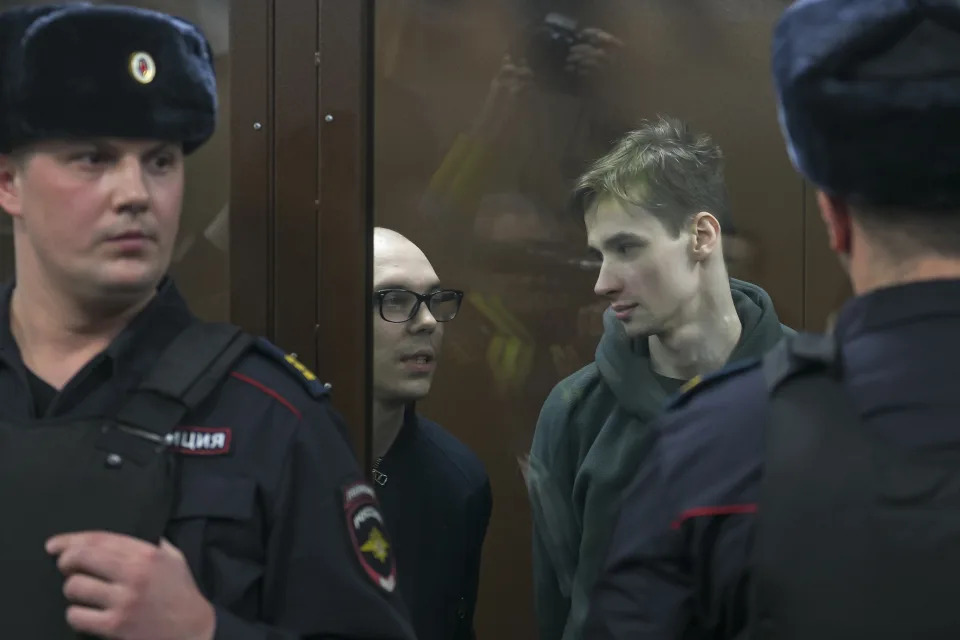
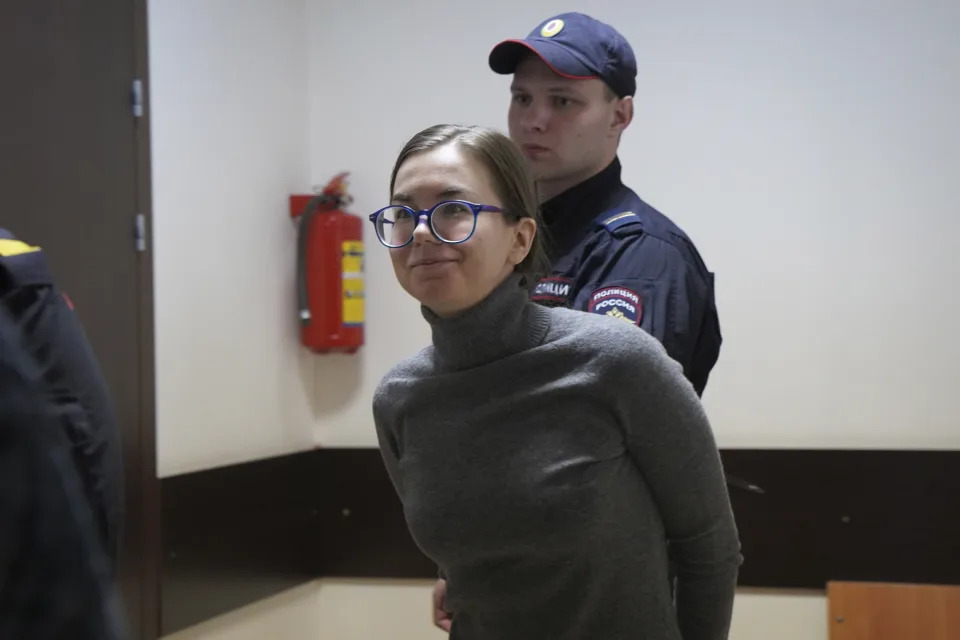
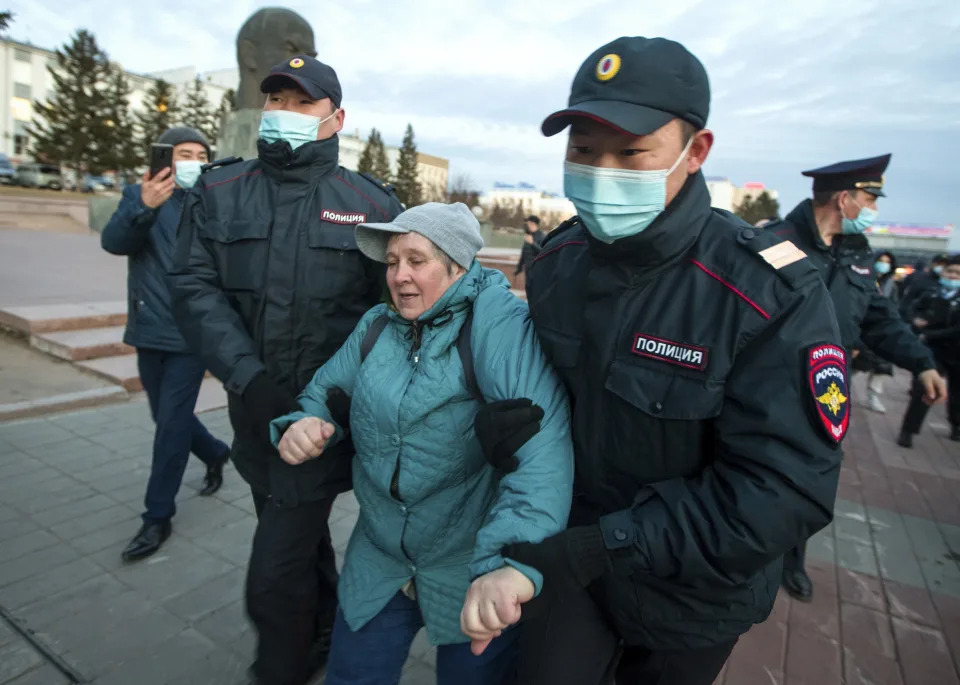
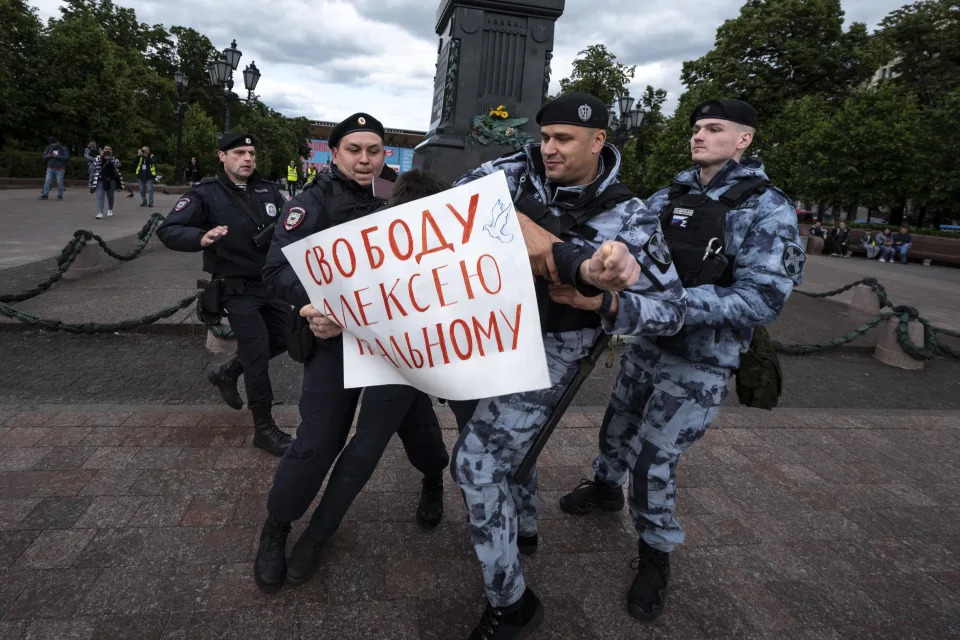
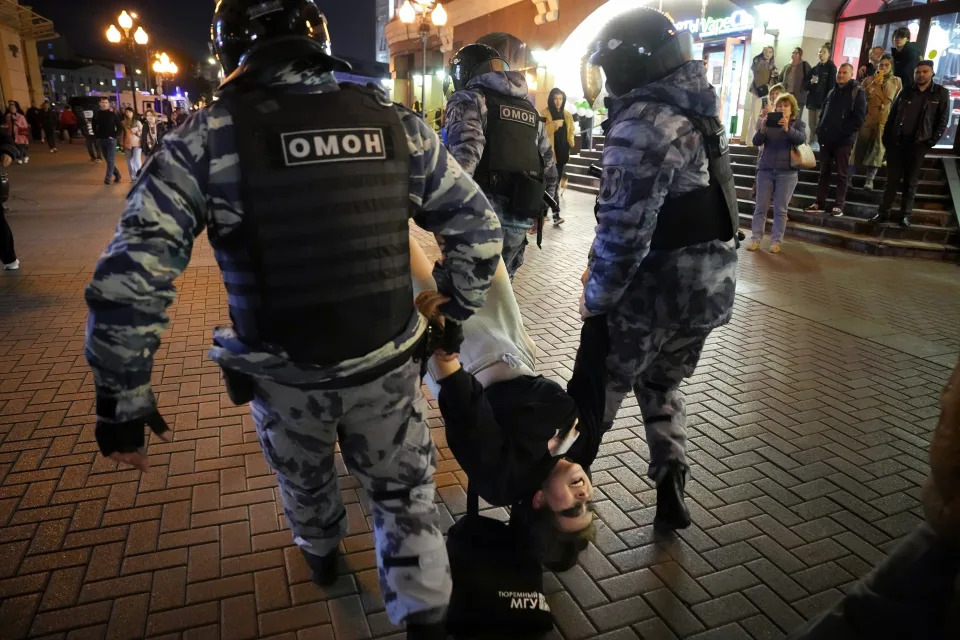
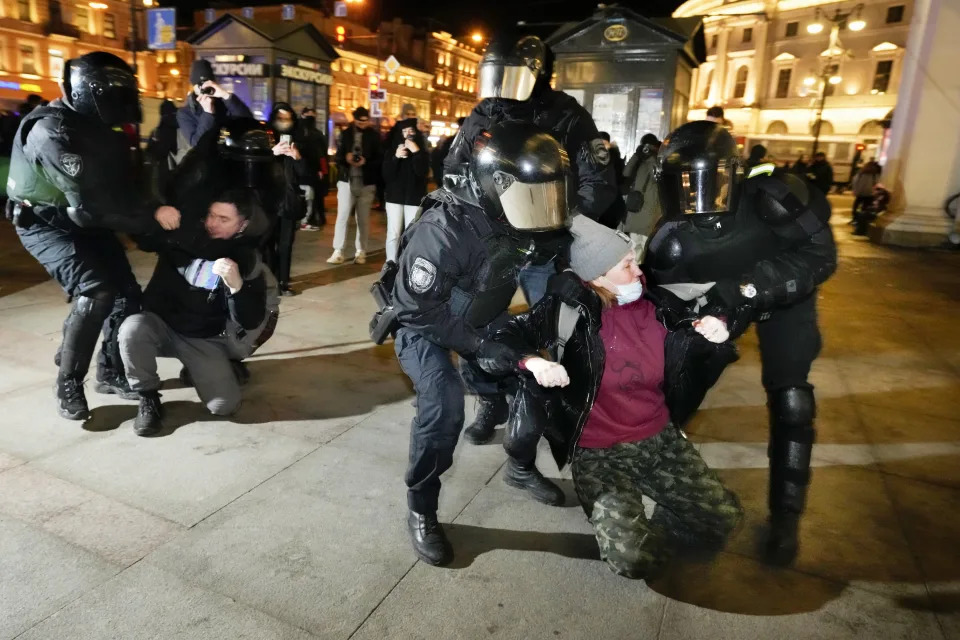
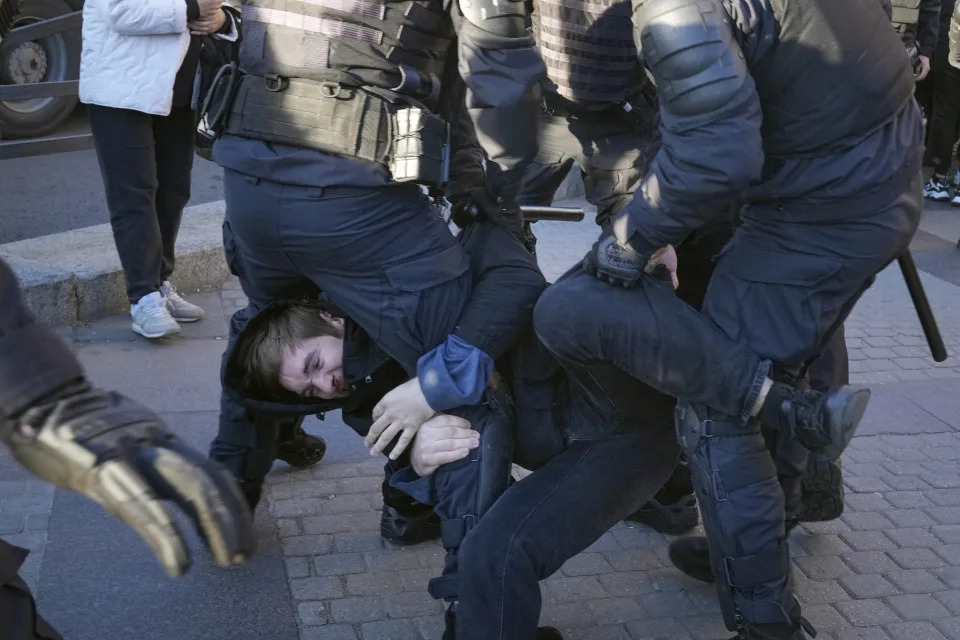
Artyom Kamardin, left, and Yegor Shtovba, right, stand behind a glass in a cage in a courtroom in Moscow, Russia, Thursday, Dec. 28, 2023. Artyom Kamardin was given a 7-year prison sentence Thursday for reciting verses against Russia’s war in Ukraine, a tough punishment that comes during a relentless Kremlin crackdown on dissent. Yegor Shtovba, who participated in the event and recited Kamardin’s verses, was sentenced to 5 1/2 years on the same charges. (AP Photo, File)Viktoria Petrova is escorted by police for a hearing in a court in St. Petersburg, Russia, Friday, March 3, 2023. Petrova was sentenced to involuntary treatment in a psychiatric facility after she condemned Russian officials for sending troops into Ukraine on social media. In the last two years, ordinary Russians have been increasingly swept up in an unprecedented government crackdown. (AP Photo)Police officers detain a woman during a protest in support of jailed opposition leader Alexei Navalny in Ulan-Ude, the regional capital of Buryatia, a region near the Russia-Mongolia border, Russia, Wednesday, April 21, 2021. In the last two years, ordinary Russians have been increasingly swept up in an unprecedented government crackdown, together with opposition politicians, independent journalists and human rights activists. (AP Photo, File)Police officers detains a demonstrator with a poster that reads: “Freedom for Alexei Navalny,” in Pushkinskaya Square in Moscow on Sunday, June 4, 2023. In the last two years, ordinary Russians have been increasingly swept up in an unprecedented government crackdown, together with opposition politicians, independent journalists and human rights activists. (AP Photo, File)Police detain a man who wants to lay flowers paying last respects to Alexei Navalny at a large boulder from the Solovetsky islands, where the first camp of the Gulag political prison system was established, in St. Petersburg, Russia on Saturday, Feb. 17, 2024. In the last two years, ordinary Russians have been increasingly swept up in an unprecedented government crackdown, together with opposition politicians, independent journalists and human rights activists. (AP Photo, File)Riot police detain a demonstrator during a protest against mobilization in Moscow on Wednesday, Sept. 21, 2022. In the last two years, ordinary Russians have been increasingly swept up in an unprecedented government crackdown, together with opposition politicians, independent journalists and human rights activists. (AP Photo, File)Police detain people protesting Russia’s attack on Ukraine in St. Petersburg, Russia, Tuesday, March. 1, 2022. In the last two years, ordinary Russians have been increasingly swept up in an unprecedented government crackdown, together with opposition politicians, independent journalists and human rights activists. (AP Photo, File) Russian policemen detain a demonstrator protesting mobilization in St. Petersburg, Russia, Saturday, Sept. 24, 2022. In the last two years, ordinary Russians have been increasingly swept up in an unprecedented government crackdown, together with opposition politicians, independent journalists and human rights activists. (AP Photo, File)
TALLINN, Estonia (AP) — A lonely man jailed for criticizing the government on his ham radio. A poet assaulted by police after he recited a poem objecting to Russia’s war in Ukraine. A low-profile woman committed to a psychiatric facility for condemning the invasion on social media.
President Vladimir Putin’s 24 years in power are almost certain to be extended six more by this month’s presidential election. That leadership has transformed Russia. A country that tolerated some dissent is now one that ruthlessly suppresses it.
Along with opposition politicians, independent journalists and human rights activists, ordinary Russians have been increasingly swept up in a crackdown reminiscent of the Soviet era. Some human rights advocates compare the scale of the clampdown to the repression from the 1960s to the 1980s, when dissidents were prosecuted for “anti-Soviet propaganda.”
THREE YEARS IN PRISON FOR A RADIO AMATEUR
Vladimir Rumyantsev led a lonely life. The 63-year-old worked stoking the furnace at a wood-processing plant in Vologda, a city about 400 kilometers (250 miles) northeast of Moscow. He had no family apart from an estranged brother.
To entertain himself, he bought a couple of radio transmitters online and started broadcasting audiobooks and radio plays that he had liked, along with YouTube videos and podcasts by journalists critical of the Kremlin and the war in Ukraine. He also shared posts on his social network page in which independent media and bloggers talked about Russia’s attacks on civilian infrastructure in Ukraine.
Rumyantsev did not intend to reach a radio audience. According to his lawyer, Sergei Tikhonov, he listened on headphones in his own apartment.
In a letter from behind bars published by Russia’s prominent rights group OVD-Info, Rumyantsev said “tinkering with and improving” radios has been his hobby since Soviet times, and he decided to set up self-broadcasting as an alternative to Russia’s state TV, which was increasingly airing “patriotic hysteria.” To him, it seemed a better technological solution than Bluetooth speakers because the radio could reach everywhere in his apartment, he said in the letter.
But his social media activity eventually put him on the authorities’ radar, and they discovered his radio frequency. In July 2022, police arrested Rumyantsev, accusing him of “spreading knowingly false information” about the Russian army — a criminal charge authorities introduced shortly after invading Ukraine.
Rumyantsev rejected the charges and insisted on his constitutional right to freely collect and disseminate information, Tikhonov says. The law under which Rumyantsev was charged effectively criminalized any expression about the war that deviated from the Kremlin’s official narrative. In December 2022, he was convicted and sentenced to three years in prison.
Tikhonov visits Rumyantsev every so often in a penal colony about 200 kilometers away (125 miles) from Vologda and described him as “calm and resilient,” even though incarceration has taken its toll on his health.
He said Rumyantsev deliberately chose to speak out against the war and refuses to apply for parole as “it is unacceptable for him to admit guilt, even as a formality.”
Russian media reported on the case against Rumyantsev when he was in pretrial detention, and he started getting many letters of support, Tikhonov said. Some supporters put money in his prison account, while others have sent supplies — mostly food, but also books and personal hygiene items, according to the lawyer.
“In addition to making the man’s life easier, this (gave him) an understanding that he is not alone and there are many people who share the same values,” Tikhonov said.
ARREST AND VIOLENCE AFTER A POETRY RECITAL
Artyom Kamardin worked as an engineer, but poetry is his passion.
He was a regular at monthly recitals in the center of Moscow, near the monument to Soviet poet Vladimir Mayakovsky. The recitals continued even after Russia invaded Ukraine. One was billed as an “anti-mobilization” recital several days after Putin announced a partial call-up into the army in September 2022.
Kamardin, 33, recited a poem condemning Russia-backed insurgents in eastern Ukraine. The next day, police with a search warrant burst into the apartment he shared with his wife Alexandra Popova and another friend, and took the poet into custody.
Police beat Kamardin, Popova and their flatmate, and raped the poet, both his wife and his lawyer said. All three filed a formal complaint with the authorities, and the allegations were eventually investigated. The authorities concluded that police acted “within the law,” the Russian news outlet Sota reported, citing the lawyer without providing further details.
For the couple, the experience was so traumatic that they “still can’t openly talk to each other” about what happened, Popova said in an interview with The Associated Press.
In addition to Kamardin, police swept up two other poets who didn’t know him, nor each other. They charged all three with making calls undermining national security and inciting hatred. All three were convicted and sentenced to prison terms.
Kamardin got the longest — seven years.
“No one should be in prison for words, for poetry,” Popova said. She said she believes that her husband’s poem “insulted someone so much that they decided to scourge a defiant poet.”
The couple got married while Kamardin was in pretrial detention.
INVOLUNTARY TREATMENT IN A PSYCHIATRIC HOSPITAL FOR WAR CRITICISM
Unlike dozens of other Russians convicted over speaking out against the war in Ukraine and handed prison terms, St. Petersburg resident Viktoria Petrova is spending her days in a psychiatric facility. In December, she was sentenced to six months of involuntary treatment over a social media post condemning Russia’s invasion of Ukraine.
Her lawyer has said that doctors can keep Petrova there for as long as they want and extend the term indefinitely once the six months run out. So the ruling “can’t be considered good news,” Anastasia Pilipenko wrote in her blog on the messaging app Telegram.
Petrova was arrested in May 2022 and placed in pretrial detention over a post on Russian social network VK, in which she criticized Russian officials for what the Kremlin insists on calling “a special military operation” in Ukraine, the lawyer told Russian independent news site Mediazona.
In her Telegram blog, Pilipenko has described Petrova, 30, as “an ordinary girl” who “merely shared her thoughts on social media.”
“Ordinary life, ordinary gym, a cat. Ordinary job at an unremarkable office,” the lawyer wrote.
The court ordered a psychiatric evaluation of Petrova after other inmates of her pretrial detention center reported that she kept up her “antiwar propaganda,” Pilipenko said in an interview with a local news outlet. These evaluations are common but in a rare turn, Petrova was declared mentally incompetent.
The lawyer argued that it wasn’t true and her client’s words have been misconstrued, but to no avail — Petrova was committed to a psychiatric facility.
In November, Pilipenko reported abuse by facility staff, saying that they forced a strip search of the woman by male workers, pushed her around, strapped her to the hospital bed and injected her with medication that left her unable to to speak for two days.
“This should not happen to ‘political (prisoners),’ criminals, mentally ill people, healthy people — anyone,” Pilipenko wrote on Telegram. The facility didn’t comment on the allegations, but shortly after she spoke out about it, Pilipenko wrote, the abuse stopped.
Trump’s vaccine rhetoric sends chills through public health circles
Nathaniel Weixel – March 9, 2024
Public health advocates are watching in growing alarm as former President Trump increasingly embraces the anti-vaccine movement.
“I will not give one penny to any school that has a vaccine mandate or a mask mandate,” Trump said in a recent campaign rally in Richmond, Va.
It’s a line Trump has repeated, and his campaign said he is only referring to school COVID-19 vaccine mandates — but that hasn’t eased fears that the GOP leader could accelerate already worrying trends of declining child vaccination.
Trump “is an important voice. He has a big platform. And he uses that platform, in this case, to do harm. Because he’s implying by saying that we shouldn’t mandate vaccines, vaccines are in some ways ineffective or unsafe,” said Paul Offit, a pediatrician and vaccine expert at the Children’s Hospital of Philadelphia.
The ironic part, Offit noted, is that the Trump administration kickstarted Operation Warp Speed, which helped drug companies use a relatively new technology to make two very effective and safe COVID-19 vaccines in less than a year.
Throughout the campaign, Trump has performed a complicated tap dance regarding COVID vaccines. He simultaneously wants to take credit for their speedy development but has also criticized their use and knocked his now former rivals for being too pro-vaccine.
In a post on Truth Social reacting to Biden’s State of the Union speech on Thursday, Trump again claimed credit for the COVID-19 shots.
“You’re welcome, Joe, nine month approval time vs. 12 years that it would have taken you!”
Every state and the District of Columbia requires children to get vaccinated against certain diseases before they start school, including measles, mumps, polio, tetanus, whooping cough and chickenpox. A plan to withhold federal funding would have widespread impact.
“Like most states, Virginia requires MMR vaccine, chickenpox vaccine, polio, etc. So Trump would take millions in federal funds away from all Virginia public schools,” former GOP Rep. Barbara Comstock (Va.) wrote in response to his campaign threat on X, formerly Twitter.
Since the public health emergency ended last May, no state requires students to get the COVID-19 vaccine, while 21 states have laws specifically banning schools from requiring COVID-19 shots.
Trump’s campaign says his comments only apply to states that mandate COVID-19 vaccines — making it essentially an empty threat.
“If you actually listen to the entire section, and also if you’ve been following his speeches for the past year, he’s talking about COVID vaccines in addition to masks in the same breath. This isn’t anything new,” Trump campaign spokesman Steven Cheung said in an email.
Experts say the politicization of vaccines has led to an increase in hesitancy and is sparking more outbreaks of preventable diseases like measles.
There have been measles outbreaks in 15 states this year, most recently in Florida, where state Surgeon General Joseph Ladapo did not recommend parents vaccinate their children or keep unvaccinated students home from school as a precaution.
Instead, he sent a letter to parents advising them to make their own decisions about school attendance.
Ladapo was appointed by Gov. Ron DeSantis (R) in 2021 and has since aligned himself with anti-vaccine sentiments, primarily about the COVID-19 shots.
Ladapo told people not to get the most recent shot and has drawn sharp rebukes from the medical community — as well as federal health agencies — for claims that the shots alter human DNA, can potentially cause cancer, and are generally unsafe.
Georges Benjamin, executive director of the American Public Health Association, said he worries that Trump is signaling he will empower more people like Ladapo if he wins reelection.
“I worry about any administration that doesn’t follow good evidence and good science, that they will put more and more people like them in their administration,” Benjamin said.
“We know that Trump had some extraordinarily competent people [in his first term]. But we also know that he had some extraordinarily incompetent people, and that in many situations, some of the really incompetent people carried the day because they aligned with his philosophy,” Benjamin added.
Robert Blendon, a professor emeritus of health politics at the Harvard School of Public Health, said the experience in Florida and the comments from Trump are part of a much broader Republican backlash against public health expertise and government mandates that can be traced to anti-COVID policies.
“It isn’t that he’s just going after these anti-vaccine votes,” Blendon said of Trump.
Trust in public health authorities has dropped precipitously among Republicans since 2021, and Blendon said Trump is a symbol of that. The anti-vaccine movement has never been associated with one particular political party, whereas the public health backlash is strongly Republican-centric.
“That’s made it very, very powerful,” Blendon said. “There are Republicans in the House and Senate, who when they’re not investigating public health, want to cut back the budget … so it has caught on within the Republican base very widely.”
Whether it’s anti-vaccine specifically or anti-public health more broadly, the sentiment is growing.
According to the Centers for Disease Control and Prevention, the percentage of kindergartners whose parents opted them out of school-required vaccinations rose to the highest level yet during the 2022-2023 school year.
Robert F. Kennedy Jr., a well-known vaccine skeptic who is running for president as an independent, has gained a major platform to spread misinformation and widely debunked claims about vaccines.
He has falsely claimed vaccines cause autism, falsely declared the coronavirus shot is the world’s deadliest vaccine and questioned the safety of shots’ ingredients.
Offit, the vaccine expert, said he thinks public health officials could have done a better messaging job on the COVID-19 shots, and that by mandating vaccines they “inadvertently leaned into a Libertarian left hook.”
Still, Offit said he is concerned about the increasing anti-science rhetoric from politicians like Trump.
“I feel like we’re on the edge of a precipice here … you have the most contagious of the vaccine preventable diseases coming back to some extent, and with Donald Trump basically casting aspersions on vaccines, that’s only going to worsen.”
Orbán meeting offers preview of Trump’s 2nd-term strongman idealizations
Analysis by Stephen Collinson – March 8, 2024
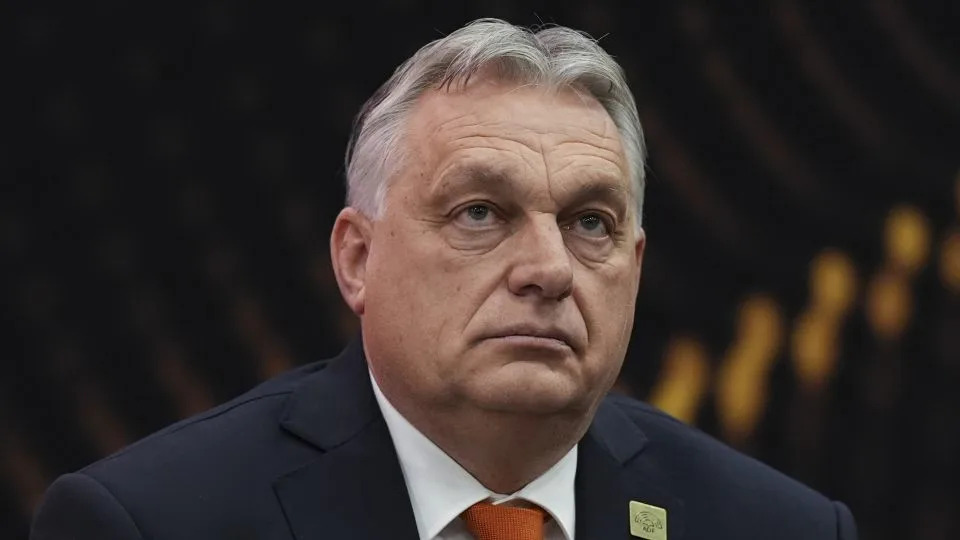
Szilard Koszticsak/EPA-EFE/Shutterstock/File
Victor Orban is taking his blueprint on dismantling democracy to Mar-a-Lago.
The Hungarian prime minister first won power through a democratic election, then proceeded to weaken the institutions of that democracy by eroding the legal system, firing civil servants, politicizing business, attacking the press and intimidating opposition parties and demagoguing migration.
Former President Donald Trump has left no doubt that he’d try something similar in the United States if he wins a second term – so the presumptive GOP nominee will presumably be eager to compare notes when he hosts Orbán in Florida on Friday.
The prime minister isn’t meeting Biden administration officials. (A Biden administration official told CNN’s Betsy Klein that no invitation for a meeting between the current US president and Hungarian leader was extended.) Instead, he’s choosing to meet the man he hopes will again be US president next year. The two men have a long history of mutual admiration. The fact that one of Trump’s first moves since becoming presumptive GOP nominee this week is to meet a European autocrat speaks volumes.
Trump sees Orbán as the kind of strongman – unencumbered by legal and political restraints – that he’d like to be. Orbán also frequently genuflects to Russian President Vladimir Putin – just like the former US president. Orbán supports Trump’s vow to end the war in Ukraine if he’s elected within 24 hours – a process that could happen only on Putin’s terms and reward his illegal invasion. Their relationship is also helped by the Hungarian leader’s frequent praise for Trump. He knows the way to the ex-president’s heart. At a rally in New Hampshire in January, Trump diverted from his regular stump speech to laud Orbán in a way that offered a chilling glimpse into his own intentions. “Some people don’t like him because he’s too strong. It’s good to have a strong man at the head of a country,” Trump reflected.
Orbán’s far-right populism, fierce anti-immigration rhetoric, Christian nationalism and hostility to LGBTQ rights has made him a popular ideological model for Trump’s “Make America Great Again” followers. He has spoken in the past at the Conservative Political Action Conference – an annual gathering of pro-Trump forces – and Hungary will host another edition of CPAC’s overseas conferences next month.
In many ways, Orbán pioneered a demagogic style of leadership that is identical to that of Trump long before the ex-reality star and property mogul went into politics. His country is a member of NATO and the European Union but, like Trump, he has often taken steps that cut against the interests of the western democracies. He has, for instance, long feuded with the EU over his anti-immigration policies and slowed the entry of Sweden into NATO, which finally took place this week.
Ahead of his meeting with the former president, Orbán endorsed Trump’s views on Ukraine, in what will have been music to Putin’s ears and will have added to alarm in Kyiv about what a second Trump term would mean. “It is not gambling but actually betting on the only sensible chance, that we in Hungary bet on the return of President Trump,” Orbán told an economic forum on Monday, Reuters reported. “The only chance of the world for a relatively fast peace deal is political change in the United States and this is linked to who is the president.”
Trump’s antipathy to sending more US aid to Ukraine had prompted House Republicans to block President Joe Biden’s latest $60 billion package and has led frontline soldiers fighting Russia to ration bullets. Trump is not even president, but he’s already influencing US policy in ways that help Putin.
Biden used the early portion of his State of the Union address on Thursday night to castigate Trump over his hostility to NATO allies and affinity with the Russian leader. “My predecessor, a former Republican president, tells Putin, ‘Do whatever the hell you want,’” Biden said, referring to a comment by Trump to the effect that if NATO states didn’t make military spending targets he wouldn’t defend them. “A former American president actually said that, bowing down to a Russian leader. It’s outrageous. It’s dangerous. It’s unacceptable.”
Biden, who is anchoring his reelection bid on a warning that Trump would destroy US democracy in a second term, was quick to seize on Orbán’s visit to Florida. In a statement, Biden’s campaign rebuked Trump for meeting “Hungarian dictator Viktor Orbán, notorious for eroding his own country’s democracy and cozying up to Vladimir Putin (sound familiar?)”
The juxtaposition of Biden using his State of the Union address on Thursday to vow to fight to preserve American and global democracy and Trump’s red carpet welcome for Orbán eloquently encapsulates the political and geopolitical crossroads that America’s presidential election represents.
Much of Europe is already recoiling in horror over the possibility of a second term for Trump. But in Budapest, at least, he’s seen as a kindred spirit and his return would be greeted with great satisfaction.
Trump praises ‘fantastic’ Viktor Orbán while hosting Hungarian autocrat at Mar-a-Lago for meeting and concert
Kristen Holmes and Andrew Millman – March 9, 2024
Emin Sansar/Anadolu/Getty Images
Donald Trump heaped praise on Viktor Orbán while hosting the Hungarian prime minister at Mar-a-Lago on Friday night.
“There’s nobody that’s better, smarter or a better leader than Viktor Orbán. He’s fantastic,” the former president told a crowd gathered for a concert at the Florida resort, as shown in a series of videos posted to Orbán’s Instagram account.
Trump added that the European autocrat is “a noncontroversial figure because he said, ‘This is the way it’s going to be,’ and that’s the end of it, right? He’s the boss and … he’s a great leader, fantastic leader. In Europe and around the world, they respect him.”
Trump called the visit “an honor” and seemed to reference the pair staying in contact after he left White House in 2021, saying they “kept in touch.”
The meeting and subsequent admiration underscore Trump’s history of embracing global strongmen – at times at the expense of more traditional US allies.
The former president and a small group of close advisers met with Orbán for roughly an hour Friday night, sources familiar with the matter told CNN, with one of the sources describing it as a “social meeting” with no agenda. A separate source called it “friendly.”
Trump, according to a readout from his campaign, met with Orbán “to discuss a wide range of issues affecting Hungary and the United States, including the paramount importance of strong and secure borders to protect the sovereignty of each nation.”
Orbán, a fourth source told CNN, sought the meeting with Trump and had been planning to be in the US separately.
Afterward, Trump took him to a tribute concert that was part of a “members only” event at the club, featuring The Beatles and Rolling Stones tribute bands, along with the Palm Beach Symphony.
In one clip posted to social media, Orbán can be seen at the concert – billed as “Orchestral Elegance Meets Rock Legends” – presenting former first lady Melania Trump with a large bouquet of flowers as the band played “Oh, Pretty Woman” by Roy Orbison.
A Biden administration official confirmed to CNN that the White House did not extend an invitation to the authoritarian leader to meet with President Joe Biden, and Orbán did not request a White House meeting during his trip to the US this week.
Biden earlier in the day suggested the meeting between the Hungarian strongman and Trump, the presumptive GOP presidential nominee, was worrying.
Asked whether he was concerned about the Mar-a-Lago talks, Biden said: “If I’m not, you should be” – suggesting it was only natural for him to be alarmed by the meeting between Orbán and Trump.
Orbán’s far-right populism, fierce anti-immigration rhetoric, Christian nationalism and hostility to LGBTQ rights has made him a popular ideological model for Trump’s “Make America Great Again” followers. He has spoken in the past at the Conservative Political Action Conference – an annual gathering of pro-Trump forces – and Hungary will host another edition of CPAC’s overseas conferences next month.
The Biden administration has mostly declined to comment on Orbán’s meetings with Trump, but the president seized on the visit during remarks Friday evening in the crucial 2024 battleground of Pennsylvania.
“You know who he’s meeting with today, down in Mar-a-Lago? Orbán of Hungary, who stated flatly he doesn’t think democracy works – he’s looking for dictatorship,” Biden told the crowd gathered for what was his effectively his first rally of the 2024 general election campaign.
“That’s who he’s meeting with,” Biden added. “I see a future where we defend democracy, not diminish it.”
This headline and story have been updated with additional details.
CNN’s Kevin Liptak, Betsy Klein, Michael Williams and Kaanita Iyer contributed to this report.
Dr. John Gartner: The world is watching “a fundamental breakdown in Trump’s ability to use language”
Chauncey DeVega – March 7, 2024
Donald Trump CHANDAN KHANNA/AFP via Getty Images
It has become undeniably clear and obvious to any reasonable person that Donald Trump is experiencing increasing challenges with his speech, language, and memory during these last few weeks and months. Such a conclusion does not require a huge team of investigative journalists: a person only has to watch the corrupt ex-president’s speeches, interviews and other public behavior. For example, at a series of rallies and other events last weekend, Trump repeatedly confused one person with another. Like a broken computer in a science fiction movie, Trump appears to have moments where he cannot speak, appears lost in his thinking, and is more generally confused as he spouts nonsense words and non-sequiturs.
MediasTouch editor Ron Filipowski shared a montage online of 32 examples of Trump experiencing severe challenges during his recent speeches in Virginia and North Carolina last Saturday. 32 examples from just two speeches where the ex-president “mispronounced words, got confused, mixed up names, forgot names, and babbled insane nonsense.”
Montage of 32 clips from Trump’s two speeches yesterday where he mispronounced words, got confused, mixed up names, forgot names, and babbled insane nonsense. pic.twitter.com/SQeURo2zhd
I have said this before, he is not as sharp as he was in 2016 and not even as sharp as he was in 2020….Listen, he’s never been a super articulate or eloquent person….But he’s consistently missing up — uh, mixing up names of heads of state. He’s mixing up names like Nancy Pelosi and Nikki Haley. I mean, this is it’s gotten worse, it hasn’t gotten better he’s not nearly as sharp as he was.
We’re seeing with more and more frequency, even as the media — and we talked about it earlier, how the weekend was full of polls and obsession about President Biden’s age — it is this, Trump, who day after day is showing the signs of age but also pressure….because he is not getting as much of the share of the Republican vote as he’d like….Nikki Haley posting a win over the weekend. Pressure because of the money he now owes, nearly half a billion dollars in a couple cases in New York City, and pressure that his first criminal case, a case that could theoretically put him in prison, starts in just three weeks. We are seeing it night after night on the rally stage, where he seems to even just lose control of the English language. Mika [Brzezinski] cringes, I can’t help it either at the end of that clip. His team knows, but they’re just forging forward.”
Whatever one may think of Donald Trump the political leader, and all of the evil and vile things he has done in that capacity, he is a human being who appears to be in crisis. Moreover, that Donald Trump is leading President Biden in the polls and has a real chance of becoming the next president of the United States should be a source of great alarm for anyone who claims to care about the well-being of the country and its future.
In a series of widely-readconversations with me here at Salon, Dr. John Gartner, a prominent psychologist and contributor to the bestselling book “The Dangerous Case of Donald Trump: 27 Psychiatrists and Mental Health Experts Assess a President,” has issued the following, almost prophetic warnings, about the ex-president’s behavior:
I had to speak out now because the 2024 election might turn on this issue of who is cognitively capable: Biden or Trump? It’s a major issue that will affect some people’s votes. Not enough people are sounding the alarm, that based on his behavior, and in my opinion, Donald Trump is dangerously demented. In fact, we are seeing the opposite among too many in the news media, the political leaders and among the public. There is also this focus on Biden’s gaffes or other things that are well within the normal limits of aging. By comparison, Trump appears to be showing gross signs of dementia. This is a tale of two brains. Biden’s brain is aging. Trump’s brain is dementing.
Continuing with this ongoing conversation, I asked Dr. Gartner, and several other leading mental health and medical professionals via email for their thoughts and insights about Donald Trump’s deeply troubling behavior last weekend (and more generally), what they believe is happening based on the public evidence, and what advice they would give Trump and those who care about him.
Dr. John Gartner is a psychologist and former professor at the Johns Hopkins University Medical School.
This is becoming a weekly ritual: A round-up of the latest behaviors evidencing Trump’s apparent dementia. For the eighth time, Trump announced that he was running against Obama. No one believed it when he said he was joking the first seven times, and he keeps saying it, showing just how deeply disoriented he is and how advanced his apparent dementia has become.
Trump is continuing to show more of these phonemic aphasias: “Venezuero” instead of Venezuela. He is also demonstrating semantic aphasias: “steak mountain or steak hill,” instead of “Snake mountain.” Trump is continuing to slur words. What is even more troubling is how Trump sometimes can’t form words at all but just makes sounds. For example, “Saudi Arabia and Russia will…. bluh-ub-bll….”
And finally, there were more examples last week of a fundamental breakdown in Trump’s ability to use language, to think and to communicate. When Trump visited the border, he said: “Nobody [can] explain to me how allowing millions of people from places unknown, from countries unknown, who don’t speak languages — we have languages coming into our country, we have nobody that even speaks those languages. They are truly foreign languages. Nobody speaks them.” In my opinion, Donald Trump is getting worse as his cognitive state continues to degrade. If Trump were your relative, you’d be thinking about assisted care right now.
Harry Segal is a senior lecturer at Cornell University and Weill Cornell Medical School. He holds a Ph.D. in English Literature from Yale University and a Ph.D. in Clinical Psychology from the University of Michigan. He also conducts a part-time practice in Ithaca, New York, and has written extensively on personality disorders.
I see a dramatic change since he announced his candidacy in November 2022. That speech was more typical of Trump during his presidency – he relied on the teleprompter, but his digressions were easy to follow even if they were filled with lies. But over the past year, his appearances have been erratic. Sometimes, as with the CNN Town Hall, he made few gaffes. But in the past six months, Trump’s rallies are filled with strange lapses of logic. He has confused Biden with Obama, spoke of World War II, and has lapsed into bewildering digressions that are hard to follow. Only this weekend he said: “We have languages coming into our country that no one can speak,” a strange grasping for meaning, bordering on neologism. At other times, he seems to get lost in the middle of a sentence.
Since this is an intermittent problem, it suggests that when Trump is especially stressed and exhausted, he suffers cognitive slippage that affects the way he associates words or their meaning. Note, though, that Trump’s pathological lying is itself a form of mental illness, so these cognitive lapses are literally sitting atop what appears to be an already compromised psychological functioning.
There seems to be an emerging difficulty maintaining linguistic control that may well be caused by his incapacity to manage the stress caused by his multiple indictments, court appearances, and huge legal fines. In addition, his daughter and son-in-law are no longer supporting him, and his wife hasn’t appeared with him in public at any of his rallies or victory speeches. This lack of support may be contributing to what appears to be his intermittent cognitive disorganization.
First, I would recommend a full neuro-psychological assessment to identify the deficits in his cognitive functioning. Given those results, I would then recommend limiting his daily activity, scheduling tasks that require high-level cognition early in the day to avoid “sun-downing,” and psychotherapy to explore the sources of stress contributing to mental difficulties. I would certainly recommend that he immediately cease running for president.
Vincent Greenwood, Ph.D, is the founder and executive director of the Washington Center For Cognitive Therapy, a mental health program that provides clinical services in the Washington D.C. area. He has worked as a research associate and training leader at Johns Hopkins University and the National Institute of Health. In 2020, he launched DutyToInform.org to disseminate information about the intersection of psychology and our recent political turmoil. He is the author of The Open And Shut Case Of Donald Trump.
In the past week, we have seen Trump say the following things which could indicate a larger problem with speech and cognition: “Putin has so little respect for Obama…we have a fool for a president.” This is an example of mixing up people, not just an occasional mix-up of a name. It is similar to his going on and on about Nikki Haley being responsible for security at the Capitol rather than Nancy Pelosi.
Trump has displayed this kind of confusion with increasing regularity over the past few years. It is meaningful because the confusion of people, in contrast to the occasional forgetting of names, is a sign of early dementia, as noted by the Dementia Care Society.
In his speech in North Carolina, Trump said “migrant cime” leaving out the “r”; and was unable to say “Venezuela” which came out sounding like “Venezwheregull.” These are examples of what we call phonemic paraphasia which is associated with underlying brain damage.
(Aphasia is the term we use for disorders of communication. Aphasia is a symptom of some other underlying condition, such as dementia, stroke or head injury. A phoneme is the smallest unit of speech – often a letter or two – that distinguishes one word from another. For example, the letter “r” in the word “far” separates that word from “fad,” “fan,” and “fat.” Phonemic paraphasia is the inappropriate substitution of one sound for the other).
We all stumble over and mispronounce words occasionally. This is not what is going on with Trump. The incidence of these kinds of mistakes takes him into this realm of phonemic paraphasia, which is a sign of underlying brain damage, not just aging. Even when compared to his speech of a few years ago, you can observe a noticeable difference. When you compare it to his speech as a middle-aged man, the shift is radical and ominous.
Trump has also been displaying another kind of paraphasia, called semantic paraphasia, also associated with cognitive deterioration. (Semantic paraphasia involves choosing incorrect words). Last week in his South Carolina speech, he said, “soup pie cane” when he meant to say “supply chain,” and “lady, lady, lady,” when he meant to say “later.” As a younger man Trump’s linguistic style might be characterized as glib but was not marked by the use of the substitution of incorrect words. Semantic paraphasia is a qualitative marker – not of aging -but of underlying disease.
Trump’s unscripted speech of late has also revealed other signs of likely dementia. These include mid-thought change of subject, repetition of words, the use of fillers (“well,” “um,” “so,”), trouble formulating complete sentences not to mention paragraphs, getting words in the wrong order, and simpler word choice.
Loss of vocabulary is not a correlate of normal aging. If anything, there appears to be a slight increase in vocabulary as one gets into their seventies and eighties. It is noteworthy that Trump exhibits a markedly declining vocabulary with overreliance on superlatives over the years. He has gone from what might be described as possessing a somewhat sophisticated vocabulary to one sorely lacking in suppleness.
The key question at the moment regarding Trump’s fitness is the following one. Is there a significant change in his cognitive baseline and are the changes markers of disease rather than normal decline linked to aging? In my professional opinion, the answer to that two-part question is yes. Trump has shown a noteworthy decline in his linguistic competency from his previous baseline, and the decline exposes clinical signs of disorder, not simply aging.
Trump meets with Hungary’s leader, Viktor Orbán, continuing his embrace of autocrats
Nicholas Riccardi and Justin Spike – March 8, 2024
Hungarian Prime Minister Viktor Orban speaks at CPAC in Dallas, Aug. 4, 2022. Former President Donald Trump is meeting Friday, March 8, 2024, with Orban, a prominent conservative populist whose crackdowns in Hungary have sparked criticism that he’s eroding that country’s democracy. The meeting comes as Hungary has had conflicts with President Joe Biden’s administration. (AP Photo/LM Otero, File)A fisherman casts a line near Mar-a-Lago, as former President Donald Trump is planning to meet Hungarian Prime Minister Victor Orban, Friday, March 8, 2024, in Palm Beach, Fla. (AP Photo/Marta Lavandier)A security guard stands near an entrance to Mar-a-Lago, as former President Donald Trump is planning to meet Hungarian Prime Minister Victor Orban, Friday, March 8, 2024, in Palm Beach, Fla. (AP Photo/Marta Lavandier)
Former President Donald Trump met Friday with Hungarian Prime Minister Viktor Orbán, as the likely Republican presidential nominee continued his embrace of autocratic leaders who are part of a global pushback against democratic traditions.
Orbán has become an icon to some conservative populists for championing what he calls “illiberal democracy,” replete with restrictions on immigration and LGBTQ+ rights. But he’s also cracked down on the press and judiciary in his country and rejiggered the country’s political system to keep his party in power while maintaining the closest relationship with Russia among all European Union countries.
In the U.S., Trump’s allies have embraced Orbán’s approach. On Thursday, as foreign dignitaries milled through Washington, D.C., ahead of President Joe Biden’s State of the Union address, Orbán skipped the White House and instead spoke at the Heritage Foundation, a conservative think tank overseeing the 2025 Project, the effort to create a governing blueprint for Trump’s next term.
“Supporting families, fighting illegal migration and standing up for the sovereignty of our nations. This is the common ground for cooperation between the conservative forces of Europe and the U.S.,” Orbán wrote on X, formerly Twitter, after his Heritage appearance.
He then flew to Florida, where met Trump late Friday afternoon at the former president’s beachfront compound, Mar-a-Lago. Orbán posted on his Instagram account footage of him and his staff meeting with Trump and the former president’s staff, then of the prime minister walking through the compound and handing Melania Trump a giant bouquet of flowers.
In the video, Trump praised Orbán to a laughing crowd. “He’s a non-controversial figure because he says, ‘This is the way it’s going to be,’ and that’s the end of it. Right?” Trump said of the Hungarian prime minister. “He’s the boss.”
The Trump campaign said late Friday that the two men discussed “a wide range of issues affecting Hungary and the United States, including the paramount importance of strong and secure borders to protect the sovereignty of each nation.”
Campaigning Friday in Pennsylvania, Biden said of Trump: ’You know who he’s meeting with today down in Mar-a-Lago? Orbán of Hungary, who’s stated flatly that he doesn’t thinks democracy works, he’s looking for dictatorship.”
“I see a future where we defend democracy, not diminish it,” Biden added.
Orbán’s approach appeals to Trump’s brand of conservatives, who have abandoned their embrace of limited government and free markets for a system that sides with their own ideology, said Dalibor Rohac, a fellow at the American Enterprise Institute.
“They want to use the tools of government to reward their friends and punish their opponents, which is what Orbán has done,” Rohac said.
The meeting also comes as Trump has continued to embrace authoritarians of all ideological stripes. He’s praised Russian President Vladimir Putin, Chinese President Xi Jinping and North Korea’s Kim Jong Un. Orbán’s government has reciprocated, repeatedly praising the former president.
On Friday, Hungary’s Foreign Minister, Péter Szijjártó, posted from Palm Beach, hailing Trump’s “strength” and implying that the world would be more peaceful were he still president.
“If Donald Trump had been elected President of the United States in 2020, the war in Ukraine, now in its third year, would not have broken out and the conflict in the Middle East would have been resolved much faster,” he wrote.
Orbán has served as Hungary’s prime minister since 2010. The next year, his party, Fidesz, used its two-thirds majority in the legislature to rewrite the nation’s constitution. It changed the retirement age for judges, forcing hundreds into early retirement, and vested responsibility for appointing new judges with a single political appointee who was widely accused of acting on behalf of Fidesz.
Fidesz later authored a new media law and set up a nine-member council to serve as the country’s media regulator. All nine members are Fidesz appointees, which media watchdogs say has facilitated a major decline in press freedom and plurality.
The country’s legislative lines have been redrawn to protect Fidesz members and no major news outlets remain that are critical of Orbán’s government, making it almost impossible for his party to lose elections, analysts say.
Orbán backed Trump’s reelection effort and has had frosty relations with the Biden administration, which pointedly did not invite Hungary to a summit on democracy it organized after the president took office. Hungarian officials have accused Biden’s ambassador to the country, former human rights lawyer David Pressman, of interfering in internal governmental affairs.
Earlier this week, Hungary objected to Biden’s choice of a former Dutch prime minister to serve as NATO’s new commander, potentially stalling the appointment.
The Hungarian leader also has enthusiastically boosted Trump’s latest presidential campaign, posting a message encouraging Trump to “keep fighting” after he was hit with the first of what would be four criminal cases against him last year. Last week, Orbán declared that a win by the former president would be “the only serious chance” for ending the war in Ukraine.
A video from the Heritage appearance posted by Orbán’s political director showed the prime minister speaking with Vivek Ramaswamy, a pharmaceutical entrepreneur who unsuccessfully ran for the Republican presidential nomination before dropping out and endorsing Trump. The Hungarian leader also met with Steve Bannon, a former Trump adviser who remains a vocal ally of the ex-president and is active in global populist circles.
Orbán’s visit this week comes after he signed a new National Sovereignty Law that penalizes any foreign support of political actors in Hungary, part of the prime minister’s longstanding battle against the European Union and international nonprofits criticizing his erosion of Hungary’s democracy.
“Orbán is setting up this huge barrier to anyone interfering in Hungarian elections, but Orbán’s interfering in all sorts of other countries’ elections,” said Kim Scheppele, a Princeton sociologist and Hungary expert.
Orbán is one of a small group of conservative populists who have publicly aligned themselves with U.S. conservatives trying to oust Biden in November. Last month, Salvadoran President Nayib Bukele and Argentine President Javier Milei spoke at the Conservative Political Action Conference just outside Washington. Orbán was a featured speaker at the 2022 event, after which he met Trump at the former president’s New Jersey golf course.
Several conservative populists have won European elections in recent years, including in Italy and Sweden. But leaders in those countries have remained staunch opponents of Russian President Vladimir Putin’s invasion of Ukraine, not battled with the European Union government or taken steps that alarm democracy advocates as Orbán has.
Scheppele said the parallels between Trump and Orbán go beyond ideology. She noted that Orbán is not very religious but has become a hero to Christian conservatives for his hardline stances, much like Trump.
The two men face a similar electoral quandary as well, she added.
“They’ve got the same problem,” Scheppele said. “How do you leverage a really solid base, which is not an actual majority, at election time?”
Riccardi reported from Denver and Spike from Budapest. Associated Press political writer Jill Colvin in New York contributed to this report.
Doctors Say Trump Is Displaying Clear Signs of Cognitive Issues
Victor Tangermann – March 8, 2024
At 81 years old, president Joe Biden has attracted significant voter misgivings over his age and mental acuity.
But his rival in the upcoming presidential election, Donald Trump, may be dealing with much more acute cognitive issues.
Experts are becoming increasingly worried over Trump’s condition, Salon reports, with the former president struggling to form coherent sentences and even once again confusing Biden with his predecessor Barack Obama during a rally in North Carolina this month.
“Not enough people are sounding the alarm, that based on his behavior, and in my opinion, Donald Trump is dangerously demented,” psychologist and former Johns Hopkins Medical School professor John Gartner, who wrote a book about Trump’s mental health, told Salon.
“This is a tale of two brains,” he added. “Biden’s brain is aging. Trump’s brain is dementing.”
“In my opinion, Donald Trump is getting worse as his cognitive state continues to degrade,” Gartner said. “If Trump were your relative, you’d be thinking about assisted care right now.”
Others agreed.
“It is meaningful because the confusion of people, in contrast to the occasional forgetting of names, is a sign of early dementia, as noted by the Dementia Care Society,” licensed psychologist and founder and executive director of the Washington Center For Cognitive Therapy Vincent Greenwoodtold the publication.
As for Trump mispronouncing words like “Venezuela” or “migrant crime,” experts tend to agree he’s exhibiting early signs of “paraphasia,” speech disturbances caused by brain damage, and “not just aging,” as Greenwood argued.
And others, like clinical psychologist and Cornell University senior lecturer Harry Segal, who specializes in mental health disorders, offer a more nuanced assessment — though not one that inspires much confidence in Trump.
“Since this is an intermittent problem, it suggests that when Trump is especially stressed and exhausted, he suffers cognitive slippage that affects the way he associates words or their meaning,” he told Salon. “Note, though, that Trump’s pathological lying is itself a form of mental illness, so these cognitive lapses are literally sitting atop what appears to be an already compromised psychological functioning.”
High interest rates and macroeconomic instabilities are adding pressure on the private sector.
Russia’s economy appears resilient after two years of war with Ukraine, but a rising number of companies in the country are in trouble.
The number of companies in Russia that have gone bankrupt has soared in the first two months of 2024, Russian business daily Kommersant reported on Thursday.
In January, 571 companies in Russia declared bankruptcy — a rise of 57% from 364 a year ago, Kommersant reported, citing data from the federal register for bankruptcy.
In February, 771 companies declared bankruptcy — 60% higher than the 478 that did so a year ago.
Russia has imposed two moratoriums on bankruptcy in recent years. The first came during the COVID-19 pandemic that started in 2020; the second came after the West imposed sanctions on Russia over its invasion of Ukraine in 2022. The moratoriums expired in 2021 and late 2022, respectively.
Ilya Torosov, Russia’s first deputy economy minister, told Kommersant that this is merely a return to pre-pandemic levels.
On-the-ground difficulties in Russia
The uptick in corporate bankruptcies highlights the difficulties faced on the ground in Russia. It also stands in contrast to the rosy official statistics the Kremlin releases, which show that Russia’s GDP grew 3.6% in 2023.
Thanks to government spending, Russia’s wartime economy is resilient — but high interest rates are biting. The Bank of Russia has hiked interest rates up to 16% to cool the economy and tame inflation.
“Companies are experiencing problems with refinancing as the effects of monetary tightening are starting to kick in,” Bartosz Sawicki, a market analyst at Conotoxia, a Polish fintech firm, told Business Insider.
Apart from war-related sectors such as arms production, the Russian economy looks “far from rosy,” Sawicki said.
“Although Russian companies are doing their utmost to dodge sanctions, international trade has become a significant issue for plenty of them,” Sawicki wrote in an email.
“The private sector also feels the pressure of macroeconomic instabilities, which deepen as the economy is on the verge of overheating,” he added.
It could get worse.
Russian President Vladimir Putin’s regime is coming under tightening Western trade restrictions, including secondary sanctions against companies doing business with the country.
Putin has also pledged to give Russians billions of dollars in lifestyle upgrades weeks before they head to the ballot for the country’s presidential election later this month.
While it’s unclear where the extra budget for Putin’s promises will come from, the Russian leader has proposed changes to the tax system that are designed to result in more taxes from high-income individuals and businesses — which could put even more pressure on private companies.
Russia’s presidential election is set to take place over three days, from March 15 to March 17. Putin is expected to win the election against three opponents.
Legal expert: Trump lawyer begging for “mercy” suggests he’s “having difficulty” coming up with bond
Igor Derysh – March 7, 2024
Donald Trump; Alina Habba Shannon Stapleton-Pool/Getty Images
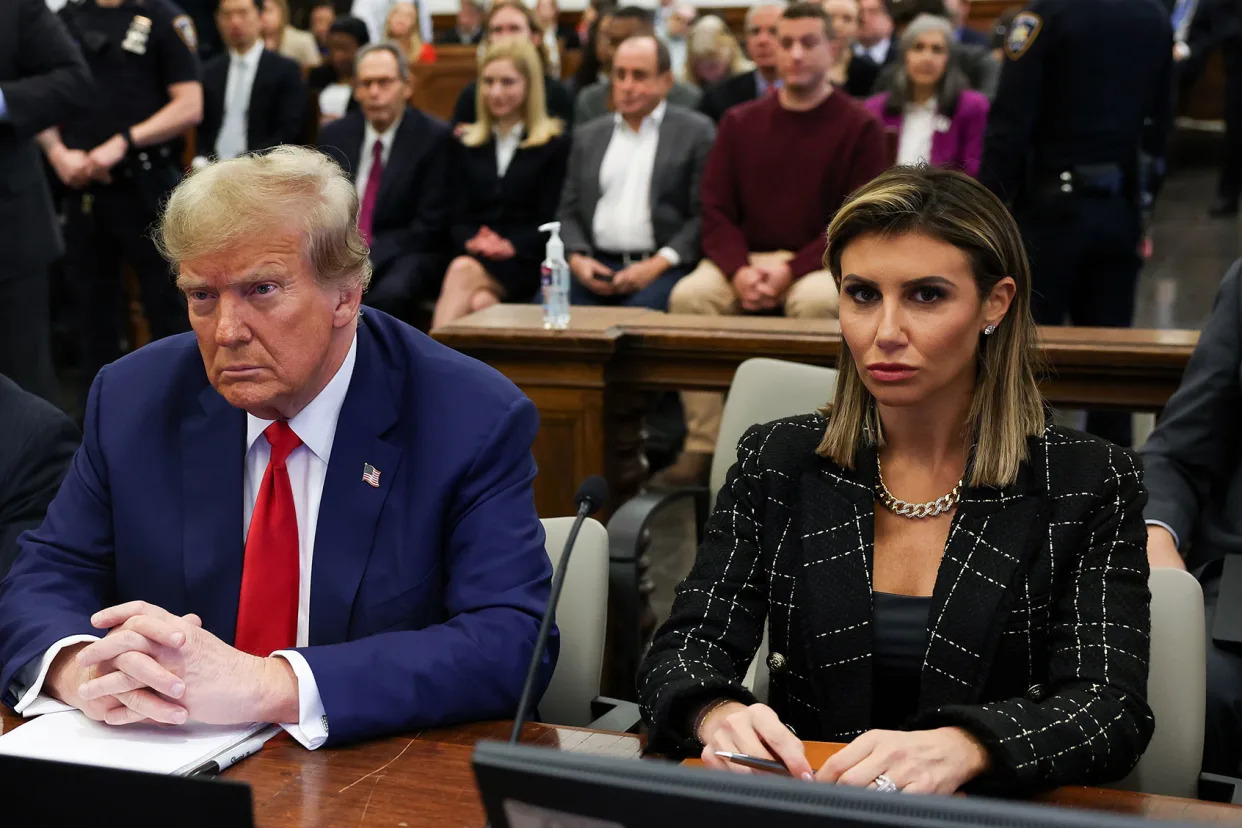
Former President Donald Trump’s lawyers asked a judge on Tuesday to delay enforcing the $83 million defamation penalty a jury handed down in writer E. Jean Carroll’s defamation trial.
Trump attorneys Alina Habba and John Sauer asked New York Judge Lewis Kaplan to extend the stay of the ruling, which is set to expire on Monday. Trump will have to pay Carroll or put up $91 million in cash bond needed to appeal the ruling.
In New York, a defendant must pay a cash bond of 110% of the judgment to appeal the ruling of a civil case.
“Requiring President Trump to post a bond or other security before this Court’s ruling on his stay motion threatens to impose irreparable injury in the form of substantial costs (which may or may not be recoverable),” the attorneys wrote.
The letter asked the judge to extend the stay through at least Thursday.
“Habba is asking Judge Lew Kaplan — who has yet to rule on Trump’s request to stay enforcement of the $83.3 million E. Jean Carroll judgment as his post-trial motions are resolved — for some mercy,” tweeted MSNBC legal analyst Lisa Rubin. “Specifically, she notes that the existing stay expires Monday and asks that if Kaplan does not rule by tomorrow, he should at least stay enforcement of the judgment for three business days after that ruling.”
Rubin added that the letter suggests “Trump could be having difficulty arranging for a bond of $91-plus million.”
“Expecting that Kaplan will deny his request for a longer stay, he is trying to buy himself time to obtain one or free up sufficient cash,” she wrote.
The New York Times’ Maggie Haberman told CNN on Thursday that the repeated requests for a delay suggest “there is clearly a problem so far in acquiring a bond.”
“It doesn’t mean that they won’t get there, but I’m not sure what a couple of more days delay is going to do. And the judge has already said no delay previously,” she said.
Habba previously argued in a filing that “requirement of a bond would be inappropriate … where the defendant’s ability to pay the judgment is so plain that the cost of the bond would be a waste of money.”
E. Jean Carroll’s lawyer Roberta Kaplan rejected that argument in a letter to the judge.
“Trump offers no alternative means other than his own unsubstantiated say so that he will have $83.3 million available when Carroll prevails on appeal,” the attorney wrote.
Judge Kaplan issued an order on Monday stating that a ruling on the stay request will be “rendered as promptly as is reasonably possible.”
“Without implying what that decision will be or when it will be made, however, it will not come today,” he wrote.
15 promises Donald Trump has made so far in his campaign for a second term
Piper Hudspeth Blackburn and Abby Turner – March 6, 2024
Former President Donald Trump, now the presumptive Republican nominee, has made a number of promises on the campaign trail, including rolling back car pollution rules, building 10 new cities and appointing a special prosecutor to investigate President Joe Biden and his family.
While some of Trump’s plans are lacking in detail, here are some of the policies he says he would enact if elected for a second term.
Immigration
Trump has made immigration and the border a central campaign issue, successfully pressuring Republicans to reject a major bipartisan border deal last month and making a trip to the southern border on February 29, where he touted his previous hard-line immigration policies.
In a Des Moines Register op-ed published roughly a week before winning the Iowa caucuses in January, Trump vowed to use the “Alien Enemies Act to remove known or suspected gang members, drug dealers, or cartel members from the United States.”
“We will shift massive portions of federal law enforcement to immigration enforcement — including parts of the DEA, ATF, FBI, and DHS,” he wrote.
In a video posted on Truth Social in late February before his border visit, Trump also promised to “carry out the largest domestic deportation operation in American history.”
After the Israel-Hamas war began last October, Trump also promised to terminate the visas of “Hamas’ sympathizers.”
“We’ll get them off our college campuses, out of our cities and get them the hell out of our country, if that’s OK with you,” he added.
Drug cartels
The former president has also made waging “war” on drug cartels a priority for his second term. If elected, Trump said in his November 2022 campaign announcement that he would ask Congress to ensure that drug smugglers and human traffickers can receive the death penalty for their “heinous acts.”
Trump also vowed to “take down” drug cartels by imposing naval embargos on cartels, cutting off cartels’ access to global financial systems and using special forces within the Department of Defense to damage the cartels’ leadership.
Education
Trump announced plans in a September 2023campaign video to close the Department of Education and send “all education and education work and needs back to the states.”
“We want them to run the education of our children, because they’ll do a much better job of it,” he added.
The former president has also promised to “put parents back in charge and give them the final say” in education. In a January 2023 campaign video, the former president said he would give funding preferences and “favorable treatment” to schools that allow parents to elect principals, abolish teacher tenure for K-12 teachers, use merit pay to incentivize quality teaching and cut the number of school administrators, such as those overseeing diversity, equity and inclusion initiatives.
Trump also said in that campaign video that he would cut funding for schools that teach critical race theory and gender ideology. In a later speech, Trump said he would bring back the 1776 Commission, which was launched in his previous administration to “teach our values and promote our history and our traditions to our children.”
The former president said he would charge the Department of Justice and the Department of Education with investigating civil rights violations of race-based discrimination in schools while also removing “Marxists” from the Department of Education. A second Trump administration would pursue violations in schools of both the Constitution’s Establishment and Free Exercise clauses, which prohibit the government establishment of religion and protect a citizen’s right to practice their own religion, he said.
Health care
Last November, Trump promised to replace the Affordable Care Act, known colloquially as Obamacare, in a series of posts on Truth Social. A Trump-backed effort to repeal andreplace Obamacare failed in 2017 after three Republicans senators joined with Democrats to vote against the bill.
“Getting much better Healthcare than Obamacare for the American people will be a priority of the Trump Administration,” he said.
“It is not a matter of cost, it is a matter of HEALTH. America will have one of the best Healthcare Plans anywhere in the world. Right now it has one of the WORST!,” he continued. He also doubled down on his vow during a speech in early January.
Trump also vowed in a June 2023 campaign video to reinstate his previous executive order so that the US government would pay the same price for pharmaceuticals as other developed countries. Some of the former president’s pharmaceutical policies were overturned by Biden.
Gender care
“I will revoke every Biden policy promoting the chemical castration and sexual mutilation of our youth and ask Congress to send me a bill prohibiting child sexual mutilation in all 50 states,” Trump said at the 2023 Conservative Political Action Conference last March.
Trump added in a campaign video that he would issue an executive order instructing federal agencies to cut programs that promote gender transitions, as well as asking Congress to stop the use of federal dollars to promote and pay for gender-affirming procedures. The former president added that his administration would not allow hospitals and health care providers to meet the federal health and safety standards for Medicaid and Medicare if they provide chemical or physical gender-affirming care to youth.
Justice system
Trump has promised to use the Department of Justice to attack critics and former allies. In several videos and speeches, the former president also laid out plans to gut the current justice system by firing “radical Marxist prosecutors that are destroying America.”
“I will appoint a real special prosecutor to go after the most corrupt president in the history of the United States of America, Joe Biden, and the entire Biden crime family,” Trump said in June 2023 remarks. “I will totally obliterate the Deep State.”
Trump said in a campaign video last year that he would reinstate a 2020 executive order to remove “rogue” bureaucrats and propose a constitutional amendment for term limits on members of Congress.
To address what he labeled the “disturbing” relationship between technology platforms and the government, the former president said in a January 2023 video that he would enact a seven-year cooling off period before employees at agencies such as the FBI or CIA can work for platforms that oversee mass user data.
Trump added in multiple campaignreleases that he would task the Justice Department with investigating online censorship, ban federal agencies from “colluding” to censor citizens and suspend federal money to universities participating in “censorship-supporting activities.”
In a September 2023 speech at the Family Research Council’s Pray Vote Stand Summit in Washington, DC, Trump also touted plans to continue appointing conservative judges.
“I will once again appoint rock-solid conservative judges to do what they have to do in the mold of Justices Antonin Scalia; Samuel Alito, a great gentleman; and another great gentleman, Clarence Thomas,” he said.
Trump has also pledged to “appoint U.S. Attorneys who will be the polar opposite of the Soros District Attorneys and others that are being appointed throughout the United States.”
In a September 2023 speech in Washington, DC, Trump also announced that he would appoint a task force to review the cases of people he claimed had been “unjustly persecuted by the Biden administration.” Trump noted that he wanted to “study the situation very quickly, and sign their pardons or commutations on day one.”
It’s a move that could lead to potential pardons of many rioters from the January 6, 2021, insurrection – which he suggested he would do at a CNN town hall in May 2023.
Crime
Trump said in two February 2023 campaignvideos that if “Marxist” prosecutors refuse to charge crimes and surrender “our cities to violent criminals,” he “will not hesitate to send in federal law enforcement to restore peace and public safety.”
Trump added that he would instruct the Department of Justice to open civil rights investigations into “radical left” prosecutors’ offices that engaged in racial enforcement of the law, encourage Congress to use their legal authority over Washington, DC, to restore “law and order” and overhaul federal standards of disciplining minors to address rising crimes like carjackings.
Addressing policies made in what Trump calls the “Democrats’ war on police,” the former president vowed in a campaign video that he would pass a “record investment” to hire and retrain police, strengthen protections like qualified immunity, increase penalties for assaulting law enforcement officers and deploy the National Guard when local law enforcement “refuses to act.”
The former president added that he would require law enforcement agencies that receive money from his funding investment or the Department of Justice to use “proven common sense” measures such as stop-and-frisk.
Foreign policy
Trump has continued his attacks against member countries of NATO, a European and North American defense alliance. At a South Carolina rally last month,Trump said he would not abide by the alliance’s collective-defense clause and would encourage Russia to do “whatever the hell they want” if a member country didn’t meet spending guidelines.
“NATO was busted until I came along,” Trump said. “I said, ‘Everybody’s gonna pay.’ They said, ‘Well, if we don’t pay, are you still going to protect us?’ I said, ‘Absolutely not.’ They couldn’t believe the answer.”
The former president has also previously pledged to end the war in Ukraine, though he’s offered no details on how he would do so.“Shortly after I win the presidency, I will have the horrible war between Russia and Ukraine settled,” Trump said at a New Hampshire campaign event last year, adding in another speech that it would take him “no longer than one day” to settle the war if elected.
Trump further addressed his strategy of stopping the “never-ending wars” by vowing to remove “warmongers,” “frauds” and “failures in the senior ranks of our government,” and replace them with national security officials who would defend America’s interests. The former president added in a campaign video that he would stop lobbyists and government contractors from pushing senior military officials toward war.
Trump said in multiple campaignvideos that he would spearhead an effort to build so-called “Freedom Cities” to “reopen the frontier, reignite American imagination, and give hundreds of thousands of young people and other people, all hardworking families, a new shot at home ownership and in fact, the American Dream.”
In his plan, the federal government would charter 10 new cities on federal land, awarding them to areas with the best development proposals. The former president said in a campaign video that the Freedom Cities would bring the return of US manufacturing, economic opportunity, new industries and affordable living.
In the March 2023 video, Trump added that the US under a second Trump administration would lead in efforts to “develop vertical-takeoff-and-landing vehicles for families and individuals,” not letting China lead “this revolution in air mobility.” The former president said these airborne vehicles would change commerce and bring wealth into rural communities.
Electric vehicles
Trump has promised to roll back new car pollution rules at the Environmental Protection Agency that could require electric vehicles to account for up to two-thirds of new cars sold in the US by 2032. Biden’s electrical vehicle-related policies, Trump claimed at a Michigan rally last September, “spell the death of the US auto industry.”
“On day one, I will terminate Joe Biden’s electrical vehicle mandate, and I will cancel every job-killing regulation that is crushing American autoworkers,” Trump added.
Energy
Trump has promised to reduce energy prices by increasing domestic production. In several campaign appearances, he has laid out plans to end delays in federal drilling permits and leases.
“We’re going to ‘drill, baby, drill’ right away,” Trump told a crowd of supporters in Des Moines, Iowa, during a victory speech after winning the state’s Republican caucusesin January.
At a South Carolina rally in February, he pledged to remove limits on American natural gas exports.
Trade
At the same rally in South Carolina,Trump pledged to impose “stiff penalties on China and other trade abusers.”
“It’s called you screw us, and we screw you,” Trump said.
Under his proposed “Trump Reciprocal Trade Act,” the former president said if other countries impose tariffs on the US, the country would impose “a reciprocal, identical” tariff right back.
It was the same pledge Trump made in a campaign video in 2023: to impose the same tariffs that other countries may impose on the US on those countries. The goal, the former president said then, is to get other countries to drop their tariffs.
As part of a larger strategy to bring jobs back into the US, Trump also said he would implement his so-called “America First” trade agenda if elected. By setting universal baseline tariffs on a majority of foreign goods, the former president said Americans would see taxes decrease as tariffs increase. His proposal also includes a four-year plan to phase out all Chinese imports of essential goods, as well as stopping China from buying up America and stopping the investment of US companies in China.
The former president has particularly focused on China, vowing in a January 2023 campaign video to restrict Chinese ownership of US infrastructure such as energy, technology, telecommunications and natural resources. Trump also said he would force the Chinese to sell current holdings that may put national security at risk. “Economic security is national security,” he said.
Economy
Trump has promised to extend the cuts from his 2017 Tax Cuts and Jobs Act, notably the TCJA’s individual income tax breaks. The former president has also talked about reducing the corporate tax rate from the current 21% to 15%.
“I will make the Trump tax cuts the largest tax cut in history,” the former president said last month at the Black Conservative Federation’s Honors Gala in South Carolina. “We’ll make it permanent and give you a new economic boom.”
Trump has also pledged to repeal Biden’s tax hikes, “immediately tackle” inflation and end what he called Biden’s “war” on American energy production.
Second Amendment
“I will take Biden’s executive order directing the federal government to target the firearms industry, and I will rip it up and throw it out on day one,” Trump said at the 2023 National Rifle Association Institute for Legislative Action leadership forum last April.
The former president also promised in the speech that the government would not infringe on citizens’ Second Amendment rights and that he would push Congress to pass a concealed carry reciprocity.
Equity
“I will create a special team to rapidly review every action taken by federal agencies under Biden’s ‘equity’ agenda that will need to be reversed. We will reverse almost all of them,” Trump said in a campaign video.
Trump added in multiple campaignvideos that he would revoke Biden’s equity executive order that required federal agencies to deliver equitable outcomes in policy and conduct equity training. If elected, Trump said he would also fire staffers hired to implement Biden’s policy, and then reinstate his 2020 executive order banning racial and sexual stereotyping in the federal government.
CNN’s Tami Luhby, Kate Sullivan and Kristin Holmes contributed to this report.