“He’ll never leave”: Why Trump’s dynasty, built on corruption and violence, won’t end with him

Salon

“He’ll never leave”: Why Trump’s dynasty, built on corruption and violence, won’t end with him

Dean Obeidallah – March 22, 2024

Donald Trump Win McNamee/Getty Images

No, you’re not being hyperbolic if you say MAGA is a fascist movement. You’re just being accurate. That was one of the biggest points made by NYU historian Ruth Ben-Ghiat, author of the book “Strongmen: Mussolini to the Present,” during our recent “Salon Talks” conversation.

Ben-Ghiat explained that Donald Trump is leading a “right-wing counterrevolution against the loss of white male privilege,” aimed at taking America back to the time when women, nonwhite people and non-Christians “knew their place.”

But what truly defines MAGA as fascist, Ben-Ghiat said — rather than just right-wing — is its use of violence. “Fascists believe that violence is the way to change history,” she told me. We saw that clearly enough on Jan. 6, 2021, with the attack on the Capitol mean to keep Trump in power despite his loss in the 2020 election.

What is most worrisome going forward, Ben-Ghiat suggested, is Trump’s defense of the Jan. 6 attackers as “hostages” and his promises to pardon them, which seek to change “the perception of violence.” Trump’s message to his loyal followers, she said, is that “violence is sometimes morally necessary and even righteous, and even patriotic.” That, she added, is “what we call sacralizing violence, giving violence a kind of ritual, religious tone.”

Ben-Ghiat sees Trump’s promise to pardon the Jan. 6 insurrectionists as intended to inspire his supporters to commit future acts of violence if that can help him win. The implied promise is that if they commit violent acts and Trump regains the White House, he’ll pardon them too. That’s straight out of the autocrat’s playbook, Ben-Ghiat says: “All authoritarians use pardons” and manipulate the justice system to maintain power.

Ben-Ghiat says she’s not trying to scare us, only to prepare us for what we’re likely to see between now and November — and for a good while after that if Trump wins. Too many Americans still don’t believe, Ben-Ghiat warns, that “it can happen here” — “it” being a fascist takeover. History tells us those people are wrong.

Watch my full conversation with Ruth Ben-Ghiat here or read a transcript of our conversation below, edited for length and clarity.

You’ve been discussing and studying this issue for years, but it seems even more important than ever to talk about authoritarianism.

It’s incredible that it could be upon us. Here’s Trump saying he’s going to be a “dictator for day one,” but we know that they’re never dictators for day one. They never relinquish their powers, so it’s extremely important to understand what we’re up against.

Despite Trump saying he wants to be a dictator and facing 91 felony counts for his attempted coup, the GOP base and millions of Americans still love him. What do you take from that?

Sadly, in history, when these charismatic demagogues come to power, they use emotions to manipulate people. Trump says, “I love you” to his people. He told them he loved them on Jan. 6. He builds a personality cult so he poses as the victim, which is really important because not only are all his crimes presented as persecutions by the “deep state,” but saying he’s being persecuted makes his followers feel protective of him.

You have quotes from MAGA people saying, “Oh, it’s so distressing. We have to be there for him.” That’s what Jan. 6 was. It was many things. It was a violent coup attempt. But he was a leader in distress and he called on people, he brought them to the rally and they responded. They were trying to rescue him. This happens in history. I have quotes in “Strongmen” with people, actual fascists sitting in jail in 1945, where they’re like, “Oh, I was completely magnetized by Mussolini. I didn’t realize what was going on.” So that’s how I see it.

Is history warning us about the fact that Trump has not been held accountable by the system? There was such a long delay in investigating him. He’s finally charged and now he’s using his lawyers to manipulate the system to keep him on the ballot, and maybe not have any of the serious criminal trials before Election Day.

It’s very disheartening, and no one is going to save the American people. My mantra has always been, “Never underestimate the American people.” We had the Women’s March, we had Black Lives Matter. These were the largest protests in history, and they led to electoral [change] in the midterms in 2018 and 2022.

We’ve got to do it. We can’t depend on our institutions, which is very sad in a democracy. But our democracy has been so damaged, including the Supreme Court with Justice Thomas who wouldn’t recuse himself. There’s a whole attempt to delegitimize democracy, and not just Joe Biden, but the whole system. So we have to do this from the ground up.

From an academic point of view, is MAGA an authoritarian movement? Is it a fascist movement? Where does it fall?

It’s pretty fascist.

Why?

The reason I wrote “Strongmen” was to have this 100-year history of authoritarianism, almost all right-wing, because that’s my specialty. Obviously communists had a higher body count than fascism, so I could have put them in there, but for narrative and other reasons, I focus on the right wing. Fascism was the first stage of authoritarianism, but it continued in different forms, like the Cold War military dictatorships.

Trump is very similar to Mussolini in many ways. It checks all the boxes, where it’s this huge right-wing counterrevolution against the loss of white male privilege, and it’s to save civilization, and the whole “great replacement” theory, which is big in the MAGA base, the idea that nonwhites and non-Christians are having too many babies: We’re going to be extinguished. Mussolini talked about this too. You can track a whole series of checkpoints and talking points, and they’re pretty much the same.

What’s the core of fascism? And why do you, as an academic, look at MAGA and say, “Yep, it’s now fascist”?

Mussolini actually was a great sloganeer. He created fascism and had one very simple definition. He called it “a revolution of reaction.” Both those things are true because it upends everything. It disrupts everything. It uses violence. Fascists believe that violence is the way to change history. Rep. Matt Gaetz of Florida, he came to the Iowa State Fair to help Trump in the summer. People are eating their corn dogs, there’s kids there, and he says, “Only through force will we bring change to corrupt D.C.” This is after the coup that tried to do that. So that’s the revolution part. People are given permission to be their most violent selves, their worst selves. It’s a collapse of morals.

The reaction is what I was saying before, where you want to turn the clock back to “the good old days.” MAGA wants to make the nation “great again” by going back to times when women knew their place, as did nonwhites and non-Christians, so things were as they should be. This is part of authoritarianism, which is also a set of attitudes about child-rearing, about traditions, about male authority. All of that, Trump says, is threatened, and so the MAGA base is responding to that.

As an expert in authoritarianism, when you hear Donald Trump defending the people who attacked the Capitol, calling them “hostages” and saying they’ve been treated unfairly, pledging to pardon them, does that raise red flags for you? And if it does, what does it mean?

Totally. One of the major things that fascists did, and that Trump is doing — he’s been doing this through his rallies with frightening relentlessness — is to change the perception of violence. To get people to see that violence is not negative, including violence against your neighbors, or that you’re going to look the other way when your neighbor’s deported. Violence is sometimes morally necessary and even righteous, and even patriotic. He has used his rallies since 2015, and I wrote about this in my report for the Jan. 6 committee, where he’d say, “Oh, in the old days we used to be able to beat people up and nothing happened.” This is thug talk. This is part of fascism.

So Jan. 6 becomes this righteous “Stop the Steal.” The people who have been arrested become patriots. He almost is doing what we call sacralizing violence, giving violence a kind of ritual, religious tone. In his rallies, he has the Jan. 6 prisoners choir sing. This is totally fascist. Trump has these fascist spectacles.

I wrote an essay for Lucid when he kicked off his campaign at Waco, Texas. What a choice! He had the choir and the spectacle of it reminded me of Hitler’s Nuremberg rally. I think I entitled my essay, for my Substack newsletter, “Triumph of the Will, Waco Version.” He knows exactly what he’s doing because he’s a showman, he’s a man of TV, he’s a man of the camera. It’s really scary and it really works. That’s what all of that is about. The pardons are about encouraging people to do more violence, thinking that they’re not going to pay any consequences. That’s actually the essence of authoritarianism and fascism: You arrange government so that you can be violent and corrupt, and get away with it.

When Trump says “I’m going to pardon you for committing these crimes,” then the message becomes “If you commit crimes for me as we get closer to the election, I will do the same for you.”

That’s right. We also want to talk about not just Trump, but the enablers. So Rep. Paul Gosar, who should not be anywhere near government, in my opinion, who hangs out with Nazis, he was promising people pardons to get all the thugs he knew, all the right-wingers who were violent, to come on Jan. 6 — promising them pardons because Trump had just pardoned all these violent people like Roger Stone and Michael Flynn and Steve Bannon. That’s the environment.

All authoritarians use pardons because why do you want people sitting in jail, the worst people in the world, who are for you the best people, when they could be serving you? So Mussolini, Pinochet, they all use pardons to free up the people they need. It’s really awful, but this is where we are.

The fact that you know all this, does it scare you more?

I do. It’s a little eerie that things are unfolding exactly as they have — well, not exactly as they have in the past because it always looks different, which is why some people don’t see it coming. Because no, we’re not 1930s Germany, even though Trump’s saying, “I hope the economy crashes,” which is the Hitler playbook. But it redoubles my mission to speak out and to warn people. The challenge is to reach more people now, reach the people who usually don’t vote, who have no idea.

There was a poll that was very disturbing that said, I forgot what percent, a lot of Americans have never heard Trump’s authoritarian declarations. They’d never heard any of that, and some of them don’t know about his crimes because they don’t follow the news at all.

As a historian, are you concerned that there are Americans who sincerely believe it can’t happen here? “It” being fascism, authoritarianism and the end to self-determination as a people.

Oh, absolutely. Even when I’m speaking to people, and these are people who have come to hear me, so they know what I’m about, when I say things like, “The GOP is an autocratic entity, or it’s become autocratic” — I don’t use the word fascist often — you can see that they’re kind of, “Well, this is a little exaggerated.” It’s like a mental divide between what we hear about abroad and what we are. In the meantime, they’re going to pick their kid up from school, they’re going to the gym, and they don’t have any conception of how their lives would be affected. So it just seems like some blathering by a professor, and that is frustrating.

Sticking to Trump and what he says, at a rally recently, he mocked President Biden’s stutter. At another rally last year, he made fun of Paul Pelosi, Nancy Pelosi’s husband, a man in his 80s who was hit in the head with a hammer. Trump doing that is one thing, but what is more bone-chilling to me is when he did that, the crowd cheered and laughed. With Biden’s stutter, the crowd cheered and laughed. What does that indicate to you?

This is part of his re-marketing of violence as positive. That’s the Pelosi part. There’s a reason that threats to members of Congress and their families are up like 400%.

Mocking the speech impediment is about cruelty. To have an autocracy, you need people to be cruel. You need them to think that solidarity and empathy and kindness are for weak people. That’s totally fascist. That’s what fascism is. In fact, Mussolini, who, like Hitler, read Nietzsche, the philosopher of the Übermensch and all that, and took away from it that if somebody is weak and they’re on a cliff, you should just push them because they’re useless to society. That’s the philosophy. Trump also made fun, years ago, of a New York Times reporter with a disability. And the disabled, just to take that theme for a second, have always been persecuted by fascists and others.

When Biden gave the State of the Union address, he raised the alarm about Trump. What more should he be doing, in talking about Trump, to alert our fellow Americans?

I was glad that he was doing that. You have to respond forcefully. This whole thing partly includes Putin’s maneuvers in Ukraine. Biden came to office and in his first press conference said, “We’ve got to prove democracy works.” So from the very beginning, he was going to not only save democracy in our country, but prove it works abroad and stop these people.

He had a summit with Putin in the summer of 2021. They sat there and Putin was placed as an equal visually, and they had the globe between them. It was in Geneva. I looked at Putin — because I live in these people’s heads, unfortunately — and I got a really bad feeling. He was also being grilled by the U.S. press, including by female journalists, and he didn’t like that at all. He was put on the spot by a female American journalist. I thought, “This is bad,” because there was something about him. So that night I wrote for my Lucid newsletter that Putin could become very reckless over the next months because he felt extremely threatened that Biden was there instead of Trump. It was a nightmare for him that Trump didn’t win. He was risking a lot.

Then we know what happened. He went into Ukraine and before that, he and China made a formal alliance. And so all of this, one way to read it is it’s because of Biden’s commitment to democracy. Now, after Jan. 6, he’s there. He almost didn’t make it into office, but now he’s there and we’re at the showdown. I think he needs to be even more forceful, but at least he’s stepped up.

Trump recently invited Viktor Orban, the prime minister of Hungary, to Mar-a-Lago. He said, “There’s no one that’s a better or smarter leader than Viktor Orbán. He’s fantastic.” What alarm bells go off when you hear that?

Trump has actually been conditioning Americans to see authoritarian leaders like Orbán as positive role models, as well as saying, “I’m going to be a dictator.” One of the interesting things he said after that was that Orbán is a “non-controversial leader because he says, ‘This is the way it’s going to be,’ and everybody accepts it, end of discussion.” So what Trump is saying is that literally being a dictator, dictating what you’re going to do and everybody just submits, shouldn’t be controversial. It’s how it’s going to be.

He’s using these visits not just to curry favor with these autocrats and whatever dirty deals they’re going to have — and it’s all about Putin, because Orbán is a client of Putin — but he’s using these occasions to keep indoctrinating Americans that this is the leadership they’re going to have.

It resonates with some folks in the base. I see interviews where people are like, “Yes, he’ll be a dictator just in the beginning to get everything right.” And you’re like, “You are not upset that he’ll be a dictator because he’ll be your dictator.” That’s the way it is. If Biden said, “I want to be a dictator,” the right would go ballistic, as they should.

They already say he’s a dictator. That’s what I call the upside-down world of authoritarianism. Marjorie Taylor Greene and others talk about the “Biden regime.” Mussolini did this: Liberal democracy is tyranny, fascism is freedom. Then we get all the way to Auschwitz, where the gates of said, “Work will set you free.” That’s the upside-down world of authoritarianism.

We’re seven or eight months out from the election right now. As we get closer, do you have concerns about violence by the MAGA movement? 

I do, because they’re being egged on. There was a news item out of Kansas, where there was a Republican fundraiser and they were using an effigy of Biden and encouraging people to attack it. This kind of violence against anybody who is trying to hold Trump accountable or protect democracy could easily, because of our lax gun laws, happen as the election nears.

If Trump loses in 2024, do you expect a similar scenario as we saw after 2020? Even a call for another Jan. 6-style attack?

I do. Sometimes I’ll have these thoughts and then they come to me and I’m like, “Oh, that’s not good.” It’s very interesting, when a president loses and a new one’s going to come in, there’s a transition team. That transition team is activated after the election is known. Project 2025, which has tens of thousands of people, 70 organizations, it builds itself as a transition team. Probably millions of dollars are being spent with giant staffs to plan a transition as though they think that whatever happens, they’re coming into power. So that is disturbing, and that’s a part of Project 2025 we haven’t thought about. Why are they doing all this if it’s going to be a free and a fair election, and they could lose?

It’s important for President Biden, as a defender of democracy, to adhere to democratic norms. Right now, there’s a debate about whether Biden should give him the standard national intelligence briefing. Do you think that is it in the nation’s best interests for Biden to adhere to this tradition that goes back to the time of Truman or, given the threat that Trump presents — and that he’s actually charged with felonies for mishandling classified documents — should Biden not give him the briefing? 

Somebody who has instigated a violent coup to overthrow the government and kept classified documents in the bathroom of his private residence is not exactly trustworthy. It’s not just Trump, it’s also Jared Kushner. We need to be investigating how he came out of the Trump administration immediately into the hands of the Saudis. It’s a whole flow of illicit money and networks. Absolutely he cannot be briefed. If that happens, that’s actually very naive.

If Trump wins in 2024, do you think he would leave office peacefully in 2028?

No. He’ll never leave, and if he falls ill or something, there’s other Trumpers waiting in the wings. It’s a dynasty. You could even see they’re talking about Jared Kushner as secretary of state, which would be perfect for crime, for corruption. You don’t know what will happen, but they build dynasties, and Trump has always had a family business. His two sons are not exactly equipped to take on high public office, but there are other people around. Lara Trump was just put in charge of the Republican National Committee so that every penny will go to [the Trump campaign]. This is classic corruption. So it could be anyone. It could be Lara Trump, who knows? As long as they keep control.

How’s this going to end if Trump ends up being convicted, he loses the election, he’s convicted and put in prison? With authoritarian movements from the past, do you have any guide? Does that weaken the movement, or no?

Yeah, there are polls showing that if he’s actually convicted and sent to jail, he may become irrelevant. We can contrast what has happened after Jan. 6 here with Brazil, where they had a military coup in 1964. They had over 20 years of horrible dictatorship, with torture and all kinds of things, that only ended in 1985. The political class, the judges, they all know. They were there, or their parents were there.

Brazil had its own insurrection, on Jan. 8 [in 2023], but the former president Jair Bolsonaro has been banned from politics until 2030, so his popularity is going down. Same thing happened in Italy without an insurrection: Silvio Berlusconi had over 20 indictments and 14 major corruption trials. He was finally convicted two years after he left office and banned from politics for five years. That’s when his amazing, formidable personality cult shriveled. Because personality cults, they’re like plants. You’ve got to water them, you got to tend to them, and they need the person to be viable and active. If they’re in jail or they’re banned from politics, that’s what you need to end them. So I hope to goodness that happens.


Going once, going twice: How Trump’s cash and properties would be garnished and auctioned to pay his NY fraud debt

Business Insider

Going once, going twice: How Trump’s cash and properties would be garnished and auctioned to pay his NY fraud debt

Laura Italiano – March 23, 2024

  • AG Letitia James plans to go after Trump’s cash and property if he doesn’t pay his civil fraud debt.
  • Trump’s bank accounts could be garnished and his properties sold at sheriff’s auction.
  • One of New York’s top judgment enforcement attorneys explains how that process would play out.

Don’t expect to see a gold-plated toilet dragged to the curb outside Trump Tower. Nor will there be padlocks summarily clapped on the glass revolving doors of 40 Wall Street or Trump Plaza.

Donald Trump’s March 25 deadline for showing Attorney General Letitia James the money — the now $457 million civil fraud judgment he owes New York — will likely come and go without any outward signs of tumult.

But if Trump doesn’t come up with the cash, bond, bankruptcy, or appellate stay that he needs to stop her, James has promised to immediately begin “enforcement,” a process that includes the potential seizing of his bank balances and the sheriff’s sale of some of his New York City and upstate New York properties.

And the estimated $3 billion he’s expected to reap six months from now, from taking Truth Social public, may come too late to ward off the auctioneers.

Bernard D’Orazio is a veteran Manhattan judgment-enforcement attorney who one city Sheriff’s Office insider calls “the best collection lawyer in New York.”

Here is D’Orazio’s myth-dispelling, step-by-step guide to what likely happens next.

Trump doesn’t have to do a thing

Trump is not legally bound to do anything on March 25, said D’Orazio, principal attorney at Bernard D’Orazio and Associates.

“He’s fully within his legal rights to do nothing, and if he fails to pay, he cannot be put in jail,” D’Orazio said.

“We don’t jail debtors anymore. We only jail them, in rare cases, if they don’t comply with court orders and are found in contempt of court,” he said.

“But the burden to do anything falls squarely on the winner, meaning the judgment creditor, which is what we call whoever won the lawsuit,” he added. “It’s their burden to seek enforcement of the judgment.”

So it’s all up to Letitia James?

It’s up to the attorney general to start enfocement, but she will have lots of help from New York’s Civil Practice Law and Rules and the sheriff’s offices of New York City and Westchester County. That’s where Trump has the bulk of his properties and where D’Orazio expects James would focus her efforts.

“The burden is on Letitia James to find Trump’s assets” and decide what she wants garnished or auctioned, he said.

That’ll be the easy part.

After five years of investigating and suing Trump — and regular updates from a court-ordered fraud monitor who’s been watching Trump Organization’s finances these past 16 months — James knows a lot about the worth and location of the GOP frontrunner’s cash and assets, something D’Orazio said will save her a lot of time.

But regardless of whether she decides to target Trump’s cash, his real estate, or a combination of both, it would be the county sheriffs who would actually garnish Trump’s bank balances and auction his real estate, he said.

Trump at Trump Palace
Trump posed outside the 55-story Trump Palace, at 69th Street, between Second and Third Avenue, in 1990.AP Photo/Mark Lennihan

“It is old school,” said D’Orazio. But we’re not talking about old-timey western movie sheriffs with cowboy hats and stars on their chests, he joked.

“Our legal system comes out of the British system, where ultimately, the enforcement of a civil judgment comes down to the sheriff,” he said.

So what happens first?

D’Orazio predicts James would first target the cash that Trump and the Trump Organization keep in New York-registered bank accounts.

“There may be a quick path forward in seeking to freeze his liquid assets,” he said.

“That can be done by the Attorney General sending a letter to the banks where his accounts are located. That doesn’t put the money in your hand yet,” he explained. “It’s just the first step in the process.”

Once the banks confirm to James that the funds are frozen, she’ll then direct the city sheriff’s office to “garnish” — meaning take — that money, he said.

“The sheriff sends a legal document called a ‘levy’ to the banks, demanding that the bank deliver the money to the sheriff,” he said.

“The sheriff then takes the money and takes his fee. The sheriff by law is entitled to 5%,” he said, money that goes into the city’s general fund.

“It’s called a ‘poundage fee,’ and he’s entitled to that by law,” he said.

Say the sheriff collects $100 million cash from Trump’s bank accounts. He would then remit $95 million to the Attorney General’s Office, and that would go toward paying Trump’s judgment.

The other $5 million would go into the city coffers, D’Orazio said.

But when’s the auction?

James probably wouldn’t drain Trump’s corporate bank accounts entirely, D’Orazio predicted.

“How’s he going to meet payroll?” he said. “I don’t think the Attorney General wants to put all the building porters and doormen out of work or close all these businesses.

Instead, she’d need to go after some of his real estate assets to reach her grand judgment total.

James would start by choosing which assets she wants to be sold. She told ABC last month that she already has her eye on 40 Wall Street, AKA “The Trump Building.” Trump owns a ground lease with a net value of around $80 million to that skyscraper, according to Forbes, which James can literally see from the windows of her financial district offices one block north.

The real estate assets James pursues could be physical properties, like 40 Wall, or Trump’s penthouse apartment in Trump Tower.

They could also be intangible assets, like his 30% stake in 1290 Avenue of the Americas, a skyscraper a block north of Radio City Music Hall. Forbes estimates the net worth of this stake alone at $287 million.

See the Trump properties James could target here.

James would inform the sheriff’s office of her choices. The sheriff’s office would then serve Trump with notice that it will be selling the assets.

“This is the ancient process of an execution of sale, a live auction where third parties would attend and bid on the property to be sold,” D’Orazio said.

Again, the sheriff’s office would collect its 5% poundage fee on any auction sale.

All told, the fee on the sales to cover a $500 million judgment could top $25 million, a boon to city coffers that would come straight out of Trump’s wallet.

Could they sell his Manhattan penthouse?

Trump’s Manhattan triplex penthouse — high atop Trump Tower, his flagship Fifth Avenue skyscraper — would be fair game, said D’Orazio.

Forbes estimates the penthouse is worth $52 million free and clear.

“That unit is owned by Trump personally and is not mortgaged and is not his primary residence,” making it a likely target, D’Orazio explained.

“If it were his primary residence, the Attorney General would need to get a court order in order to sell it,” he said.

“But it’s a secondary residence. So the attorney general could try to go after that asset pretty quickly. But pretty quickly means many months.”

Many months? Like, almost Election Day?

A lot has to happen before an actual sheriff’s sale, and Trump can be counted on to try to throw legal monkey wrenches throughout the process.

“The debtor can slow things down,” D’Orazio said.

Trump is already appealing the judgment to a Manhattan appellate court. He’s asking that the court reduce the judgment or to stay — meaning delay — its enforcement while the appeal progresses.

But there are additional monkey wrenches Trump can fling.

“There’s a safety valve feature in judgment enforcement law,” D’Orazio said.

“You can petition the judge for what’s known as a protective order, designed to prevent unnecessary harassment or abuse by the judgment creditor,” meaning by James, he said.

The civil fraud trial judge, state Supreme Court Justice Arthur Engoron, would likely reject a protective order, but that rejection, too, can be appealed by Trump.

“The appellate court doesn’t hear appeals during the summer,” D’Orazio said. “So unless Trump somehow gets on the June calendar, which may be impossible, the next time the appellate court could hear the case would be September.”

A crowd of New Yorkers walk past the gray facade of 40 Wall Street where "The Trump Building" is spelled out in gold letters
Former president Trump owns the $80 million lease for 40 Wall StreetJeff Greenberg
An auction also takes time

Even without these litigation delays, it still takes three or four months to schedule, advertise and then hold an auction, D’Orazio said.

The sheriff’s office must publish a notice of the auction in a public newspaper four times before it can be held, he said.

Auctions are only held once a month in each of New York City’s five boroughs. James can seek to auction multiple properties at a single auction.

Trump’s Manhattan properties would be auctioned in Manhattan. Anyone could attend, but the logistics could be tricky given that there would be huge media and public interest once word gets out.

Whenever such a sale happens — if it happens — Trump would get to keep any proceeds that rise above what’s needed to satisfy the judgment.

But, as he himself has complained, the forced sale of his properties would be at “fire sale prices,” whether a sheriff does it or if he sells it himself to pay for an appeal bond.

“I would be forced to mortgage or sell Great Assets, perhaps at Fire Sale prices, and if and when I win the Appeal, they would be gone,” Trump said in a Truth Social post this week. “Does that make sense?”

Trump’s dark ‘retribution’ pledge at center of 2024 bid, but can he make it reality?

ABC News

Trump’s dark ‘retribution’ pledge at center of 2024 bid, but can he make it reality?

Alexandra Hutzler – March 23, 2024

Donald Trump, in his third run for the White House, has made “retribution” central to his agenda if elected.

“For hard-working Americans, Nov. 5 will be our new Liberation Day,” Trump said as he headlined this year’s Conservative Political Action Conference. “But for the liars, and cheaters, and fraudsters, and censors and imposters who have commandeered our government, it will be their Judgment Day.”

Potential targets include former Rep. Liz Cheney and other individuals critical of his efforts to overturn his 2020 defeat. He recently said Cheney and fellow members of the House committee that investigated him “should go to jail” despite the fact they’ve not been accused of any crimes.

Last year, as he complained of “weaponization” of the Justice Department after being indicted, Trump said he would appoint a special prosecutor to go after President Joe Biden and his family.

MORE: Trump claims Liz Cheney and Jan. 6 committee should be jailed

“Donald Trump’s campaign strategy has been to say that everything is chaotic, that the world is a dangerous place and the nation is falling apart, that Joe Biden is an incompetent leader and the only way to save the nation is to vote for Trump,” said Jennifer Mercieca, a historian of political rhetoric at Texas A&M University. “That’s not unusual for him. He has been saying that since 2016. But the strategy has been darker this time around.”

“He really wants to avenge his loss in 2020,” she added, “and he is very good at using language as a weapon.”

PHOTO: Republican presidential candidate former President Donald Trump arrives at a campaign rally, Mar. 9, 2024, in Rome Ga.  (Mike Stewart/AP)
PHOTO: Republican presidential candidate former President Donald Trump arrives at a campaign rally, Mar. 9, 2024, in Rome Ga. (Mike Stewart/AP)

But how far could Trump go, if elected, in carrying out such a vision? Or how much is it just designed to rile up his supporters, many of whom appear eager to embrace his message.

“The answer is, it depends,” said Bruce Green, a Fordham Law ethics expert who examined this exact issue back in 2018.

At the very least, a retribution campaign as Trump has described would require a significant reshaping of the modern-day Justice Department, which has a tradition of independence dating back to the post-Watergate era.

Internal policies enacted at the department after the Richard Nixon Watergate scandal sought to separate politics from law enforcement, and presidents of both parties have since abided by that construct — until Trump, according to Green.

But those policies aren’t codified by law, Green noted, and if Trump were to appoint an attorney general who embraced his theory of sweeping presidential power and discretion, investigations could be launched into perceived enemies.

PHOTO: Supporters of former President Donald Trump stand outside of the Alto Lee Adams Sr. U.S. Courthouse as they await his arrival on Mar. 1, 2024, in Fort Pierce, Fla.  (Joe Raedle/Getty Images)
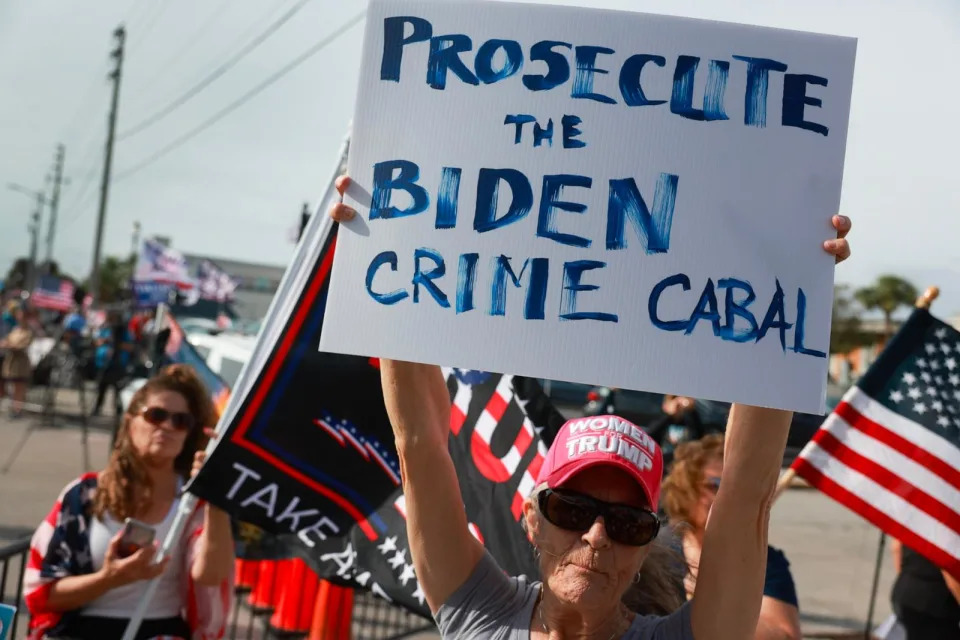
PHOTO: Supporters of former President Donald Trump stand outside of the Alto Lee Adams Sr. U.S. Courthouse as they await his arrival on Mar. 1, 2024, in Fort Pierce, Fla. (Joe Raedle/Getty Images)

Even then, there are still backstops in place to deter Trump’s more pointed threats. DOJ officials and prosecutors who are not politically appointed could threaten revolt, as has happened in the past. Evidence of wrongdoing would still need to be presented, and courts could reject politically-motivated cases that lack sufficient proof of a crime.

“So, you’d have whatever the traditional limitations are created by our judicial process, including the Constitution and statutes, but you wouldn’t have the gatekeeping function that we’ve counted on the Justice Department to exercise,” Green said.

MORE: Trump’s ‘retribution’ campaign theme has apparent roots in old Confederate code, new book says

It’s also worth noting Trump tried to target his political foes during his last administration and faced resistance.

He fumed at Jeff Sessions, his first attorney general, when Sessions recused himself from the DOJ’s investigation into Russian meddling into the 2016 election. In various social media posts, he named people Sessions should go after, including then-FBI Director James Comey, Hillary Clinton and Barack Obama.

After firing Sessions, Trump found what many believed to be a friendlier ally in Bill Barr. Barr framed special counsel Robert Mueller’s Russia report in what many said were more favorable terms for Trump than the findings warranted. He also drew scrutiny for intervening in the government’s case against Trump’s first national security adviser Michael Flynn and for suggesting a lighter sentence for longtime Trump ally Roger Stone. The actions led many Democrats and former DOJ officials to decry the politicization of the department under Barr’s leadership.

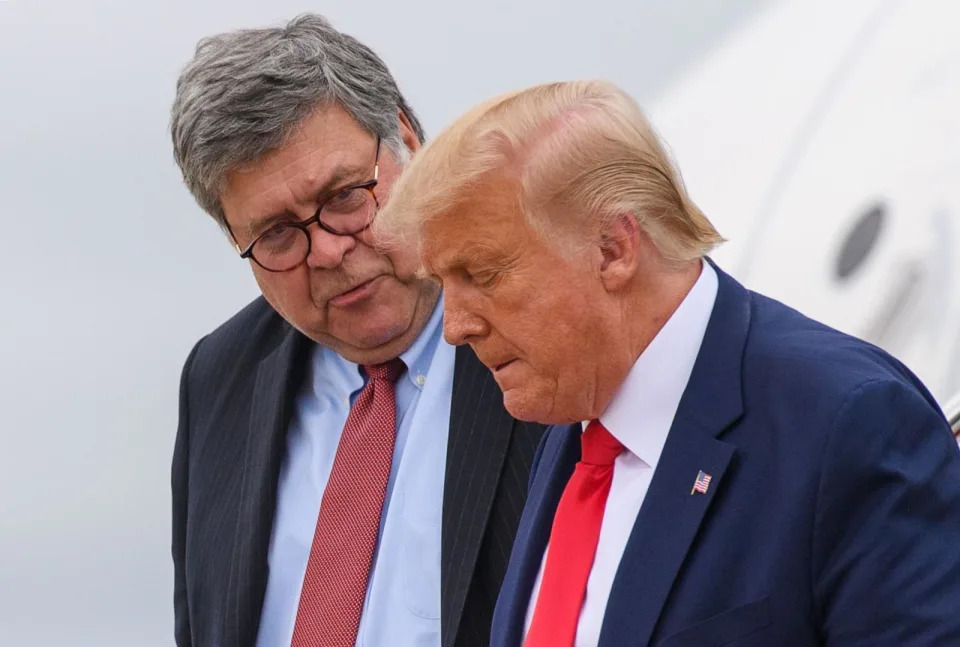
PHOTO: President Donald Trump and Attorney General William Barr step off Air Force One upon arrival at Andrews Air Force Base in Maryland, Sept. 1, 2020. (Mandel Ngan/AFP via Getty Images)

But when Trump urged Barr and the Department of Justice to push a narrative of election fraud after his loss to Biden in November 2020, the attorney general and others declined to fall in line. Then-Vice President Mike Pence, a loyalist to Trump, also resisted his demands to unilaterally reject the election results during the certification on Jan. 6, 2021.

Elaine Kamarck, a senior fellow of governance studies at the Brookings Institution, said she believed Trump would be stopped again if he tried to use his office to go after enemies or other acts of retribution.

“The Founding Fathers anticipated a Donald Trump,” Kamarck said. “They built a system of checks and balances, and it’s working so far. If Donald Trump won, what would it take to dismantle that checks and balances? It would take a clean sweep of the Congress — 60 senators in the Senate and an overwhelming majority in the House of Representatives — and the courts to start the dismantling. And I don’t see that happening at this time and I don’t see it happening within the four years that he has to do it.”

“In other words,” Kamarck said, “we’re not a banana republic yet even if he’d like to make us one.”

Trump campaign spokesperson Steven Cheung, in response to expert comments that retribution would require never-before-seen politicization of the DOJ, told ABC News, “As President Trump has repeatedly said, the best retribution is the overall success of the American people.”

Lost in the malignant normality of the Trumpocene

Salon – Opinion

Lost in the malignant normality of the Trumpocene

Chauncey DeVega – March 21, 2024

Donald Trump KAMIL KRZACZYNSKI/AFP via Getty Images

The Trumpocene is not normal. If you accept that it is normal or otherwise become habituated to it, the neofascists and other enemies of democracy have won.

For at least the last eight years I have been writing several times a week about the rise of Trumpism and the deep cultural and societal rot that birthed the monstrosity. I view this work as a type of chronicle, an ongoing account of America’s surreal misadventure. As Hannah Arendt and other truth-tellers have shown, fascism and other forms of authoritarianism are an assault on reality, the facts, and the very idea of the truth. Chronicling and otherwise documenting these events and their meaning is a way of trying to ensure that the facts are preserved, as public memory is under assault and organized forgetting spreads rapidly.

On this, Arendt famously warned, “the ideal subject of a totalitarian state is not the convinced Nazi or Communist, but people for whom the distinction between fact and fiction (that is, the reality of experience) and the distinction between true and false (that is, the standards of thought) no longer exist.”

Chronicling the Trumpocene and America’s democracy crisis and other struggles in this era is also a type of witnessing, which means not just recording the facts but testifying and feeling the pain of others. As psychohistorian Robert Jay Lifton teaches, “One bears witness by taking in the situation — in this case, its malignant nature — and then telling one’s story about it, in this case with the help of professional knowledge, so that we add perspective on what’s wrong, rather than being servants of the powers responsible for the malignant normality. We must be people with a conscience in a very fundamental way.”

It is not just those of us with a public platform who should be carefully chronicling and documenting the Trumpocene and these aberrant events. Everyone who claims to care about democracy and a free society should be doing the same thing. Moreover, this should be done not just online or in some other digital form but in print. The digital is so ephemeral and can easily be disappeared or otherwise altered. Paper is much more real and permanent — and thus dangerous. That is why fascists and other enemies of truth and democracy censor and burn books.

When reality and truth are under siege, doing this type of intellectual and spiritual work is a way to remain sane. As I tell many of the people who reach out to me about escaping the Trumpocene nightmare and who feel exhausted and confused, “You are not crazy, the Trumpocene (and late capitalism, the culture of cruelty, pandemic politics and trauma, environmental collapse, and future shock etc. etc.) is just making you feel that way.”

During the Trumpocene there have been many days when I feel like Charleston Heston in “Planet of the Apes” screaming “It’s a Madhouse!” or Peter Finch as Howard Beale in “Network” bellowing, “I’m as mad as hell and I’m not going to take this anymore!” And there have also been moments, especially as I watch Trumpism nakedly morph into some version of American Hitlerism where I truly wonder if I am Peter Weller in David Cronenberg’s film “Naked Lunch,” and if I have been exposed to that damn “bug powder.”

I know I am not alone in these feelings.

But I realized some months ago that I had made a fundamental error in my assumptions and method in how I have been chronicling these very bad times. The Trumpocene, like other forms of fascism and such malign forces do not exist in a finite space or in a linear relationship to time; it and they really have no concrete beginning and/or end. Such political formations are a type of force that is like a book or story that continues to have chapters added to it in real time. The challenge then, is how to document and intervene against such a force that is dynamic and not static.

To better orient myself, I have been returning to how the Trumpocene (the Age of Trump, the MAGAverse, TrumpWorld or whatever moniker one applies to these years) as a type of malignant normality. Focusing on that constant wrongness has ironically helped me to keep perspective and reinforced how this state of affairs cannot last forever because such systems almost always collapse inward on themselves. And of course, when the collapse takes place, it will not be without great pain and that euphemism for mass death, “collateral damage.”

In a sharp essay at the Bulwark, Jonathan Last says this about the Trumpocene and malignant normality:

When insanity becomes the norm, it ceases to be insane. As a practical matter, it is impossible for a society to spend a decade listening to an unwell man say crazy, disassociated, garbled words for hours at a time, almost daily, and maintain the position that he is unhinged. At some point, society decides that the man they once regarded as unhinged, simply is. It’s like sitting in a room that stinks of sulfur. At first the smell is intolerable; but after a while you can’t even notice it if you try. This is more than human nature: It’s how our brains are wired to adapt to environmental conditions. That’s one of my big worries about the next eight months: That it will be biologically and psychologically impossible for a crucial percentage of voters to perceive what the Republican candidate for president actually is.

At the New Yorker, Susan Glasser offers this description of Trump’s recent speech in Rome, Georgia, noting how he embodies and projects malignant normality as a type of patient zero and the main character in a twisted politics reality TV show that he is making up as he goes along:

Trump’s appearance in Georgia, by contrast, reflected a man not rooted in any kind of reality, one who struggled to remember his words and who was, by any definition, incoherent, disconnected, and frequently malicious. (This video compilation, circulating on social media, nails it.) In one lengthy detour, he complained about Biden once being photographed on a beach in his bathing suit. Which led him to Cary Grant, which led him to Michael Jackson, which led him back to the point that even Cary Grant wouldn’t have looked good in a bathing suit at age eighty-one. In another aside, he bragged about how much “women love me,” citing as proof the “suburban housewives from North Carolina” who travel to his rallies around the country. He concluded that portion of his speech by saying:

“But it was an amazing phenomenon and I do protect women. Look, they talk about suburban housewives. I believe I’m doing well—you know, the polls are all rigged. Of course lately they haven’t been rigged because I’m winning by so much, so I don’t want to say it. Disregard that statement. I love the polls very much.”

Makes perfect sense, right?

Echoing Glasser’s concerns about Trump and his disconnect from reality, chief of staff at the Department of Homeland Security in the Trump administration, Miles Taylor, who I recently spoke with here at Salon, told MSNBC last Thursday: “The man that I interacted with years ago was very visibly unwell, was observably unstable, and he was the president of the United States then. I can only imagine what’s happened to him since. We’ve witnessed it, we all see it as an American public. But I can’t imagine how unstable he’ll be behind that resolute desk again.”

In another example of how none of this is normal and America’s elites and those so-called guardians of democracy and “the system” have normalized Trump’s deviance and evil, the corrupt ex-president, traitor, Jan. 6 coup attempter, defendant who is facing hundreds of years in prison for serious felonies – which include stealing classified and other top secret documents – will soon be getting intelligence briefings. Why? Because of “tradition” as he is the Republican Party’s presidential nominee. On this perilous absurdity, Tom Nichols warns in the Atlantic:

The decision rests, as always, with the sitting president, and Joe Biden is likely to continue this practice so that he will not be accused of “politicizing” access to intelligence. Such accusations need not be taken seriously; they would only be more meaningless noise from a GOP that has already stumbled in a clumsy attempt to impeach Biden after leveling charges of corruption at both him and his son. And although denying Trump access to classified briefs would produce squawks and yowls from Republicans, it would also serve as a reminder that Trump cannot be trusted with classified information.

The risks of denying Trump these early briefings are negligible. As we learned from his presidency, Trump is fundamentally unbriefable: He doesn’t listen, and he doesn’t understand complicated national-security matters anyway. The problem with giving Trump these briefings, however, isn’t that he’s ignorant. He’s also dangerous, as his record shows.

Indeed, if Trump were a federal employee, he’d have likely already been stripped of his clearances and escorted from the building. I say this from experience: I was granted my first security clearance when I was 25 years old—Ronald Reagan was still president, which tells you how long ago that was—and I held a top-secret clearance when I advised a senior U.S. senator during the Gulf War. I then held a clearance as a Department of Defense employee for more than a quarter century.

Government employees who hold clearances have to attend annual refresher courses about a variety of issues, including some pretty obvious stuff about not writing down passwords or taking money from a friendly Chinese businessman wearing an American baseball cap. (No, really, that’s a scenario in some of the course materials.) But one area of annual training is always about “insider threats,” the people in your own organization who may pose risks to classified information. Federal workers are taken through a list of behaviors and characteristics that should trigger their concern enough to report the person involved, or at least initiate a talk with a supervisor.

Trump checks almost every box on those lists. (You can find examples of insider-threat training here and here, but every agency has particular briefs they give to their organizations.)

Continuing with this betrayal of America’s pluralistic multiracial democracy, Trump recently met with Hungary’s neofascist leader, Viktor Orban. This meeting is part of a much larger pattern where today’s Republican Party and larger “conservative” movement are forging an international alliance with malign actors and other enemies of democracy.

At the Daily Beast, David Rothkopf, sounds this alarm:

Within a 24-hour period, the 2024 presidential campaign kicked off in a way that could not present the choice before the American public more starkly.

Joe Biden stood before the Congress and, in his State of the Union address, made a powerful case that he would fight with every fiber of his being to preserve American democracy and the fundamental freedoms of all Americans.

Then, late Friday, Donald Trump hosted Hungary’s authoritarian ruler, Viktor Orbán, in the kind of pro-Putin, anti-democracy summit that perfectly captured the true nature of today’s MAGA Republican Party. The dinner reception was so important that even Melania Trump made one of her rare appearances at her husband’s side. Trump said, “There’s nobody smarter or a better leader than Viktor Orbán. He’s the boss. He’s a non-controversial figure because he says, ‘This is the way it’s going to be and that’s the end of it.’ He’s the boss. He’s a great leader.”

A day earlier, Orbán—Vladimir Putin’s man in Europe, his acolyte and champion—met behind closed doors with the leaders of the new American right at the Heritage Foundation.

There it is, America. Biden is running to preserve America’s traditional values and institutions. Trump and the GOP have openly embraced autocracy, celebrating the virtues of “strong man” government.

If Donald Trump had actually been put on trial, and properly punished for the crimes of Jan. 6 and his other violations of American democracy, civil society and the law, the Trumpocene and this state of malignant normality would be closer to dissipating. Of course, and in an anti-climax because it confirms what has long been obvious, the Washington Post is reporting that Attorney General Merrick Garland delayed investigating Trump for his obvious crimes of Jan. 6 and the larger coup plot for more than a year. The result of that choice is that Trump will likely not be tried and sentenced before the 2024 Election. If he defeats President Biden, Trump will then ignore the verdicts against him and seek revenge on all people who dared to hold him accountable for his crime spree.

Investigative reporters Carol Leonnig and Aaron Davis detail how:

Hours after he was sworn in as attorney general, Merrick Garland and his deputies gathered in a wood-paneled conference room in the Justice Department for a private briefing on the investigation he had promised to make his highest priority: bringing to justice those responsible for the attack on the U.S. Capitol on Jan. 6, 2021.

In the two months since the siege, federal agents had conducted 709 searches, charged 278 rioters and identified 885 likely suspects, said Michael R. Sherwin, then-acting U.S. attorney for the District of Columbia, ticking through a slide presentation. Garland and some of his deputies nodded approvingly at the stats, and the new attorney general called the progress “remarkable,” according to people in the room.

Congressional staffers barricade doors while taking cover during the attack on the U.S. Capitol on Jan. 6, 2021. (Amanda Voisard for The Washington Post)

Sherwin’s office, with the help of the FBI, was responsible for prosecuting all crimes stemming from the Jan. 6 attack. He had made headlines the day after by refusing to rule out the possibility that President Donald Trump himself could be culpable. “We are looking at all actors, not only the people who went into the building,” Sherwin said in response to a reporter’s question about Trump. “If the evidence fits the elements of a crime, they’re going to be charged.”

But according to a copy of the briefing document, absent from Sherwin’s 11-page presentation to Garland on March 11, 2021, was any reference to Trump or his advisers — those who did not go to the Capitol riot but orchestrated events that led to it.

A Washington Post investigation found that more than a year would pass before prosecutors and FBI agents jointly embarked on a formal probe of actions directed from the White House to try to steal the election. Even then, the FBI stopped short of identifying the former president as a focus of that investigation.

A wariness about appearing partisan, institutional caution, and clashes over how much evidence was sufficient to investigate the actions of Trump and those around him all contributed to the slow pace. Garland and the deputy attorney general, Lisa Monaco, charted a cautious course aimed at restoring public trust in the department while some prosecutors below them chafed, feeling top officials were shying away from looking at evidence of potential crimes by Trump and those close to him, The Post found.

Ultimately, malignant normality through Trumpism, neofascism, white supremac(ies) racism(s) or whatever other type of vessel it uses to inject its poison is a threat to a humane society and a real social democracy. The language and labels we use to describe this reactionary revolutionary project must not distract us from that basic and foundational truth.

As always, Henry Giroux makes an incisive intervention and offers moral clarity. In a new essay at the La Progressive which merits being quoted at length, he offers a warning and a call to action:

The cruel language and practices of human degradation and destructiveness now feed a growing fascist politics in the U.S. Fascist demagogues now boast about their racial fantasies, unchecked adoration of violence, and their aggressive lawlessness. What Ingmar Bergman once called “The Serpent’s Egg,” a metaphor for the birth of fascism, is about to hatch.

In a world shaped increasingly by emerging authoritarianism, it has become increasingly difficult to remember what a purposeful and substantive democracy looks like, or for that matter, what the idea of democracy might suggest. Democracy as an ideal, promise, and working practice is under assault, just as a number of far-right educational, market, military, and religious fundamentalisms are gaining ascendancy in American society. Increasingly, it becomes more challenging to inhabit those public spheres where politics thrives—where thinking, speaking, and acting subjects engage and critically address the major forces and problems bearing down on their lives. In this new moment in history, which too often resembles the nightmares of a fascist past with its banning of books, erasing of history, attack on trans people, and support of white nationalism and supremacy, the question of how society should imagine itself or what its future might hold has become more demanding given the eradication of social formations that place an emphasis on truth, social justice, freedom, equality, and compassion.

Historical and social amnesia have become the organizing principles of U.S. society. Lies morph into the celebration of violence, and language becomes part of the machinery of social death, relegated to the sphere of consumer culture, and devoid of an ethical grammar that is banished to zones of political and social abandonment.

Here, Giroux focuses in on how malignant normality reflects a failure of imagination:

What’s happening in this country is a failure of imagination.

Many of us take our freedoms for granted. We can’t envision a day when our rights would disappear, leaving us at the mercy of a dictatorship that’s accountable to no one.

Human beings are basically optimistic, and many of us haven’t considered the possibility that 248 years of democracy could end on a single election day. But they can, and they might.

Today I’m asking you to be alarmed – to be deeply afraid. But not crippled by that fear. I’m pleading with you to become motivated to avert a national disaster….

That’s right. The Nazi agenda was inconceivable to decent people – and that’s part of the reason it became a reality.

There was a failure of imagination.

But with today’s MAGA fascism, we don’t have to exercise our imagination very much. We just have to fight the temptation to downplay the dangers that Trump and his gang display in public, for all of us to see….

Whatever you do, don’t ignore what’s happening. Be part of the patriotic rescue of your country – something you can take pride in for the rest of your days. Consider it your gift to your children, your grandchildren, and future generations that you’ll never know.

Fight fascism now, while you can. Be a hero to your country.

I often use therapeutic language to describe the Trumpocene because fascism and other such evil forces are not “just” about politics but are an attack on our collective mental, spiritual, and physical – and intellectual – health. Applying that framework, Donald Trump is abusing the American people.

In an abusive relationship, the horrible and wrong becomes normalized and the victim often ends up celebrating those days when there is no abuse. In essence, what should be every day and a baseline becomes something special and “proof” that the relationship can somehow work or is “healthy.” Unfortunately, too many Americans have internalized the abuse, believe they deserve it, and as shown by public opinion polls want Donald Trump back in the White House to punish them (and the people they hate) some more.

Russia launches massive air attack on Ukraine’s energy infrastructure

ABC News

Russia launches massive air attack on Ukraine’s energy infrastructure

Patrick Reevell – March 22, 2024

Russia unleashed a massive aerial attack on Friday in what Ukrainian officials said was the largest and most destructive assault on its energy infrastructure since the start of the war.

Over 150 missiles and drones were involved in the bombardment, striking targets across the Ukraine, according to the Ukrainian air force, knocking out power to swathes of the country and badly damaging its largest hydroelectric power station. It was the second largest aerial attack on Ukraine since Russia began its invasion two years ago, the air force said.

At least three people were killed in the assault, and 15 others were injured, according to Ukraine’s prosecutor general’s office.

Ukraine’s military said air defenses destroyed around 90 of the projectiles but more than a third still managed to get through.

The strikes forced emergency shut downs of electricity in at least seven regions, including Odesa, Dnipro, Poltava, Zaporizhzhia and Kirovohrad, according to Ukraine’s state energy company. Officials in Ukraine’s second largest city, Kharkiv, said it was entirely without power following the attacks.

“The morning attack by the Russians on the energy system of Ukraine was the largest ever,” Volodymyr Kudrytskyi, the head of Ukrenergo said in a statement.

Kharkiv’s mayor Ihor Terekhov said it was also the largest attack on the city since the start of the war, with at least 20 missiles fired into energy infrastructure, calling the damage “too severe.”

Missiles also hit Ukraine’s largest hydroelectric power station, the Dnipro dam in Zaporizhzhia, setting off a huge fire there and causing critical damage, according to Ukrainian officials.

“We are losing the station,” Ihor Syrota, head of Ukraine’s state hydro-power company, Ukrhydroenergo, told RFE/RL in a live interview, saying that two missiles had struck the power plant.

Ukrainian officials said the structural integrity of the dam itself was not in danger, but local authorities warned people to stock up on water in case of possible shortages.

Friday’s attack involved more than 75 missiles, including seven advanced, hypersonic Kinzhal missiles, according to Ukraine’s air force.

PHOTO: Smoke and fire erupt from an missile explosion on Ukraine's largest dam, the DniproHES, in Zaporizhzhia (Denys Shmyhal/prime Minister Of /via Reuters)
PHOTO: Smoke and fire erupt from an missile explosion on Ukraine’s largest dam, the DniproHES, in Zaporizhzhia (Denys Shmyhal/prime Minister Of /via Reuters)

The attack came as Ukraine is suffering increasingly severe shortages of air defense ammunition, amid delays in Western supplies and with more U.S. support blocked in Congress. A day earlier, Russia launched its largest missile attack on Ukraine’s capital Kyiv in months.

Ukraine’s president Volodymyr Zelensky on Friday said the attacks showed the cost of the delays in Western support.

Russian drones “don’t have indecision,” Zelensky said in a video address. “It’s important to understand the price of delays and decisions put off. Our partners definitely know what is necessary. They definitely can support. These decisions are needed.”

A new $60 billion military aid package that would include funding for air defense is currently stalled in Congress, blocked by hard right Republicans close to former President Donald Trump. The bill was approved by a bipartisan majority in the Senate in December but Republican House Speaker Mike Johnson has refused to put it to a vote.

Russia has largely avoided striking Ukraine’s energy infrastructure for the past few months, instead focusing on military production targets. But Ukraine increasingly faces a choice of using its limited air defenses to protect large cities and civilian infrastructure or deploy it to the frontline, where Russia is regaining air superiority.

Ukraine has used the advanced handful of Patriot air defense batteries provided by the U.S. and European countries to shield Kyiv, but does not have enough to protect key cities elsewhere.

Ukrainian officials on Friday also defended recent Ukrainian attacks on Russia’s oil industry, following reports that U.S. officials have urged Ukraine to halt them over fears it is driving up oil prices globally.

Ukrainian drones have repeatedly struck major Russian oil refineries in recent weeks, in an apparent campaign to undermine Russia’s income for its energy sector, a crucial source of revenue for the Kremlin.

The Financial Times on Friday reported that U.S. officials have warned officials at Ukraine’s intelligence service the attacks should stop.

But Ukrainian deputy prime minister Olha Stefanishyna told a security forum Friday the strikes were legitimate.

“These are absolutely legal goals from a military point of view. We understand the appeals of American partners. At the same time, we are fighting with the capabilities, resources, and practices that we have today,” she said at the Kyiv Security Forum.

Factbox-‘Bloodbath,’ ‘vermin,’ ‘animals’: Trump’s rhetoric on the trail

Reuters

Factbox-‘Bloodbath,’ ‘vermin,’ ‘animals’: Trump’s rhetoric on the trail

Gram Slattery – March 22, 2024

FILE PHOTO: Former U.S. President Trump hosts a campaign rally, in Rome, Georgia

WASHINGTON (Reuters) – Republican presidential candidate Donald Trump has made a series of inflammatory and racist statements on the U.S. campaign trail since declaring his candidacy in November 2022.

In some cases, he has used violent imagery to lambaste immigrants and opponents. He has warned that the United States is on the verge of collapse, and his rhetoric has raised concerns that he might flout democratic norms by using the power of the state to target perceived enemies if he is elected.

Here are some of Trump’s more controversial statements to date:

BLOOD POISONING

Trump has said on several occasions that immigrants in the United States illegally are “poisoning the blood of our country.”

Anti-Defamation League leader Jonathan Greenblatt called the language “racist, xenophobic and despicable.” The campaign of Democratic President Joe Biden compared Trump’s comments to those of Adolf Hitler, who used the phrase “blood poisoning” in his manifesto “Mein Kampf.”

Public opinion polls show that illegal immigration is a leading concern for voters, and Trump has consistently portrayed immigration as a major driver of violent crime and economic decay.

In past statements, Trump has suggested that Democrats are purposefully allowing migrants into the country to grow their political support.

This is a key element of the far-right “Great Replacement” conspiracy theory, which asserts that leftist and Jewish elites are engineering the ethnic and cultural replacement of white populations with immigrants of color that will lead to a “white genocide.”

The debate over the economic effects of immigration is decades-long, though most researchers say immigration broadly boosts economic growth.

Some 33% of Republicans in a February Reuters/Ipsos poll cited immigration as their top issue, while 6% of Democrats said the same.

VERMIN

Trump pledged at a November rally in New Hampshire that he would “root out the communists, Marxists, fascists and the radical left thugs that live like vermin within the confines of our country.”

Those comments drew rebukes from congressional Democrats and some moderate Republicans. Some historians have traced the use of the word “vermin” to Hitler and Italy’s Benito Mussolini.

Political historians say the use of dehumanizing rhetoric – including words like “vermin” – makes it easier to strip away rights from residents and citizens as they are seen as less worthy of democratic or constitutional protections. Nazis, for instance, frequently referred to Jews as lice, rats and vermin.

The Trump campaign has dismissed those comparisons.

BLOODBATH

During a March appearance alongside a Republican Senate candidate in Ohio, Trump warned of a “bloodbath” if he fails to unseat Biden in November’s election.

At the time Trump was discussing the need to protect the U.S. auto industry from overseas competition, and Trump and allies later said he was referring to the auto industry when he used the term.

Trump’s campaign has sought to portray Biden as a threat to automaking jobs in Michigan, a key swing state, due to the Biden administration’s promotion of electric vehicles.

Biden’s campaign team rejected that characterization and condemned what it called Trump’s “extremism,” “his thirst for revenge” and his “threats of political violence.”

IMMIGRANTS ARE ‘ANIMALS,’ ‘NOT PEOPLE’

Trump has frequently referred to immigrants in the country illegally in subhuman terms, for example referring to them as animals who are prone to violence.

“In some cases they’re not people, in my opinion,” he said during his March appearance in Ohio. “But I’m not allowed to say that because the radical Left says that’s a terrible thing to say. “These are animals, OK, and we have to stop it,” he said.

During stump speeches, Trump frequently claims that immigrants crossing the border illegally have escaped from prisons and asylums in their home countries and are fueling violent crime in the United States.

While available data on criminals’ immigration status is sparse, researchers say people in the country illegally do not commit violent crimes at a higher rate than native-born citizens.

BLACK AMERICANS AND CRIME

Trump drew the ire of Biden’s campaign and civil rights leaders and groups in February when he suggested Black voters were more drawn to him because of his criminal indictments. He also said Black voters had come to “embrace” his mugshots.

“And then I got indicted a second time and a third time and a fourth time. And a lot of people said that that’s why the Black people like me because they have been hurt so badly and discriminated against,” Trump said while speaking to a Black conservative group in South Carolina before the state’s primary election, which he went on to win.

Trump’s legal challenges, including federal charges over his alleged efforts to overturn his 2020 election loss and his handling of classified documents, among other state charges and civil lawsuits, differ greatly from the historic inequities Black Americans have experienced in the criminal justice system.

Trump has also described at least two Black prosecutors – Manhattan District Attorney Alvin Bragg and New York Attorney General Letitia James – as “animals.” He has repeatedly referred to James as “Peekaboo,” which rhymes with a racial slur.

Trump allies say his attacks are referring to prosecutors’ conduct, not their race, and they say he is working hard to win the support of Black voters.

APOCALYPSE NOW

Trump frequently leans into apocalyptic imagery on the campaign trail, telling supporters that if he does not win in November – or if he does not otherwise get his way – the country will enter into terminal decline.

At a March campaign event in North Carolina, Trump said Biden’s immigration policies amounted to a “conspiracy to overthrow the United States” through lax security policies that had allowed millions of migrants to stream across the U.S. border with Mexico.

Biden’s administration, Trump contended, seeks “to collapse the American system, nullify the will of the actual American voters and establish a new base of power that gives them control for generations.”

In response, Biden’s campaign pointed to a border security bill in Congress that Trump helped torpedo in February by urging Republicans to vote against it.

DICTATOR ON ‘DAY ONE’

During a televised town hall in December, Trump said he would not be a dictator “other than (on) Day One” of a potential second term. He said he would close the southern border with Mexico and expand oil drilling during the first day of his administration.

Biden’s campaign said the comments were explicit proof that he wants to be an autocrat, while Trump’s allies said he was joking.

Biden has centered his campaign on the contention that stopping Trump from returning to office is crucial, as Trump represents a threat to democracy.

Trump argues that Biden is a more serious threat to democracy, as federal law enforcement agencies under him are prosecuting prominent Republicans, himself included.

Some 44% of Democrats said extremism is their top election issue, according to the February Reuters/Ipsos poll, while 13% of Republicans said the same.

GRAPHIC: Where Biden and Trump stand on the issues.

(Reporting by Gram Slattery, editing by Ross Colvin, Kieran Murray and Howard Goller)

Man who helped drag police officer into mob gets over 5 years in prison for Capitol riot attacks

Associated Press

Man who helped drag police officer into mob gets over 5 years in prison for Capitol riot attacks

Michael Kunzelman – March 21, 2024

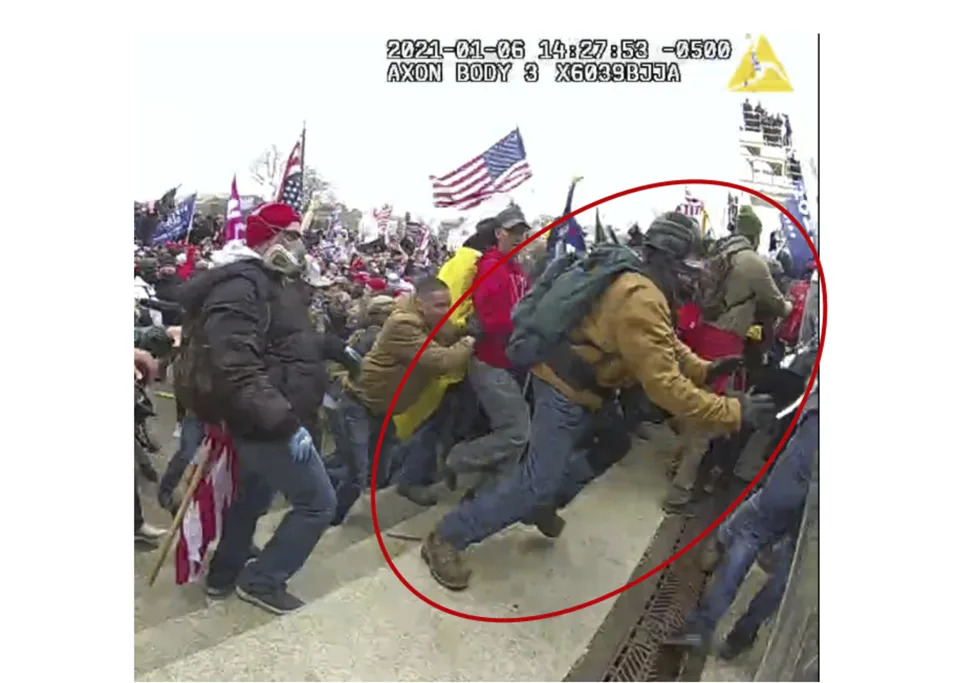
This image from police body-worn camera video, contained and annotated in the Justice Department's government's sentencing memorandum supporting the sentencing of Jeffrey Sabol shows Sabol at the U.S. Capitol on Jan. 6, 2021, in Washington. During the course of an attack on police officers, Sabol ripped the baton out of the hands of a fallen officer, leaving him unable to defend himself against assaults by other rioters. Sabol then helped his co-defendants drag a second officer into the crowd, where that officer was also beaten by rioters. (Department of Justice via AP)
This image from police body-worn camera video, contained and annotated in the Justice Department’s government’s sentencing memorandum supporting the sentencing of Jeffrey Sabol shows Sabol at the U.S. Capitol on Jan. 6, 2021, in Washington. During the course of an attack on police officers, Sabol ripped the baton out of the hands of a fallen officer, leaving him unable to defend himself against assaults by other rioters. Sabol then helped his co-defendants drag a second officer into the crowd, where that officer was also beaten by rioters. (Department of Justice via AP)
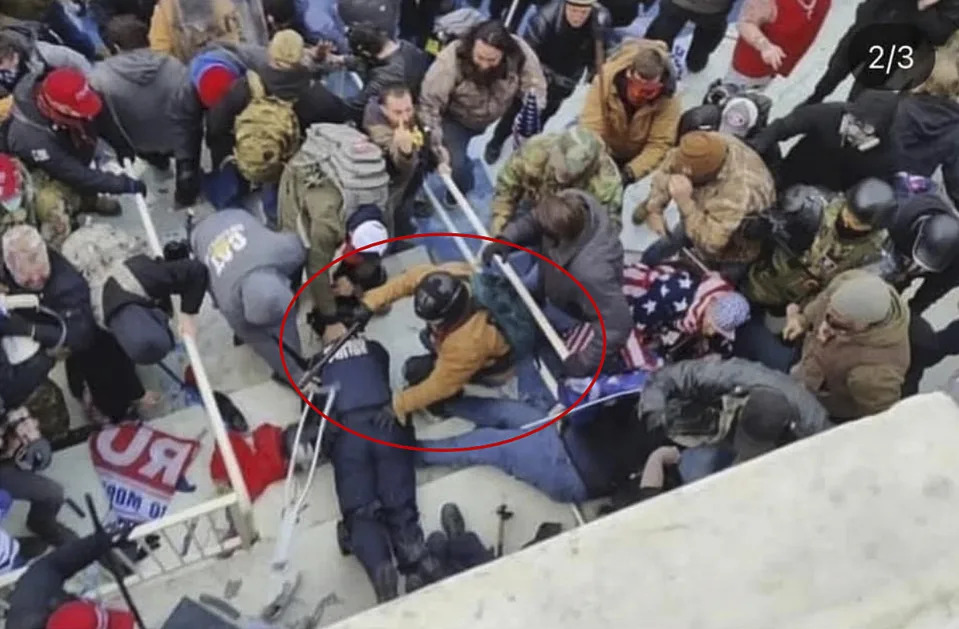
This combination of images from police body-worn camera video, contained and annotated in the Justice Department's government's sentencing memorandum supporting the sentencing of Jeffrey Sabol, shows Sabol at the U.S. Capitol on Jan. 6, 2021, in Washington. During the course of an attack on police officers, Sabol ripped the baton out of the hands of a fallen officer, leaving him unable to defend himself against assaults by other rioters. Sabol then helped his co-defendants drag a second officer into the crowd, where that officer was also beaten by rioters. (Department of Justice via AP)
This combination of images from police body-worn camera video, contained and annotated in the Justice Department’s government’s sentencing memorandum supporting the sentencing of Jeffrey Sabol, shows Sabol at the U.S. Capitol on Jan. 6, 2021, in Washington. During the course of an attack on police officers, Sabol ripped the baton out of the hands of a fallen officer, leaving him unable to defend himself against assaults by other rioters. Sabol then helped his co-defendants drag a second officer into the crowd, where that officer was also beaten by rioters. (Department of Justice via AP)
This image from police body-worn camera video, contained and annotated in the Justice Department's government's sentencing memorandum supporting the sentencing of Jeffrey Sabol, shows Sabol at the U.S. Capitol on Jan. 6, 2021, in Washington. During the course of an attack on police officers, Sabol ripped the baton out of the hands of a fallen officer, leaving him unable to defend himself against assaults by other rioters. Sabol then helped his co-defendants drag a second officer into the crowd, where that officer was also beaten by rioters. (Department of Justice via AP)
This image from police body-worn camera video, contained and annotated in the Justice Department’s government’s sentencing memorandum supporting the sentencing of Jeffrey Sabol, shows Sabol at the U.S. Capitol on Jan. 6, 2021, in Washington. During the course of an attack on police officers, Sabol ripped the baton out of the hands of a fallen officer, leaving him unable to defend himself against assaults by other rioters. Sabol then helped his co-defendants drag a second officer into the crowd, where that officer was also beaten by rioters. (Department of Justice via AP)

WASHINGTON (AP) — A Colorado man who helped other rioters drag a police officer into a mob storming the U.S. Capitol was sentenced on Thursday to more than five years in prison for his role in the Jan. 6, 2021, attack.

Jeffrey Sabol ripped a baton from an officer’s hands before pulling another officer into the crowd outside the Capitol, allowing other rioters to assault the officer with weapons.

Sabol, 54, told U.S. District Judge Rudolph Contreras that he knows he is “100%” guilty and would have apologized directly to the officers whom he attacked if they had attended the hearing.

“I accept whatever it is you hand me,” Sabol said. “I’ll be honest: I deserve it.”

The judge sentenced Sabol to five years and three months behind bars. He’ll get credit for the three years and two months that he has already spent in jail since his arrest.

Contreras said Sabol had mischaracterized his violent actions on Jan. 6 as efforts to be helpful.

“It’s hard to imagine how any of this was helpful,” the judge said after describing Sabol’s conduct that day.

Prosecutors recommended a prison sentence of 10 years and one month for Sabol.

Sabol told FBI agents who arrested him that he was filled with “patriotic rage” on Jan. 6 because he believed the 2020 presidential election was stolen from then-President Donald Trump and said he answered a “call to battle” because he was a “patriot warrior,” according to prosecutors.

Contreras convicted Sabol of felony charges last year after a “stipulated bench trial,” which means the judge decided the case without a jury based on facts that both sides agreed to in advance. Such trials allow defendants to admit to certain facts while maintaining a right to appeal a conviction.

Sabol traveled from Colorado to Washington, D.C., with other members of what he called a “neighborhood watch” group. They attended Trump’s “Stop the Steal” rally near the White House on Jan. 6 before Sabol went to the Capitol, where lawmakers were certifying President Joe Biden’s 2020 electoral victory.

Sabol was wearing a helmet when he and other rioters attacked police officers on the west side of the Capitol.

“He entered the fray with the intent to halt the certification of the electoral college vote and to violently combat what he believed was a stolen election,” prosecutors wrote in a court filing.

On the Lower West Terrace, Sabol initially watched as another rioter beat a Metropolitan Police Department officer with a crutch and started to drag that officer down a set of steps. Sabol and a third rioter stepped in and helped drag the officer headfirst down the steps and into the crowd, where other rioters beat him with a flagpole and baton.

After Sabol stole a baton from another officer, other rioters dragged the officer into the crowd, kicked and stomped on him, struck him with poles and ripped off his gas mask before he was pepper sprayed.

Sabol tried to cover his tracks and flee the country after the riot. He microwaved laptops and hard drives, dropped his cell phone out a car window and booked a flight to Zurich, Switzerland, but he didn’t board the flight. Instead, he rented a car and drove to the Westchester, New York, area before he was arrested on Jan. 22, 2021.

Sabol worked as a senior geophysical manager for an environmental services company that fired him after his arrest.

“Jeff Sabol is not a violent man and regrets being caught up in his emotions and engaging in conduct that is not reflective of the law-abiding man and loving father that he has always strived to project,” his attorney wrote in a court filing.

Contreras previously sentenced several other rioters who were charged with Sabol and convicted of attacking the injured officers.

A former Tennessee sheriff’s deputy, Ronald Colton McAbee, was sentenced to five years and 10 months in prison. Florida resident Mason Courson was sentenced to four years and nine months in prison. Arkansas truck driver Peter Francis Stager was sentenced to four years and four months in prison. Michigan resident Justin Jersey was sentenced to four years and three months in prison. Michigan construction worker Logan Barnhart was sentenced to three years in prison. Kentucky business owner Clayton Ray Mullins was sentenced to two years and six months in prison.

Another co-defendant, Georgia business owner Jack Wade Whitton, is scheduled to be sentenced in May.

More than 1,300 people have been charged with federal crimes related to the Capitol riot. Over 800 of them have been sentenced, with roughly two-thirds receiving a term of imprisonment ranging from a few days to 22 years.

Man who helped drag officer into crowd on Jan. 6 sentenced to prison

The Hill

Man who helped drag officer into crowd on Jan. 6 sentenced to prison

Tara Suter – March 21, 2024

A Colorado man charged for helping drag a law enforcement officer into a crowd during the Jan. 6, 2021, attack on the Capitol was sentenced to more than five years in prison Thursday, according to prosecutors.

On top of the sentence, Jeffrey Sabol, 53, was also given three years of supervised release and ordered to pay more than $32,000 in restitution, according to a press release from the U.S. Attorney’s Office for the District of Columbia. He has been convicted of three felony charges including obstruction of an official proceeding in relation to his conduct during the Jan. 6 riot.

Sabol traveled from Colorado to Washington, D.C., to watch former President Trump speak at his “Stop the Steal” rally at the Ellipse on the day of the Jan. 6 riot, according to court documents. He traveled with fellow members of a “self-described ‘neighborhood watch’ group.”

“Before leaving, the group members discussed what to bring with them,” the press release said. “On the advice of one group member, Sabol packed a helmet, a trauma kit, a buck knife, and zip ties.”

Following the rally, he made his way to the Capitol and joined the riot, the release said. At one point, he “assisted two rioters in dragging a law enforcement officer down the steps and into” a mob, where “rioters beat the officer with a flagpole and a baton.”

Later, Sabol “deleted text messages and other communications from his cell phone,” prosecutors wrote.

He also tried to flee the U.S. and booked a flight to Switzerland, but could not board the aircraft and “rented a car and drove toward Westchester, New York, where the FBI arrested him on Jan. 11, 2021,” according to the documents.

Sabol acknowledged during his hearing that he is “100 percent” guilty and said he would have apologized to the officers if they had been present, according to The Associated Press.

“I accept whatever it is you hand me,” Sabol told the judge, per the AP. “I’ll be honest: I deserve it.”

More than 1,300 individuals have been charged with federal crimes related to the insurrection, according to the release. Of those charged, more than 800 have been sentenced.

Self-professed ‘patriot warrior’ sentenced for role in violent Jan. 6 insurrection

United Press International

Self-professed ‘patriot warrior’ sentenced for role in violent Jan. 6 insurrection

Doug Cunningham – March 21, 2024

Jeffrey Sabol, a Colorado man who helped drag a police officer into the violent pro-Trump Jan.6 insurrection mob, was sentenced Thursday to 63 months in prison for three felonies. Pro-Trump rioters breached the security perimeter at the U.S. Capitol in Washington, D.C., on Jan. 6, 2021 (pictured). File Photo by Ken Cedeno/UPI

March 21 (UPI) — A Colorado man who helped drag a police officer into the violent pro-Trump mob during the Jan. 6, 2021, Capitol insurrection was sentenced Thursday to 63 months in prison for three felonies.

Jeffrey Sabol, 53, was accused of beating a police officer who was attempting to help injured rioters.

His charges include an attack on a D.C. police officer. He said in an interview with police following his arrest that he had answered a call to battle because he “was a patriot warrior.”

His actions and the actions of others disrupted a joint session of the U.S. Congress convened to ascertain and count the electoral votes related to the 2020 presidential election,” the Department of Justice said in a statement.

Sabol, of Kittredge, Colo., also was sentenced to 36 months of supervised release and ordered to pay $32,165.65.

Pro-Trump rioters breach the security perimeter and penetrate the U.S. Capitol to disrupt the Electoral College vote count that would certify President-elect Joe Biden as the winner in Washington, D.C. on Jan. 6, 2021. File Photo by Ken Cedeno/UPI

The Justice Department, citing court documents and stipulated facts in the case, said Sabol attended the Trump “Stop The Steal” rally before joining the front of a line of rioters confronting police at the Capitol.

“In a coordinated effort, Sabol and another rioter pushed a third rioter — who, himself, was holding a riot shield — from behind, propelling him forward and up a set of steps, so that the rioter with the shield ran into the line of police,” the DOJ said in a statement. “As the officers attempted to repel the rioters pushing against the police line, Sabol kept pushing forward and slammed into a riot shield held by a Metropolitan Police Department (MPD) officer.”

Pro-Trump rioters breach the security perimeter and penetrate the U.S. Capitol to block the peaceful transfer of presidential power as Congress met to certify the Electoral College results in Washington, D.C., on Jan. 6, 2021. File Photo by Ken Cedeno/UPI

Sabol was in the pro-Trump mob as an MPD officer was pulled into the violent mob, according to the DOJ.

He was convicted of obstruction of an official proceeding and aiding and abetting, federal robbery, and assaulting, resisting, or impeding certain officers with a deadly or dangerous weapon and aiding and abetting.

After the attack on the Capitol Sabol deleted texts and other communications from his cell phone. He also booked a flight to Zurich, Switzerland in an attempt to flee the United States.

After he was unable to board the aircraft Sabol rented a car and drove to Westchester, New York, where he was arrested by the FBI Jan. 11, 2021.

He told officers he was wanted by the FBI after “fighting tyranny in the D.C. Capitol.”

He also destroyed his laptop computers in a microwave oven and dropped his cell phone in a body of water.

The DOJ said Sabol came to the Capitol with a helmet, a buck knife, a trauma kit and zip ties.

During the melee Sabol pulled an officer’s baton from his hands as he was supine on the ground with such force that the officer’s torso was lifted from the ground, according to the DOJ.

Sabol is a geophysicist.

The DOJ said Thursday since Jan. 1, 2021 1,358 people have been charged in nearly all 50 states for crimes related to the Capitol insurrection. More than 486 people have been charged with felonies for assaulting or impeding law enforcement.

Federal judge sentencing a Jan. 6 rioter worries Trump could spur another attack

NBC News

Federal judge sentencing a Jan. 6 rioter worries Trump could spur another attack

Ryan J. Reilly – March 21, 2024

WASHINGTON — A federal judge who has overseen numerous criminal cases against Donald Trump supporters who viciously assaulted police officers during the Jan. 6 attack on the Capitol expressed concern during a sentencing hearing Thursday that the former president could trigger another violent attack in the lead-up to or aftermath of the 2024 presidential election.

U.S. District Judge Rudy Contreras voiced those concerns while sentencing Jeffrey Sabol, a Colorado geophysicist, to 63 months, or more than five years, in federal prison. Sabol had told the FBI that he believed there was no question the election was stolen and that Dominion voting machines had been tampered with. Sabol also told the FBI he was filled with “patriotic rage” on Jan. 6, that a “call to battle was announced” and that he “answered the call because he was a patriot warrior.”

Contreras said that Trump and his allies had “spurred” the attack on the Capitol, saying he was worried that Sabol would respond once again if a similar “call” was issued.

“It doesn’t take much imagination to imagine a similar call coming out in the coming months,” Contreras said Thursday.

Sabol, who repeatedly assaulted officers at the lower west tunnel during the Capitol attack, was one of a fraction of the Jan. 6 defendants who had been held pretrial, so he’s already served the majority of his sentence. He was arrested on Jan. 11, 2021, just five days after the attack. Sabol destroyed his laptop in a microwave oven, dropped his cellphone in a body of water and tried to board a flight to Zurich, Switzerland, prior to his arrest, prosecutors said.

Contreras on Thursday also ordered Sabol to pay $32,165.65 in restitution and serve three years of supervised release.

Jeffrey Sabol, center, seen during the Jan. 6 attack on the U.S. Capitol.  (U.S. District Court for the District of Columbia)
Jeffrey Sabol, center, seen during the Jan. 6 attack on the U.S. Capitol. (U.S. District Court for the District of Columbia)

In the lead-up to the Capitol attack, many Trump supporters saw the former president’s Dec. 19, 2020 “will be wild” tweet encouraging people to come to Washington on Jan. 6 as a “call to arms.” As criminal cases against hundreds of Trump supporters have made their way through federal court, Jan. 6 defendants have said time and time again that they took the actions they did because they believed the former president’s baseless lies about the 2020 election.

Some Jan. 6 defendants have said they were duped and manipulated and expressed retroactive embarrassment about their lack of critical thinking skills, with some defendants even calling themselves idiots.

In the court gallery for Sabol’s sentencing was Micki Witthoeft, the mother of Jan. 6 rioter Ashli Babbit, who was shot and killed by a Capitol Police officer as she jumped through a broken window leading into the House Speaker’s Lobby. Witthoeft attended a vigil for Jan. 6 defendants outside a jail in Washington this week, which was livestreamed, saying that she had spoken with Trump on the phone earlier in the day and that the former president “talked about setting these guys free when he gets in,” a message he asked to be passed along to Jan. 6 defendants.

The former president was supposed to be currently standing trial in connection with his efforts to overturn his election loss. Instead, the Supreme Court will hear oral arguments on Trump’s claims of total presidential immunity from criminal charges next month, and it is unclear if he will face trial before Election Day 2024.

Numerous members of the federal judiciary in Washington have indicated that they believe Trump is responsible for the events of Jan. 6. Contreras said at a prior sentencing against a Jan. 6 rioter that Trump and his allies “bear responsibility for what occurred that day.”

Judge Amy Berman Jackson, at a prior Jan. 6 sentencing, said that the Republican Party was “actively shunning the few who think standing up for principle is more important than power and have stepped forward to educate the public and to speak the truth.” The threat to democracy, Berman Jackson said, did not evaporate or dissipate just because the 2020 election results were certified.

“The lie that the election was stolen or illegitimate is still being propagated. Indeed, it’s being amplified, not only on extremist social media sites, but on mainstream news outlets,” she said. “And worse, it’s become heresy for a member of the former president’s party to say otherwise.”

More recently, Senior U.S. District Judge Royce Lamberth expressed astonishment that Republican politicians had so readily latched onto “preposterous” claims about the events of Jan. 6 itself. He cited claims that criminals convicted in a court of law or ordered held until trial by federal judges because of their danger to the community or risk of flight were “hostages,” a term Trump and his supporters like Rep. Elise Stefanik, R-N.Y., have used.

“The Court is accustomed to defendants who refuse to accept that they did anything wrong. But in my thirty-seven years on the bench, I cannot recall a time when such meritless justifications of criminal activity have gone mainstream,” Lamberth, who was appointed by former President Ronald Reagan in 1987, said.

“I have been dismayed to see distortions and outright falsehoods seep into the public consciousness,” Lamberth continued. “The Court fears that such destructive, misguided rhetoric could presage further danger to our country.”