Judge in Trump hush money case sets trial date, rejecting delay bid

Good Morning America

Judge in Trump hush money case sets trial date, rejecting delay bid

Aaron Katersky, Peter Charalambous, Olivia Rubin and Emily Shapiro – March 25, 2024

Former President Donald Trump will stand trial over alleged hush payments to porn star Stormy Daniels beginning with jury selection on April 15, Judge Juan Merchan ruled Monday, rejecting Trump’s request for an additional delay.

The case, which was initially scheduled to begin jury selection on Monday, was adjourned for 30 days by Merchan earlier this month, after defense attorneys raised issues with the late production of over 100,000 pages of potential evidence by federal prosecutors.

The judge decided Monday that the District Attorney of New York County is not at fault for the late production of documents from the U.S. Attorney’s office for the Southern District of New York.

“The Manhattan District Attorney’s office made diligent, good faith efforts” to retrieve appropriate material, the judge said, adding that Trump will not suffer any prejudice as a result of the late disclosure.

During the hearing, the judge appeared skeptical that the case needed to be delayed or dismissed because of a dispute over potential evidence, and called the defense’s claims of prosecutorial misconduct “very disconcerting.”

“You are literally accusing the Manhattan DA’s office and the people assigned to this case of prosecutorial misconduct and to make me complicit in it, and you don’t have a single cite to support that position,” Merchan told defense attorney Todd Blanche.

“This court is of the opinion that there really are not significant questions of fact to be resolved,” Merchan said earlier about the defense’s arguments to delay or dismiss the case.

The defense accused the Manhattan district attorney’s office of “widespread misconduct” and “serious discovery violations” and argued they warranted a dismissal of the indictment, an adjournment of the trial and the prohibition on former Trump lawyer Michael Cohen and Daniels from testifying.

“This is a witch hunt. This is a hoax. Thank you,” Trump told the media before entering the courtroom this morning.
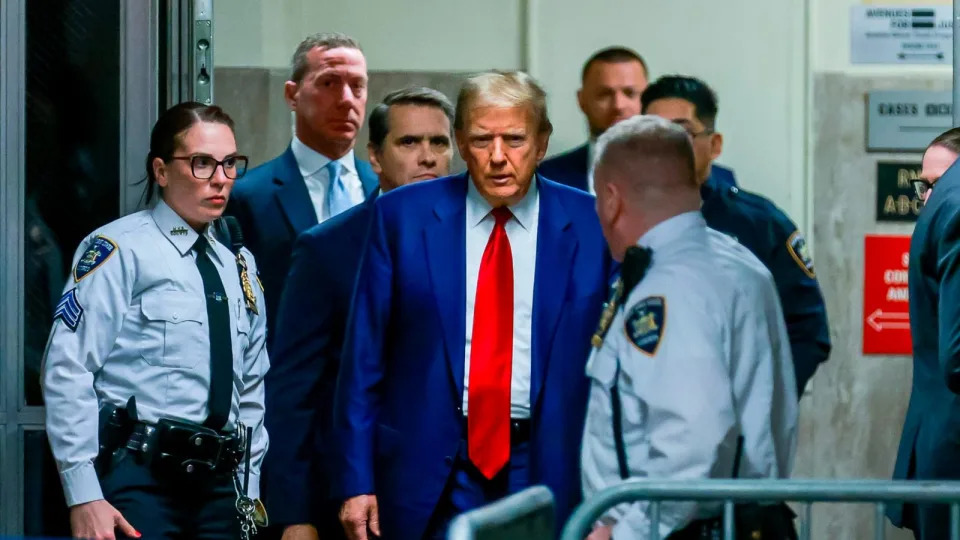
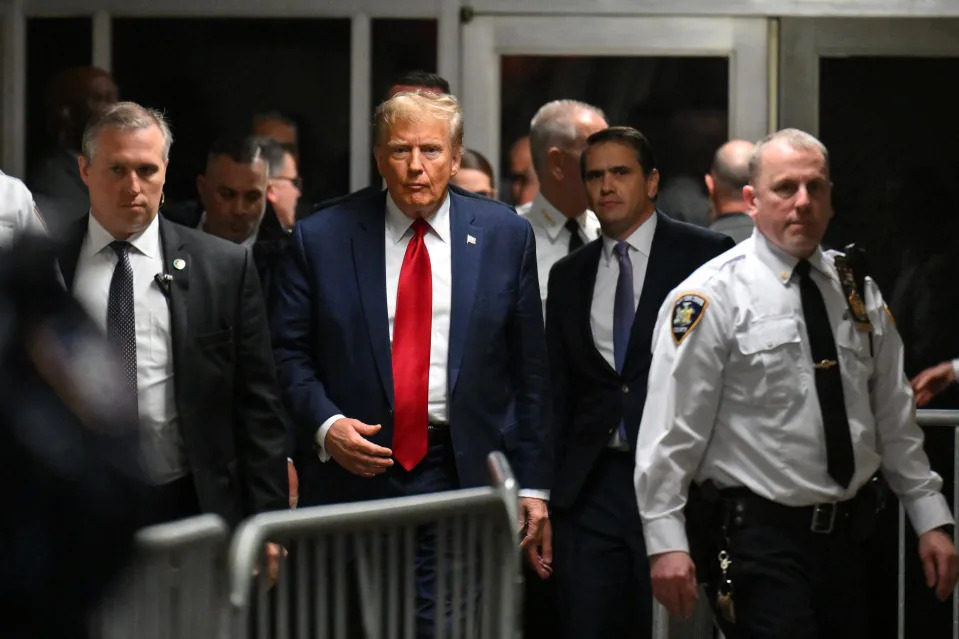
PHOTO: Former President Donald Trump arrives for his hearing to determine the date of his trial for allegedly covering up hush money payments linked to extramarital affairs, at Manhattan Criminal Court in New York City on March 25, 2024. (Justin Lane/POOL/AFP via Getty Images)

Prosecutor Matthew Colangelo aggressively pushed back on the allegation that the District Attorney’s Office actively suppressed potential evidence from defense attorneys.

“No, we are not actively suppressing … discovery or impeachment materials,” Colangelo said, reiterating the claim that most of the documents in question are irrelevant to the case against Trump.

Blanche argued that reviewing each document takes time and merits a delay. “Every document is important,” he said. “Every single one.”

Merchan set Monday’s hearing to resolve a recent defense motion related to the potential evidence and set a final trial date for the case.

MORE: Prosecutors blast Trump’s effort to further delay his criminal hush money trial

“[T]here are significant questions of fact which this Court must resolve before it may rule on Defendant’s motion,” Merchan wrote in a ruling earlier this month.

Defense attorneys have demanded a lengthier delay of the trial and limits on key testimony or the dismissal of the case based on the new materials, which they said damage the credibility of star witness and former Trump attorney Michael Cohen and contain “exculpatory information that undercuts the People’s theory of the case.”

Last week, prosecutors with the Manhattan district attorney’s office pushed back on the defense’s request, arguing that the recently disclosed potential evidence is “a red herring” and part of a “strategic delay.” While the 30-day adjournment provided defense attorneys with a “reasonable amount of time for defendant to review the information,” no further delay was necessary, according to the prosecutors’ filing.

“Defendant has taken every possible step to evade accountability in this case for more than a year,” prosecutors wrote in a filing last week. “Enough is enough. These tactics by defendant and defense counsel should be stopped.”‘

Trump last April pleaded not guilty to a 34-count indictment charging him with falsifying business records in connection with a hush money payment Cohen made to adult film actress Stormy Daniels just days before the 2016 presidential election.

Here are three things to know about the hearing.

How did defense lawyers find the new materials?

Two months after Trump was indicted last year, prosecutors turned over 3 million pages of documents, beginning the discovery process in which prosecutors share with the defense evidence obtained during their investigation.

“In the Manhattan DA’s office, they do what’s called open file discovery, which means their practice is to basically turn over every piece of paper that they get in the course of their investigation,” former federal prosecutor Josh Naftalis told ABC News.

While the DA’s office said that, in June 2023, they turned over all the materials they received from U.S. Attorney’s Office for the Southern District of New York — which in 2018 secured a guilty plea from Cohen on campaign finance charges related to the Stormy Daniels payment — Trump’s lawyers sent a subpoena to the federal prosecutors on Jan. 18, 2024, seeking additional materials.

In their subpoena, defense lawyers requested Cohen’s tax filings, bank records, files from his iPhone and email accounts, records memorializing statements made by Cohen, and communications with other law enforcement offices.

MORE: Judge rules evidence related to ‘Access Hollywood’ tape admissible in Trump hush money trial

By Feb. 23, federal prosecutors with the SDNY agreed to disclose some of the records requested, including 10,778 pages of bank records and files from two iPhones and three email accounts, according to a defense filing. In total, federal prosecutors turned over 119,000 pages of records to Trump’s defense team, according to a filing earlier this month.

“That’s a lot of information for the defense to go through very quickly, so that kind of explains why the DA’s office agreed to at least a 30-day extension of the time,” former federal prosecutor Jarrod Schaeffer told ABC News.

What was included in SDNY’s production?

The exact breakdown of the 119,000 pages of documents remains unclear, but the DA’s office argues that most of the files are irrelevant to the case or have already been produced. In total, prosecutors said the materials contained fewer than 270 new documents, including 172 pages of new witness statements.

“[T]he People now have good reason to believe that this production contains only limited materials relevant to the subject matter of this case and that have not previously been disclosed to defendant: fewer than an estimated 270 documents, most of which are inculpatory and corroborative of existing evidence,” prosecutors with the DA’s office said.

MORE: Stormy Daniels says she is ‘absolutely ready’ to testify at Trump’s hush money trial

Defense lawyers have argued that the documents are highly relevant and include materials that could be used to discredit Cohen or absolve Trump of wrongdoing.

While defense lawyers have highlighted the sheer number of pages produced by federal prosecutors, Naftalis cautioned that the documents’ contents will ultimately determine Judge Merchan’s next move.

“My guess is that 30 days is all that Trump’s going to get because the volume of documents at issue really isn’t that large in the grand scheme of things,” Naftalis said. “That doesn’t mean that these are all new documents, and there could be substantial overlap.”

Why are Trump’s lawyers arguing for dismissal?

Defense lawyers have accused the DA’s office of misconduct in their push for a dismissal of the case, the limiting of key testimony, and a lengthier delay of the trial.

“The People have engaged in widespread misconduct as part of a desperate effort to improve their position at the potential trial on the false and unsupported charges in the Indictment,” defense attorney Todd Blanche wrote in a recent filing.

Attorneys with the Manhattan DA’s office pushed back on that motion, describing it as a inaccurate “grab-bag of meritless discovery arguments in the latest of a long series of attempts to evade responsibility for the conduct charged in the indictment.”

MORE: Trump, in hush money trial, won’t use ‘advice of counsel’ defense — but will still argue lawyers were involved

“Defendant’s accusations are wholly unfounded, and the circumstances here do not come close to warranting the extreme sanctions he has sought,” assistant district attorney Matthew Colangelo said in a filing last week.

If Judge Merchan does not dismiss the case, defense lawyers asked for a longer adjournment and preclusion of the testimony of Michael Cohen, Stormy Daniels, and an expert witness.

Merchan will ultimately have to consider who, if anyone, should be culpable for the late production of evidence.

“It’s really going to come down to have the prosecutors done what they’re supposed to do — meaning, have they been diligent and made a good-faith effort to get material that they believe exists and should be turned over,” Schaeffer said.
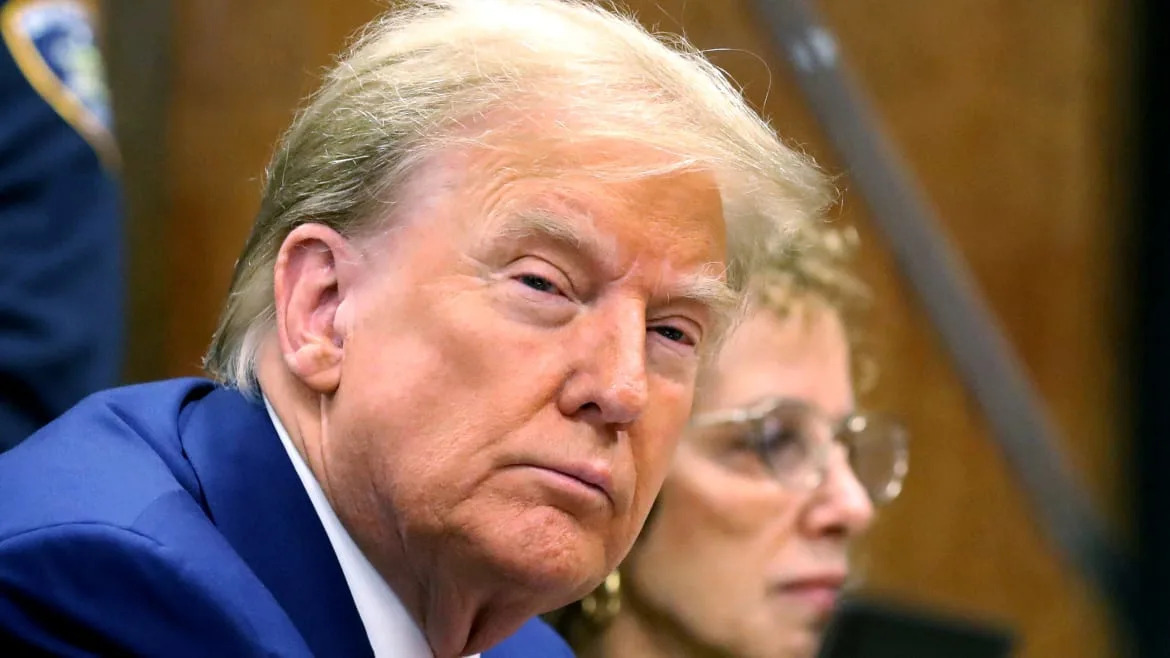
Judge Rips Into Trump Lawyers, Sets Hush Money Trial for April

Daily Beast

Judge Rips Into Trump Lawyers, Sets Hush Money Trial for April

Jose Pagliery – March 25, 2024

Spencer Platt/Reuters

Just a couple weeks ago, before prosecutors handed over about 200,000 new documents to the former president’s defense team and the judge delayed the proceedings, March 25 was supposed to be the start date of Donald Trump’s first criminal trial. And until a pre-trial hearing for the hush money case started on Monday, March 25 was supposed to be the day—as the former president’s lawyers believed—the judge might excoriate prosecutors over the missing evidence and potentially issue sanctions against them.

But when the hearing was over Monday, it was clear March 25 will instead be remembered as the day the judge slammed Trump’s lawyers for more waiting games and set the new trial date for April 15.

New York Supreme Court Justice Juan Merchan declined to issue sanctions against attorneys on either side, but he determined that a short-lived document scandal had essentially amounted to nothing.

“The defendant has been given a reasonable amount of time to prepare,” he said, ordering jury selection to begin in 21 days.

These Under-the-Radar Rulings in the Stormy Daniels Hush Money Case Are Really Bad for Trump

The judge indicated that the trial will commence days before the Jewish holiday of Passover and New York City’s spring break, but he promised not to hold court on any day that week if it would violate a person’s religious views.

Trump walked out of the courtroom with a grim look on his face, tossing a thumbs up at an acquaintance in the audience and whispering “thank you.”

Monday’s hearing knocked down what was perceived to be Trump’s last-ditch attempt to push back his trial, but it also served as the latest example of a judge running out of patience with Trump’s disruptive legal strategy.

Merchan questioned Trump’s legal team for more than an hour for what he eventually called a “misleading” tactic that threw trial plans into chaos this month, following a confusing moment when the feds suddenly dumped 200,000 pages of evidence.

Merchan laid the blame entirely at Trump’s feet, appearing flummoxed that the former president’s lawyers managed to briefly derail the trial with over-the-top accusations. He implied that this amounted to nothing more than continuing delay games.

The judge took particular aim at Trump defense lawyer Todd Blanche, saying that he should have known to seek out records for his client instead of sitting back and waiting for the Manhattan District Attorney’s Office to produce them—only to complain about it on the eve of trial. And Merchan didn’t hold back, noting that Blanche is a former federal prosecutor at the U.S. Attorney’s Office for the Southern District of New York, the very same office now at the center of a storm over missing evidence.

“You were there for 13 years. So you know that the defense has the same ability as the prosecution to obtain these documents. So when you received the people’s first production, you could have very easily done exactly as you did in January. but for whatever reason you waited until two months before trial,” Merchan said.

“Your Honor,” Blanche began to say.

“Why didn’t you do it in June? Or July?” the judge continued.

Blanche tried to deflect blame back to the DA, citing a New York law that requires turning over evidence.

“It’s not our job to get it,” he said.

“It’s not the people’s job either,” the judge shot back.

The judge seemed perturbed that Trump’s team never brought up any of these issues during what was supposed to be the final pre-trial hearing on Feb. 15—only to have this issue crop up a month later, just weeks before the start of the first ever criminal trial against a former American president.

In court, Blanche continued to blame the DA’s office, claiming that the batch of records his team had just received from the U.S. Attorney’s Office for the Southern District of New York proved that DA prosecutors held back evidence.

For more than a year, the former president’s legal team has been trying to probe the personal life of Michael Cohen—the one-time Trump confidante who has since become a key witness in the DA’s case—and they scored a win by prodding SDNY for Cohen’s emails despite resistance from the DA and even the judge.

“There’s tremendous amounts of bank records that were produced, and people think we can simply ignore those,” Blanche said in court. “I mean, thousands and thousands… meetings with witnesses and the FBI related to the 2016 election.”

“You mean the Mueller investigation?” the judge asked impatiently, referring to the Justice Department’s Trump-Russia investigation.

“Yes,” Blanche responded.

“That’s not relevant,” Merchan shot back. “That has nothing to do with this case. I decide if it’s relevant. If you’re going to offer something from the Muller investigation, it’s not coming in.”

“The witness discussed what his job was,” Blanche said.

Stormy Daniels, Michael Cohen Can Testify in Trump Hush Money Case, Judge Rules

Prosecutors have decried the invasive maneuver as nothing but a vengeful payback scheme to discredit a valuable witness and distract from the real issue: how Trump engaged in a coverup, using Cohen as a cutout to deliver Stormy Daniels $130,000 to keep her quiet about their one-night stand in order to save his 2016 presidential campaign from an embarrassing scandal and faking business records to hide Cohen’s reimbursement.

When the judge turned to the DA’s team, he heard an alternate take from Matt Colangelo, an assistant district attorney who has investigated Trump for years at the Attorney General’s office and now with the DA. Colangelo told the judge that most of the documents recently produced by the feds were mostly copies that Trump already had—and actually strengthened the case, not weakened it. Merchan pointedly asked how many records were actually new.

“Three hundred records or fewer… almost exclusively cumulative and largely inculpatory,” Colangelo said.

“Largely inculpatory?” the judge asked.

“Right, your Honor,” the prosecutor responded.

Although DA Alvin Bragg Jr. was in the courtroom, he remained quiet and seated with the audience a few feet behind the table where his prosecutors argued the case.

But the judge appeared almost enraged when he called attention to the way Trump tried to fabricate a scandal and drag in the court itself, noting how Trump has alleged in documents that the DA has held back evidence and was attempting to make the judge “complicit” in an “unethical strategy.” The judge narrowly defined the DA’s responsibilities, then when Blanche couldn’t cite cases that said otherwise, Merchan let it rip.

“If you don’t have a case right now, that is really disconcerting, because the allegation the defense makes in all of your papers about the people’s misconduct is incredibly serious. Unbelievably serious,” Merchan said. “You are literally accusing the Manhattan DA’s office… of engaging in prosecutorial misconduct—and of trying to make me complicit in it. And you don’t have a single cite to support that position, that the people by not obtaining the documentation at the US Attorney’s Office had somehow committed some sort of fraud on the court?”

While Trump was in court, he managed to score a temporary victory in his other ongoing legal nightmare in New York State. An appellate court gave him an extra 10 days to come up with the money necessary to halt the New York Attorney General from seizing his various properties as a result of losing a three-month bank fraud trial. Trump had previously failed to find a surety company willing to prove him a half billion dollar lifeline to halt last month’s $464 million judgment before a Sunday night deadline, but the appeals court lowered the sum needed to pause seizures down to $175 million.

Monday marked the first day that New York AG Letitia James could have moved to seize his various properties, something that Trump earlier in the morning was raging about on his Truth Social media site.

“Why should I be forced to sell my ‘babies,’” he complained in a post just before heading to the Manhattan courtroom for the day’s hearing.

James has already effectively put a blanket lien on his 212-acre, forested estate of Seven Springs north of the city earlier this month.

Biden Is Building a ‘Superstructure’ to Stop Trump From Stealing the Election

Rolling Stone

Biden Is Building a ‘Superstructure’ to Stop Trump From Stealing the Election

Asawin Suebsaeng and Adam Rawnsley – March 24, 2024

For years, Donald Trump has made it abundantly clear that if he doesn’t win the 2024 presidential election, he is willing to cheat and steal it. Since President Joe Biden’s inaugural address, according to sources with intimate knowledge of the situation, Biden and his inner circle have been drawing up meticulous plans and creating a large legal network focused on wargaming a close election finish, in which the former president and Republican Party launch a scorched-earth, Big Liefueled crusade.

Long before Trump began leading in battleground-state polling — and years before he was a declared 2024 candidate — the ex-president and many of his influential allies were already busy plotting ways to tilt the election in his favor. These yearslong efforts, conducted both secretly and out in the open, have already yielded tangible results for Trump and the conservative election denier movement. These wide-ranging operations have alarmed the Democratic Party elite, who aren’t just worried about Biden’s sagging poll numbers. Numerous Democratic lawmakers, operatives, Biden campaign advisers, and administration officials tell Rolling Stone that if the president does ultimately beat Trump this November, the election will be exceedingly close.

Over the past year, Team Biden has been conducting war games, crafting complex legal strategies, and devoting extensive resources to prepare for, as one former senior Biden administration official puts it, “all-hell-breaks-loose” scenarios. The preparations include planning for a contingency in which Biden’s margin of victory is so razor-thin that Trump and the GOP launch a tidal wave of legal challenges and political maneuvers to rerun his 2020 election strategy: declare victory anyways, and try to will it into existence.

“President Biden has been worried, for a while now, that Donald Trump is going to try to steal the election, if it’s very close on Election Day,” says a source familiar with Biden’s thinking. “If that ends up being the case, we are… also expecting the Republican Party to go into overdrive to help him steal it. We are continuing to build out the infrastructure to ensure that doesn’t happen — again — if President Biden wins and Trump and MAGA Republicans try to confuse [everyone] and sow chaos.”

After the 2020 race was called for Biden, Trump and much of the GOP embarked on a sprawling campaign — a blitz of lawsuits, rabid conspiracy theories, attempts to block certification, and slates of fake electors — to nullify Biden’s clear win. This culminated in the deadly Jan. 6 attack on the U.S. Capitol, which Trump instigated, and led to years of criminal investigations and various indictments, as well as the mainstreaming of the MAGA election-denial movement. The efforts to overturn the election were unsuccessful, largely because Biden had won too many battleground states — unlike when the 2000 presidential race came down to the single state of Florida, and the Republican Party was able to successfully halt the recount of an extremely close vote.

This time around, the race could be much closer, and Trump’s efforts appear significantly more organized. He also has more of the party’s elite behind him and his anti-democratic election lies than he had during the last presidential election. If the 2024 election margins end up being wafer-thin, that level of institutional backing could, of course, redound to Trump’s benefit.

Top officials in both the Trump and Biden camps are expecting an uncomfortably tight election outcome in November, sources in both campaigns have told Rolling Stone on numerous occasions over the past year. Advisers to both candidates say they expect the race will turn on a margin of just tens of thousands of votes in a handful of key battleground states, if not a single state. One Trump adviser says that they had privately told the ex-president and presumptive 2024 GOP nominee to anticipate an electoral “knife fight to the death” on, and likely in the wake of, Election Day.

Team Biden’s in-house counsels and network of outside lawyers are currently preparing legal strategies for scenarios involving recounts that would make, in the words of one Biden official, “make Florida in 2000 look like child’s play.”

Sources in and around the president’s legal and political operations say the Biden campaign’s current wargaming is informed by questions aides asked themselves in the wake of the 2020 election: What if there’s a rematch in four years with Donald Trump? What do we do if Joe Biden wins and Trump tries to steal the election again?

Bidenworld spent a lot of time pondering such a scenario even before the 2020 election.

In the months leading up to November 2020, Trump offered repeated, public signals that he would try to delegitimize any outcome in which he lost the election. As the threats mounted, Biden’s campaign brass began preemptively working through different nightmare scenarios.

That prep work accelerated in the final weeks of the campaign as an armada of lawyers, numbering in the hundreds, sketched out various unconventional scenarios in which the then-president tried to cling to power in the face of defeat, according to current and former senior Biden campaign officials.

Democratic aides walked through a range of authoritarian possibilities, including one scenario in which Trump called out the National Guard either as a show of force or in an attempt to enforce his fictitious victory, the sources say. Another scenario involved gameplans for how to handle Trump refusing to leave the White House the day of Biden’s inauguration, even if the swearing-in had already concluded.

“Biden HQ and the lawyers were essentially preparing for every insane scenario that anyone could think of, so that the campaign wouldn’t be stuck in neutral if the worst actually transpired,” says one attorney familiar with the extensive 2020 wargaming. “Even then, I’m not sure everybody was predicting just how crazy it would become and what Trump would actually do.”

Any attempt by Trump to try and undermine the 2024 election would likely look different than 2020, if only because he lacks the legal authority and access to federal resources he enjoyed as president.

Still, Team Biden has been planning for years sketching out what Trump could do as the leader of the GOP, and has partnered with the Democratic National Committee and a vast network of liberal attorneys and legal groups to conduct similar doomsday-style wargaming.

One swing-state Democratic election official involved with these efforts refers to it as a “superstructure” of various legal teams and liberal operatives who “are going to fight [Team Trump and election deniers] on all fronts and let them have it from all sides, if MAGA wants to tear down our democracy.”

According to two Biden campaign officials and two other sources with knowledge of the operation, draft pleadings and legal motions, for all kinds of possible Trump-related emergencies, are already written and at the ready. In critical swing states such as Georgia, Arizona, and Pennsylvania, Team Biden is regularly in contact with an array of outside counsels and local law firms that have been retained to actively monitor what is happening on the ground, including with regards to the activism of election-denying Trump allies.

Bidenworld’s closely-held list of nightmare scenarios — in which Democratic legal teams would have to battle it out tooth and nail with Republican counterparts before, during, or after Election Day 2024 — has grown “comically long,” says one source with direct knowledge of the matter. Biden campaign officials and other Democrats familiar with the topic tell Rolling Stone that a key concern, for which step-by-step gameplanning has already begun, is how to robustly respond if Trump and other leading Republicans try to engineer another Jan. 6-style power grab.

In these internal wargames among Bidenworld and Democratic attorneys in key states, this kind of Jan. 6 sequel has included scripts in which House Republicans or state officials refuse to certify a Biden victory — an act that prominent GOP politicians, including on Capitol Hill, have publicly dangled as an option.

A spokesperson for the Democratic National Committee tells Rolling Stone that the national party is also setting aside “tens of millions of dollars in a robust voter protection program to safeguard the rights of voters to make their voices heard against relentless attacks from Donald Trump and the GOP.”

“Meanwhile, the Trump campaign and the RNC have invested in an army of conspiratorial, election-denying legal staff to undermine our elections and make it harder for Americans’ ballots to be counted,” says the DNC spokesperson. “We won’t let Republicans get away with these baseless attacks on our democracy, and we will continue to use every tool at our disposal to strengthen our democracy as MAGA extremists attempt to tear it down.”

Of course, if much of the current national and swing-state polling holds, Trump could defeat his successor outright in a 2024 rematch. However, that is almost irrelevant to Trump and his MAGA brain trust’s goals of cementing their “heads I win, tails you lose” philosophy of election administration.

Trump, after all, has continued to falsely claim that the 2016 presidential race was somehow “rigged” in Democratic nominee Hillary Clinton’s favor. And that was the election he won.

Millions of Americans could soon lose home internet access if lawmakers don’t act

CNN

Millions of Americans could soon lose home internet access if lawmakers don’t act

Brian Fung – March 23, 2024

Every week, Cynthia George connects with her granddaughter and great-grandson on video calls. The 71-year-old retiree reads the news on her MSN homepage and googles how to fight the bugs coming from her drain in Florida’s summer heat. She hunts for grocery deals on her Publix app so that her food stamps stretch just a little further.

But the great-grandmother worries her critical lifeline to the outside world could soon be severed. In fact, she fears she might soon have to make a difficult choice: Buy enough food to feed herself — or pay her home internet bill.

George is one of millions of Americans facing a little-known but fast-approaching financial cliff, a catastrophe that policy experts say is preventable but only if Congress acts, and quickly.

By as soon as May, more than 23 million US households risk being kicked off their internet plans or facing skyrocketing bills that force them to pay hundreds more per year to get online, according to the Federal Communications Commission (FCC).

The looming disaster could affect nearly 1 in 5 households nationwide, or nearly 60 million Americans, going by Census Bureau population estimates.

Such broad disruptions to internet access would affect people’s ability to do schoolwork, to seek and do jobs, to visit their doctors virtually or refill prescriptions online, or to connect to public services, widening the digital divide between have and have-nots and potentially leading to economic instability on a massive scale.

‘I have to account for every penny’

The crisis is linked to a critical government program expected to run out of funding at the end of April. Known as the Affordable Connectivity Program (ACP), the benefit provides discounts on internet service valued at up to $30 per month to qualifying low-income households, or up to $75 per month for eligible recipients on tribal lands.

Lawmakers have known for months about the approaching deadline. Yet Congress is nowhere close to approving the $6 billion that President Joe Biden says would renew the ACP and avert calamity for tens of millions of Americans.

This past week, congressional leaders missed what advocates say was the last, best legislative opportunity for funding the ACP: The 11th-hour budget deal designed to avert a government shutdown. The bill text released this week includes no money for the program, heightening the odds of an emergency that will plunge millions into financial distress just months before the pivotal 2024 election.

Now, with time running out for the ACP, the FCC has been forced to begin shutting down the program — halting new signups and warning users their benefits are about to be suspended.

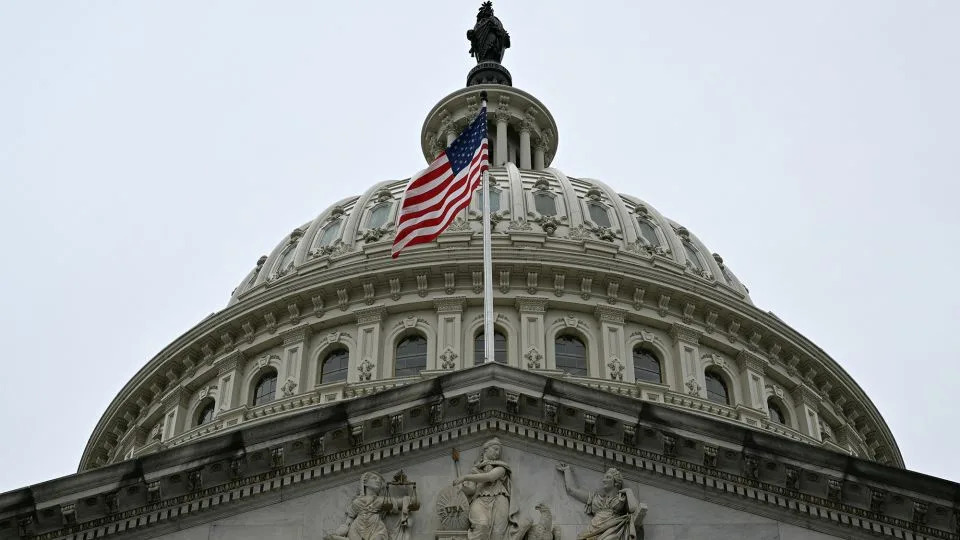
The US Capitol in Washington, DC, on March 22. - Pedro Ugarte/AFP/Getty Images
The US Capitol in Washington, DC, on March 22. – Pedro Ugarte/AFP/Getty Images

“Because of political gameplay, about 60 million Americans will have to make hard choices between paying for the internet or paying for food, rent, and other utilities, widening the digital divide in this country,” said Gigi Sohn, a former top FCC official. “It’s embarrassing that a popular, bipartisan program with support from nearly half of Congress will end because of politics, not policy.”

Without the aid, low-income Americans like George would be priced out of home internet service. The prospect of losing a critical lifeline to the modern economy has put ACP subscribers on edge. Many tell CNN they are irate at Congress for letting them down and, through inaction, taking away a basic, essential utility.

“My grandkids, they make fun of me,” George said with a chuckle. “They say I’m cheap. I go, ‘No, Grandma’s thrifty.’ I don’t have any choice; I have to account for every penny. And this would mean that that food bill would have to be cut down. There’s no place else I would be able to take it from.”

Military families, older Americans and rural residents most at risk

The ACP has quickly gained adoption since Congress created the program in the 2021 bipartisan infrastructure law. It is overwhelmingly popular with both political parties, surveys show.

Military families account for almost half of the ACP’s subscriber base, according to the White House and an outside survey backed by Comcast.

More than a quarter of ACP users live in rural areas, the same survey said, with roughly 4 in 10 enrolled households located in the southern United States alone. As many as 65% of respondents said they feared losing their job without the ACP; 3 out of 4 said they worry about losing online health care services, and more than 80% said they believe their kids would fall behind in school.

Large swaths of the ACP’s user base trend older; Americans over 65 account for almost 20% of the program. And as many as 10 million Americans who use the program are at least age 50.

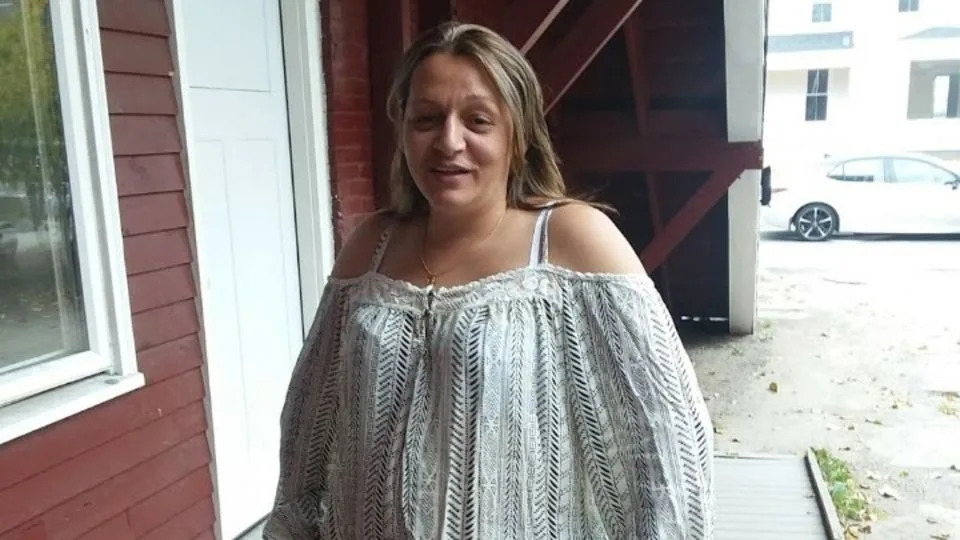
Michelle McDonough, 49, works part time at a tobacco shop in Maine and lives off Social Security disability payments. She is one statistics class away from earning an associate degree in behavioral health. Not only does she go to class virtually, but she also sees a psychiatrist who only meets patients through telehealth visits.

Michelle McDonough says she would have to cut back on groceries if the ACP goes away. - Courtesy Michelle McDonough
Michelle McDonough says she would have to cut back on groceries if the ACP goes away. – Courtesy Michelle McDonough

Like George, McDonough also expects she’ll have to cut back on groceries if the ACP goes away. There’s a library roughly five miles from her home with internet access, but having to go out of her way would cost her even more time and money she doesn’t have, she said. Besides, McDonough added, her car is dying and the library is rarely open in snowy weather.

If politicians allow the ACP to collapse, it will be a sign of how out of touch they are with their voters, McDonough said.

“I’m trying to become a productive member of society, something that they say people on low income are not,” McDonough said. “I’m trying. And, you know, one of the programs that’s helping me, they’re talking about taking it away — when there are definitely a lot of other things that they probably could take the funding from.”

How the ACP works to bring American communities online

Congress authorized the ACP with an initial $14 billion in funding in 2021. That money has now spread to virtually every congressional district in the country. It is the largest internet affordability program in US history, the government has said, describing it as working hand-in-glove with billions of dollars in new infrastructure spending.

Building out high-speed internet cables is costly; even more so to places that internet providers have traditionally overlooked as unprofitable or hard to reach. Historically, that has left millions of people with no or spotty service or facing sky-high prices just to get a basic internet plan.

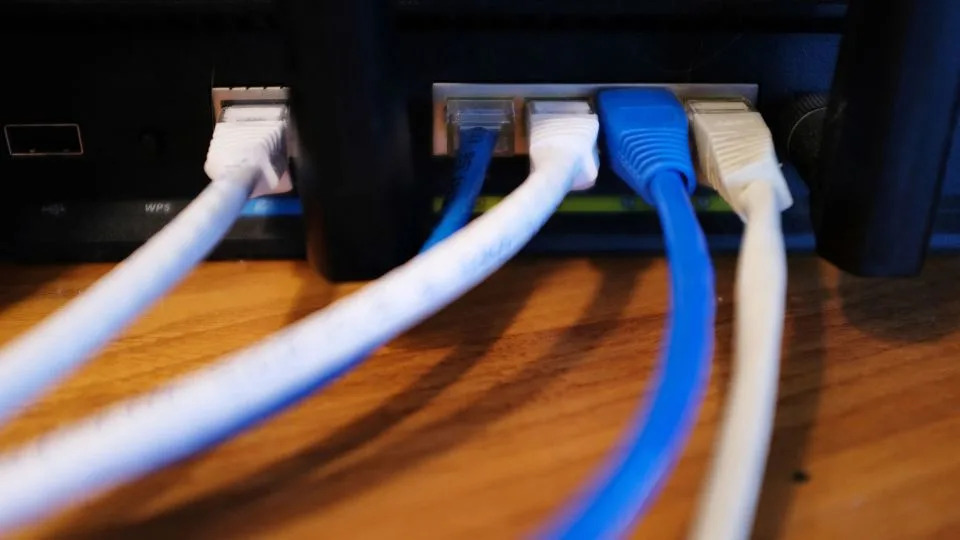
Ethernet cables are seen running from the back of a wireless router in Washington, DC on March 21, 2019. - Mandel Ngan/AFP/Getty Images
Ethernet cables are seen running from the back of a wireless router in Washington, DC on March 21, 2019. – Mandel Ngan/AFP/Getty Images

Investing in infrastructure is a first step, but it means nothing if Americans cannot afford the connectivity it provides. So the ACP helps bridge that price gap for consumers while also benefiting internet providers, many of whom say the program ensures a base of demand to support building in otherwise money-losing markets.

“I can think of lots of examples where we’re boring under a river to get to two customers, and that was extremely costly,” said Gary Johnson, CEO and general manager of Paul Bunyan Communications, a Minnesota-based telecom cooperative serving some of the furthest reaches of the state. “To get fiber in the most rocky areas, we’re literally using a rock saw and we’re cutting, slicing a path through that rock so we can put our fiber cable in. The fact you’re dividing that [cost] over a very small number of customers? That’s ultimately challenging.”

In a recent FCC survey, more than half of rural respondents — and 47% of respondents overall — said the ACP was their first-ever experience with having home internet.

Extra shifts, grocery cuts: What an ACP collapse would mean

If the ACP collapses, some, like George and McDonough, will make cuts to their budget to stay online.

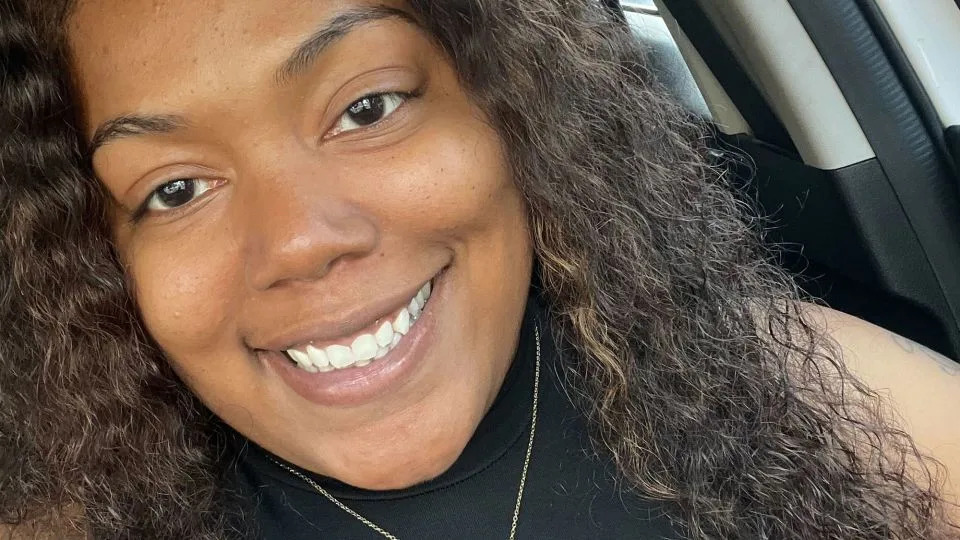
Kamesha Scott, a 29-year-old mother in St. Louis who works two jobs delivering Amazon packages and handling restaurant takeout orders, told CNN she would have to pick up extra shifts to make ends meet. And that would mean seeing her two kids even less, she said.

Kamesha Scott, 29, says she would have to work extra shifts to make ends meet if her internet bills go up. - Courtesy Kamesha Scott
Kamesha Scott, 29, says she would have to work extra shifts to make ends meet if her internet bills go up. – Courtesy Kamesha Scott

Expect others to resort to a mishmash of ad hoc solutions, policy experts say.

That could include using the free Wi-Fi at fast-food restaurants, school parking lots, and other public spaces. Or it could mean falling back on cellphone data service, at least where it’s available and plans are still affordable.

Roughly a third of the country’s 123,000 public libraries offer mobile hotspot lending, allowing visitors to borrow palm-sized devices that pump out a cellular signal that can substitute for home internet service in a pinch, said Megan Janicki, a policy expert at the American Library Association. But they aren’t a perfect solution: The cell signal may be weak, or users could have to wait to check one out.

“Depending on how long the waitlist is, they’re waiting at least three weeks, if not longer,” Janicki said.

ACP subscribers could turn to other government aid. The FCC’s Lifeline program, which dates to the Reagan administration, similarly gives low-income households a monthly discount on phone or internet service. But the benefit pales in comparison: It’s worth only $9.25 a month, or $34.25 for tribal subscribers — a fraction of what ACP subscribers are currently eligible for.

Turning low-income Americans into political pawns

Despite the ACP’s popularity, routine congressional gridlock and the politics of an election year have turned low-income Americans into unwitting — and in many cases unwilling — pawns in a much larger battle.

Earlier this year, a bipartisan group of Senate and House lawmakers unveiled legislation to authorize $7 billion to save the ACP — that’s $1 billion more than the Biden administration asked for.

The bill has not moved.

“The House Republicans attempting to demonstrate that they are cutting back on government spending makes re-funding the ACP very difficult,” Blair Levin, a telecom industry analyst at New Street Research, wrote in a research note in January. “It is unlikely the House Republican leadership will allow the bill to go to the floor.”

A crew works on a cell tower in Lake Havasu City, Ariz., on Tuesday, August 24, 2021. - Bill Clark/CQ-Roll Call, Inc/Getty Images
A crew works on a cell tower in Lake Havasu City, Ariz., on Tuesday, August 24, 2021. – Bill Clark/CQ-Roll Call, Inc/Getty Images

But there is growing evidence that money spent through the ACP ends up saving taxpayers in the long run. In a recent study, Levin said, researchers estimated that every $1 of ACP spending increases US GDP by $3.89, while other research has outlined how telemedicine can lead to substantial savings in health care.

Even though extending ACP benefits could help lawmakers from both parties as they head home to campaign, perhaps the biggest political beneficiary may be Biden as his campaign touts the administration’s economic record ahead of the election.

Jonathan Blaine, a freelance software engineer in Vermont and an ACP subscriber, pins the blame on certain Republicans that he says would rather hurt working-class people than give Biden a political victory.

“You guys seem to promote that you’re for the working-class people, but realistically, the working-class people are the ones that you’re screwing over most of the time,” Blaine said, speaking directly to GOP lawmakers. “You’re taking ACP away from the farmers that can check the local produce prices and be able to reasonably negotiate their prices with retailers. You’re removing disabled people’s ability to fill their prescriptions online.”

Lawmakers are likely to feel voters’ wrath in November if the ACP falls apart, Blaine added.

He called it “sickening” that lawmakers keep removing these benefits for poorer Americans from legislation “left and right.”

“But the fact that you sit there and smile to our faces trying to say you’re for the working class? You’re for the poor? You’re for the less fortunate? It’s absolute bulls**t,” he added. “And most of us see right through your bulls**t, and that is why you’re losing seats.”

Some Republicans who supported Nikki Haley are still refusing to back Donald Trump

Associated Press

Some Republicans who supported Nikki Haley are still refusing to back Donald Trump

Meg Kinnard and Thomas Beaumont – March 25, 2024

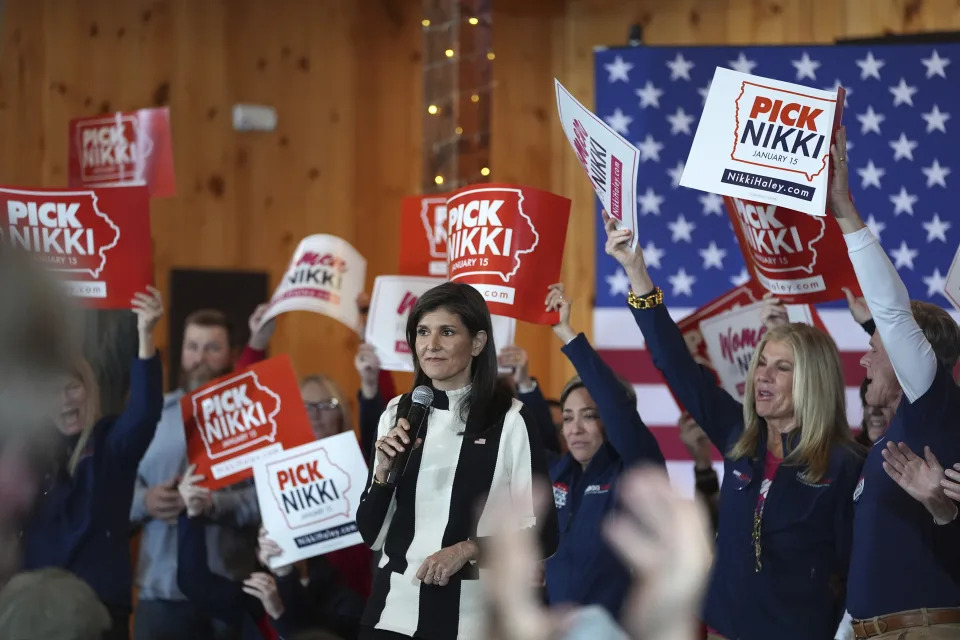
FILE - Republican presidential candidate former UN Ambassador Nikki Haley speaks at a campaign event, Jan. 14, 2024, in Adel, Iowa. Haley's base of voters and donors was never big enough to seriously challenge Donald Trump. But her supporters are still splintered weeks after she dropped out of the GOP primary. If that holds, it could hurt Trump's general election chances. (AP Photo/Abbie Parr, File)
 Republican presidential candidate former UN Ambassador Nikki Haley speaks at a campaign event, Jan. 14, 2024, in Adel, Iowa. Haley’s base of voters and donors was never big enough to seriously challenge Donald Trump. But her supporters are still splintered weeks after she dropped out of the GOP primary. If that holds, it could hurt Trump’s general election chances. (AP Photo/Abbie Parr, File)
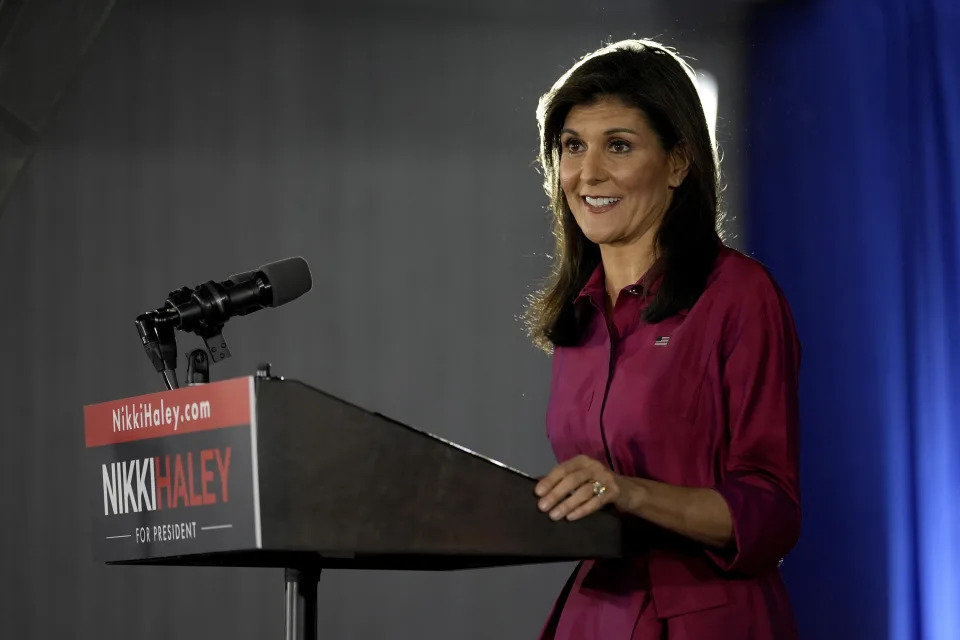
FILE - Republican presidential candidate former UN Ambassador Nikki Haley speaks at a caucus night party in West Des Moines, Iowa, Jan. 15, 2024. Haley's base of voters and donors was never big enough to seriously challenge Donald Trump. But her supporters are still splintered weeks after she dropped out of the GOP primary. If that holds, it could hurt Trump's general election chances.(AP Photo/Carolyn Kaster, File)
Republican presidential candidate former UN Ambassador Nikki Haley speaks at a caucus night party in West Des Moines, Iowa, Jan. 15, 2024. Haley’s base of voters and donors was never big enough to seriously challenge Donald Trump. But her supporters are still splintered weeks after she dropped out of the GOP primary. If that holds, it could hurt Trump’s general election chances.(AP Photo/Carolyn Kaster, File)

COLUMBIA, S.C. (AP) — Now that Nikki Haley has shuttered her presidential campaign, one person who voted for her refuses to back former President Donald Trump and plans to reluctantly vote for President Joe Biden.

Another Haley primary supporter acknowledges that he was probably always a “closet Trump fan” and will vote for the former president again in November.

The former U.N. ambassador’s base was never big enough to seriously challenge Trump before he clinched a third straight Republican nomination. But in what’s shaping up to be a tight rematch between Trump and Biden, the apparent splintering of Haley’s voters and donors could hurt Trump’s general election chances, particularly in battleground states full of suburban voters who remain dubious of a Trump return to the White House.

For now, interviews with Haley’s supporters suggest they could go in a variety of directions — some backing Trump, some going to Biden and others seeking third-party options or avoiding making a decision about the presidential race yet.

Haley has not spoken publicly since leaving the race and urging Trump to reach out to all Republicans. She has not endorsed Trump and suggested she may not at all.

“She said it’s up to him to earn the support of those who supported her, and he’s got to earn it,” said Eric Tanenblatt, a longtime GOP donor who was Haley’s Georgia campaign’s co-chairman. “Right now, I’m definitely not there. It tells me there are things that are still up in the air among other key Haley donors waiting for a sign.”

The Trump campaign did not respond to a request for comment.

A reluctant return to Trump for some voters

Glenn Swanson caucused for Haley after seeing her campaign in his hometown of Cedar Falls, Iowa. At the time, the retired architect said he was open to a Trump alternative. Now, he’s coming back to the candidate he supported in both 2016 and 2020, despite his concerns about the four felony indictments and other civil cases facing Trump.

“For sure I’m going to vote for Trump,” Swanson said in an interview. “In a sense I was kind of a closet Trump fan all along, but I really wanted to see if somebody else would emerge to get away from some of the drama.”

John Wynstra, a database administrator who attended that same event, had been deciding between Haley and Florida Gov. Ron DeSantis before choosing to caucus for her. Wynstra said he’s strategically supporting Trump and the party’s platform — as a stance primarily against Biden — although he seemingly left the door open to possibly supporting a third-party candidate like Robert F. Kennedy Jr.

“I will vote against Joe Biden and the Democrats,” Wynstra said this week. “If Kennedy were viable and if his positions were palatable, I would consider him.”

In Haley’s home state of South Carolina, high school teacher Michael Burgess said that save an unlikely independent run by Haley or a moderate like former Rep. Liz Cheney, he would be supporting Biden and criticized Trump’s “Make America Great Again” movement.

“I will reluctantly vote Biden,” Burgess said. “We can survive bad policy, but we cannot survive the destruction of the Constitution at the hands of a morally bankrupt dictator lover in Trump who, supported by his congressional MAGA minions, would do just that.”

Her donors say they haven’t heard from Trump camp

Like many who were drawn to Haley, Tanenblatt, who was her Georgia campaign’s co-chairman, became disenchanted with Trump for what he called “inflammatory rhetoric,” chiefly in the wake of the Jan. 6, 2021, attack by his supporters on the Capitol.

But he also says Trump’s opposition to military aid to Ukraine is a fundamental policy difference. Tanenblatt has talked individually with former Haley supporters weighing a role with No Labels, the third-party group that is moving forward with attempting a unity ticket of opposing party presidential and vice-presidential nominees.

By and large, Haley’s donors have paused, with key bundlers noting they have not heard from Trump’s team as well as their reluctance to make any decisions.

“I really think there’s a period of recalibrating for a number of us who were very involved in Nikki’s campaign. This was a calling, something bigger than any one of us,” said Simone Levinson, a Florida-based Haley fundraiser who hosted events for her in New York and Florida.

Those donors could be helpful to Trump were they to come to the former president’s side.

For now, Trump and national Republicans are lagging far behind Biden and national Democrats in fundraising, with Trump’s campaign and allied groups holding $37 million cash on hand at the end of February compared to the $155 million in Democratic coffers.

In one sign of her influence going forward, Haley ended last month with $11.5 million, just days before she suspended her campaign. That’s slightly more than the Republican National Committee at $11.3 million.

Beaumont reported from Des Moines, Iowa.

Trump pushed away his closest allies – he’s finally paying the price

The Telegraph – Opinion

Trump pushed away his closest allies – he’s finally paying the price

David Kaufman – March 25, 2024

Trump's bad behaviour is coming back to bite him
Trump’s bad behaviour is coming back to bite him – Seth Wenig /AP

When it comes to his personal life, former president Donald Trump is far from wholesome: from the legendary Aspen face-off between his first and second wives in 1989, to the public humiliation Melania endured at the 2016 Republican National Convention in Cleveland, the women in Trump’s life haven’t always had an easy time.

Although Trump paid millions to divorce Ivana and Maples, those sums are nothing compared to the hundreds of millions owed as a result of the myriad civil and criminal trials currently facing the former president. True, the most spectacular of those settlements – the $454 million Trump must begin paying today as part of a fraud settlement in New York – is not directly tied to Trump’s unseemly bad-boy behavior. But like the tens of millions more that are, today’s massive bill, and the possibility that his assets will be seized to cover it, suggest Trump can no longer hide from his history.

Beyond his actual wives, there are ladies like Stormy Daniels and E. Jean Carroll, the former a prostitute reportedly paid $130,000 back in 2016 to keep silent about her alleged relationship with Trump. Nearly eight years later, Daniels is still in the headlines as Trump seeks to have their case delayed or dismissed as his legal team continues to pour over thousands of pages of potential new evidence.

Carroll, meanwhile, was awarded some $83.3 million by a New York jury back in January who found Trump guilty of both disparaging her and denying her allegations of rape nearly two decades earlier. This was on top of the $5 million Carroll was awarded the previous year in a similar proceeding. Trump, of course, has appealed the latter Carroll decision via a $91 million bond earlier this month. The strain of that nearly nine-figure penalty is part of the reason Trump is now scrambling to come up with the far larger half-billion bond he must post later today. The chickens, it seems, are coming home to roost – and Trump is running out of coops to house them.

The financial crises Trump now faces reflect his clear indifference for even the most basic standards of decency. How else to explain Trump’s behavior during Campaign 2016, which kicked off with his derision of Sen. John McCain’s years of brutal captivity during the Vietnam War, continued with his mocking of New York Times reporter Serge Kovaleski – who suffers from a serious joint condition – and concluded with the release of that now infamous “grab ‘em by the pussy” tape weeks before election day in 2016.

The latter example, delivered in raucous ribald tones, is typical of Trump’s self-aggrandising and entitlement. This attitude may well explain the reluctance of his daughter Ivanka and her husband Jared Kushner, both billionaires in their own rights, to bail out Trump with a “very small loan” of $500 million dollars.

The former president needs all the allies he can get in the long, tough battle to November. Even so, he seems determined to push people away, launching barbs at everyone from his niece Mary – whose 2020 family tell-all resulted in him branding her “a mess” on Twitter – to even perhaps his own kids. At an Iowa rally in 2022, Trump bizarrely told the crowd that “some of us have horrible children,” as he spoke about inheritance taxes.

Donald Trump is hardly the only former president with a paper trail of bad behavior behind closed doors – Clinton, Kennedy and the elder Bush also come to mind. But no commander in chief has been so reckless with their disdain for the conventions of domesticity quite like the Donald. It’s not that being a good father and husband are the most important requirements when running a nation, but they’re certainly a solid start.

NBC News in revolt over Ronna McDaniel hiring. Will the network reverse course?

Los Angeles Times

NBC News in revolt over Ronna McDaniel hiring. Will the network reverse course?

Stephen Battaglio – March 25, 2024

FILE - Republican National Committee Chair Ronna McDaniel speaks before a Republican presidential primary debate hosted by NBC News, Nov. 8, 2023, at the Adrienne Arsht Center for the Performing Arts of Miami-Dade County in Miami. Facing a cash crunch and harsh criticism from a faction of far-right conservatives, McDaniel, on Friday, Feb. 2, 2024, called for the party to unite behind the goal of defeating President Joe Biden. (AP Photo/Rebecca Blackwell, File)
Then-Republican National Committee Chair Ronna McDaniel speaks before a GOP presidential primary debate hosted by NBC News. (Rebecca Blackwell / Associated Press)

The hosts at NBC News’ cable outlet MSNBC continued to pound away at their parent organization’s decision to hire former Republican National Committee chair Ronna McDaniel as an on-air analyst.

The blowback unfolded throughout the day on the progressive cable news network, presenting a highly unusual situation in which well-known TV personalities went directly to viewers to challenge a decision made by their top managers.

The open rebellion could make it difficult for Comcast-owned NBC News to move forward with any plans to use McDaniel, who resigned from the RNC last month. A representative for NBC News said Monday there was no change in her status. But people familiar with the situation who are not authorized to comment publicly said McDaniel will probably be out before she even begins.

Chuck Todd, the ex-“Meet the Press” moderator, opened the door to the criticism when he appeared on his former program Sunday and blasted the network’s decision to make McDaniel a paid contributor, citing her record of supporting former President Trump’s false claims that the 2020 election was stolen.

MSNBC hosts weighed in on Monday, starting with “Morning Joe” co-hosts Joe Scarborough and Mika Brzezinski saying McDaniel will not be welcome on their daily program, a favorite of politicians and opinion leaders in Washington, D.C., and New York.

“We weren’t asked our opinion of the hiring, but, if we were, we would have strongly objected to it for several reasons.” Scarborough said.

Brzezinski said she hoped NBC News management will reconsider its decision to bring McDaniel aboard.

“Deadline: Washington” anchor Nicolle Wallace praised Todd for his Sunday remarks. “He did something really brave,” Wallace told her viewers. “I talked to him yesterday. I said I’m knitting you a cape.”

Wallace, a former George W. Bush White House communications director who has long been anti-Trump, and Joy Reid both devoted lengthy segments critical of the McDaniel hiring. Reid described McDaniel as “a major peddler of the big lie,” referring to the Trump’s election falsehoods. Reid cited how McDaniel was on Trump’s phone calls to GOP officials in Michigan, urging them not to certify the state’s 2020 election results.

MSNBC host Jen Psaki cited a Liz Cheney tweet that noted how McDaniel once described the Jan. 6 insurrection at the Capitol as “legitimate political discourse.”

“This is about truth versus lies,” Psaki, formerly the Biden White House press secretary, said.

Read more: Nicolle Wallace won’t just be a never-Trumper as her role expands at MSNBC

Rachel Maddow, MSNBC’s biggest star, also asked NBC News management to reverse the decision.

“The fact that McDaniel is on the payroll at NBC News — to me that is inexplicable,” Maddow said on her program. “You wouldn’t hire a wise guy, you wouldn’t hire a made man, like a mobster to work in a D.A.’s office.”

Former NBC News executives took to social media to chastise the move as well. Cheryl Gould, a producer and executive at the division for 37 years, wrote an open letter on her Facebook page to Carrie Budoff Brown, the senior vice president of politics for NBC News who was involved in McDaniel’s hiring.

“We all make mistakes,” Gould wrote. “This happens to be a colossal one that unfortunately makes the network, your bosses and yourself look misguided at best, craven at worst.”

NBC has a long history of hiring former government and political officials as contributors to its news operation. Such deals are done to get exclusive access to insider knowledge — and to keep prominent talking heads from appearing on the competition.

In 1977, the network gave Gerald Ford a $1-million deal — brokered by William Morris Agency — to be a commentator and contributor to a series of specials about his presidency.

In the same year the network signed a similar deal to former Secretary of State Henry A. Kissinger. The move prompted a top news executive at the network, Richard Wald, to leave the company in protest, as he believed the deal siphoned resources from journalism projects. Wald also believed Kissinger owed it to the country to appear on NBC for free.

Political figures have segued into TV news commentary and lucrative TV anchor roles ever since.

NBC already has another former RNC chair on its payroll in Michael Steele, a co-host on the MSNBC program “The Weekend.” Psaki headed to MSNBC immediately after her departure from the Biden White House. Wallace worked on John McCain’s 2008 presidential campaign after her time in the George W. Bush administration.

All TV news organizations stock up on paid contributors during election season.

But the internal hostility toward McDaniel is linked to her support of Trump’s denial of the 2020 voting results, disqualifying her as a credible source to many inside the news organization. Before her appearance Sunday on “Meet the Press,” she had never acknowledged that President Biden won the election fairly.

McDaniel attributed her previous defense of Trump’s claims to her role in the RNC and said she can be “a little bit more of myself” now that she is no longer a party official. But she continues to say there were problems with the 2020 vote due to the dependence on mail-in ballots.

In a memo sent Friday to NBC News staff that was provided to the Times, Brown said McDaniel would provide a valuable perspective to the division’s coverage of the 2024 election with Trump as the presumptive Republican presidential nominee.

“It couldn’t be a more important moment to have a voice like Ronna’s on the team,” Brown said. “As we gear up for the longest general election season in recent memory, she will support our leading coverage by providing an insider’s perspective on national politics and on the future of the Republican Party — which she led through some of the most turbulent and challenging moments in political history.”

Our criminal justice system is broken. But Donald Trump isn’t a victim.

USA Today – Opinion

Our criminal justice system is broken. But Donald Trump isn’t a victim.

Bill Proctor – March 23, 2024

No one is above the rule of law.

That’s the promise of the American justice system – a promise that is tested by former President Donald Trump.

Trump is facing dozens of criminal charges related to election interference and business dealings.

Like clockwork, what follows Trump news is Trump noise. He hurls insults at judges, prosecutors, investigators and their agencies as he pushes back in an ugly, unprecedented fashion to pump up his already angry-at-America base of supporters.

If we faced criminal charges, we know it would not help our defense if we insulted or threatened that very same criminal justice system.

Former President Donald Trump arrives at the criminal court in New York City on Feb. 15, 2024.
Trump isn’t entirely wrong

Yet Trump says that he is the victim of a witch hunt by Democrats and his enemies, that he is suffering like Alexei Navalny, just like Jesus, just like Black people.

It’s a ludicrous assertion.

But he’s not entirely wrong. The legal system is sometimes unfair, but not in the ways Trump suggests – and not to Trump and people like him.

‘You are going to pay the price’: DeSantis sends state troopers to halt Florida spring break crime. What about Trump’s Mar-a-Lago?

Consider that Trump has bought and will continue to buy the best available defense – with $50 million in legal fees – and what that says about the stark contrast between Trump and those who are struggling and must accept whatever the justice system throws at them.

With money and influence, the usual lawful process can be delayed, compromised or crushed along the way.

Without money and influence, Americans facing criminal charges crimes often lose the game they are forced to play. They’re walking into a meat grinder, almost always represented by struggling, inexperienced court-appointed lawyers without the finances to support a good defense.

There is plenty of evidence that more often than we’d like to think, the truly innocent have gone to prison for crimes they didn’t commit, and not because of politics.

Since 1989, nearly 3,500 Americans have been exonerated, according to the National Registry of Exonerations, after serving more than 31,000 years for crimes they did not commit. Those numbers clearly indicate, and I think most of us would agree, that we have a broken criminal justice system in need of reform.

To understand true legal persecution, look no further than less-privileged Michigan citizens like Temujin Kensu, formerly known as Fredrick Freeman, and Detroit native Ray Gray.

Estimated 25,000 to 30,000 people wrongfully imprisoned

Kensu and Gray are among the estimated 25,000 to 30,000 people condemned to lengthy U.S. prison sentences for crimes there is ample reason to believe they did not commit. The Innocence Project says at least 4% to 6% of the nation’s prison population is factually innocent.

Kensu was convicted in 1987 of murder in Port Huron for the broad-daylight shotgun slaying of 20-year-old Scott Macklem, cut down as he walked away from a classroom building on the campus of St. Clair County Community College.

In this Oct. 14, 2018, photo provided by the Michigan Department of Corrections is Temujin Kensu, also known as Fred Freeman.

Several witnesses testified that on the morning of the murder, Kensu was hundreds of miles away. But he was convicted by a jury when the prosecutor, Robert Cleland, presented without any proof a theory that the man with no money, a pregnant girlfriend, no job and living on food stamps chartered a plane to travel 450 miles to commit the murder and return undetected.

When Kensu convinced the federal court that mistakes and harmful acts by the prosecutor, his drug-addicted lawyer and corrupt cops meant he should be released or be granted a new trial, an appeals court decided federal Judge Denise Page Hood’s ruling didn’t count. The Antiterrorism and Effective Death Penalty Act of 1996 time-limited his innocence claim.

At age 60, Kensu remains in prison, very ill and unable to get the governor to commute his sentence.

Criminal justice: Laken Riley’s death made the news, but here’s the real story on undocumented migrants

Released after 48 years in state prison

Raymond Gray spent more than 48 years in state prison in the robbery and murder of a drug dealer, convicted in a bench trial of the 1973 crime based on witness testimony – even though his family and one of the robbery suspects testified that Gray was at home when the crime was committed, styling the hair of one of his barber customers.

Despite police reports of two male perpetrators, one armed with a pistol at the time of the robbery, only Gray was charged and convicted when a judge chose not to believe the testimony of Gray’s relatives.

The Wayne County prosecutor’s office agreed to release Gray only if he pleaded to some element of the crime.

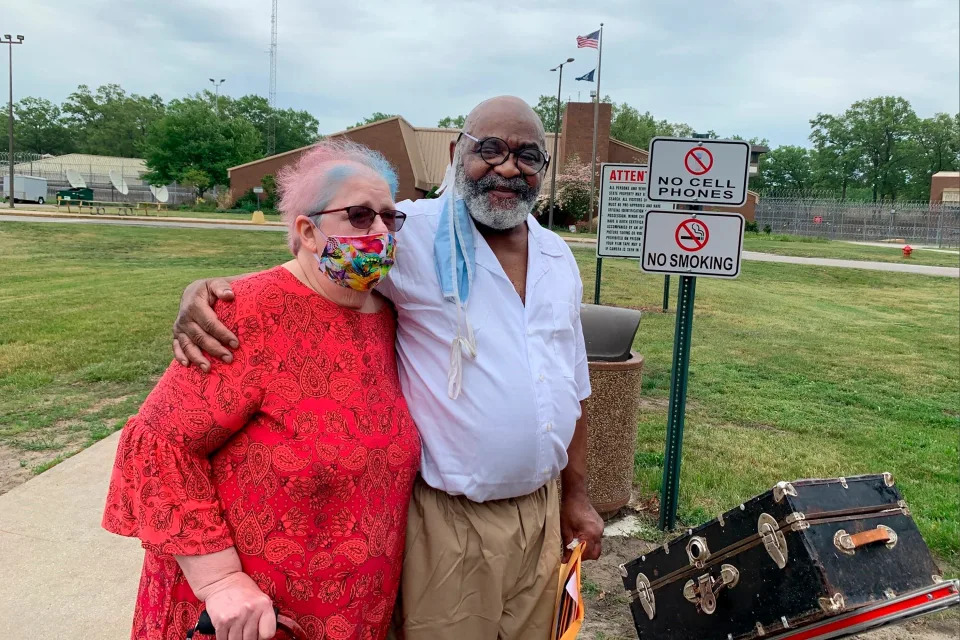
In this photo provided by Bill Proctor, Ray Gray and his wife Barb Gray pose for a photo after he was released from a state prison in Muskegon, Mich., on Tuesday, May 25, 2021. Gray was in prison for 48 years for the fatal shooting of a man in Detroit in 1973. He has long maintained his innocence and provided new evidence in March, 2021. Gray was not exonerated, but prosecutors agreed to drop the conviction in exchange for a no-contest plea to second-degree murder. He was sentenced to time served.
In this photo provided by Bill Proctor, Ray Gray and his wife Barb Gray pose for a photo after he was released from a state prison in Muskegon, Mich., on Tuesday, May 25, 2021. Gray was in prison for 48 years for the fatal shooting of a man in Detroit in 1973. He has long maintained his innocence and provided new evidence in March, 2021. Gray was not exonerated, but prosecutors agreed to drop the conviction in exchange for a no-contest plea to second-degree murder. He was sentenced to time served.More
Wrongfully convicted deserve protection and help

The wrongfully convicted and their families have been awarded billions in compensation for their suffering through judgments or state-mandated payouts. Imagine what the cost to communities would be if the nation recognized and paid damages to all the known victims of the justice system’s shortcomings.

Unjust actions in the criminal justice system have left many wondering why the Constitution didn’t fulfill its promise to them.

Last year, the right-wing majority of Trump’s Supreme Court, led by Justice Clarence Thomas, stacked with a right-wing majority, again slammed the door on innocence claims. Trump is counting on this same Supreme Court to save him from criminal prosecution.

The rule of law claims to grant equal rights and protections to everyone. It’s up to us to make that promise a reality.

Maybe now, as we face the madness of Trump’s bogus claim of unfair treatment, we should consider the real unfairness in our criminal justice system – and enact long-needed reforms and improvements to better protect those of us who aren’t rich and famous from punishment we truly don’t deserve.

Bill Proctor is a private investigator specializing in investigating wrongful convictions with his own firm, which he started after a four-decade career in broadcasting including 33 years as a reporter, producer and anchor in metro Detroit. This column first published in the Detroit Free Press.

Lisa Murkowski, done with Donald Trump, won’t rule out leaving GOP

CNN

Lisa Murkowski, done with Donald Trump, won’t rule out leaving GOP

Manu Raju, CNN – March 24, 2024

Sen. Lisa Murkowski, aghast at Donald Trump’s candidacy and the direction of her party, won’t rule out bolting from the GOP.

The veteran Alaska Republican, one of seven Republicans who voted to convict Trump in his second impeachment trial amid the aftermath of January 6, 2021, is done with the former president and said she “absolutely” would not vote for him.

“I wish that as Republicans, we had … a nominee that I could get behind,” Murkowski told CNN. “I certainly can’t get behind Donald Trump.”

The party’s shift toward Trump has caused Murkowski to consider her future within the GOP. In the interview, she would not say if she would remain a Republican.

Asked if she would become an independent, Murkowski said: “Oh, I think I’m very independent minded.” And she added: “I just regret that our party is seemingly becoming a party of Donald Trump.”

Pressed on if that meant she might become an independent, Murkowski said: “I am navigating my way through some very interesting political times. Let’s just leave it at that.”

Murkowski hasn’t always been on the outs within her party. Appointed in 2002 by her father, Gov. Frank Murkowski, the senator’s politics were in line with the president at the time – George W. Bush – as she maintained a tight relationship with the senior GOP senator from her state, Ted Stevens, who helped build Alaska through federal dollars he funneled back home.

She later found herself at odds with Sen. John McCain’s running mate, the then-Alaska Gov. Sarah Palin, who had been sharply critical of her father. As the tea party rose in 2010, Murkowski was at sharp odds with the insurgent right-wing of her party. She lost a primary in 2010 to Republican Joe Miller, only to later hold on to her seat after she became the second candidate ever to win a write-in campaign for Senate in the general election.

Murkowski skated to reelection in her next two elections, even after voting to convict Trump in 2021, voting against Brett Kavanaugh for the Supreme Court in 2018 and supporting Ketanji Brown Jackson in 2022. She had been targeted by Trump and his allies in 2022 but was backed by Senate GOP Leader Mitch McConnell and his high-spending outside group.

In the 2024 cycle, Murkowski – along with Republican Sen. Susan Collins of Maine – offered a late endorsement of former South Carolina Gov. Nikki Haley, just days before she dropped out of the race.

Now, Murkowski is clear she’s ready to move past Trump. Asked about Trump’s recent comments that Jewish people who vote for Democrats must “hate” their religion, Murkowski said it was an “incredibly wrong and an awful statement.”

And Murkowski pushed back when asked last week about Trump’s other controversial rhetoric, namely that he views January 6 prisoners as “hostages” and “patriots” who should be pardoned.

“I don’t think that it can be defended,” Murkowski said. “What happened on January 6 was … an effort by people who stormed the building in an effort to stop an election certification of an election. It can’t be defended.”

Trump stares down first derailment of his campaign-to-courthouse strategy

CNN

Trump stares down first derailment of his campaign-to-courthouse strategy

Phil Mattingly and Andrew Seger – March 23, 2024

For days, Donald Trump’s fury over the requirement to secure hundreds of millions of dollars in bond money by Monday has been bubbling behind the scenes and through a steady stream of social media posts.

Friday’s public barrage on his Truth Social platform, which included multiple all-caps posts, highlighted his persistent anger with the judge who handed down the $464 million judgment, the New York attorney general who brought the civil fraud case and Trump’s insistence that it’s all designed to derail his presidential campaign.

The posts, including one sent just before 2 a.m. Friday, contained a mix of invective and claims devoid of fact or evidence. (There is no evidence that the White House has played any role in the case brought by New York Attorney General Letitia James, let alone ordered her to pursue her effort. Nor is there any evidence that Trump, as he claimed, has plans to use any of his own money for his presidential campaign.)

But also embedded in the posts was a reality that has pushed Trump’s company and personal finances to the brink with just two days remaining to land a solution.

Trump, as he himself noted, does have a significant amount of cash, according to a review of his most recent candidate financial disclosure and personal financial statements.

It’s a point he made repeatedly in his deposition and testimony during the New York fraud trial though that diverged from his latest social media claim of having “almost five hundred million dollars in cash.” He consistently pegged the number during legal proceedings at $400 million and, barring any recent and unreported cash infusion, a person familiar with his finances confirmed that remains roughly where his cash holdings stand.

Yet even if the higher-end estimate is accurate, as Trump’s lawyers have made clear in sober, detailed filings, it wouldn’t be enough.

The $464 million decision levied in the verdict, and the bond Trump is scrambling to secure to forestall potential seizure of his properties, would require cash or cash equivalent of roughly $557 million based on industry practice.

And at least some of the money Trump does have is tied up in loan agreements that include terms requiring him to have tens of millions of dollars in cash on hand.

In other words, as the clock ticks toward the Monday deadline, securing a bond of the scale required remains – to quote Trump’s own lawyers – a “practical impossibility.”

A deft strategy

Trump’s deft navigation of – and ability to leverage – his unprecedented collision of the campaign and courthouse has defined the path he bulldozed to once again become the Republican Party’s presumptive presidential nominee.

But it was a filing by New York state lawyers at a county clerk’s office 25 miles north of Trump Tower that demonstrated how perilously close the former president is to a dramatic derailment of that strategy.

The move by James’ office to enter judgments in Westchester County marked a first step toward seizing Trump’s assets should he fail to secure a bond.

Westchester County is home to Trump’s golf course and private estate known as Seven Springs.

The initial action, which state lawyers already took in Manhattan, is just the start to what would be a complex and lengthy process.

It also came as Trump’s lawyers have continued to press to reduce or waive the bond requirement, calling it “patently unreasonable, unjust and unconstitutional,” in a Wednesday filing.

But for Trump, a man who has made his brand and his buildings his central animating feature, the filing that put a target on one of his properties crystalized a moment unlike any other he’s faced in his White House comeback bid.

“I think the whole thing is bullsh*t,” one House Republican, who communicates with Trump’s team said of the order to secure the $464 million bond while waiting for a decision on his appeal. “But it had gotten to the point where it seemed like nothing will ever stick to him, so this has been different.”

In other words, there may be actual consequences.

Enduring GOP support

Over nearly a year, as four indictments and 88 charges piled on, Trump’s poll numbers in the GOP primary tracked a steady climb.

Days when Trump faced charges, or showed up at court to face those charges, consistently ranked among his best fundraising days on the campaign.

That money, in part, has covered Trump’s legal bills so he wouldn’t have to on his own.

The lawyers that money financed have been both unequivocal about their pursuit of dilatory strategies – and have repeatedly succeeded in those efforts.

If, as countless former campaign officials say, presidential candidates’ most valuable asset is their time, Trump’s decision to repeatedly attend court hearings when his presence wasn’t required made clear his view of the incentives. So did the voters.

Trump successfully cut down – with relative ease – the best financed and most politically gifted of his primary challengers. He all but locked up the GOP nomination after just two primary contests as the party largely fell in line behind a candidate under whose tenure it lost the House, the Senate and the White House.

Trump was also the same candidate whom some publicly – and many more privately – had hoped would simply disappear after the January 6, 2021, attack on the US Capitol and the steady stream of revelations that he and his advisers had sought to overturn Joe Biden’s 2020 victory.

People around Trump say they’ve seen no sign of any political damage from his latest legal stress test. National polls continue to show a margin-of-error contest with Biden, and more importantly, surveys in the critical swing states haven’t revealed a tangible shift. New CNN polling conducted by SSRS in two battleground states showed Trump tied with Biden in Pennsylvania at 46% each, and ahead in Michigan, 50% to 42%.

Biden flipped both states from Trump’s column in 2020.

Trump’s campaign apparatus trails Biden’s team significantly in fundraising, but those around Trump are confident that the gap will be closed. The former president, these people say, has been privately working the party’s biggest donors in a way they haven’t seen before.

“The money will be there,” one person told CNN. “He’s never been more focused or effective on that front than he is right now.”

One adviser mused that any pursuit of Trump’s properties would only serve to help the campaign politically, pointing to email and text donation appeals with lines like “Keep your filthy hands off Trump Tower!” as evidence to that effect.

A cash dilemma

Still, the threat Trump currently faces cuts equally to his political and personal core. It’s also one that carries a level of irony.

In a career, and now verdict, beset by a steady stream of questions about his net worth and the value of his substantial real estate assets, Trump does have a significant amount of cash – and a valuable portfolio of properties, which could more than cover the bond amount.

But insurers rarely take real estate as collateral, fearing a complex process and skewed market where any bids on that property would come from entities well aware of the need to sell, Trump’s lawyers said.

One insurer, Chubb, underwrote a $91.63 million bond just two weeks ago in another Trump legal loss – E. Jean Carroll’s defamation case.

Trump’s team had been in discussions with Chubb over a second bond for the fraud case that included a mix of liquid assets and property. In the past week, the insurer informed Trump’s team it could not accept property as collateral.

In total, 30 insurers contacted by Trump’s team declined to pursue the effort to secure a bond. Trump, in a Truth Social posting, alluded to that fact when he noted that it “is not possible for bonding companies to do in such a high amount, before I can even Appeal. That is CRAZY! If I sold assets, and then won the Appeal, the assets would be forever gone.”

There has been a steady stream of rumors about some of Trump’s richest backers stepping in to put up the cash.

But so far there has been no confirmation of concrete requests, let alone movement toward any agreement.

Another potential pathway that Trump allies have discussed opened up Friday when investors approved a merger that made the former president’s media enterprise, Trump Media and Technology Group, a public company. Trump’s holdings in the new company would, on their face, net him billions in stock.

But the availability of that cash from the parent company of Truth Social would be subject to a six month “lockup” period that would hamstring Trump’s ability to sell any shares or use them as collateral. The billions Trump stands to gain exist only on paper – and would be subject to the price fluctuations of the stock when it starts to trade.

Any effort by Trump to get around that lockup period in order to monetize his shares would likely have a direct, and negative, effect on the stock’s price.

Watching his image

Trump has repeatedly dismissed the idea of pursuing bankruptcy, which would freeze the proceedings for what would likely be an extended period of time.

The reasons, advisers say, cut across personal and political concerns.

Trump has been publicly vocal about the deep scars he carries from bankruptcies decades ago.

“It was an experience that I don’t think I want to go through it again,” Trump said in a 1992 interview with Charlie Rose. “You’re really in a position where I think that if you had to do it again, I’m not sure you could. I went through a period of two years that was truly tough.”

Trump is also cognizant of the potential threat it could pose to his carefully crafted image that sits at the heart of his political salience: that of a billionaire business tycoon.

“No chance,” one adviser said of Trump pursuing bankruptcy. “He’d rather have Letitia James show up and try and seize his properties.”

Whether that version of the campaign and courthouse convergence plays out will be made clear in the days ahead.

For now, however, it has become clear as the deadline to secure the bond looms ever closer, that the playbook that has driven Trump’s political comeback has run into hurdles in the form of hundreds of millions of dollars.

That’s a problem the only political opponent who has ever defeated Trump is happy to highlight.

“I know not everyone is feeling the enthusiasm,” Biden joked at a Dallas fundraising reception this week. “Just the other day a defeated-looking man came up to me and said, ‘Mr. President, I have crushing debt, and I’m completely wiped out.’ And I had to look at him and say, ‘Donald, I’m sorry. I can’t help you.’”