Trump quotes Putin to call Biden ‘threat to democracy,’ reiterates anti-immigrant rhetoric at New Hampshire rally
Aaron Pellish and Steve Contorno, CNN – December 16, 2023
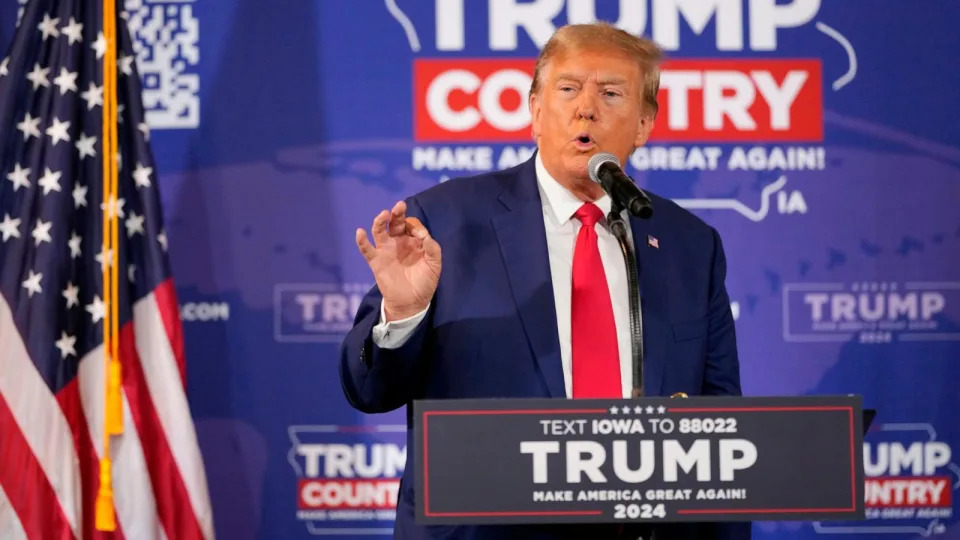
Former President Donald Trump on Saturday quoted Russian President Vladimir Putin to attack President Joe Biden as a “threat to democracy” and doubled down on language condemned for its ties to White supremacist rhetoric, saying at a campaign event in New Hampshire that immigrants are “poisoning the blood of our country.”
“Joe Biden is a threat to democracy. He’s a threat,” he told supporters at a rally in Durham, New Hampshire. “Even Vladimir Putin … says that Biden’s — and this is a quote – ‘politically motivated persecution of his political rival is very good for Russia because it shows the rottenness of the American political system, which cannot pretend to teach others about democracy.’”
Trump also praised two other authoritarian foreign leaders, calling Hungarian Prime Minister Viktor Orban “highly respected” and North Korean leader Kim Jong Un “very nice.”
Trump’s comments align with a pattern of expressing fondness for foreign leaders who use anti-democratic measures to maintain power. They also come after the former president attempted to sidestep questions in a Fox News town hall about whether he would act as a dictator if reelected, saying he would not act as a dictator “except for Day 1.” Trump faces federal and state charges stemming from his efforts to overturn the 2020 election.
Trump also told the crowd on Saturday that immigrants “from all over the world” are “pouring into the country,” reiterating a phrase he used previously that sparked outcry from the Anti-Defamation League.
“They’re poisoning the blood of our country. That’s what they’ve done,” Trump said. “They poison mental institutions and prisons all over the world, not just in South America … but all over the world. They’re coming into our country, from Africa, from Asia, all over the world.”
The comments mark another instance of Trump using increasingly violent rhetoric in his campaign messaging. At his most recent campaign event in New Hampshire prior to his appearance Saturday, Trump used the word “vermin” to describe his political rivals, drawing broad condemnation, including from President Joe Biden, who likened his comments to “language you heard in Nazi Germany.”
Following Trump’s use of the phrase in October, ADL CEO Jonathan Greenblatt linked his language to ethnically motivated massacres in Pittsburgh in 2018 and El Paso, Texas, in 2019.
“Insinuating that immigrants are ‘poisoning the blood of our country’ echoes nativist talking points and has the potential to cause real danger and violence. We have seen this kind of toxic rhetoric inspire real-world violence before in places like Pittsburgh and El Paso. It should have no place in our politics, period,” Greenblatt said in October.
The former president is planning a widespread expansion of his first administration’s hardline immigration policies if he is elected to a second term in 2024, including rounding up undocumented immigrants already in the US and placing them in detention camps to await deportation, a source familiar with the plans told CNN last month.
Trump on Saturday reiterated his proposal to “restore and expand” the travel bans he first implemented toward some countries in 2017 and pledged to “implement strong ideological screening for all illegal immigrants.” The travel ban targeted many Muslim-majority countries and African nations, leading critics to argue they were racially motivated.
In a statement released Saturday night, Biden campaign spokesperson Ammar Moussa said Trump “parroted Adolf Hitler” in his New Hampshire remarks.
“Tonight Donald Trump channeled his role models as he parroted Adolf Hitler, praised Kim Jong Un, and quoted Vladimir Putin while running for president on a promise to rule as a dictator and threaten American democracy,” Moussa said. “He is betting he can win this election by scaring and dividing this country. He’s wrong. In 2020, Americans chose President Biden’s vision of hope and unity over Trump’s vision of fear and division — and they’ll do the same next November.”
Florida Gov. Ron DeSantis, one of the former president’s GOP rivals, said later Saturday that he hadn’t heard Trump’s comments in New Hampshire about immigrants “poisoning the blood of our country,” instead reiterating the “huge risk” that people who cross the border illegally pose to Americans, especially “military-aged males.”
“We have to be smart about what we’re doing in this country,” DeSantis said at a news conference in Corydon, Iowa, when asked whether he believes this type of rhetoric should be used by someone who wants to lead the United States.
“We’re going to be very tough on who’s able to come into this country, because I think that what’s going on now, at the border in particular, has been a total train wreck,” he added.
Trump traveled to New Hampshire to lock down support as he tries to solidify his status as the 2024 Republican front-runner in the final weeks before the state’s first-in-the-nation GOP presidential primary.
In his first trip to the Granite State in over a month, Trump held a rally in the college town of Durham in one of the state’s most liberal counties. He’ll follow that up with an event in Reno, Nevada, on Sunday and then Waterloo, Iowa, on Tuesday – his second visit to the Hawkeye State in a week.
The burst of campaigning underscores an aggressive effort by Trump’s team to maintain his dominating lead when polls give way to actual voting. His advisers have privately voiced concerns that Trump supporters could simply assume he has a comfortable advantage in the race and is not reliant on their votes.
“We are leading by a lot, but you have to go out and vote,” Trump told supporters Wednesday night in Coralville, Iowa.
Trump’s visit to New Hampshire comes a day after rival DeSantis wrapped up his own one-day sojourn in the Granite State. It also comes as another opponent, former South Carolina Gov. Nikki Haley, appears to be gaining momentum there, punctuated by a recent endorsement by the state’s popular governor, Chris Sununu, who has long made clear his opposition to Trump’s candidacy.
Sununu told reporters Tuesday that he believed the Republican primary in New Hampshire was a two-person race.
“This is a race between two people. Nikki Haley and Donald Trump. That’s it … with all due respect to the other candidates,” Sununu said.
Trump has bashed Sununu following the endorsement, saying at his Saturday rally, “He’s endorsed somebody that can’t win, has no chance of winning.”
“He’s a selfish guy who can’t get elected anything right now,” Trump said of Sununu.
It’s unclear what impact Sununu’s endorsement will have on the primary. A recent Des Moines Register/NBC News/Mediacom poll in Iowa suggested DeSantis’ support there grew only nominally from an endorsement by another popular governor, Kim Reynolds.
A CNN/University of New Hampshire poll of likely voters in New Hampshire’s Republican primary released last month showed Trump with 42% support. Haley, his closest challenger, was at 20%.
Trump is even more dominant in national polls. A Pew Research Center survey released Thursday found 52% of Republican and Republican-leaning registered voters name the former president as their top choice in the primary. His nearest challenger was DeSantis, at 14%.
This story and headline have been updated with additional information.
CNN’s Jeff Zeleny, Alison Main, Kit Maher and Veronica Stracqualursi contributed to this report.
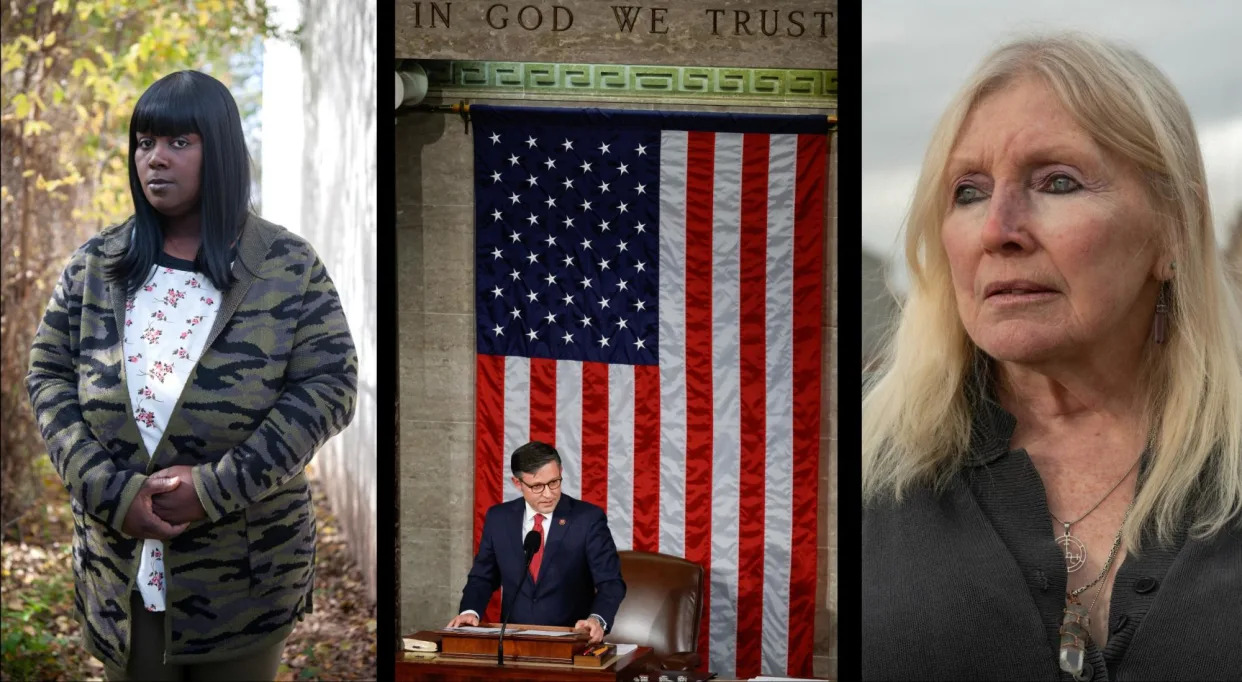
Revealed: House speaker did little to fight toxic ‘burn pit’ his father campaigned against
Oliver Laughland in Shreveport, Louisiana and Stephanie Kirchgaessner in Washington – December 13, 2023
Composite: Rory Doyle, Getty Images, Rachel Woolf
Mike Johnson was a few months away from assuming elected office in late 2014 when he was confronted with an impassioned appeal by the man he would later pay tribute to in his first speech as House speaker: his father Patrick.
The elder Johnson, a former firefighter in the Louisiana city of Shreveport, had survived a near fatal industrial explosion when Mike was 12 years old, a defining event in both men’s lives. He had just joined a local community environmental group, working to fight against US government plans to burn – in the open air – over 15m pounds of toxic munitions. It had thrust Patrick and his future wife Janis Gabriel onto the frontlines of Louisiana environmental advocacy.
As authorities were on the brink of approving the “open burn”, which would have sent vast quantities of known carcinogens into the air, Patrick and Janis turned to the most influential person they knew.
Then an ambitious, rightwing constitutional lawyer, Mike Johnson would in a matter of weeks fill the vacancy for Louisiana’s eighth state legislative district – whose borders are just 20 miles from Camp Minden, a military base where the illegal munitions dump – the largest in US history – was located. A small amount of the munitions had spontaneously exploded two years before, causing a 4-mile blast radius.
The pair drove to Mike Johnson’s legal offices in the late morning, Gabriel recalled, and Patrick Johnson explained to his son the immediate environmental and health dangers the toxic dump posed, not only to residents in the immediate vicinity but to members of the Johnson family living in the region.
“His father and I went to him and said: ‘Mike you need to get involved in this, this is really important. Your family really lives at ground zero,’” Gabriel said in an interview with the Guardian. “We basically begged him to say something, to someone, somewhere.”
A terse back and forth followed, she said.
“He just wasn’t interested,” Gabriel said. “He had other things to do. He was never interested in environmental things.”
The couple left deeply disappointed.
“It just blew my mind that he wouldn’t give five minutes of his time to the effort,” she said. “He basically shut us down.”
A spokesperson for Johnson said he “disputes this characterization as described” but did not respond to an invitation to elaborate further.
Gabriel, 72, has thought about this failed appeal to Johnson repeatedly in recent months, ever since he was thrust from relative obscurity to the US house speakership in October.
A denier of climate science, Mike Johnson has spoken about how his evangelical faith has shaped his political worldview. According to a broad examination of his past statements, Johnson’s anti-climate advocacy often bears the hallmarks of a Christian fundamentalism linked to creationism.
Louisiana’s fourth congressional district, which includes Camp Minden, has long voted staunchly Republican, but many residents still hold deep concerns about pollution and the climate crisis. In a year the district experienced record heat and a number of climate related disasters, some say their representative in Washington, who is now second in line to the presidency, is fundamentally failing them.
Mike Johnson’s views on climate change became publicly apparent in 2017, just five months into his first term in the US Congress. Asked how he felt about the climate crisis by a constituent at a rowdy town hall meeting in Shreveport, Johnson launched into a critique of climate change data, saying he had also seen “the data on the other side”.
“The climate is changing, but the question is: is the climate changing because of the natural cycles of the atmosphere over the span of history, or is it changing because we drive SUVs?
“I don’t believe in the latter. I don’t think that’s the primary driver.”
Some attendees booed.
Two years later, Johnson – who has received almost $350,000 in political donations from the oil and gas industry since his election in 2016 – led the Republican Study Committee as it lobbied against progressive Democratic efforts to implement a Green New Deal. Johnson denounced the sweeping federal blueprint for climate action as a “guise to usher in the principles of socialism” and create a system of “full government control”.
In Louisiana, which is economically dependent on the oil and gas industry, the remarks were consistent with the Republican party’s support for fossil fuels.
But to experts who study the Christian fundamentalist movement of creationism, the comments revealed a worldview that falls far outside traditional Republican pro-industry norms. They see the remarks, and Johnson’s rejection of climate science, as evidence of Johnson’s adherence to young-Earth creationist beliefs, including the presumption that the Earth is just 6,000 years old.
Johnson has been closely associated with the creationist movement since 2014 – before his entry into politics – when he became a vocal supporter and lawyer for Answers in Genesis (AiG), a global fundamentalist Christian organization that built a gigantic Noah’s Ark replica and amusement park in Kentucky. Following a headline-grabbing legal battle, Johnson ultimately helped the group secure taxpayer incentives for the project.
“Creationists can just wave away all of the geologic evidence of climate change because they are convinced that all rock layers were laid down in a global flood about 4,400 years ago,” said David MacMillan, a former Christian fundamentalist who has left the movement.
MacMillan grew up attending creationist conferences, had posts published on AiG’s website, and helped raise money for the establishment of AiG’s first creationist museum near Cincinnati, earning him a spot on a donor wall and a lifetime pass to attend. Now – having left his fundamentalist views behind – he is speaking out about the dangers of science denial.
“They will tell you that hundreds of thousands of annual ice core layers are just a bunch of snow that formed while the Earth was cooling off after Noah’s flood. They believe climate scientists are sifting through meaningless noise to try and find patterns that will get them noticed and promote narratives that please the global elite who want to control us.”
What’s more, MacMillan added, most fundamentalists argue that even if the climate is changing, it should make no difference because they also expect the imminent, apocalyptic, final judgment of the world.
MacMillan, who knows Ham, said the AiG founder pioneered a technique of trying to sow doubts about science by presenting scientific consensus as merely a belief system, much like religion.
In a video interview with the Canadian psychologist and alt-right provocateur Jordan Peterson in November last year, Johnson drew directly from this creationist strategy when asked why Democrats pursue policies to address the climate crisis.
“They regard the climate agenda as part of their religion,” Johnson said. “I don’t know any other way to explain it. They pursue it with religious zeal. And they care not what type of pain these policies inflict upon the people that they are supposed to be serving because they’re not serving the people, they’re serving the planet.”
While many media reports have highlighted Johnson’s controversial relationship with Ham, MacMillan said Johnson’s close association with the group – his bio appears on its website, he has written blog posts for the group, and spoken at an AiG event in Kentucky – means Johnson would likely have had to agree to the group’s statement of faith, which includes the assertion that the Bible is “factually true” and that its authority is not limited to spiritual or redemptive themes, but also history and science.
According to the group’s website: “All persons employed by the AiG ministry in any capacity, or who serve as volunteers, should abide by and agree to our Statement of Faith and conduct themselves accordingly.”
An AiG editorial review board regularly reviews all articles, books and other materials produced or distributed by the group to make sure they are in line with AiG values and that there “is not mission drift”.
In a speech delivered at Ham’s Ark Encounter conference center last year, Johnson raised the apocalypse and Christ’s second coming.
“We are hopeful people because we know how the book ends … God wins,” he said in an address that was met with a standing ovation. “The charge is for us, it’s not yet determined. We’re going to be here until the Lord tarries, when the Lord comes back. And maybe that’s soon, because we’re seeing a lot of signs.”
Mike Johnson and his wife are due to speak at an AiG conference event in April next year, entitled: “Reclaim: overcoming the war on women for the glory of God.”
“There is no doubt that Mike Johnson demonstrated to AiG’s satisfaction that he agrees with every aspect of that statement of faith,” MacMillan said.
A short biography of Johnson is included on AiG’s contributor’s page. A review of the 267 biographies on the AiG site indicates he is one of only two elected officials to post on the fundamentalist group’s website. The other is Tony Perkins, a former Louisiana state representative and the current president of the Family Research Council, a far-right evangelical lobby group. Perkins, one of Johnson’s political mentors, once said he believed floods were sent by God to punish homosexuality and regularly cites the Bible to deny solutions to the climate crisis.
When asked by the Guardian if Johnson had ever endorsed the AiG statement of faith, or if he shared Ham’s views on climate or if he believed the earth was 6,000 years old, a spokesperson said: “The Speaker is not responsible for the views of others” and did not respond to an invitation to elaborate.
AiG did not respond to specific questions about Johnson and the group’s statement of faith and instead commented on his legal work for the organization. “Mr Johnson served the ministry very effectively and professionally in the matter and Answers in Genesis was very pleased and grateful for his services,” said spokesman A Larry Ross.
Janis Gabriel pointed to Mike Johnson’s hardline faith and political pragmatism when explaining her interpretation of why he had brushed aside his father’s appeals to help with the air pollution crisis at Camp Minden.
“It speaks to those religious beliefs,” said Gabriel. “‘Don’t take care of the environment because we have a finite amount of time here and God will take care of you.’ It’s crazy.”
Gabriel, who was discussing her relationship with the House speaker for the first time publicly, said she was disclosing details of private conversations because Johnson now holds a position of immense power. She wanted to further public understanding of “what and who he is and how that will affect the job he’s doing for us.”
“That is the important conversation,” she said.
In his 2022 interview with Peterson, Mike Johnson couched his critique of those seeking climate solutions around conversations he was having with residents in his district.
“When I’m in Louisiana I try to explain to our folks, listen: ‘They have effectively replaced father God with mother Earth. . . . They believe we owe fealty to Mother Earth.”
Even as the speaker rejects concerns about the climate crisis, Louisiana’s fourth congressional district is already experiencing new extremes tied to global heating.
Louisiana, too, endured months of devastating drought, which contributed to a water crisis in the south-east, and hundreds of wildfires in America’s wettest state. The largest wildfire in Louisiana’s history occurred this year in Johnson’s district, scorching a staggering 33,000 acres and decimating the local economy. The heat and drought combined cost Louisiana’s agriculture industry $1.69bn alone this year.
The state also logged a record number of heat-related deaths over the summer, according to a spokesman for the Louisiana health department [LDH], with 69 people dying between June and September this year. This was almost double the death toll of any in the past six years, according to data released to the Guardian by LDH.
A report published this year, which examined all occupational heat related illnesses between 2010-2020 found that the highest rates of illness occurred in Louisiana’s north-west, which has some of the largest rates of poverty in the state and is entirely covered by Johnson’s district.
“Heat exposure is intensifying as the frequency, severity, and duration of extreme heat events increases due to climate change,” the government report acknowledges.
In Shreveport, six people died from extreme heat this year alone – a record year, according to Todd Thoma, who has served as coroner in the Shreveport area for 16 years. “This was an exceptional year to me,” Dr Thoma said, as he combed through each case file in his office, pointing to a combination of prolonged extreme heat, high poverty rates and power outages that contributed to the increased risks for the city’s most vulnerable residents.
A 62-year-old woman who died in June after a tornado knocked out power to her home, leaving her with no air conditioning. A 49-year-old man, found collapsed on the sidewalk just four days later. And, on 13 July, 34-year-old Ted Boykin, a father of one who was found dead inside a trailer home, with no air conditioning, that was used by Shreveport’s unhoused community.
The ambient air temperature inside was 98F, according to the coroner’s report. Boykin’s internal temperature was 107.9F.
In an interview Boykin’s sister, Sandy Boykin-Hays, said she considered her brother a victim of the climate crisis and chastised her congressman and others for a failure to accept science.
“He was let down by the system,” said Boykin-Hays. “And to them [in Washington], I’m sure they wouldn’t believe, even if it [climate change] was staring them in the face, because they’re rich. They have money. They don’t have to worry about air conditioning or where your next meal is coming from.”
Boykin-Hays, who works as a food delivery driver and volunteers with homeless outreach, was forced to take out a $3,000 loan to pay for her brother’s funeral.
“They’re ignoring the true issue because it doesn’t affect them,” she said.
In Washington, where Johnson now holds the power to bring legislation to the House floor, the speaker has not yet expressed a position on a bill introduced by California Democrat Judy Chu, to protect workers from excessive heat, despite it receiving some bipartisan support in committee.
“The denial of the climate crisis by Maga extremists like the Speaker isn’t just a danger to the health of his constituents during summer months,” said Chu. “It’s a danger to the long-term well being of future generations in America and around the world.”
Both Janis Gabriel and Patrick Johnson became board members of the Citizens Advisory Group set up to engage with the EPA over community concerns at Camp Minden, according to meeting minutes reviewed by the Guardian and interviews with two other board members.
Johnson even co-wrote, recorded and performed an original song to help the “stop the burn” efforts, which eventually helped force the EPA into a course change by approving use of a cleaner alternative to dispose of the waste throughout 2016 and 2017.
“Take a stand against the poison, protect our future children’s lives,” Patrick Johnson sings.
The former firefighter had become a national advocate for hazardous material safety after surviving a fiery explosion caused by leaking ammonia at a cold storage facility. Another firefighter died in the 1984 accident. The near-death experience, said Gabriel, changed his spiritual outlook. The couple met in 2013 when Johnson attended Gabriel’s Daoist center as a student in Shreveport to practice tai chi and qigong martial arts. The pair married in October 2016, shortly before Johnson’s death from cancer in December that year.
The elder Johnson, said Gabriel, clearly accepted climate science and was “acutely aware of the environment”. While he “certainly didn’t agree” with Mike Johnson’s “extremist stance” on Christianity, he accepted it. The pair disagreed over support for Donald Trump, Gabriel said.
Mike Johnson has described his father’s survival in the 1984 explosion as an “actual miracle” that “made me a person of very deep faith”. His campaign literature still references the accident and, in his first speech as speaker, Johnson described how his father’s near death “changed all of our life trajectories”.
But from January 2015, when he formally entered politics, Johnson appeared to display little interest in the Camp Minden issue that his father was campaigning on. It was a period described by three organizers as the start of heightened advocacy.
He was given invitations to attend citizens meetings as local campaigning ramped up, according to the board’s chairman Ron Hagar, but did not attend.
“He stayed as far away from it as possible,” said Hagar, a close friend of Patrick Johnson’s. “He had no sense of responsibility to stand up for the people he’s representing.”
A search of public records did not indicate Mike Johnson had spoken on the issue at the time although he was listed as a co-sponsor of a minor 2015 state house resolution to stop the facility from accepting further waste explosives. Photographs show Johnson was also present at a December 2015 press conference at the site, but according to a senior organizer in attendance, Johnson did not speak and the state representative is not quoted in local media.
The issue was championed by a Democratic state representative for the 10th district, which includes Minden, named Gene Reynolds. Reynolds, who is now retired, did not return multiple calls for comment.
A spokesperson for Johnson pointed to public activity cited by the Guardian and “other activities” to dispute claims he had not been involved in the matter.
Johnson’s short tenure in the state legislature was spent focused on far-right policy initiatives tied to his Biblical worldview, including introducing legislation to push back against same sex marriage, and a continued focus on his non-profit law practice, including work with Ham’s Ark Encounter.
Following her husband’s death, Gabriel moved out of state. She began to lose touch with Johnson, although the pair exchanged occasional cordial text messages.
In one May 2019 exchange, seen by the Guardian, Johnson contacted Gabriel to wish her a happy Mother’s Day. Gabriel told him she had left Shreveport permanently and moved to a different state.
“Don’t blame you one bit for staying there! Shreveport is really going downhill now and it’s sad to watch,” Johnson replied.
Gabriel then explained that her decision to leave had come on Patrick’s advice, partly due to his prediction of “worsening environmental problems”. She also told Johnson that his father would be proud of his “love and devotion and support” of his own children.
“Dad was right about the environmental problems in Shreveport. Those and other issues are mounting,” Johnson replied. But in the same message, he moved quickly to update her on his rapid rise in Congress: “I’ve been advanced in leadership in record time (currently the 10th ranked Republican!), and God continues to affirm that we are doing what He has called us to do, so that keeps us encouraged.”
Special counsel Jack Smith asks Supreme Court to rule quickly on whether Trump can be prosecuted
Mark Sherman and Eric Tucker – December 11, 2023
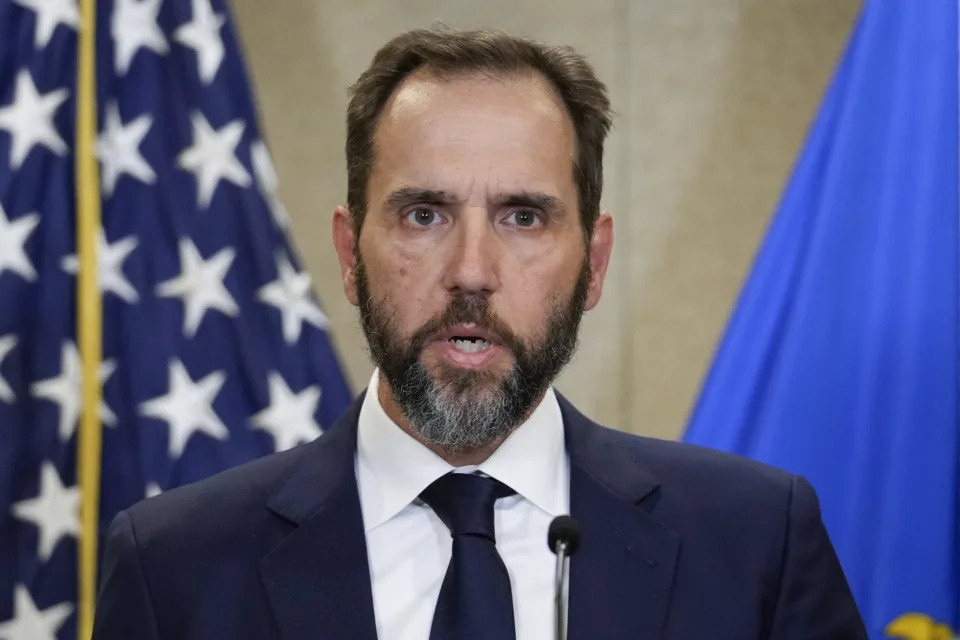
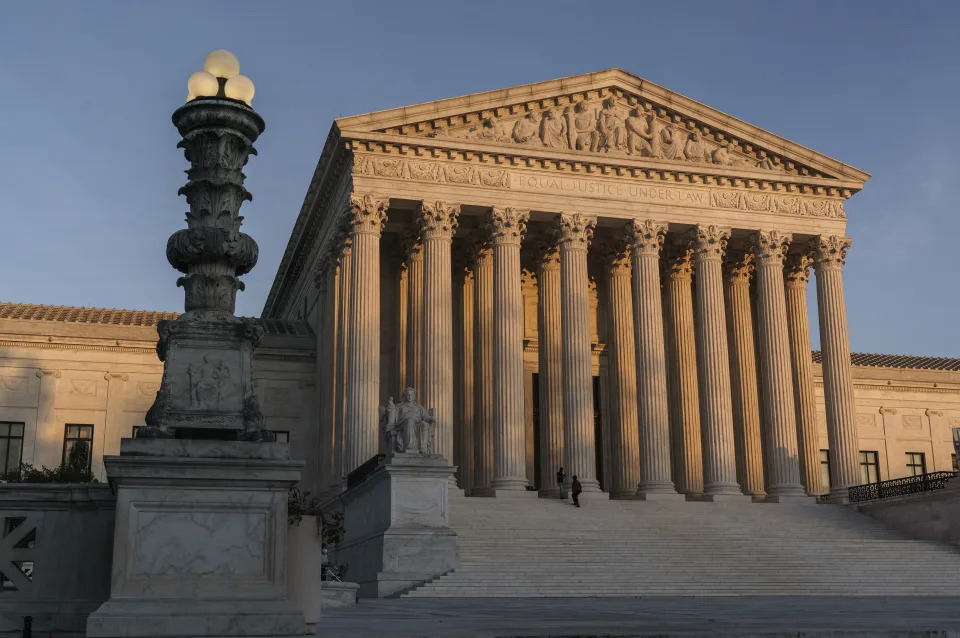
Special counsel Jack Smith speaks to the media about an indictment of former President Donald Trump, Aug. 1, 2023, at an office of the Department of Justice in Washington. Smith is asking the Supreme Court to take up and rule quickly on whether former President Donald Trump can be prosecuted on charges he plotted to overturn the 2020 election results. A federal judge ruled the case could go forward, but Trump signaled he would ask the federal appeals court in Washington to reverse that outcome. Smith is attempting to bypass the appeals court. (AP Photo/J. Scott Applewhite, File)The Supreme Court is seen at sundown in Washington, on Nov. 6, 2020. (AP Photo/J. Scott Applewhite, File)
WASHINGTON (AP) — Special counsel Jack Smith on Monday asked the Supreme Court to take up and rule quickly on whether former President Donald Trump can be prosecuted on charges he plotted to overturn the 2020 election results.
A federal judge ruled the case could go forward, but the Republican former president signaled he would ask the federal appeals court in Washington to reverse that outcome.
Smith is attempting to bypass the appeals court. The request filed Monday for the Supreme Court to take up the matter directly reflects Smith’s desire to keep the trial, currently for March 4, on track and to prevent any delays that could push back the case until after next year’s presidential election.
“This case presents a fundamental question at the heart of our democracy: whether a former President is absolutely immune from federal prosecution for crimes committed while in office or is constitutionally protected from federal prosecution when he has been impeached but not convicted before the criminal proceedings begin,” prosecutors wrote.
The earliest court would consider the appeal would be Jan. 5, the date of the justices’ next scheduled private conference.
Underscoring the urgency for prosecutors in securing a quick resolution that can push the case forward, they wrote: “It is of imperative public importance that respondent’s claims of immunity be resolved by this Court and that respondent’s trial proceed as promptly as possible if his claim of immunity is rejected.”
At issue is a Dec. 1 ruling from U.S. District Judge Tanya Chutkan that rejected arguments by Trump’s lawyers that he was immune from federal prosecution. In her order, she wrote that said the office of the president “does not confer a lifelong ‘get-out-of-jail-free’ pass.”
“Former Presidents enjoy no special conditions on their federal criminal liability,” Chutkan wrote. “Defendant may be subject to federal investigation, indictment, prosecution, conviction, and punishment for any criminal acts undertaken while in office.”
Trump faces charges accusing him of working to overturn the results of the 2020 election he lost to Democrat Joe Biden before the violent riot by his supporters at the U.S. Capitol. He has denied any wrongdoing.
Putin Critic Alexei Navalny Has Gone Missing From Prison
Nikki McCann Ramirez – December 11, 2023
Allies of Alexei Navalny say the imprisoned Russian opposition leader has been missing for days.
On Monday, Navalny’s spokesperson Kira Yarmysh wrote on X, formerly Twitter, that “the lawyers tried to get to IK-6 and IK-7 — two [prison] colonies in the Vladimir region where Alexey
[Navalny] might be. They have just been informed simultaneously in both colonies that he is not there. We still don’t know where Alexey is.”
Yarmysh added in a separate post that Russian authorities had refused to disclose where Navalny had been transferred.
Last year, Navalny was sentenced to nine years in prison on what are widely regarded as fabricated charges of corruption intended to silence his criticism of Russian President Vladimir Putin. In August, an additional 19 years were added to his sentence. Prior to his imprisonment, Navalny survived at least two documented assassination attempts, once in 2017, and again in 2020.
This is a breaking news story and will be updated.
Trump says he won’t testify again at his New York fraud trial. He says he has nothing more to say
Michael R. Sisak and Jill Colvin – December 10, 2023
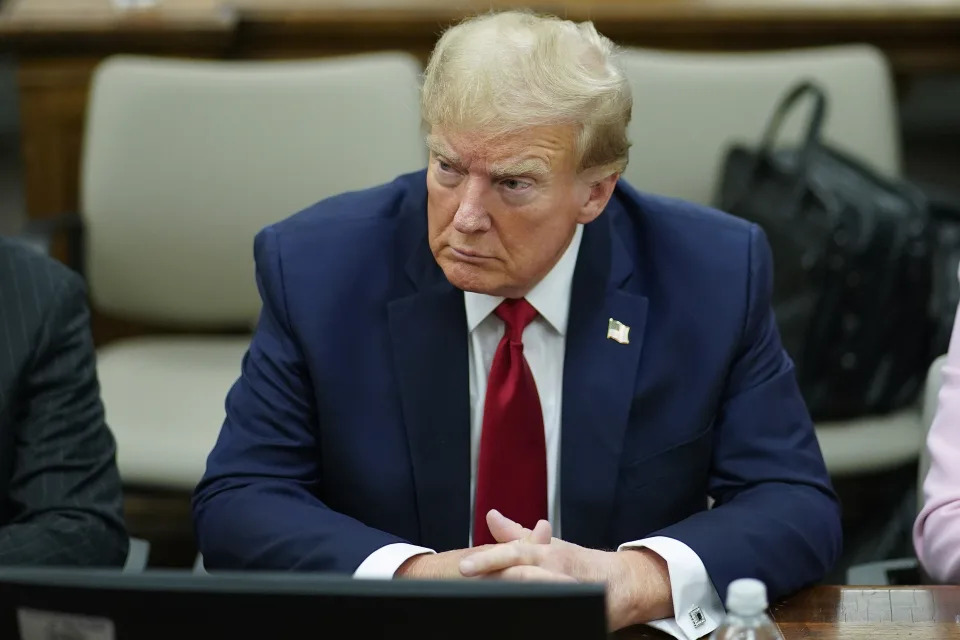
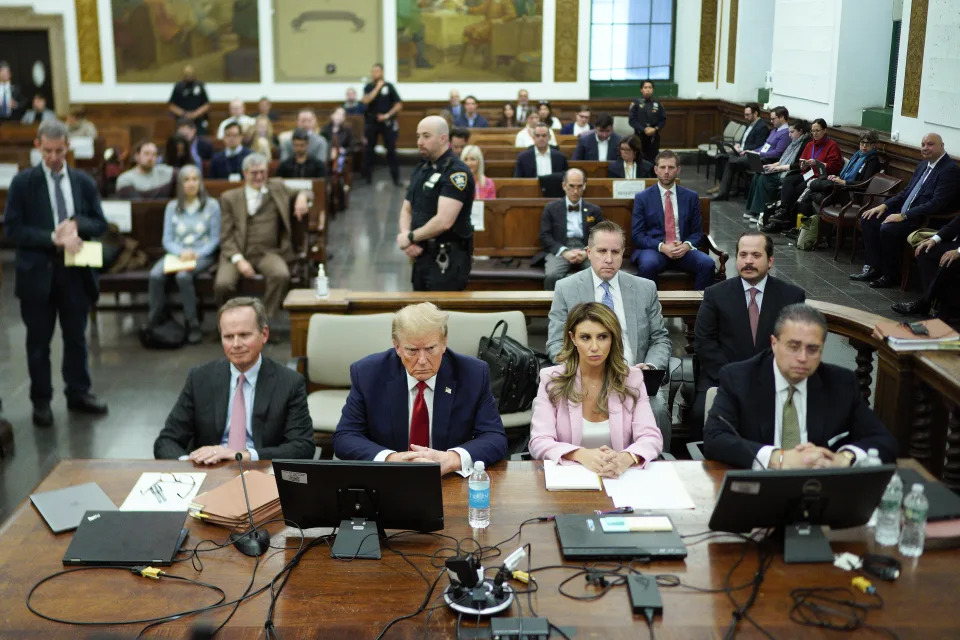
Former President Donald Trump, center, sits at the defense table with his attorney’s Christopher Kise, left, and Alina Habba, at New York Supreme Court, Thursday, Dec. 7, 2023, in New York. (AP Photo/Eduardo Munoz Alvarez, Pool, File)Former President Donald Trump, second from left, sits at the defense table with his attorney’s Christopher Kise, left, Alina Habba, second from right, and Clifford Robert at New York Supreme Court, Thursday, Dec. 7, 2023, in New York. (AP Photo/Eduardo Munoz Alvarez, Pool)
NEW YORK (AP) — Donald Trump said Sunday he has decided against testifying for a second time at his New York civil fraud trial, posting on social media a day before his scheduled appearance that he “very successfully & conclusively” testified last month and saw no need to do so again.
The former president, the leading contender for the 2024 Republican nomination, had been expected to return to the witness stand Monday as a coda to his defense against New York Attorney General Letitia James ‘ lawsuit.
James, a Democrat, alleges Trump inflated his wealth on financial statements used in securing loans and making deals. The case threatens Trump’s real estate empire and cuts to the heart of his image as a successful businessman.
“I will not be testifying on Monday,” Trump wrote in an all-capital-letters, multipart statement on his Truth Social platform less than 20 hours before he was to take the witness stand.
“I have already testified to everything & have nothing more to say,” Trump added, leaving the final word among defense witnesses to an accounting expert hired by his legal team who testified last week that he found “no evidence, whatsoever, for any accounting fraud” in Trump’s financial statements.
A Trump spokesperson did not immediately respond to questions about his decision.
The decision was an abrupt change from Trump’s posture in recent days, when his lawyers said he was insistent on testifying again despite their concerns about a gag order that has cost him $15,000 in fines for disparaging the judge’s law clerk.
“President Trump has already testified. There is really nothing more to say to a judge who has imposed an unconstitutional gag order and thus far appears to have ignored President Trump’s testimony and that of everyone else involved in the complex financial transactions at issue in the case,” Trump lawyer Christopher Kise said Sunday.
Trump’s decision came days after his son, Eric Trump, ditched his return appearance on the witness stand. Trump said on social media that he’d told Eric to cancel.
It also follows Trump’s first trip back to court since he testified in the case on Nov. 6. Last Thursday, he watched from the defense table as the accounting professor, New York University professor Eli Bartov, blasted the state’s case and said Trump’s financial statements “were not materially misstated.”
Trump’s cancellation caught court officials by surprise. Without Trump on the witness stand, the trial will be on hold until Tuesday, when Bartov will finish his testimony. State lawyers say they’ll then call at least one rebuttal witness.
In a statement, James said whether Trump testified again or not, “we have already proven that he committed years of financial fraud and unjustly enriched himself and his family. No matter how much he tries to distract from reality, the facts don’t lie.”
Trump was often defiant and combative when he testified Nov. 6. Along with defending his wealth and denying wrongdoing, he repeatedly sparred with the judge, whom he criticized as “extremely hostile,” and slammed James as “a political hack.”
Trump answered questions from state lawyers for about 3½ hours, often responding with lengthy diatribes. His verbose answers irked the judge, Arthur Engoron, who admonished, “This is not a political rally.”
Had Trump returned to the stand Monday, it would’ve been his defense lawyers leading the questioning, but lawyers from James’ office could have cross-examined him, too.
Engoron is now considering six other claims, including allegations of conspiracy and insurance fraud. James seeks penalties of more than $300 million and wants Trump banned from doing business in New York. The judge is deciding, rather than a jury, because juries aren’t allowed in this type of case.
Though testimony is nearly over, the trial that started Oct. 2 will bleed into next year. Closing arguments are scheduled for Jan. 11, just four days before the Iowa caucuses start the presidential primary season. Engoron said he hopes to have a decision by the end of January.
Trump has had a prime role in the trial. Along with his testimony, he has voluntarily gone to court eight days to watch witnesses, turning his appearances into de facto campaign stops. During breaks, he has taken full advantage of the cameras parked in the courthouse hallway, spinning what’s happening inside the courtroom, where cameras aren’t allowed, in the most favorable light.
Trump’s frequent presence in court — as a witness, observer and aggrieved defendant — has underscored the unique personal stakes for a billionaire who’s also juggling four criminal cases and a campaign.
Where other politicians have shied from legal peril, Trump has leaned in as his court and political calendars increasingly overlap, with primaries a few weeks away and the first of his criminal trials slated for March.
But Trump’s interest in vindicating his company and his wealth has also run up against the limitations of the gag order, which was reinstated at the end of November by a state appellate court after a two-week interlude. The same gag order was also in effect when he testified in November.
Despite the gag order, Trump was adamant in recent days that he’d testify again — even as one of his lawyers, Alina Habba, said she discouraged him from taking the stand.
“He still wants to take the stand, even though my advice is, at this point, you should never take the stand with a gag order,” Habba told reporters last week, before Trump changed his mind.
Trump spent Saturday evening with Habba at the New York Young Republican Club’s black-tie gala. At the event, about a mile from the courthouse, he went on at length highlighting his objections, saying, “I have proven my innocence literally every single day.”
“There’s a lot that has to be done to begin to rebuild the Republican Party, potentially to build a new conservative party,” Cheney told ABC “This Week” co-anchor Jonathan Karl in an interview that aired Sunday. “But in my view, that has to wait until after the 2024 election because our focus has got to be on defeating Donald Trump.”
Cheney, author of the new book “Oath and Honor: A Memoir and a Warning,” said she hasn’t “ruled anything out” when asked if running as a third-party candidate next year is a possibility, but she stressed that she would not “do something that has the impact of helping Donald Trump.”
Democrats have contended that third-party candidates would only hurt President Joe Biden and benefit Trump in the general election, if he is the Republican nominee. They have particular animosity toward No Labels, a group working to secure ballot access across the country as it weighs putting forward an independent, bipartisan “unity ticket” made up of one Republican and one Democrat as the presidential and vice presidential nominees.
Cheney believes that because there are several third-party candidates already in the race — like Cornel West, Jill Stein and Robert F. Kennedy Jr. — that even without a No Labels ticket, there is still going to be “a fractured electorate,” so the principal question remains: “What do we do to defeat the man who is an existential threat to our republic?”
PHOTO: ‘This Week’ co-anchor Jonathan Karl interviews former Wyoming Rep. Liz Cheney. (Al Drago/ABC)
The former three-term Wyoming congresswoman and member of Republican leadership said that it’s also “crucially important in this next cycle … to elect candidates who believe in the Constitution” to ensure that the peaceful transfer of power is completed after the next election, including on Jan. 6, 2025, when Congress will be tasked with counting the electoral votes submitted by the states — the final step before the next inauguration.
“I’ve expressed very clearly my view that having Mike Johnson as the speaker, having this Republican majority in charge, you can’t count on them to defend the Constitution at this moment,” Cheney said.
Johnson joined with more than 100 other House Republicans in 2020 in supporting a lawsuit to overturn Biden’s win in some key swing states; Johnson and numerous other Republicans also voted against certifying the 2020 election results. After winning the speakership, Johnson declined to say whether he stood by that.
In her new book, Cheney writes about how she came to believe Trump needed to be impeached as the Jan. 6, 2021, attack on the U.S. Capitol was unfolding and lawmakers were being whisked out of the chambers to safety. As the House Republican Conference chair at the time of the riot, Cheney ended up being the highest-ranking Republican — and one of just 10 Republicans total — to vote to impeach Trump on Jan. 13, 2021.
He has repeatedly maintained he did nothing wrong and was ultimately acquitted by Senate Republicans in a 57-43 vote, but Cheney continued to speak out against Trump, arguing he bore responsibility for the Jan. 6 attack.
Before losing her 2022 primary to a Trump-endorsed challenger, she served as vice chair of the House select committee investigating that attack.
Trump, for his part, has long criticized Cheney as well. He wrote in a recent social media post that she was “crazy” and has called her “smug.”
In a March 18, 2021, interview, Karl asked Trump if he really wanted to go to the Capitol on Jan. 6, as the riot was unfolding.
“I was thinking about going back during the problem, to stop the problem, doing it myself. Secret Service didn’t like that idea too much. And you know what? I would have been very well received,” Trump said, according to Karl’s latest book, “Tired of Winning.”
“Don’t forget — the people that went to Washington that day, in my opinion, they went because they thought the election was rigged,” Trump said then.
Karl asked Cheney in Sunday’s interview: “Isn’t that right there an admission by Trump himself of his own culpability?”
“Yes,” Cheney said. “One of the things that’s really important throughout all of this is Donald Trump’s intent. And we see again and again sort of the premeditation for this whole plan, the premeditation to claim victory, but also the fact that while the mob, the violence, was underway and the electoral vote was stopped — the armed mob at that point was carrying out his wishes.”
Three days after Jan. 6, Karl spoke to then-House Minority Leader Kevin McCarthy. In that interview, McCarthy told him, “What’s real crazy is back in our district, there’s tons of people who are ready to storm the Capitol again. I just don’t know about these people.”
Cheney told Karl that, behind closed doors, McCarthy initially “was being responsible” but then changed course.
“One of the things that was striking to me in writing the book was it was absolutely clear in those days, just after the sixth, on the calls that we were having in leadership, Kevin McCarthy was very clear and very strong about the potential for violence against members of the House,” Cheney said. “He actually understood reality and was being responsible in the beginning. But it didn’t take long until the political necessity of appeasing Donald Trump caused him to take a different path.”
A McCarthy spokesman said in a recent statement to CNN, responding to Cheney’s book, that she had “McCarthy Derangement Syndrome.”
PHOTO: ‘This Week’ co-anchor Jonathan Karl interviews former Wyoming Rep. Liz Cheney. (Al Drago/ABC)
Not even a month after the attack, which McCarthy had said Trump “bears responsibility” for, McCarthy visited Trump at his Mar-a-Lago club in Florida, a move that was seen by many as re-legitimizing Trump’s place in the Republican Party.
Cheney and others who have publicly taken a stance against Trump and how his influence has changed the Republican Party have faced threats in response. She called that a “sad” reality of the political environment today.
“This isn’t sort of the threat of physical violence because of terrorist organizations or outside entities. This is the threat of violence because of a former president of the United States. And I think we have to be very careful as a country that we stop and we think about what that means and the path that we’re going down,” she said.
Karl asked Cheney what she thinks people will say about her and her legacy, years in the future.
“I hope that they will say she did the right thing and that she put the country ahead of politics and ahead of partisanship at a moment when it really mattered,” she said.
“And that project is, in your mind, just getting started?” Karl asked.
“Certainly,” Cheney said. “Once we get through this election cycle and we defeat Donald Trump, I think there’s clearly a huge amount of work that has to be done to restore, to right the ship of, our democracy.”
Abcarian: Read Liz Cheney’s book and weep. America’s democracy hangs on the details.
Robin Abcarian – December 10, 2023
Former Wyoming Rep. Liz Cheney wants you to remember what Donald Trump is capable of. (Jacquelyn Martin / Associated Press)
You don’t read a book like former Wyoming U.S. Rep. Liz Cheney’s tell-all looking for literary pearls.
You read it to find out what was going on behind the scenes in Congress after the 2020 election, as Donald Trump’s Republican sycophants and enablers schemed with him to overturn the results of a legitimate U.S. election. You read it to remember just how feckless Trump was when he was in power, and to remind yourself exactly what he is capable of should the nightmare of a second Trump term come to pass.
Oh, and of course you read it because who could ever tire of revelations about former House Speaker Kevin McCarthy’s spinelessness and treachery? God, what a snake. No, strike that. Snakes actually have spines.
After forcefully blaming Trump for Jan. 6, McCarthy went to Mar-a-Lago to suck up to the former president, Cheney writes in “Oath and Honor,” because he needed money. Nearly every major corporate donor had threatened to withdraw support from Republicans who voted to object to the electoral college votes. Because McCarthy’s only real political skill was fundraising, she says, he was desperate for access to Trump’s extensive lists of small-dollar donors. “In order to use those lists,” she writes, “Kevin would have to help Donald Trump cover up the stain of his assault on our democracy.”
Like many who lean left politically, I have no enduring affection for the Cheney family. They oppose almost everything I support: reproductive rights, renewable energy, the Affordable Care Act, immigration reform, you name it. I was appalled by then-Vice President Dick Cheney’s warmongering and manipulation of then-President George W. Bush. And I’ve never forgotten, either, that Liz Cheney boycotted the 2012 wedding of her gay sister, Mary. She later said she was wrong, but her absence was downright cruel.
Imagine my surprise, then, when a tear actually sprang to my eye for a moment after reading about a particularly charged moment between Liz and her father on New Year’s Day 2021.
On Dec. 26, 2020, the Washington Post’s David Ignatius had written a column with a dire warning about Trump’s postelection plotting. Shortly after he lost, Trump had fired senior Defense Department officials and installed loyalists in their place, an unprecedented move by a lame-duck president. Was he stacking the military deck in order to invoke the Insurrection Act and stay in office?
A delegation of senior Republicans, wrote Ignatius, should pay a visit to Trump and tell him in no uncertain terms that he’d lost. There were two problems, however, as Cheney writes. First, not enough senior Republican officials would be willing to risk Trump’s wrath, and second, it was clear that privately urging Trump to do anything against his self-interest would be futile.
Father and daughter came up with a plan: Dick Cheney was a former Defense secretary, so together they would reach out to the nine other living former secretaries of Defense and ask them to sign a public letter urging a peaceful transition of power.
“Efforts to involve the U.S. armed forces in solving election disputes,” wrote the 10 secretaries, “would take us into dangerous, unlawful and unconstitutional territory.”
As Liz Cheney prepared to return to Washington from Wyoming in January 2021, her father gave her a hug, and then, she wrote, “He looked at me and with steel in his voice, said, ‘Defend the republic, daughter.’ “
“I will, Dad,” she replied. “Always.”
Unlike many of Cheney’s critics, I see nothing self-important or self-serving here.
Liz Cheney is one of the few heroic, high-profile Republicans who were willing to do the right thing after the 2020 election, even if it meant sacrificing her job and her political prospects.
Early in Cheney’s first House term, she writes, the loathsome Rep. Jim Jordan of Ohio asked her to become a member of his ultra-right-wing Freedom Caucus. His pitch? “We don’t have any women and we need one.”
“Tempting as this offer was,” she dryly notes, “I took a pass.”
Her recollection of the debate among her colleagues about whether to kick her out of her leadership position for voting to impeach Trump is priceless.
Rep. Elise Stefanik of New York wanted Cheney’s head because Stefanik’s constituents were writing letters to their local papers asking why their representative had not taken the same “principled” stand against Trump that Cheney had. (“Many of us who had known Elise since before she abandoned all principle were curious about how she had lost her sense of right and wrong,” Cheney writes.)
A number of her House male colleagues simply did not appreciate Cheney’s tone. “Ralph Normal of South Carolina kept repeating that his problem with me was my attitude: ‘You’ve just got such a defiant attitude!’ ” (So unladylike!)
Mike Kelly of Pennsylvania was hurt by Cheney’s early statement in favor of Trump’s impeachment. “It’s like playing in the biggest game of your life,” he whined, “and you see your girlfriend sitting on the opponent’s side.”
Female members loudly objected.
“Yeah,” Cheney said. “I’m not your girlfriend.”
On Jan. 6, 2022, one year after the attack by deeply misguided Trump supporters — so many of whom face long prison terms for their crimes that day — there was a small ceremony and a moment of silence on the House floor. Only two Republicans showed up: Liz Cheney and her father.
The following month, Cheney and Adam Kinzinger of Illinois, the two Republicans who served on the House Jan. 6 committee, were censured by the Republican National Committee for “participating in a Democrat-led persecution of ordinary citizens engaged in legitimate political discourse.”
Cheney, as always, was unbowed. “I do not recognize those in my party who have abandoned the Constitution to embrace Donald Trump,” she responded at the time. “History will be their judge.”
In her book, she reflects on the moment: “The resolution reflected a political party that had lost its principles and, frankly, seemed to be led by morons.”
Retribution Campaign: Trump again defends infamous ‘Access Hollywood’ comments and warns Biden, ‘Be very careful’
Lalee Ibssa, Soo Rin Kim and Kendall Ross – December 10, 2023
Former President Donald Trump spoke on Saturday night to some of his most staunch conservative supporters, filling a speech at the New York Young Republican Club’s annual gala with praise for his political allies on the far right and doubling down on his controversial comment that he’d only be a “dictator” if reelected on “Day 1.”
He also bragged about his ability to win the 2016 election after the release of a video from behind the scenes of “Access Hollywood” years earlier, where he was seen making lewd and vulgar statements about women.
Trump spotlighting the “Access Hollywood” tape — an infamous episode late in his 2016 campaign that fueled widespread condemnation and calls for him end his campaign — started out on Saturday as a seemingly off-the-cuff remark.
In his speech, he mentioned “the biggest inescapable” situation he endured in politics and then shared more details, making it clear he was talking about the “Access Hollywood” video.
In that notorious clip, he had said, “You know I’m automatically attracted to beautiful [women] — I just start kissing them. It’s like a magnet. Just kiss. I don’t even wait. … And when you’re a star they let you do it.”
“Grab them by the p—-,” Trump said in the video. “You can do anything.”
He later tried to play that down as “locker room talk,” including during one of the 2016 debates, but his defense only fueled some other notable Republicans to call for him to step aside.
Trump on Saturday described how all of his political advisers, except Steve Bannon, encouraged him to drop out of the 2016 race after the video surfaced. Trump claimed that an unnamed general told him the “locker room talk” explanation he gave was the “bravest thing I’ve ever seen” over witnessing people die on the battlefield.
“It was an incredible campaign and we won and nobody thought we could win,” Trump said.
The unusual rehashing of the “Access Hollywood” video — which has not been in the headlines for years — is the latest example of how Trump continues to brush aside scandal while remaining popular with the Republican base.
PHOTO: Former President Donald Trump speaks during a Commit to Caucus rally, Dec. 2, 2023, in Ankeny, Iowa. (Matthew Putney/AP)
Trump is campaigning for the White House for a third time while facing numerous legal battles, including four sets of criminal charges. He denies all wrongdoing and has pleaded not guilty to all of his charges.
In Saturday’s speech, he claimed it was another example of his opponents attempting to stop his political rise — an accusation prosecutors have rejected.
“Our mission in this race is to win a historic and powerful mandate to take back our nation from the shadow government of corrupt alliances,” he said.
He also continued focusing on a theme of retribution and retaliation, seemingly threatening President Joe Biden.
He has said that as president, he would appoint a special prosecutor “to go after” Biden and Biden’s family, whom he blamed for the destruction of the country.
“They’ve opened up a Pandora’s box and I only can say to Joe is: Be very careful what you wish for,” Trump said Saturday.
In front of a friendly crowd, he joked about his comments from a town hall with Fox News’ Sean Hannity last week where he said he wasn’t going to be a dictator if reelected “other than Day 1,” when he would focus on the border and drilling.
That statement raised new alarms about whether Trump would abuse his power as president, something he did not rule out when questioned by Hannity.
“You know why I wanted to be a dictator, because I want a wall. Right? I want a wall and I want to drill, drill, drill,” Trump said on Saturday to “build the wall” chants.
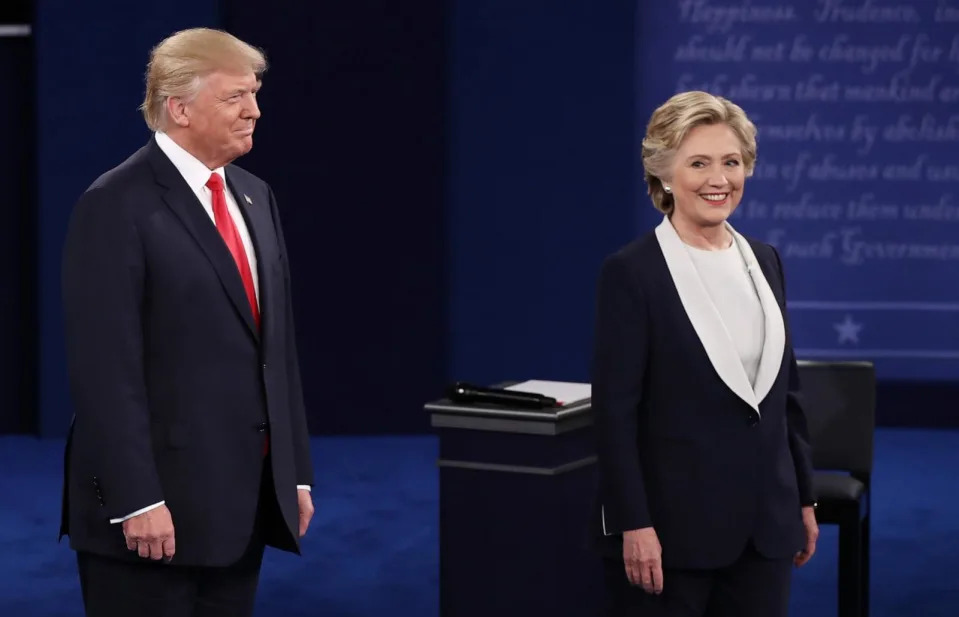
PHOTO: Formers Republican presidential nominee Donald Trump (L) and Democratic presidential nominee former Secretary of State Hillary Clinton stand on stage during the town hall debate at Washington University on Oct. 9, 2016 in St Louis, Mo. (Win Mcnamee/Getty Images, FILE)
The club’s gala is known for making headlines with its speeches and a room full of guests with their own controversies.
Saturday’s event honored figures like Bannon, who was sentenced last year after being convicted of contempt of Congress.
Bannon has had an off-and-on relationship with Trump, including serving briefly as a senior White House strategist in 2017. Trump pardoned him in early 2021 after Bannon was accused of money laundering and conspiracy to commit wire fraud by federal prosecutors. Bannon has pleaded not guilty to similar charges filed by prosecutors in New York City.
Other guests on Saturday included former New York City Mayor Rudy Giuliani, who is charged with Trump in a Georgia election subversion indictment (Giuliani has pleaded not guilty); and Arizona Rep. Paul Gosar, who was previously censured and removed from committees after posting a graphic anime clip featuring violence against New York Rep. Alexandria Ocasio-Cortez.
At one point during the gala, host Alex Stein tried to make a punchline out of stereotyping the Black and Hispanic community as criminals and gang members, saying it would be “good if Donald Trump went to jail” because it would help him earn the support from those communities.
Stein then repeated the joke later in the night when Trump was in the room.
“Once President Trump is back in office, we won’t be playing nice anymore. It will be a time for retribution,” the club’s president, Gavin Wax, said in his own remarks. “After baseless years of investigations and government lies and media lies against this man, now it is time to turn the tables on these actual crooks and lock them up for a change.”
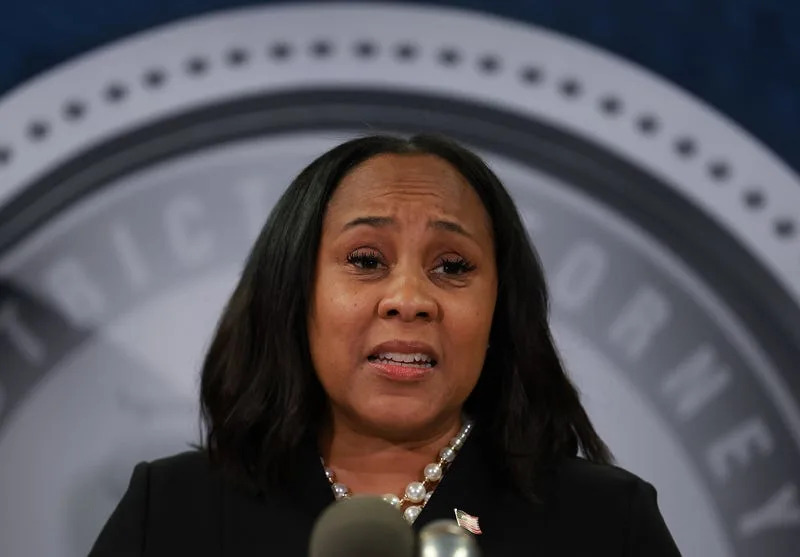
ATLANTA, GEORGIA – AUGUST 14: Fulton County District Attorney Fani Willis speaks during a news conference at the Fulton County Government building on August 14, 2023 in Atlanta, Georgia. A grand jury today handed up an indictment naming former President Donald Trump and his Republican allies over an alleged attempt to overturn the 2020 election results in the state.
Fulton County District Attorney Fani Willis doesn’t appear to be messing around when it comes to former Donald Trump.
On Thursday, The Guardian reported on newly obtained emails from the District Attorney, revealing that Willis is aiming for serious jail time for Trump.
Willis recently announced that she will seek an Aug. 5 trial date for Trump in the election interference case, meaning that Trump could be facing at least two felony trials in the midst of the 2024 election.
In court, Trump’s attorney, Steve Sadow, argued that the August date amounts to “election interference.” Willis was asked by CNN about the allegation from Sadow on The Root’s red carpet. “I think it’s ridiculous; we’ve been conducting that investigation since 2021,” Willis said. “The investigation has taken the normal course, and we’re at the point that the investigation naturally took us to.”
Sadow responded to CNN: “What is utterly ‘ridiculous’ is Willis, the DA in Fulton County, GA, campaigning for substantial money handouts from left-wing democrats in Washington D.C. and NYC yet proclaiming her prosecution of President Trump is not political.”
Regardless of when the trial actually occurs, preparing to take on a former President in a sprawling RICO case will undeniably be labor intensive. But Willis told The Root that her main focus going into the new year is “violent crime.”
“We need to make sure that we keep the community safe,” she said. “You need to be safe no matter what your socio-economic status is, whether you’re living in an impoverished neighborhood or one that is plentiful.”
Trump’s Capitol Hill allies push part of his 2025 agenda
Sophia Cai – December 9, 2023
Photo illustration: Sarah Grillo/Axios. Photo: Roberto Schmidt/AFP via Getty Images
Former President Trump’s allies in Congress are pushing a series of bills that reflect part of his 2025 agenda, including plans to crack down on mask mandates, affirmative action and who can become a U.S. citizen.
Why it matters: The recent proposals show that even as Trump plans to remake the executive branch in a way that would give him unprecedented power as president, Trump’s MAGA loyalists on Capitol Hill aim to turn many of his campaign-rally talking points into law.
The proposals also reflect Trump’s influence on Congress’ GOP caucus — despite losing the 2020 election, his not-so-stellar record endorsing other Republicans, and the prospect of facing four felony trials as he runs for president next year.
Trump’s been endorsed by at least 83 House Republicans and 16 GOP senators for the 2024 election, when Republicans will try to take over the Senate while Democrats will seek to regain control of the House.
Zoom in: Sen. J.D. Vance’s (R-Ohio), one of Trump’s most loyal backers in Congress, introduced a bill over the summer to bar the Department of Transportation from enforcing mask mandates, a popular cause in Trumpworld.
The bill, an echo of conservative criticisms of pandemic-era restrictions, passed the Senate with votes from 10 Democrats. Trump has promised to “use every available authority to cut federal funding to any school, college, airline or public transportation system” imposing a mask or vaccine mandate.
Rep. Jim Banks (R-Ind.) and Vance this week introduced a bill to create a federal office to investigate any claims of colleges using affirmative action in admissions — essentially an agency to police a Supreme Court ruling this year that Trump and other Republicans cheered.
Rep. Marjorie Taylor Greene (R-Ga.), another Trump loyalist, has joined Vance in proposing bills that would make gender-affirming care for minors a felony, another priority on the far right’s social agenda.
Rep. Matt Gaetz (R-Fla.), meanwhile, introduced legislation to end birthright citizenship for children of undocumented immigrants after Trump vowed to sign an executive order to do the same on his first day back in office day.
The intrigue: Rep. Elise Stefanik (R-N.Y.) and Greene have put forward a pair of legally dubious bills that would aim to “expunge” Trump’s two impeachments — an idea Trump talks about frequently and would favor, people familiar with his thinking tell Axios.
Legal analysts largely agree, though, that Congress has no such authority.
Between the lines: One of the biggest issues Trump had as president was a lack of ideological allies in the Senate even though it was controlled by the GOP, a person close to Trump’s campaign tells Axios.
If Trump were to win a second term, he’d hope for another GOP majority in the Senate and count on Vance and a few other like-minded Republicans senators such as Eric Schmitt (Missouri), Tommy Tuberville (Alabama) and Roger Marshall (Kansas) to be “bulldogs” for his policies, the source close to the campaign tells Axios.
In the House, Trump enjoys a close relationship with new Speaker Mike Johnson (R-La.). During Trump’s first impeachment hearings, Johnson, then a member of the House Judiciary Committee, defended the president on TV.
Reality check: In today’s Democrat-controlled Senate — and as long as both chambers of Congress aren’t under total GOP control — the vast majority ofthe legislation proposed by Trump allies has no chance becoming law.