‘Grifters and sycophants’: the radicals who would fill key posts if Trump is re-elected

The Guardian

‘Grifters and sycophants’: the radicals who would fill key posts if Trump is re-elected

Peter Stone – December 8, 2023

<span>Photograph: Leah Millis/Reuters</span>
Photograph: Leah Millis/Reuters

As Donald Trump and his allies start plotting another presidency, an emerging priority is to find hard-right lawyers who display total fealty to Trump, as a way to enhance his power and seek “retribution” against political foes.

Related: Trump says ‘I’m not a dictator’ but top figures warn of authoritarian takeover

Stocking a future administration with more ideological lawyers loyal to Trump in key posts at the justice department, other agencies and the White House is alarming to former DoJ officials and analysts who say such plans endanger the rule of law.

Trump’s former senior adviser Stephen Miller, president of the Maga-allied legal group America First Legal, is playing a key role in seeking lawyers fully in sync with Trump’s radical agenda to expand his power and curb some major agencies. His search is for those with unswerving loyalty to Trump, who could back Trump’s increasingly authoritarian talk about plans to “weaponize” the DoJ against critics, including some he has labeled as “vermin”.

Miller is well known in Maga circles for his loyalty to Trump and the hard-line anti-immigration policies he helped craft for Trump’s presidency. Notably, Trump has vowed to make those policies even more draconian if he is the GOP nominee and wins again.

Such an advisory role for Miller squares with Trump’s desire for a tougher brand of lawyer who will not try to obstruct him, as some top administration lawyers did in late 2020 over his false claims about election fraud.

Trump doesn’t care about the rule of law or the quality of the criminal justice system. He only cares about fealty to him

Former Trump White House lawyer Ty Cobb

“They’re looking for lawyers who worship Trump and will do his bidding,” Ty Cobb, a former White House lawyer during the Trump years and former justice department official, said. “Trump is looking to Miller to pick people who will be more loyal to Trump than the rule of law.”

Cobb added that “Trump trusts Miller greatly”, although Miller is not a lawyer.

“Trump doesn’t care about the rule of law or the quality of the criminal justice system,” Cobb said. “He only cares about fealty to him.”

Miller’s legal group, which raked in a hefty $44m dollars in 2022, also has a board seat with Project 2025, a sprawling effort led by the Heritage Foundation and dozens of other conservative groups to map policy plans for a second Trump term – or another GOP presidency if Trump is not the nominee.

Project 2025 includes schemes to curb the justice department, the FBI and other agencies, giving Trump more power to seek revenge – as he has pledged to do in campaign speeches and Truth Social posts – against critics in both parties, which could benefit from conservative lawyers’ sign-offs, but which justice department veterans warn would undermine the legal system.

It seems that they are looking for lawyers who will do whatever Trump wants them to do, and that is the antithesis of implementing the rule of law,” Donald Ayer, a former deputy attorney general under George HW Bush, said.

“When you consider the number of lawyers who became Trump’s severe critics after joining the first Trump administration and participating in a lot of questionable actions, selection for a new administration will have to exclude pretty much anyone who has any inclination to defend our legal system or question the president asserting absolute authority.”

Ayer’s analysis is underscored by Trump’s 2020 anger at top lawyers such as the then attorney general William Barr, the then White House counsel Pat Cipollone and others, who pushed back on Trump for his false claims that he lost to Biden due to fraud.

Trump has cited Barr – one of several former top lawyers and officials who later became critics – as someone he would press the justice department to launch inquiries against, according to the Washington Post.

The former president, who faces 91 criminal charges in four jurisdictions including 17 involving his aggressive efforts to overturn his 2020 election defeat, has also threatened to appoint a special prosecutor to “go after” Biden and his family.

Trump has attacked the prosecutions against him as political witch-hunts, arguing they give him the right if he wins the presidency again to use the justice department and FBI as tools to attack his opponents.

Trump’s retribution agenda was partly revealed on Tuesday at a Fox News town hall, when he slyly said if he was elected again he would not be a dictator “except for day one”.

To help facilitate Trump’s agenda, Miller plus the former Trump aide John McEntee, who started as Trump’s personal aide and then became a key adviser in 2020, have reportedly been working with others at Project 2025 to identify tougher pro-Trump lawyers.

Besides Miller’s group, numerous conservative groups have board seats on Project 2025 including the Center for Renewing America, a thinktank run by the former Trump budget director Russ Vought. The center employs Jeffrey Clark, a former justice department official who pushed false information about voting fraud in 2020 as part of Trump’s efforts to overturn his election loss. Clark has written a paper that Vought’s center published titled The US Justice Department Is Not Independent.

However, Clark and several other former Trump lawyers are now facing major legal headaches after aiding Trump’s efforts to block Biden’s victory, which could complicate Miller’s hunt for new diehard Trump lawyers.

This is a search for people with situational ethics

Timothy Naftali of Columbia University

Clark and other key conservative lawyers including Rudy Giuliani and John Eastman have been charged by the Fulton county, Georgia, district attorney, Fani Willis, in a sprawling racketeering case against Trump and 18 others for seeking to thwart Biden’s Georgia victory. Other Trump legal advisers who were charged, including Kenneth Chesebro, Sidney Powell and Jenna Ellis, have struck plea deals with Willis.

Some experts foresee real dangers to democracy in Miller’s search for lawyers who would back Trump’s emerging far-right agenda.

“This is a search for people with situational ethics,” Timothy Naftali, a senior research scholar at Columbia University’s School of International and Public Affairs, said.

“They’re trying to screen out people who have higher loyalties to the US constitution. It’s likely they’re looking for people whose higher loyalty is to Donald Trump,” he said. “They’re trying to find lawyers who believe in dictatorship. You have to wonder what kind of people in good conscience could sign up for a Trump revenge tour. This appears to be a casting call for an American political horror movie.”

If Trump wins, some of the lawyers who may be candidates for key posts according to the New York Times include a few who work at either Miller’s group or have worked for Texas’s attorney general, Ken Paxton, a close Trump and Miller ally who has faced several ethics and criminal inquiries.

Miller and his legal center did not respond to a request for comment for this story.

Miller’s lawyer search could benefit from his group’s contacts in Maga circles and rapid growth. When America First Legal was launched in 2021, it soon garnered $1.3m from the Maga-allied Conservative Partnership Institute, where Trump’s ex-chief of staff Mark Meadows is a senior official. Meadows and Vought have both served on the board of Miller’s group.

America First Legal’s deep pockets have helped fund an array of lawsuits against the Biden administration, states targeting immigration policies and what Miller has labeled “the equity cult”. Just last month, America First Legal filed a brief opposing the limited gag order placed on Trump by a federal judge overseeing special counsel Jack Smith’s four-count criminal indictment of Trump for election subversion.

More broadly, the mission statement of Miller’s America First Legal reveals its ideological compatibility with Trump’s authoritarian-leaning agenda, of which hard-right lawyers would be assets in implementing should Trump get another term.

“Our security, our liberty, our sovereignty, and our most fundamental rights and values are being systematically dismantled by an unholy alliance of corrupt special interests, big tech titans, the fake news media, and liberal Washington politicians,” the mission statement reads.

Given Miller’s strong ties to Trump, some GOP congressional veterans are alarmed by his search for more ideological lawyers who would not question Trump’s emerging authoritarian agenda.

“They’re looking for grifters and sycophants like Jeffrey Clark and Ken Paxton,” said the former House member Charlie Dent.

In Dent’s eyes, these kinds of lawyers would “do whatever they’re told. This is absolutely dangerous.”
Behind the Curtain — Exclusive: How Trump would build his loyalty-first Cabinet

Axios – Politics and Policy

Behind the Curtain — Exclusive: How Trump would build his loyalty-first Cabinet

Mike Allen and Jim VandeHei – December 7, 2023

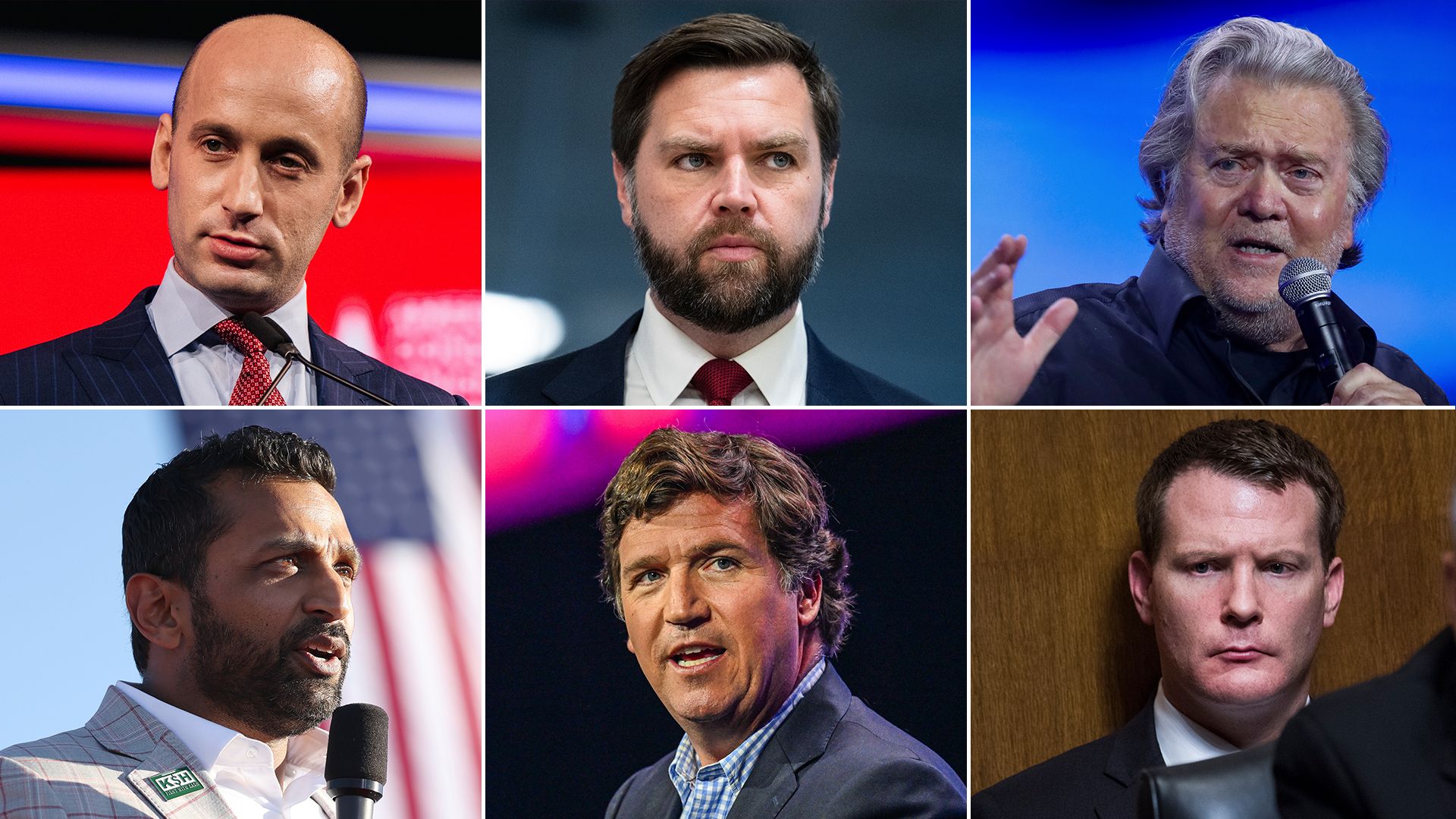
Clockwise from top left: Stephen Miller, Sen. J.D. Vance, R-Ohio; Steve Bannon, Mike Davis, Tucker Carlson and Kash Patel. Photos: Giorgio Viera/AFP, Tom Williams/CQ-Roll Call, Eva Marie Uzcategui/Bloomberg, Brandon Bell, Justin Sullivan/Getty Images

Former President Trump, if elected, would build a Cabinet and White House staff based mainly on two imperatives: pre-vetted loyalty to him and a commitment to stretch legal and governance boundaries, sources who talk often with the leading GOP presidential candidate tell Axios.

Why it matters: Trump would fill the most powerful jobs in government with men like Stephen Miller, Sen. J.D. Vance of Ohio and Kash Patel — with the possible return of Steve Bannon. If Trump won in 2024, he’d turn to loyalists who share his zeal to punish critics, purge non-believers, and take controversial legal and military action, the sources tell us.

Trump and his prospective top officials don’t mince words about their plans:

What’s happening: Trump hasn’t settled on specific roles for specific figures, and hates it when his staff and friends speculate otherwise. It’s not in his DNA to do detailed personnel planning, and a lot depends on the last few people he’s talked to.

  • But in rolling conversations with friends and advisers, he’s been clear about the type of men — and they’re almost all older, white men — he’d want to serve at his pleasure if he were to win a second term.

Between the lines: We wrote last month about the multimillion-dollar effort to vet loyalists for up to 50,000 lower-level government jobs in a Trump administration. This is about their potential bosses.

  • It’s unclear who would land where, but make no mistake: These are specific prototypes of Trump Republicans who would run his government. This is very different from the early days of his first term, when he was restrained by more conventional officials, from John Kelly to James Mattis to Gary Cohn.
  • This time, it’d be all loyalists, no restraints. 

Here’s our latest intelligence on what’s being discussed among Trump and a small group of confidants:

Vice president: Trump talks openly to friends about several possibilities for running mate. Table stakes for these candidates is proving you believe the 2020 election was stolen and that former Vice President Mike Pence wimped out by allowing its certification.

  • Those who’d be considered include J.D. Vance, the “hillbilly Elegy” author and a MAGA favorite; Arkansas Gov. Sarah Huckabee Sanders; Kari Lake, a leading election denier now running for U.S. Senate in Arizona, and South Dakota Gov. Kristi Noem. (Vance might prefer to remain in the Senate as “Trump’s hammer,” we’re told.)
  • Rep. Byron Donalds (R-Fla.), one of the few Black Republicans in Congress, has traveled with Trump on the campaign and would love to be V.P. Rep. Marjorie Taylor Greene, who lost her House committee assignments because she pushed baseless conspiracy theories, also gets mentioned.
  • But here’s an interesting twist: Melania Trump is an advocate for picking Tucker Carlson, the booted Fox News star. She thinks Carlson would make a powerful onstage extension of her husband, a source close to Trump told us. The former first lady has made few campaign appearances this time around — but a Trump-Carlson ticket might encourage her to hit the trail.
  • Trump, asked last month about Carlson as a potential V.P., said: “I like Tucker a lot. … He’s got great common sense.”
  • The idea of Tucker Carlson has been discounted by many people close to Trump because they assume he’d never pick someone who could outshine him. And Trump’s staff is convinced (correctly) that Carlson can’t be controlled. But the two men talk a lot.

Others likely to wield power in a second Trump term share a lot in common with Carlson. They’re full, proud MAGA warriors, anti-GOP establishment zealots, and eager and willing to test the boundaries of executive power to get Trump’s way. They include:

Stephen Miller:  He could be your next attorney general and, if not that, get a Cabinet-level role to greatly influence immigration policy.

  • He was the architect of Trump’s most controversial immigration plans in the first term — including family separation — and has written and spoken extensively about unprecedented plans to detain, purge and punish undocumented immigrants if put back in charge. He’s eager to test the boundaries of what courts and the military can do to make this happen fast.
  • Miller currently heads a nonprofit dedicated to suing the Biden administration and promoting “America First” causes, and has been leading efforts to recruit an army of right-wing lawyers to staff a MAGA-dominated executive branch.
  • Carlson told Axios that Miller would be his first choice to lead the Justice Department: “He’s a serious person and he understands how the system works.”

Mike Davis: Donald Trump Jr. has floated Davis, the former chief counsel for nominations to then-Senate Judiciary Chairman Chuck Grassley (R-Iowa), to be Trump’s interim attorney general — saying it would be a “shot across the bow of the swamp.”

  • In his public auditions for the job, the bombastic Davis has promised a “three-week reign of terror” in which he would “put kids in cages” and jail prosecutors and journalists who have gone after Trump — even telling MSNBC’s Mehdi Hasan that he has “his spot picked out in the D.C. gulag.”
  • A source close to the Trump campaign told us A.G. is the office where Trump is “most likely to make a shocking pick,” with the defiant view: “You want to weaponize DOJ, mother—-er?'”

Steve Bannon: In the early days of Trump’s first term, he was arguably the most powerful man on staff, plotting personnel and policy decisions from his Capitol Hill townhouse. Then, he was ousted and frozen out. Now, thanks to his popular podcast and pro-Trump fervency, he’s back.

  • He could be the next White House chief of staff, an idea Carlson and a few others are pushing hard with the former president.
  • Carlson tells Axios that Bannon would diligently implement promises after Trump lost interest. “Steve believes: If you said we’re building a wall, we’re building a wall,” Carlson said.
  • Bannon — who is appealing a contempt of Congress conviction — has proud authoritarian beliefs and sees everything as an existential war between good (Trump) and evil (Democrats, establishment Republicans, the media).

Kash Patel:  A protege of former Rep. Devin Nunes (R-Calif.) who led efforts to discredit the Russia investigation, Patel came to be viewed as a political mercenary in Trump’s war against the intelligence community. The former Pentagon official would be considered for a top national security job in the next administration, possibly even running the CIA or NSC.

  • In 2021, Patel authored an illustrated children’s book about the Russia investigation in which “King Donald” is a character persecuted by “Hillary Queenton and her shifty knight.”
  • Trump took a shine to Patel in his first term but was talked out of making him a deputy director of the FBI or CIA by senior officials — including former Attorney General Bill Barr, who wrote in his memoir that it would happen “over my dead body.”
    • Former CIA director Gina Haspel threatened to resign over a plan to install Patel as her deputy in the final weeks of Trump’s presidency, when he became convinced the intelligence community possessed documents that could damage his political enemies.
  • Steve Bannon said this week on his “War Room” podcast that Patel would “probably” be CIA director in a second term.
  • Patel told Bannon: “One thing we learned in the Trump administration the first go-round is we’ve got to put in all of our compatriots from top to bottom. And we’ve got them for law enforcement … [Defense Department], CIA, everywhere. … Yes, we’re going to come after the people in the media who lied about American citizens.”
  • To avoid a confirmation battle, Patel also might have a National Security Council role where he could do special projects for Trump — or even be national security adviser.

Johnny McEntee, Trump’s loyalty vetter and enforcer, headed presidential personnel in the first term. McEntee might return to that role with even more power. He also could be Trump’s gatekeeper as head of Oval Office operations, or could be Cabinet secretary, riding herd on the White House liaisons to each department.

  • A former colleague described McEntee to us as “Trump’s utility player — a guaranteed loyal ally, wherever you place him, who’d make sure the Trump agenda was being implemented.”
  • The 33-year-old former UConn quarterback was empowered by the end of Trump’s term in a way his predecessors never were — tasked with systematically purging officials deemed insufficiently loyal and making significant staffing changes without the consent of agency heads.
  • By late 2020, McEntee had explicit lists of top officials to fire and hire in a Trump second term, reaching far down the federal bureaucracy in a mission to truly “clean out” the “Deep State.” That project has continued outside of government with a $22 million presidential transition project led by the Heritage Foundation.
  • “The president’s plan should be to fundamentally reorient the federal government in a way that hasn’t been done since F.D.R.’s New Deal,” McEntee told the N.Y. Times, arguing the current system “was conceived of by liberals” and must be completely overhauled.
  • In the final days of the Trump administration, McEntee sought to orchestrate the withdrawal of U.S. troops from Afghanistan, Iraq, Syria, Germany and Africa — a last-minute gambit by the president stifled by guardrails that likely wouldn’t be present in a second term.

Jeffery Clark — a former assistant attorney general for Trump who could get a top Justice Department slot — is the rare person to be considered for a future administration while under indictment.

  • In the weeks after the 2020 election, the little-known environmental lawyer urged top DOJ officials to announce they were investigating baseless claims of election fraud, which they rejected.
  • Trump then considered appointing Clark as acting attorney general as the pair plotted to overturn the election results, prompting DOJ leadership to threaten to resign en masse.
  • Clark was charged as part of the Trump racketeering case in Fulton County, Ga., over his attempts to have DOJ send a letter to Georgia officials declaring that fraud may have altered the outcome of the 2020 election.
  • Prosecutors say the statement was false and furthered the conspiracy to overturn the election. Clark pleaded not guilty.

Ric Grenell — former ambassador to Germany, and Trump’s acting director of national intelligence — would be on the short list for secretary of state.

  • Grenell infuriated European diplomats with his “America First” broadsides during his time in Berlin, and has basked in his reputation as an online troll beloved by the MAGA movement for his willingness to go on the attack.
  • Career intelligence officials have labeled Grenell — who declassified Obama-era intelligence in an effort to reshape perceptions of the Russia investigation — the least-experienced and most overtly political appointee ever to serve as head of the intelligence community.
  • In Grenell’s last Cabinet meeting before his exit, Trump praised him as an “all-time great acting [official], at any position.”
  • Former national security adviser Robert O’Brien, a more traditional conservative who remains in Trump’s good graces, would be a more confirmable pick for secretary of state.

Susie Wiles: Some in Trumpworld assume the most likely chief of staff is Wiles, the longtime Florida political operative who’s running Trump’s campaign.

  • The campaign so far has avoided the gusher of leaks that have been hallmarks of Trump operations. She’s seen as an adept Trump enabler who would serve loyally, with discipline. By bridging the campaign and the administration, she’d provide continuity.
  • Trump’s pell-mell style could push him to a wild-card choice for chief. “Everyone he knows is a direct report,” said one former Trump administration official.

John Ratcliffe, the former Texas congressman who was Trump’s final DNI, would be considered to head the CIA, for a return to DNI, for defense secretary or even for vice president.

  • Ratcliffe, a China Hawk, was one of Trump’s fiercest allies in Congress during the first impeachment inquiry. He later used his authority as the nation’s top intelligence official to declassify information aimed at calling into question the origins of both COVID and the Justice Department’s Russia investigation.

Jamie Dimon: Trump is open to a few more mainstream picks if they bring celebrity or pizzazz. For example, Trump would consider JPMorgan Chase CEO Jamie Dimon, a Democrat, to head Treasury. “He wants a big name,” a source close to the campaign said. “And he loves billionaires.”

  • It’s not clear Dimon would take the job — he’s been talking privately with Nikki Haley about the global economy as she tries to knock off Trump for the nomination. Dimon told the N.Y. Times DealBook conference that Haley would be “a choice on the Republican side that might be better than Trump.”
  • Dimon added: “He might be the president, and I have to deal with that, too.”

Sen. Tom Cotton of Arkansas — a former Army infantry officer known for his hard edge, and who wrote a New York Times op-ed in Trump’s first term supporting use of the Insurrection Act against civil disorder — would be considered to head the Pentagon.

Lee Zeldin —a former congressman from Long Island who deployed to Iraq as an Army paratrooper — is another confirmable option for the Pentagon.

  • Like Cotton, Zeldin is considered more confirmable than many others in the mix.

Jared Kushner, who was a huge power center in Trump’s West Wing, has mostly kept his distance from the campaign so far — but might well return to the White House if his father-in-law wins again, with a continued interest in Middle East policy.

  • Because Kushner would be talking with Trump’s authority to world leaders anyway, one option would be secretary of state.

What to watch: The heads of Cabinet departments don’t have full powers unless confirmed by the Senate. Many of Trump’s wannabe secretaries would have difficulty winning confirmation.

  • But Trump made unprecedented use of “acting” Cabinet members, who have temporary power over agencies even without Senate approval. And we’re told he’d be prepared to push the envelope on ambiguities about how many stints an “acting” could serve.
  • “I sort of like ‘acting,'” Trump said in 2019. “It gives me more flexibility.”

Zachary Basu and Sophia Cai contributed reporting.

“Behind the Curtain” is a column by Axios CEO Jim VandeHei and co-founder Mike Allen, based on regular conversations with White House and congressional leaders, CEOs and top technologists.

Editor’s note: This story has been updated to include that Bannon is appealing a contempt of Congress conviction.

Trump melts down on Truth Social after judge refuses to delay his testimony: “No way, no how”

Salon

Trump melts down on Truth Social after judge refuses to delay his testimony: “No way, no how”

Igor Derysh – December 6, 2023

Donald Trump Paul Hennessy/Anadolu via Getty Images

The judge overseeing former President Donald Trump’s New York fraud trial on Tuesday shot down his attorney’s request to postpone his scheduled testimony.

Trump attorney Chris Kise made a “lengthy request” to postpone Trump’s testimony, which is scheduled for Monday, until an appeals court reviews the gag orders Judge Arthur Engoron imposed on the former president and his legal team barring their attacks on his law clerk and court staff.

“Absolutely not. No way. No how. It’s a nonstarter,” Engoron told Kise, according to The Messenger’s Adam Klasfeld.

“You tried,” Engoron added. “And I gave it a deep thought, as well.”

Kise also told Engoron that Eric Trump, who was scheduled to testify on Wednesday, would no longer be part of the defense case, according to CNN. The defense is expected to finish its case after Trump’s testimony concludes next week.

Trump on Truth Social said he was behind Eric’s abrupt cancellation.

“I told my wonderful son, Eric, not to testify tomorrow at the RIGGED TRIAL brought about by A.G. Letitia James’ campaign promise that, without knowing anything about me, ‘I WILL GET TRUMP!’” Trump wrote Tuesday night. “She ran for A.G., then Governor of New York, and lost! Eric has already testified, PERFECTLY (Unlike their STAR witness-who admitted he lied!), so there is no reason to waste any more of this Crooked Court’s time on having him say the same thing, over and over again, as a witness for the defense (us!). His young life has already been unfairly disturbed and disrupted enough on this corrupt Witch Hunt. Besides, I will be testifying on Monday in this shameful, NO JURY ALLOWED ‘TRIAL.’”

Trump repeatedly lashed out at Engoron in a series of posts, claiming that the judge “should be sanctioned” and “thrown off the ‘bench.’”

Trump claimed to reporters on Tuesday that the gag order is in place because “they’re afraid to have me speak” even though the gag order only prevents him from targeting court staff, not the judge or the attorney general’s team nor from defending himself against the state’s claims.

“If Trump’s truly unconcerned about testifying while the NY gag orders in place, why did his lawyers ask Judge Engoron to postpone his testimony until his appeal of that gag order is resolved?” questioned MSNBC legal analyst Lisa Rubin.

Engoron, who already issued a summary judgment holding Trump liable for persistent fraud, imposed gag orders on Trump and his lawyers after they targeted his law clerk Allison Greenfield, who has been bombarded with hundreds of threatening and disparaging calls and messages, according to the court.

Trump falsely accused Greenfield of being romantically involved with Senate Majority Leader Chuck Schumer, D-N.Y., and his attorneys have accused her of bias and influencing the judge’s rulings in the case.

The gag orders were briefly paused on appeal, leading to a flurry of new attacks from Trump before an appeals court reinstated the gag order last Thursday.

Engoron warned Trump’s team that he plans to enforce the order “rigorously and vigorously.”

Listen closely to Liz Cheney about Republicans and the 2024 election | Opinion

The Charlotte Observer – Opinion

Listen closely to Liz Cheney about Republicans and the 2024 election | Opinion

Gene Nichol – December 5, 2023

Last Monday, candidate filing for the 2024 election began. On the same day, Black and Latino voters sued the state for race discrimination in the construction of the new congressional districts. Republicans said they didn’t do it. That’s what they always say. Every time.

But here is something that hasn’t always been said. Liz Cheney, the hard-right former member of Republican leadership in the U.S. House of Representatives, said: “…the Republican Party of today has made a choice and they haven’t chosen the Constitution.” She went on to say that if they control the House in January 2025, it will present “an existential threat” to the American democracy. It “can’t happen.” Defeating them, and Donald Trump, according to Cheney, is “the cause of our time.”

Here’s how her deadly accurate claim goes.

An election denier now leads the House of Representatives. Mike Johnson, whom Cheney describes as a former friend, is “dangerous” — he was “a collaborator in the overthrow of the election.” She has “seen him take steps he knows to be wrong, steps not supported by the law, by the facts, by the Constitution to do Trump’s bidding.”

“He can’t be the speaker in 2025”, she adds. We cannot have “an election which is thrown into the House of Representatives which is governed by the Republican Party.”

Johnson and his cohort have already shown themselves to be opponents of democracy; they’ve “made their choice,” as Cheney said. It is now “easy to see” the democracy-denying steps they’ll take. We’re “numb to the truth.” We are “slow walking to dictatorship.”

Cheney adds that these Republican House members “have an extra role to play in the normalization of Trump’s attack on democracy.” They bolster and amplify it, they aren’t, as they assume, just silent aiders and abettors. You can’t “defend the Constitution and support Donald Trump, they break their oaths.” “I don’t know how they look at themselves in the mirror,” she concludes. They “vote for the destruction of democracy in the United States.”

Surely Republicans understand this. Every step in the chain is literally and irrefutably true. But maybe it’s like historian Heather Cox Richardson says, “we get so invested in our own beliefs that we don’t care what is true.” And that provides fertile ground for the breeding of totalitarianism.

I know this can, somehow, seem distant to North Carolina. Washington stuff. But the bulk of our Republican House of Representatives delegation has voted to support sedition before. And the entire N.C. Republican delegation voted to elect “a collaborator in the overthrow of (the) 2020 election” as speaker of the House. All have now formally enrolled in the shameful sedition caucus. It is surely absurd and naïve and numb to assume any will stand on democratic principle when given the opportunity to hand the American experiment over to its first dictator.

I know a lot of us, even folks who vote for them, don’t think of an array of our Republican congressmen as serious people. We’ve elected them because they were outrageous, or owned a gun shop, or because they hate transgender people, or because they say they’re holy, or, apparently, because they are buffoonish. But now we face grim and sober business. Weighty work. In our highest calling.

North Carolina cannot afford to send a single Republican member to the U.S. Congress in 2024. Our very form of government, and the blood and tears shed in the long history of its sacred name, hang in the balance. As Ulysses Grant, and, I suppose, Liz Cheney, would put it: ““There are but two parties now: traitors and patriots.”

Contributing columnist Gene Nichol is a professor of law at the University of North Carolina-Chapel Hill.

14th Amendment challenge to Trump’s eligibility heads to Colorado Supreme Court

CBS News

14th Amendment challenge to Trump’s eligibility heads to Colorado Supreme Court

Melissa Quinn – December 6, 2023

14th Amendment challenge to Trump’s eligibility heads to Colorado Supreme Court

Washington — A closely watched legal fight that aims to keep former President Donald Trump off the ballot in Colorado under a rarely invoked provision of the 14th Amendment is set to come under review by the state’s supreme court on Wednesday.

The challenge to Trump’s candidacy in Colorado is just one in a nationwide fight underway in courts across more than a dozen states. Those arguing against Trump say he is disqualified from holding federal office again under Section 3 of the 14th Amendment because of his conduct surrounding the Jan. 6, 2021, attack on the U.S. Capitol.

The provision says those who engaged in insurrection against the Constitution after swearing an oath to support it cannot hold federal or state office. While enacted after the Civil War and designed to exclude former Confederate civil and military officials from future office, the so-called disqualification clause has now been invoked to target Trump’s candidacy.

The question of Trump’s eligibility is widely expected to land before the U.S. Supreme Court, but it will face a major test when the seven members of Colorado’s Supreme Court consider a bid from voters to keep Trump off the state’s presidential primary ballot. Secretary of State Jena Griswold has until Jan. 5 to certify the candidates for Colorado’s March 5 primary, and Trump is leading the field of candidates vying for the Republican presidential nomination.

The Colorado Supreme Court is holding oral arguments in the case at 3 p.m. ET on Wednesday, or 1 p.m. local time. The proceedings will be streamed live on CBS News in the player above.

The Colorado lawsuit

Former President Donald Trump speaks at a campaign event in Ankeny, Iowa, on Dec. 2, 2023. / Credit: Getty Images

The four Republican and two unaffiliated voters in Colorado filed their lawsuit against Griswold and Trump in September, arguing the former president is disqualified from public office under Section 3. The voters asked a state trial court in Denver to block Griswold from taking any action that would allow Trump access to the ballot.

Following a five-day hearing, Judge Sarah Wallace concluded that the Jan. 6 assault was an insurrection against the Constitution, and found that Trump engaged in insurrection — the first time a court has made such a finding about the former president’s conduct regarding Jan. 6. But the judge found that Trump was not disqualified under Section 3 because the clause does not apply to those who took only the presidential oath and does not prevent those who engaged in insurrection from becoming president.

Section 3 of the 14th Amendment states:

No person shall be a Senator or Representative in Congress, or elector of President and Vice-President, or hold any office, civil or military, under the United States, or under any State, who, having previously taken an oath, as a member of Congress, or as an officer of the United States, or as a member of any State legislature, or as an executive or judicial officer of any State, to support the Constitution of the United States, shall have engaged in insurrection or rebellion against the same, or given aid or comfort to the enemies thereof. But Congress may by a vote of two-thirds of each House, remove such disability.

Wallace’s ruling rested on her finding that the president is not an “officer of the United States,” as cited in Section 3. She said the president’s oath to “preserve, protect, and defend the Constitution” differs from an oath to “support” the Constitution, as specified in the provision. As a result, she ordered Griswold to place Trump on the state’s GOP presidential primary ballot.

The group of voters challenging Trump’s candidacy and the former president both appealed to the Colorado Supreme Court. The voters argued that Section 3 covers the president and presidential oath. Trump pushed back on the findings involving the events of Jan. 6, among other matters.

In a filing with the state high court, lawyers for the voters said that excluding the president from the provision in the 14th Amendment “would make no sense.”

“There would be no reason to prohibit insurrectionists from serving as mere presidential electors, and from holding every other office in the land, while allowing them to hold the most powerful and hence most dangerous office,” they argued. “Nor would there be any reason to allow insurrectionist former presidents to hold office again, while excluding former low-level state officers.”

The former president challenged several aspects of Wallace’s decision. His legal team claimed that the trial court lacked jurisdiction to consider the case because Section 3 is not self-executing and could only be enforced through an act of Congress. Trump’s lawyers also argued that his speech on Jan. 6 was protected under the First Amendment and asserted that states cannot create and enforce an additional qualification for a candidate to be elected president.

“The framers excluded the office of President from Section Three purposefully,” his lawyers told the state supreme court. “Section Three does not apply, because the presidency is not an office ‘under the United States,’ the president is not an ‘officer of the United States,’ and President Trump did not take an oath ‘to support the Constitution of the United States.'”

The case, Trump’s legal team said, is about whether Republicans and unaffiliated voters in Colorado can be denied their right to vote for the former president. They warned that candidate access to the ballot affects the constitutional rights of not only those running, but also that of voters to cast their ballots effectively.

Griswold, who was sued in her capacity as Colorado’s chief election official, has not taken a position on whether Trump should be listed on the ballot. But in a filing with Colorado’s high court, lawyers for the state said the secretary’s “overriding concern” is that Colorado courts and election officials remain empowered to ensure the integrity of the ballot.

“Electoral chaos”

If Trump’s argument that state courts don’t have jurisdiction to hear the constitutional claim under state election law is accepted, it would hinder the ability of the state and courts to exclude candidates from the ballot who are disqualified from holding office, Colorado Attorney General Phil Weiser wrote.

The former president’s assertion “would render ballots nothing more than vehicles for political party expression with the State unable to exclude even candidates who do not meet the age, residency, or nationality requirements for office,” Weiser argued. “This radical interpretation would undermine Colorado’s interests in ballot integrity and ensuring that all Colorado voters can cast ballots for eligible candidates.”

Supporting Trump in the case is a group of 19 GOP-led states, who said in a friend-of-the-court brief that the question of the former president’s eligibility under the 14th Amendment demands a “single, national answer.”

“Electoral chaos would ensue if a presidential candidate, whose eligibility is governed by a single set of constitutional requirements, is eligible to appear on some States’ ballots but not others,” officials for the states said in their filing.

They argued that questions about the so-called insurrection clause are left to Congress, and said the case raises a political question that cannot be decided by the courts.

At least two courts, a state court in Michigan and federal district court in New Hampshire, have already dismissed cases seeking to exclude Trump from their states’ presidential primary ballots because they raised political questions that courts were barred from adjudicating. A group of Michigan voters has appealed the decision from the court of appeals and asked the state supreme court to step in.

In Minnesota, the state supreme court dismissed a lawsuit that sought to bar Trump from the primary ballot under Section 3. But the court said in its ruling that voters challenging his candidacy could return after the state’s primary election on March 5 and pursue a case over the general election.

‘Test case’ for America: Colorado’s top court poised to weigh Trump’s eligibility to run again

Politico

‘Test case’ for America: Colorado’s top court poised to weigh Trump’s eligibility to run again

Erica Orden, Kyle Cheney and Zach Montellaro – December 6, 2023

Matthew Putney/AP

The most potent effort to disqualify Donald Trump from the 2024 ballot lands Wednesday in the lap of Colorado’s highest court — and a ruling there could send the case hurtling toward the U.S. Supreme Court just as the election year arrives.

The Colorado case is one of dozens around the country that have challenged Trump’s eligibility to return to the presidency. The cases argue that he is disqualified under section 3 of the 14th Amendment, which states that anyone who “engaged in insurrection or rebellion” after taking an oath of office to support the Constitution is forbidden from holding any public office.

So far, no court has declared Trump ineligible, and few of the cases have advanced beyond initial stages. In Minnesota, the state supreme court dismissed a challenge seeking to bar Trump from that state’s Republican primary ballot, but said the challengers could bring a new case concerning the general election after the primary. In Michigan, a state judge dismissed a challenge there, and an appeals court is expected to issue a ruling after Dec. 8.

The Colorado case, however, is on the fastest track, and the challengers there may have one of their most favorable venues: All seven justices of the Colorado Supreme Court are Democratic appointees.

During Wednesday’s argument, those justices will face two weighty questions: whether Trump provoked and participated in the Jan. 6, 2021, insurrection at the U.S. Capitol and, if so, whether that act requires his removal from the ballot.

After a week-long trial last month in Denver, the district judge who heard the case on an expedited basis ruled that Trump was a willing instigator of the violence that nearly derailed the transfer of power in 2021. But Judge Sarah Wallace also concluded that Trump could remain on Colorado’s presidential ballot because she found that the 14th Amendment’s insurrection clause does not apply to the office of the president.

Colorado Secretary of State Jena Griswold, a Democrat, said the lower court ruling was “pretty surprising.”

“I think it is important that a court of law has decided that Donald Trump engaged in insurrection,” she told POLITICO. “The court’s decision to say the presidency is excluded from section 3 of the 14th Amendment is the really surprising part. Under that decision, Donald Trump is above the law when it comes to insurrection.”

Now, the Colorado justices have a chance to lend the imprimatur of a state supreme court to the debate. And if they rule against Trump, they will trigger a rush to the U.S. Supreme Court, which would be called upon to resolve Trump’s eligibility nationwide.

“I think once that happens, the court will seriously consider getting involved,” said Richard Hasen, an expert in election law who teaches at UCLA Law School.

Sen. John Hickenlooper (D-Colo.), who appointed five of the seven current justices in his former role as the state’s governor, described the issue as a “test case” for the nation to determine the meaning of 14th Amendment provision. He said in an interview that he worries his state becoming the epicenter of the issue isn’t “in Colorado’s best interest.”

“That being said, we need to figure out what that law means,” he added.

Trump contends that the violence at the Capitol on Jan. 6 doesn’t amount to an insurrection at all. He argues that the Colorado challengers seeking to remove him from the ballot — several voters backed by advocacy groups — relied too heavily on the work of the House Jan. 6 select committee and on witness testimony that he argues was subjective.

He also argues that his conduct on Jan. 6 was largely protected by the First Amendment and that he can’t be blamed for the violence that followed his remarks to the crowd.

But Wallace rejected those assertions. “The Court finds that Petitioners have established that Trump engaged in an insurrection on January 6, 2021 through incitement, and that the First Amendment does not protect Trump’s speech,” she ruled.

The case may turn on historical understandings about the roots of the 14th Amendment’s insurrection clause, which passed in the aftermath of the Civil War and was intended to prevent former leaders of the Confederacy from returning to power. The clause has rarely been applied in the modern era, and it has never been applied to a presidential candidate — nor has any former president been accused of aiding an insurrection against his own government.

The Jan. 6 select committee spent a year interviewing hundreds of witnesses in Trump’s orbit, amassing a trove of evidence that has formed the backbone of multiple civil and criminal investigations of Trump’s efforts to subvert the 2020 election. Though the committee’s conclusions were the subjective judgment of its nine members — seven Democrats and two Republicans — the hundreds of witness transcripts and exhibits laid bare an extraordinary effort by Trump to use his office to pressure federal and state officials to prevent Joe Biden from taking office.

That effort culminated with Trump’s incendiary speech to a crowd of supporters on Jan. 6 near the White House, where Trump urged them to “fight like hell” to “stop the steal” and told them to march on the Capitol. Violence was already underway during his speech, and thousands of his supporters began the 1.5-mile march before hearing him implore them to go “peacefully.”

Wallace’s trial featured testimony from the Jan. 6 committee’s chief investigator, Tim Heaphy, who described the panel’s evidence-gathering process. Other witnesses included D.C. Police Officer Daniel Hodges, who was famously assaulted by Jan. 6 rioters while he was wedged in a Capitol doorway; former Trump Pentagon aide Kash Patel; retiring Rep. Ken Buck (R-Colo.); and several experts in constitutional history and right-wing extremism.

Wallace’s ruling perplexed many legal advocates by concluding that Trump engaged in an insurrection but nevertheless holding that he could remain on the ballot.

Advocacy groups successfully deployed the 14th Amendment to have a local official in New Mexico removed from office last year over his actions related to Jan. 6. A state judge ordered that Couy Griffin, a “Cowboys for Trump” co-founder and then an Otero County commissioner, be removed. That lawsuit was backed by advocacy group Citizens for Responsibility and Ethics in Washington, which is also backing the Colorado case.

Griffin was previously convicted in a federal court for a misdemeanor for entering the grounds of the Capitol on Jan. 6. The state Supreme Court twice turned away his appeal of the 14th amendment ruling.

Activists have pushed election officials across the country to remove Trump from state ballots, but they have largely balked, saying courts — not election officials — should be the ones to make that call. Now, officials across the country are watching the Colorado case for signals on how to proceed in their own states.

Recently, Oregon Secretary of State LaVonne Griffin-Valade, a Democrat, said she would not remove Trump from the state’s primary ballot last week. Her office — relying on legal advice from the state Department of Justice — noted that state law treats presidential primary elections and the general election differently, and that her decision here does not apply to the November election.

“We recognize that the same question may come up with respect to the general election if Donald Trump is nominated,” Benjamin Gutman, the state’s solicitor general, wrote in a letter to Griffin-Valade. But, he concluded, “we think it would be prudent to defer consideration of the general-election question at present.”

Anthony Adragna contributed to this report.

Liz Cheney warns Trump will never leave office if he’s elected president again

NBC News

Liz Cheney warns Trump will never leave office if he’s elected president again

Rebecca Shabad – December 4, 2023

https://s.yimg.com/rx/ev/builds/1.1.50/pframe.html

WASHINGTON — Former Rep. Liz Cheney, R-Wyo., warned Monday that if Donald Trump is elected president next year for a second term, he will try to remain in power beyond those four years.

“There’s no question,” Cheney said about that possibility in an interview on NBC’s “TODAY” show with host Savannah Guthrie in advance of the release Tuesday of her book, “Oath and Honor: A Memoir and a Warning.”

Asked if she believes Trump would try to stay in power forever, Cheney said, “Absolutely. He’s already done it once,” referring to his efforts after the 2020 presidential election to overturn Joe Biden’s victory and to stop its certification on Jan. 6, 2021.

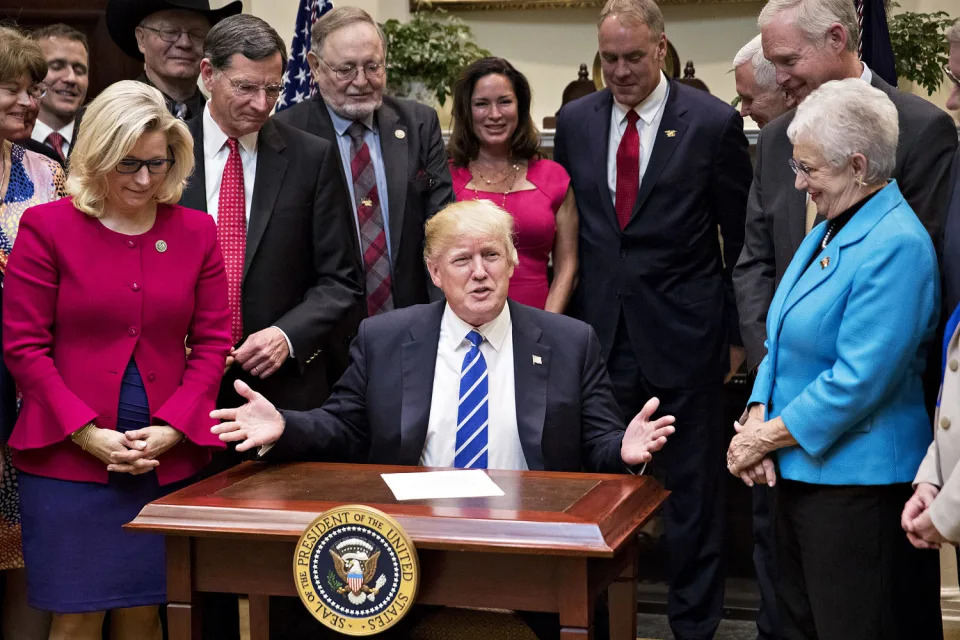
President Trump Signs Bills That Nullify Measures Put In Place During Obama Presidency (Andrew Harrer / Bloomberg via Getty Images file)

The U.S. could become a dictatorship if Trump is re-elected, Cheney warned. “I think it’s a very, very real threat and concern. And I don’t say any of that lightly and frankly, it’s painful for me as someone who has spent her whole life in Republican politics, who grew up as a Republican to watch what’s happening to my party and to watch the extent to which Donald Trump himself has basically determined that the only thing that matters is him, his power and his success.”

Cheney said it’s “naive” for Americans to think the country would survive another Trump presidency. She argued that Americans cannot count on a House led by Speaker Mike Johnson, R-La., to stop Trump or a Senate whose members include Republicans Josh Hawley, of Missouri, or Mike Lee, of Utah.

Asked what would happen if Trump tried to overturn the election again with Johnson as House speaker, Cheney said it’s “too dangerous to even contemplate going down that path” because, she said, they all had a “practice run” in 2020 and 2021.

Cheney suggested it would be safer for the country for Democrats to take control of the House, saying emphatically that Johnson and the Republicans currently serving there cannot be in the majority in 2025, especially if it has to determine the outcome of the presidential election.

“I think what we have seen is that you cannot count on this group of elected Republicans to uphold their oath,” she said.

Cheney repeated that she would “never vote for Donald Trump” and that she would “do whatever it takes to make sure that Donald Trump is defeated in 2024.” Asked if that means she would vote for Biden, she repeated, “I will do whatever it takes.”

“A vote for Donald Trump may mean the last election that you ever get to vote in,” she warned. “A vote for Donald Trump is a vote against the Constitution.”

The former congresswoman and daughter of former Vice President Dick Cheney said she would see how the presidential race unfolds over the next couple of months before deciding if she would try to launch her own White House bid.

‘Dictator’ Trump warnings spook America

AFP

‘Dictator’ Trump warnings spook America

Danny Kemp – December 5, 2023

A rash of dire warnings has appeared in US media that a second Trump presidency could slide into dictatorship (Brandon Bell)

Could a second Donald Trump presidency slide into dictatorship? A sudden spate of dystopian warnings has got America talking about the possibility less than a year before the US elections.

Dark scenarios about what could happen if the twice-impeached Republican former president wins in 2024 have appeared in the space of a few days in major US media outlets that include The Washington Post, The New York Times and the Atlantic.

Grim predictions also came from top Republican Trump critic Liz Cheney, who said that the country is “sleepwalking into dictatorship” and that she is weighing a third-party presidential run of her own to try to stop him.

Together, they paint a bleak picture of an angrier yet more disciplined Trump than during his first spell in the White House, one who would wreak vengeance on his perceived enemies and possibly try to stay in power beyond the two-term US limit.

Trump, 77, responded to the warnings in typical style by laughing them off — with an edge.

“He says, you’re not going to be a dictator, are you? I said no, no, no — other than day one,” Trump said when asked in a televised Fox News townhall on Tuesday if he would abuse power or seek retribution.

“We’re closing the border and we’re drilling, drilling, drilling (for oil). After that I’m not a dictator.”

– ‘Day one’ –

President Joe Biden, who is behind Trump in the polls ahead of a likely replay of their bitter 2020 contest, said the warnings backed his own claims to be defending democracy.

“If Trump wasn’t running, I’m not sure I’d be running. But we cannot let him win,” the 81-year-old Democrat told a campaign event in Massachusetts.

Biden cited Trump’s own increasingly violent language on the campaign trail, saying his rival’s description of his opponents as “vermin” echoed the language used in Nazi Germany.

The most eye-opening piece appeared in The Washington Post by conservative commentator Robert Kagan, with the headline: “A Trump dictatorship is increasingly inevitable. We should stop pretending.”

Comparing him to the power-grabbing Roman emperor Julius Caesar, the lengthy article says neither the US Constitution nor the Supreme Court could prevent Trump being “president for life” if he wanted.

Kagan wrote that if Trump survives the trials he faces over trying to upend the 2020 election and cling to power illegally, and wins the next election, he will in effect feel he is above the law and can get away with anything.

The New York Times analyzed the ways that a “second term could unleash a darker President Trump” than in his chaotic first presidency from 2017-2021.

Trump has “spoken admiringly of autocrats for decades” and would likely follow their example by packing the civil service with loyalists and using the Justice Department to crack down on opponents, it said.

In scenes reminiscent of a dystopian movie, it said Trump would also set up migrant detention camps and use the military against protesters under the US Insurrection Act.

The Atlantic magazine meanwhile is dedicating its entire January-February 2024 issue to what a Trump presidency would look like, with an editor’s note titled simply: “A Warning.”

– ‘Dangerous moment’ –

Some of the most dire forebodings have come from Cheney, the former Republican lawmaker and daughter of ex-vice president Dick Cheney, whose opposition to Trump made her a pariah in the party.

“It’s a very dangerous moment,” she told NBC on Sunday.

There was “no question” Trump would try to stay in office beyond 2028, she said, adding that the January 6, 2021 assault on the Capitol by supporters trying to overturn Biden’s election win was merely a “practice run.”

For his critics, Trump’s autocratic side has long been in plain sight.

Trump already faces trial for conspiring to upend the 2020 election result, with prosecutors saying on Tuesday that evidence shows he was determined to “remain in power at any cost.”

His language has turned more extreme in recent months, during which he described migrants as “poisoning the blood of our country” and suggested his former military chief should face death for treason.

But in the looking-glass world of Trump and his allies, he is always the victim.

“Joe Biden is the real dictator,” Trump said in a picture posted on his conservative Truth Social network.

The Atlantic’s new issue sounds alarm over second Trump term

The Hill

The Atlantic’s new issue sounds alarm over second Trump term

Lauren Sforza – December 4, 2023

The Atlantic’s new issue sounds alarm over second Trump term

The Atlantic’s newest issue is sounding the alarm over a potential second term by former President Trump, warning that another four years under the former president would be worse than the first.

For The Atlantic’s January/February issue, the magazine published a 24-article project titled “If Trump Wins” to outline what a second Trump presidency would look like. The magazine’s editor-in-chief, Jeffrey Goldberg, wrote an editor’s note titled, “A Warning,” to introduce the series, which largely argues against another Trump term.

He wrote that for a short-lived period he believed Trump would never be a candidate for the White House again. He said this period lasted only from Jan. 6, 2021, to Jan. 28, 2021 — the date when former Speaker Kevin McCarthy (R-Calif.) visited the former president at his Mar-a-Lago residence.

“And so here we are. It is not a sure thing that Trump will win the Republican nomination again, but as I write this, he’s the prohibitive front-runner. Which is why we felt it necessary to share with our readers our collective understanding of what could take place in a second Trump term,” Goldberg wrote.

“Our team of brilliant writers makes a convincingly dispositive case that both Trump and Trumpism pose an existential threat to America and to the ideas that animate it. The country survived the first Trump term, though not without sustaining serious damage. A second term, if there is one, will be much worse,” Goldberg continued.

Goldberg emphasized that The Atlantic is not a partisan magazine, noting that its issues with the former president do not stem from him being a Republican.

“We believe that a democracy needs, among other things, a strong liberal party and a strong conservative party in order to flourish. Our concern is that the Republican Party has mortgaged itself to an antidemocratic demagogue, one who is completely devoid of decency,” he wrote.

David Frum, a staff writer for The Atlantic, used his piece to argue that Trump would lurch the country into a “constitutional crisis” if elected again. Frum was a speechwriter for former President George W. Bush.

In a post on X, formerly Twitter, Frum wrote that his article argues that “Trump’s attempt to destroy the legal system will lead — not to dictatorship — but to chaos, to the paralysis of the presidency, the US government, an open door to US enemies.”

The New York Times also published an article Monday pushing back on a second Trump term that argued his win could lead to a “more radical” term than the first.

“As he runs for president again facing four criminal prosecutions, Mr. Trump may seem more angry, desperate and dangerous to American-style democracy than in his first term. But the throughline that emerges is far more long-running: He has glorified political violence and spoken admiringly of autocrats for decades,” according to the article.

Trump’s campaign dismissed The Atlantic’s articles in a statement to The Hill.

“This is nothing more than another version of the media’s failed and false Russia collusion hoax,” Trump campaign spokesman Steven Cheung said in a statement. “The Atlantic will be out of business soon because nobody will read that trash.”

A second Trump term ‘poses a threat to the existence of America as we know it,’ says The Atlantic’s top editor

CNN

A second Trump term ‘poses a threat to the existence of America as we know it,’ says The Atlantic’s top editor

Oliver Darcy, CNN – December 5, 2023

Bloomberg/Getty Images

Jeffrey Goldberg, the editor-in-chief of The Atlantic, refuses to go gently into that good night.

“We can’t participate in the normalization of Donald Trump,” an impassioned Goldberg told me by phone on Monday. “I refuse to participate in the normalization of Donald Trump.”

Goldberg is one of the few major newsroom leaders who has been exceptionally clear-eyed about the perilous storm on the horizon for American democracy. Using plain language, Goldberg and his team of writers at the renowned magazine have not shied away from portraying Trump as a vandal of civilized society and an outright menace to the U.S. Constitution.

On Monday, The Atlantic published a special edition of its monthly magazine focusing on what a second Trump term would look like. The aptly-titled “If Trump Wins” issue features two dozen articles laying out how the twice-impeached, four-time indicted candidate would shred norms, weaponize government, warp the rule of law, and degrade democracy.

“I want people to be able to hand this issue to people… who are still unsure about the nature of Trump’s authoritarianism,” Goldberg explained to me.

While the leaders of major American newsrooms might privately believe Trump will aim to rule as an authoritarian, it is rare to hear any of them say so aloud — especially in such frank terms. But Goldberg is more than comfortable doing so. He points out that his position is not a partisan one. It’s “not about Republicans and Democrats,” he stressed, but “about authoritarians versus pro-democracy Americans.” And, in his view, not being open with readers about dangerous forces on the march would amount to a dereliction of duty.

“I would prefer journalists to speak plainly about what they’re seeing,” Goldberg said. “And I believe that a second Trump term poses a threat to the existence of America as we know it.”

It is not difficult for newsrooms to state that they are pro-democracy. Most leaders in the Fourth Estate have no problem saying as much. The conundrum they face is that, in this dark time in which we find ourselves, staking out a vocal pro-democracy stance effectively means being anti-Trump. And most news organizations are not comfortable in that territory, given it could be perceived as partisan and turn away audiences.

“This is one of the discomforting aspects of this whole dilemma that people in the news media face,” Goldberg noted. “Our eyes and ears tell us that Donald Trump fomented an insurrection against the Constitution. Right? We saw it. We heard it. It happened. That means that he placed himself outside the norms of American democratic behavior. That is why I am comfortable devoting an entire issue of answering the question of what a second Trump term would look like and reaching the conclusion that it would be terrible. Absolutely terrible.”

When I asked Goldberg about whether being outspoken about the prospect of a second Trump presidency could alienate otherwise persuadable audiences, he argued that self-censorship is not the solution. As he put it, “At a certain point, you can’t convince people of reality.”

“All we can do is try to present fairly and completely our fact-checked views of Trump and Trumpism and hope that people read it and understand that we are trying to be truthful with our readers and truthful with ourselves and transparent,” Goldberg said.
“And if some voters in America can’t handle that, then they can’t handle that. There’s not much I can do about it.”

“And this is the dilemma facing all journalism institutions,” Goldberg continued. “We’d like to be able to speak to 100% of Americans. But at a certain point you don’t want to twist or muffle or downplay certain realities simply because reporting those realities offends a segment of your audience.”

Goldberg personally knows that being candid and reporting aggressively on Trump can come with severe consequences. After Goldberg reported in September 2020 that Trump had disparaged American servicemembers who had died in war as “suckers” and “losers” (something former White House chief of staff John Kelly later confirmed on the record to Jake Tapper), he had to move out of his house over security concerns for a period.

But, he warned, a second Trump presidency could be even worse for the press. And, for that reason, members of the news media will need to contemplate their editorial decisions now, given Trump’s already-declared hopes to muzzle critics if he were to regain power.

“We all understand that Trump thinks of us as enemies of the state, and we understand that there are consequences for us that come with this belief,” Goldberg said. “There’s a chance that he would try to somehow criminalize reporting in a second term, and so we have to sound the alarm about that, along with the more generalized threats to American democracy. And we have to sound the alarm now