The drama unfolded in the Senate as Sen. Elizabeth Warren, a Massachusetts Democrat, moved a request to allow the promotions and Tuberville blocked the action.
“I warned Secretary Austin that if he did this and changed this, I would put a hold on his highest-level nominees. Secretary Austin went through with the policy anyway in February of this year, so I am keeping my word,” Tuberville said on the Senate floor.
He has been blocking military promotions in objection to the Department of Defense providing leave and covering expenses for service members who travel to have abortions. Tuberville claims the policy is a violation of federal law.
Tuberville was head coach at the University of Cincinnati for four seasons before he resigned in December 2016, a short time after telling a heckling fan to “go to hell” and “get a job.”
Tommy Tuberville is in his second year as a U.S. senator from Alabama.
Warren and Defense Secretary Lloyd Austin say the promotions are critical to military readiness, and Tuberville is blocking pay raises and preventing key leaders from taking their posts.
“One senator is jeopardizing America’s national security,” Warren said on the Senate floor.
The promotion of Shoshana Chatfield to vice admiral and as the U.S. representative to the NATO military committee is especially urgent, Warren said.
“At this critical juncture of Russia’s illegal invasion of Ukraine, we need her leadership in NATO now more than ever,” she said.
Blocking military promotions leaves America more vulnerable, Austin said last month during a Senate Armed Services Committee hearing.
“There are a number of things happening globally that indicate that we could be in a contest on any one given day,” he said. “Not approving the recommendations for promotions actually creates a ripple effect through the force that makes us far less ready than we need to be.”
By Eliza Daley, orig. pub. by: By my solitary hearth – April 24, 2023
Photo by Annie Spratt on Upsplash
It’s spring, so obviously it’s time to get the garden in production. For those who don’t know where to start or who just want more tips I have some recommendations on books that I use every year in planning and implementing food production. I know I just talked about my book-free kitchen, however, this is one very important caveat — I definitely use books for the intersection of kitchen and garden. These books are less about cooking than growing, processing and storing the harvest, and all three affect food safety. So reference books are necessary.
I am reading a new one — The Backyard Homestead Book of Kitchen Know-How by Andrea Chesman (2015, Storey Publishing). Chesman lives on an acre in Vermont, so this book is highly relevant to me. However, with her decades of practical experience — in addition to her homestead life, she’s written many books and teaches classes on storing the harvest — there are tips for anyone anywhere who grows typical garden produce. I have already found useful suggestions and I have almost as much experience as she does, so I feel like this is a good book to recommend to anyone with a veg plot. One caution: her methods do tend to lean toward agricultural extension agency practices, lots of plastic and electricity. She acknowledges that not everybody is going to have the capacity to run two refrigerators and a chest freezer, but she also doesn’t talk as much about lower-energy preservation methods. However, she includes the most detailed instructions on drying food that I’ve ever encountered. Mostly without electricity. And since she does this in Vermont — in normal, New England summer humidity — I think I may have found my solution to that problem.
She also spends a bit at the beginning of the book talking about what you should grow. For example, if you don’t like stuffing squash in summer heat, don’t plant round varieties. And if your family is less than Victorian in number, then don’t plant more than a few bushes of all the summer squashes put together. But she doesn’t talk as much about gardening as she does about produce, so there isn’t good information on yields and varieties. I have other books for that.
Keeping the Harvest by Nancy Chioffi and Gretchen Mead (1991, Storey Publishing) is a slim but indispensable reference for basic recipes and techniques. It also contains a chart I have been using for decades: the yields of frozen veg per unit of harvest (bushels, heads, pounds, etc). This table is gold! Nothing is more annoying than running out of pint containers in the middle of processing veg, especially the chiles. With this chart, I know that I need at least 18 pint containers washed and ready when I tackle the 25 pound box of Big Jim peppers in August. They also give yields per unit of planting area (row feet, square feet, bushes, trees, etc). So if you are unsure about how many potatoes you should plant for a given yield or how much space will be necessary for that yield or even how much ‘yield’ you will be able to eat, then buy this book.
Another extremely useful reference book is Rosalind Creasy’s The Complete Book of Edible Landscaping (1982, Sierra Club Books). This is a permaculture book from before permaculture. I learned how to grow abundant food in small spaces from this one book. More a gardening manual than food processing book, Edible Landscaping contains general guides to growing and using just about every kind of fruit, veg and herb that might be grown in temperate climates. (And a few from more tropical conditions.) Creasy gives hardiness, growing season length, light and moisture needs, soil types and whatever else you need to grow a plant. She describes the different growing needs of different varieties of a given species also. For example, you may not live in a climate with the 1000 chill hours needed by Wolf River apples (my favorites), but there are plenty of apple varieties that can be grown in regions with warmer winters.
These two books are my main garden production planning references. I have many other books, but these are the ones that come out every year. I definitely recommend getting them if you are new to producing and storing your own food, or even if you just want to learn more about these skills that everyone will be needing in the not so distant future. However, I would also advise you to get at least one recently published reference on canning and preserving. This is one type of cookbook that I do use. Nobody should improvise on this stuff!
My two go-to garden planning books have plenty of recipes, however there have been many changes in the intervening decades on food safety recommendations. For just one example, it’s been determined that tomatoes are not high enough in acid to kill harmful microbes, so pressure-canning is safer than the water-bath canning I used to use on canned tomato sauce. Most of the recipes are fine and obviously I’m still alive after using them for many years, but that might just be because I’ve been lucky. (That, and botulism doesn’t stand a chance in my sterile kitchen…) But still, preserving low-acid veg is flirting with food poisoning even in the best conditions. So use up-to-date information on how to avoid that nightmare. I use Saving the Seasons by Mary Clemens Meyer and Susanna Meyer (2010, Herald Press), and I have the most recent copy of the USDA’s Complete Guide to Home Canning and Preserving (2008). I have a few other books on jams, chutneys and other high-acid things, but I always cross-reference cooking times and temperatures with the books I trust implicitly. And sometimes I even go look things up on extension agency websites, which presumably have the most recent information available.
So those books go very far toward planning a garden, including what use you’ll make of the produce. But to round out garden planning, especially for those who are looking to create a landscape that needs little maintenance and very few inputs, I have two other book recommendations. These are not quick reads, and maybe I should have suggested starting them last November, but they are invaluable in garden planning. The first is the classic ecology book by Donald Worster, Nature’s Economy (1977, Sierra Club Books). From how ecological balance is physically achieved to the history and ethics of the conservation movement, Worster’s book is a complete education. I only include one other book because it is written specifically for the garden: Ecology for Gardeners by Steven B. Carroll and Severn D. Salt (2004, Timber Press). If there is a fault in Worster’s book, it’s that he doesn’t talk as much as I’d like about the kinds of plants we grow intentionally. Carroll and Salt make up for that — and include lots of images! I don’t know about you, but I will never be able to sort out the good caterpillars from the evil spawn of hell without a good visual guide.
Hope these references help! They’ve inspired me to try new things and see the garden in new ways each year. And speaking of… it’s time to cut up the potatoes so they’ll be cured before planting time. So… I’m off to the cellar now.
Eliza Daley
Eliza Daley is a fiction. She is the part of me that is confident and wise, knowledgable and skilled. She is the voice that wants to be heard in this old woman who more often prefers her solitary and silent hearth. She has all my experience — as mother, musician, geologist and logician; book-seller, business-woman, and home-maker; baker, gardener, and chief bottle-washer; historian, anthropologist, philosopher, and over it all, writer. But she has not lived, is not encumbered with all the mess and emotion, and therefore she has a wonderfully fresh perspective on my life. I rather like knowing her. I do think you will as well.
By Chris Smaje, originallypublished by Small Farm Future
April 20, 2023
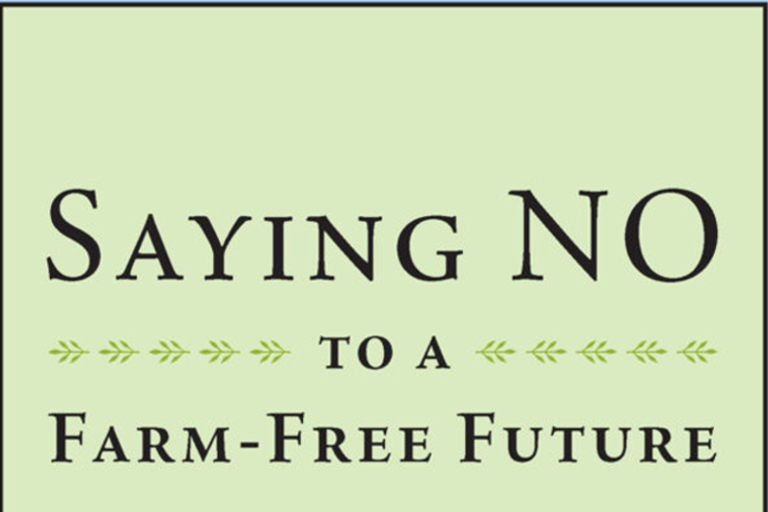
The time has come to announce my new book, Saying NO to a Farm-Free Future: The Case for an Ecological Food System and Against Manufactured Foods. It’ll be published in the UK on 29 June and the US on 20 July, with ebook and audio versions also available. So there’s no excuse… I’m delighted that Sarah Langford, the author of Rooted, is writing a foreword for it.
The folks at Chelsea Green have come up with this attractive but unfancy cover, which matches my feelings about the book.
I wrote the book in a two-month blur as a job of work that I felt somebody had to do to combat the head of steam building around the case for a farm-free future associated with George Monbiot’s book Regenesis and the Reboot Food initiative. And if that somebody was me, so be it.
My original motivation was mainly just to critique the fanciful ecomodernism of Reboot Food, which I believe is apt to bedazzle people of goodwill but with limited knowledge of food and farming into thinking that a technological solution is at hand that will enable them to continue living high-energy, urban consumerist lifestyles while going easy on the climate and the natural world. Really, it isn’t. The danger is that farm-free bromides will, as usual with ecomodernism, instil a ‘great, they’ve fixed it!’ complacency at just the time when we need to jettison the techno-fix mentality and radically reimagine our social and political assumptions.
So the book takes a somewhat polemical approach in critiquing the arguments for manufactured food. But actually I found that this provided a pretty good foil for making an alternative case for agrarian localism, what I call in my book ‘a predominantly distributed rural population, energy restraint, diverse mixed farming for local needs, wildlands, human-centred science, popular smallholder democracy and keystone ecology’. So the book has that more positive framing too, much of which will be familiar to regular readers of this blog or of my previous book, although I like to think I’ve pushed a few things forwards. Still, it’s a short book, so a more detailed exposition awaits.
What I don’t and won’t do is offer some alternative technical or social one-size-fits-all solution. Solutionism of this kind is itself part of the problem. I daresay that will lead to some incomprehension in the book’s reception along the lines that if I can’t provide an alternative ‘answer’, then I can’t have anything worthwhile to say. Naturally, I don’t subscribe to that line of reasoning. Researchers, opinion-mongers and writers of books just don’t have ‘the answer’, whereas you – whoever ‘you’ are – probably do have part of an answer locally. But you have to work at it. Maybe my book will help. In that sense, what I offer is a bit like the answer of farming itself. Instead of the magic beans and golden geese of the Reboot Food narrative, all I can realistically offer is a bare seedbed awaiting productive work. The scene then has to be peopled by others, ordinary working people, doing the work.
Or maybe you could think of the book as an exercise in rewilding, because the nature of wildness is that you can’t really tell what’s going to happen next.
Anyway, I’ll be interested to see what kind of reception the book gets. Possibly, it’s presumptuous of me to expect it’ll get much of a reception at all, but my tweet from a few days back announcing the book has had around 34,000 views – so by my humble standards I think there may be an appetite out there for this.
I’m not going to steal my own thunder from the book pre-publication, but I thought I’d offer loyal readers of this blog a few tidbits by way of a sneak preview.
So, after some introductory material the book asks whether the energetics and economic geography implied in the manufactured food narrative are feasible (as I just said, I can’t give too much away just now about the book’s contents, but I’ll offer a clue: the answer is a two-letter word beginning with ‘n’). Then I consider whether the case against the wildlife and climate impacts of familiar plant-and-livestock based agriculture articulated in manufactured food narratives is plausible (answer: it’s complicated – let’s call it a two-letter word beginning with ‘n’ again, but with a side of three-letter word beginning with ‘y’). Next, I move on to examine whether a farm-free future for humanity is likely to involve what ecomodernist pioneer Stewart Brand called ‘urban promise’ – urbanization as a positive and prosperity-enriching experience. On that one, we’re back to a straightforward answer – the two-letter ‘n’ word again. Or at least we are if we have any commitment to justice. Finally, I make an alternative case for agrarian localism as the best means of securing human and natural wellbeing and climate stability, involving long-term human relationships with the land that, like all long-term relationships, require regular and ongoing work.
So there you have it. If you’d like to read the full version (or alternatively hear me reading it) I’d suggest pre-ordering a copy now! But I daresay I’ll write more about its themes on this blog once the book is out, albeit most likely with a bit less expounding than I devoted to my previous one.
Chris Smaje
Chris Smaje has coworked a small farm in Somerset, southwest England, for the last 17 years. Previously, he was a university-based social scientist, working in the Department of Sociology at the University of Surrey and the Department of Anthropology at Goldsmiths College on aspects of social policy, social identities and the environment. Since switching focus to the practice and politics of agroecology, he’s written for various publications, such as The Land , Dark Mountain , Permaculture magazine and Statistics Views, as well as academic journals such as Agroecology and Sustainable Food Systems and the Journal of Consumer Culture . Smaje writes the blog Small Farm Future, is a featured author at www.resilience.org and a current director of the Ecological Land Co-op. Chris’ latest book is: A Small Farm Future: Making the Case for a Society Built Around Local Economies, Self-Provisioning, Agricultural Diversity, and a Shared Earth.
Switzerland has a stunningly high rate of gun ownership — here’s why it doesn’t have mass shootings
Hilary Brueck and Azmi Haroun – April 19, 2023
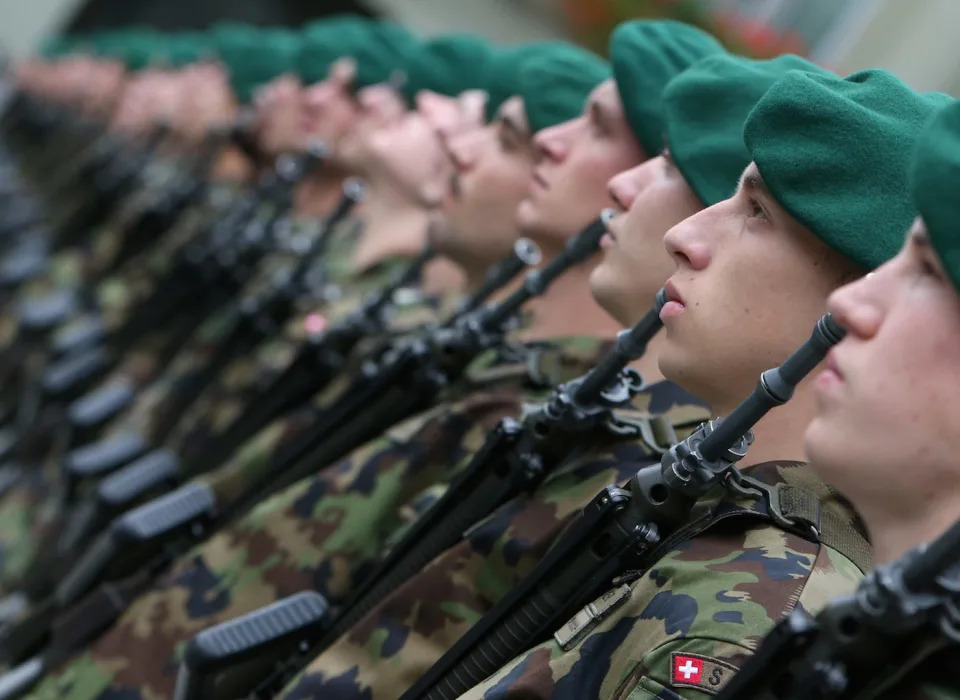
Switzerland has a stunningly high rate of gun ownership — here’s why it doesn’t have mass shootingsMembers of the Swiss federal army’s honor guard in October 2012.REUTERS/Thomas Hodel
Switzerland hasn’t had a mass shooting in 21 years.
The Swiss have strict rules for who can get a gun, and take firearm training very seriously.
Switzerland hasn’t had a mass shooting since 2001, when a man stormed the local parliament in Zug, killing 14 people and then himself.
The country has about 2 million privately owned guns in a nation of 8.3 million people. In 2016, the country had 47 attempted homicides with firearms. The country’s overall murder rate is near zero.
The National Rifle Association often points to Switzerland to argue that more rules on gun ownership aren’t necessary. In 2016, the NRA said on its blog that the European country had one of the lowest murder rates in the world while still having millions of privately owned guns and a few hunting weapons that don’t even require a permit.
But the Swiss have some specific rules and regulations for gun use.
Though the word roughly translates to “boys shooting” and the competition used to be only boys, teenage girls have been allowed in since 1991.
Kids in the country flock to the competition every September to compete in target shooting using Swiss army-service rifles. They’re proud to show off how well they can shoot.
The competition values accuracy above all else, and officials crown a Schutzenkonig — a king or queen of marksmen — based on results.
Having an armed citizenry helped keep the Swiss neutral for more than 200 years.
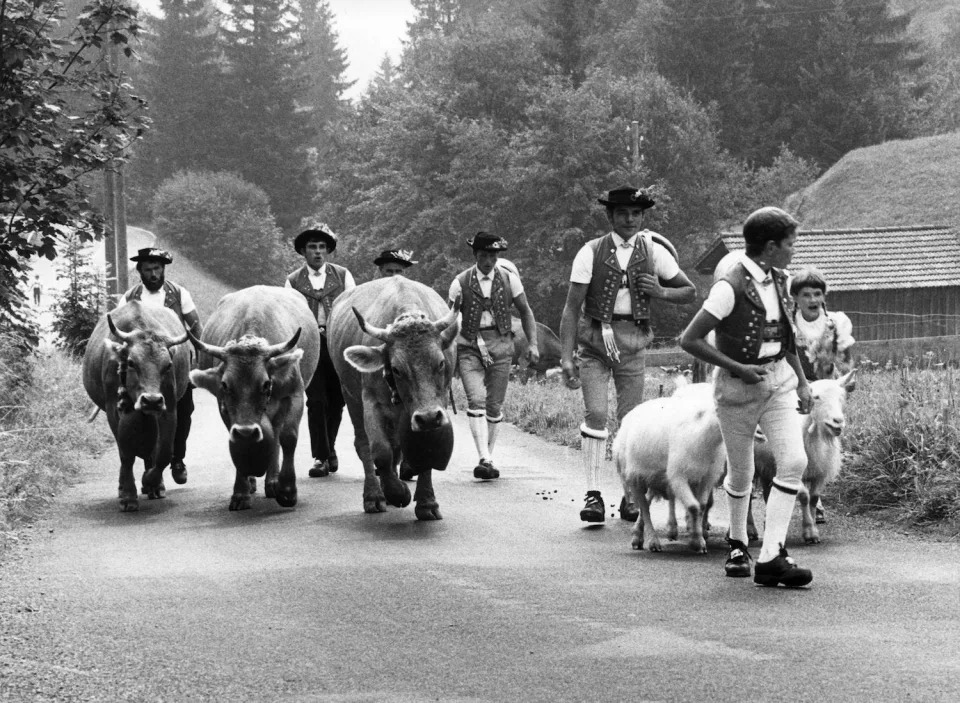
Alpine herdsmen in Toggenburg, Switzerland.Keystone/Getty Images
Switzerland hasn’t taken part in any international armed conflict since 1815, but some Swiss soldiers help with peacekeeping missions around the world.
Many Swiss see gun ownership as part of a patriotic duty to protect their homeland.
Most Swiss men are required to learn how to use a gun.
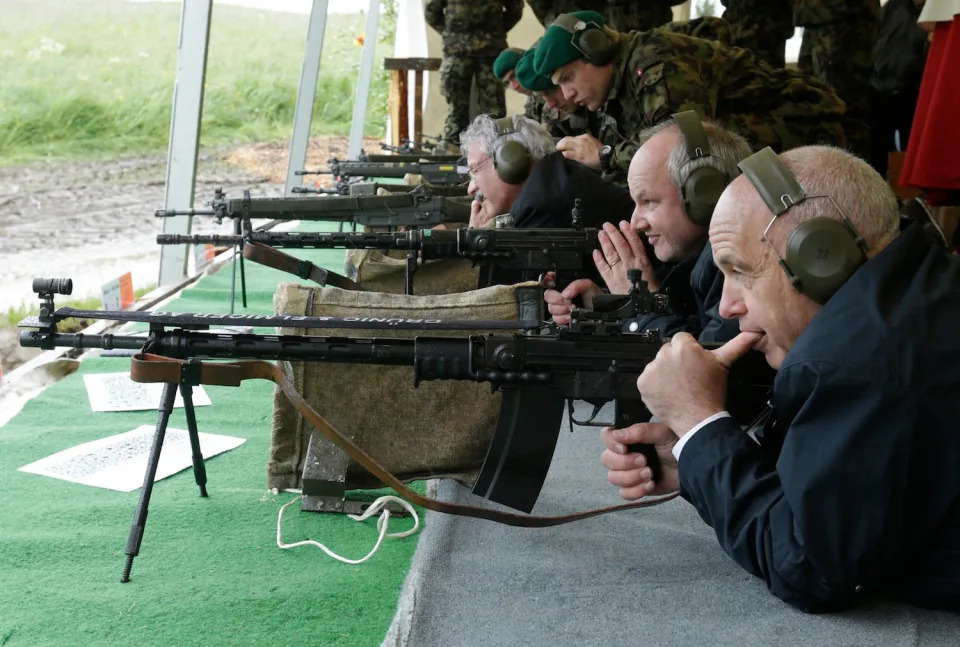
Swiss President Ueli Maurer pauses during a shooting-skills exercise — a several-hundred-year-old tradition — with the Foreign Diplomatic Corps in Switzerland on May 31, 2013.REUTERS/Denis Balibouse
In recent years, the Swiss government has voted to reduce the size of the country’s armed forces.
Switzerland is a bit like a well-designed fort.
Arnd Wiegmann/Reuters
Switzerland’s borders are basically designed to blow up on command, with at least 3,000 demolition points on bridges, roads, rails, and tunnels around the landlocked European country.
John McPhee put it this way in his book “La Place de la Concorde Suisse”:
“Near the German border of Switzerland, every railroad and highway tunnel has been prepared to pinch shut explosively. Nearby mountains have been made so porous that whole divisions can fit inside them.”
Roughly a quarter of the gun-toting Swiss use their weapons for military or police duty.
AP/Keyston, Lukas Lehmann
In 2000, more than 25% of Swiss gun owners said they kept their weapon for military or police duty, while less than 5% of Americans said the same.
In addition to the militia’s arms, the country has about 2 million privately owned guns — a figure that has been plummeting over the past decade.
Members of an honor guard of the Swiss army.REUTERS/Arnd Wiegmann
The Swiss government has estimated that about half of the privately owned guns in the country are former service rifles. But there are signs the Swiss gun-to-human ratio is dwindling.
In 2007, the Small Arms Survey found that Switzerland had the third-highest ratio of civilian firearms per 100 residents (46), outdone by only the US (89) and Yemen (55).
But it seems that figure has dropped over the past decade. The University of Sydney now estimates that there’s about one civilian gun for every three Swiss people.
Gun sellers follow strict licensing procedures.
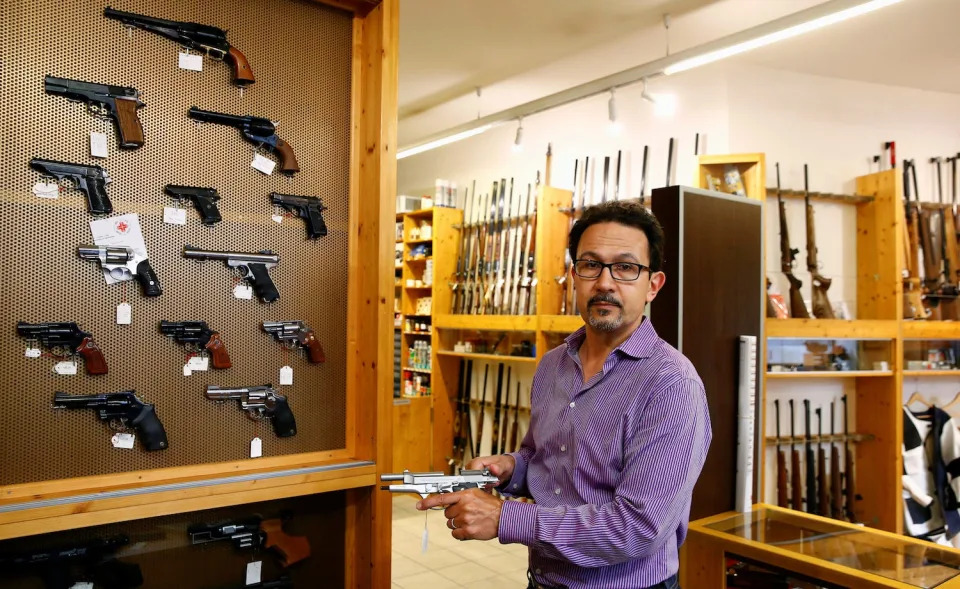
Daniel Wyss, the president of the Swiss weapons-dealers association, in a gun shop.REUTERS/Arnd Wiegmann
Swiss authorities decide on a local level whether to give people gun permits. They also keep a log of everyone who owns a gun in their region — known as a canton — though hunting rifles and some semiautomatic long arms are exempt from the permit requirement.
Cantonal police don’t take their duty doling out gun licenses lightly. They might consult a psychiatrist or talk with authorities in other cantons where a prospective gun buyer has lived to vet the person.
Swiss laws are designed to prevent anyone who’s violent or incompetent from owning a gun.
Nina Christen of Switzerland at the Olympic Games in Rio in August 2016.Sam Greenwood/Getty Images
People who’ve been convicted of a crime or have an alcohol or drug addiction aren’t allowed to buy guns in Switzerland.
The law also states that anyone who “expresses a violent or dangerous attitude” won’t be permitted to own a gun.
Gun owners who want to carry their weapon for “defensive purposes” also have to prove they can properly load, unload, and shoot their weapon and must pass a test to get a license.
Switzerland is also one of the richest, healthiest, and, by some measures, happiest countries in the world.
The Swiss have been consistently near the top of this list. In 2017, when the UN ranked Switzerland fourth overall among the world’s nations, the report authors noted that the country tends to do well on “all the main factors found to support happiness: caring, freedom, generosity, honesty, health, income, and good governance.”
Meanwhile, according to the report, happiness has taken a dive over the past decade in the US.
The report authors cite “declining social support and increased corruption,” as well as addiction and depression for the fall.
Around the world, stronger gun laws have been linked to fewer gun deaths. That has been the case in Switzerland, too.
A police officer at Geneva’s airport.REUTERS/Denis Balibouse
After hundreds of years of letting local cantons determine gun rules, Switzerland passed its first federal regulations on guns in 1999, after the country’s crime rate increased during the 1990s.
As of 2015, the Swiss estimated that only about 11% of citizens kept their military-issued gun at home.
Most people aren’t allowed to carry their guns around in Switzerland.
Hunters at a market in central Switzerland offer their fox furs.REUTERS
Concealed-carry permits are tough to get in Switzerland, and most people who aren’t security workers or police officers don’t have one.
“We have guns at home, but they are kept for peaceful purposes,” Martin Killias, a professor of criminology at Zurich University, told the BBC in 2013. “There is no point taking the gun out of your home in Switzerland because it is illegal to carry a gun in the street.”
That’s mostly true. Hunters and sports shooters are allowed to transport their guns only from their home to the firing range — they can’t just stop for coffee with their rifle.
Guns also cannot be loaded during transport to prevent them from accidentally firing in a place like Starbucks — something that has happened in the US at least twice.
At the beginning of March, Aria Babu quit her job at a think tank to dedicate herself to something most people have never heard of. Having worked in public policy for several years, the 26-year-old Londoner had come to an alarming realisation about the future of the UK, the world – and the human species.
‘It became clear to me that people wanted more children than they were having,’ Babu says. ‘Considering this is such a massive part of people’s lives, the fact that they were not able to fulfil this want was clearly indicative that something was wrong.’
The new focus of Babu’s career is a philosophy known as pronatalism, literally meaning pro-birth. Its core tenet is deceptively simple: our future depends on having enough children, and yet life in developed countries has become hostile to this basic biological imperative. Linked to the subcultures of rationalism and ‘effective altruism’ (EA), and bolstered by declining birth rates, it has been gaining currency in Silicon Valley and the wider tech industry – especially its more conservative corners.
‘I’ve been in various text threads with technology entrepreneurs who share that view… there are really smart people that have real concern around this,’ says Ben Lamm, a Texas biotech entrepreneur whose company Colossal is developing artificial wombs and other reproductive tech (or ‘reprotech’) that could boost future fertility.
‘We are quite familiar with the pronatalist movement and are supporters of it,’ says Jake Kozloski, the Miami-based co-founder of an AI matchmaking service called Keeper, which aims to address the ‘fertility crisis fueled by a marriage crisis’ by helping clients find the other parent of their future children.
‘I encourage people who are responsible and smart and conscientious to have children, because they’re going to make the future better,’ says Diana Fleischman, a pronatalist psychology professor at the University of New Mexico and consultant for an embryo-selection start-up (she is currently pregnant with her second child).
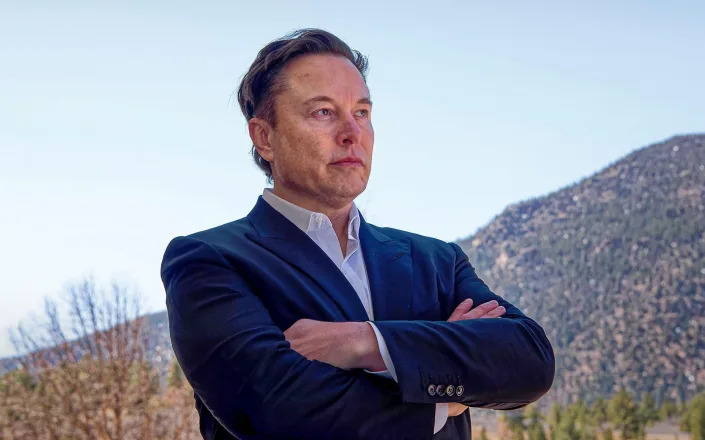
Easily the most famous person to espouse pronatalist ideas is Elon Musk, the galaxy’s richest human being, who has had 10 children with three different women. ‘If people don’t have more children, civilisation is going to crumble. Mark my words,’ Musk told a business summit in December 2021. He has described population collapse as ‘the biggest danger’ to humanity (exceeding climate change) and warned that Japan, which has one of the lowest birth rates in the world, ‘will eventually cease to exist’.
In an Insider article last November that helped bring the movement to wider attention, 23andMe co-founder Linda Avey acknowledged its influence on the Texan tech scene, while the managing director of an exclusive retreat, Dialog, co-founded by arch-conservative investor and PayPal pioneer Peter Thiel, said population decline was a frequent topic there.
Babu, who hopes to join or create a pronatalist organisation in the UK, says it is still ‘niche’ here but gaining ground on both the ‘swashbuckling intellectual Right’ and the more family-focused and Blue-Labour-tinged segments of the Left.
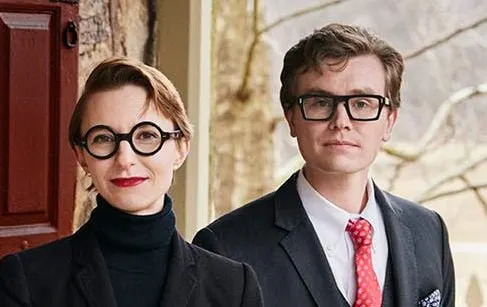
At the centre of it all are Simone and Malcolm Collins, two 30-something American entrepreneurs turned philosophers – and parents – who say they are only the most outspoken proponents of a belief that many prefer to keep private. In 2021 they founded a ‘non-denominational’ campaign group called Pronatalist.org, under the umbrella of their non-profit Pragmatist Foundation. Buoyed by a $482,000 (£385,000) donation from Jaan Tallinn, an Estonian tech billionaire who funds many rationalist and EA organisations, it is now lobbying governments, meeting business leaders, and seeking partnerships with reprotech companies and fertility clinics.
The Collinses did not coin the word ‘pronatalism’, which has long been used (along with ‘natalism’) to describe government policies aimed at increasing birth rates, or mainstream pro-birth positions such as that of the Catholic Church. Its opposite is ‘anti-natalism’, the idea that it is wrong to bring a new person into the world if they are unlikely to have a good life. Lyman Stone, a natalist demographer and research fellow at the US’s Institute for Family Studies, has described the Collinses’ philosophy as ‘a very unusual subculture’ compared to millions of everyday natalists. Yet it is their version – a secular, paradoxically unorthodox reconstruction of arguably the most traditional view on earth, driven by alarm about a looming population catastrophe – that is prospering among the tech elite.
‘I don’t think it’s appealing to [just] Silicon Valley people,’ Malcolm tells me on a long call from his home in Pennsylvania. ‘It’s more like, anyone who is familiar with modern science and familiar with the statistics is aware that this is an issue, and they are focused on it. The reason why you see Silicon Valley people disproportionately being drawn to this is they’re obsessed with data enough, and wealthy enough, to be looking at things – and who also have enough wealth and power that they’re not afraid of being cancelled.’
The Collinses – Winnie Au
The problem, he concedes, is that falling birth rates are also a common preoccupation of neo-Nazis and other ethno-nationalists, who believe they are being outbred and ‘replaced’ by other races. ‘A lot of alleged concerns about fertility decline are really poorly masked racist ideas about what kinds of people they want on the planet,’ says demographer Bernice Kuang of the UK’s Centre for Population Change.
The Collinses strongly disavow racism and reject the idea that any country’s population should be homogenous. Still, Babu finds that many in the rationalist and EA community, which skews pale and male, are wary of exploring pronatalism – lest they be ‘tarred with the brush of another white man who just wants an Aryan trad-wife’.
Another issue is what you might call the Handmaid’s Tale problem. From Nazi Germany’s motherhood medals to the sprawling brood of infamous, Kansas-based ‘God hates fags’ preacher Fred Phelps, a zeal for large families has often been accompanied by patriarchal gender politics. For liberal Westerners, the idea that we need to have more babies – ‘we’ being a loaded pronoun when not all of us would actually bear them – may conjure images of Margaret Atwood’s Gilead.
Some more illiberal countries are already shifting in this direction. China has begun restricting abortions after decades of forcing them on anyone who already had one child. Russia has revived a Soviet medal for women with 10 or more children. Hungary, where fertility long ago dropped below 2.1 births per year per woman – the ‘replacement rate’ necessary to sustain a population without immigration – has tightened abortion law while offering new tax breaks and incentives for motherhood. Following the end of Roe v Wade in the US, Texas has proposed tax cuts for each additional child, but only if they are born to or adopted by a married heterosexual couple who have never divorced.
But the Collinses contend that this kind of future is exactly what they are trying to prevent. ‘People often compare our group to Handmaid’s Tale-like thinking,’ says Malcolm, ‘and I’m like: excuse me, do you know what happens if we, the voluntary movement, fails…? Cultures will eventually find a way to fix this; how horrifying those mechanisms are depends on whether or not our group finds an ethical way.’ Though they define themselves politically as conservatives – Malcolm invariably votes Republican – they claim to favour LGBT rights and abortion rights and oppose any attempt to pressure those who don’t want children into parenthood.
Instead, they say, their hope is to preserve a ‘diverse’ range of cultures that might otherwise begin to die out within the next 75 to 100 years. They want to build a movement that can support people of all colours and creeds who already want to have large families, but are stymied by society – so that ‘some iteration of something that looks like modern Western civilisation’ can be saved.
‘We are on the Titanic right now,’ says Malcolm. ‘The Titanic is going to hit the iceberg. There is no way around it at this point. Our goal is not to prevent the Titanic from hitting the iceberg; it’s to ready the life rafts.’
It was on the couple’s second date, sitting on a rooftop and gazing out at the nearby woods, that Malcolm first raised the prospect of children. Simone’s response was not enthusiastic.
‘I was very excited to spend my life alone, to never get married, to never have kids,’ she recalls. ‘People would be like, “Do you want to hold the baby?” I was one of those who’s like, “No, you keep it. I will watch that baby from behind glass and be a lot more comfortable.”’
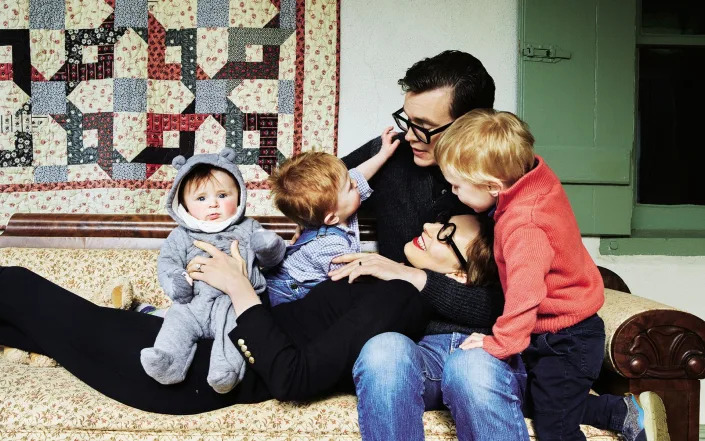
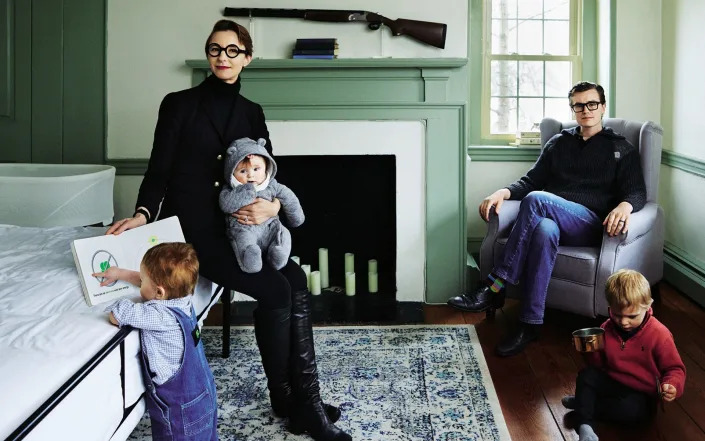
As she says this, her five-month-old daughter Titan Invictus – the couple refuse to give girls feminine names, citing research suggesting they will be taken less seriously – is strapped to her chest, occasionally burbling, while Malcolm has charge of their two sons Torsten, two, and Octavian, three. They live in the leafy suburbs of Philadelphia, balancing parenthood with full-time jobs as co-chief-executives of a travel company, writing books about pronatalism, and their non-profit projects (to which they donated 44 per cent of their post-tax income last year). They project an image of accentuated preppiness, dressing in ultra-crisp country club, business casual when photographers visit, and are effusive and open to the press. Malcolm starts our interview by saying, ‘Absolutely spectacular to meet you!’
The Collins family – Winnie Au
Both dealt with adversity in their own youths. Malcolm, 36, was held by court order in a centre for ‘troubled’ teenagers, where he was told by staff that if he resisted they would simply invent new infractions to keep him locked up. Simone, 35, now needs hormone therapy to menstruate regularly and IVF to conceive a child due to years of anorexia.
Back then, Simone was a textbook anti-natalist. She grew up as the only child of a failed polyamorous marriage among California hippies, where her understanding of a wedding was ‘everyone puts on masks in the forest and there’s a naked sweat lodge’. She was also a ‘mistake baby’, who watched her mother struggle with shelving her career ambitions.
What changed Simone’s mind was not any kind of Stepfordian conversion but a simple promise from Malcolm that she would not have to surrender her career. So it proved. She took no time off during Octavian’s gestation, answered business calls while in labour, and returned to the office five days after his birth. She stays with each child continuously for their first six months, carrying them in a chest harness while working at a treadmill desk, after which Malcolm handles the bulk of child-raising. She finds she gets a productivity bump with each newborn – ‘You’re up every three hours anyway, so why not knock off some emails?’
These personal epiphanies might not have translated into political ones except for Malcolm’s stint as a venture capitalist in South Korea, where the fertility rate is the lowest in the world at 0.8. He was shocked that nobody seemed to regard this as an emergency.
‘If this was an animal species it would be called endangered,’ says Malcolm. ‘We would be freaking out that they are about to go extinct.’ He begins our interview by speaking without interruption for nearly half an hour, incredibly quickly and with frenetic intensity as if chased by the enormity of what is coming.
Virtually every developed nation is now below replacement rate, and the United Nations predicts that the global average will sink below that line around 2056. By 2100 only seven countries are projected to remain above 2.1, mostly in sub-Saharan Africa, meaning developed nations won’t be able to rely on immigration to keep growing.
The impact on actual population will be delayed by decades and hopefully offset by increasing life expectancy, so our species will probably grow through most of the 21st century before holding steady or starting to shrink (estimates vary).
Most demographers do not consider this a crisis, according to Bernice Kuang. ‘In pop culture, there’s so much really alarmist talk about fertility and population implosion, and that just doesn’t really come up in the same way in academia,’ she says, noting that we cannot predict the long-term impact of future ‘reprotech’. Many experts also see overall population decline as a good thing, arguing that it will help prevent or mitigate climate change and other problems.
But pronatalists argue that problems will manifest long before this, as working-age people begin to be outnumbered by older ones. The global economy is predicated on the assumption of continual growth in GDP, which is strongly linked to population growth. ‘If people assume that the economy is going to shrink in future, and shrink indefinitely, then it’s not just a recession – it’s like there’s no point investing in the future,’ says Babu, who defines her politics as economically liberal, feminist, and pro-immigration. ‘If that happens, your pension breaks down because your pension is gambled on the stock market. You withdraw your savings; the government can’t borrow. A lot of these structures just break down.’
Aria Babu – Aria Babu
Take the UK’s current economic doldrums and broken public services, which Babu blames partly on the combination of Britain’s ageing population and the flight of younger immigrants after Brexit. What happens when populations everywhere are ageing or shrinking? One omen is Japan, which is ageing faster than any other nation. A Yale professor called Yusuke Narita, who has become an icon among angry young people, has proposed ‘mass suicide and mass seppuku [ritual disembowelment] of the elderly’ as ‘the only solution’, although he later said that this was merely ‘an abstract metaphor’.
For the Collinses, all of this is only part of the crisis, because the fertility of different cultural groups is not declining uniformly. Research by Pronatalist.org found that higher birth rates are associated with what some psychologists call the ‘Right-wing authoritarian personality’ – or, as Malcolm puts it, ‘an intrinsic dislike and distrust of anybody who is not like them’. That is, says Malcolm, emphatically not his or Simone’s brand of conservatism, which welcomes immigration and wants a pluralistic, multicultural society in which all groups are free to raise their children in their own way of life. By contrast, progressives and environmentalists have fewer children on average, not least because of a widespread despair about climate change among millennials and Gen Z.
There is also emerging evidence that the personality traits thought to undergird political beliefs – such as empathy, risk-taking, and a preference for competition vs cooperation – may be partly inherited. A literature review by New York University and the University of Wisconsin found evidence that political ideology is about 40 per cent genetic. Hence, the Collinses fear that as fertility declines it will not be some racial Other who outbreeds everyone else but each culture’s equivalent of the neo-Nazis. ‘We are literally heading towards global Nazism, but they all hate each other!’ says Malcolm.
What is to be done? ‘Our solution is, uh, we don’t have a solution,’ he admits. He says the only things proven to increase birth rates are poverty and the oppression of women, which are bad and should be stamped out. The only hope is to find those few families that combine liberal, pluralistic politics, such as support for LGBT rights, with high fertility – or create new, hybrid micro-cultures that value both – and help them multiply.
That means creating new educational and childcare institutions, supporting alternative family structures (the nuclear family is historically very unusual, and struggles to support large broods), repealing red tape such as sperm- and egg-freezing regulations, and cutting the cost of fertility treatments.
‘We’re trying to rebuild the high-trust networks that existed before the industrial revolution,’ says Pronatalist.org’s 20-year-old executive director Lillian Tara. ‘Raising children takes a village, and we’re trying to create that village.’ It also means resisting any attempt by what Malcolm calls the ‘woke mind virus’ to assimilate their children into a progressive monoculture.
This is where technology comes in. ‘Many of the groups that we are concerned about disappearing – gay couple couples, lesbian couples – from a traditional organs-bumping-together standpoint, can’t have kids… that are genetically both of theirs,’ says Simone. ‘That certainly dissuades some people from having kids entirely.’ A still-nascent technique called in vitro gametogenesis (IVG), which grows eggs and sperm directly from stem cells, could change this. Cheaper egg freezing and IVF could lighten the trade-off between career and motherhood for women.
Then there are those who struggle with inheritable problems such as depression and schizophrenia. Diana Fleischman says she knows many ‘wonderful people’ who are leery about having children for this reason. Such problems could be mitigated by genetic screening and embryo selection. Titan was born through just such a process, the Collinses tell me, winning out over other embryos that had higher estimated risks of traits such as obesity, migraines and anxiety.
The idea of using birth rates to influence future politics is one many will find alarming. It echoes the American ‘Quiverfull’ movement, which dictates that Christians should breed profusely so that over time society will be stuffed full of good believers.
Malcolm is blunt that some techies are trying to do just that. ‘Silicon Valley people, they’ve done the math, and they actually do want to replace the world with their children,’ he says. ‘They’re like, “Oh yeah, I have eight kids, and if those kids have eight kids, and those kids have eight kids, then at the end my kids will make up the majority of the world’s population… I understand these people’s mindset. They’ve been economically successful… they think they’re better than other people.’ (Musk, he insists, is not of this persuasion.)
Fleischman says she has encountered this too: ‘A lot of this is secret, because it’s just not socially acceptable to say, “I’m going to use my wealth to make as many half-copies of myself as possible. I’m going to photocopy myself into the future.”’
While Musk has been open about his pronatalist beliefs, others are staying quiet to maximise their chance of victory, notes Malcolm. ‘They’re like, “Why are you broadcasting this? We all know this, we can fix this on our own, we don’t need the diversity that you seem pathologically obsessed with”… they’re the people you’re not hearing from.’ Musk did not respond to a request to be interviewed.
If people don’t have more children, civilisation is going to crumble. Mark my words,’ Musk told a business summit in December 2021 – (Apex MediaWire Photo by Trevor Cokley/U.S. Air Force
The Collinses aren’t worried about this, because they think it is doomed to fail. They want to build a durable family culture that their descendants will actually want to be part of, not just ‘spam their genes’, and to help other families with different values do the same. ‘You have an 18-year sales pitch to your kids… and if you fail, well f—k you – your kid’s gonna leave,’ says Simone. ‘The people who carry forward their culture and viewpoints are going to be people who love being parents.’
Even so, this project inherently requires making some judgment on which cultures should prosper in future – and therefore, potentially, which genomes. That rings alarm bells for Emile Torres, a philosopher who studies the history of eugenics and its counterpart, dysgenics – the notion that humanity’s gene pool is slowly becoming somehow worse.
‘Dire warnings of an impending dysgenic catastrophe go back to the latter 19th century, when this idea of degeneration became really widespread in the wake of Darwin,’ Torres says. ‘Biologists were warning that degeneration is imminent, and we need to take seriously the fact that intellectually “less capable” individuals are outbreeding.’ Often this meant poor people, disabled people, non-white people, or other groups lacking the political power to contest their designation as inferior, leading to atrocities such as the Nazi sterilisation regime.
The Collinses – despite using embryo selection – say they reject that kind of eugenics, and Malcolm pours scorn on the ‘pseudoscience’ idea that intelligence or political personality traits differ meaningfully between ethnicities. Rather, he argues that they cluster in much smaller cultural groups such as families or like-minded subcultures. When screening their own embryos, the Collinses did not worry about traits such as autism or ADHD. ‘We don’t think humanity can be perfected, we just want to give our kids the best possible roll of the dice,’ says Simone, who herself is autistic and Jewish.
Still, Torres argues that voluntary, ‘liberal’ eugenics can end up having the same effect as the coercive kind by reinforcing whatever traits are seen as desirable by the prevailing ideology, such as lighter skin, mathematical reasoning or competitiveness. Lyman Stone’s verdict last year was scathing: ‘My policy goal is for people to have the kids they want, but these “pronatalists” would abhor that outcome because it would yield higher fertility rates for people they think shouldn’t breed so much.’
Malcolm says he shares those concerns, which is why he is committed to being almost totally agnostic about which families Pronatalist.org works with. ‘If we act as anything other than a beacon, then we are applying our beliefs about the world to the people we recruit, which goes against our value set,’ he says.
The Collins family – Winnie Au
To sceptics, pronatalism’s appeal in Silicon Valley may simply look like the latest messianic project for a community already convinced that they are the best people to colonise space, conquer death and fix the world’s problems. Yet it speaks to a sense of disquiet that is widely shared. You do not need to fear dysgenic doom to feel that something is fundamentally broken about the way we have and raise children – as many recent or aspiring parents are already aware.
‘In almost every low-fertility country, no one is able to have the number of children they want to have. Even in South Korea, people still want to have two children; they don’t want to have 0.8,’ says Kuang. But far from being an inevitable consequence of progress, she contends that it stems from specific choices we force on to families.
‘The first half of the gender revolution was women attaining educational attainment at parity with men, entering the workforce at parity with men,’ she continues. But the second half remains unfinished, leaving many women caught between mutually incompatible expectations at work versus at home – the classic ‘have it all’ problem. In South Korea, where the new president (a man) has declared that structural sexism is ‘a thing of the past’, a government pamphlet advised expecting mothers to prepare frozen meals for their husbands before giving birth and tie up their hair ‘so that you don’t look dishevelled’ in hospital. ‘Wow, you wonder why women aren’t rushing to sign up for that kind of life?’ laughs Kuang.
Partly of the problem is that middle-class parents are now expected to micromanage their children’s upbringings more intensely than ever before. ‘It seems like in the past six- and seven-year-olds were just allowed to be feral… now it would basically be considered abuse to leave your child alone all day,’ says Babu.
Then there is the cost of housing. ‘How are you going to have two children, even if you desperately wanted to, if you can barely afford a one-bedroom apartment?’ asks Kuang, who would love to have three or four kids if only she could square the mortgage. Babu likewise says becoming a parent would be an easy choice if she knew she could still have a high-flying career and make enough money for a decent home. As it is, she’s torn.
Kuang concedes that no government has yet fixed these problems, but she does believe they are fixable. Although cash bonuses, lump sum payments and restricting abortion have all proven ineffective, she says, robust parental leave for all genders could make a difference. So could high-quality, affordable childcare that is available in adequate supply, and begins as soon as parents need to go back to work.
In the meantime, the Collinses hope to have at least four more babies, unless they are thwarted by complications from repeated C-sections. ‘When I look into the eyes of our children,’ says Simone, ‘and I see all the potential they have… and I think about a world in which they didn’t exist because we thought it was inconvenient? I’m like, I can’t. I can’t not try to have more kids.’
5 Ways Sleep Deprivation Affects Your Brain and Mood, According to Sleep Doctors
Lindsay Tigar – April 17, 2023
Your mind needs sleep just as much as your body does.
Westend61/Getty Images
Parents of newborns, students cramming for exams, overworked professionals pushed to their max, insomniacs, caffeine dependents, night-shift workers, and menstruating people—at some point, we all know how getting less than enough sleep feels (very bad). Though it’s normal to have trouble falling asleep and/or staying asleep occasionally, prolonged periods of sleepless nights and chronic sleep deprivation can harm not only our bodies, but our minds.
Sleep is essential for brain development, wellness, and functioning, explains Heidi Riney, MD, board-certified sleep medicine and neurology psychologist and the chief medical officer of Nox Health. “Sleep has long been thought to be a passive process, but it’s actually an active state, and the quality and duration of our sleep impacts crucial brain functions,” she says, including memory storage, attention maintenance and arousal, learning new material/tasks, mood stability, the ability to read social cues, problem-solving, executive functioning, and impulse control.
So what happens to your brain health and mental capacities if you consistently don’t get enough sleep? And how can you power through on days when you didn’t get enough shut-eye the night before? We asked sleep specialists and mental health experts to weigh in.
How Much Sleep Do You Need for Optimal Brain Health?
Though it seems like a straightforward question, it’s somewhat complicated to understand how much sleep your mind needs to perform well and stay well. The human brain is as different from one person to the next as fingerprints. Because of this, the specific amount of optimal sleep one brain needs isn’t the same for everyone, says licensed clinical psychologist Bethany Cook, PsyD.
Generally speaking, Cook says, scientists have found that most adults need around 8 or 9 hours of sleep to perform and feel their best. However, since this estimate is a bell curve, some people need more, and some need less to feel great.
Though without undergoing formal sleep analysis, it’s difficult to know exactly how much sleep you need, there are a few things that can help guide your body’s natural cues. Quality and quantity of hours sleep do matter, but so does how you feel in the morning.
“The only way of knowing if you’re getting ‘quality sleep’ is if you typically wake up feeling rested, refreshed, and revitalized,” Cook says. “Our brains need around four to six full sleep cycles a night to wake [feeling] rested. If you’re sleeping for 10 hours every night, but not waking up feeling refreshed, you’re getting poor sleep quality.” She adds that it can be helpful to visit a clinic for a sleep study to identify and fix the problems in your sleep cycle.
The Mental Health Effects of Sleep Deprivation
A Slower Response Time
Even if you didn’t have a single sip of wine last night, you might wake up feeling foggy and sluggish, unable to respond to questions or respond to things happening around you quickly, explains Nicole Avena, PhD, research neuroscientist, psychologist, and a wellness ambassador for Nature Made.
“Lack of sleep, short term, has been linked to poor response times and processing,” she says. “This not only can impair your awareness, but it can also harm others around you. Demanding cognitive functions, for example, driving, cannot be performed adequately when sleep is hindered.”
Short-Term Memory Disruption
When you miss your date with Mr. Sandman, the next day may likely bring a struggle to remember much of anything: your keys, your wallet, your phone, you name it. According to Taz Bhatia, MD, board-certified integrative medicine physician and OLLY ambassador, this is because there is a connection between sleep and its impact on memory retention. “Sleep is essential in consolidating memories and allowing us to retain and recall information,” she says. “However, this process can be disrupted without enough sleep, leading to difficulties forming, keeping, and calling back memories.”
After tossing and turning for hours, you finally leave your bed and head straight to the kitchen. What do you reach for? Probably simple carbohydrates and sugar, since one common effect of sleep deprivation is increased hunger by 24 percent, says Melissa Halas, MA, RDN, CDE, registered dietitian and brain health expert for Neauriva.
“Often, the carbohydrates consumed aren’t nutrient-dense foods like apples, or whole grains, but rather simple carbs like snack foods high in refined sugars or refined grains,” she says. So if you’re wondering why you can’t stop craving sugar, maybe you should take a look at your sleep patterns first.
Trouble Making Decisions (Large or Small)
Depending on what type of career path you’re on, the ability to make fast decisions is vital to your success. Think: operating heavy machinery, responding to an emergency, or managing a large team with many moving parts. (And let’s not even get started on all the decision-making that also needs to happen at home.) Even if you don’t have a high-stakes job, being able to make simple decisions, like what to wear for the day, is impacted by sleep. Avena explains that our brains process things differently when we don’t get enough sleep. “What’s called ‘naturalistic decision making,’ or being able to make everyday decisions, like what to have for lunch, can be altered,” she says. “This is due to the prefrontal cortex lacking adequate rest.”
Maybe you don’t usually have a short fuse with your partner and friends, but every interaction might feel tense and irritating when you’re running on only two hours of rest. This is because people who don’t sleep well or enough often feel snappy, depressed, and more likely to make risky choices, according to Avena. “There’s no need to break up with your boyfriend after days of not sleeping properly, but your brain may think otherwise,” she says. “Sleep plays a role in the brain to regulate and process emotions, which affects how we react and manage emotions every day.” If you’re mood seems like it’s on a chaotic roller coaster, part of the reason may be that you (and your brain) are under-slept, leading to quick tears, more flashes of frustration, negative reactions, and the like.
How to Cope if You’re Running on Little Sleep
We all have our reasons for sleepless nights once in a while, and in these cases, while making sure to catch up on sleep A.S.A.P. is the best solution, it’s not always an immediate possibility. Here are some of the healthiest and most effective ways to power through and compensate for any mental glitches that come with occasional sleep deprivation. But don’t rely on these tips as an excuse to skimp on sleep! They’re temporary bandages, not the final fix for sleepiness.
Get outside.
You might want to crawl under the covers and hide from the world after a restless night, but you should do the opposite, as sunlight and fresh air are both great for triggering endorphins and serotonin, Avena says. “Serotonin, in particular, is a melatonin precursor and can help fight insomnia together,” she says. “It can be as easy as sitting on your porch for your morning coffee.”
Listen to music to wake up your brain.
Taylor Swift can get you through a breakup, and she might also help your brain power through a tough day. When you need an energy boost on sleepy mornings, turn up the volume on your favorite, upbeat playlist while driving or taking a shower. Believe it or not, when you listen to music, your entire brain lights up with neuronal activity, getting the entire brain ‘online,’ Cook says: “While all the parts are awake and working, music’s vibrational energy will inevitably sync your own body’s internal energy to match the faster, higher and happy vibrations.”
Caffeinate (responsibly).
Although turning to too much caffeine habitually to make up for poor sleep isn’t wise, there’s little downside to using it as a wakefulness tool every now and then, says Valerie Ulene, MD, MPH, cofounder of Boom Home Medical. “A caffeinated beverage early in the day will almost certainly help keep you more alert for a few hours,” she says. “Just remember to avoid caffeine after about mid-day as consuming it too close to bedtime will likely cause more problems than it solves.”
Try to find the root issue.
Though you may need to power through the day after a poor night of sleep, it’s crucial to try to identify the reason you’re not sleeping the night before and address it before it becomes a chronic issue.
“It can take days to catch up from even losing one hour of sleep the night before, so it’s best to try and maintain a consistent sleep and wake schedule and allow yourself to get at least seven hours of sleep each night,” Dr. Riney says. “If you feel you’re experiencing poor quality sleep or have daytime dysfunction that may be attributed to poor sleep, it’s important to seek out a sleep specialist for further evaluation.”
How Many Feet Are in a Mile? Here’s a Simple Trick To Remember the Exact Number
Beth Ann Mayer – April 15, 2023
Learn precisely how many feet are in a mile and more fun facts.
Your thoughts on the mile are likely all about perspective. If you’re driving, it’s likely a quick trip (barring massive traffic). You can probably leave a minute before you have to be there and arrive on time. Walking? That’s more of a slog. A marathon runner? No big. But if the only marathon you’ve ever participated in is one that involved watching Law & Order: SVU, running a mile can feel like a steep hill to climb, even if it’s a flat road. How many feet are in a mile, anyway?
You probably learned how many feet are in a mile sometime in school. But, like the difference between an isosceles and a trapezoid and scalene triangle, you likely forgot all about it (unless you’re a parent and your kid needs help with homework).
Here’s a refresher on how many feet there are in a mile, plus more fun facts worth remembering for your next water cooler chat.
How Many Feet Are in a Mile?
There are 5,280 feet in a mile. This distance is a British imperial unit and United States customary unit. It’s equivalent to 1,760 yards.
Where Did the Mile Originate?
The mile originated from the Roman mille passus, AKA “a thousand paces” or “5,000 Roman feet.” According to Merriam-Webster, a Roman pace was equal to five Roman feet or 4.85 English feet. It was “measured in pacing from the heel of one foot to the heel of the same foot when it next touches the ground.”
How Did It Become 5,280 Feet?
Sometime around 1500, the English divided the mile into eight furlongs. Each furlong was 625 feet long, making the mile 5,000 feet. The Statute of 1593, which came under Queen Elizabeth I, lengthened the furlong to 660 feet. That extra 35 feet per furlong added 280 total feet to the mile. The final tally? 5,280 feet.
What Distance Is a Furlong?
Initially, the furlong was 625 feet. But the Statute of 1593 under Queen Elizabeth I extended the length of a furlong to 660 feet.
What Distance Is a Country Mile?
A country mile isn’t an actual unit of measure—it’s a term used to describe a sneaky-long distance. Country roads usually aren’t a straight line like a highway—they can be winding from left to right and up and down. The shortest distance between two points is a straight line, so a winding dirt road can feel longer than it is.
How To Easily Remember How Many Feet Are in a Mile
To easily remember how many feet are in a mile, think of the phrase “five tomatoes.” It’s similar to the 5,280 feet in a mile. Think about it. “Five-to-may-toes” sounds sort of similar to “five-two-eight-oh.”
‘Get here now!’; 911 calls from panicked employees inside Louisville bank released – Oh my God, there’s an active shooter there.
Jorge L. Ortiz, John Bacon and Andrew Wolfson – April 12, 2023
LOUISVILLE, Ky. – A frantic call from an Old National Bank employee and a much calmer one from a co-worker hiding in a closet provided Louisville police the first indications of the carnage caused by a gunman’s attack, according to audio of 911 calls released Wednesday.
The shooter’s mother tried to prevent the mayhem, reaching out to police and saying her son “currently has a gun and is heading toward” the bank, but it was too late.
Together, the 911 calls and the body camera video released Tuesday fill out details of the chaotic scene surrounding Monday’s assault and the police officers’ heroic response.
Five people were killed and eight injured by a bank worker identified as Connor Sturgeon, who police said was armed with an AR-15 rifle. Authorities said officers arrived at the scene three minutes after being dispatched, likely saving lives.
“Oh my God, there’s an active shooter there,” says a panicked woman identified as the first 911 caller. “I just watched it on a Teams meeting. … We were having a board meeting with our commercial (lending) team.”
An initial picture of the harrowing Monday morning scene develops as the operator asks the woman for the bank’s address, where specifically the shooting was taking place and what the assailant looked like.
As more calls start to come in, the operator excuses himself and tells her, “We have them (police officers) going that way. … We do have everybody responding. We’re getting them out there.’’
One of the callers says she’s calling from inside a closet in the building as numerous gunshots are heard in the background. She gives a description of the shooting and says she knows the perpetrator: “He works with us.”
Another call came from a woman who says her son was heading toward the bank with a gun, saying his roommate had called expressing concern. She identifies herself as Sturgeon’s mother.
“He apparently left a note,’’ she says. “I don’t know what to do, I need your help. He’s never hurt anyone. He’s a really good kid. Please don’t punish him.’’
The woman says her son is an employee at the bank, is not violent and has never owned a gun. She asks if she should go to the bank and the responder advises her against it, saying officers were already at the scene and it was not a safe location.
Louisville police release body camera footage from mass shooting at bank
Latest developments:
►Funeral services will be held Friday for Elliott, a senior vice president at the bank whom Kentucky Gov. Andy Beshear described as a good friend who helped him launch his law career.
►The killer left a note behind and told at least one person he was suicidal, U.S. Rep. Morgan McGarvey said.
A mother’s anguished 911 call
The gunman’s mother appears torn in a 911 call, wanting to protect her son but also warn police about what he might do. She tells the operator her son doesn’t own a gun but may be headed toward the bank with one.
Sturgeon’s mother says she’s shaking and doesn’t know where her son could have gotten a weapon.
“We don’t even own guns,” she says, providing a description of her son – white, 6-foot-4 inches tall.
She asks whether she should go to the bank and the operator warns her against it, saying police officers have responded.
“You’ve had calls from other people?” she asks, sounding incredulous and heartbroken. “So they’re already there?”
Yes, the operator says. “It is an unsafe situation.”
– Donovan Slack
Shooter’s parents can’t explain how ‘Mr. Floyd Central’ became a mass killer
The parents of the 25-year-old bank employee who killed five people in a hail of bullets say they can’t explain how the son voted “Mr. Floyd Central High” seven years ago turned into a brutal killer.
The family of Connor Sturgeon said late Tuesday that he had “mental health challenges” but that there were never any warning signs he was capable of what police described as the targeted shooting of Old National Bank colleagues gathered for a meeting Monday morning.
“No words can express our sorrow, anguish, and horror at the unthinkable harm our son Connor inflicted on innocent people, their families, and the entire Louisville community,” the family said in a statement.
As Louisville police seek a motive, Interim Chief Jacquelyn Gwinn-Villaroel denied reports that Sturgeon was about to get fired from his job at the bank. She told CNN on Wednesday that “there was no discussion about him being terminated.”
Body camera video from the first two police officers who responded shows them taking fire in what Deputy Police Chief Paul Humphrey described as an “ambush.”
Governor, mayor among hundreds paying tribute to victims at vigil
Hundreds of people gathered Wednesday afternoon at Louisville’s Muhammad Ali Center – about a mile from the site of the shooting – for a vigil to honor the five persons killed.
They have been identified as Joshua Barrick, 40, Thomas Elliott, 63, Juliana Farmer, 45, James Tutt, 64, and Deana Eckert, 57. They were all bank employees.
Among those who spoke at the memorial were Kentucky Gov. Andy Beshear and Louisville Mayor Craig Greenberg. Beshear was close friends with Elliott, whom the governor credited with helping launch his law career.
Beshear urged those in attendance to remember to express their love for those they care about.
“We can live for the fallen, and we can live better for them. We can be better,” Beshear said. “We can be better family members. Better dads. Better moms. We can be better community members, and we can be better people. Let’s commit that to them.”
Officer Nickolas Wilt fights for his life
Officer Nickolas Wilt remained in the hospital in critical condition after being shot in the head as he ran toward the gunfire. The released version of Wilt’s footage cuts off before he is shot.
A bullet grazed fellow officer Cory Galloway, Wilt’s field trainer, on his left side. Galloway found cover behind a large planter and eventually fired the round that took down the assailant.
Wilt, 26, graduated from the Louisville Metro Police Academy 10 days before the shooting. Gwinn-Villaroel said she had sworn him in as his family watched, and Wilt’s twin brother is going through the academy now, friends of the family said. Wilt was working just his fourth shift as a police officer.
The two officers’ quick response Monday saved lives, Gwinn-Villaroel said: They “did not hesitate” when the call came in at 8:38 a.m.
“I’m just truly proud of the heroic actions of those two officers and everybody else that responded,” Gwinn-Villaroel said. “They went toward danger in order to save and preserve life, and that’s what you saw yesterday. They stopped the threat so other lives could be saved.
“They showed no hesitation, and they did what they were taught to do.”
– Lucas Aulbach and Madeline Mitchell, Louisville Courier Journal
Galloway: ‘I think I’ve got him down’
Galloway’s video shows him and Wilt as they reach the top of the stairs outside the bank. Wilt is not shown being hit, but Galloway rolls down the stairs and positions himself behind the planter and on the sidewalk. He takes cover there for just over three minutes before other officers arrive.
At that point, Galloway is shown firing several shots. The gunshots are audible, but the footage does not offer a clear view of the fatal shot. Humphrey said Galloway did not have a “close-range shot” and the stairs obscured his camera angle.
“I think I’ve got him down,” Galloway says. He then walks up the stairs and over shattered glass. An image blurred by police shows the shooter down in the lobby, near a second set of glass doors.
“There’s only a few people in this country that can do what they did. Not everybody can do that,” Humphrey said. “They deserve to be honored for what they did because it is not something that comes easily, it is not something that comes naturally. … That’s superhuman.”
– Madeline Mitchell and Lucas Aulbach, Louisville Courier Journal
Impromptu memorial to victims emerges outside bank
The steps outside of Old National Bank have been transformed into a somber memorial crowded with flowers. White crosses with blue hearts bear the names of the victims. Kett Ketterer, who works nearby at KD & Company wholesale flower company, unloaded more than a dozen potted Easter lilies.
“I think everybody’s just in shock, and you have to have some way to express yourself in your grief,” he said. “And I’m trying to understand. It just doesn’t make sense.”
Andrew Thuita came to the memorial because his girlfriend works nearby downtown. She was safe, but he has been too close to tragedy before. In 2018, he had gone shopping at the Jeffersontown Kroger on the same day two people were shot and killed.
“Another statistic in America,” Thuita said. “There is something wrong.”
– Maggie Menderski, Louisville Courier Journal
Timeline for a tragedy
Sturgeon made a number of posts on his now deleted Instagram account shortly before the rampage began. Among them: “They won’t listen to words or protests. Let’s see if they hear this.” Sturgeon, armed with an AR-15 rifle, then livestreamed his assault.
Humphrey said the first 911 call came in at 8:38 a.m., and officers were sent to the scene. Wilt and Galloway arrived at the entrance to the bank three minutes later and were met with gunfire that forced them to back up their vehicle. One minute later they got out of the car, and two minutes after that Wilt was shot and officers returned fire.
At 8:45 a.m., after a burst of gunfire, officers entered the bank and confirmed the suspect was down. Sturgeon died at the scene.
Family statement mourns loss of son, his victims
The shooter’s family reached out to the Louisville community in their statement Tuesday night.
“We mourn their loss and that of our son, Connor. We pray for everyone traumatized by his senseless acts of violence and are deeply grateful for the bravery and heroism of the Louisville Metropolitan Police Department,” the statement read.
“While Connor, like many of his contemporaries, had mental health challenges which we, as a family, were actively addressing, there were never any warning signs or indications he was capable of this shocking act. While we have many unanswered questions, we will continue to cooperate fully with law enforcement officials and do all we can to aid everyone in understanding why and how this happened.”
A star athlete with negative self-image
Sturgeon grew up in southern Indiana and graduated from Floyd Central High School, about 12 miles northwest of Louisville. He earned his bachelor’s and master’s degrees at the University of Alabama, an school spokesperson confirmed.
At Floyd Central, he played basketball for his father, Todd Sturgeon, who was the head coach. The younger Sturgeon was named “Mr. Floyd Central” in 2016 as a senior.
A former friend and teammate at Floyd Central told The Daily Beast this week that Sturgeon was “smart, popular and a star athlete.”
But in a 2018 college essay at the University of Alabama, Sturgeon wrote, “My self-esteem has long been a problem for me,” and as a “late bloomer in middle and high school, I struggled to a certain extent to fit in, and this has given me a somewhat negative self-image that persists today.” The essay was posted to a website called “CourseHero,” CNN and The Daily Beast reported, but it has since been taken down.
Pressured by Their Base on Abortion, Republicans Strain to Find a Way Forward
Jonathan Weisman – April 11, 2023
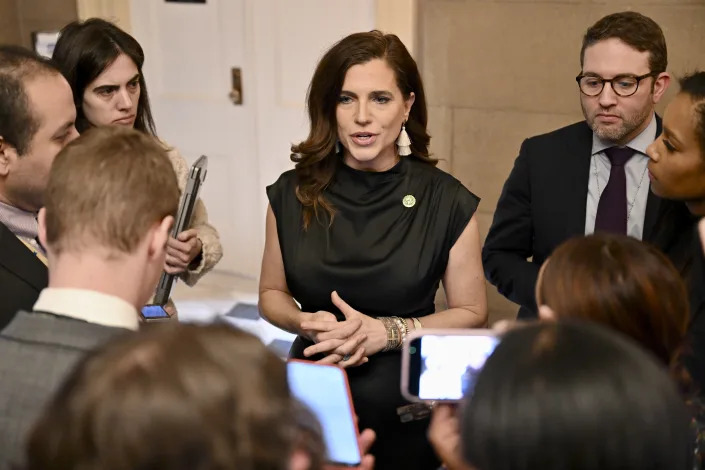
Rep. Nancy Mace (R-S.C.) speaks to reporters at the U.S. Capitol in Washington, on Feb. 2, 2023 (Kenny Holston/The New York Times)
Republican leaders have followed an emboldened base of conservative activists into what increasingly looks like a political cul-de-sac on the issue of abortion — a tightly confined absolutist position that has limited their options before the 2024 election season, even as some in the party push for moderation.
Last year’s Supreme Court decision overturning a woman’s constitutionally protected right to an abortion was supposed to send the issue of abortion access to the states, where local politicians were supposed to have the best sense of the electorate’s views. But the decision on Friday by a conservative judge in Texas, invalidating the Food and Drug Administration’s 23-year-old approval of the abortion pill mifepristone, showed the push for nationwide restrictions on abortion has continued since the high court’s nullification of Roe v. Wade.
Days earlier, abortion was the central theme in a liberal judge’s landslide victory for a contested and pivotal seat on the state Supreme Court in Wisconsin. Some Republicans are warning that the uncompromising position of their party’s activist base could be leading them over an electoral cliff next year.
“If we can show that we care just a little bit, that we have some compassion, we can show the country our policies are reasonable, but because we keep going down these rabbit holes of extremism, we’re just going to keep losing,” said Rep. Nancy Mace, R-S.C., who has repeatedly called for more flexibility on first-term abortions and exceptions for rape, incest and the life and health of the mother. “I’m beside myself that I’m the only person who takes this stance.”
She is far from the only one.
The chair of the Republican National Committee, Ronna McDaniel, has been showing polling to members of her party demonstrating that Americans largely accept abortion up to 15 weeks into a pregnancy and support the same exemptions that Mace wants. Dan O’Donnell, a conservative radio host in Wisconsin, wrote after the lopsided conservative defeat in the state Supreme Court contest that abortion was driving young voters to the polls in staggering numbers and that survival of the party dictated compromise.
“As difficult as this may be to come to grips with, Republicans are on the wrong side politically of an issue that they are clearly on the right side of morally,” he wrote.
The problem goes beyond abortion. With each mass shooting, the GOP’s staunch stand against gun control faces renewed scrutiny. Republicans courted a backlash last week when they expelled two young Democratic lawmakers out of the Tennessee state legislature for leading youthful protests after a school shooting in Nashville that left six dead. Then on Monday came another mass shooting, in Louisville, Kentucky.
“My kids had friends on Friday night running for their lives,” said Mace, referring to a shooting on South Carolina’s Isle of Palms, which elicited no response from most of her party. “Republicans aren’t showing compassion in the wake of these mass shootings.”
The party’s stand against legislation to combat climate change has helped turn young voters into the most liberal bloc of the American electorate. And Republican efforts to roll back LGBTQ rights and target transgender teenagers, while popular with conservatives, may be seen by the broader electorate as, at best, a distraction from more pressing issues.
Rep. Mark Pocan, an openly gay Democrat from Wisconsin, said Monday that in the short term, the Republican attacks on transgender Americans were having a real-world effect, with a rise in violence and bigotry. But he said it is also contributing to the marginalization of the party, even in his swing state.
He pointed to the “WOW counties” that surround Milwaukee — Waukesha, Ozaukee and Washington — where then-Republican Gov. Scott Walker won 73% in 2014, and where the Republican, Dan Kelly, won 58.7% in the state Supreme Court race last week.
“We keep seeing our numbers increase in those counties because those Republicans largely are economic Republicans, not social Republicans,” Pocan said, adding that GOP candidates “definitely are chasing their people away.”
Mace does appear to be correct that her desire for compromise is not widely shared in a party in which analysts continue to look past social issues to explain their electoral defeats.
Kelly was a poor candidate who lost by an almost identical margin in another state Supreme Court race in 2020, noted David Winston, a longtime pollster and strategist for House Republican leaders. And, Winston added, Republicans may have lost female voters by 8 percentage points in the 2022 midterm elections, but they lost them by 19 points in 2018.
If inflation and economic concerns remain elevated, he added, the 2024 elections will be about the economy, not abortion or guns.
Republicans greeted the abortion-drug ruling on Friday, by Judge Matthew J. Kacsmaryk of the U.S. District Court for the Northern District of Texas, with near total silence. The judge gave the Biden administration seven days to appeal, and on Monday, senior executives of more than 250 pharmaceutical and biotech companies pleaded with the courts to nullify the ruling with a scorching condemnation of Kacsmaryk’s reasoning.
Most anti-abortion advocates are not backing down. Katie Glenn Daniel, the state policy director for Susan B. Anthony Pro-Life America, one of the most powerful anti-abortion groups, said Wisconsin’s results were more about anti-abortion forces being badly outspent than about ideology. In her state, Florida, she noted, Democrats scorched Republicans with advertising in 2022 saying they planned to ban abortion without exceptions. Republicans, from Gov. Ron DeSantis on down, easily prevailed that November.
Republicans need to keep pressing with abortion restrictions that will affect Democratic states as well as Republican ones, she said.
“A national minimum standard is incredibly important. Without it there will continue to be late-term abortions, and governors like Gavin Newsom are very motivated to force his views on the rest of the country,” she said of California’s Democratic governor.
Last week, the Florida state Senate approved legislation pushing the state’s ban on abortion from the current 15 weeks into pregnancy to six weeks. If the state’s House of Representatives approves it, DeSantis has said he will sign it. If DeSantis runs for president as expected, his signature would thrust abortion squarely into the 2024 race for the White House.
Last year, John P. Feehery, a veteran Republican leadership aide in the House, urged his party to find a defensible position on abortion that included flexibility on abortion pills, allowed early pregnancies to be terminated and detailed a coherent position on exceptions for rape, incest and health concerns. He said Monday that he was repeatedly told abortion would be a state-level issue and federal candidates should just stay quiet.
“They didn’t want to do the hard work on abortion,” he said, blaming “a lack of leadership” in the party that still has the Republican position muddled.
Guns are another issue where silence is not working. The shooting in Louisville, which left six dead, including the gunman, and eight wounded, kept the issue of guns in the spotlight after last week’s heated showdown in Tennessee — and before a three-day gathering of the National Rifle Association on Friday in Indianapolis. The Kentucky attack was the 15th mass shooting this year in which four or more victims were killed, the largest total in a year’s first 100 days since 2009, according to a USA Today/Associated Press/Northeastern University database.
“You can’t stop paying attention after one horrible event happens. You have to watch what happens afterward,” said Rep. Maxwell Frost, 26, a Florida Democrat who last year became the first member of Generation Z to be elected to the House.
Voices for compromise are beginning to bubble up, in some cases from surprising sources. Carol Tobias, president of the National Right to Life Committee, one of the country’s largest anti-abortion groups, said Monday that even she was “somewhat concerned” that the Republican Party might be getting ahead of the voters on abortion. Her organization has drafted model legislation to ban abortion at the state level in every case but when the life of the mother is in grave danger. But, Tobias said, that legislation comes with language to extend those exceptions to the “hard cases,” pregnancies that result from rape or incest, or that might harm a mother’s health.
“We’ve always known the American public does not support abortion for all nine months of a pregnancy,” she said. “They want some limits. We are trying to find those limits.”
She added, “If we can only at this time save 95% of the babies, I am happy to support that legislation.”
Fed Up With Mayhem, Miami Beach Wants to Tame Spring Break for Good
Patricia Mazzei – April 9, 2023
From left, Chandler Robinson, Sam Fisher and Alexis Illes play slam ball on South Beach in Miami Beach, Fla. on Friday, March 31, 2023, while vacationing from Orlando, Fla. (Scott McIntyre/The New York Times)
MIAMI BEACH — After two fatal shootings on Ocean Drive over a March weekend, Miami Beach leaders followed their recent playbook for dealing with raucous spring break crowds: a state of emergency, a midnight curfew and limited liquor sales.
Then, in a new and drastic step, the city commissioners announced a curfew for 2024, a full year in advance, and declared spring break on the sun-kissed streets of Miami Beach to be over.
“Miami Beach is shutting the door on spring break, once and for all,” Alex Fernandez, a city commissioner who sponsored a series of 2024 measures, said before the vote.
The decision, in the middle of the March and April season that is the most profitable time of the year for local businesses, has caused both relief and consternation over the possible loss of the throngs of visitors that have grown to overwhelm the city’s police and other public services — and of the money that those visitors spend on hotel rooms, nightclub cover charges and boozy cocktails.
Miami Beach both loves and hates its tourists, a conflicting sentiment that has long plagued officials as the city has evolved from a cocaine cowboy den in the 1980s to a high-fashion Riviera in the 1990s to what it is today: a glittering playground for affluent families making a home, foreigners chasing the sun and young American visitors who come looking for a good time. Some people, including the city’s mayor, want the partyers gone for good.
If Miami Beach is to be rebranded as less of a spring break destination and more of an arts, culture and health and wellness hub, some owners of bars, nightclubs and liquor stores worry that they will lose business. And some residents and officials fear losing the diversity and laid-back vibe that make Miami Beach Miami Beach.
“What we’re seeing is panic-stricken politicians who feel the need to do something,” Ricky Arriola, a city commissioner who voted against the 2024 curfew, said in an interview. “The heavy hand of government is being imposed on residents, our visitors and businesses, rather than doing the hard work of coming up with really strategic alternatives.”
Similar frictions between residents and visitors have afflicted other popular Florida spring break locales like Panama City Beach. Over time, Fort Lauderdale and other cities have pushed spring breakers out, in part by raising hotel rates and changing zoning laws to turn dive bars into more upscale establishments.
Miami Beach has been wrestling with its reputation as a party town. A judge recently upheld an ordinance imposing a partial 2 a.m. cutoff on alcohol sales for a South Beach neighborhood known as South of Fifth, now full of glimmering condos. The law had been challenged by Story, a nightclub that argued it could not survive if it could no longer sell alcohol until 5 a.m.
Patience has worn thin as spring break revelers, often partying with alcohol or drugs, have packed a roughly 10-block stretch of South Beach along the Atlantic oceanfront each season, leading to unpredictable situations that sometimes turn violent because so many people have guns, according to city leaders, police officers and business owners.
The two deadly incidents this year took place over the St. Patrick’s Day weekend, typically one of the busiest of the season. After the second, the city briefly imposed a midnight curfew.
Last year, two shootings on Ocean Drive led the city to set a midnight curfew. In 2021, Miami Beach made headlines when, in the middle of the coronavirus pandemic, the city marketed itself to visitors even though many nightclubs remained closed, leading to raucous street parties. Officials responded that year by imposing an 8 p.m. curfew.
The rowdy behavior in the streets and the curfews that result have hurt businesses year after year, said Joshua Wallack, the chief operating officer of Mango’s Tropical Cafe, an Ocean Drive institution for more than 30 years.
“When they go from a dangerous situation to complete lockdown, there is no business,” he said. “We’re just caught in the wake of how they handle it. The service industry and the hospitality industry, they get completely obliterated because it goes from having complete chaos to nothing.”
In the past, civil rights activists have complained about the city police department’s use of military-style vehicles, pepper balls and forceful crowd control tactics during spring break, which attracts many Black visitors to a city whose resident population is largely white. Glendon Hall, chair of the Miami Beach Black Affairs Advisory Committee, which was created two years ago, was embedded with police officers and the city’s “goodwill ambassadors” during spring break last month. He said in a statement that was read at a meeting Tuesday that he was pleased with how law enforcement handled the “massive crowds” this year and that there had been no major complaints from civil rights groups.
The Miami Beach Police Department made 573 arrests in March, a slight drop from 615 arrests in March 2022, according to Officer Ernesto Rodriguez, a department spokesperson. Police officers seized more than 100 guns this year, he added.
Despite the headlines about shootings and curfews, families, couples and small gaggles of friends strolled down the sidewalks of Ocean Drive on a Friday afternoon late last month. Marcus Benjamin, a 19-year-old college student from Chicago, said the city’s emergency measures had “not at all” affected his trip with two of his buddies.
“I’ve seen a lot of cops on the beach,” said one of his friends, Cameron Sasser, also 19. “But it’s about the same as other years.”
Still, most everyone in city leadership seems to agree that the chaotic spring break crowds have become too much. But when it comes to what to do about them, views differ.
Mayor Dan Gelber said spring break “doesn’t fit with a city that has so many residents.”
“South Beach has bars and restaurants,” he said, “but it also has elementary schools and churches and synagogues.” Some local residents and visitors who spend lavishly often avoid the city during spring break.
Some commissioners like Fernandez have said they want to keep spring breakers but not “lawbreakers” who follow them into the city.
“The worst thing that we can do is continue doing the same thing we’ve done now for several years in a row, which is knowing that we’re going to have an overcrowding of our city and waiting until the violent situation occurs — until the death occurs — to react,” he said in an interview. “It’s better to get ahead of the situation and impose the curfew and the restrictions now.”
In 2021, Miami Beach lost in court after the Clevelander Hotel sued the city over a law setting a 2 a.m. cutoff for alcohol sales. The judge ruled that the ordinance had not been properly enacted.
Under states of emergency during past spring breaks, increased regulations yielded little success in subduing the party scene, according to commissioners like Arriola, who would prefer to bring in a big organized event in March that would allow officials to set up barricades, ticketed entry and metal detectors around Ocean Drive roughly from Fifth to 15th streets.
“At least people that are celebrating spring break in a street party on Ocean Drive could have the comfort of knowing that there wouldn’t be any weapons in that area,” he said.
After seeing crowds grow for nearly two decades at another busy time of year, Memorial Day weekend, the city began in 2017 to host the Hyundai Air & Sea Show, which features the military. The event has displaced many of the partyers who used to gather for Urban Beach Week, celebrating hip-hop.
This year, a three-day festival in March on Ocean Drive and in nearby Lummus Park drew daytime visitors and, the police department said, helped tame spring break — but only until the festival’s music and other entertainment ended around 9 p.m. each day. Both of the shootings happened later at night.
Without a major event lined up for 2024, the city appears to be considering a spring break lockdown — something Wallack said would go too far. Miami Beach should be able to offer a multitude of activities, from arts to wellness to nightlife, without having to sacrifice one for another, he argued.
“This is a city,” he said.
And anyway, he added, “Good luck trying to lock down public beaches.”