Report details ‘staggering’ church sex abuse in Maryland

Associated Press

Report details ‘staggering’ church sex abuse in Maryland

Les Skene, Brian Witte and Sarah Brumfield – April 5, 2023
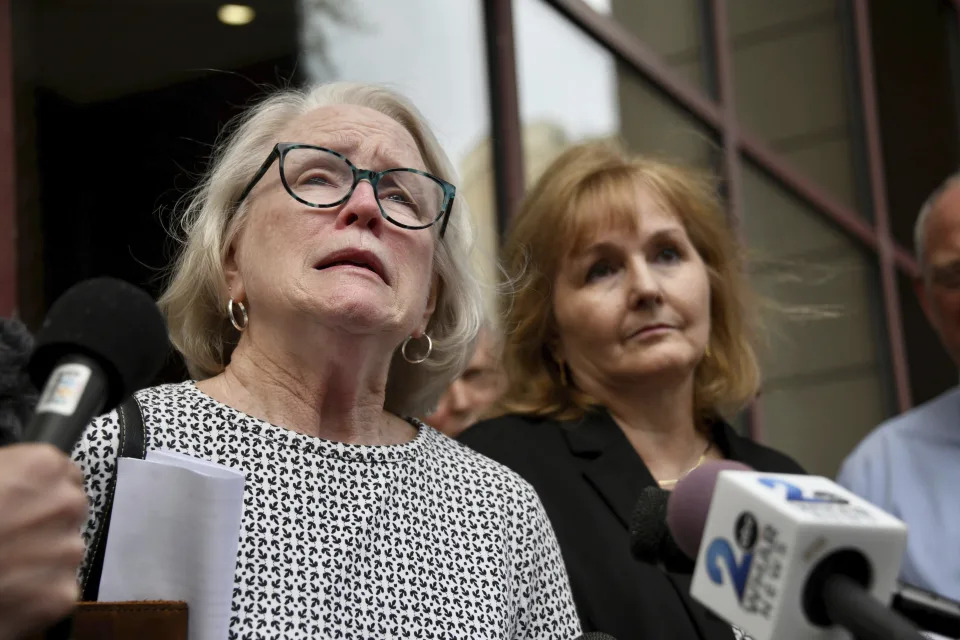
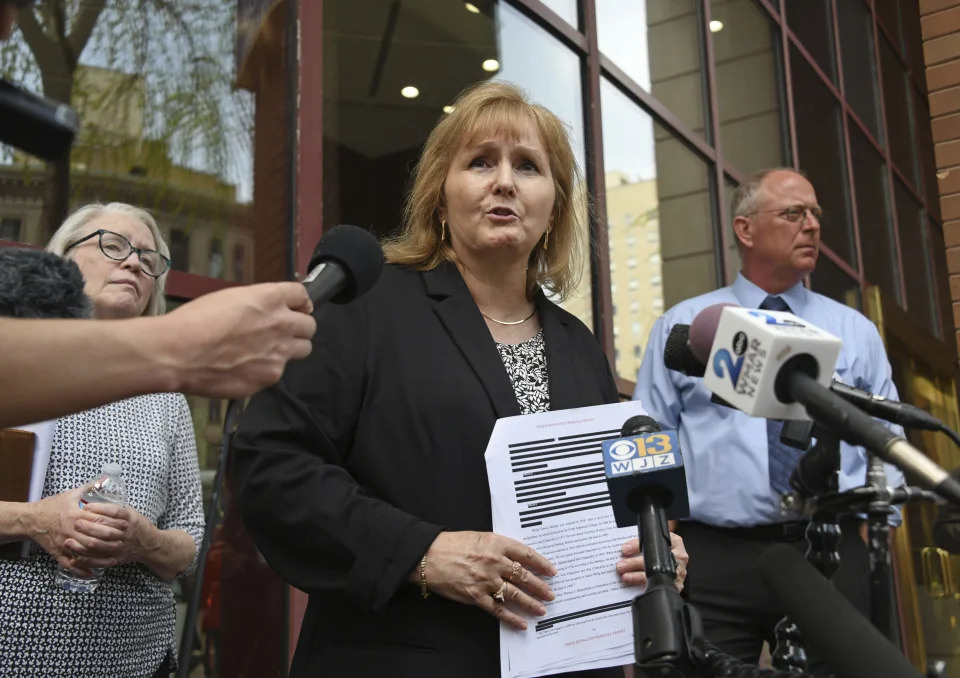
Jean Hargadon Wehner speaks about the release of the redacted report on child sexual abuse in the Catholic Archdiocese of Baltimore by the Maryland Attorney General's Office on Wednesday, April 6, 2023, in Baltimore. Standing next to her is Teresa Lancaster. (Kim Hairston/The Baltimore Sun via AP)
Jean Hargadon Wehner speaks about the release of the redacted report on child sexual abuse in the Catholic Archdiocese of Baltimore by the Maryland Attorney General’s Office on Wednesday, April 6, 2023, in Baltimore. Standing next to her is Teresa Lancaster. (Kim Hairston/The Baltimore Sun via AP)
Kurt Rupprecht speaks about the abuse he suffered after the release of the redacted report on child sexual abuse in the Catholic Archdiocese of Baltimore by the Maryland Attorney General's Office on Wednesday, April 6, 2023, in Baltimore. (Kim Hairston/The Baltimore Sun via AP)
Kurt Rupprecht speaks about the abuse he suffered after the release of the redacted report on child sexual abuse in the Catholic Archdiocese of Baltimore by the Maryland Attorney General’s Office on Wednesday, April 6, 2023, in Baltimore. (Kim Hairston/The Baltimore Sun via AP)
Teresa Lancaster speaks about the release of the redacted report on child sexual abuse in the Catholic Archdiocese of Baltimore by the Maryland Attorney General's Office on Wednesday, April 6, 2023, in Baltimore. (Kim Hairston/The Baltimore Sun via AP)
Teresa Lancaster speaks about the release of the redacted report on child sexual abuse in the Catholic Archdiocese of Baltimore by the Maryland Attorney General’s Office on Wednesday, April 6, 2023, in Baltimore. (Kim Hairston/The Baltimore Sun via AP)
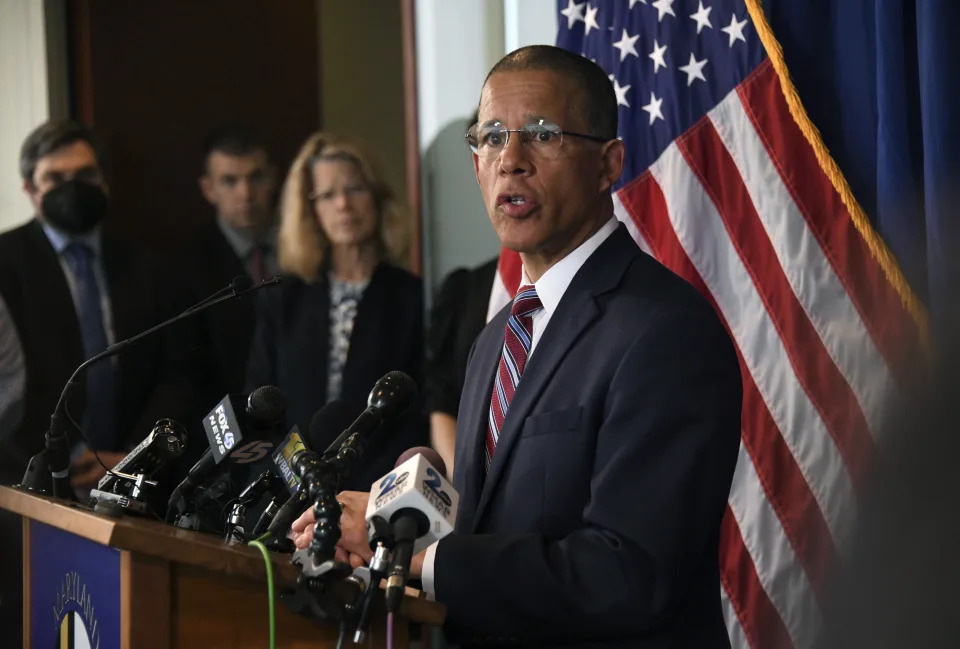
Maryland Attorney General Anthony Brown comments about releasing the redacted report on child sexual abuse in the Catholic Archdiocese of Baltimore on Wednesday, April 6, 2023, in Baltimore. (Kim Hairston/The Baltimore Sun via AP)

BALTIMORE (AP) — More than 150 Catholic priests and others associated with the Archdiocese of Baltimore sexually abused over 600 children and often escaped accountability, according to a long-awaited state report released Wednesday that revealed the scope of abuse spanning 80 years and accused church leaders of decades of coverups.

The report paints a damning picture of the archdiocese, which is the oldest Roman Catholic diocese in the country and spans much of Maryland. Some parishes, schools and congregations had more than one abuser at the same time — including St. Mark Parish in Catonsville, which had 11 abusers living and working there between 1964 and 2004. One deacon admitted to molesting over 100 children. Another priest was allowed to feign hepatitis treatment and make other excuses to avoid facing abuse allegations.

The Maryland Attorney General’s Office released the findings of their yearslong investigation during Holy Week — considered the most sacred time of year in Christianity ahead of Easter Sunday — and said the number of victims is likely far higher. The report was redacted to protect confidential grand jury materials, meaning the identities of some accused clergy were removed.

“The staggering pervasiveness of the abuse itself underscores the culpability of the Church hierarchy,” the report said. “The sheer number of abusers and victims, the depravity of the abusers’ conduct, and the frequency with which known abusers were given the opportunity to continue preying upon children are astonishing.”

Disclosure of the redacted findings marks a significant development in an ongoing legal battle over their release and adds to growing evidence from parishes across the country as numerous similar revelations have rocked the Catholic Church in recent years.

Baltimore Archbishop William Lori, in a statement posted online, apologized to the victims and said the report “details a reprehensible time in the history of this Archdiocese, a time that will not be covered up, ignored or forgotten.”

“It is difficult for most to imagine that such evil acts could have actually occurred,” Lori said. “For victim-survivors everywhere, they know the hard truth: These evil acts did occur.”

Also on Wednesday, the state legislature passed a bill to end a statute of limitations on abuse-related civil lawsuits, sending it to Gov. Wes Moore, who has said he supports it. The Baltimore archdiocese says it has paid more than $13.2 million for care and compensation for 301 abuse victims since the 1980s, including $6.8 million toward 105 voluntary settlements.

Maryland Attorney General Anthony Brown, who took office in January, said the investigation shows “pervasive, pernicious and persistent abuse.” State investigators began their work in 2019; they reviewed over 100,000 pages of documents dating back to the 1940s and interviewed hundreds of victims and witnesses.

ABUSE RECALLED AS A ‘LIFE SENTENCE’

Victims said the report was a long-overdue public reckoning with shameful accusations the church has been facing for decades.

Jean Hargadon Wehner said she was abused in Baltimore as a teen by A. Joseph Maskell, a priest who served as her Catholic high school’s counselor and chaplain. She said she reported her abuse to church officials in the early ’90s, when her memories of the trauma finally surfaced about two decades after she was repeatedly raped.

“I expected them to do the right thing in 1992,” she told reporters Wednesday. “I’m still angry.”

Maskell abused at least 39 victims, according to the report. He denied the allegations before his death in 2001 and was never criminally charged. The Associated Press typically doesn’t name victims of abuse, but Wehner has spoken publicly to draw attention to the issue.

Kurt Rupprecht, who also experienced abuse as a child, said he was in his late 40s when he pieced together his traumatic memories. He said the realization brought him some relief because it explained decades of self-destructive behavior and mental health challenges, but also left him overwhelmed with anger and disbelief.

Rupprecht said his abuser was assigned to the Diocese of Wilmington, which covers some counties on the Eastern Shore of Maryland.

“We’re here to speak the truth and never stop,” he said after the news conference. “We deal with this every day. It is our life sentence.”

The Survivors Network of Those Abused by Priests, known as SNAP, noted the report lists more names of abusers than have been released publicly by archdiocese officials. The organization called on the archbishop to explain the discrepancies.

Other investigations involving the Archdiocese of Washington and the Diocese of Wilmington, Delaware, which both include parts of Maryland, are ongoing.

ARCHDIOCESE TOOK STEPS TO PROTECT THE ACCUSED

The Baltimore report says church leaders were focused on keeping abuse hidden, not on protecting victims or stopping abuse. In some situations, victims ended up reporting abuse to priests who were abusive themselves. And when law enforcement did become aware of abuse allegations, police and prosecutors were often deferential and “uninterested in probing what church leaders knew and when,” according to the report.

The nearly 500-page document includes numerous instances of leaders taking steps to protect accused clergy, including allowing them to retire with financial support rather than be ousted, letting them remain in the ministry and failing to report alleged abuse to law enforcement.

In 1964, for instance, Father Laurence Brett admitted to sexually abusing a teenager at a Catholic university in Connecticut.

He was sent to New Mexico under the guise of hepatitis treatment and then to Sacramento, where another teenage boy reported being abused by Brett, the report said. He was later assigned to Baltimore, where he served as chaplain at a Catholic high school for boys and abused over 20 victims.

After several students accused him of abuse in 1973, Brett was allowed to resign, saying he had to care for a sick aunt. School officials didn’t report the abuse to authorities and dozens more victims later came forward. He never faced criminal charges and died in 2010.

The report largely focuses on the years before 2002, when an investigation by the Boston Globe into abuse and coverup in the Archdiocese of Boston led to an explosion of revelations nationwide. The nation’s Catholic bishops, for the first time, then agreed on reforms including a lifetime ban from ministry for any priest who commits even a single incident of abuse. While new national policies significantly improved the internal handling of reported abuse in the Baltimore archdiocese after 2002, significant flaws remained, according to the report.

Only one person has been indicted through the investigation: Neil Adleberg, 74, who was arrested last year and charged with rape and other counts. The case remains ongoing. Officials said he coached wrestling at a Catholic high school in the ’70s, then returned to the role for the 2014-2015 school year. The alleged abuse occurred in 2013 and 2014 but the victim was not a student of the school, officials said.

COURT TO CONSIDER RELEASING MORE NAMES IN THE FUTURE

Lawyers for the state asked a court for permission to release the report and a Baltimore Circuit Court judge ruled last month that a redacted version should be made public. The court ordered the removal the names and titles of 37 people accused of wrongdoing — whose names came out during confidential grand jury proceedings — but will consider releasing a more complete version in the future.

Lawmakers’ passage of a bill to end the state’s statute of limitations Wednesday came after similar proposals failed in recent years. Currently, victims of child sex abuse in Maryland can’t sue after they turn 38. The bill would eliminate the age limit and allow for retroactive lawsuits.

The Archdiocese of Baltimore has long faced scrutiny over its handling of abuse allegations.

In 2002, Cardinal William Keeler, who served as Baltimore archbishop for nearly two decades, released a list of 57 priests accused of sexual abuse, earning himself a reputation for transparency at a time when the nationwide scope of wrongdoing remained largely unexposed. That changed, however, when a Pennsylvania grand jury accused Keeler of covering up sexual abuse allegations while serving as bishop of Harrisburg in the 1980s.

Associated Press reporter Stefanie Dazio contributed to this report from Los Angeles. Peter Smith contributed from Pittsburgh. Witte reported from Annapolis and Brumfield reported from Silver Spring.

Why Does America Keep Killing it’s Children?: ‘Radiant’ 9-Year-Old Killed While Leading Nashville Classmates to Safety, Family Believes

Daily Beast

‘Radiant’ 9-Year-Old Killed While Leading Nashville Classmates to Safety, Family Believes

Eileen Grench – March 30, 2023

Courtesy of Kelly Dorrance

A 9-year-old girl killed during the deadly school shooting in Nashville, Tennessee may have been leading her classmates to safety after a fire alarm was tripped when the killer entered the school, her aunt told The Daily Beast.

Evelyn Dieckhaus’ aunt said that while exact details of Evelyn and other victims’ final moments are still unclear, she heard her “radiant” niece died after leading her classmates in what she possibly thought was a fire drill.

“We’re finding out the shooter may have pulled the fire alarm to get kids out of their classroom. Evelyn being one of the class leaders was at the front of the line assuming fire drill,” read a private Instagram post provided to The Daily Beast by the aunt, Kelly Dorrance.

“She was trying to lead her classmates to safety and possibly didn’t hear the shouts to come back in the room. Things children should never worry about,” read the post.

Evelyn, Dorrance told The Daily Beast, was “radiant—a beacon of joy in our family. She had a calm confidence and a natural sense of purpose—alongside a whip smart sense of humor and a sly little smile.”

The Metropolitan Nashville Police Department confirmed to The Daily Beast on Thursday that their investigation currently indicates “that the alarm originated from the area of the shooter’s entry” at The Covenant School on Monday morning.

Contrary to some reports that Dieckhaus was killed as she tried to pull the fire alarm, MNPD spokesman Don Aaron told The Daily Beast Thursday, “The investigation at present does not support a ‘pulling’ of the alarm.” MNPD declined to comment on whether Dieckhaus was killed while leading a fire drill from the classroom.

The other two 9-year-old victims were identified by police as William Kinney and Hallie Scruggs. Three school staff were also killed: 61-year-old custodian Mike Hill; head of school Katherine Koonce; and substitute teacher Cynthia Peak.

Harrowing body-camera footage released on Tuesday showed officers Michael Collazo and Rex Engelbert rushing into the school and following the sounds of gunfire to the second floor.

Once upstairs, Engelbert and Collazo saw the shooter, Audrey Hale, standing in front of a window, and opened fire. Hale was killed within 14 minutes of the initial call to police.

Dorrance said the death of her niece is a “nightmare you can’t wake up from,” but told The Daily Beast by text message that ”the support and love our family has received has proved that humanity is, ultimately, good.”

“How our country puts assault rifles in the hands of civilians, I’ll never understand. We are in disbelief. Devastated. Heartbroken. Sick,” she said on Instagram.

And though the family is grieving, they want to make sure Evelyn’s memory will live on, Dorrance told The Daily Beast: “After we get through this initial phase of grief, we’re committed to make her memory an important one that will save the lives of other children.”

Related:

Funerals begin for 6 victims of Nashville school shooting

ABC News

Emily Shapirof – March 31, 2023

Funerals begin for 6 victims of Nashville school shooting

Mourners will gather on Friday for the first of six funerals in the wake of Monday’s mass shooting at The Covenant School, a private Christian school in Nashville, Tennessee.

Friends and family of 9-year-old victim Evelyn Dieckhaus were asked to wear pink and green to her funeral service on Friday afternoon.

“Our hearts are completely broken,” the Dieckhaus family said in a statement. “We cannot believe this has happened. Evelyn was a shining light in this world.”

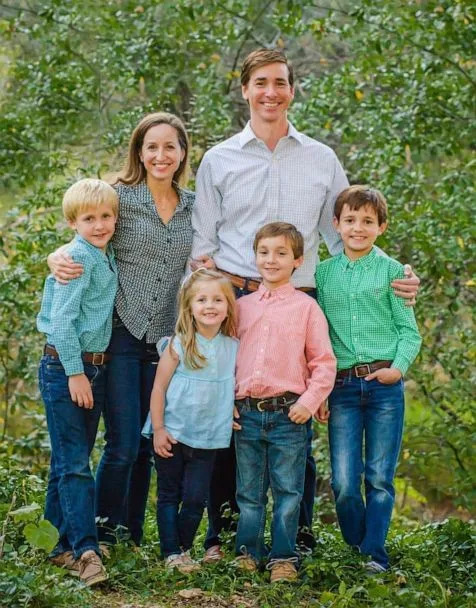
PHOTO: Evelyn Dieckhaus is seen in this undated photo. (Courtesy The Dieckhaus Family)

MORE: Nashville school shooting updates: Slain head of school lauded for her forethought

The service for 9-year-old victim Hallie Scruggs will be on Saturday. Hallie’s funeral will be at Covenant Presbyterian Church — the church connected to the school where she was killed and where her father, Chad Scruggs, is a senior pastor.

Chad Scruggs told ABC News in a statement, “We are heartbroken. She was such a gift. Through tears we trust that she is in the arms of Jesus who will raise her to life once again.”

PHOTO: Hallie Scruggs is seen with her family in this undated family photo. (Courtesy Chad Scruggs)

Saturday will also be the visitation and service for 61-year-old Cynthia Peak, who was a substitute teacher at The Covenant School.

Her family called her “a pillar of the community, and a teacher beloved by all her students.”

“Her favorite roles in life were being a mom to her three children, a wife to her husband, and an educator to students,” Peak’s family said in a statement. “We will never stop missing her.”

PHOTO: Cindy Peak is seen in this undated photo. (Courtesy of the Peak Family)

The service for the third child killed, 9-year-old Will Kinney, will take place on Sunday.

PHOTO: Parishioners participate in a community vigil at Belmont United Methodist Church in the aftermath of a school shooting in Nashville, March 27, 2023, in Nashville, Tenn. (John Bazemore/AP)

On Tuesday, beloved school custodian, 61-year-old Mike Hill, will be laid to rest.

He was a father of seven and a grandfather of 14.

MORE: Nashville school shooting: What to know about the 6 victims

“We pray for the Covenant School and are so grateful that Michael was beloved by the faculty and students who filled him with joy for 14 years,” his family said in a statement.

Former student Bex Lithgow called Hill “the kindest soul who loved all the students so much.”

PHOTO: Mike Hill is seen here in an undated file photo. (Mike Hill/Facebook)

The final funeral service will be on Wednesday for 60-year-old Katherine Koonce, the head of the school.

“Katherine was devoted to her family, her friends, and especially the children she cared for. She gave her life to protect the students she loved,” Koonce’s family said in a statement. “It is our privilege to honor Katherine’s legacy and to celebrate her remarkable spirit.”

PHOTO: Katherine Koonce, a victim in The Covenant School shooting in Nashville, Tenn., March 27, 2023. (The Covenant School)

MORE: Timeline: How the shooting at Covenant School unfolded

A former local school administrator, Tricia Drake, told ABC News that her last conversation with Koonce was in August, discussing companies they used for active shooter training.

Drake said she knew Koonce had initiated her active shooter protocols on Monday when she saw footage police released from two of the responding officers’ body cameras. One of the videos shows a Covenant School staff member meeting an officer at the school’s main entrance, telling him, “The kids are all locked down, but we have two kids that we don’t know where they are.” The staffer is then seen using a key to unlock the door so officers could go inside.

“Students were in their classrooms, locked up, the professional outdoors to lead the Metro policeman. She had a key, what her headcount was, she knew exactly where the students would be, she was prepared,” Drake said. “I’m sure they had run those drills, and it’s because of Katherine and the foresight she had to make sure her staffers were prepared.”

PHOTO: People attend a vigil after a deadly shooting at the Covenant School in Nashville, Tenn., March 29, 2023. (Cheney Orr/Reuters)

ABC News’ Steph Wash, Morgan Winsor and Miles Cohen contributed to this report.

Women are skipping marriage and becoming a force in the workplace

Fortune

Women are skipping marriage and becoming a force in the workplace

Megan Leonhardt – March 22, 2023

Hero Images/Getty Images

The number of single, unmarried women in the workforce has grown three times faster than the overall pool of workers in the past decade.

Women today are spending a larger portion of their lives single, many of whom are waiting longer to marry or start families, while others are opting to remain permanently unattached. It’s a global trend, according to Dinah Hannaford, associate professor of anthropology at the University of Houston. In the U.S., the median age of first marriage for women has risen from a low of 20.1 in 1956 to an estimated age of 28.2 last year, according to the Census Bureau.

More than half (52%) of women are unmarried or separated as of 2021, according to a recent report from Wells Fargo Economics. “As women spend a greater portion of their lives as a single economic unit, it is ushering in changes to their relationship with the labor market,” the report notes.

Although the reasons behind delaying or skipping marriage vary, careers play a large role—as the numbers show. Single, unmarried women, as it turns out, are a rapidly growing segment of the labor force, holding the highest participation rate of all women. The participation rate for married women, for example, is about 7 percentage points lower than that for single women, according to research from the Federal Reserve Bank of Cleveland. Unmarried single women now account for 16% of workers, up from 13.9% in 2012, according to the Wells Fargo research.

These unmarried women are increasing their share of the labor force not only because of their growing population numbers, but also because they tend to have a greater financial need for work. Single women, particularly those who have never married, usually only have their own earnings to rely on, creating more of an imperative to hold down employment. Researchers found that the labor force participation rate of never-married women has increased 1.9 percentage points over the last 10 years—higher than the rate of never-married men.

The growing labor force participation rate among unmarried women also stands in contrast to an overall steady decline in the total U.S. participation rate (even prior to the COVID-19 pandemic). “The rising number of single women in the United States has thus provided some much-needed support to the U.S. labor force over the past decade,” the report says.

The labor force participation rate of working women (ages 25 to 54) has finally, fully rebounded after 13.6 million women lost their jobs during the onset of the COVID-19 pandemic three years ago. In February, 77.2% of prime-age women were working or actively looking for a job, on par with the pre-pandemic rate of 77%.

But women—even single unmarried women—are still employed at lower rates in the U.S. than men due to a number of headwinds, including a lack of childcarewage disparitiestax policies, and even government benefits. The latest data shows men’s workforce participation is still roughly 12 points higher than women.

So while single women who have never married are increasingly a critical labor source—particularly as employers continue to struggle with recruiting—there are still challenges to overcome to see continued financial and economic improvement for this sector of the population.

An MIT neuroscientist says ‘routine’ and ‘discipline’ are the keys to preserving memory and staving off dementia

Business Insider

An MIT neuroscientist says ‘routine’ and ‘discipline’ are the keys to preserving memory and staving off dementia

Yeji Jesse Lee – March 22, 2023

Elderly Chinese people perform tai-chi while exercising at Ritan Park on June 10, 2016 in Beijing, China.
People perform tai-chi while exercising at Ritan Park in Beijing.Kevin Frayer/Getty Images
  • Memory and cognitive function tend to decline as people age.
  • But research shows that healthy habits can keep your memory stronger.
  • MIT neuroscientist Li-Huei Tsai said it boils down to routine and discipline.

It comes down to discipline.

That’s according to MIT Professor Li-Huei Tsai, a neuroscientist who focuses on diseases like Alzheimer’s and directs The Picower Institute for Learning and Memory. She told Insider that the keys to maintaining healthy brain function and memory as you age are no secret.

Li-Huei Tsai
Li-Huei TsaiCognito Therapeutics

“I think people actually know what they should be doing to stay healthy and to preserve their memory,” Tsai said.

She said that common expert advice — exercise, be socially and intellectually active, and maintain a healthy diet — are important to implement into our lives. The harder part is maintaining those habits.

“I think that if you just keep a routine, you know, you do it,” Tsai said. “I mean, I think that’s the only way to do it.”

recent study published in The BMJ that followed almost 30,000 people in China for 10 years found that those who followed more “healthy lifestyle factors” had slower memory decline than those who did not.

Researchers in the study looked at many of the same factors that Tsai called out: a healthy diet, regular exercise, regular social contact, cognitive activities, and abstaining from both smoking and alcohol.

Tsai is now working on a medical device that’s intended to slow the progression of Alzheimer’s disease. It creates a show of light and sound for the wearer, and is designed to stimulate their brain.

Tsai said she knows it’s important to maintain her routine even when conditions are less than favorable.

“I just have to really discipline myself,” she said. “For instance, exercise in the winter: it’s really painful when you look at outside temperature below zero and there’s ice and snow on the ground. I just try to discipline myself.”

I moved to Alabama To Fight Trump. I Thought It’d Be Temporary — Here’s Why I Decided To Stay.

HuffPost

I Moved To Alabama To Fight Trump. I Thought It’d Be Temporary — Here’s Why I Decided To Stay.

Ellen Gomory – March 18, 2023

The author at The Nick, a local bar, in Birmingham, Alabama.

In July of 2018, I arrived in Huntsville, Alabama, sight unseen.

My 2009 Honda Accord was packed to the brim with the contents of my Bushwick, New York, apartment, which had started to feel like a distant memory somewhere in the rolling, monotonous beauty of the Smokies. The trunk held garbage bags stuffed with clothing and liquor boxes filled with books. In the backseat was bedding, framed art and a coffee table my uncle made in the 1980s. My plan was to stay for five months ― through the end of the midterm elections ― and then return to the life I had been living in Brooklyn for the better part of a decade.

I had only been down to Alabama once before, several months prior, to volunteer at the Equal Justice Initiative’s opening of its museum dedicated to victims of lynching. It was there that I met Alabama’s Democratic House minority leader, who offered me a job working on the midterms. It was also there, in the Red Roof Inn on Zelda Road, that I picked up a mean case of bedbugs, which left itchy welts across my face and arms that took weeks to disappear.

Now I was headed to meet Alice, a volunteer on the campaign who had offered to put me up for a few nights and rent me an apartment at one of the properties she owned in downtown Huntsville. The rent was $400 per month for a large one bedroom ― less than half of what I had paid for my portion of the dilapidated two-bedroom I’d been renting in Brooklyn.

Alice and her wife lived about 20 minutes outside of Huntsville in Harvest, an unincorporated rural community. Driving around Huntsville, which I had been told would soon be the largest city in Alabama, I wondered Where’s the city part? The sight of cotton fields sent chills down my spine, and by the time I arrived at Alice’s, I was fundamentally questioning my decision to move.

I was not a professional campaign worker. In fact, this was my first job in politics. Until Donald Trump was elected president in 2016, I had been working in book publishing, teaching yoga and generally enjoying the many privileges that my whiteness allowed me. Like so many New York City liberals, that election had been a wakeup call, and I’d committed myself to doing more, to educating myself, to fighting for the rights I’d naively thought were guaranteed.

I’d read myriad think pieces about how we needed to spend more time in those parts of the country that had voted for Trump. But if Hillary Clinton couldn’t even be bothered to go to Wisconsin, did I really need to uproot my life and move to Alabama?

The scene in Harvest, Alabama, outside of Huntsville.

Growing up in New Jersey, I knew about as much about the South as I did about Timbuktu. When I applied to Tulane University, my grandmother, a die-hard New Yorker, said without a hint of sarcasm, “But you know you can’t get a decent education below the Mason-Dixon line.” The bedbugs were surprising to no one ― my decision to move was a shock.

With some trepidation, I let myself into Alice’s house using her keypad and waited for her to come home. The campaign was in full swing, so I occupied the afternoon with calls, fundraising emails and drafting the paperwork for a 501(c)3 tax-exempt organization.

When Alice arrived, we greeted each other cautiously. We’d spoken many times on the phone, mostly about campaign-related business, and her low voice, thick accent and easy demeanor immediately put me at ease. She was understandably more skeptical of me. What was a girl from New Jersey with no prior work experience in politics doing down here in Alabama?

Over dinner and bourbon, we got to know each other. I told her about my family, the guy I was dating and my desire to find more meaningful work. Alice shared her struggle to lift herself out of rural poverty and become the vice president of a major tech company, and the difficulties she’d faced in coming out. We began to develop a friendship.

As part of my Alabama education, Alice pulled out a white board to explain the state’s deepest political divide. On one side she wrote “Alabama.” On the other side she wrote “Auburn,” with a line dividing the two. Under Alabama, she wrote “Roll Tide”; under Auburn, “War Eagle.”

“I don’t get it,” I said. “Why is one team called ‘Alabama’ if both teams are in Alabama? And why is Auburn’s chant ‘War Eagle’ if their mascot is the tigers?”

Alice looked at me like I had two heads.

“What’s not to get?” She asked. “I think you’ve had too much bourbon.”

Football as religion was just one of many cultural discoveries I made over those first months in Alabama, the majority of which could be easily packaged into an early-aughts rom-com. Meat and three’s, Jason Isbell and chatting with people in line at the grocery store were all foreign concepts, and I reveled in their discovery. Well, everything except football.

Alice was my first friend, but I quickly made more, and before long Alabama began to feel like home.

The author on the Edmund Pettus Bridge in Selma, Alabama, where voting rights protesters marched on Bloody Sunday in 1965.

The campaign was busy, but the work felt meaningful. We hoped to capitalize on Doug Jones’ historic Senate win and break the Republican supermajority in the state house ahead of the census and redistricting. Since state lawmakers are responsible for drawing up voting districts, it was crucial that we win in districts across the state where Democrats had not only lost but in many cases had not even run a candidate for many years. Given the state’s history of civil rights organizing and voter suppression, the task felt especially vital.

During the campaign, I visited New York frequently, on both personal and fundraising trips. Each time I came up, I was surprised by how little I missed the city and how eager I was to return to Alabama. The energy and schlep of the city that had energized me throughout my 20s felt draining, and the disdain with which so many Northeasterners treated my new home felt frustrating.

At a fundraising event in lower Manhattan, I told the host about my recent move. He simply responded, “I’m sorry.”

Almost no one I knew had ever visited Alabama, and most seemed to think that the state was populated by illiterate Trump supporters who didn’t wear shoes.  The grace that well-meaning liberals offered the Midwest did not extend to a state whose reputation had been solidified during the civil rights movement. Most people I spoke with still associated Alabama with Gov. George Wallace’s proclamation of “segregation forever” and Bull Connor’s assault on peaceful protesters with dogs and fire hoses.

Though Alabama’s brutal, racist history is very much alive and undeniably woven into the fabric of the state, it is far from unique to Alabama. I was consistently surprised by the smugness with which Northeasterners talked about Alabama without any apparent awareness of our own region’s history of racism or, more strikingly, the state’s equally potent history of activism. In sneering at the state as a whole, people seemed not to realize that they were also sneering at activists, organizers and everyday people working to make the best with what little resources they might have.

The joke that Alabamians are shoeless and illiterate is much less funny when you consider the state’s history of racism and lack of job opportunities or public school funding.

Yard signs at one of Sen. Doug Jones’ COVID-19 drive-in rallies.

Following a brutal midterm loss, I decided to stay in Alabama and work for the state House Democratic Caucus. When the session ended, I went to work for Terri Sewell, our sole Democrat in the U.S. House of Representatives, and then on Doug Jones’ second Senate race. I moved to Birmingham, fell in love and bought a house. I got engaged, started teaching yoga again and completed a master’s program in journalism at the University of Alabama. Before long, 4½ years had passed and I had built a life for myself.

To my friends and family up North, my decision to stay was even more confusing than my initial decision to leave. Then, I had been on a mission with a clear goal and end date. Now, I was just… living?

Gradually, more friends and family came down to visit and started to understand the appeal. The pace down here is slower, the food is excellent and history is everywhere. Politically and culturally, the state is still deeply conservative, but I found a group of friends (largely through political work) whose progressive ideals align with my own. We joke that the only time Alabama makes positive national news is for football, but within challenge and struggle, there is also beauty and culture. Social justice and equity work become more potent in the face of clear and vocal enemies.

As a country, we are still mired in the work of consensus building. We are still deeply and fundamentally divided. Partially, I believe the issue is one of exposure. The echo chambers of social media and online news are further isolating and entrenching people in their beliefs and, despite the commitments many of us made to understanding those with opposing viewpoints, it’s easier to hand-wring with likeminded friends.

Rep. Marjorie Taylor Greene (R-Ga.) recently made headlines for proposing a “national divorce” between red and blue states. Though pundits were quick to ridicule her, it’s a sentiment I’ve often heard in casual conversation with Northern friends on the left. “If the South is going to hold us back from meaningful climate and social progress, why not just let them secede?”

The answer, in simple terms, is that separation hurts those with the least. If creating a fairer, more equitable society is truly what we as progressives care about, then we have a responsibility not to pull away but to lean in.

We’ve seen what leaning in has done in Georgia, but it took Stacey Abrams and many other organizers and activists well over a decade to implement the internal structures that have turned Georgia purple. And still the fight continues. There is still so much important work to be done and so many people fighting to hold on to the ugliness of the past. Dismissing Alabama or the South as a whole does nothing to advance that work; it only confirms to people down here that they have been left behind.

A photo the author took of Rep. John Lewis in Selma, Alabama, a few weeks before he died.

Ellen Gomory is a New Jersey native living in Birmingham, Alabama. She is passionate about storytelling, progressive politics, the Real Housewives and her pug, Eloise. 

Texas Taliban embraces indoctrination: Texas announces takeover of Houston schools, stirring anger

Associated Press

Texas announces takeover of Houston schools, stirring anger

Juan A Lozano and Paul J. Weber – March 15, 2023

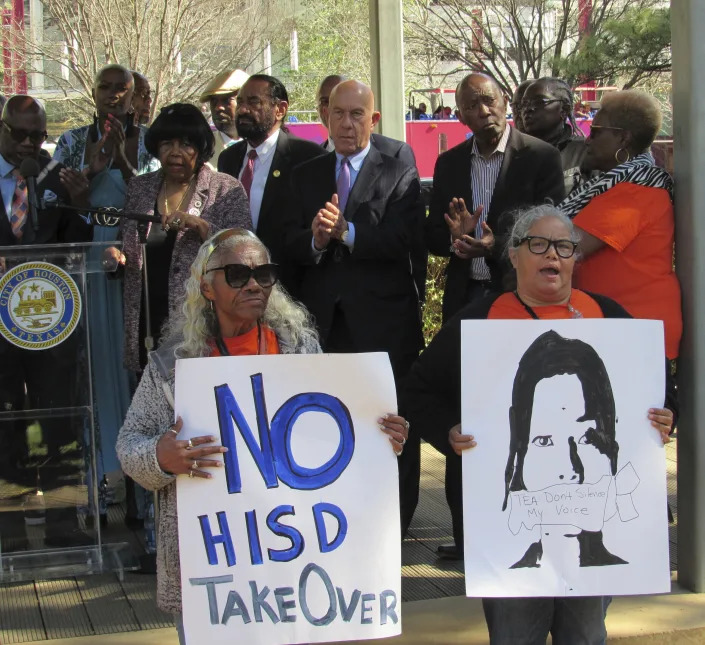
People hold up signs at a news conference on Friday, March 3, 2023, in Houston while protesting the proposed takeover of the city’s school district by the Texas Education Agency. Local and federal officials say state leaders are preparing to take over the Houston Independent School District over allegations of misconduct by district board members and the yearslong failing performance of one campus. ( Juan A. Lozano/AP Photo) (ASSOCIATED PRESS)

HOUSTON (AP) — Texas officials on Wednesday announced a state takeover of Houston’s nearly 200,000-student public school district, the eighth-largest in the country, acting on years of threats and angering Democrats who assailed the move as political.

The announcement, made by Republican Gov. Greg Abbott’s education commissioner, amounts to one of the largest school takeovers ever in the U.S.

It also deepens a high-stakes rift between Texas’ largest city, where Democrats wield control locally and state Republican leaders have sought increasing authority in the wake of election fumbles and pandemic restrictions.

Other big cities including PhiladelphiaNew Orleans and Detroit in recent decades have gone through state takeovers, which are generally viewed as last resorts for underperforming schools and are often met with community backlash. Critics argue that past outcomes show little improvement following state interventions.

The state began making moves toward a takeover of the Houston Independent School District in 2019, following allegations of misconduct by school trustees, including inappropriate influencing of vendor contracts, and chronically low academic scores at one of its roughly 50 high schools.

The district sued to block a takeover, but new education laws subsequently passed by the GOP-controlled state Legislature and a January ruling from the Texas Supreme Court cleared the way for the state to seize control.

Schools in Houston are not under mayoral control, unlike in cities such as New York or Chicago, but as expectations of a takeover mounted, the city’s Democratic leaders unified in opposition.

Most of Houston’s school board members have been replaced since 2019. District officials also say the state is ignoring academic strides made across city schools.

Race is also an issue because the overwhelming majority of students in Houston schools are Hispanic or Black. Domingo Morel, a professor of political science and public services at New York University, has studied school takeovers nationwide and said the political dynamics in Texas are similar to where states have intervened elsewhere.

The demographics in Houston, Morel said, are also similar.

“If we just focus on taking over school districts because they underperform, we would have a lot more takeovers,” Morel said. “But that’s not what happens.”

Weber reported from Austin, Texas.

Texas announces takeover of Houston schools, stirring anger

Associated Press

Texas announces takeover of Houston schools, stirring anger

Juan A. Lozano and Paul J. Weber – March 15, 2023

FILE - People hold up signs at a news conference, Friday, March 3, 2023, in Houston while protesting the proposed takeover of the city's school district by the Texas Education Agency. Texas officials on Wednesday, March 15, announced a state takeover of Houston's nearly 200,000-student public school district, the eighth-largest in the country, acting on years of threats and angering Democrats who assailed the move as political. (AP Photo/Juan A. Lozano)
People hold up signs at a news conference, Friday, March 3, 2023, in Houston while protesting the proposed takeover of the city’s school district by the Texas Education Agency. Texas officials on Wednesday, March 15, announced a state takeover of Houston’s nearly 200,000-student public school district, the eighth-largest in the country, acting on years of threats and angering Democrats who assailed the move as political. (AP Photo/Juan A. Lozano)
FILE - People hold up signs at a news conference, Friday, March 3, 2023, in Houston while protesting the proposed takeover of the city's school district by the Texas Education Agency. Texas officials on Wednesday, March 15, announced a state takeover of Houston's nearly 200,000-student public school district, the eighth-largest in the country, acting on years of threats and angering Democrats who assailed the move as political. (AP Photo/Juan A. Lozano)
People hold up signs at a news conference, Friday, March 3, 2023, in Houston while protesting the proposed takeover of the city’s school district by the Texas Education Agency. Texas officials on Wednesday, March 15, announced a state takeover of Houston’s nearly 200,000-student public school district, the eighth-largest in the country, acting on years of threats and angering Democrats who assailed the move as political. (AP Photo/Juan A. Lozano)
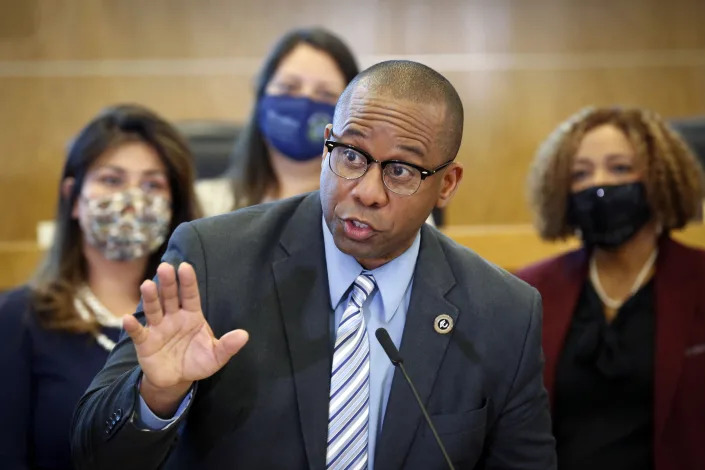
FILE - Houston Independent School District Superintendent Millard House II answers questions from the media, May 21, 2021, in Houston. Texas officials on Wednesday, March 15, 2023, announced a state takeover of Houston's nearly 200,000-student public school district, the eighth-largest in the country, acting on years of threats and angering Democrats who assailed the move as political. (Steve Gonzales/Houston Chronicle via AP, File)
Houston Independent School District Superintendent Millard House II answers questions from the media, May 21, 2021, in Houston. Texas officials on Wednesday, March 15, 2023, announced a state takeover of Houston’s nearly 200,000-student public school district, the eighth-largest in the country, acting on years of threats and angering Democrats who assailed the move as political. (Steve Gonzales/Houston Chronicle via AP, File)

HOUSTON (AP) — Texas officials on Wednesday announced a state takeover of Houston’s nearly 200,000-student public school district, the eighth-largest in the country, acting on years of threats and angering Democrats who assailed the move as political.

The announcement, made by Republican Gov. Greg Abbott’s education commissioner, Mike Morath, amounts to one of the largest school takeovers ever in the U.S. It also deepens a high-stakes rift between Texas’ largest city, where Democrats wield control, and state Republican leaders, who have sought increased authority following election fumbles and COVID-19 restrictions.

The takeover is the latest example of Republican and predominately white state officials pushing to take control of actions in heavily minority and Democratic-led cities. They include St. Louis and Jackson, Mississippi, where the Legislature is pushing to take over the water system and for an expanded role for state police and appointed judges.

In a letter to the Houston Independent School District, Morath said the Texas Education Agency will replace Superintendent Millard House II and the district’s elected board of trustees with a new superintendent and an appointed board of managers made of residents from within the district’s boundaries.

Morath said the board has failed to improve student outcomes while conducting “chaotic board meetings marred by infighting” and violating open meetings act and procurement laws. He accused the district of failing to provide proper special education services and of violating state and federal laws with its approach to supporting students with disabilities.

He cited the seven-year record of poor academic performance at one of the district’s roughly 50 high schools, Wheatley High, as well as the poor performance of several other campuses.

“The governing body of a school system bears ultimate responsibility for the outcomes of all students. While the current Board of Trustees has made progress, systemic problems in Houston ISD continue to impact district students,” Morath wrote in his six-page letter.

Most of Houston’s school board members have been replaced since the state began making moves toward a takeover in 2019. House became superintendent in 2021.

He and the current school board will remain until the new board of managers is chosen sometime after June 1. The new board of managers will be appointed for at least two years.

House in a statement pointed to strides made across the district, saying the announcement “does not discount the gains we have made.”

He said his focus now will be on ensuring “a smooth transition without disruption to our core mission of providing an exceptional educational experience for all students.”

The Texas State Teachers Association and the American Civil Liberties Union of Texas condemned the takeover. At a news conference in Austin, state Democratic leaders called for the Legislature to increase funding for education and raise teacher pay.

“We acknowledge that there’s been underperformance in the past, mainly due to that severe underfunding in our public schools,” state Rep. Armando Walle, who represents parts of north Houston, said.

An annual Census Bureau survey of public school funding showed Texas spent $10,342 per pupil in the 2020 fiscal year, more than $3,000 less than the national average, according to the Kinder Institute for Urban Research at Rice University in Houston.

The state was able to take over the district under a change in state law that Houston Democratic state Rep. Harold Dutton Jr. proposed in 2015. In an op-ed piece in the Houston Chronicle on Monday, Dutton said he has no regrets about what he did.

“We’re hearing voices of opposition, people who say that HISD shouldn’t have to face consequences for allowing a campus to fail for more than five consecutive years. Those critics’ concern is misplaced,” Dutton wrote.

Schools in other big cities, including PhiladelphiaNew Orleans and Detroit, in recent decades have gone through state takeovers, which are generally viewed as last resorts for underperforming schools and are often met with community backlash. Critics argue that state interventions generally have not led to big improvements.

Texas started moving to take over the district following allegations of misconduct by school trustees, including inappropriate influencing of vendor contracts, and chronically low academic scores at Wheatley High.

The district sued to block a takeover, but new education laws subsequently passed by the GOP-controlled state Legislature and a January ruling from the Texas Supreme Court cleared the way for the state to seize control.

“All of us Texans have an obligation and should come together to reinvent HISD in a way that will ensure that we’re going to be providing the best quality education for those kids,” Abbott said Wednesday.

Schools in Houston are not under mayoral control, unlike in New York and Chicago, but as expectations of a takeover mounted, the city’s Democratic leaders unified in opposition.

Race is also an issue because the overwhelming majority of students in Houston schools are Hispanic or Black. Domingo Morel, a professor of political science and public services at New York University, said the political and racial dynamics in the Houston case are similar to instances where states have intervened elsewhere.

“If we just focus on taking over school districts because they underperform, we would have a lot more takeovers,” Morel said. “But that’s not what happens.”

Weber reported from Austin, Texas. Associated Press writer Acacia Coronado in Austin, Texas, contributed to this report.

MAGAnians not only detest science and facts, they hate education: Trump tells Iowa campaign stop he’ll revamp ‘insane’ US schooling

AFP

Trump tells Iowa campaign stop he’ll revamp ‘insane’ US schooling

March 13, 2023

Former president Donald Trump on Monday slammed the “insane” US education system and vowed to bring back “common sense” schooling as part of his “America First” campaign platform, touching on a hot-button issue that is expected to dominate next year’s election.

Speaking to potential voters in Iowa, he hit on what has increasingly become a cultural flashpoint in the United States, with Republicans taking every opportunity they get to assail Democrats over what they see as the encroachment of “wokeness” into teaching.

“We have to get back to common sense, and that is reading, writing, arithmetic,” Trump told the crowd in Davenport, in response to an audience question about schools becoming “indoctrination camps” that are “focused on sexualizing our children.”

“What they’re teaching in schools today is insane,” said the 76-year-old Republican, who is running for president again after failing to win a second term in 2020.

Trump had previewed his education policy blueprint in January, calling for federal funding cuts to programs teaching children “critical race theory, gender ideology, or other inappropriate racial, sexual, or political content.”

On Monday night, he also promised to champion school choice, the right of parents to elect principals, and state — rather than federal — control over curriculums.

“School choice is where it’s at,” Trump said, referring to a movement that seeks to use tax credits and vouchers to allow parents to opt out of the public school system in favor of privately managed charter schools.

“As president I’ll fight to expand that right to every single state in America,” he said.

And he repeated a previous pledge to “keep men out of women’s sports” — a reference to Republican efforts to ban transgender women and girls from sports teams that match their gender identity.

– Shifting polls –

Iowa tends to be deluged by candidates in presidential election cycles as it hosts the first nominating contest for Republicans, and remains high in the Democratic calendar after being knocked from top spot.

Florida Governor Ron DeSantis — Trump’s chief potential rival for the Republican nod and a major critic of progressive messaging in classrooms — himself stopped by the Hawkeye State on Friday.

Former United Nations ambassador Nikki Haley, the only high-profile Republican Trump rival to have officially declared her candidacy, also campaigned in the largely rural Midwestern state last week.

A Des Moines Register/Mediacom Iowa Poll out on Friday showed Trump still holding significant sway in Iowa, although his favorability rating among self-identified Republicans has fallen from 91 percent in September 2021 to 80 percent.

DeSantis was close behind, with 74 percent of self-identified Republicans having a favorable opinion of him. 

And the share of Republicans who said they’d “definitely vote” for Trump if he were the party’s 2024 presidential nominee dropped from 69 percent in June 2021 to 47 percent now.

Democratic National Committee spokesman Rhyan Lake has previously accused Trump’s support for school choice as being an effort to gut public education while pushing to move billions of dollars towards private schools.

“Everyone will see right through Donald Trump’s desperate spin about his own record as the GOP field races to out-MAGA each other at the expense of America’s kids,” Lake said in a statement.

The Ugly Elitism of the American Right

The Atlantic Daily

The Ugly Elitism of the American Right

No one hates ordinary people like the Republicans and their media enablers do.

By Tom Nichols – March 9, 2023

A political display is posted on the outside of the Fox News headquarters in New York in July 2020.
A political display is posted on the outside of the Fox News headquarters in New York in July 2020. (Timothy A. Clary / AFP via Getty)

Fox News will likely never face any real consequences for the biggest scandal in the history of American media. But will Republican voters finally understand who really looks down on them?


Loathing and Indifference

It’s time to talk about elitism.

Last month, I wrote that the revelations about Fox News in the Dominion Voting Systems lawsuit showed that Fox personalities, for all their populist bloviation, are actually titanic elitists. This is not the elitism of those who think they are smarter or more capable than others—I’ll get to that in a moment—but a new and gruesome elitism of the American right, a kind of hatred and disgust on the part of right-wing media and political leaders for the people they claim to love and defend. Greed and cynicism and moral poverty can explain only so much of what we’ve learned about Fox; what the Dominion filings show is a staggering, dehumanizing version of elitism among people who have made a living by presenting themselves as the only truth-tellers who can be trusted by ordinary Americans.

I am, to say the least, no stranger to the charge of elitism. When I wrote a book in 2018 titled The Death of Expertise, a study of how people have become so narcissistic and so addled by cable and the internet that they believe themselves to be smarter than doctors and diplomats, I was regularly tagged as an “elitist.” And the truth is: I am an elitist, insofar as I believe that some people are better at things than others.

But even beyond talent and ability, I do in fact firmly believe that some opinions, political views, personal actions, and life choices are better than others. As I wrote in my book at the time:

Americans now believe that having equal rights in a political system also means that each person’s opinion about anything must be accepted as equal to anyone else’s. This is the credo of a fair number of people despite being obvious nonsense. It is a flat assertion of actual equality that is always illogical, sometimes funny, and often dangerous.

If that makes me an elitist, so be it.

In this, elitism is the opposite of populism, whose adherents believe that virtue and competence reside in the common wisdom of a nebulous coalition called “the people.” This pernicious and romantic myth is often a danger to liberal democracies and constitutional orders that are founded, first and foremost, on the inherent rights of individuals rather than whatever raw majorities think is right at any given time.

The American right, however, now uses elitist to mean “people who think they’re better than me because they live and work and play differently than I do.”They rage that people—myself included—look down upon them. And again, truth be told, I do look down on Trump voters, not because I am an elitist but because I am an American citizen and I believe that they, as my fellow citizens, have made political choices that have inflicted the greatest harm on our system of government since the Civil War. I refuse to treat their views as just part of the normal left-right axis of American politics.

(As an aside, note that the insecure whining about being “looked down upon” is wildly asymmetrical: Trump voters have no trouble looking down on their opponents as traitorsperverts, and, as Donald Trump himself once put it, “human scum.” But they react to criticism with a kind of deep hurt, as if others must accommodate their emotional well-being. Many of these same people gleefully adopted “Fuck your feelings” as a rallying cry but never expected that it was a slogan that worked both ways.)

In 2016, I believed that good people were making a mistake. In 2023, I cannot dismiss their choices as mere mistakes. Instead, I accept and respect the human agency that has led Trump supporters to their current choices. Indeed, I insist on recognizing that agency: I have never agreed with the people who dismiss Trump voters as robotic simpletons who were mesmerized by Russian memes. I believe that today’s Trump supporters are people who are making a conscious, knowing, and morally flawed choice to continue supporting a sociopath and a party chock-full of seditionists.

I have argued with some of these people. Sometimes, I have mocked them. Mostly, I have refused to engage them. But whatever my feelings are about the abominable choices of Trump supporters, here is the one thing I have never done that Fox’s hosts did for years: I have never patronized any of the people I disagree with.

Unlike people such as Tucker Carlson or Sean Hannity or Laura Ingraham, I have never told anyone—including you, readers of The Atlantic—anything I don’t believe. What we’re seeing at Fox, however, is lying on a grand scale, done with a snide loathing for the audience and a cool indifference to the damage being done to the nation. Fox, and the Republican Party it serves, for years has relentlessly patronized its audience, cooing to viewers about how right they are not to trust anyone else, banging the desk about the corruption of American institutions, and shouting into the camera about how the liars and betrayers must pay.

Fox’s stars did all of this while privately communicating with one another and rolling their eyes with contempt, admitting without a shred of shame that they were lying through their teeth. From Rupert Murdoch on down, top Fox personalities have admitted that they fed the rubes all of this red, rotting meat to keep them out of the way of the Fox limos headed to Long Island and Connecticut.

You can see this same kind of contemptuous elitism in Republicans such as Ted Cruz, Josh Hawley, and Elise Stefanik. They couldn’t care less about the voters—those hoopleheads back home who have to be placated with idiotic speeches against trans people and “critical race theory.” These politicians were bred to be leaders, you see, and having to gouge some votes out of the hayseeds back home requires a bit of performance art now and then, a small price to pay so that the sons and daughters of Harvard and Yale, Princeton and Stanford, can live in the imperial capital and rule as is their due and their right.

Some years ago, I was at a meeting of one of the committees of the National Academy of Sciences. The conferees asked me how scientists—there were Nobel Laureates in the room—could defend the cause of knowledge. Stand your ground, I told them. Never hesitate to tell people they’re wrong. One panel member shook his head: “Tom, people don’t like to be condescended to.” I said, “I agree, but what they hate even more is to be patronized.

I believed it then, but we’re now testing that hypothesis on a national scale. I hope I wasn’t wrong.

Related:

‘I just found myself struggling to keep up’: Number of teachers quitting hits new high

USA Today

‘I just found myself struggling to keep up’: Number of teachers quitting hits new high

Matt Barnum – March 6, 2023

Why some US school districts are seeing extreme teacher shortages 

The data is in: More teachers than usual exited the classroom after last school year, confirming longstanding fears that pandemic-era stresses would prompt an outflow of educators. That’s according to a Chalkbeat analysis of data from eight states – the most comprehensive accounting of recent teacher turnover to date.

In Washington state, more teachers left the classroom after last school year than at any point in the last three decades. Maryland and Louisiana saw more teachers depart than any time in the last decade. And North Carolina saw a particularly alarming trend of more teachers leaving mid-school year.

The turnover increases were not massive. But they were meaningful, and the churn could affect schools’ ability to help students make up for learning loss in the wake of the pandemic. This data also suggests that spiking stress levels, student behavior challenges, and a harsh political spotlight have all taken their toll on many American teachers.

“Education had changed so dramatically since COVID. The issues were getting bigger and bigger,” said Rebecca Rojano, who last year left a job teaching high school Spanish in Connecticut. “I just found myself struggling to keep up.”

At risk: Despite ‘teacher shortage,’ coming layoffs could hit newly hired teachers of color hardest

The pandemic changed American education overnight: Some changes are here to stay.

Across 8 states, more teachers left the classroom following last school year

Since the pandemic threw U.S. schools into disarray, many educators and experts warned that more teachers would flee the profession. But in 2020, turnover dipped in many places as the economy stalled, then in 2021 it ticked back up to normal or slightly above-average levels.

As this school year began, widespread reports of teacher shortages suggested that turnover had jumped more significantly.

Data was hard to come by, though. The federal government doesn’t regularly track teacher quit rates. Many states don’t either, with education officials in California, New Mexico, Ohio and Pennsylvania saying that they don’t know how many teachers leave each year.

But Chalkbeat was able to obtain the latest teacher turnover numbers from eight states: Hawaii, Louisiana, Maine, Maryland, Mississippi, North Carolina, South Carolina, and Washington. These figures encompassed turnover between the 2021-22 year and this school year.

In all cases, turnover was at its highest point in at least five years – typically around 2 percentage points greater than before the pandemic. That implies that in a school with 50 teachers, one more than usual left after last school year.

“I am struck by just how consistent these patterns are looking at all of these different states,” said Melissa Diliberti, a researcher at RAND, which has monitored teacher attrition during the pandemic.

In Louisiana, for instance, nearly 7,000 teachers exited the classroom last school year, or about 1,000 more than usual. That’s a turnover rate of 14%, up from between 11% and 12% in a typical pre-pandemic year.

Is there a teacher shortage? Here’s what the data says.

There was variation among the eight states. Mississippi’s teacher workforce was the most stable: Turnover was 13% this year, only slightly higher than the two years before the pandemic. North Carolina saw the largest spike: 16% of teachers left after last year, compared with less than 12% in the three years before the pandemic.

For Kimberly Biondi, who taught high school English for 21 years in a district outside Charlotte, her reasons for leaving were wrapped up in the politics of education. She advocated for remote instruction as well as in-school safety rules, such as masking, but faced personal criticism from a local group opposed to these measures, she said. Biondi was also worried that politics could eventually limit what she taught.

“I taught AP language where we were supposed to teach very controversial work. I taught Malcolm X. I taught all sorts of philosophers and speakers,” she said. “I could only imagine how I would be targeted for continuing to teach this.”

Five decades and yet: The fight for African American studies in schools isn’t getting easier

Other former teachers cited growing workloads and more difficulty managing student behavior.

Rojano said that student engagement plummeted as students returned to class in fall 2021, some for the first time in over a year. “A lot of these students are really hurting and suffering with intense emotional problems and high needs,” she said. “The needs just grew after the pandemic – I noticed a lot more emotional outbursts.”

It didn’t help, she said, that her class sizes were large, ranging from 25 to 30 students, making it hard to form close relationships with students. Plus, the school was short staffed and had many absences, forcing Rojano to constantly cover other teachers’ classes, losing her planning time.

Overworked, underpaid?: The toll of burnout is contributing to teacher shortages nationwide

She left in the middle of the last school year, something she never imagined doing because it was so disruptive for the school and her students. “It got so bad,” she said. “I was very overwhelmed and stressed. I was anxious and tired all the time.” Rojano ended up taking a job at an insurance company, where she is able to work remotely when she wants.

State reports hint that rising frustration has pushed more teachers out of the classroom. In Louisiana, the number of teachers who resigned due to dissatisfaction increased. In Hawaii, more teachers than usual identified their work environment as the reason for leaving. (In both states, personal reasons or retirement were still far more common explanations.)

A degree of staff turnover in schools is considered healthy. Some new teachers realize the profession just isn’t for them. Others take different jobs in public education, becoming, say, an assistant principal. But in general, research has found that teacher churn harms student learning – students lose relationships with trusted educators, inexperienced teachers are brought on as replacements, and in some cases classrooms are left with only long-term substitutes.

While the eight states where Chalkbeat obtained data may not be representative of the country as a whole, there are signs that higher attrition was widespread. In a recent nationally representative survey from RAND, school district leaders reported a 4 percentage point increase in teacher turnover. Data from a handful of districts show a similar trend. For instance, turnover among licensed staff, including teachers, spiked from 9% to 12% in Clark County, Nevada, the country’s fifth-largest district. In Austin, Texas, turnover jumped from 17% to 24%.

Other school staff appear to be leaving at higher rates, too.

Hawaii experienced a jump in aides and service staff who exited public schools. North Carolina saw over 17% of principals depart last school year, compared to an average of 13% in the three years before the pandemic. The RAND survey also found a sharp increase in principals leaving.

Thinking outside the box: Amid crippling teacher shortages, some schools are turning to unorthodox solutions

Why rising teacher turnover is concerning

A degree of staff turnover in schools is considered healthy. Some new teachers realize the profession just isn’t for them. Others take different jobs in public education, becoming, say, an assistant principal. But in general, research has found that teacher churn harms student learning – students lose relationships with trusted educators, inexperienced teachers are brought on as replacements, and in some cases classrooms are left with only long-term substitutes.

“Teacher attrition can be destabilizing for schools,” said Kevin Bastian, a researcher at the University of North Carolina, where he calculated the state’s turnover rate.

He found that effective teachers were particularly likely to leave the state’s public schools last year. Mid-year turnover, which is especially disruptive, increased from under 4% in prior years to over 6% in the 2021-22 school year in North Carolina. The state also ended up hiring fewer teachers for this school year than it lost, suggesting that some positions were eliminated or left vacant.

Biondi is now seeing the effects on her own children, who attend school in the district where she taught. “My daughter lost her math teacher in December,” she said. “They don’t have a replacement teacher – she’s struggling very much in math.”

This year, schools may have been in a particularly fraught position. Teachers appear to be leaving at higher rates, and there’s been a longer-standing decline in people training to become teachers. At the same time, schools may have wanted to hire more teachers than usual because they remain flush with COVID relief money and want to address learning loss. That’s a recipe for a shortage.

Typically, shortages hit high-poverty schools the hardest. They also tend to be more severe in certain areas including special education, math, and science.

Distance learning affected disadvantaged students most: The teacher shortages are just piling on.

Benjamin Mosley, principal of Glenmount Elementary/Middle School in Baltimore, has been buffeted by these pressures. He’s had multiple teachers leave in the middle of this year, and has not been able to replace them or some others who left at the end of last year.

On a recent visit to the school, students in a math class listened to a teacher based in Florida teach a lesson virtually; the class was supervised by an intervention teacher who was originally meant to provide small group tutoring. A social studies class, whose teacher had recently resigned, was being overseen by a staff member who had been hired to serve as a student mentor.

Mosley is still actively trying to find teachers and is now considering candidates whom he might have passed over in years past.

“We can put a man on the moon, but yet we can’t find teachers,” he said.

Teacher salaries become a bipartisan cause: Low pay ‘a major crisis in education’

Matt Barnum is a Spencer fellow in education journalism at Columbia University and a national reporter at Chalkbeat covering education policy, politics, and research.