Florida teacher investigated by state for showing Disney cartoon movie in class
Ana Goñi-Lessan, USA TODAY NETWORK – May 14, 2023
TALLAHASSEE, Fla. — A Florida teacher is under investigation by the state Department of Education after what she believes is a targeted attack by a school board member who took issue with a Disney movie shown in her classroom.
At a Hernando County School Board meeting Tuesday, fifth-grade teacher Jenna Barbee alleged school board member Shannon Rodriguez reported her to the Florida Department of Education for showing her students Disney’s 2022 movie “Strange World.” It’s the first Disney movie with an openly gay character.
Barbee, a teacher at Winding Waters K-8, said during public comment the Disney movie tied into her students’ Earth science lesson and did not have sexually inappropriate content.
“The word indoctrination is thrown around a lot right now, but it seems that those who are using it are using it as a defense tactic for their own fear-based beliefs without understanding the true meaning of the word,” Barbee said.
Florida educators are prohibited from teaching about gender and sexual identity due to the Parental Rights in Education Act, signed by Gov. Ron DeSantis last year. Also known as “Don’t Say Gay” by critics, teachers have expressed anxiety and confusion over the vague wording of the law for fear of losing their teaching licenses or criminal penalties if found in non-compliance.
Opponents of the law say the vague wording unfairly targets books and classroom materials with gay and transgender characters and themes.
Teacher speaks out in public comments amid investigation
Hernando County’s school district confirmed a fifth-grade teacher is being investigated for showing “Strange World,” and that a parent complained to the principal about the movie not being appropriate for students.
In Barbee’s public comments, she alluded to her seven-year-old expunged record on a fraud charge, acknowledging she has made mistakes but showing a Disney movie is not one of them. Barbee said every student in her class had a signed parent permission slip that said PG movies were allowed.
“I’m a first-year teacher. I’ve had to learn so much this year,” she told the USA TODAY NETWORK-Florida. “I work with teachers who have taught for 20 years, 30 years, tell me every day it never used to be like this.
“Times have changed so much and they are so micromanaged, they’re not allowed to teach anymore. They’re basically a caregiver who has to teach the standards. Teachers stay for the children, but because of the laws and the fear of being let go for saying one wrong thing, they can’t connect to their students.”
At the end of the school board meeting Tuesday, Rodriguez said Barbee broke school policy because she did not get the specific movie approved by school administration and said the teacher is “playing the victim.” Rodriguez’s daughter is also in Barbee’s class.
“It is not a teacher’s job to impose their beliefs upon a child: religious, sexual orientation, gender identity, any of the above,” Rodriguez said. “But allowing movies such as this, assist teachers in opening a door, and please hear me, they assist teachers in opening the door for conversations that have no place in our classrooms.”
Rodriguez, who was elected to the school board last fall, was endorsed by the conservative parents’ rights group Moms for Liberty. In her short tenure, she has argued there is “smut” and “porn” on schools’ library shelves and has asked for books to be removed, according to Suncoast News.
Rodriguez did not immediately respond to Tallahassee Democrat’s, part of the USA TODAY Network, request for comment.
“Strange World,” an animated sci-fi movie, was released by Disney in the late fall of 2022. The movie depicts a group of explorers who go on an adventure to find an exotic plant that serves as their society’s source of energy.
The main character, Ethan Clade, is gay and his storyline includes having a crush on another male character named Diazo.
Critics have blasted the movie as indoctrination and FOX News said it was the latest “in a year of woke disasters” for Disney. Disney refrained from showing “Strange World” in the Middle East, China, Indonesia, Turkey, Nigeria, Uganda and other countries because of the LGBTQ storyline.
“In countries where we operate, we seek to share our stories in their original form as we and the artists involved have created them. If we make edits, because of legal or other considerations, they will be as narrow as possible. We will not make an edit where we believe it would impact the storytelling. In that circumstance, we will not distribute the content in that market,” Disney said in its Human Rights Policy, which was updated in 2022.
“Strange World” features the voices of (clockwise from top left) Lucy Liu as Callisto Mal, the leader of Avalonia; Jake Gyllenhaal as farmer and father Searcher Clade; Dennis Quaid as diehard explorer and Searcher’s father, Jaegar Clade; Gabrielle Union as pilot and mother Meridian Clade; and Jaboukie Young-White as the youngest Clade, Meridian and Searcher’s son, Ethan.More
Disney has been in a legal battle with Gov. Ron DeSantis since company leadership spoke out against DeSantis’ Parental Rights in Education law.
The governor has gone to war against the Magic Kingdom, escalating the back-and-forth until the Florida Legislature authorized what amounted to a hostile takeover of the Disney-allied Reedy Creek Improvement District that was created in 1967 to give the entertainment giant broad, self-governing powers.
“Disney had clearly crossed a line in its support of indoctrinating very young schoolchildren in woke gender identity politics,” DeSantis wrote in his book ahead of his expected announcement of his presidential candidacy.
Disney is suing DeSantis in federal court, charging him with violating the company’s free speech rights and claiming the governor led a “targeted campaign of government retaliation” against the company, a charge DeSantis dismissed as “political.”
Breast cancer screening should start at age 40 – 10 years earlier than previous advice, group says
Nada Hassanein, USA TODAY – May 9, 2023
Women should be screened for breast cancer every other year starting at age 40 instead of 50, according to draft guidelines released Tuesday by the United States Preventive Services Task Force, the independent national body of experts that sets standards for tests and screenings.
The previous recommendations, last updated in 2016, said women younger than 50 who are concerned could discuss screening with their doctors. Now, the task force says screening at 40 could save 19% more lives.
Experts say the guidelines are a leap in the right direction but should go further to advise women to be screened annually. Several other leading groups have long recommended yearly mammograms starting at age 40.
“Cancers do grow between mammograms,” said Dr. Maxine Jochelson, a radiologist at Memorial Sloan Kettering Cancer Center. She agreed that beginning screenings at 40 is the “right answer for average risk women.”
Breast cancer makes up nearly 30% of new cancers in U.S. women each year, and it’s estimated that 1 in 8 women will develop breast cancer in the course of their lives. The median age for diagnosis across all women is 62, but that can vary by racial group.
Breast cancer clinicians have long called for lowering the recommended age for a woman’s first mammogram, especially for Black women, who are more likely to be diagnosed at earlier ages or with aggressive subtypes and are 40% more likely than white women to die of breast cancer.
Nearly 1 in 5 Black women with breast cancer are diagnosed with triple-negative breast cancer, a type that grows and spreads more quickly, is difficult to treat and lacks three receptors commonly found in breast cancers that doctors target for treatment.
The task force is “also calling for more research on how best to address health disparities across screening and treatment,” task force member and internist Dr. John Wong, chief of the division of clinical decision making at Tufts Medical Center, told USA TODAY.
Breast cancer is also the second-leading cause of cancer-related death for white, Asian, Pacific Islander, American Indian and Alaska Native women, though Asian and Pacific Islander women have the lowest breast cancer death rate of all groups.
The guidelines will become official after the task force reviews feedback during the public comment period that ends June 5. The recommendations apply to women, including those assigned female at birth, transgender men and nonbinary people.
Why experts say the new guidelines still fall short
Most organizations recommend annual mammograms starting at age 40, including the American College of Radiology, the American Society of Breast Surgeons, and the American College of Obstetricians and Gynecologists.
But the task force is the official body that many primary care doctors follow for preventive testing. Its recommendations are based on review of existing evidence and is supported by the federal Agency for Healthcare Research and Quality.
Private insurance plans generally base coverage off the task force’s recommendations, though the Centers for Disease Control and Prevention says most insurance plans are required to cover mammograms starting at age 40.
In announcing the new draft guidelines, the task force said it chose to keep the recommendation at every other year because of an increased risk of false positives diagnosis. It said callbacks can cause patients to worry or lead to unnecessary biopsies.
But experts say the harms of missed cancers outweigh that worry, and advanced imaging and biopsies can address false positives.
“The guidelines are worrisome,” said Dr. Michele Blackwood, chief of breast surgery at Rutgers Cancer Institute of New Jersey and member of the American Society of Breast Surgeons. “Most of us in this realm still vociferously support yearly mammograms for women over age 40.”
Women diagnosed under age 50 are more likely to be diagnosed with aggressive cancers, and many women skipped mammograms during the COVID-19 pandemic and are seeing later-stage diagnoses, Blackwood said. It’s time, she said, “to focus on harms of not screening.”
The American College of Radiology also recommends high-risk groups such as Black women and Ashkenazi Jewish women get risk assessments by age 25 to determine whether a mammogram before age 40 is needed.
Unified guidance is needed, said Dr. Vivian Bea, section chief of breast surgical oncology at NewYork-Presbyterian Brooklyn Methodist Hospital and a breast surgeon at Weill Cornell Medicine.
“It’s confusing for physicians and providers who are then counseling patients,” she said. “It’s also confusing for patients.”
Dr. Ryland Gore, a breast surgical oncologist in Atlanta, said the Preventative Services Task Force could benefit from having an oncologist − a cancer doctor − on the task force.
“It’s estimated that about 300,000 new cases will be diagnosed this year, but breast cancer numbers are not going down,” Gore said. “Imagine how many you potentially miss by saying, ‘Oh, you can just do this every other year.’ That is not good enough.”
Cancer can go under the radar in people with dense breasts, which means they have more fibrous tissue than fatty tissue. Nearly half of all women have dense breasts, which increases the risk for breast cancer.
Experts say mammograms may miss tumors in people with dense breasts and that they may be better detected by ultrasound or MRI. But in its draft guidelines, the task force concluded “that the evidence is insufficient to determine the balance of benefits and harms of supplemental screening for breast cancer with breast ultrasound or MRI, regardless of breast density.”
“Dense breasts make it harder to find the cancer on the mammogram,” Jochelson said. “And so, what happens is you miss it on the mammogram, and then you might find it on the next mammogram. But it’s going to have a year to grow.”
MRI was the best supplemental imaging in women with dense breasts who had average to intermediate risk for breast cancer and whose mammographies were negative for cancer, according to a meta-analysis of 22 studies published in the journal Radiology in January. Of more than 132,000 patients with dense breasts, 541 cancers missed by mammography were detected with alternative imaging.
As of 2019, at least 38 states had laws mandating clinicians inform patients that they have dense breasts. In March the U.S. Food and Drug Administration, which is responsible for regulating mammography standards, updated regulations to require mammography facilities to inform patients if they have dense breasts.
“We can save more lives by doing yearly and doing supplemental imaging,” Jochelson said. “I don’t doubt it for a second.”
Dense breast tissue. This increases the risk of breast cancer and can make it harder to see a tumor by mammogram. Ask your mammographer to let you know if you have dense breast tissue, and if you do, discuss with your clinician whether they recommend additional imaging like ultrasound or MRI.
Family history. Risk is higher for people with a first-degree relative – mother, sister or daughter – or multiple relatives on either the maternal or paternal side who have had breast or ovarian cancers.
Age. Breast cancer risk increases as a person ages.
Genetic mutations. People with inherited changes in genes, such as BRCA1 and BRCA2, are at higher risk for breast and ovarian cancers.
Previous history. Prior diagnoses of breast cancer increases the risk for a second diagnosis.
The CDC says there are also risk factors that can be reduced. These include not exercising, being overweight or obese, taking certain forms of hormone replacement therapy during menopause and certain oral contraceptives, and drinking alcohol.
A Colorado school board was taken over by Trump-loving conservatives. Now nearly half its high-school teachers are bailing.
Grace Eliza Goodwin – May 9, 2023
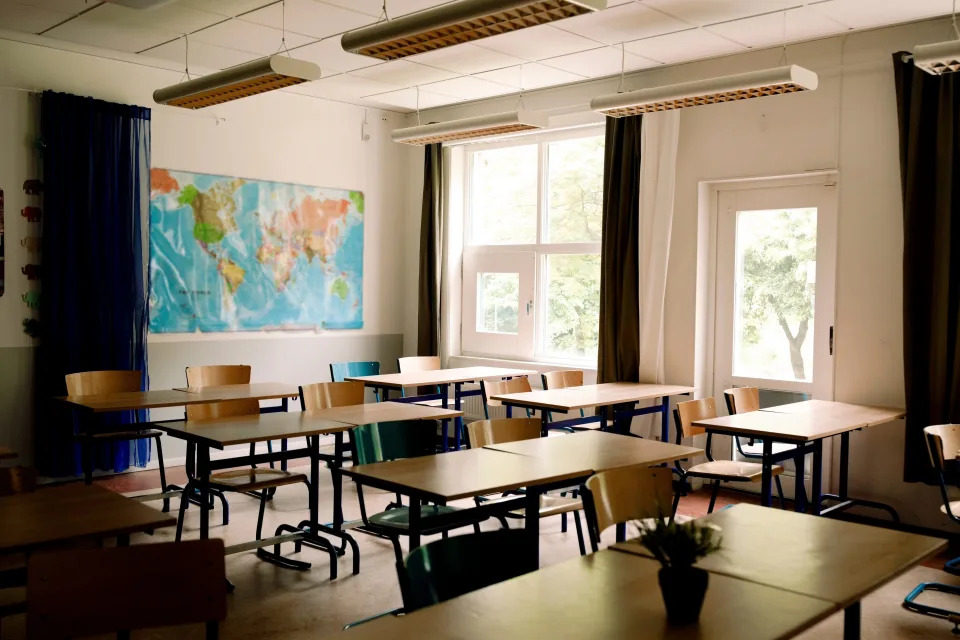
Desks and chairs arranged in classroom at high schoolMaskot / Getty Images
A newly elected conservative school board in Colorado is enraging many residents and teachers.
About 40% of the district’s high-school teachers have said they’re leaving next year, NBC News said.
The board has adopted a conservative teaching standard and argued against mental-health resources.
A Colorado school district’s board was taken over by conservatives aiming to emulate former President Donald Trump — and its new policies are set to drive off nearly half the district’s high-school teachers, NBC News reported.
At the end of 2021, a group of conservatives won control of the school district in Woodland Park, Colorado.
Since then, it has enacted a number of conservative policies that have infuriated many teachers, residents, and even staunch Republicans in the town of just 8,000 people, NBC News reported.
Nearly 40% of the district’s high-school teachers have decided to leave at the end of this school year, a district administrator told NBC News.
At least four higher-ups in the district have quit over the new board’s policies, according to interviews and emails viewed by NBC News.
“This is the flood the zone tactic, and the idea is if you advance on many fronts at the same time, then the enemy cannot fortify, defend, effectively counter-attack at any one front,” David Illingworth, a new member of the school board, wrote to another member shortly after being elected, NBC News reported.
“Divide, scatter, conquer,” he wrote. “Trump was great at this in his first 100 days.”
Among its most controversial new policies is the board’s decision to adopt the American Birthright social-studies standard. The curriculum standard, created by a conservative advocacy group, emphasizes patriotism, discourages civic engagement, and criticizes the federal government’s control of public schools, NBC News said.
The board also pushed against mental-health resources for students, with the superintendent musing how a school social worker didn’t help stop a student’s killing off campus, the NBC News report said.
America is refusing to do the one simple thing that would solve the Great People Shortage
Gaby Del Valle – May 4, 2023
The US needs more workers or it will face serious economic chaos. There’s a clear fix: more immigration.Tyler Le/Insider
Two simple words: more immigrants
America needs more workers.
The United States is already running low on critical positions such as nurses, home-health aides, farmworkers, and truckers. And there are fewer young people on the way to make up the difference: The National Bureau of Economic Research found that birth rates in the US have declined by nearly 20% since 2007, while the fertility rate has been below the replacement level for decades.
That means that unless people start having a lot more kids, the US population could eventually start to shrink — just like China’s population has. The problem, though, isn’t just a smaller population, but an aging one. With fewer people to pay into Social Security to support the growing number of retirees and fewer workers in critical industries, including healthcare and agriculture, a declining population would have devastating consequences for the American economy.
“This is the issue of the future, because this is going to become the first-order issue for all kinds of industries in America,” Lant Pritchett, a development economist and RISE Research director at Oxford University’s Blavatnik School of Government, told me. “They just won’t be able to attract workers.”
Politicians have suggested various ways to encourage people to have more children: “We will support baby bonuses for a new baby boom,” former President Donald Trump said at a conference in March. But even if these policies went into effect, we’d still have to wait for those kids to grow up before they could enter the workforce. The labor imbalance is already here, and the economy needs more workers now. That’s why a growing number of demographers, economists, and business executives support letting more immigrants into the US as a more immediate way to fill in the gaps. President Joe Biden’s economic advisors even said in March that more legal immigration is needed to boost the economy. And while immigration is a politically touchy solution, the quickly aging US economy is running out of options to keep itself afloat.
“The only solution is more workers,” Pritchett said.
America’s People Shortage
The US fertility rate first dipped below the replacement level — the rate needed to sustain the population, which is about 2.1 births per woman — in the 1970s. After rebounding in the 1990s and early 2000s, the rate began a steady decline in 2007 that has not reversed. While the US population has managed to avoid an outright drop, population growth reached an unprecedented low of 0.12% in 2021. Some of this loss can be attributed to the deaths of over 1 million Americans during the pandemic, but the COVID crisis only exacerbated preexisting demographic trends. Americans are getting older: The median age of the US population has increased by roughly 3.5 years since 2000, according to the Census Bureau, and 2021 saw the largest upward shift in the population age ever recorded.
According to estimates, these trends won’t reverse anytime soon. The Congressional Budget Office estimated this year that population growth will slow between 2023 and 2053, and that by 2042, any growth will be from immigration, not births. Kenneth Johnson, a professor of sociology and a senior demographer at the University of New Hampshire, pointed out that the demographic mismatch is even more dire when you look at county-by-county data. Deaths outnumbered births in two-thirds of US counties in 2021, creating a phenomenon that demographers call “natural decrease.” Even before the pandemic, roughly half of all US counties had more deaths than births, he said.
Johnson said that one big debate among demographers is whether people are simply delaying having children or just putting it off altogether. It’s possible that a combination of factors, including the lingering effects of the Great Recession, coupled with crushing student-loan debt, the rising cost of housing, and the pandemic simply pushed back the timeline for many people to have children. After all, birth rates did rise slightly in 2021, likely because of stimulus payments and the flexibility of remote work. But Johnson told me, “Right now, my impression is that a fair number of those babies aren’t going to be born.”
Policymakers and economists have suggested myriad ways to increase the number of babies people are having — ranging from “baby bonds” to a stronger social-safety net. But some ideas to boost fertility come with a sinister undercurrent. The preoccupation with increasing birth rates has particularly taken hold on the political right, which has long had a fascination with the racist conspiracy theory that there is a global plot to “replace” white Americans with immigrants. Trump’s baby-boom plan, for instance, may have been inspired by Hungary’s family-planning program, which is designed to encourage white heterosexual couples to have more children. “Migration for us is surrender,” Hungary’s far-right Prime Minister Viktor Orbán said in 2019.
Kenneth Johnson, University of New Hampshire
The pronatalist movement, which argues that people should be having more babies, has also grabbed hold in Silicon Valley — but some of its adherents don’t believe that just anyone should be having children. Tech billionaires like Elon Musk (who has 10 children) have become convinced that they need to have lots of children to save the human race. And one Silicon Valley couple has started a campaign to encourage more people like themselves to have children, speaking openly about their use of reproduction technology to select embryos based on genetic testing.
But so far, policies designed to induce people into having more kids have been a bust. Japan has struggled with a declining birthrate for decades despite efforts to encourage families to have more children. Earlier this year, Prime Minister Fumio Kishida warned that Japan was “on the brink of not being able to maintain social functions” due to population decline, adding that it was “now or never” to solve the problem. China’s population is both aging and shrinking as well, and after decades of restrictive family-planning policies, the country is trying to change course. In recent years, China has reversed its notorious “one-child policy” and started restricting abortions for “nonmedical reasons.” But the country’s population is still declining.
How immigration can boost the economy
In the face of looming population decline and resulting labor shortages, there is a clear answer staring the US in the face: immigration. Allowing more people to become Americans would not only help immediately alleviate some of the labor shortages plaguing the US economy but would also help to stem some of the country’s long-term population decline. Historically, the median age of immigrants has been younger than the median American age. And people of working age — meaning those between 18 and 64 — comprised 77% of the immigrant population in 2021, compared to just 59% of the US-born population that same year. Immigrants, Johnson said, “bring not only themselves,” but also the potential for more children, further boosting the US population and productivity.
Though current immigration rates — particularly the number of migrants apprehended at the border — are the subject of contentious national debate, recent Census data shows that the total number of immigrants arriving in the country isn’t enough to offset population losses. Between 2021 and 2022, the number of immigrants in the 20 most-populous counties in the country nearly tripled, but most of those counties still saw their overall populations decline. Despite increased immigration, Los Angeles County’s population declined by 90,000 people in 2022 — and by 180,000 people the previous year.
In order to truly prevent a people shortage, the US will need to let more people into the country. And there’s already evidence that immigrants can help boost local economies — and transform entire cities. Immigrants are 80% more likely to start a business than people born in the US, and recent data shows that they’ve started more than 25% of businesses in seven of the eight fastest-growing sectors of the US economy. Because of that, research has found that immigrants actually create more jobs than they take. Plus, across the US, several key industries — including agriculture, meatpacking, manufacturing, and healthcare — depend on immigrant labor. And if we boost immigration rates, the incoming workers could help ease labor shortages in these critical fields.
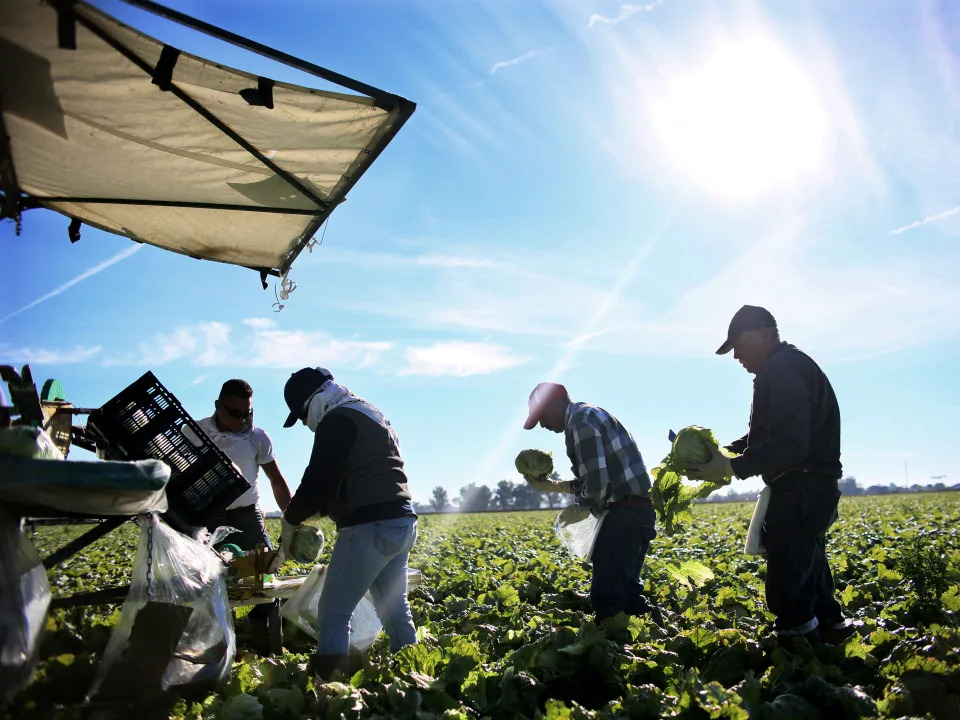
Critical industries such as agriculture and healthcare rely on immigrant labor.Sandy Huffaker/AFP via Getty Images
From central Indiana to New York City, businesses are struggling because they can’t hire enough workers to fill their open roles. “If we don’t do this and have a positive conversation about immigration today, it will continue to crush Hoosier households and economy,” Patrick Tamm, the president and CEO of the Indiana Restaurant and Lodging Association, told a local publication.
Take Utica, New York. The city’s population declined from 100,410 people in 1960 to just over 60,500 in 2000. But instead of facing extinction, the postindustrial city’s population slowly began rebounding in the 1990s with the arrival of Bosnian immigrants fleeing the Yugoslav Wars, who were followed by refugees from Myanmar in the 2000s and, more recently, Bantu refugees from Somalia. The city’s relatively low cost of living has made it a hub for people fleeing conflicts around the world, who resettle with the help of refugee-aid organizations. Though the city’s population still hovers around 60,000, it would be much lower if not for the resettled refugees and their families who now make up about 25% of Utica’s population.
“The refugee population has helped the city’s economy tremendously,” Brian Thomas, the commissioner of Utica’s Department of Urban and Economic Development, told CNBC.
Political compromise?
Immigration has, of course, been a political hot potato for decades. One 2022 survey found that one-third of Americans and two-thirds of Republicans believe in tenets of the so-called “Great Replacement” theory. A February Gallup poll found that just 28% of responding Americans are satisfied with our current immigration rates, and most of those who are dissatisfied want immigration to decrease. But even without a huge overhaul of the entire system, there are clear solutions that could help welcome more talented, much-needed workers to America.
One way the US could encourage more immigration is by focusing on temporary visas for specific industries that need workers. Japan took this approach and quietly opened itself to foreign workers in 2019 when it began allowing “specific skilled workers” in 14 key industries. These workers are allowed to stay in the country for up to five years on temporary labor visas — but they aren’t allowed to bring their families. Lawmakers hoped that the policy would attract around 345,000 workers in a five-year period, or an average of 5,750 people each month. Pritchett said this model could also work in the United States.
“A lot of people in the world would love to come work in a high-productivity place and would be more than willing to do so not in an exploitative way, but on a term-limited basis,” he told me.
There are already two guest-worker programs in the United States: the H-2A program for temporary agricultural laborers and the H-2B program for temporary non-agricultural workers. Both programs give temporary work visas to people tied to specific employers. The current programs are not perfect, however, and workers on H-2A and H-2B visas have sounded the alarm over squalid living conditions, wage theft, and exploitation. And the treatment of workers in the country on temporary visas has been a problem for decades. For these programs to be expanded, there would need to be significant safeguards in place to ensure workers aren’t exploited.
And there are other approaches that could work. Tara Watson, an economist and the director of the Center on Children and Families at the Brookings Institution, said that solutions focused on bringing people here on a long-term basis are more in line with what the US needs. “I’d rather see more expansion on the permanent side than the temporary side, because I think the challenges that we’re facing are long-run challenges and they really require long-run solutions,” Watson said.
She said that a good place to start would be expanding both family- and employment-based migration by simply allocating more visas in each category. Scaling up both programs would make an immediate difference, she said. Other simple solutions include lifting the cap on the number of skill-based green cards issued to immigrants from each country and letting people on nonimmigrant visas renew their status in the United States, rather than having to leave the country to do so.
Regardless of the approach, the biggest hurdle is a matter of political will. “I think there will be some resistance to this as a solution,” said Watson. “But I also think it’s essentially an imperative.” After all, the US is running out of options, and soon its growing people shortage is going to spell economic disaster.
Watson said that the economic forces will eventually overwhelm the “white-nationalist far right” that has “played an outsize influence” on the immigration debate. “If we don’t solve this problem in the next couple of years, it’s going to come to a head,” she said.
Gaby Del Valle is a writer and reporter living in Brooklyn. She coauthors the immigration newsletter BORDER/LINES.
Thomas had taken legal custody of his grandnephew at the time and told C-SPAN in an interview he was “raising him as a son.” Tuition at the Georgia boarding school ran more than $6,000 a month, ProPublica reported. Thomas did not note the payments from Crow on his annual financial disclosures.
The revelation was the latest involving Thomas and Crow, who paid for lavish trips and private jet travel for the justice and his wife and who purchased three Georgia properties from Thomas and his family − none of which were reported on disclosure forms officials are required to file to give the public insight into their financial arrangements.
The court did not respond to a request for comment.
In a statement, Mark Paoletta, who has represented Thomas’ wife, Ginni, said the tuition payment was not reportable because disclosure requirements do not cover nephews.
“This malicious story shows nothing except for the fact that the Thomases and the Crows are kind, generous, and loving people who tried to help this young man,” Paoletta said.
What’s the potential impact of the latest Clarence Thomas revelations?
The latest ProPublica story came as Thomas and the Supreme Court are under heightened scrutiny from Congress and outside groups over ethics concerns. The Senate Judiciary Committee held a hearing Tuesday in which Democrats, in particular, slammed the court for a series of recent stories questioning disclosure practices.
But the debate over ethics at the Supreme Court has also become increasingly partisan, and Republican senators at the hearing accused Democrats of highlighting the ethics issues as a way to delegitimatize a court that handed down several controversial and conservative opinions on abortion, guns and religion in recent years.
In response to the initial ProPublica story about travel, Thomas said he was “advised that this sort of personal hospitality from close personal friends, who did not have business before the court, was not reportable.” He said he has “endeavored to follow that counsel throughout my tenure,” Thomas said in a statement, “and have always sought to comply with the disclosure guidelines.”
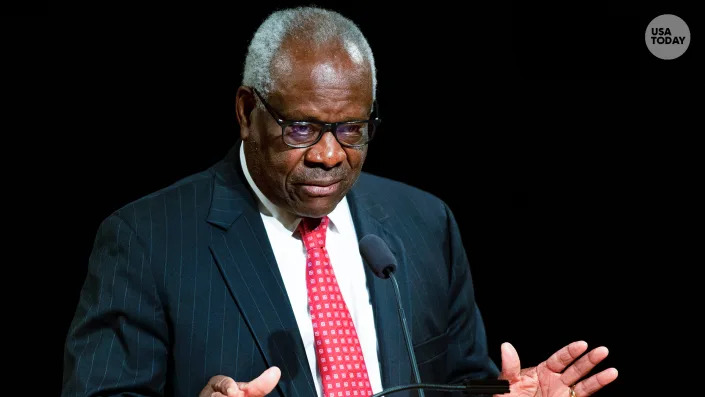
Justice Clarence Thomas and the Supreme Court are under heightened scrutiny from Congress and outside groups over ethics concerns.
‘Harlan picked up the tab’
It was not clear exactly how much money Crow spent on the tuition at the school, Hidden Lake Academy. ProPublica identified a bank statement for July 2009 that showed Crow paid the tuition for Thomas’ relative that month. Christopher Grimwood, a former administrator at the school, told ProPublica that Crow paid the tuition the entire time Thomas’ grandnephew was a student there.
“Harlan picked up the tab,” Grimwood told ProPublica.
Crow’s office responded with a statement asserting that his family has supported many scholarships and blamed “partisan political interests” for trying to turn an effort to help “at-risk youth” into something “nefarious.”
Thomas and Ginni Thomas have also accepted luxury trips for years paid for by Crow, including international travel on his private jet and yacht, ProPublica reported last month. Crow also purchased three Georgia properties from Thomas and members of his family in 2014, a transaction that Thomas failed to note on his annual disclosure forms.
‘Older generations are so confused’: A young woman on TikTok says Gen Z, Millennials don’t share the same work ethic as Boomers — 3 reasons why she might be onto something
Vishesh Raisinghani – May 3, 2023
Generational grumble is old as time itself.
There’s probably a cave painting about how the younger generation had ruined the hunter-gatherer economy with their “fancy agriculture.” Since then, every successive generation has found a new medium to express their disappointment with ‘them young’uns.’
A recent example comes from the comment section on TikTok, which recently erupted when a young lady explained why Gen Z and Millennials don’t exactly share the same values regarding work.
“Older generations are so confused about why we don’t want to work hard anymore or prioritize our careers,” Demi Kotsoris said in the clip “We know how short life is now.”
Kotsoris goes on to explain that the pandemic and greater access to information have reshaped the perspective of younger generations and made them question whether work should be the center of their lives.
Of course, the response was heated. “This mindset is so [‘you only live once’] that you will regret those decisions later,” says one comment on Kotsoris’ video.
“People are just SELFISH & LAZY NOW,” says another.
But the replies may have missed the point of the video. Here’s why Kotsoris’ message resonates with so many younger workers and why her experience highlights some deeper truths about modern work.
Work isn’t as rewarding anymore
For Baby Boomers, there were clear rewards for working hard. Putting in an average amount of effort allowed a typical worker to buy a nice home, raise children comfortably and travel the world. In the 1980s, the average home price was just four or five times the median income. Now, it’s closer to 7.5 times.
Having a college degree was also far more rare in the 80s. Now, nearly everyone in the job market has a degree so its value has been eroded. Meanwhile, the dollar has been eroded too. Wages haven’t kept up with inflation for decades, so an hour of work today isn’t worth as much as an hour of work in the 80s.
Upward mobility has declined too. A person born in a middle-class family in the 1940s was 93% likely to outearn their parents by the age of 30. For those born in the 1990s, that rate is just 45%.
Some Boomers could beat the odds and create generational wealth by investing in stocks. However, even that is not as easy as it used to be. The S&P 500 was trading at around 10 times its earnings during the 1980s. It’s now trading in the low-20s.
The relationship with corporations has changed
The employee-employer relationship has also changed since the 80s. Defined-benefit pension plans are nearly extinct. A major corporation that went public before the 1970s was 92% likely to survive the next five years. By the early 2000s, the rate had dropped to 63%.
Unions have also declined, which means workers now have far less bargaining power than their parents.
All these factors have made younger workers question the value of company loyalty and lifelong careers.
The pandemic altered perspective
The global pandemic may also have shifted work culture
This is true across generations because the crisis triggered a retirement boom too. Meanwhile, younger workers saw how short life can be, and how easily their lifestyle can be disrupted by a global crisis like a pandemic or climate change. A study by Deloitte found that Gen Z and Millennials are more likely to prioritize work-life balance, flexible work arrangements, and purposeful work.
The pandemic highlighted that remote work is a viable option for many companies. In fact, a survey by Buffer found that 98% of remote workers would like to continue working remotely at least some of the time for the rest of their careers.
‘Poor people are not stupid’: I grew up in poverty, earned $14 an hour, and inherited $150,000. Here’s what I have learned from my windfall.
Quentin Fottrell – May 3, 2023
‘When I open my accounts and see how they are growing it really fills me with a sense of pride and determination.’
‘My tiny house has been one of the greatest decisions I’ve ever made, and has truly changed my whole mindset on what makes me happy.’ MARKETWATCH
In September 2018, this woman from Texas, then 36, wrote to the Moneyist to ask how she should invest her windfall — over $150,000. It was small by some people’s standards, but it was life-changing to her. She didn’t have a college degree, said she would never earn more than $30,000 a year, and worked full-time for $15 an hour, in addition to a part-time job at $10 an hour. She paid $1,050 a month in rent.
She paid off her car, and bought a “tiny home,” which she owns free and clear, she wrote in an update a year later. She deposited $70,000 in a high-yield online savings account. She topped up her retirement portfolio and invested $30,000 into emerging markets. She maxed out her IRA and invested $10,000 between very safe dividend stocks and ETFs. She also spent $7,000 on dental work in Mexico.
And today? Five years after her first letter, she has updated MarketWatch readers on her progress, and what she learned from this experience:
Dear Moneyist,
There are a lot more Americans making less than $50,000 a year than there are those who make more. I feel like we aren’t really represented in the financial-advice world. I’d love to see more columns helping people to invest $25-$100 when they can. It’s empowering to invest. I might never be a Warren Buffet, but when I open my accounts and see how they are growing it really fills me with a sense of pride and determination.
As to how I’m doing? Beautifully. I hate to say it but the pandemic was a blessing to me personally. I feel terrible saying that because of the loss and devastation so many others suffered and are still suffering because of it, but for me, the pandemic opened up a world of possibilities. A job opportunity landed in my lap because of the shutdown, and I’m making almost $4,000 a month now after taxes.
Yes, me! I’ve never made so much money before (outside of the inheritance I received). I am still frugal and live off of about $1,800 a month, and that includes health insurance, long-term disability insurance, full-coverage car insurance, and pet insurance! Everything else goes to savings and investments. I won’t say what it is I’m doing because it might identify me, but I will say it is a job that allows me to be happy every second I’m “working.”
My tiny house has been one of the greatest decisions I’ve ever made, and has truly changed my whole mindset on what makes me happy. As I’ve lived in it I’ve altered certain parts of the design to be more efficient, and I can honestly say I intend to live tiny until some mobility issue — hopefully age-related and not an accident of some kind! — forces me back into a more conventional dwelling. Tiny living forces you to be mindful. Not only of your space, but also of yourself, and how you live in your space. It might sound strange to hear, but living tiny has truly made me a better person and improved my quality of life in ways other than financial.
I would like to address some of the comments I read in response to your previous article on my letter. While most were truly supportive others were coming from a place of judgment and condescension. I’d like to thank everyone who wished me well, and for them to know that their words meant a lot to me. That people took time out of their day to read about me and wish me well was uplifting. I send them all virtual hugs and hope each and everyone is happy and healthy.
However, I’d also like to address some of the comments that were less encouraging. Several people insisted that my letter was obviously fake because of how well I wrote, and that someone with my education level could not possibly be in the financial situation I’m in. I was less hurt by this attitude as I was utterly astounded by it. That people genuinely believe the educated cannot struggle financially just floored me.
‘There are more ‘poor’ Americans than there are ‘rich’ Americans, and we are not stupid or lazy. We’re trying to make it work.’
Poor people are not stupid. We’re not illiterate country bumpkins struggling to figure out how to work a computer. We’re the nurse that lives down the street with two roommates to be able to afford rent. We’re the teachers still living with their parents because they can’t find enough roommates to qualify for an apartment. We’re the cops working at Home Depot on the side trying to save up for a baby. We’re the lawyers doing Uber just to afford student-loan payments. There are more “poor” Americans than there are “rich” Americans, and we are not stupid or lazy. We’re trying to make it work — usually by having 2-3 jobs.
There is a financial crisis in this country. I believe it comes from unchecked capitalism. When corporations are allowed to buy up single-dwelling homes and drastically raise rents, and banks/lending institutions are allowed to prey on people with obscenely high interest rates, you foster an environment of exploitation. Our society allows for the targeting of young people before they even graduate high school. Credit-card companies and college-loan institutions begin preying on people as soon as they hit 18. If their parents are financially illiterate, and considering most public schools rarely teach financial literacy, too many young people start out life with insane amounts of debt. Additionally, wages have not kept pace with the cost of living in this country, and you have a lot of educated “poor” people.
I just could not believe those comments that insisted this story was fake because I was too educated to be poor. Then I was mad. Mad because that stereotype is what prevents a lot of change from taking place. Nothing is ever going to get better if we keep thinking the worst of each other.
Anyway, I again want to thank you for thinking of me and sharing my story. Hopefully it helped more people. As I said before, investing is truly empowering. I didn’t know that before, but I know it now, and I wish it for many more Americans.
Sincerely,
Not Quite As Low Income, But I’m Still A Couponing Lady
Dear Not Quite As Low Income,
Thank you for your insightful and eloquent letter. Your words and story continue to inspire me, and I hope will inspire many others out there in America who never had a head start in life and/or continue to face financial struggles. I wish you the best of everything in your life, and I hope more good things continue to happen to you.
The uptick on excoriating “woke ” ideology has increased in recent years among politicians, including former President Donald Trump, as Americans across the nation battle over diversity, inclusion and equity efforts in the workforce, public schools and in legislation.
But what is “woke”? And what do the GOP attacks mean for 2024?
Among conservative lawmakers and activists “woke” tends to be an across-the-board denunciation of progressive values and liberal initiatives.
Some have used it to attack trans and gay rights while others apply it to critical race theory – a legal theory that examines systemic racism as a part of American institutions – and the teachings of the New York Times’ 1619 project in public schools.
“If you ask people what woke is, I think what they mean is they want to stand against people who are engaging in some type of advocacy for marginalized people,” said Andra Gillespie, political scientist at Emory University.
“It’s kind of this lumping together of anybody whose views could be construed as being progressive on issues related to identity and civil rights.”
As the Black Lives Matter movement began after the police killing of Michael Brown in Ferguson, Missouri in 2014, “woke” expanded outside of Black communities into the larger public lexicon.
What about ‘stay woke’?
Black artists and entertainers continued to insert the phrase in their music, including Grammy-award-winning artists Erykah Badu and Childish Gambino — a.k.a. Donald Glover—for political causes.
Yet “woke” has now been hijacked by the political right to mean something far from its original definition.
“The reason we have to ‘stay woke’ is because of exactly what these people are doing right now, which is finding very insidious ways to undercut our rights,” said Terri Givens, a political science professor at McGill University.
Givens called the attacks on the term “a full-on dog whistle” and pointed to attempts to limit the right to vote, curtail reproductive and abortion rights and ban inclusive education in schools as examples of the backlash against Black and brown civil rights.
“Learning history is not about woke-ism,” Given said.
Conservatives now use the term as a political retort to combat what they perceive as political correctness gone haywire.
But progressive commentators note that the response also comes in the context of a changing America, which is becoming more diverse racially and ethically and along sexual orientation and gender identity lines.
“What they’re trying to do is make the term a pejorative,” said Kendra Cotton, chief operating officer of New Georgia Project, a progressive-leaning voting rights group.
As more marginalized groups are elected into office and exercising their voting power during elections, it can make some Americans afraid, said Cotton.
Florida Gov. Ron DeSantis, a possible GOP presidential candidate, has built a persona crusading against ideas and policies conservatives deem as “woke.”
Tehama Lopez Bunyasi, a political scientist at George Mason University and co-author of the book “Stay Woke: A People’s Guide to Making All Black Lives Matter,” said the legislation is “perhaps the most explicit way we see the co-optation of the term ‘woke’ today.”
“Right now, we’re seeing racially conservative pundits and politicians positioning themselves as adversaries of the multiracial Black Lives Matter movement,” said Lopez Bunyasi. “One of the rhetorical tools they are using is the maligning of a term that has been in use by Black people and in Black politics for well over a hundred years.”
Have the anti-woke attacks been successful?
Virginia GOP Gov. Glenn Youngkin cruised to victory in 2021 riding a wave of parental anger over teaching inclusive history in public schools.
Keneshia Grant, a political scientist at Howard University, said Youngkin’s success was part of an intentional pushback against marginalized communities, which includes misunderstanding terms like woke, critical race theory, and LGBTQ rights.
“He ends up successfully using the fear that people have about teaching students Black history or American history through the guise of CRT and successfully uses that to motivate a base,” Grant said. “They are doing this because they think it will help them win. And we have evidence that sometimes it actually does help them win.”
Americans divided on what ‘woke’ means
What’s telling is that despite the conservative backlash most Americans don’t view “woke” negatively heading into the 2024 presidential contest.
A March 2023 USA TODAY/Ipsos Poll found that 56% of Americans said it means “to be informed, educated on, and aware of social injustices.”
But the efforts to re-define “woke” have worked with a significant portion of the country. Roughly 39% of those surveyed agree with the Republican definition,”to be overly politically correct and police others’ words.”
“Racial resentment and grievance are certainly one of those things that have been very effectively used to mobilize a certain segment of the Republican population for a long time,” said Gillespie.
Reporter Phillip M. Bailey contributed to this story.
Rick Steves Is Making One Major Change to His European Guidebooks This Year — for an Important Reason
Kelsey Fowler – April 27, 2023
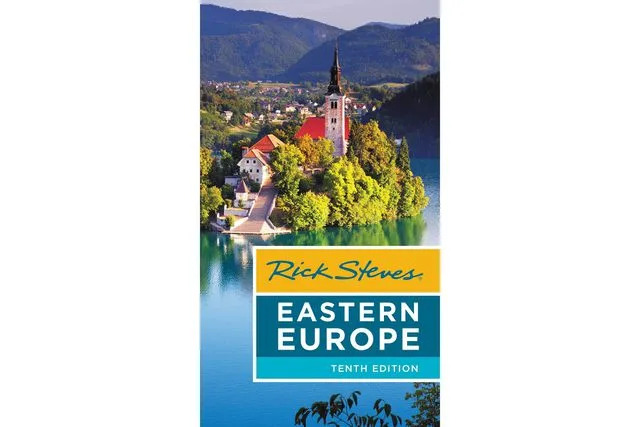
The newest edition of Rick Steves Eastern Europe is getting a new name.
Courtesy of Rick Steves’ Europe
The guidebook formerly known as “Rick Steves Eastern Europe” will have a new title when the next edition is published later this year.
Rick Steves’ Europe is changing “Eastern Europe” across the brand to “Central Europe,” to better reflect a more geographically accurate name for the region.
When the 11th edition is published, the guidebook will switch over to “Central Europe” as the identifier for the area that includes countries like the Czech Republic, Poland, Hungary, Slovenia, and Croatia. The change was announced in February and will roll out across the company’s guidebooks, website, and tour itineraries.
In a recent interview with Travel + Leisure, founder Rick Steves explained why he thought the switch was long overdue.
Courtesy of Rick Steves’ Europe
“From a marketing, publishing, and tourism point of view, we call Central Europe ‘Eastern Europe’ and that’s a hangover from the Cold War,” he said. “That was a 50-year anomaly. Poland, Hungary, the Czech Republic got filed away in our minds as Eastern Europe, but that’s really Central Europe.”
In a post announcing the change, guidebook co-author Cameron Hewitt wrote that “Eastern” Europe should really be considered countries like Georgia, Ukraine, and Russia. Prague, often the showcase city of “Eastern” European tours, is actually located to the west of cities like Vienna, Stockholm, and even parts of Italy.
“The political divide of Europe has changed, of course, and it’s high time guidebooks and tour itineraries do, too,” Hewitt wrote.
The zone is also down in tourism this year, Steves said, because people are worried about the ongoing war in Ukraine. Rick Steves’ Europe is continuing to operate tours in the region as long as it remains safe to do so, and Steves said he plans to film with his TV crew in Poland later this year.
Courtesy of Rick Steves’ Europe
“It’s unfortunate that people are penalizing the countries that are farther east,” Steves said. “Their economy is hurting because people are staying away.”
While the change might result in some confusion for travelers looking to visit Poland but still searching for “Eastern” Europe trips and tips, Hewitt and those at Rick Steves’ Europe believe the change is worth the risk that come with rebranding.
Hewitt wrote: “We’ve learned that Rick Steves travelers are savvy, open-minded, and curious enough about our world to hop on board when we lead them toward new places and new ideas.”
Disney v. DeSantis judge called Florida governor’s law ‘dystopian’
Tom Hals – April 26, 2023
WILMINGTON, Delaware (Reuters) -When attorneys for Florida Governor Ron DeSantis appear in court to defend against Walt Disney Co’s lawsuit that accuses the Republican official of weaponizing state government, they will see a familiar face, if not always a welcome one.
U.S. District Judge Mark Walker in Tallahassee has struck down several laws that defined DeSantis’ conservative political agenda, including statutes that sought to limit the speech of college professors, curtailed protests and restricted voting access.
Walker was nominated to the federal court by former President Barack Obama, a Democrat.
Disney sued DeSantis on Wednesday to block a state law that created an oversight board that Disney said will interfere with billions of dollars of planned development.
The feud between the global entertainment giant and a likely candidate for the 2024 presidential election started last year, when Disney criticized a law signed by DeSantis that banned classroom instruction on gender identity and sexual orientation for younger children.
Disney alleges a law that imposed an oversight board was punishment for voicing opposition to DeSantis’ classroom instruction law known as the Parental Rights in Education Act.
The company called the state’s actions “particularly offensive here due to the clear retaliatory and punitive intent.”
The gender-education statute, derided by critics as the “Don’t Say Gay” law, survived challenges in federal court before a different judge.
Free speech has been central to several rulings by Walker against DeSantis, although the judge has also at times sided with the governor.
Walker blocked the Individual Freedom Act or Stop Woke Act, which limited the speech of college professors, calling it “positively dystopian” in an opinion that began with a quote from George Orwell’s anti-totalitarian novel “1984.”
In 2021, Walker blocked the Combating Public Disorder Act, which DeSantis signed into law after the 2020 protests over the murder of George Floyd, a Black man, at the hands of police.
Walker ruled the law’s expansion of the definition of “riot” infringed on protesters’ right to free speech.
The judge last year enjoined a law signed by DeSantis that banned ballot drop boxes and prevented groups from offering food and water to voters waiting in long lines, causes championed by Democrats as a way to support voter turnout.
The judge also sided with plaintiffs in a second lawsuit challenging a different aspect of the Stop Woke Act, which defined as “unlawful employment practices” workplace training around issues of race and sex.
Walker said Florida had become a place where the First Amendment allowed, rather than prevented, the state to limit speech. Or as he put it, “in the popular television series Stranger Things, the ‘upside down’ describes a parallel dimension containing a distorted version of our world. Recently, Florida has seemed like a First Amendment upside down.”
The judge has also ruled with DeSantis and declined to block the execution of a death row inmate and dismissed some claims against the governor over the Individual Freedom Act.
(Reporting by Tom Hals in Wilmington, DelawareAdditional reporting by Lisa Richwine in Los AngelesEditing by Amy Stevens and Matthew Lewis)