Hillary Clinton’s Emails: A Nation Struggles to Unsubscribe

The New York Times

Hillary Clinton’s Emails: A Nation Struggles to Unsubscribe

Reid J. Epstein and Katie Glueck – June 13, 2023

Secretary Hillary Rodham Clinton speaking at the 92nd Street Y on Thursday, May 4, 2023, in New York. (Photo by Evan Agostini/Invision/AP) (Evan Agostini/Invision/AP)

WASHINGTON — It is the topic that the nation just can’t delete from its political conversation: Hillary Clinton’s emails.

In the days since Donald Trump became the first former U.S. president to face federal charges, Republicans across the ideological spectrum — including not only Trump and his allies but also his critics and those who see prosecutors’ evidence as damaging — have insistently brought up the 8-year-old controversy.

They have peppered speeches, social media posts and television appearances with fiery condemnations of the fact that Clinton, a figure who continues to evoke visceral reactions among the Republican base, was never charged.

The two episodes are vastly different legal matters, and Clinton was never found to have systematically or deliberately mishandled classified information. Still, Republicans have returned to the well with striking speed, mindful that little more than the word “emails” can muddy the waters, broadcast their loyalties and rile up their base.

“Lock her up,” chanted a woman at last weekend’s Georgia Republican Party state convention, where Trump sought to revive the issue of Clinton’s email use. “Hillary wasn’t indicted,” he said in a speech at the event. “She should have been. But she wasn’t indicted.”

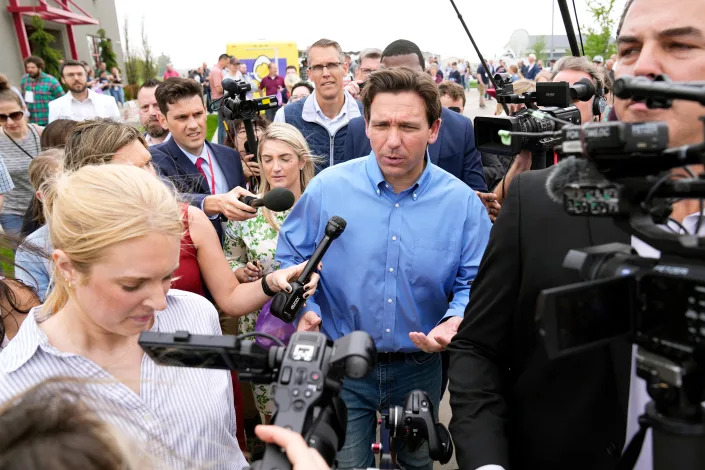
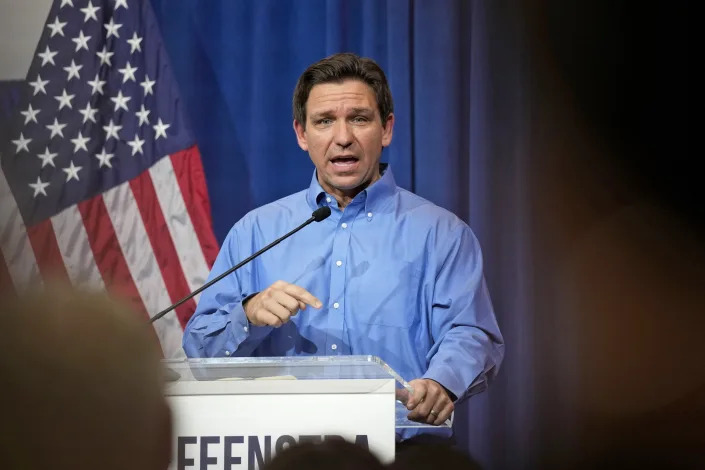
Campaigning in North Carolina, Florida Gov. Ron DeSantis bashed Clinton’s email practices while being far more circumspect in alluding to Trump, his top rival for the Republican nomination.

Even former New Jersey Gov. Chris Christie, who has made criticizing Trump a central theme of his presidential campaign, said on CNN recently that the Justice Department “is at fault for not charging Hillary Clinton,” while casting the facts laid out against Trump as “damning.”

“The perception is that she was treated differently,” Asa Hutchinson, a former Arkansas governor, a 2024 presidential candidate and a Trump critic, said in an interview Monday. “Perception can become a reality very quickly.”

Hutchinson, once a chief Clinton antagonist from former President Bill Clinton’s home state — he helped guide impeachment proceedings against Bill Clinton — said he saw distinctions between Hillary Clinton’s email episode and the charges Trump faced. But, he added, “If the voters say it’s relevant, it becomes relevant politically.”

Taken together, the moment offers a vivid reminder of the ways the ghosts of the 2016 campaign continue to shape and scar American politics.

“There are few politicians on the Democratic side of the aisle that raise the ire of Republicans more than Hillary Clinton,” said Neil Newhouse, a veteran Republican pollster.

Clinton and her supporters, of course, have not forgotten the email saga. After Trump’s indictment, the episode to many of them serves as a symbol of a political system and a mainstream news media often focused on the superficial at the expense of the substantive.

Clinton backers now make light of what they view as comparatively flimsy and unproven accusations she faced about her use of a private email server when she was secretary of state. And some relish the fact that the man who crowed about “Crooked Hillary” finds himself facing a range of serious charges and the prospect of prison if he is convicted.

Speaking Monday with the hosts of the “Pod Save America” podcast at the Tribeca Film Festival in New York, Clinton laughed when a host noted the tendency of some Republicans to make parallels to her emails.

“When in doubt, right?” she said. “I do think it’s odd, let’s just say, to the point of being absurd, how that is their only response. You know, they refuse to read the indictment, they refuse to engage with the facts.”

On Friday, Clinton posted an edited photo of herself on Instagram wearing a black baseball hat that reads, in pink letters, “BUT HER EMAILS.” That three-word phrase has become something of a shorthand among Democrats for frustration at the grief she received for how she handled classified correspondence compared with the blowback Trump confronted for all the legal and ethical norms he busted while in office.

She included a link to buy the hat for $32 on the website of her political group. (Asked about that decision, Nick Merrill, who served as a longtime spokesperson for Clinton and remains an adviser, replied, “We’re seven years past what was widely viewed as, at worst, a stupid mistake. And reminding people that a piece of merchandise exists in order to raise money to preserve our democracy is something I’m very comfortable with.”)

Substantively, there are many clear differences between the episodes.

A yearslong inquiry by the State Department into Clinton’s use of a private email server found that although it increased the risk of compromising classified information, “there was no persuasive evidence of systemic, deliberate mishandling of classified information.”

The indictment against Trump, by contrast, accuses him of not only mishandling sensitive national security documents found at his Mar-a-Lago club in Florida but also willfully obstructing the government’s efforts to retrieve them. He has been charged with 37 criminal counts related to issues including withholding national defense information and concealing possession of classified documents.

Robert Kelner, a Republican lawyer and Trump critic who is a partner in the white-collar defense and investigations practice group at Covington & Burling, said Trump most likely would not have been indicted had he cooperated with the government’s requests to return classified documents he took from the White House.

“There were lots of things to criticize about the way the Hillary Clinton investigation was handled — none of which, however, in any way to my mind, suggests that the case against Donald Trump is unfounded,” Kelner said.

Jack Smith, the special counsel who indicted Trump, seemed to anticipate efforts to bring up Clinton’s emails. The indictment cited five statements Trump made during his 2016 campaign about the importance of protecting classified information.

For veterans of Clinton’s campaign, the Republican attempt to resurface their old boss’s email server to defend Trump’s storage of boxes of classified documents in a Mar-a-Lago bathroom and other places would be comical had their 2016 defeat not been so painful.

“The best evidence that Trump’s actions are completely indefensible is the Republican Party’s non-attempt to defend it and instead rehash 7-year-old debunked attacks on somebody who is no longer even in politics,” said Josh Schwerin, a former Clinton campaign spokesperson who for years after the 2016 election had a recording of Trump saying his name as his voicemail greeting.

Merrill said that if there was a single word for “particularly acute hypocrisy,” it would apply to Republicans now.

For Republicans, “whether you believe she was cavalier or you believe that she should be tried for treason for the risky position she put Americans in by sending correspondence about yoga or whatever,” he said, “Donald Trump has done the most severe possible thing. It’s not a close call with him.”

Trump acolytes are now delighting at the prospect of reviving one of their favorite boogeywomen.

“Republicans believe there’s been an unequal application of justice,” said former Rep. Jason Chaffetz, a Utah Republican who as chair of the House Oversight Committee investigated myriad Clinton episodes leading up to the 2016 election. He added, “What is it that Donald Trump did that was worse than Hillary Clinton? Nothing, nothing, nothing.”

Timothy Parlatore, a criminal defense lawyer who quit the Trump legal team last month, said he did not believe that Clinton, Trump or President Joe Biden — who has cooperated with a special counsel’s investigation into his own handling of classified documents after his tenure as vice president — should have been charged for their handling of classified information.

Trump’s Justice Department had four years to prosecute Clinton and did not. Parlatore said Trump no longer saw her as a threat — and instead called for an investigation into Biden and his son Hunter.

“Here is a big difference,” Parlatore said. “The Trump administration wasn’t looking at Hillary as being a presidential candidate. The Biden administration is looking at Trump in a different way.”

For now, the most devoted Clinton supporters are following her lead and wearing “BUT HER EMAILS” hats as a badge of honor. They appeared in recent days at dog parks, soccer tournaments and Pride events as a sort of celebration of Trump’s comeuppance.

In Boston, Rebecca Kaiser, a political consultant, has worn her “BUT HER EMAILS” hat regularly since she received it as a gift the day before Trump was indicted on 34 counts of falsifying business records in the New York City borough of Manhattan in April.

Since then, at Little League and soccer games, the supermarket, the beach and during dates with her wife, Kaiser has sported the hat, which she said served as a conversation starter about an election that many other Democrats would rather forget.

“There are definitely people who notice the hat and very quickly avert their eyes,” Kaiser said. “There are other people who look at the hat and just roll their eyes. And honestly, I think there are a good amount of people who have no idea what it’s referencing.

Before you fight over the word ‘woke,’ learn its history. It will blow you away.

AZ Central – The Arizona Republic – Opinion

Before you fight over the word ‘woke,’ learn its history. It will blow you away.

Phil Boas, Arizona Republic – June 7, 2023

Poster of Leadbelly at the Rusty Nail in Wilmington.

Someday when the cultural moment that many have called “The Great Awokening” is finally, mercifully, over, Americans of all races should fight to give African Americans their word back.

Less than 10 years ago, “woke” was a word so deeply layered with history and meaning it could evoke years of pain suffered by descendants of slaves coming of age in Jim Crow America.

You don’t have to be African American, however, to feel its history. The word woke is seminal to our larger culture in ways most of us have never understood.

It’s one of the great words in American English and it should be preserved in its purest form.

At the moment it is being hijacked by politics – first by white liberals, then by white conservatives.

A battle over ‘woke’ in the Republican Party primary

This week the word “woke” is igniting a family spat within the 2024 Republican primary for president, pitting Donald Trump against his former apprentice, Ron DeSantis.

DeSantis, the Florida governor, uses the word frequently to describe an ideology steeped in identity politics that has taken over our universities, media, large corporations, medicine, arts, entertainment and sports.

Trump argues he doesn’t use the word. “I don’t like the term ‘woke’ because I hear, ‘Woke, woke, woke.’ It’s just a term they use, half the people can’t even define it, they don’t know what it is.”

There’s a good chance none of us would know the word today had the Library of Congress not set out in the 1930s to preserve American folk music in the South.

That project took library archivists to Louisiana where they discovered a little-known African American blues singer named Huddie William Ledbetter or “Lead Belly.”

The archivists recorded on aluminum discs Lead Belly and his 12-string guitar, preserving what would become some of the great Blues standards such as “Cotton Fields,” “Goodnight, Irene” and “Rock Island Line.”

‘Woke’ emerges with a song about race and suffering

In Lead Belly’s song “The Scottsboro Boys,” the nine African-American young men falsely accused of raping two white women in Alabama, he admonishes his listeners to, “Best stay woke!”

It’s believed to be the first recorded instance of the word.

As Huddie Ledbetter used “woke,” it meant that when you’re a Black person travelling through a deeply racist state such as Alabama, you need to know what you’re dealing with – a highly refined form of evil.

Ledbetter would know. He travelled the byways of Louisiana, Alabama and Texas singing his songs and confronting white bigotry and its violence against Black people.

In a way that history has of surprising us, Lead Belly would become essential to white culture in America and Great Britain. All white people reading this and learning the name Huddie Ledbetter for the first time, should know that they have likely felt his influence, far more than they could have imagined.

The driving rhythms of Lead Belly’s version of “Rock Island Line,” would in the 1950s inspire an early British pop singer named Lonnie Donegan, who adopted the song’s musical style called skiffle, a mash of American folk, blues and jazz.

Lead Belly influences Rock ‘n Roll’s greatest band

Donovan became “the king” of the U.K. “skiffle craze” and eventually inspired new skiffle groups across England, such as Liverpool’s The Quarrymen, then led by an aspiring singer-songwriter named John Lennon.

By 1960, the group would evolve into The Beatles, and its lead guitarist, George Harrison, would one day tell an interviewer, “If there was no Lead Belly, there would have been no Lonnie Donegan; no Lonnie Donegan, no Beatles. Therefore, no Lead Belly, no Beatles,” as recounted by Smithsonian Magazine.

Lead Belly was inspiring many musical forms of that day. Those same early recordings that preserved his music and the word “woke,” found their way into the imagination of another young artist of some note. 

“Somebody – somebody I’d never seen before – handed me a Lead Belly record with the song ‘Cottonfields’ on it,” recalled Bob Dylan in his 2017 lecture to the Noble (Prize) Foundation. “That record changed my life right then and there. Transported me into a world I’d never known.

“It was like an explosion went off. Like I’d been walking in darkness and all of the sudden the darkness was illuminated. It was like somebody laid hands on me. I must have played that record a hundred times.”

The biggest names in many genres sing his songs

By the end of the century, Led Belly’s influence on American popular music was its own constellation of stars. Artists covering his songs included Gene Autry, Frank Sinatra, Nat King Cole, Tom Jones, Harry Belafonte, Elvis Presley, Johnny Cash, The Beach Boys, Creedence Clearwater Revival, Aerosmith, Lead Zeppelin, Tom Petty, The Grateful Dead.

When Beat Generation author William S. Burroughs wrote, “These new rock ‘n roll kids should just throw away their guitars and listen to something with real soul, like Lead Belly,” a young musician in Seattle named Kurt Cobain took up his challenge.

Years later, he recalled on an MTV stage: “I’d never heard about Lead Belly before so I bought a couple of records, and now he turns out to be my absolute favorite of all time in music. I absolutely love it more than any rock’n’roll I ever heard.”

After he said it, his band Nirvana began to play Huddie William Ledbetter’s “Where Did You Sleep Last Night.”

Our chattering classes, and I include myself among them, have been poor caretakers of the word “woke.”

When this battle over wokeness is finally over, it would do us well to give the word back.

And while we’re at it, maybe we could make the name Huddie Ledbetter, one of America’s most important songwriters, as easily recognizable as say, Ringo Starr.

Phil Boas is an editorial columnist with The Arizona Republic. Email him at phil.boas@arizonarepublic.com. 

This article originally appeared on Arizona Republic:

Teens are spending less time than ever with friends

The Hill

Teens are spending less time than ever with friends

Daniel de Visé – June 7, 2023

America’s teenagers are seeing a lot less of one another.

The share of high school seniors who gathered with friends in person “almost every day” dropped from 44 percent in 2010 to 32 percent in 2022, according to Monitoring the Future, a national survey of adolescents. Social outings for the typical eighth grader dwindled from about 2 1/2 a week in 2000 to 1 1/2 in 2021.

The nation’s teens have traded face time for Facetime. Adolescents are spending less time gathering in shopping malls, movie theaters and rec rooms, and more time connecting on Instagram, TikTok and Discord.

Some researchers see the retreat from social gatherings as key to explaining the wave of adolescent ennui that is sweeping the nation. Numerous studies have tracked rising rates of loneliness among adolescents before, during and since the COVID-19 pandemic. Last month, Surgeon General Vivek Murthy declared a national loneliness epidemic. And loneliness presages depression and other mental health maladies, which are also growing more prevalent among teens.

“Teens are spending a lot more time communicating with each other electronically and a lot less time hanging out with each other face to face,” said Jean Twenge, a professor of psychology at San Diego State University and author of “Generations,” a new book about generational differences.

“Going to the mall has gone down. Driving in the car for fun has gone down. Going to the movies has gone down,” she said. “We’re talking about kids who are spending five, six, seven hours a day on social media.”

Twenge sees a connection between the decline of adolescent gatherings and the rise of teenage loneliness.

About half of the nation’s high-school seniors met up with friends almost daily in the 1970s, when researchers at the University of Michigan began tracking their outings in the Monitoring the Future study.

In the decades since, a gradually shrinking share of teens has reported regular meetups with friends. The steepest decline commenced around 2010, just as smartphones and social media were taking hold. U.S. smartphone ownership reached 50 percent in 2012.

The loneliness epidemic arrived around the same time. A landmark 2021 study found that levels of adolescent loneliness nearly doubled between 2012 and 2018. Prior to 2012, researchers had spotted no loneliness trend.

Twenge believes the timing of the two trends, falling face time and rising loneliness, is no mere coincidence.

“If it’s not smartphones and social media that have caused the rise in teen depression, what is it?” she said. Twenge was the lead author of the 2021 study, published in the Journal of Adolescence.

Today’s teenagers may be spending more time in front of screens than any prior generation.

The average teen spent eight hours and 39 minutes on daily screen time for entertainment in 2021, up from six hours and 40 minutes in 2015, according to Common Sense Media, publisher of a closely watched Common Sense Census.

To put those numbers into perspective: An entire household watched eight hours and 55 minutes of daily television, on average, in 2009-10, the historic peak of television consumption. But researchers caution against comparing the two.

“Screen time can be so many different things,” said Amanda Lenhart, head of research at Common Sense. “There’s all sorts of ways in which these platforms can be both good for kids and bad for kids.”

Nearly half of the nation’s teens now say they are online “almost constantly,” according to Pew Research. More than half say they are effectively addicted to social media and would have a hard time giving it up.

The surgeon general, among others, has linked social media to rising depression and anxiety in teenagers.

Loneliness deepened at the height of the pandemic. Three years later, the epidemic shows few signs of abating. New survey data from the Harvard Graduate School of Education, collected in December, shows 21 percent of teens report being lonely much or all of the time.

“I think social media has been a really significant factor in this decline,” said Richard Weissbourd, a senior lecturer at the Harvard education school.

Weissbourd and other researchers agree with Twenge that face-to-face relationships play a large role in adolescent development.

“Friendships and relationships are very important in adolescence,” said Adam Hoffman, an assistant professor of psychology at Cornell University. Social media “can really only supplement, and cannot replace, in-person relationships. We need to have both of these.”

Both he and Weissbourd stress, however, that social media is only one of several societal forces that have afflicted the mental health of adolescents and young adults in recent years.

“Teens rank achievement pressure really high in terms of negatively influencing their mental health,” Weissbourd said. Adolescents and their families report heightened financial stress. Teens in the 2020s fret about climate change and political strife.

Causes of adolescent loneliness vary by race, class and culture.

“What’s going on with low-income kids in rural areas or low-income kids in areas of concentrated poverty is really different from what’s going on with affluent kids in suburbs,” Weissbourd said.

Social media itself is, psychologically speaking, a mixed bag.

The social maelstrom of Instagram drives some teens into depression. For other young people, social media can bring connection. Nonbinary and transgender teens, for example, have reported joy and empowerment in discovering people like themselves through social media.

“I’m thinking about a gay kid in Montana, and he’s completely on his own, and he doesn’t really know anyone he can talk to,” Hoffman said. “But he’s developed a community online, and he’s got connections with gay kids all over the country.”

Other research suggests teens may ultimately be better off with a social media life than without one.

One 2022 study found that teens reported lower self-esteem when their Internet access was poor or nonexistent. The survey also found that adolescent self-esteem suffered when parents wielded strict control over screen time.

“There’s such strong rhetoric out there about the harms associated with these screens, but to be honest, the data is so weak,” said Keith Hampton, a professor of media and information at Michigan State University and co-author of the study.

“All the data supports the notion that adolescents who spend more time using social media spend more time in person with their friends,” he said.

Twenge agrees with that point. But she also notes that teens are spending less overall face time with their friends today than before the social media era.

As a group of friends migrates from mall gatherings to Instagram, Twenge explains, its most sociable member may spend more time than the others in both in-person and virtual get-togethers. But the group still winds up spending less face time together, in the end.

“There’s a big difference between being in the same place with someone and interacting with someone electronically,” she said. “When you’re in the same room with someone in real time, you’re having a conversation, you can see the look on their face, you can touch each other, and all of these things are important for teens.”

Would $10,000 convince you to move to a new city?

MarkerWatch – Best New Ideas in Money

June 1, 2023

To change the world, we may need to change money first. Best New Ideas in Money explores innovations that rethink how we live, work, spend, save and invest. Each week, MarketWatch reporter Charles Passy and economist Stephanie Kelton will talk to leaders in business, tech, finance and government about the next phase of money’s evolution, and meet real people whose lives are being changed as these new ideas are put to the test.

More Ways to Listen

That’s the premise of Tulsa Remote, and the program is far from alone: Cities across the country are competing for workers who can work from anywhere.

Full Transcript

This transcript was prepared by a transcription service. This version may not be in its final form and may be updated.

Raj Choudhury: Given the prevalence of work from anywhere as a work arrangement now it gives policy makers an opportunity to try to leverage this and attract their communities, their region’s workers who can work remotely.

Stephanie Kelton: Welcome to the Best New Ideas in Money, the podcast for Market Watch. I’m Stephanie Kelton. I’m an economist and a professor of economics and public policy at Stony Brook University.

Charles Passy: And I’m Charles Passy, a reporter at Market Watch.

Stephanie Kelton: Each week we explore innovations and economics, finance, technology, and policy that rethink the way we live, work, spend, save, and invest. So Charles, before we get started, I think you have some news that you want to share with our listeners.

Charles Passy: I sure do, Stephanie. So this will be my next to last episode of Best New Ideas in Money. I’ve really loved working on the podcast, but time has come to step aside and let somebody else from the Market Watch team take over. I’ll be doing a little bit more writing for Market Watch, which is my primary duty at the publication.

Stephanie Kelton: Well, I’ve had an absolute blast working with you, Charles. We will miss you and I’m going to continue to read everything you write at Market Watch.

Charles Passy: That’s great. I appreciate that. I’m happy to say that my colleague James Rogers will be taking my place. James is a financial columnist at Market Watch and he has been covering money and technology for decades.

Stephanie Kelton: So you’re saying we’re in good hands?

Charles Passy: Very much. And next week James and I will co-host an episode about why many innovative projects fail and what these failures can teach us about taking meaningful risks. So as always, stay tuned.

Stephanie Kelton: Charles, if you are going to work from anywhere, where would that be?

Charles Passy: I’m going to say a place called Block Island. It’s a island community in Rhode Island. Very remote, very peaceful. I think it’s the kind of place where you could really hunker down and do some really quality work in peace. What about you, Stephanie?

Stephanie Kelton: That sounds pretty nice. Well, I mean, I live on the north shore of Long Island, so it’s pretty peaceful. I’ve got a lot of space. We have the water, but I guess maybe I would go somewhere where there are mountains, maybe a lot of nature, low humidity, nice hiking trails, maybe Colorado.

Charles Passy: So as you might have guessed, working from anywhere is the subject of today’s episode. A few weeks back we talked about the impact of remote and hybrid work on commercial real estate cities and even the economy. Put simply what happens if people stop going to the office.

Stephanie Kelton: Today we’re taking a look at another piece of this puzzle, which is, does remote work present an opportunity for cities and regions across the United States to compete for workers who can, well, work from anywhere?

Charles Passy: But first, when we say remote work, what exactly do we mean?

Johnny C. Taylor Jr.: First of all, it’s really important that we distinguish remote work, which I will say is fully remote from hybrid, from in the office.

Stephanie Kelton: That’s Johnny C. Taylor Jr. President and CEO of the Society for Human Resource Management or SHRM.

Johnny C. Taylor Jr.: Remote work is where your full-time job is working away from an office. Hybrid, which has really become all the rage is where you spend some portion of time in your employer’s physical office space and another portion of time at wherever you’d like to work remotely. And then the obvious is the traditional in-office work environment.

Charles Passy: We’re focusing specifically on fully remote work. So how many jobs does Taylor Jr estimate will be fully remote in the near future?

Johnny C. Taylor Jr.: We believe the number is going to settle in somewhere between 12 and 15% where people will be able to work remotely full time. We believe that’s where we’re going to settle. Obviously none of us know, but that’s our best guess.

Stephanie Kelton: Estimates vary and they’re contested and debated on the higher end the freelance platform, Upwork anticipates that as much as 22% of the United States workforce could become remote by 2025.

Charles Passy: But we’re not there yet. And a more conservative estimate is roughly in line with Taylor Jr’s as of its most recent count. In February, 2023, Stanford University’s monthly study on remote work found that 12% of workers were fully remote.

Stephanie Kelton: But if we stick with Taylor Jr’s range 12 to 15%. That’s between 20 and 25 million workers in the United States.

Charles Passy: That’s a lot of fully remote workers.

Stephanie Kelton: It really is Charles, and it also means that 20 to 25 million workers are potentially up for grabs. To understand more about the race for talent this pool of jobs may create we spoke to three academics who co-authored a study for the Brookings Institution about work from anywhere as policy. They looked at a program called Tulsa Remote, which we’ll hear about later in the episode.

Charles Passy: Before we do, what’s the new idea here? What does work from anywhere say about how the geography of work may be shifting?

Evan Starr: For most of history where workers live has been tied to the jobs that they have.

Charles Passy: That’s Evan Starr, a professor of economics at the University of Maryland, and one of the co-authors of the Brookings Report on work from anywhere as policy.

Evan Starr: So if a locality wants to bring in a bunch of workers and jobs, historically, the main way to do that has been to try to bring in companies.

Stephanie Kelton: Why do companies benefit cities and states? Well, two of the big reasons are they broaden the tax base and they bring jobs.

Charles Passy: And if you remember anything that happened before the COVID-19 pandemic, you might remember the big brouhaha over where Amazon was going to build its HQ two,

Speaker 6: Amazon’s shopping for a second headquarters bringing up to 50,000 jobs to the city the online retail giant selects.

Speaker 7: Amazon will feel right at home here.

Speaker 8: Of the nearly 240 bids from across America. The 20 finalists are mostly in the east and south from big cities like Boston, Dallas, and Atlanta to the mid-size like Columbus, Raleigh, and Nashville.

Stephanie Kelton: Cities and states across America compete with each other to lure corporations typically by offering them valuable tax credits and subsidies or granting them other favorable treatment. And Amazon’s HQ2 was the ultimate big fish pitting cities against cities and states against states.

Charles Passy: Ultimately, Amazon settled on a new build in northern Virginia outside of Washington DC and after a whole lot of controversy leased additional space in New York City where it had originally intended to build a large complex. And notably this year after cutting thousands of jobs, Amazon recently paused construction of its Northern Virginia headquarters.

Stephanie Kelton: The point is with work from anywhere, how cities compete for jobs could be changing. Back to Starr.

Evan Starr: In this day and age where we have these remote workers who can work from anywhere who aren’t tied to location, we can now separate the company from where they live. And so we can have these municipalities competing for the location of the individual while simultaneously having employers competing over their labor. So we’ve split this classic connection of where you work and where you live. And I think that kind of gave all of these programs, these work from anywhere as policy programs a boost.

Stephanie Kelton: What exactly is work from anywhere as policy? Raj Choudhury is another co-author of the Brookings Report, as well as a professor at Harvard Business School. Choudhury studies the future of work, and in particular how the geography of work is changing.

Raj Choudhury: Given the prevalence of work from anywhere as a work arrangement now, it gives policy makers an opportunity to try to leverage this and attract to their communities, their towns, their regions workers who can work remotely. And this is especially salient for towns and cities and regions that have witnessed a lot of talent flight, brain drain, or have had problems retaining their own young workers. So I think if you can incentivize remote workers to relocate to your town, your city, or your region, then you are leveraging work from anywhere as a policy.

Charles Passy: Why is this important? For Choudhury it presents an opportunity.

Raj Choudhury: So in the case of the US, the smaller towns in the middle of the country lose talent with the larger cities on the coasts. And this has been described as a chicken and egg problem. So if you were a mayor or a policymaker in one of these smaller towns, it’s hard for you to try to convince companies to come and set up factories or offices or warehouses in your town because there’s no talent. The talent is leaving. And it’s also hard to convince your residents to stay back because there are no jobs. And so the argument we’ve made in the past is that remote work and work from anywhere breaks this chicken and egg problem because the remote workers come with their own jobs.

Charles Passy: In Choudhury’s view, it’s a win-win. Remote workers bring their jobs and their higher salaries and spend money and pay taxes, which all benefits communities. And if some of these remote workers go on to start companies or open businesses, well, it’s a new way of doing economic development.

Stephanie Kelton: The incentives for cities and states are fairly clear and as a result, the number of work from anywhere as policy programs is growing. Here’s Thomaz Teodorovicz, a professor in the Department of Strategy and Innovation at the Copenhagen Business School. Teodorovicz is the third and final co-author on the Brookings study.

Thomaz Teodorovicz: Right now. We know of more than 17 municipalities who have some type of relocation incentive programs, and they are distributed in several states, West Virginia, Maine, Vermont, Michigan, Iowa, Oklahoma, Alaska, Hawaii. You can see them spread out across all the country. And if you look internationally in 2022, there are over 40 countries that started issuing digital nomad visas.

Charles Passy: Digital nomad visas are pretty much exactly what you’d expect them to be, a type of visa that authorizes the holder to work remotely in another country. And in 2023, there may be more than 50 countries worldwide, which offers some type of digital nomad visa.

Stephanie Kelton: Although the United States doesn’t offer digital nomad visas, Teodorovicz believes that we’ll be seeing more and more of these work from anywhere incentive programs.

Thomaz Teodorovicz: So we are seeing an increase in interest, and that has not diminished even after the COVID pandemic has started, we are have seen a little. So my expectations, this will continue to increase to a certain extent. And right now we’re just starting to explore what is the potential of Working-From-Anywhere as a policy.

Charles Passy: But wait a minute, if one of the inducements for workers is taking their big city salary and moving to a place with a lower cost of living well, aren’t companies going to eventually start to say, “Hey, I’m not going to pay somebody in Tulsa what I pay somebody in New York City? I’m going to adjust for cost of living?”

Stephanie Kelton: Let’s go back to Johnny C. Taylor Jr. President and CEO of SHRM.

Johnny C. Taylor Jr.: It’s actually being hotly debated right now is if in fact you should make cost of living adjustments for people who choose to work remotely. If one currently works in New York City and is going to move to Idaho, perhaps we should decrease your pay. Because if the opposite were occurring, if we were asking someone who lives in the Midwest to move to New York City, we would increase their pay.

Charles Passy: And thinking about these digital nomad visas, couldn’t jobs done anywhere, literally be done anywhere? Meaning if I’m an employer, why would I pay an employee an American salary to work in a country with a much lower cost of living?

Stephanie Kelton: It’s not quite so simple and there are meaningful business labor and tax implications to consider when employers weigh moving jobs abroad. But the point is for employees, be careful what you wish for. Here’s Taylor Jr.

Johnny C. Taylor Jr.: Well, that’s precisely what happened to me as the CEO of SHRM, I had an employee who came in fully prepared, made a very compelling case for why her job could be done remotely, fully, remotely. She wanted to go live in the Caribbean and she could do her work. She didn’t really interact with her fellow colleagues, wasn’t involved in innovation, et cetera. And so she could do it remotely. And I said, “You raise a really important point, but be careful because what you’ve actually done is convinced me that there is no value in me carrying you as a full-time employee, which includes benefits, annual merit increases, et cetera. I could actually get your work done more cost effectively going outside of the country. So while you’re looking to work remotely, I’m looking for remote employees, including elsewhere on the globe.”

Charles Passy: Would $10,000 convince you to move to Tulsa, Oklahoma for one year? Plus we’ll look at another side of the story or what happens when a so-called Zoom town sees too much remote work too fast?

Stephanie Kelton: Welcome back to the Best New Ideas in Money. Before the break we considered how tens of millions of work from anywhere jobs could create a new way in which cities and states consider economic development.

Charles Passy: But what does this actually look like? Our next guest is Justin Harlan, managing director of Tulsa Remote, the program we mentioned earlier. So what exactly is Tulsa Remote?

Justin Harlan: At its core, Tulsa Remote is a one-year program that offers a $10,000 grant and additional benefits to eligible remote workers who move to and work from Tulsa for a year.

Charles Passy: Wait a minute. So if you move to Tulsa for a year and bring your job with you, you get $10,000. How does this work?

Justin Harlan: It’s a fairly quick and easy process is our hope. You jump online, tulsaremote.com, you submit your application. There’s some basic eligibility requirements like having a full-time remote job, living outside of Oklahoma for at least the last year and being eligible to work in United States. And then if you do get invited to move to Tulsa through Tulsa Remote, you have a year to do so. You can move at any time. And when you’re here, you let us know you sign up for an orientation and that’s when we start really trying to help you get integrated into the city and get you connected to the events and connect you with other people.

Stephanie Kelton: And the program is popular. According to Harlan. Tulsa Remote receives about 10,000 applications a year.

Justin Harlan: We started off pretty small. Our cohort in that first year in 2019 was about 70 people. And then in 2020, obviously everything changed. We had about 350 people move to the city, and then that number grew to about 950 people in 2021. And last year we brought in just under 800. So all in all, we’ve brought in over 2300 people to the city thus far. And one of the things that we’re probably most proud of at Tulsa Remote is the fact that about 90% of people that come to Tulsa through the program are staying beyond that year. We have recently surveyed our alumni and know that about 75% of folks that have ever come through the program and have finished that year are still around in Tulsa today, contributing in meaningful ways and choosing to call it home.

Charles Passy: For context, the population of Tulsa is about 400,000. So who are these Tulsa Remoters?

Justin Harlan: 35 is the average age and $100,000 is the average salary. So we see people that are kind of within their career. They’re not entry level folks on average. And the biggest places we see those folks coming from are those big expensive cities like New York and LA and San Francisco and Austin, and really tapping into Tulsa as a place that has high quality of life at a low cost of living.

Stephanie Kelton: It’s not the same measure as average salary, but the real median household income in Tulsa was about $52,000, according to the Census Bureau.

Charles Passy: Stephanie, I’ve been thinking 2300 remote workers at $10,000 each. That’s $23 million. Not to mention staff like Harlan, where’s this money coming from?

Stephanie Kelton: That’s a great question, Charles. Here’s Harlan.

Justin Harlan: Our program is fully funded by the George Kaiser Family Foundation. It’s a large philanthropic organization here in the city of Tulsa, and we also had some legislation passed recently at the state of Oklahoma that essentially incentivizes programs like ours to bring quality remote jobs to the state by reimbursing us up to $10,000 if somebody sticks around for a couple of years. So it’s kind of paying for success that employer tax dollars that are coming with an individual to the state are then coming back to the program that brought that individual.

Stephanie Kelton: According to a November, 2022 story in Oklahoma’s journal record, Tulsa Remote is expected to hit 5,000 jobs and $500 million in new local earnings by 2025. When we spoke, Harlan said they’re on track to exceed those numbers.

Charles Passy: On the other hand, Tulsa has a significant poverty rate, 18% compared to 11.6% nationally. And despite the low cost of living that Tulsa Remote advertises, Tulsa is itself in the grips of a housing crisis. We asked Harlan if some Tulsa’s have questioned why all of this money isn’t being invested into programs that benefit those who need the help and who already live in Tulsa.

Justin Harlan: I believe that both are necessary. In Tulsa we need to continue to attract talented and diverse people to add to the incredibly talented and diverse folks that are already here, which will grow our city and grow the opportunities that exist in our city, which I believe raises the floor for everybody. And one of the beautiful things about working for a program that’s underneath the Georgia Kaiser Family Foundation is I see the annual budget and I know that Tulsa Remote is a very small sliver of the annual budget and the vast majority of the rest of that money is being spent at a local level. So we believe it’s an important both/and we can do both simultaneously and we can do them both really well.

Stephanie Kelton: In Harlan’s view. It’s really a different model of economic development.

Justin Harlan: The traditional economic development approach has been you try to go after a company and you go all in and you invest incentives and you roll out the red carpet in hopes of them bringing hundreds of jobs with them. Our approach has been quite different by going after the individual instead of creating one basket that we’re putting all of our eggs in the form of a company. In our case at Tulsa Remote, we’ve created 2300 different baskets that all primarily have different employers. I think it really creates a less risky, far more differentiated approach to economic development that’s rooted in an individual as opposed to a company.

Charles Passy: Stephanie, you are the economist. What do you think about this?

Stephanie Kelton: Well, it makes a lot of sense and it makes a lot of sense as someone who thinks about finance too, right? I mean, if you were building a portfolio, you wouldn’t just put stocks from a couple of behemoth companies in there. You’d want to diversify your portfolio so it would be less risky. And that’s what this feels like to me. Now, on the other hand, if too many remote workers suddenly descend on a city that isn’t prepared for them, well, that can create a whole lot of problems.

Brian Guyer: Hi everybody. My name is Brian Guyer. I am the housing director for HRDC, the Human Resources Development Council here in Bozeman, Montana.

Stephanie Kelton: The population of Bozeman, Montana is about 50,000 people, but Bozeman is growing fast.

Brian Guyer: Bozeman, during the pandemic was affectionately dubbed a Zoom town by a lot of national publications because quite frankly, it’s a great place to be a remote worker. There’s a lot to love outdoors, a lot of natural amenities that are really attractive to a lot of people, and it’s also a really vibrant community.

Charles Passy: Bozeman is popular and it has been for a while, but during the height of the COVID-19 pandemic, it got even more popular. And unlike a big city, a city of 50,000 people typically has far less capacity to absorb new arrivals who put a strain on often already burdened resources like housing and infrastructure.

Stephanie Kelton: That’s right. Take housing for example. In March of 2020, the median listing price in Bozeman was about $643,000. In January of 2022, it had shot up to $1.8 million.

Charles Passy: That’s higher than Manhattan.

Stephanie Kelton: No kidding. And although that number has since dropped today, it’s still very high, nearly $1.3 million. Meanwhile, according to the Census Bureau, the median household income in Bozeman was about $67,000 in 2021. How did locals respond to this meteoric rise in the cost of housing? Here’s Guyer.

Brian Guyer: We were just in shock at what was going on, and our focus and the focus of a lot of our discussions was on that cost of a single family home and what are we going to do about home ownership opportunities for our workforce? But at the same time, probably the more difficult problem was the rapidly increasing cost of rental units, and that’s something that has really had a profound impact on our local workforce.

Stephanie Kelton: If you’ve watched the show Yellowstone, the fictional drama between longtime residents and new arrivals bear some resemblance to what’s happening in Bozeman today. What does that look like?

Brian Guyer: One of the things that kind of is in my purview is homeless shelters, and we are seeing more and more of our guests who are working multiple jobs. So our staff are waking folks up at 4:00 AM to get off to their early shift. We’re keeping our doors open late because they’re coming home from the late shift. So in a real perverse sort of way, the shelter is workforce housing.

Charles Passy: But the housing affordability issue doesn’t only impact lower income residents.

Brian Guyer: We are seeing more and more people coming to the table to talk about housing solutions who aren’t traditionally at the table. So these employers are losing this sort of middle management talent to other more affordable communities. And when that starts to happen, employers are finding themselves at the table saying, “I have to have a viable business, and if I can’t have housing for my mental management, then my business is not as viable as it may have once been.”

Charles Passy: Despite these issues, the state of Montana has a major initiative called Come Home Montana. It aims to attract remote workers from anywhere and especially to bring home Montanans who have left the state. Why? Well, in a state that was and still is struggling with brain drain, talent flight or the flow of recent college graduates out of the state, the advent of remote work isn’t necessarily a bad thing. Here’s Guyer.

Brian Guyer: So I try to think about it by considering the alternative. If we’re not growing, then effectively our community is dying. And we see a lot of communities who were at one point pretty vibrant, smaller communities who are struggling to retain that vibrancy. So I really pause and I hesitate to say that this is all a bad thing. If it were the alternative of a brain drain to borrow your term, if that was our other option, I’d much rather have the growth and the vibrancy that comes with people arriving in our community excited about being in a new place.

Charles Passy: For Guyer, it’s important that remote workers think of their new home as not only a place that offers some of the best skiing in the world, but a place that needs their talents and expertise.

Brian Guyer: What we aren’t seeing yet is people who are newly arrived to our community rounding themselves out. And I don’t know that we’ve done the best job of outreach and education to our newcomers to say, welcome to our community. We can’t wait to see you on the ski hill. We can’t wait to see you out on the trails. But also, we got issues here. We’re going through some major growing pains, and you’re very smart and you have a lot of resources that maybe haven’t always existed in a place like Montana. Let’s put those resources to good use.

Stephanie Kelton: Thanks for listening to the Best New Ideas in Money. You can subscribe to the show wherever you listen to podcasts. If you like what you heard, please leave us a rating or review. And if you have ideas for future episodes, drop us a line at bestnewideasinmoney@marketwatch.com. Thanks to Johnny C. Taylor, Jr. Evan Starr, Raj Choudhury Thomas, Teodorovicz, Justin Harlan, and Brian Guyer. To learn more about remote work, head to marketwatch.com. I’m Stephanie Kelton.

Charles Passy: And I’m Charles Passy. The Best New Ideas in Money is a podcast for Market Watch. The producers are Michael McDowell, Meta Lutoff and Katie Ferguson. Michael McDowell mixed this episode. Melissa Haggerty is the executive producer. Nathan Vardi was our newsroom editor on this episode. The Best New Ideas in Money theme was composed by Sam Retzer. Stephanie Kelton is an economist and a professor of economics and public policy at Stony Brook University and not part of the Market Watch Newsroom. We’ll be back next week with another new idea.

Five college towns worth staying put in after graduation

MarketWatch – Livability

Five college towns worth staying put in after graduation

Lesley Kennedy – June 1, 2023  

Imagine living in these lively towns without all the classes and homework
Madison is the capital of Wisconsin and home to the flagship state university. ISTOCK

Your diploma has been framed, the cap and gown are in storage, and you’ve been to more going-away parties than you can count. Now, where to focus that job hunt and narrow down where to live after graduation? If your destination wish list includes lots of culture, a smaller-town feel and football Saturdays (you’re never too old to tailgate), it may be time to head back to school — only without all the classes and homework.

Here are five college towns that are great places to live after graduation. 

1. Madison, Wis.
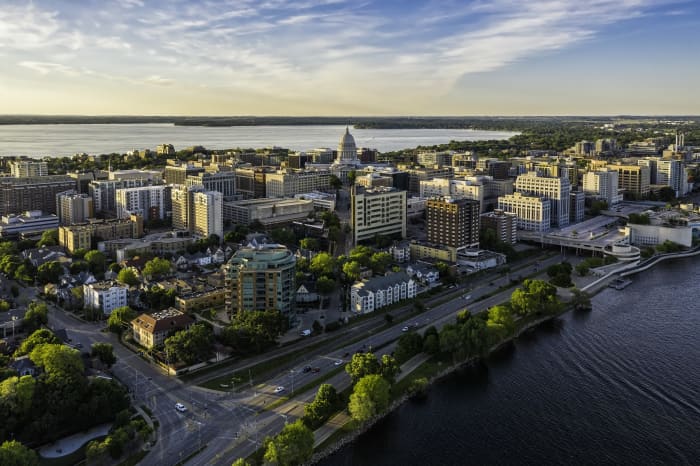
Lakes Monona and Mendota and the urban core of Madison, Wis. ISTOCK

If the Midwest is calling your name, this authentic college town, home to the University of Wisconsin-Madison, is an easy answer. Frequently recognized on award lists — one of the best cities in the Midwest, best city for biking, happiest city in the world, greenest city, fittest city, etc. — the state capital has the feel of a smaller town (population: 272,159) but offers big-city amenities and culture. With an array of museums, the largest producer-only farmers market in the nation and plenty of food fests — from the world’s biggest Brat Fest to the Isthmus Beer Cheese Festival — it’s also just 77 miles from Milwaukee and 122 miles from Chicago.

Madison is also an excellent place for 20-somethings (more than half the population is younger than 30) and those who seek an active lifestyle (you’ll find five lakes, more than 260 parks and bike paths everywhere you look). 

Ready to move? The average rent for a one-bedroom apartment is $1,567, roughly $400 below the national average, and the median home value in Madison is $339,874. The largest job sectors include healthcare, life sciences, agriculture, advanced manufacturing and IT, and, of course, public employment in education. Is that “On, Wisconsin” we hear you humming?

2. Corvallis, Ore.
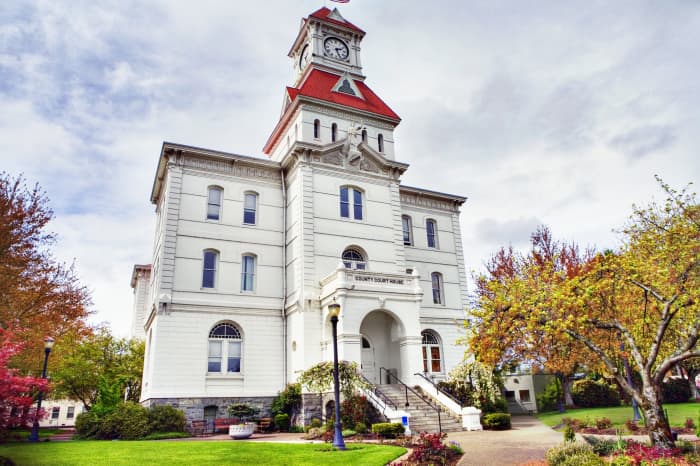
Corvallis is home to Oregon State University. ISTOCK

So your ultimate town wish list includes charming homes, proximity to outdoor adventures, a vibrant college campus and breweries, wineries and independent restaurants? It’s a tall order, but Corvallis, home to Oregon State University, will check all your boxes. 

The pretty, stately campus, situated near downtown, is one of just a few in the country with National Register of Historic Places status and hosts many cultural events (and Pac-12 athletics) open to the public throughout the year. 

With a population of 58,612 and an average Benton County home price of $527,363, it’s also a place where creative jobs are common — nearly half of the workforce is engaged in careers in science and technology, design and architecture, arts, entertainment and media, healthcare, law, management, and education.

Also see: 25 of the best places to live out West

Weekend warriors will love its location in the Willamette Valley (just 90 minutes from Portland), where both skiing and the Oregon coast are within easy drives, but crowd-drawing events, including a festival called da Vinci Days and the Corvallis Fall Festival, make staying put fun, too. 

3. Ames, Iowa
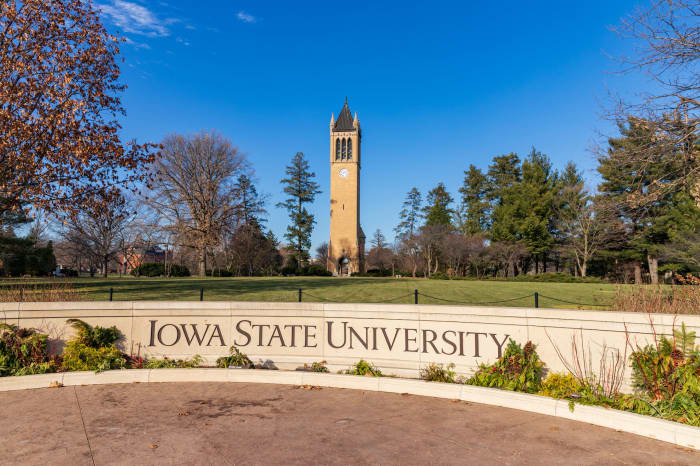
A view of the Iowa State University campanile. ISTOCK

“Is this heaven? No, it’s Iowa.”

Longtime residents of Ames may tire of the famous “Field of Dreams” line, but the movie quote isn’t far off. Boasting Iowa State University, 36 parks, a fun downtown scene, miles and miles of bike trails, four golf courses and more, this college town is a solid place to put down roots.

And it’s not just us saying it: Ames, with a population of 66,361 (including students), has racked up a long list of accolades, including best place for STEM grads, best town for millennials and healthiest city. 

If you plan to have kids, Ames has one of the nation’s top school systems. If you crave culture, the university brings Broadway shows, Pulitzer Prize–winning speakers and famous artists from across the world. If you love collegiate athletics, the Big 12 member ISU Cyclones will have you cheering. 

Don’t miss: This Iowa town will pay you to build a house there

And it’s affordable, too: The median home value is $246,387, and the average rent for a one-bedroom apartment is $725. Top jobs are in education, government and professional, and scientific and technical services.

Heaven? No, it’s Ames. 

Also see: The best affordable places to live in the U.S.

4. Ann Arbor, Mich.
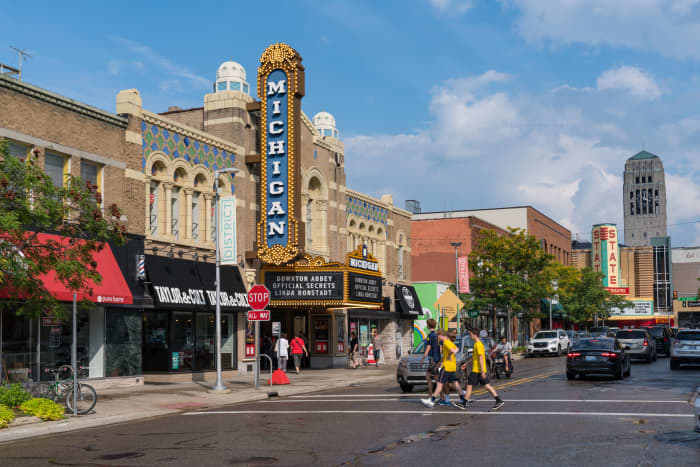
Liberty Street in Ann Arbor. GETTY IMAGES

Thinking of moving to Wolverine territory? Start by learning the lyrics to the University of Michigan fight song (“Hail! to the victors valiant; Hail! to the conqu’ring heroes; Hail! Hail! to Michigan, the champions of the West!”), then get ready to take notes on what makes this city (one of the best in the country) so beloved.

First is the college’s award-winning museums, cultural performances, nationally ranked sports teams (the football stadium seats a whopping 107,601, with epic tailgating on its exterior) and Instagram-worthy campus. Then there’s the food and drink scene: more than 300 restaurants, food trucks, a charming farmers market and a host of breweries.

See: 25 of the best cities and towns to live in the Northeast U.S.

Or the festivals held most weekends, such as July’s Ann Arbor Art Fair, April’s FoolMoon and FestiFools and holiday lights fest. Or the outdoor options — you could golf, hike, mountain bike, snowshoe or cross-country ski or canoe, paddleboard or kayak the Huron River. 

Named a winner on lists celebrating the most educated cities in America, best coffee, best college towns, happiest cities, best cities for entrepreneurs, best city for millennials and so on, Ann Arbor boasts about 122,915 residents (U. of M. students included). The median home value is $377,706, and almost 10% of the workforce is employed by the university (the city’s largest employer); unemployment is low, with the healthcare, automotive, IT and biomedical research fields as local leaders.

Ann Arbor? Hail, yes!

5. Fort Collins, Colo.
On the Poudre River Trail in Fort Collins. ISTOCK

When it comes to Rocky Mountain college towns, Boulder tends to get most of the love. But Fort Collins, home to CU’s intrastate rival, Colorado State, is bursting with potential as a worthy city in which to put down roots.

And if you’re a beer drinker, it’s time to hoist a pint. Fort Collins makes roughly 70% of the craft beer produced in the state of Colorado and has one of the highest numbers of microbreweries per capita. When friends visit, hop on a brew tour (there are plenty to choose from) to sample a Fat Tire from New Belgium, a 90 Shilling from Odell or a Dunkel from Zwei. 

Just an hour’s drive north of Denver, this town (population: 172,676), may center on CSU (which boasts a world-class performing-arts center, historic buildings and a state-of-the-art stadium), but it also supports a ballet troupe, opera company, symphony, art galleries, museums and lots of live music venues. The major employers in the area include Advanced Energy Industries, Anheuser Busch, Banner Health and CSU. 

Also see: I’m looking for a place that has year-round mild, sunny weather and is near or on the water, and my budget is $125,000 — where should I retire?

And the setting ain’t bad. Located along the Cache la Poudre River and along the Front Range, camping, hiking, skiing, fishing, biking and other outdoor adventures are just moments away. It’s a perpetual award winner on top-cities lists, from the best city for cycling to the best place to raise a family to the best place to live.

The average home price in Fort Collins is climbing — currently, it’s at $487,730, with one-bedroom apartments renting for $1,500 on average. But it’s easy to see why folks come here for college and stay forever. 

NC Governor declares ‘state of emergency’ due to GOP school voucher expansion, tax cuts

The News & Observer

NC Governor declares ‘state of emergency’ due to GOP school voucher expansion, tax cuts

T. Keung Hui – May 22, 2023

Kaitlin McKeown

Democratic Gov. Roy Cooper declared Monday that “public education in North Carolina is facing a state of emergency” in the face of “extreme legislation” being promoted by Republican state lawmakers.

In a video posted online Monday, Cooper said GOP lawmakers are “starving” public schools and “dropping an atomic bomb on public education” with plans to further cut taxes and increase funding for private school vouchers. He said the public needs to speak out against the changes before they’re adopted in the state budget.

“It’s clear that the Republican legislature is aiming to choke the life out of public education,” Cooper said. “I am declaring this state of emergency because you need to know what’s happening.

“If you care about public schools in North Carolina, it’s time to take immediate action and tell them to stop the damage that will set back our schools for a generation.”

Cooper’s speech comes as Republican legislative leaders are negotiating a state budget deal for the next two years that includes tax cuts and expansion of private school vouchers. The GOP has a legislative supermajority, so it can adopt a spending plan and other legislation without needing Cooper’s support.

The governor will hold public events across the state in the days ahead to call on parents, educators and business leaders to speak against the GOP proposals, the Associated Press reported.

Cooper, who can’t run again for a third consecutive term, has been losing political power. Last week, seven Democrats joined Republicans in passing the Senate budget proposal.

“Meaningless publicity stunts do nothing to improve educational outcomes in our state,” Randy Brechbiel, a spokesman for Senate leader Phil Berger, said in a statement Monday. “The House and Senate will continue working together to put forward budget proposals that address the needs of students and parents.”

‘Our teachers deserve better’

Under the Senate budget, average teacher pay would increase 4.5% over the next two years with the biggest increase going toward beginning educators. The House GOP budget had average 10.2% raises for teachers over the next two years.

Cooper has advocated for 18% raises for teachers over the next two years.

“Our teachers deserve better pay and more respect but the legislature wants to give them neither one,” Cooper said.

The $250 pay raise that the Senate would provide veteran teachers over the next two years “is a slap in the face,” Cooper said. He said the proposed Senate pay raise will not help the state deal with the thousands of teacher vacancies.

‘Cut public schools to the bone’

The Senate GOP budget would also expand the Opportunity Scholarship program so that any family, regardless of its income, would qualify to apply for vouchers to attend a K-12 private school.

Republicans point out that public education spending would grow by several hundred million dollars a year annually in their competing plans. And GOP leaders consider expansion of the private-school vouchers program part of a philosophy to give all children access to education options — whatever the source — to help them succeed.

But an Office of State Budget and Management analysis says the bill could cost traditional public schools $200 million in state funding, rural counties being particularly hard hit.

The Senate budget would also accelerate the tax cuts that Republicans put in previous budgets.

Cooper accused GOP lawmakers of wanting to help millionaires by giving them more tax cuts and making it possible for them to get private school vouchers. Currently, the Opportunity Scholarship program is limited to lower-to-middle-income families.

GOP lawmakers are choosing corporations and millionaires over public schools, the governor charged.

“Public school superintendents are telling me they’ll likely have to cut public schools to the bone — eliminate early college, AP and gifted courses, art, music, sports — if the legislature keeps draining funds to pay for private schools and those massive tax breaks,” Cooper said.

Ron DeSantis is learning that not every state wants to be Florida

NBC News

Ron DeSantis is learning that not every state wants to be Florida

Henry J. Gomez – May 22, 2023

Charlie Neibergall

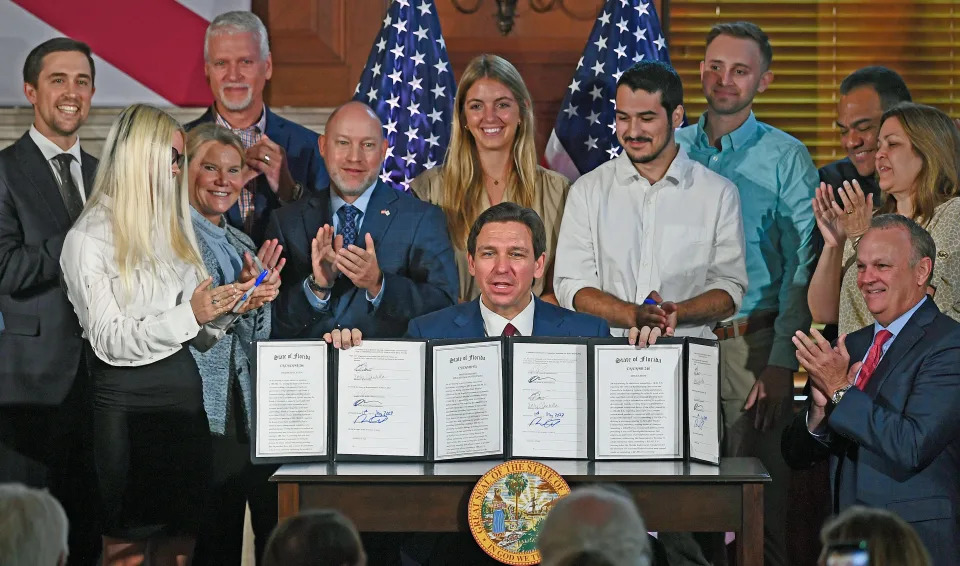
Wherever Gov. Ron DeSantis goes, he brings greetings from “the free state of Florida.” He heralds his “Florida Blueprint.” And he brags about how many people originally from whichever state he happens to be visiting love taking advantage of Florida’s warm weather and low taxes.

But a funny thing has happened as DeSantis travels the country with a “Make America Florida” message that underpins the Republican’s soon-to-launch presidential campaign.

DeSantis has found that not everyone wants to be Florida. And he has encountered spirited pushback from competitive fellow governors and GOP officials who believe that their states have done just as much, if not more, to advance a conservative agenda.

“It’s a lot of fun competing with my colleagues and Republican governors across the country,” Iowa Gov. Kim Reynolds, who has hosted DeSantis in the first-in-the-nation caucus state, said in an interview with NBC News. “But make no mistake, we are competitors.”

Reynolds introduced and interviewed DeSantis at two events in March, making sure to hold up her own record alongside his and frame them as equally accomplished governors. DeSantis, though, emphasized that he enjoys a “special perch” or “unique catbird’s seat” to view how other governors are doing, “because when people visit or move here, they tell me what’s going on in their states.”

After bestowing this authority onto himself, he took some shots at Democratic-led Illinois and proclaimed that Reynolds indeed presides over “one of the best-run states.”

It’s a tricky task — one that has caught attention of DeSantis’ home state reporters at Florida Politics — that in the wrong hands can come off as a magnanimous pander or a condescending pat on the back. And there have been signs in recent weeks that DeSantis recognizes he needs to shift how he talks about Florida, making it seem less aspirational and exceptional and more like an example of Republican leadership that has thrived elsewhere.

Reynolds, who stressed that her rivalry with DeSantis is friendly, brushed aside a question about whether his comments might offend Iowans and then quickly pivoted to her own accomplishments.

“Offend Iowans? Oh no, because I took care of that,” Reynolds said. “Because starting this year, we no longer tax retirement income. I made a deal with Gov. DeSantis. I said, ‘Hey, I’ll let our retirees go down to Florida — maybe a couple of months in January and February when the temperature’s not as good here in Iowa. … He’s gracious when he talks about it.”

DeSantis’ Florida boosterism has also prompted some ribbing in New Hampshire. At a GOP dinner there last month, DeSantis spoke admiringly about that state’s “Live Free or Die” motto before launching into his self-congratulatory story. Before DeSantis left the stage, New Hampshire GOP Chairman Chris Ager playfully jabbed at the governor.

“Instead of people moving to Florida,” Ager said, “maybe you can move up here.”

DeSantis’ spokesperson did not return a request for comment for this piece.

As boastful as DeSantis can be, he also searches for common cause with his audiences. During two stops in Ohio last month he played up his mother’s roots in the Youngstown area and his wife’s childhood in Troy, near Dayton. During that trip, he told a GOP crowd over breakfast in Akron that some parts of Florida are like “Ohio South,” given the number of retirees there.

“And it’s all good, because I’ll tell you, when it came time to get that big victory margin, there were a lot of transplanted people from Ohio who had my back,” DeSantis said, referring to his 19-point re-election margin last year. “So, God bless them for doing that.”

During a speech in South Carolina, DeSantis mentioned how his in-laws now live in the state and how he’s noticed more traffic on the roads there when he and his wife visit.

“Similar to what we’ve seen in Florida over the years with people coming down here,” he said.

But he was unable to resist an attempt at one-upmanship: “Famously — and, as long as I’m around, permanently — we have no state income tax. You guys should try that sometime.”

In Georgia, a compliment quickly gave way to grievance.

“One thing we’re no longer No. 1 in is college football,” DeSantis told an audience during a visit to a gun store in March. “So I just have a little bit of a plea … just stop taking so many of our high school football recruits. Can you give us a little bit of a chance?”

Ager, the New Hampshire GOP chair, said in an interview that he sees nothing wrong with friendly competition — and he wasted little time asserting his own state’s superiority.

“We are clearly No. 1. Gov. DeSantis calls it the free state of Florida. But the Cato Institute … in their whole scoring criteria, New Hampshire came in first last year,” Ager said, referring to a libertarian think tank’s ranking of New Hampshire as the freest state, based on personal and economic freedoms. “So we have some objective criteria from a third party.”

DeSantis himself seems to have softened his pitch a tad. While addressing the Utah GOP’s organizing convention in late April, he called the state, led by Republican Gov. Spencer Cox, “one of the best governed, best performing states.” DeSantis then went on to bestow perhaps the biggest compliment he could, even if it kind of came at the expense of a third state.

“I was recently visiting with some folks in Iowa, and people said, ‘Iowa, they’re really the Florida of the Midwest with all the conservative stuff they’re doing,’” DeSantis said. “Well, let me just tell you, maybe this is a little secret, but it might just be that Florida’s the Utah of the Southeast.”

By the time he returned to Iowa this month, DeSantis sounded ready to reconsider.

“I was here in March, and someone kind of took note and they’re like, ‘Man … Iowa’s like the Florida of the Midwest.’ … But I just want to let you know, after watching all the good stuff you’ve done in Iowa, it may be that Florida is the Iowa of the Southeast. So we’ll see.”

For the competitive Reynolds, there’s no question.

“Absolutely,” said Iowa’s governor, who has not endorsed a candidate for president. “Florida is the Iowa of the Southeast, and we’re doing everything we can to continue that narrative.”

Texas is facing a housing crisis, a migrant crisis, a multi-year drought, and an epidemic of mass shootings. Ted Cruz, meanwhile, has opened an investigation into Bud Light.

Insider

Texas is facing a housing crisis, a migrant crisis, a multi-year drought, and an epidemic of mass shootings. Ted Cruz, meanwhile, has opened an investigation into Bud Light.

Katie Balevic – May 20, 2023

Texas is facing a housing crisis, a migrant crisis, a multi-year drought, and an epidemic of mass shootings. Ted Cruz, meanwhile, has opened an investigation into Bud Light.

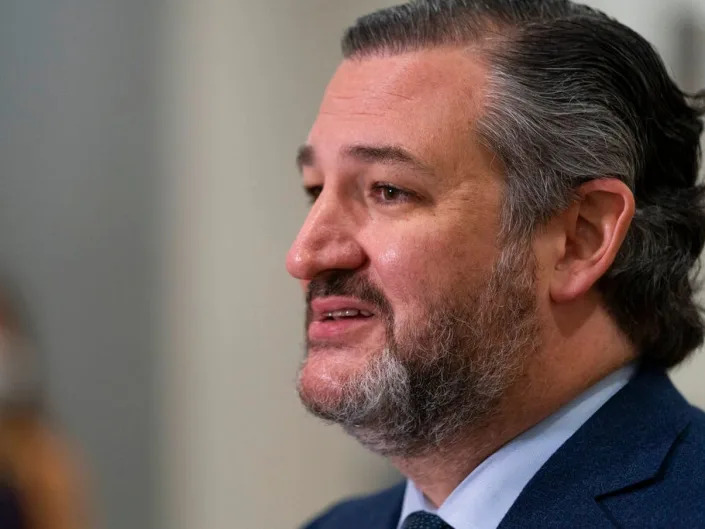
Texas Sen. Ted Cruz opened an investigation into Bud Light’s partnership with trans influencer Dylan Mulvaney.

Meanwhile, Texas is grappling with a migration crisis and a severe housing crisis.

And also an epidemic of gun violence, extreme weather, and a multi-year drought.

Texas is facing a laundry list of crises: housing, immigration, and weather, among others.

So, naturally, Texas Sen. Ted Cruz is opening an investigation into Bud Light.

Social conservatives across the country continue to clutch their pearls over Bud Light’s partnership with influencer Dylan Mulvaney, a 26-year-old transgender activist who has shaken the far-right’s perception of reality by existing in the open.

The company’s partnership with Mulvaney led to right-wing calls for a boycott of Bud Light, which has impacted sales at its parent company, Anheuser-Busch. The latter reported a 23% drop in sales for the last week of April compared to the previous year, CBS News reported.

Together with Sen. Marsha Blackburn of Tennessee, Cruz sent a letter to the beer industry’s regulatory body, the Beer Institute, inquiring whether Anheuser-Busch’s partnership with Mulvaney “violates the Beer Institute’s guidelines prohibiting marketing to underage individuals.”

“The Beer Institute must examine whether your company violated the Beer Institute’s Advertising/Marketing Code and Buying Guidelines prohibiting marketing to individuals younger than the legal drinking age,” the letter said, claiming that “Mulvaney’s audience skews significantly younger than the legal drinking age.”

To avoid an investigation, Cruz and Blackburn offered Anheuser-Busch the option to “publicly sever its relationship with Dylan Mulvaney, publicly apologize to the American people for marketing alcoholic beverages to minors, and direct Dylan Mulvaney to remove any Anheuser-Busch content” from her social media platforms, they wrote in the letter.

The letter, which misgendered Mulvaney throughout, also seeks documents and information on how “Anheuser-Busch vets its partnerships and how Anheuser-Busch failed in assessing the propriety of a partnership with Dylan Mulvaney.”

Meanwhile, in Cruz’ home state of Texas:

Following the expiration of Title 42, the fates of thousands of immigrants are up in the air as politicians on both sides of the aisle play hot potato by busing them to different cities.

The state faces an urgent housing and affordability crisis. There are just 25 available rental units for every 100 low-income households, according to The Texas Tribune.

Texas is also grappling with a series of deadly extreme weather events. In 2022, at least 279 people in Texas died from extreme heat, and the year before that, 246 Texans died from a brutal winter freeze. And Texas farmers are bracing for another growing season beset by a multi-year drought.

Texas is also the epicenter of gun violence. It is the site of 5 of the 10 deadliest shootings in US history.

Beer marketing, however — thanks to Cruz — has all the attention of the state’s top leaders in Washington.

Texas passes bill stripping authority from cities

The Hill

Texas passes bill stripping authority from cities


Saul Elbein – May 16, 2023

A sweeping Texas bill stripping authority from cities passed the state Senate on Tuesday and is now headed to the governor’s desk.

House Bill 2127 takes large domains of municipal governing — from payday lending laws to regulations on rest breaks for construction workers to laws determining whether women can be discriminated against based on their hair — out of the hands of the state’s largely Democratic-run cities and shifts them to its Republican-controlled legislature.

According to the Austin American Statesman, Gov. Greg Abbott (R) has been a vocal supporter of the bill.

Progressive critics argue the legislation — which one lawyer for Texas cities called “the Death Star” for local control — represents a new phase in the campaign by conservative state legislatures to curtail the power of blue-leaning cities.

Opponents of the bill include civil society groups like the AFL-CIO — and representatives of every major urban area in Texas, along with several minor ones.

They argue the shift in power it would enable would hamstring cities’ abilities to make policies to fit their unique circumstances.

“Where the state is silent, and it is silent on a lot — local governments step into that breach, to act on behalf of our shared constituents,” state Sen. Sarah Eckhardt (D) told the Senate on Tuesday.

“We should be doing our job rather than micromanaging theirs.”

But the bill’s Senate sponsor, state Sen. Brandon Creighton (R), said it was necessary to protect “job creators” from “cities and counties acting as lawmakers outside of their jurisdiction.”

Both the legislation’s sponsors and the principal trade group that backed it — the National Federation of Independent Businesses (NFIB) — have argued local regulation poses an existential threat to Texas businesses.

“As prices escalate, property taxes increase, and workers remain in short supply, small business owners are continuing to struggle in this economic environment,” said Annie Spilman, state director of the NFIB, in a statement earlier this month. “Arduous local ordinances, no matter how well-intended, exacerbate these challenges.”

The NFIB’s solution to that problem: one set of rules governing business across the state, which it says will cut costs by preventing the “patchwork” of local and county regulations that govern Texas’s sprawling cities.

While the NFIB and the legislation are officially nonpartisan, support for the bill has been overwhelmingly Republican.

The bill passed the state Senate 18-13 on a nearly party-line vote after passing the House in April with the votes of just eight out of 65 Democrats.

If enacted, the legislation would have a wide reach, banning — technically “preempting” — broad swaths of the state code.

It would nullify many existing ordinances, like Austin and Dallas’s heat protections for construction workers.

It would also ban new restrictions on payday lending or puppy mills, although — after a long fight — existing city laws will be preserved.

Urban advocates say other specific local laws without state or federal analogs — like an Austin law banning discrimination based on hair texture or style — would also likely be struck down.

The bill failed to pass in the 2019 or 2021 sessions — in part because it was seen as too broad, Austin City Councilor Ryan Alter told The Hill.

But with every failed passage, Alter said, “The bill has only gotten broader.”

Alter listed the state preemption of the Property and Business and Commerce codes as two domains that would lead to unforeseen consequences for cities.

“We do a lot of things as the city as relates to property, land use and issues concerning land, and we make a lot of decisions that impact business and commerce,” Alter added.

The bill also preempts city and county ordinances relating to the Agriculture Code, Finance Code, Insurance Code, Labor Code, Natural Resources Code and Occupations Code.

One worry among the legislation’s opponents is procedural.

The state legislature only meets every two years, making each session a logjam of potential bills, most of which never go anywhere. In 2022, for example, the Legislature passed about 38 percent of the nearly 10,000 bills introduced.

That low frequency of meetings and state-level focus make the Legislature a body opponents argue is ill-suited to managing the day-to-day affairs of cities.

Under the new law, “cities and counties across Texas will have to rely on the state’s part-time Legislature, which meets for only 140 days every two years, to address various issues and problems of local concern,” Adrian Shelley, Texas director for public interest advocacy group Public Citizen, said in a statement.

Spilman of the NFIB has argued the law was necessary to rein in out-of-control municipal governments.

The long campaign for the legislation that became H.B. 2127 began in 2018, when Dallas, Austin and San Antonio passed ordinances requiring employers to offer paid sick leave.

Those laws were later shot down by state and federal courts as a violation of state bans on raising the minimum wage above the federal standard.

But the ordinances would have given city governments subpoena power to investigate potential violations — powers which worried the NFIB, Spilman said in an April statement.

“I just don’t know why a city ordinance would have something in there like that. That’s very frightening to a small business owner, with no compliance officers.”

The need for the legislation was urgent, she added at the time. “You go another two years without this protection — we just don’t know what cities might propose next.”

Opponents, meanwhile, argue the bill would present challenges to businesses because its scope is so broad as to make it impossible to say how far it will reach.

“If there is one thing businesses hate it is uncertainty,” Houston city attorney Collyn Peddie wrote in an April statement.

“Because 2127 barely attempts to define the fields that it purports to preempt, [self-governing] cities will not know what laws to enforce and, more important, businesses will not know what laws to obey,” Peddie continued.

Another source of concern for bill opponents is the method of enforcement, which — as in the case of the state’s “bounty” abortion ban — would occur through lawsuits.

The bill would authorize “any person who has sustained an injury in fact, actual or treated” to sue cities and counties for passing ordinances in areas now officially under the domain of the state.

Winners of such suits would get damages and attorney’s fees covered.

Whenever cities pass big ordinances, “people get clever in their lawsuits to challenge anything they don’t like,” said Alter, the Austin councilor.

“And because the bill is so broad there are a lot of opportunities for people to poke holes in any bills the city passes.”

The NFIB’s position is that the newly preempted powers aren’t being taken away from cities: They’re ones the cities never had to start with, as Spilman explained to The Hill.

The legislation’s GOP sponsors agree. “It’s a ‘stay in your lane’ bill,” Rep. Dustin Burrows (R) said at a February event hosted by the NFIB. “If you’re a city, do your core functions. If you’re a county, do your core functions.”

Burrows has dismissed critics of the bill as “taxpayer-funded lobbyists” who he told the Texas Tribune in March were “out in full force trying to undermine this effort.”

In those remarks, Burrows took a tack familiar from statehouse Republican messaging nationwide.

Groups opposing the bills, he added, “are beholden to special interest groups who cannot get their liberal agenda through at the statehouse, so they go to city halls across the State, creating a patchwork of unnecessary and anti-business ordinances.”

But bill opponents argued that local laws are a patchwork because local conditions are, too.

“Lawmakers who voted for this must explain to their constituents why they gave away local authority to lawmakers hundreds of miles away in Austin who may have never even set foot in their community,” said Adrian Shelley, Texas director of advocacy group Public Citizen.

Eckhardt, the state senator from Bastrop, argued the legislation “obliterates the local balancing of interests that creates the distinct local flavor from Lubbock to Houston, Laredo to Texarkana.”

Bills like House Bill 2127 “excuse the Texas legislature from leading,” she added.

“We are wasting our precious 140 days — when we could be doing statewide health, education, justice and prosperity policies — barging into bedrooms, locker rooms, boardrooms examining rooms and now city council meetings.”

DeSantis signs bill banning funding for college diversity programs

Sarasota Herald Tribune

DeSantis signs bill banning funding for college diversity programs

Zac Anderson, Steven Walker, Sarasota Herald-Tribune – May 15, 2023

Gov. Ron DeSantis signed legislation Monday banning state funding for diversity, equity and inclusion programs at Florida’s public universities, staging the event at New College of Florida, which the governor has transformed into a conservative higher education experiment.

A New College board revamped by DeSantis abolished the school’s DEI office, and the college’s interim president recently fired the diversity dean, a precursor to what other Florida universities could experience under SB 266, which was a centerpiece of DeSantis’ aggressive legislative agenda this year.

More: DeSantis says GOP must end a ‘culture of losing’ but still won’t acknowledge Trump lost

The latest headlines: New College campus café re-opens with vendor tied to Interim President Corcoran

Intrigue: Florida Senate won’t confirm controversial New College board member, who blames Corcoran

As he gears up for a run for president, DeSantis has emphasized a culture war agenda against so-called “woke” policies, and universities have been a major focus. The governor has decried a campus culture that he views as overly focused on issues of racial, gender and LGBTQ equity.

The legislation signed by DeSantis Monday also restricts how gender and race are taught on campus. It requires university officials to review any lessons “based on theories that systemic racism, sexism and privilege are inherent in the institutions of the United States and were created to maintain social, political and economic inequities.”

Gov. Ron DeSantis shows off all three bills he signed into legislation on Monday May 15, 2023, at New College of Florida. One of the main bills, banning state funding for diversity, equity and inclusion programs at Florida's public universities, which the governor has transformed into a conservative higher education experiment.
Gov. Ron DeSantis shows off all three bills he signed into legislation on Monday May 15, 2023, at New College of Florida. One of the main bills, banning state funding for diversity, equity and inclusion programs at Florida’s public universities, which the governor has transformed into a conservative higher education experiment.

DeSantis said Monday that DEI really should stand for “discrimination, exclusion and indoctrination.”

“This has basically been used as a veneer to impose an ideological agenda and that is wrong,” he said.

Democrats said the legislation will hurt students and Florida’s university system.

“Governor DeSantis is treating freedom of speech as an enemy, and the Legislature allowed his partisan politics to get in the way of initiatives that have progressed us as a nation to allow students from diverse backgrounds and experiences be included in places where historically they have not been accepted,” said Lauren Book, the Democratic leader in the state Senate.

DeSantis also signed HB 931 and SB 240, which prohibit Florida colleges from requiring students, faculty or staff to sign in support of DEI and expand apprenticeship programs, respectively.

New College has been at the forefront of DeSantis’ higher education agenda ever since he appointed six new board members on Jan. 6. DeSantis has talked about turning New College, Florida’s public honors college, into something resembling Hillsdale College, a private Christian school in Michigan.

The new board quickly fired the president and installed a DeSantis ally in her place, eliminated the DEI office and rejected early tenure for five professors, among a litany of changes that have dramatically altered the trajectory of the school.

Interim President Richard Corcoran also fired the diversity dean, who is transgender, and a librarian who also is a member of the LGBTQ community.

At the same time, state lawmakers have appropriated an extra $50 million for New College since Jan. 6 to accelerate the conservative transformation. The money is being used to recruit students, hire new faculty and create new sports teams, among other programs.

Investigative report: As DeSantis, legislature weaponize diversity initiatives, many are enshrined in Florida law

Whiplash: Florida universities were told to prioritize diversity plans. Now, DeSantis aims to gut them

Controversy in the classroom: Florida teacher investigated by state agency for showing Disney movie in class

“I don’t think they’ve ever gotten that infusion in the history of the college,” DeSantis said, drawing applause from the crowd of 75 people gathered in College Hall. “We are committed to the mission here. I would love for this to be, and I think it will be, the top classical liberal arts college in America.”

Out front of College Hall, students gathered on short notice to rally in protest of DeSantis and the bill. Several students woke up to texts from other students about the event.

Libby Harrity, 19, had attended rallies outside of Board of Trustees meetings, and learned of Monday’s event shortly before it started. Harrity and other students jeered at DeSantis supporters as they pulled into the parking lot at College Hall.

“I have the fire of 10,000 suns in my soul, and it’s all of the transgender energy,” they said.

Jackson, a 20-year-old New College student, said he had an exam scheduled for 12:30 p.m. at College Hall. He said his professor was unaware that DeSantis was coming and that his exam may have to be moved because of it.

After Gov. Ron DeSantis signed three bills into legislation, Christopher Rufo, one of the six new trustees went over to visit with the protesters who got unruly and was he eventually escorted by police while the protesters virtually surrounded him while leaving the New College of Florida's campus to have lunch, on Monday May 15, 2023.
After Gov. Ron DeSantis signed three bills into legislation, Christopher Rufo, one of the six new trustees went over to visit with the protesters who got unruly and was he eventually escorted by police while the protesters virtually surrounded him while leaving the New College of Florida’s campus to have lunch, on Monday May 15, 2023.More

“They’ve been doing this for decades, and it’s these like constant surprise attacks on people who are 20-year-old students who just want to have, like, a normal education and life,” said Alex Abraud, a 21-year-old anthropology student.

The protestors chanted throughout DeSantis’ event and could be clearly heard inside College Hall during speeches by the governor and others.

“I saw some of the protesters out there,” DeSantis said. “I was a little disappointed. I was hoping for more.”

Christopher Rufo, a DeSantis appointee to the New College board, also mocked the protesters.

Rufo is a conservative activist and prominent critic of DEI who called the legislation DeSantis signed Monday “once-in-a-generation reforms.” He noted that he lives in the Seattle area, and said protests there are common.

“This is kind of kindergarten-level protest,” he said.

Following the event, Rufo met protesters outside where he blew kisses to them as they chanted “f—- you fascist.” The protesters then followed Rufo to his car, where he was escorted out by police.