In Trump immunity case, Supreme Court justices are Trumpists, not jurists
By Gene Nichol – May 1, 2024
Members of the U.S. Supreme Court, seated from left: Associate Justices Sonia Sotomayor and Clarence Thomas, Chief Justice John Roberts and Associate Justices Samuel Alito and Elena Kagan. Standing, from left: Associate Justices Amy Coney Barrett, Neil Gorsuch, Brett Kavanaugh and Ketanji Brown Jackson. JACK GRUBER Jack Gruber-USA TODAY
I’ll concede, readily, that in my old age I find it almost unbearable to listen to U.S. Supreme Court arguments. After all, I’ve been studying them, in one format or another, for many decades. This is the bench of Earl Warren, Thurgood Marshall, William Brennan, Ruth Bader Ginsburg, Sandra Day O’Connor, John Marshall Harlan. It’s high ground. Or was.
Now there are other occupants. Massively different driving forces. Clarence Thomas, Samuel Alito, John Roberts, and the three Trump judges — Neil Gorsuch, Brett Kavanaugh and Amy Coney Barrett. Committed enlistees in a Republican crusade. Untethered to law. Lifelong opponents of the high aspirations of independent judicial review. Warriors against the enforcement of the Constitution’s obligations to open and secure the channels of democracy.
It’s hard to hear them talk. To hear them speak as if they pursued actual inquiry — instead of Federalist Society shop talk. To see the masquerade. They’re delivering gold for Donald Trump in last week’s insurrectionist-immunity case. Like you knew they would.
First, there is no straight-faced claim in the case that Trump is immune from the operation of the criminal law. As Jack Smith’s brief put it: “a criminal scheme to overturn an election and thwart the peaceful transition of power is the paradigm example of conduct” that cannot be immunized. And, as the Court of Appeals had held, Trump’s actions sought to interfere with “the constitutionally established design for determining the presidential election” — which provides “no role” for the president. Of course it doesn’t. The framers weren’t nuts.
But Justice Gorsuch said he “wasn’t concerned about this case” — he wanted to “write a rule for the ages.” Of course he does. Gorsuch, Thomas, Kavanaugh and Alito “for the ages.” It makes one nauseous. And it’s the literal definition of judicial legislation.
But it does at least distract. They can simply ignore what Trump has done. (That’s what Republicans do.) Plus, it’ll take forever to craft an unnecessary set of rules. They’ll need more process. Tons of it. They received the memo. Delay, delay, then delay some more. And who knows, presidents may need to stage coups, sell nuclear secrets, assassinate opponents and pay off porn stars. Judges have to be pragmatic futurists — not originalists, not this day.
A second point. A test of imaginative powers. Imagine that Barack Obama had done what Donald Trump did. (I know that’s actually impossible, Obama is the anti-Trump.) But go with me. Assume it was Obama’s case before these faux-judges rather than Trump. Is there any possibility that Thomas, Alito, Gorsuch, Kavanaugh, Barrett and Roberts would declare — even for a moment — that Obama was immune, or might be immune, or that his immunity should be examined, except to throw it on the trash bin of history?
I’ve been doing this for 40 years, and I promise there would be no possibility of that. None. No honest lawyer in the country would disagree with that assessment. These are partisans in charade. Nothing more. We should expect no more of them than we would Marjorie Taylor Greene or Matt Gaetz. They do the same work. They just pretend otherwise. They pose. They deserve the same level of respect we afford to the formal nutjobs.
They are also engaged, ironically, in bold, unprecedented election interference. Trumpists, not jurists.
The rest of us need to understand this. Clear eyed. If we are committed to the American democratic experiment, these pretenders must be disempowered – dismantled as the anti-democratic wrecking ball they’ve become. Worry not about the institution. There is no institution left to save. Donald Trump, Mitch McConnell, George H.W. Bush and the Republican Party have already done that work. Fully.
Contributing columnist Gene Nichol is a professor of law at the University of North Carolina-Chapel Hill. This story was originally published May 1, 2024.
Voters can’t tell between the arsonist and the fireman
Mark Gongloff, Bloomberg Opinion -The Tribune Content Agency May 02, 2024
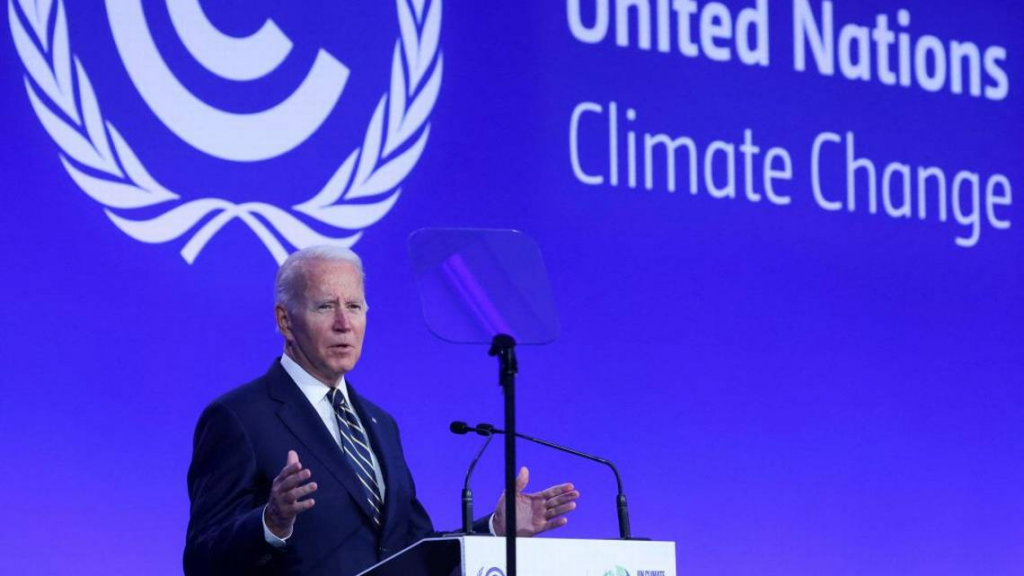
US President Joe Biden presents his national statement as part of the World Leaders’ Summit of the COP26 UN Climate Change Conference in Glasgow, Scotland on Nov. 1, 2021. (Yves Herman/Pool/AFP via Getty Images/TNS) YVES HERMAN/POOL/AFP TNS
If you were shopping for toaster ovens and your choice was between one that posed a 1% chance of setting your house on fire and a competing one that would not only 100% set your house on fire but proudly guaranteed it right on the box, then you would probably go with the 1% model.
U.S. voters face a similar choice this November when it comes to which presidential candidate will set the climate on fire. But they don’t seem to realize how much of a no-brainer that choice truly is.
President Joe Biden may not have a spotless climate record, but he has done much more to ensure a livable environment for future generations than any of his predecessors. Donald Trump, on the other hand, not only has history’s worst climate record, but he has announced, loudly and often, that his second term would be far, far worse.
Voters haven’t received the message, according to poll after poll. The latest is from CBS News, which found that 49% of Americans have heard little or nothing about what Biden has done for the climate. More alarmingly, most Americans think neither Biden’s second-term policies nor Trump’s would make any difference to the climate. That is dangerous nonsense.
The list of what Biden has already done is long and substantial, and it goes beyond the Inflation Reduction Act, easily the biggest climate bill in history. He also passed a bipartisan infrastructure bill and the Chips and Science Act, both with significant investments in the renewable-energy transition. He rejoined the Paris accord to limit long-term warming to 2 degrees Celsius, tightened emissions standards for power plants and cars and limited oil and gas drilling and liquefied natural gas exports. To name just a few things.
Biden has frustrated environmentalists at times with compromises such as approving the Willow drilling project in Alaska and pulling some regulatory punches on emissions and corporate disclosures. But he has done these things mostly in the name of getting reelected – which may sound cynical, until you consider the person who will be elected if Biden is not.
During his first term, Trump ditched the Paris accord and loosened regulatory fetters on the fossil-fuel and other polluting industries at the worst possible moment, just as the global concentration of atmospheric carbon was reaching dangerous levels. A Trump restoration would again come at a key point, just when scientists say the window to avoid the worst effects of a chaotic climate is slamming shut.
And Trump’s advisers are vowing to wreck progress even more aggressively in a second term. The Heritage Foundation’s Project 2025 lays out an agenda for Trump II that includes leaving the Paris accord again; undoing Biden’s efforts to regulate pollution; repealing the IRA or at least neutralizing it by closing the Energy Department loan office; throwing the entire country open to oil and gas exploration; and dismantling the climate-tracking National Oceanographic and Atmospheric Administration. To name just a few things.
A second Trump term would add 4 billion extra tons of carbon to the atmosphere, according to an analysis by Carbon Brief, a nonprofit advocacy group. That’s about two-thirds of what the U.S. produces in an entire year and matches the combined annual emissions of the European Union and Japan. The global clean-energy transition has built up anti-Trump defenses in the past four years, as my Bloomberg Opinion colleague Liam Denning and I have written. But make no mistake about it: A second Trump presidency would be a disaster.
So the whole planet needs Biden to do a much better job of communicating the stark contrast between him and Trump. The first step will be overcoming the mistaken sense among his voting base that he has failed them with his compromises.
“The key voters that put Biden in office in the first place – young people, people of color, women in the suburbs – were very concerned about climate,” Anthony Leiserowitz, director of the Yale Program on Climate Change Communication, told me in an interview. “Some of these same demographics think he’s done nothing or worse because of the Willow decision.”
Seven out of 10 Biden voters in 2020 said climate was important to their vote, according to a Pew Research Center poll. Nearly a fifth of Biden voters consider it their top priority, according to an Economist/YouGov poll. If he wants these voters back at the polls in November, then Biden must convince them early and often that staying home and giving Trump the White House would make all their worst fears come true.
The trick is that Biden may also need to win swing voters, most of whom don’t care as much about the environment and may fear (incorrectly) that there’s a trade-off between fighting global warming and growing the economy. That’s one reason Biden and his advisers spend so much time trumpeting the jobs the IRA and other climate actions create.
The good news is that the politics of this issue have shifted drastically in recent years. As evidence, Biden made his climate promises sharper for the general election campaign than during the Democratic primaries in 2020, Leiserowitz notes. Most Americans now think global warming is real and human-made and support Biden’s policies when they hear about them.
But we can’t wait for the battleship of public opinion to complete its U-turn. We don’t have another four years to waste.
This column does not necessarily reflect the opinion of the editorial board or Bloomberg LP and its owners. Mark Gongloff is a Bloomberg Opinion editor and columnist covering climate change. He previously worked for Fortune.com, the Huffington Post and the Wall Street Journal.
Spring is tornado season in the U.S., but the tornadoes in Nebraska and Iowa were quite a bit farther north and east of what would be typical for tornadoes in late April, when tornado activity is more common in Oklahoma and Texas.
The outbreak did fit another pattern for severe weather events, however, that occur as the atmosphere transitions out of El Niño. And this is exactly what was happening in late April.
I study tornadoes and the conditions under which they form. Here’s how these storm systems develop and what El Niño has to do with it.
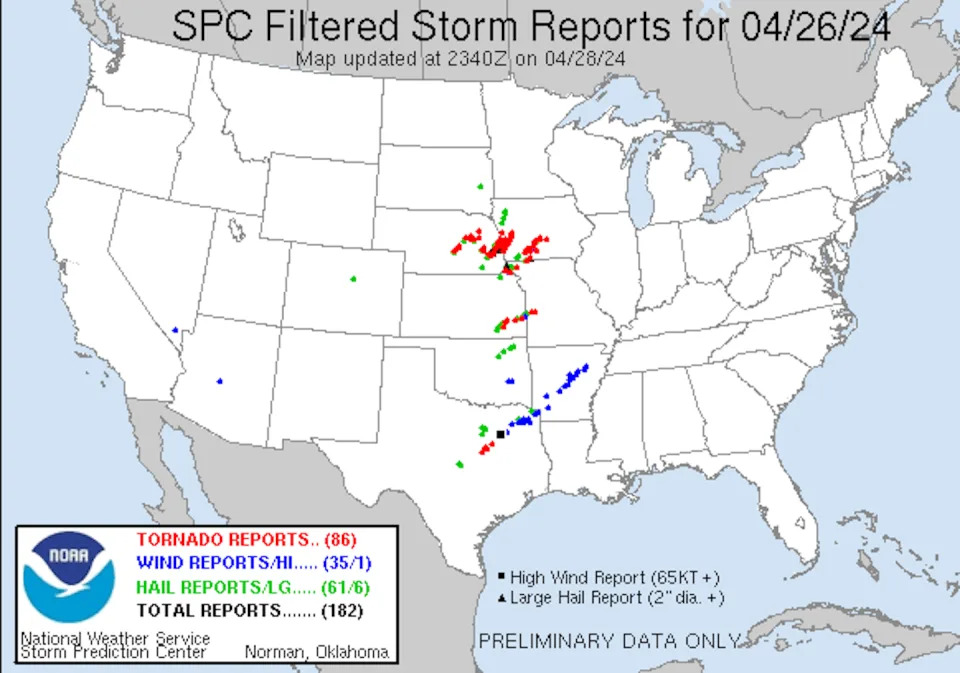
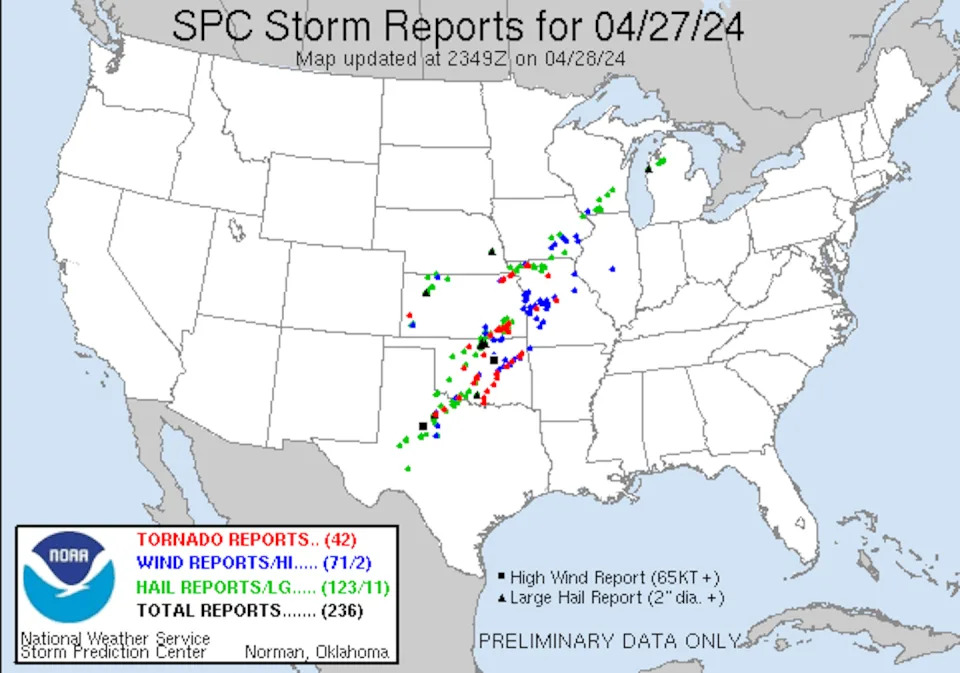
Preliminary reports of tornadoes and hail during severe storms on April 26, 2024, collected by the National Oceanic and Atmospheric Administration’s Storm Prediction Center. NOAAPreliminary reports of tornadoes and hail on April 27, 2024, collected by the Storm Prediction Center. NOAA.
The right conditions for a tornado
Two basic conditions are required to produce the rotating supercell thunderstorms that are capable of generating tornadoes:
Warm moist surface conditions and cold air above.
Winds that change in both speed and direction as you move up in the atmosphere, known as vertical wind shear.
Picture a kid who has a helium balloon at a party and releases it – the balloon floats upward. Like that helium balloon, the warm moist air is less dense than the surrounding colder air, so it rises, accelerating upward. This upward motion releases heat, moisture and energy, and causes thunderstorms to develop.
As with many severe weather outbreaks that occur in the U.S., the atmosphere became primed for storms as warm moist air at the surface was being transported northward from the Gulf of Mexico by a series of surface low-pressure systems.
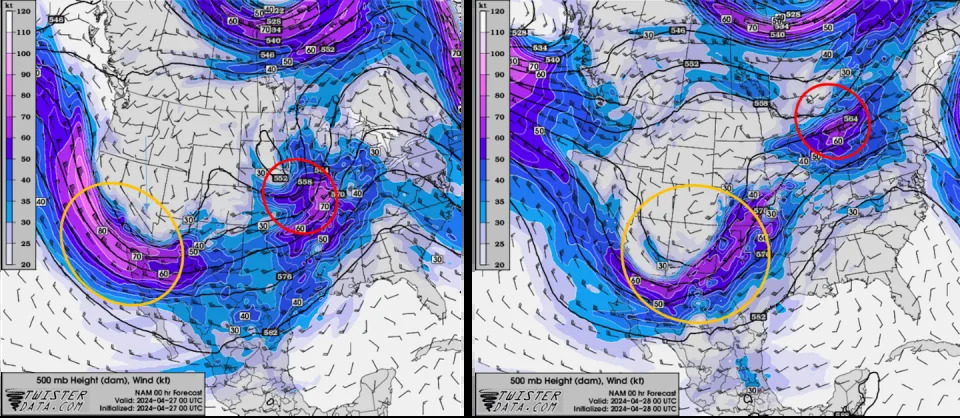
Higher up, about halfway between the ground and where airplanes fly, atmospheric waves within and below the jet stream were transporting cold air through the middle part of the atmosphere. These waves, formally called Rossby waves and commonly referred to as troughs and ridges, also enhanced vertical wind shear.
A small atmospheric wave that moved through the Central Plains and Midwest on April 26, helped trigger the tornadoes in Nebraska and Iowa, including a large, destructive tornado in the suburbs of Omaha, Nebraska, and in the town of Minden, Iowa, about 30 miles away.
The following day, a bigger wave moved through Oklahoma, where tornadoes damaged several small towns that evening.
The two images show the short-wave trough, circled in red, and the longer wave, circled in orange, traveling behind it. On the left is April 26, with the short-wave trough moving through Nebraska. On the right, the longer wave is affecting Oklahoma and Kansas on April 27. TwisterData.com
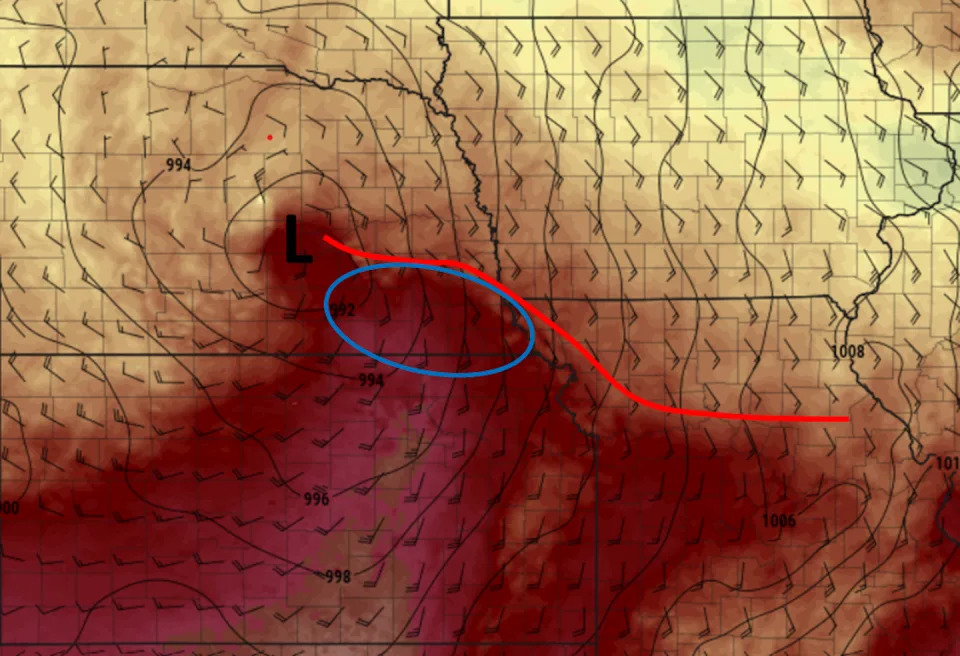
What was especially important was how close these parameters were to the center of the surface low-pressure system and a warm front that extended just to the east of it. The tornado-producing storms were able to tap into that instability and draw on the strong vertical wind shear generated in the vicinity of the warm front.
Surface temperatures (colors), winds (barbs indicating direction the wind was blowing from), surface pressure (solid black contours) indicating the location of the low pressure system (L), the warm front (red line) and the region of favorable conditions (blue circle) on the evening of April, 26, 2024. Pivotal Weather
When El Niño decays, the atmospheric waves change and can become wavier, so they have a greater amplitude. That tends to enhance conditions needed for tornadoes.
The U.S. often sees more frequent tornadoes when the climate is transitioning out of El Niño. The strong El Niño of 2023-24 was decaying in April 2024, and forecasters expect it to be gone by summer.
Weather experts are getting better at predicting tornado conditions. It is not uncommon now to know days in advance of the actual event that an elevated threat exists. Forecasters have high-resolution weather models that can anticipate storms at an appropriate spatial scale to provide a sense of the likely organization of the storms and come close to the location.
The better we understand these storms’ attributes, the better those forecasts and warnings can become.
This article is republished from The Conversation, a nonprofit, independent news organization bringing you facts and trustworthy analysis to help you make sense of our complex world. It was written by: Jana Lesak Houser, The Ohio State University
An El Niño-less summer is coming. Here’s what that could mean for the US
Mary Gilbert, CNN Meteorologist – April 29, 2024
It may be spring, but it’s not too soon to look ahead to summer weather, especially when El Niño – a player in last year’s especially brutal summer – is rapidly weakening and will all but vanish by the time the season kicks into gear.
El Niño’s disappearing act doesn’t mean relief from the heat. Not when the world is heating up due to human-driven climate change. In fact, forecasters think it could mean the opposite.
What this summer’s weather could look like
El Niño is a natural climate pattern marked by warmer than average ocean temperatures in the equatorial Pacific. When the water gets cooler than average, it’s a La Niña. Either phase can have an effect on weather around the globe.
By June, forecasters expect those ocean temperatures to hover close to normal, marking a so-called neutral phase, before La Niña builds in early summer, according to NOAA’s Climate Prediction Center.
But the strength of El Niño or La Niña’s influence on US weather isn’t uniform and varies greatly based on the strength of the phenomena and the season itself.
The influence of El Niño or La Niña on US weather isn’t as clear-cut in the summer as it is in the winter, especially during a transition between the two phases, said Michelle L’Heureux, a climate scientist with the Climate Prediction Center.
Temperature differences between the tropics and North America are more extreme in the winter, L’Heureux explained. This allows the jet stream to become quite strong and influential, reliably sending storms into certain parts of the US.
In the summer, the difference in temperature between the two regions isn’t as significant and the obvious influence on US weather wanes.
But we can look back at what happened during similar summers to get a glimpse of what could come this summer.
In short: It’s not cool.
The summer of 2016 was one of the hottest on record for the Lower 48. La Niña conditions were in place by midsummer and followed a very strong El Niño winter.
Summer 2020 followed a similar script: La Niña conditions formed midsummer after a weak El Niño winter but still produced one of the hottest summers on record and the most active hurricane season on record.
Then there’s the fact that these climate phenomena are playing out in a warming world, raising the ceiling on the extreme heat potential.
“This obviously isn’t our grandmother’s transition out of El Niño – we’re in a much warmer world so the impacts will be different,” L’Heureux, said. “We’re seeing the consequences of climate change.”
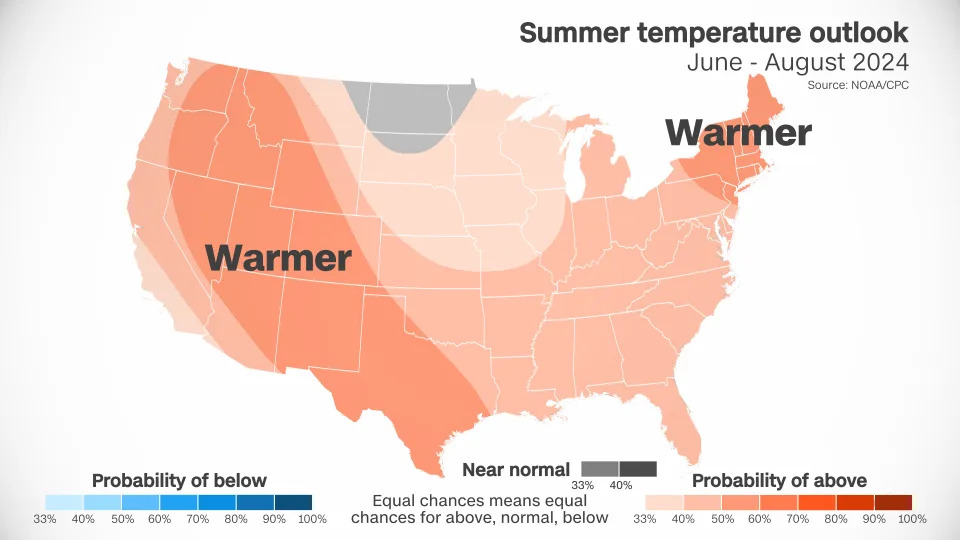
Current summer temperature outlooks for the US are certainly bringing the heat.
CNN Weather
Above-average temperatures are forecast over nearly every square mile of the Lower 48. Only portions of the Dakotas, Minnesota and Montana have an equal chance of encountering near normal, above- or below-normal temperatures.
A huge portion of the West is likely to have warmer conditions than normal. This forecast tracks with decades of climate trends, according to L’Heureux.
Summers have warmed more in the West than in any other region of the US since the early 1990s, according to data from NOAA. Phoenix is a prime example. The city’s average July temperature last year was an unheard-of 102.7 degrees, making it the hottest month on record for any US city. It was also the deadliest year on record for heat in Maricopa County, where Phoenix is located.
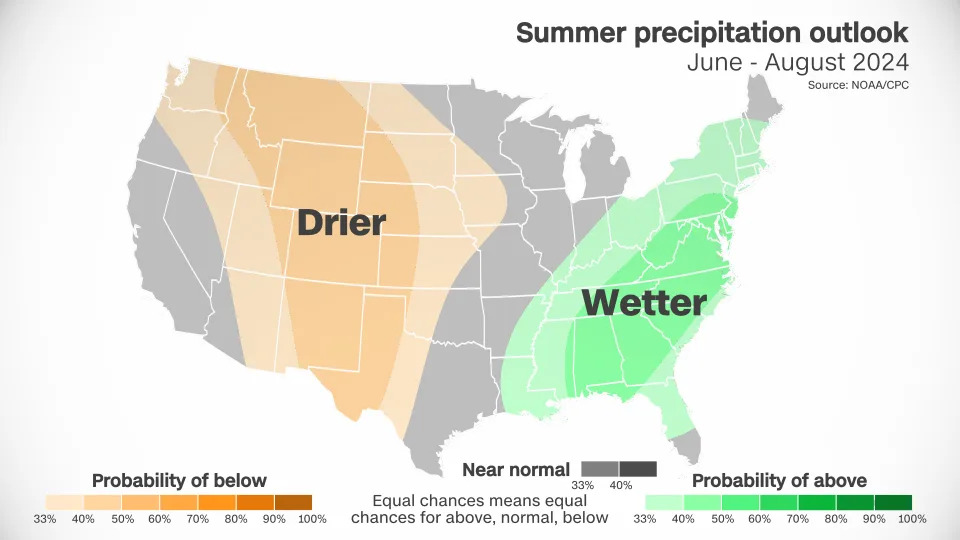
Forecasts also show a worrying precipitation trend for parts of the West.
CNN Weather
Large sections of the West and the central US are likely to be drier than normal. This dryness, combined with above-normal heat, which only amplifies the dryness, could be a recipe for new or worsening drought.
Wetter than normal conditions are in the forecast from the Gulf Coast to the Northeast. Stormy weather could be a consistent companion for much of the East – but whether it comes from typical rain and thunderstorms or tropical activity won’t be known for months.
A warming world generates more fuel for more tropical activity and stronger storms. La Niña tends to produce favorable atmospheric conditions to allow storms to form and hold together in the Atlantic.
“We anticipate a well above-average probability for major hurricanes making landfall along the continental United States coastline and in the Caribbean,” the group said in a news release.
Which foods have the most plastics? You may be surprised
Sandee LaMotte, CNN – April 22, 2024
“How much plastic will you have for dinner, sir? And you, ma’am?” While that may seem like a line from a satirical skit on Saturday Night Live, research is showing it’s much too close to reality.
Ninety percent of animal and vegetable protein samples tested positive for microplastics, teeny polymer fragments that can range from less than 0.2 inch (5 millimeters) down to 1/25,000th of an inch (1 micrometer), according to a February 2024 study. Anything smaller than 1 micrometer is a nanoplastic that must be measured in billionths of a meter.
Even vegetarians can’t escape, according to a 2021 study. If the plastic is small enough, fruits and vegetables can absorb microplastics through their root systems and transfer those chemical bits to the plant’s stems, leaves, seeds and fruit.
Salt can be packed with plastic. A 2023 study found coarse Himalayan pink salt mined from the ground had the most microplastics, followed by black salt and marine salt. Sugar is also “an important route of human exposure to these micropollutants,” according to a 2022 study.
Even tea bags, many of which are made of plastic, can release enormous amounts of plastic. Researchers at McGill University in Quebec, Canada found brewing a single plastic teabag released about 11.6 billion microplastic and 3.1 billion nanoplastic particles into the water.
Rice is also a culprit. A University of Queensland study found that for every 100 grams (1/2 cup) of rice people eat, they consume three to four milligrams of plastic — the number jumps to 13 milligrams per serving for instant rice. (You can reduce plastic contamination by up to 40% by washing rice, researchers said. That also helps reduce arsenic, which can be high in rice.)
Let’s not forget bottled water. One liter of water — the equivalent of two standard-size bottled waters — contained an average of 240,000 plastic particles from seven types of plastics, including nanoplastics, according to a March 2024 study.
“All of those chemicals are used in the manufacturing of plastic, so if a plastic makes its way into us, it’s carrying those chemicals with it,” Sherri “Sam” Mason, director of sustainability at Penn State Behrend in Erie, Pennsylvania, told CNN in a prior interview.
“And because the temperature of the body is higher than the outside, those chemicals are going to migrate out of that plastic and end up in our body,” Mason said.
“Those chemicals can be carried to your liver and your kidney and your brain and even make their way across the placental boundary and end up in an unborn child,” she said.
“There currently is no scientific consensus on the potential health impacts of nano- and microplastic particles. Therefore, media reports based on assumptions and conjecture do nothing more than unnecessarily scare the public,” a spokesperson for the International Bottled Water Association, an industry association, told CNN previously.
All types of proteins contained microplastics
In the February study, which was published in Environmental Research, researchers looked at over a dozen commonly consumed proteins, including beef, breaded and other types of shrimp, chicken breasts and nuggets, pork, seafood, tofu and several plant-based meat alternatives, such as nuggets, plant crumbles similar to ground beef and plant-based fish sticks.
Breaded shrimp contained the most tiny plastics by far, at well over an average of 300 microplastic pieces per serving. Plant-based nuggets came in second, at under 100 pieces per serving, followed by chicken nuggets, pollock fish sticks, minimally processed White Gulf shrimp, fresh caught Key West pink shrimp and a plant-based fish-like stick.
The least contaminated proteins were chicken breasts, followed by pork loin chops and tofu.
After comparing the results to consumer consumption data, researchers estimated the average exposure of American adults to microplastics could range between 11,000 and 29,000 particles a year, with a maximum estimated exposure of 3.8 million microplastics per year.
Fruits and vegetables tested high in plastics
The oceans are filled with plastics, and a number of studies have captured how those are ending up in the seafood we eat. However, fewer studies have looked at vegetables and land animal proteins, such as cattle and hogs, according to an August 2020 study.
The study, published in Environmental Science, found between 52,050 and 233,000 plastic particles under 10 micrometers — each micrometer is about the diameter of a rain drop — in a variety of fruits and vegetables.
Apples and carrots were the most contaminated fruit and vegetable, respectively, with over 100,000 microplastics per gram. The smallest particles were found in carrots, while the largest pieces of plastic were found in lettuce, which was also the least contaminated vegetable.
Plastics are everywhere
There are a staggering number of plastics in the world, today, according to a recent analysis — 16,000 plastic chemicals, with at least 4,200 of those considered to be “highly hazardous” to human health and the environment.
As these chemicals break down in the environment, they can turn into microplastics and then nanoplastics, particles so small science struggled for decades to see them.
A recent study that utilized brand new technology found the number of nanoplastics in three popular brands of water sold in the United States to be in between 110,000 and 370,000 per liter, if not higher. A liter is the equivalent of about two 16 ounce bottled waters. (The authors declined to mention which brands of bottled water they studied.)
Prior research using older technology had identified only about 300 nanoplastics in bottled water, along with bigger microplastics.
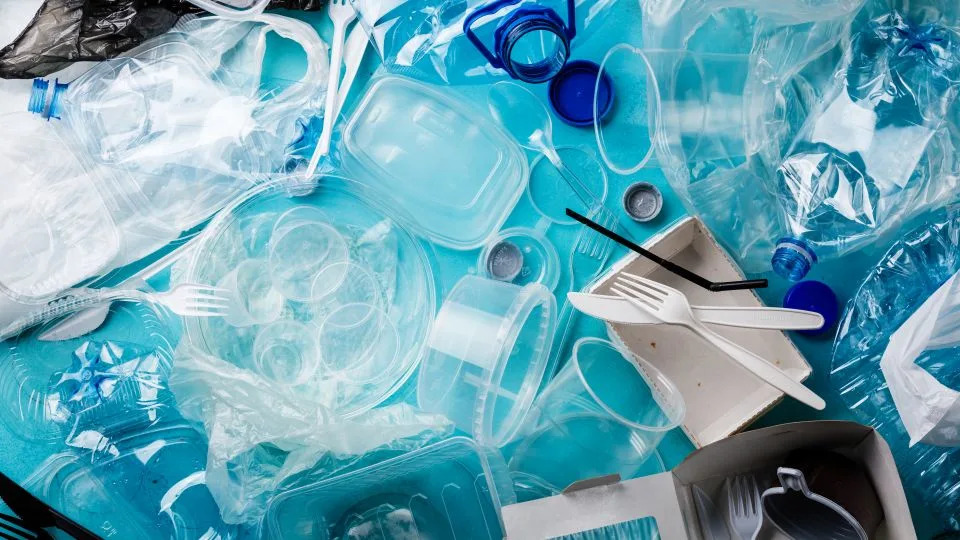
At least 16,000 plastic chemicals exist with least 4,200 of those considered to be “highly hazardous” to human health and the environment, a study found. – Lisovskaya/iStockphoto/Getty Images
Ways to reduce plastic
The levels of contamination found in bottled water reinforce long-held expert advice to drink tap water from glass or stainless steel containers to reduce exposure, Mason said. That advice extends to other foods and drinks packaged in plastic as well, she added.
“People don’t think of plastics as shedding but they do,” she said. “In almost the samewaywe’re constantly shedding skin cells, plastics are constantly shedding little bits that break off, such as when you open that plastic container for your store-bought salad or a cheese that’s wrapped in plastic.”
While science learns more about the plastics we consume, there are things people can do to reduce their exposure, according to experts.
· Try to avoid eating anything that has been stored in a plastic container. Look for food stored in glass, enamel or foil.
· Wear clothing made from natural fabrics and buy consumer products made from natural materials.
· Don’t microwave in plastic. Instead, heat food on the stove or by microwaving in glass.
· If you can, eat as much fresh food as possible, and limit purchase of processed and ultraprocessed foods wrapped in plastic.
Drought devastates crops in southern Africa: ‘The grain I have is only enough for the next two months’
Timothy McGill – April 27, 2024
The Africa hunger crisis, exacerbated by a climate change–amplified El Niño, is reaching a critical point. A recent Reuters report paints a grim picture, revealing that southern Africa is grappling with its most severe drought in several years.
What’s happening?
Earth saw a record $63 billion in damages from weather disasters in 2023. Many of those disasters were made worse by El Niño. Reuters cited a study from October last year that “even suggested that climate change may now be as significant a factor in triggering El Niño conditions as natural causes like sun rays.” An El Niño is an unusual warming of the eastern Pacific Ocean along and near the equator.
This year’s extreme drought has devastated crops, and now millions are hungry in southern Africa. World Vision calls it a “severe food crisis” that is “driving millions of people into a heightened risk of hunger and starvation.”
The peak of farming season in southern Africa is from October to March. Several weather disasters have struck the region since the end of 2023’s season. Tropical storm Freddy destroyed homes in Blantyre, the capital of Malawi, on March 14, 2023. This March, tropical storm Filipo brought devastating floods to Maputo, the capital of Mozambique.
Drought is impacting this part of the world, with increasing global temperatures exacerbating the problem. The lack of rainfall has decimated maize crops in southern Africa. An estimated 24 million people are impacted by hunger and malnutrition. The soil is normally suitable for maize farming.
Seventy percent of southern Africa’s maize comes from South Africa. The ongoing drought has led to a 15% drop in the country’s maize production for 2023-24 compared to 2022-23.
“The grain I have is only enough for the next two months. It is going to be hunger from here on,” farmer Mandisireyi Mbirinyu told Reuters.
What is being done?
African countries have been forced to come up with innovative ways to deal with drought. Some of these approaches include reusing rainwater, preserving humidity in fields, and promoting effective and inclusive consultation. The United Nations Sustainable Development Group suggests several ways that communities can end desertification, including “combatting soil erosion and restoring coastal ecosystems, leveraging innovation, technology, partnerships and private finance, and supporting the livelihoods of people displaced by drought.”
In Ukraine’s old imperial city, pastel palaces are in jeopardy, but black humor survives
Laura King – April 21, 2024
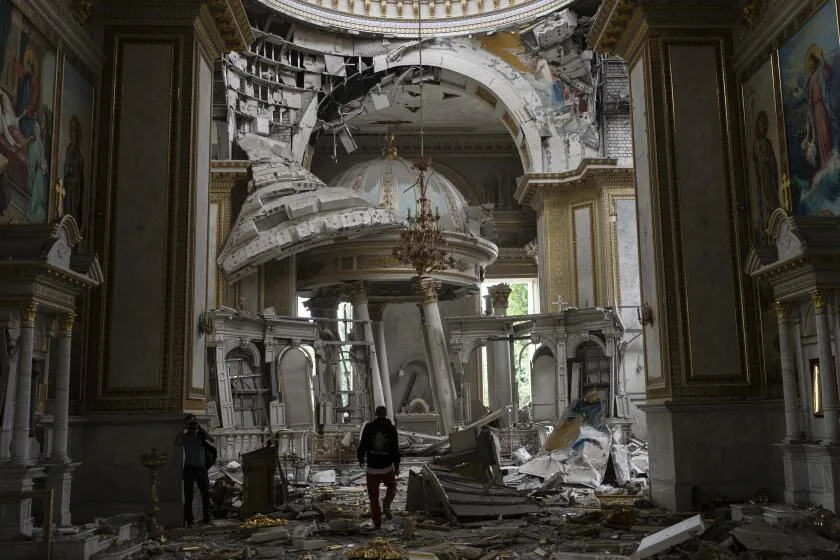
Church personnel inspect damage from Russian missile attacks at the Transfiguration Cathedral in Odesa, Ukraine. The cathedral is in the historic city center, a UNESCO-designated site. (Jae C. Hong / Associated Press)
On a cool spring morning, as water-washed light bathed pastel palaces in the old imperial city of Odesa, the thunder of yet another Russian missile strike filled the air.
That March 6 blast came within a few hundred yards of a convoy carrying Ukraine’s president, Volodymyr Zelensky, who was touring the country’s principal shipyard with the visiting Greek prime minister, Kyriakos Mitsotaki.
It was a close call, but Ukrainian officials said that in all likelihood the two leaders were not the target. Like so many other strikes during what Ukrainians call the “big war” — ignited by Russia’s all-out invasion in February 2022 — the attack was aimed at Odesa’s port, a strategic prize of centuries’ standing.
The Black Sea harbor and its docklands — Ukraine’s commercial lifeline and a prime military asset — have been the object of intensifying Russian drone and missile attacks in recent weeks, as Ukraine’s dwindling air defenses leave critical infrastructure vulnerable across the country.
Ukrainian President Volodymyr Zelensky, center left, and Greek Prime Minister Kyriakos Mitsotakis, center right, walk in Odesa, Ukraine, on March 6. The sound of a Russian airstrike a few hundred yards away reverberated around the port city as they ended their tour. (Ukrainian Presidential Press Office via AP)
In Odesa, the deadly campaign of airstrikes has brought sharply renewed peril to nearly a million inhabitants of one of Ukraine’s most eclectic and cosmopolitan cities, known in equal measures for its people’s mordancy and joie de vivre. And it poses a heightened threat to a world-renowned cultural treasure: the jewel-box grid of streets making up Odesa’s UNESCO-designated historic center, which abuts the port.
After a string of attacks on Odesa and its environs, those who watch over the city’s landmark structures are braced for the worst. On many ornate facades in the city center, full-length windows topped with curlicued pediments are boarded over. Inside, as periodic power cuts permit, workers sweep up shattered masonry and painstakingly restore ruined grand staircases.
“It’s very, very difficult work to safeguard these beautiful old buildings,” said Oleksei Duryagin, who heads a firefighting team that works out of a headquarters dating back to the city’s days of horse-drawn fire wagons. “Whenever they try to hit the port, which is what they try to hit, everything here is in danger.”
Because of the building materials used — wood, flammable insulation within the walls — the 19th century buildings that line Odesa’s cobblestone, tree-lined central streets are especially susceptible to fire or collapse. First responders undergo special training in how to fight blazes in structures like Odesa’s sumptuous opera house, perched on a promontory above the seafront.
“From basement to ceiling, I know these buildings like my old friends,” said Duryagin, 52, who has more than three decades of firefighting experience. “I know their mysteries.”
Falling debris from airborne interceptions, rather than direct drone or missile strikes, has caused some of the most serious destruction. Some sites, like the city’s Fine Arts Museum, which is housed in a reconstructed palace, were hit again before they could be cleaned up after an initial attack.
The windows on Odesa’s Museum of Western and Eastern Art are boarded up as Russian forces continue to target the port city. (Laura King / Los Angeles Times)
Early in the war, the museum whisked most of its art treasures into hiding. Some display areas are closed off for repairs, and big niches that once held priceless artworks are starkly blank. But the museum remains open to culture-hungry visitors, who must periodically be hustled into its underground shelter when air alerts sound.
Most of the exhibits now have a somber martial theme, including a striking collection of botanical watercolors by a 48-year-old Ukrainian army captain, Borys Eisenberg, an artist and landscape architect who volunteered on the first day of Russia’s invasion and was killed last year on the front lines. His delicate, violet-veined works on paper are mounted on the wooden lids of ammunition boxes.
“You can see that even looking out from the trenches, he found beauty,” said Irina Kulabina, 66, a retired engineer who helps out at the museum. “It’s really important. We should believe in life more than death.”
At Odesa’s Transfiguration Cathedral, the city’s largest Orthodox Christian church, a young priest named Father Alexei gazed out at blue sky through a gaping hole punched in an outer wall during a missile attack last July. He wondered aloud if fresh attacks would outpace rebuilding.
The blackened interior of the Transfiguration Cathedral in Odesa. (Laura King / Los Angeles Times)
“We just don’t know what else is to come,” said the 28-year-old cleric, who came to Odesa as a refugee from a front-line town in the eastern province of Luhansk.
While repairs slowly progress, services are held in a cavernous, basement-level secondary space, lighted only by flickering candles and lanterns whenever the electricity goes out. After the July strike, congregants converged on the landmark church, helping to gather artifacts scattered by the blast.
“It was really shocking for everyone,” said Father Alexei. Zelensky said at the time that hitting the cathedral amounted to targeting “the foundations of our entire European culture.”
Last month was a particularly deadly one for the city and its outskirts.
A March 2 drone attack wrecked a nine-story building, killing a dozen people. Five more perished in the strike four days later that narrowly missed Zelensky and the Greek leader. A missile and drone barrage on March 15 left 21 dead, including a paramedic killed in a dreaded “double tap,” in which first responders are targeted, seemingly deliberately, by strikes aimed at the same site a few moments apart to give rescuers time to arrive.
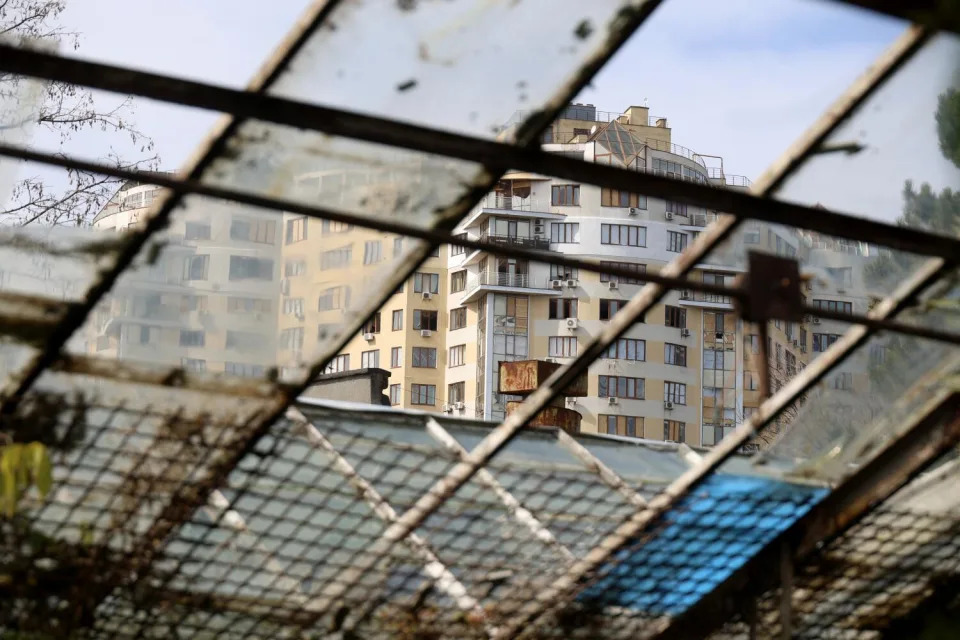
The roof of a greenhouse damaged by a Russian missile attack in the botanical garden of Odesa I.I. Mechnikov National University. (Future Publishing via Getty Images)
More recently, on April 10, six people, including a 10-year-old girl, were killed in a strike on an outlying district of Odesa. That attack came on the 80th anniversary of Odesa’s liberation from Nazi forces during World War II.
At the war’s outset, world grain prices jumped as Ukraine exports slumped, causing hardship in some of the world’s most impoverished countries. Now, though, almost 40 million tons of cargo have been shipped since August 2023, port officials said.
“Sometimes we spend all night in a shelter, then take a coffee and go straight to work — this is our reality,” said Dmytro Barinov, the deputy head of the state-owned Ukrainian Sea Ports Authority. “We feel responsibility not only for the Ukraine economy, to our farmers, but to the whole world that relies on our grain exports.”
As attacks continue and the overall war outlook grows grimmer, the city veers between a sense of relative safety and an acute awareness of peril.
Central cafes are full, and people linger at ice cream stands on the promenade. In flat green fields less than half an hour to the east, though, crews scatter pyramid-shaped reinforced cement antitank obstacles known as “dragon’s teeth.”
An ice cream stand on the promenade near the Potemkin Stairs, Odesa’s most famous landmark. Disused “tank traps” on the corner of a main boulevard in Odesa’s center. Laura King / Los Angeles Times
Odessa’s most famous landmark, the Potemkin Stairs — best known for the harrowing tumbling-baby-carriage scene in the 1925 film “Battleship Potemkin” — are topped with a roll of barbed wire. But a military checkpoint a few blocks away has been removed, and pedestrians can draw close enough to gaze down the 192 steps leading to the seafront.
The source of the city’s splendor is now the principal cause of its jeopardy. Odesa’s free port status financed its extraordinary architectural flowering in the 1800s and helped build its vibrant multiethnic society.
Russian warships have been driven back from Ukraine’s Black Sea coast — “when the big war started, we could see them from our palaces,” said naval spokesman Dytro Pletenchuk — but only 150 nautical miles to the east-southeast lies the Russian-occupied Crimean peninsula, from which many strikes are launched.
At that range, there is little time for people in Odesa to get to shelter once missiles are in the air.
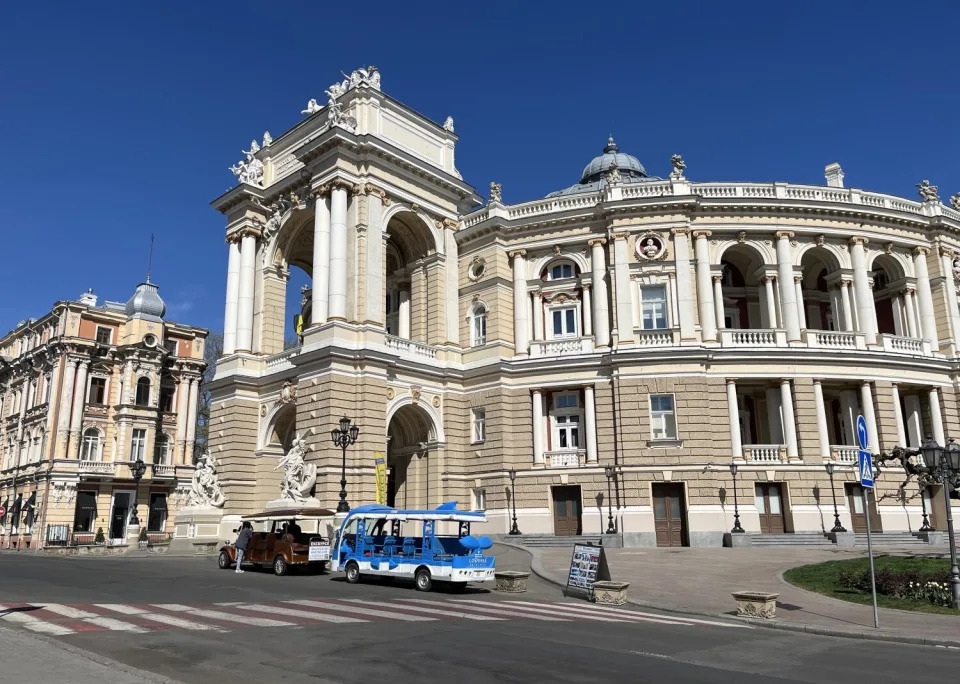
At the National Academic Opera and Ballet Theater — where April offerings include the ballet “Giselle” and Verdi’s opera “Nabucco” — the show goes on, as it has almost continuously since the start of the conflict. The neo-Baroque opera house is no longer sandbagged, but the war still feels ever present.
Odesa’s opera house, formerly protected with sandbags. Performances and rehearsals are often interrupted by air alerts. (Laura King / Los Angeles Times)
“After night bombings come the most difficult days: Actors, singers and dancers are just physically tired, and it’s hard to deliver the emotional spectrum in their performances,” said Oksana Ternenko, 50, a stage director.
“Sometimes it’s like a theater of the absurd,” she said. “We are starting to rehearse, and a singer is showing photos on the phone: ‘Look, here’s a piece of my house that fell on my car.’ ”
Despite all, Odesa maintains an irrepressible offbeat humor.
A man dances during the Festival of Humor, which has been taking place in Odesa on and around April Fools’ Day since 1973. (Nina Liashonok / Getty Images)
“My parents and I, we’re very happy that Granny is deaf, so the explosions don’t scare her,” said 14-year-old Alina Kulik, who lives in an outlying district that has been hit repeatedly.
“Right now, we’re in a place that’s a little dangerous,” said her 15-year-old friend Anastasia Jelonkina, as the two girls perched on a promenade bench overlooking the seaport. “We know that. But here we are!”
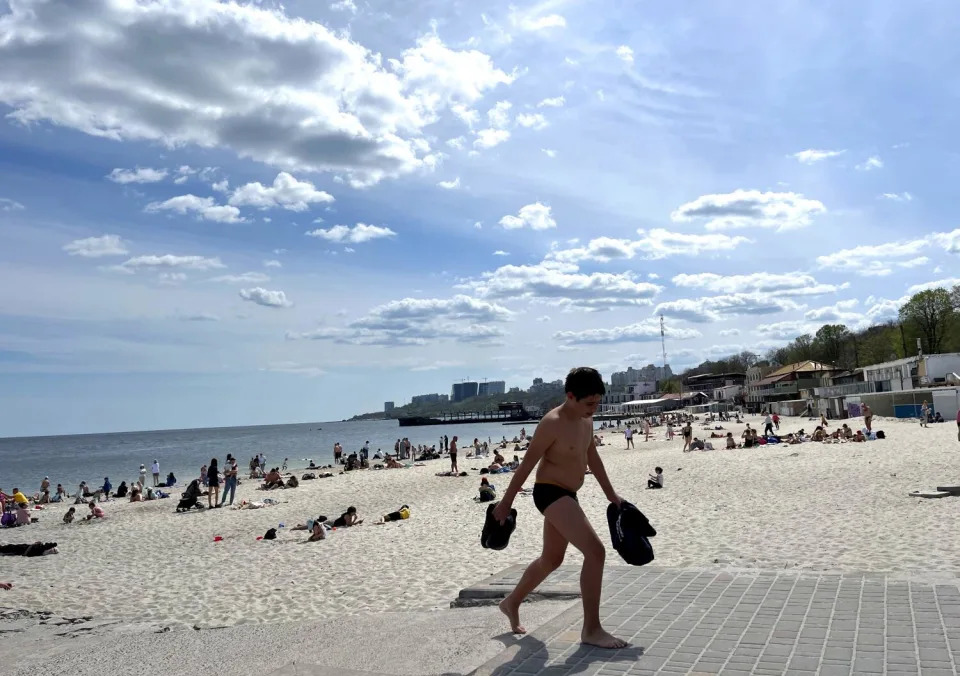
Odesa’s beaches, beloved by tourists before the war and by locals all along, are full again as spring temperatures rise. During much of the last two years, danger from mines and debris from destruction of a massive dam on the Dnipro River kept the shoreline largely closed.
Sunbathers flock to an Odesa city beach. De-mining efforts allowed the reopening of the seashore. (Laura King / Los Angeles Times)
But intensive de-mining efforts have rendered the sea off Odesa relatively safe for swimming again, and a tousle-haired Irina Khosovana, a 62-year-old doctor who is a fifth-generation Odesan, said nothing — not even periodic air alerts — could keep her away.
“The sea is our comfort,” she said, gesturing toward the blue expanse. “Coming here is as important as life.”
A largely Russian-speaking city at the start of the war, Odesa still has deep cultural roots in common with the enemy now battering its shores. The poet Pushkin is still revered, with a grand boulevard named for him and a big statue taking pride of place in front of the city council building.
But another prominent piece of statuary near the opera house was deemed a symbol of colonialist oppression — that of the Russian empress known as Catherine the Great. Her likeness, hauled down in the war’s first year, is now boxed up in a black lean-to outside the damaged art museum.
Atop the empty plinth where the statue once stood flies a blue-and-yellow Ukrainian flag.
Climate impacts set to cut 2050 global GDP by nearly a fifth
Marlowe Hood – April 17, 2024
A new study shows that climate change will cause massive economic damage within the next 25 years (Frederic J. BROWN)
Climate change caused by CO2 emissions already in the atmosphere will shrink global GDP in 2050 by about $38 trillion, or almost a fifth, no matter how aggressively humanity cuts carbon pollution, researchers said Wednesday.
But slashing greenhouse gas emissions as quickly as possible remains crucial to avoid even more devastating economic impacts after mid-century, they reported in the journal Nature.
Economic fallout from climate change, the study shows, could increase tens of trillions of dollars per year by 2100 if the planet were to warm significantly beyond two degrees Celsius above mid-19th century levels.
Earth’s average surface temperature has already climbed 1.2C above that benchmark, enough to amplify heatwaves, droughts, flooding and tropical storms made more destructive by rising seas.
Annual investment needed to cap global warming below 2C — the cornerstone goal of the 2015 Paris Agreement — is a small fraction of the damages that would be avoided, the researchers found.
Staying under the 2C threshold “could limit average regional income loss to 20 percent compared to 60 percent” in a high-emissions scenario, lead author Max Kotz, an expert in complexity science at the Potsdam Institute for Climate Impact Research (PIK), told AFP.
Economists disagree on how much should be spent to avoid climate damages. Some call for massive investment now, while others argue it would be more cost-effective to wait until societies are richer and technology more advanced.
– Poor countries hit hardest –
The new research sidesteps this debate, but its eye-watering estimate of economic impacts helps make the case for ambitious near-term action, the authors and other experts said.
“Our calculations are super relevant” to such cost-benefit analyses, said co-author Leonie Wenz, also a researcher at PIK.
They could also inform government strategies for adapting to climate impacts, risk assessments for business, and UN-led negotiations over compensation for developing nations that have barely contributed to global warming, she told AFP.
Mostly tropical nations — many with economies already shrinking due to climate damages — will be hit hardest, the study found.
“Countries least responsible for climate change are predicted to suffer income loss that is 60 percent greater than the higher-income countries and 40 percent greater than higher-emission countries,” said senior PIK scientist Anders Levermann.
“They are also the ones with the least resources to adapt to its impacts.”
Rich countries will not be spared either: Germany and the United States are forecast to see income shrivel by 11 percent by 2050, and France by 13 percent.
Projections are based on four decades of economic and climate data from 1,600 regions rather than country-level statistics, making it possible to include damages earlier studies ignored, such as extreme rainfall.
– A likely underestimate –
The researchers also looked at temperature fluctuations within each year rather than just averages, as well as the economic impact of extreme weather events beyond the year in which they occurred.
“By accounting for these additional climate variables, the damages are about 50 percent larger than if we were to only include changes in annual average temperatures,” the basis of most prior estimates, said Wenz.
Wenz and her colleagues found that unavoidable damage would slash the global economy’s GPD by 17 percent in 2050, compared to a scenario with no additional climate impacts after 2020.
Even so, the new calculations may be conservative.
“They are likely to be an underestimate of the costs of climate change impacts,” Bob Ward, policy director of the Grantham Research Institute on Climate Change and the Environment in London, commented to AFP ahead of the study’s publication.
Damages linked to sea-level rise, stronger tropical cyclones, the destabilisation of ice sheets and the decline of major tropical forests are all excluded, he noted.
Climate economist Gernot Wagner, a professor at Columbia Business School in New York who was also not involved in the study, said the conclusion that “trillions in damages are all locked in doesn’t mean that cutting carbon pollution doesn’t pay.”
In fact, he said, it shows that “the costs of acting are a fraction of the costs of unmitigated climate change”.
Global GDP in 2022 was just over $100 trillion, according to the World Bank. The study projects that — absent climate impacts after 2020 — it would be double that in 2050.
Climate change damage could cost $38 trillion per year by 2050, study finds
Riham Alkousaa – April 17, 2024
FILE PHOTO: French lake dries up due to winter drought, threatening farming and tourism
BERLIN (Reuters) – Damage to farming, infrastructure, productivity, and health from climate change will cost an estimated $38 trillion per year by 2050, German government-backed research finds, a figure almost certain to rise as human activity emits more greenhouse gases.
The economic impact of climate change is not fully understood, and economists often disagree on its extent.
Wednesday’s study from the Potsdam Institute for Climate Impact Research (PIK), which is backed by the German government, stands out for the severity of its findings.
It calculates climate change will shave 17% off the global economy’s GDP by the middle of the century.
“The world population is poorer than it would be without climate change,” Potsdam climate data researcher Leonie Wenz, a co-author on the study, said. “It costs us much less to protect the climate than not to.”
At an estimated $6 trillion, the cost of measures to limit global warming to within 2 degrees Celsius (3.6F) of pre-industrial temperatures by 2050 would be less than a sixth of the cost of the estimated damage caused by allowing warming to exceed that level, the report said.
While previous studies have concluded climate change could benefit some countries’ economies, PIK’s research found almost all would suffer – with poor, developing nations the hardest hit.
Its estimation of damage is based on projected temperature and rainfall trends, but does not take into account extreme weather or other climate-related disasters such as forest fires or rising sea levels.
It is also only based on emissions already released, even though global emissions continue to rise at record levels.
As well as spending too little to curb climate-warming emissions, governments are also under-spending on measures to adapt to the impact of climate change.
For the study, the researchers looked at temperature data and rainfall for more than 1,600 regions over the last 40 years, and considered which of these events were costly.
They then used that damage assessment, along with climate model projections, to estimate future damage.
If emissions continue at today’s rate – and the average global temperature climbs beyond 4C – the estimated economic toll after 2050 amounts to a 60% income loss by 2100, the findings suggest. Limiting the rise in temperatures to 2C would contain those losses at an average of 20%.
(Reporting by Riham Alkousaa, Editing by Rachel More, Katy Daigle and Barbara Lewis)
New study calculates climate change’s economic bite will hit about $38 trillion a year by 2049
Seth Borenstein – April 17, 2024
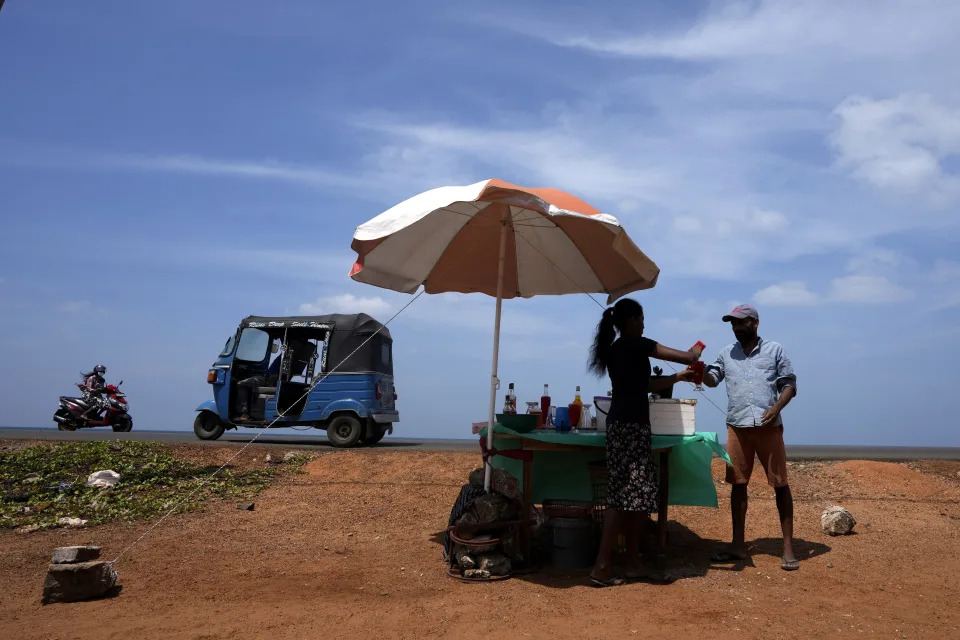
People watch the sunset at a park on an unseasonably warm day, Feb. 25, 2024, in Kansas City, Mo. A new study says climate change will reduce future global income by about 19% in the next 25 years compared to a fictional world that’s not warming. (AP Photo/Charlie Riedel, File)A man buys a cool drink from a roadside vendor on a sunny day in Mahawewa, a village north of Colombo, Sri Lanka, Feb. 29, 2024. A new study says climate change will reduce future global income by about 19% in the next 25 years compared to a fictional world that’s not warming. (AP Photo/Eranga Jayawardena, File)
Climate change will reduce future global income by about 19% in the next 25 years compared to a fictional world that’s not warming, with the poorest areas and those least responsible for heating the atmosphere taking the biggest monetary hit, a new study said.
Climate change’s economic bite in how much people make is already locked in at about $38 trillion a year by 2049, according to Wednesday’s study in the journal Nature by researchers at Germany’s Potsdam Institute for Climate Impact Research. By 2100 the financial cost could hit twice what previous studies estimate.
“Our analysis shows that climate change will cause massive economic damages within the next 25 years in almost all countries around the world, also in highly-developed ones such as Germany and the U.S., with a projected median income reduction of 11% each and France with 13%,” said study co-author Leonie Wenz, a climate scientist and economist.
These damages are compared to a baseline of no climate change and are then applied against overall expected global growth in gross domestic product, said study lead author Max Kotz, a climate scientist. So while it’s 19% globally less than it could have been with no climate change, in most places, income will still grow, just not as much because of warmer temperatures.
For the past dozen years, scientists and others have been focusing on extreme weather such as heat waves, floods, droughts, storms as the having the biggest climate impact. But when it comes to financial hit the researchers found “the overall impacts are still mainly driven by average warming, overall temperature increases,” Kotz said. It harms crops and hinders labor production, he said.
In the United States, the southeastern and southwestern states get economically pinched more than the northern ones with parts of Arizona and New Mexico taking the biggest monetary hit, according to the study. In Europe, southern regions, including parts of Spain and Italy, get hit harder than places like Denmark or northern Germany.
Only Arctic adjacent areas — Canada, Russia, Norway, Finland and Sweden — benefit, Kotz said.
It also means countries which have historically produced fewer greenhouse gas emissions per person and are least able to financially adapt to warming weather are getting the biggest financial harms too, Kotz said.
The world’s poorest countries will suffer 61% bigger income loss than the richest ones, the study calculated.
“It underlies some of the injustice elements of climate,” Kotz said.
This new study looked deeper than past research, examining 1,600 global areas that are smaller than countries, took several climate factors into account and examined how long climate economic shocks last, Kotz said. The study examined past economic impacts on average global domestic product per person and uses computer simulations to look into the future to come up with their detailed calculations.
The study shows that the economic harms over the next 25 years are locked in with emission cuts producing only small changes in the income reduction. But in the second half of this century that’s when two different possible futures are simulated, showing that cutting carbon emissions now really pays off because of how the heat-trapping gases accumulate, Kotz said.
If the world could curb carbon pollution and get down to a trend that limits warming to 2 degrees Celsius (3.6 degrees Fahrenheit) above pre-industrial times, which is the upper limit of the 2015 Paris climate agreement, then the financial hit will stay around 20% in global income, Kotz said. But if emissions increase in a worst case scenario, the financial wallop will be closer to 60%, he said.
That shows that the public shouldn’t think it’s a financial “doomsday” and nothing can be done, Kotz said.
Still, it’s worse than a 2015 study that predicted a worst case income hit of about 25% by the end of the century.
Marshall Burke, the Stanford University climate economist who wrote the 2015 study, said this new research’s finding that the economic damage ahead is locked in and large “makes a lot of sense.”
Burke, who wasn’t part of this study, said he has some issues with some of the technical calculations “so I wouldn’t put a ton of weight on their specific numerical estimates, but I think the big picture is basically right.”
The conclusions are on the high end compared to other recent studies, but since climate change goes for a long time and economic damage from higher temperatures keep compounding, they “add up to very large numbers,” said University of California Davis economist and environmental studies professor Frances Moore, who wasn’t part of the study. That’s why fighting climate change clearly passes economists’ tests of costs versus benefits, she said.