Sheinbaum Makes History as First Woman Elected to Lead Mexico
Natalie Kitroeff – June 3, 2024
A young girl with the name of Claudia Sheinbaum, a climate scientist and former mayor of Mexico City, on her face attends Sheinbuam’s election night event in Mexico City, on Sunday, June 2, 2024. (Fred Ramos/The New York Times)
MEXICO CITY — Claudia Sheinbaum, a climate scientist and former mayor of Mexico City, won her nation’s elections Sunday in a landslide victory that brought a double milestone: She became the first woman, and the first Jewish person, to be elected president of Mexico.
Early results indicated that Sheinbaum, 61, prevailed in what the authorities called the largest election in Mexico’s history, with the highest number of voters taking part and the most seats up for grabs.
It was a landmark vote that saw not one, but two, women vying to lead one of the hemisphere’s biggest nations. And it will put a Jewish leader at the helm of one of the world’s largest predominantly Catholic countries.
Sheinbaum, a leftist, campaigned on a vow to continue the legacy of Mexico’s current president and her mentor, Andrés Manuel López Obrador, which delighted their party’s base — and raised alarm among detractors. The election was seen by many as a referendum on his leadership, and her victory was a clear vote of confidence in López Obrador and the party he started.
López Obrador has completely reshaped Mexican politics. During his tenure, millions of Mexicans were lifted out of poverty and the minimum wage doubled. But he has also been a deeply polarizing president, criticized for failing to control rampant cartel violence, for hobbling the nation’s health system and for persistently undercutting democratic institutions.
Still, López Obrador remains widely popular and his enduring appeal propelled his chosen successor. And for all the challenges facing the country, the opposition was unable to persuade Mexicans that their candidate was a better option.
“We love her, we want her to work like Obrador,” Gloria Maria Rodríguez, 78, from Tabasco, said of Sheinbaum. “We want a president like Obrador.”
Sheinbaum won with at least 58% of the vote, according to preliminary results, while her closest competitor, Xóchitl Gálvez, an entrepreneur and former senator on a ticket with a coalition of opposition parties, had at least 26.6%.
If early returns hold, Sheinbaum will have captured a broader share of the vote than any candidate in decades.
Speaking to supporters early Monday, Sheinbaum vowed to work on behalf of all Mexicans, reaffirmed her party’s commitment to democracy and celebrated her groundbreaking ascension to the nation’s highest office.
“For the first time in 200 years of the republic, I will become the first female president of Mexico,” she said. “And as I have said on other occasions, I do not arrive alone. We all arrived, with our heroines who gave us our homeland, with our ancestors, our mothers, our daughters and our granddaughters.”
Sheinbaum said she received calls from Gálvez and the third-place candidate, Jorge Álvarez Máynez, to congratulate her on the victory. Shortly after Sheinbaum’s speech, Gálvez told supporters that the early returns were “not favorable to my candidacy,” and “irreversible,” noting that she had just communicated with Sheinbaum.
Gálvez had said in an interview days before the vote Sunday that “an anti-system vote” against López Obrador could help propel her to victory. In reality, it appeared that many Mexicans still associate the parties backing her with a system they see as inept and corrupt.
“Xóchitl Gálvez has been unable to represent change because the parties backing her embody the establishment,” said Carlos Bravo Regidor, a political analyst based in Mexico City. “Most Mexicans want a continuity of the change brought by López Obrador.”
Many voters seemed to endorse Sheinbaum as an agent of institutionalizing the changes brought about by her mentor. “We need to bring about more change to the country,” said Evelyn Román, 21, a chemical engineering student in Mexico City who supports Sheinbaum. “We did notice the progress in these six years.”
Sheinbaum’s experience is ample: She has a doctorate in energy engineering, participated in a United Nations panel of climate scientists awarded a Nobel Peace Prize and governed the capital, one of the largest cities in the hemisphere.
Known as a demanding boss with a reserved demeanor, Sheinbaum has risen through the ranks by aligning herself completely with López Obrador, who built an entire political party around his outsize personality. During the campaign, she backed many of his most contentious policies, including a slate of constitutional changes that critics say would severely undermine democratic checks and balances.
As a result, the president-elect battled the perception among many Mexicans that she will be little more than a pawn of her mentor.
“There’s this idea, because a lot of columnists say it, that I don’t have a personality,” Sheinbaum complained to reporters earlier this year. “That President Andrés Manuel López Obrador tells me what to do, that when I get to the presidency, he’s going to be calling me on the phone every day.”
Even with the broad mandate voters granted her, she faces significant challenges when she takes office in October.
López Obrador benefited “from the invincible popularity that comes from being a very charismatic leader — something that Claudia is not,” said Paula Sofía Vásquez, a political analyst based in Mexico City.
Cartel violence continues to torment the country, displacing people en masse and fueling one of the deadliest campaign cycles in recent Mexican history, with more than 36 people vying for public office killed since last summer.
Carlos Ortiz, 57, a municipal official working for the Iztapalapa borough in Mexico City, said that such bloodshed compelled him to vote against Sheinbaum.
“I want everything to change,” Ortiz said, recalling the dozens of aspirants for public office killed in recent months. “I don’t want a country on fire anymore.”
López Obrador has directed government attention to addressing the drivers of crime instead of waging war on the criminal groups, a strategy he called “hugs not bullets.” Homicides declined modestly but remain near record levels, and reports of missing people have spiked. Insecurity was a top concern for voters.
Sheinbaum has said she would continue his focus on social causes of the violence, while also working to lower rates of impunity and building up the national guard.
On the economy, the opportunities are clear: Mexico is now the largest trading partner of the United States, benefiting from a recent shift in manufacturing away from China. The currency is so strong it’s been labeled the “super peso.”
But there are also problems simmering. The federal deficit ballooned to around 6% this year, and Pemex, the national oil company, is operating under a mountain of debt, straining public finances.
“The fiscal risk we’re facing at the moment is something we haven’t seen for decades,” said Mariana Campos, director of Mexico Evaluates, a public policy research group.
It’s unclear how Sheinbaum would make good on a range of campaign promises — from building public schools and new health clinics to expanding social welfare programs — given the current state of public finances.
“The problem I see is that a lot of proposals are oriented toward spending and there is nowhere to get the money from,” said Vásquez.
Another challenge involves the broad new responsibilities granted to the armed forces, which have been tasked with running ports and airports, running an airline, and building a railroad through the Mayan jungle. Sheinbaum has said “there is no militarization” of the country, while suggesting she’s open to reevaluating the military’s involvement in public enterprises.
Beyond the domestic strains, Sheinbaum’s destiny will be intertwined with the outcome of the presidential election in the United States.
A reelection victory for President Joe Biden would provide continuity, but a return of Donald Trump to the White House would likely be far less predictable. Trump’s plans to round up people living in the country illegally on a vast scale and deport them to their home countries could target millions of Mexicans living in the United States. He has already threatened to slap 100% tariffs on Chinese cars made in Mexico.
Then there’s the festering issue of fentanyl, which cartels produce in Mexico using chemicals imported from China, the U.S. government says. Trump has suggested taking military action to combat the fentanyl trade.
Sheinbaum has said Mexico would have “good relations” with either Trump or Biden as president, and her campaign team has said it will continue to work to contain flows of migrants.
But handling such pressure from Washington, even in the form of incendiary campaign rhetoric, could prove complicated.
Voters expressed faith in Sheinbaum’s ability to deal with such challenges. Daniela Mendoza, 40, a psychologist who lives in Villahermosa, in Tabasco state, said she had long supported López Obrador, including during his previously unsuccessful bids to win the presidency.
Pleased with his social welfare programs, Mendoza voted for Sheinbaum.
“Claudia follows that line, perhaps with better ideas,” Mendoza said. “And having the first woman president in the country is an accomplishment.”
Louisiana graduate finishes high school as valedictorian while being homeless
Ashley R. Williams, CNN – June 1, 2024
A Louisiana high school senior experiencing homelessness recently graduated at the top of his class with the highest-earned GPA.
Elijah Hogan, 19, was named valedictorian of Walter L. Cohen High School in New Orleans and graduated May 24 with a 3.93 GPA, he told CNN.
Hogan, who became homeless a year and a half ago, says he was in disbelief when he learned of his academic achievement.
“I thought they were mistaking me for someone else, but when I looked at it and I was shown evidence that it was me, I was in awe, like, I was jaw dropped,” said Hogan, who was born in New Orleans and raised mostly in Houston.
Hogan was one of four Black male students who achieved valedictorian status at their New Orleans schools this spring, CNN affiliate WDSU reported.
Hogan, who previously lived with his grandmother since he was 11, says he became homeless after the lease on his grandmother’s house expired when the homeowner decided to sell the property.
He and his grandmother were given 30 days to vacate the house, according to Hogan.
“From there, I made the executive decision to live on my own to lighten my grandmother’s burden,” Hogan told CNN.
While his grandmother went to live in a care home for the elderly, Hogan was left without permanent housing.
His grandmother told him about the Covenant House, a homeless shelter in New Orleans serving youth and young adults ages 16-22. Hogan has been living at the shelter as part of its transitional housing program since he became homeless, he said.
Elijah Hogan, center, proudly holds up his high school diploma from Walter L. Cohen High School. – Courtesy Kewe Ukpolo
The program allows young people to stay at the shelter up to 24 months rent-free, giving them an opportunity to focus on education or to save money while working, Covenant House New Orleans chief executive officer Rheneisha Robertson told CNN.
“It really allows them to get stable and identify more permanent, stable housing,” said Robertson, who added the homeless shelter had five other high school graduates this year.
Hogan, who addressed his graduating class with an uplifting valedictorian speech last week, said dealing with homelessness while completing his education was challenging but he found support from the homeless shelter’s employees and his high school’s staff.
“As time went on, I started to open up to people over at Covenant House as well as Cohen, people were there to support me and give me a guiding hand,” Hogan said. “Without them, I wouldn’t (have) become who I am today.”
He credits his Covenant House case manager, Jarkayla Cobb, with never giving up on him.
“She helped me get through it even when I was showing a lack of faith in myself,” Hogan said. “She’s been there no matter what I needed.”
Hogan, who lost his mother just before he turned 12, says her death encouraged him to push forward with his education for his grandmother’s sake.
“I know that’s what (my mother) would have wanted,” he said.
Hogan plans to attend Xavier University in New Orleans in the fall to study graphic design and has been granted a scholarship to cover his tuition fees, he says.
“Elijah’s accomplishments are worth celebrating. We know that they are a product of his character and the choices he made day after day to pursue his dreams,” Jerel Bryant, chief executive officer of Collegiate Academies, which operates Hogan’s former high school, said in a statement.
“His success is also a testament to how capable and excellent our Black youth are, in New Orleans and across this country,” Bryant said.
Hogan offered these words of encouragement for other young people:
“To any race, no matter what color or accent you have, you are your own guiding light,” Hogan said. “You are your own storybook that you write. Let yourself be the pen that you write on paper.”
Honorary degree recipient Ken Burns delivers the Undergraduate Commencement speech at Brandeis University’s 73rd Commencement Exercises on May 19, 2024.
Transcript
Brandeisian, love it.
President Liebowitz, Ron, Chair Lisa Kranc, and other members of the board of trustees, Provost Carol Fierke, fellow honorees, distinguished faculty and staff, proud and relieved parents, calm and serene grandparents, distracted but secretly pleased siblings, ladies and gentlemen, graduating students of the class of 2024, good morning.
I am deeply honored and privileged that you have asked me here to say a few words at such a momentous occasion that you might find what I have to say worthy of your attention on so important a day in all of your lives. Thank you for this honor.
Listen, I am in the business of history. It is not always a happy subject on college campuses these days, particularly when forces seem determined to eliminate or water down difficult parts of our past, particularly when the subject may seem to sum an anachronistic and irrelevant pursuit, and particularly with the ferocious urgency this moment seems to exert on us. It is my job, however, to remind people of the power our past also exerts, to help us better understand what’s going on now with compelling story, memory, and anecdote. It is my job to try to discern patterns and themes from history to enable us to interpret our dizzying and sometimes dismaying present.
For nearly 50 years now, I have diligently practiced and rigorously tried to maintain a conscious neutrality in my work, avoiding advocacy if I could, trying to speak to all of my fellow citizens. Over those many decades I’ve come to understand a significant fact, that we are not condemned to repeat, as the saying goes, what we don’t remember. That is a beautiful, even poetic phrase, but not true. Nor are there cycles of history as the academic community periodically promotes. The Old Testament, Ecclesiastes to be specific, got it right, I think. What has been will be again, what has been done will be done again. There is nothing new under the sun. What those lines suggest is that human nature never changes or almost never changes. We continually superimpose that complex and contradictory human nature over the seemingly random chaos of events, all of our inherent strengths and weaknesses, our greed and generosity, our puritanism and our prurience, our virtue, and our venality parade before our eyes, generation after generation after generation. This often gives us the impression that history repeats itself. It does not. “No event has ever happened twice, it just rhymes,” Mark Twain is supposed to have said. I have spent all of my professional life on the lookout for those rhymes, drawn inexorably to that power of history. I am interested in listening to the many varied voices of a true, honest, complicated past that is unafraid of controversy and tragedy, but equally drawn to those stories and moments that suggest an abiding faith in the human spirit, and particularly the unique role this remarkable and sometimes also dysfunctional republic seems to play in the positive progress of mankind.
During the course of my work, I have become acquainted with hundreds if not thousands of those voices. They have inspired, haunted, and followed me over the years. Some of them may be helpful to you as you try to imagine and make sense of the trajectory of your lives today.
Listen, listen. In January of 1838, shortly before his 29th birthday, a tall, thin lawyer prone to bouts of debilitating depression addressed the young men’s lyceum in Springfield, Illinois. “At what point shall we expect the approach of danger?” He asked his audience, “Shall we expect some trans-Atlantic military giant to step the earth and crush us at a blow?” Then he answered his own question. “Never. All the armies of Europe, Asia, and Africa could not by force take a drink from the Ohio River or make a track on the Blue Ridge in a trial of a thousand years. If destruction be our lot, we must ourselves be its author and finisher. As a nation of free men, we must live through all time or die by suicide.” It is a stunning, remarkable statement, one that has animated my own understanding of the American experience since I first read it more than 40 years ago. That young man was of course Abraham Lincoln, and he would go on to preside over the closest this country has ever come to near national suicide, our civil war, and yet embedded in his extraordinary, disturbing, and prescient words is also a fundamental optimism that implicitly acknowledges the geographical forcefield two mighty oceans east and west and two relatively benign neighbors north and south have provided for us since the British burned the White House in the War of 1812 and inspired Francis Scott Key.
Lincoln’s words that day suggest what is so great and so good about the people who happen to inhabit this lucky and exquisite country of ours. That’s the world you now inherit: our work ethic and our restlessness, our innovation and our improvisation, our communities and our institutions of higher learning, our suspicion of power. The fact that we seem resolutely dedicated to parsing the meaning between individual and collective freedom; What I want versus what we need. That we are all so dedicated to understanding what Thomas Jefferson really meant when he wrote that mysterious phrase, “The pursuit of happiness”. Hint, it happens right here in the lifelong learning and perpetual improvement this university is committed to.
But the isolation of those two oceans has also helped to incubate habits and patterns less beneficial to us: our devotion to money and guns and conspiracies, our certainty about everything, our stubborn insistence on our own exceptionalism blinding us to that which needs repair, especially with regard to race and ethnicity. Our preoccupation with always making the other wrong at an individual as well as a global level. I am reminded of what the journalist I.F. Stone once said to a young acolyte who was profoundly disappointed in his mentor’s admiration for Thomas Jefferson. “It’s because history is tragedy,” Stone admonished him, “Not melodrama.” It’s the perfect response. In melodrama all villains are perfectly villainous and all heroes are perfectly virtuous, but life is not like that. You know that in your guts and nor is our history like that. The novelist, Richard Powers recently wrote that, “The best arguments in the world,” — and ladies and gentlemen, that’s all we do is argue — “the best arguments in the world,” he said, “Won’t change a single person’s point of view. The only thing that can do that is a good story.” I’ve been struggling for most of my life to do that, to try to tell good, complex, sometimes contradictory stories, appreciating nuance and subtlety and undertow, sharing the confusion and consternation of unreconciled opposites.
But it’s clear as individuals and as a nation we are dialectically preoccupied. Everything is either right or wrong, red state or blue state, young or old, gay or straight, rich or poor, Palestinian or Israeli, my way or the highway. Everywhere we are trapped by these old, tired, binary reactions, assumptions, and certainties. For filmmakers and faculty, students and citizens, that preoccupation is imprisoning. Still, we know and we hear and we express only arguments, and by so doing, we forget the inconvenient complexities of history and of human nature. That, for example, three great religions, their believers, all children of Abraham, each professing at the heart of their teaching, a respect for all human life, each with a central connection to and legitimate claim to the same holy ground, violate their own dictates of conduct and make this perpetually contested land a shameful graveyard. God does not distinguish between the dead. “Could you?”
[Audience applauding]
“Could you?” A very wise person I know with years of experience with the Middle East recently challenged me, “Could you hold the idea that there could be two wrongs and two rights?”
Listen, listen. In a filmed interview I conducted with the writer James Baldwin, more than 40 years ago, he said, “No one was ever born who agreed to be a slave, who accepted it. That is, slavery is a condition imposed from without. Of course, the moment I say that,” Baldwin continued, “I realize that multitudes and multitudes of people for various reasons of their own enslave themselves every hour of every day to this or that doctrine, this or that delusion of safety, this or that lie. Anti-Semites, for example,” he went on, “are slaves to a delusion. People who hate Negroes are slaves. People who love money are slaves. We are living in a universe really of willing slaves, which makes the concept of liberty and the concept of freedom so dangerous,” he finished. Baldwin is making a profoundly psychological and even spiritual statement, not just a political or racial or social one. He knew, just as Lincoln knew, that the enemy is often us. We continue to shackle ourselves with chains we mistakenly think is freedom.
Another voice, Mercy Otis Warren, a philosopher and historian during our revolution put it this way, “The study of the human character at once opens a beautiful and a deformed picture of the soul. We there find a noble principle implanted in the nature of people, but when the checks of conscience are thrown aside, humanity is obscured.” I have had the privilege for nearly half a century of making films about the US, but I have also made films about us. That is to say the two letter, lowercase, plural pronoun. All of the intimacy of “us” and also “we” and “our” and all of the majesty, complexity, contradiction, and even controversy of the US. And if I have learned anything over those years, it’s that there’s only us. There is no them. And whenever someone suggests to you, whomever it may be in your life that there’s a them, run away. Othering is the simplistic binary way to make and identify enemies, but it is also the surest way to your own self imprisonment, which brings me to a moment I’ve dreaded and forces me to suspend my longstanding attempt at neutrality.
There is no real choice this November. There is only the perpetuation, however flawed and feeble you might perceive it, of our fragile 249-year-old experiment or the entropy that will engulf and destroy us if we take the other route. When, as Mercy Otis Warren would say, “The checks of conscience are thrown aside and a deformed picture of the soul is revealed.” The presumptive Republican nominee is the opioid of all opioids, an easy cure for what some believe is the solution to our myriad pains and problems. When in fact with him, you end up re-enslaved with an even bigger problem, a worse affliction and addiction, “a bigger delusion”, James Baldwin would say, the author and finisher of our national existence, our national suicide as Mr. Lincoln prophesies. Do not be seduced by easy equalization. There is nothing equal about this equation. We are at an existential crossroads in our political and civic lives. This is a choice that could not be clearer.
[Audience applauding]
Listen, listen. 33 years ago, the world lost a towering literary figure. The novelist and storyteller, not arguer, Isaac Bashevis Singer. For decades he wrote about God and myth and punishment, fate and sexuality, family and history. He wrote in Yiddish a marvelously expressive language, sad and happy all at the same time. Sometimes maddeningly all knowing, yet resigned to God’s seemingly capricious will. It is also a language without a country, a dying language in a world more interested in the extermination or isolation of its long suffering speakers. Singer, writing in the pages of the Jewish Daily Forward help to keep Yiddish alive. Now our own wonderfully mongrel American language is punctuated with dozens of Yiddish words and phrases, parables and wise sayings, and so many of those words are perfect onomatopoeias of disgust and despair, hubris and humor. If you’ve ever met a schmuck, you know what I’m talking about. [audience laughs] Toward the end of his long and prolific life, Singer expressed wonder at why so many of his books written in this obscure and some said useless language would be so widely translated, something like 56 countries all around the world. “Why,” he would wonder with his characteristic playfulness, “Why would the Japanese care about his simple stories of life in the shtetls of Eastern Europe 1,000 years ago?” “Unless,” Singer paused, twinkle in his eye, “Unless the story spoke of the kinship of the soul.” I think what Singer was talking about was that indefinable something that connects all of us together, that which we all share as part of organic life on this planet, the kinship of the soul. I love that.
Okay, let me speak directly to the graduating class. Watch out, here comes the advice. Listen. Be curious, not cool. Insecurity makes liars of us all. Remember, none of us get out of here alive. The inevitable vicissitudes of life, no matter how well gated our communities, will visit us all. Grief is a part of life, and if you explore its painful precincts, it will make you stronger. Do good things, help others. Leadership is humility and generosity squared. Remember the opposite of faith is not doubt. Doubt is central to faith. The opposite of faith is certainty. The kinship of the soul begins with your own at times withering self-examination. Try to change that unchangeable human nature of Ecclesiastes, but start with you. “Nothing so needs reforming,” Mark Twain once chided us, “As other people’s habits.” [audience laughs]
Don’t confuse success with excellence. Do not descend too deeply into specialism. Educate all of your parts, you will be healthier. Do not get stuck in one place. “Travel is fatal to prejudice,” Twain also said. Be in nature, which is always perfect and where nothing is binary. Its sheer majesty may remind you of your own atomic insignificance, as one observer put it, but in the inscrutable and paradoxical ways of wild places, you will feel larger, inspirited, just as the egotist in our midst is diminished by his or her self regard.
At some point, make babies, one of the greatest things that will happen to you, I mean it, one of the greatest things that will happen to you is that you will have to worry, I mean really worry, about someone other than yourself. It is liberating and exhilarating, I promise. Ask your parents.
[Audience laughs]
Choose honor over hypocrisy, virtue over vulgarity, discipline over dissipation, character over cleverness, sacrifice over self-indulgence. Do not lose your enthusiasm, in its Greek etymology the word enthusiasm means simply, “god in us”. Serve your country. Insist that we fight the right wars. Denounce oppression everywhere.
[Audience applauding]
Convince your government, as Lincoln understood that the real threat always and still comes from within this favored land. Insist that we support science and the arts, especially the arts.
[Audience cheering]
They have nothing to do with the actual defense of our country; They just make our country worth defending.
[Audience applauding]
Remember what Louis Brandeis said, “The most important political office is that of the private citizen.” Vote. You indelibly… [audience applauding] Please, vote. You indelibly underscore your citizenship, and most important, our kinship with each other when you do. Good luck and godspeed.
La Niña, which means “little girl” in Spanish, is a climate phenomenon characterized by the cooling of sea surface temperatures in the central and eastern equatorial Pacific Ocean. La Niña and its opposite, El Niño, as well as a neutral phase, are part of a larger climate pattern known as the El Niño-Southern Oscillation. The tropical Pacific can be in either one of those three states.
According to scientists, El Niño years tend to bring cold, wet winters to California and the southern U.S. but warm, dry conditions to the Pacific Northwest and the Ohio Valley. La Niña tends to bring the opposite: dry conditions for the whole southern half of the country but colder, wetter weather for the Pacific Northwest.
La Niña is an oceanic and atmospheric phenomenon that is the colder counterpart of El Niño, as part of the broader El Niño–Southern Oscillation climate pattern.
How does La Niña affect Texas weather?
La Niña has a notable impact on Texas weather, primarily influencing temperature and precipitation patterns. Here’s how La Niña typically affects Texas, according to NOAA:
Temperature: La Niña often brings warmer-than-average temperatures to Texas during the winter months. The warmer conditions are a result of the jet stream shifting northward, reducing the frequency of cold air masses moving into the region. Summers during La Niña years can also be hotter than normal, with higher heatwaves and increasing demand for water and energy.
Precipitation: La Niña is usually associated with drier-than-normal conditions across Texas, particularly in the fall and winter months. The northward shift of the jet stream tends to divert storm systems away from the state, reducing the overall rainfall. The reduced precipitation can lead to an increased risk of drought. Texas may experience significant water shortages, affecting agriculture and water supply and increasing the likelihood of wildfires.
Severe weather: Due to warmer temperatures during La Niña winters, the likelihood of severe weather, such as snow and ice storms, is generally lower. However, La Niña can increase severe weather events like tornadoes in Texas due to enhanced instability and favorable atmospheric conditions.
Hurricane season: La Niña can contribute to a more active Atlantic hurricane season. This means Texas might face a higher risk of hurricanes and tropical storms making landfall, bringing heavy rainfall and potential flooding. The NOAA predicts between 17 and 25 named storms this season, with 4 to 7 becoming major hurricanes classified as category 3, 4, or 5.
Schools that never needed AC are now overheating. Fixes will cost billions.
Anna Phillips and Veronica Penney – May 24, 2024
Nearly 40 percent of schools in the United States were built before the 1970s, when temperatures were cooler and fewer buildings needed air conditioning.
That has changed. In recent decades, heat has crept northward, increasing the number of school days with temperatures above 80 degrees Fahrenheit.
Large parts of the country, where temperatures were previously cooler, now experience at least one month of school days with temperatures above 80 degrees Fahrenheit. Many schools still don’t have air conditioning.
America’s aging school buildings are on a collision course with a rapidly warming climate.
Last fall, school officials were forced to send students home across the Northeast and the Mid-Atlantic – just as many were returning from summer break – because of extreme heat and schools lacking air conditioning. In Baltimore and Detroit, high heat led to early dismissals, the same as it had four months earlier when summer temperatures struck in May.
In Philadelphia last year, administrators moved the first day of school from late August to after Labor Day, in part to avoid a repeat of heat-related school closures in previous years. But the weather didn’t cooperate. They ended up closing more than 70 schools three hours earlier than usual for the entire week.
Hot weather is not a new concern for school districts. But as the burning of fossil fuels heats the planet, it’s delivering longer-lasting, more dangerous heat waves, and higher average temperatures. Across much of the northern United States, where many schools were built without air conditioning, districts are now forced to confront the academic and health risks posed by poorly cooled schools. Fixing the problem often requires residents to pass multimillion dollar school repair bonds, which can be hard to do. Climatic change is arriving faster than most can adapt.
“We have had situations where it’s been 88 degrees outside but the real feel in the classrooms is well over 90 degrees because of the humidity,” said Shari Obrenski, president of the Cleveland Teachers Union. Although most of the district’s schools have air conditioning, 11 switched to virtual instruction during a period of high heat in 2022. “It’s miserable,” she said, “students throwing up, not being able to keep their heads up, just horrible conditions.”
Because of the highly localized nature of U.S. public schools, data on school air conditioning is scarce and researchers rely on surveys to gather information.
In 2021, when the environmental advocacy group Center for Climate Integrity set out to examine air conditioning, its researchers collected information on more than 150 schools and school districts across the country. They found that in places where temperatures historically hit 80 degrees Fahrenheit at least 32 days during the academic year, the vast majority of schools already had air conditioning.
Using this as their threshold for when AC is needed, they modeled what it would cost to keep schools cool in the near future under a moderate warming scenario. Their answer: more than 13,700 public schools in the United States that did not need air conditioning in 1970 need it today. Some have already installed it, some are working on it now and some can only dream of having enough money. The estimated cost of this huge investment exceeds $40 billion.
Paul Chinowsky, a professor emeritus of engineering at the University of Colorado at Boulder who led the analysis, said it showed two distinct trends in America: Northern school districts experiencing hotter school year temperatures that are overheating classrooms and forcing closures, especially in old buildings without enough electrical capacity to run air conditioners. And Southern districts with aging cooling systems outmatched by abnormally hot weather.
A generation ago, few would have imagined that school districts from Denver to Boston would need to spend millions of dollars on cooling. Today, the reality is different.
Aging schools, built for a different climate
The scene at Dunbar Elementary was so distressing that, six years later, it is still fresh in Jerry Jordan’s mind.
In late August 2018, a punishing heat wave gripped Philadelphia just as public school students were returning from summer break. Jordan, the president of the local teachers union, was holding a news conference at Dunbar to demand the state help pay to air-condition schools. Before the event, he walked through the building to get a feel for what its students and staff were experiencing.
“I ran into one teacher as she was walking her first-grade class down to computer science – she was wearing a dress and the back of the dress was literally soaked right through. It was sticking to her,” Jordan said. A little boy got out of line and lay down on the concrete floor. He stayed put, even when the teacher urged him to rejoin the class. “But it’s cool here,” Jordan remembers him pleading.
Today, roughly 30 percent of Philadelphia public schools don’t have fully air-conditioned classrooms, according to district officials. In interviews, teachers said many more buildings don’t have cooling in gyms, cafeterias and libraries. The district has made progress since that 2018 heat wave, thanks in large part to millions of dollars in federal pandemic aid and a $200,000 donation from Philadelphia Eagles quarterback Jalen Hurts. But it still has many buildings with only enough power to support window AC units in every other classroom, or on certain floors. Some units are broken or barely functional. At one school, parents said the units are window dressing – they can’t be switched on for fear of using more electricity than the building can safely handle.
The district’s goal is to have all classrooms air-conditioned by 2027, but its pandemic money is about to run out and state funding remains uncertain. “The aspirational is absolutely dependent on funding,” said Superintendent Tony Watlington Sr.
In interviews, teachers said that classroom temperatures have climbed into the high 80s to low 90s in the early fall, past the point when studies have shown heat can impede learning.
“94 degrees F in my classroom today,” teacher Trey Smith wrote on X, formerly Twitter, on a day in late August, posting a photo of a thermometer in his third-floor un-air-conditioned classroom at Marian Anderson Neighborhood Academy. Smith said that, for years, he has had to endure high temperatures with only fans and a portable AC unit that trips the circuit breaker.
“I’m angry,” he said. “Not at the district and not at my administration, it’s just that as a state we’ve underfunded our schools. That’s the crime.”
As hotter-than-normal temperatures become more common in the late spring and early fall, they pose a risk to students’ academic success. Researchers have linked heat exposure to reduced learning, in addition to a range of well-known health effects such as dizziness, headaches and worsening asthma symptoms. Teachers aren’t immune either – especially in places that aren’t used to hot weather.
“On those really really hot days, our attendance is low because kids don’t want to boil in a classroom and asthmatic kids are being kept home by their parents,” said Olney High School teacher Sarah Apt, who also has asthma. “Those are days I have used my inhaler and kind of take it slower.”
Climate change is expanding the swath of the country facing these problems.
At the same time, as school shootings become more frequent, district leaders are under pressure to turn their buildings into fortresses to stop an attacker.
“We’ve got schools that want to button up for security reasons, but that’s making them hotter, stuffier and requiring more mechanical air conditioning,” said Chinowsky. “You’ve got two different goals working against each other.”
Well-off school districts often address this problem by putting a bond before voters, asking them to support higher taxes to pay for cooling. But despite its improving poverty rate, Philadelphia is still the poorest big city in the nation. And a quirk in state law bars the school district from raising its own revenue, leaving it few options but to ask the city and state for money. That hasn’t worked out so well – last year, a state court found that Pennsylvania’s funding formula leaves some schools so underfunded that it violates students’ constitutional right to an education.
Parents and teachers have become increasingly vocal in demanding healthier conditions following scandals over asbestos and lead contamination in schools. The teachers union now employs a director of environmental science and commissioned an app that allows teachers to report extreme temperature problems, as well as leaks and pest infestations.
Yet some families don’t know their children attend schools without air conditioning.
Sherice Workman was among them. When she chose Paul Robeson High School in West Philadelphia for her youngest son, Juelz, she was unaware how hot it was inside until he began bringing deodorant to school to mask his constant sweating. He came home with stories of students sleeping through class to deal with the heat. She and some of the school’s staff delivered a petition to district leaders two years ago.
“When it is 80 degrees outside, it is 90 to 100 in the classrooms. When it is 90 degrees outside, it is 100 to 105 degrees in the classrooms,” the petition read. “This extreme heat in our building has caused our children to pass out and miss classes due to dehydration-related headaches.”
The district installed window air conditioners at Robeson the next year, an experience that Workman said taught her the value of speaking out. When it comes to air conditioning in neighboring suburbs’ schools, she said, “It’s just something they have. Our fight isn’t their fight.
Hotter school days and no cheap fixes
Fall in Colorado’s Front Range can be glorious – with blue skies and aspens changing color in the Rockies. But it is also the time of year when Colorado has experienced its greatest warming, with temperatures rising by 3.1 degrees Fahrenheit from 1980-2022, according to a state report.
That’s when kids are in class. In the northern Colorado city of Fort Collins, classroom temperatures in some buildings reach upward of 90 degrees when the school year starts in mid-August, said middle school social studies teacher Jacque Kinnick, and the heat is lasting longer in the season.
“I used to need sweaters,” in October said Kinnick. “Now, I wear short sleeves.”
Kinnick said one of her colleagues compared the test scores of students in her morning and afternoon classes and found that the children performed worse later in the day, when the heat was highest.
“It’s like you can actually see kids just wilting,” she said. “They’re sweating, they’re laying their heads on the desk.”
University of Pennsylvania economist R. Jisung Park has studied the effect of rising temperatures on students. He found that, even when other factors are controlled for, students who are exposed to days in the 80s and 90s perform worse on standardized tests. His research also suggests that, in the United States, heat has a greater effect on Black and Latino students, who are less likely to have air conditioning at school or home.
The effect may not be noticeable at first – a one-degree hotter school year is linked to learning loss of about one percent – but the damage accumulates and the impact is likely underestimated. A federal analysis published last year noted that while these losses only account for students’ exposure to hot days during high school, newer research suggests heat experienced by elementary and middle school students also impedes learning.
Some of the coldest parts of the country will eventually have to face overheating schools, too. The federal study found that at the 2 degrees Celsius threshold, the states with the highest projected learning losses per student, because of low AC coverage in schools, will be Maine, Michigan, New Hampshire, Vermont and Wyoming.
Heat also affects students’ well-being. It increases ozone pollution in cities, extends the pollen season, worsens asthma symptoms and can exacerbate a host of other medical conditions, forcing students to leave their classes in search of relief. Children become dehydrated easily and turn woozy and irritable. After sitting in a hot classroom all day, they may struggle to play sports or participate in after-school activities.
Schools along the Front Range have historically counted on the region’s overnight low temperatures to cool off their buildings. But as climate change causes nights to warm faster than days, such methods are proving ineffective.
Jeff Connell, chief operations officer of the Poudre School District, which is centered in Fort Collins and includes surrounding towns, said the district recorded temperatures between 85 and 90.5 degrees in an elementary school classroom last fall. Poudre’s leaders have discussed postponing the start of school, but with extreme daily highs becoming more common, “it’s harder to know with certainty that if we move the calendar, we’ll avoid the hot days,” said Connell.
Fort Collins exemplifies two trends that confront public education as climate change intensifies. Heat is one problem – in part because urban schools are often ringed by heat-reflecting asphalt parking lots and playgrounds.
Demographics are another. Since funding is tied to enrollment, some school districts face budget crises as their student populations shrink – yet they need more money for air conditioning projects to keep their schools habitable.
Fort Collins’ affordability and easy access to the mountains has long-fueled the city’s growth. But the increasing number of high heat days has put a strain on teachers and students as enrollment is beginning to decline, prompting the school district to consider closing schools. Poudre has a $700 million deferred maintenance backlog. Last year, an assessment of how much it would cost to fully air-condition 36 school buildings came in at more than $200 million – money the district does not have.
The city is hardly an outlier.
In 2020, the Government Accountability Office found that an estimated 41 percent of school districts surveyed needed to replace or update their HVAC systems in at least half of their schools. But the report also found that roughly 40 percent of districts rely on state money for large-scale facilities improvements and don’t have the capacity to issue bonds or raise property taxes.
Persuading school board members and voters to fund air conditioning in schools can be a tough sell. This is an acute problem in Southern school districts where cooling was installed decades ago, but is now breaking down from near-constant use, Chinowsky said.
“The people making these decisions have a tendency to say, ‘We dealt with it when we were in school,’ Or, ‘It’s only hot for a couple of days,’” Chinowsky said. “And the fact is that’s not really the truth anymore.”
Often, the states aren’t coming to districts’ aid. Neither is the federal government. Advocates for more school funding said the Federal Emergency Management Agency, which rebuilds schools once they’re destroyed, is the biggest source of government money.
Decades of planning help keep classrooms cool
Some communities have more latitude to address the problem.
In Denver, about an hour south of Fort Collins, school officials have slowly been preparing their buildings for a hotter world. It began a decade ago with simple measures such as blinds and nighttime cooling. But as the years progressed and nights didn’t cool off like they once did, officials decided they were going to have to install air conditioning. The district began prioritizing retrofits based on factors such as student poverty levels and disabilities, the age and condition of the buildings and indoor temperatures.
Denver residents have approved multiple bond measures to pay for the upgrades and they may be asked to vote on one again soon. The district expects that 30 schools still won’t be fully air-conditioned by the end of the year. Fixing them will cost an estimated $290 million.
“The voters have been pretty receptive,” said Trena Marsal, chief operating officer of Denver Public Schools. “We’ve heard from our teachers, from our community members and our parents that the classrooms are hot.”
Among the districts where voters have agreed to support facilities bonds, some have used the money to not only air-condition their classrooms, but to also electrify their heating and cooling systems with air source or geothermal heat pumps. In St. Paul, Minn., the school district has finished installing a geothermal system at one of its high schools, where heat is pumped out of the building during the summer, transferred to water and stored deep underground in pipes. That heated water is pumped back into the buildings in winter to warm them.
Some of these systems can qualify for major federal subsidies. Yet to the chagrin of environmentalists, large school districts in cities such as New York City, Boston and Philadelphia are buying thousands of window units, which gobble up electricity and break down easily.
“They’re a maintenance nightmare. They’re an operating cost nightmare,” said Sara Ross, co-founder of the group UndauntedK12, which advocates for green building improvements in schools. “The decision to use window units is only going to worsen these districts’ challenges in terms of their emissions because they’re using much more energy.”
The picture in selected areas
Philadelphia: 3.7°F warmer since 1970
197,115 students enrolled
67 out of 218 schools are not fully air-conditioned.
By 2025, students will experience 22 more days with temperatures above 80°F. In 1970, 28 days were above 80°F. In 2025, it is predicted that 50 days will be above 80°F.
Fort Collins, Colo.: 3.4°F warmer since 1970
29,914 students enrolled
36 out of 49 schools are not fully air-conditioned.
By 2025, students will experience 17 more days with temperatures above 80°F. In 1970, 25 days were above 80°F. In 2025, it is predicted that 42 days will be above 80°F.
Denver: 1.3°F warmer since 1970
89,235 students enrolled
37 out of 207 schools are not fully air-conditioned.
By 2025, students will experience 18 more days with temperatures above 80°F. In 1970, 32 days were above 80°F. In 2025, it is predicted that 50 days will be above 80°F.
About this story
Sources: Resilient Analytics and the Center for Climate Integrity (hot school days); NOAA Regional Climate Centers via the Applied Climate Information System (temperature trends); Denver Public Schools.
The Post used data from Resilient Analytics and the Center for Climate Integrity that estimates the increase in hot school days by 2025 using downscaled climate projections for North America from CMIP5. The gridded data has a resolution of 3.7 miles. To calculate the increase in hot days by 2025, researchers used the middle-of-the-road RCP 4.5 scenario.
There are some U.S. counties where varying terrain affects county-level temperature projections. Monroe County, Fla. – just west of Miami-Dade – includes mainland, coasts and islands. The varied terrain creates microclimates that make county-level averages cooler than neighboring counties, even if mainland areas of the county remain very hot.
School years days were defined separately for each state using the 2018-2019 school year calendar for the state’s largest school district. Charter schools are not included in the analysis.
To determine the increase in average temperature for each school district, The Post used station temperature records from NOAA Regional Climate Centers via the Applied Climate Information System. Maximum temperature records for 1970-2023 were analyzed using a linear regression to determine the average rate of warming over the time period. Days with missing temperature measurements were excluded.
Cities look for new ways to keep people safe — and alive — as extreme summer heat looms
Denise Chow – May 16, 2024
More than five weeks remain before summer’s official start, but preparations for extreme heat have been underway for many months in parts of the country hit hard by last year’s sweltering conditions.
“We prepare for heat year-round in Phoenix,” Mayor Kate Gallego said. “It’s something that we know is coming, so we have to think about it even on the coldest day of the year.”
The 2023 heat waves revealed how challenging it can be to cope with extreme temperatures for weeks on end, even in places where residents are accustomed to warm weather. And the months ahead are expected to be just as hot — if not hotter.
The National Oceanic and Atmospheric Administration said Thursday that based on global temperatures so far, 2024 will rank among the five warmest years in recorded history and has a 61% chance of being the hottest on record.
That has prompted cities across the South and the Southwest to re-evaluate how best to keep people safe — and alive — this summer. Some have launched new initiatives aimed at increasing shade in public spaces, strengthening health care systems to deal with victims of heat waves and doing outreach with outdoor workers, homeless populations and other vulnerable communities.
Gallego said Phoenix has been creating “cool corridors” by planting trees and resurfacing the pavement with more reflective coatings to reduce urban heat. A primary focus right now is mitigating high overnight temperatures, which plagued the city last summer.
“We were getting low temperatures that were setting records for how hot they were,” she said. “That’s really pushing us to focus on how we design the city — what materials we use and how we protect open spaces, which tend to dissipate heat at night.”
extreme heat help water hot weather (Matt York / AP file)
In Florida’s Miami-Dade County, chief heat officer Jane Gilbert said a key priority is channeling resources to protect residents who are most vulnerable to temperature spikes.
“It’s people who can’t stay cool at home affordably, it’s people who have to work outside, it’s the elderly, it’s people who have to take a bus on a route where they might have to wait at an unsheltered stop for over an hour in that heat,” she said.
To that end, the county’s Transportation Department installed 150 new bus shelters last year and is expected to add 150 more this year, according to Gilbert. With a $10 million grant from the Inflation Reduction Act, the office is also planting trees along roads maintained by the county and the state to increase shade.
Gilbert’s team has focused on raising awareness among renters and homeowners about affordable ways to cool their spaces. Her office also tries to educate employers about the importance of protecting their workers and holds training programs for health care practitioners, homeless outreach workers and summer camp providers.
Nationally, heat kills more people than any other extreme weather event; it’s often referred to as a “silent killer” because heat’s impact on the human body is not always obvious.
“When a hurricane hits or a wildfire comes through, there’s no doubt about what just happened, but heat is more difficult because, for the most part, we don’t have those same context clues in our environment until it gets so extreme,” said Ashley Ward, director of the Heat Policy Innovation Hub at Duke University’s Nicholas Institute for Energy, Environment & Sustainability.
Ward and her colleagues specialize in “heat governance,” helping local and state governments prepare for extreme heat events. The work includes finding ways to mitigate heat and develop emergency responses for major heat waves.
In North Carolina, for example, Ward and her colleagues have helped counties craft heat action plans to identify their most vulnerable populations.
She said government officials should treat onslaughts of high heat and humidity similar to hurricanes, tornadoes and other disasters.
“People in emergency management and public health have a lot of structures in place already for all kinds of other extreme weather events, but not so much for heat,” Ward said.
Last summer was a wake-up call, she added.
“That was our category 5 heat event,” Ward said. “The extreme nature of what we saw last summer was enough to focus attention on this topic.”
Climate change is increasing the frequency, duration and intensity of heat waves around the world, studies show. Last year was the planet’s hottest on record, and the warming trend continues. April was the 11th consecutive month with record-breaking global temperatures, according to the European Union’s Copernicus Climate Change Service.
In much of the U.S., temperatures over the next three months are expected to be above average, according to NOAA.
Ward said that it’s heartening to see cities take extreme heat seriously but emphasized that major challenges lie ahead. For one, preparing early for extreme heat requires funding, which is a major challenge, especially for rural communities.
Even trickier will be addressing the underlying social issues that get magnified during heat waves, such as homelessness, rising energy costs and economic inequality.
Ward is optimistic, though, that last summer’s experience has catalyzed some local governments to act.
“What I hope we see going forward is more emphasis on what we can do to reduce those exposures to begin with,” she said, “so that we’re not constantly in response mode.”
Scientists sound alarm as growing threat looms over coastal states: ‘We are preparing for the wrong disaster’
Doric Sam – May 7, 2024
Scientists have issued a stern warning over the ongoing threat of rising sea levels caused by the ever-changing climate.
What’s happening?
A detailed report by The Washington Post revealed that coastal communities across eight states in the U.S. are facing “one of the most rapid sea level surges on Earth.” Since 2010, satellite data shows that the Gulf of Mexico has experienced twice the global average rate of rising sea levels, with more than a dozen tide gauges spanning from Texas to North Carolina registering sea levels that are at least six inches higher than they were 14 years ago.
While many understandably assume that extreme weather events like hurricanes are the source of these changes, experts revealed that rising water levels face a “newer, more insidious challenge” of accumulation caused by smaller-scale weather events.
“To me, here’s the story: We are preparing for the wrong disaster almost everywhere,” said Rob Young, a professor at Western Carolina University and director of the Program for the Study of Developed Shorelines. “These smaller changes will be a greater threat over time than the next hurricane, no question about it.”
Charleston, South Carolina recorded its fourth-highest water level since measurements began in 1899, with the city’s average rising by seven inches since 2010. Jacksonville, Florida has seen an increase of six inches during that period, but Galveston, Texas experienced a whopping eight-inch increase in 14 years.
Why is this concerning?
These rapidly increasing water levels are uncommon, and to make matters worse, experts believe they are here to stay even if the rate of the rise tapers off eventually.
“Since 2010, it’s very abnormal and unprecedented,” said Jianjun Yin, a climate scientist at the University of Arizona who has studied the changes. “It’s irreversible.”
Rising global temperatures have caused warmer currents that cause water to expand. However, human-induced climate change caused by harmful gases and a lack of care for the environment have also contributed to these concerning issues.
The rising levels have particularly impacted the state of Louisiana, where wetlands that are meant to act as a natural barrier to catastrophic storms are now in a state of “drowning.” This issue would make the state more vulnerable to future major weather events.
Across the rest of the American South, failing septic systems can lead to contaminated water sources. During big storms, roads can fall below the highest tides and leave residents in the community cut off from essential services like medical care. Also, the future value of homes in flood-prone areas is being impacted by rising rates and limited policies from insurance companies.
What can be done about it?
Officials are trying to figure out ways to combat these issues. In Galveston, for example, there is a plan to install several pump stations over the next few years using funding provided through federal grants. However, it was noted that each pump is expected to cost over $60 million, which is likely to exceed the city’s annual tax revenue.
We can help by taking steps to reduce our own carbon footprint, like switching to electric vehicles, supporting local food sources, choosing native species when planting or volunteering for local cleanup projects in areas where rising sea levels pose a threat.
Join our free newsletter for cool news and cool tips that make it easy to help yourself while helping the planet.
New EV tax credit rules mean cars with Chinese materials won’t qualify — but there’s a catch
‘Impracticable-to-trace’ elements like Chinese graphite will be temporarily excluded from EV tax credit rules, a boon for US automakers.
Pras Subramanian, Senior Reporter May 6, 2024
New rules from the Treasury Department will make it harder for vehicles to qualify for the full federal electric vehicle tax credit of $7,500 if key components are sourced from China.
But the rules also offered a two-year reprieve on some materials that are mostly sourced from China.
Late last week Treasury released new rules mandating that manufacturers not use critical materials that originate from a Foreign Entity of Concern (FEOC) — including China, Russia, North Korea, or Iran — by 2025 if they want to receive the full EV tax credit.
The federal government, however, is giving automakers some important leeway in sourcing some rarer materials, like graphite.
“The final regulations also identify certain impracticable-to-trace battery materials,” the Treasury said, adding that “qualified manufacturers may temporarily exclude these battery materials from FEOC due diligence and FEOC compliance determinations until 2027.”
Currently, the Inflation Reduction Act’s (IRA) federal EV credit requires that manufacturers ramp up sourcing of battery “critical materials” such as nickel and cobalt from the US and its trade partners and ensure that battery components are increasingly built in North America.
The White House’s goal with the mandates was to reduce the industry’s reliance on battery materials and components from China.
China’s chokehold over battery mineral production is the main concern for automakers who need to diversify supply chains and for the federal government as it looks to boost domestic production of these minerals. Morgan Stanley estimated that 90% of the EV battery supply chain originates from China, with Chinese companies like CATL and BYD dominating the space.
The “impracticable-to-trace” exemption is a boon for automakers in sourcing low-value and hard-to-trace elements like graphite, which is a critical component of a battery’s anode and comes mainly from China.
The automakers and their main trade group, the Alliance for Automotive Innovation (AAI), cheered the 2027 exemption for non-traceable elements.
“This updated guidance from the Treasury Department is something we recommended. It makes good sense for investment, job creation and consumer EV adoption,” said John Bozzella, AAI president and CEO.
This photo taken on Dec. 8, 2022, shows the graphitization process of cathode materials for lithium-ion batteries at a workshop of a company in Hegang City, northeast China’s Heilongjiang Province. (Photo by Xie Jianfei/Xinhua via Getty Images) (Xinhua News Agency via Getty Images)
Bozzella also noted that the EV tax credit was hard enough to qualify for; only 20% of EVs received the credit, and on top of that, requirements will get harder next year. Currently, only 22 vehicles sold in the US qualify for the tax credit, and only 13 of them qualify for the full $7,500.
A restriction on trace or low-value minerals would have meant even fewer (if not all EVs) would no longer qualify for the credit.
“Imagine an EV that complied with all IRA eligibility requirements but is kicked out of the program because of a trace amount of a critical mineral from an FEOC,” Bozzella said. “That makes no sense — especially when you consider the massive investments automakers and suppliers are making in domestic EV manufacturing.”
Sen. Joe Manchin questions Education Secretary Miguel Cardona during a hearing in Washington, on Tuesday, April 30, 2024. (AP Photo/Susan Walsh) (ASSOCIATED PRESS)
“President Biden’s Inflation Reduction Act has unleashed an investment and manufacturing boom in the United States,” Treasury Secretary Janet Yellen said in a statement.
“I’ve seen firsthand in Tennessee, North Carolina, and Kentucky how ecosystems have developed in communities nationwide to onshore the entire clean vehicle supply chain so the United States can lead in the field of green energy.”
The White House also noted that 15 battery gigafactories have been commissioned in the US since the start of Biden’s term in office.
But critics, like Senator Joe Manchin (D-W.Va.), who helped push IRA legislation through the Senate back in 2022, see this loophole as the White House “breaking the law.”
“With this final rule for the consumer credit, their creation of loopholes in the commercial vehicle credit, and their EPA tailpipe rules, the Administration is effectively endorsing ‘Made in China,'” the Democratic senator from West Virginia said in a statement, adding that the White House is “blatantly breaking the law by implementing a bill that they did not pass.”
Manchin has vowed to lead a Congressional Review Act resolution of disapproval for the IRA’s tax credit implementation, which could lead to the repeal of Treasury’s guidance for untraceable elements.
No issue in U.S. politics is more contentious right now than the situation at America’s southern border.
Since President Biden took office in 2021 and reversed some of former President Donald Trump’s hard-line restrictions, illegal crossings have surged to a record high of more than 2 million per year, on average.
Democrats and other defenders of Biden’s record say the causes are complicated and predate his presidency: foreign violence, economic hardship and cartels that profit from crossings.
Republicans and other Biden critics argue that the president has effectively encouraged migrants to try their luck by using immigration parole at a historic scale and ordering a pause on most U.S. Immigration and Customs Enforcement (ICE) arrests and deportations.
But how could the differences between Biden and Trump reshape U.S. border policy going forward?
November’s election will be the first since 1892 to feature two presidents — one former, one current — competing as the major-party nominees. As a result, this year’s candidates already have extensive White House records to compare and contrast.
Here’s what Biden and Trump have done so far about the border — and what they plan to do next.
Part two in an ongoing series. Read part one: Abortion.
Where they’re coming from
Trump: More than anything else, Trump built his political following on a hard-line approach to immigration.
Starting in 2011, Trump boosted his profile on the right by positioning himself as the leading proponent of the false conspiracy theory that then-President Barack Obama — whose father was from Kenya — wasn’t born in Hawaii as stated on his birth certificate. In 2016, Trump finally admitted that so-called birthers (those who believe Obama isn’t a native-born citizen) were wrong and that “Obama was born in the United States.”
Trump spent much of 2016 vowing to build a physical wall along the border between the U.S. and Mexico — possibly fortified with spikes, electricity and an alligator moat — and make Mexico pay for it.
According to the New York Times, “the idea [of a border wall] was initially suggested by a Trump campaign aide … as a memory aid to prompt the candidate to remember to talk about immigration in his speeches. But it soon became a rallying cry at his events.”
“You know, if it gets a little boring, if I see people starting to sort of, maybe thinking about leaving,” Trump told the Times editorial board, “I just say, ‘We will build the wall!’ And they go nuts.”
Mexican immigrants weren’t the only ones in Trump’s crosshairs. In late 2015, after domestic terrorists Syed Rizwan Farook (a U.S. citizen born in Chicago) and his wife, Tashfeen Malik (a native of Pakistan who’d lived in the U.S. for years), killed 14 people in San Bernardino, Calif., Trump called for “a total and complete shutdown of Muslims entering the United States.”
Around the same time, Trump said he would create a “deportation force” that would expel millions of unauthorized immigrants. “We have at least 11 million people in this country that came in illegally,” he claimed during one primary debate. “They will go out.”
Biden: Biden entered the 2020 Democratic presidential primary under pressure from the left on immigration.
As Obama’s vice president, Biden could claim partial credit for 2012’s Deferred Action for Childhood Arrivals (DACA) program, which shielded from deportation about 700,000 immigrants (known as Dreamers) who were brought to the country as children.
“[Obama’s] title of deporter in chief was earned,” Domingo Garcia, president of the League of United Latin American Citizens, said at the time.
As a result, Biden sought to mend ties to Latino voters by calling Obama’s deportation approach a “big mistake” and pledging to reverse Trump’s border policies — while making DACA permanent and providing a pathway to citizenship for millions of undocumented immigrants.
“We’re going to immediately end Trump’s assault on the dignity of immigrant communities,” Biden said in his acceptance speech at 2020’s “virtual” Democratic National Convention. “We’re going to restore our moral standing in the world and our historic role as a safe haven for refugees and asylum seekers.”
What they’ve done as president
Trump: During his four years in office, Trump issued more than 400 executive actions on immigration.
The changes started almost immediately. On Jan. 27, 2017, Trump signed an order seeking to block travelers from seven majority Muslim countries for 90 days while suspending refugee resettlement and prohibiting Syrian refugees indefinitely. Challenged in court, the administration issued revised travel bans as time went on, removing or adding certain countries.
Trump quickly zeroed in on his signature border wall as well. But Congress refused to meet his funding demands, sparking a lengthy government shutdown. Ultimately, Trump managed to build just 458 miles of barrier along the 1,954-mile U.S.-Mexico border — nearly all of them in areas where older barriers already stood.
Mexico did not pay for any of Trump’s border wall.
Frustrated with the continued crush of illegal border crossings, Trump green-lit a plan in 2018 to separate migrant children from their parents or caregivers at the border and then criminally prosecute the adults. Trump eventually ended his “family separation” policy — but only after images of crying, traumatized kids detained in crowded facilities sparked a national outcry.
Despite Trump’s vow to expel “millions” of immigrants, deportations by ICE officers — who were given broad latitude to go after anyone without legal status — averaged just 80,000 per year during his presidency (significantly lower than the annual rate under Obama).
Why? Trump supporters and critics largely agree that the former president’s strict policies — including narrowing who is eligible for asylum; making it more difficult to qualify for permanent residency or citizenship; rolling back DACA; and forcing Central American asylum seekers to wait in Mexico while their cases are processed — “deterred” some migrants from even trying to cross the border.
But while Trump’s supporters described this as deterrence through strength, Trump’s critics called it deterrence through cruelty.
In March 2020, Trump implemented the emergency health authority known as Title 42, which allowed border officials to rapidly turn away asylum seekers on the grounds of preventing the spread of COVID-19 — without giving them a chance to appeal for U.S. protection.
Biden: Biden vowed to reverse Trump’s immigration policies on “day one” of his administration — and it’s a promise he largely kept.
In early 2021, the new president halted construction of the border wall; ended his predecessor’s travel bans; created a task force to reunify migrant families separated under Trump; reinstated DACA; ended Title 42 expulsions for unaccompanied minors; and ordered a pause on most ICE arrests and deportations, issuing new guidelines directing officers to prioritize national security threats, serious criminals and recent border crossers.
At the same time, Biden warned that without more funding and stronger “guardrails,” such as additional asylum judges, the U.S. could “end up with 2 million people on our border” and “a crisis on our hands that complicates what we’re trying to do.”
“Migrants and asylum seekers absolutely should not believe those in the region peddling the idea that the border will suddenly be fully open to process everyone on day one,” said Susan Rice, Biden’s domestic policy adviser. “It will not.”
Initially, Biden kept Title 42 in place (until May 2023), expelling five times more border crossers than Trump did (in large part because more migrants were trying to cross the border illegally).
As a result, national surveys show that voters are unhappy about the border situation and prefer Republicans to handle it. A February Gallup survey found that nearly 20% of those who disapproved of Biden’s job performance cited “illegal immigration/open borders” as the biggest reason — more than any other issue.
What they want to do next
Trump: More of the same — with the emphasis on more.ADVERTISEMENT
Among the ramped-up policies Trump is reportedly planning, according to the New York Times:
“round[ing] up undocumented people already in the United States on a vast scale and detain[ing] them in sprawling camps while they wait to be expelled”
reviving his Muslim travel ban and his COVID-era Title 42 restrictions on the basis “that migrants carry other infectious diseases like tuberculosis”
and “scour[ing] the country for unauthorized immigrants and deport[ing] people by the millions per year” by redirecting military funds and deploying federal agents, local police officers and National Guard soldiers to help ICE.
In an April interview with Time magazine, Trump confirmed that he is plotting “a massive deportation of people” using “local law enforcement” and the National Guard — and “if they weren’t able to,” he added, “then I’d use [other parts of] the military.”
He also refused to “rule out” detention camps, saying “it’s possible that we’ll do it to an extent.”
His inspiration, he has said, is the “Eisenhower model” — a reference to President Dwight D. Eisenhower’s 1954 campaign, known by the ethnic slur “Operation Wetback,” to round up and expel Mexican immigrants in what amounted to a nationwide “show me your papers” rule.
Trump has also said he would suspend refugee resettlement, revive his “Remain in Mexico” policy and end DACA. He has even left the door open to resuming “zero tolerance” family separations.
Biden: Most Democrats spent 2023 avoiding border politics while privately fretting about how the issue might affect the 2024 election. But the president finally bowed to GOP pressure last fall, agreeing to bipartisan border talks; the hope was that “a deal might take the issue off the table for his reelection campaign,” according to the New York Times.
In January, Senate negotiators actually struck a $20 billion bipartisan deal — a deal that gave the GOP much of what it had asked for, including provisions that would restrict claims for parole, raise the bar for asylum, speed the expulsion of migrants and automatically shutter the border if attempted illegal crossings reach a certain average daily threshold.
But Trump balked — and following his lead, Republicans on Capitol Hill effectively doomed the legislation.
“We can fight about the border — or we can fix it,” Biden said during his State of the Union address. “I’m ready to fix it. Send me the border bill now.”
In lieu of legislation, Biden is also considering using the same section of the federal code behind Trump’s most controversial actions, known as 212(f), to issue a “nuclear” executive order that would unilaterally crack down on migrants’ ability to seek asylum at the border after crossing illegally — but that would also risk legal challenges and left-wing backlash.
“Some are suggesting that I should just go ahead and try it,” Biden said in a recent interview with Univision. “And if I get shut down by the court, I get shut down by the court.”
Biden says Americans have ‘right to protest but not the right to cause chaos’ on college campuses after another night of mass arrests. Here are the latest updates.
Thursday marked the first time President Biden has directly addressed the student protests since they started in mid-April.
David Knowles, Senior Editor – May 2, 2024
President Biden on Thursday addressed the college protests unfolding across the United States, telling reporters that “dissent is essential for democracy” but that “dissent must never lead to disorder.”
“There’s the right to protest but not the right to cause chaos,” Biden said of the protests, which have seen more than 1,500 arrests nationwide. His remarks at the White House were the first since April 22, when he made brief comments to reporters.
“In moments like this, there are always those who rush in to score political points. But this isn’t a moment for politics. It’s a moment for clarity. So let me be clear. Violent protest is not protected, peaceful protest is,” Biden said.
Police in cities and towns across the country have been deployed in recent days to clear pro-Palestinian demonstrators from a growing number of encampments and occupied buildings on the campuses of American colleges and universities.
Police advance on demonstrators on the UCLA campus early Thursday. (Ryan Sun/AP) (ASSOCIATED PRESS)
More than 90 protesters [The Dartmouth] were arrested at Dartmouth College Wednesday night and early Thursday morning after New Hampshire State Police were called to campus to dismantle the growing encampment.
Late Tuesday, nearly 300 protesters [Bloomberg] at Columbia University and City University in New York City were arrested. Police remained on campus Wednesday at the Ivy League school.
New York police arrested protesters who occupied the lobby of a building at Fordham University [Daily News] on Wednesday. They also cleared away a tent encampment.
Students at Portland State University [KOIN] continued to barricade themselves inside the school’s library, escalating a multiday standoff with officials, who canceled classes Wednesday.
Universities like Brown [AFP] and Northwestern have diffused protests [Associated Press] after pledging to demonstrators this week to take up votes on whether to divest from companies doing business with Israel.
What sparked the protests?
After decades of conflict between Israelis and Palestinians living in the occupied territories of Gaza and the West Bank, Hamas, Gaza’s militant government, launched an attack on Israel on Oct. 7 that killed nearly 1,200 people. The incident was the largest single killing of Jews since the Holocaust, and hundreds of hostages were taken.
In response, Israel’s right-wing government, led by Prime Minister Benjamin Netanyahu, declared war on Hamas and launched an invasion that has so far killed more than 34,000 Palestinians, according to figures from the Hamas-run Health Ministry.
The scale of Israel’s retaliation for the Oct. 7 attack has received international condemnation, including by President Biden, as indiscriminate and responsible for a heavy civilian death toll.
What do the protesters want?
While there is no single group organizing all of the protests across the U.S., one recurring demand that has emerged among demonstrators is for American universities to divest themselves from companies that have a financial stake in Israel’s government, or from companies that supply Israel with weapons or military technology.
At Columbia University, for example, protesters have often chanted the slogan “Disclose, divest, we will not stop, we will not rest.”
In the 1980s, students protested at colleges across the country to pressure universities to divest themselves from companies that did business with South Africa’s apartheid government. That movement has been credited with the downfall of the regime.
What about free speech rights?
The arrests of protesters at U.S. college campuses can be controversial. After all, the First Amendment of the Constitution protects the right to free speech. The rub, however, comes when demonstrations disrupt the rights of others or put their safety at risk.
“I condemn the violence at UCLA last night,” California Gov. Gavin Newsom said in a statement issued Wednesday. “The law is clear: The right to free speech does not extend to inciting violence, vandalism, or lawlessness on campus. Those who engage in illegal behavior must be held accountable for their actions — including through criminal prosecution, suspension, or expulsion.”
Ultimately, it may be up to the courts to decide whether colleges that have brought in police to arrest protesters have gone too far.
At Arizona State University, some students arrested over the weekend have filed a lawsuit against the school for allegedly infringing on their free speech rights.
Political fallout
With a significant portion of his political base upset over his handling of the Israel-Hamas war, Biden has walked a delicate line regarding the pro-Palestinian campus demonstrations.
On Wednesday, Biden was content to let his press secretary, Karine Jean-Pierre, field questions about the recent arrests at American universities.
“Americans have the right to peacefully protest, as long as it’s within the law,” Jean-Pierre said. “Forcibly taking over a building is not peaceful. It’s just not.
“Students have the right to feel safe, they have the right to learn, they have the right to do this without disruption,” she added. “They have the right to attend their commencement without feeling unsafe.”
On Tuesday, former President Donald Trump, who has also been critical of Netanyahu, openly mused about whether the protesters detained so far would be treated better than his own supporters who rioted at the U.S. Capitol on Jan. 6, 2021.
“I wonder if what’s going to happen to them will be anything comparable to what happened to J6, because they’re doing a lot of destruction, a lot of damages, a lot of people getting hurt very badly,” he wrote in a post to his social media site, Truth Social. “I wonder if that’s going to be the same kind of treatment they gave J6. Let’s see how that all works out.”



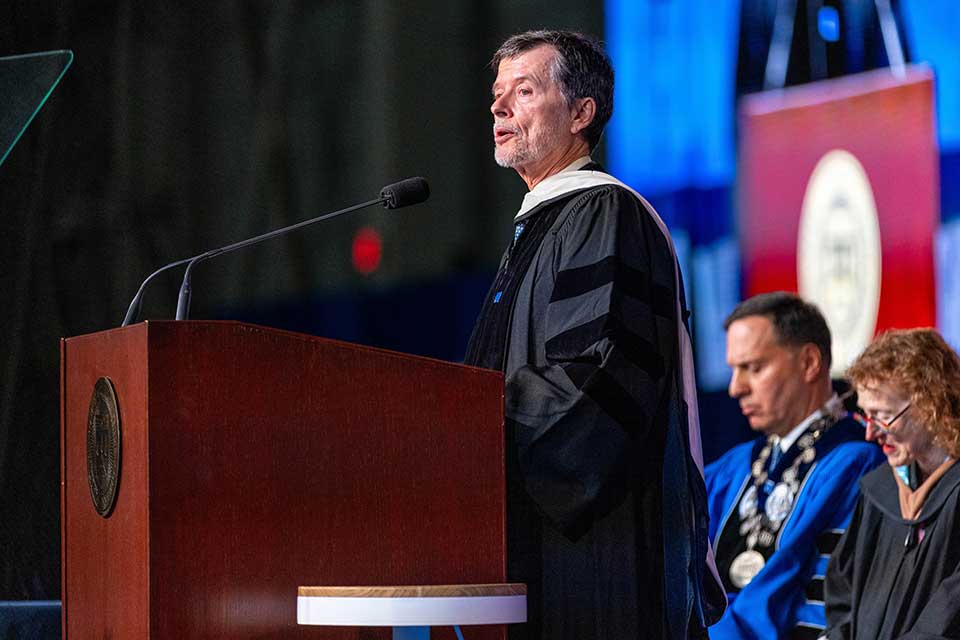
 Graduate Ceremony


