
Let’s Talk About Trump’s Gibberish

The Atlantic

Let’s Talk About Trump’s Gibberish

What the former president’s shark tirade says about American politics and media

By Tom Nichols – June 12, 2024 
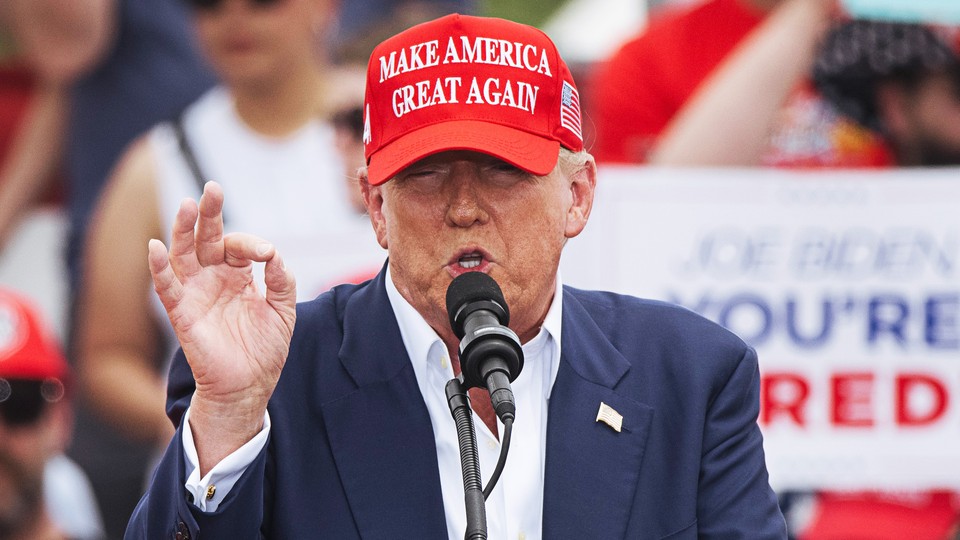
Wearing a red MAGA hat and a blue suit with a flag lapel pin, Trump speaks into a microphone at his recent rally in Las Vegas.
Eric Thayer / The Washington Post / Getty

Perhaps the greatest trick Donald Trump ever pulled was convincing millions of people—and the American media—to treat his lapses into fantasies and gibberish as a normal, meaningful form of oratory. But Trump is not a normal person, and his speeches are not normal political events.

For too long, Trump has gotten away with pretending that his emotional issues are just part of some offbeat New York charm or an expression of his enthusiasm for public performance. But Trump is obviously unfit—and something is profoundly wrong with a political environment in which he can now say almost anything, no matter how weird, and his comments will get a couple of days of coverage and then a shrug, as if to say: Another day, another Trump rant about sharks.

Wait, what?

Yes, sharks. In Las Vegas on Sunday, Trump went off-script—I have to assume that no competent speechwriter would have drafted this—and riffed on the important question of how to electrocute a shark while one attacks. He had been talking, he claims, to someone about electric boats: “I say, ‘What would happen if the boat sank from its weight and you’re in the boat, and you have this tremendously powerful battery, and the battery’s now underwater, and there’s a shark that’s approximately 10 yards over there?’”

As usual, Trump noted how much he impressed his interlocutor with his very smart hypothetical: “And he said, ‘Nobody ever asks this question,’ and it must be because of MIT, my relationship to MIT. Very smart.” (MIT? Trump’s uncle taught there and retired over a half century ago, when Trump was in his 20s, and died in 1985. Trump often implies that his uncle passed on MIT’s brainpower by genetic osmosis or something.)

This ramble went on for a bit longer, until Trump made it clear that given his choice, he’d rather be zapped instead of eaten: “But you know what I’d do if there was a shark or you get electrocuted? I’ll take electrocution every single time. I’m not getting near the shark. So we’re going to end that, we’re going to end it for boats, we’re going to end it for trucks.”

Hopefully, this puts to rest any pressing questions among Americans about the presumptive Republican nominee’s feelings on electric vehicles and their relationship to at least two gruesome ways to die.

Sure, it seems funny—Haha! Uncle Don is telling that crazy shark story again!—until we remember that this man wants to return to a position where he would hold America’s secrets, be responsible for the execution of our laws, and preside as the commander in chief of the most powerful military in the world. A moment that seems like oddball humor should, in fact, terrify any American voter, because this behavior in anyone else would be an instant disqualification for any political office, let alone the presidency. (Actually, a delusional, rambling felon known to have owned weapons would likely fail a security check for even a visit to the Oval Office.)

Nor was the Vegas monologue the first time: Trump for years has fallen off one verbal cliff after another, with barely a ripple in the national consciousness. I am not a psychiatrist, and I am not diagnosing Trump with anything. I am, however, a man who has lived on this Earth for more than 60 years, and I know someone who has serious emotional problems when I see them played out in front of me, over and over. The 45th president is a disturbed person. He cannot be trusted with any position of responsibility—and especially not with a nuclear arsenal of more than 1,500 weapons. One wrong move could lead to global incineration.

Why hasn’t there been more sustained and serious attention paid to Trump’s emotional state?

First, Trump’s target audience is used to him. Watch the silence that descends over the crowds at such moments; when Trump wanders off into the recesses of his own mind, they chit-chat or check their phones or look around, waiting for him to come back and offer them an applause line. For them, it’s all just part of the show.

Second, Trump’s staff tries to put just enough policy fiber into Trump’s nutty verbal soufflés that they can always sell a talking point later, as if his off-ramps from reality are merely tiny bumps in otherwise sensible speeches. Trump himself occasionally seems surprised when these policy nuggets pop up in a speech; when reading the teleprompter, he sometimes adds comments such as “so true, so true,” perhaps because he’s encountering someone else’s words for the first time and agreeing with them. Thus, they will later claim that questions about sharks or long-dead uncles are just bad-faith distractions from substance. (These are the same Republicans who claim that every verbal stumble from Joe Biden indicates full-blown dementia.)

Third, and perhaps most concerning in terms of public discussion, many people in the media have fallen under the spell of the Jedi hand-waves from Trump and his people that none of this is as disturbing and weird as it sounds. The refs have been worked: A significant segment of the media—and even the Democratic Party—has bought into a Republican narrative that asking whether Trump is mentally unstable is somehow biased and elitist, the kind of thing that could only occur to Beltway mandarins who don’t understand how the candidate talks to normal people.

Such objections are mendacious nonsense and represent a massive double standard. As Eugene Robinson of The Washington Post wrote today: “It is irresponsible to obsess over President Biden’s tendency to mangle a couple of words in a speech while Donald Trump is out there sounding detached from reality.” Biden’s mush-mouthed moments fall well within the range of normal gaffes. Had he or any other American politician said anything even remotely like one of Trump’s bizarre digressions, we’d be flooded with front-page stories about it. Pundits would be solemnly calling for a Much Needed National Conversation about the Twenty-Fifth Amendment.

It is long past time for anyone who isn’t in the Trump base to admit, and to keep talking about, something that has been obvious for years: Donald Trump is unstable. Some of these problems were evident when he first ran, and we now know from revelations by many of his former staff that his problems processing information and staying tethered to reality are not part of some hammy act.

Worse, the people who once managed Trump’s cognitive and emotional issues are gone, never to return. A second Trump White House will be staffed with the bottom of the barrel—the opportunists and hangers-on willing to work for a reprehensible man. His Oval Office will be empty of responsible and experienced public servants if the day comes when someone has to explain to him why war might be about to erupt on the Korean peninsula or why the Russian or Chinese nuclear forces have gone on alert, and he starts talking about frying sharks with boat batteries.

The 45th president is deeply unwell. It is long past time for Americans, including those in public life, to recognize his inability to serve as the 47th.

Scientists Found Microplastics in Every Human Semen Sample They Examined

Futurism

Scientists Found Microplastics in Every Human Semen Sample They Examined

Victor Tangermann – June 11, 2024

A team of researchers has found microplastics in all 40 semen samples they examined from healthy men, highlighting the urgent need to study how these tiny particles could affect human reproduction.

In a paper published in the journal Science of the Total Environment, researchers from a number of Chinese institutions identified eight different polymers in the samples, with polystyrene being the most prevalent.

As The Guardian reports, it’s only the latest in a string of studies that have equally found microplastics in semen.

While their effect on reproduction and human health still isn’t entirely understood, researchers have also been documenting a global decline in sperm count and other issues plaguing male fertility, linking them to a number of environmental and lifestyle factors.

Other studies have found that microplastics can reduce sperm count in mice and disrupt the human endocrine system.

It’s also yet another stark reminder of how ubiquitous microplastics have become in the world. They’ve been found clogging human arteries, in bottled waterinside clouds, and even in a cave that was sealed off from all humans.

Given the latest research, these tiny pollutants could even have troubling consequences for our ability to reproduce.

“As emerging research increasingly implicates microplastic exposure as a potential factor impacting human health, understanding the extent of human contamination and its relation to reproductive outcomes is imperative,” the researchers wrote in their paper.

Studies involving mice “demonstrate a significant decrease in viable sperm count and an uptick in sperm deformities, indicating that microplastic exposure may pose a chronic, cumulative risk to male reproductive health,” they added.

different study published in the journal Toxicological Sciences last month found microplastics in all samples of 47 canine and 23 human testicles.

“At the beginning, I doubted whether microplastics could penetrate the reproductive system,” coauthor and University of New Mexico professor Xiaozhong Yu told The Guardian at the time. “When I first received the results for dogs I was surprised. I was even more surprised when I received the results for humans.”

Worse yet, the samples dated back to 2016, suggesting that the “impact on the younger generation might be more concerning,” given the particles’ growing prevalence, Yu added.

As a result, experts are calling for action to reduce the amount of plastic being produced worldwide, much of which will end up polluting the environment and our bodies.

“In particular, there is a need for action to avoid additional permanent damage to the planet and the human body,” University of Rome’s Luigi Montano, who coauthored a separate study that found microplastics in human semen, told The Guardian.

“If microplastic pollution impacts the critical reproductive process, as evidenced in particular by the decline in seminal quality recorded in recent decades globally, it may prove to be [even worse] for our species in the not too distant future,” he added.

More on microplastics: Whoever Figures Out How to Remove Microplastics From the Human Body Is Going to Make a Fortune

Alito’s Wife Caught on Tape Spewing Venom at Everyone

The New Republic – Opinion

Alito’s Wife Caught on Tape Spewing Venom at Everyone

Edith Olmsted – June 11, 2024

A secret tape has exposed what Supreme Court Justice Samuel Alito’s wife, Martha-Ann, really thinks behind closed doors—and the truth isn’t pretty. In the span of just a few minutes, Alito promised revenge on the media, flung around terms like “femnazis,” lauded her German heritage, and went off about Pride flags. It was a mess.

Alito has been in and out of the news in the last month, after her high-ranking husband blamed her for hanging an upside-down American flag outside of their home, a symbol favored by the “Stop the Steal” movement following the 2020 presidential election. She supposedly hung the flag in response to a neighbor’s “F— Trump” sign, which sparked the rather unneighborly spat. Alito also engaged in some light menacing as part of the feud, prompting the neighbor to call the cops on the Alitos. Still, Justice Alito has refused calls to recuse himself from cases relating to the January 6 insurrection.

Journalist Laura Windsor recorded Martha-Ann’s and her husband’s comments during the Supreme Court Historical Society’s annual dinner earlier this month. A copy of the tape was published on Monday by Rolling Stone.

Windsor first approached Martha-Ann, posing as a Christian conservative, to express her sympathy over “everything that you’re going through,” referring to the highly publicized flag hanging.

“It’s OK because if they come back to me, I’ll get them,” Alito said cheerfully. “I’m gonna be liberated and I’m gonna get them.”

“What do you mean by ‘they?’” Windsor asked.

“There is a five-year defamation statute of limitations,” Alito said, letting out a laugh.

“I don’t know what you mean by ‘they’, like by ‘get them’?” Windsor pressed.

“The media!” Alito said, going on to complain about her coverage in The Washington Post style section from nearly two decades ago.

It appears Alito doesn’t forget about the journalists who’ve gotten on her bad side. In 2016, Alito was reportedly enthusiastic about Trump’s promise to expand U.S. libel laws to make it significantly easier to sue news outlets for their coverage, one GOP operative told Rolling Stone.

While maintaining her cheerful tone, Alito also took aim at any woman who suggested her husband should’ve prevented her from hanging an “Appeal to Heaven” flag, a symbol revived by a Christian nationalist sect and favored by January 6 insurrectionists, at their vacation home.

“The other thing the femnazis believe, that he should control me,” Alito said about her husband. “So, they’ll go to hell. He never controls me.”

When Windsor asked what someone who has the same flag should do, Alito responded simply, “Don’t get angry, get even.”

There was one group that Alito seemed to admire, and it’s not exactly one that people are often openly praising. “Look at me, look at me. I’m German, from Germany. My heritage is German. You come after me. I’m gonna give it back to you. And there will be a way, it doesn’t have to be now, but there will be a way they will know. Don’t worry about it,” she said.

When Windsor tried to ask Alito about the political divide in the United States and her thoughts on the “radical Left,” about which her supposedly nonpolitical husband had plenty to say, Alito cut her off to complain about Pride flags.

“You know what I want? I want a Sacred Heart of Jesus flag because I have to look across the lagoon at the Pride flag for the next month,” she said.

“And he’s like, ‘Oh please, don’t put up a flag.’ I said, ‘I won’t do it because I’m deferring to you. But when you are free of this nonsense I’m putting it up, and I’m gonna send them a message every day. Maybe every week I’ll be changing the flags. They’ll be all kinds,’” she said, fantasizing about the day when she could finally antagonize her neighbors who support the LGBTQ+ community.

Alito even explained she had invented a flag that says, “Vergogna,” which means “shame” in Italian. “Shame, shame, shame on you,” Alito added darkly.

One can scarcely believe that her husband ruled in favor of allowing businesses to discriminate against people who identify as LGBTQ+.

Mexico’s new president ran on climate goals. Will she follow through?

The Guardian

Mexico’s new president ran on climate goals. Will she follow through?

Thomas Graham in Mexico City – June 10, 2024

<span>Claudia Sheinbaum in Mexico City, Mexico, last week.</span><span>Photograph: Raquel Cunha/Reuters</span>
Claudia Sheinbaum in Mexico City, Mexico, last week.Photograph: Raquel Cunha/Reuters

The month before Mexico’s 2 June presidential vote the country was bedeviled by water cuts and blackouts as a record heatwave took the country beyond red and into an ominous purple on the weather map.

As dehydrated monkeys dropped dead from trees, the landslide victory of Claudia Sheinbaum, a climate scientist, might look like salvation. But her record paints a more complicated picture – one where climate convictions have often, and may still, come second to political pragmatism.

Sheinbaum will inherit a country that has slipped from frontrunner to laggard on climate policy – in part due to the policies of her predecessor and ally, Andrés Manuel López Obrador, which she has promised to continue.

López Obrador, who comes from the oil-rich state of Tabasco, prioritised “energy sovereignty” by growing the role of state companies and striving for self-sufficiency.

Related: Mexico was once a climate leader – now it’s betting big on coal

This was manifested in a $17bn oil refinery and colossal injections of cash and tax cuts for Pemex, the most indebted state oil company in the world, and one of the biggest historical polluters.

One result was to entrench a dirty-energy matrix, with almost 80% coming from fossil fuels.

Meanwhile, Mexico’s climate commitments were left to languish. It is one of just two G20 countries not to have a net-zero target, and it’s a long way from reducing emissions by 35% by 2030, under the Paris agreement.

“Not only are we nowhere near it, but we don’t have any specific and detailed plans to achieve it, let alone financing and concrete infrastructure projects,” said Diego Rivera Rivota, a researcher at Columbia University’s Center on Global Energy Policy.

This is despite the fact that Mexico is highly vulnerable to climate change – as was driven home by the extraordinary hurricane that hit Acapulco in October 2023, killing dozens and causing catastrophic damage.

“Acapulco taught us a big lesson. We weren’t prepared for that,” said Gustavo Alanís, general director of CEMDA, an environmental NGO. “These floods, droughts, hurricanes and heatwaves aren’t just going to continue, but possibly get more severe and frequent.”

Many hope Sheinbaum’s background as a climate scientist – one who contributed to the reports of the Nobel prize-winning Intergovernmental Panel on Climate Change – will shine through once she takes office on 1 October, notwithstanding her reliance on López Obrador to win the presidency.

When she was mayor of Mexico City, there were certain signs of the approach she might take as president, with an emphasis on solar energy, electrified public transport and a new cable car line.

But then, the city saw no great improvement in either of its fundamental environmental problems: air pollution and water shortages.

Related: A tale of two cities: a month after Hurricane Otis, Acapulco exposes gaps in disaster response

Meanwhile, on the campaign trail, Sheinbaum promised all things to all people, saying she would both continue López Obrador’s policies but also do more for the environment.

This means the Maya Train – one of López Obrador’s flagship infrastructure projects to develop historically poorer regions – will continue to cut through Latin America’s second-largest tropical forest. Sheinbaum has even suggested expanding it to neighbouring Belize and Guatemala.

There will also be more backing for Sembrando Vida, López Obrador’s pet forestry and rural development initiative that has had money plowed into it as budgets for state environmental agencies have been slashed – even though its results are little understood, and there are reports it even promotes deforestation.

And there will be more public money for Pemex as it staggers on under its debt burden and tries to increase its oil output.

On the other hand, Sheinbaum has also suggested that Pemex expand its remit to include mining for lithium, a crucial element of electric batteries.

And there was a campaign pledge to spend $14bn on clean-energy projects. That would mark a radical change from López Obrador’s government, which not only invested very little in renewables, but also revoked or blocked permits for private projects.

Experts also expect to see more action on the demand side of the equation, with an emphasis on electrification of public transport and incentives for residential solar panels. “This is a country with 300 days plus of sun,” said Rivera Rivota. “It has massive potential for that.”

Although Sheinbaum’s proposals lack detail at this stage, she has repeatedly emphasised the need for long-term planning for both energy and water – looking not just to 2030, but to 2050 and beyond.

“[Long-term planning] was not guaranteed during the current administration. We had several legal and regulatory changes, and other attempts at change that led to battles in court,” said Rivera Rivota. “As long as it’s clear what the rules of the game are, what the legal framework is, I think Mexico has enormous potential for investment in renewable energy.”

The scale of victory for Sheinbaum’s Morena party, which seems to have given it a supermajority in one and perhaps both houses of congress, as well as the governorships of 24 of Mexico’s 32 federal entities, has given Sheinbaum a huge mandate as president-elect.

But whether she wants or will be able to move away from her predecessor’s policies is an unknown.

López Obrador will remain a powerful figure – and his continued support may be needed to help hold together Morena, the party that he founded but has since expanded to house disparate ideologies, and fractious groups.

“She was never going to contradict the president during the campaign,” said Rivera Rivota. “But who knows what will happen when she’s sitting in the Palacio Nacional and making the calls herself.”

“There is hope, and there is a vote of confidence [in Sheinbaum],” said Alanís of CEMDA. “But here we will be vigilant, and we will be checking the actions of her administration every day.

“And if necessary, we will raise our voice.”

The Success Narratives of Liberal Life Leave Little Room for Having Children

By Anastasia Berg and Rachel Wiseman – June 10, 2024

Dr. Berg and Ms. Wiseman are the authors of the forthcoming book “What Are Children For?: On Ambivalence and Choice.”

A baby atop a podium next to a man standing at another podium.
Credit…Andrea Settimo

For young, secular, politically progressive men and women, having children has become something of an afterthought. Liberal conventional wisdom encourages people to spend their 20s on journeys of personal and professional self-discovery and self-fulfillment. Children are treated as a bonus round, something to get to only after completing a long list of achievements: getting a degree, forging a satisfying and well-established career, buying a house, cultivating the ideal romantic partnership.

The standards of readiness for family are at once so high and so vague that it’s hardly a surprise when people fail to reach them. Indeed, the data suggest that people are having children later than they used to and are having fewer than they’d like.

For progressives, waiting to have children has also become a kind of ethical imperative. Gender equality and female empowerment demand that women’s self-advancement not be sacrificed on the altar of motherhood. Securing female autonomy means that under no circumstances should a woman be rushed into a reproductive decision — whether by an eager partner or tone-deaf chatter about ticking biological clocks. Unreserved enthusiasm for having children can come across as essentially reactionary.

Over the past four years, we’ve conducted interviews and surveys with hundreds of young Americans about their attitudes toward having children. These conversations revealed that the success narratives of modern liberal life leave little room for having a family. Women who want kids often come to that realization belatedly, at some point in their early 30s — the so-called panic years. If they are lucky, their partner (if they have one) will fall in line. If they are not, they face a choice of returning to the dating pool, freezing their eggs (if they haven’t done so already), single parenting or giving up their hope of having kids of their own.

In this way, the logic of postponement that has been promoted by liberals and progressives — and bolstered by overblown optimism about reproductive technologies — robs young people of their agency. How many children they have, and even whether they have them at all, is increasingly a decision made for them by circumstance and cultural convention.

This is not just a recipe for unhappiness; it also reflects a deep confusion. There is nothing inherently unprogressive about embracing the prospect of children. Even Simone de Beauvoir, the philosopher who was among the first to critique reproduction and family as instruments for the oppression of women, acknowledged that shaping the character and intellect of another human being was “the most delicate and the most serious undertaking of all.” While certain conservative visions of family life — such as “trad wives” and Silicon Valley pronatalism — no doubt have little to offer those on the left, our fellow progressives need to stop thinking of having children as a conservative hobbyhorse and reclaim it for what it is: a fundamental human concern.

The family — recognized as the seat of customs and traditional values — has long been central to the appeal of conservatism. Yet it wasn’t that long ago that Republicans and Democrats fought over who could rightfully claim to be the party of “family values.” Bill Clinton, while campaigning for president against George H.W. Bush in 1992, assailed the Republican Party’s commitment to families as little more than hypocrisy. “Where are they,” he asked, “when there is no health care for pregnant women? When too many children are born with low birth weights?” Mr. Clinton went on to announce a 14-point “American Family Values Agenda.”

But in time, liberals and progressives came to shy away from publicly embracing the American family as a symbol and an ideal. After Mr. Clinton was impeached in the wake of his own family-values hypocrisy and George W. Bush was elected with the help of energized evangelical voters, family-friendly rhetoric became anathema to liberals — perceived as phony, intrusive and toxic. (The notable exception was gay marriage, whose legalization was won with the help of arguments that promoted the virtues of families.) Today, the left proudly defends the sacrosanct right to abortion and reproductive justice while almost entirely sidestepping the question of whether having children is a worthy project to begin with.

The stark polarization of today’s public discourse has only heightened the left’s wariness of children, both privately and politically. Progressive policy defeats are often met with anti-natalist grandstanding. Members of the ecological activist group BirthStrike, founded in 2018, declared that they were protesting climate inaction by refusing to have kids. The following year, shortly after proposing legislation for a Green New Deal, Representative Alexandria Ocasio-Cortez of New York broadcast progressives’ hesitancy to reproduce in the face of climate change to her 2.5 million Instagram followers when she said, “It does lead young people to have a legitimate question: Is it OK to still have children?”

The Supreme Court’s Dobbs decision, which overturned the constitutional right to abortion in 2022, has also made liberals and progressives more uneasy with the idea of starting a family. A year after Dobbs, the reproductive-rights journalist Andrea González-Ramírez wrote that she had been contemplating having children in her early 30s, before the Supreme Court’s decision put an end to all that: “I have never been sure that I desire to be a mom, let alone that I desire it enough to assume the risks. These days, however, that door is shut. I choose myself.”

That choice is not uncommon. In a recent study, 34 percent of women ages 18 to 39 reported that they or someone they know had “decided not to get pregnant due to concerns about managing pregnancy-related medical emergencies.” That might sound like a worry about abortion access, but the study suggested that Dobbs intensified ambivalence about having children more generally. Indeed, of the women who said they were forgoing having children because of the Dobbs ruling, about half lived in states where abortion rights were still protected.

One can’t help noting the irony: In permitting the conservative movement to alienate them from the question of whether they want to have and raise children, these liberals and progressives are allowing the right to shape their reproductive agendas in yet another way.

But the partisan framing of the issue is flawed at a more fundamental level. The question of children ultimately transcends politics. In deciding whether to have children, we confront a philosophical challenge: Is life, however imperfect and however challenging — however fraught with political disagreement and disaster — worth living?

To be sure, having children is not the only way to address this question. But having children remains the most basic and accessible way for most of us to affirm the value of our lives and that of others. This is in part because becoming a parent represents one of the greatest responsibilities one human being can assume for another. And it is also because the perpetuation of human life is the condition of possibility for every other thing we care about.

Committing oneself to long-term leftist causes like economic, environmental, racial and social justice is more than just compatible with embracing children and family life. It presupposes a willingness to take personal and collective responsibility for the next generation — raising, nurturing and educating those who will decide the fate of our country and our planet.

Surely, progressives and conservatives will give as vastly different answers to the question of what raising children ought to look like as they will to the question of how American society ought to be governed. But progressives must not let partisan loyalties stop them from thinking about the ways in which having children does or does not express their values, and what shape they really want their lives to take. Children are too important to allow them to fall victim to the culture wars.

Anastasia Berg is an assistant professor of philosophy at the University of California, Irvine, and an editor of the magazine The Point, where Rachel Wiseman is the managing editor. They are the authors of the forthcoming book “What Are Children For? On Ambivalence and Choice.”

The Day My Old Church Canceled Me Was a Very Sad Day


The New York Times – Opinion

The Day My Old Church Canceled Me Was a Very Sad Day

By David French, Opinion Columnist – June 9, 2024

An image of a blurry American flag and of a small cross hanging in a car.
Credit…Jim Watson/Agence France-Presse — Getty Images

This week, the leaders of the Presbyterian Church in America will gather in Richmond, Va., for their annual General Assembly. The Presbyterian Church in America is a smalltheologically conservative Christian denomination that was my family’s church home for more than 15 years.

It just canceled me.

I am now deemed too divisive to speak to a gathering of Christians who share my faith. I was scheduled to speak about the challenges of dealing with toxic polarization, but I was considered too polarizing.

I was originally invited to join three other panelists on the topic of “how to be supportive of your pastor and church leaders in a polarized political year.” One of the reasons I was invited was precisely that I’ve been the target of intense attacks online and in real life.

The instant my participation was announced, those attacks started up again. There were misleading essays, vicious tweets, letters and even a parody song directed at the denomination and at me. The message was clear: Get him off the stage.

And that’s what the conference organizers chose to do. They didn’t just cancel me. They canceled the entire panel. But the reason was obvious: My presence would raise concerns about the peace and unity of the church.

Our family joined the P.C.A. denomination in 2004. We lived in Philadelphia and attended Tenth Presbyterian Church in Center City. At the time, the denomination fit us perfectly. I’m conservative theologically and politically, and in 2004 I was still a partisan Republican. At the same time, however, I perceived the denomination as relatively apolitical. I never heard political messages from the pulpit, and I worshiped alongside Democratic friends.

When we moved to Tennessee in 2006, we selected our house in part because it was close to a P.C.A. church, and that church became the center of our lives. On Sundays we attended services, and Monday through Friday our kids attended the school our church founded and supported.

We loved the people in that church, and they loved us. When I deployed to Iraq in 2007, the entire church rallied to support my family and to support the men I served with. They flooded our small forward operating base with care packages, and back home, members of the church helped my wife and children with meals, car repairs and plenty of love and companionship in anxious times.

Two things happened that changed our lives, however, and in hindsight they’re related. First, in 2010, we adopted a 2-year-old girl from Ethiopia. Second, in 2015, Donald Trump announced his presidential campaign.

There was no way I could support Trump. It wasn’t just his obvious lack of character that troubled me; he was opening the door to a level of extremism and malice in Republican politics that I’d never encountered. Trump’s rise coincided with the rise of the alt-right.

I was a senior writer for National Review at the time, and when I wrote pieces critical of Trump, members of the alt-right pounced, and they attacked us through our daughter. They pulled pictures of her from social media and photoshopped her into gas chambers and lynchings. Trolls found my wife’s blog on a religious website called Patheos and filled the comments section with gruesome pictures of dead and dying Black victims of crime and war. We also received direct threats.

The experience was shocking. At times, it was terrifying. And so we did what we always did in times of trouble: We turned to our church for support and comfort. Our pastors and close friends came to our aid, but support was hardly universal. The church as a whole did not respond the way it did when I deployed. Instead, we began encountering racism and hatred up close, from people in our church and in our church school.

The racism was grotesque. One church member asked my wife why we couldn’t adopt from Norway rather than Ethiopia. A teacher at the school asked my son if we had purchased his sister for a “loaf of bread.” We later learned that there were coaches and teachers who used racial slurs to describe the few Black students at the school. There were terrible incidents of peer racism, including a student telling my daughter that slavery was good for Black people because it taught them how to live in America. Another told her that she couldn’t come to our house to play because “my dad said Black people are dangerous.”

There were disturbing political confrontations. A church elder came up to my wife and me after one service to criticize our opposition to Trump and told me to “get your wife under control” after she contrasted his support for Trump with his opposition to Bill Clinton over the Monica Lewinsky affair. Another man confronted me at the communion table.

On several occasions, men approached my wife when I was out of town, challenging her to defend my writing and sometimes quoting a far-right pastor named Douglas Wilson. Wilson is a notorious Christian nationalist and slavery apologist who once wrote that abolitionists were “driven by a zealous hatred of the word of God” and that “slavery produced in the South a genuine affection between the races that we believe we can say has never existed in any nation before the war or since.”

We also began to see the denomination itself with new eyes. To my shame, the racism and extremism within the denomination were invisible to us before our own ordeal. But there is a faction of explicitly authoritarian Christian nationalists in the church, and some of that Christian nationalism has disturbing racial elements underpinning it.

A member of the denomination wrote “The Case for Christian Nationalism,” one of the most popular Christian nationalist books of the Trump era. It argues that “no nation (properly conceived) is composed of two or more ethnicities” and that “to exclude an out-group is to recognize a universal good for man.”

I do not want to paint with too broad a brush. Our pastors and close friends continued to stand with us. Our church disciplined the man who confronted me about Trump during communion. And most church members didn’t follow politics closely and had no idea about any of the attacks we faced.

But for us, church no longer felt like home. We could withstand the trolls online. We could guard against physical threats. But it was hard to live without any respite, and the targeting of my children was a bridge too far. So we left for a wonderful multiethnic church in Nashville. We didn’t leave Christianity; we left a church that inflicted harm on my family.

I still have many friends in the Presbyterian Church in America, people who are fighting the very forces that drove us from the church. In March, one of those friends reached out and asked if I’d join a panel at this year’s General Assembly.

I agreed to come. The P.C.A. extended a formal invitation for me to join a panel with three church elders to speak at a session before the main event. I knew the invitation would be controversial. Members of the denomination have continued to attack me online. But that was part of the point of the panel. My experience was directly relevant to others who might find themselves in the cross hairs of extremists.

The anger against me wasn’t simply over my opposition to Trump. It was directly related to the authoritarian turn in white evangelical politics. My commitment to individual liberty and pluralism means that I defend the civil liberties of all Americans, including people with whom I have substantial disagreements. A number of Republican evangelicals are furious at me, for example, for defending the civil liberties of drag queens and L.G.B.T.Q. families. A writer for The Federalist ranted that granting me a platform was akin to “giving the wolf a brand-new wool coat and microphone and daring the sheep to object.”

The panel was announced on May 9. On May 14, the denomination caved. It canceled the panel, and in its public statement, I was to blame. I was sacrificed on the altar of peace and unity. But it is a false peace and a false unity if extremists can bully a family out of a church and then block the church from hearing one of its former members describe his experience. It is a false peace and a false unity if it is preserved by granting the most malicious members of the congregation veto power over church events.

When I left the Republican Party, I thought a shared faith would preserve my denominational home. But I was wrong. Race and politics trumped truth and grace, and now I’m no longer welcome in the church I loved.

Freedom’s Just Another Word for Not Paying Taxes

By Paul Krugman, Opinion Columnist  – June 10, 2024

An American flag being flown upside-down next to the flag of the Heritage Foundation.
Outside the Heritage Foundation in Washington on May 31.Credit…Jose Luis Magana/Associated Press

After Donald Trump was convicted on 34 felony counts, the Heritage Foundation — a right-wing think tank that has, among other things, produced the Project 2025 agenda, a blueprint for policy if Trump wins — flew an upside-down American flag, which has become an emblem for support of MAGA in general and election denial in particular.

This action may have shocked some old-line conservatives who still thought of Heritage as a serious institution, but Heritage is, after all, just a think tank. It’s not as if upside-down flags were being flown by people we expect to defend our constitutional order, like Supreme Court justices.

Oh, wait.

But Heritage’s embrace of what amounts to an attack on democracy is a useful symbol of one of the really troubling developments of this election as it heads into the final stretch. Heritage presents itself as a defender of freedom, but its real mission has always been to produce arguments — frequently based on shoddy research — for low taxes on rich people. And its tacit endorsement of lawlessness illustrates the way many of America’s plutocrats — both in Silicon Valley and on Wall Street — have, after flirting with the crank candidacy of Robert F. Kennedy Jr., been rallying around Trump.

Why would billionaires support Trump? It’s not as if they’ve done badly under President Biden. Stock prices — which Trump predicted would crash if he lost in 2020 — have soared. High interest rates, which are a burden on many Americans, are if anything a net positive for wealthy people with money to invest. And I doubt that the superrich are suffering much from higher prices for fast food.

Wealthy Americans, though, are surely betting they’ll pay lower taxes if Trump wins.

Biden and his team have offered fairly explicit guidance about their tax agenda, which would directly raise taxes on high-income Americans and also raise corporate taxes, which would indirectly be mainly a tax on the wealthy. These measures wouldn’t produce taxes at the top remotely comparable to what they were during the Eisenhower years, when the top marginal income tax rate was 91 percent and large estates could face inheritance taxes as high as 77 percent. Still, Biden’s plans, if carried out, would make the rich a bit less rich.

Trump has been far less explicit, but he clearly wants to retain his 2017 tax cut in full, and his allies in Congress are committed not just to tax cuts but to starving the Internal Revenue Service of resources, which would allow more wealthy Americans to evade the taxes they legally owe.

So billionaires aren’t wrong in thinking they’ll pay less in taxes if Trump wins. But why aren’t they more concerned about the bigger picture?

After all, even if all you care about is money, Trump’s agenda should make you very worried. His advisers’ plans to deport millions of immigrants (supposedly only the undocumented, but do you really believe many legal residents wouldn’t get caught up in the dragnets?) would shrink the U.S. labor force and be hugely disruptive. His protectionist proposals (which would be very different from Biden’s targeted measures) could mean an all-out global trade war. If he’s able to make good on them, his attacks on the independence of the Federal Reserve risk much more serious inflation than anything we’ve experienced in recent years.

Beyond all that, Trump will almost certainly try to weaponize the justice system to go after his perceived enemies. Only someone completely ignorant of history would imagine himself safe from that kind of weaponization — even if Trump considers you an ally now, that can change in an instant.

And if you’ve been following Trump’s rantings, you know that his rhetoric is getting less rational and more vindictive by the week. Yet his support among billionaires seems if anything to be consolidating.

So what’s going on? Here’s what I think, although it’s admittedly speculative.

First, America’s oligarchs probably believe that their wealth and influence would protect them from the arbitrary exercise of power. Trump and company might turn corrupt law enforcement and a cowed judiciary against other people, but surely not them! By the time they realized how wrong they were, it would be too late.

As I’ve written before, the superrich can be remarkably obtuse and ignorant of history.

Second, at some level I don’t really think it’s about the money. How much difference does it make to a billionaire’s quality of life if he has to settle for a slightly smaller superyacht? At the top of the pyramid, wealth is largely about status and self-importance; as Tom Wolfe wrote long ago, it’s about “seeing ’em jump.”

And when politicians don’t jump, when they don’t treat the very wealthy with the deference and admiration they consider their due, some of them become enraged. We saw this when many Wall Streeters turned on President Barack Obama — after he helped bail them out in the financial crisis — because they felt insulted by his occasional criticisms.

Biden is hardly a class warrior, but he clearly doesn’t worship the superrich. And all too many of them are turning to Trump out of sheer pettiness.

In Secret Recordings, Alito Endorses Nation of ‘Godliness.’ Roberts Talks of Pluralism.

The two justices were surreptitiously recorded at a Supreme Court gala last week by a woman posing as a Catholic conservative.

Abbie VanSickle, Reporting from Washington – June 10, 2024

Justice Samuel A. Alito Jr., wearing a black robe.
“One side or the other is going to win,” Justice Samuel A. Alito Jr. said in a recording when talking about differences between the left and the right in the United States. Credit…Doug Mills/The New York Times

Justice Samuel A. Alito Jr. told a woman posing as a Catholic conservative last week that compromise in America between the left and right might be impossible and then agreed with the view that the nation should return to a place of godliness.

“One side or the other is going to win,” Justice Alito told the woman, Lauren Windsor, at an exclusive gala at the Supreme Court. “There can be a way of working, a way of living together peacefully, but it’s difficult, you know, because there are differences on fundamental things that really can’t be compromised.”

Ms. Windsor pressed Justice Alito further. “I think that the solution really is like winning the moral argument,” she told him, according to the edited recordings of Justice Alito and Chief Justice John G. Roberts Jr., which were posted and distributed widely on social media on Monday. “Like, people in this country who believe in God have got to keep fighting for that, to return our country to a place of godliness.”

“I agree with you, I agree with you,” he responded.

The justice’s comments appeared to be in marked contrast to those of Chief Justice Roberts, who was also secretly recorded at the same event but who pushed back against Ms. Windsor’s assertion that the court had an obligation to lead the country on a more “moral path.”

“Would you want me to be in charge of putting the nation on a more moral path?” the chief justice said. “That’s for people we elect. That’s not for lawyers.”

Ms. Windsor pressed the chief justice about religion, saying, “I believe that the founders were godly, like were Christians, and I think that we live in a Christian nation and that our Supreme Court should be guiding us in that path.”

Chief Justice Roberts quickly answered, “I don’t know if that’s true.”

He added: “I don’t know that we live in a Christian nation. I know a lot of Jewish and Muslim friends who would say maybe not, and it’s not our job to do that.”

The chief justice also said he did not think polarization in the country was irreparable, pointing out that the United States had managed crises as severe as the Civil War and the Vietnam War.

Chief Justice John G. Roberts Jr., wearing a black robe.
Justice John G. Roberts Jr., in a recording, pushed back against the notion that the United States is a “Christian nation.”Credit…Doug Mills/The New York Times

When Ms. Windsor pressed him on whether he thought that there was “a role for the court” in “guiding us toward a more moral path,” the chief justice’s answer was immediate.

“No, I think the role for the court is deciding the cases,” he said.

The justices were secretly recorded at an annual black-tie event for the Supreme Court Historical Society, a charity aimed at preserving the court’s history and educating the public about the role of the court. The gala was open only to members, not journalists, and tickets cost $500.

Chief Justice Roberts and Justice Alito did not immediately respond to requests for comment, but the charity released a statement on Monday that its “policy is to ensure that all attendees, including the justices, are treated with respect.”

The charity added: “We condemn the surreptitious recording of justices at the event, which is inconsistent with the entire spirit of the evening.”

Ms. Windsor describes herself as a documentary filmmaker and “advocacy journalist.” She has a reputation for approaching conservatives, including former Vice President Mike Pence, Representative Jim Jordan of Ohio and Gov. Glenn Youngkin of Virginia.

She said in an interview on Monday that she felt she had no other way to report on the candid thoughts of the justices.

“We have a court that has refused to submit to any accountability whatsoever — they are shrouded in secrecy,” Ms. Windsor said. “I don’t know how, other than going undercover, I would have been able to get answers to these questions.”

Ms. Windsor would not say how she recorded the encounters, other than that she did not tell the justices she was a journalist or that they were being recorded. She said she felt she needed to record the justices secretly to ensure that her account would be believed.

“I wanted to get them on the record,” she said. “So recording them was the only way to have proof of that encounter. Otherwise, it’s just my word against theirs.”

Some journalism ethics experts questioned her tactics.

Jane Kirtley, a professor of media ethics and law at the University of Minnesota, said that the episode called to mind the tactics used by Project Veritas, a conservative group well known for using covert recordings to embarrass its political opponents.

“I think it’s fair to say that most ethical journalists deplore those kind of techniques,” Ms. Kirtley said. “How do you expect your readers or your viewers to trust you if you’re getting your story through deception?”

Bob Steele, a retired ethics scholar at the Poynter Institute, has written ethics guidelines for journalists on when it is appropriate to use secret recordings or to conceal their identities as reporters.

“I don’t believe that in this particular case the level of misrepresentation of her identity and the surreptitious audio recording is justifiable,” Mr. Steele said.

The secret recording is the latest controversy around the Supreme Court and its justices, particularly Justice Alito, who has faced recent revelations that provocative flags flew outside two of his homes. The flags raised concerns about an appearance of bias in cases currently pending before the court tied to the Jan. 6, 2021, attack on the Capitol.

In the weeks following the attack, an upside-down American flag, a symbol used by Trump supporters who contested the 2020 election results, flew outside the Alitos’ suburban Virginia home. Last summer, a flag carried by Capitol rioters, known as an “Appeal to Heaven” flag, was flown at their New Jersey vacation home.

Justice Alito has declined to recuse himself from any of the Jan. 6-related cases and has said that it was his wife who flew the flags.

This is also not the first time the historical society has been in the spotlight. The group, which has raised millions of dollars in recent decades, made news after the Supreme Court overturned Roe v. Wade when a former anti-abortion leader came forward to say that he had used the historical society to encourage wealthy donors, whom he called “stealth missionaries,” to give money and mingle with the justices.

Abbie VanSickle covers the United States Supreme Court for The Times. She is a lawyer and has an extensive background in investigative reporting. 

Alex Jones’ lies about the Sandy Hook shooting may have finally caught up with him

MSNBC

Alex Jones’ lies about the Sandy Hook shooting may have finally caught up with him

Clarissa-Jan Lim – June 8, 2024

Tyler Sizemore

Conspiracy theorist Alex Jones has agreed to sell his assets to help pay the massive debt he owes to families of the Sandy Hook shooting victims, whom he has spent years spreading lies about and defaming.

Jones’ decision to liquidate his assets this week ends his pursuit of Chapter 11 bankruptcy as part of an effort to avoid paying the $1.5 billion he owes the families after they successfully sued him for defamation in Texas and Connecticut. The move also could see him lose ownership of Infowars, the far-right platform from which he’s peddled lies that the deadly Sandy Hook Elementary School shooting was a “hoax” perpetrated to strip Americans of their Second Amendment rights. Proceeds from the sale of his assets would go to his creditors and the families.

“Alex Jones has hurt so many people,” Christopher Mattei, who represents the Sandy Hook families, said in a statement. “The Connecticut families have fought for years to hold him responsible no matter the cost and at great personal peril. Their steadfast focus on meaningful accountability, and not just money, is what has now brought him to the brink of justice in the way that matters most.”

Jones’ Chapter 7 liquidation will not cover the debt that he owes the shooting victims’ families, but it is an outcome they have been seeking. Last year, Jones offered the families a $55 million settlement, a fraction of the $1.5 billion he owes them. The families filed a counterproposal that sought to liquidate nearly all his assets, including Free Speech Systems, the company that owns Infowars. A judge is set to rule on June 14 as to whether Free Speech Systems will be liquidated.

The far-right radio show host spent part of his Friday broadcast railing against the latest development in his financial troubles, NBC News reported. He also lamented Infowars’ potential impending doom, though he suggested he may “relaunch” a similar platform.

Trump says it’s “very possible” that Biden and other political rivals will have to be jailed

Salon

Trump says it’s “very possible” that Biden and other political rivals will have to be jailed

Nicholas Liu – June 5, 2024

Donald Trump Spencer Platt/Getty Images

Donald Trump, spinning the old, false line that the trial that led to his conviction on felony charges was “rigged” and orchestrated by Joe Biden, suggested in an interview with Newsmax that the “precedent” would give him an opening pay his political opponents back in kind, according to the Washington Post.

“I said, ‘Wouldn’t it really be bad? … Wouldn’t it be terrible to throw the president’s wife and the former secretary of state — think of it, the former secretary of state — but the president’s wife into jail?” Trump mused on Tuesday, referring to his 2016 opponent Hillary Clinton, who he had repeatedly said should be “locked up” despite now blaming his supporters for saying it instead.

“But they want to do it,” Trump said, apparently referring to Biden and other political rivals. “So, you know, it’s a terrible, terrible path that they’re leading us to, and it’s very possible that it’s going to have to happen to them … it’s a terrible precedent for the country.”

The precedent Trump was referring to was his imagined version of events, in which President Biden supposedly instructed Manhattan District Attorney Alvin Bragg to prosecute him, and then rigged the trial secure a conviction. Despite making this claim for several months now, Trump has been unable to cite any evidence to suggest that Bragg, an independently elected prosecutor, coordinated with the White House at all. Prosecutors said that they were only following the facts in their case.

Trump, who faces criminal charges in three other cases, has made revenge a central message of his campaign, telling supporters at one point that “I am your retribution.” Other times, he has vacillated, saying in an Iowa rally that he “didn’t have time for retribution.” Since he first ran for president in 2015, Trump has called for the Justice Department to investigate political opponents and former allies who are now critical of him; in the lead up to the 2024 election, he has a plan to make that a reality by purging DOJ staff turning the department into what Reuters referred to as “an attack dog for conservative causes.”