Florida passes bill to prevent billionaires like Elon Musk and Jeff Bezos being sued if their mega-rockets kill or injure people

Business Insider

Florida passes bill to prevent billionaires like Elon Musk and Jeff Bezos being sued if their mega-rockets kill or injure people

Marianne Guenot – May 17, 2023


How SpaceX, Blue Origin, and Virgin Galactic plan on taking you to space

The SpaceX Starship lifts off from the launchpad during a flight test from Starbase in Boca Chica, Texas, on April 20, 2023.
The SpaceX Starship lifts off in Boca Chica, Texas, on April 20, 2023.PATRICK T. FALLON/AFP via Getty Images
  • Florida passed a bill protecting space companies in case of injury or death of a crew member.
  • Passengers will have to sign a waiver stating they understand the risks before boarding a spaceship.
  • The bill comes as more billionaires are trying to make commercial space flight a reality.

Florida has signed a bill protecting the billionaire owners of space companies against civil lawsuits in case of the death or injury of a passenger or crew member.

Passengers will have to sign a waiver stating they understand the risks of spaceflight before boarding a spaceship, the bill states.

“Under Florida law, there is no liability for an injury to or death of a participant or crew in a spaceflight activity provided by a spaceflight entity if such injury or death results from the inherent risks of the spaceflight activity,” the bill states.

For private sector companies like Elon Musk’s SpaceX and Jeff Bezos’ Blue Origin, the bill “has the potential to limit the cost of litigation to businesses engaging in spaceflight activities,” a senate analysis of the bill said.

The bill extends protections to private space companies
Elon Musk
Elon Musk stands in front of a model of a rocket.(Photo by Hannibal Hanschke-Pool/Getty Images)

The Spaceflight Entity Liability bill, which was sent to Governor Ron DeSantis and passed the Florida Senate and House with little opposition, was adjusted to reflect “the evolution of spaceflight,” said Republican Sen. Tom Wright, the bill’s sponsor, per Florida Politics.

“Astronauts are no longer government astronauts. These are commercial crew,” said Republican Rep. Tyler Sirois at a March 9 hearing, per Florida Politics.

The new bill states that space flight remains “an extraordinarily dangerous condition” and people should take responsibility for the risks before boarding the rocket, the Senate bill analysis states.

The bill doesn’t protect the companies in case of “gross negligence”

Florida lawmakers have every motivation to protect the spaceflight industry, which contributes $17.7 billion in revenues to Florida’s economy, per Florida’s Aerospace and Spaceport Development Authority.

SpaceX and Blue Origin have their primary launch sites in Florida. Jeff Sharkey, a lobbyist representing SpaceX, also stood in support of the bill at a March 26 hearing, per Florida Politics.

Still, the bill doesn’t abrogate space companies from all responsibility. It states clearly that the company is still liable in case of gross negligence, if the company knew or should have known about dangerous conditions, or it intentionally tried to hurt or kill a crewmember.

Even in a case of negligence, the bill would be difficult to hold up in court, Mark Sundahl, director of the Global Space Law Center at Cleveland State University, told Gizmodo in an email.

The waiver, he said “assumes that there is ‘informed consent.’ It is questionable whether a passenger who is not familiar with the technology and history of spaceflight can truly be ‘informed’ as to the risks.”

More protections are needed as space tourism takes off
yusaku maezawa is seeing wearing a orange shirt, floating cross legged and waving in the International Space Station.
Japanese billionaire Yusaku Maezawa floats inside the International Space Station (ISS) as seen in this photo uploaded on December 9, 2021,Yusake Maezawa via Instagram/via REUTERS

The bill comes in the wake of a boom in space tourism led by private companies.

Multi-millionaire and billionaire civilians are hitching rides to low earth orbit and outer space.

“The fear is that the estate of ultra-wealthy passengers could bring massive claims for hundreds of millions of dollars in lost revenue due to the life of the passenger being cut short,” said Sundahl, per Gizmodo.

“The industry is still in its early days and such liability might stunt the industry,” he said.

These include billionaire Yusaku Maezawa, a Japanese fashion mogul who has already flown to the International Space Station and purchased all the seats on an upcoming SpaceX  Starship flight around the moon.

250,000 Florida residents kicked off Medicaid; more expected

Tampa Bay Times – St. Petersburg, Fla.

250,000 Florida residents kicked off Medicaid; more expected

Christopher O’Donnell, Tampa Bay Times – May 17, 2023

Health advocate groups are calling on Florida to halt a review of the eligibility of Medicaid recipients after close to 250,000 residents were terminated from the program during the past four weeks.

The Florida Department of Children and Families began a purge of the more than 5 million people from the state’s Medicaid rolls on April 18 as part of the winding down of the public health emergency that took effect May 11. Since then, state workers have reviewed more than 461,000 people, taking Medicaid benefits away from more than half.

About 80% of those terminated — roughly 205,000 — were disqualified because they failed to respond to requests for information needed to renew their eligibility, the state report shows. About 44,300 recipients were referred to other programs because they earn too much to be eligible.

The high number of so-called procedural terminations has alarmed health advocacy groups, who fear families, including children who are still eligible, will lose coverage because they were unaware of the requirement.

The Florida Policy Institute, an Orlando nonprofit group, was among groups who earlier this year warned of a “looming tidal wave of health coverage loss for children, parents, and young adults.” CEO Sadaf Knight on Wednesday said the state should pause the process and re-enroll those who have been removed until it has checked their eligibility.

“We have consistently urged the state and administration to do everything in its power to ensure no eligible child or parent was kicked off of health coverage because of bureaucratic inadequacies,” she said. “Now, the first reports confirm our fears about unnecessary losses in coverage. There is no excuse for the loss of health coverage for over 200,000 Floridians due to procedural ‘red tape.’”

The state’s Medicaid rolls swelled by nearly 1.8 million people since 2020, when the federal government paid states extra money to keep people covered during the pandemic, even if they were no longer eligible. Similar checks on recipients are being conducted in every state across the nation in accordance with instructions from the federal government.

The Department of Children and Families earlier this year released a plan to send renewal notices to recipients through emails and letters.

The plan states those who lose coverage will be referred to alternatives, including Florida KidCare, a government-sponsored health insurance program, and federally subsidized health centers that treat low-income patients. Hillsborough County also runs a health care program for low-income residents funded through a sales tax.

Hillsborough County received 877 new applications for its program in April. As of Wednesday, more than 1,060 people had applied this month, said spokesperson Todd Pratt.

“The federal pause on Medicaid redeterminations for the last three years has been unprecedented,” said Department Secretary Shevaun Harris in an April 18 memo to health care groups. “This change reflects a return to normal operations.”

Florida is one of only 10 states that have not taken advantage of a provision in the Affordable Care Act that rewards states for expanding Medicaid to more low-income residents.

Florida’s Medicaid program covers children ages 5 and younger in households that make $33,408 or less and older children whose parents make up to $31,795. But there is no coverage for parents who earn more than $7,000 a year, and adults with no children are ineligible no matter how little they earn. Only four states in the nation have stricter Medicaid eligibility, according to the Florida Policy Institute.

The Florida Health Justice Project is also calling for a halt to the state’s Medicaid review process. Eligible families with children who rely on Medicaid could fall through the cracks and be disqualified, said Alison Yager, the project’s executive director. She also questioned whether the state was following its plan to prioritize reviewing people who no longer qualified and those who have not used Medicaid services.

“It raises all kinds of questions about whether people are getting their correspondence or are having trouble getting through to (the Department of Children and Families),” she said. “People still don’t know this is happening.”

Many Texans must work for food stamps. But no work required for $92,000 payout.

Austin American – Statesman

Grumet: Many Texans must work for food stamps. But no work required for $92,000 payout.

Bridget Grumet, Austin American-Statesman – May 17, 2023

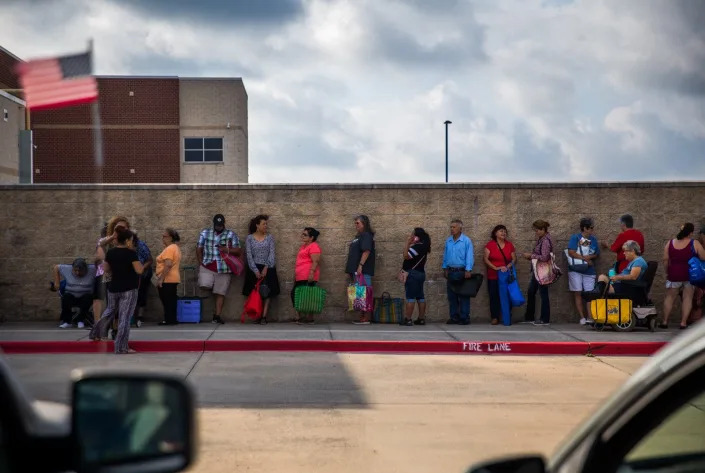
People in need wait to receive food from a mobile food pantry in Kyle. Texans who receive food stamps for their families must renew their status every six months.

If you’re on food stamps, you can be sure the state of Texas will check up on you. Every six months, in fact.

You have to fill out new forms proving that you’re still poor and working at least 30 hours a week (unless you’re over 60 or physically unable to work). You have to demonstrate that your car isn’t worth too much, and, in some cases, show your housing and health care costs.

Every six months.

Just to get help to buy food — up to $939 a month for a family of four.

I kept thinking about that as I read a stunning story last week about government spending on the other end of the spectrum. As my colleague Tony Plohetski reported, Victor Vandergriff resigned from his post as a Texas Department of Transportation commissioner in 2018 — but the state continued to pay him for five years, in payments totaling nearly $92,000.

No one was checking up on Vandergriff. He didn’t have to justify himself every six months. The paychecks kept flowing, even though he stopped doing a job that, in fairness, he had quit.

When it comes to social safety net programs, our state is so worried that people might get something they don’t deserve. Where is that concern when it comes to someone drawing a state paycheck they didn’t earn?

The focus has been on the “holdover” provision in state law that allowed this to happen. To ensure the government keeps operating, original language in the 1876 Texas Constitution says that state officials remain state officials until they are replaced by someone else. So even though Vandergriff resigned, he remained a transportation commissioner on paper — and on the payroll — until Gov. Greg Abbott named a replacement this March.

Victor Vandergriff resigned in 2018 as a Texas Department of Transportation Commissioner, but he continued to be paid for five years until his replacement was named.

In such a system, the onus is on the governor’s office to ensure that appointees who resign are replaced in a timely way. Abbott’s office didn’t respond to follow-up questions about why it took five years to name Vandergriff’s successor.

It’s worth noting that the governor’s office handles more than 1,500 appointments to various boards and commissions during each four-year term, and finding people with the right expertise and willingness to serve in these roles can take time.

Still, it’s striking to see that Texas’ systems are designed to provide grace periods and continued resources to those in power, while imposing rigid deadlines and an obstacle course of justifications for Texans in need.

The car conundrum

Consider the Supplemental Nutrition Assistance Program, or SNAP, more commonly known as food stamps.

Most food stamp recipients must prove they’re working. Getting to and from a job often requires a car. To get food stamps, though, your car can’t be worth more than $15,000 — a value that hasn’t been updated since 2001 to reflect inflation.

Heaven help you if you’re a two-car household: The second car can’t be worth more than $4,650, a value set in 1973.

“The wrinkle is, through the pandemic, when used car prices accelerated, it meant people’s existing vehicles became worth more,” Rachel Cooper, director of Health & Food Justice for Every Texan, told me. “So it also made it harder for (people) to qualify for SNAP.”

And some people actually lost their food stamps in the past couple of years because their used cars grew too much in value, she added.

Last month, the House passed a common-sense bill — House Bill 1287 — to provide a one-time adjustment to the allowable car value for food stamp recipients, and to create a process for considering future adjustments. The measure could be heard by the Senate Finance Committee this week.

Technically, it’s legislation about car values and benefits calculations. But really it’s about whether some Texans on the margins can qualify for the food their families need.

Difficult by design

Food stamps are just one example.

Consider Medicaid: Prior to the pandemic, some of the poorest kids in Texas routinely lost their health care coverage because the state used a flawed system to conduct random spot-checks for eligibility. New moms on Medicaid — nearly half of the women giving birth in Texas — lost their health coverage just two months after the baby arrived.

Federal COVID-era policies provided temporary relief, preventing anyone from losing health coverage during the pandemic. Lawmakers last session shifted Medicaid eligibility checks for kids to once every six months, and lawmakers this session are considering HB 12 to keep uninsured women on Medicaid for 12 months after they’ve given birth.

Meanwhile, as the pandemic-era protections lift, 2.7 million Texas women and children must once again prove to the state that they deserve health care coverage.

Applying for government assistance is notoriously tough. Nonprofits often have staffers dedicated to helping Texans navigate the bureaucratic maze, Cooper said.

The process is difficult by design.

“If you have a mentality that folks who need these programs are taking from everybody else, or somehow they’re not working, somehow they’re lazy, and now they’re abusing the system, then then you build a system to lock people out, to make it so that it’s only the desperate or the very well-resourced who make it through the gauntlet to get services,” Cooper said.

Contrast that with the ease with which Victor Vandergriff collected $92,000 from the state without doing a thing.

Vandergriff’s case might reflect one extreme example, but it still provides an instructive view. Our state systems are designed to maintain Texas government, to keep officials and their compensation in place.

Imagine if our systems were equally focused on maintaining Texans themselves, ensuring the most vulnerable can get the essentials they need.

Grumet is the Statesman’s Metro columnist. Her column, ATX in Context, contains her opinions. 

Texas passes bill stripping authority from cities

The Hill

Texas passes bill stripping authority from cities


Saul Elbein – May 16, 2023

A sweeping Texas bill stripping authority from cities passed the state Senate on Tuesday and is now headed to the governor’s desk.

House Bill 2127 takes large domains of municipal governing — from payday lending laws to regulations on rest breaks for construction workers to laws determining whether women can be discriminated against based on their hair — out of the hands of the state’s largely Democratic-run cities and shifts them to its Republican-controlled legislature.

According to the Austin American Statesman, Gov. Greg Abbott (R) has been a vocal supporter of the bill.

Progressive critics argue the legislation — which one lawyer for Texas cities called “the Death Star” for local control — represents a new phase in the campaign by conservative state legislatures to curtail the power of blue-leaning cities.

Opponents of the bill include civil society groups like the AFL-CIO — and representatives of every major urban area in Texas, along with several minor ones.

They argue the shift in power it would enable would hamstring cities’ abilities to make policies to fit their unique circumstances.

“Where the state is silent, and it is silent on a lot — local governments step into that breach, to act on behalf of our shared constituents,” state Sen. Sarah Eckhardt (D) told the Senate on Tuesday.

“We should be doing our job rather than micromanaging theirs.”

But the bill’s Senate sponsor, state Sen. Brandon Creighton (R), said it was necessary to protect “job creators” from “cities and counties acting as lawmakers outside of their jurisdiction.”

Both the legislation’s sponsors and the principal trade group that backed it — the National Federation of Independent Businesses (NFIB) — have argued local regulation poses an existential threat to Texas businesses.

“As prices escalate, property taxes increase, and workers remain in short supply, small business owners are continuing to struggle in this economic environment,” said Annie Spilman, state director of the NFIB, in a statement earlier this month. “Arduous local ordinances, no matter how well-intended, exacerbate these challenges.”

The NFIB’s solution to that problem: one set of rules governing business across the state, which it says will cut costs by preventing the “patchwork” of local and county regulations that govern Texas’s sprawling cities.

While the NFIB and the legislation are officially nonpartisan, support for the bill has been overwhelmingly Republican.

The bill passed the state Senate 18-13 on a nearly party-line vote after passing the House in April with the votes of just eight out of 65 Democrats.

If enacted, the legislation would have a wide reach, banning — technically “preempting” — broad swaths of the state code.

It would nullify many existing ordinances, like Austin and Dallas’s heat protections for construction workers.

It would also ban new restrictions on payday lending or puppy mills, although — after a long fight — existing city laws will be preserved.

Urban advocates say other specific local laws without state or federal analogs — like an Austin law banning discrimination based on hair texture or style — would also likely be struck down.

The bill failed to pass in the 2019 or 2021 sessions — in part because it was seen as too broad, Austin City Councilor Ryan Alter told The Hill.

But with every failed passage, Alter said, “The bill has only gotten broader.”

Alter listed the state preemption of the Property and Business and Commerce codes as two domains that would lead to unforeseen consequences for cities.

“We do a lot of things as the city as relates to property, land use and issues concerning land, and we make a lot of decisions that impact business and commerce,” Alter added.

The bill also preempts city and county ordinances relating to the Agriculture Code, Finance Code, Insurance Code, Labor Code, Natural Resources Code and Occupations Code.

One worry among the legislation’s opponents is procedural.

The state legislature only meets every two years, making each session a logjam of potential bills, most of which never go anywhere. In 2022, for example, the Legislature passed about 38 percent of the nearly 10,000 bills introduced.

That low frequency of meetings and state-level focus make the Legislature a body opponents argue is ill-suited to managing the day-to-day affairs of cities.

Under the new law, “cities and counties across Texas will have to rely on the state’s part-time Legislature, which meets for only 140 days every two years, to address various issues and problems of local concern,” Adrian Shelley, Texas director for public interest advocacy group Public Citizen, said in a statement.

Spilman of the NFIB has argued the law was necessary to rein in out-of-control municipal governments.

The long campaign for the legislation that became H.B. 2127 began in 2018, when Dallas, Austin and San Antonio passed ordinances requiring employers to offer paid sick leave.

Those laws were later shot down by state and federal courts as a violation of state bans on raising the minimum wage above the federal standard.

But the ordinances would have given city governments subpoena power to investigate potential violations — powers which worried the NFIB, Spilman said in an April statement.

“I just don’t know why a city ordinance would have something in there like that. That’s very frightening to a small business owner, with no compliance officers.”

The need for the legislation was urgent, she added at the time. “You go another two years without this protection — we just don’t know what cities might propose next.”

Opponents, meanwhile, argue the bill would present challenges to businesses because its scope is so broad as to make it impossible to say how far it will reach.

“If there is one thing businesses hate it is uncertainty,” Houston city attorney Collyn Peddie wrote in an April statement.

“Because 2127 barely attempts to define the fields that it purports to preempt, [self-governing] cities will not know what laws to enforce and, more important, businesses will not know what laws to obey,” Peddie continued.

Another source of concern for bill opponents is the method of enforcement, which — as in the case of the state’s “bounty” abortion ban — would occur through lawsuits.

The bill would authorize “any person who has sustained an injury in fact, actual or treated” to sue cities and counties for passing ordinances in areas now officially under the domain of the state.

Winners of such suits would get damages and attorney’s fees covered.

Whenever cities pass big ordinances, “people get clever in their lawsuits to challenge anything they don’t like,” said Alter, the Austin councilor.

“And because the bill is so broad there are a lot of opportunities for people to poke holes in any bills the city passes.”

The NFIB’s position is that the newly preempted powers aren’t being taken away from cities: They’re ones the cities never had to start with, as Spilman explained to The Hill.

The legislation’s GOP sponsors agree. “It’s a ‘stay in your lane’ bill,” Rep. Dustin Burrows (R) said at a February event hosted by the NFIB. “If you’re a city, do your core functions. If you’re a county, do your core functions.”

Burrows has dismissed critics of the bill as “taxpayer-funded lobbyists” who he told the Texas Tribune in March were “out in full force trying to undermine this effort.”

In those remarks, Burrows took a tack familiar from statehouse Republican messaging nationwide.

Groups opposing the bills, he added, “are beholden to special interest groups who cannot get their liberal agenda through at the statehouse, so they go to city halls across the State, creating a patchwork of unnecessary and anti-business ordinances.”

But bill opponents argued that local laws are a patchwork because local conditions are, too.

“Lawmakers who voted for this must explain to their constituents why they gave away local authority to lawmakers hundreds of miles away in Austin who may have never even set foot in their community,” said Adrian Shelley, Texas director of advocacy group Public Citizen.

Eckhardt, the state senator from Bastrop, argued the legislation “obliterates the local balancing of interests that creates the distinct local flavor from Lubbock to Houston, Laredo to Texarkana.”

Bills like House Bill 2127 “excuse the Texas legislature from leading,” she added.

“We are wasting our precious 140 days — when we could be doing statewide health, education, justice and prosperity policies — barging into bedrooms, locker rooms, boardrooms examining rooms and now city council meetings.”

Texas passes bill stripping authority from cities

The Hill

Texas passes bill stripping authority from cities


Saul Elbein – May 16, 2023

A sweeping Texas bill stripping authority from cities passed the state Senate on Tuesday and is now headed to the governor’s desk.

House Bill 2127 takes large domains of municipal governing — from payday lending laws to regulations on rest breaks for construction workers to laws determining whether women can be discriminated against based on their hair — out of the hands of the state’s largely Democratic-run cities and shifts them to its Republican-controlled legislature.

According to the Austin American Statesman, Gov. Greg Abbott (R) has been a vocal supporter of the bill.

Progressive critics argue the legislation — which one lawyer for Texas cities called “the Death Star” for local control — represents a new phase in the campaign by conservative state legislatures to curtail the power of blue-leaning cities.

Opponents of the bill include civil society groups like the AFL-CIO — and representatives of every major urban area in Texas, along with several minor ones.

They argue the shift in power it would enable would hamstring cities’ abilities to make policies to fit their unique circumstances.

“Where the state is silent, and it is silent on a lot — local governments step into that breach, to act on behalf of our shared constituents,” state Sen. Sarah Eckhardt (D) told the Senate on Tuesday.

“We should be doing our job rather than micromanaging theirs.”

But the bill’s Senate sponsor, state Sen. Brandon Creighton (R), said it was necessary to protect “job creators” from “cities and counties acting as lawmakers outside of their jurisdiction.”

Both the legislation’s sponsors and the principal trade group that backed it — the National Federation of Independent Businesses (NFIB) — have argued local regulation poses an existential threat to Texas businesses.

“As prices escalate, property taxes increase, and workers remain in short supply, small business owners are continuing to struggle in this economic environment,” said Annie Spilman, state director of the NFIB, in a statement earlier this month. “Arduous local ordinances, no matter how well-intended, exacerbate these challenges.”

The NFIB’s solution to that problem: one set of rules governing business across the state, which it says will cut costs by preventing the “patchwork” of local and county regulations that govern Texas’s sprawling cities.

While the NFIB and the legislation are officially nonpartisan, support for the bill has been overwhelmingly Republican.

The bill passed the state Senate 18-13 on a nearly party-line vote after passing the House in April with the votes of just eight out of 65 Democrats.

If enacted, the legislation would have a wide reach, banning — technically “preempting” — broad swaths of the state code.

It would nullify many existing ordinances, like Austin and Dallas’s heat protections for construction workers.

It would also ban new restrictions on payday lending or puppy mills, although — after a long fight — existing city laws will be preserved.

Urban advocates say other specific local laws without state or federal analogs — like an Austin law banning discrimination based on hair texture or style — would also likely be struck down.

The bill failed to pass in the 2019 or 2021 sessions — in part because it was seen as too broad, Austin City Councilor Ryan Alter told The Hill.

But with every failed passage, Alter said, “The bill has only gotten broader.”

Alter listed the state preemption of the Property and Business and Commerce codes as two domains that would lead to unforeseen consequences for cities.

“We do a lot of things as the city as relates to property, land use and issues concerning land, and we make a lot of decisions that impact business and commerce,” Alter added.

The bill also preempts city and county ordinances relating to the Agriculture Code, Finance Code, Insurance Code, Labor Code, Natural Resources Code and Occupations Code.

One worry among the legislation’s opponents is procedural.

The state legislature only meets every two years, making each session a logjam of potential bills, most of which never go anywhere. In 2022, for example, the Legislature passed about 38 percent of the nearly 10,000 bills introduced.

That low frequency of meetings and state-level focus make the Legislature a body opponents argue is ill-suited to managing the day-to-day affairs of cities.

Under the new law, “cities and counties across Texas will have to rely on the state’s part-time Legislature, which meets for only 140 days every two years, to address various issues and problems of local concern,” Adrian Shelley, Texas director for public interest advocacy group Public Citizen, said in a statement.

Spilman of the NFIB has argued the law was necessary to rein in out-of-control municipal governments.

The long campaign for the legislation that became H.B. 2127 began in 2018, when Dallas, Austin and San Antonio passed ordinances requiring employers to offer paid sick leave.

Those laws were later shot down by state and federal courts as a violation of state bans on raising the minimum wage above the federal standard.

But the ordinances would have given city governments subpoena power to investigate potential violations — powers which worried the NFIB, Spilman said in an April statement.

“I just don’t know why a city ordinance would have something in there like that. That’s very frightening to a small business owner, with no compliance officers.”

The need for the legislation was urgent, she added at the time. “You go another two years without this protection — we just don’t know what cities might propose next.”

Opponents, meanwhile, argue the bill would present challenges to businesses because its scope is so broad as to make it impossible to say how far it will reach.

“If there is one thing businesses hate it is uncertainty,” Houston city attorney Collyn Peddie wrote in an April statement.

“Because 2127 barely attempts to define the fields that it purports to preempt, [self-governing] cities will not know what laws to enforce and, more important, businesses will not know what laws to obey,” Peddie continued.

Another source of concern for bill opponents is the method of enforcement, which — as in the case of the state’s “bounty” abortion ban — would occur through lawsuits.

The bill would authorize “any person who has sustained an injury in fact, actual or treated” to sue cities and counties for passing ordinances in areas now officially under the domain of the state.

Winners of such suits would get damages and attorney’s fees covered.

Whenever cities pass big ordinances, “people get clever in their lawsuits to challenge anything they don’t like,” said Alter, the Austin councilor.

“And because the bill is so broad there are a lot of opportunities for people to poke holes in any bills the city passes.”

The NFIB’s position is that the newly preempted powers aren’t being taken away from cities: They’re ones the cities never had to start with, as Spilman explained to The Hill.

The legislation’s GOP sponsors agree. “It’s a ‘stay in your lane’ bill,” Rep. Dustin Burrows (R) said at a February event hosted by the NFIB. “If you’re a city, do your core functions. If you’re a county, do your core functions.”

Burrows has dismissed critics of the bill as “taxpayer-funded lobbyists” who he told the Texas Tribune in March were “out in full force trying to undermine this effort.”

In those remarks, Burrows took a tack familiar from statehouse Republican messaging nationwide.

Groups opposing the bills, he added, “are beholden to special interest groups who cannot get their liberal agenda through at the statehouse, so they go to city halls across the State, creating a patchwork of unnecessary and anti-business ordinances.”

But bill opponents argued that local laws are a patchwork because local conditions are, too.

“Lawmakers who voted for this must explain to their constituents why they gave away local authority to lawmakers hundreds of miles away in Austin who may have never even set foot in their community,” said Adrian Shelley, Texas director of advocacy group Public Citizen.

Eckhardt, the state senator from Bastrop, argued the legislation “obliterates the local balancing of interests that creates the distinct local flavor from Lubbock to Houston, Laredo to Texarkana.”

Bills like House Bill 2127 “excuse the Texas legislature from leading,” she added.

“We are wasting our precious 140 days — when we could be doing statewide health, education, justice and prosperity policies — barging into bedrooms, locker rooms, boardrooms examining rooms and now city council meetings.”

Rudy Giuliani lawsuit: Here are the 7 most salacious claims against the former NYC mayor

Yahoo! News

Rudy Giuliani lawsuit: Here are the 7 most salacious claims against the former NYC mayor

In a 70-page complaint filed in New York on Monday, Noelle Dunphy alleges that Giuliani, 78, made satisfying his sexual demands “an absolute requirement of her employment.”

Dylan Stableford, Senior Writer – May 16, 2023

(Photo illustration: Kelli R. Grant/Yahoo News; photo: Bonnie Cash/UPI/Bloomberg via Getty Images)

A woman who says she worked for Rudy Giuliani claims that the former New York City mayor and ex-personal lawyer for Donald Trump coerced her into sex and owes her nearly $2 million in unpaid wages.

In a 70-page complaint filed in New York on Monday, Noelle Dunphy alleges that Giuliani, 78, made satisfying his sexual demands “an absolute requirement of her employment” when she worked as a consultant for him from 2019 to 2021 — and has numerous audio recordings to prove it.

Dunphy also claims that Giuliani told her that he and Trump were selling pardons for $2 million each.

In a statement issued through his spokesman, Giuliani “unequivocally” denied the allegations.

“Mayor Rudy Giuliani unequivocally denies the allegations raised by Ms. Dunphy and every news outlet covering this story must include the fact that an ex-partner accused her of being ‘an escort that fleeces wealthy men,'” said Ted Goodman, Giuliani’s communications adviser. “Mayor Giuliani’s lifetime of public service speaks for itself, and he will pursue all available remedies and counterclaims.”

Dunphy is seeking $10 million in damages.

Here are some of her most shocking allegations against Giuliani.

He deferred paying her $1 million salary because his soon-to-be ex-wife was ‘crazy’
Rudy Giuliani
Rudy Giuliani, then-President Donald Trump’s personal attorney, speaks to reporters outside the White House, July 1, 2020. (Kevin Lamarque/Reuters)

According to the complaint, Giuliani first met Dunphy in the lobby of Trump Tower in September 2016 and said he was interested in hiring her and gave her his business card. She never contacted him.

They reconnected after Giuliani sent her an unsolicited Facebook message and friend request, which she accepted, and later met with her for a formal interview at the Trump International Golf Club in West Palm Beach, Fla., where he offered to pay her $1 million per year as his business development director and public relations consultant, and promised he would give Dunphy free legal representation.

But Giuliani also told her that he had to defer paying her salary and keep her employment secret until he settled his divorce from his “crazy” third wife, Judith, according to the lawsuit. Dunphy reluctantly agreed to defer her pay and not to publicize her employment.

He groped her in an SUV on her first day of work
Rudy Giuliani
Giuliani outside his Manhattan apartment building after his law license was suspended, June 24, 2021. (Andrew Kelly/Reuters)

On Jan. 21, 2019, after a “long first day on the job” in South Florida, Giuliani told his bodyguard to “take a separate car so he could have privacy in the back seat” with Dunphy as his limo service drove her home in a black SUV.

“After the bodyguard left, Giuliani kissed Ms. Dunphy and asked if he could enter her home,” the complaint alleges. “Ms. Dunphy was stunned and shaken. She politely declined and thanked him for her new job and his legal representation.”

He forced her to perform oral sex
Noelle Dunphy attends a charitable fundraiser in New York City, Oct. 21, 2022. (Michael Ostuni/Patrick McMullan via Getty Images)

Four days later, he chartered a plane to fly her to New York, where he insisted she stay in a guest suite at his Upper East Side apartment.

When she arrived, Giuliani “smelled of alcohol,” and after she declined his offer to pour her a scotch, she politely agreed to have a glass of red wine. After having “two or three glasses,” she became intoxicated and went back to her guest suite alone.

“She put her suitcase on the bed, closed the door to the room, and took a shower,” the lawsuit states. “When Ms. Dunphy got out of the shower, she was startled to see that Giuliani had entered the guest suite, uninvited.”

Dunphy “asked for privacy” but Giuliani would not leave.

“He sat on the bed and pulled down his pants,” according to the lawsuit, which included a screenshot from an infamous scene in the movie, “Borat: Subsequent Moviefilm,” with Giuliani acting in a similar manner.

Giuliani “then pulled her head onto his penis, without asking for or obtaining any form of consent. He held her by her hair,” the lawsuit states. “It became clear to Ms. Dunphy that there was no way out of giving him oral sex. She did so, against her will.”

He drank ‘morning, noon, and night’
Rudy Giuliani
Giuliani speaking to reporters at Trump Tower in Manhattan, Jan. 12, 2017. (Jabin Botsford/Washington Post via Getty Images)

Giuliani “made clear that satisfying his sexual demands — which came virtually anytime, anywhere — was an absolute requirement of her employment,” the complaint alleges.

He also required her to “work at his home and out of hotel rooms” to be near her.

And according to Dunphy, Giuliani “drank morning, noon, and night, and was frequently intoxicated.” His behavior, she said, was “always unpredictable.”

Giuliani also “often demanded that she work naked, in a bikini, or in short shorts with an American flag on them that he bought for her.”

He took Viagra ‘constantly’ and demanded she service him
Rudy Giuliani
Giuliani at Trump Tower. (Drew Angerer/Getty Images)

Giuliani also “took Viagra constantly,” the lawsuit alleges, and Dunphy “worked under the constant threat that Giuliani might demand sex from her at any moment.”

According to the suit, Giuliani “would look to Ms. Dunphy, point to his erect penis, and tell her that he could not do any work until ‘you take care of this.’”

“He often demanded oral sex while he took phone calls on speaker phone from high-profile friends and clients, including then-President Trump,” the complaint states, adding that Giuliani told Dunphy that he enjoyed receiving oral sex on the telephone because it made him “feel like Bill Clinton.”

Even when the COVID-19 pandemic “halted Giuliani’s ability to physically assault her,” he demanded that she disrobe during their work-related videoconferences.”

“He often called from his bed, where he was visibly touching himself under a white sheet,” the lawsuit states.

She says she has recordings of his harassment
Rudy Giuliani
Giuliani at the Republican National Committee headquarters in Washington, Nov. 19, 2020. (Jacquelyn Martin/AP)

According to the lawsuit, Giuliani gave Dunphy permission to record their interactions, and she has “many” recordings of Giuliani’s alleged “alcohol-drenched rants that included sexist, racist, and antisemitic remarks.”

In one exchange described in the suit, Giuliani promised Dunphy that he would give her $300,000 if she “would forgo her legal rights” and “f*** me like crazy.”

Giuliani also “forbade her from seeing or talking on the phone with anyone without his approval” and began calling her “obsessively.”

On Feb. 12, 2019, according to the complaint, Giuliani called her 50 times. The next day, he called 53 times.

And according to her complaint, Giuliani “never asked Dunphy to sign a nondisclosure or confidentiality agreement.”

Giuliani said he and Trump were selling pardons for $2 million each
Rudy Giuliani with Donald Trump
Giuliani arrives for a meeting with President-elect Donald Trump in Bedminster, N.J., Nov. 20, 2016. (Carolyn Kaster/AP)

According to Dunphy, Giuliani asked her during a Feb. 16, 2019, meeting “if she knew anyone in need of a pardon” because he and then-President Trump were “selling pardons for $2 million” each.

Giuliani told Dunphy that “she could refer individuals seeking pardons to him, so long as they did not go through ‘the normal channels’ of the Office of the Pardon Attorney, because correspondence going to that office would be subject to disclosure under the Freedom of Information Act,” the suit alleges.

Trump granted numerous pardons during his presidency, but there is no evidence Trump or Giuliani were ever compensated for any presidential pardon granted during the former president’s time in office.

‘My truck won’t move:’ Are truckers boycotting Florida over DeSantis’ new immigration law?

USA Today

‘My truck won’t move:’ Are truckers boycotting Florida over DeSantis’ new immigration law?


C. A. Bridges and Thao Nguyen, USA TODAY – May 15, 2023

Truck drivers called for boycotts over the weekend against Florida’s tough new penalties and restrictions on undocumented immigrants in the state, which include requiring employers to verify if workers are authorized to work in the United States.

Social media “exploded” with reports of Latino truck drivers threatening to stop delivering to and in Florida, according to independent journalist Arturo Dominguez.

“Don’t enter Florida,” one trucker said in a TikTok video.

“My truck will not be going to Florida at all. I’m pretty sure we can all come together as a Latino community and boycott Florida as a whole because what they are doing to our brothers and sisters out there is not fair,” a truck driver said in another TikTok video.

Florida’s new immigration law requires businesses with more than 25 employees to use E-Verify. The web-based, federal system allows enrolled employers to determine if their employees are legally authorized to work in the United States. It also invalidates identification cards issued in other states that are held by people who live in the country illegally.

The new law, which was signed by Gov. Ron DeSantis Wednesday, will take effect July 1.

‘PUT UP OR SHUT UP:’ Florida Gov. Ron DeSantis gets ready to decide 2024 presidential plans

DESANTIS EDUCATION BILL: DeSantis signs bill banning funding for diversity programs at Florida public colleges

Why are truckers not delivering to Florida?

During the COVID-19 pandemic, the Trump administration established Title 42, part of a public health law to curb migration in the name of protecting public health. It allowed U.S. officials to turn away migrants at the U.S-Mexico border and denied migrants the right to seek asylum.

President Joe Biden tried to end the policy’s use in 2022 but Republicans sued, claiming it was necessary for border security. Title 42 was tied to the national COVID-19 emergency declaration and it ended when that did last week, triggering GOP warnings of a massive surge at the border.

In response to the end of Title 42, the Florida legislature pushed through a new bill, which has been praised by supporters as necessary and condemned by critics as cruel and potentially leading to law enforcement profiling. It’s considered among the toughest steps taken by any state to deter migrants from arriving.

What does DeSantis’ new immigration law do?

Florida’s sweeping immigration bill, SB 1718, seeks to crack down on the flow of illegal immigration with some of the toughest penalties in the country. Among other things, the new law:

  • Requires private employers with 25 or more employees and all public agencies to use the federal E-Verify system to verify a new employee’s employment eligibility, starting on July 1.
  • Requires employers to fire an employee if they discover them to be a “foreign national” who is not authorized to work in the U.S. and makes it illegal for any person to knowingly employ, hire, recruit or even refer, either for herself or himself or on behalf of another, for private or public employment within the state, such a person.
  • Hospitals that accept Medicaid must ask patients if they are U.S. citizens and if they are here legally, and report that data (without personally identifying information) to the governor quarterly and annually.
  • Invalidates out-of-state driver’s licenses issued to “unauthorized immigrants.”
  • Makes it a third-degree felony for anyone who knowingly or who reasonably should know that they are transporting immigrants who entered the country illegally into Florida. Transporting a minor is a second-degree felony.
  • Expands the Florida Department of Law Enforcement’s counter-terrorism efforts to include immigration matters.
  • Appropriates tax dollars to be used for DeSantis’ “unauthorized alien transport program,” the program he began when he flew about 50 Venezuelan migrants in two charter planes from Texas to Martha’s Vineyard, Massachusetts.

According to Susan Pai, a Florida immigration lawyer based in Jacksonville, the law also applies to people who lawfully entered the country on visitor and student visas but are not authorized to work.

DISNEY, DESANTIS FEUD: Disney CEO Bob Iger questions if Gov. Ron DeSantis wants the company in Florida ‘or not?’

Are truckers boycotting Florida?

We don’t know for sure that they are, yet. Dominguez retweeted several videos of truckers calling for a boycott.

In one of the TikTok videos, a trucker under the name of @robertooleo88oficial said, translated from Spanish: “Truckers, don’t enter the state of Florida. Let’s be united as Latinos in defense of our Latin American brothers who are being assaulted by this very stupid law, which incites hatred and discrimination. My truck won’t move. Don’t enter Florida. Nobody enter Florida.”

Another backed him up.

“I’m not going to Florida. I’m with you,” @elarracas91.1 said, translated from Spanish. “I’m a trucker and Cuban. The race needs help and here we are. Strength.”

“Look at how many truckers are behind me,” he said. “We have lines and lines and lines of truckers.

“Remember one thing. In Florida, more goes in than comes out so if we don’t take anything to Florida. Tell me? What are they going to have? Let’s see what the governor is going to do. Is his little truck going to take things to his lousy racist people he has there?”

Immigrant advocates said Florida’s approach targets a community already struggling to survive with new criminal penalties and restrictions. Immigrants living in Florida, legally and illegally, represent a huge share of the state’s workforce, leaders added. And now with out-of-state driver’s licenses for undocumented people invalid in Florida, some are concerned they will be profiled and stopped.

“I’ve been getting a lot of calls from people asking me if they should leave the state,” Pai said. “The undocumented community is very scared to even show up for work.”

How many immigrants live and work in Florida?

According to the Migration Policy Institute, about 21% of Florida’s population is foreign-born.

The Farmworkers Association of Florida, a grassroots nonprofit that advocates for social and environmental justice with farmworkers, estimates that there are about 300,000 farm workers in Florida who live in the state illegally — making up about 60% of the state’s farm workers.

Contributors: John Kennedy, Capital Bureau, USA TODAY NETWORK – FLORIDA; Brandon Girod, Pensacola News-Journal, part of the USA TODAY Network

Florida teacher investigated by state for showing Disney cartoon movie in class

USA Today

Florida teacher investigated by state for showing Disney cartoon movie in class

Ana Goñi-Lessan, USA TODAY NETWORK – May 14, 2023

TALLAHASSEE, Fla. — A Florida teacher is under investigation by the state Department of Education after what she believes is a targeted attack by a school board member who took issue with a Disney movie shown in her classroom.

At a Hernando County School Board meeting Tuesday, fifth-grade teacher Jenna Barbee alleged school board member Shannon Rodriguez reported her to the Florida Department of Education for showing her students Disney’s 2022 movie “Strange World.” It’s the first Disney movie with an openly gay character.

Barbee, a teacher at Winding Waters K-8, said during public comment the Disney movie tied into her students’ Earth science lesson and did not have sexually inappropriate content.

“The word indoctrination is thrown around a lot right now, but it seems that those who are using it are using it as a defense tactic for their own fear-based beliefs without understanding the true meaning of the word,” Barbee said.

Florida educators are prohibited from teaching about gender and sexual identity due to the Parental Rights in Education Act, signed by Gov. Ron DeSantis last year. Also known as “Don’t Say Gay” by critics, teachers have expressed anxiety and confusion over the vague wording of the law for fear of losing their teaching licenses or criminal penalties if found in non-compliance.

Opponents of the law say the vague wording unfairly targets books and classroom materials with gay and transgender characters and themes.

DeSantis education bills: Florida Gov. DeSantis signs bill targeting teachers’ unions, classroom social media ban

Teacher speaks out in public comments amid investigation

Hernando County’s school district confirmed a fifth-grade teacher is being investigated for showing “Strange World,” and that a parent complained to the principal about the movie not being appropriate for students.

In Barbee’s public comments, she alluded to her seven-year-old expunged record on a fraud charge, acknowledging she has made mistakes but showing a Disney movie is not one of them. Barbee said every student in her class had a signed parent permission slip that said PG movies were allowed.

“I’m a first-year teacher. I’ve had to learn so much this year,” she told the USA TODAY NETWORK-Florida. “I work with teachers who have taught for 20 years, 30 years, tell me every day it never used to be like this.

“Times have changed so much and they are so micromanaged, they’re not allowed to teach anymore. They’re basically a caregiver who has to teach the standards. Teachers stay for the children, but because of the laws and the fear of being let go for saying one wrong thing, they can’t connect to their students.”

At the end of the school board meeting Tuesday, Rodriguez said Barbee broke school policy because she did not get the specific movie approved by school administration and said the teacher is “playing the victim.” Rodriguez’s daughter is also in Barbee’s class.

“It is not a teacher’s job to impose their beliefs upon a child: religious, sexual orientation, gender identity, any of the above,” Rodriguez said. “But allowing movies such as this, assist teachers in opening a door, and please hear me, they assist teachers in opening the door for conversations that have no place in our classrooms.”

Rodriguez, who was elected to the school board last fall, was endorsed by the conservative parents’ rights group Moms for Liberty. In her short tenure, she has argued there is “smut” and “porn” on schools’ library shelves and has asked for books to be removed, according to Suncoast News.

Rodriguez did not immediately respond to Tallahassee Democrat’s, part of the USA TODAY Network, request for comment.

Disney, DeSantis feud: Disney CEO Bob Iger escalates war of words with Ron DeSantis. Who’s winning the Florida feud?

Disney vs. DeSantis feud

“Strange World,” an animated sci-fi movie, was released by Disney in the late fall of 2022. The movie depicts a group of explorers who go on an adventure to find an exotic plant that serves as their society’s source of energy.

The main character, Ethan Clade, is gay and his storyline includes having a crush on another male character named Diazo.

Critics have blasted the movie as indoctrination and FOX News said it was the latest “in a year of woke disasters” for Disney. Disney refrained from showing “Strange World” in the Middle East, China, Indonesia, Turkey, Nigeria, Uganda and other countries because of the LGBTQ storyline.

“In countries where we operate, we seek to share our stories in their original form as we and the artists involved have created them. If we make edits, because of legal or other considerations, they will be as narrow as possible. We will not make an edit where we believe it would impact the storytelling. In that circumstance, we will not distribute the content in that market,” Disney said in its Human Rights Policy, which was updated in 2022.

"Strange World" features the voices of (clockwise from top left) Lucy Liu as Callisto Mal, the leader of Avalonia; Jake Gyllenhaal as farmer and father Searcher Clade; Dennis Quaid as diehard explorer and Searcher’s father, Jaegar Clade; Gabrielle Union as pilot and mother Meridian Clade; and Jaboukie Young-White as the youngest Clade, Meridian and Searcher’s son, Ethan.
“Strange World” features the voices of (clockwise from top left) Lucy Liu as Callisto Mal, the leader of Avalonia; Jake Gyllenhaal as farmer and father Searcher Clade; Dennis Quaid as diehard explorer and Searcher’s father, Jaegar Clade; Gabrielle Union as pilot and mother Meridian Clade; and Jaboukie Young-White as the youngest Clade, Meridian and Searcher’s son, Ethan.More

Disney has been in a legal battle with Gov. Ron DeSantis since company leadership spoke out against DeSantis’ Parental Rights in Education law.

The governor has gone to war against the Magic Kingdom, escalating the back-and-forth until the Florida Legislature authorized what amounted to a hostile takeover of the Disney-allied Reedy Creek Improvement District that was created in 1967 to give the entertainment giant broad, self-governing powers.

“Disney had clearly crossed a line in its support of indoctrinating very young schoolchildren in woke gender identity politics,” DeSantis wrote in his book ahead of his expected announcement of his presidential candidacy.

Disney is suing DeSantis in federal court, charging him with violating the company’s free speech rights and claiming the governor led a “targeted campaign of government retaliation” against the company, a charge DeSantis dismissed as “political.”

DeSantis just like Putin; they’re both passing laws that force folks to flee their state and country. Concerned about exodus from Russia, Putin orders country to be made “attractive”

Ukrayinska Pravda

Concerned about exodus from Russia, Putin orders country to be made “attractive”

Ukrainska Pravda – May 12, 2023

Russian President Vladimir Putin has ordered that his country should be made “attractive financially and socially” to stem the tide of Russian emigration that occurred in 2022 due to “socio-economic conditions”.

Source: Kremlin-aligned news agency RBCInterfax

Details: Putin has signed a decree amending the migration policy concept for 2019-2025.

The concept now includes a clause stating that the authorities should create “attractive financial, social and other mechanisms for retaining human capital and reducing the outflow of the population” in Russia. The reason is that emigration from Russia increased in 2022 “under the influence of altered social and economic conditions”.

A clause has also been added to the concept that refers to the need to “create conditions for the return” from abroad of residents of the occupied territories of Ukraine who have left since the beginning of the full-scale invasion.

Other clauses added to the concept refer to “creating conditions to ensure that only persons who are in its territory legally may participate in civil and other legal relations on the territory of the Russian Federation”, as well as on “combating the formation of ethnic (multiethnic) enclaves”.

Do you really want to ‘make America Florida’? Under DeSantis, it’s a mean place”

The Miami Herald – Opinion

Do you really want to ‘make America Florida’? Under DeSantis, it’s a mean place” | Opinion

The Miami Herald Editorial Board – May 12, 2023

Alicia Devine/Tallahassee Democrat / USA TODAY NETWORK

Florida, under Gov. Ron DeSantis and Republican Legislature, is increasingly hard to recognize. It’s an intolerant and repressive place that bears scant resemblance to the Sunshine State of just a few years ago.

The 2023 legislative session cemented those appalling setbacks. Florida is now a state where government intrusion into the personal lives of Floridians is commonplace. What will it take for citizens to push back on this unprecedented encroachment on their rights? And, more broadly, what if Desantis supporters get what they want, which is to “make America Florida”?

The latest round of laws makes Florida sound more and more dystopian — something voters in the rest of the nation should note if they are considering what a DeSantis presidency could look like. The state has new rules for who can use which bathroom, what pronouns can be used in schools, which books can be taught and when women can get an abortion (almost never.) There are measures to strip union protections from public employees, keep transgender children and their parents from choosing to seek medical treatment, prevent universities from discussing diversity or inclusion and ban talk of gender identity or sexuality in schools all the way through 12th grade.

The governor, meanwhile, is consolidating power — with a personal militia to do his bidding and the ability, granted by the ever-compliant Legislature, to fly undocumented immigrants around the country on taxpayer dollars. Guns will be easier to carry, and the death penalty will be easier to impose, thanks to DeSantis and the Legislature.

Groups targeted

Forbidden speech, attacks on the rights of vulnerable groups, union-busting, a governor-controlled State Guard? Welcome to the mean state of Florida.

This session, lawmakers seemed to take delight in passing bills designed to push already-marginalized groups into the shadows. One bans children from drag shows (where’s parental freedom now?) Another makes it a misdemeanor to use bathrooms in public schools and other government buildings if the bathroom doesn’t correspond with your sex at birth.

That’s the same bill that led Rep. Webster Barnaby, a Republican from Deltona, to erupt into a thundering, Old Testament-style tirade at a House Commerce Committee meeting in April, calling transgender people “demons,” “imps” and “mutants from another planet.” He apologized later, but the fact that he felt free enough to go on that rant speaks volumes about the way Republicans in Tallahassee are thinking. And though the words were abhorrent even to some Republicans, in the end, that didn’t make a dent. The bill passed.

Lawmakers still had plenty more punishment to dole out: Florida also will start prohibiting teachers from asking for students’ preferred gender pronouns in schools, expanding the “Don’t say gay” law, and criminalizing gender-affirming care.

In addition to making it legal to carry a loaded and concealed gun, without training or a permit — that’s HB 543 — lawmakers made sure under SB 450 to lower the bar for the death penalty to eight votes from a 12-member jury, the lowest in the nation. They did that knowing that Florida has the highest number of exonerations in the country, with 30 people since 1973 wrongfully convicted and sent to Death Row, only to be cleared years later.

What happens if we continue to convict the wrong people? Republicans clearly don’t care. They had one main goal this session: to make DeSantis more right-wing than potential White House rival Donald Trump.

Court challenge

They may have succeeded with the six-week abortion ban, which goes into effect if the state’s current 15-week law weathers an ongoing legal challenge in the state Supreme Court. The six-week ban is especially cruel and punitive because many women don’t know they are pregnant within at that point. That could amount to forced pregnancy, a hellish concept if there ever was one — and one that may make even staunch Republicans blanch.

And don’t forget about immigration. Lawmakers sure didn’t. They passed a bill that will give DeSantis $12 million to continue his inhumane migrant relocation effort — the one that drew national attention last year when he treated a group of migrants like pawns, flying them from Texas to Martha’s Vineyard. The government will also prohibit local governments from providing money to organizations that issue identification cards to people illegally in the country and will require hospitals that accept Medicaid to ask about citizenship — no doubt intended to dissuade undocumented immigrants from seeking medical care.

Banning speech, discouraging medical care for immigrants, making transgender people feel unwelcome while making women less free and loosening up gun laws? This dark and angry place isn’t the Florida we know. It’s not the Florida we want.

Voters across the country should take note. As we head into a presidential election, the Florida that is emerging today under DeSantis’ tight control is a bleak cautionary tale.