Xi Jinping’s new world order is collapsing before our eyes
Matthew Henderson – June 15, 2023
China’s President Xi Jinping speaks during the introduction of members of the Chinese Communist Party’s new Politburo Standing Committee – NOEL CELIS/AFP
While the UK and US, each embroiled in democracy’s perverse consequences, struggle to thwart Putin’s mad ambitions in Ukraine, their respective China strategies face forceful challenge from Beijing. Xi Jinping is pushing brinkmanship to the edge in the Taiwan Straits and doubling down, as in Honduras, on its global efforts to isolate Taiwan.
Meanwhile, leading Western technology companies, alarmed by geopolitical uncertainty and facing hostile data “legislation,” are marching out of China in droves. Microsoft has already taken LinkedIn out and is moving an expert AI team to Canada to avoid local pressure on them.
Risk has been defined as exposure to hostile intentions and capabilities. This dictum omits one vital issue: whether the party at risk is aware of what is going on. Arguably much of the “free” world is either ignorant, or in denial, about Xi Jinping’s policy drivers, intentions and capabilities.
This in itself is acutely risky. A tipping point in China Risk is rapidly approaching, and with it an opportunity to turn this to the West’s advantage.
Xi Jinping is forging ahead with plans for a revisionist New Era in which China becomes the sole super-power in an authoritarian, post-democratic world order. His immediate tactics include expedient alliances with other enemies of the West to defeat sanctions and other preemptive counter-measures short of military conflict.
He is striving to exploit Western political and economic division and disarray, not least through his tacit support for Putin’s illegal invasion of Ukraine. His spuriously neutral Ukraine peace initiative lacks substance – indeed, this may be deliberate – but it symbolises his ultimate aspiration to global authority.
However, Xi is still a long way from achieving this. Though propaganda trumpets China’s triumph over the Covid virus and prospects for renewed growth, part of Xi’s aggressive haste stems from the realisation that the Chinese Communist Party state remains riddled with vulnerabilities.
China rapidly globalised its economic influence by exploiting the West’s illusion that, once admitted to the World Trade Organisation (WTO), it would engage in trade according to WTO rules and norms. But from the outset it denied foreign businesses free and fair access to its domestic market and used massive state subsidies to capture market dominance for its own products and systems across the world.
Subsequent geopolitical and economic tensions have progressively worsened due to China’s human rights abuses, political interference, cyber espionage and IP theft, mistrust and sourcing disruption caused by the pandemic, alignment with Russia, and threats to Taiwan.
This has led to an accelerating exodus of major Western companies from China to more reliable regional bases in South-East Asia, India and Bangladesh. The low cost of factory labour in China, formerly a major draw for FDI, no longer applies. Factory wages in South China are now around three times higher than in equivalent South Asian industries.
The Chinese economy has long been struggling under Xi Jinping’s Marxist ideological chokehold. Covid lockdown early in the pandemic was a kneejerk CCP crisis management response to potential social disturbance. Imposed disastrously late, it slowed transmission but failed to boost immunity.
“Zero Covid” proved powerless against the omicron variant but was not abandoned until the export-led national economy had been badly damaged by needlessly-prolonged coercive lockdowns.
Unsurprisingly, promised recovery has not been realised. Exports are depressed and the property market is in disarray, with more and more major players being delisted on the Shanghai stock exchange. The tech sector remains traumatised by Xi’s politically-motivated crackdown in 2021, which has wiped out many jobs for educated young workers at a time of serious youth unemployment.
Debt remains toxic, demographics are intractable (despite a huge surge in mortality among the under-immunised elderly soon after Zero Covid rules were abruptly relaxed). Environmental stresses, particularly water security, are worsening.
Seemingly ignoring these headwinds, Xi Jinping’s model for economic resurgence is a distinctly ideological formula called the Dual Cycle economy. The idea is to stimulate domestic technical innovation and production, leveraging this to give China a lead in global markets for cutting-edge technologies, while concurrently driving down dependency on technical cooperation with the West.
This construct ties in existing nationalist, anti-market measures and a protectionist, sanction-proofing subtext, sitting badly with claims that China is now open to the world for “business as usual”. Recent use of arbitrary data-protection legislation to seize records, detain staff and freeze important ESG and other compliance work done by foreign consultancies in Shanghai and elsewhere also undermines this claim.
Xi is hoarding gold, securing energy supplies and building up China’s military capabilities, in particular those used to threaten Taiwan. To argue that he will not, for some time at least, invade Taiwan for fear of the economic consequences misses the real point.
Xi would prefer to annex Taiwan without a fight, but he needs to be able to flex enough military muscle to undermine US support to the point that the Taiwanese lose faith in it and accept the inevitable. But this will not pay for itself, and scaring off FDI won’t fill any coffers.
Xi shows little capacity to tackle the fundamental unsustainability of the Chinese economy. Failure to do so could sweep away his dreams of a revisionist New Era. There has been much talk lately of “de-risking” from China. This is a two-way process; it should entail renewed, concerted economic pressure, including enhanced sanctions, against a regime that is already far more of a global threat than Russia.
As an Indian commentator has observed, the imperative is to reinforce national power and work in step with China’s sole global “balancer,” the US. The “Atlantic Declaration” is welcome; now it needs to grow some teeth.
The US is now facing a third inflation wave, economist explains
‘Greedflation’ comes when companies use the excuse of higher input costs to hike prices, but are really profit-led, UBS’s Paul Donovan said.
Brad Smith – Anchor – June 15, 2023
Although US consumer prices provided further signs of relief for consumers in April, there are still factors keeping inflation elevated — and corporations may be reaping the benefits of that.
“We’ve had a really unfortunate situation where we’ve had three very, very different inflation waves caused by very different things,” UBS Global Wealth Management Chief Economist Paul Donovan told Yahoo Finance (video above). “And they’ve just come one after the other. So it looks like you’ve had this continuous period of inflation.”
The first wave, primarily in consumer durable goods, “was demand-led,” Donovan explained. “That’s over. Durable goods prices in the States are falling. You’ve got outright deflation.”
That was followed by a second wave of supply-led inflation, he added, “and that was the energy shock coming out of the war in Ukraine.” And then “the third wave of inflation — the one we’re getting now — is this unusual profit-led inflation story.”
Sometimes called “excuseflation” or “greedflation,” profit-led inflation occurs when consumer-facing companies toward the end of the supply chain persuade shoppers to accept price hikes by pointing to plausible explanations (such as historically-elevated inflation). However, Donovan said, the true reason for these elevated prices could have more to do with expanding margins and keeping investor sentiment high than with increased input costs.
“It’s using excuses,” Donovan said. “It’s using a cover.”
A shopper, who lamented that groceries have recently become much more expensive, holds the receipt from his purchase at a discount supermarket on June 15, 2022, in Berlin, Germany. (Photo by Sean Gallup/Getty Images)
Why inflation remains sticky
The main drivers of higher prices are the costs of goods sold — which includes both material and labor costs — and corporate profits.THE TAKEAWAY
As supply and demand shocks begin to wane, economists look to another potential culprit of sticky inflation: corporate profit margins.
Fortunately for consumers, prices for materials have slid tremendously. The World Bank expects a 21% decline in commodity prices in 2023 relative to 2022 — which, it noted, would be the sharpest drop since the COVID-19 pandemic.
However, prices still hover well above average levels from 2015-2019. During the first quarter of 2023, certain companies continued to institute price increases even as they witnessed flat or declining comparable sales volumes.
“I think what you see going on as much as anything is, one, obviously we’ve taken some pricing to cover the inflation that we’ve been dealing with,” PepsiCo (PEP) CFO Hugh Johnston told Yahoo Finance. “As consumers move to smaller size packages, it affects volume a little bit as well. But overall, the demand for our products continues to be quite high.”
Elevated labor costs may be the larger quandary for an inflation-fighting Federal Reserve — and a viable explanation for businesses pushing through price increases.
“What I think will be the bigger story this year for the broader economy, especially for the Fed, will be these stickier labor costs,” Charles Schwab Senior Investment Strategist Kevin Gordon told Yahoo Finance.
“Look at unit labor-cost growth — it is still way above trend, pre-COVID trend — and the fact that you’re not really seeing an easing in productivity growth or lack thereof because it’s still deeply negative,” he said.
“So that convergence, I think, will be really important because companies can only stomach those higher labor costs for so long, especially if you’re not getting that revenue back and that revenue surge.”
However, corporate profits have also played a large role in price increases since the disruptions from the coronavirus pandemic took hold.
According to an analysis published by the Economic Policy Institute, corporate profits replaced unit labor costs as the largest contributor to unit price growth in the nonfinancial corporate sector from the second quarter of 2020 to the fourth quarter of 2021, when compared with historical averages from 1979-2019.
“[Corporations] sneak in a margin increase,” Donovan said. “And you can see this with, for example, the rise in retail profits as a share of GDP. That’s one instance where we’re seeing this expansion of margin under the cover of, ‘Oh, it’s a general inflation problem. We can’t help it.’ But actually, they’re expanding margin and just basically persuading consumers to accept that.”
How long before companies rethink ‘excuseflation’?
Another reason companies may feel comfortable raising prices has been the continued strength of consumers.
During the first quarter of 2023, a host of company executives said US consumers were “healthy” and their spending remained “resilient“, while also detailing price increases and profit preservation efforts to investors and equity analysts.
“After slowing in the back half of 2022 a bit, we saw the pace of payments picked back up in quarter one, especially in the latter parts of the quarter,” Bank of America (BAC) CEO Brian Moynihan said during the company’s Q1 earnings call. “Consumers’ financial position remains generally healthy. They’re employed with generally higher wages, continue to have strong account balances, and have good access to credit.”
In June, however, Moynihan acknowledged that spending has “slowed down” following a succession of Federal Reserve interest rate increases. There’s also evidence that higher prices are weighing on consumer confidence.
For instance, consumer sentiment slid 7% in May, “erasing nearly half of the gains achieved after the all-time historic low from last June,” Joanne Hsu, director of the University of Michigan’s Surveys, said in its most recent report. “That said, consumer views over their personal finances are little changed from April, with stable income expectations supporting consumer spending for the time being.”
People shop at Lincoln Market on June 12, 2023, in the Prospect Lefferts Gardens neighborhood in the Brooklyn borough of New York City. (Photo by Michael M. Santiago/Getty Images)
While profit-led inflation can help preserve near-term profits for a company, it could also be detrimental to a brand’s image if consumers see the reasons for raising prices as disingenuous — particularly as social media provides a new outlet for consumers to push back.
Donovan said that a company’s brand can be damaged if it’s accused of “profiteering” at a time when people are suffering.
“Remember, we’ve had two years of negative real-wage growth across the developed world — people are feeling the pain,” he said. “So I think that social media can help inflame profit-led inflation by creating excuses that companies can use. But it can also work by threatening brand values to cause companies to rethink some of their pricing strategies.”
Because of that, profit-led inflation won’t last forever, Donovan said.
“At some point, either governments or consumers realize that this is going on, and they say, ‘Hold on, that’s not fair,’ and then you start to damage brand values,” he said. “You’re seen as cheating or unfairly treating the consumer. And that’s exactly the point that we’re now starting to get to.”
Youngkin, commenting last week on Trump’s Espionage Act indictment for mishandling classified documents, wrote on Twitter that Trump was being victimized by selective prosecution that ignores some people’s lawbreaking.
Stewart, host of “The Problem with Jon Stewart” retweeted a clip from his show acknowledging the existence of a “two-tiered justice system” before schooling the Republican governor on Trump’s place in it.
“He has lived his entire adult life in the space twixt illegal and unethical. He’s in the tier where you get the platinum arraignment package — no cuffs, no mugshot, all-you-can-eat fingerprint ink.”
The former “Daily Show” host later analyzed the New York state attorney general’s civil lawsuit against Trump’s now-defunct charitable organization, which Trump was ordered to settle for $2 million.
“Yes. It’s all selective prosecution,” Stewart said. “And when you’re in the good tier, you can do whatever you want and you’re probably going to be fine.”
“In fact, you might even be elected president — twice.”
Two more property insurance companies scaling back coverage in Florida
Rich Jones – June 15, 2023
Florida homeowners have fewer options for property insurance. Just two weeks into hurricane season, The Farmers Group and AIG say they’re scaling back policy coverage.
Both companies point to their vulnerability to natural disasters like hurricanes and flood.
Over the past 18 months in Florida, 16 property insurance companies have decided to stop writing new business to new homeowners in one form or the other.
WOKV Consumer Warrior Clark Howard says insurers are pulling out of Florida and California because the risks have become incalculable.
“Florida and California will need to offer state-backed reinsurance so that insurers can issue actuarially sound policies.”, Clark said.
Clark suggests shopping for insurance through an independent agent and then get quotes for a high deductible, the highest your mortgage company will allow you take.
“You’re eliminating for the insurer what they refer to as nuisance claims. So you become a less risky, less costly person for them to insure.”, Clark said.
Clark says the Florida Legislature is going to need to step in and address Citizens Insurance, the insurer of last resort. He says the state will have to take over the role of reinsurance, eliminate Citizens, which could allow regular insurers to come back.
“That insurers would be liable for losses up to a ceiling, whatever that is. And then after that the Florida reinsurance would cover it.”, said Clark.
The Struggle for Food Sovereignty in Immokalee, Florida
Julia Knoerr – June 14, 2023
The majority of migrant farmworkers live below the federal poverty line, without easy access to healthy foods or affordable housing. To survive, many in this tight-knit community have found strategies for mutual aid and collaborative resilience.
People wait in line for food at the annual Thanksgiving in the Park gathering where residents of the farmworker community of Immokalee are provided with a free Thanksgiving meal. (Photo by Spencer Platt/Getty Images)
After leaving three children in Guatemala, Maria Vasquez spent 15 years working in the agricultural industry in Immokalee, Florida. She worked in the fields for three years picking jalapeños, watermelons, cucumbers, melons, tomatoes, and pumpkins before spending 12 years processing tomatoes in a warehouse.
Although Vasquez handled food every day for work, she couldn’t afford to buy groceries. Instead, she began exchanging food with friends and learning about Immokalee’s community-based resources through word of mouth.
Immokalee is known as the tomato capital of the United States, yet 28 percent of the town’s 24,500 residents—the majority migrant farmworkers from Central America, Mexico, and Haiti—live below the federal poverty line and without easy access to healthy foods. This poverty rate is more than double the statewide average, and it’s compounded by higher-than-average food prices, a housing crisis, and minimal public transportation options.
A volunteer distributes bags of free food at the Meals of Hope weekly Thursday distribution at Immokalee’s Farmworker Village. (Photo credit: Julia Knoerr)
To face these challenges, Vasquez connected with local organizations committed to mutual aid and self-reliance. She began attending meal distribution events at Misión Peniel, a ministry of Peace River Presbytery that supports the Immokalee farmworker community, and joined the mission’s women’s group to build connections.
When she gave birth to a son with Down syndrome in 2015, she gave up the demanding hours of agricultural work to care for him and began providing cleaning services for the mission. She volunteered at the community garden behind the building run by Cultivate Abundance, an organization that addresses food insecurity and livelihood challenges in low-income, migrant farmworker communities, until the group hired her on as a garden aid.
Like Vasquez, many in this tight-knit community have found strategies for collaborative resilience as the pandemic and Hurricane Ian have made food access even more challenging in recent years.
A combination of informal mutual aid networks, small-scale farms, foraging, and donated meals from local organizations such as Misión Peniel and Meals of Hope keep the community nourished. Additionally, Cultivate Abundance is growing crops such as amaranth, Haitian basket vine, and chaya (a nutritious shrub native to the Yucatan peninsula) to move beyond charity and equip community members with culturally relevant, locally recognized produce.
These efforts not only bolster food security, but they also support the community’s autonomy to grow their own food and engage in collective healing. While many Immokalee residents report that they practice grueling labor each day and have experienced xenophobia, sexual violence, and rent gouging in their recent pasts, the garden behind Misión Peniel offers a safe space for community members to speak their own languages, share memories from their home countries, practice meditation, and return to their ancestral cultural knowledge to grow their own food as stewards of the land.
One of Cultivate Abundance’s community gardens sits behind Misión Peniel and has helped the organization produce over 59 tons of produce since beginning operations in 2018. (Photo credit: Julia Knoerr)
Food and Housing Insecurity in Immokalee
Immokalee’s Main Street boasts a few blocks of small markets featuring products from the community’s predominant Mexican, Guatemalan, and Haitian diasporas, as well as money-transfer services for migrants to send money home. Old school buses transporting farmworkers to work pull into the parking lot of La Fiesta supermarket, a key intersection in town bordering on the land owned and occupied by Misión Peniel and the Coalition of Immokalee Workers (CIW), a high-profile farmworker advocacy group.
Here, wild chickens cluck at all hours of the day, their chorus mixing with broadcasting from Radio Conciencia 107.7, the CIW’s community radio station. Green space is scarce, and beyond the town’s center, sidewalks fade into neighborhoods of run-down trailers and busy roads lined with fast food restaurants.
Though Immokalee sits just 30 miles from Naples, one of the wealthiest cities in Florida, wages remain a primary barrier to residents’ adequate food access. The most recent Census found an average per-capita annual income of $16,380 in Immokalee between 2017-2021. Nearly 39 percent of the town’s population was born outside of the U.S., and the number of farmworkers varies based on the season; some sources estimate that as many as 15,000–20,000 migrant seasonal farmworkers typically live in the area.
In the winter months, the majority of those workers are there to pick tomatoes. From 1980 to 2009, farmworkers received 50 cents per bucket picked rather than a guaranteed minimum wage, meaning they had to harvest at least 150 buckets per day to make enough income.
Cultivate Abundance’s banana circle offers different varieties of banans and plaintains. (Photo credit: Julia Knoerr)
CIW’s Fair Food Program, which began in 2010 to create a fairer food industry for workers, farmers, buyers, and consumers, improved those conditions. The program is known nationally as a model for providing farmworkers with human rights, and requiring that growers selling to participating buyers (such as McDonalds, Walmart, Whole Foods, and Trader Joe’s) clock workers’ time and pay them minimum wage (currently $11 per hour in Florida), as required by federal law. Participating buyers also agree to pay at least a penny more per pound of tomatoes they buy, translating to a bonus that gets split among qualifying workers.
However, not all buyers participate in the Fair Food Program. The CIW continues to advocate for a consumer boycott of Publix, Kroger, and Wendy’s, which have all refused to join. Julia Perkins, education coordinator for the CIW, says even with these gains, many workers struggle to feed themselves. Agricultural work is inconsistent, and an individual’s income will vary greatly by season.
“When there is a lot of picking to be done, when it’s not raining a lot, [if] it’s the first pick, you can do pretty well for a number of weeks,” Perkins says. “[But] not well enough to feed you for the rest of the year.”
The pandemic exacerbated farmworkers’ struggle for adequate income. The market for wholesale crops declined because industries like cruises, hotels, and restaurants shut down, lowering the prices of commodities and increasing grocery store prices.
Farmworkers experienced the brunt of the economic downturn—lower demand for the crops they picked meant fewer jobs, and inflation limited their wages’ reach. If farmworkers fell sick with the virus and couldn’t go to work, they received no pay, and as they remained essential workers, they couldn’t shelter in place.
Furthermore, many Immokalee residents are undocumented, meaning they didn’t qualify for federal stimulus checks under the Coronavirus Aid, Relief, and Economic Security Act (CARES Act), nor have they received Supplemental Nutrition Assistance Program (SNAP) benefits to help them purchase food.
Beyond wages, housing often demands 60 percent of Immokalee residents’ income, according to Arol Buntzman, chairman of the Immokalee Fair Housing Coalition. The same five or six families have owned the majority of Immokalee properties for years and charge weekly rent for each individual, including small children, living in 50-year-old trailers. Multiple families and strangers often share rooms.
In September 2022, Hurricane Ian further increased the cost of rent. Intensifying the already severe housing shortage, Hurricane Ian destroyed housing in Naples and Fort Myers, leading some residents of those towns to move to Immokalee and outbid farmworkers, which Buntzman says in turn raised rents even more.
Feeding Farmworker Families
To address these growing needs, nonprofit and religious organizations have been providing fundamental support through basic health and food services.
Julyvette Pacheco, office manager at the food security organization Meals of Hope, saw need increase in the wake of Hurricane Ian, compounded by inflation. Her organization used to feed 200 families in Immokalee every week, but after the hurricane, that number rose to 350.
“Something we have been noticing since the hurricane,” Pachecho says, “is that people are not patient. When they come here, most of them are struggling. They need food, they have been waiting.”
Meanwhile, Cultivate Abundance addresses food insecurity by growing produce reflective of migrants’ foodways and empowering them with skills to grow their own. The main garden behind Misión Peniel is one-tenth of an acre and has produced more than 59 tons of fruit and vegetables since its start in 2018.
During the garden’s inception, members of the mission’s women’s group contributed to a participatory decision-making process about the type of produce they valued, and community members can now volunteer in the garden in exchange for produce to take home. Whether through their families or professional lives, staff members share connection to the agricultural industry and have built partnership with other local farms and gardens.
Lupita Vasquez-Reyes, Cultivate Abundance’s community garden and outreach manager, grew up in Immokalee as the daughter of migrant farmworkers from Mexico. After 20 years away, she returned in 2019, just one year after the garden started in collaboration with Misión Peniel. Vasquez-Reyes says the group has worked to build intentional solidarity with an intersectional approach to diversity in the garden. The beds now boast a wide variety of medicinal herbs and produce, including edible weeds like yerba mora that many would discard.
Lupita Vasquez-Reyes (left) showcases the garden’s offerings, including many plants requested by community members or grown from shared seed. Corn (right) is an essential crop for many community members, who dry corn daily to make masa and use the silk for its medicinal qualities. (Photo credit: Julia Knoerr)
Vasquez-Reyes points to plantains, bananas, corn, chaya, edible mesquite pods, Barbados cherries, tree tomatoes native to Guatemala, and a vertical garden of herbs and lettuces. Epazote is a bitter herb that Vasquez says is helpful to make beans and other legumes easier to digest. Cactus pads have been planted to support climate and storm resilience, and a compost pile ensures that nothing goes to waste.
Cilantro is the biggest hit. “People get so joyous about being able to have it fresh,” Vasquez-Reyes says. “If we didn’t have cilantro, we probably wouldn’t have the success we have here.”
Cultivate Abundance also functions as a garden center for residents, giving out seedlings, recycled soil, fertilizer, and extra materials. Vasquez-Reyes says container gardens are accessible and can easily move with community members with very limited living space or permanence.
Landlords often deter tenants from gardening due to water costs, so many people hand water and collect rain to decrease their dependence on grocery stores.
Thursday is the official harvest day at the Misión Peniel garden; all produce goes to the mission’s meal distributions that have a policy of turning no one away. Cultivate Abundance also maintains a small budget to purchase produce from other local organic farms to supplement their own harvests for meal distributions.
Collaborating for Survival
Vasquez-Reyes says that Haitian, Guatemalan, and Mexican migrants tend to share similar conditions in Immokalee, inspiring a cross-cultural exchange of knowledge and networking. That might look like sharing food, sharing food bank tips, and comparing grocery prices between stores.
Community members will also often forage for weeds with high nutritional content or medicinal uses, according to Vasquez-Reyes. Sometimes they will return to trailer camps where they lived previously to forage plants and will then exchange information with friends about where to find different food sources.
Herbs grow vertically at Cultivate Abundance, where cilantro is the most popular crop. (Photo credit: Julia Knoerr)
Maria Vasquez is one community member who has built a strong network of mutual care. Seven blocks over from Misión Peniel, Vasquez has a small garden at her trailer where she grows everything from amaranth to chile de árbol, mostaza [mustard plant], and epazote and shares it with people in great need. This invitation often leads them to try new foods.
“A little while back, there was an older woman who I came to help. I brought her amaranth; I brought her cilantro,” Vasquez says in Spanish.
Today’s food system is complex.
It took her some time to gain her neighbor’s trust, but now that neighbor, who has diabetes, checks in with Vasquez if she doesn’t see her every day. “She said she had never eaten amaranth; she knew of it, but it was only for the animals,” Vasquez says. Now, she’s started cooking it, as well as other vegetables Vasquez introduced her to.
This knowledge sharing has gone directly back into the garden. Vasquez brought taquitos made with yerba mora one day for Cultivate Abundance staff to sample, and now the herb grows in the garden.
To Vasquez-Reyes, these strategies move away from a fear-based, scarcity approach to poverty and hunger. “We’ve been functioning in food insecurity in this country from a very harmful place, and we’re not centering what people are living,” Vasquez-Reyes says. “That includes the violence, but it includes also the resilience and the self-reliance component of what people are already doing—the networks, the economic alternatives.”
Vasquez-Reyes hopes the garden can also provide space for community members to give voice to their stories in their own healing processes surrounding their experiences as immigrants and laborers fueling an industry of mass consumption. These reflections often emerge as core memories of working in the fields, talking freely about the places they are from, or sharing family members’ stories.
For Vasquez-Reyes, the goal is to reimagine a better world. The practice of growing chemical-free, slow food itself flips the narrative of agriculture as an industry rooted in commodity production. Rather, Vasquez-Reyes says, Cultivate Abundance’s intentional, small-scale approach allows community volunteers and staff to again grow food in partnership with the land.
When planting the milpa (corn, squash, and beans), community members will share blessings and even make video calls to family members in their home countries who are simultaneously preparing the same crops. Through these types of exchanges, the garden space nurtures the community’s nutritional needs, their identities, and their souls.
“It’s not survival of the fittest; it’s collaborative survival,” Vasquez-Reyes says. “That’s the real sustainability.”
This reporting was supported by the Pulitzer Center.
Read a Spanish-language version of the story on El Nuevo Herald.
98% of borrowers have a below-market mortgage rate—that’s keeping housing inventory tight
Alena Botros – June 12, 2023
Fortune· Getty Images
Johnas Street and his wife were living in a one-bedroom home in the Bay Area with their, at the time, three kids (they’ve got four now). Then the pandemic happened, and the couple started working from home. In April 2021 they closed on a six-bedroom, $650,000 home in Charlotte, where Street has family. They locked in a 30-year fixed rate at 2.62%, and it’s keeping them there.
“California is home for us, and eventually we’ll go back,” Street told Fortune. “I will say, I don’t know if stuck is the right word, but a 2.62% interest rate is hard to give up right now.”
The housing market has been on a wild ride over the last few years. Starting with the Pandemic Housing Boom, a short-lived era of low mortgage rates and a surge in demand as people shifted to remote work, and ending with a correction that’s lost steam. Still, 98% of outstanding borrowers have a below-market mortgage rate, according to an estimate from Goldman Sachs, and that’s constraining both sides of the market.
Look no further than Street and his wife, who in their mid-to-late thirties work in tech with remote roles that might not last forever. They know that, so they’re looking to move back as more positions in their field transition to hybrid work. But it would cost them a lot to sell their home with a rate below 3% and buy another in San Francisco (or anywhere in the Bay Area), with an average home value that’s much higher than Charlotte’s, coupled with rates that are pushing 7%.
“It’s really keeping us…that’s so much more money in our pockets,” Street said. “That’s so much more money for our kids, you know what I mean, so it’s kind of tough to leave that.”
Mortgage rates that were previously below 3% spiked to above 7%, and currently, the average 30-year fixed rate is hovering around 7%, with the latest reading at 6.94%. That’s of course down from a peak of 7.37% last year, but still much higher than the 3% people got used to during the pandemic. Let’s take a look at the difference that makes in Street’s monthly mortgage payment. On a $500,000 loan with a 30-year fixed rate at 2.62%, his monthly mortgage payment comes out to roughly $2,007 (without taxes and insurance). With the same circumstances but at a 7% rate, his monthly mortgage payment would be around $3,327. That’s a roughly $1,320 monthly difference and a $15,840 difference annually. That’s not taking into account the difference in home values between Charlotte and the Bay Area.
Outstanding borrowers like Street who have a below-market mortgage rate are fueling the so-called lock-in effect or the golden handcuffs of mortgage rates. To put it simply, would-be sellers are holding on to their homes in fear of losing their low rates. With Street’s case, in choosing not to move back to California and buy a home there, retaining their current home in North Carolina, the market lost both a buyer and a seller. Not to mention that Street told Fortune that he gets tons of messages from people wanting to buy their home, likely because of a lack of supply.
As of last month, there were 22.7% fewer newly listed homes for sale compared to last year, according to Realtor.com. All the while, new listings remained 29.4% below pre-pandemic levels. The difference primarily amounts to a segment of people that have almost disappeared from the market: move-up buyers and sellers.
It’s clear that selling a home with a rate below 3% and buying another with a rate over 6% doesn’t make financial sense because of that substantially larger monthly payment. That’s exactly why homeowners are holding on to their low rates and not selling. Some are even becoming “accidental landlords” to keep their low rates.
Take Josh Dudick, CEO and founder of wealth and investment website Top Dollar, who previously toldFortune he was thinking of selling his vacation home in the Hamptons with a 30-year fixed rate below 3%, but decided to rent it out instead. Dudick said he didn’t want to lose that “really low mortgage rate” he locked in. And Bob Wood, finance and economics professor at the University of South Alabama, previously toldFortune that despite wanting to downsize, “it just doesn’t make sense” to sell his home in Mobile with a 15-year fixed rate below 3%.
Even homeowners that want to move feel like they can’t because they’re trapped by their low mortgage rates that were once considered a financial win. This all translates into fewer homes coming into the market, which puts pressure on the supply side and the demand side because every homeowner that decides not to sell equates to one less buyer.
Housing has become so unaffordable that over 75% of homes on the market are too expensive for middle-income buyers
Jennifer Sor – June 12, 2023
Robert Galbraith/ Reuters
The housing affordability crisis has priced middle-income buyers from a majority of homes on the market.
Buyers earning up to $75,000 could only afford 23% of properties listed for sale in the US.
Affordability has been crimped by low inventory and mortgage rates at multi-decade highs.
The US housing market is so unaffordable, over 75% of homes on the market are too expensive for middle class buyers, according to a recent report from the National Association of Realtors and Realtor.com.
That’s largely due to the shortage of housing supply, which has hit middle income buyers the hardest. Thanks to elevated mortgage rates, the housing market is missing around 320,000 homes priced at or below $256,000 – the maximum price a middle-income buyer earning up to $75,000 can afford.
Of the 1.1 million listings on the market in April, middle-income buyers could only afford 23% of them, the report said. That’s less than half of what the group could afford five years ago, when around 50% of all listings on the market were considered affordable for that group.
The three metropolitan areas with the largest inventory of affordable homes are currently located in Ohio, the report added. Meanwhile, El Paso, Texas; Boise, Idaho; and Spokane, Washington have the fewest number of listing considered affordable.
“Even with the current level of listings, the housing affordability and shortage issues wouldn’t be so severe if there were enough homes for all price ranges,” NAR senior economist Nadia Evangelou said in a statement. “Our country needs to add at least two affordable homes for middle-income buyers for every home listed for upper-income buyers.”
The US housing market has slowed in 2023, with high mortgage rates sidelining both buyers and sellers. Existing homeowners are discouraged from listing their properties for sale, as many of their properties were financed in the last decade of ultra-low interest rates.
The result is an inventory shortage that could last for the next several years, industry experts say, which has pushed up home prices and made unaffordability even worse. Housing has never been so unaffordable for Americans, according to data from the Mortgage Bankers Association, with the group’s Purchase Applications Payment Index rising to a record high of 172.3 in April.
Affordability is also unlikely to improve until mortgage rates ease, which will incentivize more homeowners to list their properties for sale. But that’s an uncertain prospect, as the average 30-year fixed mortgage rate surpassed 7% in May, and has hovered around two-decade highs. Mortgage rates will likely pull back to just 6% by the end of the year, Redfin’s chief economist told Insider.
Tanker fire causes part of Interstate 95 in Philadelphia to collapse; complete rebuild expected to take ‘months’: Updates
Francisco Guzman, Grace Hauck and Thao Nguyen, USA TODAY –
June 11, 2023
A tanker truck fire shut down I-95 in both directions after an elevated portion of the heavily traveled interstate collapsed in Philadelphia on Sunday morning, state officials said, raising concerns about possible travel headaches throughout the Northeast.
The Pennsylvania Department of Transportation said the fire closed all lanes between Exit 25 and Exit 32, which includes Allegheny Avenue, Castor Avenue, Academy Road, and Linden Avenue.
Philadelphia Fire Department Captain Derek Bowmer said emergency crews responded shortly before 6:30 a.m. local time after receiving a report of a vehicle being on fire on the interstate. Authorities later identified the vehicle as a gasoline tanker truck that may have been carrying hundreds of gallons of gasoline.
The fire took about an hour to get under control. City and state officials are “responding to address impacts to residents in the area and travelers affected by the road closure,” the state fire department said in a statement to USA TODAY.
In a Sunday night update, Pennsylvania Gov. Josh Shapiro said at least one vehicle was still trapped under the collapsed roadway but there were no immediate reports of injuries. “We’re still working to identify any individual or individuals who may have been caught in the fire and the collapse,” he said.
Interstate 95 is the main north-south highway on the East Coast and stretches from Florida through Maine to Canada.
“Travelers should expect delays and plan alternative travel routes, especially while planning for their weekday commute,” the City of Philadelphia Office of Emergency Management said.
Transportation Sec. Pete Buttigieg said he was monitoring the fire and collapse and was in touch with the governor and Federal Highway Administration to offer “help with recovery and reconstruction.” And the National Transportation Safety Board said it was working with the Pennsylvania State Police to conduct a safety investigation.
President Joe Biden was also briefed on the collapse and officials offered assistance to local and state authorities, according to White House press secretary Karine Jean-Pierre.
How did the section of I-95 in Philadelphia collapse?
Transportation Department spokesperson Brad Rudolph said some kind of crash occurred on a ramp under northbound I-95 causing the northbound section above the fire to quickly collapse.
Bowmer said runoff from the fire or compromised gas lines caused explosions underground. Because of heat from the fire, Bowmer said the northbound lanes were gone and the southbound lanes were “compromised.”
“Today’s going to be a long day. And obviously, with 95 northbound gone and southbound questionable, it’s going to be even longer than that,” said Dominick Mireles, director of the Philadelphia OEM.
According to Rudolph, the collapsed section of I-95 was part of a $212 million reconstruction project that was completed four years ago. The highway segment is closed indefinitely but Rudolph said officials would consider “a fill-in situation or a temporary structure.”
Witness describes a ‘pretty remarkable’ collapse
Mark Fusetti was driving south toward the city’s airport when he saw black smoke rising above the highway. The retired Philadelphia police sergeant said the road beneath the fire began to “dip,” creating a depression. Traffic soon came to a halt before the northbound lanes of the highway gave way.
“It was crazy timing,” Fusetti said. “For it to buckle and collapse that quickly, it’s pretty remarkable.”
Detour routes recommended
For people traveling on I-95 southbound, officials recommended using Route 63 West (Woodhaven Road), U.S. 1 South, 76 East to 676 East. For people traveling I-95 northbound, officials recommended I-676 West, I-76 West, U.S. 1 North to Route 63 East (Woodhaven Road).
Philadelphia residents should use regional public transits services, such as rapid transit, commuter rail or light rail, the city’s Office of Emergency Management said.
Fire contents did not appear to spread into environment
Concerns about the environmental effects of runoff into the nearby Delaware River were raised after a sheen was seen in the river near the collapse site. The Coast Guard contained the material by deploying a boom.
While the tanker truck had a capacity of 8,500 gallons, Ensign Joshua Ledoux said contents from the fire did not appear to be spreading into the environment and “it seems like things are under control.”
The Philadelphia Water Department said the incident had no impact on drinking water quality but will continue to monitor and work with other agencies in their emergency response.
Mireles said heavy construction equipment would be needed to remove the thousands of tons of debris at the site of the fire.
Residents in some areas should expect delays in trash and recycling collections, the Philadelphia Office of Emergency Management said.
“The Streets Department is assessing which areas will be impacted as sanitation trucks will have to be diverted to alternative travel routes,” the office said.
Heat from fire can quickly weaken bridge structures, expert says
Tanker truck fires carry a large amount of hydrocarbon fuel and can generate a “fast, intense release of heat,” said Dr. Thomas Gernay, an assistant professor of civil engineering at Johns Hopkins University who studies ways to protect structures from fires.
“These fires can exceed temperatures of 1500 F in just a few minutes,” Gernay said in an email to USA TODAY.
Heat from a fire underneath a bridge, which is generally not designed for fire exposure, can quickly weaken structural members, according to Gernay. The materials, such as steel and concrete, of structural members lose load-carry capacity as temperatures increase.
Gernay also said structural members will expand when heated and contract when cooled down, further damaging the structure.
“The parts of the structure that did not collapse can be permanently damaged by the material degradation and the movements induced by the heat exposure,” Gernay said in an email.
Incident resembles other bridge fire failures
While bridge fire failures are rare, according to Gernay, past incidents have been similar and involved a portion of a busy highway collapsing.
In 2007, the MacArthur Maze connecting ramp in Oakland, California, collapsed after a tank truck carrying 8,600 gallons of unleaded gasoline overturned. And more recently in 2017, an elevated portion of Interstate 85 collapsed in a fire and shut down the heavily traveled route.
Gernay said in both cases, contractors had to work ahead of schedule due to the “economic impact of traffic interruption.” The timeline of reconstruction of the two cases occurred over several weeks.
Shapiro said Sunday night he planned to issue a disaster declaration Monday to speed up federal funds. He said he had spoken with Buttigieg and was assured that there would be “absolutely no delay” in getting federal funds to safely reconstruct what he called a “critical roadway.”
But Shapiro also said the complete rebuild of I-95 would take “some number of months.”
In Bones of Crows, Grace Dove found healing among the heaviness
Prince George, B.C., actor says she got into the craft to share hard stories
CBC News – June 10, 2023
Starring as Aline Spears, Grace Dove in Bones of Crows plays a Cree woman who navigates her trauma from the residential school system. (TIFF)
After a decade in the acting industry, Grace Dove knows why she chose this field.
“I really believe I became an actor and a storyteller to share hard stories,” she told CBC’s Eli Glasner.
Dove stars as Aline Spears in Bones of Crows, a film written and directed by Marie Clements.
The film follows a Cree woman’s journey from her childhood to old age as she navigates trauma from her time in the residential school system. WATCH | Grace Dove talks about handling difficult subject matter:
Bones of Crows star Grace Dove says she became an actor ‘to share hard stories’
Dove says both heaviness and healing were involved in making the upcoming film and mini-series that deals with intergenerational trauma and residential schools.
As with any role, there’s research involved.
“I have to do the homework. I have to study about World War II. I have to study about code talking,” Dove said. “I have to study about even being a Cree Indigenous person. I’m Secwépemc, so that brings so much to learn about.”
And an actor, she says there’s something from within that she must also bring to the role.
“I have to bring a piece of me,” she said. “Especially when it comes to Indigenous representation, when it comes to Indigenous films, this is my story. This is my family story. So there is so much heaviness to it.”
“But also it’s so healing, and I think that every role I do, it really brings out what I need to almost let go.”
Dove says she gave a piece of herself to her character, Aline Spears, in the film. (CBC)
She says Bones of Crows is another way to address a subject where some may want to look away.
“I think there’s a time and place for films about love, a rom-com. And we will see that,” she said. “I hope for more of that, that we have more light Indigenous cinema, but … we can’t do that yet until the truth is out there.”
Expanded series
Bones of Crows will also be a five-part limited series on CBC and APTN beginning Sept. 20. The story will expand on the feature film, with a broader focus on Spears’ relatives over the span of 100 years.
“I think the most important message that I took away is, what happens to you and how you deal with those adversities is going to last for, we say seven generations,” Dove said.
“It really shows the impact generation by generation and I think that’s what the series is really going to delve into.”
Dove grew up in Prince George, B.C. She says Bones of Crows can help educate young people and anyone else about the traumas that Indigenous people still face today. (Matt Sayles/ABC)
The breadth of the project meant a large cast, many of whom came to the production with lengthy resumes.
“We’ve had so many Indigenous creatives fighting for us to be here, for me to be here, and so it’s just constantly passing the torch and getting better every time,” she said.
Dove had a breakthrough role in the 2015 film The Revenant, playing the wife of Leonardo DiCaprio’s character Hugh Glass. DiCaprio is starring in the upcoming Killers of The Flower Moon, from director Martin Scorcese, which centres around the Osage Nation in Oklahoma.
She says she was in the running to be cast in that film and met Scorcese.
“I think it would be weird if me and Leo got married again, especially, you know when it happens eventually in real life as well,” she joked.
Lessons for the audience
There’s a practical lesson Dove wants viewers to take from Bones of Crows.
“I hope that audiences can walk away and think about their actions, and think about the way that they treat people. Because the way that you treat someone today might affect their family for generations,” she said.
“It just comes back to human kindness, and seeing people for real people.”
ABOUT THE AUTHOR
Joseph Pugh is a writer with the Entertainment department at CBC News. Prior to joining CBC he worked with the news department at CHLY, Nanaimo’s Community radio station, and taught math at Toronto’s Urban International School. He can be reached at joseph.pugh@cbc.ca
Putin asserts Ukrainian counteroffensive has begun, while drones strike within Russia
Jamey Keaten and Joanna Kozlowska – June 9, 2023
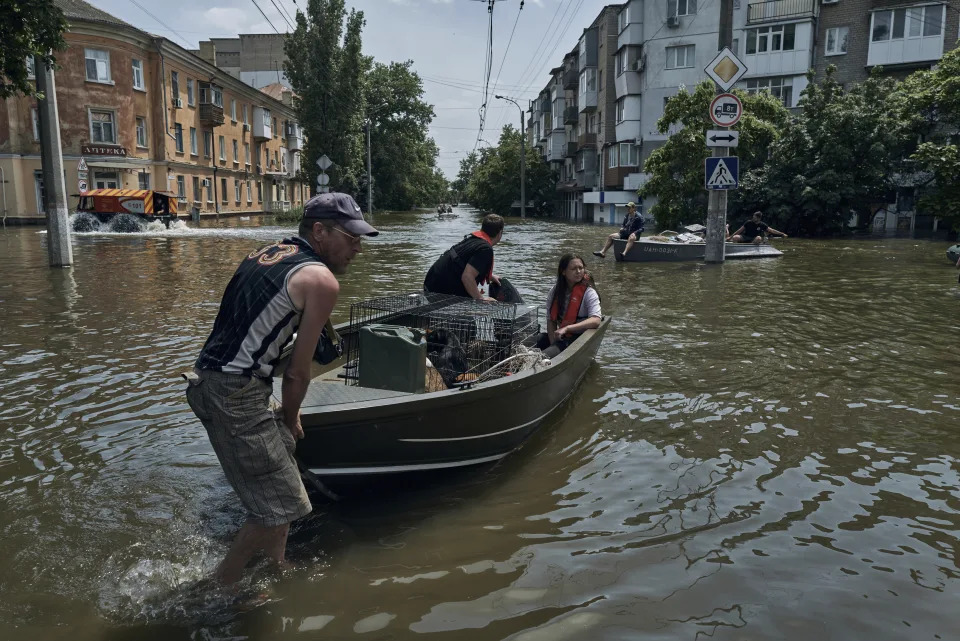
Broken windows and traces of fire are seen after a drone fell at a residential building in Voronezh, Russia, Friday, June 9, 2023. A Russian regional governor says three people were lightly wounded after a drone crashed into a residential building in central Voronezh, a city in southwestern Russia near the border with Ukraine. (Ara Kilanyants/Kommersant Publishing House via AP)People with pets are evacuated on a boat from a flooded neighbourhood in Kherson, Ukraine, Thursday, June 8, 2023. Floodwaters from a collapsed dam kept rising in southern Ukraine on Thursday, forcing hundreds of people to flee their homes in a major emergency operation that brought a dramatic new dimension to the war with Russia, now in its 16th month. (AP Photo/Libkos)Emergency workers evacuate an elderly resident from a flooded neighbourhood in Kherson, Ukraine, Thursday, June 8, 2023. Floodwaters from a collapsed dam kept rising in southern Ukraine on Thursday, forcing hundreds of people to flee their homes in a major emergency operation that brought a dramatic new dimension to the war with Russia, now in its 16th month. (AP Photo/Libkos)
KYIV, Ukraine (AP) — Russian President Vladimir Putin asserted Friday that Ukrainian troops have started a long-expected counteroffensive and were suffering “significant” losses. His comments came just hours after a string of drone strikes inside Russian territory.
It was Putin’s latest effort to shape the gut-wrenching narrative of the invasion he ordered more than 15 months ago, sparking widespread international condemnation and reviving Cold War-style tensions.
The conflict entered a complex new phase this week with the rupture of a Dnieper River dam that sent floodwaters gushing through a large swath of the front in southern Ukraine. Tens of thousands of civilians already facing the misery of regular shelling fled for higher ground on both sides of the swollen and sprawling waterway.
Kyiv has played down talk of a counteroffensive, reasoning that the less said about its military moves the better. Speaking after he visited flood zones on Thursday, Ukrainian President Volodymyr Zelenskyy said he was in touch with Ukrainian forces “in all the hottest areas” and praised an unspecified ”result” from their efforts.
Putin said Russian forces have the upper hand.
“We can clearly say the offensive has started, as indicated by the Ukrainian army’s use of strategic reserves,” Putin told reporters in Sochi, where he was meeting with heads of other states in the Eurasian Economic Union. “But the Ukrainian troops haven’t achieved their stated tasks in a single area of fighting.”
Kyiv has not specified whether reservists have been mobilized to the front, but its Western allies have poured firepower, defensive systems, and other military assets and advice into Ukraine, raising the stakes for the expected counteroffensive.
“We are seeing that the Ukrainian regime’s troops are suffering significant losses,” Putin said, without providing details. “It’s known that the offensive side suffers losses of 3 to 1 — it’s sort of classic — but in this case, the losses significantly exceed that classic level.”
On Friday, Ukrainian Deputy Defense Minister Hanna Maliar said Russia was on the defensive in the southeastern Zaporizhzhia province, though the epicenter of fighting remained in the east, particularly in the Donetsk region. She described “heavy battles” in Lyman, Bakhmut, Avdiivka and Marinka.
Valerii Shershen, a spokesperson for Ukraine’s armed forces in Zaporizhzhia, told Radio Liberty that they were searching for weaknesses in Russia’s defense, which Moscow was trying to strengthen by deploying mines, constructing fortifications and regrouping.
Earlier, regional authorities in southwest Russia near the Ukrainian border reported the latest flurry of drone strikes. The strikes have exposed the vulnerabilities of Moscow’s air defense systems.
The regional governor of Voronezh, Alexander Gusev, said on the Telegram app that a drone crashed into a high-rise apartment building in the city of the same name, injuring three residents who were hit by shards of glass. Russian state media published photos of windows blown out and damage to the facade.
Gusev said the drone was targeting a nearby airbase but veered off course after its signal was jammed. The city lies some 250 kilometers (155 miles) north of Ukraine’s Luhansk region, most of which is occupied by Russia.
Separately, Gov. Vyacheslav Gladkov of the neighboring Belgorod region, which also borders Ukraine, said air defenses had shot down two unspecified targets overnight. An apartment building and private homes were damaged, he said, without saying by what. He also said a drone fell on the roof of an office building in the city of Belgorod. It failed to detonate but caught fire on impact, causing “insignificant damage,” he wrote.
The leader of a third region of Russia, Kursk Gov. Roman Starovoit, said a drone crashed to the ground outside an oil depot and near water reservoirs in the local capital, causing no casualties or damage.
Ukrainian authorities have generally denied any role in attacks inside Russia. Such drone strikes — there was even one near the Kremlin — along with cross-border raids into southwestern Russia have brought the war home to Russians.
In Ukraine, the governor of the Kherson region, Oleksandr Prokudin, said Friday that water levels had decreased by about 20 centimeters (8 inches) overnight on the western bank of the Dnieper, which was inundated starting Tuesday after the breach of the Nova Kakhovka dam upstream.
Officials on both sides indicated that about 20 people have died in the flooding. The United Nations’ humanitarian coordinator in Ukraine, Denise Brown, visited the flood-hit town of Bilozerka on Friday, U.N. spokesman Stephane Dujarric said.
“Ms. Brown said that although initial estimates indicate that 17,000 people are being impacted in the areas controlled by Ukraine alone, it is important to understand that the crisis has not stopped and continues to evolve rapidly,” Dujarric said.
Kyiv accused Russia of blowing up the dam and its hydropower plant, which Russian forces controlled, while Moscow said Ukraine bombarded it.
The Norwegian earthquake center NORSAR said Friday that a seismological station in neighboring Romania recorded tremors in the vicinity of the dam at 2:54 a.m. Tuesday, around the time Zelenskyy said the breach occurred.
“What we can see from our data is that there was an explosion in the area of the dam as the same time as the dam broke,” NORSAR head of research Volker Oye told The Associated Press.
The Norwegian center is part of a global monitoring system that helps verify compliance with the Comprehensive Nuclear Test Ban Treaty.
Experts predicted the consequences of the dam’s collapse would last for months. Continued fighting in the region was bound to slow recovery efforts.
Viktor Vitovetskyi, a representative of Ukraine’s Emergency Service, said 46 municipalities in the Kherson region have flooded, 14 of them along the Russian-occupied eastern bank of the river.
Even as efforts were underway to rescue civilians and supply them with fresh water and other services, he said Russian shelling over the last day killed two civilians and injured 17 in the region.
Kozlowska reported from London. Jon Gambrell in Kyiv; Hanna Arhirova in Warsaw, Poland; Edit M. Lederer at the United Nations; and David Keyton in Stockholm, Sweden, contributed to this report.



 People wait in line for food at the annual Thanksgiving in the Park gathering where residents of the farmworker community of Immokalee are provided with a free Thanksgiving meal. (Photo by Spencer Platt/Getty Images)