Florida is now America’s inflation hotspot

CNN

Florida is now America’s inflation hotspot

Bryan Mena – July 10, 2023

Florida is America’s inflation hotspot, thanks to a persistent problem with sky-high housing costs.

The Miami-Fort Lauderdale-West Palm Beach area has the highest inflation rate of metro areas with more than 2.5 million residents, with a 9% inflation rate for the 12 months ended in April.

That’s more than double the national average of 4%, according to data from the Consumer Price Index. The Tampa-St. Petersburg-Clearwater metro had the third-highest inflation rate in the country, at 7.3% for the year ended in May.

Other metro areas, however, have seen some welcome progress. Minneapolis had an inflation rate of 1.8% in May from a year earlier, the lowest of the 23 metro areas for which the Labor Department publishes inflation data. Urban Hawaii had the second lowest inflation rate at 2% — mirroring the Federal Reserve’s target for its preferred inflation gauge, the Personal Consumption Expenditures index.

Here are some notable inflation trends for the biggest metros in the US and the dynamics behind those shifts.

A vexing inflation problem in the Sunshine State

In Florida, the state’s growing population has been pushing up inflation — particularly via housing costs. It’s a trend that accelerated during the pandemic, when remote work gave some Americans the freedom to relocate, economists say.

“A lot of people are still coming to Florida because the economy is really strong, and many like the fact that we don’t have an income tax like in New York, for example,” said Amanda Phalin, an economist at the University of Florida. “And in places like Miami, we’re seeing a lot of real estate demand from non-Floridians or non-American investors — generally wealthy folks who want to have a nice home here.”

Florida’s population grew the most of any state from July 2021 to July 2022 because of domestic migration, according to the Census Bureau’s latest estimates. During that same period, Florida also had the fastest population growth by percentage, the first time it has notched that top spot since 1957.

Housing costs account for almost a third of the Labor Department’s Consumer Price Index, and population gains heavily influence that component. An influx of residents boosts demand in a local economy across the board — for transportation, services and housing. That has pushed up inflation rates.

Rising interest rates, limited housing stock in cities such as Miami, and more expensive property insurance have also pushed up housing costs, Phalin said.

“Both the rental and purchasing markets are seeing upward pressures on prices from all these factors,” Phalin said. She added that there’s a shortage of available rental units because “a lot of homes are converting themselves into Airbnbs and some homeowner associations prohibit people from renting out their homes.”

That has all resulted in a growing affordability issue for residents who have lived in cities such as Miami and Tampa Bay for decades or their entire lives.

Progress on inflation

Housing costs also loom large in the metro area with the lowest inflation rate: Minneapolis and St. Paul.

“Shelter costs grew faster in Minneapolis and peaked a little bit earlier,” said Tyler Schipper, associate professor of economics at the University of St. Thomas in Minneapolis. “They peaked about six months before they did on average of the rest of the country.”

Also likely playing a role is how the Bureau of Labor Statistics tabulates shelter costs within the CPI and the timing of when readings are collected for various regions.

Shelter carries a lot of weight in the CPI calculations. However, it comes at a significant lag because of how infrequently the data is collected (every six months versus monthly or two months for other CPI prices) and because of how infrequently rents change (many leases are for 12 months, and rents typically are raised when a tenant leaves).

“I think that’s leading to this divergence where inflation peaked at about the same time for [the Twin Cities and the nation], but it just has dropped off faster here than in the rest of the country,” he said.

Helping that along has been a surge of multifamily construction, putting more apartments on the market and bringing down rents in the process.

Last year, multifamily permits made up nearly half of the total housing permits issued in the Federal Reserve Bank of Minneapolis’ district, which spans the Upper Midwest into the Mountain West. The activity — which was the highest share on record for that district, the regional Fed noted — is particularly evident in southeastern Minnesota, where large apartment projects are flourishing throughout the Twin Cities.

Even though the Twin Cities’ inflation rate is currently the lowest among major cities, it might not feel that way to residents, Schipper said.

“Because the CPI is so weighted toward housing, our overall numbers still looked really good, but those food prices went higher and stayed higher relative to other metro areas,” he said. “You’re going to have a hard time convincing people that inflation is getting better if their grocery store prices are still going up.”

Minneapolis resident Latoya Rogers isn’t feeling much price relief when she’s out getting groceries or buying other home goods. Aside from grabbing an item or two if she’s near a Target or a Cub grocery store, most of her shopping is done at Costco or Sam’s Club, she said.

“I budget a lot because things are so expensive these days,” she said during a quick run to Target in south Minneapolis. “Buying in bulk will last you longer.”

Still high, but doing better

At one point, the Atlanta-Sandy Springs-Roswell metro was America’s inflation hotspot.

Inflation soared in Atlanta for the reason it did in other cities in the South: The population grew, driven by Americans fleeing expensive coastal cities.

However, inflation in this metro area has come down steadily in the past year as supply and demand in the region’s housing market has come into better balance as migration into the city has slowed.

Atlanta notched an inflation rate of 5.8% in the 12 months ended in April — about half of the 11.7% peak it saw in August 2022.

“If you look at the data, housing inventory in Atlanta has increased quite a bit from a year ago, so there’s a lot more supply in the market, while the number of sales has been declining,” said Kaiji Chen, an economics professor at Emory University in Atlanta.

A drop in transportation costs also helped slow Atlanta’s inflation rate, he said.

The worst thing for Russia’s economy isn’t Western sanctions. It’s Putin.

Business Insider

The worst thing for Russia’s economy isn’t Western sanctions. It’s Putin.


Phil Rosen – July 10, 2023

Vladimir Putin has steered the Russian economy to the brink of catastrophe.
Vladimir Putin has steered the Russian economy to the brink of catastrophe.Anadolu Agency / Getty Images
  • Vladimir Putin has crippled Russia’s economy to fund the war in Ukraine, experts tell Insider.
  • Experts say the official data from Moscow suggests it’s faring far better than it actually is.
  • The ruble has is crashing, the labor force has seen an exodus, and civil war remains possible.

The West has imposed sweeping sanctions on Moscow since it launched its war on Ukraine last February, but much of Russia’s economic troubles can be chalked up to suspect and counterproductive leadership by Vladimir Putin.

Before the “special military operation” began, Russia was the 11th largest economy in the world, accounting for almost 40% of Europe Union’s natural gas imports and a quarter of its crude oil. A year and a half later, Putin’s turned Moscow into a pariah state, isolated from the global financial system, barred from its most lucrative trade routes, and in the midst of a worker brain drain. Experts say the damage has been largely self-inflicted.

Speaking with Insider on Monday, Yale researchers Jeffrey Sonnenfeld and Steven Tian said that Putin has lost the economic battle to a profound degree, and now he’s scrambling to maintain a status quo that’s quickly dissolving beneath his feet.

“He’s devouring core bedrock industries,” Sonnenfeld said. “The lion’s share of the economy is controlled by the state, the energy and financial sectors, and Putin is taking from the seed capital of those businesses to use as a cookie jar for his war chest.”

Trade will never be the same

Russia is barely breaking even on its energy trade, and most of its other top commodities like wheat, lumber, and metals sell cheaper today than before the invasion. The lack of trade income pushed Putin to levy draconian windfall taxes on businesses and individuals, which the Yale academics see as part of his “cannibalization” of the economy.

“Laying on onerous taxes is doing nothing for the economic health of the country, but they allow him to pay bills,” Sonnenfeld said.

Putin’s policy missteps became inevitable after he made the initial call to invade Ukraine, Tian said, adding that Russia’s trade status may never be the same. It’s become increasingly clear that other countries can get by just fine without Russia as a trading partner.

“He’s destroying the historical underpinnings of the Russian economy,” Tian said. “Its main exports have always been commodities, but now nobody needs to buy Russian commodities anymore.”

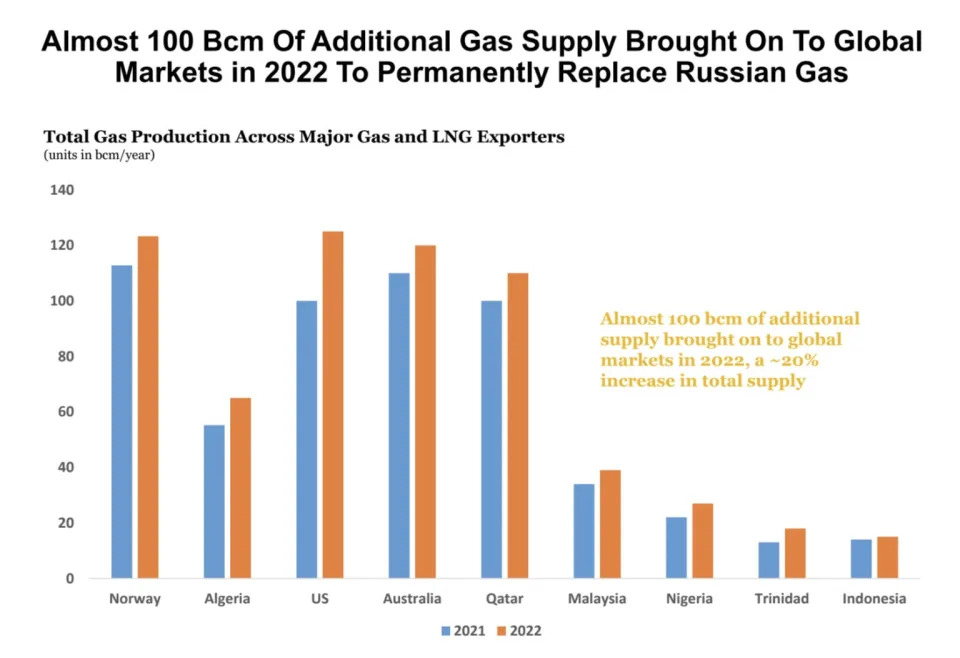
Yale data shared with Insider showed that Russia’s natural gas market in particular has been permanently lost.

The initial supply shock in February 2022 has quickly been overcome, with nearly 100 billion cubic metres of natural gas going online since then thanks to regasification projects commissioned across Europe. Germany has led nations including France, Netherlands, and Italy to develop new floating storage units that have come online in record time.

yale lng russia fuel energy
Russia’s LNG markets are permanently lost, according to Yale data. Gas production across other major exporters jumped following the invasion of Ukraine.Courtesy of Yale Chief Executive Leadership Institute

While China and India have stepped in as big buyers of cheap Russian crude since last year, steep discounts and lengthy shipping routes prevent those sales from propping up the Russian economy in a meaningful way.

“If Putin were on the call with us today, he couldn’t point to a single policy or economic positive for himself, the Russian people, or the economy,” Sonnenfeld said.

Potential for Soviet-style collapse

Volodymyr Lugovskyy, an economics professor at Indiana University, told me he expects to see a dramatic economic change within the next three or four months.

“Many people still don’t realize how bad the situation in Russia might be,” he said.

Official government data point to an economy that’s been able to withstand the costs of war, but under-the-hood numbers like retail sales, flight purchases, and business activity suggest otherwise.

“Things are much worse than the reported 2% drop in GDP,” Lugovskyy said. “Sales of new cars, sales of new computers, those dropped by 40% to 60%. And if you remove military activity from the data, production looks far worse [than reported].”

The country’s currency in particular looks vulnerable. After the Wagner Group’s attempted mutiny in June, the ruble crashed to a 15-month low. On Monday, it hovered just above 90 per dollar, but that could weaken to 149 per dollar, in Lugovskyy’s view.

A change in power, civil war, or another attempt at mutiny, the professor maintained, could drag on the exchange rate and ultimately lead to the collapse of the economy.

“Russia might collapse into multiple pieces, like the Soviet Union, and that might not be a bad thing for the world,” Lugovskyy said. “It’s resembling an empire right now, with a central power. Extreme events are highly possible.”

Toxic algae that can cause lung infections and neurological disorders is taking over a giant lake in Florida, and ecologists say the bloom will only grow

Business Insider

Toxic algae that can cause lung infections and neurological disorders is taking over a giant lake in Florida, and ecologists say the bloom will only grow

Katie Hawkinson – July 9, 2023

Boats sit at a dock while algae blooms turn the water green around them in Lake Okeechobee.
More than half of Lake Okeechobee is covered in algae blooms.Joe Raedle/Getty Images
  • Florida’s Lake Okeechobee is already half full with toxic algae, and the bloom will only grow.
  • Fumes from the algae can cause several health complications, like lung infections.
  • Climate warming and pollutant run-off from nearby crops help it thrive, experts say.

The largest freshwater lake in Florida, which is a draw for fishing and boating in the summer months, likely won’t see many faces this year.

That’s because Lake Okeechobee is already half-full with a bright green, toxic algae that researchers say will only grow as algae season continues on through the summer. The algae can cause several health complications, including lung infections, organ damage, and neurological disorders, The New York Times reports.

Experts told the Times the severity of this year’s bloom is, in large part, due to the warming climate that has resulted in increased rainfall and rising levels of carbon dioxide, which the algae feeds on. The algae also thrives among the fertilizer and manure that runs into the lake from nearby crops.

This is not a new problem for Florida. In 2018, former Governor Rick Scott declared a state of emergency across seven counties in an effort to combat the same toxic algae in Lake Okeechobee that was also inundating a nearby river.

Finding a solution to this toxic bloom has been a challenge.

Florida plans to build a reservoir to stop the algae from flowing out of the lake and into other bodies of water — though the Times reports that the reservoir would fill to capacity after depleting Okeechobee by only six inches.

Environmentalists are also calling on the state of Florida to implement rules limiting the run-off of pollutants from nearby crops that feed the algae, the Times reports.

This policy would take decades to make a large impact, thanks to the phosphorous-rich sediment already present in the lake.

Las Vegas Valley is making major changes to its landscape to keep up with its fast-growing population

TCD

Las Vegas Valley is making major changes to its landscape to keep up with its fast-growing population — here’s what’s happening

Mary Swansburg – July 9, 2023

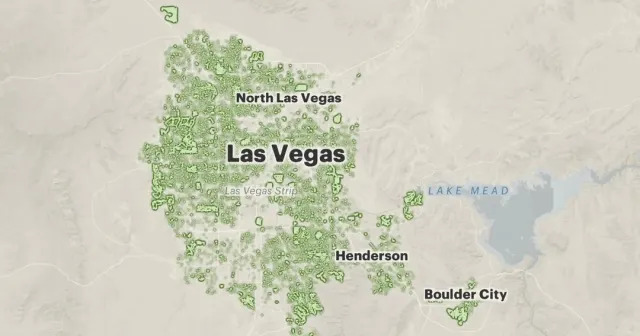
The Las Vegas Valley is working with its citizens to help them ditch their grassy yards and embrace Nevada’s natural landscape instead.

The news was shared in an article by ProPublica that was reposted on Reddit.

Las Vegas Valley landscape
Photo Credit: u/WhoIsJolyonWest / Reddit

The effort will conserve water and allow the population in Vegas to continue growing.

Community members have already done their part to conserve water indoors, and Nevada treats and recycles all indoor water. Outdoor water, however, cannot be recycled in the same way because it evaporates or settles into the ground.

Because of this, the state is turning toward grass reduction because growing grass in the desert climate requires a significant amount of water.

A similar plan has been utilized before and helped the conservation effort, but it encountered some pushback from homeowner associations (HOAs.) Also, some citizens want to preserve the aesthetic of green lawns, so the state is making an effort to find a compromise.

The state is targeting “nonfunctional” grass first, like grass that lines roadways and lakes, with the goal to get rid of all of it by 2027. Citizens upset about grass removal can submit an exemption request — many of which are approved — making the pushback from HOAs minimal.

In addition, some companies like Par 3 Landscape and Maintenance are offering ideas for alternative plantlife that is native to the area, such as evergreens and desert-friendly shrubs.

Families that choose to embrace the natural landscape will lower their water bills while leaving resources for the addition of new residents and businesses. On top of that, they’ll be helping to fight rising global temperatures.

Princeton reported that 800 million gallons of gasoline, which releases planet-warming gases, are used by lawn equipment each year, and an additional 17 million gallons are spilled in the process.

Plus, the Natural Resource Defense Council reported that lawns are responsible for consuming almost three trillion gallons of water each year. And when grass is grown outside of its natural habitat, it doesn’t benefit the local wildlife either.

One Redditor echoed this in the comments. “Lawns do NOT belong in the southwest,” they wrote.

Luckily, the Las Vegas Valley is setting a great example for communities looking to conserve water.

“If everyone else takes on similar initiatives, we’ll be able to sustain our community and communities across the Colorado River Basin for future generations,” said Howard Watts, Nevada state representative.

Texas considered a bill that would severely limit residents’ use of solar power: ‘[It] would turn all of Texas into an HOA’

TCD

Texas considered a bill that would severely limit residents’ use of solar power: ‘[It] would turn all of Texas into an HOA’

Laurelle Stelle – July 8, 2023

The Texas legislature recently considered a bill to heavily restrict the generation of wind and solar energy, University of Texas at Austin research scientist Joshua D. Rhodes revealed in a tweet.

The bill in question was Texas SB 624co-sponsored by Senators Lois Kolkhorst, Mayes Middleton, and Bryan Hughes. It would have established new permit requirements for affordable “renewable energy” — not for dirty energy sources, such as coal. In a win for clean energy, it failed to get out of committee.

According to the latest version of the bill (as of late May), any Texas resident with a large solar or wind system who wanted to connect to the grid would have needed a permit. The lengthy permitting process would have required a public meeting to allow comments, multiple surveys and assessments, and a website with information about the project.

SB 624 would also have required that wind turbines be placed a whole 3,000 feet — more than half a mile — away from the property line, except with the permission of neighboring property owners.

“Texas #SB624 would turn all of Texas into an HOA where your neighbors are now going to be able to tell you what you can and can’t do on your own property,” tweeted Rhodes.

As written, the bill applied to facilities with a capacity of 10 megawatts or higher to connect “with a transmission facility.” That wouldn’t include small residential systems, which are usually between one and four kilowatts (0.001 to 0.004 megawatts), according to Yes Energy Solutions.

However, it would have applied to the many wind farms set up by rural property owners across Texas, Rhodes said.

“Our current and expected fleet of renewables are set to pay landowners tens of billions of dollars over their lifetimes, but those Texans might get less if their neighbors protest,” he said in a comment.

Power Up Texas said the new bill would not only have harmed Texas landowners financially but would also have made the energy grid less stable and raise the cost of electricity for everyone.

According to state legislators, the bill’s purpose was to protect wildlife, water, and land from the effects of energy generation. But it’s telling that the proposed law applied only to nonpolluting wind and solar, rather than heavily polluting energy sources like coal and oil that have a much harsher impact on our air and our planet.

Putin is cannibalizing Russia’s economy as war in Ukraine derails financial order, Yale researchers say

Business Insider

Putin is cannibalizing Russia’s economy as war in Ukraine derails financial order, Yale researchers say

Jennifer Sor – July 8, 2023

putin russia flag
Russia’s President Vladimir Putin speaks at the victory ceremony at an Annual International Vladivostok Jigoro Kano Cadet Judo Tournament at Fetisov Arena, on Day 2 of the 2018 Eastern Economic ForumMikhail Klimentyev\TASS via Getty Images
  • Putin has begun a “merciless cannibalization” of Russia’s economy, two Yale academics said.
  • Researchers pointed to the chaos unfolding in Russia as Putin tries to cover the nation’s growing budget deficit.
  • Russia’s show of economic strength is a “facade,” the researchers said.

Vladimir Putin is ruining his nation’s economy, as the Russian president is derails the financial order in his quest to conquer Ukraine, according to two Yale researchers.

In a recent op-ed for TIME, Jeffrey Sonnenfeld and Steven Tian, two academics from the Yale Chief Executive Leadership Institute, pointed to the economic chaos unfolding in Russia as the war in Ukraine drags on.

Though some estimates show that Russia is spending surprisingly little on its “special military operation,” official statistics show that the nation has racked up around a $40 billion budget deficit so far this year, thanks to increased military spending and falling revenue as western sanctions bite into key sectors of its economy.

“Far from the prevailing narrative on how Putin funds his invasion, Putin’s financial lifeline has his merciless cannibalization of Russian economic productivity,” Sonnenfeld and Tian said. “He has been burning the living room furniture to fuel his battles in Ukraine, but that is now starting to backfire amidst a deafening silence and dearth of public support.”

Putin, for his part, has tried to shore up more money as the war effort continues, but has done so in ways that have largely ignored Russia’s fiscal responsibilities, the researchers said. That includes measures like printing record volumes of Russia’s ruble “out of thin air,” forcing institutions to buy “near-worthless” Russian debt assets, hefty windfall taxes on “basically anything that moves,” and taking billions out from Russia’s sovereign wealth fund to square the nation’s finances.

Those measures have contributed to the flight of millionaires and everyday workers, who have left the country to look for better opportunities, significantly hurting the nation’s output and productivity. And though Putin has made a show of Russia’s economic strength, his actions have only bought Russia more time, researchers warned.

“That resilience is nothing but a Potemkin façade, sustained not through genuine economic productivity but rather through shaking down the entire country for pennies to direct towards war,” Sonnenfeld and Tian said. “Putin can continue to sustain his invasion of Ukraine this way, but in doing so, continues to rip off his own people. In avoiding outright economic collapse by mortgaging Russia’s future, he grows more unloved by his people and is thus increasingly weakened.

Sonnenfeld and Tian have been critical of the state of Russia’s economy, despite Putin’s attempts to assure the public that Russia is doing just fine. Unpublished statistics from the Kremlin are likely to show a weaker picture of Russia’s economy than the government has led on, Sonnenfeld and Tian said, who previously argued that Russia’s economic figures were merely “cherry-picked” and that its economy was actually imploding.

“Amidst such undisguised plundering of the Russian economy, stripping it down for war toys, it is perhaps no surprise that Prigozhin’s failed putsch this past weekend revealed no lost love for Putin domestically from the Russian populace and elites,” the researchers said.

DeSantis’ veto of electric cars bill cost taxpayers $277 million, critics say

Orlando Sentinel

DeSantis’ veto of electric cars bill cost taxpayers $277 million, critics say

Jeffrey Schweers, Orlando Sentinel – July 7, 2023

Suzanne Cordeiro/AFP/GETTY IMAGES NORTH AMERICA/TNS

TALLAHASSEE — Gov. Ron DeSantis was more concerned about Iowa corn farmers than Florida taxpayers when he vetoed a popular bill that could have saved the state $277 million by adding electric vehicles to state and local government fleets, a Democratic critic says.

More EVs would mean less of a demand for ethanol, which is processed from corn grown in states such as Iowa, the expected home to the first presidential caucus next year.

It’s another example of DeSantis putting his own political ambitions to be president over the needs of Floridians, said Rep. Anna Eskamani, D-Orlando.

“The Iowa caucus voters who are all about ethanol don’t see electric vehicles as something that is economically in their favor,” Eskamani said. “DeSantis is catering to his Iowa voters, not passing policy for Floridians.”

The electric car bill, SB 284, sponsored by Sen. Jason Brodeur, R-Lake Mary, would have required all state and local governments, colleges and universities to buy vehicles based on their lowest lifetime costs. Current law requires such purchases to be based on fuel efficiency.

It ordered the Department of Management Services to make recommendations by July 1, 2024, to state agencies, colleges, universities and local governments about buying electric vehicles and other vehicles powered by renewable fuels.

“It allows us to look at procuring electric vehicles,” Brodeur said. “It doesn’t mean you have to purchase any.”

The governor’s veto last week was perplexing, supporters said. Both the Florida Natural Gas Association and the Sierra Club supported the measure, along with the Advanced Energy United and Electrification Coalition, a group that supports increasing the use of alternative-fuel vehicles.

“It was a common sense, good governance bill. There is nothing in this bill that any person in America should be against,” said former Sen. Jeff Brandes, a Tampa Bay Republican who tried getting similar legislation through last year.

The law could have saved state and local governments $277 million over 15 years by adding more electric vehicles to their fleets, said Michael Weiss, the Florida state lead at Advanced Energy United, a trade association of clean energy companies.

Advanced Energy United and the Electrification Coalition calculated the bill would have saved governments an average of $18,000 per vehicle by switching to an all-electric vehicle fleet, Weiss said. Using the state’s vehicle data provided by the Department of Management Services, they conducted a total cost analysis of the state’s fleet.

“This veto is a baffling decision that will cost Florida taxpayers millions of dollars,” Weiss said. “The Florida Legislature saw the clear economic and taxpayer benefits of a modern and efficient state fleet, but Gov. DeSantis somehow didn’t get the memo.”

It was only a few years ago that DeSantis touted the benefits of electric cars at a news conference announcing the construction of EV charging stations at rest stops along Florida’s Turnpike.

“It’s amazing how much cheaper it is to just charge a vehicle than to fill up a gas tank,” DeSantis said at the time. “And so as technology evolves, we hope that that’ll be reflected in people’s pocketbooks. So we want to make sure we have the infrastructure in place to make that a reality.”

His staff didn’t respond to a request to explain the veto.

The bill passed both chambers of the Legislature with just a single no vote, by Rep. Yvonne Hinson of Gainesville. But it is not likely anyone would even suggest trying to override the veto because of the governor’s immense grip on Tallahassee.

“That’s not going to happen,” Eskamani said.

Eskamani said DeSantis also has put personal politics first with culture war laws such as sexual orientation in schools, banning gay-themed books and drag shows, and making it harder for unions to collect dues.

She and other Democrats have pointed out problems such as soaring insurance premiums and a spike in housing costs that go unsolved.

“Not a single part of his agenda that passed is helping Floridians,” she said. “His agenda is tailored to the needs of Republican [primary and caucus voters].”

‘Woke’ isn’t going to die in DeSantis’ Florida. It’s just taking its dollars elsewhere

Miami Herald – Opinion

‘Woke’ isn’t going to die in DeSantis’ Florida. It’s just taking its dollars elsewhere | Opinion

The Miami Herald Editorial Board – July 7, 2023

Katie Goodale/USA TODAY NETWORK

Think of a dystopian, polarized country, where Americans are not only divided based on political beliefs but also on where they live and shop, what beer they drink, what doctors they visit, whether they are vaccinated, where they go on vacation and attend professional conferences.

This is what politicians who want to inject extremism (from the right or the left) into governing seem to want to accomplish: to reshape their communities so that only like-minded people feel comfortable co-existing.

Gov. Ron DeSantis has made no secret that his approach to governing is “You’re either with me or get the heck out.” He has signed laws and used state power against: teachers; transgender people; African Americans; women’s bodies; teachers and unions; university professors and academic freedom; universities that want to diversify their student body; immigrants; LGBTQ people and drag queens.

Most recently, DeSantis defended a bizarre and homophobic video his campaign shared on Twitter, calling it “fair game” to attack Donald Trump for past statements in support of LGBTQ rights. Not surprising coming from the governor of the state “where woke goes to die.”

The governor probably doesn’t lose sleep over the few conferences that Florida has lost recently as professional organizations take their dollars and thousands of attendees to states with less extreme policies. That blue parts of the state, Broward and Orange counties, lost the opportunity to host those events fit right into the governor’s strategy. DeSantis’ motto is to “own the libs.”

Two organizations canceled events that were planned in the Orlando area in coming years. AnitaB.org, a group of women and nonbinary tech workers, canceled a 2027 event that normally draws about 16,000 visitors. The group told the Orlando Sentinel it will no longer hold events in the state after this year’s conference at the Orange County Convention Center. The reasons are Florida’s abortion ban, its easing of gun regulations and the state’s efforts “to erase the identities and dignities of people from historically marginalized and excluded groups, including Black, Brown, LGBTQIA+, and Indigenous people.”

Broward County has lost more than half-dozen conferences, thanks to Florida’s political climate, organizers told the county’s tourism agency Visit Lauderdale, as the Sun Sentinel reported Friday. Among them is the 2024 National Family and Community Engagement and Community Schools Conference, which would have needed more than 2,000 hotel rooms. The organization “decided to pull out of Florida due to concerns about what the Governor is doing in the education/schools and that he will likely run in 2024. They do not want to lose attendees due to this,” according to a list of cancellations Visit Lauderdale put together.

The governor’s office told the Sun Sentinel the cancellations are “nothing more than a media-driven stunt.” His administration recently released numbers that show the number of tourists visiting the state is up compared to last year. Florida also welcomed nearly 320,000 new residents from other states between 2021 and 2022, according to the U.S. Census Bureau. DeSantis claims credit for those new residents but Florida benefits from a series of factors, such as the longstanding lack of state income taxes and the rise of remote work during the pandemic

Have DeSantis’ policies caused widespread financial ruin in Florida? No, though the hotels and conference centers that lost business might see it differently.

The bigger question is who DeSantis thinks Florida is for. Nonbinary tech workers are not his intended demographic. Neither are college professors, who have warned that the state’s crackdown on what they can teach regarding race is causing a brain drain. Nor are the undocumented workers who are leaving the state after DeSantis signed into law one of the most draconian immigration laws in the country (it requires, among other things, that immigrants disclose their citizenship status at hospitals).

Are these people leaving in big enough numbers to make a difference? We bet that’s the governor’s goal.

The Florida Blueprint he’s trying to sell to presidential primary voters doesn’t concern itself with having a diverse workforce, attracting the best and brightest or ensuring that Florida’s agriculture has enough people to work its fields. Its myopic focus is fighting the outsider — and there are more and more of those — and rewarding those who fall in line.

1 million Florida buildings will be overrun by sea-level rise by 2100, study shows

USA Today

1 million Florida buildings will be overrun by sea-level rise by 2100, study shows

Jim Waymer, USA TODAY NETWORK – July 5, 2023

Storms that ride in on seas rising due to global warming will displace millions of Floridians in low-lying areas by century’s end, according to a new analysis by a flood-risk research group.

Well before then, a higher ocean will force many to elevate their homes, similar to stilted homes on North Carolina’s Outer Banks, or else endure deadly surging floodwaters and sky-high insurance costs.

The lure of living beachside has long been Florida’s biggest draw. But with sea levels expected to rise one foot by 2030 and another three feet by the end of the century, many dream homes could become nightmares.

“If nobody acts, if nothing changes, by the end of the century there are approximately 1 million buildings that will be inundated in Florida,” said Adrian Santiago Tate, CEO/cofounder of HighTide Intelligence, a flood-risk data company that spun out of a research group at Stanford University. About 90% of those buildings are single-family homes. “We wanted to make this abstract idea of flooding mean something to people.”

Don’t believe it? Search your address on HighTide Intelligence’s platform Arkly.com and see for yourself. The site’s a work in progress, so not every home is there but if your home is, and at low elevation, it likely will pop up as at “high-risk” of flooding and property damages.

Derrick Lockhart, owner of Airboat Rides at Midway on the St. Johns  River just over the Brevard County line, says the flooding that followed Hurricane Ian last fall was the worst he had ever seen in the area.n(Credit: TIM SHORTT/ FLORIDA TODAY, TIM SHORTT/ FLORIDA TODAY)
Derrick Lockhart, owner of Airboat Rides at Midway on the St. Johns River just over the Brevard County line, says the flooding that followed Hurricane Ian last fall was the worst he had ever seen in the area.n(Credit: TIM SHORTT/ FLORIDA TODAY, TIM SHORTT/ FLORIDA TODAY)

Floridians already are feeling the pain. After last year’s hurricane season, Florida homeowners watched their premiums double or triple or got letters cancelling their policies. More than a dozen insurance companies either went belly up or just bailed on Florida altogether.

Satellite Beach and other coastal cities for years have been warning residents in the most vulnerable spots to start planning countermeasures now. To bring concrete data to those warnings, Satellite Beach hired HighTide Intelligence to do a $295,000, three-year study to assess flood risk from rising seas. The analysis was paid for in part by a $275,000 grant the city received from the Florida Department of Environmental Protection (DEP) to study ways to make the city more resilient to flooding and sea-level rise. The city chipped in $20,000.

Sparked in part by the Satellite Beach project, HighTide decided to make its statewide dataset of building-level flood risk available to the public in a new user-friendly website, Arkly.com.

Insurers and risk managers use the term “hundred-year storms” when assessing flooding risk. Such storms have about a 1% chance of striking in any given year based on historical data.

But don’t think such storms only roll around every 100 years. With global warming, such storms are striking with increasing frequency.

Statewide, HighTide found that within Florida’s 35 coastal counties, a once-in-a-century storm would:

  • Flood at least 1.28 million buildings, with potential for $261 billion in losses (2020 dollars).
  • By 2030, as the sea levels rise, it’s 1.3 million buildings and $270 billion.
  • By 2050, it’s 1.6 million buildings and $321 billion in losses.
  • Then by 2100, it’s 2.4 million buildings and whopping $624.5 billion in losses.

“Satellite Beach gets some credit for this,” Santiago Tate, CEO/cofounder of HighTide Intelligence, said of the city’s proactive stance on planning for sea-level rise. “They really wanted us to focus on the element of communicating risk.”

And for thousands in this small city of just 11,200 residents, that risk is mounting. Unless the city prepares, rising seas and powerful storms will put 2,200 households in Satellite Beach — half the city’s total — at risk and could inflict $142 million in flood damages to buildings by 2050, according to HighTide’s study.

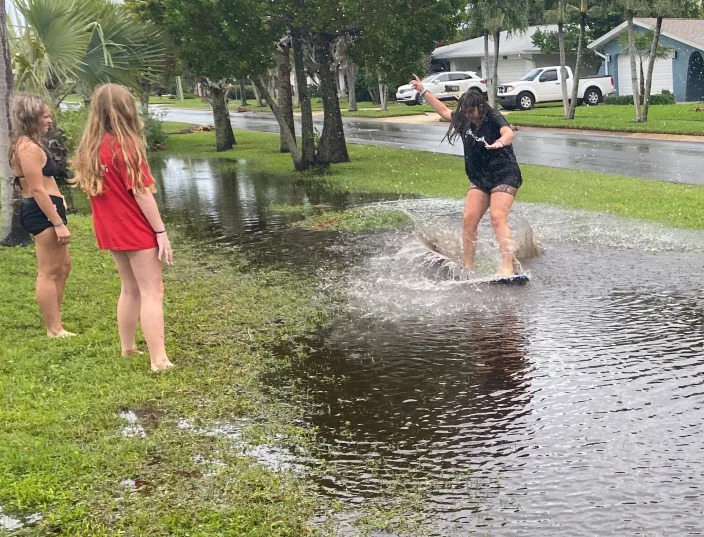
During the run-up to Hurricane Ian in October 2022, many teenagers decided to have some fun in the flooding. Rising sea levels are expected to make flooding a more common problem in Florida even in the absence of hurricanes.n(Credit: MALCOLM DENEMARK/FLORIDA TODAY)

Local governments can get insurance discounts for residents from Federal Emergency Management Agency’s National Flood Insurance Program (NFIP) by conducting floodplain management activities that qualify for points in what’s called the Community Rating System (CRS). Part of Satellite Beach’s effort is to improve the city’s rating.

Most of the vulnerable homes and infrastructure are on the city’s west side, along the low-lying banks of the Indian River Lagoon.

Don’t care about climate change?: Insurance rates might force you to.

How fast is sea level rising?
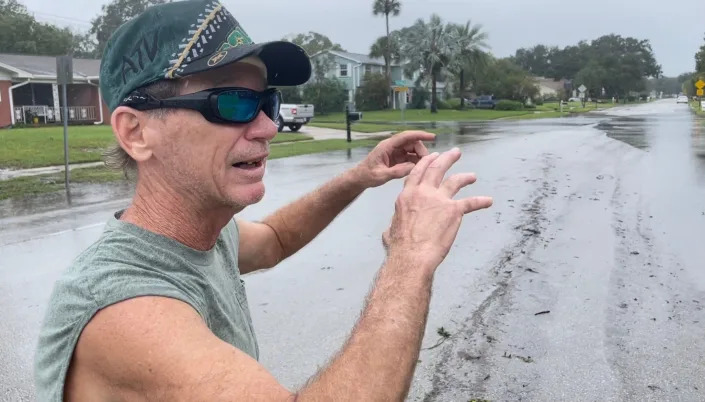
Lee Corbridge describes how this flooding near his family's home on Lantern Drive, north of Titusville, in late September, early October 2022 was the worst he has ever seen. Rising sea levels are expected to make flooding a more common problem in Florida even in the absence of hurricanes.
Lee Corbridge describes how this flooding near his family’s home on Lantern Drive, north of Titusville, in late September, early October 2022 was the worst he has ever seen. Rising sea levels are expected to make flooding a more common problem in Florida even in the absence of hurricanes.

On average, sea levels rose about 6 to 8 inches worldwide over the past century,  according to the National Oceanic and Atmospheric Administration. But the rate of rise has more than doubled since 2006.

Researchers at the University of Central Florida found sea level rise is accelerating in other parts of Florida such as Key West and Fernandina Beach. A study in Nature this past April on sea level rise along the Southeastern U.S. and Gulf of Mexico coasts echoed those findings.

Sea levels along the southeastern and Gulf Coasts already are rising faster than climate models predicted, the UCF researchers note, causing coastal erosion, high-tide flooding, saltwater contamination of freshwater aquifers and higher storm surges in Florida.

Hurricanes exacerbate the problem. Even a Category 1 storm could inundate more than 40% of Satellite Beach, according to a 2010 study for the city by Florida International University, and as sea level rises, it’s only going to get worse.

Governments usually opt for large-scale infrastructure projects to prevent flooding, such as levees, the Satellite Beach report notes. Those aren’t always best, though, because costs exceed benefits and can take decades for Congress to appropriate funds.

Meanwhile, property owners are left susceptible to storm flooding.

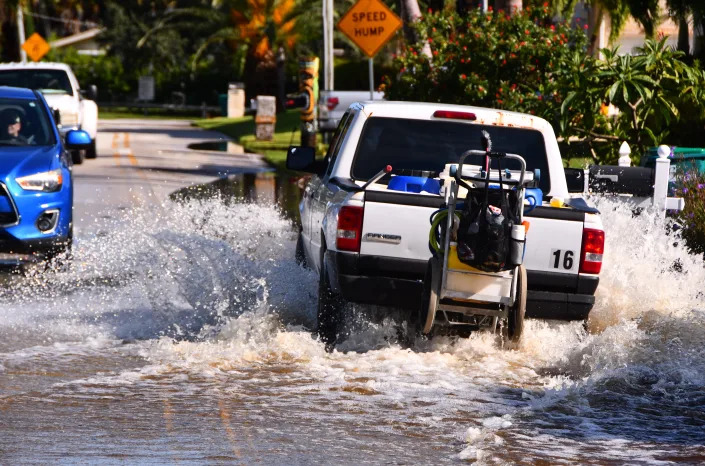
A truck makes its way down Milford Point Drive on Merritt Island after heavy rains pounded Brevard County in September 2022, flooding streets and yards. Rising sea levels are expected to make flooding a more common problem in Florida even in the absence of hurricanes.

HighTide’s study builds on two previous flood studies of Satellite Beach, including the one by Florida International University. At the time, the researchers in that study anticipated the tipping point toward “catastrophic inundation” — a 2-foot sea-level rise — in just 40 years for Satellite Beach. Now that’s less than 30 years away.

Rotting seaweed, dead fish, no sand: Climate change threatens to ruin US beaches

“I don’t really know how you get ahead on this,” said Randy Parkinson, the coastal geologist at Florida International University who coauthored the 2010 study.https://flo.uri.sh/story/1950403/embed

Complacency about flood risk jumped out at him during a recent drive down State Road A1A in south Brevard and into Indian River County, where the barrier island thins to just a few hundred feet wide.

“I couldn’t believe the number of new single-family homes still going in,” Parkinson said. “The real wakeup call is sadly when we get a Cat. 4 or Cat. 5 and it’s moving slow.”

Time will tell how many structures Satellite Beach and other Florida coastal cities will have to move to higher ground or elevate.

“It really depends on the timescale,” Santiago Tate said. “There’s only so much you can do to hold back Mother Nature.”

Contact Environment reporter Jim Waymer at jwaymer@floridatoday.com.

Food Industry Giants Must Fix Their Plastic Pollution

Civil Eats – Op-Ed:

Food Industry Giants Must Fix Their Plastic Pollution

McDonald’s, Coca-Cola, PepsiCo, and other major brands are creating massive amounts of plastic waste. Their initiatives are not enough and they need to be held accountable for the plastics crisis.

By Ashka Nail – July 6, 2023 

Plastic bottles for recycling are seen at a junkshop on April 11, 2023 in Manila, Philippines. (Photo by Ezra Acayan/Getty Images)

Plastic bottles for recycling are seen at a junkshop on April 11, 2023 in Manila, Philippines. (Photo by Ezra Acayan/Getty Images)

RELATED

Op-ed: Is There Plastic in Your Soda?

Beverage Companies Must Go Beyond Recycling

In the Food System and Beyond, Plastics Are the Problem

Ocean Plastic Is Bad, but Soil Plastic Pollution May Be Worse

Plastic has allowed many food industry giants to become the massive entities they are today. For example, Coca-Cola generates 3 million tons of plastic packaging a year; PepsiCo has been found to use nearly 2.3 billion tons of plastic each year for its bottles and packaging; and McDonald’s has been called out for generating the weight of “100 Eiffel Towers” worth of packaging waste.

It hasn’t always been this way. Plastic became the packaging material of choice in the mid-20th century, when it took over human imagination with its malleability, seeming ease of production, and strength. Its production increased threefold during WWII alone.

The political power of plastic also became palpable rather quickly with the emergence of plastic industry lobbying more than 30 years ago. Its primary function has been to fight laws designed to safeguard people and the planet from plastic’s well-documented toxicity. Plastic industry lobbyists also amped up their work as widespread concern grew about plastic’s presensce in the oceanin animalsin farming systems, and in the human body.  And while the industry has always had grand plans of recycling its plastic waste, most plastic is not recycled today.

“Predictably, when we take a closer look at some of these initiatives, what we find is not much evidence of meaningful or sustained progress.”

This lobby’s political power was also present in the corridors of the United Nations recently, as the majority of the world’s countries negotiated a legally binding agreement on plastic pollution focused on production, design, use, and disposal. In this context, the industry has worked diligently to position itself as a solution to a crisis it has avariciously fueled.

Over the years, in addition to making unverifiable commitments to reduce the use of plastic and ensure more of its products are recycled, the industry has convened at platforms like the Business Coalition for a Global Plastics Treaty, the World Economic Forum, Global Plastic Action Partnership, and the NextGen Consortium.

The industry has also judiciously crafted narratives about its commitment to solving this global emergency by supporting entities like the Ocean Cleanup, Ocean Conservancy’s Trash Free Seas Alliance, and World Wildlife Fund’s ReSource.

Predictably, when we take a closer look at some of these initiatives, what we find is not much evidence of meaningful or sustained progress. In fact, recent investigations have found that many corporations like Coca-Cola and PepsiCo have been backing these initiatives while using more plastic than even before.

There is also a litany of corporate doublespeak on plastic in the media. Take the recent New York Times article by Boyan Slat titled, “Reducing Plastic Pollution in Our Oceans Is Simpler Than You Think.”

Slat is the founder of Ocean Cleanup, “a nonprofit funded by donations and a range of philanthropic partners with the mission to rid the oceans of plastic.” In the article, Slat claims his program has salvaged “more than 0.2 percent of the plastic in the [garbage] patch so far,” and mentions the need for stopping “more plastic from flowing into the oceans,” but conspicuously shies away from calling on Coca-Cola and his other program partners to stop producing plastic.

Instead, he writes that “meaningful reductions in plastic use will be difficult to achieve.” Slat also blames the lagging waste management systems in middle- and lower-income countries for the majority of ocean plastic pollution without recognizing that much of the plastic waste from the Global North is in fact being dumped in middle- and lower-income countries—such as Vietnam, India, Indonesia, and Malaysia.

He fails to recognize the fact that it is often “waste colonialism” that forces these nations to become what Slat calls “hot spots” of plastic pollution.

Corporations often tout the fact that the Ellen MacArthur Foundation’s (EMF) New Plastics Economy Global Commitment reports on their plastic use. But if you dig deeper, the information it shares doesn’t provide much actual transparency.

For instance, its audit of PepsiCo says there is “no third-party verification or assurance in place.” Coca-Cola’s reporting on this portal yielded no concrete third-party reviewed progress, but more of the same—self reporting and more corporate marketing speech than evidence of verifiable progress. In fact, an analysis done by Oceana of the data from the 2022 progress report found that Coca-Cola increased its plastic packaging use by nearly 9 percent between 2020 and 2021, and PepsiCo increased its use of virgin plastic by 4.5 percent in 2021 compared with the previous year.

Another disturbing example of promises unkept comes from the world’s largest distributor of plastic toys, McDonald’s. It has publicly committed to “drastically reduce plastics in Happy Meal toys [including the latest toy, a replica of The Little Mermaid, a symbol of the ocean] around the globe and transition to more sustainable materials by the end of 2025.”

However, when some of the largest food and beverage corporations were surveyed by a conservation organization last year, McDonald’s emerged as one of only two whose “plastic intensity” was actually increasing. And then at the company’s annual meeting in May, McDonald’s faced investor scrutiny (p.101) for its staunch opposition to proposed EU plastic waste reduction laws.

The company distributes nearly 1 billion toys a yearevery year. To its credit, it claims that in Japan it has recovered toys to make trays that can be equivalent to approximately 0.75 percent of its annual global toy distribution. The number of recycled toys for other countries where it operates, and there are nearly 100 of them, are difficult to find; it’s not clear whether they even exist.

All these initiatives and commitments tell the true story of plastic. It is about time McDonald’s, Coca-Cola, PepsiCo, and other food and beverage companies own up to their role in fueling the plastics crisis, by eliminating the use of plastic from their entire supply chains immediately. For more than 80 years, Coca-Cola mainly used glass and aluminum, so it can be done! It’s time for these companies to devise business models that stop exploiting the planet, its ecosystems, and the public to benefit a handful of shareholders.

These corporations also need to be held accountable by legal systems and democratic institutions across the world for their inaction.

Yes, the power of plastic has proven potent in changing the course of our history, but lest the world forget, so has the power of the people to determine our collective future. It’s about time food and beverage companies stopped jeopardizing the viability of future generations of all species to have a livable planet to call home.

Ashka Naik is a director of research and policy at Corporate Accountability. Her work focuses on on strategic campaign development, corporate research, and equity-centered analysis of corporate power across issues that guide the vision and overall success of the campaigns. She also spearheads Corporate Accountability’s food program, which focuses on structural determinants and sociopolitical dimensions of food systems, nutrition, and public health, while uncovering industry’s influence in the policies and politics of global food security, sovereignty, and justice. Read more >