New York City’s mayor just conceded defeat to remote work—and declared war on the housing crisis. Here’s how it went down
Alena Botros – August 17, 2023
Lev Radin/VIEWpress—Getty Images
New York City officials, led by Mayor Eric Adams, announced a plan to convert empty office buildings across the heart of its central business district into housing at a news conference on Thursday. Although parts of this plan were announced previously, and it must clear several hurdles en route to implementation, it represents the nearest thing to an admission that the scourge of remote work has spread too far to turn back now.
He admitted as much. “COVID taught us something, if we want to acknowledge it or not, we are in a different norm,” Adams said. “Everything has changed, and we have to be willing to change with it.”
Earlier in the press conference, Adams kicked off with, “we know New Yorkers are struggling, you hear it all the time, every elected [official] in this city, the number one thing they hear is housing, housing, housing. And [there’s] just not enough of it, that’s the reality of it, the demand is not meeting the need.”
Before fully diving into aspects of the plan, Adams said the city has the potential to remove barriers to create more housing, “with a proposal to rewrite zoning regulations so unused office space can become homes for New Yorkers.” He added that it was unbelievable how much empty office space is “sitting idly by,” when it can be developed into housing to address the city’s housing crisis, while also “revitalizing” business districts, given that remote work is costing Manhattan more than $12 billion a year.
With this plan, an additional 136 million square feet of office space will be eligible for residential conversions, allowing the city to create 20,000 homes and house 40,000 New Yorkers. While this is a drop in the bucket in a city of more than 8 million where the median rent for all bedrooms and property types has skyrocketed to $3,750 a month, it’s a significant departure for a mayor who swore he would return midtown to its pre-pandemic state.
The mayor’s office plans to call on the state to create a tax incentive for office to housing conversions. Another part of the plan, Adams said, is that the creation of an “office conversions accelerator,” an interagency group that will work with property owners to help speed up conversions and quickly increase the city’s supply of homes.
But converting empty offices that might not return to their pre-pandemic occupancy levels any time soon into desperately needed housing is much more complicated to actually do than you might think. Several commercial real estate executives have told Fortune as much, mostly because it doesn’t make economic sense, with one calling it a “pipe dream,” and another saying that “it’s not the slam dunk that everybody thinks it is.” At the end of the day, they said, investors want a return, and affordable housing doesn’t make that easy.
Nonetheless, aside from actually converting office spaces to housing, Adams also mentioned something he called the “Midtown South Mixed-Use Neighborhood Plan.” It will create a mixed-use community by rezoning Midtown South, an area running roughly from the low 40s to 23rd Street, given that no new housing has been allowed in the area until now, Adams explained.
New York isn’t the only city to hatch a plan in hopes of killing two birds with one stone. Last month, Boston Mayor Michelle Wu announced a residential conversion plan for downtown offices. The pilot program plans to offer the owners of “underutilized” office buildings a property tax break of up to 75% of the standard residential tax rate (which is lower than the commercial tax rate) for up to 29 years in return for converting their properties to residential homes “immediately.”
Gen Z has seen their debts skyrocket 179% over the past couple years. Here’s what’s causing their balances to snowball — and how to control them
Dan Weil – August 17, 2023
Gen Z has seen their debts skyrocket 179% over the past couple years. Here’s what’s causing their balances to snowball — and how to control them
Entering adulthood is proving to be expensive for Generation Z, or those people born between 1997 and 2012. Just as the members of this generation are embarking on their careers, they’re also building up a hefty pile of debt — everything from mortgages to student loans, car loans and credit cards. And that debt can quickly start to balloon out of control.
In fact, Gen Zers aged 18 to 26 saw their overall debt burden soar 179% between 2021 and 2023, according to a recent study by LendingTree. That was the biggest change of any generation during that period, topping increases of 88% for millennials and 26% for Gen X. Meanwhile, baby boomers saw their debt burdens decrease nearly 16% in that timeframe.
But it’s not simply a case of young people spending recklessly — there are bigger issues at play. Here’s what’s really going on and how to get back on track if you’re snowed under too.
As with any social trend, there are a number of reasons Gen Z is now grappling with a hefty deft load. But the cost of living can’t be overlooked: It has become increasingly expensive to live in these inflationary days, and younger generations don’t have decades of savings to fall back on to get through.
Which may account for why the most typical type of debt Gen Zers carry is on their credit cards — a reality for nearly 77% of people in this generation, according to the report from LendingTree. Gen Z appears to deploy credit cards for spending large and small, as their card balances have climbed 174% over the past two years, data from LendingTree shows.
And then there’s the auto loans: Many young adults also need to purchase a car for getting to work and general transportation. But car prices have increased over the past two years, according to Consumer Reports, and that’s seen auto loan balances climb 59% over that time period, to an average of nearly $9,900.
Student loans also play a part, with nearly 35% of Gen Zers holding an outstanding balance. And higher education has grown more expensive over the years, which has then translated into a 135% increase in their student loan balances over the past two years.
Many Gen Zers also lean on personal loans to get set up in life, including paying for improvements on the homes they’re starting to buy (which of course adds mortgage balances to the pile of debt too) and other general expenses that start cropping up in adulthood. Gen Z personal loan balances jumped 207% in the last two years to an average balance of more than $1,900, according to the LendingTree report.
With all the odds stacked up against them, many Gen Zers may find it’s easy to get into debt, while getting out of it can feel next to impossible. Here’s how to get back in the black whatever generation you’re from.
Read more: ‘Hold onto your money’: Jeff Bezos says you might want to rethink buying a ‘new automobile, refrigerator, or whatever’ — here are 3 better recession-proof buys
Control your spending
One of the most straightforward ways to control your debt is to control your spending, be it on small things (a daily coffee) or big-ticket items (opting not to buy a new car if your current car runs perfectly well or can be repaired for a reasonable price). It may help to look at all your spending for the last month and figure out where you can cut back. Although you can’t necessarily count on this happening, you may be able to negotiate price reductions with your phone, Internet, TV, and energy providers, which will reduce your monthly spending.
Creating a budget — and more importantly, sticking to it — is one of the best ways to keep your spending on track. Doing so can not only help you to reduce your debt, it’ll also help you to boost your savings and meet your long-term financial goals.
Increase your income
Another way to reduce your debt is by finding ways to boost your income. If there’s a way for you to make more money — either at your current job or by picking up some work on the side — that extra cash will obviously give you more resources to pay down your debt and save more money.
You could also earn some extra cash by selling items online, renting out some space (a room or even a parking spot) or getting a housemate to split some of your housing costs. If you’re open to getting creative, there are all kinds of ways to make money these days.
Create a debt paydown strategy
Think strategically about dealing with your debt. If you have the option, paying off your debt with the highest interest rates first can usually save you lots in interest. The average credit card rate is now 24.37%, according to LendingTree.
If credit card debt is a problem for you, you might consider calling the card company to ask for a lower interest rate. In fact, 76% of people who asked for a lower interest rate on their credit card in the past year were granted one, according to a recent LendingTree survey. Creditors for your other loans also may be willing to reduce your interest rate, so it may be worth your time to simply ask.
Finally, if you’re dealing with multiple different monthly payments, debt consolidation can make that easier. Banks, credit unions and online lenders offer debt consolidation loans. These loans consolidate your unsecured debt — such as credit cards and medical bills — into a single loan with a fixed monthly payment. This strategy can make sense if the interest rate on your debt consolidation loan is lower than the combined rate on the loans to be consolidated. You’ll save on interest payments and potentially erase your debts sooner with a debt consolidation loan. And instead of making payments to multiple creditors each month, you’ll only make one — to pay off the new loan.
What to read next
Super-rich Americans are snatching up prime real estate abroad as US housing slumps — but here’s a sharp way to invest without having to move overseas
This Network of Regenerative Farmers Is Rethinking Chicken
The team at Tree-Range Farms is pioneering an approach to raising chickens and trees in tandem, storing more carbon and water in the soil while providing an entry point for new and BIPOC farmers often left out of the conventional system.
By Twilight Greenaway – August 16, 2023
Reginaldo Haslett-Marroquin, the founder of the Regenerative Agriculture Alliance and co-founder of Tree-Range Farms. Together the nonprofit and for-profit business have created an “ecosystem” that includes more than 40 farms and a processing plant in the Upper Midwest. (Photo credit: Leia Marasovich, Farmer’s Footprint)
This article was produced in partnership with Edible Communities; a version of this article will appear in future issues of local Edible magazines.
When you approach the poultry paddocks at Salvatierra Farms outside Northfield, Minnesota, you might not notice how many chickens are hiding among the tall grasses and young hazelnut trees at first. And that’s by design.
On a warm afternoon in June, 1,500 7-week-old hens had come out to mill around—lured by feed and water stations—but many were hard to find.
“There’s an eagle that comes around here,” says Reginaldo Haslett-Marroquin, the farmer and visionary behind the operation. “It has flown over a few times, and it just keeps going.” Soon, he adds, the trees and other perennials will be tall enough to provide cover for the birds, but the grass will suffice in the meantime.
One of several flocks raised at Organic Compound Farm in Fairibault, Minnesota, which helped pioneer and has been using the Tree-Range system for six years. (Photo courtesy of Wil Crombe/Organic Compound.)
Salvatierra, which was a conventional corn and soy operation until Haslett-Marroquin bought it three years ago, is in the midst of a wholesale transformation. He has planted more than 8,000 hazelnut trees there, created a water catchment pond, begun managing the forest that frames it on two sides, and leveled the land where he plans to build a home for his family.
This summer, he also raised the first flocks of chickens there. As it comes into maturity, Salvatierra stands to become a central hub around which a growing network of farmers, scientists, nonprofits, and funders will rotate—all in the name of regenerative poultry farming.
Regenerative is a complex term with many interpretations. Haslett-Marroquin’s approach combines what he learned growing up in Guatemala—where chickens thrive in multi-story jungles—with a deep understanding of the Midwest’s native ecosystems. Unlike the pasture-based model of poultry production which typically uses mobile barns and is sometimes also referred to as “regenerative,” it involves raising the birds in one spot, alongside trees and other perennial crops as a way to build soil that is rich with organic matter and carbon, capture and store water, and make the land on which it takes place more resilient in the face of the climate crisis.
The birds are fed outdoors, and the placement of the feeders help draw them out of their barns to eat insects and some plants. (Photo courtesy of Wil Crombe/Organic Compound.)
At the core of the effort in Minnesota is Tree-Range Farms, the company Haslett-Marroquin co-founded, and a growing network that includes more than 40 farms in the region. The Regenerative Agriculture Alliance (RAA), the nonprofit he founded and now sits on the board of, also plays a key, ongoing role in developing the infrastructure behind the network and has plans to scale it up to extend across the upper portion of the corn belt.
“Everything that is part of the standard was tried and tested, from breeds to how long you feed them, to the right kind of welfare aspect to consider in the coop construction.”
But the grand vision doesn’t end there. There are also farms using Haslett-Marroquin’s approach in Guatemala, Mexico, and in several Native American communities, including the Pine Ridge Reservation in South Dakota. And if its advocates have their way, the core practices and the philosophy behind it could be replicated in many parts of the world in the years to come.
And at a time when Americans eat more than 160 million servings of chicken every day and industrial poultry farming is known for polluting ground water, air, and waterways, as well as causing health issues for people who live nearby, it could be a welcome change.
How the Model Works
Like the chickens hiding in the grass, the sophistication of Haslett-Marroquin’s regenerative poultry system may be hard to spot for the untrained eye.
For years, he collaborated on research and development on his first farm, Finca Marisol, and on a nearby farm called Organic Compound in Faribault, Minnesota, to establish a production standard with very specific parameters.
Each poultry flock or “unit” includes 1,500 chickens, a barn, and 1.5 acres of land divided into two fenced in areas, or paddocks. The birds spend every day outside—where they eat a combination of dry grain, sprouted grain, bugs, and plants—in one paddock, and when the plants there have been sufficiently grazed down, they’re moved to a second one. Farms typically start with one unit, but they can also opt to start with half a unit if land is scarce.
Each flock in the Tree-Range system is made up of 1,500 birds on 1.5 acres of land. Most farmers raise more than one flock. (Photo courtesy of Wil Crombe/Organic Compound.)
“Everything that is part of the standard was tried and tested, from breeds to how long you feed them, to the right kind of welfare aspect to consider in the coop construction,” says Diane Christofore, the current executive director of the RAA, which brought in the funding for the research and development behind the standard. The organization recently launched an online course to train farmers in the practices and philosophy behind the standard; it is also making a number of scholarships available and will release a version in Spanish soon.
In addition to trees, farmers are encouraged to plant other perennials such as grasses, elderberry bushes, and comfrey. And if they grow corn and soybeans on the property, they are invited to diversify their rotations by adding oats for soil health. In eight to 12 weeks, farmers can take the birds to the small-scale processing plant that the RAA runs in Northern Iowa.
If they opt to sell them under the Tree-Range label, storage, distribution, and marketing are all taken care of, as the birds make their way to consumers in the Minneapolis-St. Paul region. Soon, Tree-Range plans to expand its reach to add retailers in Madison, Milwaukee, and Chicago.
The hope is to provide a relatively easy point of entry for beginning and immigrant farmers looking for a way to start earning capital quickly. With their short lifecycle and relevance across many cultures, chickens allow farmers to get onboard and join the network—or the “ecosystem,” as RAA refers to it—while renting land and/or working other jobs. Once the barn has been built—or adapted from an existing structure—the required labor is concentrated in the mornings and evenings, making it a relatively easy lift for new farmers.
“We’re creating this for the people that don’t have access to the [resources to engage in large-scale agriculture], but you’re also working with people who are still engaged in conventional ag, watching this, and asking, ‘How could I transition?’” says Christofore.
Many of farms raising birds for Tree-Range are run by former immigrants, such as Callejas Farm, where Jose and Erica Callejas, formerly from El Salvador, raise multiple flocks of chickens each year with their daughters. Or Carrillo Brother Farms, where Jesus and Aldo Carrillo—who immigrated from Mexico—raise one flock a year alongside a wide array of fruit and vegetables.
Feed the People Farm Cooperative is another interesting example. There, Cliff Martin has been raising two flocks a year on land that his dad owns as part of a collective with three other young farmers, including Helen Forsythe and Bec Ersek (who also works at the RAA’s business administrator).
They see the farm as part of a larger collective movement and the money they earn from the flocks goes toward maintaining the land, holding trainings and events for other young community organizers in the region. They’re also working on adding a composting processing site, neighbor approval pending. “We simply wouldn’t be doing this if it weren’t for the RAA’s infrastructure and support,” Forsythe said during a recent farm visit.
Haslett-Marroquin says there are more interested farmers than the RAA has the bandwidth to support at this point, so he’s confident that the network will continue to grow.
For one, he says, the modular approach to adding flocks to farms makes it relatively simple to replicate. After years of prototyping the system at Finca Marisol, he says everything fell into place very quickly at Salvatierra Farms, where he is starting with three units and plans to add three more in the coming year.
“There was no guesswork,” he says. “This thing happened as if I had done it a million times. And we could take 1,000 acres, 10,000 acres, or 1 million acres, and we’d know exactly what to do. That’s the difference between farm-level thinking and system-level thinking. And at the end, it’s that large scale that makes it truly regenerative, not the farm itself.”
Feed conversion ratio—or the relationship between the feed that goes into the animals and the final product—is a common metric for measuring financial success and environmental impact in meat production. But the RAA’s definition of regenerative turns that equation on its end.
“We are unleashing the original Indigenous intellect that makes us so powerful as human beings.”
The chickens in that system eat more grain than chickens raised solely in a barn because they move around much more. But the farms have an overall smaller footprint, because the added chicken manure boosts the productivity of the hazelnuts and other companion crops, without synthetic fertilizer. On 1.5 acres, mature hazelnut trees will produce around 800 to 1,200 pounds of nuts.
“Once you add up the output of meat, the output of hazelnuts, the large-scale sequestration of carbon,” Haslett-Marroquin says, “you can’t even compare it to a confinement model. It’s not apples to apples.”
At the core, his approach to food production is one that places productivity within a larger context of a balanced living system. It’s about “stewarding the transformation of energy from non-edible forms to edible ones,” and it’s a process that isn’t new, but on the contrary, quite old.
“We are unleashing the original Indigenous intellect that makes us so powerful as human beings. It is the one thing that all capitalistic, extractive, destructive systems hate. That’s why they will go and massacre Indigenous communities at mass scale, because they know that that intellect is so powerful that it can overcome the extractive system. And it can, in the end, save the planet,” he says, adding, “If you restore the people to the land, you can’t exploit them.”
The young farmers at Feed the People Farm, a collective operation that works with Tree-Range. (Photo courtesy of the Regenerative Agriculture Alliance)
The Science
Haslett-Marroquin is confident that the system he has developed works, but he knows that Western scientific research is key to scaling it up.
Beth Fisher, a soil scientists and assistant professor at Minnesota State University, Mankato, is part of a team of scientists in Minnesota that started measuring the health of the soil, water, and the emissions released from farms in 2021.
Fisher says she was approached by Haslett-Marroquin, who asked her to gather evidence to add validation to what he had long observed and understood intuitively about the way regenerative practices work on the ground. She was interested in the approach, but it was the visit to Finca Marisol, the first farm where birds and trees had been raised side by side for almost a dozen years, that sealed the deal.
“The soil structure is beautiful—you pull up a scoop and how it holds together on its own, is held together by the ooey gooey stuff that organic critters put into the soil,” she says. “Water infiltrates beautifully. It has a wonderful collection of organic matter.”
Since then, she and the undergraduate students she works with have been gathering samples of soil on a handful of farms in the network, as well as conventional corn and soy farms that neighbor them.
“At Finca Marisol, the comparison farm is considered reduced-till better practice. And it’s night and day; the [water] infiltration is way slower on the reduced till practice, the carbon storage is way less, and that farmer has been doing it for decades, really trying to do better in his practice. And the effect on his soil is negligible,” she says.
“At The Organic Compound, where they’ve raising chickens using regenerative practices for six years, they’re already in better shape than the neighboring conventional farm,” adds Fisher, who is hoping to start publishing some preliminary data soon.
Farmer and Tree-Range Farms co-founder Wil Crombie stands among the mature chestnut trees at the Organic Compound in June 2023. (Photo by Twilight Greenaway)
“We’ll be disseminating the results, both in the academic peer-reviewed literature, but also, I think it’s so important for it to find its way into the context where farmers can hear about it.”
Carrie Jennings, who is research and policy director at the nonprofit Freshwater, and an adjunct professor and researcher at the University of Minnesota, is another scientist engaged in the research. She points to the fact that the Cannon River, which runs through Minnesota and down to the Mississippi River, is one of the bodies of water that is most polluted by agriculture chemicals in the nation.
“The soil structure is beautiful…Water infiltrates beautifully. It has a wonderful collection of organic matter.”
And she has seen strong initial evidence that regenerative poultry system is sending water down into the aquifers below, rather than adding to that pollution. This is rare in Minnesota and other the parts of the corn belt, where the water on millions of acres drain directly to waterways due to the ceramic pipes, or drainage tiles, that were installed below farmland over the last century. The roots of the trees and other perennial plants on the farms in the RAA network, however, often break up and clog the tiles, preventing runoff and sending the water into the aquifer below.
Jennings is closely tracking the funds Minnesota is directing toward regenerative practices. “We want to make sure they’re funding the right practices; we don’t want them throwing away tax money on things that aren’t going to improve water, soil, and climate,” she says.
Jennings also wants to provide hard evidence for farmers looking to change their practices. “Farmers notice that their lives and waters are degrading over generations, and even within a generation. They’re not exactly happy about it, either. They know that they’re spending more than they should on chemicals. So, if someone like Regi[naldo], who is innovative and experimental entrepreneurial, can show that this works then it’s more likely to be adopted.”
She also points to the fact that General Mills has been funding the research for the first two years, as evidence of the potentially influential nature of Haslett-Marroquin’s approach. “They need to make sure [crops] can continue to be grown in this rapidly changing world. It’s important to the companies and the consumers of those products,” she adds.
Today’s food system is complex.
In addition to the research, General Mills is also funding the RAA’s farmer training and the establishment of its demonstration farm. “We have been inspired by the RAA’s thought leadership and continue to learn from the deep and holistic way they approach regenerative agriculture,” said a company representative in a statement to Civil Eats.
RAA collaborated with Oatly, General Mills, and number of other nonprofit and research entities in the region, on a $5 million climate-smart commodities grant from the U.S. Department of Agriculture (USDA) aimed at “support[ing] poultry producers who follow diversified, regenerative, climate-smart grain production methods incorporating small grains such as oats, no-till, and cover crops, integrated agroforestry practices.”
“It’s an opportunity now to start to produce grains within [the regenerative] system, because 70 percent of the cost to farm business is feed,” says Christofore.
Rethinking Processing and Growing the Network
Lack of accessible meat processing is a common barrier to entry for small-scale poultry producers. So, in prototyping a regional network of producers, the RAA—whose express goal is to make regenerative poultry production the norm—has invested in its own processing facility as a separate LLC.
A relatively small building in Northern Iowa—just over an hour south of Northfield—the facility was acquired in late 2021. That first year, the small staff processed 1,000 chickens. In 2022, it processed 50,000, and manager Arnulfo Perrera says he hopes to reach 80,000 to 90,000 birds this year.
After attending agricultural school in Honduras, Perrera came to the U.S. to work as a manager for Smithfield Foods, the nation’s largest pork producer. “That was not really like my calling—raising hogs in barns in the conventional systems,” he says of the experience.
A decade later, with a long-awaited green card, Perrera was able to leave Smithfield to take a role managing the RAA processing plant in 2022. Since leaving what he calls “the dark side,” he has staffed it up 14 people, despite its isolated rural location and the challenge of competing with larger companies in the region that can offer higher pay.
The Regenerative Ag Alliance processing team. (Photo courtesy of the Regenerative Agriculture Alliance)
But, ultimately, Perrera hopes to help create a new model, in an industry where ever-faster line speeds, crowded facilities, underage workers, and resistance to protecting workers’ health have become the norm. “I believe strongly that if the food is going to be sustainable and regenerative, it needs to be that way throughout [the food chain]. On the farm side, as well as the processing,” he says.
For Jose Morales, who has been at the plant since the RAA took ownership, the difference is palpable. The facility he worked at previously slaughtered 13,000 chickens every day of the year; 2,000 workers arrived in three shifts and worked 24 hours a day. He felt like one small cog in an enormous machine.
At the RAA facility, Morales says, he has had a say in shaping the workday and he’s helped train other employees. “We came up with a plan. Each person will be doing each job for two, maybe two and a half hours. So, you’re not doing the same thing all day.” It’s less repetitive motion, which is less difficult on everyone’s bodies, and all the workers at the plant are trained to work in all the roles. “It’s harder in the beginning, but then it’s better. When somebody’s calls in sick, or they don’t have a babysitter, we have somebody to call.”
Nonprofit meat processing plants are very rare, but Christifore, Haslett-Marroquin, and the rest of the team see the fact that they don’t have shareholders to appease as key to their approach.
The goal is to enable the proliferation and growth of the network of farms, and provide better jobs than many meat processing facilities. “If you’re doing it with integrity, there is not a lot of money to be made at that level of the supply chain,” says Christofore.
In stepping down from leading the RAA, Hasslet-Morroquin hopes the network moves toward a collective model of leadership based on a Mayan diagram that looks more like a circle than a pyramid. The idea is to create a strong system wherein everybody leads and follows at the same time, a reciprocal form of relationship-based accountability. “And if you do that, you unleash the energy of the people, and it is unbelievable. That’s why we call this an intellectual insurgency.”
Christofore echoes that idea. “We expect a certain level of participation, from those who want to commit to the ecosystem. And that’s when you start to care about things; it’s when you start to have ownership. It comes with a lot of responsibility and does require risk. But what comes with it is an opportunity to be a part of a culture and a community that’s growing.”
Hasslet-Morroquin has his sights set on reaching 250 farms on 50,000 acres in Minnesota, Iowa, and Wisconsin. From there, he can see the network expanding to five or six other regions around the U.S. until it reaches 500 million chickens. That type of growth sounds enormous, but it would still only be 5 percent of the total chicken raised in the U.S. And at that point, he says, a truly regenerative system would have some real leverage.
“At that point, we’ll look at the industry—the USDA, investors, markets, everybody, and say, ‘OK, folks, why should we only do 5 percent of the total poultry system this way when we can do 100 percent?’” says the visionary farmer. “I may not get there myself, but somebody else could get us there. It doesn’t matter how long it takes. We don’t plan for the next year to two; this is about the seven generations in front of us.”
Twilight Greenaway is the executive editor of Civil Eats. Her articles about food and farming have appeared in The New York Times, NPR.org, The Guardian, Food and Wine, Gastronomica, and Grist, among other.
New report shares the concerning reason why attendance at Disney’s theme parks is dropping — they’re becoming a ‘ghost town’
Leo Collis – August 15, 2023
The Happiest Place on Earth is seemingly not immune to the challenges of extreme weather.
According to InsideTheMagic.com, “Disney’s attendance has dropped substantially,” with some attendees reporting impacts at Disneyland and other parks, with Disney World appearing more like a “ghost town” than a thriving tourist destination.
And while it could be down to several factors, weather conditions appear to be one of the more common threads linking the trend.
What’s happening at Disney parks?
Walt Disney World in Orlando, Florida, has been snapped repeatedly by visitors as looking much emptier than usual.
Meanwhile, waiting times for rides during the typically hectic Fourth of July weekend were much shorter than usual.
One Reddit user even described the parks as “barren” in May.
Among the reasons cited for the drop in attendance, unpredictable weather conditions are a common explanation.
Why are weather conditions affecting guest numbers?
If you’ve ever been on a Disney vacation, you know it doesn’t come cheap. The cost of accommodation, tickets, food, drink, and gifts adds up in a hurry, and if you’ve paid in advance for any of the trip, it might be difficult to get that money back should the parks be forced to shut down — and that’s not to mention the disappointment of not being able to go.
Park closures in extreme weather conditions are not unheard of. In September 2022, for example, Hurricane Ian forced the closure of Disney World from the 28th to the 29th.
In other parts of the world, a typhoon warning in Hong Kong in July forced the Disneyland park there to close.
Then consider the impact of heat waves, which are exacerbated by excessive carbon emissions resulting from everyday human activity, not to mention those emitted in the parks.
Limited shade areas, long lines, crowded parks, and the cost of beverages may put some off from visiting the park in the summer months when hotter temperatures can be unsafe and problematic for visitors — especially those with children.
In 2017, ash clouds and orange skies greeted visitors at Disneyland in California following wildfires in the surrounding countryside. While the park wasn’t closed, nearby communities were evacuated, signaling that it would have caused problems for those staying in the area.
Extreme weather events like these are likely to become more common because of the effects of Earth’s rising temperatures, and spending money on what could be a wasted trip won’t appeal to many, which could lead to even sharper declines in visitor numbers.
What is Disney doing to deal with weather problems at its parks?
While there isn’t a lot Disney can do when it comes to the weather, it is making changes to tackle rising temperatures.
In 2022, it was announced that Disney World would be installing two 75-megawatt solar facilities that in addition to existing solar generation would power around 40% of the resort’s annual electricity needs.
Jeff Vahle, president of Walt Disney World Resort, told ABC News (via “Good Morning America“): “Our commitment to the environment goes beyond imagining a brighter, more sustainable future by putting possibility into practice to ensure a happier, healthier planet for all.”
Disney has said its aim is “to achieve net-zero emissions for direct operations by 2030.”
This city famous for its water is now at risk of running out — here’s how things changed so quickly
Sara Klimek – August 15, 2023
The Florida city of Zephyrhills is known for its water — notably the bottled water company with the same name. But ironically the city, located northeast of Tampa, is setting off alarm bells for that exact reason. According to a state report, Zephyrhills is expected to run out of drinking water within the next two decades.
What’s happening?
Population growth in the Sunshine State has been one of the primary reasons for its water stress. According to the National Association of Realtors, Florida’s population increased by 1.9% in 2022 and is expected to continue to increase in the coming years.
“Visitors to Florida and new residents assume there is no problem with water,” Virginia Haley, president of the Sarasota Convention & Visitors Bureau, said. “There has always just been the assumption about the availability of drinking water that it is going to be there.”
However, this is proving not to be the case. Over 3 billion gallons of water are used in Central and South Florida every day, Southwest Florida TV station WGCU reports — and the strain on the water system is increasing with the new population booms.
Why is this problematic?
The major water use in South Florida is for landscape irrigation, meaning watering lawns and golf courses. Landscape irrigation diverts water that could be otherwise used for drinking, bathing, and indoor household use, and it leaches fertilizers, chemicals, and pesticides into local waterways.
As its water continues to dwindle, Zephyrhills is expected to funnel more funds into sourcing water from other sources in the region. So far, the city council approved placing a development moratorium to reduce the strain on its water supply.
This will allow the council the time to consider the future of development in the city as well as how to increase the “impact fees” to cover the pressure that development puts on city services — like the water supply. In turn, this can make development more expensive and potentially decrease the cost efficiency of development in the region.
What’s being done?
Governments in Southern Florida are having to assess current water stocks as well as search for alternative sources of drinking water, such as recycled water or aquifers.
Municipalities may have to be more strict about how much water residents can use for nonessential purposes, like watering lawns, or restrict the time window homeowners can water their lawns to help encourage water conservation.
People can also do their part to help decrease water use. “Wait for the dishwasher to be full before you run out. Do a full load of laundry, not a partial load, and take shorter showers,” said South Florida Water Management District section leader Tom Colios.
Middle class Americans are moving straight into fire and drought because they can’t afford to live in the cities that are safer from climate change
Eliza Relman – August 15, 2023
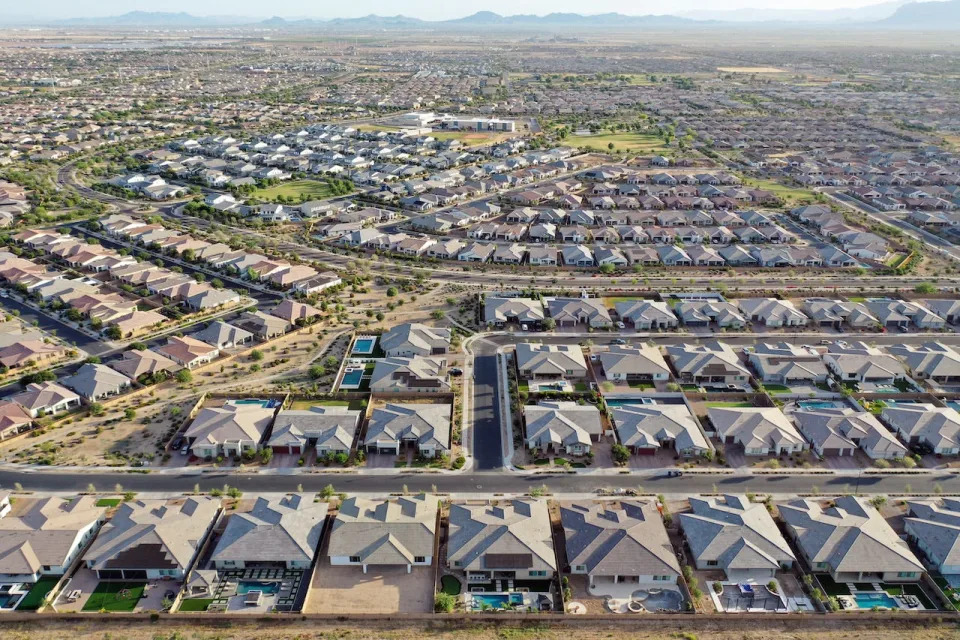
An aerial view of homes in the Phoenix suburbs on June 9, 2023 in Queen Creek, Arizona.Mario Tama/Getty Images
Rising housing costs have helped push Americans into parts of the country more vulnerable to climate change.
US counties that have the most at-risk homes are all growing in population.
The trend shows how the burden of climate change is falling disproportionately on less affluent people.
The skyrocketing cost of housing has pushed many Americans to trade their lives in big coastal cities like New York and San Francisco for more affordable ones in Sunbelt cities and Southern suburbs.
But that move could cost more in the long-run.
These more affordable regions of the country are also facing much more severe impacts of climate change, including extreme heat, wildfires, floods, and droughts. People are pouring into flood-prone Florida, moving into Houston not long after Hurricane Harvey devastated the city in 2017, and relocating to parts of the West and Southwest dealing with the worst droughts and wildfires in the country.
Rather than leaving areas at high risk of natural disasters and other climate issues, more Americans are moving into them. US counties that have the most at-risk homes are all growing in population, while those with the fewest at-risk homes are almost all losing residents, according to a 2021 Redfin analysis.
The pandemic exacerbated this trend. There’s been a recent spike in people moving from more expensive cities to lower-cost, smaller places farther from large metros and closer to natural amenities, in part due to the rise in remote work. These locations – like Bend, Oregon, which is vulnerable to wildfires — tend to be more at risk of natural disasters. The number of loan applications for homes in high-risk areas rose from 90,462 in February 2020 to 187,669 in February 2022, Freddie Mac reported.
In the longer-term, this trend will put many more Americans at risk of losing their homes to wildfires and floods, or being hurt or killed by extreme heat, or suffering from a lack of water. Rich people are already better able to protect themselves from natural disasters and other climate impacts, whether by fleeing, hiring private firefighters, or retrofitting their homes. But if lower-risk cities continue to price people out, the burden of climate change will fall even more disproportionately on less affluent communities.
Experts say there are ways that local, state, and federal governments can help to reverse this dangerous trend.
A recent Brookings Institution report recommended several ways that policymakers can encourage Americans to seek climate safety. First, the researchers say that Congress and the the Federal Housing Finance Agency should work with mortgage lenders and property insurers to factor climate risk into their rates, charging homeowners more based on how much risk they’re taking on.
Often, homebuyers don’t know what kinds of climate risks their property faces, so state and local governments should develop rules about what information needs to be disclosed to a potential homebuyer and then impose higher taxes on riskier property.
“Higher fees in risky areas serve two purposes: they encourage price-sensitive households to choose safer locations, and they also provide local governments with more revenue to upgrade the climate resilience of infrastructure,” Jenny Schuetz and Julia Gill of Brookings write.
Zoning and other land-use regulations, they argue, should be reformed to encourage more dense development in safer places and less sprawl into particularly climate-impacted areas.
Homeowners and landlords in riskier places also need to do more to retrofit homes to make them more fire and wind proof and more energy efficient. The researchers recommend that local policymakers think more carefully about where to invest infrastructure — including roads, schools, and water and sewage capacity — in climate-impacted areas to either discourage or encourage people to move to certain areas.
Republican-controlled states like Oklahoma are rushing to invest in clean energy, even as conservative groups push for more oil and gas
Chris Panella – August 14, 2023
Republican-controlled states across the country are seeing record investment in renewable energy industries.Jason Kozlowski / EyeEm
GOP-controlled states like Oklahoma are seeing major economic investment in clean energy industries.
A solar power exec told The New York Times the “financial opportunity” is drawing people in.
But conservative groups behind The Heritage Foundation are pushing for more fossil fuel production.
Across the US, Republican-controlled states are seeing major investments in clean energy such as wind and solar. But conservative groups are banning together to slash renewables and increase oil and gas production should a Republican be elected president in 2024.
The conservative-led Heritage Foundation’s policy playbook for renewable energy seeks to reverse regulations to rein in greenhouse gases, cut federal spending on wind and solar, and bolster oil and gas production. The plan is part of the foundation’s Project 2025, a sweeping agenda designed by dozens of conservative groups to “pave the way for an effective conservative administration” should a Republican be elected president in 2024.
No leading Republican presidential candidate has responded on whether they support the project, according to The New York Times, but several officials involved were former members of the Trump administration and their plans match Trump’s 2024 platform.
But as The Heritage Foundation pushes back against renewables, clean energy companies and projects are leading the way in Republican-led states. About two-thirds of new clean energy investment is in Republican states such as Oklahoma, Texas, and South Dakota, the Times reported.
A solar farm plan in Arkansas, for example, will be the state’s largest and power a major nearby US Steel factory by late 2024, which the company Entergy says will help them meet their sustainability goals and cut the steel factory’s greenhouse gas emissions by 80%, the Times reported.
And in Oklahoma, economics takes precedence over politics, as renewables lead to record profits.
“The environmental benefits are nice,” J.W. Peters, president of Solar Power of Oklahoma, told the Times, “but most people are doing this for the financial opportunity.”
Ill. Gov. Pritzker signs bill allowing gun makers to be sued for marketing to minors
Joe Fisher – August 13, 2023
Illinois Gov. J.B. Pritzker discusses the newly signed Firearm Industry Responsibility Act during the Everytown for Gun Safety conference in Chicago on Saturday. Photo courtesy of Illinois Governors Office/Twitter
Aug. 13 (UPI) — Firearm manufacturers and retailers can be sued in Illinois for marketing toward minors according to a new bill signed by Gov. J.B. Pritzker.
The Illinois governor signed the bill on Saturday, a day after the state Supreme Court ruled 4-3 to uphold a ban on some high-powered guns and high-capacity magazines.
The measure, called the Firearm Industry Responsibility Act, mirrors similar laws for opioid manufacturers and vaping companies, Pritzker said while discussing the law during the Everytown for Gun Safety conference in Chicago.
“I know we’ve had enough of ‘thoughts and prayers,’ together we’ve taken on the gun lobby and made real change with @Everytown,” Pritzker tweeted on Saturday. “We go further today by signing the Firearm Industry Responsibility Act into law holding gun manufacturers accountable.”
Illinois Gov. J.B. Pritzker likened the newly signed Firearm Industry Responsibility Act to laws that allow opioid manufacturers and vaping companies to be sued for their marketing tactics. File Photo by Bill Greenblatt/UPI
Under the law, firearm businesses can be sued for advertising to people under the age of 18 as well as businesses that do not take measures to stop illegal sales or sell firearms to a person who is not legally allowed to possess them. It also restricts certain imagery from being used in firearms advertisements.
Illinois is the eighth state to enact such a law.
“The Firearms Industry Responsibility Act will clarify my office’s ability to use the Consumer Fraud and Deceptive Business Practices Act, which is a primary tool available to hold businesses accountable for fraudulent or deceptive practices through civil litigation,” Attorney General Kwame Raoul said in a statement in May.
“It is how my office has protected the public from opioid manufacturers, vaping companies, tobacco companies and predatory lenders. No single industry should be given a free pass to engage in unlawful, unfair or deceptive conduct.”
Vivek Ramaswamy says US ‘climate change agenda’ is a ‘hoax’
Nick Robertson – August 12, 2023
GOP presidential candidate Vivek Ramaswamy railed against climate-conscious business policy at an Iowa State Fair appearance Saturday.
In an fireside chat with Iowa Gov. Kim Reynolds, Ramaswamy said that environmental, social, and corporate governance (ESG) business policies are among the “grave threats to liberty,” and said “the climate change agenda” is a “hoax.”
“They’re using our money… to implement social and environmental agendas through the backdoor. Through corporate America,” Ramaswamy said. “Using your retirement funds and your investment accounts to vote for racial equity audits or Scope 3 emissions caps that you didn’t know they were using your money to do, and that Congress would have never passed through the front door.”
ESG has become a political punching bag for conservatives, who view it as corporations overreaching into the political space. The policies increase diverse hiring, reduce carbon emissions and manage how they invest their money with climate in mind.
“This is actually one of the grave threats to liberty today. Wherever you stand on climate change — I think most of the climate change agenda is, I’m just going to say it, is a hoax,” Ramaswamy said. “I’m going to call that for what it is.”
The entrepreneur also claimed ESG is comparable to the “back-rooms deals” of Old World Europe, and called for more public debate on the topic.
“Wherever you stand on that, we should settle that through free space and open debate in the public square in a constitutional republic,” he said. “That’s the way we do things, post-1776, on this side of the Atlantic.”
Conservatives’ crusade against ESG has drawn ire from Democrats, who have called many of the follies a waste of time. Rep. Katie Porter (D-Calif.) called a House hearing over the issue the “stupidest hearing I’ve ever been to.”
Ramaswamy’s campaign has gained steam in recent months, rising from an unknown political figure to third in national polling averages — passing former Vice President Mike Pence last month. A biotech entrepreneur from Ohio, Ramaswamy has garnered about 7 percent support in recent polls.
Bone dry on the range: Texas cattle ranchers battle drought, extreme heat
Evan Garcia – August 10, 2023
Cattle move throughout a pasture during a heat wave in Tennessee ColonyRancher David Henderson watches his herd of cattle after pouring them animal feed on his ranch in Tennessee ColonyCattle gather in the shade during a heat wave in Tennessee Colony
TENNESSEE COLONY, Texas (Reuters) – The brown and black cattle of Texas, beloved symbols of the Lone Star state, walk through desiccated grass and stand in shrunken watering holes while their ranchers struggle to get them enough food.
For the second summer in a row, drought and extreme heat are stressing the health of cattle in Texas – the top beef-producing state in the U.S. by far – leading some ranchers to think about thinning their herds to save money on animal feed and hay.
“The grass is just not growing and primarily because it’s thirsty,” said rancher David Henderson. “Now we hit August and this is normally our hottest, driest time of the year … and the only thing I can think of, sometimes it calls for selling cows.”Henderson, 62, manages a herd of about 150 cows in Tennessee Colony in East Texas, and said he sold roughly 30 cows in 2022 due to the drought.
Dry conditions last year drove ranchers in East Texas to sell more than 2.66 million cattle from January 2022 through August 2022 — an increase of more than 480,000 cattle compared to that time period the previous year, according to the Texas Farm Bureau.
Texas State Climatologist John Nielsen-Gammon predicts extreme heat spurred by global warming will become the norm.
“Well, certainly for the next few decades, the trends are going to continue,” Nielsen-Gammon said. “This sort of heat will become normal in the summertime for Texas. And that, in addition, means that the heat extremes will be that much hotter and that much more severe.”
The drought, triple-digit heat and lack of food impacts just about every facet of the cattle industry – how much milk the calves get, how the cows fatten up, how much they reproduce, and how much that coveted steak will cost.
Jimmy Reed owns the Cattle Ranch Supply store in Tennessee Colony and, with pastures diminished, has been sending out feed deliveries to ranchers in early August instead of the normal time in mid-November.
“With everybody wanting to eat that rib eye and that T-Bone or those ribs, there’s going to be less supply. So the price of beef will once again take a rise,” Reed said.
Rancher Corey Davis, 39, said after plentiful spring rains he had been optimistic.
“This year, I thought being a young farmer, I said, ‘Well, we’re going to make a bunch of hay,'” Davis said.
“I was excited and you know, four or five months later, no rain for a month. So, we’re back in a drought again.”
(Reporting by Evan Garcia; Writing by Mary Milliken; Editing by Rosalba O’Brien)



 Reginaldo Haslett-Marroquin, the founder of the Regenerative Agriculture Alliance and co-founder of Tree-Range Farms. Together the nonprofit and for-profit business have created an “ecosystem” that includes more than 40 farms and a processing plant in the Upper Midwest. (Photo credit: Leia Marasovich, Farmer’s Footprint)