“The end of Trump’s financial empire”: Legal experts say N.Y. fraud ruling could bring him down

Salon

“The end of Trump’s financial empire”: Legal experts say N.Y. fraud ruling could bring him down

Areeba Shah – September 27, 2023

Donald Trump; Trump Tower Photo illustration by Salon/Getty Images

Donald Trump committed massive fraud in New York for years by repeatedly misrepresenting his wealth by hundreds of millions of dollars while building his real estate empire, a state Supreme Court judge ruled on Tuesday afternoon.

This startling decision came in the civil case brought by New York Attorney General Letitia James, who has argued that Trump, along his sons Donald Jr. and Eric and the entire Trump Organization, had “grossly” inflated the value of more than a dozen assets by hundreds of millions in total, and then used those fake values to defraud banks and insurers in order to obtain more favorable deals and secure loans.

James argued that Trump routinely overstated his net worth to financial institutions by between $812 million to $2.2 billion, depending on the year and the specific applications he filed, and is seeking a penalty of about $250 million in a trial scheduled to begin Oct. 2.

New York Supreme Court Judge Arthur Engoron, who issued the summary judgment on Tuesday, ordered that some of Trump’s business licenses be rescinded as punishment and ordered that an outside “receiver” must be appointed to supervise the management of those Trump properties. The ultimate outcome could well be the end of Trump’s ability to do business in the state.

Trump and his adult sons are now “barred from doing business in New York forever” under Engoron’s ruling, said Catherine Ross, a constitutional law professor at George Washington University. “And given that New York was the home base of their business, the base of their fortune, of Trump’s reputation, his credibility, his integrity — it’s all been found lacking.” The former president “is not a good businessman,” she added. “He’s a conman.”

Tuesday’s ruling came summary judgment, a decision indicating that there is no need for a jury trial because the evidence is “so strong” for one side, Ross explained, that no reasonable jury could reach a different decision.

Engoron’s ruling amounts to saying “that the New York attorney general presented an ironclad, well-documented case backed up with lots of evidence,” Ross said. In fact, she added, Engoron had already “lambasted Trump’s lawyers for trying to resuscitate defense arguments and positions that he had already expressly rejected and for essentially misleading the court in a number of instances.”

This decision was viewed as a surprise by legal observers and is clearly a major victory for James, who has been investigating claims since March 2019 that Trump and other executives at his companies had manipulated the values of various properties in order to get better deals from banks and insurers. She filed a lawsuit in September 2022.

Though the trial will determine the exact magnitude of the financial penalty inflicted on the Trumps and their business entity, Engoron has already granted one of the biggest punishments James pursued: the cancellation of business certificates that allow some of Trump’s New York properties, including the Trump Organization itself, to operate in the state. That could have major repercussions for the Trump family business.

This decision “signals the end of Trump’s financial empire,” Bennett Gershman, a former New York prosecutor and law professor at Pace University, told Salon.

“The judge declared that Trump and his family are guilty of a massive, staggering fraud in overvaluing his properties,” Gershman said. “The only issue left to be decided is the penalty to be imposed on him.”

The ruling, if it survives the appeals that are sure to follow, would deprive Trump of his ability to exercise control over critical properties in the state, particularly with regard to strategic and financial decisions. This would effectively dismantle a large portion of the former president’s business empire, and could destabilize his financial standing.

“This ruling cripples [Trump’s] ability to engage in business activities anywhere, and completely terminates his ability to do business in New York state,” Gershman said, adding that Manhattan District Attorney Alvin Bragg could now decide to reopen “his criminal investigation of Trump for falsely stating the value of his properties.” Bragg had earlier declined to prosecute Trump on those charges.

The former president has “boasted” that his personal net worth in the billions, Gershman added, although many observers have concluded that is unlikely. “The truth is that his net worth is far, far less than that,” Gershman said. “The consequences of this ruling and the upcoming trial, while not making him a pauper, will significantly reduce his net worth.”

According to Engoron’s ruling, Trump, along with his company and key executives, engaged in a pattern of false statements about their financial status in annual statements. This resulted in more favorable loan conditions and reduced insurance expenses, among other tangible benefits, the judge found.

Furthermore, these deceptive tactics violated legal boundaries, Engoron said, despite the arguments by Trump’s lawyers that a disclaimer attached to his financial statements absolved him of liability.

“In defendants’ world: rent regulated apartments are worth the same as unregulated apartments; restricted land is worth the same as unrestricted land; restrictions can evaporate into thin air; a disclaimer by one party casting responsibility on another party exonerates the other party’s lies,” Engoron wrote in his 35-page ruling. “That is a fantasy world, not the real world.”

The judge ordered that Trump and the other defendants provide the names of potential independent receivers “to manage the dissolution of the canceled LLCs,” meaning the various Trump business entities, within 10 days of the ruling.

No member of the Trump family will have control over the properties in question, and according to Ross it is “very likely” that many or most will be sold to compensate for the Trumps’ fraudulent gains, a process similar to the “liquidation” that occurs in bankruptcy proceedings.

One notable finding in Engoron’s decision was that Trump had continuously overvalued Mar-a-Lago, his private club in Palm Beach, inflating its value on one financial statement by as much as 2,300%, The Associated Press reported. Engoron also challenged Trump’s claim about the size of his apartment in Manhattan’s Trump Tower, which the former president on at least one occasion had asserted was 30,000 square feet, nearly three times its actual size. Trump had estimated the apartment’s market value at $327 million, a patently implausible number even in the New York City real estate market.

“A discrepancy of this order of magnitude, by a real estate developer sizing up his own living space of decades, can only be considered fraud,” Engoron wrote.

Former federal prosecutor Neama Rahmani told Salon that while the former president is a “fraudster,” his supporters will continue to claim that “he’s a good businessman,” adding that Trump has “proven time and again that he can survive these sorts of stains on him and his company.”

As far as Trump’s business ventures go, Rahmani said: “He’s done doing business in New York. He’s just done.”

In their own motion for summary judgment, Trump’s legal team had asked the judge to dismiss the case, contending that there was no evidence that the public had been harmed by Trump’s actions. They also argued that many of the allegations in the lawsuit were barred by the statute of limitations.

Engoron noted that he had rejected those arguments earlier in the case, and fined Trump’s five defense lawyers $7,500 each as punishment for “engaging in repetitive, frivolous” arguments.

James’ lawsuit is just one of many legal challenges confronting Trump, who remains the frontrunner for the 2024 Republican presidential nomination. Over the past six months, the former president has faced four criminal indictments and is also facing a second defamation suit filed by writer E. Jean Carroll, who earlier won a civil verdict against Trump for sexually assaulting her in the 1990s.

“Maybe this will affect the public’s perception of him not only as an obstructer of justice, who undermined national security and sought to unlawfully undo a fair election, but also as a financial cheat,” Gershman said.

Ross added that Trump “seems to be leveraged up to his eyeballs,” facing “enormous debts” and rapidly mounting legal bills. And this decision creates further legal jeopardy for him, she added.

“If he were to consider taking the stand in one of the many pending cases against him, whether criminal or civil,” Ross said, “this finding of fraud could be used by the other side — by the prosecution, or the other party in a civil case — to impeach his testimony. Fraud goes to the essence of whether you tell the truth.”

Judge rules Donald Trump defrauded banks, insurers while building real estate empire

Associated Press – U.S. News

Judge rules Donald Trump defrauded banks, insurers while building real estate empire

By Michael R. Sisak – September 26, 2023

FILE - Former President Donald Trump pauses before ending his remarks at a rally in Summerville, S.C., Sept. 25, 2023. A New York judge ruled, Tuesday, Sept. 26, 2023, that the former president and his company committed fraud for years while building the real estate empire that catapulted him to fame and the White House. (AP Photo/Artie Walker Jr., File)
FILE – Former President Donald Trump pauses before ending his remarks at a rally in Summerville, S.C., Sept. 25, 2023. A New York judge ruled, Tuesday, Sept. 26, 2023, that the former president and his company committed fraud for years while building the real estate empire that catapulted him to fame and the White House. (AP Photo/Artie Walker Jr., File)

NEW YORK (AP) — A judge ruled Tuesday that Donald Trump committed fraud for years while building the real estate empire that catapulted him to fame and the White House.

Judge Arthur Engoron, ruling in a civil lawsuit brought by New York’s attorney general, found that the former president and his company deceived banks, insurers and others by massively overvaluing his assets and exaggerating his net worth on paperwork used in making deals and securing financing.

Engoron ordered that some of Trump’s business licenses be rescinded as punishment, making it difficult or impossible for them to do business in New York, and said he would continue to have an independent monitor oversee the Trump Organization’s operations.

A Trump spokesperson did not immediately respond to a request for comment on the ruling. Trump has long insisted he did nothing wrong.

FILE- Attorney Scott Grubman, who is defending Kenneth Chesebro, argues before Fulton County Superior Judge Scott McAfee in Atlanta on Wednesday, Sept. 6, 2023. Past high-profile trials suggest additional scrutiny and stress for the four judges overseeing the indictments against former President Donald Trump. But the challenge facing Fulton County Judge Scott McAfee in Georgia is unlike any of the others. (Jason Getz/Atlanta Journal-Constitution via AP, Pool, File)

With cameras capturing every word, the pressure is on for the Georgia judge over Trump’s indictment

Former President Donald Trump speaks at a rally in Summerville, S.C., Monday, Sept. 25, 2023. (AP Photo/Artie Walker Jr.)

Trump lawyers say prosecutors want to ‘silence’ him with gag order in his federal 2020 election case

FILE - A woman walks across the street with a flag supporting President Donald Trump during a rally Jan. 6, 2021, in Huntington Beach, Calif. A state GOP rule change has opened the possibility that former President Donald Trump could sweep California’s entire trove of delegates in the March 5 primary, the plumpest prize in the party’s nominating contest. The election falls on Super Tuesday, when California is among more than a dozen states holding primaries and the largest number of delegates are up for grabs of any single day. (AP Photo/Jae C. Hong, File)

California, a liberal bastion, may give Donald Trump an unlikely boost in 2024

The decision, days before the start of a non-jury trial in Attorney General Letitia James’ lawsuit, is the strongest repudiation yet of Trump’s carefully coiffed image as a wealthy and shrewd real estate mogul turned political powerhouse.

Beyond mere bragging about his riches, Trump, his company and key executives repeatedly lied about them on his annual financial statements, reaping rewards such as favorable loan terms and lower insurance premiums, Engoron found.

Those tactics crossed a line and violated the law, the judge said, rejecting Trump’s contention that a disclaimer on the financial statements absolved him of any wrongdoing.

“In defendants’ world: rent regulated apartments are worth the same as unregulated apartments; restricted land is worth the same as unrestricted land; restrictions can evaporate into thin air; a disclaimer by one party casting responsibility on another party exonerates the other party’s lies,” Engoron wrote in his 35-page ruling. “That is a is a fantasy world, not the real world.”

Manhattan prosecutors had looked into bringing a criminal case over the same conduct but declined to do so, leaving James to sue Trump and seek penalties that could disrupt his and his family’s ability to do business in the state.

Engoron’s ruling, in a phase of the case known as summary judgment, resolves the key claim in James’ lawsuit, but six others remain.

https://www.documentcloud.org/documents/23991865-trump-ny-fraud-ruling

Engoron is slated to hold a non-jury trial starting Oct. 2 before deciding on those claims and any punishments he may impose. James is seeking $250 million in penalties and a ban on Trump doing business in New York, his home state. The trial could last into December, Engoron has said.

Trump’s lawyers had asked the judge to throw out the case, which he denied. They contend that James wasn’t legally allowed to file the lawsuit because there isn’t any evidence that the public was harmed by Trump’s actions. They also argued that many of the allegations in the lawsuit were barred by the statute of limitations.

Engoron, noting that he had “emphatically rejected” those arguments earlier in the case, equated them to the “time-loop in the film ‘Groundhog Day.’”

James, a Democrat, sued Trump and the Trump Organization a year ago, alleging a pattern of duplicity that she dubbed “the art of the steal,” a twist on the title of Trump’s 1987 business memoir “The Art of the Deal.”

The lawsuit accused Trump and his company of routinely inflating the value of assets like skyscrapers, golf courses and his Mar-a-Lago estate in Florida, padding his bottom line by billions.

Among the allegations were that Trump claimed his Trump Tower apartment in Manhattan — a three-story penthouse replete with gold-plated fixtures — was nearly three times its actual size and valued the property at $327 million. No apartment in New York City has ever sold for close to that amount, James said.

Trump valued Mar-a-Lago as high as $739 million — more than 10 times a more reasonable estimate of its worth. Trump’s figure for the private club and residence was based on the idea that the property could be developed for residential use, but deed terms prohibit that, James said.

Trump has denied wrongdoing, arguing in sworn testimony for the case that it didn’t matter what he put on his financial statements because they have a disclaimer that says they shouldn’t be trusted. He told James at the April deposition, “You don’t have a case and you should drop this case.”

“Do you know the banks were fully paid? Do you know the banks made a lot of money?” Trump testified. “Do you know I don’t believe I ever got even a default notice, and even during COVID, the banks were all paid? And yet you’re suing on behalf of banks, I guess. It’s crazy. The whole case is crazy.”

Engoron rejected that argument when the defense previously sought to have the case thrown out.

The judge said the disclaimer on the financial statements “makes abundantly clear that Mr. Trump was fully responsible for the information contained within” them and that “allowing blanket disclaimers to insulate liars from liability would completely undercut” the “important function” that such statements serve “in the real world.”

James’ lawsuit is one of several legal headaches for Trump as he campaigns for a return to the White House in 2024. He has been indicted four times in the last six months — accused in Georgia and Washington, D.C., of plotting to overturn his 2020 election loss, in Florida of hoarding classified documents, and in Manhattan of falsifying business records related to hush money paid on his behalf.

The Trump Organization was convicted of tax fraud last year in an unrelated criminal case for helping executives dodge taxes on extravagant perks such as Manhattan apartments and luxury cars. The company was fined $1.6 million. One of the executives, Trump’s longtime finance chief Allen Weisselberg, pleaded guilty and served five months in jail. He is a defendant in James’ lawsuit and gave sworn deposition testimony for the case in May.

James’ lawsuit does not carry the potential of prison time, but could complicate his ability to transact real estate deals. It could also stain his legacy as a developer.

James has asked Engoron to ban Trump and his three eldest children from ever again running a company based New York. She also wants Trump and the Trump Organization barred from entering into commercial real estate acquisitions for five years, among other sanctions. The $250 million in penalties she is seeking is the estimated worth of benefits derived from the alleged fraud, she said.

James, who campaigned for office as a Trump critic and watchdog, started scrutinizing his business practices in March 2019 after his former personal lawyer Michael Cohen testified to Congress that Trump exaggerated his wealth on financial statements provided to Deutsche Bank while trying to obtain financing to buy the NFL’s Buffalo Bills.

James’ office previously sued Trump for misusing his own charitable foundation to further his political and business interests. Trump was ordered to pay $2 million to an array of charities as a fine and the charity, the Trump Foundation, was shut down.

Can We Imagine Life Without Oil?

The Nation – Books & The Arts

Can We Imagine Life Without Oil?

Mobility, a novel by Lydia Kiesling, looks at the way fossil fuels defines life in public and private, shaping the very way we tell stories.

Jess Bergman – September 26, 2023 (October 2nd-9th, 2023 issue)

A businessman hitchhiking at a gas station in Oregon, 1973.(Photo by Smith Collection / Gado / Getty Images)

Elizabeth “Bunny” Glenn, the protagonist of Lydia Kiesling’s new novel Mobility, may work for the Turnbridge Oil Company, but that doesn’t mean she’s in oil. As she’s quick to remind anyone who asks, “I work for the non-oil part of it, the part that is moving away from oil; we are targeting batteries and energy storage, not oil.” And as she rationalizes to herself, all she does in her capacity as a marketer and administrator is “relay information, tell stories, shape narratives, soft things, things that didn’t really matter.”

Despite these disavowals, the fact is that Bunny has spent years trying to better understand the oil industry. It turns out to be a Sisyphean task: The basic schema of the industry—where many companies are vertically and horizontally integrated, mergers are a constant, and financialization has spawned its own sprawling sub-industry—intentionally obscures the full picture. The oil landscape is a quicksand of “names and names and names.” Every time Bunny learned a new one, “the map she had constructed in her mind shifted.” Meanwhile, her brother John, a do-gooder Peace Corps veteran who teaches English in Ukraine, teases Bunny that she’ll wind up like their uncle Warren, a garden-variety reactionary with a desk job at Motiva that earns him “a seemingly huge amount of money.”

More than halfway through the novel, John’s partner, Sofie—a Swedish journalist who covers fossil fuels—provides Bunny with a term that describes the oil industry’s elusiveness: “hyperobject.” Coined by the philosopher Timothy Morton in 2010, a hyperobject is something so large and complex, so distributed across both space and time, that it evades our comprehensive understanding, even as we cannot escape its presence in our life. “The more data we have about hyperobjects, the less we know about them—the more we realize we can never truly know them,” Morton argues. Oil is a hyperobject par excellence: Not only is it the result of a geologic process that is millions of years old, but there are reserves of crude oil all over the world, and its byproducts are found in innumerable consumer items: artificial limbs and toilet seats, lipstick and trash bags, refrigerators and contact lenses. As Bunny herself puts it, “It does touch everything. Absolutely everything.”

Even before Bunny started working at Turnbridge, her life had been touched by oil more directly than others’. As a Foreign Service brat in Azerbaijan in the late 1990s, her adolescence unfolded alongside the development of a new international order, and commodities like oil played a starring role in this transition. Four years before her family’s arrival in Baku, and three years after the country restored its independence from the Soviet Union, the State Oil Company of Azerbaijan Republic and a consortium of 11 foreign oil companies signed what was called the “contract of the century”: an agreement to jointly develop—and share the profits from—oil fields in the Azeri sectors of the Caspian Sea. Several of those foreign companies, of course, were American. Bunny’s father is sent to Azerbaijan in part to protect his country’s investment.

In Baku, some of the consequences of the newly privatized oil economy are obvious even to a self-absorbed 15-year-old like Bunny: a sulfuric smell on the beach, or the “mansions with no context” piled up on cliffsides outside of the capital. But most of what she learns about the industry comes via a more sentimental education—namely, crushes on the young men who have flocked to Azerbaijan to witness the so-called end of history. There is Eddie, a mild-mannered Brit making a documentary about the Nagorno-Karabakh War, who rents a room in the apartment above the Glenns’; and then there is Charlie, a hedonistic, hirsute American who publishes a guerrilla newspaper called The Intercock (short for Inter-Caucasian Times) covering “foreign activity in the former Soviet Union.”

At one point, while attending a party at an oil prospector’s mansion in Baku’s ancient inner city, Bunny bumps into her crushes smoking cigars with a gray-haired Amoco bureaucrat. After frightening the oilman off with a veiled reference to his taste for sex workers, Charlie turns to Bunny. “Do you want to hear the story of oil in the former Soviet Union?” he asks. Following her noncommital “I guess,” Charlie proceeds to unspool a profane monologue about the scramble for the Caspian’s riches amid the breakup of the USSR, featuring cameos by Mikhail Gorbachev, Ilham Aliyev, “Condoleezza fucking Rice,” BP, Chevron, Exxon, and more.

This speech, which unfolds across four pages, is for Bunny’s benefit, but also our own. By embedding crucial context in naturalistic dialogue, Kiesling is able to establish the historical conjuncture in which her book is set without resorting to dull exposition. But this formal choice is more than just a canny bit of craft; it also hints at the novel’s true subject. Recognizing the epistemological impasse that Bunny runs up against in her quest to master the industry’s inner workings, Mobility is not really about oil qua oil, but the way it is narrativized—both for good and for ill.

Mobility teems with storytellers, from investigative reporters, podcasters, and filmmakers to spin doctors, government public information officers, and oil CEOs, dictating their memoirs to underpaid female assistants. When Bunny eventually joins their ranks, it’s due less to any conscious choice than to circumstance. Personally and professionally adrift after graduating from college in the midst of the 2008 financial crisis, she moves in with her recently divorced mother in Texas and finds a job through a temp agency at Miles Engineering Consultants, a firm that provides “client satisfaction in the diverse fields of geophysics and seismology, hydrology, hydrogeology, and construction support.” Bunny is assigned to the admin pool, where she puts her English degree to work copy-editing inscrutable reports about prospective megaprojects, such as a nuclear power plant in the Persian Gulf. However tedious, it’s a task at which she excels.

Not long after Bunny is hired, she meets Frank Miles—son of the company’s founder, and son-in-law to oil magnate Frank Turnbridge—who recognizes in Bunny a potential asset to his own ambition. Before long, Frank convinces her to jump ship to Turnbridge, where he’ll be heading up a new arm of the business: one that “over time,” he promises, will begin investing in “renewables, batteries, clean energy.” As she’ll learn, it’s a future that’s always just on the verge of arriving.

Whatever “unease” Bunny feels as a reflexive liberal who believes in global warming but who is now working for an oil company is allayed in short order by the material comforts that the job enables her to obtain: a well-appointed apartment in Houston, Ted Baker dresses, Bare Minerals makeup, Jo Malone perfume (the novel is littered with brand names that increase in value in tandem with Bunny’s professional advancement). It’s a state of affairs that Sofie mocks during a visit to Texas: “I’m sorry, but this is such an American tragedy! You work for the oil complex so you can have health insurance and a place to live!” However much Bunny clings to these justifications, the truth is that she starts to find something magnetic about the industry after immersing herself in its literature.

While attempting to better understand her new workplace, Bunny spends many Saturdays at the Turnbridge Petroleum Library, donated by Frank to a local college, where she reads introductory textbooks (“useful but boring”) as well as “narrative histories, which she infinitely preferred.” The latter are seductive in both the cinematic quality of their imagery and in the sheer enormity of the feats of engineering and labor they describe—so monumental that they reduce the “dead people and filth strewn all over the pages of these books” to mere footnotes. “These tragedies were made small against the inexorability of a steel tube drilling down thousands of feet, drilling sideways a thousand feet more, seeming to subvert the laws of geology or physics,” Bunny thinks. “Literal pipelines laid under the ground and spanning two continents, traveling under the ocean itself, to bring them their standard of living.”

Her encounter with these texts is formative in more ways than one: Bunny will eventually stake her career on building a Lean In version of this emphatically masculine mythos. In 2016, she attends a women-in-energy luncheon in a frigid Texas conference room where the keynote speaker is “one of the first Black women special agents in the FBI.” Bunny, then unmarried and childless, is seated with a number of colleagues discussing the challenges of being a working mother in the oil industry. A geologist with twins who’s recently been let go from Exxon jokes—if you can call it that—that “they always lay the moms off first.” Then one of the only men present at the lunch drops by their table. “What are we talking about here?” he asks. “Shoes?” A less keen novel might leverage this interaction into an epiphany for Bunny, but Kiesling is working in an ultimately ironic register here. At the end of the scene, Bunny lifts a foot out of her “Tory Burch square-heeled croc pumps that didn’t have quite enough room in the toe box…before turning her attention back to the podium.” She, at least, had been thinking about shoes after all.

Over the course of Mobility, Kiesling develops a critique of the fossil fuel industry’s use of women as both a shield and a source of legitimacy. This applies to women on the outside: A recurring motif is the line, supplied by industry flacks like Bunny, that it’s thanks to oil and gas that mothers can give birth in brightly lit, temperature-regulated hospitals, full of high-tech devices made from petrochemical byproducts, rather than in unsanitary sheds, the United States’ high rate of maternal mortality be damned. But it’s women working on the inside who prove to be most useful to the industry. Of course, the benefits flow both ways: On the one hand, the industry’s embrace of corporate feminism allows individual women to recast their environmentally destructive and highly remunerative work as a radical riposte to the old boys’ club. More significantly, this PR strategy plays into the narrative that a lack of diversity, not a profit motive antithetical to life, is responsible for oil’s gravest ills. In this way, reforming the energy industry’s relationship to women and other minorities becomes a metonym for reforming the industry itself. At yet another conference, Bunny listens to a chipper blonde introduce a new professional network for women backed by companies like Shell and Halliburton. Her ambitions for the project are grand: It’s “something that will benefit not only us, but our entire oil and gas industry.” Notably, the woman is a special guest at an event titled “Storytelling Oil and Gas.”

By focusing primarily on the recent past and covering mostly real disasters, natural and otherwise—the Deepwater Horizon spill; Hurricane Harvey—Mobility sets itself apart from most so-called climate change novels, which tend to take place in an alternative present or near future menaced by mysterious adverse weather events. So when the book flashes forward to 2051 in a brief coda knowingly titled “Downstream”—referring to the refining of crude oil and all of its byproducts, as well as their marketing and sale—it comes as a somewhat deflating capitulation to the conventions of the genre. Kiesling depicts this future bluntly; its crises are represented in broad strokes, with minimal stylistic flourishes: “On the first 120-degree-Fahrenheit day [Bunny] ever felt, nearly everything shriveled and died and the crows fell out of the trees.”

Given the destructiveness of Mobility’s final act, it’s tempting to read it as an environmentalist parable, or even an intervention. But the novel is fundamentally ambivalent about the usefulness of stories in fighting climate change. Through Bunny’s occasional insecurities about the meaning of her work for Turnbridge, Kiesling breaks the fourth wall. “Sometimes Elizabeth marveled at how simultaneously irrelevant and critical the shaping of narrative was to reality,” she writes.

Decarbonization was more important than ever. The majors were pulling out of the Permian and Bakken right and left…. And yet Europe was preparing to freeze without Russian gas. The EU had signed a deal to double its supply of LNG from Azerbaijan, great news for Azerbaijan and BP.

In Mobility, the primary function of the stories told by fossil fuel companies is to approximate the feeling of change without actually changing anything—except, perhaps, their names.

For the industry, this proves to be a winning strategy: “Many of the people who got rich from oil put themselves directly atop the next generation of energy just in the nick of time.” For its opponents, the value of narrative is less clear. We learn little about the impact of Sofie’s journalism, other than that her career goes “gangbusters” after she becomes a household name during the Standing Rock protests. And when Bunny bumps into Charlie many years after their initial meeting in Baku, he’s traded in harassing fossil fuel executives for reporting on drone war, because, he explains, “There’s more people with a deep state paranoia who will subscribe to your podcast than there are people who want to hear about oil companies.” Stories, Kiesling suggests, can make us feel better about the path of least resistance, or they can prompt us to consider the cost of our familiar comforts. But given that they tend toward tidy resolution, stories are more likely to produce inertia than action on a mass scale. This makes them no match for the resources of an industry that scaffolds our geopolitical order and produces trillions of dollars in profits a year.

Rather than styling itself as a rallying cry, the closest thing that Mobility offers to a concrete solution is smuggled into a joke in a scene some years before the apocalyptic flash-forward. During a visit to the United States in 2014 from his posting in Tajikistan, Bunny’s diplomat father tells his grown children that the long-defunct oil field their grandparents owned a small interest in might soon become active again, thanks to a tertiary form of oil recovery in which pressurized carbon dioxide is blasted into old wells to loosen whatever remains. Any money it yields, he says, will be passed on to them. Bunny’s brother John is horrified by the prospect of profiting from oil. “Can you do something to shut down production?” he asks.

Bunny laughs. “He owns one-seventy-somethingth of it,” she tells her brother. “Is he supposed to throw a grenade down the well?

Jess Bergman is a senior editor at The Baffler and a contributing writer at Jewish Currents.

Joe Biden makes history by joining UAW picket line

BBC News

Joe Biden makes history by joining UAW picket line

Bernd Debusmann Jr, Sarah Smith, Natalie Sherman September 26, 2023

US President Joe Biden has backed striking cars workers in Michigan during a visit to their picket line – a first for a sitting US president.

Mr Biden said that the workers “deserve” raises and other concessions they are seeking.

The visit comes a day before his would-be challenger, Donald Trump, is due to arrive.

But workers told the BBC they felt the rivals might politicise the strike, and urged them to “just stay away”.

In brief remarks to the picketing workers on Tuesday, the Democratic president said that they “deserve the significant raise you need and other benefits”.

He added that the workers should be doing as “incredibly well” as the companies that employ them.

While US lawmakers – and presidential candidates – frequently appear at strikes to express solidarity with American workers, it is considered unprecedented for a sitting president to do so.

Some workers said they hoped the attention from Mr Biden and his rival would help their cause, but others dismissed the visits as political stunts aimed at getting votes, which would have little practical impact on the negotiations.

“We would much rather neither of them showed up,” longtime Ford worker Billy Rowe told the BBC. “We don’t want to divide people and when you bring politics into it, it’s going to cause an argument.”

Earlier in September the UAW declared a strike targeting Ford, General Motors and Stellantis, pushing the three major car companies for better pay and conditions.

The White House, which was heavily involved in resolving a 2022 labour dispute with rail workers, was “not part of the negotiations”, White House Press Secretary Karine Jean-Pierre told reporters on Tuesday.

Officials had previously refused to be drawn on whether Mr Biden supports the current UAW proposal, with Ms Jean-Pierre insisting the administration would “leave it to the UAW and the big three”.

Mr Biden’s presence in Michigan is instead intended to show support to the car workers, Ms Jean-Pierre said.

The president believes “that the men and women of the UAW deserve a fair share of the record profits they’ve helped to create”, she added.

The White House announced Mr Biden’s visit to the UAW workers last week, soon after Mr Trump announced he would skip the 27 September Republican presidential debate in California to visit Detroit, the heart of US vehicle manufacturing.

On his social media platform Truth Social, Mr Trump said he had provoked the presidential visit.

“Crooked Joe Biden had no intention of going to visit the United Autoworkers, until I announced that I would be headed to Michigan to be with them [and] help them out,” he wrote.

Mr Biden was invited to visit the UAW members by the group’s president, Shawn Fain, who has sometimes been critical of Mr Trump.

In his Truth Social post, Mr Trump – who has not been invited by the UAW – vowed that car workers are “toast” if they do not endorse him and if he does not win the election.

Striking UAW members
UAW members Frankie Worley (L) and Billy Rowe (Centre) have expressed dismay at the visit of both Mr Biden and Mr Trump

On the picket line in Michigan, word of the duelling visits was greeted by groans and “a lot of eye rolls”, according to Billy Rowe, 61, one of half a dozen workers huddled in the rain holding picket signs outside a Ford factory near Detroit, receiving regular honks of support from passing cars and trucks.

Mr Rowe, who has worked at Ford for 27 years, said he saw the dispute as one between workers and the companies.

Another Ford employee, Frankie Worley, said that “politics shouldn’t be involved” in the issue.

“They come down here and get a picture and say they support us, but really, do they?” said Mr Worley, who has spent 28 years at the company, including 20 on the assembly line. “This involvement is just to put their face against us and say they’re helping us. Just stay away.”

The strike, he added, is his first. He said he was partly motivated by the fact that his pay has only risen $4 (£3.2) from $28 an hour 25 years ago to $32 today.

“It’s hard to make a living now,” he said.

The visits by Mr Biden and Mr Trump – currently the frontrunner for the Republican nomination – come as Republicans and Democrats alike focus on the electorally important Midwestern “Rust Belt”, where blue-collar workers such as UAW members form a vital voting bloc.

The battle for those votes in Michigan promises to be intense. Democrats narrowly won the state in the 2020 presidential election after losing there in 2016.

Meanwhile, the UAW endorsed Mr Biden in 2020, but has yet to name a preferred candidate for the 2024 election, saying that the union’s support needs to be “earned”.

Though the UAW has long been allied with the Democratic party, Mr Worley said that many of its members are upset about issues including inflation and illegal border crossings, weakening support for Mr Biden among the rank-and-file.

“I’ve seen a big shift,” he said.

Mr Biden’s visit to the picket line also comes as his administration pushes for more electric vehicle (EV) production in the US – a cause for concern for union members who worry that EVs require fewer workers to build them and could be made in non-union factories for much lower wages.

In a statement issued on Tuesday afternoon, Mr Trump called Mr Biden’s visit a “PR stunt” to “distract and gaslight” the US public from other issues, including immigration and public safety.

Surveys suggest that a majority of Americans back the UAW’s cause, and a recent Gallup poll found that 67% support unions more generally.

The elusive Fed ‘soft landing’ nears. Why are Americans so mad about the economy?

Reuters

The elusive Fed ‘soft landing’ nears. Why are Americans so mad about the economy?

Howard Schneider – September 26, 2023

FILE PHOTO: Grocery store in Washington
Grocery store in Washington
FILE PHOTO: U.S. President Biden meets with Fed Chair Powell and Treasury Secretary Yellen
U.S. President Biden meets with Fed Chair Powell and Treasury Secretary Yellen
FILE PHOTO: The U.S. Federal Reserve building in Washington, D.C.
The U.S. Federal Reserve building in Washington, D.C.

WASHINGTON (Reuters) – U.S. Federal Reserve Chair Jerome Powell said emphatically last week that people “hate inflation, hate it,” but he left another fact unspoken – they also punish the politicians in charge when prices rise.

The central bank’s quest for a “soft landing” of more slowly rising prices and continued economic growth looks increasingly probable. In fact, the U.S. may hit a sweet spot just as the 2024 presidential election campaign crescendos next year.

It’s the sort of benign outcome that academic studies and high-ranking economists had called virtually impossible after inflation hit 40-year highs in June of 2022. Some warned that millions of workers might need to be rendered jobless to reduce the pace of price increases in a flashback to the central banking experience of the 1970s.

Rather than cheering, though, after years of economic turbulence since the coronavirus pandemic erupted in 2020, Americans grumble, at least if you ask them about the economy.

More than 40% of U.S. voters who backed Joe Biden in the 2020 presidential election say they think the economy is worse off than it was then, a Reuters/Ipsos poll published last month found.

The front-runner for the Republican presidential nomination, former President Donald Trump, faces a string of criminal indictments related to his attempts to overturn the 2020 election. Still, several recent polls show him tied with Biden in a hypothetical 2024 matchup.

That’s because things on the ground don’t feel as good as the positive inflation trend would indicate. With fast rising prices and the end of an array of pandemic-era government benefit programs, inflation-adjusted household income fell last year, and the poverty rate increased.

Borrowing costs also have risen sharply in the past 18 months as the Fed ratcheted up interest rates to tame the surge in inflation, adding to consumers’ sour mood.

Past presidential elections have often seemed to turn on pocketbook issues. High inflation and a Fed-induced recession hampered President Jimmy Carter’s 1980 reelection campaign against Republican candidate Ronald Reagan; President George H. W. Bush was hobbled by rising unemployment, a spike in prices, and a recession in his 1992 bid for a second term against Democrat Bill Clinton, the race in which a Clinton adviser famously framed campaign strategy around “the economy, stupid.”

The Biden administration has worked to lower costs by releasing stores of the country’s strategic petroleum stockpile, pushing down health insurance premiums, negotiating the cost of common prescription drugs, and trying to end monopolies in meat processing and battling “junk” fees paid by consumers.

They’ve also touted hundreds of billions of dollars in infrastructure investments during Biden’s term as increasing the capacity of the U.S. economy going forward by easing supply chain constraints. Critics say that spending and the associated deficits may actually be fueling higher prices.

A Biden adviser said the White House understands that the economy and inflation are a critical issue, and the campaign has a big media push planned on “Bidenomics.” The adviser added that many voters see threats to democracy and their rights as vital, too, and the strong performance of Democrats in the midterm elections last year shows that.

‘MORAL INDIGNATION’

Analysts, economists and the media closely track the main inflation gauge, the U.S. Consumer Price Index, for its monthly window on how much prices have risen from a month or a year ago.

In the 12 months through August, the CPI accelerated 3.7%, a sharp drop from its peak of 9.1% in June of 2022.

But that’s not what voters care about. Even as the pace of price hikes recedes, the sticker shock from previous increases remains. Just because inflation falls, in other words, it doesn’t mean prices fall back to where they were – only that they are growing less quickly.

Anyone in a grocery store is less likely to appreciate that meat, poultry, fish and eggs are slightly less expensive now than they were at the start of the year – inflation among those goods was negative for several months – than to grimace at the fact that those core sources of protein still cost about 24% more than they did on the eve of the pandemic in early 2020.

In a mid-1990s survey, Yale University economics professor and Nobel Prize winner Robert Shiller found that inflation associated with no less than “a tone of moral indignation.”

“People tell of businesses trying too hard to pursue profits, the Fed behaving stupidly, people trying to live above their means, or politicians trying too hard to get reelected,” Shiller wrote.

In another telling survey in the summer of 2022, management consulting firm McKinsey & Company found that the onset of inflation had promptly doubled the percentage of respondents seen in previous polls who felt pessimistic about the economy – dwarfing the numbers seen even at the depths of a pandemic that would go on to kill 1.1 million people in the U.S. and throw the economy into chaos.

“Now that inflation has accelerated to its highest rate in four decades, the mood has turned darker,” the McKinsey study said.

The headline to the American Psychological Association’s “Stress in America 2022” report from October of last year was headlined “Concerned for the future, beset by inflation.”

How could paying more at the grocery store or the gas station compare with a mass catastrophe like the pandemic?

In the latter case, a multi-trillion-dollar government safety net had given people a bridge through the initial spike in unemployment and provided a buffer for them to stay away from jobs until they regarded the workplace as safe.

There is no similar buffer from higher prices, a stretched family budget, or an eroding retirement. Inflation is universal and efforts to combat it with things like price controls or subsidies typically don’t work.

Biden promised this month to get gasoline prices down again, a rash vow for any president given the limited impact an administration has on prices at the pump.

The question is how long the inflation scar will last from here, whether the pace of price increases continues to moderate, and whether, as the Fed seems to anticipate, the rest of the economy remains on track.

STILL SPENDING

If it goes according to the central bank’s current expectations, there may even be interest rate cuts thrown into the mix next year, letting Biden test the premise of whether running on a strong economy in an environment of easing credit works as well as running against an economic downturn, financial tightening, and rising prices.

There’s some indication a turn in public sentiment could be in the making even before that happens. The U.S. Census Bureau’s most recent Household Pulse survey, for the two weeks ending Sept. 4, showed that while 80% of respondents were still “somewhat” or “very” concerned about future inflation, the number had fallen from earlier peaks in every state.

As Powell noted last week, there is a schism between what people say in surveys and how they behave.

When asked a question, they are sour.

When left alone, they go shopping.

“It’s a very hot labor market … You’re starting to see real wages are now positive by most metrics … Overall, households are in good shape,” Powell said in his Sept. 20 press conference after the end of the latest Fed policy meeting. “Surveys are a different thing. Surveys are showing dissatisfaction. I think a lot of it is people hate inflation. Hate it. And that causes people to say the economy’s terrible. At the same time they’re spending money. Their behavior is not exactly what you’d expect from the survey.”

(Reporting by Howard Schneider; additional reporting by Trevor Hunnicutt; Editing by Heather Timmons and Paul Simao)

Five key takeaways from Donald Trump’s financial fraud case ruling

The Guardian

Five key takeaways from Donald Trump’s financial fraud case ruling

Lauren Aratani – September 26, 2023

<span>Photograph: Mandel Ngan/AFP/Getty Images</span>
Photograph: Mandel Ngan/AFP/Getty Images

A New York judge ruled on Tuesday that Donald Trump committed financial fraud by overstating the value of his assets to broker deals and obtain financing.

The ruling is an acceleration of the case that the New York attorney general, Letitia James, has been building against Trump since 2019, that the former president fudged financial statements and inflated his net worth up to $2.2bn more than the actual figure.

Related: Trump lawyers plan to appeal judge’s ruling that he committed fraud while building empire

In a dramatic step just days before the trial is set to start, New York supreme court justice Arthur Engoron issued a partial ruling largely agreeing with James. He also ordered the cancellation of New York business certificates of all companies related to Trump and his two sons, Donald Trump Jr and Eric Trump, making it difficult for Trump to continue running his real estate business in the state.

A trial is still set to start 2 October, in which Engoron will decide whether Trump, his allies and his companies will have to pay the $250m in monetary damages James is asking for. Trump’s lawyers say they will appeal the judge’s ruling.

Here are five takeaways from Tuesday’s ruling:

1. A big win for Letitia James

Though the trial is technically not over, the ruling is a huge win for the New York attorney general, who started her investigation into the Trump Organization in 2019.

Over three years, her office interviewed 65 witnesses and reviewed “millions of pages of documents”. Trump was ultimately fined $110,000 for not complying with subpoenas for documents. When he eventually sat for a deposition, Trump told James that “the whole case is crazy” and that he created “the hottest brand in the world”.

The former president tried to sue James after she filed her lawsuit in September 2022, but Trump ended up dropping his lawsuit earlier this year. Trump has denied wrongdoing and has called the case a “witch-hunt”.

2. A bench trial will still take place, but it will be shorter

Engoron initially scheduled the trial to go from 2 October to 22 December. But his judgement on Tuesday will dramatically shorten the trial since he already ruled in agreement with James’s main case against Trump: that he and his allies wrote up “false and misleading” financial statements and that they used these doctored financial statements to conduct business transactions.

It is unclear how much shorter the trial will be after the ruling. It is a bench trial, meaning there will be no jury and the case will be decided solely by the judge.

3. Doing business in New York will be difficult for Trump, and his company could still face a $250m fine

Engoron ruled that the New York business certificates of the Trump Organization and other Trump subsidiaries listed in the suit will be cancelled. Certificates of companies owned by the named defendants, including Trump and his two sons, Donald Trump Jr and Eric Trump, will also be cancelled.

The impact of this is still unclear, though it does not bode well for the Trump Organization, which has multiple major real estate holdings in New York City.

This means that his companies can no longer hold certificates that make them incorporated or set up as limited liability companies (LLCs) in the state. Engoron gave the Trumps 10 days to name three people who can oversee the dissolution of existing incorporated companies and LLCs in the Trumps’ name, including the Trump Organization.

James also asked Engoron to rule on monetary damages of up to $250m, which is how much the attorney general’s office believes the Trump Organization gained by issuing false and misleading financial statements. Engoron could also permanently bar Trump and his sons from serving as officers, which includes C-suite executive roles, of New York-based companies and place a five-year ban on any real estate acquisitions.

4. Trump is a real estate ‘genius’ only in a ‘fantasy world’

In pre-trial hearings before the ruling, Trump lawyer Christopher Kise told the judge that the former president is “an investment genius” and “probably one of the most successful real estate developers in the country”.

“President Trump is a master at finding value where others see nothing,” Kise told Engoron.

In his ruling, it is clear that Engoron sees things differently.

“In defendants’ world: rent-regulated apartments are worth the same as unregulated apartments; restricted land is worth the same as unrestricted land; restrictions can evaporate into thin air; a disclaimer by one party casting responsibility on another party exonerates the other party’s lies,” Engoron wrote.

“This is a fantasy world, not a real world.”

5. The ruling is just another legal woe that is teed up for Trump

Trump has been actively campaigning for the 2024 presidential election and is leading the polls among his peers in the Republican primaries. But his campaign may be interrupted by more trials set to take place next year in New York, Washington DC and Florida.

In January, Trump will be facing another trial around accusations of defamation from writer E Jean Carroll. Carroll is seeking damages of $10m. Trump has two trials scheduled for March: one around hush-money payments made to Stormy Daniels and a second in Washington around the January 6 Capitol insurrection. Then in May, Trump will have a trial in Florida for the withholding of classified documents at his Mar-a-Lago estate. Another trial over election meddling in Georgia has yet to be scheduled.

As much of a setback as Tuesday’s ruling may be for the former president, this may only be the beginning.

Florida’s coastal homes may lose value as climate-fueled storms intensify insurance risk

USA Today

Florida’s coastal homes may lose value as climate-fueled storms intensify insurance risk

Kate Cimini, USA TODAY- Florida – September 25, 2023

Climate-fueled disasters like Hurricane Ian are wreaking havoc on home values across the nation, but Florida’s messy insurance market makes it one of the most stressed, new research out of a nonprofit climate modeling group indicates.

High insurance premiums and a state-backed requirement that homeowners covered by the state-backed insurer of last resort enroll in the National Flood Insurance Program over the next three years could drop home values up to 40% in Florida in the next 30 years, data provided by First Street Foundation shows. And climate and insurance experts say that may further gentrify Florida’s coastal regions and barrier islands.

Using what First Street representatives described as a typical institutional-investing calculation, First Street Foundation found some homes, adjusting for 2023 insurance costs, have already lost up to 19% of their value.

The News-Press reported earlier this month on middle-class families being forced off Fort Myers Beach due to the rising costs associated with living on a barrier island in a time of stronger storms, including more stringent, expensive building requirements and a high demand for Beach property.

Experts say this trend will likely continue in coastal communities as high-income buyers who can afford to go without insurance rebuild and repair out of pocket. They say it will take a concerted effort among state and federal officials, as well as insurance and reinsurance companies to avoid climate-spurred migration and subsequent gentrification of Florida’s coast.

Do property values go down after a hurricane in Florida?

Geographer Zac Taylor, a professor with the Delft University of Technology in Norway, studies the connection between climate change and the insurance industry in Florida. Taylor uses they/them pronouns.

They urged caution in reassessing home values but agreed that this was a possible outcome based on current climate models.

Some of Florida’s more vulnerable coastline may even see corporations purchasing homes with the intent to rent them out, Taylor said, though real estate investor purchases of single-family homes dropped 45% in the second quarter of 2023, compared to a year ago, per realty company Redfin.

Soon, “only wealthy people will be able to afford to remain in coastal areas,” said Taylor.

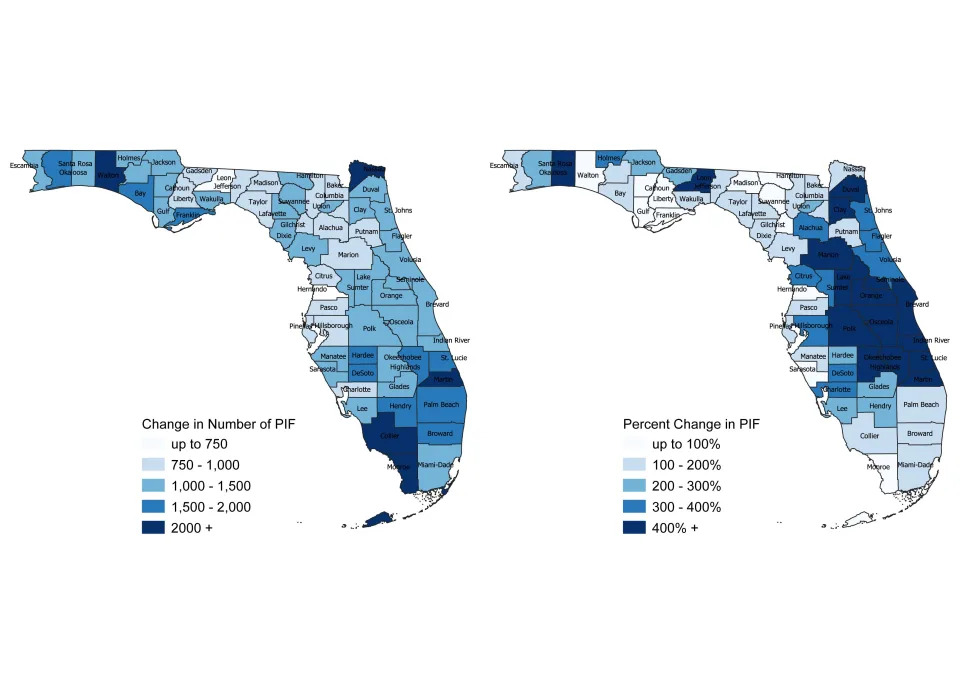
Graphic shows increases by percentage and number of state-created insurer Citizens Property Insurance Corporation's policies in force (PIF) between 2016 and 2023. Monroe and Collier counties had the largest increase in numbers while the percentage of households that turned to Citizens for homeowner's insurance grew the most in inland counties Seminole, Orange and Osceola.
What areas are being gentrified in Florida?

Gentrification of Florida’s coastline may have already begun in areas hardest-hit by Ian.

This is likely to continue as a number of factors drive up the costs associated with living along the Sunshine State’s coast thanks to sea level rise, a 2022 study out of Florida State University predicted.

“Eventually, people are likely to start moving inland from coastal areas as the costs of staying become too great,” the report reads. “Those that are further inland are more likely to be displaced by higher income residents who eventually move inland in the process of relocating to higher ground.”

On Pine Island, a community whose year-round residents are largely working-class, people are cutting back their monthly budgets and searching desperately for cheaper insurance after rates rose in response to Hurricane Ian’s devastation of the barrier island. Some are leaving the island after too many problems with insurance, said nonprofit civic group Matlacha Hookers president Joanne Correia.

Guylinda DeMyers and her husband have lived in Pine Island’s St. James City for 20 years, she estimates, but after this most recent hurricane, she said they plan to sell their home and leave for safer climes − once their insurance company pays their claim.

They’ve yet to see a penny of their claim from People’s Trust, she said, even though it’s been almost a year. In fact, it’s been so long, their policy has expired. They haven’t pursued a new one because “there’s nothing to insure,” DeMeyers said. “It’s broken.”

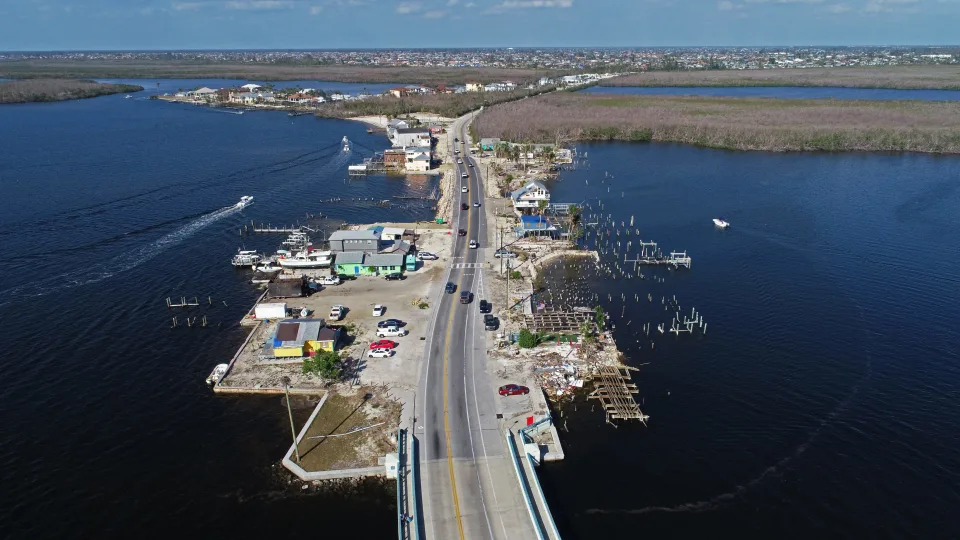
Nearly six months after Hurricane Ian devastated Southwest Florida, parts of Matlacha remain damaged. Photographed Monday, March 20, 2023.

She doesn’t think they’ll get what the home was worth before the storm, but says her realtor has told her the property itself – an ocean-front lot ‒ is valuable enough by itself.

But DeMeyers is determined to see her claim through – if not for her, then for her husband, who has Alzheimer’s. She’s lived through three major hurricanes and subsequent rising insurance costs.

“It’s not safe here anymore,” DeMeyers said.  “We need a stable place.”

On Fort Myers Beach, another one of Florida’s vulnerable barrier islands, coastal gentrification is already underway. Renters and low-income homeowners are finding there’s nothing in their budget on the island anymore. The island is home to just 5,700 residents year-round, and the loss of even a few is significant.

“I feel like I’ve lost my community,” former Fort Myers Beach resident Cheri Warren told Chad Gillis of The News-Press in early September. Warren’s one-story home was destroyed during Hurricane Ian; now, she and her husband found it was too costly to repair it and have left the barrier island for the mainland. They plan to sell their lot at a later date, when the market has stabilized.

Has home insurance gone up in Florida?

For its new study, released in September, First Street Foundation founder and CEO Matthew Eby said the nonprofit, like institutional investors, calculated home values by dividing the amount of what a property would rent for over the course of a year, minus operating costs (which includes insurance costs), by 5%, an average risk amount.

While most homeowners look at the prices their neighbors homes are selling for in order to figure out how much theirs could be worth, this approach can take a while to show fluctuations in real home value, said First Street Foundation’s head of climate implications Jeremy Porter. Institutional investors use a standard calculation that First Street Foundation employed to “take the uncertainty out of the equation,” he said.

But with the cost of insurance rising due to both inflation and natural disasters like hurricanes and fires, risks increase as well. That means that operating costs have increased, particularly for Floridians who have no option for insurance other than state-created nonprofit Citizens Property Insurance Corporation. Citizens was created to insure homes that all other carriers refused to insure − the riskiest properties.

Not only is Citizens often more expensive than other carriers, as state law allows them to charge an actuarially-sound amount, but Florida legislators recently passed a law requiring homeowners who get their insurance through Citizens also enroll their homes in the National Flood Insurance Program, a federal insurance program.

That increases a homeowner’s operating costs even further.

“When … you don’t have anywhere else to go and you are beholden to whatever increase in prices that they just decide to put on you, there’s no way out,” Eby said.

Since 2017, Citizens’ number of policies have increased 168%, while the average premium has also increased from roughly $2,000 to more than $3,000 annually.

Citizens spokesman Michael Peltier said Citizens is held to a policy premium increase of 12% annually, and increases are subject to state approval.

Although California and Louisiana are facing rocketing insurance costs as well, according to First Street Foundation’s data, Eby said, “Florida has the biggest problem.”

The nonprofit examined the number of policies Citizens holds in Florida going back to 2017, when Citizens held roughly 500,000 policies. Eby noted that increased over time, and dramatically grew in 2021 as private insurance companies began to pull out of the state. After Ian, it shot up once again.

Citizens currently holds 1.5 million policies in force, and, Peltier said, expects that to increase to 1.7 million by the end of 2023.

“The major insurance companies have all been pulling out of Florida, leaving Citizens the largest insurer in the state,” said Eby. “The insurance company of last resort, the very last one that you want to go to for your insurance, is now the insurer for the entire state.”

CountyCitizens Policies in Force (07/2023)Citizens Average Premium (07/2023)Average Homeowners Insurance Across County
Duval24,503$1,790.81$1,168
Leon4,433$1,229.12$1,185
Collier13,594$5,489.82$1,645
Lee38,716$2,626.48$1,168
Palm Beach132,811$851.61$1,514
Sarasota33,399$2,940.27$1,445
Escambia13,085$3,241.48$1,153

‘Not all doom and gloom’: How this Florida Gen Z homebuyer bought in an uncertain market

Insurance and natural disasters: How billion-dollar hurricanes, other disasters are starting to reshape your insurance bill

Are Florida property values going up?
This photo taken Sept. 30, 2022 shows the heavy damage Hurricane Ian caused on Pine Island and Matlacha.

Rising homeowners’ insurance bill have yet to translate that to loss of equity, Porter said.

“When you go to sell it, that’s when the property devaluation becomes realized – at the closing table,” Porter said. But even those who hang on to their homes may feel it the next time Florida gets hit by another major weather event like Ian, he cautioned.

Then, he said, taxpayers will be the ones hurting.

“At some point, the amount of exposure on Citizens is too much, relative to its premiums,” said Porter. “If it’s not accounted for properly there has to be some kind of a subsidy from Florida taxpayers one way or another.”

Eventually, Porter predicted, “the state of Florida is going to have to ask the federal government for a bailout if they if they end up getting hit by a disaster that empties the coffers.”

According to Peltier, Citizens has a number of backstops to keep itself solvent. First, he said, if the state-created nonprofit goes through its premium-driven surplus, like all other insurers in the state it has access to the Florida hurricane catastrophe fund. It also purchases reinsurance to cover the possibility that the catastrophe fund is exhausted. Finally, Peltier said, Citizens is required by law to levy assessments on policyholders to make up any deficits.

This article originally appeared on Fort Myers News-Press: Florida home insurance risk intensified by climate-fueled storms

Floridians stunned by Citizens Insurance ‘depopulation’ letters

South Florida Sun Sentinel

Floridians stunned by Citizens Insurance ‘depopulation’ letters

Ron Hurtibise – September 25, 2023

Tens of thousands of customers of Florida’s state-owned Citizens Property Insurance Corp. are getting a stunning surprise in their mailboxes.

It’s a letter from Citizens’ “Depopulation Unit” stating their policies have been assumed by a private-market company.

Cause for celebration? Not if the private company’s estimated annual premium is higher than what the policyholder is paying Citizens.

Delores Smerkers, a Davie retiree, said her Citizens policy renewed in July for $5,523 — $650 more that what she paid last year. Less than two months later, in late August, she received a letter saying her coverage was being assumed by Safepoint Insurance Co.

The letter stated that her estimated cost to renew her Safepoint policy will be $6,650 — an increase of $1,127.

That’s a substantial price hike, but because it’s less than 20% above her Citizens premium, she is ineligible to reject the offer and stay with Citizens.

Smerkers says she doesn’t know how many more insurance price hikes she and her disabled husband can endure as they try to live out the remainder of their lives in the modest 1,750-square-foot villa they bought new in 1978.

“It’s a shame,” she said. “People on fixed incomes are hurting the most. We’re not rich. We worked like dogs all our lives. Now look at where we are at.”

More than 300,000 Citizens policyholders are getting letters stating that their policies have been selected for removal in October by one or more of five private-market companies.

Targeted policyholders are ineligible to remain with Citizens if their letter identifies a private company’s “estimated renewal premium” that’s less than 20% over Citizens’ estimated renewal premium for comparable coverage.

But if all estimated renewal premiums exceed 20% of Citizens’, the policyholder can opt to remain with Citizens by logging onto the company’s website or asking their insurance agent to make the selection for them.

Removal is automatic for those who don’t take action

October marks the first of two depopulation efforts. Another is scheduled in November.

Five companies have been approved to take 184,000 policies from Citizens in October: Florida Peninsula (up to 19,000 policies), Monarch (10,000), Safepoint (30,000), Slide (100,000) and Southern Oak (25,000).

Letters sent to selected policyholders state that the transfer will take place on Oct. 17 unless the policyholder selects another option by Oct. 5. But the Oct. 5 deadline was moved to Oct. 10 after a vendor handling the mail-outs fell behind, leaving some recipients with only a couple weeks to act.

Of 311,250 policyholders informed that they’ve been selected for takeout in October, 99,500 have so far elected to remain with Citizens, according to data provided by Citizens spokesman Michael Peltier. Just 9% — 28,750 — have selected a private company. And the majority, 183,000, have not yet registered a selection.

Anyone who fails to make a selection will automatically be transferred on Oct. 17 to the private company identified in their letter with the lowest premium, Peltier said.

Targeted policyholders don’t have to pay more now

Some policyholders who have received a depopulation letter say they were confused about the estimated renewal premiums identified in the letter.

The premiums are just estimates of the following year’s insurance costs and don’t have to be paid right away. Even if a policyholder accepts the transfer, the coverage remains in place at the current Citizens rate until the policy expires.

In Smerkers’ case, she won’t owe the new $6,650 premium until her Citizens policy is set to expire in July.

Deerfield Beach resident Jeff Torrey said it took a phone call to his agent to clarify that he didn’t owe more money immediately.

He received a letter in mid-September saying Slide was assuming his policy on Oct. 17 and that he was ineligible for Citizens because Slide’s estimated renewal premium was nearly $1,000 more but $185 under the 20% threshold.

“I thought come Oct. 17, I was going to have to pay more,” Tolley said in an interview. The agent told him “the letter is not very clear. It’s confusing.”

In addition, those estimates could change prior to the policy renewal date, and that could change policyholders’ eligibility to remain with Citizens.

Policyholders currently ineligible to remain with Citizens are advised to wait until 90 days before their policies are set to renew with the new company and then look at the difference between the actual renewal rates at that time. If the difference falls below 20%, the policyholder will be eligible to return to Citizens.

Steve Rogosin, a Plantation-based insurance agent, said 55 of his clients have received depopulation letters and of those, only half are currently eligible to remain with Citizens.

“I tell them to carefully read the offer, and then on an individual basis, we help them make their decision,” he said.

Most who remain eligible to stay with Citizens are choosing to do so, he said. Other options are available beyond the private companies identified in the letters, but “they’re not cheaper than Citizens,” he said.

Brian Murphy, co-owner of a Brightway Insurance agency in Palm Beach Gardens, said one of his clients who’s currently paying $4,400 for his Citizens policy received a letter estimating the new company would charge him $8,200 when it comes time to renew his policy.

“So he gets to stay in Citizens,” Murphy said.

New law will make more ineligible to stay in Citizens

The current round isn’t like recent depopulation efforts.

What’s new is the 20% threshold. It’s being used to reduce the number of policies held by the state’s “insurer of last resort.”

Citizens’ board of governors and legislators that oversee the program have become anxious in recent years about the company’s renewed growth. As private-market companies stopped writing policies or were driven to bankruptcy, Citizens’ policy count increased from 420,000 in 2019 to 1.4 million currently.

Such a large number of policies sets off alarm bells, because if a major hurricane wipes out Citizens’ ability to pay claims, the company will have to levy surcharges and assessments to make up the shortfall.

Citizens’ policyholders would first face surcharges of up to 45% of their premiums.

If that’s not enough, a special assessment would be imposed to collect 2% of the cost of every homeowner, auto, specialty and surplus lines policy in the state.

And there’s more. If those two levies don’t generate enough, Citizens has the right to impose on all policies — Citizens and private-market — an emergency assessment of up to 10% for each of Citizens’ three accounts.

Until this year, Citizens customers targeted for removal could opt out for any reason.

And that worked for awhile, as a 10-year stretch without a major hurricane making landfall in Florida enabled some private-market companies to offer rates lower than Citizens.

But over the past five years, the private insurance market has hemorrhaged tens of millions of dollars, forcing companies to raise their rates far above Citizens.

Citizens, in turn, was prohibited from keeping pace by raising its rates more than an average 10% each year.

Last year, the state Legislature enacted the 20% threshold and put Citizens on a path to increase rates by increasing the rate cap by a percentage point a year until it reaches 15% in 2026.

More companies signal an improved insurance market

Murphy said his firm has a team of people answering questions from clients about their depopulation letters.

They’ve haven’t heard many complaints, he said, possibly because clients understand that Citizens is “stretched” and has to depopulate.

But he sees the number of companies willing to assume Citizens policies as a good sign that the market is poised to recover.

A big reason companies are reentering the market, experts say, is that reforms enacted by the state Legislature last year remove enticements for repair contractors and plaintiffs attorneys to file lawsuits against insurers.

Removing those enticements reduces potential for losses and should help convince insurers that they’ll again be able to make a profit in the Florida market, they say.

“Other carriers are coming in with some appetite,” Murphy said. “And I believe we’re going to see more in 18 months.”

Meanwhile, depopulation targets who were able to remain in Citizens shouldn’t get too comfortable. They might soon get targeted again.

Agents are gearing up for a fresh round of depopulation offers to start going out in late September.

Six companies, including the four participating in this month’s round, have been approved to remove up to 196,399 Citizens policies on Nov. 21.

According to letters informing policyholders about the Oct. 17 takeouts, “If your policy is not successfully assumed, you may continue receiving future offers from private-market insurance companies interested in removing your policy from Citizens.”

AAA says it now costs more than $12,000 a year to drive a vehicle

Auto blog

AAA says it now costs more than $12,000 a year to drive a vehicle

Jonathon Ramsey – September 25, 2023

It’s time for the American Automobile Association’s (AAA) 2023 “Your Driving Costs” study. The spreadsheet breaks down the average yearly costs of owning a new vehicle and driving it for either 10,000, 15,000, or 20,000 miles. The five top-selling vehicles of 2023 across nine categories are included, from small sedan to half-ton pickup, hybrid, and EV. Sample costs factored in are fuel, maintenance, full-coverage insurance, registration and taxes, finance charges, and depreciation at each mileage level. In 2019, Your Driving Costs came up with an annual outlay of $9,282 for the first five years of ownership, driving 15,000 miles per year. That was a 5% bump over 2018. In 2021, the annual cost had risen to $9,666 for the same use case. This year’s study is out, and no one will be surprised to find costs are up: AAA says it costs an average of $12,182 every year — $1,015.17 every month — to drive for five years at 15,000 miles per year.

That’s almost $1,500 more last year’s study result of $10,728 annually.

The average annual cost to own and maintain a small sedan is $8,939. A compact front-wheel drive SUV needs $10,066, a midsize AWD SUV is $11,971, an electric vehicle is $10,112. It’s the enormous popularity of half-ton crew cab pickups that drives the final figure, their annual costs $15,858. We’d be interested in results that excluded pickups just to see the difference. 

No denying it costs more to own any kind of car, though. It starts with MSRPs still being elevated. The knock-on effect is elevated car payments, especially with more new buyers choosing shorter terms to get manufacturer incentives that don’t come with the 84-month terms. And higher interest rates eat up savings no matter the term. Earlier this month, Experian Automotive research said the average monthly car payment is $729 for a new car and $528 for a used carJ.D. Power followed that up with news about the rising costs of auto insurance, rates getting so high that more households have stopped buying coverage. The same story explained that higher insurance premiums are partly due to skyrocketing vehicle repair costs. 

Of note, the AAA study doesn’t include luxury cars, so the average MSRP of the new cars among the field is $35,000. Even though that’s up 4.7% from last year, there’s quite the gap between that number and the most recent data on average transaction prices; KBB information for July put the average price paid for a new non-luxury vehicle at $44,700, an amount that’s held pretty steady throughout the year. The KBB number jives with Experian Automotive’s finding that the average loan amount for a new vehicle in Q1 of this year was $40,851.

Going lightly used was once a slam dunk for big savings, but those days are gone for now. A new study from iSeeCars showed that buyers spending $23,000 could get a three-year-old car in 2019, but now, that amount struggles to buy a six-year-old vehicle.

How climate change threatens some of the world’s most coveted real estate

CNN

How climate change threatens some of the world’s most coveted real estate

Kathleen Magramo and Chris Lau – September 23, 2023

Until recently, the upscale homes of the Redhill Peninsula seemed like an oasis for rich Hong Kongers aspiring to a tranquil lifestyle in an otherwise notoriously cramped metropolis of 7.5 million.

Its cliffside location and unobstructed views of the South China Sea made for great Feng Shui and offered the perfect antidote to the hustle and bustle of city life for its gated community of tycoons, expats and celebrities.

But that same pristine location worked against it on September 8, when a storm brought the heaviest rainfall in nearly 140 years to Hong Kong, wreaking havoc across the city.

Two people were killed and more than a hundred injured as more than 600mm (23.6 inches) of rain barreled down on the coastal city, flooding metro stations and turning roads into rivers.

The chaos was not confined to the flooded lowlands. Up on the edge of the cliff separating the Redhill Peninsula from the sea below it chipped away at the soil, leaving three millionaire homes perilously close to the edge and prompting an evacuation.

In a city that had just experienced its hottest summer on record, the unprecedented rainfall – itself the product of the second typhoon to have hit the city in the space of a week – was a potent demonstration of the threat posed by climate change and its associated extreme weather.

But for the residents of the Redhill Peninsula it was also a reminder that climate change is rewriting the rules of what can be considered “safe” construction, and that even the costliest, most well-constructed homes can be vulnerable.

For some it may even be a reminder that such rules exist at all. City authorities say they are investigating whether building code violations in some of the houses contributed to the problem, in a development likely to fuel perceptions that the rich don’t play by the same rules as the poor.

Whatever those investigations find, experts say extreme weather events like that of September 8 will become more frequent and when they do rich and poor alike will suffer the consequences – whichever rulebook they play by – even if the former have far more ability to bounce back from disasters than the latter.

As Benny Chan, the president of Hong Kong Institute of Architects, points out, Hong Kong has long been prone to typhoons and torrential downpours and has “plenty of experience building these kinds of cliffside houses.”

It also has stringent safety standards designed over many years with landslides in mind, he says. So it would have been reasonable – at least until a couple of weeks ago – to expect somewhere like the Redhill Peninsula to be a safe place to be in a storm.

But the old rules, experts say, may no longer apply.

Houses at the Redhill Peninsula, a luxurious residential estate in the Tai Tam area of Hong Kong, on September 13. - Chris Lau/CNN
Houses at the Redhill Peninsula, a luxurious residential estate in the Tai Tam area of Hong Kong, on September 13. – Chris Lau/CNN
A ‘sensitive’ issue

That is likely to be an uncomfortable realization for anyone who has invested in the Redhill Peninsula – one of the most expensive neighborhoods in one of the world’s most expensive property markets.

Properties here have the sort of appeal and cachet of the Malibu coast in Los Angeles. They have a distinctive Mediterranean style, with colors alternating in hues of cream and pink, and many have french windows overlooking the cove of Tai Tam, a scenic spot with a lush hiking trail nearby and ample shelter for luxury yachts to anchor below.

They can go for between $10 million-$20 million for a 2,400-3,600 square foot home (and rent for up to $20,000 a month). Or at least, they could before the recent downpour. Local real estate agents say what effect the storm will have on property prices is a “sensitive” issue for some in the community.

When CNN visited Redhill last week, sports cars and SUVs sporting the logos of Porsche, Land Rover and Ferrari were among the vehicles that cruised past the palm-tree-lined entrance, where a security guard stood like an impenetrable wall preventing the gaggle of assembled journalists from going in.

The real pull of the district, according to a real estate agent with more than two decades of experience selling properties here, is its tight-knit community.

“It has an international school and kids can hang out with one another at home after school,” said the agent, speaking on the condition of anonymity due to the sensitivity of the issue. She was referring to the Hong Kong International School, one of the most prestigious in town.

“Almost every house comes with a view of the sea,” she said, adding that while the development is far from the hustle and bustle of the city, it offers a convenient shuttle bus service to ferry residents around.

The three houses most affected by the landslides were between 2,700 and 3,000 square feet in size, each valued at up to $11.5 million, the agent said.

She added that she had noticed a change of mood in recent days and expects anyone trying to sell a property – especially one near to the sea – to lay low for a while.

“It’s sensitive timing,” she said.

Flooded roads after heavy rains in Hong Kong on September 8. - Tyrone Siu/Reuters
Flooded roads after heavy rains in Hong Kong on September 8. – Tyrone Siu/Reuters
The old rules may not apply

Heavy rain is far from unusual in Hong Kong, especially during the summer months.

Even so, recent weather patterns have been unsettling to many, with two consecutive typhoons sweeping across the region within a space of less than two weeks.

Typhoon Saola, which barreled through Hong Kong on September 1, was the strongest to hit the city in five years. A week later, the remnants of Typhoon Haikui unleashed the rains that caused the problems at Redhill, dozens of landslides and left large swathes of the city underwater.

Scientists say climate change will make such weather events only more frequent and some are urging Hong Kong to rethink its rain mitigation strategy.

Leung Wing-mo, former assistant director of the city’s weather observatory, told public broadcaster RTHK that rainstorms are becoming harder to predict because of climate change.

“In the past few decades, record-breaking events have been occurring much, much more frequently…This is a clear indication that climate change has a role to play. As a matter of fact, climate change is making extreme weather more extreme,” Leung said.

With that in mind, architects and civil engineers are also calling for the city to review standards set decades ago for hillside buildings, including many luxury mansions.

The city experienced some of its worst landslides in the 1970s, including one that knocked down a series of residential buildings in the city’s upscale Mid-Levels district, causing 67 deaths.

The same powerful rain that caused the Mid-Levels landslide in 1972 also triggered a hill in a district of Hong Kong’s Kowloon Peninsula to collapse, decimating a squatter site in Sau Mai Ping causing a further 71 deaths.

Structural engineering professor Ray Su, from the University of Hong Kong, said that the series of catastrophic incidents had prompted the government of the time to reinforce slopes across the city, turning Hong Kong into one of the most resilient places against landslides and floods in the world.

But some engineers fear safety rules that seemed adequate in the past may no longer be enough.

Su noted that some of the city’s low-rise houses were still built on shallow footings.

In extreme rain scenarios, “they will take a big hit when landslides crumble down,” he said.

The Redhill Plaza shopping center in the Tai Tam area of Hong Kong on September 13, 2023. - Chris Lau/CNN
The Redhill Plaza shopping center in the Tai Tam area of Hong Kong on September 13, 2023. – Chris Lau/CNN
‘A ticking time bomb’

Complicating matters in the case of the Redhill Peninsula is the suggestion by authorities that some of properties in danger may not even have been playing by the old rules.

In the wake of the storm, government authorities detected what they suspect may be illegal alterations made to the three Redhill properties – alterations that experts say may have contributed to the disaster.

That suggestion is something of a third rail issue in a city that has a track record of scandals involving wealthy individuals and politicians altering their properties and violating building codes with the sort of illegal extensions skeptics say the less well-off wouldn’t get away with.

Hong Kong’s Buildings Department says among those unauthorized modifications are basements, a swimming pool, and a three-story extension.

So controversial is the issue that even the city’s leader John Lee has stepped in, vowing that the government will investigate and prosecute anyone found to have violated building codes.

“The landslide at Redhill Peninsula has already shown us that part of the estate carries risks, so relevant departments will target the estate for inspections,” he said last week.

Preliminary investigations have shown a retaining wall was demolished in one of the houses.

Chan, from the Hong Kong Institute of Architects, said the modification could destabilize the structure of the cliff below and greatly affect the drainage of the soil underneath, ultimately causing landslides.

“The more the water is trapped, the less the slope can maintain a high steepness,” Chan said.

He said while painful lessons in the past had given rise to high standards on building retaining walls and drainage systems, the old set of requirements is slowly losing relevance.

“These standards were set a long time ago,” he said.

“Can the present standards withstand that much rain? It is time for the government to look at them again,” he added.

Chan Kim-ching, founder of Liber Research Community, a non-government organization that focuses on scrutinizing the authorities on land policies, said the safety problems that arose from illegal modifications went far further than the cases at Redhill.

His group recently compared contracts available on public records and identified at least 173 individual houses across the city suspected of violations on public land.

“We studied it in the past because it involves the fair use of public resources. Never did it strike us that it’s an issue that would threaten public safety,” he said.

“It is like a ticking time bomb,” Chan said.