Treasury’s Yellen says US overdependent on China for critical supply chains
Reuters – October 3, 2023
WASHINGTON (Reuters) – U.S. Treasury Secretary Janet Yellen said on Tuesday the United States has become overly dependent on China for critical supply chains, particularly in clean energy products and needs to broaden out sources of supply.
Yellen, speaking at a Fortune CEO event in Washington, repeated her longstanding view that the United States does not want to decouple economically from China.
She said that she has not been “a strong believer” in industrial policy, but that the United States had stood by for too long while other countries built up semiconductor industries with massive subsidies.
The U.S. would face national security concerns without a robust semiconductor sector of its own, she said, adding that last year’s Chips and Science Act will help reverse that trend.
“We’re fooling ourselves if we think that abandoning, for all practical purposes, semiconductor manufacturing, is a smart strategy for the United States,” Yellen said.
(Reporting by David Lawder and Kanishka Singh in Washington; editing by Jonathan Oatis and Deepa Babington)
Russian rouble briefly returns to ‘laughing stock’ level that prompted emergency interest rate hikes last time
Prarthana Prakash – October 3, 2023
Getty Images
The Russian rouble hit the skids after Russia’s invasion of Ukraine last February. Initially, the government took a hands-off approach to deal with the rollercoaster ride of exchange rates. Instead, they boasted about the nation’s economic resilience in the face of sanctions and shrinking exports. But come August, they had to step in as the rouble nosedived to a 16-month low, worth less than a penny.
A déjà vu moment played out on a recent Tuesday, with the rouble teetering just below the 100-mark against the U.S. dollar—a critical benchmark for Russia’s currency. Although the rouble managed a modest comeback, this embarrassing stumble highlighted its shaky footing and raised concerns of further depreciation.
The rouble’s value has taken a beating this year, shedding almost 30% of its worth against the greenback since January.
A number of things may have influenced the drop in exchange rates—from foreign currency outflows and declining trade activity to Russia’s waning current account surplus.
But some factors may still be working to Russia’s advantage, such as its budget.
The falling value of the rouble means more of the Russian currency for every dollar earned through the trade of oil or other products. This, in turn, has given the Kremlin more money to pour into the military or social schemes, for instance, to help offset the impact of sanctions.
Despite the seeming upside of a weak ruble and the Kremlin’s swift actions to stem any negative effects from it, the Russian currency’s value is not out of the woods yet.
The August slump
When the rouble weakened to more than 100 to the U.S. dollar in August, the Bank of Russia called an “extraordinary meeting”, subsequently hiking interest rates by 350 basis points to 12%. The bank also said it would halt foreign currency purchases on the domestic market until the end of the year in an effort to stabilize its financial markets.
Russia’s state media and senior officials were also rattled by the rouble’s tumble into three-digit territory. Vladimir Solovyov, a popular TV person in Russia and President Vladimir Putin’s ally, said the country had become a laughing stock, pointing to how dire the situation had gotten.
Putin’s economic advisor, Maxim Oreshkin, told state-owned news outlet TASS that “loose monetary policy” was causing the drop in the rouble’s exchange rate and exacerbating inflation.
“A weak ruble complicates the structural restructuring of the economy and negatively affects the real incomes of the population. A strong ruble is in the interests of the Russian economy,” Oreshkin said according to the translation of an August op-ed in TASS.
In September, the central bank once against raised rates to 13% to tackle the falling rouble value and stubborn inflation, which was at 5.33% at the time. Further rate hikes are expected in the next central bank meeting later this month.
The rouble has wavered a lot since 2022—shortly after Russia’s invasion of Ukraine it hit an all-time low of 120 roubles to the U.S. dollar, but by last June, the currency had recovered to nearly 50 roubles to the dollar when oil and gas prices soared.
“This level (100) is not a technical resistance, it’s an important psychological barrier,” said Russian investment group Alor Broker’s Alexei Antonov told Reuters. “For now, everything speaks in favour of the rouble continuing to get cheaper.”
The rouble’s current weakness could be temporary, but the Russian government faces pressures on its finances and more prolonged effects of a weaker currency. Plunging export volumes continue to weigh on the economy, as the current account surplus shrank 86% year-on-year to just $25.6 billion in January-August. Elevated consumer prices along with a depreciated rouble make it harder for the average Russian to afford basic goods.
As Moscow struggles to keep its currency strong while navigating other macroeconomic challenges, experts suggest that a drop in the rouble’s exchange rate is not quite an economic crisis, although it does ring alarm bells for the government.
“This is the closest we came to a real economic problem since the start of the war,” Janis Kluge, an expert in the Russian economy at the German Institute for International and Security Affairs told the Associated Press in August following the rouble’s drop to a 16-month low. “In Russia, the exchange rate is always seen as the most important indicator of the health of the economy.”
Arizona moves to end Saudi firm Fondomonte’s groundwater deals to grow, export alfalfa
Stacey Barchenger, Arizona Republic – October 2, 2023
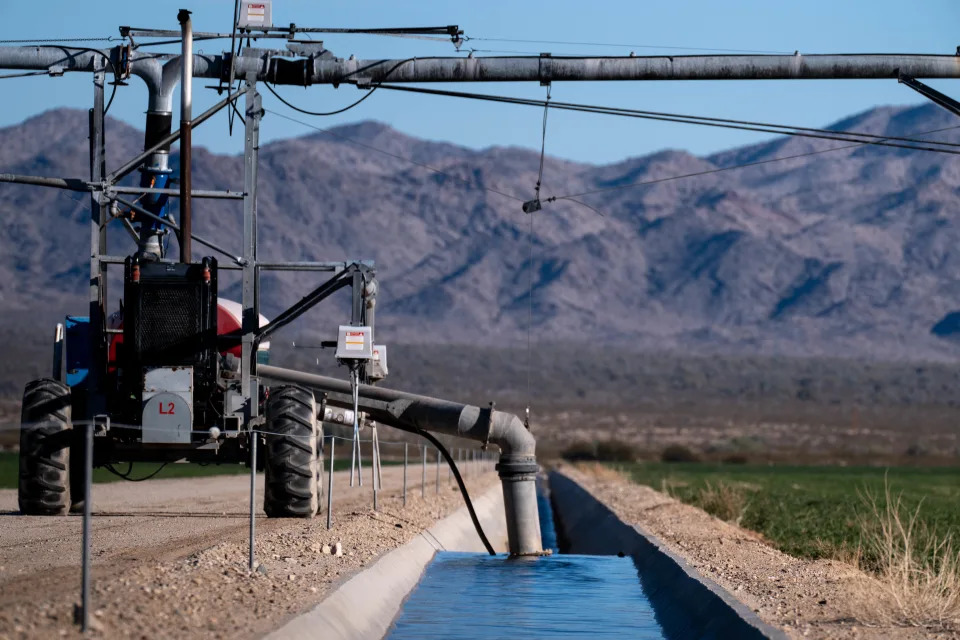
Gov. Katie Hobbs’ administration on Monday announced two steps to stop a controversial Saudi Arabian company from using groundwater beneath state land in western Arizona to grow and export alfalfa.
Hobbs said in a statement that the Arizona State Land Department had canceled one of its leases to Fondomonte Arizona, and would not renew three others that are set to expire in February.
Those four account for all of Fondomonte’s leases in the Butler Valley near Bouse, though the company leases other state land elsewhere, according to the Governor’s Office.
The company farmed about 3,5000 acres of state land in Butler Valley to grow feed for dairy cows in Saudi Arabia and is allowed to pump groundwater for that purpose entirely unchecked and unpaid for.
The issue was brought to light last year by The Arizona Republic, which highlighted Fondomonte as an example of companies that get below-market-rate leases on Arizona’s vast stretches of state land. Fondomonte was unique in that its leases allowed it to draw water from a groundwater supply earmarked as a possible future source for Phoenix and other metro areas.
Fondomonte’s presence in western Arizona became a political lightning rod as policymakers grappled with a megadrought, a decreasing supply from the Colorado River and increasing demand for water in the form of a growing population.
“I’m not afraid to do what my predecessors refused to do — hold people accountable, maximize value for the state land trust, and protect Arizona’s water future,” Hobbs said in a statement. “It’s unacceptable that Fondomonte has continued to pump unchecked amounts of groundwater out of our state while in clear default on their lease.”
While leases of state land carry penalties for early termination, the Governor’s Office said the first Fondomonte lease was canceled because the company was in default on “numerous items,” including failing to properly store fuel and diesel exhaust fluid. Fondomonte was given notice of those issues in November 2016, and nearly seven years later, a mid-August inspection showed the company had not fixed those problems, according to Hobbs’ office.
The other leases would not be renewed because of Fondomonte’s draw on “excessive amounts of water” in the Butler Valley, one of five water transportation basins that allow water to be moved around the state and that has been earmarked as a possible future water supply for Phoenix and other metro areas.
Fondomonte said through a spokesperson it was reviewing the notifications from Hobbs and the State Land Department but that it believed “the state is mistaken that the company is in breach of its lease.”
“Fondomonte will work with the Governor’s Office to highlight these factual errors,” spokesperson Barrett Marson said. “Fondomonte is adhering to all the conditions of the lease, and thus we have done everything required of us under these conditions.
“As for the other leases the state intends to not renew, this would set a dangerous precedent for all farmers on state land leases, including being extremely costly to the state and Arizona taxpayers. Fondomonte will explore all avenues to ensure there is no discrimination or unfair treatment.”
Arizona leases vast stretches of its publicly owned land to private companies, turning a profit that funds the State Land Trust and its various beneficiaries, the largest of which is K-12 education. In 2021, the state received $4.3 million for its about 160,000 acres of leased land for agriculture, according to the department.
The Republic’s reporting highlighted other shortcomings of those leases, including agricultural rental rates that haven’t changed in more than 15 years.
Republican La Paz County Supervisor Holly Irwin has been raising concerns for eight years about such leases and their toll on the state’s water supply.
“I’m just so glad we have leadership in this current administration that listened to La Paz County’s voice,” she told The Republic. “For the first time, I feel like there’s real hope in dealing with the water issues here.”
Irwin commended Hobbs, as well as Democratic Attorney General Kris Mayes and U.S. Rep. Ruben Gallego, D-Ariz., for their work on the state’s water issues.
Mayes has taken aim at well drilling permits given to Fondomonte and criticized the state Department of Water Resources, which she has said is not following groundwater management laws.
Gallego, who is running for U.S. Senate next year, introduced a bill in Congress that would levy a 300% tax on the sale and export of any water-intensive crop by a foreign company or government.
“For all of our leaders to come together to take a look at this issue and realize it’s wrong, it shouldn’t matter what side of the aisle you’re on,” Irwin said. “It demonstrates how government should work.”
Mayes, however, suggested the government’s response didn’t happen fast enough or reach to systemic issues with state land leases.
“This decision to protect Arizona’s precious groundwater resources and uphold the integrity of our state land trust is a good step in the right direction for the future of Arizona,” Mayes said in a statement. She said while the announcement was “commendable, it should have been taken by state government much earlier.”
“The failure to act sooner underscores the need for greater oversight and accountability in the management of our state’s most vital resource. … The decision by the prior administration to allow foreign corporations to stick straws in the ground and pump unlimited amounts of groundwater to export alfalfa is scandalous.”
Hobbs was sworn in as governor on Jan. 2, following former Gov. Doug Ducey, a Republican, who served two four-year terms in office.
Supreme Court Weighs Fate of Consumer Agency That Vexes Banks, Riles GOP
Greg Stohr – October 2, 2023
Thirteen years after a Democratic-controlled Congress created the CFPB to regulate mortgages and other consumer-finance products, the high court on Tuesday will weigh a novel constitutional argument that the bureau’s supporters say could leave it decimated.
The clash will shape the future of an agency that critics see as the ultimate symbol of an unaccountable and overreaching federal bureaucracy – but that backers including President Joe Biden’s administration say has provided crucial safeguards and an independent check against corporate power in the years since the 2008 financial crisis.
“The CFPB is under attack because it’s good at what it does,” Senator Elizabeth Warren, the Massachusetts Democrat who spearheaded the bureau’s creation, said last week.
The justices, who open their new term Monday, are reviewing a ruling that said the agency’s funding system violates a constitutional provision requiring a congressional appropriation for government spending. The CFPB isn’t subject to the year-to-year congressional appropriation process and instead draws as much money as it needs – up to a cap it has never hit – from the Federal Reserve. In fiscal 2022, the agency received $641.5 million in funding, short of its $734 million cap.
“It’s not about the merits of CFPB,” said Michael Pepson, a lawyer with the conservative Americans for Prosperity Foundation. “It’s about ensuring that Congress doesn’t shirk its duties by passing off its exclusive funding authority to unelected officials.”
The case comes at a time when the CFPB under Biden-appointed Director Rohit Chopra is taking an especially aggressive tack. The agency has sought to stamp out abuses in the mortgage-lending market, scrutinize the use of artificial intelligence in credit underwriting and rein in so-called junk fees, a catch-all term that include charges for bounced checks and late credit-card payments.
The bureau last year reached a $3.7 billion settlement with Wells Fargo & Co. to resolve allegations that it mistreated its customers for years by illegally repossessing cars, bungling record-keeping on payments and improperly charging fees and interest. Beyond banks, the CFPB under Biden has sought to probe “buy-now-pay-later” firms and penalize student lending servicers and credit reporting agencies.
Since the CFPB was created in 2010, its enforcement actions have returned $20.2 billion in compensation, principal reductions, canceled debts, and other relief to consumers, agency spokesperson Samuel Gilford said.
The activity is only fueling longstanding Republican complaints that the agency is too powerful. At a hearing in June, GOP Representative Andy Ogles of Tennessee told Chopra the bureau “should die a painful death.”
Mortgage Worries
Although the high court case centers on a never-enforced payday-lending rule, the impact is potentially far broader. In urging the justices to take up the case, the bureau said the ruling from the 5th US Circuit Court of Appeals cast a legal cloud over every action the agency has taken since its creation, providing an argument for re-opening even long-finalized rules and enforcement cases.
That’s a worry shared in part by the mortgage-banking industry, which filed a brief urging the court to limit any ruling against the CFPB. The bureau has issued dozens of rules affecting consumer mortgages and the industry has invested billions of dollars toward compliance, according to three trade groups led by the Mortgage Bankers Association.
A decision calling those rules into question “could set off a wave of challenges and the housing market could descend into chaos, to the detriment of all mortgage borrowers,” the groups argued.
The payday-lending trade group pressing the challenge, the Community Financial Services Association, calls those concerns overblown. Judges have a variety of tools to prevent disruption of the mortgage market, including the six-year statute of limitations that applies to CFPB rules, the group says.
“Lacking any viable legal argument, the bureau resorts to fear-mongering about significant disruption if all the CFPB’s past actions are vacated,” the trade group argued. “But the bureau grossly exaggerates the effects and implications of setting aside this rule.”
Delay Suggested
At a minimum, a decision striking down the payday-lending rule could provide a potent new argument for companies currently battling the CFPB, according to Bloomberg Intelligence analyst Elliot Stein. Navient Corp., which is fighting a complaint over its student-loan servicing practices, could have an especially strong case because it has already raised the issue in its defense, Stein said.
Some industry groups – including the US Chamber of Commerce and the American Bankers Association – have suggested the court could take the unusual step of ruling against the agency but delaying the decision’s effective date to give Congress time to set up a different funding system.
The 5th Circuit ruling marked the first time a federal appeals court had ever used the appropriations clause to strike down part of a federal statute. The Supreme Court has never interpreted the clause as a check on Congress, so far invoking it only as a limitation on the executive branch.
The case is part of a Supreme Court term that could put new constraints on federal administrative agencies. The justices are also considering restricting the use of in-house judges to handle cases at the Securities and Exchange Commission. And the court has agreed to revisit an important 1984 ruling that gives agencies latitude in interpreting ambiguous federal statutes.
The Supreme Court in 2020 gave the president broad power to fire the CFPB’s director, striking down job protections Congress had enacted. At the same time, the court stopped short of abolishing the agency altogether, as critics had sought.
The case is Consumer Financial Protection Bureau v. Community Financial Services Association, 22-448.
Democrats tried to protect the CFPB from politics. The Supreme Court may blow up that plan.
Katy O’Donnell – October 2, 2023
Manuel Balce Ceneta/AP Photo
Democrats who created the Consumer Financial Protection Bureau a decade ago thought they could shield the agency from political pressure by funding it through the Federal Reserve instead of Congress.
That decision, which drew condemnation from GOP lawmakers and has helped make the regulator a lightning rod for attacks ever since, is facing its biggest test Tuesday when the Supreme Court hears arguments on its constitutionality.
The case is highly anticipated since it could not only result in curbing the agency’s power and throwing its rules into question but potentially affect other regulators throughout the government — including the Fed and the FDIC — that are also not funded by annual congressional spending bills.
“The CFPB has returned $17 billion directly to Americans cheated by financial institutions,” Sen. Elizabeth Warren (D-Mass.) told POLITICO. “If the Supreme Court disregards over a century of legal precedent, it risks undermining banking regulators safeguarding our economy, as well as Social Security and Medicare.”
Warren, who is credited with conceiving the agency that was created in the wake of the 2008 financial crisis before she became a senator, said the CFPB’s political independence was critical to its formation. Republicans and financial industry critics, many of whom have opposed the bureau since its inception, argue that the funding scheme allows the agency to escape accountability.
Many Democrats see the case as part of a broad-based attack on the regulatory state by Republicans eager to bring challenges before the Supreme Court, whose conservative majority has proved willing to curtail the power of agencies.
In a 2022 ruling limiting the Environmental Protection Agency’s authority to regulate greenhouse gases, the high court’s six GOP-appointed justices invoked the so-called major questions doctrine, saying that agencies like the EPA need congressional approval before “asserting highly consequential power.” The court has also taken up a case this term challenging the constitutionality of the Securities and Exchange Commission’s in-house enforcement proceedings.
The CFPB was created by the Dodd-Frank Act, the landmark 2010 law that rewrote the rules of finance. The funding mechanism set up by Obama-era Democrats allows the bureau to request the amount of money it needs each year from the Fed, which, in turn, is funded by fees it levies on financial institutions and interest on the securities it holds. The CFPB automatically receives the requested amount, subject to a cap set by Congress.
Among the options the Supreme Court has when it makes its ruling, probably next year, is kicking the matter back to Congress to overhaul the way the bureau is financed — a move that would open the door for other reforms to the agency in an election year.
The case was brought by small-dollar lenders challenging a 2017 CFPB rule restricting their activity. An appellate court ruled last year that the current funding system violates the Constitution’s separation of powers doctrine.
The court scrapped the 2017 rule on the grounds that the CFPB was unconstitutionally funded when it adopted the regulation. The ruling held that the agency’s self-determined budget drawn from an agency that is itself not funded by appropriations marked a “double insulation from Congress’ purse strings,” a unique setup even among financial regulators.
The government maintains that Congress’s decision to authorize the Fed to fund the agency up to a fixed level amounts to “a standing, capped lump-sum appropriation,” as Solicitor General Elizabeth Prelogar wrote in an August brief.
Counsel for the payday lender groups, meanwhile, argued that “Congress does not possess unfettered discretion to authorize executive spending, let alone the power to cede virtually unfettered discretion to an agency to determine the size of its own purse in perpetuity,” in their brief to the high court.
If the Supreme Court does decide the funding stream is unconstitutional, the government is urging the justices to “sever” the funding provision from the rest of the law that created the agency.
“A decision invalidating the CFPB’s past actions would be deeply destabilizing” and “threaten profound disruption for consumers, regulated businesses, and the nation’s financial markets,” Prelogar said in the brief.
Housing industry representatives have also called on the high court to preserve existing CFPB regulations. They warned of “potentially catastrophic consequences that a decision drawing those rules into doubt could have on the mortgage and real-estate markets,” in an amicus brief submitted by three of the industry’s most powerful trade groups.
The Chamber of Commerce and nine other industry groups, meanwhile, urged the court to “avoid disruptions in consumer financial markets” in their own amicus brief. But the groups, which include the major banking trades, also stated that they “believe they are entitled to” the invalidation of CFPB actions they have challenged in pending lawsuits related to the agency’s funding mechanism. They also said CFPB “enforcement actions should be paused” until Congress resolves its funding.
Court watchers say wholesale invalidation of past CFPB actions is a remote possibility.
“Nobody wants a remedy where they throw every regulation out the window, and I doubt very much if they would do that,” said Alan Kaplinsky, former chair of the consumer financial services group at Ballard Spahr. “If they get to the point where they’ve got to decide the remedy, I think the conservatives and the liberals on that court would prefer to kick the ball over to Congress and let them try to deal with that.”’
The Supreme Court has already ruled that “the Dodd-Frank Act contains an express severability clause” in a 2020 decision holding that another part of the CFPB’s structure, a single director who could only be fired for cause, violated the separation of powers. While that decision eroded some of the bureau’s political insulation, separating out the removal clause from the rest of the law preserved the agency.
Both bureau backers and critics say a key question is whether a ruling against the agency could apply only to the CFPB and not to other regulators with independent funding.
“I think philosophically there are going to be five to six votes that probably would like to decide against the CFPB,” Kaplinsky said. “What they’re not going to want to do is decide the case and in doing that put a big cloud over the constitutionality of the Fed, FDIC and [the Office of the Comptroller of the Currency] — that would be a horrendous result. I don’t think any of them would want that, it would create economic chaos.”
France set to destroy enough wine to fill over 100 Olympic-sized swimming pools: ‘It’s going to cost the nation about $216 million’
Sara Klimek – October 2, 2023
Wine lovers might hate to see millions of gallons of wine destroyed without so much as a taste, but that’s the reality for many vineyards in France amid the changing climate and low demand.
What’s happening?
The French are currently set to dump 100 Olympic-sized swimming pools worth of wine, estimated to cost the government nearly $216 million, according to The Washington Post.
The European Union gave the country $172 million to destroy 80 million gallons of wine in June 2023, and the French recently announced they had scraped together the remainder of the money needed.
Though it might seem like a waste, this wine is not going down the drain. Producers are expected to use the funds to distill the wine into pure alcohol to be used for other cleaning products and perfumes.
Why is it important?
France is experiencing a wine crisis. Consumption of the beverage has plummeted significantly in the country since its peak in 1926, when the average Frenchperson consumed about 36 gallons every year. Now, that amount hovers around 10.5 gallons. Experts trace the drop in consumption to individuals having more drink options.
A dramatically changing climate also plays a big role in the French wine industry. The above-average temperatures in its wine-growing regions, like Bordeaux, paired with more frequent droughts and storms, are changing how fast the grapes ripen.
Merlot, which encompasses 60% of the vineyard production in Bordeaux, is expected to be one of the first species to succumb to the changing climate entirely.
The adaptions needed to grow wine grapes are becoming more costly for vineyards, which, when paired with the lower demand, is causing it to be cheaper to convert the wine into other products than to grow and sell it.
What’s being done to stop it?
Experimental laboratories in France are looking for more drought-tolerant grape species that can keep the cost of production low for vineyards and stay alive as the climate continues to change.
Meanwhile, experts hope the wine buy-back will hold space and time to consider alternative solutions. “We need to think in terms of … long-run adaptation to these changing conditions,” said food and wine researcher Olivier Gergaud.
“We need to help this market to transition to a better future, maybe with more wines that would respect the environment. Adaptation to climate change is a real challenge.”
The scope of the season’s impact, while minimal, was exacerbated by the scalding summer conditions and multiple heat records in a slew of categories.
Thunderstorms were hard to come by this year. Rainfall totals for the monsoon season, which ends Sept. 30, will likely result in the driest-ever summer season at Phoenix Sky Harbor International Airport, where the National Weather Service records the official figure. The rain gauge there posted just 0.15 of an inch, less than half the total of 1924, previously the driest with 0.35 of an inch.
Some areas did fare better, primarily in the East Valley and Cave Creek, where some gauges snagged upward of 4 inches, but the spotty season will still place Maricopa County on the infamous dry list behind 2020’s “Nonsoon.”
Ultimately, this lack of storms helped fuel the full effect of triple-digit temperatures and the sweltering sun to be felt across the state.
In fact, each of the three branches of the National Weather Service — Flagstaff, Phoenix and Tucson — recorded Julys that surpassed the month in years prior, posting their hottest-ever totals.
Flagstaff sees hottest monsoon season on record; Tucson and Phoenix hottest-ever Julys
Climate summary data from the weather service’s website highlights the month’s ferocity. In the Phoenix area, for example, average high temperatures for July were 114.7 degrees, more than eight degrees above the recorded norm between the years 1991-2020.
The average mean temperature was 102.7 degrees, about seven degrees higher than the recorded norm. The most revealing stat was for warm-lows, as nights in Phoenix averaged 90.8 degrees, more than six degrees north of the month’s typical mean.
For Tucson and Flagstaff, climate reports echo a similar song. Tucson posted its hottest July, with an average monthly temperature of 94.2, six degrees hotter than normal. Flagstaff witnessed its warmest July, with a 4.7-degree temperature spike above its typical mark, bringing the overall average figure for the month to 71.4 degrees.
Flagstaff is on pace for its warmest monsoon season on record by just 0.2 degrees, surpassing the number one spot set in 1980.
Rainfall totals shallow compared to recent years
Total precipitation for 2023’s monsoon, recorded at Phoenix Sky Harbor, Flagstaff Pulliam and Tucson International airports, varied across the board:
Flagstaff: 4.24 inches
Tucson: 4.73 inches
Phoenix: 0.15 of an inch
As a whole, the deviation from the norm for Tucson is not that negative.
A typical season usually produces around 5.7 inches of rain for Tucson’s airport, coming mainly in July and August. This was mirrored in 2023, as the prime months brought 2 and 2.39 inches, respectively, making up for a zero in the June column and a lackluster September
Tucson held close to its 2022 mark as well, coming just 0.20 of an inch from eclipsing that year’s total.
In Flagstaff and Phoenix, things get a lot less pretty.
At the high country’s airport, 2023’s accumulation of 4.24 inches puts it well below its average of 7.68. The year was also dwarfed in comparison to 2022 (10.63 inches) and 2021 (10.90 inches).
In Phoenix, Sky Harbor caught an abysmal 0.15 of an inch of rain this season, easily placing it as the driest on record, pushing out 1924 at 0.35 of an inch. Usually, Sky Harbor gets around 2.43 inches of rain during the season.
When compared even to 2020’s “Nonsoon,” a total that both Tucson and Flagstaff handily exceeded, Phoenix’s 2023 comes nowhere close. Sky Harbor got exactly 1 inch of rain that year, according to NWS statistics.
Overall for Arizona, precipitation in 2023 was more in line with typical seasons than that of 2020 and 2021.
“I would say as far as precipitation patterns, it was more typical because of the variability,” NOAA Warning Coordination Meteorologist Kenneth Drozd told The Arizona Republic. “(In) 2022, there were more places that were above normal than below normal, but it was still pretty mixed. Kind of like this year, there are more places that are below normal than above normal, but it still varies quite a bit depending on where you’re at.”
In 2020 and 2021, Drozd said, conditions were “unique” because of their widespread consistencies, with 2020 being so dry and 2021 being much wetter.
Maricopa County on pace to be wetter than 2020
While Sky Habor couldn’t catch a break, Arizona’s most populous county as a whole is set to end the monsoon season in a better position.
According to data from the Maricopa County Flood Control District, the county posted wetter numbers than it did in 2020, in large part due to healthier amounts falling in Cave Creek, Wickenburg, Apache Junction and portions of the East Valley.
Throughout Maricopa County, totals from data stretching back 108 days from the season’s Saturday endpoint bounce around from lows in central Phoenix at 0.39 of an inch to upward of four inches in parts of Cave Creek.
A notable area that performed the best in the county was near rural Crown King north of the Valley, where there were spots receiving nearly eight inches during the storm span.
“In general, the closer to the mountains you are, the more rain you’re going to receive during monsoon because the storms form over them,” National Weather Service Phoenix office meteorologist Mark O’Malley told The Republic. “That just became exacerbated this year where the areas of south Phoenix through Laveen, down through Avondale and Goodyear, some areas didn’t even receive a tenth of an inch.”
According to O’Malley, the lack of storms this season was primarily due to the weather pattern setting up with strong high pressure over southern Arizona, bringing hotter temperatures and lackluster storms.
“The weather pattern was set up to where it favored the heat and the storms were more removed from the area, more frequently,” O’Malley said.
SRP: 3 monsoons touched down in the Valley in 2023
According to data from Salt River Project, three major monsoon storms hit metro Phoenix in 2023: on July 26, Aug. 31 and Sept. 12.
These storms left their marks, too, with SRP reporting estimated outage numbers at the height of each storm:
July 26: 50,000 customers out of power
Aug. 31: 71,000 customers out of power
Sept. 12: 39,000 customers out of power
APS customers were affected as well, with the company reporting approximate outages during peak storm hours:
July 26: 7,750 customers without power
Aug. 31: 18,000 customers without power
Sept. 12: 11,000 customers without power
Each event brought its own force, bringing down power lines, overturning planes, destroying mobile homes and uprooting trees. While par for the course during the season, rainfall totals certainly weren’t.
For July 26, chunks of the storm covered the greater Phoenix area into Scottsdale and swaths of the East Valley, with downtown Phoenix only registering 0.04 of an inch of rain. Paradise Valley and Apache Junction received as much as one full inch during the duration of the storm.
On Aug. 31, more portions of Maricopa County got involved but with far less rain. Only two areas throughout the metro saw upward of a half inch. Much of the rain that fell did so in the Cave Creek and New River areas, ranging from 1.45 to 3 inches through the course of the storm.
A storm on Sept. 12 produced the best results for the Valley, with multiple areas getting over the half-inch hump. Again, much of the wealth ended up in Cave Creek, with various areas tabulating over 1.5 inches.
Judge Rules That Donald Trump Committed Fraud While Building Real Estate Empire
Virginia Chamlee – September 27, 2023
The ruling allows a civil trial against Trump and his adult sons to move forward next week, and orders that some of the former president’s companies be dissolved
James Devaney/GC Images Donald Trump leaves Trump Tower in Manhattan on March 9, 2021
A New York judge ruled on Tuesday that Donald Trump lied on financial statements about the value of the properties in his real estate portfolio and was therefore able to secure favorable loan terms and lower insurance premiums.
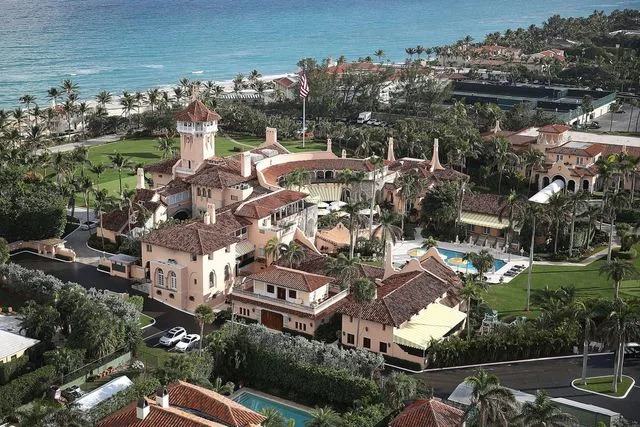
In a 35-page ruling, Judge Arthur Engoron said that Trump and his organization had overvalued several of it’s properties, including the members-only Mar-a-Lago club in Palm Beach, Florida.
In court filings, Trump has pegged the property’s worth at between $426.5 million and $612.1 million. But Engoron cited a Palm Beach County assessor who appraised Mar-a-Lago’s market value to be between $18 million and $27.6 million — at least 2,300 percent less than what the former president has claimed.
In the ruling, the judge adds that some of the former president’s defenses — such as arguing that square footage is “subjective” — are “absurd.” The ruling further sanctions Trump’s attorneys $7,500 each for continuing to make legal arguments that had already been rejected in court twice, and requires that some LLCs associated with Trump be dissolved.
Tuesday’s ruling allows a civil trial into the outstanding claims (to be decided by the judge, with no jury) to begin next week.
The ruling came as part of a fraud case brought against the former president, his adult sons Eric Trump and Donald Trump Jr., and their company the Trump Organization, by New York State Attorney General Letitia James.
“Today, a judge ruled in our favor and found that Donald Trump and the Trump Organization engaged in years of financial fraud,” James said in a statement. “We look forward to presenting the rest of our case at trial.”
James has accused the Trumps and their company of fraudulently inflating the former president’s fortune by as much as $2.2 billion since 2011. The lawsuit aims to have Trump banned from doing business in New York and pay $250 million.
Engoron’s ruling alleges that the inflation of Mar-a-Lago’s worth is akin to fraud. From the ruling: “A discrepancy of this order of magnitude, by a real estate developer sizing up his own living space of decades, can only be considered fraud.”
Joe Raedle/Getty Donald Trump’s Mar-a-Lago resort in Palm Beach, Florida
An earlier court filing alleges that “correcting for these and other blatant and obvious deceptive practices engaged in by Defendants reduces Mr. Trump’s net worth by between 17-39% in each year, or between $812 million to $2.2 billion, depending on the year.”
The filing accused Trump of valuing several of his properties “at amounts that significantly exceeded professional appraisals of which his employees were aware and chose to ignore.” In one alleged instance, he valued his leased property on Wall Street at more than twice the amount of the appraised value.
Trump and his sons have both fired back at the recent ruling regarding the worth of Mar-a-Lago, with Eric claiming on Twitter: “Mar-a-Lago is speculated to be worth we’ll [sic] over a billion dollars.”
Trump himself also disputed the ruling, writing an angry missive on his social media site Truth Social in which he accused the judge of being “a Deranged, Trump Hating Judge, who RAILROADED this FAKE CASE through a NYS Court at a speed never seen before, refusing to let it go to the Commercial Division, where it belongs, denying me everything, No Trial, No Jury.”
Trump added that Mar-a-Lago is “WORTH POSSIBLY 100 TIMES” what Engoron cited in his ruling, adding: “My actual Net Worth is MUCH GREATER than the number shown on the Financial Statements, a BIG SURPRISE to him & the Racist A.G., Letitia James, who campaigned for office on a get Trump Platform.”
Since leaving office in January 2021, Trump’s post-White House prestige has been overshadowed by intensifying investigations on various fronts, including into his political conduct and business affairs.
Arizona’s monsoon will end as one of the hottest and driest on record. What happened?
Hayleigh Evans, Arizona Republic – September 27, 2023
Summer 2023 ended as the hottest on record in Phoenix, and now the 2023 monsoon season will end as the driest.
During a summer of unprecedented and prolonged heat in metro Phoenix, many people had eagerly waited for the monsoon season to begin and fend off the scorching temperatures. But aside from a few storms that offered temporary reprieves, monsoon precipitation was weeks delayed and below average.
The monsoon season officially ends on Saturday having produced fewer storms overall than previous years, especially in central and southeastern Arizona.
Although parts of the state depend on the monsoon for much of their annual rainfall, lack of precipitation during this season will not endanger water supplies, especially following a wet winter and the strengthening of El Niño conditions.
Here’s some of what to know about the monsoon:
How much rainfall did Arizona get during the 2023 monsoon?
Phoenix posted its driest monsoon ever, with just 0.15 of an inch of rainfall at Sky Harbor International Airport, compared to a 2.28-inch average. While rain gauges in other parts of metro Phoenix recorded higher totals, the airport reports the official figure.
Statewide, the 2023 monsoon was hotter and drier than previous years. While season totals have not yet been released, based on figures from June, July and August, it was the 20th-warmest and 10th-driest season. (The monsoon season starts June 15 and ends Sept. 30, while meteorological summer covers June, July and August.)
Although residents of central and southeastern counties experienced an exceptionally arid monsoon, precipitation in the north and west offset the drier areas.
“Fortunately, this monsoon season was dry but not the driest. The 2020 ‘nonsoon’ season remains the precipitation loser,” said Erinanne Saffell, director of the Arizona State Climate Office and the state climatologist, regarding 2020’s status as the driest monsoon.
Tucson and Flagstaff also recorded below-average precipitation. As of Sept 26, Tucson fared the best with 4.73 inches of rain compared to a 5.39 average between 1991 and 2020. Flagstaff had 4.24 inches of precipitation compared to a 7.2-inch average.
The monsoon typically accounts for about half the yearly rainfall in the central and northern regions and roughly two-thirds to three-fourths of annual precipitation in southern Arizona.
Northern and western counties saw more rain than usual, particularly Yuma, Mohave and Coconino counties. Remnants of Tropical Storm Harold (which originated in the Atlantic Ocean) and Hurricane Hilary (which developed in the Pacific) played a role in bringing more precipitation to these areas.
Why was Arizona’s monsoon delayed?
It took weeks for monsoon thunderstorms to develop, which is a key reason why some areas saw less rain. The Arizona monsoon season begins on June 15, but storms did not arrive in central and southern counties until mid-to-late July.
Monsoon storms need two key elements to occur: a northward wind shift that brings in summertime moisture from the Pacific and the Gulf of Mexico, and high daytime temperatures. Together, intense surface heating and increased moisture produce monsoon thunderstorms during the summer.
The first storms generally require three consecutive days with a dew point higher than 55 degrees and temperatures between 100 and 108 degrees to develop. Typically, temperatures over 100 degrees in June help build a high pressure, subtropical ridge that summons moisture from the south. Arizona’s abnormally cool June delayed the onset of the monsoon by about six weeks.
This hot high-pressure ridge settled over central Arizona instead of the Four Corners, where it typically stays during the monsoon, bringing moisture through the state.
“When you’re underneath that bubble of heat, there’s really not much moisture, and the opportunity for thunderstorms is limited,” said Michael Crimmins, a climatologist from the University of Arizona. “When the monsoon doesn’t behave correctly, we can get into these really nasty heat spells.”
And yes, the lack of monsoon storms contributed to the 31-day streak of high temperatures at or over 110 degrees in Phoenix. Monsoon showers typically offset the heat in July, and the record-breaking heat wave finally came to an end on July 31 following storm activity.
Because the high-pressure system stalled over central Arizona, western and northern areas around the edges of the system saw some precipitation. Along with tropical storm activity, this subtropical system spurred more rainfall in the north and west.
Despite a lackluster monsoon, the state overall is on track for an average water year. The water year spans from October 1 to September 30, coinciding with the end of the monsoon, and tracks statewide precipitation during that time.
Based on data collected from 1896 to 2022, the average annual precipitation in Arizona is 12.26 inches. Between October 2022 and August 2023, the state had 11.43 inches of rainfall, and experts hope September’s precipitation will bring numbers even closer to the annual average.
Does below-average monsoon rainfall affect water levels?
While every drop counts during Arizona’s ongoing 23-year drought, the state does not rely on the monsoon to replenish its rivers and reservoirs. Watershed from snowmelt is the backbone of the Colorado, Salt and Verde river systems.
During the 2023 monsoon, Salt River Project’s watershed had its second-driest season. As of Sept. 17, SRP reported a combined watershed rainfall of 3.45 inches, 61% of the average precipitation.
SRP’s reserves are still high following winter storms that brought above-average snowmelt to Arizona. The SRP system is at 86% of capacity, compared to 65% during the same time last year.
“It’s not operationally something that we are concerned about, especially given that it was on the heels of an incredibly productive and wet winter, which completely filled our reservoir system,” SRP meteorologist Jesus Haro said.
Precipitation from the monsoon helps alleviate downstream demand from water sources and can affect releases from lakes and reservoirs. For example, the Bureau of Reclamation temporarily increased the minimum amount of water released hourly from Glen Canyon Dam on Sept. 14 to improve boater safety in the absence of monsoon showers.
In June, scientists from the National Weather Service declared an El Niño Advisory, saying they observed El Niño weather conditions and expected them to strengthen through 2023 and into 2024.
El Niño is a climate phenomenon that creates above-average sea surface temperatures in the Pacific Ocean near the equator. It usually occurs every three to five years and lasts for nine to 12 months. While it is difficult to predict the exact weather implications, El Niño events can impact weather patterns that trigger heavy rainfall and droughts around the world.
Experts say it is hard to determine El Niño’s impact on summer weather, but it may contribute to higher summer temperatures and delay the monsoon because it can weaken and reposition the subtropical ridge that summons moisture from the south.
While this summer was drier than normal, climatologists are hopeful for another wet winter. Out of the nine El Niño events since 1994, seven brought above-average precipitation in Arizona during the winter.
“Statistically, we tend to get more precipitation in the winter when we have an El Niño event,” Saffell said. “How much? We don’t know how much is going to come out of the sky, but we’re all crossing our fingers.”
Hayleigh Evans covers environmental issues for The Arizona Republic and azcentral.
Explainer-What does New York fraud ruling mean for Donald Trump’s business empire?
Jack Queen – September 27, 2023
FILE PHOTO: A worker cleans up one of the Trump Tower’s entrance before the arrival of former U.S. President Trump in New York
(Reuters) – The fate of Donald Trump’s business empire hangs in the balance after a New York judge stripped control of key properties from the former U.S. president as punishment for his “repeated and persistent fraud” over their valuations.
Here’s a look at the ruling and its implications for Trump, the frontrunner for the 2024 Republican presidential nomination.
WHAT DOES THE RULING SAY?
Democratic New York Attorney General Letitia James filed a civil lawsuit against Trump, his adult sons and nearly a dozen business entities in September 2022, alleging they inflated the value of their assets by billions of dollars to secure more favorable loan and insurance terms.
Justice Arthur Engoron of New York state court in Manhattan ruled on Tuesday that Trump and his co-defendants committed fraud and ordered the cancellation of certificates that some of his businesses need to operate in New York. He also said he would appoint independent receivers to manage the dissolution of the canceled certificates.
The order did not provide a timeline for the cancellations. Engoron asked the parties to recommend potential receivers within the next 30 days.
Trump has denied wrongdoing and said the case is part of a political witch hunt.
WHAT DOES THE RULING MEAN FOR TRUMP’S BUSINESS?
The immediate impact of the ruling is unclear as Trump’s holdings comprise a network of roughly 500 entities spanning real estate, licensing and other business ventures.
The ruling covers 10 Trump entities but includes pillars of Trump’s empire, including his commercial property at 40 Wall Street in Manhattan, golf resort in Scotland and Mar-a-Lago resort in Palm Beach, Florida.
Independent receivers could continue to operate the properties as businesses or liquidate them, though Trump would likely be entitled the proceeds of any sale, legal experts say.
Engoron declined to answer whether the assets would be sold or simply managed by an independent receiver when asked by one of Trump’s lawyers during a hearing on Wednesday, saying he would rule on that question later.
WHAT COMES NEXT IN THE CASE?
Trump’s lawyers have said they will appeal the decision, which they described as an “outrageous” attempt to “nationalize one of the most successful corporate empires in the United States and seize control of private property.”
Trump could also seek a stay or pause of the court’s order pending appeal, which would likely be met by a request from James to block any asset transfers while the case plays out.
A trial is scheduled to begin on Monday. Because of Engoron’s fraud ruling, it would largely be limited to how much Trump and his co-defendants must pay in penalties.
James is seeking at least $250 million and has asked the court to permanently bar Trump from serving as an officer or director of any business in New York, and prohibit him from acquiring any real estate or applying for a loan in the state for five years.
James is seeking the same restrictions for Trump’s two adult sons, Donald Jr and Eric.
COULD TRUMP FACE CRIMINAL PENALTIES?
Not in this case, which is civil. But Trump is under indictment in four separate criminal cases.
He has been charged in Florida for his handling of classified documents upon leaving office; in Washington D.C. over his efforts to undo his loss in the 2020 presidential election; in Georgia over his efforts to reverse the election results in that state; and in New York over hush money payments he made to a porn star.
Trump has pleaded not guilty in all four cases.
(Reporting by Jack Queen; Editing by Noeleen Walder and Bill Berkrot)