Shell leaves experts fuming with latest admission on 2050 pledge: ‘They are making so much money right now’
Erin Feiger – October 9, 2023
Shell has backpedaled on its climate change pledges to provide bigger payouts to shareholders, in a move slammed by many as shady.
What’s happening?
After a surprising announcement last year, in which Shell set 2050 as its target to reach net-zero planet-overheating gas pollution, the company became the latest to join others like BP in scaling back their climate pledges, according to Euronews.green.
Shell said oil production levels will remain stable until 2030, justifying it by saying selling its interest in the Permian Basin oilfield in 2021 allowed it to reach production reduction goals until then.
Euronews.green further reported that the company will invest $40 billion in oil and gas production through the next 13 years, all of this amid record profits, leaving many questioning the dirty energy company’s alleged commitment to shift to clean energy.
Mark van Baal, founder of Follow This, which unites shareholders to push Big Oil to clean up its act, told the Washington Post, “We have to regain momentum, or these companies will keep on saying they can continue with oil and gas because the majority of shareholders want them to do that. The fact that they are making so much money right now is not helping.”
Carla Denyer, co-leader of the U.K. Green party, told Euronews.green that Shell’s actions are “pure climate vandalism,” with Friends of the Earthadding that “like other fossil fuel giants which have also scaled back their ambitions, Shell now admits that it has no plans to change its business model.”
Why is this climate pledge pivot concerning?
Dirty energy sources, like oil, gas, and coal, are the largest contributor to Earth’s rising temperatures, accounting for more than 75% of the world’s overall heat-trapping gas pollution and nearly 90% of harmful carbon pollution, according to the U.N.
Because they’re such a huge part of the problem, dirty energy companies like Shell need to be a big part of the solution.
Making pledges like the ones Shell is now scaling back on to convince us that the company is a friend to our planet is called greenwashing, which is when a company makes false or misleading statements about the environmental benefits of one of its products or practices.
Greenwashing is a particularly sinister problem because it prevents real and very necessary progress from being made, while duping customers into spending our money with companies that are lying to us and hurting our planet.
What can be done?
Many organizations are working to hold Big Oil companies accountable for enacting real change, but it’s a long road.
As individuals, we can work to mitigate the harm done by these big companies by moving away from using their dirty energy sources.
We can switch from gas-powered cars to electric vehicles, limit the amount of single-use plastics we use, and switch to alternative sources of power at home when possible.
Join our free newsletter for cool news and actionable info that makes it easy to help yourself while helping the planet.
Trump is furious at Forbes after the publication dropped him from its 400 wealthiest Americans list
Brent D. Griffiths – October 9, 2023
Former President Donald TrumpJoe Raedle/Getty Images
Trump is angry that Forbes kicked him off of its list of wealthiest Americans.
Forbes says Trump just isn’t worth enough money, especially because his social media play fizzled.
The former president claimed Forbes “lost most of its relevance long ago.”
Donald Trump on Monday lashed out at Forbes after the financial publication recently dropped the former president from its list of the 400 wealthiest Americans that includes the likes of Elon Musk, Jeff Bezos, and Warren Buffett.
Trump said the publication “lost most of its relevance long ago” and “knows less about me than Stormy Daniels (who doesn’t know me at all!) or Rosie O’Donnell,” a reference to the adult film star who claimed she had an affair with him and the actress and TV host that Trump with which a long-running feud. The former president also repeatedly claimed Forbes was “China-owned” and referenced China’s sovereign wealth fund that was involved in an abandoned deal to take the publication public.
“For years Forbes has attacked me with really dumb writers assigned to hit me hard, and I am now up 60 Points on the Republicans, and beating Crooked Joe by a lot. So much for Forbes!” Trump wrote on his social media platform, Truth.
Forbes said that the former president failed to make the influential list for the second time in three years, because some of his portfolio has failed to live up to the hype. One of the main reasons was that Truth Social, the very social media platform where Trump lashed out at Forbes, has lost significant value.
“Trump once envisioned a significant percentage of the country logging onto the platform. But that never happened,” Forbes’ Dan Alexander wrote of the decision. “Roughly 6.5 million have signed up so far, about 1% of the total on X (né Twitter). Trump’s 90% stake in Truth Social’s parent company has plummeted in value from an estimated $730 million to less than $100 million.”
As Forbes alluded to in explaining its decision, Trump’s net worth is in the news for far more than vanity. New York Attorney General Letitia James has argued Trump exaggerated his net worth by billions. New York Supreme Court Justice issued a surprise order that was effectively viewed as a “corporate death penalty” after finding that Trump committed fraud for years. The former president’s legal team quickly appealed the decision, which another judge put on hold for the time being.
Trump’s claims about Forbes’ China ties are outdated and extremely misleading. Despite his claims, China’s sovereign wealth fund does not own Forbes. In May, Forbes announced that Austin Russell, an automotive tech tycoon, had acquired an 82% stake in the parent company of the magazine. The Hong-Kong based Integrated Whale Media Investments now holds only a minority stake in the company.
Trump’s lengthy rant did not refer to Whale Media Investments, but he mentioned the China Investment Corp, the nation’s sovereign wealth fund. The fund, per the South China Morning Post, owned just over a $11 million stake in a company that was going to take Forbes public. As The New York Times later reported, the agreement to take Forbes public through a special-purpose acquisition company (SPAC) was abandoned.
This is not to say that there have not been concerns about Forbes’ ownership. A Washington Post contributor pointed out in 2017 examples of potential “editorial meddling,” including the publication cutting ties with a long-time Communist Party critic.
A spokesperson for Forbes pointed Insider to the publication’s own story, which included a statement that defended Forbes’ view of Trump’s net worth.
“Twice a year, we publish a detailed breakdown of our work, offering a far more accurate portrayal of Trump’s personal balance sheet than the fictitious documents the Trump Organization has created over the years,” the publication said.
Trump Wildly Claims Forbes Is a ‘China Propaganda Machine’ After He’s Removed from 400 Richest Americans List
Dan Ladden-Hall –October 10, 2023
Brian Snyder/Reuters
Donald Trump lashed out at Forbes on Monday after the magazine cut him from its list of the wealthiest 400 people in America last week. On his Truth Social platform, the former president complained that the magazine had “taken me off their Fake Forbes 400 list just by a ‘whisker,’ even though they know that I should be high up on that now very dated and discredited ‘antique,’” and accused the company of being owned by China and its “Sovereign wealth Fund!” “Removed from The Forbes 400, Trump responds as he always has—by lying about his net worth and saying he should be higher on the list,” Forbes said in response, noting it had taken “extraordinary care in valuing his fortune” and saying its ownership does not, in fact, include China’s wealth fund. Undeterred, Trump later posted on Truth Social to call Forbes a “China Propaganda machine, EXPOSED.”
“I should be high up”: Trump rages on Truth Social after falling off Forbes wealthiest list
Igor Derysh – October 9, 2023
Donald Trump Julie Bennett/Getty Images
Former President Donald Trump on Monday accused Forbes magazine of colluding with New York Attorney General Letitia James after he fell off the outlet’s list of 400 wealthiest Americans.
“China owned (China Investment Corp, the Country’s Sovereign wealth Fund!), and very badly failing, Forbes ‘Magazine,’ which lost most of its relevance long ago, and which knows less about me than Stormy Daniels (who doesn’t know me at all!) or Rosie O’Donnell, took me off their Fake Forbes 400 list, just by a ‘whisker,’ even though they know that I should be high up on that now very dated and discredited ‘antique,’” Trump wrote on Truth Social.
“They are working with the Racist and highly incompetent, job killing Attorney General of New York, Letitia ‘Peekaboo’ James, who has allowed Murder and Violent Crime in the State to hit epidemic levels,” he continued. “China owned Forbes is a participant in the Election Interference Scam, and after what I have done to China, with hundreds of billions of dollars being paid to the USA, who can blame them? For years Forbes has attacked me with really dumb writers assigned to hit me hard, and I am now up 60 Points on the Republicans, and beating Crooked Joe by a lot. So much for Forbes!”
The magazine last week announced that Trump, whose net worth the outlet estimated at $2.6 billion, is “no longer rich enough” to make the list, missing it by about $300 million. Trump’s net worth fell more than $600 million, in large part due to the failure of Truth Social. His stake in the platform’s parent company fell from $730 million in value to less than $100 million. His office buildings are also down about $170 million, the outlet reported.
Trump rips Forbes after removal from wealthiest Americans list
Dominick Mastrangelo – October 9, 2023
Trump rips Forbes after removal from wealthiest Americans list
Former President Trump tore into Forbes magazine after it again dropped him from its annual list of the wealthiest Americans.
Trump ripped the magazine in a Truth Social post on Monday, calling it “very badly failing” and asserting it “lost most of its relevance long ago.”
Trump bemoaned that Forbes “took me off their Fake Forbes 400 list, just by a ‘whisker,’ even though they know that I should be high up on that now very dated and discredited ‘antique.’”
The magazine announced last week Trump had fallen off the list of its 400 richest Americans for the second time in three years, citing what it said was Trump’s estimated $2.6 billion fortune, which came in $300 million short of the threshold used to make the list.
“For years Forbes has attacked me with really dumb writers assigned to hit me hard, and I am now up 60 Points on the Republicans, and beating Crooked Joe by a lot,” Trump wrote. “So much for Forbes!”
The Forbes announcement comes amid Trump’s civil fraud trial in New York, where he faces a lawsuit from New York Attorney General Letitia James (D). She has alleged the former president inflated the value of his companies and properties and defrauded business partners.
Florida has ‘Help Wanted’ hanging on it. Economist says labor shortage is here to stay
Mary Ellen Klas, Syra Ortiz Blanes – October 8, 2023
“We’re hiring” banners hang above grocery stories in nearly every community in Florida. “Help wanted” signs are taped to storefronts and posted on hundreds of online job boards. Florida’s unemployment rate is nearing a record low, even as the state population grows.
“Get used to it,” said Ron Hetrick, who lives in St. John’s County, south of Jacksonville. He’s a senior labor economist at labor market analytics firm Lightcast.
This is Florida’s new normal, and the results will translate into competitive wages, longer waits for professional and domestic services, and higher costs of living — for everyone.
Florida is unlike many other states because of its fast growth, aging population and dependence on migrants for both skilled and unskilled labor, Hetrick said. But a beefed-up state law that attempts to crack down on undocumented labor is exacerbating the deep hole in the work force that may take years to close.
“What makes Florida unique is that people are moving from all over the country, but the unemployment rate is not going up — it’s going down or holding a low level,’’ Hetrick said.
According to the Florida Chamber of Commerce, which is updating its 2021 “Workforce Needs Study,” 73% of job creators surveyed in Florida reported challenges in recruiting qualified candidates, and more than 58% reported they anticipate a need for training and “up-skilling” current employees.
Hardest hit are industries such as construction, restaurants, hotels, roofing, landscaping and agriculture, which traditionally have relied on both legal and illegal migrant workers. They have hit a new hurdle with Gov. Ron DeSantis’ recent crackdown on undocumented workers in Florida.
At DeSantis’ urging, legislators passed a package of immigration related measures this year that attempt to keep undocumented immigrants from coming into the state and make it more difficult for those living here to stay.
Dependence on migrant labor
Greg Batista, founder and owner of G. Batista Engineering & Construction, has seen the effect of the new laws first hand. He specializes in condo development in Miami-Dade and Broward counties and employs about 50 people.
“The immediate impact is that we’ve got four or five ongoing construction jobs at this moment and fewer people to do the jobs,’’ he said. “The job that you told the owner was going to take five months is now going to take 10 months.”
He attributed much of the problem to the exodus of construction workers from Florida.
“They’re just picking up and leaving to a state where they’re more friendly towards migrants, where they don’t have to be looking over their shoulder every 10 seconds and saying, ‘Look, I’m going have to go to be deported, going to go to jail, or I’m going to be fined,’ ’’ he said.
According to a 2021 analysis of U.S. Census data by the policy research and polling firm KFF, undocumented workers in Florida made up 11% of the state’s workforce, including 37% of all agriculture workers, 23% of construction workers, 14% of service workers, and 14% of transportation workers.
In Miami-Dade County, the number of all immigrants, legal and undocumented, are even higher: 65% of the county’s employed labor force are immigrants, according to the county’s Office of cq New Americans.
According to a survey of 25 Florida construction companies in 2023 by The Associated General Contractor of America and Autodesk, nearly all the surveyed companies were having difficulty filling some or all craft and salaried positions.
Eighty percent of companies reported having to increase base pay rates, 65% reported delays due to shortage of workers, and 68% said they expected to add new employees over the next 12 months.
Jeff Lozama, CEO of Miami-based glazing contractor CMS Group, said his staff is made up of immigrants and, without them, the construction industry in Florida could not continue at its current pace.
“They often take on jobs that are physically demanding and require skills in jobs that most Americans are not willing to take on,’’ he told an audience during the Miami Opportunity Summit in August.
Lozama recounted his company’s experiences at a recent job fair in Liberty Square, a predominantly Black community with a small immigrant population.
“We had a poor showing. It was really horrible. No one showed up,’’ he said. They also participated in a similar job fair in North Miami, home to a large Haitian population.
“There were busloads of immigrants that showed up,’’ Lozama said. “… It just tells you how important that immigrant population is.”
Many professions in Florida are heavily dependent on legal immigrants, such as nurses coming to Florida from the Philippines. The state’s agricultural industry depends on H2-A workers, a federal visa program that farmers use to bring temporary workers that harvest crops.
“People aren’t fully aware of just how dependent our labor force growth is on immigration,” Hetrick said. “A lot of our homes, a lot of our foods that we’re eating are because of immigration right now.”
Enforcement crackdown
Florida’s strengthened immigration laws increase the penalties for anyone who transports an undocumented migrant into the state, require hospitals that accept Medicaid to ask patients about their immigration status and require employers with 25 or more workers to check whether new hires are allowed to work in the country by using the federal E-verify program.
There is little evidence that the laws have produced many arrests, but they have had a chilling effect on available workers.
Rep. Rick Roth, a Belle Glade vegetable farmer and one of the Republican legislators who supported the laws strengthening immigration enforcement, said many Florida farmers are relying on a loophole in the law that allows seasonal workers who were employed last season to come back without having their immigration status checked.
“The good news is, we’re hearing pretty much from the industry that if you had a seasonal workforce back in April and May and you told them to come back in November, that’s not going to be a problem,’’ he said. “They’ll come back and we’ll get to treat them as returning workforce. They’re not new employees who would have to go through E-verify.”
Roth acknowledged, however, that the law has added to a labor shortage years in the making. “Absolutely,’’ it’s having an impact, he said. “The difficulty is measuring the problem.”
Florida’s retiree dilemma
As Florida has grown, so has its labor force — just not fast enough to meet the demand.
In 2008, before the Great Recession, the state’s unemployment rate was 2.4% and the labor force was about 9 million people. In 2023, the unemployment rate is 2.6% and there are 11 million people in the workforce. By comparison, the national unemployment rate is 3.8%
According to the U.S. Bureau of Labor Statistics’ Job Openings and Labor Turnover Survey, there were 552,000 job openings in Florida in July, the last month with data.
The dilemma now facing Florida, Hetrick said, is whether to continue to encourage population growth when that growth is not producing workers to match the demand, or tamp down expansion to allow the labor force to catch up and costs to stabilize.
Remote workers are coming to the Sunshine State bringing jobs with them, new residents quickly find something once they arrive, or retirees are coming with demands for services but aren’t working while they’re here, he explained.
“The reality is, to get somebody to fill your job, you’re gonna have to unseat them from an existing job,’’ he said.
Retirees entering Florida “used to be a good thing, but it’s not anymore,’’ he said. “Because you cannot have people who put demand on an economy but who don’t contribute to the supply of an economy.”
Former Gov. Rick Scott used his “Let’s Get to Work” mantra to activate Baby Boomers and get elected in Florida.
But, now job creation absent a steady stream of new workers is “the worst thing you could possibly do,’’ Hetrick said, “because your existing employers are dying and they need workers.”
Legal immigration slowdown
Part of the pressure of the influx of migrants on the U.S.-Mexico border is happening because consulates shut down and stopped processing visas during the pandemic, Hetrick said.
He tells governors and other elected officials with whom he consults across the country, that “instead of focusing so much attention on talking about what we should not be doing, let’s focus on what we should be doing: Creating faster visa processing, getting companies involved in sponsorships” and expanding the federal temporary worker programs of H2-A and H2-B.
“You would see a lot more people pursuing the legal route if they knew something would happen in two or three months, rather than two or three years,’’ he said.
Getting creative
Batista, the Davie construction and engineering company owner, said the market has forced him to “get creative.” In August, he went on a recruiting mission to a large engineering conference in Puerto Rico, an American territory, where he hoped to recruit U.S. citizens and avoid immigration paperwork.
He was prepared to pay to relocate structural engineers to have them move to Florida to help fill the need for people to certify inspections to meet Florida’s new condominium safety laws, he said.
But, he discovered, Puerto Rico continues to rebuild after Hurricane Maria, “everyone is looking for structural engineers” and none of the prospective candidates wanted to move to South Florida.
“I thought the trip to Puerto Rico was going to be more fruitful and it hasn’t been,’’ Batista said. “I don’t know what else to do. If people aren’t there, they aren’t there.”
Scientists warn of ‘silent pandemic’ stirring across the globe: ‘[This] could cause 10 million deaths per year by 2050’
Leo Collis – October 7, 2023
After the coronavirus pandemic, the world is on high alert for the next global health emergency.
Scientists are now warning about the risk to humans from the food production network, and factory farms are among the most concerning areas that could spawn the next virus.
What’s happening?
At the Compassion in World Farming event in London in May 2023, scientists, policymakers, and farmers met to discuss challenges within the industry and potential threats to human health.
Among the issues discussed was the use of antibiotics in factory farming, which has been found to lead to a potential problem when humans eat meat.
“Most antibiotic resistance in human medicine is actually due to the human use of antibiotics,” scientific adviser at the Alliance to Save Our Antibiotics Cóilín Nunan told Euronews.green. “However, there is clear evidence that the farm use of antibiotics is also contributing, not just to antibiotic resistance in farm animals, but also to infections in humans.”
With animals kept in close quarters on factory farms, hygiene standards are poor, and disease spreads more easily, so antibiotic use is frequent.
Why is this a concern?
The World Health Organization has described antimicrobial resistance (AMR) as a “silent pandemic” and one of the top 10 global public health threats. Bacterial AMR has already been estimated to kill 1.3 million people a year.
If antibiotics are overused in farming, it could impact humans higher up the food chain as bacteria develop resistance to the drugs and multiply.
“If some of the bacteria have developed resistance, then these bacteria are unaffected by the antibiotic and can continue to proliferate, spreading from human to human, or from animal to animal, or from animal to human,” Nunan explained, per Euronews.green.
Nunan also described how animals fed antibiotics could end up with resistant bacteria in their gut at slaughter, leading to potential contamination of the carcass. This can spread to humans when handled or when undercooked meat is eaten.
Further, resistant bacteria can also enter the food system via animal manure, which is used to fertilize crops.
How can we prevent a “silent pandemic”?
Controlling AMR is essential, as experts predict it “could cause up to 10 million deaths a year by 2050,” per Euronews.green.
Nunan noted that better animal husbandry, such as providing animals with more space and improving hygiene, is one of the keys to preventing the spread of disease and, thus, the overuse of antibiotics. But there are already positive changes happening in the farming industry.
The EU has banned all forms of routine antibiotics on farms and the use of antibiotics to make up for poor farm husbandry.
The U.K. has also seen a 55% decrease in antibiotic use on farms since 2014, Euronews.green reported.
Consumer choices like buying responsibly sourced meat can also make a difference and discourage cheap and intensive farming methods that lead to animal disease and potential problems later on in the food chain.
People have been quick to blame climate change – and they’re right: Human-caused global warming does play the biggest role. For example, a study determined that the weekslong heat wave in Texas, the U.S. Southwest and Mexico that started in June 2023 would have been virtually impossible without it.
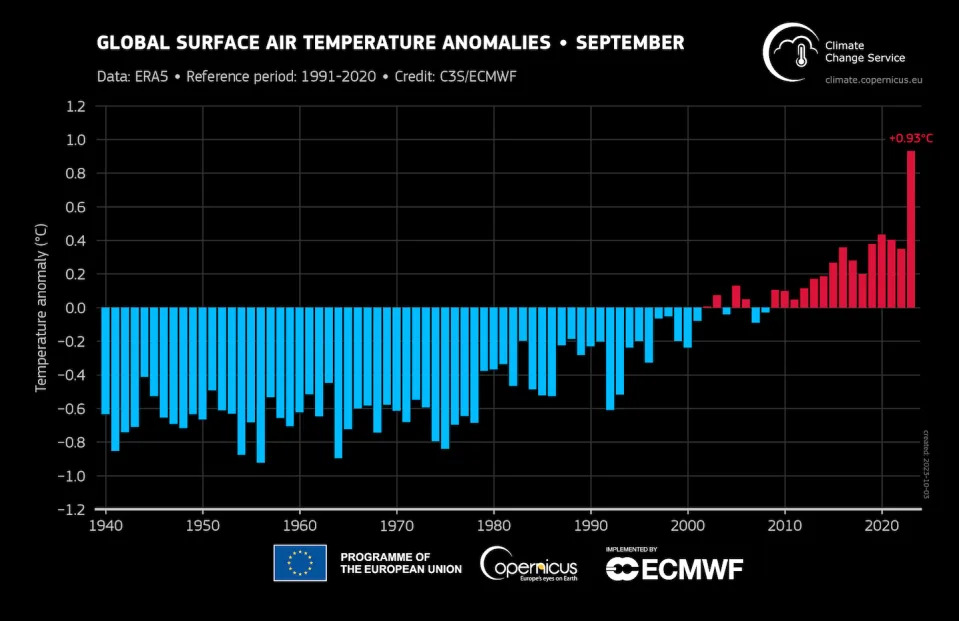
However, the extremes this year are sharper than anthropogenic global warming alone would be expected to cause. September temperatures were far above any previous September, and around 3.1 degrees Fahrenheit (1.75 degrees Celsius) above the preindustrial average, according to the European Union’s earth observation program.
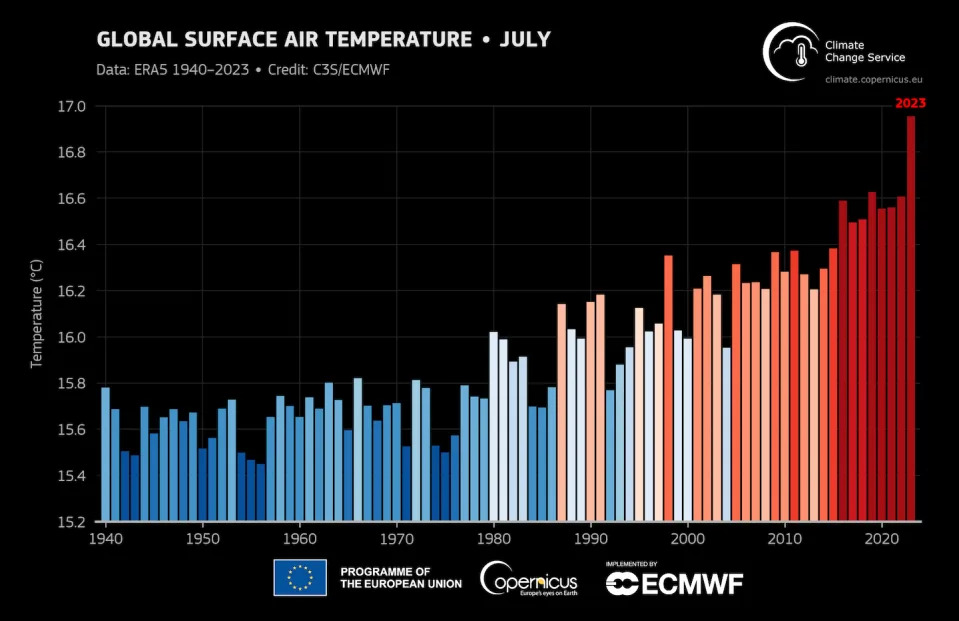
July was Earth’s hottest month on record, also by a large margin, with average global temperatures more than half a degree Fahrenheit (a third of a degree Celsius) above the previous record, set just a few years earlier in 2019.
September 2023’s temperatures were far above past Septembers. CopernicusJuly 2023 was the hottest month on record and well above past Julys. Copernicus Climate Change ServiceMore
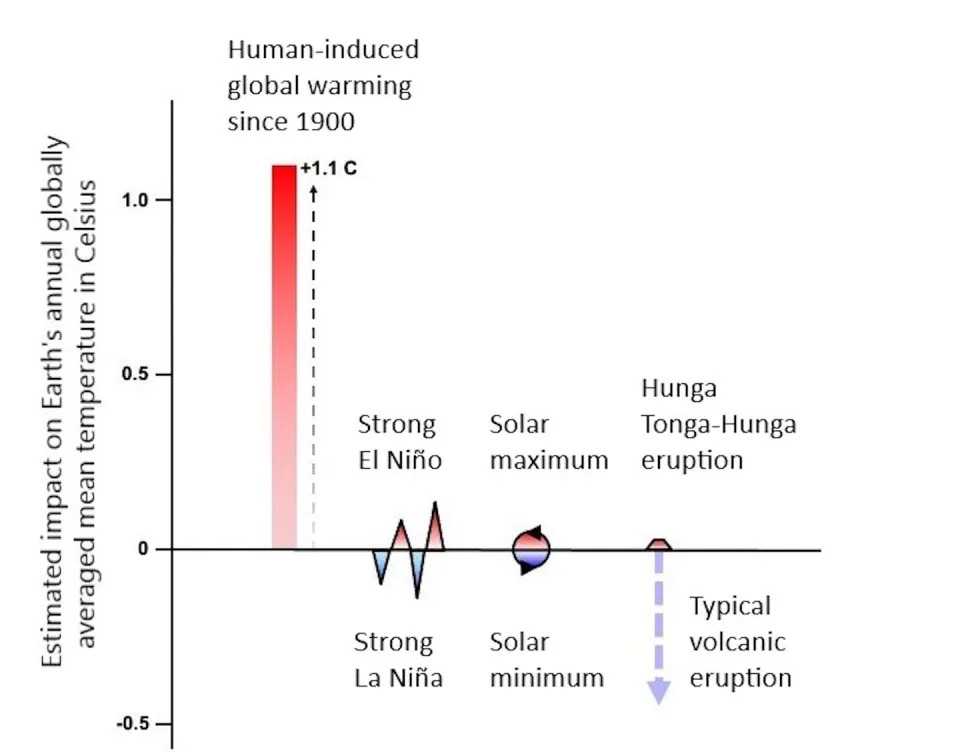
Human activities have been increasing temperatures at an average of about 0.2 F (0.1 C) per decade. But this year, three additional natural factors are also helping drive up global temperatures and fuel disasters: El Niño, solar fluctuations and a massive underwater volcanic eruption.
Unfortunately, these factors are combining in a way that is exacerbating global warming. Still worse, we can expect unusually high temperatures to continue, which means even more extreme weather in the near future.
An illustration by the author shows the typical relative impact on temperature rise driven by human activities compared with natural forces. El Niño/La Niña and solar energy cycles fluctuate. The Hunga Tonga-Hunga Ha’apai volcano’s underwater eruption exacerbated global warming. Michael Wysession
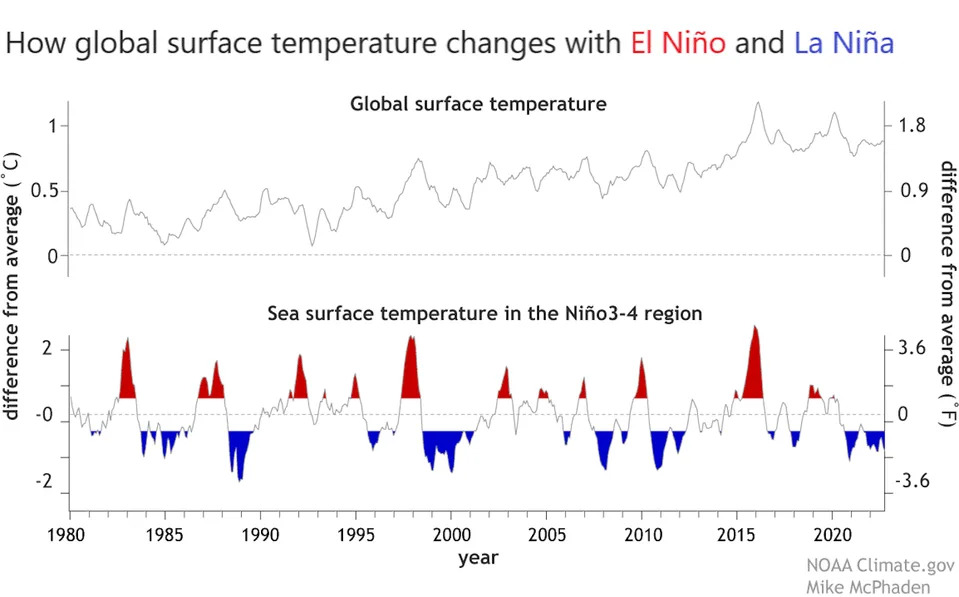
Essentially, the atmosphere borrows heat out of the Pacific, and global temperatures increase slightly. This happened in 2016, the time of the last strong El Niño. Global temperatures increased by about 0.25 F (0.14 C) on average, making 2016 the warmest year on record. A weak El Niño also occurred in 2019-2020, contributing to 2020 becoming the world’s second-warmest year.
El Niño’s opposite, La Niña, involves cooler-than-usual Pacific currents flowing westward, absorbing heat out of the atmosphere, which cools the globe. The world just came out of three straight years of La Niña, meaning we’re experiencing an even greater temperature swing.
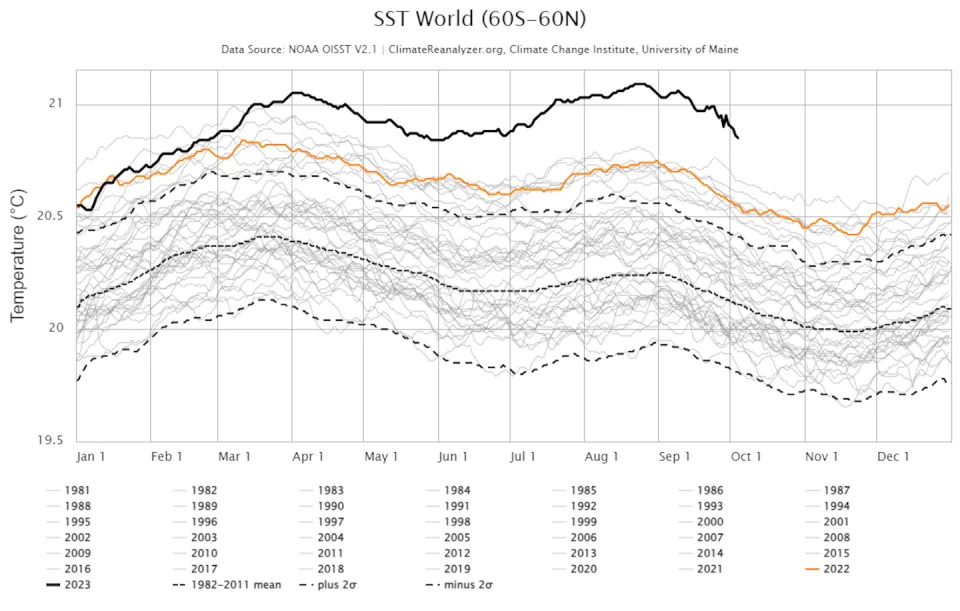
Based on increasing Pacific sea surface temperatures in mid-2023, climate modeling now suggests a 90% chance that Earth is headed toward its first strong El Niño since 2016.
Combined with the steady human-induced warming, Earth may soon again be breaking its annual temperature records. June 2023 was the hottest in modern record. July saw global records for the hottest days and a large number of regional records, including an incomprehensible heat index of 152 F (67 C) in Iran.
Solar fluctuations
The Sun may seem to shine at a constant rate, but it is a seething, churning ball of plasma whose radiating energy changes over many different time scales.
The Sun is slowly heating up and in half a billion years will boil away Earth’s oceans. On human time scales, however, the Sun’s energy output varies only slightly, about 1 part in 1,000, over a repeating 11-year cycle. The peaks of this cycle are too small for us to notice at a daily level, but they affect Earth’s climate systems.
Rapid convection within the Sun both generates a strong magnetic field aligned with its spin axis and causes this field to fully flip and reverse every 11 years. This is what causes the 11-year cycle in emitted solar radiation.
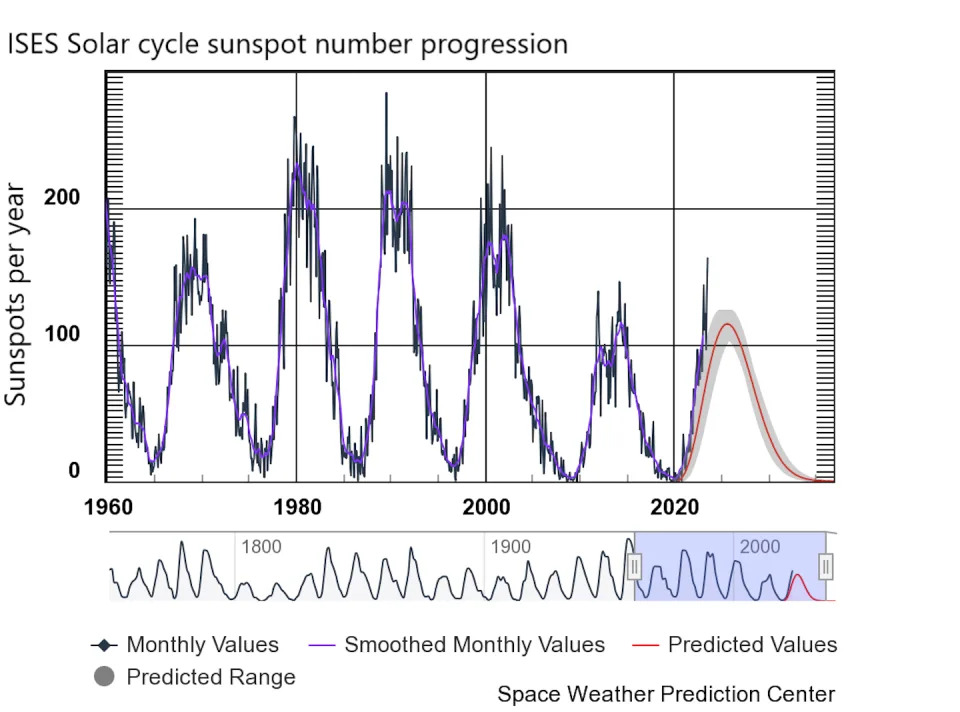
Sunspot activity is considered a proxy for the Sun’s energy output. The last 11-year solar cycle was unusually weak. The current cycle isn’t yet at its maximum. NOAA Space Weather Prediction CenterMore
Earth’s temperature increase during a solar maximum, compared with average solar output, is only about 0.09 F (0.05 C), roughly a third of a large El Niño. The opposite happens during a solar minimum. However, unlike the variable and unpredictable El Niño changes, the 11-year solar cycle is comparatively regular, consistent and predictable.
The last solar cycle hit its minimum in 2020, reducing the effect of the modest 2020 El Niño. The current solar cycle has already surpassed the peak of the relatively weak previous cycle (which was in 2014) and will peak in 2025, with the Sun’s energy output increasing until then.
A massive volcanic eruption
Volcanic eruptions can also significantly affect global climates. They usually do this by lowering global temperatures when erupted sulfate aerosols shield and block a portion of incoming sunlight – but not always.
The eruption released an unusually small amount of cooling sulfate aerosols but an enormous amount of water vapor. The molten magma exploded underwater, vaporizing a huge volume of ocean water that erupted like a geyser high into the atmosphere.
Water vapor is a powerful greenhouse gas, and the eruption may end up warming Earth’s surface by about 0.06 F (0.035 C), according to one estimate. Unlike the cooling sulfate aerosols, which are actually tiny droplets of sulfuric acid that fall out of the atmosphere within one to two years, water vapor is a gas that can stay in the atmosphere for many years. The warming impact of the Tonga volcano is expected to last for at least five years.
Underlying it all: Global warming
All of this comes on top of anthropogenic, or human-caused, global warming.
Humans have raised global average temperatures by about 2 F (1.1 C) since 1900 by releasing large volumes of greenhouse gases into the atmosphere. The amount of carbon dioxide in the atmosphere is up 50%, primarily from the combustion of fossil fuels in vehicles and power plants. The warming from greenhouse gases is actually greater than 2 F (1.1 C), but it has been masked by other human factors that have a cooling effect, such as air pollution.
If human impacts were the only factors, each successive year would set a new record as the hottest year ever, but that doesn’t happen. The year 2016 was the warmest in part because temperatures were boosted by the last large El Niño.
What does this mean for the future?
The next couple of years could be very rough.
If a strong El Niño develops over the coming months as forecasters expect, combined with the solar maximum and the effects of the Hunga Tonga-Hunga Ha’apai eruption, Earth’s temperatures will likely continue to soar.
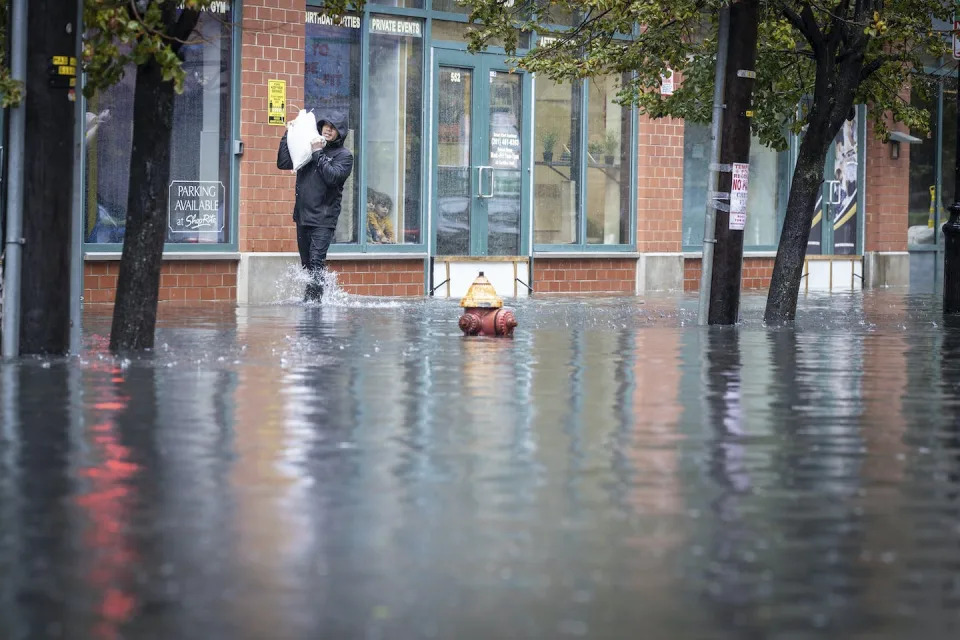
A heavy downpour flooded streets across the New York City region, shutting down subways, schools and businesses on Sept. 29, 2023. AP Photo/Jake OffenhartzMore
In January 2023, scientists wrote that Earth’s temperature had a greater than 50% chance of reaching 2.7 F (1.5 C) above preindustrial era temperatures by the year 2028, at least temporarily, increasing the risk of triggering climate tipping points with even greater human impacts. Because of the unfortunate timing of several parts of the climate system, it seems the odds are not in our favor.
This article, originally published July 27, 2023, has been updated with September’s record heat.
Michael Wysession does not work for, consult, own shares in or receive funding from any company or organization that would benefit from this article, and has disclosed no relevant affiliations beyond their academic appointment.
The ultra-rich are not just the worst polluters–their donations to climate action are also another way of hoarding money and gaming the system
Alan Davis – October 4, 2023
Getty Images
Everyone should know that we’re heading to a climate disaster that can best be modified by immediate actions addressing the causes. But it doesn’t appear that the excessively rich are feeling the heat and stepping up to the plate. Their philanthropic foundations announce commitments to fight climate change but in reality, they are building up endowments to save for the future.
It is estimated that it could take $3 to 10 trillion (twelve zeroes) per year to avoid climate disaster. Even if they wanted to fix the climate problem, it would require extraordinary collective action for philanthropists to pony up enough money to fix the climate problem. Only governments (funded by taxes on these very ultra-wealthy donors) can effectively do that. In short, the philanthropic investments now being made are necessary but insufficient.
We need to hold the ultra-rich responsible for the role their investments play in worsening the climate crisis, call out their insincere philanthropic efforts aimed at “addressing” climate change, and hold them accountable for paying their fair share of taxes to provide funding for clean energy.
Extreme inequality and wealth concentration undermine humanity’s ability to stop climate breakdown. The richest of the rich play the largest role in driving and accelerating the climate crisis with out-of-control carbon footprints due to extravagant lifestyles, excessive wealth-hoarding, corporate greed, and investments in polluting industries. Poor and middle-class communities who share the least responsibility for the problem will bear the brunt of climate change and suffer the most as shifting weather patterns, destructive storms, floods, wildfires, and heat waves wreak havoc across the globe, with the potential to displace 216 million people from their homes (and countries) by 2050.
According to the most recent data, the world’s top 125 billionaires have “an average of 14% of their investments in polluting industries, such as fossil fuels and materials like cement….Only one billionaire in the sample had investments in a renewable energy company.” When combining the impact from both their investments and lifestyles, carbon emissions exceed 3 million tons per billionaire, about a million times greater than the average person! The same report finds that through campaign contributions and lobbying, the wealthiest among us have an oversized impact on election outcomes and more political power than anyone else to protect their investments and shape climate policies in their favor.
And therein lies the biggest problem: We must have a functioning democracy to address society’s most pressing issues, including climate change–one where an exclusive ruling class doesn’t control our policies. When the government is beholden to the excessively wealthy, backroom deals influence laws and shape the rules without the public’s knowledge or ability to change the outcomes. The only way to limit the power of the excessively wealthy is to stop the hoarding of excessive wealth.
Extremely rich Americans hoard their wealth through tax loopholes and preferential policies enforced by their armies of lawyers, accountants, wealth advisers, and politicians. Four simple tax solutions would address excessive wealth hoarding: a multi-millionaire income tax, a robust wealth tax, closing gaping estate tax loopholes through an estate or inheritance tax, and finally, changes to the tax rules to foster increased, transparent and more equitable charitable giving.
We are facing a collective emergency: to save the planet from–and for–ourselves. The rapidly accelerating climate crisis is a class issue that impacts all of humanity. The reality is that our futures are interconnected with one another–and economic and climate inequality reinforce each other. To develop solutions that slow or solve climate change, we must address the deep-seated conflicts of interest and the systemic inequalities of our unjust wealth system.
It’s true NJ, your commute stinks. Census data says it’s third-worst in U.S.
Manahil Ahmad – October 4, 2023
Recent data on travel times in the United States has found that New Jersey has the third-longest average time people spend getting to work.
The U.S Census shared these results, highlighting the tough daily journeys faced by people in the state of New Jersey due to crowded roads and public transportation.
The study looked at data from big cities all over the country. It showed that in New Jersey, people spend about 30.3 minutes on an average going to work each day. This is almost five minutes more than the national average, showing just how tough commuting is in the Garden State.
Being very close to major cities like New York City and Philadelphia makes things harder, as many folks cross state borders for work, making the traffic situation even worse.