Biden blames Trump for sinking bipartisan immigration bill
By Steve Holland – February 6, 2024
WASHINGTON (Reuters) -U.S. President Joe Biden said on Tuesday that the bipartisan immigration bill is falling apart under political pressure from Republican rival Donald Trump and vowed to hit the road to remind voters who was to blame if it fails.
“All indications are this bill won’t even move forward to the Senate floor. Why? The simple reason: Donald Trump,” Biden said. “Because Donald Trump thinks it’s bad for him politically.”
Concerns over immigration have become a top issue in this year’s election campaign, with Trump preparing for a likely November rematch with Biden. Trump has been pushing congressional Republicans to reject the bipartisan border security deal unveiled on Sunday.
A spokesperson for Trump did not immediately respond to a request for comment.
Biden’s vow to make the Republican ex-president’s efforts to kill the bill a major theme of his reelection campaign is a risky bet given polls showing that Americans give Biden low grades for his handling of border security and immigration.
The Democratic president’s approval rating sank to 38% in January as concerns over immigration flared, the latest Reuters/Ipsos poll showed.
Biden has grappled with record numbers of migrants caught illegally crossing the U.S.-Mexico border during his presidency. Republicans contend that Biden should have kept the restrictive policies of Trump.
In December, encounters averaged more than 9,500 per day, according to U.S. government statistics, but have dropped steeply in about the last month.
Biden will test whether blaming Trump for thwarting a bipartisan compromise can help change American minds.
“I’ll be taking this issue to the country and the voters are gonna know that…just at the moment we’re going to secure the border and fund these other programs Trump and the MAGA Republicans said no because they’re afraid of Donald Trump,” Biden said at the White House.
The $118 billion bill, which also includes aid for Israel and Ukraine as it fights a Russian invasion, is quickly losing support on Capitol Hill. House of Representatives Republicans have declared it dead on arrival, and more than 20 Republican senators have said the measure is not strict enough.
Several Democrats have also opposed the bill because they say some of its measures treat migrants too harshly.
Biden didn’t mention the Democratic opposition, but blamed Republicans for buckling under the pressure from Trump, who he said was reaching out to Republican lawmakers to “intimidate them to vote against this proposal.”
“Frankly, they owe it to the American people to show some spine and do what they know to be right,” Biden said.
Senate Majority Leader Chuck Schumer on Tuesday also took aim at Trump over the mounting opposition to the border security deal.
“Donald Trump would rather keep the chaos at the border so he can exploit it on the campaign trail instead of letting the Senate do the right thing and fix it,” Schumer said.
(Reporting by Steve Holland and Jarrett Renshaw; Writing by Jarrett Renshaw; Editing by Trevor Hunnicut and Leslie Adler)
Negotiators in the Senate have produced a draft agreement on immigration and asylum. The deal delivers on Republican priorities. It includes changes to federal law to discourage asylum seeking. It shuts down asylum processing altogether if too many people arrive at once. Those and other changes send a clear message to would-be immigrants: You’re going to find it a lot harder to enter the United States without authorization. Rethink your plans.
The draft agreement offers little to nothing on major Democratic immigration priorities: no pathway to citizenship for long-term undocumented immigrants, only the slightest increase in legal immigration. The Democrats traded away most of their own policy wish list. In return, they want an end to the mood of crisis at the border, plus emergency defense aid for Ukraine and Israel.
Yet Republicans in the House seem determined to reject the draft agreement. They appear poised to leave in place a status quo that one senior GOP House leader has described as an “invasion” and an “existential and national security threat.”
So if no deal results, what truths will we learn from this process?
The first is that Republicans don’t really care all that much about the situation at the border. A real “existential threat” cannot wait for some later date. People who perceive an existential threat don’t delay. In fact, a good many Republican legislators are very happy to allow a continuing flow of laborers across the border.
Consider that Florida’s Republican-controlled House of Representatives has voted to allow 16- and 17-year-olds to work eight-hour days during the school year. Or that the Republican governor of Arkansas has signed a bill that relieves the state of having to certify that teenage workers aged 14 and 15 may work. Or that Ohio’s Republican-controlled legislature may soon pass a law allowing 14- and 15-year-olds to work as late as 9 p.m. on school nights. Or that Republican legislators in Wisconsin are pushing to allow 14-to-17-year-olds to serve alcohol in bars and restaurants. Consider also that all of these changes are written with teenage migrants very much in mind: Almost 40 percent of recent border-crossers have been under 18, a fivefold increase since the late aughts.
Those teenagers are traveling both alone and in family groups. They are coming to the U.S. to work. When state legislatures relax the rules on employing under-18s and under-16s, they’re flashing a giant we’re hiring sign to job-seeking teenagers around the world. The legislators know that. The teenagers know it. American voters should know it too.
A second truth concerns what Republican priorities really are. When Mike Johnson was elevated to the House speakership, he claimed that he genuinely wanted to help Ukraine but that aid had to wait until Congress passed new laws to harden the U.S. southern border. He wrote to President Joe Biden as recently as December 5 that further aid to Ukraine was “dependent upon enactment of transformative change to our nation’s border security laws.” When Senate negotiators produced exactly what Johnson said he wanted—a transformative bill that Congress could enact—he responded by reversing his demands. Johnson no longer wants any law at all. But one thing is constant: no aid to Ukraine—which suggests that “no aid to Ukraine,” not “defend the border,” is the true priority here.
A third truth is suggested by the angry reaction of House Republicans to the work of Senate Republicans: The very act of negotiation is mistrusted. Along with their speaker, House Republicans radically altered their position from “there must be a new law” to “there must be no new law,” and from “the president must sign our bill exactly as we wrote it” to “the president must act unilaterally by executive authority only.” How does anyone negotiate with a House majority that can so abruptly and totally pivot? The true goal revealed is failure and chaos.
And this points to a fourth truth, maybe the most important one of all. Donald Trump has sold his supporters the dangerous fantasy that democratic politics can be replaced by one man’s will. No need for distasteful compromises. No need to reckon with the concerns and interests of people who disagree with House Republicans. Just somehow return Trump to the presidency: He’ll bark; the system will obey.
Of course, such fantasies have no basis in reality. As the Cato Institute reported last November:
The Biden Department of Homeland Security (DHS) has removed a higher percentage of arrested border crossers in its first two years than the Trump DHS did over its last two years. Moreover, migrants were more likely to be released after a border arrest under President Trump than under President Biden. In absolute terms, the Biden DHS is removing 3.5 times as many people per month as the Trump DHS did.
Altogether, about 1.1 million unauthorized border-crossers were released into the United States during the Trump presidency and not removed by the end of his term. Glowering and yelling do not in fact accomplish much. But to many Trump supporters, glowering and yelling are the whole of it. They don’t care how little gets accomplished, so long as that little is done in the most offensive manner possible.
In their 1981 study of negotiation, Getting to Yes, Roger Fisher and William Ury stress the importance of understanding the opposite party’s point of view. Among the benefits of doing so is helping a negotiator recognize when he’s received the best offer he’s likely to get—and then say yes rather than press for more and arrive at no.
Arriving at no is what’s happening now among the House Republicans. Because they refuse to understand the other side, they cannot appreciate a good offer and recognize when to accept it. They’re going to arrive only at no—no for America, and no for Ukraine. But no is what they want.
Until a few days ago, I was feeling fairly sanguine about America’s prospects. Economically, we’ve had a year of strong growth and plunging inflation — and aside from committed Republicans, who see no good, hear no good and speak no good when a Democrat is president, Americans appear to be recognizing this progress. It has seemed increasingly likely that the nation’s good sense would prevail and democracy would survive.
But watching the frenzy over President Biden’s age, I am, for the first time, profoundly concerned about the nation’s future. It now seems entirely possible that within the next year, American democracy could be irretrievably altered.
And the final blow won’t be the rise of political extremism — that rise certainly created the preconditions for disaster, but it has been part of the landscape for some time now. No, what may turn this menace into catastrophe is the way the hand-wringing over Biden’s age has overshadowed the real stakes in the 2024 election. It reminds me, as it reminds everyone I know, of the 2016 furor over Hillary Clinton’s email server, which was a minor issue that may well have wound up swinging the election to Donald Trump.
As most people know by now, Robert Hur, a special counsel appointed to look into allegations of wrongdoing on Biden’s part, concluded that the president shouldn’t be charged. But his report included an uncalled-for and completely unprofessional swipe at Biden’s mental acuity, apparently based on the president’s difficulty in remembering specific dates — difficulty that, as I wrote on Friday, everyone confronts at whatever age. Hur’s gratuitous treatment of Biden echoed James Comey’s gratuitous treatment of Clinton — Hur and Comey both seemed to want to take political stands when that was not their duty.
Yes, it’s true that Biden is old, and will be even older if he wins re-election and serves out a second term. I wish that Democrats had been able to settle on a consensus successor a year or two ago and that Biden had been able to step aside in that successor’s favor without setting off an intraparty free-for-all. But speculating about whether that could have happened is beside the point now. It didn’t happen, and Biden is going to be the Democratic nominee.
It’s also true that many voters think the president’s age is an issue. But there’s perception and there’s reality: As anyone who has recently spent time with Biden (and I have) can tell you, he is in full possession of his faculties — completely lucid and with excellent grasp of detail. Of course, most voters don’t get to see him up close, and it’s on Biden’s team to address that. And yes, he speaks quietly and a bit slowly, although this is in part because of his lifetime struggle with stuttering. He also, by the way, has a sense of humor, which I think is important.
Most important is that Biden has been a remarkably effective president. Trump spent four years claiming that a major infrastructure initiative was just around the corner, to the point that “It’s infrastructure week!” became a running joke; Biden actually got legislation passed. Trump promised to revive American manufacturing, but didn’t. Biden’s technology and climate policies — the latter passed against heavy odds — have produced a surge in manufacturing investment. His enhancement of Obamacare has brought health insurance coverage to millions.
If you ask me, these achievements say a lot more about Biden’s capacity than his occasional verbal slips.
And what about his opponent, who is only four years younger? Maybe some people are impressed by the fact that Trump talks loud and mean. But what about what he’s actually saying in his speeches? They’re frequently rambling word salads, full of bizarre claims like his assertion on Friday that if he loses in November, “they’re going to change the name of Pennsylvania.”
Not to mention confusing Nikki Haley with Nancy Pelosi and mistaking E. Jean Carroll for one of his ex-wives.
As I also wrote last week, Trump’s speeches make me remember my father’s awful last year, when he suffered from sundowning — bouts of incoherence and belligerence after dark. And we’re supposed to be worried about Biden’s mental state?
Over the past few days, while the national discussion has been dominated by talk about Biden’s age, Trump declared that he wouldn’t intervene to help “delinquent” NATO members if Russia were to attack them, even suggesting that he might encourage such an attack. He seems to regard NATO as nothing more than a protection racket and after all this time still has no idea how the alliance works. By the way, Lithuania, the NATO member that Trump singled out, has spent a larger percentage of its G.D.P. on aid to Ukraine than any other nation.
Again, I wish this election weren’t a contest between two elderly men and worry in general about American gerontocracy. But like it or not, this is going to be a race between Biden and Trump — and somehow the lucid, well-informed candidate is getting more heat over his age than his ranting, factually challenged opponent.
As I said, until just the other day I was feeling somewhat optimistic. But now I’m deeply troubled about our nation’s future.
Paul Krugman has been an Opinion columnist since 2000 and is also a distinguished professor at the City University of New York Graduate Center. He won the 2008 Nobel Memorial Prize in Economic Sciences for his work on international trade and economic geography.
U.S. mends fences with El Salvador’s Bukele as China lurks
Diego Oré, Sarah Kinosian and Nelson Renteria – February 6, 2024
U.S. papers over differences with El Salvador’s Bukele with China waiting in the wings
SAN SALVADOR (Reuters) – When El Salvador President Nayib Bukele published a private WhatsApp conversation with the top U.S. diplomat in the Central American country two years ago, he was sending a message of his own: I will not take orders from the United States.
U.S. officials had for months been protesting Bukele’s support for moves like dismissing judges and bucking constitutional term limits – measures they said endangered the country’s young democracy.
Jean Manes, the chargé d’affaires whose messages intervening on behalf of a detained former mayor were unmasked, left the country. She said the bilateral relationship between the erstwhile allies was “on pause,” citing attacks on the U.S. by Bukele’s “paid media machine.”
Two years later, the United States is publicly cozying up to Bukele, a populist anti-establishment renegade who on Sunday romped to re-election in a landslide – even as it continues to emphasize concerns over the erosion of human rights and democracy.
Now, more than ever, the U.S. needs Central American nations like El Salvador to curb migration to the southern border. It is also striving to offset growing Chinese influence in Latin America.
In October, the State Department’s top Latin America diplomat, Brian Nichols, visited El Salvador and posed for photos with Bukele. He sought to “give a message that democracy is the most important form of government,” the U.S. embassy said at the time.
And on Monday, U.S. Secretary of State Antony Blinken congratulated Bukele on his win, saying the United States would prioritize “good governance” and “fair trials and human rights in El Salvador” as part of its plan to tackle the causes of migration.
Three U.S. State Department officials Reuters spoke to said they have moved more critical diplomacy behind closed doors, a tactic they have found effective given Bukele’s rebellious style and rebukes of perceived foreign meddling.
Bukele has since toned down the kind of inflammatory comments that marked his spat with Manes.
He has also grown savvy at milking the regional tug-of-war for influence between the United States and China.
“(Bukele) has used the approach to China as a negotiating card,” said Ana Maria Mendez, of the Washington Office on Latin America. “(He) threatens or challenges U.S. foreign policy by engaging with China.”
RAPPROCHEMENT
The more reserved public U.S. stance may be a tacit acknowledgement that Bukele’s success in smashing gang violence has led to a decline in migration, officials from both countries said.
Salvadorans fleeing violence and poverty have migrated to the U.S. for decades, hitting record levels in 2021. Following the gang crackdown that began in March 2022, the number of Salvadorans reaching the U.S. southern border fell, dipping 36% from 2022 to 2023, according to U.S. Customs and Border Protection.
Bukele has also implemented measures such as hefty taxes on flights from 57 largely African countries to dampen onward U.S. migration.
Bukele will be conscious of the need to stay on good terms with El Salvador’s largest trading partner and benefactor. The U.S. disbursed $629 million in aid between when Bukele took office in 2019 and 2022 – more than went to Honduras, a country with almost double the population, according to USAID.
The U.S. officials said they recognize Salvadorans support the gang crackdown, but that they are pushing Bukele to wind it down.
Under a “state of exception” stretching nearly two years, Bukele’s government has detained over 75,000 Salvadorans – 1.1% of the country’s population. Rights groups have documented 150 deaths in prison, while Salvadorans have lost their rights to due process.
“We recognize the profound challenge El Salvador faced curbing gang violence,” a U.S. State Department spokesperson said in an email. “(But) the state of exception must be an exception.”
WAITING IN THE WINGS
At the same time, there are growing ties between China and El Salvador.
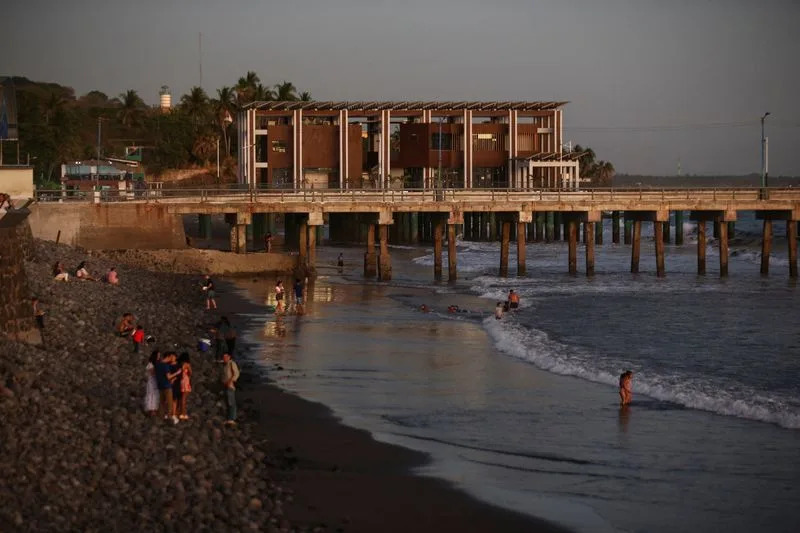
In recent years, China has spent $500 million in infrastructure projects that include a state-of-the-art sports stadium, a tourist pier and water purification plants.
A futuristic library near the capital’s main square flies a giant Chinese flag and was inaugurated with a drone display of Bukele’s face.
“El Salvador will look to work as closely with China as possible in the coming years. China is an economic partner that is willing to look the other way on human rights and other issues,” said Margaret Myers, from Washington-based think tank Inter-American Dialogue.
China’s embassy in San Salvador was quick to congratulate Bukele and his party “for the historic victory in these elections” this week.
Although of limited commercial importance in itself, El Salvador offers China a foothold in Central America, and in 2018 broke relations with Taiwan in favor of China.
Bukele’s government must walk a careful line, though. In mid-2023 it stopped negotiating a 5G deal with Chinese telecoms provider Huawei, which has been the subject of U.S. sanctions, and now is working with Washington in “to achieve a secure nationwide 5G service using trusted vendors,” said a U.S. State Department spokesperson .
“El Salvador wants to do trade with everyone,” Bukele said during his victory speech on Sunday night. “What we are not going to be is your lackeys.”
(This story has been corrected to rectify the year that El Salvador broke relations with Taiwan in paragraph 24)
(Reporting by Diego Ore in Mexico City and Nelson Renteria and Sarah Kinosian in San Salvador; Editing by Christian Plumb and Rosalba O’Brien)
‘Morning Joe’ Shreds Mike Johnson for Border Bill Shutdown Effort: ‘Worshipping at the Feet’ of Trump | Video
Andi Ortiz – February 5, 2024
“Morning Joe” host Joe Scarborough laid into House Speaker Mike Johnson on Monday morning, after Johnson made it clear that he won’t be supporting a bipartisan bill aiming to improve border security. According to the MSNBC host, Johnson is simply “worshipping at the feet of Donald Trump” at this point.
On Sunday, after the text of the bipartisan bill was released — clocking in at 370 pages — Johnson posted on X, still popularly referred to as Twitter, that he’d “seen enough” and that the bill was “even worse than we expected.”
“That’s just a lie. And I’d love to know what bible he’s looking at when he says he lives by the Bible,” Scarborough said disgustedly. “Because it’s bizarre that this guy is worshipping at the feet of Donald Trump. [He] basically does whatever Donald Trump tells him to do, and was, of course, the chief sponsor of the Big Lie in the House of Representatives.”
“This is the toughest border bill in a generation,” Scarborough said. “If you’d have read any of that to us a year or two ago, we would all say ‘Oh, yeah, that’s the Republican wishlist.’”
He added, “And now, just because Mike is being told by Donald not to pass this bill … we have a situation where they want to keep the border open, because it’s bad for America, and they believe what’s bad for America is good for Donald Trump.”
You can watch the full discussion from “Morning Joe” in the video above.
Lankford defends border bill amid GOP criticism: ‘Don’t just go off of Facebook’
Alexander Bolton – February 5, 2024
Lankford defends border bill amid GOP criticism: ‘Don’t just go off of Facebook’
Sen. James Lankford (Okla.), the lead GOP architect of the bipartisan Senate border security deal, pushed back on Republican critics, including Speaker Mike Johnson (R-La.), for rushing to condemn the legislation.
Lankford during an appearance on “Fox & Friends” also responded to the scathing criticism of the legislation by Sen. Mike Lee (R-Utah), who panned the proposal Sunday as the “Border Capitulation Bill” and more bluntly as a “crap-sandwich of a border bill.”
Lankford noted that Lee had previously insisted on giving senators at least three weeks to review the 370-page bill but is expressing opposition after having less than a day to study it.
“He needs three weeks to be able to read it, but he’s already opposed to it. So again, people have to be able to read it and go through it themselves. Don’t just go off of Facebook post somewhere on what the bill says,” Lankford said.
Lankford, who spent four months negotiating the legislation and said it “blew up” his Thanksgiving, Christmas and New Year’s holidays, said it’s “unfortunate” that the Speaker has declared the Senate bill is “even worse than expected” and “dead on arrival” in the House.
The Oklahoma senator lamented Johnson’s condemnation of the bill without taking more time to digest reforms such as raising the standard of migrants seeking asylum, eliminating the backlog at immigration courts and granting the president new power to expel migrants and shut down the border.
“Unfortunate that he would step out and be able to see that right away, before, obviously, he has had a chance to be able to read it as well, and to be able to go through it,” he said of Johnson’s declaration that the bill has no chance of passing the House.
Lankford said Republicans need to make a decision about whether they want to enact some meaningful border security reforms into law or to let the border crisis continue unabated and allow an average of 10,000 people to steam into the country each day, many of them unvetted.
“The key aspect of this, again, is are we, as Republicans, going to have press conferences and complain the border’s bad and then intentionally leave it open after the worst month in American history in December?” Lankford argued.
“Now we’ve got to actually determine, are we going to just complain about things? Are we going to actually … change as many things as we can if we have the shot?” he said.
Lankford has told reporters that under the bill, once the daily average of migrants encountered at the border reaches 5,000, President Biden will be forced to shut down the border until the Department of Homeland Security regains operational control.
And he has dismissed talk among some GOP lawmakers that passing a bipartisan border deal will protect Biden from attacks over his immigration record.
“I’ve had some Republicans say, ‘Well, this will make Joe Biden whole [on immigration].’ I don’t think anyone is going to see Joe Biden as the border security president. I just don’t think there’s any chance of that. Because what we’ve seen the last three years is an open border like our country’s never experienced. So I don’t think when we pass this bill everybody’s going to suddenly think he’s the savior of the closed border,” Lankford told reporters last week.
Trump says border bill ‘very bad’ for Lankford’s career
Sarah Fortinsky – February 5, 2024
Former President Trump on Monday railed against the bipartisan border agreement and took aim at Sen. James Lankford (R-Okla.), a key negotiator, for his role in brokering the deal.
In an interview on “The Dan Bongino Show,” Trump denied endorsing Lankford’s candidacy in 2022 — despite doing so publicly — and did not rule out endorsing a primary opponent when Lankford is up for reelection in 2028.
“I think this is a very bad bill for his career, especially in Oklahoma,” Trump said about Lankford when asked whether he would back a primary challenge to the senator.
“I won in Oklahoma,” Trump said. “I know those people. They’re great people. They’re not going to be happy about this. Nobody’s going to be happy about this, but the people in Oklahoma are, these are serious MAGA, these are serious people. They are not going to be happy about this, Dan, when they see this. This is crazy. This is lunacy, this bill.”
Senate negotiators unveiled the 370-page national security legislation Sunday evening after months of negotiations. The bill includes funding for Ukraine, Israel and other foreign policy priorities, as well as significant changes aimed at tightening enforcement at the U.S.-Mexico border.
The border component includes provisions to raise standards for asylum screening and to process claims faster, ends the practice known as “catch and release” and provides the administration with new emergency authority to close the border to most migrants when crossings reach a set threshold. It also seeks to make it easier for migrants to get work authorization and eliminate the immigration court backlog.
The bill has faced significant pushback from progressives and Trump allies in Congress, and House Republican leaders have said it would be dead on arrival in the lower chamber. Still, the Senate plans to take the first procedural vote on the legislation this week.
Ahead of the bill text’s release, Trump had attacked the prospect of the legislation, branding it as a political victory for Democrats ahead of the 2024 election — a message he repeated in Monday’s interview.
“This is a gift to Democrats, and this, sort of, is a shifting of the worst border in history onto the shoulders of Republicans. That’s really what they want. They want this for the presidential election, so they can now blame the Republicans for the worst border in history,” Trump said.
Lankford has fiercely defended the bill and said that if Trump returned to the White House, it would give him the tools to manage the border. He also lamented Speaker Mike Johnson’s (R-La.) rush to disavow the legislation before even having a chance to read it.
“The key aspect of this, again, is, are we, as Republicans, going to have press conferences and complain the border’s bad and then intentionally leave it open after the worst month in American history in December?” Lankford said in a Monday interview on “Fox & Friends.”
“Now we’ve got to actually determine, are we going to just complain about things? Are we going to actually … change as many things as we can if we have the shot?” he added.
“I’ve had some Republicans say, ‘Well, this will make Joe Biden whole [on immigration].’ I don’t think anyone is going to see Joe Biden as the border security president. I just don’t think there’s any chance of that. Because what we’ve seen the last three years is an open border like our country’s never experienced. So I don’t think when we pass this bill everybody’s going to suddenly think he’s the savior of the closed border,” Lankford told reporters last week.
Trump falsely claims he didn’t endorse border bill co-author James Lankford
Kyla Guilfoil – February 6, 2024
Former President Donald Trump falsely claimed in an interview Monday that he did not endorse Sen. James Lankford, R-Okla., for re-election in 2022.
“Just to correct the record, I did not endorse Sen. Lankford. I didn’t do it. He ran, and I did not endorse him,” Trump told right-wing radio host Dan Bongino in an interview after the host noted the former president previously endorsed the Oklahoma Republican.
But in a Sept. 27, 2022, statement, Trump gave Lankford his “Complete and Total Endorsement!”
“Sometimes we didn’t exactly agree on everything, but we do now,” Trump said in a statement ahead of the midterm elections. “He is a very good man with a fabulous wife and family, loves the great State of Oklahoma, and is working very hard on trying to Save our Country from the disaster that it is in.”
Trump also praised Lankford’s commitment to improving border security.
“James Lankford is Strong on the Border, Tough on Crime, and Very Smart on the Economy,” Trump’s statement said.
Trump’s false claim on Monday about not previously endorsing Lankford came after the Oklahoma senator helped negotiate a bipartisan border security bill in Congress that the former president is trying to quash.
The bill aims to address record-high border crossings with a series of provisions that would include language to tighten an asylum system that has been overwhelmed with migrants. The bill also includes aid for Israel, Ukraine and Taiwan.
In his interview Monday, Trump bashed Lankford’s support of the new border bill, adding that it would hurt the senator’s support in his home state.
“This is a very bad bill for his career and especially in Oklahoma,” Trump said. “I know those people. They’re great people. They’re not going to be happy about this.”
Lankford is not up for re-election until 2028. He has served in the Senate since 2015 and previously served in the House from 2011 to 2015.
Why Are Americans Wary While the Economy Is Healthy? Look at Nevada.
Peter S. Goodman – February 5, 2024
Nevada is dependent on a single industry — casino resorts and the hospitality trade — for roughly one-fourth of its jobs. (Bridget Bennett/The New York Times)
LAS VEGAS — Toni Irizarry recognizes that the economy has improved. Compared with the first wave of the pandemic, when Las Vegas went dark, and joblessness soared to levels not seen since the Great Depression, these are days of relative normalcy.
Irizarry, 64, oversees a cafe at the Orleans Hotel and Casino, a property just off the Las Vegas Strip that caters mostly to locals. Guests have returned, filling the blackjack and roulette tables amid the cacophony of jingling slot machines — the sound of money.
She started in the hospitality industry busing tables when she was only 16. Her paychecks have allowed her to purchase a home, raise three children and buy each of them their first car. But as she contemplates the future, she cannot shake a sense of foreboding.
The outlook of people like Irizarry could be crucial in determining who occupies the White House. Nevada is one of six battleground states that are likely to decide the outcome of November’s presidential election. Its economic centerpiece, Las Vegas, was constructed on dreams of easy money. That proved a winning proposition for generations of working people, yielding middle-class paychecks for bartenders, restaurant servers, casino dealers and maids. Yet over the last two decades, a series of shocks have eroded confidence.
First, a speculative bonanza in real estate went spectacularly wrong, turning the city into the epicenter of a national foreclosure crisis. The Great Recession inflicted steep layoffs on the hospitality industry, demolishing the notion that gambling was immune to downturns. Then in 2020, the pandemic turned Las Vegas into a ghost town.
“There is that sense of the unknown,” Irizarry said. “People are scared. They think, ‘If this could happen, which we never ever had before, what else could happen?’”
That the fate of the 2024 presidential election could hinge on economic sentiments is widely taken as a given among political operatives.
In the battleground states, 57% of registered voters identified the economy as the most important issue in a poll conducted in October by The New York Times and Siena College. More than half of all respondents described economic conditions as “poor” — a key reason that President Joe Biden was trailing his presumptive Republican challenger, former President Donald Trump, in five of the six states.
Such indications of worry appear to conflict with data points that reflect an unambiguous strengthening of the U.S. economy. Incomes have risen, unemployment remains low and consumer confidence is improving. Fears of recession have yielded to exultation over economic growth that registered 3.3% over the last three months of 2023. And the Super Bowl, coming to Las Vegas for the first time Sunday, will bring a short-term boost of as much as $700 million to the local economy.
Still, a sense of insecurity has seeped into the crevices of everyday experience. This feeling is especially palpable in Nevada, a state dependent on a single industry — casino resorts and the hospitality trade — for roughly one-fourth of its jobs.
In Nevada, 59% of those polled described the economy as “poor,” the highest margin among the six states. Seventeen percent of registered Democrats asserted intentions to vote for Trump.
The state’s unemployment rate is down sharply, registering 5.4% in November — a fraction of the 31% logged in April 2020 — even as it remains higher than any other state. Wages have grown, especially for more than 40,000 leisure and hospitality workers represented by a pair of local unions. The rate of inflation on a range of consumer goods has slowed markedly.
But those figures leave out key sources of distress that are playing out across the country and even globally, and whose origins are not confined to the four-year windows conventionally used to assess presidential administrations.
While prices for many goods have stopped rising, they remain higher than before the pandemic, especially for critical things like gasoline, groceries and rent.
Higher interest rates — the result of the Federal Reserve’s credit tightening to choke off inflation — have increased credit card burdens for those carrying balances. They have multiplied mortgage payments for homeowners whose interest payments float with broader rates.
Of special concern in Nevada is recognition that potentially lucrative pursuits like advanced manufacturing could take years to produce significant numbers of jobs.
For decades, Nevada’s leaders have sought to diminish the state’s dependence on casinos and tourism. Las Vegas is rapidly filling with warehouses as the metro area emerges as a hub for the distribution of products. Ventures centered on the transition to green energy are generating high-paying jobs, especially near Reno.
Nonetheless, Nevada remains heavily reliant on the willingness of people around the world to fly in, pack into resorts and convention centers, and scatter their dollars across casinos, restaurants and entertainment venues. Which makes the enterprise subject to abrupt changes of fortune. Which makes people nervous.
“We’re still very vulnerable to another recession,” said Andrew Woods, director of the Center for Business and Economic Research at the University of Nevada, Las Vegas. “If the U.S. economy decides to go off the deep end, we are not any more resilient than we were before.”
The Strains of High Prices
Much of the unhappiness in Nevada, as in the rest of the country, centers on high costs for everyday items along with housing.
Antonio Muñoz, a former police officer, owns 911 Taco Bar, a restaurant tucked inside a food court near the Strip. He laments how the price of chicken has increased to $3.50 a pound from $1.20 before the pandemic. A 5-gallon jug of cooking oil has risen to $60 from $25. He has been forced to increase wages to keep his five full-time workers.
Much of his business is dedicated to catering work. Large events have come back robustly, he said. The annual Consumer Electronics Show in early January produced a surge of orders for rib eye and shrimp tacos as technology companies hosted visitors in private suites. He was gearing up for the Super Bowl.
But smaller bookings — birthday parties in particular — diminished last year by one-fifth compared with 2022. He blames Russia’s ongoing war in Ukraine, conflict in the Middle East and acrimony over the U.S. election for making people nervous and tight with money.
He worries that worry itself could take down the economy.
“I feel like it’s teetering,” Muñoz said. “People seem to be waiting to see what happens.”
More Pay, Greater Security
One group is celebrating potent gains. After threatening to strike, tens of thousands of people represented by the Culinary Workers Union Local 226 and Bartenders Union Local 165 secured a contract settlement that includes raises of 32% over the next five years.
Union workers played a critical role in turning out voters for Biden four years ago, and their greater pay could motivate them to repeat that effort. And given the importance of their wages in fueling local spending, the new contracts are themselves a source of economic vibrancy.
Kimberly Dopler has worked as a cocktail server at Wynn’s Las Vegas for nearly 20 years. The job is physically exhausting and fraught with the pitfalls of tending to customers who are “drinking and gambling, and not in their right state of mind,” she said. Yet she navigates those risks for the resulting security.
“I get to go home with money in my pocket every day, and I can take my shoes off and relax,” she said.
The union contract has enhanced her sense that the economy is strong. “I see a lot of hiring happening at my job, hiring events throughout town,” Dopler said. “I feel like people have a good opportunity in this town to find work.”
Raymond Lujan, 61, a union steward and server at Edge Steakhouse, a restaurant inside the Westgate Las Vegas, was born and raised in the city. His mother worked as a cocktail server at the Stardust. His brother is a bellman at the Bellagio.
Before the pandemic, Lujan had never been out of work. When the restaurant where he worked closed, he drew on savings, but many of his co-workers live check to check.
He remains confident in a future centered on the hospitality industry.
“This is Vegas,” he said. “It’s still the destination capital of the world.”
‘It’s Still Hard’
Yet for working people who lack the protection of a union, Las Vegas remains something else: an economy subject to violent fluctuations.
Before the pandemic, Carlos Arias, 51, was earning more than $2,000 a week as an Uber driver. When the casinos shut down, he found work as a cook — first at Denny’s for $13.75 an hour, then at IHOP for 50 cents more.
Suddenly earning only one-fourth of his previous income, Arias and his partner, a manger at a McDonald’s, struggled to pay the $1,100 monthly rent on their one-bedroom apartment. They tapped credit cards to keep gas in their car. They cut grocery purchases to bare essentials like rice, beans and instant ramen.
They fell behind on the payments for their Cadillac van. One morning, it was gone, seized in repossession.
He found a new job as a cook at a Mexican restaurant for an extra $1 an hour, and then a second one at an eatery inside the Ellis Island casino. For a year, he worked both positions, rising at 4 a.m. for the early shift, and sometimes not getting home until after midnight.
He felt dizzy, his vision blurring. He could not tell if he was ill or merely exhausted, and he had no health insurance. When he nearly collapsed, he went to the hospital and was diagnosed with diabetes. The medicine the doctor prescribed cost more than $50 for a 30-day course — more than he could manage.
Early last year, he took a job at a restaurant in the Mandalay Bay Resort and Casino, for $19 an hour.
On paper, Arias presents as an example of an improving economy. He is earning more than during the worst of the pandemic. He has health insurance, and is taking medication for his diabetes.
But he is earning less than half what he did before the unraveling began.
“It’s still hard,” he said. “You go to the store and buy $100 worth of groceries and there’s nothing in the car.”
Ex-GOP Lawmaker Has Urgent 2024 Message For Former Trump Loyalists
Josephine Harvey – February 5, 2024
Former Rep. Denver Riggleman (R-Va.) says it’s time for more of Donald Trump’s former allies to throw their weight behind President Joe Biden.
On MSNBC Sunday, Riggleman said it’s “absolutely” important for those who no longer support Trump to publicly back Biden. As examples, he pointed to former Trump aide Anthony Scaramucci and former Rep. Adam Kinzinger (R-Ill.), both of whom have said they would vote for Biden in his likely rematch with Trump this year.
“This is a person that you don’t want anywhere near … the Oval Office again,” Riggleman told MSNBC’s Alex Witt of the quadruply-indicted former president. “This is an individual that is out of touch with reality, or pretends that he’s out of touch with reality, to actually ignite the base, or to try to make the base violent, or to do things outside of what normal behavior would be.”
Riggleman said that when he considers what Trump has done and what kind of people he has surrounded himself with, “there’s nobody else who I’d vote for but Joe Biden.”
The ex-congressman announced in 2022 that he had left the Republican Party over its devotion to Trump.
Numerous former Trump associates and officials have in recent months spoken out about the former president and warned about the dangers of a potential White House return, but some have stopped short of saying they’d vote for Biden.
Riggleman later shared a RawStory editor’s tweet about his comments, writing: “Yes. I said this.”
“I am done identifying with a party,” he wrote on X (formerly Twitter). “I am an American— and right now that means supporting Democratic institutions and our way of life no matter what.”