Biden challenges House GOP to solve border crisis — or ‘keep playing politics’
Myah Ward and Jennifer Haberkorn – February 4, 2024
BLUE BELL, PENNSYLVANIA – JANUARY 5: U.S. President Joe Biden speaks during a campaign event at Montgomery County Community College January 5, 2024 in Blue Bell, Pennsylvania. In his first campaign event of the 2024 election season, Biden stated that democracy and fundamental freedoms are under threat if former U.S. President Donald Trump returns to the White House. (Photo by Drew Angerer/Getty Images)More
President Joe Biden urged Congress to pass the bipartisan border deal unveiled Sunday night by Senate negotiators, ramping up the pressure on House Republicans who have repeatedly cast doubt on the bipartisan effort.
“Working with my administration, the United States Senate has done the hard work it takes to reach a bipartisan agreement. Now, House Republicans have to decide. Do they want to solve the problem? Or do they want to keep playing politics with the border?” Biden said in a lengthy statement.
The president’s response came not long after senators released the long-awaited $118 billion deal that would unleash stricter border and immigration policies, while sending billions of dollars to Ukraine, Israel and Taiwan as well as the southern border. The bill’s introduction kicks off a sprint as the White House and negotiators work to sell the deal to Republicans and progressives before it heads for a procedural vote in the Senate scheduled for Wednesday.
The president said the agreement released Sunday includes some of the “toughest and fairest set of border reforms in decades,” and ones that he “strongly” supports. Biden asked Congress to pass the deal quickly — placing the fate of the deal in their hands. And he once again dared Republicans to reject the deal as it faces a make-or-break moment amid GOP fissures in both chambers.
“I’ve made my decision. I’m ready to solve the problem. I’m ready to secure the border. And so are the American people,” the president said. “I know we have our divisions at home but we cannot let partisan politics get in the way of our responsibilities as a great nation. I refuse to let that happen.”
The border has long been a challenging issue for the Biden White House. The president has seen record crossings since taking office in 2021, further straining a southern border already weighed down by irregular migration and an overwhelmed asylum processing system. Border Patrol agents reported a record 302,034 encounters with migrants over the southern border in December, according to figures released by U.S. Customs and Border Protection.
In addition, the fast-approaching 2024 election has piled on the pressure for Biden to take action on the border — to address the crisis but to also win the messaging battle on an issue Republicans frequently used to rally their base. Former President Donald Trump, Biden’s likely 2024 opponent, is sure to continue his efforts to combust a deal, adding another layer to efforts to sell the border legislation.
The legislation includes an authority that would effectively “close” the border if the number of migrant crossings reach a certain number over a certain period of time, although a limited number of people would still be allowed to apply for asylum at ports of entry.
Biden suggested publicly late last month that he’d be open to such an authority, vowing to “shut down the border” as soon as the bill was passed.
“I urge Congress to come together and swiftly pass this bipartisan agreement,” Biden said in Sunday night’s statement. “Get it to my desk so I can sign it into law immediately.”
Given the White House’s work with Senate Republicans on the legislation, Biden administration officials have focused their attention on Speaker Mike Johnson, casting him and House Republicans as the barrier to securing the border.
During the Senate talks, the Biden administration has tried to flip the long-held view — one borne out in public polling — that Republicans are better trusted on the issues of immigration and protecting the border. The administration argues the House GOP has blocked all of the president’s efforts to secure the border.
“Despite arguing for 6 straight years that presidents need new legal authority to secure the border, and despite claiming to agree with President Biden on the need for hiring more Border Patrol agents and deploying new fentanyl detection equipment, Speaker Johnson is now the chief impediment to all 3,” White House spokesperson Andrew Bates wrote in a strategy memo released last week.
Johnson’s camp has blamed Biden for reversing Trump-era border regulations that led to an uptick in migrants crossing the border.
“In a desperate attempt to shift blame for a crisis their policies have induced, they have argued it’s a funding problem,” wrote Johnson spokesperson Raj Shah in a memo last month. “Clearly, they have no facts to back up their claim.”
The bill raises “credible fear” standards for migrants; if they are able to pass the more challenging and faster screening, the migrants would be released after full adjudication of their cases and be allowed to work immediately. The legislation would also provide 50,000 visas a year — a mix of family and employment visas, and include the Fend Off Fentanyl Act and the Afghan Adjustment Act.
A major sticking point in talks was the president’s humanitarian parole authority, which the administration uses to accept up to 30,000 migrants from Cuba, Haiti, Nicaragua and Venezuela each month. The legislation would not affect this program, which has been central to the administration’s border management strategy, including an agreement with Mexico to also accept 30,000 migrants a month from those four countries.
But the administration would no longer be able to offer parole grants to incentivize migrants to use the online app CBP One, which would curtail the president’s authority to allow more undocumented immigrants into the country.
“This agreement on border security and immigration does not include everything we have fought for over the past three years — and we will continue to fight for these priorities — but it shows: we can make the border more secure while preserving legal immigration, consistent with our values as a nation,” Vice President Kamala Harris said in a statement.
“No, I would say maybe it’s going to be more than that,” Trump said when asked by Fox News’ Maria Bartiromo on “Sunday Morning Futures” whether he would consider imposing a 60% tariff, as The Washington Post has reported.
As president, Trump slapped tariffs of 25% on $50 billion of Chinese goods in June 2018. Beijing countered with its own tariffs, and the spiral continued until the two countries arrived at an agreement in 2020. The Biden administration has largely kept the Trump-era tariffs in place.
The former president also said he thought China would try to interfere in the 2024 presidential election.
“I think they will, and they won’t be interfering on my behalf. We should go same-day voting, paper ballots, voter ID and no mail-in ballots,” Trump said.
Chinese leader Xi Jinping told President Joe Biden that China would not interfere in the 2024 US presidential election when the two men met in November, CNN has reported. But FBI Director Christopher Wray warned Wednesday that Chinese hackers are preparing to “wreak havoc and cause real-world harm” to the US.
Trump also praised Xi, whom he described as “a very good friend of mine during my term,” and said, “I want China to do great, I do.”
Trump would not say whether he would intervene if China tried taking over Taiwan, arguing that doing so would “jeopardize my negotiating ability with China.”
China’s ruling Communist Party views Taiwan as part of its territory, despite never having controlled it, and leader Xi has not ruled out the use of military force to “reunify” the island with the mainland.
The US, meanwhile, is obligated under the Taiwan Relations Act to provide Taiwan with the military means to defend itself, something Beijing regards as interference in its internal affairs.
CNN’s Jack Forrest and Brad Lendon contributed to this report.
Trump campaign pumps small-dollar donors for $55m in legal expenses, records show
Alex Woodward – February 1, 2024
Two political action committees supporting Donald Trump spent more than $55m on the former president’s legal bills in 2023, with more than half of that cash spent within the second half of the year.
Campaign finance reports filed by Trump-allied PACs on Wednesday show Mr Trump paid out millions of dollars to almost 50 firms over the last year.
Many of these firms represent the Republican Party’s likely nominee for president as he faces 91 criminal charges, a massive defamation verdict and a potentially business-crushing lawsuit.
His committees paid out nearly $30m in legal costs within the last six months, records show. By the end of the year, across all his supporting PACs, Mr Trump’s campaign had more than $70m on hand.
A massive chunk of that campaign cash came from small-dollar donors, whose contributions face a fine print that 90 cents of every dollar goes to campaign committees while 10 cents goes to his Save America PAC.
That committee, founded in the wake of his 2020 presidential election loss as the campaign waged failed legal battles to overturn the results, raised tens of millions of dollars on a spurious pledge to fight for his victory in court. It’s now effectively a bank account for his legal expenses, with many donors giving donations of less than $50 at a time.
Wednesday’s filings only scratch the surface of Mr Trump’s mounting legal expenses. Jury trials have not yet started, he is in the middle of several appeals involving at least two cases likely headed to the US Supreme Court, and he cannot legally touch PAC money to pay out civil suit judgments.
Staggering legal expenses
The campaign finance reports show Mr Trump’s campaigns paid legal bills to 46 firms last year, though eight of them earned the lion’s share of that $55m.
The firms of Chris Kise, who is defending Mr Trump in both his New York civil fraud trial and in the federal classified documents case involving his Mar-a-Lago resort, were paid nearly $5m last year. The firm of Clifford Robert, a Trump family attorney representing Donald Trump Jr and Eric Trump in the civil fraud case, was paid nearly $4m.
The firm of Alina Habba, who represented Mr Trump in the fraud case and in E Jean Carroll’s defamation suit, was also paid nearly $4m.
John Lauro and Todd Blanche, attorneys in the federal criminal case involving his efforts to overturn 2020 election results, were paid $2.5m and $1.9m, respectively.
Donald Trump’s attorney Alina Habba walks outside a federal courthouse in Manhattan on 26 January. (REUTERS)
Save America PAC, which started 2022 with $105m, was burning through cash for Mr Trump’s legal bills through the first half of last year. The organisation spent more than $40m on legal fees by July.
The group asked for a refund of a $60m donation to the Trump-connected MAGA Inc. That PAC refunded $30m to Save America in the second half of the year – an average of about $5m a month – in addition to $12.5m that it gave back to Save America in the first half of the year, records show.
In all, a PAC established to re-elect Mr Trump funneled $42.5m back into a fund that is now chiefly used for paying lawyers, a total that is nearly equivalent to super PAC spending on other campaign expenses like television advertising.
The FEC filings detail Mr Trump’s web of legal obstacles and fees to attorneys wrapped up in them. Filings show payments to the firm of John Sauer, his attorney leading an appeal of a federal judge’s decision that rejected Mr Trump’s claim of “presidential immunity” to evade prosecution in his election conspiracy case. The filings also show payments to the firm that represented former Trump-allied attorney Kenneth Chesebro in the Fulton County election interference case – before he pleaded guilty.
Pumping small-dollar donors to pay lawyers and legal fees
After Mr Trump’s mugshot was released last August in the Georgia RICO case, his campaign raised more than $4.2m in online donations – his largest single-day haul of 2023, records show.
Mr Trump’s campaign has largely been powered by an aggressive fundraising operation relying on a long list of potential contributors, with only 6 per cent of his campaign cash coming in from donors who hit the $6,600 limit.
Campaign messages routinely use his mugshot and frame his legal challenges as a political attack to cast him as a victim of a Democratic conspiracy against him. He continues to baselessly cast the consequences of his alleged actions as “election interference” under President Joe Biden, who is “weaponizing” the judicial system against him.
The House select committee investigating the events surrounding the attack on the US Capitol on 6 January 2021 reported that Mr Trump’s fundraising arms collected more than $100m in the first week after Election Day in 2020 alone.
His campaign and allies raised $250m from baseless claims that the 2020 presidential election was stolen from him, the committee found.
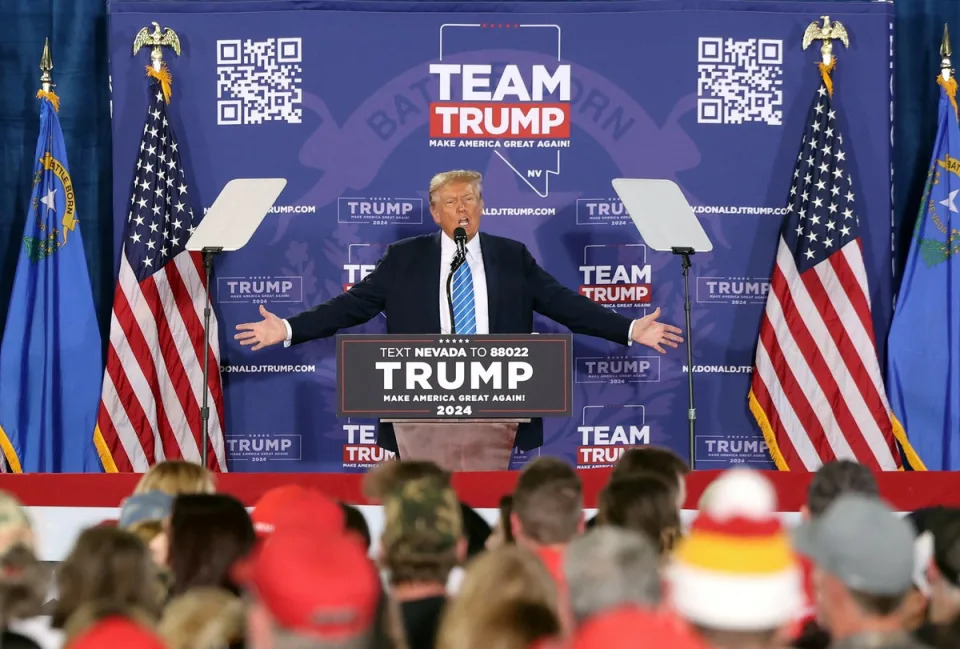
Donald Trump speaks to supporters in Nevada on 27 January. (REUTERS)
As his campaign pivoted to his criminal cases and lawsuits, fundraising messages remind supporters of his legal fights and courtroom appearances to tell his supporters that their contributions help “defend our movement” against “witch hunt” trials.
His mugshot appears on “signed” posters with the words “never surrender”, $47 T-shirts, $35 mugs, and Trump-branded Christmas wrapping paper.
Last week, a jury determined he owes more than $83m in damages to E Jean Carroll, whom he repeatedly smeared after a separate jury found him liable for sexual abuse and defamation.
The attorney general of New York also is seeking $370m from Mr Trump and his co-defendants in a separate civil case targeting his Trump Organization for fraud.
In a deposition last year, the former president described his cash stockpile as “substantially in excess” of $400m, while Bloomberg listed his liquid assets at roughly $600m, though the actual state of his financial affairs is unclear, and he won’t be able to tap PAC cash to pay civil damages.
Dave Aronberg, the state attorney in Florida’s Palm Beach County, home of Mr Trump’s Mar-a-Lago estate, explained to MSNBC on Monday that Mr Trump has to post a bond just to appeal the jury verdict in Ms Carroll’s case within 30 days of the decision, “so E Jean Carroll will get her money at some point”.
“He can try to get money from his supporters, but he’s got to tell them what it’s for … He can’t say, ‘Help me with my re-election fund’ and then divert the money to E Jean Carroll,” he said. “That would be a crime.”
Competing for megadonor cash with Haley
In the final months of 2023, Mr Trump’s campaigns took in roughly $19m – less than 60 per cent of Mr Biden’s $33m haul – while paying out more than $23m.
The president’s campaign ended 2032 with $46m cash on hand, records show. By the end of the year, Biden-supporting super PAC Future Forward had roughly the same amount in the bank as MAGA Inc – $24m to MAGA’s $23.3m.
Mr Biden also can tap funding from the Democratic National Committee, while Mr Trump will have to wait until he is the Republican party’s nominee before he can formally access the Republican National Committee’s reserves.
But the RNC had its worst fundraising year in a decade, and its worst year in 30 years in inflation-adjusted figures, according to FEC filings.
Last year, the RNC raised $87.2m, spent $93.5m, and had roughly $8m on hand by the end of the year.
Mr Trump, meanwhile, is competing with Nikki Haley for a pool of campaign cash from billionaire Republican megadonors that could keep Mr Trump’s PACs afloat.
Robert Bigelow, formerly Ron DeSantis’s largest donor, told Reuters on Tuesday that he gave Mr Trump $1m to support his legal fees and agreed to donate another $20m to a Trump-aligned super PAC for campaign purposes.
“I gave him $1m towards his legal fees a few weeks ago. I made a promise to give him $20m more, that will be to the super PAC,” he told the outlet.
The fulminations surrounding the world’s biggest pop icon — and girlfriend of Chiefs tight end Travis Kelce — reached the stratosphere after Kansas City made it to the Super Bowl.
By Jonathan Weisman – January 31, 2024
Taylor Swift and Travis Kelce after the Chiefs’ victory on Sunday. They are the focus of right-wing vitriol and conspiracy theories. Credit…Julio Cortez/Associated Press
For football fans eager to see a new team in the Super Bowl, the conference championship games on Sunday that sent the Kansas City Chiefs and San Francisco 49ers back to the main event of American sports culture were sorely disappointing.
But one thing is new: Taylor Swift. And she is driving the movement behind Donald Trump bonkers.
The fulminations surrounding the world’s biggest pop icon — and girlfriend of Travis Kelce, the Chiefs’ star tight end — reached the stratosphere after Kansas City made it to the Super Bowl for the fourth time in five years, and the first time since Ms. Swift joined the team’s entourage.
The conspiracy theories coming out of the Make America Great Again contingent were already legion: that Ms. Swift is a secret agent of the Pentagon; that she is bolstering her fan base in preparation for her endorsement of President Biden’s re-election; or that she and Mr. Kelce are a contrived couple, assembled to boost the N.F.L. or Covid vaccines or Democrats or whatever.
“I wonder who’s going to win the Super Bowl next month,” Vivek Ramaswamy, the conspiratorial presidential candidate, turned Trump surrogate, pondered on social media on Monday. “And I wonder if there’s a major presidential endorsement coming from an artificially culturally propped-up couple this fall.”
The pro-Trump broadcaster Mike Crispi led off on Sunday by claiming that the National Football League is “rigged” in order to spread “Democrat propaganda”: “Calling it now: KC wins, goes to Super Bowl, Swift comes out at the halftime show and ‘endorses’ Joe Biden with Kelce at midfield.”
Other detractors of Ms. Swift among Mr. Trump’s biggest fans include one of his lawyers, Alina Habba, one of his biggest conspiracy theorists, Jack Posobiec, and other MAGA luminaries like Laura Loomer and Charlie Kirk, who leads a pro-Trump youth organization, Turning Point USA.
The right has been fuming about Ms. Swift since September, when she urged her fans on Instagram to register to vote, and the online outfit Vote.org reported a surge of 35,000 registrations in response. Ms. Swift had embarked on a world tour that helped make her a billionaire. Gavin Newsom, the California governor, praised her as “profoundly powerful.” And then Time magazine made her Person of the Year in December, kicking off another round of MAGA indignation.
Ms. Swift embarked on a worldwide stadium tour last year, which included a May stop at MetLife Stadium in New Jersey. Credit…Jutharat Pinyodoonyachet for The New York Times
Some of the Monday morning quarterbacking has been downright silly, including speculation that Ms. Swift is after Mr. Kelce for his money. (Her net worth exceeds $1 billion, a different universe than the athlete’s merely wealthy status.)
Other accusations appear to be driven by fear and grounded in some truth, or at least in her command of her 279 million Instagram followers: that she has enormous influence, and has supported Democrats in the past. For much of her extensive music career, Ms. Swift avoided politics, but in 2018, she endorsed two Democrats in Tennessee, where she owns two homes: former Gov. Phil Bredesen, who was running for the Senate against then-Representative Marsha Blackburn, and Jim Cooper, a House member who has since retired.
“I always have and always will cast my vote based on which candidate will protect and fight for the human rights I believe we all deserve in this country,” she wrote on social media. “I believe in the fight for L.G.B.T.Q. rights, and that any form of discrimination based on sexual orientation or gender is WRONG.”
She added, “I believe that the systemic racism we still see in this country towards people of color is terrifying, sickening and prevalent.”
The alarm bells were loud enough to pull Mr. Trump into loudly backing Ms. Blackburn: “I’m sure Taylor Swift doesn’t know anything about her,” he said at the time, knowing all too well how influential Ms. Swift could be. “Let’s say that I like Taylor’s music about 25 percent less now, OK?”
He probably liked her even less in 2020 when she criticized his pandemic response, and then endorsed Mr. Biden.
While her early pop music may have mainly attracted teens and preteens, those fans have reached voting age, and her music has grown more sophisticated with the albums “Evermore” and “Folklore” to match her millennial roots and her fans’ taste.
In September, Ms. Swift urged her fans on Instagram to register to vote, yielding a surge of 35,000 registrations on the website Vote.org. Credit…Jutharat Pinyodoonyachet for The New York Times
Much of the Swift paranoia has lurked on the MAGA fringes, with people like Ms. Loomer, the conspiracy theorist from Florida who declared in December that “2024 will be MAGA vs Swifties” and Mr. Kirk, who declared in November that Ms. Swift would “come out for the presidential election” after Democrats had another strong showing in an election that demonstrated the issue of abortion motivated voters to the polls.
“All the Swifties want is swift abortion,” he said.
Then Swift-bashing reached Fox News in mid-January. The host Jesse Watters suggested the superstar was a Defense Department asset engaging in psychological warfare. He tied Ms. Swift’s political voice with her boyfriend’s Pfizer endorsement to the remarkable success of her Eras tour, which bolstered local economies and landed her on the cover of Time.
“Have you ever wondered why or how she blew up like this?” Mr. Watters wondered on air. “Well, around four years ago, the Pentagon psychological operations unit floated turning Taylor Swift into an asset during a NATO meeting.”
Andrea Hailey, the chief executive of Vote.org, made the most of the Fox News criticism, saying the organization’s partnership with Ms. Swift “is helping all Americans make their voices heard at the ballot box,” adding that the star is “not a psy-op or a Pentagon asset.”
But her appearance on the field with Mr. Kelce in Baltimore after the Chiefs beat the Ravens on Sunday, complete with a kiss and a hug, appears to have sent conservatives into a fit of apoplexy that may only grow in the run-up to Super Bowl LVIII in Las Vegas Feb. 11.
The feelings are so strong that Fox News ran a segment on Sunday lamenting that Ms. Swift’s private “jet belches tons of CO2 emissions,” showing a sudden awareness of the leading cause of global warming.
Mr. Ramaswamy said his Super Bowl conjecture was dead serious.
“What your kind of people call ‘conspiracy theories,’ I simply call an amalgam of collective incentives hiding in plain sight,” he said.
The White House press secretary Karine Jean-Pierre stoked speculation still more by invoking the Hatch Act, which prohibits political actions by civil servants, in declining to answer whether Mr. Biden would be appearing with Ms. Swift.
“I’m just going to leave it there,” she said Monday. “I’m not going to get into the president’s schedule at all from here, as it relates to the 2024 elections.”
The Trump campaign, which had initially planned to ignore the frenzy, dispatched Karoline Leavitt, a campaign spokeswoman, to dismiss concerns about a potential Biden endorsement.
“I don’t think this endorsement will save him from the calamity” of his record, she said.
Audio produced by Parin Behrooz.
Jonathan Weisman is a politics writer, covering campaigns with an emphasis on economic and labor policy. He is based in Chicago.
Half of US tenants can’t afford to pay their rent. Here’s what’s ahead
Anna Bahney, CNN – January 30, 2024
Gabby Jones/Bloomberg/Getty Images
Half of renters in the United States have found themselves paying more than they can afford, following years of surging rents. But an increase in the construction of multiple-unit buildings has boosted the supply of apartments, which is slowly beginning to rein in runaway rents.
Nationally, rents declined annually in December for the eighth straight month, according to Realtor.com’s monthly report. The median asking rent was $1,713, which was down $4 from November and down $63 from the July 2022 peak.
However, median rent is still $309 higher than the same time in 2019, before the pandemic. That’s a 22% increase.
And people have been feeling it. In some places, rents aren’t dropping at all. Rent is just increasing at a slower pace.
Still, even if rents aren’t dropping like a rock, they aren’t expected to be skyrocketing in the same way this year.
This may come as some relief to the 22.4 million households who, according to Harvard University’s Joint Center for Housing Studies, pay more than a third of their income in rent.
Paying anything above the standard 30% threshold is commonly considered a cost burden.
What’s more, 12 million of those renters are severely cost burdened, which means they are spending more than half their income on housing.
The report reveals several disturbing records, including the record-high number of renters in housing they cannot afford and a record-high number of people who are homeless, said Chris Herbert, managing director of the Harvard Joint Center for Housing Studies.
In addition, the report found that evictions are rising as pandemic protections have expired and a record-high number of income-eligible renters can’t get assistance as rental support falls short.
Rents are cooling off but affordability remains untenable
“Rental conditions are softening, but affordability conditions are worse than ever before,” said Whitney Airgood-Obrycki, senior research associate at the Harvard center, who presented some of the report’s findings.
Following changes in housing needs during the pandemic and an already existing low supply of multifamily housing in some markets, rents surged in 2021 and 2022. But that has changed in 2023 thanks to increased supply, the report showed.
Rent growth peaked at a record breaking 15% annually in the first quarter of 2022, before starting to slow. By the end of 2023, rents were growing by just 0.4% annually.
Even cities with the most intractable rents are seeing some cooling.
In November rents dropped in Manhattan for the first time in 27 months. The median rent fell to $4,000, down 4.6% from October and down 2.3% from the year before, according to a report from the brokerage firm Douglas Elliman and Miller Samuel Real Estate Appraisers and Consultants.
“We’re seeing supply and demand switch places in real time,” said Anthemos Georgiades, chief executive of Zumper, an online rental marketplace. “Pandemic-fueled migrations have slowed just as new multifamily buildings are coming online in many markets.”
He added that winter is a slow time for renters to move, which is driving demand even lower right now.
“Renters have more leverage right now than anytime in recent memory,” Georgiades said.
New supply helps, but may not last long
Multifamily building has been booming at a pace not seen in decades.
About 436,000 multifamily units were completed in the third quarter of last year, on a seasonally adjusted basis, which was the highest level since 1988, and up about a third from pre-pandemic levels, according to the Harvard report.
And there are more in the pipeline.
The number of multifamily units under construction peaked in July at over 1 million, the highest level on record, according to the US Census Bureau. While the number has stayed at a historically higher level since then, it has been ticking down on a seasonally adjusted annualized basis.
Builders are facing higher costs due to interest rates on their loans, material costs and land costs, and are already pulling back on building. As a result, the National Association of Home Builders forecasts that multifamily construction will decrease by about 20% next year.
While the increase in new construction and available apartments has been a boon to the market, there may not be new units coming at the same pace in the future. That’s despite large demand from Baby Boomers and Millennials, and also Gen Z aging into apartment renting.
Without continued new supply in addition to enhanced rental support, the Harvard report concludes affordability will remain a critical concern for many renters.
‘Smoking gun proof’: fossil fuel industry knew of climate danger as early as 1954, documents show
Oliver Milman – January 30, 2024
Composite: The Guardian/Special Collections & Archives, UC San Diego/Lyndon B Johnson Library
The fossil fuel industry funded some of the world’s most foundational climate science as early as 1954, newly unearthed documents have shown, including the early research of Charles Keeling, famous for the so-called “Keeling curve” that has charted the upward march of the Earth’s carbon dioxide levels.
A coalition of oil and car manufacturing interests provided $13,814 (about $158,000 in today’s money) in December 1954 to fund Keeling’s earliest work in measuring CO2 levels across the western US, the documents reveal.
Keeling would go on to establish the continuous measurement of global CO2 at the Mauna Loa Observatory in Hawaii. This “Keeling curve” has tracked the steady increase of the atmospheric carbon that drives the climate crisis and has been hailed as one of the most important scientific works of modern times.
The fossil fuel interests backed a group, known as the Air Pollution Foundation, that issued funding to Keeling to measure CO2 alongside a related effort to research the smog that regularly blighted Los Angeles at the time. This is earlier than any previously known climate research funded by oil companies.
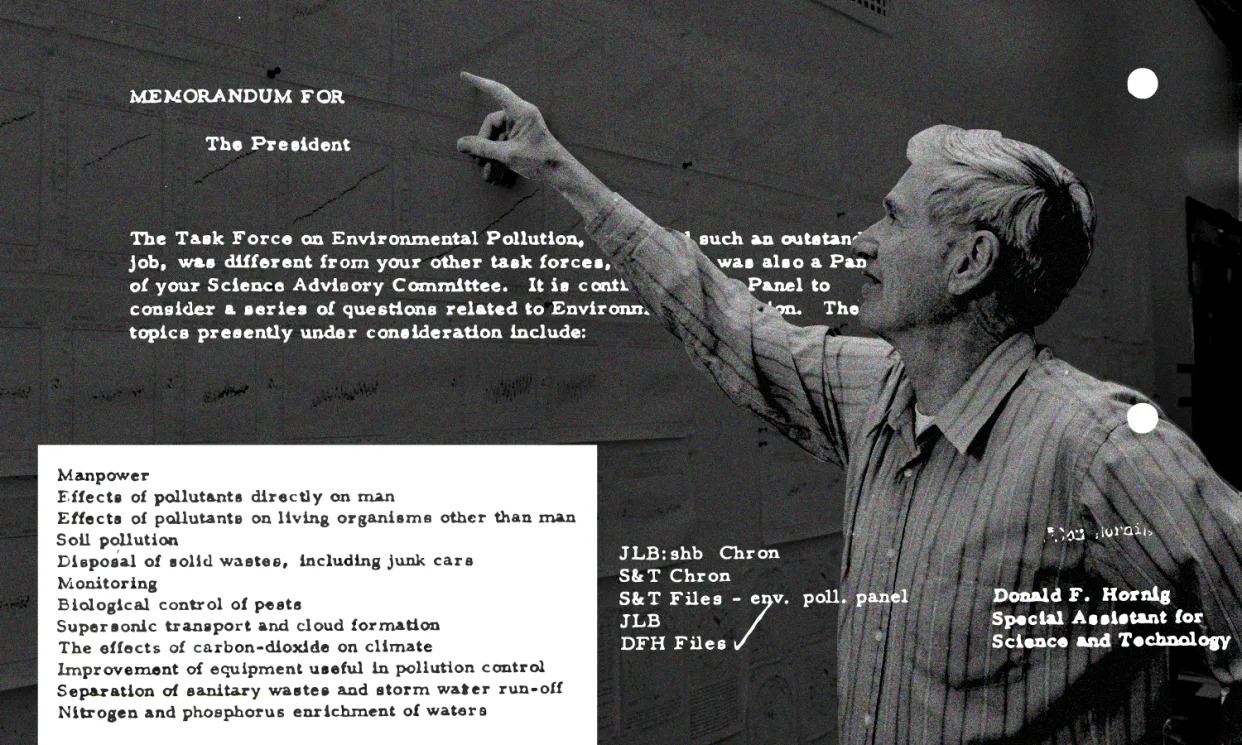
In the research proposal for the money – uncovered by Rebecca John, a researcher at the Climate Investigations Center, and published by the climate website DeSmog – Keeling’s research director, Samuel Epstein, wrote about a new carbon isotope analysis that could identify “changes in the atmosphere” caused by the burning of coal and petroleum.
“The possible consequences of a changing concentration of the CO2 in the atmosphere with reference to climate, rates of photosynthesis, and rates of equilibration with carbonate of the oceans may ultimately prove of considerable significance to civilization,” Epstein, a researcher at the California Institute of Technology (or Caltech), wrote to the group in November 1954.
Experts say the documents show the fossil fuel industry had intimate involvement in the inception of modern climate science, along with its warnings of the severe harm climate change will wreak, only to then publicly deny this science for decades and fund ongoing efforts to delay action on the climate crisis.
“They contain smoking gun proof that by at least 1954, the fossil fuel industry was on notice about the potential for its products to disrupt Earth’s climate on a scale significant to human civilization,” said Geoffrey Supran, an expert in historic climate disinformation at the University of Miami.
“These findings are a startling confirmation that big oil has had its finger on the pulse of academic climate science for 70 years – for twice my lifetime – and a reminder that it continues to do so to this day. They make a mockery of the oil industry’s denial of basic climate science decades later.”
Previous investigations of public and private records have found that major oil companies spent decades conducting their own research into the consequences of burning their product, often to an uncannily accurate degree – a study last year found that Exxon scientists made “breathtakingly” accurate predictions of global heating in the 1970s and 1980s.
The newly discovered documents now show the industry knew of CO2’s potential climate impact as early as 1954 via, strikingly, the work of Keeling, then a 26-year-old Caltech researcher conducting formative work measuring CO2 levels across California and the waters of the Pacific ocean. There is no suggestion that oil and gas funding distorted his research in any way.
The findings of this work would lead the US scientist to further experiments upon the Mauna Loa volcano in Hawaii that were to provide a continual status report of the world’s dangerously-rising carbon dioxide composition.
Keeling died in 2005 but his seminal work lives on. Currently, the Earth’s atmospheric CO2 level is 422 parts per million, which is nearly a third higher than the first reading taken in 1958, and a 50% jump on pre-industrial levels.
A total of 18 automotive companies, including Ford, Chrysler and General Motors, gave money to the foundation. Other entities, including banks and retailers, also contributed funding.
Separately, a 1959 memo identifies the American Petroleum Institute (API), the US’s leading oil and gas lobbying body, and the Western Oil and Gas Association, now known as the Western States Petroleum Association, as “major contributors to the funds of the Air Pollution Foundation”. It’s not clear exactly when API started funding the foundation but it had a representative on a research committee from mid-1955 onwards.
A policy statement of the Air Pollution Foundation from 1955 calls the problem of air pollution, which is caused by the emissions of cars, trucks and industrial facilities, “one of the most serious confronting urban areas in California and elsewhere” and that the issue will be addressed via “diligent and honest fact finding, by wise and effective action”.
The unearthed documents come from the Caltech archives, the US National Archives, the University of California at San Diego and Los Angeles newspapers from the 1950s, and represent what may be the first instance of the fossil fuel industry being informed of the potentially dire consequences of its business model.
The oil and gas industry was initially concerned with research related to smog and other direct air pollutants before branching out into related climate change impacts, according to Carroll Muffett, chief executive of the Center for International Environmental Law.
“You just come back to the oil and gas industry again and again, they were omnipresent in this space,” he said. “The industry was not just on notice but deeply aware of the potential climate implications of its products for going on 70 years.”
Muffett said the documents add further impetus to efforts in various jurisdictions to hold oil and gas firms legally liable for the damages caused by the climate crisis.
“These documents talk about CO2 emissions having planetary implications, meaning this industry understood extraordinarily early on that fossil fuel combustion was profound on a planetary scale,” he said.
“There is overwhelming evidence the oil and gas industry has been misleading the public and regulators around the climate risks of their product for 70 years. Trusting them to be part of the solutions is foolhardy. We’ve now moved into an era of accountability.”
API and Ralph Keeling, Charles’s son who is also a scientist, were contacted for comment about the documents but did not respond.
Iconic lake once known for its crystal-clear waters is on the verge of extinction: ‘The damage done … cannot be compensated’
Jeremiah Budin – January 30, 2024
Anchar Lake, located in the Kashmir region, is on the verge of disappearing entirely, despite calls for action from environmentalists that have been going unheeded for more than a decade.
What is happening?
Once a major tourist destination, Anchar Lake has fallen victim to the same forces that have negatively impacted so many bodies of water and parts of nature throughout the world — pollution, overdevelopment, and governments that prioritize protecting profits over the environment.
“The lake was once a beautiful tourist attraction, but over the past many years, it has turned into a polluted wasteland,” one nearby resident told Rising Kashmir.
Why is this concerning?
A century ago, the lake encompassed 7.5 square miles. Today, it has been reduced to 2.6 square miles, with more than half of that area comprised of marshland. Contributing factors include unregulated development around the area that has pushed silt and sediment into the lake.
Improper sewage and drainage systems have filtered waste into the lake, making its waters toxic and inhospitable to the bird and fish species that once thrived there.
“The lake is under tremendous anthropogenic pressures, which have resulted in deterioration of its water quality. The entire liquid and solid wastes generated on the peripheral areas situated at higher contours where people live find its way into the lake. Even the agricultural waste of the above area is disposed of in it,” Ajaz Rasool, an environmentalist and hydraulic engineer, told Greater Kashmir.
What is being done about it?
Greater Kashmir laid out several steps that need to be taken to ensure that Anchar Lake does not become extinct, which would be devastating for local wildlife that has already seen its habitat harmed dramatically.
These steps include officially making the conservation of the lake the responsibility of the Lake Conservation and Management Authority, erecting fences around the area to prevent further development and encroachment, plugging drains that filter waste into the lake, and rebuilding the sewage system.
“It is the responsibility of the Government and people to join hands to restore the glory of Anchar, as both are responsible for its deterioration. Damage done to the environment is irreparable and cannot be compensated in any form,” the piece concluded.
Join our free newsletter for cool news and cool tips that make it easy to help yourself while helping the planet.
In Biden’s pledge to ‘shut down’ border, a stunning political shift
Analysis by Zachary B. Wolf, CNN – January 29, 2024
President Joe Biden’s evolution on the key election issue of immigration entered a new phase when he promised to “shut down the border right now” if given new powers by Congress.
The deeper policy context of the comments, delivered at a campaign event in South Carolina Saturday and in a statement from the White House on Friday, is that Biden wants to resuscitate a bipartisan deal to pair new border powers with additional military aid for Ukraine and Israel.
But the Trump-like rhetoric from the Democratic president – and the fact that Democrats are not even talking about a pathway to legal status for undocumented immigrants currently in the country – is also an important political admission as immigration-focused Donald Trump zeroes in on the Republican presidential nomination and the border crisis reverberates through the country and into Washington, DC.
Biden is willing to offer concessions so he can make deals, and Trump wants to keep this as a campaign issue.
Trump wants to kill bipartisan deal
“As the leader of our party, there is zero chance I will support this horrible, open-borders betrayal of America,” Trump said in Nevada on Saturday, although future Republican presidents would also benefit from the new power Biden is seeking.
Trump doesn’t think the president needs new power to shut the border. He has promised that, if elected, he will act as “dictator for one day” to do it, and he’s actively working against the bipartisan effort even though parts of it are straight out of his policy playbook.
“The reality is that this includes many provisions that when Donald Trump was president, he hoped would be made into law,” said CNN’s Lauren Fox, appearing Monday on “Inside Politics.” These Trump-friendly priorities, she said, include making it much more difficult for migrants to seek asylum in the US and increasing the speed at which asylum cases can be processed in immigration courts.
Biden’s acknowledgment
CNN’s Priscilla Alvarez, a White House reporter who is also an expert on the issue of immigration, documents Biden’s shift.
“Biden took office pledging to restore asylum and manage the border in a ‘humane’ way,” Alvarez writes. “But his administration has faced the harsh realities and challenges at the US-Mexico border amid record migration across the Western Hemisphere — making it a political vulnerability seized on by Republicans.”
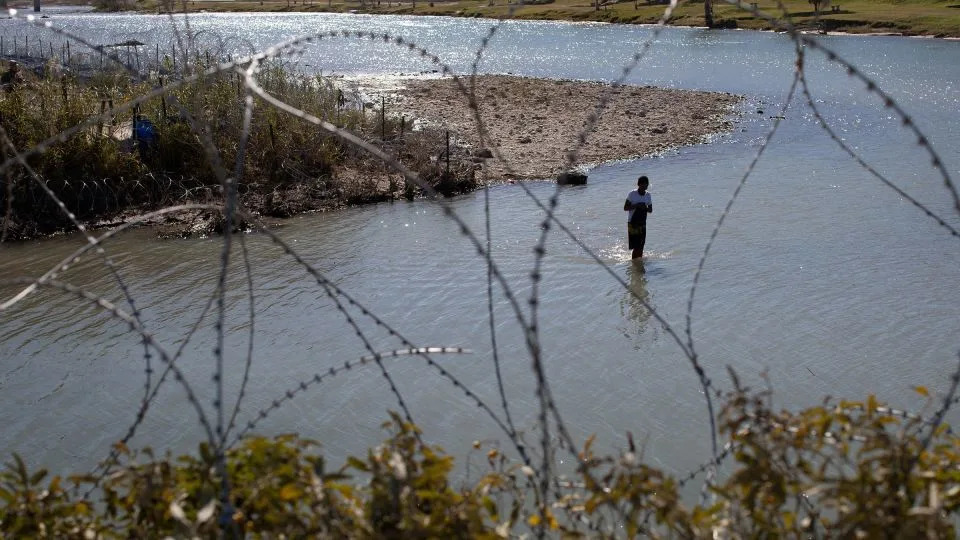
A man crosses the Rio Grande River from Mexico to collect clothing and other items left on the Texas banks of Shelby Park at the US-Mexico border in Eagle Pass, Texas, on January 12, 2024. – Kaylee Greenlee Beal/Reuters
Permanent power for the president
The new permanent power pushed by Biden and Senate negotiators is in line with temporary, Covid-era restrictions originally put in place during Trump’s administration, but which lapsed last year on Biden’s watch.
Following Trump’s lead, rather than work with the president to secure the border, House Republicans have rejected even the idea of a Senate compromise and are gearing up to impeach Biden’s secretary of Homeland Security, Alejandro Mayorkas, for not applying current law to turn away more people at the border.
Still no deal in writing
The framing of this issue may end up being more important than the policy itself. The bipartisan group of senators has not released text for their compromise, but they insist it does exist.
“We do have a bipartisan deal. We’re finishing the text right now,” Sen. Chris Murphy, the Connecticut Democrat who is a key negotiator on the deal, said on CNN’s “State of the Union” on Sunday.
“The question is whether Republicans are going to listen to Donald Trump, who wants to preserve chaos at the border because he thinks that it’s a winning political issue for him,” said Murphy, adding the proposal would give the president, Republican or Democrat, permanent new emergency powers.
What we know
While the text of the bill has not been finalized, Biden ticked off the major points during that appearance in South Carolina:
“It includes an additional 1,300 Border Patrols — we need more agents on the border;
375 immigration judges to judge whether or not someone can come or not come and be fair about it;
1,600 asylum officers;
and over 100 cutting-edge inspection machines to help detect and stop fentanyl coming in.”
GOP negotiator censured by his own party
Sen. James Lankford of Oklahoma, the top Republican negotiator, is already facing blowback even though the deal has not been publicly released.
The Oklahoma Republican Party voted over the weekend to censure Lankford and demanded that he abandon the bipartisan talks.
Appearing on “Fox News Sunday,” Lankford was pressed about the new authority for Biden, which would be triggered if there’s an average of 5,000 migrant crossings per day over the course of a full week. Lankford said this would not normalize 5,000 migrant crossings per day. And for context, border officials were dealing with more than 10,000 crossings per day for most of December.
“This is set up for if you have a rush of people coming at the border, the border closes down – no one gets in,” he said. “This is not someone standing at the border with a little clicker, saying, ‘I’m going to let one more in, we’re at 4,999 and then it has to stop.’ It is a shutdown of the border, and everyone actually gets turned around.”
Democrats waiting for details too
Rank-and-file Democrats would surely be frustrated with such a compromise, which does not address their long-term immigration priorities, like giving permanent legal status to the children of undocumented immigrants who were raised in the US or paving a pathway to citizenship for undocumented immigrants who have built lives and paid taxes in the US.
“We have milestones and we have a path to get there, but we were never going to get a path to citizenship in this bill,” former House Speaker Nancy Pelosi told CNN’s Dana Bash on Sunday.
Frustration in US cities
Meanwhile, mayors of Democratic cities continue to raise the alarm about an untenable wave of migrants bused north from border states and draining their infrastructure.
The public view of the current immigration situation has shifted
Nearly half – 45% of Americans in a CBS News poll released early this month – said the situation at the border is a crisis.
And a strong majority of the public – 63% now compared with 55% in September – said the Biden administration should be tougher on immigrants crossing at the border. More than two-thirds, 68%, said they disapproved of Biden’s handling of the border, although that does not translate into support for Republicans. Sixty-five percent of Americans said they disapproved of congressional Republicans’ handling of the issue.
Americans are still broadly supportive of immigration, however. In a Gallup poll released last July, 68% said the overall effect of immigration was a good thing for the US, compared with just 27% who said it was a bad thing.
After publication, White House spokesperson Angelo Fernandez Hernandez provided this statement:
“The American people overwhelmingly agree with what President Biden underlined in his Day One reform plan: that our immigration system is broken and we have an imperative to secure the border and treat migrants with dignity,” Fernandez Hernandez said in an email. “After opposing the record border security funding President Biden has delivered every year of his administration, House Republicans are blocking the border security resources President Biden is fighting for in order to hire more Border Patrol officers and invest in cutting edge technology to detect fentanyl.”
Donald Trump’s utmost assault on American democracy and the rule of law has been his ability to exploit these foundational institutions to weaken each as he constantly makes a mockery of both. It’s part and parcel of his efforts to sustain personal power. The ultimate goal is to enable oligarchic domination and facilitate financial looting by the uber-wealthy.
My aim in this commentary is to move beyond Trump’s procedural harms or distractions and to connect his very real substantive crimes, fraudulent behaviors, and policies of deception to the GOP’s larger and unending appropriation of accumulated capital from the US commonwealth.
Contrary to Trump’s repetitive narrative about how the Justice Department (DOJ), state prosecutors, and the courts are engaging in some kind of persecution or witch-hunt and/or weaponization of the rule of law against the former president as part of a “deep state” conspiracy to interfere with his winning back the presidency in 2024, these civil and criminal agencies of adjudication have been bending over backward to privilege or accommodate Trump’s perpetual lawlessness inside and outside various courthouses across America.
For example, the latest episodes of indulging the “man-child” occurred during closing arguments of Trump’s $370M civil fraud trial as well as his second sex abuse defamation civil trial in two Manhattan courtrooms located in close proximity.
In the latter case, which ended Friday with a jury judgment that Trump must pay E. Jean Carroll over $83 million in damages, Judge Lewis Kaplan had this testy exchange with Trump. “I understand you’re probably very eager for me” to remove “you from the trial.” To which Trump sitting between his two lawyers at the defense table shouted back, “I would love it.” Of course, Trump would.
Trump had already been warned that he could be expelled for continuing to disrupt the trial. Nevertheless, the judicially found rapist of Carroll could be heard remarking loud enough to his lawyers for the jurors to hear, “it is a witch hunt” and “it really is a con job.” Never mind that Trump in a previous lawsuit by a jury of his peers had already been found civilly liable for sexual assault as well as defamation of character to the tune of $5 million. It’s little wonder he stormed out of the courtroom on Friday.
In the former case, Judge Arthur Engoron bent the rules and allowed Trump “to go on a courtroom rant lasting several minutes,” which had nothing whatsoever to do with either the law or the facts of the case. Instead, Trump made another political speech claiming that the New York civil trial is a ‘fraud on me’ and that he was “an innocent man” who claimed among other things that the New York Attorney General Letitia James “hates” him and “doesn’t want me to get elected.” Trump also stated to the presiding judge, “I know this is boring you. I know you have your own agenda” here as well.
Procedurally, either Trump as the defendant or one of his attorneys, but not both, was entitled to make the closing argument. However, Judge Engoron made an exception allowing Trump and his attorney Chris Kise to speak during closing arguments. Before doing so, the judge re-iterated what he had previously spelled out one week earlier about what Trump could or could not comment about as part of his closing arguments. Predictably, Trump totally disregarded Judge Engoron’s instructions the same as he had Judge Kaplan’s.
On Friday, former federal judge Barbara Jones, appointed by Engoron to monitor the Trump Organization’s finances, told the judge that Trump had failed to provide “information required to be submitted to me pursuant to the terms of the monitorship order and review protocol.”
Engoron coddled the former president and permitted his procedural misconduct because the judge knew that after his final decision — dismantling Trump’s New York base business empire – to be rendered later this month, Trump and his attorneys would be appealing and filing an avalanche of motions mostly to delay rather than rectify justice. By allowing Trump to speak, Engoron figured there would be one less bogus motion to be made about how the former president had been denied his right to speak on his own behalf.
Again, I do not want to get caught up in these procedural abuses by Trump and his attorneys because their claims are primarily smokescreens designed to deflect attention away from the substantive lawlessness or fraudulent behavior involved in his adversarial conflicts with the administration of justice.
In the case of the fraudulent business trial brought by the New York Attorney General, Trump’s phony legal defense pertaining to his illegal acquisition of money or to his financial looting from both the Internal Revenue System and the US monetary system is that these lending transactions allegedly caused no injuries to the parties involved.
To paraphrase Trump: nobody was injured here or there were no harms to speak of. Of course, that is pure fiction or nonsense as the summary judgment has already been declared and as the final verdict will be revalidated in the next couple of days when Trump and company find themselves liable for at least $300 million.
Trump’s fraudulent business dealings involved in this civil case, like using other people’s money vis-à-vis deceitfully acquired lower interest rates along with tax evasion, are consistent with the former president’s modus operandi and sheds light on some of the other ways in which the 45th president’s appointments of free marketers and deregulators facilitated financial looting on a much grander scale. The GOP’s $1.9 trillion tax break for the wealthy, signed by Trump, is perhaps the most infamous example
As I have argued in Indicting the 45th President, “the Racketeer-in-Chief as POTUS had established from the top down an administrative apparatus marked by placing self-interest, profiteering, and corruption above the public welfare.” In similar fashion, Trump’s “networks for raising and flowing cash loads of electronic money also helped to contribute to the ‘deadly insurrection that was rooted in the same self-serving ethos’.”
By the end of 2023, the ex-president had already spent more than $57 million of other people’s money on his legal fees, which will very likely continue to grow for the foreseeable future. While raising money to steal the election was unlawful, raising money to defend those people from trying to steal an election is perfectly lawful.
As we have learned in some detail from the New York civil fraud trial, Trump has spent most of his dishonest life in search of money. His business history has been filled with overseas financial deals and missed deals. Some of these have involved the Chinese state where Trump “spent a decade unsuccessfully pursuing projects in China, operating an office there during his first run for president and forging a partnership with a major government-controlled company.”
China along with Britain and Ireland are three nations that we know about where Trump maintains bank accounts. These foreign accounts do not show up on Trump’s public financial disclosures where he must list his personal assets because these accounts are not in his name. In the case of China, the bank account is controlled by Trump International Hotels Management, LLC, whose tax records reveal that TIHM paid $188,561 in pursuing licensing deals there from 2013 to 2015 that did not pan out. During those same pre-MAGA years Trump had been paying the IRS less than $1,000 annually.
Until 2019, China’s biggest state-controlled bank rented three floors in Trump Tower stateside, a very lucrative lease that had generated accusations of conflicts of interest for the former president. Citizens for Responsibility and Ethics in Washington (CREW) in its January 15, 2021, report on corruption identified more than 3,700 conflicts of interest while Trump was president because of his decision while in office not to divest from his business interests.
As far as offshore banking laws and accounts go, the release of Trump’s taxes from 2015 to 2020 revealed that for at least 2016 he had an offshore bank account in the Caribbean nation of St. Martin, a popular place to avoid paying taxes. Nevertheless, recall when he was asked during the 2016 campaign whether U.S. citizens should be allowed to save or invest in offshore bank accounts, Trump responded: “No, too many wealthy citizens are abusing loopholes in offshore banking laws to evade taxes.”
At the time, key planks in Trump’s tax reform plan would have allegedly ended the practices of U.S. multinationals stockpiling offshore hundreds of billions of dollars and millions of jobs. For the record, the sheltered tax dollars did not come home nor did outsourced jobs ever come back to America. Those were merely “talking points” that were never going to materialize during a Trump administration.
When it came to stocking the laissez-faire policy swamps, Trump’s political appointments included more than its share of high rolling donors with no expertise in anything let alone with an appropriate area of specialty. As for those appointments where expertise was required, those were located primarily in the areas of business, finance, and the law.
The economic orientation or philosophy of these appointments reinforced generally a “hands off” approach to regulation and taxation. These free marketers were not about recouping billions let alone trillions of dollars from the tax avoiding and tax evading superrich or mega corporations. Quite the contrary, these appointments involved persons who had specialized in tax avoidance. For example, four of Trump’s key economic appointments had been beneficiaries of shell companies and offshore banking accounts including Gary Cohn, Rex Tillerson, Steven Mnuchin, and Randal Quarles.
Chief economic adviser Gary Cohn was the driver behind the White House tax reform act. Leaked documents reveal that between 2002 and 2006 Cohn was either president or vice-president of 22 separate offshore entities in Bermuda for Goldman Sachs. That was before Cohn eventually became the president and COO of Goldman Sachs, one of the foremost banking, securities, and investment management firms in the world.
As for secretary of state Rex Tillerson, leaked documents reveal that before he ascended to chairman and CEO of ExxonMobil in 2006 and while still presiding as president of ExxonMobil Yemen division, Tillerson was also a director of Marib Upstream Services Company that was incorporated in Bermuda in 1997.
Randal Quarles, Trump’s most senior banking “watchdog” was also outed in connection with offshore banks and tax evasion as he appeared prominently in the infamous Paradise Papers.
As we all know the only shining accomplishment of President Trump during his four years in office was a $1.9 trillion tax gift or cut enjoyed primarily by super-wealthy individuals, mega-corporations, and multinational businesses – to the ongoing detriment of the general population — who already had enjoyed the lowest tax rates in the corporate world.
These economic projections are consistent with the negative or not “trickling down” benefits and failures to increase production after the same types of Reagan and Bush II administrations’ tax cuts or benefits for the corporate wealthy had also occurred.
What is consistent is that these same types of neoliberal taxing policies or practices of financial looting from other commonwealths around the global economy have yielded the same dismal outcomes in Argentina, Brazil, Russia, and every other nation where they have been employed.
Head-to-head: Trump accounted for the largest deficit growth in the 21st century of $6.7 trillion in four years while Biden accounted for only $2.5 trillion in his first three years in office.
In stark contrast, however, the deficits accumulated during the Obama and Biden administrations have benefitted the American people in numerous ways, for example, from health care coverage to infrastructure development. Meanwhile, the deficits accumulated by Bush II and Trump had only benefited the wealthy.
Exclusive-Russia struggles to sell Pacific oil, 14 tankers stuck – sources, data
Reuters – January 26, 2024
FILE PHOTO: Regional office of Russian oil firm Rosneft is seen in city of Yuzhno-Sakhalinsk on Sakhalin Island
This content was produced in Russia where the law restricts coverage of Russian military operations in Ukraine
More than a dozen tankers loaded with 10 million barrels of Russia’s Sokol grade crude oil have been stranded off the coast of South Korea for weeks, so far unsold due to U.S. sanctions and payment issues, according to two traders and shipping data.
The volumes, equating to 1.3 million metric tons, represent more than a month’s production of the Sakhalin-1 project, once a flagship venture of U.S. major Exxon Mobil, which exited Russia after Moscow’s invasion of Ukraine.
Sakhalin-1 was one of the first post-Soviet deals in Russia made under a production sharing agreement. When Exxon Mobil left in 2022, output fell to nearly zero and hasn’t fully recovered since.
Difficulties in selling Sokol grade pose one of the most significant challenges Moscow has faced since the West imposed sanctions and one of the most serious disruptions to Russian oil exports in two years.
Washington has said it wants sanctions to reduce revenues for President Vladimir Putin and his war machine in Ukraine but not to disrupt the flows of Russian energy to global markets.
Last year, the United States imposed sanctions on several vessels and companies involved in transporting Sokol.
As of Friday, 14 vessels loaded with Sokol were stuck around South Korea’s port of Yosu, including 11 Aframax vessels and three very large crude carriers (VLCCs), according to LSEG, Kpler data and traders.
The volume stored in tankers represent 45 days of production from Sakhalin-1, which averages output of 220,000 barrels per day (bpd).
Supertankers (VLCCs) La Balena, Nireta and Nellis with some 3.2 million barrels onboard (430,000 metric tons), currently near South Korea’s Yosu, are acting as a floating storage for the Russian oil grade, Reuters sources said and Kpler and LSEG shipping data show.
The VLCCs previously accepted oil from several Aframax vessels via ship-to-ship, the data showed. Supplying oil volumes from smaller ships to bigger ones can save on freight.
The rest of the Sokol oil loaded from November to January is stored on smaller Aframax vessels (able to carry 500,000-800,000 barrels) – Krymsk, NS Commander, Sakhalin Island, Liteyny Prospect, NS Century, NS Lion, NS Antarctic, Jaguar, Vostochny Prospect, Pavel Chernysh and Viktor Titov.
Shipments of Sokol to the Indian Oil Corp have been delayed by payment problems, forcing India’s biggest refiner to draw from its inventories and buy more oil from the Middle East.
A source close to IOC said the company did not expect to receive any Sokol shipments soon due to a disagreement over which currency would be used to pay for it.
IOC is the only state refiner that has an annual deal to buy a variety of Russian grades, including Sokol, from Russian oil major Rosneft. IOC and Rosneft did not reply to Reuters requests for comment.
(Reporting by Reuters reporters in Moscow, Nidhi Verma in India, Muyu Xu in Singapore; Editing by Louise Heavens and Ros Russell)