MEXICO CITY — Thousands of demonstrators cloaked in pink marched through cities in Mexico and abroad on Sunday in what they called a “march for democracy” targeting the country’s ruling party in advance of the country’s June 2 elections.
The demonstrations called by Mexico’s opposition parties advocated for free and fair elections in the Latin American nation and railed against corruption the same day presidential front-runner Claudia Sheinbaum officially registered as a candidate for ruling party Morena.
Sheinbaum is largely seen as a continuation candidate of Mexico’s highly popular populist leader Andrés Manuel López Obrador. He’s adored by many voters who say he bucked the country’s elite parties from power in 2018 and represents the working class.
But the 70-year-old president has also been accused of making moves that endanger the country’s democracy. Last year, the leader slashed funding for the country’s electoral agency, the National Electoral Institute, and weakened oversight of campaign spending, something INE’s head said could “wind up poisoning democracy itself.” The agency’s color, pink, has been used as a symbol by demonstrators.
López Obrador has also attacked journalists in hours-long press briefings, has frequently attacked Mexico’s judiciary and claimed judges are part of a conservative conspiracy against his administration.
In Mexico City on Sunday, thousands of people dressed in pink flocked to the the city’s main plaza roaring “get López out.” Others carried signs reading “the power of the people is greater than the people in power.”
Among the opposition organizations marching were National Civic Front, Yes for Mexico, Citizen Power, Civil Society Mexico, UNE Mexico and United for Mexico.
“Democracy doesn’t solve lack of water, it doesn’t solve hunger, it doesn’t solve a lot of things. But without democracy you can’t solve anything,” said Enrique de la Madrid Cordero, a prominent politician from the Institutional Revolutionary Party, or PRI, in a video posted to social media calling for people to join the protests.
The PRI held uninterrupted power in Mexico for more than 70 years.
Marches were organized in a hundred cities across the country, and in other cities in the United States and Spain.
Still, the president remains highly popular and his ally Sheinbaum appears set to coast easily into the presidency. She leads polls by a whopping 64% over her closest competition, Xóchitl Gálvez, who has polled at 31% of the votes.
López Obrador railed against the protests during is Friday morning press briefing, questioning whether the organizers cared about democracy.
“They are calling the demonstration to defend corruption, they are looking for the return of the corrupt, although they say they care about democracy,” he said.
Single family homes in the Elm Trails development near San Antonio, Texas, on Tuesday, Feb. 13, 2024. (Josh Huskin/The New York Times)
Robert Lanter lives in a 600-square-foot house that can be traversed in five seconds and vacuumed from a single outlet. He doesn’t have a coffee table in the living room because it would obstruct the front door. When relatives come to visit, Lanter says jokingly, but only partly, they have to tour one at time.
Each of these details amounts to something bigger, for Lanter’s life and the U.S. housing market: a house under $300,000, something increasingly hard to find. That price allowed Lanter, a 63-year-old retired nurse, to buy a new single-family home in a subdivision in Redmond, Oregon, about 30 minutes outside Bend, where he is from and which is, along with its surrounding area, one of Oregon’s most expensive housing markets.
Lanter’s house could easily fit on a flatbed truck, and it is dwarfed by the two-story suburban homes that prevail on the blocks around him. But, in fact, there are even smaller homes in his subdivision, Cinder Butte, which was developed by a local builder called Hayden Homes. Some of his neighbors live in houses that total just 400 square feet — a 20-by-20-foot house attached to a 20-by-20-foot garage.
This is not a colony of “tiny houses,” popular among minimalists and aesthetes looking to simplify their lives. For Lanter and his neighbors, it’s a chance to hold on to ownership.
Lanter, who is recently divorced, came back to central Oregon from a condominium in Portland only to discover that home prices had surged beyond his reach. He has owned several larger homes over the years and said he began his recent search looking for a three-bedroom house.
“I did not want to rent,” he said after a five-minute tour of his “media room” (a small desk with a laptop) and bedroom (barely fits a queen). After being an owner for 40 years, the idea of being a tenant felt like a backslide.
And after living on the 17th floor of a Portland condominium, he had ruled out attached and high-rise buildings, which he described as a series of rules and awkward interactions that made him feel as though he never really owned the place.
There was the time he sold a sofa, and the front desk attendant scolded him for moving it down the elevator without alerting management a day in advance. Or the times he came home to find someone parked in the spot he owned and paid property taxes on. Try to imagine a random driver parking in a house’s driveway, he said — there’s no way.
A single-family home means “less people’s hands in your life,” Lanter said.
He wanted the four unshared walls of the American idyll, even if those walls had minimal space between them and were a couch length from his neighbor.
A Chance at Ownership
Several colliding trends — economic, demographic and regulatory — have made smaller units like Lanter’s the future of American housing, or at least a more significant part of it. Over the past decade, as the cost of housing exploded, homebuilders have methodically nipped their dwellings to keep prices in reach of buyers. The downsizing accelerated last year, when the interest rate on a 30-year fixed rate mortgage reached a two-decade high, just shy of 8%.
Mortgage rates have fallen since, and sales, especially of new homes, are beginning to thaw from the anemic pace of last year. Even so, a move toward smaller, affordable homes — in some cases smaller than a studio apartment — seems poised to outlast the mortgage spike, reshaping the housing market for years to come and changing notions of what a middle-class life looks like.
“This is the front end of what we are going to see,” said Ken Perlman, a managing principal at John Burns Research and Consulting.
Extremely small homes have long been an object of curiosity and fodder for internet content; their tight proportions seem to say large things about their occupants. On social media and blogs, influencers swipe at American gluttony and extol the virtues of a life with less carbon and clutter than the standard two-car suburb.
Now, in the same way décor trends make their way from design magazines to Ikea, mini homes are showing up in the kinds of subdivisions and exurbs where buyers used to travel for maximum space.
The shift is a response to conditions that are found in cities across America: Neighborhoods that used to be affordable are being gentrified, while new condominiums and subdivisions mostly target the upper end of the market, endangering the supply of “starter homes” in reach of first-time buyers. That developers are addressing this conundrum with very small homes could be viewed as yet another example of middle-class diminishment. But buyers say it has helped them get on the first rung of the housing market.
“They should help out more people that are young like us to buy houses,” said Caleb Rodriguez, a 22-year-old in San Antonio.
Rodriguez recently moved into a new community outside San Antonio called Elm Trails, which was developed by Lennar Corp., one of the country’s largest homebuilders. His house sits in a line of mini dwellings, the smallest of which is just 350 square feet.
On a recent evening after work, neighbors were walking dogs and chatting along a row of beige, gray and olive-green two-story homes of the same shape. The development has a pond where residents picnic and catch bass and catfish. The houses do not have garages, and their driveways are wide enough for one vehicle or two motorcycles — proportions that pushed the sale prices to well under $200,000.
“I wanted to own, and this was the cheapest I could get,” said Rodriguez, who moved in this month and works at a poultry processing plant in nearby Seguin, Texas. He paid $145,000 and hopes the house can be a step toward wealth building. Maybe in a few years he will move and rent it out, Rodriguez said.
Homes under 500 square feet are not taking over anytime soon: They are less than 1% of the new homes built in America, according to Zonda, a housing data and consulting firm. Even Lanter, who evangelizes about his newly low heating bill and the freedom of shedding stuff, said he would have preferred something bigger, around 800 square feet, if he could find it.
While these floor plans might be an edge-case offering reserved for certain kinds of buyers — “Divorced … divorced … really divorced,” Lanter said as he pointed to the small homes around him — they are part of a clear trend. Various surveys from private consultants and organizations like the National Association of Home Builders, along with interviews with architects and developers, all show a push toward much smaller designs.
“Their existence is telling,” said Ali Wolf, chief economist of Zonda. “All the uncertainty over the past few years has just reinforced the desire for homeownership, but land and material prices have gone up too much. So something has to give, and what builders are doing now is testing the market and asking what is going to work.”
Builders are substituting side yards for backyards, kitchen bars for dining rooms. Suburban neighborhoods have had a boom in adjoined townhouses, along with small-lot single family homes that often have shared yards and no more than a few feet between them — a kind of mash-up of the suburb and the urban rowhouse.
The great compression is being encouraged by state and local governments. To reduce housing costs, or at least keep them from rising so fast, governments around the country have passed hundreds of new bills that make it easier for builders to erect smaller units at greater densities. Some cities and states, like Oregon, have essentially banned single-family zoning rules that for generations defined the suburban form.
These new rules have been rolled out gradually over years and with varying degrees of effectiveness. What has changed recently is that builders are much more willing to push smaller dwellings because they have no other way to reach a large number of buyers.
“There is a market opportunity and people are using it,” said Michael Andersen, a senior researcher at Sightline Institute, a Seattle think tank focused on housing and sustainability.
Big House on a Little Lot
American homes have long been larger on average than those in other developed countries. For most of the past century, the country’s appetite for size has only grown.
The Cape Cods in Levittown, New York — often considered the model post-World War II suburb — were typically about 750 square feet, roomy for a one-bedroom apartment but small for a free-standing house with two bedrooms. Today, though, the median American home size is about 2,200 square feet, up from around 1,500 in the 1960s. Lot sizes have remained more or less the same, which means the typical home is built to maximize the size of the kitchen and bedrooms even as its yard contracts.
The expansion came despite a profound shift in household composition. Over the past half-century, America has gone from a country in which the predominant homebuyer was a nuclear family with about three children to one in which singles, empty nesters and couples without children have become a much larger share of the population. Meanwhile, housing costs shot up in recent years as cities around the nation grappled with a persistent housing shortage and a surge in demand from millennial and Gen Z buyers.
This has created a mismatched market in which members of the Baby Boom generation are disproportionately living in larger homes without children, while many millennial couples with children are in smaller houses or in rental apartments, struggling to buy their first home.
Even buyers who are willing to move across state lines are finding that affordable housing markets are increasingly hard to find. In the Bend area where Lanter lives, housing costs have been pushed up by out-of-state buyers, many from California, who have flocked to the area to buy second homes or work there remotely.
The influx of money has helped raise the median home price to almost $700,000 from a little over $400,000 in 2020, according to Redfin. Driving through the downtown on a snowy afternoon recently, Deborah Flagan, a vice president at Hayden Homes, pointed left and right at storefronts that used to be boarded and are now part of a vibrant ecosystem of retailers that includes numerous high-end coffee shops, a “foot spa” and a bar where people drink craft beer and throw axes at wall-mounted targets.
The upscaling extends well beyond downtown to adjacent neighborhoods, where the small-footprint “mill houses” that once served a blue-collar workforce now sit on land that is so valuable they are being slowly erased by two-story moderns with seven-figure sales prices. Toward the end of the snowy driving tour, Flagan pointed toward one of those old mill houses — a compact ranch-style home with fading yellow paint and a white picket fence pocked with broken boards. She estimated it was no more than 800 square feet, and framed it as an example of the small and affordably priced housing whose stock needs to be rebuilt.
“What we are doing now is what they were doing then,” she said.
Four Walls, Close Together
Hayden builds about 2,000 homes a year throughout the Pacific Northwest. Its business model is to deliver middle-income housing that local workers can afford, Flagan said, and it does this by skipping larger cities like Portland and Seattle in favor of lower-cost exurbs like Redmond (where the company is based).
Like a lot of builders, Hayden has spent the past few years whittling back sizes on its bread-and-butter offering of one- and two-story homes between 1,400 and 2,500 square feet. But because its buyers are so price-sensitive, it decided to go further. After rates began rising, Hayden redesigned a portion of Cinder Butte — the Redmond subdivision where Lanter lives — for homes between 400 and 880 square feet.
Most of Cinder Butte looks like any subdivision anywhere: A mix of one- and two-story homes that have faux exterior shutters and fill out their lots. The corner where Lanter lives is strikingly different, however, with a line of cinched homes that front the main road into the development and have driveways in a back alley.
The alley is where neighbors say hi and bye, Lanter said. And because nobody has much space, people often throw parties in their garages.
The smaller houses sold well, so Hayden has now expanded on the idea. It recently began a new development in Albany, Oregon, in which a third of the 176 homes are planned to be under 1,000 square feet. “Our buyers would rather live in a small home than rent,” Flagan said.
A decade ago, Jesse Russell was a former reality TV producer looking to get started in real estate. He had just moved back to Bend (his hometown) from Los Angeles, and began with a plot of two dozen 500-square-foot cottages sprinkled around a pond and common gardens. When he pitched it at community meetings, “the overwhelming sentiment was, ‘Nobody is going to live in a house that small,’” he said.
Then the units sold out, and his investors nearly doubled their money in two years.
Russell’s company, Hiatus Homes, has since built about three dozen more homes that range from 400 square feet to 900 square feet, and he has 100 more in development — a thriving business. How does he feel about subdivision builders’ getting into a business that used to belong to smaller companies like his?
“I love it!” he said. “I hope that at some point a tiny house just becomes another thing. It’s like, ‘Oh, that’s a duplex, that’s a townhouse, that’s a single-family house, and that over there is a cottage.’ It just becomes another type of housing you get to select.”
“First of all, there is no nuclear threat to the people of America or anywhere else in the world with what Russia is doing at the moment, No. 1,” Biden said in remarks from the White House when asked if he was concerned about Russia’s potential anti-satellite capability.
“No. 2, anything they’re doing or they will do relates to satellites in space and damaging those satellites potentially,” he added. “No. 3, there’s no evidence they’ve made a decision to go forward with anything in space either.”
The question came after Biden spoke about the death of Russian opposition leader Alexei Navalny, accusing Russian President Vladimir Putin of being responsible for Navalny’s death in a Siberian prison Friday.
President Joe Biden at the White House on Feb. 16, 2024. (Anna Moneymaker / Getty Images)
Biden’s national security adviser, Jake Sullivan, briefed top House leaders behind closed doors Thursday on Capitol Hill about the Russian threat. National Security Council spokesman John Kirby also confirmed Thursday at the White House briefing that the threat is “related to an anti-satellite capability that Russia is developing.”
“First, this is not an active capability that’s been deployed, and though Russia’s pursuit of this particular capability is troubling, there is no immediate threat to anyone’s safety,” Kirby told reporters. “We are not talking about a weapon that can be used to attack human beings or cause physical destruction here on Earth. That said, we’ve been closely monitoring this Russian activity and we will continue to take it very seriously.”
In response, Biden has directed a series of actions, Kirby said, including additional briefings to members of Congress and direct diplomatic engagement with Russia as well as with U.S. allies and other countries.
A U.S. official and congressional official familiar with the intelligence told NBC News on Thursday that the threat is a Russian nuclear-powered space asset that could be weaponized rather than a nuclear bomb that Russia is trying to send into space. Russia is making headway, although it has not fielded the capability, officials said.
NBC News has reported that arms experts believe the threat is likely a nuclear-powered satellite that might be able to carry a high-powered jammer that could block satellite communications for long periods, according to a 2019 essay in The Space Review, an online publication, that was widely shared among experts following this week’s news.
Russian Deputy Foreign Minister Sergei Ryabkov characterized the U.S. information as a “malicious fabrication,” according to Russian state-run news agency Tass.
Information about the threat surfaced after House Intelligence Committee Chairman Mike Turner, R-Ohio, released a cryptic statement Wednesday that called on the White House to declassify information about an unnamed “serious national security threat.”
Sullivan later said he had already planned on briefing top leaders in the House on Thursday.
Trump has one trick up his sleeve to dodge crushing NY fraud judgment
Thomas G. Moukawsher – February 16, 2024
Donald Trump Spencer Platt/Getty Images
Donald Trump’s whole life has prepared him, not for the presidency, but for this moment—beset by lawsuits and criminal charges in court. Some calculations show he filed over 3,500 lawsuits over the years. He knows the vulnerabilities of our legal system and is having no trouble exploiting them.
He hasn’t needed much help in Florida. He appears to have a willing ally in Judge Aileen Cannon in the secret documents case who, so far, has either ruled in Trump’s favor or, in ruling against him, has left the door open to giving Trump what he wants later. What Trump wants is delay. Judge Cannon is likely to give it to him.
In Washington, Trump claims that he is so immune from criminal responsibility that he could have used Seal Team Six to assassinate his political opponents without consequences. Trump has bought himself time with this issue, including asking for more time to petition the Supreme Court. If he fails on this issue, you can expect a series of other claims—each one holding things up.
In Georgia, Trump’s seedy collaboration with the National Enquirer has combined with his connoisseurship of the courtroom to deliver us a Jerry Springer Show moment with Trump and his allies examining the love life of District Attorney Fani Willis on live television. Once again, Trump has come out a winner, smothering the main event and making Willis, Judge Scott McAfee, and the judicial system look ridiculous.
And most ridiculous of all, the first criminal case against Trump going to trial is the case about his payoff to a porn star. Manhattan District Attorney, Alvin Bragg claims Trump falsified business records and disguised a campaign contribution by paying hush money about an affair. More silliness, more salaciousness. More distraction from what matters: the allegation that Donald Trump, president of the United States, attempted by fraud, coercion, and a violent attack on the United States Capitol to overthrow the democratically elected government of our country.
And if you think Trump at least faced the music in his New York civil fraud case with Justice Arthur Engoron’s ruling ordering Trump to pay $355 million in penalties, think again. The case is far from over. Trump will stall the case, diddle the docket, drag out the appeal, appeal from the appeals court, and, if he becomes cornered resort to another trick he has considerable experience with—he will declare bankruptcy.
It doesn’t have to be this way, but deeply engrained formalism in court plays right into Trump’s hands. When in doubt, judges delay. When there is a claim, however frivolous and intentionally dilatory, it must receive the same slow service as every other claim at the courthouse window. While the idea of due process is the constitutional promise of a meaningful hearing at a meaningful time, too many judges prefer the appearance of fairness that long delays promise but don’t deliver. Too many times, justice delayed is justice denied, but judges in our contemporary system simply aren’t set up to do it any other way, and Trump and other courthouse cognoscenti know how to exploit it.
Instead of exalting form over substance, courts should recognize the humanism of legal dilemmas and focus on it. That is, every case in court has a human heart. A value against lying, cheating, stealing, violence or what have you is in play and the fate of real people are on the line. When the parties’ claims and not the process is the focus, courts can push aside obstacles and achieve substantial justice. Parties can be ordered to make all their legal challenges to a case at the same time to keep them from dribbling out and causing long delays. Judge McAfee should have ruled on whether a hypothetical relationship between prosecutors would have anything to do with Donald Trump before allowing a circus about it. The upper courts should see Donald Trump coming and rule fairly and quickly on his claims in New York. The courts should try Trump’s attempted takedown of democracy before they put on a show about a payoff to a porn star.
American courts are in the spotlight. Trump’s opponents can be grateful that he may face justice someday, but not one of the cases against him will be over before the election.
Chinese and Indian companies are about to be hit by sanctions because of their ties to Russia, reports say
George Glover – February 13, 2024
The European Union wants to sanction three Chinese companies for supporting Russia, according to reports.
It’s also sizing up firms based in Hong Kong, India, Serbia, and Turkey, per Bloomberg and the FT.
This would mark the first time the bloc has sanctioned Chinese and Indian businesses since the invasion of Ukraine.
The European Union wants to sanction three Chinese companies due to their ties to Russia, according to reports by Bloomberg and the Financial Times.
It’s also sizing up a business based in India and firms from Hong Kong, Kazakhstan, Serbia, Sri Lanka, Turkey, and Thailand, the outlets said, citing a draft proposal that hasn’t been made public yet.
The EU reportedly wants to ban companies from doing business with the listed parties, which it believes could be aiding the Kremlin in its war in Ukraine.
Member states voting through the plan would mark the first time that the trading bloc has imposed restrictions on Chinese and Indian businesses since Russia invaded its neighbor in February 2022.
In the aftermath of that attack, the EU, the US, and other Western countries rushed to sanction Moscow, by cutting Russia’s banks out of the SWIFT payments system and capping oil prices. The EU alone has imposed 12 sanctions packages over the past two years.
Meanwhile, China and India are yet to roll out similar restrictions and have instead stepped up their purchases of Russian crude.
In April 2023, European Commission president Ursula von der Leyen traveled to Beijing to warn China’s leader Xi Jinping not to support Russia’s war efforts.
“This visit is taking place in a challenging and increasingly volatile context, in particular because of Russia’s war of aggression against Ukraine,” she said in a press conference. “China’s position on this is crucial for the European Union.”
“We also count on China not to provide any military equipment, directly or indirectly, to Russia. Because we all know, arming the aggressor would be against international law. And it would significantly harm our relationship,” von der Leyen added.
I’m a Neuroscientist. We’re Thinking About Biden’s Memory and Age in the Wrong Way.
By Charan Ranganath – February 12, 2024
Dr. Ranganath is a professor of psychology and neuroscience and director of the Dynamic Memory Lab at the University of California, Davis, and the author of the forthcoming book “Why We Remember: Unlocking Memory’s Power to Hold On to What Matters.”
Credit…Doug Mills/The New York Times
Dr. Ranganath is a professor of psychology and neuroscience and director of the Dynamic Memory Lab at the University of California, Davis, and the author of the forthcoming book “Why We Remember: Unlocking Memory’s Power to Hold On to What Matters.”Sign up for the Opinion Today newsletter Get expert analysis of the news and a guide to the big ideas shaping the world every weekday morning. Get it sent to your inbox.
Special Counsel Robert K. Hur’s report, in which he declined to prosecute President Biden for his handling of classified documents, also included a much-debated assessment of Mr. Biden’s cognitive abilities.
“Mr. Biden would likely present himself to a jury, as he did during our interview with him, as a sympathetic, well-meaning, elderly man with a poor memory.”
As an expert on memory, I can assure you that everyone forgets. In fact, most of the details of our lives — the people we meet, the things we do and the places we go — will inevitably be reduced to memories that capture only a small fraction of those experiences.
It is normal to be more forgetful as you get older. Broadly speaking, memory functions begin to decline in our 30s and continue to fade into old age. However, age in and of itself doesn’t indicate the presence of memory deficits that would affect an individual’s ability to perform in a demanding leadership role. And an apparent memory lapse may or may not be consequential depending on the reasons it occurred.
There is forgetting and there is Forgetting. If you’re over the age of 40, you’ve most likely experienced the frustration of trying to grasp hold of that slippery word hovering on the tip of your tongue. Colloquially, this might be described as ‘forgetting,’ but most memory scientists would call this “retrieval failure,” meaning that the memory is there, but we just can’t pull it up when we need it. On the other hand, Forgetting (with a capital F) is when a memory is seemingly lost or gone altogether. Inattentively conflating the names of the leaders of two countries would fall in the first category, whereas being unable to remember that you had ever met the president of Egypt would fall into the latter.
Over the course of typical aging, we see changes in the functioning of the prefrontal cortex, a brain area that plays a starring role in many of our day-to-day memory successes and failures. These changes mean that, as we get older, we tend to be more distractible and often struggle to pull up the word or name we’re looking for. Remembering events takes longer and it requires more effort, and we can’t catch errors as quickly as we used to. This translates to a lot more forgetting, and a little more Forgetting.
Many of the special counsel’s observations about Mr. Biden’s memory seem to fall in the category of forgetting, meaning that they are more indicative of a problem with finding the right information from memory than actual Forgetting. Calling up the date that an event occurred, like the last year of Mr. Biden’s vice presidency or the year of his son’s death, is a complex measure of memory. Remembering that an event took place is different than being able to put a date on when it happened, the latter of which is more challenging with increased age. The president very likely has many memories of both periods of his life, even though he could not immediately pull up the date in the stressful (and more immediately pressing) context of the Oct. 7 attack on Israel.
Other “memory” issues highlighted in the media are not so much cases of forgetting as they are of difficulties in the articulation of facts and knowledge. For instance, in July 2023, Mr. Biden mistakenly stated in a speech that “we have over 100 people dead,” when he should have said, “over one million.” He has struggled with a stutter since childhood, and research suggests that managing a stutter demands prefrontal resources that would normally enable people to find the right word or at least quickly correct errors after the fact.
Americans are understandably concerned about the advanced age of the two top contenders in the coming presidential election (Mr. Biden is 81 and Donald Trump is 77), although some of these concerns are rooted in cultural stereotypes and fears around aging. The fact is that there is a huge degree of variability in cognitive aging. Age is, on average, associated with decreased memory, but studies that follow up the same person over several years have shown that, although some older adults show precipitous declines over time, other “super-agers” remain as sharp as ever.
Mr. Biden is the same age as Harrison Ford, Paul McCartney and Martin Scorsese. He’s also a bit younger than Jane Fonda (86) and a lot younger than Berkshire Hathaway CEO Warren Buffett (93). All these individuals are considered to be at the top of their professions, and yet I would not be surprised if they are more forgetful and absent-minded than when they were younger. In other words, an individual’s age does not say anything definitive about their cognitive status or where it will head in the near future.
I can’t speak to the cognitive status of any of the presidential candidates, but I can say that, rather than focusing on candidates’ ages per se, we should consider whether they have the capabilities to do the job. Public perception of a person’s cognitive state is often determined by superficial factors, such as physical presence, confidence, and verbal fluency, but these aren’t necessarily relevant to one’s capacity to make consequential decisions about the fate of this country. Memory is surely relevant, but other characteristics, such as knowledge of the relevant facts and emotion regulation — both of which are relatively preserved and might even improve with age — are likely to be of equal or greater importance.
Ultimately, we are due for a national conversation about what we should expect in terms of the cognitive and emotional health of our leaders.
And that should be informed by science, not politics.
Until a few days ago, I was feeling fairly sanguine about America’s prospects. Economically, we’ve had a year of strong growth and plunging inflation — and aside from committed Republicans, who see no good, hear no good and speak no good when a Democrat is president, Americans appear to be recognizing this progress. It has seemed increasingly likely that the nation’s good sense would prevail and democracy would survive.
But watching the frenzy over President Biden’s age, I am, for the first time, profoundly concerned about the nation’s future. It now seems entirely possible that within the next year, American democracy could be irretrievably altered.
And the final blow won’t be the rise of political extremism — that rise certainly created the preconditions for disaster, but it has been part of the landscape for some time now. No, what may turn this menace into catastrophe is the way the hand-wringing over Biden’s age has overshadowed the real stakes in the 2024 election. It reminds me, as it reminds everyone I know, of the 2016 furor over Hillary Clinton’s email server, which was a minor issue that may well have wound up swinging the election to Donald Trump.
As most people know by now, Robert Hur, a special counsel appointed to look into allegations of wrongdoing on Biden’s part, concluded that the president shouldn’t be charged. But his report included an uncalled-for and completely unprofessional swipe at Biden’s mental acuity, apparently based on the president’s difficulty in remembering specific dates — difficulty that, as I wrote on Friday, everyone confronts at whatever age. Hur’s gratuitous treatment of Biden echoed James Comey’s gratuitous treatment of Clinton — Hur and Comey both seemed to want to take political stands when that was not their duty.
It’s a case of bureaucrats overstepping their bounds in a way that’s at best careless and at worst malicious.
Yes, it’s true that Biden is old, and will be even older if he wins re-election and serves out a second term. I wish that Democrats had been able to settle on a consensus successor a year or two ago and that Biden had been able to step aside in that successor’s favor without setting off an intraparty free-for-all. But speculating about whether that could have happened is beside the point now. It didn’t happen, and Biden is going to be the Democratic nominee.
It’s also true that many voters think the president’s age is an issue. But there’s perception and there’s reality: As anyone who has recently spent time with Biden (and I have) can tell you, he is in full possession of his faculties — completely lucid and with excellent grasp of detail. Of course, most voters don’t get to see him up close, and it’s on Biden’s team to address that. And yes, he speaks quietly and a bit slowly, although this is in part because of his lifetime struggle with stuttering. He also, by the way, has a sense of humor, which I think is important.
Most important is that Biden has been a remarkably effective president. Trump spent four years claiming that a major infrastructure initiative was just around the corner, to the point that “It’s infrastructure week!” became a running joke; Biden actually got legislation passed. Trump promised to revive American manufacturing, but didn’t. Biden’s technology and climate policies — the latter passed against heavy odds — have produced a surge in manufacturing investment. His enhancement of Obamacare has brought health insurance coverage to millions.
If you ask me, these achievements say a lot more about Biden’s capacity than his occasional verbal slips.
And what about his opponent, who is only four years younger? Maybe some people are impressed by the fact that Trump talks loud and mean. But what about what he’s actually saying in his speeches? They’re frequently rambling word salads, full of bizarre claims like his assertion on Friday that if he loses in November, “they’re going to change the name of Pennsylvania.”
Not to mention confusing Nikki Haley with Nancy Pelosi and mistaking E. Jean Carroll for one of his ex-wives.
As I also wrote last week, Trump’s speeches make me remember my father’s awful last year, when he suffered from sundowning — bouts of incoherence and belligerence after dark. And we’re supposed to be worried about Biden’s mental state?
Over the past few days, while the national discussion has been dominated by talk about Biden’s age, Trump declared that he wouldn’t intervene to help “delinquent” NATO members if Russia were to attack them, even suggesting that he might encourage such an attack. He seems to regard NATO as nothing more than a protection racket and after all this time still has no idea how the alliance works. By the way, Lithuania, the NATO member that Trump singled out, has spent a larger percentage of its G.D.P. on aid to Ukraine than any other nation.
Again, I wish this election weren’t a contest between two elderly men and worry in general about American gerontocracy. But like it or not, this is going to be a race between Biden and Trump — and somehow the lucid, well-informed candidate is getting more heat over his age than his ranting, factually challenged opponent.
As I said, until just the other day I was feeling somewhat optimistic. But now I’m deeply troubled about our nation’s future.
Abandoned by his colleagues after negotiating a border compromise, GOP senator faces backlash alone
Mary Clare Jalonick and Stephen Groves – February 7, 2024
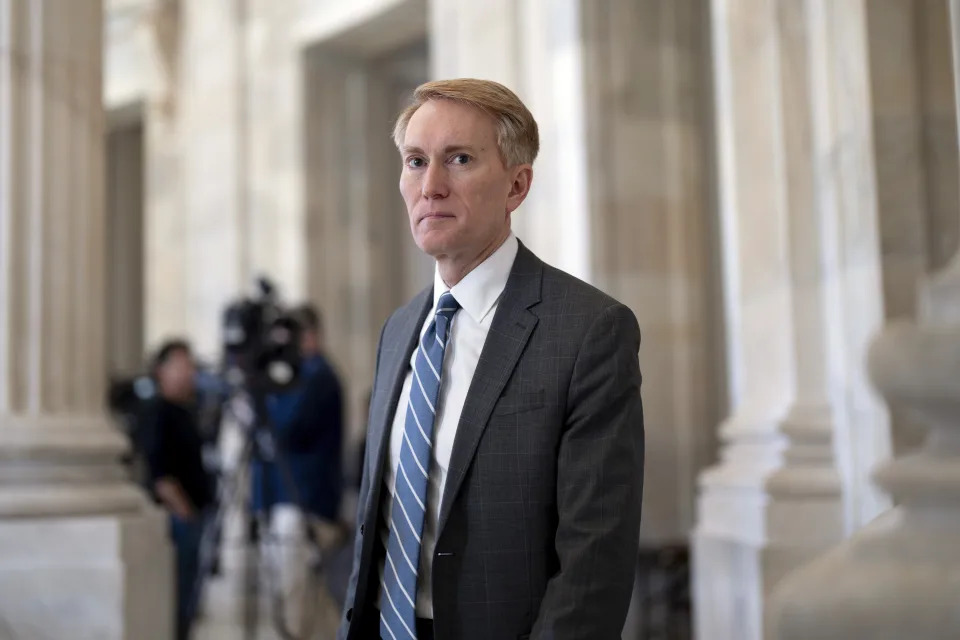
Sen. James Lankford, R-Okla., left, the lead GOP negotiator on a border-foreign aid package, holds hands with his wife Cindy Lankford, center, joined at right by Sen. Kyrsten Sinema, I-Ariz., who has been central to Senate border security talks, during procedural votes, at the Capitol in Washington, Wednesday, Feb. 7, 2024. Senate Republicans have blocked the bipartisan border package, scuttling months of negotiations between the two parties on legislation intended to cut down record numbers of illegal border crossings. (AP Photo/J. Scott Applewhite)Sen. James Lankford, R-Okla., the lead GOP negotiator on the Senate border and foreign aid package, does a TV news interview at the Capitol in Washington, Monday, Feb. 5, 2024. (AP Photo/J. Scott Applewhite)
WASHINGTON (AP) — Just before the Senate voted Wednesday to kill the border deal he spent the last four months negotiating, Oklahoma Sen. James Lankford climbed a set of marble stairs outside the chamber and joined his wife in the visitors’ gallery.
As the Republican quietly watched from a floor above, briefly the outsider after defending his legislation in a last Senate floor speech, fellow negotiator Kyrsten Sinema of Arizona was down on the floor excoriating the Republicans who had abandoned Lankford, one by one, after insisting on a border deal and asking him to negotiate a compromise on one of the country’s most intractable issues.
“Less than 24 hours after we released the bill, my Republican colleagues changed their minds,” said Sinema, a former Democrat turned Independent. “Turns out they want all talk and no action. It turns out border security is not a risk to our national security. It’s just a talking point for the election.”
Walking out of the gallery with his wife close by his side, Lankford was asked by a waiting reporter if he felt betrayed by his party. He sighed, deeply, and waited a few beats.
“I’m disappointed we didn’t get it done,” Lankford said, diplomatically. “I don’t know if I feel betrayed, because the issue is still there. It’s not solved.”
He then walked back down the stairs with his wife and Sinema, who had come up to greet them after her speech, and walked into the chamber to watch the bill’s defeat.
In the end, all but four Republicans voted against moving forward on the legislation — including Republican Leader Mitch McConnell, who had delegated Lankford to negotiate the bill combining Ukraine aid and border security and had been closely involved in the negotiations.
A former youth minister in the Baptist church, Lankford, 55, is known as one of the most sincere and well-liked members of the Senate. He’s a conservative who rarely votes against his party, has long championed stricter measures at the border and has been supportive of former President Donald Trump. So his colleagues’ swift and outright rejection of the deal he has spent weeks and months negotiating — and their willingness to completely abandon Lankford in the process, after many of them indicated they were supportive of the direction of the talks — is all the more remarkable.
“They reacted to it like it was a poison,” said Democratic Sen. Chris Murphy of Connecticut, the third negotiator with Lankford and Sinema, of Senate Republicans who had previously signaled they were supportive. “I think it’s unforgiveable what they did to James.”
“They really threw the man overboard,” President Joe Biden said of Lankford at a fundraiser Wednesday evening.
While some Republicans were always going to vote against the compromise, arguing that no policy is better than what they saw as weak policy, others made clear they were encouraged by the talks as Lankford briefed them on the emerging details. But his colleagues’ eventual, quick rejection of the bill highlights the deep divides in the GOP as Trump, the party’s front-runner for the 2024 presidential nomination, has made immigration a top issue. Some senators who had previously been open to a deal became more skeptical after Trump made his opposition clear.
It is also a sign of dysfunction and paralysis in the Senate as its traditionally bipartisan image fades in favor of more partisan, House-like battles.
When he took on the job negotiating a border compromise, Lankford laughed that “he drew the short straw.” Sen. Roger Marshall, R-Kan., joked later that if Lankford can’t get a deal done: “Moses couldn’t get a deal done. He’s one of the most kindest, compassionate people I’ve met in my lifetime.”
His fellow negotiators described him as an earnest, smart legislator who was willing to spend long hours digging into the intricacies of immigration law — and spent weeks away from his family in the process. Murphy said senators often negotiate the broad policies and let staff do the “dirty work” of putting the ideas into legislative text.
“James does both,” Murphy said. “It’s a sign of how sincere he is and how in the weeds he is on policy. But it probably means he’s maybe a little less attuned to the politics.”
The Oklahoma Republican has spent the last three days desperately trying to explain the bill after many of his colleagues put out statements opposing it without even reading the full text. Some Republicans put out misleading statements about what it would do, claiming it was designed to let more people into the country. Trump, who has strongly opposed the bill and said he doesn’t want to give Democrats a win on the issue, gleefully bragged that he helped kill it.
“I think this is a very bad bill for his career, and especially in Oklahoma,” Trump said of Lankford on a radio show earlier this week.
The bipartisan compromise would overhaul the asylum system at the border with faster and tougher enforcement, as well as give presidents new powers to immediately expel migrants if authorities become overwhelmed with the number of people applying for asylum, among other measures to reduce the record numbers of migrants crossing the border. It would also send billions to Ukraine, Israel and allies in the Asia-Pacific.
Lankford’s work on the issue could have lasting political consequences. A group of about 100 people within the Oklahoma GOP put out a statement condemning him for crafting the bill even before it had been released. And in his Senate floor speech Wednesday, Lankford spoke of an unidentified “popular commentator” who told him that if he tries to move a bill to solve the border crisis, “I will do whatever I can to destroy you, because I do not want you to solve this during the presidential election.”
Even more stunning was how quickly his Senate colleagues turned against it.
As the bill was released late Sunday night, Lankford was on an airplane flying to Washington. By the time he landed, an onslaught of criticism from conservatives was already underway. He was on a call with reporters, trying to explain the details of the bill, when House Speaker Mike Johnson posted on X that the bill would be “ dead on arrival ” in his chamber.
Lankford’s frustration was palpable as he responded, listing off how the bill would accomplish several conservative goals like building more border wall, hiring more Border Patrol agents, expanding detention capacity and speeding deportations.
“We’ve got to be able to find a way to stop the chaos at the border,” Lankford said.
Almost no Republicans endorsed it, save McConnell. And by Monday night, seeing the writing on the wall, McConnell told the conference it was OK to vote against it.
“I feel like the guy standing in the middle of a field in a thunderstorm holding up the metal stick,” Lankford told reporters shortly ahead of the bill release. “This is a really intense thing. It’s been divisive.”
Associated Press writers Seung Min Kim, Will Weissert, Jill Colvin and Lisa Mascaro contributed to this report.
Three reasons why so many migrants want to cross from Mexico to US
By Bernd Debusmann Jr, Washington– February 7, 2024
Getty Images
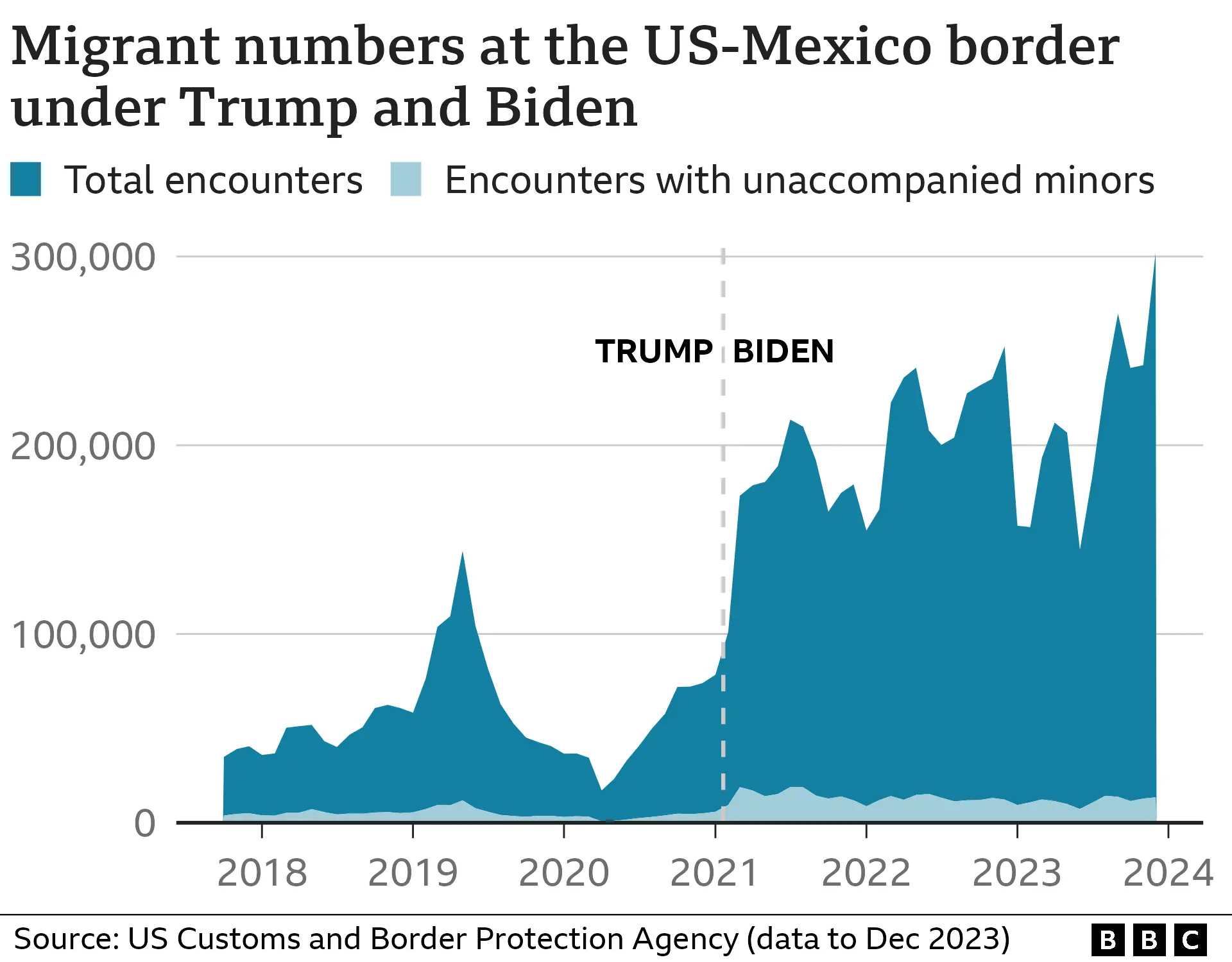
Migrant arrivals at the border have risen to record highs during President Joe Biden’s administration, a massive political headache for him ahead of the election.
Polls suggest that more than two-thirds of Americans disapprove of Mr Biden’s handling of the issue.
His likely opponent in November’s presidential election, Donald Trump, has this week condemned a cross-party bill trying to address the problem, saying it’s not tough enough.
But it’s not just Republicans who are unhappy about the influx. Democratic mayors in cities struggling to cope with the numbers are also making their feelings known.
More than 6.3 million migrants have been detained crossing into the US illegally under Biden, a higher number than under Trump, Obama or George W Bush.
The reasons for the spike are complex, with some factors pre-dating this government and beyond the control of the US. We asked experts what’s going on.
1. Pent-up demand after lockdown
The number began to rise in 2018, largely driven by Central Americans fleeing a series of complex crises including gang violence, poverty, political repression and natural disasters. Detentions fell again in the summer of 2019, which US officials credited to increased enforcement by Mexico and Guatemala.
The most drastic reduction took place in early 2020, when pandemic-era restrictions led to a drastic reduction of over 53% between March and April that year.
Since these measures were lifted in early 2021, the numbers have steadily risen, reaching an all-time high of just over 302,000 in December 2023.
“That’s when we began to see an increase again, primarily of Central Americans after mobility restrictions [there] and across the region began to ease,” said Ariel Ruiz Soto, a policy analyst at the Washington DC-headquartered Migration Policy Institute.
“That’s also when the bigger change happened and we began to see much more diversified flows, starting with Venezuela, but also Colombia, Ecuador and places further away.”
Migrants now come from as far afield as West Africa, India and the Middle East.
Of migrants from outside the Americas, the greatest increase comes from China. More than 37,000 Chinese nationals were detained at the US-Mexico border last year, about 50 times the figure from two years ago.
2. Global migration trends
The increases in migrant figures seen at the US-Mexico border seen in the last several years also come at a time when, globally, migration to rich countries is at an all-time high.
Statistics from the Organisation for Economic Co-operation and Development (OECD) released late last year show that 6.1m new permanent migrants moved to its 38 member states in 2022 – a 26% increase over 2021 and 14% higher than in 2019.
The number of people granted asylum in the US doubled in 2022, driven in large part by migrants from Venezuela, Nicaragua and Cuba. The US is second only to Germany now in levels of humanitarian migration.
“We are experiencing displacement around the world at a level never seen in recorded history, and people are turning up at our southern border for a variety of different reasons,” explained Jorge Loweree, managing director of programmes at the American Immigration Council, a Washington-based non-profit and advocacy group.
“There are four failed states in our hemisphere alone.”
The switch in the White House in 2021 also contributed, say some experts.
A key message from President Trump, even if it never became a reality, was the building of a border wall and increased deportations.
The headlines created by the separation of children from their detained parents, decried by many as cruel, added to the impression that the US was closing its border.
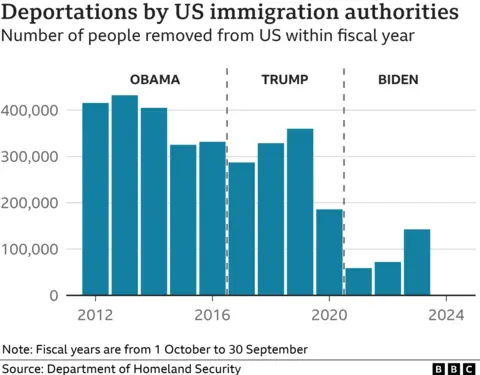
Under President Biden there was a change of tone and of policy. Deportations fell and “deterrent-focused” policies such as the rapid removal of migrants to Mexico and the building of a border wall ended.
Migrants were paroled into the US to await immigration court dates – a process which can often take years.
People trying to cross the border during this time told the BBC they thought that entering and staying in the US was going to be easier now. And human smugglers took advantage of a change in presidency to create a sense of urgency among migrants that they should hurry to the border.
“Part of it is that they think they can just come. I think that’s just what they’re being told,” said Alex Cuic, an immigration lawyer and professor at Case Western Reserve University in Ohio.
“They feel like there’s a pathway to come here,” he added. “It’s almost like an invite.”
Conversely, some immigration activists have criticised the Biden administration and US lawmakers from both parties for failing to pass meaningful immigration reform.
The last major overhaul of the system was more than 30 years ago and now the cross-party bill presented to Congress this week looks doomed due to Republican opposition.
Behind the border mess: Open GOP rebellion against McConnell
Burgess Everett – February 7, 2024
Senate Minority Leader Mitch McConnell, R-Ky., speaks during a news conference on border security, following the Senate policy luncheon at the Capitol in Washington, Tuesday, Feb. 6, 2024. (AP Photo/Jose Luis Magana)
Conservative hardliners once celebrated Mitch McConnell for wrestling the federal judiciary to the right and thwarting progressive hopes.
Now he is under open attack from the right for even trying to work with Democrats on the border.
The Senate GOP leader is facing internal resistance not seen in more than a year as Republicans descend into discord over two issues they once demanded be linked: border security and the war in Ukraine.
McConnell, now nearing his 82nd birthday, is determined to fund the Ukrainian war effort, a push his allies have depicted as legacy-defining. But now that his party is set on Wednesday to reject a bipartisan trade of tougher border policies for war funding, his far-right critics are speaking out more loudly: Several held a press conference Tuesday where they denounced his handling of the border talks, with Sen. Ted Cruz (R-Texas) calling on McConnell to step down.
In an interview, McConnell rejected the criticism and said his antagonists fail to recognize the reality of divided government.
“I’ve had a small group of persistent critics the whole time I’ve been in this job. They had their shot,” McConnell said, referring to Sen. Rick Scott’s (R-Fla.) challenge to his leadership in 2022.
“The reason we’ve been talking about the border is because they wanted to, the persistent critics,” he added. “You can’t pass a bill without dealing with a Democratic president and a Democratic Senate.”
Despite that pragmatism, McConnell’s job is only getting harder. If he runs for another term in leadership next year, a tougher fight than Scott gave him seems almost inevitable.
That is in part because of Donald Trump, whom McConnell barely acknowledges after criticizing his role in the Capitol riot of Jan. 6, 2021. The former president played a leading role in killing the border deal and has called consistently for McConnell’s ouster. And at this time next year, Trump could well be back in the White House.
More and more of Senate Republicans’ internal strife is seeping out into public view, exposing years-old beefs that are still simmering. Sen. Mike Lee (R-Utah) posted a fundraising link asking donors to “kill this border bill” in the middle of a closed-door GOP meeting on Monday and demanded “new leadership,” while Sen. Ron Johnson (R-Wis.) memed McConnell as Charlie Brown whiffing on an attempt to kick a football held by Sen. Kyrsten Sinema (I-Ariz.).
“I’ve been super unhappy since this started,” Johnson said in an interview. “Leader McConnell completely blew this.”
Trump and Speaker Mike Johnson helped squash the border bill’s prospects in the House while Ron Johnson, Lee, Cruz, Scott and Sen. J.D. Vance (R-Ohio) pummeled it on TV and social media. The intensity of that assault turned many GOP senators sour on a border security deal that would have amounted to the most conservative immigration bill backed by a Democratic president in a generation — a bill they once said was the key to unlocking Ukraine aid.
Though McConnell touted the work of Sen. James Lankford (R-Okla.) and the bill’s endorsement by the Border Patrol union, he conceded what was obvious by Monday night: This legislation is dead.
“The reason we ended up where we are is the members decided, since it was never going to become law, they didn’t want to deal with it,” McConnell said in the interview. “I don’t know who is at fault here, in terms of trying to cast public blame.”
At Tuesday’s party meeting, Cruz told McConnell that the border deal was indefensible, while Sen. Lisa Murkowski (R-Alaska) questioned why the GOP would walk away from it, according to two people familiar with the meeting. That followed a Monday evening private meeting where Johnson got into a near-shouting match with Sen. Todd Young (R-Ind.), one of several senators who has tried to rebut Trump’s influence on the party.
Young played down the spat afterward: “Ron and I have a very good relationship. We can be very candid with one another.”
McConnell’s loud critics are among those most responsible for raising opposition to the border deal, attacking its provisions while the text was being finalized. They raised such a ruckus that none of McConnell’s potential successors as leader — Sens. John Barrasso (R-Wyo.), John Cornyn (R-Texas) and John Thune (R-S.D.) — offered to support it.
McConnell can’t be ejected spontaneously like a House speaker, meaning his job is safe until the end of the year. He also has major sway over the Senate Leadership Fund, a super PAC that may have to help Cruz, Scott and other Republicans win reelection.
And McConnell is not without defenders. Sen. Lindsey Graham (R-S.C.) said any attempt to blame McConnell for the border crackup is “a bit misplaced.”
Indeed, McConnell was OK with just approving foreign aid back in the fall, but agreed to link it to border security after rank-and-file Republicans grew eager to extract concessions from Democrats in order to get Ukraine money.
“It’s not James’ fault, he did the best he could under the circumstances. It’s not Mitch’s fault,” said Sen. John Kennedy (R-La.).
The historical record holds plenty of quotes from McConnell’s current critics asking for stronger border policy during the Trump administration. Many of them now have since changed their tune to say Biden doesn’t need new laws at all to enforce border security.
“We all wanted to see border security. And I think a lot of our members were demanding that in exchange for the rest of the funding. That’s an issue our conference needs to be aware of,” said Sen. Joni Ernst (R-Iowa), the No. 4 leader. “The conference wanted border security.”
The animosity McConnell now faces from Ron Johnson, Lee and others isn’t new either: They’ve questioned Senate GOP leadership’s decisions for years.
Ron Johnson’s been a thorn in McConnell’s side for years, particularly after many Republicans abandoned his reelection bid in 2016. Cruz has sparred with McConnell since getting to the Senate in 2013, Lee frequently breaks with leadership and a number of newer GOP senators voted for Scott over McConnell in 2022.
One GOP senator, granted anonymity to assess the situation candidly, said that the new wave of attacks could be happening because McConnell’s opponents sense weakness — or just out of “personal pique” over years-old disagreements.
“For three months it’s been nothing but border and Ukraine, border and Ukraine, border and Ukraine. I don’t know how many speeches I’ve heard … and now all of a sudden, it’s: ‘We’re not going to do that,’” said Sen. Josh Hawley (R-Mo.), another of the McConnell critics. “It just seems like total chaos to me.”
Either way, the 180 among many Republicans is evidence of a major drift away from McConnell’s style of Republicanism and toward Trump’s. McConnell hasn’t talked to Trump since the Jan. 6 riot and tried to turn the party in a surprisingly deal-centric direction during the first two years of President Joe Biden’s presidency.
Just two years ago, debt ceiling increases, gun safety and infrastructure laws passed with McConnell’s blessing — all a reflection of his view that protecting the filibuster requires working with Democrats on bipartisan bills.
Now the reality is that Trump, the likely nominee, doesn’t want a deal that Republicans set out to secure four months ago. Deal-making without Trump’s blessing appears impossible, and that’s a challenging dynamic for the longtime GOP leader.
“This wasn’t good for him. This wasn’t good for any of us,” said Sen. Tommy Tuberville (R-Ala.) of McConnell, whom he backed in 2022. “And I’m not gonna say he’s the total cause of it, but we got to have a better plan. This didn’t work out for us.”






 Getty Images