When Russia invaded Ukraine a year ago, President Vladimir Putin had a lot more in his war plan than tanks and missiles. Putin also planned an energy war in parallel with his military war on the ground in Ukraine.
Putin’s military war has gone badly, his army decimated after failing to seize Ukraine, as planned. Putin’s energy war has failed, too. Neither war is over, but the many nations now allied against Russia have done a remarkable job blunting Putin’s most potent economic weapon.
Putin clearly anticipated sanctions against his country in response to the 2022 invasion. He also thought he could counter those sanctions using Russian energy, which Europe in particular was dependent on. Russia is the world’s third-largest oil and natural gas producer, and at the time of the invasion, it was Europe’s top source of gas, needed to produce electricity.
At first, Putin’s energy war worked as planned. Sanctions imposed by the United States and other nations largely exempted Russian energy, to protect consumers from price spikes. But the unpredictable nature of those sanctions, plus instability caused by the war itself, generated a “fear premium” in energy markets that pushed prices up. Oil prices spiked from about $90 before the invasion to nearly $125 four months later.
U.S. gasoline prices hit $5 per gallon last June, damaging President Biden’s popularity and making inflation a bigger everyday concern for Americans than the war in Ukraine. Natural gas prices rose by far more than oil and gasoline. Russia started reducing gas flows to Europe last June, then completely shut the main gas pipeline to Europe in September.
https://flo.uri.sh/story/1836372/embed?auto=1
By late August, European natural gas prices were four times higher than before the war. Wintertime rationing seemed likely, along with a recession caused by sporadic business shutdowns and painful energy inflation. Gas prices surged in the United States as well, though not by as much in Europe, given that gas is not as transportable as oil, generating regional price differences.
Soaring energy prices were exactly the kind of pain Putin planned for nations opposing his war. His hope was that high energy prices among Ukraine’s allies would wreck their economies, undermining public support for sanctions and for aid to Ukraine.
The full-blown energy crisis Putin tried to create never materialized, however. Prices tell the story. Oil, gasoline and natural gas prices are now lower than they were before Putin invaded, as the chart above shows. Russia is still a crucial source of energy, but the nations it tried to bring to heel have reconfigured their energy supply chains with speed and skill nobody foresaw a year ago.
“The last year may be remembered as the twilight for Russian energy leverage,” Richard Morningstar, founding chairman of the Atlantic Council Global Energy Center, wrote in a January report. “Moscow’s energy strategy is not working, and its ability to wield energy chaos as a geopolitical weapon is waning.”
Several concerted actions by Ukraine’s allies parried Putin’s energy offensive. In the United States, President Biden released an unprecedented amount of oil from the strategic reserve, with other countries releasing smaller amounts. Though not huge relative to total oil supply, those releases seem to have reassured markets and brought price relief at the margins.
TOPSHOT – Workers repair high-voltage power lines cut by recent missile strikes near Odessa on December 7, 2022, amid the Russian invasion of Ukraine. – A new barrage of Russian strikes on December 5, left several Ukrainian cities without power, including the eastern city of Sumy and the southern city of Mykolaiv, according to officials. In Odessa, the water services operator said “there is no water supply anywhere” and officials in the central city of Kryvyi Rig said “parts of the city are cut off from electricity, several boiler and pumping stations are disconnected.” (Photo by OLEKSANDR GIMANOV / AFP) (Photo by OLEKSANDR GIMANOV/AFP via Getty Images)
Putin himself blinked. He could have slowed or stopped Russian oil sales, which would undoubtedly have sent prices soaring, given that Russia produces about 10% of the world’s oil. But he never did. Oil sales are Russia’s biggest source of revenue, and Putin desperately needs that funding to pay for a war that is far costlier than he anticipated. Russian oil production has actually remained stable for most of the past year, which is helping Putin keep the war going but also keeping global prices under control.
Europe also dramatically revamped its natural-gas supply chains, with the portion of gas coming from Russia dropping from 40% to less than 10%. And much of that gas goes to Turkey and Balkan nations not fully participating in sanctions. Gas shipped on tankers from the United States and Qatar backfilled much of the supply lost from Russia. Some European power plants also switched from gas to coal, which boosted carbon emissions, but is also likely temporary.
The United States and other large nations have also developed novel ways to begin sanctioning Russian energy while keeping supplies on the market and prices low. In December, a U.S.-led group of large nations imposed a price cap of $60 per barrel on Russian oil. Barrels from Russia generally sell for less than that, since global prices have been around $80 and the market demands a discount for the risk and complexity of purchasing from Russia. But this “buyers cartel” can lower the price and pinch Russia harder.
On February 5, another set of price caps went into effect for Russian petroleum products such as diesel fuel. Putin has vowed to withhold oil from any buyer participating in the price-cap regime, but so far nothing has changed.
Putin may still have some ammunition in reserve. “Given that Washington has strongly signaled an aversion to higher oil prices, and has gone to quite extraordinary lengths to keep a lid on them, there remains an elevated risk that Putin will seek to exploit this pain point in 2023,” Helima Croft, head of global commodity strategy at RBC Capital Markets, wrote in the January Atlantic Council report. “We may be entering a particularly precarious phase in the conflict. Putin may endeavor to demonstrate that he is not a spent force.”
One concern is Russian sabotage of energy facilities in regions where it has some influence, similar to the mysterious explosions that ruptured two undersea gas pipelines running from Russia to Germany last September. Russia has links to mercenary groups in oil-producing nations such as Iraq, Algeria, and Libya, and direct involvement in some energy facilities operated by former Soviet Republics. Some analysts think a surprise slowdown in production from two fields in Kazakhstan last April may have been a dress rehearsal for future Russian sabotage.
What’s the best way to leave your house to your heirs?
Carmen Cusido – February 24, 2023
The most important thing is to determine whether to transfer the home during your lifetime or after death.
Time passes and estate plans need updating — decide now what you want to do with the family home after you are gone — and then write it down and update as necessary. ISTOCK
This article is reprinted by permission from NextAvenue.org.
Francesca Maresca, 54, of Highland Park, New Jersey, had spoken in passing to her father, John, about whether he had an updated will. It was only when he died at 89 of congestive heart failure in September 2020 that she and her sister, Catherine, learned that he kept their late mother’s name on the deed to the family home and they, rather than their stepmother, had inherited the house.
The sisters sold their childhood home soon after the deed was transferred to them. “There was no squabbling over things,” Maresca said. “I recognize that’s rare.”
Indeed, homeowners who die before they decide and document what they want to do with their property can leave their relatives with a legacy no one wants: a protracted legal fight over what to do with the family home and the possibility of a substantial tax liability.
What is at stake?
Much is at stake. Cerulli Associates, a research and analytics firm in Boston, estimates that $84.4 trillion in personal wealth will be transferred from one generation to the next between now and 2045.
Most of it — more than $53 trillion — will come from baby boomers, people born between 1945 and 1964; another $15.8 trillion from people born before 1945. Primary residences represent more than 70% of that wealth, according to one estimate.
Members of Generation X — people born between 1965 and 1980 — stand to inherit the greatest portion of that transfer — $29.6 trillion over the next 25 years, including $8.9 trillion in the next 10 years, according to Cerulli. The millennial generation, which consists of people born from 1981 to 1996, are expected to inherit more than $27 trillion by 2045.
You can transfer a home or other property while you’re still alive, but Lazaro Cardenas, an estate lawyer in Freehold, New Jersey, said a drawback in doing so is that if your heirs are sued or otherwise get in trouble with the law, the property can be seized if it’s not adequately insured.
Additionally, by selling their house to their child or children, parents will lose the mortgage-interest deduction on their income tax return.
However, selling your house can generate cash that you may need for nursing care and other medical expenses late in life.
“If you bequeath the property in your will, one of the benefits is you can maintain control of your home until you die,” said Cardenas, a partner at Patel & Cardenas. “The drawback is that end-of-life care becomes expensive and usually is not covered by insurance.”
Cardenas added that if you apply for Medicaid to cover end-of-life expenses, the agency could consider your house as your asset if you sold it to your heirs within the previous five years.
“One solution is to sell your property to your child but create a deed that states you’re allowed to live in the house until you die, even if your child or children are now owners,” Cardenas said.
Another option is to place the property in a trust. That way, when you die, the property passes to the trust and the trustee then owns the home. The benefit here is the heir does not have to go to probate court after the last parent dies, Cardenas explained.
“Ultimately, you can leave your property to a child, all your children or none,” he added. “However, in a state like New Jersey, you cannot disinherit your spouse.”
Robert “Bob” Keebler, a Certified Public Accountant based in Green Bay, Wisconsin, with clients all over the world, advises parents to get ahead of potential arguments and create separate trusts for each child if there’s a lot of money involved.
“Lawyers bring CPAs in to get the math right so that there’s a clear delineation of what a client wants to accomplish from an economic standpoint,” Keebler said.
Potential hazards
He gave an example of a case he worked on where a man wanted his business to go to one of his children and the other child to inherit an equal amount of property.
“In this case, Child A must pay a little bit into the business so that it’s mathematically equal to what Child B gets,” Keebler added.
Other cases, though, are more complicated. For instance, children from a first marriage may have an issue with a stepparent or that stepparent’s children inheriting assets.
“As CPAs, we’re doing the tax work and projections on the settlements to defuse the situation with the least amount of tax for the group taken as a whole,” Keebler said. “We have clients who we help while they’re alive, but I sometimes get brought in after someone dies, when people start to understand what’s going to whom.”
The most important thing a person needs to determine is whether to gift their assets during their lifetime or after death.
The benefits of giving
“There are benefits to giving gifts during your lifetime,” Keebler said. “This is where you need to lay out a balance sheet and your goals and work with your accountants to structure your estate best.”
He added that giving real estate to your heirs while you are still alive can reduce the tax they will have to pay.
Inheriting money or other assets can bring up a lot of emotions, even when there are wills and trusts in place.
Jacquette M. Timmons, the president and CEO of Sterling Investment Management in New York City, said there’s often a sense of overwhelming responsibility from someone who inherits a home or a large sum of money. “There’s a sense of grief; you wouldn’t have this house or money if the person had not died,” she said. “Many want to ensure they’re a good steward of what they’re left with.”
Timmons advises her clients to wait at least a year before they make a big decision, like selling a home. “Time and distance bring clarity,” she said. “But I recognize that waiting before deciding is a privilege that few have.”
Instead of emphasizing death when working on wills and trusts, Timmons encourages her clients to view these legal documents as leaving a legacy.
“When someone has invested the time to put together an estate plan and say what their wishes are, that’s an incredible gift for the people left behind,” Timmons said. “They don’t have to worry about piecing things together. They can leave their loved ones with a full road map of what they’d like done. To me, that’s a love letter you’re leaving someone.”
In Maresca’s case, she and her sister spent two months cleaning their inherited home in Saddle River, New Jersey. They donated most of its contents. The three-bedroom, one-bathroom house went on the market in November 2021, and the sisters had 40 offers.
“We decided in about 10 minutes” Maresca said. “We went with the least amount of work; the investor who made a cash offer.” After the sale closed on Dec. 21, they split the proceeds evenly.
Maresca said the experience taught her the importance of communicating her wishes to her teenage son and establishing a trust in his name.
Carmen Cusido earned a bachelor’s from Rutgers University and a master’s degree from the Columbia School of Journalism. Her work has appeared in Newsweek, Oprah Daily, Refinery29, Health, NBC, CNN, NPR, Cosmopolitan, and other publications.
This article is reprinted by permission from NextAvenue.org, Twin Cities Public Television.
Pritzker Will Do What It Takes to Keep Both DeSantis and Trump Out of the White House
Laura Davison and Shruti Date Singh – February 23, 2023
Pritzker Will Do What It Takes to Keep Both DeSantis and Trump Out of the White House
(Bloomberg) — Illinois Governor J.B. Pritzker said he’s willing to spend what it takes in the next election to help President Joe Biden keep his job — and keep Republicans like Ron DeSantis and Donald Trump out of the White House.
“It’s very important to me that we elect a Democratic president and that we make sure to keep DeSantis, Trump and the retrograde views that they carry out of the White House,” Pritzker, a longtime Democratic donor, said in an interview Thursday with Bloomberg News in Chicago. “I’ll continue to support Democrats in the best way I can to help them get elected.”
Pritzker, 58, is a member of one of the world’s wealthiest families, with a net worth of $3.7 billion, according to the Bloomberg Billionaires Index. The Democrat has been in the middle of recent spats with DeSantis, Florida’s Republican governor, and is a long-running nemesis of Citadel founder and GOP mega-donor Ken Griffin, who has said he’d back a DeSantis bid for president in 2024.
DeSantis, who visited Illinois this week, has criticized Chicago’s crime under Pritzker’s watch. Pritzker shot back, saying that DeSantis is trying to lower public education standards by banning the teaching of racial history.
Pritzker also said Griffin moved his financial empire headquarters to Miami from Chicago last year out of “embarrassment” after spending $50 million trying to defeat him in the gubernatorial race by backing Richard Irvin, the mayor of Aurora, Illinois.
“That person lost badly in the Republican primary,” Pritzker said in an interview Thursday with Bloomberg TV.
National Attention
Trading barbs with prominent Republicans sets up Pritzker for national political attention.
Pritzker, who was re-elected as Illinois governor in 2022, said he has been approached about potentially running for president, but declined to give any details about those discussions. He said he’s happy as governor, intends to serve the rest of his term and will back Biden this cycle.
Still, he’s raised his national profile by visiting New Hampshire and Florida, and has taken stances on expanding abortion access and banning assault weapons, stoking speculation that he has lofty ambitions beyond the Illinois statehouse in Springfield.
Regardless, the billionaire’s wealth promises to play a role in the 2024 race.
He poured more than $300 million of his own money into his two successful bids for governor. He spent about $51 million for a failed campaign to change Illinois’s flat income-tax structure to one that increases taxes on the rich.
Outside of Illinois, Pritzker and his wife have donated more than $39 million since 2011, according to campaign finance disclosures. Topping the list of recipients is Priorities USA Action, the super-PAC that’s supported Democratic presidential nominees since it was launched in 2011.
The Pritzkers have also given $2 million to support Hillary Clinton’s 2016 general election campaign and $1.4 million to back Biden in 2020.
Real estate: US homeowners have lost $2.3 trillion since June: Redfin data
Dylan Croll – February 22, 2023
U.S. homeowners have lost $2.3 trillion since June, according to a new report from the real-estate brokerage Redfin. The total value of U.S. homes was $45.3 trillion at the end of 2022, down 4.9% from a record high of $47.7 trillion in June. That figure signifies the largest June-to-December percentage decline since 2008.
The report comes amid increased mortgage rates as the Fed tries to curb inflation. The 30-year fixed mortgage rate sat at 6.36% in December, about twice what it was at the start of 2022. Though rates fell in early February, they’ve since risen back to December levels to the dismay of buyers.
Consequently, Americans find themselves more reluctant to buy homes and prices have dropped. The median U.S. home sale price was $383,249 in January, which was up just 1.5% from the previous year, according to the report.
Redfin highlighted the Bay Area, noting that the region had seen the biggest drop in real-estate value compared to other parts of the country. For instance, the total value of San Francisco homes fell 6.7% in December, to $517.5 billion, a $37.3 billion decline year over year.
“Three of my listings recently went under contract after sitting on the market for more than a month,” said Ali Mafi, a Redfin real estate agent in San Francisco featured in the note. “They all had a few showings here and there in the fall, but no buyer wanted to pull the trigger. And then suddenly in the new year, we had 10 or 15 people touring each property.”
Meanwhile, the report pointed out, the Florida housing market has remained robust, with the largest increase in real-estate value compared to other parts of the country. The total value of homes in Miami rose 19.7% year over year ($77 billion) to $468.5 billion in December.
“Florida’s housing market is being sustained by folks moving in from the North and as of recently, the West Coast,” said Elena Fleck, Florida real estate agent featured in the report. “People are pouring in from New Jersey and New York, in large part because Florida has relatively affordable homes and no income tax. They can get a lot more bang for their buck here.”
The report noted that U.S. cities are doing much worse than U.S. suburbs. While the value of urban homes increased 2.5% to $10.8 trillion year over year, the value of suburban properties jumped 6.4% year over year, to $25.4 trillion, in December.
“The housing market has shed some of its value, but most homeowners will still reap big rewards from the pandemic housing boom. The total value of U.S. homes remains roughly $13 trillion higher than it was in February 2020, the month before the coronavirus was declared a pandemic,” said Redfin Economics Research Lead Chen Zhao in the report.
“Unfortunately, a lot of people were left behind. Many Americans couldn’t afford to buy homes even when mortgage rates hit rock bottom in 2021, which means they missed out on a significant wealth building opportunity,” Zhao added.
Dylan Croll is a reporter and researcher at Yahoo Finance.
Donald Trump, who rolled back rail safety regulations and slashed environmental protections, donates Trump-branded water to East Palestine residents
Erin Snodgrass – February 22, 2023
Former President Donald Trump heads out of the East Palestine Fire Department next to his son, Donald Trump, Jr., as he visits the area in the aftermath of the Norfolk Southern train derailment Feb. 3 in East Palestine, Ohio, Wednesday, Feb. 22, 2023. In the background is a pallet of personalized Trump water he donated.AP Photo/Matt Freed
Donald Trump visited East Palestine, Ohio, on Wednesday, following a disastrous train derailment.
The 2024 Republican candidate donated pallets of Trump-branded water to residents.
Trump’s visit raised questions about his administration’s rollback of rail safety regulations.
The former president’s visit to the northeastern village preempted Transportation Secretary Pete Buttigieg’s arrival by one day, and Trump relished every opportunity to castigate his Democratic successors, saying Buttigieg “should have already been here,” and commanding President Joe Biden to “get over here,” according to local reports.
While assuring East Palestine residents that they had “not been forgotten,” Trump managed to tout his own presence in the besieged community and brush off questions about his administration’s noted history of rolling back regulations on both rail safety and hazardous chemicals.
Trump started his day by briefly visiting with local leaders, according to WKBN-27, before conducting a small press conference at a fire station, where, donning his signature “Make America Great Again” hat, he handed out a flurry of red baseball caps to attendees.
During his speech, Trump pledged to donate thousands of bottles of cleaning supplies, as well as pallets of Trump-branded water bottles to members of the community, many of whom have expressed continued concern over the safety of the town’s water supply following the derailment.
“You wanna get those Trump bottles, I think, more than anybody else,” Trump said, while flanked by state and local leaders, including Republican Sen. JD Vance.
The former president dismissed questions about his administration’s rollback of Obama-era rail safety regulations saying he “had nothing to do with it.”
The Department of Transportation under Trump justified the rollback with a 2018 analysis arguing the cost of requiring such brakes would be “significantly higher” than the expected benefits of the update.
A spokesperson for Trump did not immediately respond to Insider’s request for comment.
Following his Wednesday news conference, Trump visited a local Ohio McDonald’s where he handed out more MAGA hats and bought meals for firefighters.
San Francisco holds its breath to find out how much it will cost to protect its waterfront from sea level rise
David Knowles, Senior Editor – February 22, 2023
San Francisco’s waterfront. (Getty Images)
SAN FRANCISCO — On a brisk February morning, a portable orange traffic sign set up near the intersection of Mission Street and Embarcadero shuddered in the wind, blinking a warning to passing drivers: “Caution: King tides.”
Waves from San Francisco Bay now regularly breach the pier and spill into the streets at this spot during tidal surges and helped convince city officials that sea level rise caused by climate change is no longer a problem that can be ignored.
“It was into my second year that I realized that my whole job and the organization was going to do this work,” Port of San Francisco executive director Elaine Forbes, who was appointed to her position in 2016 by then-Mayor Ed Lee, said beneath the Ferry Building’s broken clock tower, its hands fixed to either high noon or midnight as it undergoes repairs. “You’re on the line of defense.”
A semi-independent entity, the port oversees 7.5 miles of the city’s coastal facilities along the bay, leasing out a wide array of properties, including landmarks like Fisherman’s Wharf, Pier 39, the Ferry Building, a cruise ship terminal and Oracle Park, where the Giants play baseball. Its revenues are crucial to the city’s bottom line, and in 2018 Forbes mobilized her office to help ensure the passage of Prop A, a voter initiative that raised $425 million in taxpayer funds to begin addressing repairs and seismic upgrades to a 3-mile section of the city’s crumbling, more-than-100-year-old sea wall in anticipation of sea level rise.
“We said at the time, this is really a down payment for the problem,” Forbes recounted.
Since then, projections for how bad that problem will get have only become more dire. In 2020, the Legislative Analyst’s Office, the nonpartisan fiscal and policy adviser to the California Legislature, issued a report stating that under a scenario of continued high greenhouse gas emissions, San Francisco could see as much as 7 feet of sea level rise by 2100.
A graphic from a 2020 report by California’s Legislative Analyst’s Office.
In response to that grim new estimate, Forbes and the port’s commissioners announced last fall that they were partnering with the U.S. Army Corps of Engineers to conduct a comprehensive yearlong study examining how best to protect the vulnerable waterfront. Doing nothing, everyone seemed to agree, was not an option.
“The increased frequency of flooding that you’ll see as the bay comes up and you have more frequent tidal flooding, the numbers are in the billions in terms of the damages that will accumulate from that,” Brian Harper, a director of planning with the Army Corps, told Yahoo News.
But just as significant increases in sea level will result in monumental damages, adequately protecting communities from the additional rise will also become much more expensive. Complicating San Francisco’s efforts, the pandemic has badly diminished revenues from tourism and financial district foot traffic, forcing port officials to go hat-in-hand to city, state and federal entities in search of money to use to harden the coastline against rising waters.
“We’re not even at a scale to pretend to be able to pay for this project,” Forbes said. “We have a $114 million balance sheet, maybe a little higher. If we’re lucky, we have a $25 million capital budget that we squeeze out of our net revenues.”
While noting that any estimate on how much a fix will cost depends on what the Army Corps recommends in its report, Forbes speculates that the range could end up between $10 billion and $30 billion. Other experts, however, believe that guess could be too low.
Pier 14 in the Embarcadero district of San Francisco. (Getty Images)
“Projects like this have never, ever been built for the initial cost estimate,” said Peter Gleick, a climate scientist and the founder of Oakland’s Pacific Institute, which in 1990 conducted California’s first-ever report on how sea level rise would impact the Bay Area. “It’s not just sea level rise. It’s the big storm in addition to sea level rise that’s the issue. Seven feet of sea level rise is devastating, and then on top of that you have the extreme storm and then the king tides on top of 7 feet. That’s when the real damages are felt, and they’re felt long before they reach 7 feet.”
While many Americans still doubt the existence of climate change or whether climate change represents a threat serious enough to spend billions to address, coastal communities across the country have already begun heeding the wake-up call issued by scientists. San Francisco is just one of several U.S. cities to seek help from the Army Corps of Engineers in recent years. Others include Charleston, S.C., Miami and Boston. As the reality of the situation and the costs associated with it continue to sink in, more and more cash-strapped communities will no doubt seek federal assistance.
“Our standard cost sharing for flooding coastal projects is 65% federal, 35% local,” Harper said.
But federal money for projects designed and proposed by the Army Corps is by no means guaranteed.
A king tide washes up along the Embarcadero in San Francisco on Jan. 3, 2022. (Brontë Wittpenn/The San Francisco Chronicle via Getty Images)
“Each step of the way, we need an authorization from Congress and we need appropriation of funding to move to the next step,” Harper said. “Our steps are: Study it, design it, construct it and then operate it. So in each of those stages we would be going back to the Congress with an updated status of where we are and request for appropriation to move to the next stage.”
With the GOP back in the majority in the House of Representatives, it’s unclear how future requests for climate adaptability from the Corps will be received. Not a single Republican, after all, voted in favor of the Inflation Reduction Act, and many lawmakers who abhor large federal outlays have already begun looking for ways to kill its climate provisions. Yet much of the funding for hardening ports and waterfronts was allocated in the bipartisan Infrastructure Investment and Jobs Act, and Harper notes that the Corps continues to get approval for large projects.
“The administration incorporated authorization for all federal infrastructure agencies to specifically address climate resilience across the country, but [also] in urban settings like San Francisco and other large cities,” Harper said. “Some of this is still evolving and developing as federal agencies and their local and state counterparts figure out how to make those partnerships come together. The climate resilience aspect is continually evolving.”
Seeing the future
Kevin Costner in the 1995 movie “Waterworld.” (Ben Glass/Universal/Kobal/Shutterstock)
Of all the consequences of climate change, sea level rise has so far remained something of an abstraction for many in the general public. While the oceans have indeed risen by an average of 8 to 9 inches since the 1880s, that difference can seem laughable when compared with Hollywood’s dystopian portrayal of what the future will look like. “Waterworld,” set in the year 2500, envisioned a world in which the polar ice caps and glaciers have completely melted away and sea levels have risen by 24,000 feet.
Since the 1995 debut of that film, the U.S. Geological Survey has released its own estimate of what an ice-free world would mean, concluding that “global sea level would rise approximately 70 meters (approximately 230 feet), flooding every coastal city on the planet.”
Given the swift transition to renewable sources of energy over the past few years, that outcome may also turn out to be too pessimistic. But until we dramatically slow the burning of fossil fuels, the planet will almost certainly continue to warm, causing the seas to keep rising. Though today’s 8 to 9 inches of sea level rise may not seem headline-worthy, almost half of the amount (3.8 inches) has occurred since 1990, according to the National Oceanic and Atmospheric Administration (NOAA). The pace of that rise, scientists predict, is poised to increase dramatically in the coming decades.
To better understand what multiple feet of additional sea level rise will mean for the nation’s coastlines, NOAA created its Sea Level Rise Viewer tool. When one toggles up to 7 feet of rise in San Francisco, Pier 39, Fisherman’s Wharf, Oracle Park and the $1.4 billion Chase Center, where the Golden State Warriors play basketball, are all shaded light blue, meaning they will be submerged in water. Forbes’s office on Pier 1, the Ferry Building next door and a good chunk of the financial district would also be permanently flooded, with access to multiple underground BART and Muni stations needing to be sealed off.
A screengrab from NOAA’s Sea Level Rise Viewer tool showing the San Francisco area with 10 feet of sea level rise.
But how seriously should people take the Legislative Analyst’s Office upper-end prediction?
“It’s based on very sophisticated model assumptions,” Gleick said. “There’s a range of estimates. We don’t know how fast the big ice masses on Greenland and Antarctica are going to destabilize, but 1 to 2 meters by 2100 is not out of the bounds of reality and what we can expect.”
The same year San Francisco voters passed Prop A with 82.7% of the vote in order to “protect $100 billion of assets and economic activity,” a poll from the University of California, Santa Barbara, found that 84% of area residents said they believed global temperatures were rising and would continue to do so, the highest number of any community in the U.S.
“It does help when they’re able to see the change. With flooding during a king tide they say, ‘Hey, this is different,’” Harper acknowledged. “But that doesn’t really capture the severity of what they’re going to see over a longer time frame.”
Like NOAA, the Army Corps has turned to visual aids to help residents understand what they will be up against, posting its own sea level rise viewer that overlays flooding depictions onto photos of urban areas.
“Here’s your downtown area. Here are buildings you should recognize because they’re in your community, and here’s what that future tidal event is going to look like,” Harper said.
If “Waterworld” was too fantastical, another sci-fi film, “Blade Runner 2049,” offered viewers a glimpse of something less abstract in scenes that featured a massive sea wall that shields Los Angeles from the encroaching ocean. That kind of utility-over-aesthetics approach has, despite the obvious drawbacks, been suggested in San Francisco to replace and dwarf the existing sea wall.
“We don’t just want to build a vertical wall. We could do that and just solve it, but that’s not good for anybody,” saidKevin Conger, president and founding partner of CMG Landscape Architecture, a San Francisco firm the port has hired to begin drawing up ideas for what a fortified sea wall would look like. “In order to adapt and hold the water back we need to elevate portions of the waterfront, but that causes another problem, which is inland flooding, because all the stormwater that’s running down by gravity is no longer going to be able to run out to the coast because you’ve elevated that edge.”
An aerial view of the Port of San Francisco shrouded in fog. (Getty Images)
Conger, Forbes and Harper all agree that whatever the final plan that emerges following the release of the Army Corps report, it should prioritize community access to the waterfront while preparing it for what’s ahead. To address the varying needs and limitations of the waterfront, the designs will include a mixture of solutions, including reinforcing and raising the existing sea wall; creating new parks that will help channel floodwaters; adding pumping stations; upgrading stormwater systems; elevating roadways, light rail tracks and even some buildings, and floodproofing the lower floors of many others; and, quite possibly, retreating from some areas altogether.
“Fundamentally, it’s looking at maintaining the line of defense, managing water, adapting with water or allowing water,” Forbes said. “There’s various alternatives that will work best in different locations along the waterfront.”
Despite the immense scale of the project, Conger stresses the long view.
“We get so sort of locked into a fear of change. But we’re always tinkering with our cities and changing things. For us to work on these projects, it’s not like we build them and walk away and we’re done, especially as landscape architects,” he said. “Our designs change constantly.”
In November, the Army Corps will present its draft to the public, inviting comments from a range of stakeholders before incorporating that feedback. Assuming congressional authorization follows suit, Harper said, the budgeting for design could come as soon as 2026.
“Depending on what the project is, design can be two to five years. Construction, again, can be two to five years. It will depend on what the specific project recommendation is coming out of the report, and it’s all subject to congressional action and administration support,” Harper said.
Calculating the final costs could itself be a years-long project. In surveys conducted by the port, for instance, San Francisco residents have prioritized elevating the 1898 Ferry Building to keep it above the rising waters. But lifting a three-story building that contains more than 200,000 square feet of office and commercial space and a 15-story clock tower won’t be cheap. Nor will be addressing possible groundwater contamination at Hunters Point Naval Shipyard, now an 866-acre federal Superfund site. Last June, a civil grand jury released a report that stated, “As the sea level rises, shallow groundwater near the shore rises with it, and can cause flooding, damage infrastructure, and mobilize any contaminants in the soil.” While the cleanup of buried radioactive soils is being overseen by the Environmental Protection Agency and state officials, the city is “poorly prepared,” the report said, for how sea level rise could cause the problem to spread into nearby lower-income neighborhoods.
San Francisco’s Ferry Building. (Getty Images)
All the coastal challenges facing San Francisco could become much more difficult depending on the precarious fate of the Thwaites Glacier in Antarctica. In 2021, a study was published that concluded that the Florida-size glacier was at risk of collapse in the following five years. Already, Thwaites accounts for roughly 4% of global sea level rise annually, and its collapse would, in the short term, translate into 2 more feet of rise. Because Thwaites helps hold other glaciers in place, however, its destruction would result in a cascading catastrophe resulting in an additional 10 feet of sea level rise.
Of course, the contiguous 7.5-mile stretch operated by the Port of San Francisco is just one small part of the Bay Area coastline that will be impacted by sea level rise.
“You’re going to have to build sea walls around the Oakland airport, the San Francisco airport, and sea walls around San Jose,” Gleick said. “When we did our study there were 29 wastewater treatment plants that were vulnerable to a meter of sea level rise.”
Though Gleick notes that San Francisco has plenty of options when it comes to combating rising seas, many poorer and less well-situated places aren’t as lucky.
“I guess the whole point is, this is just a little hint of the huge costs that are going to be associated with climate change in general and sea level rise in particular if we don’t slow these [temperature] changes,” he added.
The housing market correction has already caused homeowners to lose $2.3 trillion
Lance Lambert – February 22, 2023
For 124 consecutive months, spanning the bottom of the housing crash in February 2012 through the top of the Pandemic Housing Boom in June 2022, U.S. home prices posted positive month-over-month growth. That streak, of course, came to an abrupt end last year as the Fed’s inflation fight set off a correction in home prices.
On one hand, since their peak, national home prices have only fallen by a few percentage points through November, according to the seasonally adjusted Case-Shiller National Home Price Index. On the other hand, the ongoing housing correction is already starting to have a financial, and psychological, impact on homeowners.
On Wednesday, Redfin published a report finding that the total value of U.S. homes has fallen $2.3 trillion since the start of the home price correction.
“The total value of U.S. homes was $45.3 trillion at the end of 2022, down 4.9% ($2.3 trillion) from a record high of $47.7 trillion in June. That’s the largest June-to-December drop in percentage terms since 2008,” writes Redfin researchers.
Let’s be clear: While there’s certainly a home price correction rolling through many markets nationwide, most homeowners are still up big-time since the pandemic’s onset.
“The housing market has shed some of its value, but most homeowners will still reap big rewards from the Pandemic Housing Boom,” Redfin researchers said in the report. “The total value of U.S. homes remains roughly $13 trillion higher than it was in February 2020, the month before the coronavirus was declared a pandemic.”
Is this home price correction almost over? It depends on who you ask.
Among the 29 major real estate forecasters, six firms think national home prices will either rise or remain flat in 2023. Meanwhile, 23 major real estate forecasters think national home prices will fall further this year.
On Wednesday, minutes released from the recent FOMC meeting showed that Federal Reserve officials believe “valuations in both residential and commercial property markets remained high” and “that the potential for large declines in property prices remained greater than usual.”
Whenever a group like Redfin says “U.S. home prices,” it means a national aggregate. On a regional level, this home price correction (or lack thereof) continues to vary.
Among the country’s 400 largest housing markets tracked by Zillow, 276 have seen local home prices fall from their seasonally adjusted 2022 peak. Another 124 markets remain at their 2022 peak price.
The markets with the biggest declines, including places like Bend, Ore. (down 9.2%) and Phoenix (down 6.3%), are disproportionately located across the Pacific Coast and Southwest.
“On a regional basis, we project larger declines across the Pacific Coast and Southwest regions—which have seen the largest increases in inventory on average—and more modest declines across the Mid-Atlantic and Midwest—which have maintained greater affordability over the past couple years,” wrote Goldman Sachs in a recent report.
How the Russian economy self-immolated in the year since Putin invaded Ukraine
Jeffrey Sonnenfeld, Steven Tian – February 20, 2023
OLGA MALTSEVA – AFP – Getty Images
A year after Putin’s invasion of Ukraine, some cynics lament that the unprecedented economic pressure campaign against Russia has not yet ended the Putin regime. What they’re missing is the transformation that has happened right before our eyes: Russia has become an economic afterthought and a deflated world power.
Coupled with Putin’s own misfires, economic pressure has eroded Russia’s economic might as brave Ukrainian fighters, HIMARS, Leopard tanks, and PATRIOT missiles held off Russian troops on the battlefield. This past year, the Russian economic machine has been impaired as our original research compendium shows. Here are Russia’s most notable economic defeats:
Russia’s permanent loss of 1,000+ global multinational businesses coupled with escalating economic sanctions
The 1,000+ global companies who voluntarily chose to exit Russia in an unprecedented, historic mass exodus in the weeks after February 2022, as we’ve faithfully chronicled and updated to this day, have largely held true to their pledges and have either fully divested or are in the process of fully separating from Russia with no plans to return.
These voluntary business exits of companies with in-country revenues equivalent to 35% of Russia’s GDP that employ 12% of the country’s workforce were coupled with the imposition of enduring international government sanctions unparalleled in their scale and scope, including export controls on sensitive technologies, restrictions on Russian elites and asset seizures, financial sanctions, immobilizing Russia’s central bank assets, and removing key Russian banks from SWIFT, with even more sanctions planned.
Plummeting energy revenues thanks to the G7 oil price cap and Putin’s punctured natural gas gambit
The Russian economy has long been dominated by oil and gas, which accounts for over 50% of the government’s revenue, over 50% of export earnings, and nearly 20% of GDP every year.
In the initial months following the invasion, Putin’s energy earnings soared. Now, according to Deutsche Bank economists, Putin has lost $500 million a day of oil and gas export earnings relative to last year’s highs, rapidly spiraling downward.
The precipitous decline was accelerated by Putin’s own missteps. Putin coldly withheld natural gas shipments from Europe–which previously received 86% of Russian gas sales–in the hopes freezing Europeans would get angry and replace their elected leaders. However, a warmer-than-usual winter and increased global LNG supply mean Putin has now permanently forfeited Russia’s relevance as a key supplier to Europe, with reliance on Russian energy down to 7%–and soon to zero. With limited pipeline infrastructure to pivot to Asia, Putin now makes barely 20% of his previous gas earnings.
However, Russia’s energy collapse is also triggered by savvy international diplomacy. The G7 oil price cap has achieved the once unimaginable balance of keeping Russian oil flowing into global markets while simultaneously cutting into Putin’s profits. Russian oil exports have held amazingly consistent at pre-war levels of ~7 million barrels a day, ensuring global oil market stability, but the value of Russian oil exports has gone from $600 million a day down to $200 million a day as the Urals benchmark crashed to ~$45 a barrel, barely above Russia’s breakeven price of ~$42 per barrel.
Even countries on the sidelines of the price cap scheme, such as India and China, ride the coattails of the G7 buyers cartel to secure Russian supply at deep discounts of up to 30%.
Talent and capital flight
Since last February, millions of Russians have fled the country. The initial exodus of some 500,000 skilled workers in March was compounded by the exodus of at least 700,000 Russians, mostly working-age men fleeing the possibility of conscription, after Putin’s September partial mobilization order. Kazakhstan and Georgia alone each registered at least 200,000 newly fleeing Russians desperate not to fight in Ukraine.
Moreover, the fleeing Russians are desperate to stuff their pockets with cash as they escape Putin’s rule. Remittances to neighboring countries have soared more than tenfold and they rapidly attracted ex-Russian businesses. For example, in Uzbekistan, the Tashkent IT Park has seen year-over-year growth of 223% in revenue and 440% growth in total technology exports.
Meanwhile, offshore havens for wealthy Russians such as the UAE are booming, with one estimate claiming 30% of Russia’s high-net-worth individuals have fled.
Russia will only become increasingly irrelevant as supply chains continue to adapt
Russia has historically been a top commodities supplier to the world economy, with a leading market share across the energy, agriculture, and metals complex. Putin is fast making Russia irrelevant to the world economy as it is always much easier for consumers to replace unreliable commodity suppliers than it is for suppliers to find new markets.
Supply chains are already adapting by developing alternative sourcing that is not subject to Putin’s whims. We have shown how in several crucial metals and energy markets, the combined output of new supply developments to be opened in the next two years can fully and permanently replace Russian output within global supply chains.
Even Russia’s remaining trade partners apparently prefer short-term, opportunistic spot-market purchases of Russian commodities to capitalize on depressed prices rather than investing in long-term contracts or developing new Russian supply.
It appears Russia is well on its way toward its long-held worst fear: becoming a weak economic dependent of China–its source of cheap raw materials.
The Russian economy is being propped up by the Kremlin
The Kremlin has had to prop up the economy with escalating measures, and Kremlin control is increasingly creeping into every corner of the economy with less and less space left for private sector innovation.
These measures have proven costly. Government expenditures rose 30% year-over-year. Russia’s 2022 federal budget has a deficit of 2.3%–unexpectedly exceeding all estimates despite initially high energy profits, drawdowns and transfers of 2.4 trillion rubles from Russia’s dwindling sovereign wealth fund in December, and asset fire sales of 55 billion yuan this month.
Even these measures of last resort have been insufficient. Putin has been forced to raid the coffers of Russian companies in what he calls “revenue mobilization” as energy profits decline, extracting a hefty 1.25 trillion ruble windfall tax from Gazprom’s corporate treasury with more raids scheduled–and forcing a massive 3.1 trillion ruble issuance of local debt down the throats of Russian citizens in the autumn.
More can be done
Although 2023 will exacerbate each of these trends and further batter the Russian economy, there is even more that can be done to grease the skids.
A crackdown on sanctions evasion and smugglers, perhaps through secondary sanctions in the case of Turkey and other chronic offenders, will ensure that bad actors do not feed Putin’s war machine.
Sanctions provisions across technology, financial institutions, and commodity exports can be escalated. Pressure on companies remaining in Russia to fully and immediately exit the country must be maintained. Some $300 billion in frozen foreign exchange reserves could be seized and committed to the reconstruction of Ukraine
Tightening these screws will help improve the chances that before this time next year, Russia will realize it does not need Putin, just as the world has already realized it does not need Russia.
Only then will the Russian economy and people stand a chance of returning to prosperity.
Jeffrey Sonnenfeld is the Lester Crown Professor in Management Practice and Senior Associate Dean at Yale School of Management. Steven Tian is the director of research at the Yale Chief Executive Leadership Institute.
The opinions expressed in Fortune.com commentary pieces are solely the views of their authors and do not necessarily reflect the opinions and beliefs of Fortune.
Column: Shrinking water supply will mean more fallow fields in the San Joaquin Valley
George Skelton – February 20, 2023
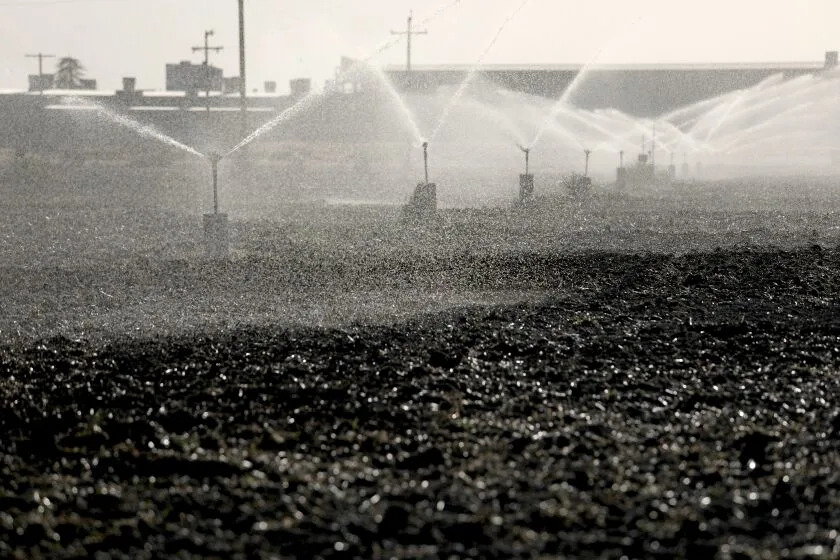
Irrigation in Kingsburg, Calif., in 2021. A deepening drought and new regulations are causing serious challenges for some California growers. (Gary Coronado / Los Angeles Times)
Downpours or drought, California’s farm belt will need to tighten up in the next two decades and grow fewer crops.
There simply won’t be enough water to sustain present irrigation in the San Joaquin Valley.
Groundwater is dangerously depleted. Wells are drying up and the land is sinking in many places, cracking canals. Surface water supplies have been cut back because of drought, and future deliveries are uncertain due to climate change and environmental regulations.
We’ve known all this for years, but long-term projections have become even more grim, according to a new study by the Public Policy Institute of California.
“We found that annual water supplies could decline by 20% by 2040,” PPIC experts wrote. That would mean around 3.2 million acre-feet — almost the amount giant Oroville Dam can hold in California’ second-largest reservoir.
For many generations, Californians have taken pride in the state’s bountiful harvests of fruits, vegetables, nuts and wine grapes. We’re envied by the nation for our production of varied foods — from avocados to almonds, from peaches to pistachios, from okra to oranges.
But by the end of this century, will agriculture still be robust?
Agriculture is water intensive. And water is becoming increasingly worrisome in the West, particularly with overuse of the Colorado River. There’s plenty of water off our coast, but we’ve only begun to dip our toe into desalination.
PPIC researchers offered a glimmer of hope for the San Joaquin Valley. With government teamwork — local, state and federal — and agriculture itself, the financial blow could be lightened, they said.
That would mean loosening the rules on farmers selling their entitled water to other growers. There’d also need to be investments in infrastructure to import additional water supplies.
But realistically all that seems iffy given California’s historic water wars. Selling water means taking it from one crop and pouring it on another. And most new supplies would come from other interests — such as farmers to the north or the coastal salmon fishing industry.
Compromising probably would require money — perhaps tax money — to pay farmers to fallow their land and governments to build new canals and repair old ones.
Growers and local irrigation districts would need to write checks.
“Locals need to have skin in the game. Everybody’s always happy to have someone else pay for their crops,” says Ellen Hanak, vice president and director of the PPIC Water Policy Center.
The PPIC found that at least 500,000 acres of San Joaquin Valley cropland will need to be fallowed in the next 20 years. The institute initially calculated that figure four years ago. But now it’s considered a best-case scenario, requiring an additional 1 million acre-feet of water.
“Needless to say, this would be a very heavy lift,” the researchers wrote.
A more likely scenario, the PPIC says, would be to expand water supplies by 500,000 acre-feet annually and wind up being forced to fallow about 650,000 acres.
But even half a million more acre-feet of water seems wishful.
The worst-case scenario would be losing 3.2 million acre-feet of water and fallowing nearly 900,000 acres, one-fifth of currently irrigated land.
Plan on it. Prepare to plant solar panels.
The biggest reason farmers face a severe water shortage is that for decades they’ve over-pumped aquifers. And government didn’t have the guts to stop them.
Finally in 2014, California became the last Western state to begin regulating groundwater use — but very slowly. By law, groundwater usage doesn’t have to become sustainable for 20 years.
Meanwhile, farmers have been drilling deeper and faster to extract water — not necessarily even their own — before they’re restricted by law.
“The real promise of the groundwater act is making sure people are not using groundwater they shouldn’t,” Hanak says. “If you use someone else’s surface water you’re going to court. But with groundwater, no one has been minding the shop.”
Gov. Gavin Newsom and water officials everywhere talk optimistically about recharging aquifers. Great idea. But first you need to find the water for recharging.
That can come from rare mega-storms, as we had in January. But there need to be facilities for moving the rampaging water and rules that permit it.
The water can be pumped onto barren land — storm or not — and allowed to sink into the ground. But a landowner must agree.
Here’s an idea: Turn barren, fallowed cropland into wetlands that recharge aquifers. Nurture wildlife. California lost 95% of its wetlands in the last century.
Climate change may also reduce available surface water.
Hotter, drier air may cause snowpacks to evaporate or soak into the mountaintops before the water can flow down into reservoirs. Or Sierra snow may melt quickly and descend in torrents so fast it can’t be captured in the Sacramento-San Joaquin River Delta.
It’s all guesswork now.
PPIC researchers also predicted increased environmental restrictions on water in an effort to protect salmon and other fish.
I wouldn’t bet on that. Farm interests tend to outmuscle fish interests.
Newsom, for example, is trying to waive environmental rules aimed at keeping juvenile salmon alive in the delta. He wants more water to be stored for farmers.
Some footnotes:
The San Joaquin Valley produces more than half of California’s agriculture. The wetter Sacramento Valley produces nearly one-fourth. Together they make up the Central Valley.
Agriculture uses 80% of California’s developed water. The rest goes to domestic use — business and residential.
But agriculture generates only about 2% of the state’s gross product, down from 5% 60 years ago. It’s 14% of the San Joaquin Valley’s gross domestic product.
Three of my solutions:
Plant fewer thirsty crops, such as almonds that have proliferated.
Expedite groundwater regulations and aquifer recharging.
Rebecca Fuoco, David Rosner and Gerald Markowitz – February 19, 2023
Ms. Fuoco is the director of science communications at the Green Science Policy Institute. Dr. Rosner is a professor of sociomedical sciences and history at Columbia. Dr. Markowitz is a history professor at John Jay College of Criminal Justice.
A black plume and flames rise over East Palestine, Ohio, from a controlled burn of chemicals carried by a derailed train.Credit…Gene J. Puskar/Associated Press
Like a scene out of some postapocalyptic movie, Gov. Mike DeWine of Ohio convened a news conference on Feb. 5 to deliver a stark warning. “We are ordering them to leave,” he said of residents of the small rural community of East Palestine, Ohio, and a neighboring part of Pennsylvania. “This is a matter of life and death.” To emphasize the point, he added: “Those in the red area are facing grave danger of death if they are still in that area.”
In this case, the “grave danger of death” was not a zombie fungus or lethal bacteria but chemicals. The red area was an area one mile by two miles surrounding the town, on the Ohio-Pennsylvania border about 40 miles northwest of Pittsburgh.
Two days earlier, it was the site of a fiery derailment of train cars carrying the gas vinyl chloride and other chemicals. Freight trains typically transport more than two million carloads of hazardous materials each year, including many chemicals. Vinyl chloride is particularly dangerous and increasingly common, used primarily to make polyvinyl chloride, better known as PVC, a hard plastic resin used to produce pipes, wire, cable coatings and packaging. We should begin phasing out the use of this chemical.
It was a particular concern in East Palestine after the derailment. Because vinyl chloride is so flammable, it created a risk of an explosion that could launch deadly shrapnel as far as a mile. To avoid such a catastrophe, railroad officials vented the vinyl chloride and burned it off.
But shrapnel wasn’t the only risk. Inhaling vinyl chloride fumes can be deadly. Even people in neighboring towns were at risk. On Feb. 10, seven days after the crash, the Environmental Protection Agency said that chemicals were “known to have been and continue to be” released to the air, surface soil and surface waters.
Residents complained last week of rashes, headaches and a lingering odor. Thousands of dead fish turned up in streams near the crash site.
Vinyl chloride is not just suspected of causing cancer. The International Agency for Research on Cancer considers it a Group 1 carcinogen known to cause liver cancer in highly exposed industrial workers. It has also been associated with brain and lung cancers, lymphoma and leukemia.
We need to stop producing and using vinyl chloride and its most important end product, PVC plastics. Increasingly, major businesses are phasing it out. Many European communities have banned or restricted its use, even as the PVC plastics industry is expanding.
The United States should begin eliminating PVC by categories of use. Legislation has been floated in California to prohibit PVC in food packaging — a ban that could be expanded to other nonessential needs. Though PVC is inexpensive, it is replaceable in most cases. Alternatives include glass, ceramics, linoleum, polyesters and more.
Also, discarded PVC should be labeled a hazardous waste. The designation would put the burden on users for its safe storage, transportation and disposal, creating an incentive to accelerate its elimination. The E.P.A. tentatively rejected such an action in January but is still accepting public comment on the proposal.
You might wonder why such a hazardous chemical, among others, is being transported along American railways and through our communities. It’s because vinyl chloride is one of the most produced petrochemicals in the world. Tens of millions of tons of it are manufactured annually. (It was used as an aerosol propellant in household consumer products like hair spray until it was banned in aerosols by the Consumer Product Safety Commission in 1974.)
Vinyl chloride manufacturers laid the groundwork for the chemical’s proliferation decades ago with cover-ups and disinformation campaigns. Their own research showed that exposure led to deadly cancers in rodents. Numerous studies have found that workers regularly exposed to the chemical during the 1970s developed malignant liver cancers at very high rates. Chemical companies knew early on they were unleashing a dangerous substance into the world.
The extraordinary efforts of the chemical industry to continue selling products it knew were harmful were recounted by two of us in our 2002 book “Deceit and Denial.”
In addition to the manufacturing and transportation risks of vinyl chloride, PVC plastics can release endocrine-disrupting phthalates, used to soften PVC, and cancer-causing dioxins into air and water during much of their life cycle.
Many of the vinyl chloride and PVC production facilities are clustered with other petrochemical facilities along an 85-mile stretch of the Mississippi River in Louisiana between Baton Rouge and New Orleans known as Cancer Alley. People in one town in the area, most of whom are Black, are about 50 times as likely to develop cancer as the average American. They face the constant threat of chemical accidents.
The PVC plastics industry is expanding in other parts of the country. Growing plastics hubs in Ohio, Pennsylvania and West Virginia could become new cancer alleys.
As long as PVC production continues, the risk of vinyl chloride spills will persist. Worse, more workers and communities will be exposed to the ticking time bombs of cancer and other severe health harms.