Here’s the biggest hurdle facing America’s EV revolution
Shannon Osaka – April 13, 2023
A curbside PlugNYC Flo electric vehicle (EV) charger near Central Park West in New York, US, on Wednesday, Aug. 31, 2022. (Jeenah Moon/Bloomberg)
The Biden administration just unveiled some of the most aggressive auto climate rules in the world – the latest step for an administration that has gone all-in on EVs. But America’s EV transition could soon stumble: not because of high car costs or a lack of automaker support, but thanks to the country’s broken and dysfunctional public charging system.
Most electric vehicle drivers charge their vehicles at home. But as Americans buy EVs – to the tune of 7 percent of all new vehicle registrations in January – more and more people are finding that the public charging system is unreliable, inconvenient and simply confusing.
“I’ve seen people wait because there are only four chargers and two of them are out of service,” said Bill Ferro, the founder of EVSession, a software firm that tracks charger reliability. “Everything that I’ve seen shows that it’s driving away current and potential EV owners.”
Drivers might show up at a DC-fast charging station – which can fill a vehicle’s battery by 80 percent in about 20 minutes – to find that most of the chargers are broken. Or one might work, but only if the driver installs a particular app on their phone, creates an account, and loads money onto it.
Last year, in a preprint study conducted by researchers at the University of California, Berkeley, and the nonprofit Cool the Earth, researchers tested every single fast charging station in the San Francisco Bay Area. They found that more than a quarter of the 657 charging points didn’t function during a 2-minute charging test. Sometimes the charging cable couldn’t reach the vehicle’s charging port; other times the payment system wouldn’t work; sometimes the charger’s screen was broken or the network was down.
Some of the chargers had the option to pay by 1-800 number – but Carleen Cullen, the executive director of Cool the Earth and one of the authors of the study, said that’s not a good solution. “If we want mass market adoption, people are going to want to pay and move along and charge their vehicles,” she said.
Another survey, from the group J.D. Power and Associates, found that one in five EV owners who had recently visited a station where unable to charge – largely due to a system malfunction.
Tesla’s proprietary charging network usually gets the highest ratings from users. But the vast majority of stations are only open to Tesla drivers. The company has agreed to open a small fraction of its stations to non-Tesla drivers by 2024, beginning now with a few select locations around the country.
Ferro, who drives an electric vehicle himself, frequently has to take road trips of around 300 miles. He ended up buying a Tesla Model 3 largely to make use of the reliable charging network. “On any other network, I wouldn’t have trusted it,” he explained.
But there’s more to the problem than that. The decentralized nature of American charging is also confusing early adopters and turning off potential EV drivers. Public charging is currently managed by a hodgepodge of private companies, utilities, government spending, and automakers. There are private companies – like Electrify America, EVgo, or ChargePoint – which each have their own machines and ways of paying for charging. (A typical EV driver may have as many as eight phone apps and several RFID cards to manage all the possible chargers on the road.)
Then there are automakers, like Tesla or Rivian, that establish their own networks tailor-made for those who buy their products. Utilities are also trying to get into the game, building up their own fast-charging networks in states like Minnesota. The result is a mess for drivers who simply want to plug in – and a logistical nightmare for regulators.
“There are so many different players in this, and they all need to be singing the same song,” said Cullen.
There have been attempts to regulate chargers’ “uptime,” or the amount of time that they are functioning properly. The Biden administration has established rules for the $5 billion in funding for public chargers in the infrastructure bill, ordering that they have at least a 97 percent uptime and are accessible via a single payment method. But the federal rules also allow networks to self-report how often their chargers work – a decision that Ferro finds troubling. “It’s letting the fox in the henhouse,” he said.
And that’s only for the chargers that will receive federal funding; the vast majority of stations will not.
Unless the United States sorts out its public charging infrastructure, it’s hard to imagine EV sales growing as quickly as the Biden administration wants. The strictest version of the rules the Environmental Protection Agency proposed Wednesday would require a whopping two-thirds of all new passenger vehicle sales to be electric by 2032.
New federal subsidies, offered under the Inflation Reduction Act, are making electric vehicles more accessible to Americans. More EV drivers means more pressure on the existing malfunctioning stations, as well as more drivers who live in apartments or don’t have easy access to home charging.
While early adopters and EV enthusiasts might be happy to build in multiple contingency plans, mainstream EV adoption is going to require a more streamlined system. U.S. public charging also lags far behind other countries: According to S&P Global, China has 1.2 million charging points, Europe has 400,000 – and the United States only has 140,000.
“We’re not yet to the mass market phase,” said Ferro. “And if the infrastructure isn’t there, it will put a damper on everybody’s plans.”
18,000 cows killed in explosion, fire at Texas dairy farm may be largest cattle killing ever
Rick Jervis, USA TODAY – April 12, 2023
The fire spread quickly through the holding pens, where thousands of dairy cows crowded together waiting to be milked, trapped in deadly confines.
After subduing the fire at the west Texas dairy farm Monday evening, officials were stunned at the scale of livestock death left behind: 18,000 head of cattle perished in the fire at the South Fork Dairy farm near Dimmitt, Texas – or nearly three times the number of cattle led to slaughter each day across the U.S.
A dairy farm worker rescued from inside the structure was taken to an area hospital and was in critical but stable condition as of Tuesday. There were no other human casualties.
“It’s mind-boggling,” Dimmitt Mayor Roger Malone said of the number of bovine deaths. “I don’t think it’s ever happened before around here. It’s a real tragedy.”
The Castro County Sheriff’s Office was among several agencies to respond to a fire and explosion at a dairy farm near Dimmitt on Monday.
It was the biggest single-incident death of cattle in the country since the Animal Welfare Institute, a Washington-based animal advocacy group, began tracking barn and farm fires in 2013.
That easily surpassed the previous high: a 2020 fire at an upstate New York dairy farm that consumed around 400 cows, said Allie Granger, a policy associate at the institute.
“This is the deadliest fire involving cattle we know of,” she said of the Texas incident. “In the past, we have seen fires involving several hundred cows at a time, but nothing anything near this level of mortality.”
Where was the Texas cattle fire?
Castro County, where the fire occurred, is open prairie land dotted with dairy farms and cattle ranches, about 70 miles southwest of Amarillo.
Pictures posted on social media by bystanders showed the large plume of black smoke lifting from the farm fire, as well as charred cows that were saved from the structure.
What caused the dairy farm explosion?
A malfunction in a piece of equipment at the South Fork Dairy farm may have caused an explosion that led to the fire, said County Judge Mandy Gfeller, the county’s top executive. Texas fire officials are still investigating the exact cause, she said.
Malone, the mayor, said he wasn’t aware of any previous fires reported at the facility. He said the dairy had opened in the area just over three years ago and employed between 50 to 60 people.
The owners of South Fork Dairy couldn’t be reached for comment.
How many cows were killed in the dairy fire?
Most of the perished animals – a mix of Holstein and Jersey cows – were in a large holding pen before being milked, she said. The 18,000 cows represented about 90% of the farm’s total herd.
With each cow valued roughly at around $2,000, the company’s losses in livestock could stretch into the tens of millions of dollars, Gfeller said. That doesn’t include equipment and structure loss.
“You’re looking at a devastating loss,” she said. “My heart goes out to each person involved in that operation.”
How did the Texas dairy compare with the rest of the country?
Cattle stranded in a flooded pasture in La Grange, Texas, after Hurricane Harvey in 2017. The storm drowned thousands of cattle in southeast Texas.
Texas ranks fourth nationally in milk production, home to 319 Grade A dairies with an estimated 625,000 cows producing almost 16.5 billion pounds of milk a year, according to the Texas Association of Dairymen, a trade group.
And Castro County is the second-highest producing county in Texas, with 15 dairies producing 148,000 pounds of milk a month, according to the U.S. Department of Agriculture.
Even by Texas standards, South Fork Dairy was a behemoth. Its 18,000 cattle made it nearly 10 times larger than the average dairy herd in Texas.
It’s not the first time large numbers of Texas cattle have died, but rarely do so many perish from a single fire. A blizzard in December 2015killed off around 20,000 cattle across the Texas panhandle, according to the Texas Association of Dairymen.
And Hurricane Harvey in 2017 drowned thousands more in Southeast Texas, leading to $93 million in livestock losses across the state, according to Texas A&M AgriLife Extension Service.
What happens next?
Now, state and dairy officials are turning to the massive, messy task of cleaning up 18,000 charred cow carcasses. On its website, the Texas Commission on Environmental Quality lists several rules for onsite burial of carcasses, including burying the animal at least 50 feet from the nearest well and recording GPS coordinates of the site. Nowhere does it mention mass graves, however.
TCEQ and the AgriLife Extension Service are teaming up to assist in the clean up effort, officials said.
Malone, Dimmitt’s mayor, said he’s taken emergency management courses that teach how to dispose of animal carcasses after a disaster, just not at this scale.
“How do you dispose of 18,000 carcasses?” he said. “That’s something you just don’t run into very much.”
Study warns critical ocean current is nearing ‘collapse.’ That would be a global disaster.
Doyle Rice, USA Today – April 11, 2023
Due to global warming, a deep ocean current around Antarctica that has been relatively stable for thousands of years could head for “collapse” over the next few decades.
Such a sudden shift could affect the planet’s climate and marine ecosystems for centuries to come.
So says a recent study that was published in the peer-reviewed journal Nature.
The cold water that sinks near Antarctica drives the deepest flow of a network of currents that spans throughout the world’s oceans, known as the overturning circulation. The overturning carries heat, carbon, oxygen and nutrients around the globe.
This in turn influences climate, sea level and the productivity of marine ecosystems. Indeed, the loss of nutrient-rich seawater near the surface could damage fisheries, according to the study.
‘Headed towards collapse’
This deep ocean current has remained in a relatively stable state for thousands of years, but with increasing greenhouse gas emissions and the melting of Antarctic ice, Antarctic overturning is predicted to slow down significantly over the next few decades.
“Our modeling shows that if global carbon emissions continue at the current rate, then the Antarctic overturning will slow by more than 40% in the next 30 years – and on a trajectory that looks headed towards collapse,” said study lead author Matthew England of the University of New South Wales in Australia.
Speaking about the new research, paleoclimatologist Alan Mix told Reuters “that’s stunning to see that happen so quickly.” Mix, a paleoclimatologist at Oregon State University and co-author on the latest Intergovernmental Panel on Climate Change assessments, who was not involved in the study, added “It appears to be kicking into gear right now. That’s headline news.”
Such a collapse would also impact a nearby Atlantic Ocean current, known as the Atlantic Meridional Overturning Circulation, or AMOC, which transports warm, salty water from the tropics northward at the ocean surface and cold water southward at the ocean bottom.
This current includes the well-known Gulf Stream, which affects weather patterns in the U.S. and Europe. “The main issue for the AMOC at the moment is meltwater from Greenland, which slows that current,” England told USA TODAY.
Other studies in recent years about the AMOC drew comparisons to the scientifically inaccurate 2004 disaster movie “The Day After Tomorrow,” which used such an ocean current shutdown as the premise of the film. In a 2018 study, authors said a collapse was at least decades away but would be a catastrophe.
An Antarctic “tidewater” glacier meets the ocean in this 2018 photo that also shows sea ice floating on the water’s surface.
Cause of the current slowdown
What’s causing the currents to slow down and potentially collapse? “Climate change is to blame,” England wrote for the Conversation. “As Antarctica melts, more freshwater flows into the oceans. This disrupts the sinking of cold, salty, oxygen-rich water to the bottom of the ocean”.
Specifically, more than 250 trillion tons of that cold, salty, oxygen-rich water sinks near Antarctica each year. This water then spreads northward and carries oxygen into the deep Indian, Pacific and Atlantic Oceans.
“If the oceans had lungs, this would be one of them,” England said.
“Simply put, a slowing or collapse of the overturning circulation would change our climate and marine environment in profound and potentially irreversible ways.” he wrote.
England told USA TODAY that the main impact for North America would be sea-level rise along the East Coast.
In addition, another impact of the collapse of the AMOC would be a transition to a more La Nina-like-state in the Pacific Ocean, England said. La Niña, a natural cooling of sea water in the tropical Pacific Ocean, affects weather and climate in the U.S. and around the world.
It tends to lead to worsening droughts and wildfires in the Southwest U.S., and more hurricanes in the Atlantic Ocean.
What can be done?
“Our study shows continuing ice melt will not only raise sea levels, but also change the massive overturning circulation currents which can drive further ice melt and hence more sea-level rise, and damage climate and ecosystems worldwide,” England wrote in the Conversation. “It’s yet another reason to address the climate crisis – and fast.”
How Russia’s large-scale war efforts have warped the country’s economy, according to top scholars
Morgan Chittum – April 11, 2023
Russian President Vladimir Putin.Contributor/Getty Images
Russia’s economy is adjusting to the sanctions imposed on it after Moscow began its war on Ukraine.
As a result, the country has lost the largest markets for its exports.
The shrinking market for Russia’s resources will force the Kremlin to cut spending on infrastructure and social programs.
Russia’s economy has been transformed in nearly ever way since Vladimir Putin launched his war on Ukraine last year.
While the World Bank sees a smaller contraction than expected, and the International Monetary Fund forecasted some growth in 2023, top scholars outlined how the country has adjusted to the Western sanctions imposed on it since the invasion.
For example, Russia has lost its largest export markets, reducing its bargaining power. So Russia is selling its crude to a “truncated” market for around $50 per barrel, or just half of its breakeven price, Wharton Business School professor Philip Nichols told Insider.
“Russia is able to make up the difference by drawing on the foreign currency reserves in its National Wealth Fund, but those reserves are shrinking,” he said.
Eventually, the smaller market for Russia’s resources will force the Kremlin to cut spending on infrastructure and social programs, Nichols added.
Meanwhile, Russia has had to search for substitutions to trading partners that the Kremlin deems as “unfriendly countries,” which represent over 50% of the global economy, per a report from Finland’s central bank.
As a result of deteriorating relationships with other countries, Russia is orienting towards partners that did not impose sanctions like China and Turkey.
To trade with them, Russia must build more infrastructure, such as oil pipelines, to minimize exposure to the West, said Boston College’s Aleksandar Tomic.
“However, the war in Ukraine is definitely imposing costs on Russia, and there must be realignment to support the effort which is not likely to end any time soon,” he added.
And car imports from China have increased as Russian auto manufacturing collapsed, Tania Babina, a business professor at the Columbia Business School, told Insider.
Finally, airlines, pharmaceuticals, and industries that require “sophisticated materials” have been hit hard too, Nichols said.
This is due to highly skilled workers fleeing the country, resulting in less productivity. Also, these industries rely on sophisticated machinery, which need a continued supply of replacement parts that are now harder to obtain because of sanctions.
“This cannot be turned around in a short period of time; the Russian economy is going to feel the effects of this downgrade for a long time,” said Nichols.
Sea levels rising rapidly in southern U.S., study finds
Ben Adler, Senior Editor – April 10, 2023
Damage after Hurricane Ian Bonita Springs, Fla., Sept. 29, 2022. (Sean Rayford/Getty Images)
A study published Monday finds sea-level rise along the coast of the southeastern United States has accelerated rapidly since 2010, raising fears that tens of millions of Americans’ homes in cities across the South will be at risk from flooding in the decades to come.
“It’s a window into the future,” Sönke Dangendorf, an assistant professor of river-coastal science and engineering at Tulane University, who co-authored the study that appeared in Nature Communications, told the Washington Post.
That paper and another published last month in the Journal of Climate find that sea levels along the Gulf Coast and the southern Atlantic Coast have risen an average of 1 centimeter per year since 2010. That translates to nearly 5 inches over the last 12 years, and it is about double the rate of average global sea-level rise during the same time period.
The Journal of Climate study found that the hurricanes that have recently hammered the Gulf Coast, including Michael in 2018 and Ian — which was blamed in the deaths of 109 Floridians last year — had a more severe impact because of higher sea levels.
“It turns out that the water level associated with Hurricane Ian was the highest on record due to the combined effect of sea-level rise and storm surge,” Jianjun Yin, a climate scientist at the University of Arizona and the author of the Journal of Climate study, told the Post.
Residents of Houston evacuate their homes after the area was flooded from Hurricane Harvey, Aug. 28, 2017. (Joe Raedle/Getty Images)
Data from the National Oceanic and Atmospheric Administration (NOAA) show the water level at Lake Pontchartrain, an estuary bordering New Orleans, is eight inches higher than it was in 2006. Other cities threatened by rising oceans in the region include Houston, Miami and Mobile, Ala.
The centimeter-per-year rate is far faster than experts had expected, and it is more in line with projections made for the end of the century, Dagendorf said. High-tide flooding — when the tides bring water onto normally dry land on rain-free days — has more than doubled on the Gulf Coast and Southeast coast since the beginning of this century, according to NOAA. Recent years have seen records for high-tide flooding obliterated. The city of Bay St. Louis, Miss., went from three days of high-tide flooding in 2000 to 22 days in 2020.
A study by scientists with the University of Miami, NOAA, NASA and other institutions, which has not yet undergone peer review, found that the Southeastern sea-level rise accounted for “30%-50% of flood days in 2015-2020.”
“In low-lying coastal regions, an increase of even a few centimeters in the background sea level can break the regional flooding thresholds and lead to coastal inundation,” the study said.
Miami and New Orleans face greater sea-level threat than already feared
Richard Luscombe – April 10, 2023
Photograph: Wilfredo Lee/AP
Coastal cities in the southern US, including Miami, Houston and New Orleans, are in even greater peril from sea-level rise than scientists already feared, according to new analysis.
What experts are calling a dramatic surge in ocean levels has taken place along the US south-eastern and Gulf of Mexico coastline since 2010, one study suggests, an increase of almost 5in (12.7cm).
That “burst”, more than double the global average of 0.17in (0.44cm) per year, is fueling ever more powerful cyclones, including Hurricane Ian, which struck Florida in September and caused more than $113bn of damage – the state’s costliest natural disaster and the third most expensive storm in US history, according to the National Oceanic and Atmospheric Administration (Noaa).
The University of Arizona study, published in the Journal of Climate and reported on Monday by the Washington Post, provides an alarming new assessment of a key ingredient of the escalating climate emergency, particularly in popular but vulnerable areas of the US where millions of people live.
Existing projections by Nasa show a sea-level rise up to 12in (30cm) by the middle of the century, with longer-range forecasts even more dire.
The Gulf region from Texas to Florida, and southern Atlantic seaboard will see most of the change, the agency says.
“The entire south-east coast and the Gulf Coast is feeling the impact of the sea-level rise acceleration,” the study’s author Jianjun Yin, professor of geosciences at the University of Arizona, told the Post.
“It turns out that the water level associated with Hurricane Ian was the highest on record due to the combined effect of sea-level rise and storm surge.”
The threat from rising oceans hangs over numerous centers of heavy population located on, or close to the coast. Miami, and Miami Beach, cities often cited as ground zero for the climate emergency, frequently see flooding during high tides. Property insurance rates throughout Florida, which Noaa says has experienced more than 40% of all US hurricane strikes, have soared in recent years.
Earlier this month, the Guardian carried an extract from a new book about how Charleston, South Carolina, is facing a “perfect storm” of rising sea levels and racism that leaves the city, in the view of many observers, living on borrowed time.
“What is likely to happen in Charleston is likely, absent a substantial shift in attitude, to happen in many other coastal cities around the globe,” wrote Susan Crawford, author of Charleston: Race, Water, and the Coming Storm.
The Post reported on a second study, published on Monday on nature.com, effectively mirroring the finding of the Arizona analysis that an “acceleration” of sea-level rise was under way.
Researchers at Tulane University, New Orleans, also note that the increase in the Gulf and south-eastern region is greater than the global average, a surge of greater than 0.4in per year they say is “unprecedented in at least 120 years”.
The study, which says the rise is “amplified by internal climate variabilities”, cites storms such as Katrina, and Hurricane Sandy in 2012, that “illustrate that any further increases in the rate of MSL [mean sea-level] rise, particularly rapid ones, threaten the national security of the US and hamper timely adaptation measures.”
Human activity in the Gulf region, which the researchers refer to as “vertical land motion” (VLM), has played a role, the study continues.
“It is well known that tide gauges in the Gulf of Mexico are subject to significant nonlinear VLM, likely related to oil, gas, or groundwater withdrawal. These nonlinear changes appear predominantly along the western portions of the US Gulf coast (Louisiana and Texas),” it says.
Fed Up With Mayhem, Miami Beach Wants to Tame Spring Break for Good
Patricia Mazzei – April 9, 2023
From left, Chandler Robinson, Sam Fisher and Alexis Illes play slam ball on South Beach in Miami Beach, Fla. on Friday, March 31, 2023, while vacationing from Orlando, Fla. (Scott McIntyre/The New York Times)
MIAMI BEACH — After two fatal shootings on Ocean Drive over a March weekend, Miami Beach leaders followed their recent playbook for dealing with raucous spring break crowds: a state of emergency, a midnight curfew and limited liquor sales.
Then, in a new and drastic step, the city commissioners announced a curfew for 2024, a full year in advance, and declared spring break on the sun-kissed streets of Miami Beach to be over.
“Miami Beach is shutting the door on spring break, once and for all,” Alex Fernandez, a city commissioner who sponsored a series of 2024 measures, said before the vote.
The decision, in the middle of the March and April season that is the most profitable time of the year for local businesses, has caused both relief and consternation over the possible loss of the throngs of visitors that have grown to overwhelm the city’s police and other public services — and of the money that those visitors spend on hotel rooms, nightclub cover charges and boozy cocktails.
Miami Beach both loves and hates its tourists, a conflicting sentiment that has long plagued officials as the city has evolved from a cocaine cowboy den in the 1980s to a high-fashion Riviera in the 1990s to what it is today: a glittering playground for affluent families making a home, foreigners chasing the sun and young American visitors who come looking for a good time. Some people, including the city’s mayor, want the partyers gone for good.
If Miami Beach is to be rebranded as less of a spring break destination and more of an arts, culture and health and wellness hub, some owners of bars, nightclubs and liquor stores worry that they will lose business. And some residents and officials fear losing the diversity and laid-back vibe that make Miami Beach Miami Beach.
“What we’re seeing is panic-stricken politicians who feel the need to do something,” Ricky Arriola, a city commissioner who voted against the 2024 curfew, said in an interview. “The heavy hand of government is being imposed on residents, our visitors and businesses, rather than doing the hard work of coming up with really strategic alternatives.”
Similar frictions between residents and visitors have afflicted other popular Florida spring break locales like Panama City Beach. Over time, Fort Lauderdale and other cities have pushed spring breakers out, in part by raising hotel rates and changing zoning laws to turn dive bars into more upscale establishments.
Miami Beach has been wrestling with its reputation as a party town. A judge recently upheld an ordinance imposing a partial 2 a.m. cutoff on alcohol sales for a South Beach neighborhood known as South of Fifth, now full of glimmering condos. The law had been challenged by Story, a nightclub that argued it could not survive if it could no longer sell alcohol until 5 a.m.
Patience has worn thin as spring break revelers, often partying with alcohol or drugs, have packed a roughly 10-block stretch of South Beach along the Atlantic oceanfront each season, leading to unpredictable situations that sometimes turn violent because so many people have guns, according to city leaders, police officers and business owners.
The two deadly incidents this year took place over the St. Patrick’s Day weekend, typically one of the busiest of the season. After the second, the city briefly imposed a midnight curfew.
Last year, two shootings on Ocean Drive led the city to set a midnight curfew. In 2021, Miami Beach made headlines when, in the middle of the coronavirus pandemic, the city marketed itself to visitors even though many nightclubs remained closed, leading to raucous street parties. Officials responded that year by imposing an 8 p.m. curfew.
The rowdy behavior in the streets and the curfews that result have hurt businesses year after year, said Joshua Wallack, the chief operating officer of Mango’s Tropical Cafe, an Ocean Drive institution for more than 30 years.
“When they go from a dangerous situation to complete lockdown, there is no business,” he said. “We’re just caught in the wake of how they handle it. The service industry and the hospitality industry, they get completely obliterated because it goes from having complete chaos to nothing.”
In the past, civil rights activists have complained about the city police department’s use of military-style vehicles, pepper balls and forceful crowd control tactics during spring break, which attracts many Black visitors to a city whose resident population is largely white. Glendon Hall, chair of the Miami Beach Black Affairs Advisory Committee, which was created two years ago, was embedded with police officers and the city’s “goodwill ambassadors” during spring break last month. He said in a statement that was read at a meeting Tuesday that he was pleased with how law enforcement handled the “massive crowds” this year and that there had been no major complaints from civil rights groups.
The Miami Beach Police Department made 573 arrests in March, a slight drop from 615 arrests in March 2022, according to Officer Ernesto Rodriguez, a department spokesperson. Police officers seized more than 100 guns this year, he added.
Despite the headlines about shootings and curfews, families, couples and small gaggles of friends strolled down the sidewalks of Ocean Drive on a Friday afternoon late last month. Marcus Benjamin, a 19-year-old college student from Chicago, said the city’s emergency measures had “not at all” affected his trip with two of his buddies.
“I’ve seen a lot of cops on the beach,” said one of his friends, Cameron Sasser, also 19. “But it’s about the same as other years.”
Still, most everyone in city leadership seems to agree that the chaotic spring break crowds have become too much. But when it comes to what to do about them, views differ.
Mayor Dan Gelber said spring break “doesn’t fit with a city that has so many residents.”
“South Beach has bars and restaurants,” he said, “but it also has elementary schools and churches and synagogues.” Some local residents and visitors who spend lavishly often avoid the city during spring break.
Some commissioners like Fernandez have said they want to keep spring breakers but not “lawbreakers” who follow them into the city.
“The worst thing that we can do is continue doing the same thing we’ve done now for several years in a row, which is knowing that we’re going to have an overcrowding of our city and waiting until the violent situation occurs — until the death occurs — to react,” he said in an interview. “It’s better to get ahead of the situation and impose the curfew and the restrictions now.”
In 2021, Miami Beach lost in court after the Clevelander Hotel sued the city over a law setting a 2 a.m. cutoff for alcohol sales. The judge ruled that the ordinance had not been properly enacted.
Under states of emergency during past spring breaks, increased regulations yielded little success in subduing the party scene, according to commissioners like Arriola, who would prefer to bring in a big organized event in March that would allow officials to set up barricades, ticketed entry and metal detectors around Ocean Drive roughly from Fifth to 15th streets.
“At least people that are celebrating spring break in a street party on Ocean Drive could have the comfort of knowing that there wouldn’t be any weapons in that area,” he said.
After seeing crowds grow for nearly two decades at another busy time of year, Memorial Day weekend, the city began in 2017 to host the Hyundai Air & Sea Show, which features the military. The event has displaced many of the partyers who used to gather for Urban Beach Week, celebrating hip-hop.
This year, a three-day festival in March on Ocean Drive and in nearby Lummus Park drew daytime visitors and, the police department said, helped tame spring break — but only until the festival’s music and other entertainment ended around 9 p.m. each day. Both of the shootings happened later at night.
Without a major event lined up for 2024, the city appears to be considering a spring break lockdown — something Wallack said would go too far. Miami Beach should be able to offer a multitude of activities, from arts to wellness to nightlife, without having to sacrifice one for another, he argued.
“This is a city,” he said.
And anyway, he added, “Good luck trying to lock down public beaches.”
Putin’s plundered aircraft not our problem, insurance chief says
Oliver Gill – April 9, 2023
Vladimir Putin seized 500 commercial aircraft after his invasion of Ukraine – MIKHAIL KLIMENTYEV/POOL/AFP via Getty Images
Insurers will go bust if they are forced to cover the cost of Vladimir Putin’s war in Ukraine, the founder of one of the world’s biggest brokers has warned.
Mr Howden said: “The insurance market cannot be a systemic backstop for a war between the UK and Russia. And it’s not designed to be. No policies cover it.
“Otherwise, if we covered it all, it would actually end up with the Government anyway – we’d all go bankrupt.”
Russian authorities seized 500 commercial aircraft owned by overseas leasing companies shortly after the outbreak of war against Ukraine.
The owners, mostly domiciled in Ireland, have tried to claim on insurance but have been rebuffed. They are now suing Lloyd’s of London insurers for their refusal to pay out up to $10bn (£8bn) in claims. A legal showdown in the High Court is scheduled for next year.
Mr Howden said insurers are legitimately refusing to pay under the terms of certain types of cover.
He said: “Ultimately, war has never been something that insurance has been there to cover.”
If insurance policies were broad enough to cover the impact of war, it would force the Government to bail out companies “because there is not enough capital in the insurance market to pay for it,” he said.
“The insurance industry – no-one quite knows – [but it’s] four or five trillion dollars of capital. It’s small. It’s a tenth of the derivative market, for example.”
David Howden – David Rose
Howden Group has not underwritten policies itself but has deep connections within the industry as Europe’s largest broker.
The row over the “stolen” planes in Russia comes with the UK insurance sector still reeling from a public backlash to its refusal to pay claims under business interruption policies during the Covid pandemic.- ADVERTISEMENT -https://s.yimg.com/rq/darla/4-11-1/html/r-sf-flx.html
Mr Howden admitted that insurers had handled the crisis poorly.
He said: “Did we cover ourselves in glory over business interruption during the Covid pandemic? No, we didn’t. Should we respond differently? Yes, we should have.”
He said insurers were too focused on the technical detail of policies despite the extraordinary circumstances.
“When the claims come, the insurance company, rightly from a technical point of view but maybe wrongly from a PR point of view, say: ‘I’m very sorry, that’s not covered by our policy.’”
The insurance industry is currently facing a new headache over how to handle cyber insurance.
Members of Lloyd’s of London, the 335-year-old insurance market, have been angered by the institution’s insistence that all cyber policies exclude “state-backed” attacks.
Many hackers are based in countries such as Russia and North Korea. Clarifying which ones are and aren’t backed by the state can be more of an art than a science.
Lloyd’s members complain that the blanket policy is too broad and prevents them from offering coverage they would be happy to sell.
Mr Howden called the row over cyber insurance “ridiculous”. The straight-talking 59-year-old said: “The excitement over cyber is ridiculous.”
“We’re trying to be clear and we try to tell people it’s not covered, [but] suddenly – because we are bad at PR – people go: ‘Oh, my God, they are excluding war.’ It’s never been covered.”
Mr Howden suggested Lloyd’s should settle the argument by drawing up official guidance as to what constitutes a state-backed attack, which the marketplace worries would leave members open to “systematic risk.”
He said: “Most wars are easy to define. Cyber wars are more difficult to define.
“What we should have on cyber is one of the very smart GCHQ people define what is a war, and what is systemic attack. And then you could go out and separately buy from the insurance market your war coverage.”
Mr Howden started his eponymous empire in 1994 with three employees, a dog and £25,000 of funding from an angel investor. These days the company is headquartered in One Creechurch Place, a 156 metre skyscraper in the heart of the City that looks directly over onto the second floor office where it all began.
Mr Howden has created the largest insurance broker in the UK – and the biggest operator outside of the US – through a series of shrewd acquisitions, turbo-charged by private equity investment from General Atlantic and Hg Capital alongside funding from Canadian pension fund CDPQ.
Yet Howden Group is the UK’s fifth-largest employee-owned business, with 4,500 employees owning 35pc of the company.
“Employee ownership is amazing,” Mr Howden said. “We’ve built a business around people.”
The buy-in from staff has helped foster a positive culture without too much effort, he said.
“People care about people and people seem to be having fun. That’s culture. It’s like within your family or friends, it’s how you behave, how you act.”
“Anywhere where I go where they have got their culture on the wall, you know that’s not their culture. You know they are lying.”
Howden Group’s combination of employee-ownership and private investment is precisely the model now being considered by John Lewis, Britain’s biggest employee-owned business.
Mr Howden said: “We don’t have any dividends at all. All the money we make, we reinvest back in, unlike a public company that would use a lot of its capital to pay dividends.”
The long-standing executive is a refreshing counterpoint to the majority of Britain’s carefully manicured executives. Running a privately-owned business means he does not have to mince his words.
“We don’t make f****** kitchens!” he exclaims when asked about Howden Joinery, the kitchen supplier that shares the business’ name and is better known to the general public.
“They’re worth half what we’re worth. They are worth £3.6bn, we are worth £7.2bn.” (Add in Howden’s roughly £4bn in debt and the group boasts an enterprise value in excess of £11bn.)
Mr Howden laments that his business is not as well known as publicly traded peers such as L&G or Aviva.
“We’re opening more offices on the high street than anyone else. We’ve got a market cap that is more than Sainsbury’s – but no-one has heard of us!”
Howden Group’s head offices are an extension of its co-founder’s personal tastes. Life-size figures of dogs, oodles of artwork and clocks of all shapes and sizes are littered across the 14th floor of the company headquarters.
“These clocks are all Howden clocks, because we were clockmakers as well,” he explained, referencing the Victorian clockmakers who bore his family’s name.
For the insurance sector to flourish, it must shake off its stuffy past, he said. Above his office is a cafe and neon-signed bar stocked with beer and wine aplenty – more Shoreditch than Square Mile.
“We want to attract people who aren’t in insurance. We want to get really bright young kids who think they’re going to work with Google,” he said. “Don’t work for Google, come to Howden.”
Mr Howden was arguably destined for a career in insurance. After dropping out of Radley College following his O Levels, he started working at City broker Alexander Howden in 1981. The company had originally been founded by his great-great-great grandfather, though the family connection had been lost by the time he joined.
Today, he lives in Oxfordshire’s Cornbury Park estate, best known among younger generations as the venue that hosts the Wilderness music festival.
“I love life,” Mr Howden said. “I think to be good at a job, you’ve got to be good at life. I don’t think you can really just be a workaholic.”
Mobile home park residents form co-ops to save their homes
Claire Rush – April 8, 2023
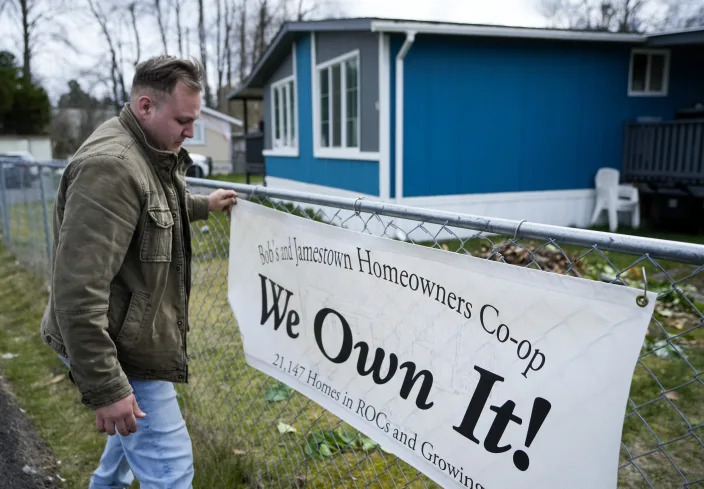
Resident and board member of the mobile home park Bob’s and Jamestown Homeowners Cooperative, Gadiel Galvez, 22, poses for a portrait in his neighborhood on Saturday, March 25, 2023, in Lakewood, Wash. When residents learned the park’s owner was looking to sell, they formed a cooperative and bought it themselves amid worries it would be redeveloped. Since becoming owners in September 2022, residents have worked together to manage and maintain the park. (AP Photo/Lindsey Wasson)Resident and board member of the mobile home park Bob’s and Jamestown Homeowners Cooperative, Gadiel Galvez, 22, takes a walk in his neighborhood on Saturday, March 25, 2023, in Lakewood, Wash. When residents learned the park’s owner was looking to sell, they formed a cooperative and bought it themselves amid worries it would be redeveloped. Since becoming owners in September 2022, residents have worked together to manage and maintain the park. (AP Photo/Lindsey Wasson)Gadiel Galvez, 22, adjusts a sign stating that his resident cooperative owns their mobile home park, Bob’s and Jamestown Homeowners Cooperative, in Lakewood, Wash., on Saturday, March 25, 2023. When residents learned the park’s owner was looking to sell, they formed a cooperative and bought it themselves amid worries it would be redeveloped. Since becoming owners in September 2022, residents have worked together to manage and maintain the park. (AP Photo/Lindsey Wasson)
PORTLAND, Ore. (AP) — When Gadiel Galvez learned that the owner of his mobile home park south of Seattle was looking to sell, he and other residents worried their largely Latino community would be bulldozed to make way for another Amazon warehouse.
So, they decided to form a cooperative and buy their park in Lakewood, Washington. With help from a nonprofit that advises communities like theirs and helps them secure loans, they bought it for $5.25 million. Since becoming owners in September, everyone’s worked to make improvements.
“Everybody thought, ‘You know what? … I’m going to make this place the best that I can,’” said Galvez, 22, who is a co-op board member. “Some people painted their homes, some people remodeled their interiors and exteriors, and some are working on their roofs.”
With rents rising at mobile home parks nationwide, advocates tout the cooperative model as a way to preserve one of the last affordable housing options for people with low- or fixed-incomes and to give them a greater voice in managing their parks.
So far these resident-owned communities are proving to be a reliable option. None of the more than 300 in the network of nonprofit ROC USA have defaulted or closed. One decided to sell back to the county housing authority it originally purchased from.
“They have a 100% track record of success, which tells you that it’s working for the residents,” said George McCarthy, president and CEO of the Lincoln Institute of Land Policy, a Cambridge, Massachusetts, think tank. “Resident ownership is an absolute bulwark against the intrusion of institutional capital in the market.”
Nearly a third of mobile home parks in the U.S. have been bought by such investors since 2015, lured by reliable cash flow and high returns from raising rents at nearly double the general rental market rate, McCarthy said.
“They’re trading on the desperation of people living in the parks,” he said. “There’s no place that they can take their homes if they can’t afford to keep paying the increasing rents.”
Park residents often own their home but rarely the land beneath it. So if a landlord raises rent, residents can be evicted or forced to sell their home. If a park is sold to be redeveloped, mobile homes that can’t be moved are demolished.
“Homelessness is really what residents are facing” if investors aggressively raise rents, said Victoria O’Banion, ROC Northwest’s marketing and acquisitions specialist.
At Rimrock Court in the central Oregon town of Madras, rent increased from $350 to $495 over five years. When the owner notified residents he planned to sell, they feared further increases — or worse, that it would be torn down to make way for apartments. So they decided to buy it.
“We were really worried about being forced out of our homes,” said Shawn King, who lives there with her husband on a fixed income and had experienced homelessness before.
To pay off the purchase loan, residents now pay $520 a month — a stretch, but one that comes with reassurance, King said.
“Just to have that peace of mind, to know that our rent is going to be locked in for awhile and not keep going up, and also knowing that our rent monies … are going back into the property, that is the cool part,” she said.
The required rent increase to go co-op was even steeper in Evergreen Village Cooperative in Mount Bethel, Pennsylvania, — from $460 a month to $750 to pay off the $12 million loan.
Still, more than two-thirds of residents voted in favor, figuring their rent would stabilize in the long run.
“We are not for profit. All the money that we get has to go back into the village and pay the mortgages off,” said Stephen Laclair, board president.
Evergreen Village has earmarked funds for improvement projects for the next decade, and this year plans to enhance the sewer plant and fix electrical issues, he said.
Co-ops can also provide social support to residents. At Liberty Landing Cooperative in Missouri, residents started a food pantry to help neighbors in need.
“If there’s a hardship, we’re willing to work with somebody. … It’s emotional when you find out that somebody’s lost their job, their child support … and they don’t know what to do,” said Kristi Peterman, the board vice president. “Our president likes to say: ‘If it doesn’t work for the poorest of us then it’s not going to work for anybody.'”
Despite the talk of better management and stronger community, most parks aren’t co-ops.
The country’s roughly 43,000 mobile home communities are home to 22 million people, according to the Manufactured Housing Institute, a national trade organization. But only about 1,000 are resident-owned, according to Carolyn Carter, deputy director at the National Consumer Law Center.
Some resistance comes from residents, many of whom are seniors and people with disabilities who may not want the responsibility of managing their park. Others argue rent control or stricter zoning regulations protecting mobile home parks from redevelopment are more effective.
“Zoning is critical. … That is what we ought to be fighting for everywhere,” said Jan Leonard, who lives in a park in Walla Walla, Washington, and worked with other residents to successfully push the city council to amend zoning codes to add mobile home parks as a land-use type.
Other residents considering buying their parks are running up against the same forces that make them popular with investors — a red-hot market and competition from private equity firms and other prospective buyers.
Sarah Marchant, vice president of Community Loan Fund, ROC USA’s New Hampshire affiliate, recalled Tara Estates, a 380-home park in Rochester. The steep $45 million asking price discouraged residents from organizing.
Another challenge is that few states provide funding for residents looking to buy their parks. The lack of grants can make it difficult for residents to finance large loans.
New Hampshire, Vermont, Rhode Island, Massachusetts, Colorado and Oregon are among states with laws that have been effective in helping residents buy their parks, the National Consumer Law Center said.
A new bill in Oregon would allocate $35 million in grants to help residents purchase their parks. Washington passed a bill last month requiring that landlords offer tenants a chance to compete to purchase their park. It also requires two years’ notice if a park will be closed, although that can be reduced if landlords financially compensate residents.
Mobile homes are “an important and affordable housing option for a lot of folks, especially older people aging in place, and we need to make sure it’s preserved,” said state Sen. Noel Frame, the Washington bill’s prime sponsor.
Some real estate groups and park owners argue the bill places an undue burden on landlords.
“If you want tenants to organize and make offers to purchase their communities … they should not wait until there’s a clock ticking,” said Robert Cochran, property manager of Contempo Mobile Home Park in Spokane.
Assisted-living homes are rejecting Medicaid and evicting seniors
Christopher Rowland, The Washington Post – April 6, 2023
Shirley Holtz paid private rates for 26 months at an assisted-living facility before qualifying for Medicaid. She lived there for another two years at the Medicaid rate before being evicted. (Family Photo)
Shirley Holtz, 91, used a walker to get around. She had dementia and was enrolled in hospice care. Despite her age and infirmity, Holtz was evicted from the assisted-living facility she called home for four years because she relied on government health insurance for low-income seniors.
Holtz was one of 15 residents told to vacate Emerald Bay Retirement Community near Green Bay, Wis., after the facility stopped accepting payment from a state-sponsored Medicaid program. And Emerald Bay is not alone. A recent spate of evictions has ousted dozens of assisted-living residents in Wisconsin who depended on Medicaid to pay their bills – an increasingly common practice, according to industry representatives.
The evictions highlight the pitfalls of the U.S. long-term care system, which is showing fractures from the pandemic just as a wave of 73 million baby boomers is hitting an age where they are likely to need more day-to-day care. About 4.4 million Americans have some form of long-term care paid for by Medicaid, the state-federal health system for the poor, a patchy safety net that industry representatives say pays facilities too little.
Residents of assisted-living facilities – promoted as a homier, more appealing alternative to nursing homes – face an especially precarious situation. While federal law protects Medicaid beneficiaries in nursing homes from eviction, the law does not protect residents of assisted-living facilities, leaving them with few options when turned out. In Wisconsin, residents who entered facilities on Medicaid, as well as those who drained their private savings after moving in and subsequently enrolled in Medicaid, have been affected.
“It’s a good illustration of how Medicaid assisted-living public policy is still in its Wild West phase, with providers doing what they choose in many cases, even though it’s unfair to consumers,” said Eric Carlson, a lawyer and director of long-term services and support advocacy at the nonprofit group Justice in Aging. “You can’t just flip in and out of these relationships and treat the people as incidental damage.”
The U.S. government does not monitor or regulate assisted-living facilities, and no federal data is available on the frequency of evictions. In Wisconsin, The Washington Post counted at least 50 since the fall based on statements by operators and nonprofit and government Medicaid agencies. But evictions have become so common that some states, including New Jersey, have enacted policies to curb them.
Emerald Bay did not explain why it stopped participating in Medicaid. But advocates, family members and the nonprofit that managed the facility’s Medicaid contract contend the motivation was financial: Medicaid reimbursement is lower than full private pay rates.
Family members said they were upset and angry. Holtz spent her entire savings paying out of pocket with the understanding that she would be permitted to stay once she qualified for low-income insurance, her relatives said. Ann Marra, Holtz’s daughter, said her mother – who worked much of her life as a professional secretary and raised her family in Algoma, a small town on Lake Michigan – deserved better treatment.
Marra feared the eviction would affect her mother’s mental health.
“It’s cruel, heartless and sad,” she said.
After a stressful search, Holtz’s family moved her on March 13 to an assisted-living facility that still honors state Medicaid. Emerald Bay’s operator, Baka Enterprises, did not respond to requests for comment.
Advocates for assisted-living residents worry that pandemic-induced economic conditions are contributing to the problem in pockets of the country. Profits in assisted-living facilities are threatened by a shortage of staff and big spikes in labor costs, inflation that is jacking up the costs of goods, and higher interest rates. Meanwhile, occupancy rates continue to lag behind pre-pandemic peaks.
The industry blames evictions on insufficient Medicaid funding. Reimbursements, made under federal waivers that allow states to spend Medicaid dollars for elderly care outside of nursing homes, are not keeping up with rising costs, industry representatives said.
“Chronic Medicaid underfunding is not sustainable and is limiting participation as well as driving many providers out of the waiver program, reducing access to care options,” said LaShuan Bethea, executive director of the National Center for Assisted Living trade group.
The gap in pay rates between Medicaid and the full amount charged to families paying out of pocket varies among states. While private pay rates are often $5,000 a month or more, Medicaid in many states pays only about $3,000 a month, said Paul Williams, vice president of government relations at Argentum, a trade association representing assisted-living facilities.
Operators “have tried to hold off [canceling Medicaid contracts] as long as they can, hoping the reimbursement will be increased to help them afford inflation factors,” Williams said. “Hope has diminished in some states of that happening, and they’re saying, ‘I cannot do this anymore.'”
In 2020, about 18 percent of 818,000 residents in U.S. assisted-living facilities were supported by Medicaid payments, according to federal data, a ratio that has remained stable for at least a decade.
In Wisconsin, at least four facilities have canceled Medicaid managed-care contracts in recent months. In addition to Emerald Bay’s 15 residents, Cedarhurst of Madison had 28 residents who were Medicaid beneficiaries when it terminated its contract last year. Residents found out they were being evicted after being called to a group meeting in late fall, said one of those told to leave, Elizabeth Burnette.
“Residents were in tears to hear they had to find another place to live,” Burnette, 80, said. “Most of us are incapacitated in some way, with walkers and in wheelchairs or mobile beds.”
Cedarhurst operates the facility, which is owned by a Massachusetts-based real estate investment trust, Diversified Healthcare Trust. Going to 100 percent private pay at the Madison site was a “tough decision” made in conjunction with Diversified Healthcare, Cedarhurst spokeswoman Christie Schrader said.
Cedarhurst became the facility’s operator in November 2021.
“When we took over management, we inherited Medicaid residents with special cases who required advanced care that we do not offer at our communities,” Schrader said. “Therefore, we believed it was in the residents’ best interest to aid them in finding alternative placement which could care for them in the way they deserve.”
The lobbying and trade group in Wisconsin that represents the long-term care industry said assisted-living operators recognize evictions are highly stressful for residents and their families.
“Not only is it traumatic for the resident and the family, it’s also traumatic for the facility. It really is,” said Rick Abrams, president and CEO of the Wisconsin Health Care Association/Wisconsin Center for Assisted Living. “This is the residents’ home. Everyone understands that.”
He said evictions usually occur when an assisted-living facility and one of the state’s nonprofit Medicaid managed-care organizations cannot agree on the monthly rates for care of an elderly person. Written notices given to residents in the recent evictions stated little about the rationale.
HarborChase of Shorewood, outside Milwaukee, had six Medicaid residents when it said it was ending its Medicaid contracts in January, according to managers of the state’s nonprofit Medicaid managed-care organizations.
“With the new year comes necessary changes,” Karin Bateman, chief operating officer of Vero Beach, Fla.-based Harbor Retirement Associates, HarborChase of Shorewood’s parent company, wrote in a three-paragraph letter to residents on Jan. 6 that informed them that the facility would no longer accept Medicaid. “Our 60-day notice of Medicaid termination gives you time to plan accordingly.”
Harbor Retirement Associates did not respond to requests for comment.
The evictions carry an especially harsh sting for residents who enter assisted-living facilities paying full rates out of pocket with the understanding that, once their nest egg has been spent down, they can remain in the facility under Medicaid. Such arrangements are common across the country and are discussed with families by marketing staff, according to elder-law attorneys and industry experts.
But facilities may have strict limits on the number of beds they designate as Medicaid-eligible, or they can back out of state Medicaid contracts completely. Such caveats may be buried in the fine print of resident agreements or are not addressed at all in the contracts, according to contract provisions in the Wisconsin cases reviewed by The Post. Families often sign such contracts in a time of stress, as they are seeking a safe place for a parent who can no longer remain in their own home.
“This is how people are getting screwed, by promises that the place will take [Wisconsin Medicaid] if they stay for two years. Then they either sell to another company, or change their minds and opt out of the program entirely, which you really can’t stop them from doing. At that point, the family has used up their funds,” said Carol Wessels, an attorney specializing in elder law in Mequon, Wis.
Family members are often left feeling betrayed.
“It’s appalling to say the least,” said Megan Brillault, whose mother, Nancy Brillault, was evicted from HarborChase of Shorewood after spending most of her $120,000 savings. “They said, ‘Here, let us take your money, all your life savings, and you can live here forever,’ and 10 months later they’re saying, ‘We miscalculated, and we are no longer taking Medicaid beds.'”
Megan Brillault provided an email to The Post in which a HarborChase representative said Nancy could transition to Medicaid after paying private-pay rates for one year. The residency contract did not address the issue, said Brillault, a lawyer.
Medicaid pays for nursing home care directly. It’s an entitlement – if a low-income person qualifies, the state must fund a nursing home bed. Medicaid pays all costs in nursing homes, including room and board, as well as care.
Assisted living is different. At those facilities, Medicaid money can be used to reimburse only the cost of care, such as bathing and dressing, and not room and board, although some states offer supplemental payments to help with rent and food.
With the overwhelming majority of residents paying privately, the median operating profit for U.S. assisted-living facilities in 2019 was 29 percent before deductions for interest and rent payments, according to the National Investment Center for Seniors Housing & Care.
Kate McEvoy, executive director of the National Association of Medicaid Directors, said states want to give elderly people options outside of nursing homes but are squeezed between restrictions on how Medicaid money can be used and the high costs of assisted living.
“This has been a challenge in what has primarily been a proprietary, market-driven model,” she said.
In the eviction notice emailed to Holtz’s family in Wisconsin, Baka Enterprises, Emerald Bay’s operator, said it had decided to terminate its contracts with the state’s Medicaid program that covers services for the elderly. It did not provide a reason, but cited a provision of its contract with residents that allowed it to discharge them if they could not afford private-pay rates and the facility did not have designated Medicaid beds.
Kris Holtz, Shirley Holtz’s son, said he was not aware of the provision when he moved his mother into Emerald Bay. Shirley Holtz paid private rates for 26 months before qualifying for Medicaid. She lived at Emerald Bay for another two years at the Medicaid rate before receiving the eviction notice, he said.
The Emerald Bay Medicaid contract was managed by a nonprofit called Lakeland Care. “In the end, Emerald Bay asked us to pay the full private-pay rate for these members, which we are unable to do as a Medicaid-funded agency,” Lakeland Care’s chief executive officer, Sara Muhlbauer, said in a written statement to The Post.
Experts say moving elderly people out of familiar surroundings can induce a condition called “transfer trauma” that accelerates decline. Shirley Holtz’s relatives detected rapid changes after the eviction, said Marra, her daughter. Her mother lost 15 pounds, she said, and quickly stopped using her walker.
On Monday, three weeks after moving out of Emerald Bay and into the new facility, Shirley Holtz died. “The move was a huge factor in her decline,” Marra said in a text.
Even as she mourned, Marra texted an expletive to describe the U.S. long-term care system, punctuated by a red-faced frown emoji. “Kinda angry right now,” she said.