Striking before-and-after satellite photos show the great California snowmelt underway

Los Angeles Times

Striking before-and-after satellite photos show the great California snowmelt underway

Terry Castleman – April 19, 2023

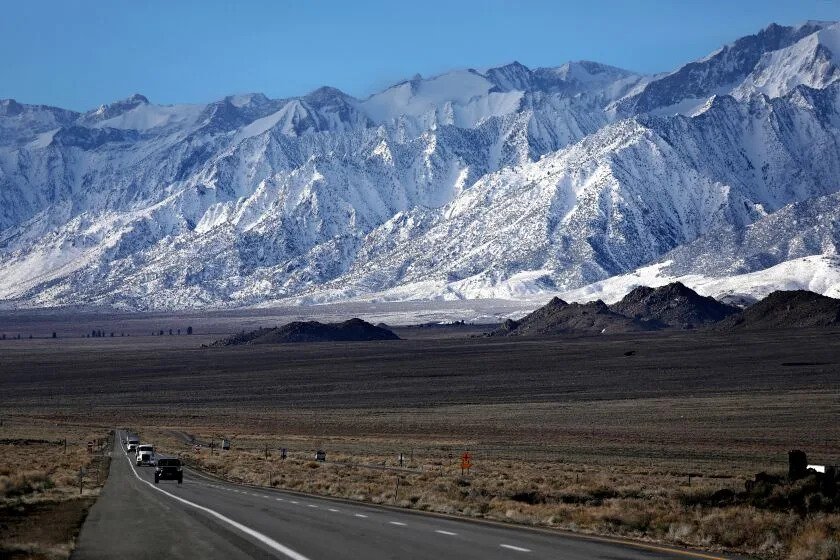
LONE PINE, CA - MARCH 22: The east side of the Sierra Nevada mountain range along HWY 395 on Wednesday, March 22, 2023 in Lone Pine, CA. Flash flooding along the eastern Sierra Nevada a week ago caused an unprecedented breach in the City of Los Angeles Department of Water and Power Los Angeles Aqueduct, as well as other damage. (Gary Coronado / Los Angeles Times)
Cars on Highway 395 along the east side of the Sierra Nevada near Lone Pine, Calif., on March 22, 2023. (Gary Coronado / Los Angeles Times)

As California’s wet winter has given way to warmer spring weather, the state’s record snowpack has begun to melt.

Though the accumulated snow still measures 249% of normal as of April 18, new satellite photos show that the white blankets enveloping mountains across the state have started to recede.

The Southern Sierra continues to be the standout region, with snow levels on slopes there at more than 300% of normal.

Satellite images seen below from NASA’s Earth Observing System Data and Information System, or EOSDIS, show the snowy Sierra on March 16 (left), and a month later (right).

While the snowpack remains substantial in the more recent image , it has dissipated significantly at lower elevations. The Mendocino Range, seen in the top left of the image, also shows significant snow loss.

In Southern California, the change has been even more dramatic.

The San Gabriel, San Bernardino and San Jacinto mountains were blanketed in snow on March 24, but by April 8 much of the snow had melted away.

Images below from a European Space Agency satellite captured the snow melt.

While the Southern California snowpacks have caused relatively little flooding as they melt, the snow in the Sierra may be a different story.

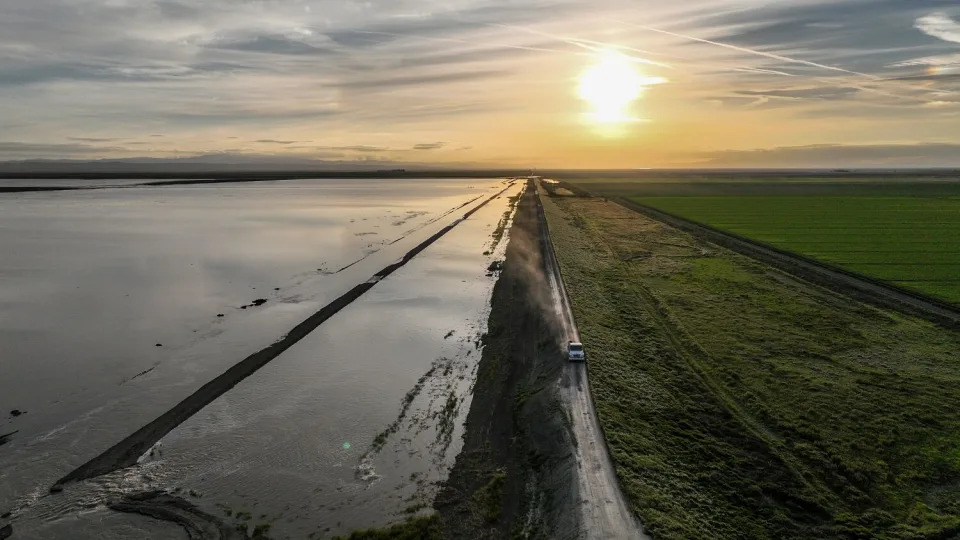
Farm equipment stands in floodwater just South of Tulare River Road.
Farm equipment stands in floodwater just South of Tulare River Road. (Robert Gauthier / Los Angeles Times)

Flood danger could last through the year in the adjacent San Joaquin Valley, officials told the Times. The valley has already endured significant flooding this year, with excessive rains wreaking havoc in small towns and fueling the renaissance of Tulare Lake.

Tulare Lake continues to rise along its northern border.
Tulare Lake continues to rise along its northern border. (Robert Gauthier / Los Angeles Times)

Typically, about a quarter of snow melt takes place in April, with the majority coming in May and June as the weather warms up.

But the remarkably wet winter means flooding could linger through much of the year, the latest outlooks show.

View from aboard a whitewater raft during a tour of the upper Kern River
View from aboard a whitewater raft during a tour of the upper Kern River in Kernville. (Jack Dolan / Los Angeles Times)

The Tulare Lake basin and the San Joaquin River basin remain the areas of top concern, as record-deep snowpack in the southern Sierra Nevada is expected to send a cascade of water down into the San Joaquin Valley as it melts.

Isabella Lake as seen from Wofford Heights.
Isabella Lake as seen from Wofford Heights on April 7, 2023. (Myung J. Chun / Los Angeles Times)

The threat comes after one of the state’s coldest, wettest winters on record. Mammoth Mountain in the Sierra received more than 700 inches of fresh powder this season, and there is now more water contained in the state’s snowpack than the capacity of Lake Mead, the nation’s largest reservoir.

Though most of the focus is on the Central Valley, officials in L.A. are also keeping an eye on on spring and summer flooding as it could cause additional damage to the Los Angeles Aqueduct.

The aqueduct, which delivers water from the Owens Valley to millions of Angelenos, has already suffered damage from this winter’s storms.

Times Staff Writer Hayley Smith contributed to this report.

I Lost My House in the Fort Lauderdale Flood While Ron DeSantis Campaigned in New Hampshire

Daily Beast

I Lost My House in the Fort Lauderdale Flood While Ron DeSantis Campaigned in New Hampshire

Elijah Manley – April 18, 2023

Photo Illustration by Kelly Caminero / The Daily Beast / Getty

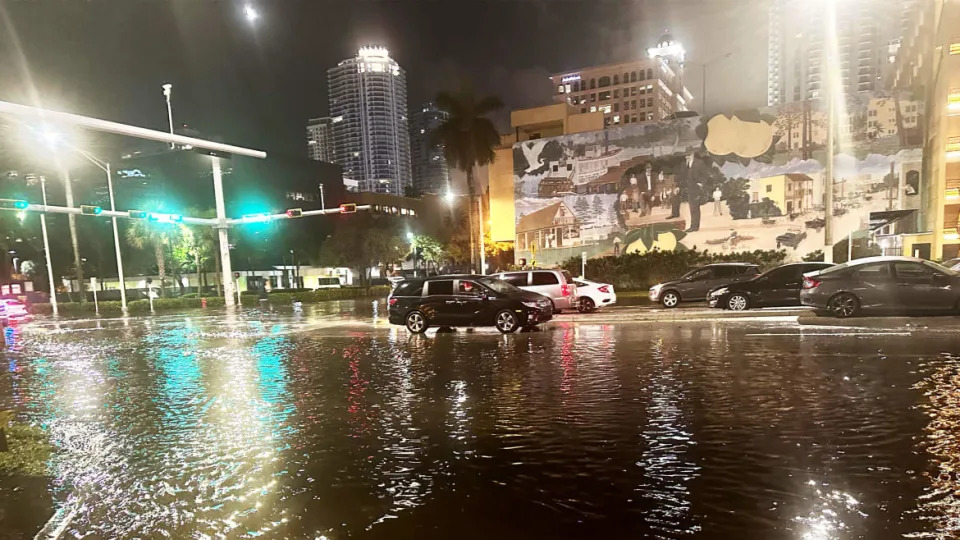
Fort Lauderdale last week was inundated with a historic downpour that caused massive floods and catastrophic property damage, upending the lives of thousands of people. According to experts and meteorologists such as Dan DePodwin of AccuWeather, this level of rain was so historic and rare that it is expected to only occur once every thousand years. Some areas saw over 25 inches of rain.

Cars and trucks floated through the city, and artery roads were turned into rivers that can only be passed by swimming through them. Many residents lost their homes, their vehicles, and their every material possession.

I know all this to be true because my family experienced it all.

Ron DeSantis May Fall Into His Own Abortion Trap

As I was heading home last Wednesday night, I got a frightening text. It was from my mom, telling me not to come home. “You can’t come home. Water is everywhere, inside and outside. We’re flooded.”

Though it was pouring, I wasn’t gravely concerned. “It’s just a little water,” I thought to myself. I was wrong.

I would have no home to return to that night, but I would swim through two feet of water across the city just to sleep on the ground downtown. When the waters receded days later, I came back to what had been my home to find all my belongings destroyed and the interior of the house flooded.

<div class="inline-image__credit">Elijah Manley</div>
Elijah Manley

Pictures, clothes, books, everything: gone. They’re irreplaceable. Everything I spent my life building was gone in one night. It’s like the memory of your identity has been wiped away. I couldn’t help but feel destroyed inside knowing that everything I had to my name is gone. It takes me back to a time in my childhood when my family was homeless. During that time, it was difficult maintaining all of our belongings.

And as I and countless others were experiencing this tragedy, our governor was in other states, far away, hawking his book and hyping up donors for a likely presidential run. In a time of historic crisis, the leader of our state’s government went AWOL.

It was only a few years ago when another Florida Republican governor, Rick Scott, traveled to areas affected by other natural disasters. He’d put partisanship aside and advocate for emergency aid to support affected communities. “We can rebuild homes. We can rebuild businesses. We cannot rebuild your life,” Scott said.

Our current governor, Ron DeSantis, is no Rick Scott.

<div class="inline-image__credit">Elijah Manley</div>
Elijah Manley

While our local mayors, city commissioners, and emergency management personnel were on the ground immediately working to address the crisis, Gov. DeSantis didn’t even have the time to call Fort Lauderdale Mayor Dean Trantalis to offer his support.

This angers me beyond words. I’m not rich. My family is working class, and we have been blue-collar all our lives. It hurts my heart to know that my governor couldn’t make time to visit my city, witness our suffering, and demonstrate leadership. He could have promised swift and aggressive relief, pledged to help us rebuild, and looked into our eyes and let us know some things are more important than politics. But he didn’t.

<div class="inline-image__credit">Elijah Manley</div>
Elijah Manley

Some DeSantis supporters have argued that his book tour and speaking engagements were planned in advance, while these floods could not have been predicted. That excuse might work for a day. Once it became clear there was a catastrophe back home, he could (and should) have hopped on the first jet back to Florida.

Instead, he continued his journey across the country to three states, including the early primary state of New Hampshire.

Yes, you read that correctly: while a major city in the governor’s home state was underwater, Ron DeSantis continued to sell books and campaign across the country.

Ron DeSantis Isn’t a Tough Guy. He’s Just Another Cowardly Bully.

When he did fly back, it was in the middle of the night for a quick stop at the state Capitol to sign the six-week abortion ban. Then he left again, making no stops in Fort Lauderdale or affected areas. (His campaign and office staff did muster up the energy to attack critics on social media and lambaste the media for pointing out his absence.)

This isn’t about partisanship, this is about responsibility. I have levied the same criticism at President Joe Biden for not visiting East Palestine, Ohio, after the catastrophic train derailment that devastated the working-class region.

If Ron DeSantis is more interested in running for president than being the governor we deserve in difficult times, then he must resign immediately. When we lost everything, our governor was absent. If DeSantis can’t demonstrate basic humanity and offer effective leadership during an emergency as governor, how can we expect him to handle larger crises as president? We shouldn’t.

Tiny homes tucked into Boise neighborhoods? This pilot project will test the idea

Idaho Statesman

Tiny homes tucked into Boise neighborhoods? This pilot project will test the idea

Angela Palermo – April 17, 2023

The city of Boise is working on a tiny home pilot project to study its potential impact on housing affordability.

The program aims to assist selected residents in placing six movable tiny homes on land across various neighborhoods within city limits for a temporary period of time. City code currently does not allow for movable tiny homes.

The pilot project will allow approved applicants to be the first to test the concept.

“The idea was that we need more housing that’s affordable to folks on a Boise budget,” Kyle Patterson, director of innovation and performance at the city, told the Idaho Statesman by phone. “Meanwhile, things like tiny homes and small-footprint living are in high demand these days, but not something that’s allowed within city limits.”

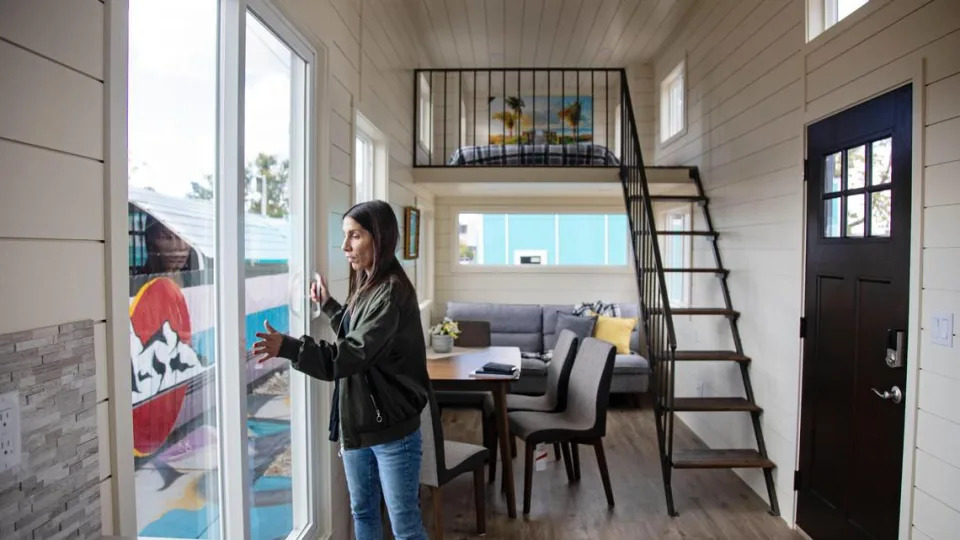
Developer Hannah Ball opens the back door of a tiny home she had on display in Garden City in 2021.

About a year and a half ago, the city participated in an innovation program through Bloomberg Philanthropies and Harvard University where staff members were tasked with identifying new solutions for housing relief. The group of about 10 city employees took what they learned and interviewed dozens of Boise residents, from developers to homeowners to people experiencing homelessness, to try to understand the issue of housing affordability from their perspectives.

The city also held sessions where residents were invited to brainstorm creative solutions to address the rising cost of housing in the area. Hundreds of ideas were shared.

The plan was to test out some of the most promising proposals.

“There were a few ideas that rose to the top from that work,” Patterson said. “One of them was around tiny homes. The thought was, could we try this on a small scale for a few tiny homes, and then evaluate that pilot to see if it’s something we might consider allowing permanently throughout the city?”

Housing advocates see tiny homes as among a variety of housing types that could help address affordability.

In Boise State University’s 2022 survey on growth, when asked which type of building Idaho needs to meet the demand for more housing, 17.9% of respondents said new, alternative types of housing like tiny homes were needed. Seventy percent of those surveyed said they favor their local government changing zoning laws to allow them.

The survey was conducted Nov. 13-21, 2021, of 1,000 adults living in Idaho.

In Boise State’s 2023 survey, 68.8% of respondents said if they had to move out of their home for whatever reason, it would be very unlikely they’d be able to purchase or rent a similar home for the same amount.

What is a tiny home?

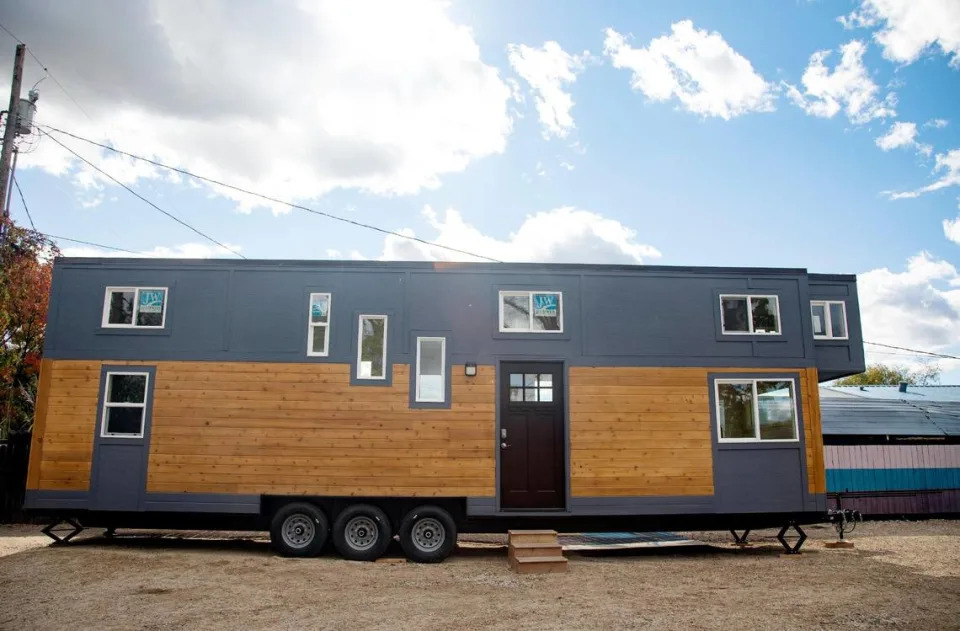
Tiny homes are small houses on wheels, and are usually 200-400 square feet. They’re much smaller than a typical single-family American home, which is around 2,500 square feet on average, but have most of the essential amenities such as a bed, kitchen and bathroom — albeit on a much smaller scale.

“The hope is that because these are very small homes, they might be more affordable,” Patterson said. “Through the pilot, we’re hoping to test whether that’s actually true.”

Many people who choose to live in tiny homes are single, according to Patterson. Some are retired, some live only with a dog and oftentimes they don’t need a lot of space.

Developer Hannah Ball had this tiny home on display in Garden City in 2021.

Homeowners who are willing to place a tiny home in their backyard have to pay to install a gravel pad and to extend hookups to electricity, water and sewer services. Plus, there’s the cost of the tiny home itself. Tumbleweed Tiny House Co., one of the largest manufacturers of tiny homes in the U.S., sells the made-to-order homes for around $90,000.

Still, it’s considerably less than the median price of a newly built, single-family home in Ada County, which was $507,500 in March.

The city is working with LEAP Housing, a local nonprofit, to administer and manage the tiny home pilot program. Zeb Moers, director of development for LEAP Housing, told the Statesman by phone that the project has to get unanimous neighborhood approval from each homeowner who shares a property boundary with the tiny home applicants, at least for the pilot program.

That’s a requirement that could change if the pilot program is successful and the city decides to permanently change its zoning laws to allow them.

For now, it means that even if 10 neighbors say yes, but one says no, the application can’t go forward.

The city already had screened who it thought were the top candidates, but after finishing site plans and a few other processes, one neighbor voiced concerns about two tiny home projects planned nearby.

“We just had to move on to the next person on the application list,” Moers said. Right now, the city and LEAP Housing are working on filling all the slots.

The hope is to try out the tiny homes in a mix of contexts to see what works best. For example, Patterson said one site could have a community scenario with a few tiny homes in the same area, another could involve someone renting a tiny home from someone who already owns one on their property and a third scenario could include someone moving their tiny home onto another’s property.

But the city planners and organizers from LEAP Housing want to make sure the tiny homes for the pilot are generally spread out among a few different neighborhoods in Boise to see what works best.

The program is planned to last 12-18 months.

“The folks that we’re going to work with for the pilot, we’re going to make sure that they’re renting to folks for whom this won’t make them more unstable,” Patterson said. “I think there’s a lot of folks who are happy to have a place to stay for the next 12-18 months. You think of like a traveling medical worker or a child who just graduated from college but can’t afford the cost of living here.”

Russian oil products are heading to the crude-rich Persian Gulf as the UAE and Saudi Arabia take advantage of cheap barrels

Business Insider

Russian oil products are heading to the crude-rich Persian Gulf as the UAE and Saudi Arabia take advantage of cheap barrels

Phil Rosen – April 17, 2023

saudi arabia russia putin
Russian President Vladimir Putin with Saudi Arabia’s Ambassador to Russia Abdulrahman Al-Rassi.Reuters/Sergei Karpukhin
  • Gulf nations are snapping up cheap Russian oil products while exporting their own crude at market rates.
  • Saudia Arabia and the UAE have emerged as key storage and trading hubs for Russian products, the Wall Street Journal reported.
  • Russia is sending 100,000 barrels a day to Saudi Arabia, up from effectively zero pre-Ukraine war, Kpler data shows.

Petro-rich nations in the Persian Gulf are buying discounted Russian oil products as Moscow continues to seek willing buyers while the West shuns the warring nation.

The United Arab Emirates and Saudi Arabia are using those Russian barrels within their own borders for consumption and refining purposes, while exporting their own products at market rates, the Wall Street Journal reported.

Russian naphtha and diesel sell at discounts of $60 and $25 a ton, respectively, according to the report.

In addition, the two countries, particularly the UAE, have emerged as key trade and storage hubs for Russian oil and fuel. Trading firms import Russia energy to the UAE and re-export it to Pakistan, Sri Lanka or East Africa, the report said.

Kpler data shows Russian oil exports to the UAE more than tripled to 60 million barrels last year. Separate Argus Media data cited by the Journal show Russia now accounts for more than 10% of gas oil stored in Fujairah, the UAE’s main oil-storage center.

Meanwhile, Saudi Arabia is importing 100,000 barrels a day from Russia after seeing effectively zero before Russia war on Ukraine, translating to an annual pace of about 36 million barrels.

US officials have objected to the burgeoning relations between Russia and the Gulf nations. But with Russia’s Urals crude trading at more than a 30% discount to Brent crude, the international benchmark, the arbitrage is particularly attractive.

Moscow has proven capable of navigating Western sanctions and price caps well enough to push oil exports above levels reached before it invaded Ukraine. In the first quarter, Russia’s seaborne crude exports hit 3.5 million barrels a day, compared to the 3.35 million barrels reached in the year-ago quarter.

Meanwhile, Kpler data shows that China and India now account for roughly 90% of Russia’s oil, with each country taking in 1.5 million barrels a day — more than enough to absorb the volumes no longer heading to European nations.

Still, even with other countries plugging the gaps left by sanctions, Moscow hasn’t been able to maintain the same level of energy profits amid war. The International Energy Agency said Friday that the country’s export revenue is down 43% compared to the same time last year.

I’m a former Microsoft VP of HR. Here are the real reasons why layoffs are happening and how much longer they’ll last.

Business Insider

I’m a former Microsoft VP of HR. Here are the real reasons why layoffs are happening and how much longer they’ll last.

Chris Williams – April 17, 2023

  • Chris Williams is a former VP of HR at Microsoft and podcaster, consultant, and TikTok creator.
  • He explains that COVID made way for unprecedented opportunities for tech companies and many over-hired.
  • Williams also says many of today’s layoffs are cuts companies wished they could have done years ago.

I was Vice President of HR at Microsoft at the peak of the dot com bubble. I lived — like most of us — through the collapse of 2008. I’ve seen this movie before.

Here are three reasons why the tech industry is laying people off and why it’s not a sign that tech is collapsing.

1. COVID exuberance

Some industries like travel and entertainment were devastated when everyone was stuck at home. Tech was just the opposite. Everyone stuck at home on their computers was a gold mine. Companies saw unprecedented demand and opportunity. Some saw it as a sea change.

The biggest was Amazon who saw a huge shift to ecommerce as not just a blip but a change in buying habits. They hired breathlessly, doubling from 800,000 employees in 2019 to over 1.6 million in 2021. Alas, when things opened back up, we also returned to the brick and mortar stores. Amazon had over-hired and has needed to retreat.

The same was true for other companies in tech. Microsoft, Google, Meta, even Peloton all saw the pandemic as a sea change. Though it changed many things, the rebound has shown the changes to be less dramatic. They too have found themselves to have over-hired.

Former Federal Reserve Chairman Alan Greenspan called the dot com bubble “irrational exuberance.” COVID has been a bit like that too.

2. Shedding excess

The wakeup call that came with the rebound from COVID also caused many tech companies to examine their businesses for excess. Tech has been famous for harboring people and projects beyond their usefulness.

To their credit, many of these companies have shown loyalty to those who helped lead them in the creation of some amazing products. And they have chosen to stick with experimental projects long past the time when more traditional companies would have pulled the plug.

But when the COVID rebound happened, they used the opportunity to examine more critically some of these things well past their “sell by” date. Some of the layoffs we’ve seen have included long-time employees years from their most meaningful contributions. And projects years past their prime.

When choosing who to layoff, these companies deserve some credit for applying business results as a metric. Rather than simply saying “last in, first out.” But it has been painful to watch.

3.  The optics 

Some of the layoffs we’ve seen in tech are ones that the companies have probably wished they could do for years. Some of the above, for example.

But they didn’t want to be seen by Wall Street as companies at risk. They didn’t want to be the only one laying people off while other companies were still hiring or at least staying stable. The optics would have sent their stocks into a nosedive.

With the cover of many companies doing layoffs, there was safety in numbers. Companies who otherwise would have avoided layoffs have done them. Even notoriously cautious and stable Apple has used this to realign their retail organization and lay off a small number.

The cover offered by a broad retreat has made the layoffs more widespread than the pure economic metrics might justify.

The future is bright

We are in a season of layoffs, and it’s not clear we’ve seen the last or worst of it. I expect to see more coming through summer and into the fall.

That said, there is no reason to see the layoffs as a harbinger of doom and gloom for the tech world. There are almost too many rays of hope to count.

There is the revolution AI will bring. Microsoft is betting the company that every aspect of knowledge work will be impacted, and even that may be conservative. Machine learning and tools like ChatGPT will have profound impact across tech and beyond.

There is the amazing world of quantum computing that will completely reset our yardstick for measurement of computer performance. It will overhaul the worlds of cryptography, finance, modeling, genomics, and on and on.

Then there is the virtual world. Perhaps Meta is overselling the metaverse, but there is plenty of reason to be optimistic for augmented reality. The applications in industrial and other real-world mixed scenarios are endless. Even Apple is rumored to be putting serious effort here.

None of these even touch on the dramatic shifts in social media that lie ahead. The drama and changes around TikTok, Twitter, Facebook, and others provide plenty of room for growth.

And there is the huge backlog of digital transformation that is pending. So many old-line businesses have yet to convert to electronic workflows there is opportunity there for decades.

There are so many lights ahead in the future of tech you would be wise to wear shades.

Japan Has Millions of Empty Houses. Want to Buy One for $25,000?

The New York Times

Japan Has Millions of Empty Houses. Want to Buy One for $25,000?

Tim Hornyak – April 17, 2023

The interior of Jaya Thursfield’s remodeled home in Ibaraki, Japan, March 12, 2023. (Andrew Faulk/The New York Times)

When Jaya Thursfield found a house he wanted to buy in Japan a few years ago, friends and family told him to forget it. The place wasn’t worth the trouble, they said. After all, it stood in a forest of shoulder-high weeds after being abandoned about seven years earlier — one of the millions of vacant houses known as akiya, Japanese for “empty house” — throughout the country.

But Thursfield, 46, an Australian software developer, wasn’t deterred. Through the overgrown garden, he could see it was special: The black roof tiles cascaded down to slightly curving eaves that were much higher off the ground than those of most houses. The entrance hall had its own gable tile roof. If the 2,700-square-foot house looked more like a Buddhist temple than a farmhouse, it’s because it was built by a temple architect in 1989.

Thursfield and his Japanese-born wife, Chihiro, had moved to Japan from London in 2017 with their two young sons and a dream of buying a home with a big yard. The plan was to purchase a vacant lot and build a house on it, but land is expensive in Japan and their budget wouldn’t allow it. So they turned to the growing supply of abandoned houses, which are cheaper and often come with more land.

They’re far from the only ones.

“We would never have been able to afford a house of this quality and size if it wasn’t an akiya,” Chihiro Thursfield, 49, said. “And while many Japanese don’t like used homes, foreigners see a house that is cheap and are more willing to reuse and renovate to their tastes and budget.”

As Japan’s population shrinks and more properties go unclaimed, an emerging segment of buyers, feeling less tethered to overcrowded cities, is seeking out rural architecture in need of some love. The most recent government data, from the 2018 Housing and Land survey, reported about 8.5 million akiya across the country — roughly 14% of the country’s housing stock — but observers say there are many more today. The Nomura Research Institute puts the number at more than 11 million, and predicts that akiya could exceed 30% of all houses in Japan by 2033.

The Thursfields’ house, which sits among the paddies in southern Ibaraki Prefecture, about 45 minutes from central Tokyo, had been deserted after the previous owner’s family refused to inherit it upon the owner’s death. The local municipality took over the property and put it up for auction with a 5 million yen ($38,000) minimum bid, but it failed to sell.

When it landed on the block again, Jaya Thursfield decided to try his luck. After giving it a quick inspection with an architect friend and finding no major issues despite the years of neglect, he nabbed the house for 3 million yen, about $23,000.

Houses in Japan typically decrease in value over time until they are worthless — the cultural legacy of post-World War II construction and shifting building codes — with only the land retaining value. Owners feel little incentive to maintain an aging house, and buyers often seek to demolish them and start fresh. But that can be expensive.

Others aim to preserve what’s there.

“There was no way we wanted to knock it down and build something new. It was too beautiful. So we decided to renovate instead,” Thursfield said. “I’ve always been someone who likes to jump in the deep end, take a few risks and learn new things, so I was confident that we would manage somehow.”

Since buying the farmhouse in 2019, the couple has spent about $150,000 on renovations, and there’s more to do. Thursfield has documented the project on YouTube, drawing more than 200,000 subscribers.

While the Thursfields’ house had been abandoned by the previous owner’s heirs, some homeowners die without ever naming an inheritor. Others leave their properties to relatives who refuse to sell family land out of respect for their elders, leaving the house to wither.

“In rural areas, there is a long history of ancestral owners of akiya living in the houses and on the land,” said Kazunobu Tsutsui, a professor of rural geography and economics at Tottori University who lives in a renovated akiya built more than a century ago. “Therefore, even after moving to the city, families will not give up their akiya easily.”

Now officials on both local and national levels are taking steps to give them a push.

“Poorly maintained akiya can mar the scenery as well as endanger residents’ lives and property if they collapse,” said Kazuhiro Nagao, a city official in Sakata, along the west coast, where heavy snowfall can damage unattended structures. “We’re partly subsidizing demolitions, collecting neighborhood association reports on akiya, and trying to make owners aware of the problem by holding briefings.”

Although the akiya problem has not had a direct impact on sales in urban markets, where high-rises continue to go up, the potential hazards to communities posed by empty houses are growing along with their numbers, according to Akira Daido, chief consultant at the Nomura Research Institute’s Consulting Division.

Daido pointed to a recent legal revision that allows local authorities to effectively raise the property taxes on neglected houses if the owners ignore municipal requests to maintain or demolish them. In another sign of rising concern, the government has approved a plan by the city of Kyoto, where inventory is tight yet some 15,000 houses sit empty, to tax the owners of those empty homes — a first in Japan.

Akiya are increasingly seen not just as a threat to suburban and rural markets but to the emotional health of the country, sparking family disputes over inherited properties. That, in turn, has led to a cottage industry of akiya consultants like Takamitsu Wada, CEO of Akiya Katsuyo, who acts as a counselor for squabbling relatives, often urging them to act before their properties become a lost cause.

“In many cases, the parents die without making clear their wishes regarding the family home, or they develop dementia and find it difficult to discuss these things,” Wada said. “In such cases, the children may feel guilty about getting rid of the family home, and may often choose to leave it unoccupied.”

Municipalities across Japan are also compiling listings of vacant houses for sale or rent. Known as “akiya banks,” they are often bare-bones web pages with a few underwhelming photos. Some have partnered with private-sector companies like At Home, which currently lists akiya in 658 of Japan’s 1,741 municipalities.

“Akiya banks are run by municipal office workers, the majority of which often do not have any experience in real estate,” said Matthew Ketchum, a Pittsburgh native and co-founder of Akiya & Inaka, a Tokyo-based real estate consultancy. “The existing solutions do not align with the needs of modern buyers and sellers.”

Ketchum’s firm is one of several that have sprung up to capitalize on the akiya glut, matching vacant homes with curious buyers. Akiya & Inaka’s listings include a 2,195-square-foot home built in 1983 in the suburb of Hachioji, Tokyo, with a small garden and a reception room featuring a raised tatami floor, tokonoma alcove and a rare wickerwork ceiling of woven cedar. The property is listed at 36 million yen, about $272,000.

“Every Japanese agent we talked to advised us to demolish this place,” said the house’s owner, Takahiro Okada, 85, a retired journalist. He and his wife, Reiko, 86, had been renting out the house but decided to sell after their tenant left last year. Their children weren’t interested in it, so the property lingered. Different owners might have torn it down and sold the land.

“If we all do that, we’re losing Japanese culture,” Reiko Okada said. “When seen from an international perspective and through the eyes of foreigners, Japanese things can have inherent uniqueness and value.”

Ketchum and his partner, Parker J. Allen, said they’re now fielding about five times the number of inquiries as when they began in 2020.

“At first, we were getting most of our inquiries from Japan residents, Australians and Singaporeans,” Ketchum said. “That has changed now, with the vast majority of our international clients being based in the U.S.”

Many clients have been spurred by the pandemic, which “definitely changed the mindset of people living in Japan regarding the idea of rural living,” Allen said. “The fact that property in the Japanese countryside is by and large undervalued and there are viable properties that are almost turnkey has finally dawned on these people.”

One person it did not dawn on recently is Alex Kerr, an author and Japanologist originally from Maryland, who became an akiya owner in 1973 when he acquired an abandoned country house (known as a minka) in the mountains of Shikoku, the smallest of Japan’s four main islands, for $1,800.

Named Chiiori, or House of the Flute, the thatched-roof aerie is about 300 years old. Inside, it’s a shadowy space of polished wood floorboards, a large sunken irori hearth and giant overhead rafters wreathed in smoke. Outside, mist rises from the Kumatani River in the gorge below.

Kerr, 70, is the first to admit that akiya can be money pits. He has spent decades and roughly $700,000 (“about half” of which came from a government grant, he said) maintaining it, and now rents it out as a guesthouse. It’s one of about 40 derelict Japanese properties he has restored over the years, all the while preaching the importance of conservation and rural revitalization to municipalities, companies and homeowners who may not know what makes their properties special.

“Many cultures have wooden architecture, but when it comes to the techniques of carpentry, Japan overwhelmingly leads the world in joinery and use of materials, as well as use of space and choreography,” said Kerr, whose books include the memoir “Lost Japan.” “When it comes to old minka houses, you have all that, set in a natural environment, and within the context of being cheap. In the Cotswolds, wooden houses cost a fortune, but in Japan they’re being thrown away.”

But he has taken note as real estate companies have begun to snap up habitable antique houses and market them to non-Japanese luxury buyers. He also pointed to young international buyers opening Airbnb rentals in erstwhile akiya and attending events like minka conferences.

Last year, British videographer Sam King and his wife, Nanami Sakurai, fled Tokyo with the help of an architect who introduced them to an unlisted akiya in the mountains of Otsuki, 50 miles west of Tokyo.

The couple wanted to be “closer to nature on our days off,” King, 35, said. “We also could not afford to buy so much as a shoebox in the city, so the thought of being able to get somewhere with a lot more space was very appealing so we can start a family and also own pets without any trouble.”

The house, in a depopulated community of mostly older residents, had been abandoned for roughly two years after the death of its owner. The price was 12 million yen, or about $88,000.

Set in a garden among plum and kiwi trees, the cottage has traditional tatami mats, shoji-paper and fusuma sliding doors, chunky wooden cabinets and tokonoma alcoves. The previous owner left behind a trove of personal possessions — paintings of Mount Fuji, rolls of Japanese calligraphy, old tape players, kites, guitars, skis, crockery. The house is about 50 years old and needs to be updated to modern standards. King estimated that the initial renovations, such as redoing the kitchen and bathroom, will cost $20,000 to $30,000. It’s well worth it to escape the city.

“We’d like to improve upon it quite a bit as it’s going to be our home, so we’ll probably end up spending over $100,000 in total on the project,” he said. “But we’ll hopefully end up with our dream home.”

Who says Florida property insurers aren’t taking new customers?

South Florida Sun Sentinel

Who says Florida property insurers aren’t taking new customers? See whether yours added or subtracted policies

Ron Hurtibise, South Florida Sun Sentinel – April 17, 2023

Apparently not all Florida-regulated property insurance companies are too financially troubled to take on new customers.

Thirty-two companies added customers between the second and third quarters of 2022, according to a South Florida Sun Sentinel analysis of market share data released by the Florida Office of Insurance Regulation.

A few companies added significant numbers of what are called personal residential policies that cover single-family homes, condominiums and even renters.

Of 18,243 new policies written by State Farm Florida, currently the third-largest carrier in the state, 8,595 were homeowner policies, 2,538 were new tenant policies, and 7,110 were new condo policies.

Castle Key Indemnity, a subsidiary of Allstate, added 8,508 new policies, including 3,987 homeowner policies and 3,805 tenant policies.

Edison Insurance, owned by Boca Raton-based Florida Peninsula, added 4,766 policies, of which 4,176 were homeowner policies.

The analysis suggests that reforms enacted in two special legislative sessions to reduce litigation against insurers — though disliked by plaintiffs attorneys, repair contractors and public adjusters — are encouraging carriers to expand their presence here.

Insurance insiders contacted for this report said it’s a promising sign that so many companies are deciding to take on new business.

Restrictions intended to reduce lawsuits against insurers that were enacted during two special sessions have given some companies confidence to expand in the state, said Mark Friedlander, communications director for the industry-funded Insurance Information Institute.

“The data shows some positive signs for Florida’s property insurance market,” Friedlander said in an email. “Several private insurers have indicated they are willing to take on more risk based on the property insurance reform that was passed in December and the new tort reform bill that was passed in March.

“Based on the Q3/Q4 2022 data, it appears a few insurers were willing to assume more risk even before the market reforms were enacted. Insurance agents are also starting to see more options when trying to place a customer’s business.”

The Sun Sentinel’s analysis compares market share data that insurance companies have tried to keep confidential over the past six years. Since 2017, more than 60 private-market companies, including most of the largest, have blocked quarterly release of their county-by-county and — until this year — statewide market data after State Farm won a court battle that allowed companies to declare the information a “trade secret.”

State Farm objected to county-level dissemination of its policy counts, saying it provided competitors with too much insight into markets where the company was targeting its marketing efforts.

But last May, lawmakers included, among reforms desired by insurers, the required disclosure of aggregated statewide policy data with no option to declare it a trade secret.

Formerly ‘trade secret’

The first statewide spreadsheet released under the new law disclosed policy counts, total premium collected, the value of insured property, cancellations, and other information, for the third quarter of 2022. The second release, for the fourth quarter, made it possible to compare which companies added and subtracted policies, as well as average policy costs and average value of property covered, between the third and fourth quarters.

Not surprisingly, insurers that posted significant policy count increases weren’t eager to share their reasons why. Insurers are generally tight-lipped about all aspects of their business.

“We can’t talk about our growth strategy but we can share that State Farm continues to maintain the financial strength to be there for our Florida customers,” a State Farm spokeswoman said by email.

Clint Strauch, president of Edison Insurance and Florida Peninsula, credited its professional network of agents, traditional underwriting practices and fiscal conservatism, “which gives us the financial ability to take on new policies.

He added, “We are bullish about the state of insurance in Florida, in light of the positive steps taken by the Governor and the Legislature to stabilize the market for all Floridians.”

Even as it revealed a number of companies willing to take on new business, the data comparison showed that an even larger number of companies continued to lose policies, either deliberately to reduce the amount of risk on their books and thus, their reinsurance costs, or because policyholders are shopping for lower prices, possibly from state-owned Citizens Property Insurance Corp.

Seventy companies saw reduced policy counts between the third and fourth quarters. Of them, 16 lost or shed more than 1,000 policies each.

Those companies are among the largest in the state, including the second-largest behind Citizens, Fort Lauderdale-based Universal Property & Casualty, which reported 23,100 fewer policies at the end of the fourth quarter compared to three months earlier.

Others were ASI Preferred (down 16,014), a subsidiary of Progressive, which last year announced plans to stop writing new policies in Florida; American Integrity (-7,051); Security First (-6,729); and Heritage Property & Casualty (-6,528).

Slide Insurance Co., which was founded by former Heritage CEO Bruce Lucas in early 2020, saw a 6,272-policy reduction. However, since Dec. 31, the company announced plans to add up to 91,000 policies covered by United Property & Casualty when that company went into dissolution in February.

Travis Miller, spokesman for Universal Property & Casualty, said it’s not accurate to assume that the company “shed” 23,100 policies.

“Instead, the data more simply shows that during the quarter, the reduction in (Universal’s) policies exceeded the number of new business policies it wrote,” he said by email. “An insurer can see reductions in its policy count for reasons beyond its typical renewal underwriting process.”

Many customers in the current climate of rapidly rising rates are comparative shopping, he said, including many with Citizens, which by law offers premiums below market rates to homeowners who cannot find comparable coverage that costs less than 20% more.

“To a lesser degree, some insureds also are making the difficult decision to forego coverage,” Miller said.

Those decisions can be inferred from the data that show the number of overall homeowner policies stayed relatively flat between the third and fourth quarters even though 57,004 single-family homes were sold between Oct. 1 and Dec. 31, according to the Florida Association of Realtors.

And Citizens, the “insurer of last resort,” added 73,617 personal residential policies in the fourth quarter, more than any single private-market company.

Citizens’ continued growth is a sign that insurance industry troubles persisted into the fourth quarter as it became the insurer of last resort for homeowners unable to find an affordable policy elsewhere.

The next set of data, for the first quarter, will show a similar increase for Citizens, according to data posted on the company’s website. But brightening conditions could begin to nudge policyholders back to private-market insurers, Friedlander said.

“We learned this week that more than 61,000 policies have been approved for take-out from Citizens by three Florida insurers — Monarch National Insurance, Florida Peninsula and Edison Insurance Co.,” he said.

Tallahassee-based Monarch National alone was approved to take out up to 46,218 policies, Citizens spokesman Michael Peltier said.

In addition, a new company has been approved by Florida regulators to enter the market: Tailrow Insurance is being launched by publicly traded HCI Group, which also owns Homeowners Choice and TypTap Insurance, and will begin writing new business this year, according to a consent order filed by the Florida Office of Insurance Regulation.

Both the Citizens takeouts and the newly launched Tailrow Insurance “are positive signs,” Friedlander said, adding, “It would not surprise us if some of the property insurers that posted a net decline in policies during 2022 begin to move in the other direction in 2023.”

More insurance availability if you can pay

Yet, increased availability of insurance is coming at higher prices, as policyholders hit hard by rate increases over the past two years can attest.

John Rollins, former chief risk officer at Citizens, notes that strong headwinds are still facing companies trying to secure required levels of reinsurance — coverage insurers buy to guarantee the ability to file all claims after a catastrophe — by June or July, ahead of the most active part of the hurricane season that begins around mid-August. Whatever they’ll end up having to pay will be passed along to their customers.

The reinsurance renewal period “by all accounts is set to feature the largest year-over-year price hikes in living memory,” Rollins said.

Gallagher Re, a global reinsurance broker, said reinsurance rate increases for catastrophe loss have ranged from 50% to 100% according to Artemis.bm, a website targeted to capital markets investors.

“This would make four years in a row of reinsurance prices ratcheting up — slightly at 2020 and 2021, 30% at 2022, and now this,” Rollins said. “Companies will pass through the costs in rate filings once they are clear, but nobody knows where the market will settle right now.”

Until the dust settles, “smart managers would not be adding policies,” he said.

Other observations

Tenant policies up: Even as the overall number of homeowner policies remained flat, the number of insurance policies purchased by renters increased statewide by 53,999 to 1.15 million at the end of the fourth quarter.

“The spike is not surprising as Florida’s rental market has become the most robust in the U.S.,” Friedlander said. “The cost of renters insurance is extremely reasonable for consumers and fairly low risk for insurers compared to property coverage. Most landlords required their tenants to have individual renters coverage, which is a very good thing.”

Tenant insurance is so cheap, there’s no excuse to forego it. The average annual premium, according to the data, was $200. The highest average premium, $13,643 was charged by a company that insures just 12 condos in the state, Pacific Indemnity Co., and the average insured value of those 12 condos was $1.2 million. The lowest average premium was $11 paid by 10,924 customers of Markel Insurance Co.

Homeowner premiums: Average homeowner premiums as of Dec. 31 ranged from a low of $346 for the 2,848 properties covered by Farmers Casualty to $51,823 for the 252 properties insured by Century-National.

The average homeowner premium increased from $2,908 to $3,026.

The average insured value of covered single-family homes — known in the industry as “exposure” — jumped from $624,126 on Sept. 30 to $641,253 on Dec. 31. The average exposure ranged from $12.7 million for each of five houses insured by Ace Insurance Co. of the Midwest to $285,823 for customers of White Pine Insurance Co.

Condos: The average cost to insure a condominium unit increased from $1,375 to $1,419 between Sept. 30 and Dec. 31. Because they are smaller and have common areas insured by separate commercial policies, it costs less to insure condo units. The highest average condo premium in Florida was $13,643 from American Home Assurance Company, while the lowest was $348 from Teachers Insurance Co., which insures exactly one condo unit in the state. The average insured value for condos increased from $154,431 on Sept. 30 to $156,777 on Dec. 31.

7 Reasons You Don’t Want To Retire in Florida

Go Banking Rates

7 Reasons You Don’t Want To Retire in Florida

Bob Haegele – April 17, 2023

Image Source / Getty Images/Vetta

For many people, retiring in Florida sounds like the dream. It allows them to escape the cold and snow they put up with for decades in the Northeast or perhaps other parts of the country. Instead of the biting cold and gray skies, you get nonstop sunshine and warm weather. Sounds like a great deal, right?

Perhaps. But there are also some potentially serious downsides of retiring in Florida. Of course, there are the snakes and gators and endless traffic, but there are also financial concerns. If you dream of retiring in Florida, here are some reasons you may want to reconsider.

Homes Can Be Expensive

Many states have watched their housing prices balloon over the past few years, thanks in part to a shortfall in new construction that dates back to the Great Recession. However, none have seen their housing prices skyrocket the way Florida has.

For example, housing prices increased by 22.7% from the year before as of the third quarter of 2022, according to Statista. The median home price in Orlando is $345,000, Redfin reports. So if you intend to retire in Florida, you’ll need to be financially prepared from the get-go.

Healthcare Can Be Costly

Florida has numerous excellent medical facilities where patients can receive top-quality care. As great as that is, though, healthcare can be costly in the Sunshine State. That’s especially problematic for retirees, who are more likely to need expensive medical care.

While Medicare does cover most medical expenses for retirees over 65, there may still be out-of-pocket costs. These include deductibles, premiums and co-pays. There are also costs like long-term care, dental care and vision care that are typically not covered. Plus, Florida’s aging population could further push prices upward for everyone.

Retirement Communities May Be Expensive

In addition to healthcare costs, there is also the cost of retirement communities, which is something many retirees eventually need. On the plus side, retirement communities offer many seniors a comfortable and welcoming lifestyle.

However, these communities can be expensive in Florida. The real cost might vary significantly depending on things like where the community is located and the fees it charges. But some retirement communities charge significant fees for maintenance, security and other services. If you see yourself living in one of these communities, investigate the rates in Florida.

You Might Get Hit by a Hurricane

Florida is known for being at risk for hurricanes, which can cause severe damage to property and be costly to repair. The risk can be significant depending on where you live in Florida. Plus, the risk of hurricane damage may increase due to climate change.

The Atlantic hurricane season runs from June 1st to November 30th, putting you at risk for a large portion of the year. This is one reason the average homeowner’s insurance premium is $1,981 in Florida, making it the 10th most expensive state in the country for homeowner’s insurance.

You May Need Flood Insurance

In much of the country, flood insurance isn’t something people think about as a necessity. But it’s often required in flood-prone areas, which includes much of Florida.

Homes with government-backed mortgages in high-flood-risk areas are required to have flood insurance. It isn’t federally required if you have a mortgage from a private lender, but they may still require it. The average cost of flood insurance in Florida is a little over $600. However, premiums may vary significantly depending on where you live and your property’s risk assessment.

Property Taxes Can Be High

The average property tax rate is 0.89% in Florida, which puts it right in the middle in terms of property tax rates. However, even Florida’s relatively modest property tax rate can still result in significant property tax thanks to the state’s rapidly rising home costs. For example, 0.89% paid on Florida’s median $345,000 home would equate to $3,070.50 in property taxes per year.

Plus, property tax rates may vary depending on where you live within the state. Property tax rates may vary by city, county and school district. This means you could end up paying even more in property taxes if you move to Florida.

Don’t Forget Sales Tax

One thing that sometimes draws people to Florida is its lack of income tax. On the one hand, this could be seen as a good thing for retirees, many of whom live on a fixed income. But don’t forget state and local sales tax, which is 7.02% in Florida. That can significantly impact retirees when they purchase goods and services.

One positive is that certain goods, such as groceries and prescription drugs, are exempt from sales tax in Florida. However, some jurisdictions might still add a tax on these items. The bottom line is that if you are flocking to Florida to escape income taxes, its sales taxes can quickly sour your plan.

Where are all those tech workers going? A Silicon Valley exodus is shaking up the landscape.

The Washington Post

Where are all those tech workers going? A Silicon Valley exodus is shaking up the landscape.

Danielle Abril, The Washington Post – April 14, 2023

A beautiful view of residential area in San Francisco, California (Wirestock via Getty Images)

SAN FRANCISCO – As a computer science student in the Midwest, Alex Valaitis idolized Silicon Valley, drawn to the Bay Area like a theater major dreams of Broadway. But after five years of “soul-crushing” tech work, an exodus from San Francisco and rising crime in the city, Valaitis decamped in June 2021 for Austin.

“I like to bet on momentum, and Austin has it,” said Valaitis, 28, who runs a Web3 product studio and a newsletter about artificial intelligence. “More and more [tech] people seem to be flooding in every month.”

Silicon Valley has reigned for decades as America’s innovation capital, home to tech giants like Apple, Google and Facebook; unicorns like Uber, DoorDash and Instacart; and start-ups fueled by the venture capitalists that populate Sand Hill Road. But the region’s dominance has declined since the pandemic, as lenient remote work policies and a spate of layoffs have fueled the departures of workers and cleared the way for rising investment in other tech hubs across the United States, notably Austin and Miami.

Silicon Valley still ranked first last year in terms of venture-capital investments and the number of deals, according to data from PitchBook. But funding for companies in Miami has nearly quadrupled in the past three years, totaling $5.39 billion in 2022, while deal volume jumped 81 percent. Austin venture capital investments rose 77 percent to $4.95 billion with the number of deals jumping 23 percent. New York, Seattle, Philadelphia, Chicago, Denver and Houston also saw relatively large increases in investment and deals, data shows.

These regions still pale in comparison to Silicon Valley, which in 2022 drew $74.9 billion in investments across 3,206 deals. That’s about $45.36 billion and 1,058 deals more than New York, the second highest region for VC fundraising. The Silicon Valley region was also the home of 86 percent of start-ups, up from 53 percent last year, funded by famed start-up accelerator Y Combinator.

But Silicon Valley’s share of total value of venture capital investments in the United States last year was at its lowest since 2012. And nearly 250,000 people left the Silicon Valley region during the pandemic, according to census data from April 1, 2020, to July 1, 2022.

“There’s no doubt that [Silicon Valley’s] sort of exemplary, center-of-the-universe status has really absorbed some blows,” said Mark Muro, senior fellow at Brookings Institution.

Miami and Austin both benefited from fewer restrictions during the coronavirus pandemic. Early on, cryptocurrency and Web3 – a broad term for the next generation of the internet that would give people more control and ownership – were major drivers of Miami’s growth. Seattle benefited from having Amazon and Microsoft in its backyard, attracting more enterprise technology and also biotech, said Kyle Stanford, lead venture capital analyst at PitchBook.

“A redistribution [of funding] has definitely started. The pandemic, the fleeing of start-ups and remote work helped catalyze growth in those smaller markets,” he said.

Brianne Kimmel, founder of investment firm Worklife Ventures, has noticed a change in identity for the Silicon Valley region as many tech workers have moved out of San Francisco to other places like Austin or Seattle.

“That’s really created room for young, very technical, traditional hacker types to come to San Francisco,” she said. “It’s giving the city a personality it may have lost in years prior.”

She points to Cerebral Valley, an area in the Hayes Valley neighborhood where hacker houses filled with young start-up workers focused on AI are popping up. Kimmel compares the feeling to the Silicon Valley region during the early days of the internet, when people were huddling to work out of garages. She expects AI developments to accelerate people’s ability to work anywhere but also create concentrated areas of innovation across the United States that will draw workers.

But AI could ultimately change the industry and how many people are needed to operate those companies, said Muro, of Brookings. If AI innovations fundamentally change the industry’s structure, the biggest impact to workers could be in Silicon Valley, he said.

Tech workers desiring the quintessential start-up experience are still flocking to Silicon Valley, said partners at investment firm Index Ventures. But unlike the past, more start-ups are popping up in other places – like Seattle, which is producing start-ups focused on cloud infrastructure and developer tools, and New York, which has also been a hot bed for AI, said Bryan Offutt, partner at Index Ventures focused on investments in software infrastructure and AI.

“Five years ago, 90 percent of companies would’ve been founded in San Francisco,” he said. “Now it might be more like 70 percent, with others starting in places like Seattle and New York.”

And once companies mature, many are finding it useful to look for workers outside Silicon Valley as it widens the pool of prospective hires, said Erin Price-Wright, an Index partner focused on AI and machine learning investments.

“The need for talent to all be in the same place as they scale, we’ve sort of moved passed that,” she said. “It’s much more beneficial to branch out.”

Atli Thorkelsson, vice president of talent network at Redpoint Ventures, says Austin has grown as a hub for marketing, sales and customer teams for tech companies, and New York is capitalizing on a mixed bag of talent including those in financial tech, health tech and insurance tech.

“There is a way higher concentration of tech talent in New York than ever before,” he said. “The most prone [to move away from the Bay] seem to be those who are about five to 10 years into their career.”

The next generation of tech workers say the attractiveness of the region as a tech hub depends on their ambitions, as those seeking to build companies and find funding still want to go to Silicon Valley.

For Kai Koerber, a senior data science major at the University of California at Berkeley and founder of his start-up Koer A.I., Silicon Valley is still the place to be as he works on building his company. However, in a couple of years after he’s done some of the groundwork, the 22-year-old hopes to join some of his Gen Z tech peers by moving to New York.

“It’s great to be here and build your connections,” he said. “Then after that, live your life and have fun. I’m a young guy. I want to enjoy my 20s.”

Dylan Costinett, a senior data science major at Eastern Washington University, said that Silicon Valley region tech jobs have become less attractive in recent years. Instead, he’s planning to work for a third-party government software provider that will likely base him somewhere in the Northeast or Midwest.

“I got pretty worried about getting a job right out of college because I was seeing all the layoffs,” Costinett, 21, said, adding the high cost of living also plays into his feelings about Silicon Valley. “I’m not sure how stable Big Tech is right now.”

Airbnb was one of the first tech companies to allow permanent remote work. As a result, several workers at the company said they didn’t see the need to remain in Silicon Valley.

Airbnb tech employees Sofia Ruehle and Ian Demattei-Selby, who both moved from Silicon Valley region to Washington, said they believe the spread of employees leads to a diversification of ideas that allows the companies and workers to learn from different regions. And Rori Jones, Airbnb’s diversity and belonging business partner who moved to Denver during the pandemic, said six Silicon Valley friends have joined her since she left.

“Pre-pandemic, if you weren’t in San Francisco, in some ways you were at a disadvantage for opportunities and promotions,” she said. “But now, it doesn’t feel like you’re missing out on anything.”

After spending nearly 15 years in Silicon Valley, Duncan Cook, engineering manager at Yelp, traded his techie lifestyle for the nature-filled Portland suburb of Happy Valley in December 2021. Yelp had told its workers they could work from anywhere. That allowed Cook to get away from what appeared to him as a growing drug problem in the region and move into a bigger home with his wife and new son. He says he’s excited to see flexible work fuel a larger distribution of the tech industry.

“I don’t think San Francisco is going to self-destruct any time soon . . . but it’s less of a shining star,” he said.

Valaitis, the tech worker who moved to Austin, said people like him are coming to a new realization: “You don’t have to be in the Bay Area to have success in tech.”

“I think that’s part of the disruption and narrative people are slowly waking up to, ” he said.

Red tide lingering? Bloom continues to impact south Sarasota County beaches

Herald Tribune

Red tide lingering? Bloom continues to impact south Sarasota County beaches

Jesse Mendoza, Sarasota Herald-Tribune – April 14, 2023

South Sarasota County is one of the few areas along the coast still affected by bloom levels of red tide, despite improved conditions throughout most of the region.

Samples published this week by the Florida Fish and Wildlife Commission show red tide was either not found, or only found in low levels, near most of the Sarasota and Manatee shoreline. Samples do show medium concentrations of red tide in south Sarasota County near Manasota Beach on April 10 and Blind Pass Beach on April 6.

The Florida Department of Health in Sarasota County issued an update on Thursday notifying the public that elevated levels of red tide continue to be found near local beaches in that area — specifically highlighting Nokomis, North Jetty, Venice Beach, Service Club, Venice Fishing Pier, Brohard, Casperson, Manasota Key, and Blind Pass.

Previously: Is red tide still impacting beaches in Sarasota, Manatee?

Red Tide: Respiratory Irritation Forecast

Red tide can cause short-lived respiratory symptoms such as eye, nose, and throat irritation like those associated with the common cold or seasonal sinus allergies. Red tide bloomed along the coastline at the end of October and came to a head in early March.

The bloom has largely cleared along most of Sarasota and Manatee since then, making for improved beach conditions during spring break and the Easter holiday weekend.

A map showing sample results for red tide published by the Florida Fish and Wildlife Conservation Commission for the week ending on April 13.

The bloom did persist to the south and north of the region and continues to affect the south Sarasota County area as of the latest information available this week.

There is a moderate risk of red tide-related respiratory irritation over the next 36 hours in Sarasota, Pinellas, and Charlotte counties, according to a forecast issued by the National Centers for Coastal and Ocean Science issued at 6 a.m. on Friday. Red tide is present in Collier, Lee, and Pasco counties at levels that could cause respiratory irritation as well.

Visit www.redtideforecast.com for the most up-to-date respiratory irritation forecast information.