America is refusing to do the one simple thing that would solve the Great People Shortage

Business Insider

America is refusing to do the one simple thing that would solve the Great People Shortage

Gaby Del Valle – May 4, 2023

A US factory with immigrant employees multiplying
The US needs more workers or it will face serious economic chaos. There’s a clear fix: more immigration.Tyler Le/Insider

Two simple words: more immigrants

America needs more workers.

The United States is already running low on critical positions such as nurses, home-health aides, farmworkers, and truckers. And there are fewer young people on the way to make up the difference: The National Bureau of Economic Research found that birth rates in the US have declined by nearly 20% since 2007, while the fertility rate has been below the replacement level for decades.

That means that unless people start having a lot more kids, the US population could eventually start to shrink — just like China’s population has. The problem, though, isn’t just a smaller population, but an aging one. With fewer people to pay into Social Security to support the growing number of retirees and fewer workers in critical industries, including healthcare and agriculture, a declining population would have devastating consequences for the American economy.

“This is the issue of the future, because this is going to become the first-order issue for all kinds of industries in America,” Lant Pritchett, a development economist and RISE Research director at Oxford University’s Blavatnik School of Government, told me. “They just won’t be able to attract workers.”

Politicians have suggested various ways to encourage people to have more children: “We will support baby bonuses for a new baby boom,” former President Donald Trump said at a conference in March. But even if these policies went into effect, we’d still have to wait for those kids to grow up before they could enter the workforce. The labor imbalance is already here, and the economy needs more workers now. That’s why a growing number of demographers, economists, and business executives support letting more immigrants into the US as a more immediate way to fill in the gaps. President Joe Biden’s economic advisors even said in March that more legal immigration is needed to boost the economy. And while immigration is a politically touchy solution, the quickly aging US economy is running out of options to keep itself afloat.

“The only solution is more workers,” Pritchett said.

America’s People Shortage

The US fertility rate first dipped below the replacement level — the rate needed to sustain the population, which is about 2.1 births per woman — in the 1970s. After rebounding in the 1990s and early 2000s, the rate began a steady decline in 2007 that has not reversed. While the US population has managed to avoid an outright drop, population growth reached an unprecedented low of 0.12% in 2021. Some of this loss can be attributed to the deaths of over 1 million Americans during the pandemic, but the COVID crisis only exacerbated preexisting demographic trends. Americans are getting older: The median age of the US population has increased by roughly 3.5 years since 2000, according to the Census Bureau, and 2021 saw the largest upward shift in the population age ever recorded.

According to estimates, these trends won’t reverse anytime soon. The Congressional Budget Office estimated this year that population growth will slow between 2023 and 2053, and that by 2042, any growth will be from immigration, not births. Kenneth Johnson, a professor of sociology and a senior demographer at the University of New Hampshire, pointed out that the demographic mismatch is even more dire when you look at county-by-county data. Deaths outnumbered births in two-thirds of US counties in 2021, creating a phenomenon that demographers call “natural decrease.” Even before the pandemic, roughly half of all US counties had more deaths than births, he said.

Johnson said that one big debate among demographers is whether people are simply delaying having children or just putting it off altogether. It’s possible that a combination of factors, including the lingering effects of the Great Recession, coupled with crushing student-loan debt, the rising cost of housing, and the pandemic simply pushed back the timeline for many people to have children. After all, birth rates did rise slightly in 2021, likely because of stimulus payments and the flexibility of remote work. But Johnson told me, “Right now, my impression is that a fair number of those babies aren’t going to be born.”

Policymakers and economists have suggested myriad ways to increase the number of babies people are having — ranging from “baby bonds” to a stronger social-safety net. But some ideas to boost fertility come with a sinister undercurrent. The preoccupation with increasing birth rates has particularly taken hold on the political right, which has long had a fascination with the racist conspiracy theory that there is a global plot to “replace” white Americans with immigrants. Trump’s baby-boom plan, for instance, may have been inspired by Hungary’s family-planning program, which is designed to encourage white heterosexual couples to have more children. “Migration for us is surrender,” Hungary’s far-right Prime Minister Viktor Orbán said in 2019.

Kenneth Johnson, University of New Hampshire

The pronatalist movement, which argues that people should be having more babies, has also grabbed hold in Silicon Valley — but some of its adherents don’t believe that just anyone should be having children. Tech billionaires like Elon Musk (who has 10 children) have become convinced that they need to have lots of children to save the human race. And one Silicon Valley couple has started a campaign to encourage more people like themselves to have children, speaking openly about their use of reproduction technology to select embryos based on genetic testing.

But so far, policies designed to induce people into having more kids have been a bust. Japan has struggled with a declining birthrate for decades despite efforts to encourage families to have more children. Earlier this year, Prime Minister Fumio Kishida warned that Japan was “on the brink of not being able to maintain social functions” due to population decline, adding that it was “now or never” to solve the problem. China’s population is both aging and shrinking as well, and after decades of restrictive family-planning policies, the country is trying to change course. In recent years, China has reversed its notorious “one-child policy” and started restricting abortions for “nonmedical reasons.” But the country’s population is still declining.

How immigration can boost the economy

In the face of looming population decline and resulting labor shortages, there is a clear answer staring the US in the face: immigration. Allowing more people to become Americans would not only help immediately alleviate some of the labor shortages plaguing the US economy but would also help to stem some of the country’s long-term population decline. Historically, the median age of immigrants has been younger than the median American age. And people of working age — meaning those between 18 and 64 — comprised 77% of the immigrant population in 2021, compared to just 59% of the US-born population that same year. Immigrants, Johnson said, “bring not only themselves,” but also the potential for more children, further boosting the US population and productivity.

Though current immigration rates — particularly the number of migrants apprehended at the border — are the subject of contentious national debate, recent Census data shows that the total number of immigrants arriving in the country isn’t enough to offset population losses. Between 2021 and 2022, the number of immigrants in the 20 most-populous counties in the country nearly tripled, but most of those counties still saw their overall populations decline. Despite increased immigration, Los Angeles County’s population declined by 90,000 people in 2022 — and by 180,000 people the previous year.

In order to truly prevent a people shortage, the US will need to let more people into the country. And there’s already evidence that immigrants can help boost local economies — and transform entire cities. Immigrants are 80% more likely to start a business than people born in the US, and recent data shows that they’ve started more than 25% of businesses in seven of the eight fastest-growing sectors of the US economy. Because of that, research has found that immigrants actually create more jobs than they take. Plus, across the US, several key industries — including agriculture, meatpacking, manufacturing, and healthcare — depend on immigrant labor. And if we boost immigration rates, the incoming workers could help ease labor shortages in these critical fields.

Mexican farm workers harvest cabbages in a sunny field in California
Critical industries such as agriculture and healthcare rely on immigrant labor.Sandy Huffaker/AFP via Getty Images

From central Indiana to New York City, businesses are struggling because they can’t hire enough workers to fill their open roles. “If we don’t do this and have a positive conversation about immigration today, it will continue to crush Hoosier households and economy,” Patrick Tamm, the president and CEO of the Indiana Restaurant and Lodging Association, told a local publication.

Take Utica, New York. The city’s population declined from 100,410 people in 1960 to just over 60,500 in 2000. But instead of facing extinction, the postindustrial city’s population slowly began rebounding in the 1990s with the arrival of Bosnian immigrants fleeing the Yugoslav Wars, who were followed by refugees from Myanmar in the 2000s and, more recently, Bantu refugees from Somalia. The city’s relatively low cost of living has made it a hub for people fleeing conflicts around the world, who resettle with the help of refugee-aid organizations. Though the city’s population still hovers around 60,000, it would be much lower if not for the resettled refugees and their families who now make up about 25% of Utica’s population.

“The refugee population has helped the city’s economy tremendously,” Brian Thomas, the commissioner of Utica’s Department of Urban and Economic Development, told CNBC.

Political compromise? 

Immigration has, of course, been a political hot potato for decades. One 2022 survey found that one-third of Americans and two-thirds of Republicans believe in tenets of the so-called “Great Replacement” theory. A February Gallup poll found that just 28% of responding Americans are satisfied with our current immigration rates, and most of those who are dissatisfied want immigration to decrease. But even without a huge overhaul of the entire system, there are clear solutions that could help welcome more talented, much-needed workers to America.

One way the US could encourage more immigration is by focusing on temporary visas for specific industries that need workers. Japan took this approach and quietly opened itself to foreign workers in 2019 when it began allowing “specific skilled workers” in 14 key industries. These workers are allowed to stay in the country for up to five years on temporary labor visas — but they aren’t allowed to bring their families. Lawmakers hoped that the policy would attract around 345,000 workers in a five-year period, or an average of 5,750 people each month. Pritchett said this model could also work in the United States.

“A lot of people in the world would love to come work in a high-productivity place and would be more than willing to do so not in an exploitative way, but on a term-limited basis,” he told me.

There are already two guest-worker programs in the United States: the H-2A program for temporary agricultural laborers and the H-2B program for temporary non-agricultural workers. Both programs give temporary work visas to people tied to specific employers. The current programs are not perfect, however, and workers on H-2A and H-2B visas have sounded the alarm over squalid living conditions, wage theft, and exploitation. And the treatment of workers in the country on temporary visas has been a problem for decades. For these programs to be expanded, there would need to be significant safeguards in place to ensure workers aren’t exploited.

And there are other approaches that could work. Tara Watson, an economist and the director of the Center on Children and Families at the Brookings Institution, said that solutions focused on bringing people here on a long-term basis are more in line with what the US needs. “I’d rather see more expansion on the permanent side than the temporary side, because I think the challenges that we’re facing are long-run challenges and they really require long-run solutions,” Watson said.

She said that a good place to start would be expanding both family- and employment-based migration by simply allocating more visas in each category. Scaling up both programs would make an immediate difference, she said. Other simple solutions include lifting the cap on the number of skill-based green cards issued to immigrants from each country and letting people on nonimmigrant visas renew their status in the United States, rather than having to leave the country to do so.

Regardless of the approach, the biggest hurdle is a matter of political will. “I think there will be some resistance to this as a solution,” said Watson. “But I also think it’s essentially an imperative.” After all, the US is running out of options, and soon its growing people shortage is going to spell economic disaster.

Watson said that the economic forces will eventually overwhelm the “white-nationalist far right” that has “played an outsize influence” on the immigration debate. “If we don’t solve this problem in the next couple of years, it’s going to come to a head,” she said.

Gaby Del Valle is a writer and reporter living in Brooklyn. She coauthors the immigration newsletter BORDER/LINES.
Flood insurance costs will soar in Florida. See the expected increases in your ZIP code

Miami Herald

Flood insurance costs will soar in Florida. See the expected increases in your ZIP code

Nicolas Rivero – May 4, 2023

Brace for a few years of flood insurance rate hikes, South Florida. And they’re going to be steep — doubling, even tripling for thousands of homeowners.

FEMA has changed the way it calculates flood insurance prices. Instead of relying on old flood zone maps covering broad areas, it’s now basing premium prices on a wider range of factors, like an individual property’s distance from the ocean, rainfall levels and the cost to rebuild a home.

Last month, for the first time, FEMA shared estimates for what that will mean for the average flood insurance premium by ZIP code. For the worst-hit ZIP code in South Florida — 33469, a stretch of coastal Palm Beach County that covers parts of Jupiter and Tequesta — that will mean a 342% premium increase, on average.

In the most expensive ZIP code for flood insurance in South Florida — 33149, which covers Key Biscayne — average premiums will rise north of $7,000 a year.

How your costs compare

Type in your ZIP code to see what is happening to flood insurance costs in your community.

Some important qualifiers: The premium hikes won’t hit all at once for existing policyholders, and not everyone will see an increase. FEMA estimates that about 20% of Florida policyholders will actually see their premiums drop under the new pricing regime, known as Risk Rating 2.0.

For those with current federal flood policies, the good news is that the rate won’t immediately skyrocket. Congress has capped price hikes at 18% per year. The bad news is, you might see that flood insurance premium go up 18% every year for several years until it reaches the new Risk Rating 2.0 calculation for your home.

If you’re buying a new flood insurance policy, however, you’ll get hit with the new premium all at once. Since April 2022, new policyholders have had to enroll at the full Risk Rating 2.0 price.

FEMA says the new premiums reflect the reality of Florida’s increasing flood risk, as people continue to build homes in flood-prone areas and climate change raises sea levels and makes “rain bomb” events, like the 1,000-year floods that recently inundated Fort Lauderdale, more common.

The agency also argues that the new premium regime is more fair. “The new methodology allows FEMA to equitably distribute premiums across all policyholders based on the value of their home and the unique flood risk of their property. Currently, many policyholders with lower-value homes are paying more than they should and policyholders with higher-value homes are paying less than they should,” FEMA wrote in an April 2021 press release announcing the change.

Mortgage lenders and banks often require that home and property owners get federal flood insurance. Although Florida has the highest number of policies in the country, roughly 4 out of 5 Florida homes aren’t covered. Emergency management experts warn that just about anyone in a state vulnerable to hurricanes and heavy rains should get it.

The number of Florida flood insurance policies is likely to rise. This year, Florida lawmakers passed a bill requiring anyone with hurricane and wind policies from Citizens Insurance to also get flood insurance. That affects 1.2 million Citizens policyholders in the state.

Across South Florida, the biggest premium hikes will go to policyholders in the Keys, South Miami-Dade and coastal Broward and Palm Beach counties. Rates will remain relatively stable in North Dade and inland Broward and Palm Beach.

The 10 biggest premium hikes in South Florida affect ZIP codes up and down the coastline from Summerland Key to Jupiter — and three ZIP codes in inland Miami-Dade County.

Those hikes will eventually lead to average increases in annual insurance bills as high as $4,056 in ZIP code 33036, which covers Islamorada. But the increases will phase in gradually. In ZIP code 33469, which covers parts of Jupiter and Tequesta, the average policyholder will see eight straight years of 18% insurance hikes before their premiums stabilize at the new Risk Rating 2.0 level.

Under the new risk rating regime, the highest average premiums in South Florida will all be in ZIP codes in Miami-Dade and Monroe counties. Key Biscayne, Islamorada, Marathon, Miami Beach, North Bay Village, Bal Harbor, Surfside, and Sunny Isles will be among the most expensive areas to insure against flooding in South Florida.

Key Biscayne will have the sixth highest insurance premiums of any ZIP code in the state.

In Miami-Dade, the biggest premium increases are coming in the southern part of the county, in ZIP codes where home prices are particularly high (33146, i.e. Coral Gables) or where premiums have been historically low (33033, i.e. Leisure City and 33170, which runs west from Goulds to the Everglades).

In Broward, the biggest premium increases are concentrated on the coast, especially in ZIP codes surrounding Fort Lauderdale. ZIP code 33315, which covers Edgewood, one of the worst-hit neighborhoods in the Fort Lauderdale floods, will see a relatively modest 64% premium hike. But a few miles north in ZIP code 33305, premiums are expected to double on average.

This climate report is funded by Florida International University, the Knight Foundation and the David and Christina Martin Family Foundation in partnership with Journalism Funding Partners. The Miami Herald retains editorial control of all content.

Clarence Thomas’ wife Ginni was paid nearly $100,000 for ‘consulting’ by a nonprofit that ended up filing an amicus brief to the Supreme Court

Insider

Clarence Thomas’ wife Ginni was paid nearly $100,000 for ‘consulting’ by a nonprofit that ended up filing an amicus brief to the Supreme Court: report

Erin Snodgrass and Matthew Loh – May 4, 2023

Ginni Thomas against blue background
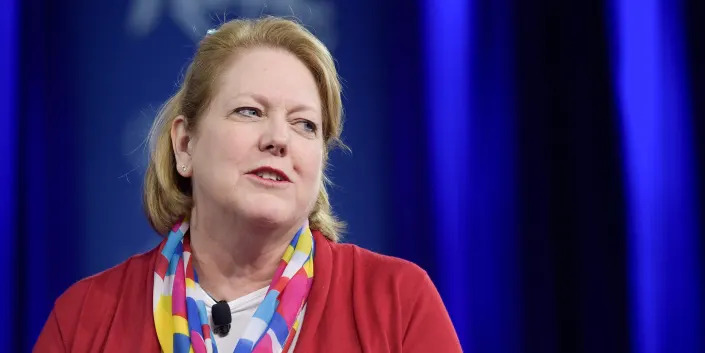
Virginia “Ginni” Thomas at the Conservative Political Action Conference in Oxon Hill, Maryland, on February 23, 2017.Susan Walsh/AP
  • A conservative activist helped Ginni Thomas rake in nearly $100,000 for consulting, The Washington Post reported.
  • Conservative lawyer Leonard Leo reportedly ensured Ginni Thomas’ name was kept off the paperwork.
  • The nonprofit that was billed filed an amicus brief before the Supreme Court that same year.

A little more than a decade ago, a conservative judicial activist helped Ginni Thomas, the wife of Supreme Court Justice Clarence Thomas, secure consulting work that yielded her nearly $100,000 — all the while asking that her name was left off the financial paperwork, according to a new Washington Post report.

Leonard Leo, a lawyer and conservative legal activist, told then-GOP pollster Kellyanne Conway to bill a nonprofit he advised, Judicial Education Project, and give that money to Ginni Thomas in January 2012, the outlet reported, citing financial documents.

That very same year, Leo’s nonprofit filed an amicus brief to the Supreme Court in a key voting rights case in which a 5-4 majority — that included Thomas — ultimately opted to strike down a component of the Voting Rights Act.

The Post highlighted an opinion that Thomas wrote for the case, in which he favored the same outcome that the Judicial Education Project pushed for alongside other conservative organizations. However, he did not mention the amicus brief submitted by the nonprofit.

The latest scandal comes amid a flood of judicial misconduct allegations against Thomas in recent weeks. A series of ProPublica reports alleged that the longest-serving justice sold his childhood home to GOP mega-donor Harlan Crow without disclosing the sale and accepted decades of expensive — and undisclosed — vacations from Crow.

Ginni Thomas has previously courted controversy with her public, pro-Trump activities, and other conservative activism.

The Post said documents show that Leo instructed Conway at the time to “give” Ginni Thomas “another $25K,” noting that the billing information should have “no mention of Ginni, of course.”

“When you funnel tens of thousands of dollars to the wife of a Supreme Court justice and go out of your way to specify that her name must be kept off all records of the transaction, that means you know you are doing something wrong,” Sarah Lipton-Lubet, president of the Supreme Court advocacy nonprofit Take Back the Court, said in a statement shared with Insider.

Leo told The Post in a statement that Ginni Thomas’ work at the Judicial Education Project “did not involve anything connected with either the Court’s business or with other legal issues.”

“Anybody who thinks that Justice Thomas is influenced in his work by what others say or do, including his wife Ginni, is completely ignorant of who this man is and what he stands for,” Leo’s statement read, per The Post. “And anybody who thinks Ginni Thomas would seek to influence the Supreme Court’s work is completely ignorant of the respect she has for her husband and the important role that he and his colleagues play in our society.”

The conservative activist said he kept Thomas’ name off the financial paperwork “knowing how disrespectful, malicious and gossipy people can be,” per The Post.

“I have always tried to protect the privacy of Justice Thomas and Ginni,” he told the outlet.

Leo and Thomas first met when the justice was a clerk in the District of Columbia Circuit, and have been friends for decades, per The New York Times. Thomas is the godfather to one of Leo’s children and has spent time at the activist’s vacation home, The Times reported, while Ginni Thomas considers Leo a mentor, per The Washington Post.

Leo himself has been under recent scrutiny. Politico reported in March that Leo’s personal wealth soared as he started playing a key role in political fundraising and assisting then-President Donald Trump in 2016 with creating a conservative Supreme Court majority.

And on April 6, a nonprofit watchdog organization in Washington accused Leo of acquiring $73 million over six years from nonprofit groups that illegally sent money to his businesses.

Representatives for Ginni Thomas and the Supreme Court, did not immediately respond to Insider’s requests for comment sent outside regular business hours. Leo’s firm, CRC Advisors, and Conway’s website did not immediately respond to similar requests.

Previously, SCOTUS experts have said that a main issue is the lack of enforcement of ethics standards; justices are tasked with policing themselves.

GOP donor Harlan Crow paid private tuition for relative of Justice Clarence Thomas

USA Today

GOP donor Harlan Crow paid private tuition for relative of Justice Clarence Thomas

John Fritze – May 4, 2023

WASHINGTON − Republican megadonor Harlan Crow paid private boarding school tuition for the grandnephew of Supreme Court Justice Clarence Thomas, according to a report Thursday in ProPublica that was likely to bring a fresh round of scrutiny to both Thomas and the ethics practices at the nation’s highest court.

Thomas had taken legal custody of his grandnephew at the time and told C-SPAN in an interview he was “raising him as a son.” Tuition at the Georgia boarding school ran more than $6,000 a month, ProPublica reported. Thomas did not note the payments from Crow on his annual financial disclosures.

The revelation was the latest involving Thomas and Crow, who paid for lavish trips and private jet travel for the justice and his wife and who purchased three Georgia properties from Thomas and his family − none of which were reported on disclosure forms officials are required to file to give the public insight into their financial arrangements.

The court did not respond to a request for comment.

In a statement, Mark Paoletta, who has represented Thomas’ wife, Ginni, said the tuition payment was not reportable because disclosure requirements do not cover nephews.

“This malicious story shows nothing except for the fact that the Thomases and the Crows are kind, generous, and loving people who tried to help this young man,” Paoletta said.

What’s the potential impact of the latest Clarence Thomas revelations?
  • The latest ProPublica story came as Thomas and the Supreme Court are under heightened scrutiny from Congress and outside groups over ethics concerns. The Senate Judiciary Committee held a hearing Tuesday in which Democrats, in particular, slammed the court for a series of recent stories questioning disclosure practices.
  • But the debate over ethics at the Supreme Court has also become increasingly partisan, and Republican senators at the hearing accused Democrats of highlighting the ethics issues as a way to delegitimatize a court that handed down several controversial and conservative opinions on abortion, guns and religion in recent years.
  • In response to the initial ProPublica story about travel, Thomas said he was “advised that this sort of personal hospitality from close personal friends, who did not have business before the court, was not reportable.” He said he has “endeavored to follow that counsel throughout my tenure,” Thomas said in a statement, “and have always sought to comply with the disclosure guidelines.”
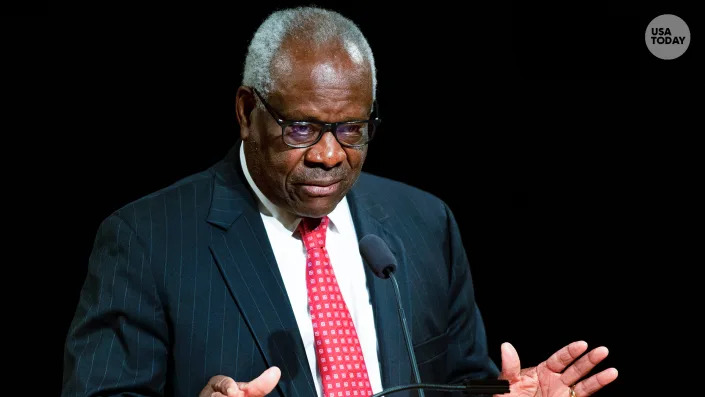
Justice Clarence Thomas and the Supreme Court are under heightened scrutiny from Congress and outside groups over ethics concerns.
‘Harlan picked up the tab’

It was not clear exactly how much money Crow spent on the tuition at the school, Hidden Lake Academy. ProPublica identified a bank statement for July 2009 that showed Crow paid the tuition for Thomas’ relative that month. Christopher Grimwood, a former administrator at the school, told ProPublica that Crow paid the tuition the entire time Thomas’ grandnephew was a student there.

“Harlan picked up the tab,” Grimwood told ProPublica.

Crow’s office responded with a statement asserting that his family has supported many scholarships and blamed “partisan political interests” for trying to turn an effort to help “at-risk youth” into something “nefarious.”

Thomas and Ginni Thomas have also accepted luxury trips for years paid for by Crow, including international travel on his private jet and yacht, ProPublica reported last month. Crow also purchased three Georgia properties from Thomas and members of his family in 2014, a transaction that Thomas failed to note on his annual disclosure forms.

There are big problems with the way the Kremlin drone incident went down, and war experts say Russia ‘likely staged’ it

Insider

There are big problems with the way the Kremlin drone incident went down, and war experts say Russia ‘likely staged’ it

 Mia Jankowicz – May 4, 2023

kremlin explosion drones ukraine russia
Unverified footage on social media appeared to show an object flying over the Kremlin in Moscow.Reuters
  • Much remains unknown about the drone incident that the Kremlin announced on Wednesday.
  • A US think tank, however, argues it was “likely” a Russian false-flag operation.
  • Several commentators have cautiously noted the potential political benefits for Russia.

A US think tank says Russia “likely” staged a drone attack on the Kremlin as a false-flag operation, with other observers noting how politically advantageous the incident would be for Russian President Vladimir Putin.

Russia on Wednesday claimed that two drones — one of which was apparently caught on camera exploding — were sent over the Kremlin as a “planned terrorist act and an attempt on the president’s life.” It characterized the incident as a Ukrainian attack.

Ukrainian President Volodymyr Zelenskyy quickly denied any involvement.

The Kremlin was largely unharmed in the incident, and Putin wasn’t in the building at the time.

As military experts told Insider, many details of the incident — and ultimate responsibility for it — remained unconfirmed as of Thursday.

But the Institute for the Study of War, a US think tank that produces a detailed daily situation update on Russia’s invasion of Ukraine, says “several indicators suggest that the strike was internally conducted and purposefully staged” by Russia.

Russia has bolstered its multilayered air defenses around Moscow, making it “extremely unlikely” that two drones could get close enough to explode “just over the heart of the Kremlin in a way that provided spectacular imagery caught nicely on camera,” the ISW said.

The think tank pointed to geolocated images of Russia installing advanced Pantsir surface-to-air missile-defense systems around Moscow earlier this year.

Moscow and the central industrial district are defended by the 1st Air and Missile Defense Army, equipped with S-300 or S-400 surface-to-air missile systems, as Defense News reported. The Russian defense ministry is also working to further bolster these capabilities by year-end.

The highly coordinated public statements made immediately after the incident also suggest it was no surprise to Russia, the ISW said.

Russia’s much-hyped annual Victory Day celebrations are looming on May 9 — but have been pared back nationwide over security concerns.

Some observers have argued that the celebrations could turn into a show of dissent against Russia’s invasion of Ukraine, as the BBC reported.

The Kremlin could use the drone incident to justify scaling them back even further, which would help it in “framing the war in Ukraine as directly threatening Russian observance of revered historical events,” the ISW wrote.

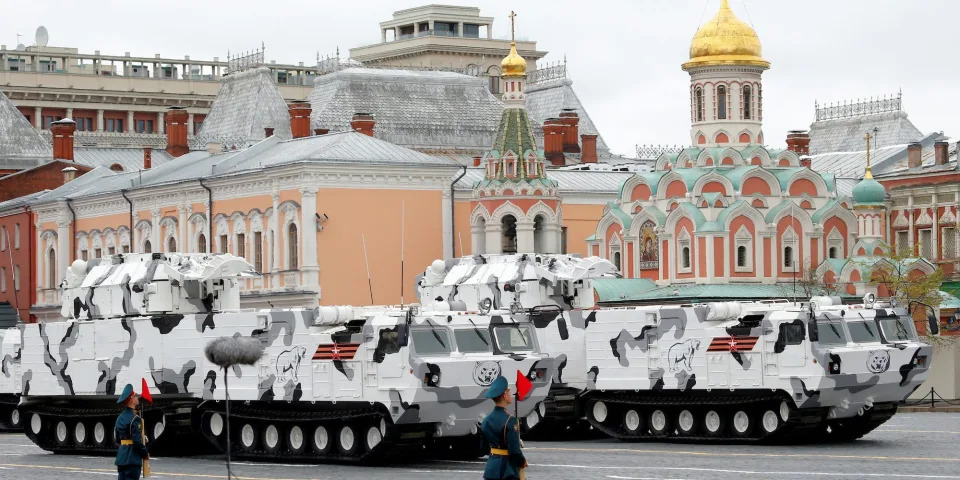
A 2017 image of two Pansir air defense systems, painted in white and grey, in Moscow.
A 2017 image of two Pantsir-SA surface-to-air missile systems during a parade in Red Square.Sergei Karpukhin/Reuters

Several commentators have speculated on the positive political possibilities for Russia in staging such an attack, both domestically and on the international stage.

“Russia needs some sort of justification for why they are continuing to stay in Ukraine,” Marina Miron, a postdoctoral researcher at the Department of War Studies at King’s College London, told Insider, speaking hypothetically about the incident.

“And so this has a message for the domestic populace to say: ‘Look how dangerous Ukraine is. They’re even trying to kill Putin.'”

“The motives are all really in Russia’s favor,” an unnamed UK senior defense source told the Sky News correspondent Tamara Cohen.

The source echoed Miron’s sentiments, saying it would encourage “the public to rally round; excuse for more random and reckless bombardments; trying to gain sympathy for Russia over Ukraine.”

Russia also has a history of false-flag attacks and is known to make demonstrably false claims around international incidents.

Still, other theories — such as the drone incident being a warning signal from Ukraine or the work of Russian dissidents — are far from closed off, experts told Insider.

Some commentators have said Ukraine’s denial is undermined by the fact that it has also denied prior incidents on Russian territory that have been widely attributed to Kyiv.

James Patton Rogers, a drone expert, hypothesized that the drones used could have been the Ukrainian UJ-22, which was most likely used in a prior attempt on a Gazprom site near Moscow in February. He said the earlier strike could have been a test to feel out Moscow’s air defenses.

The Russian defense and foreign ministries didn’t immediately respond to requests for comment.

GOP Lawmaker’s Wild Claim About Those Who ‘Hate Homosexuals’ Causes Literal Jaw-Drop

HuffPost

GOP Lawmaker’s Wild Claim About Those Who ‘Hate Homosexuals’ Causes Literal Jaw-Drop

Ed Mazza – May 3, 2023

Fox News Flips Over ‘Woke’ Legos

The right-wing network has added another new enemy to its list — the Lego toy company.

There was a jaw-dropping moment on the floor of the Florida House of Representatives this week after a Republican lawmaker’s comment about who really hates the LGBTQ+ community.

“ISIS, the Taliban and al Qaeda. Those are the folks who discriminate,” state Rep. Jeff Holcomb said Monday. “Our terrorist enemies hate homosexuals more than we do.”

It’s not clear if he misspoke or intended to say it like that, but he was speaking in support of a bill that urges Congress to prohibit “woke social engineering and experimentation” that are “eroding” the military.

The implication that Republicans hate the gay community ― but terrorists hate them even more ― led to gasps in the audience, while Democratic Rep. Kelly Skidmore’s jaw literally dropped:

Holcomb, who is in the Navy Reserve, continued by quoting the Navy creed: “I am committed to excellence and fair treatment of all.”

‘Older generations are so confused’: A young woman on TikTok says Gen Z, Millennials don’t share the same work ethic as Boomers

Money Wise

‘Older generations are so confused’: A young woman on TikTok says Gen Z, Millennials don’t share the same work ethic as Boomers — 3 reasons why she might be onto something

Vishesh Raisinghani – May 3, 2023

Generational grumble is old as time itself.

There’s probably a cave painting about how the younger generation had ruined the hunter-gatherer economy with their “fancy agriculture.” Since then, every successive generation has found a new medium to express their disappointment with ‘them young’uns.’

A recent example comes from the comment section on TikTok, which recently erupted when a young lady explained why Gen Z and Millennials don’t exactly share the same values regarding work.

“Older generations are so confused about why we don’t want to work hard anymore or prioritize our careers,” Demi Kotsoris said in the clip “We know how short life is now.”

Kotsoris goes on to explain that the pandemic and greater access to information have reshaped the perspective of younger generations and made them question whether work should be the center of their lives.

Of course, the response was heated. “This mindset is so [‘you only live once’] that you will regret those decisions later,” says one comment on Kotsoris’ video.

“People are just SELFISH & LAZY NOW,” says another.

But the replies may have missed the point of the video. Here’s why Kotsoris’ message resonates with so many younger workers and why her experience highlights some deeper truths about modern work.

Work isn’t as rewarding anymore

For Baby Boomers, there were clear rewards for working hard. Putting in an average amount of effort allowed a typical worker to buy a nice home, raise children comfortably and travel the world. In the 1980s, the average home price was just four or five times the median income. Now, it’s closer to 7.5 times.

Having a college degree was also far more rare in the 80s. Now, nearly everyone in the job market has a degree so its value has been eroded. Meanwhile, the dollar has been eroded too. Wages haven’t kept up with inflation for decades, so an hour of work today isn’t worth as much as an hour of work in the 80s.

Upward mobility has declined too. A person born in a middle-class family in the 1940s was 93% likely to outearn their parents by the age of 30. For those born in the 1990s, that rate is just 45%.

Some Boomers could beat the odds and create generational wealth by investing in stocks. However, even that is not as easy as it used to be. The S&P 500 was trading at around 10 times its earnings during the 1980s. It’s now trading in the low-20s.

The relationship with corporations has changed

The employee-employer relationship has also changed since the 80s. Defined-benefit pension plans are nearly extinct. A major corporation that went public before the 1970s was 92% likely to survive the next five years. By the early 2000s, the rate had dropped to 63%.

Unions have also declined, which means workers now have far less bargaining power than their parents.

All these factors have made younger workers question the value of company loyalty and lifelong careers.

The pandemic altered perspective

The global pandemic may also have shifted work culture

This is true across generations because the crisis triggered a retirement boom too. Meanwhile, younger workers saw how short life can be, and how easily their lifestyle can be disrupted by a global crisis like a pandemic or climate change. A study by Deloitte found that Gen Z and Millennials are more likely to prioritize work-life balance, flexible work arrangements, and purposeful work.

The pandemic highlighted that remote work is a viable option for many companies. In fact, a survey by Buffer found that 98% of remote workers would like to continue working remotely at least some of the time for the rest of their careers.

This is why nobody watches Russian movies; False flag attempts are unconvincing: Russia says Ukraine tried to kill Putin with night-time drone attack on Kremlin

Reuters

Russia says Ukraine tried to kill Putin with night-time drone attack on Kremlin

Mark Trevelyan – May 3, 2023

A still image from video said to show alleged Ukrainian drone attack on Kremlin

(Reuters) -Russia accused Ukraine on Wednesday of attacking the Kremlin with drones overnight in a failed attempt to kill President Vladimir Putin.

A senior Ukrainian presidential official denied the accusation – the most serious that Moscow has levelled at Kyiv in more than 14 months of war – and said it indicated Moscow was preparing a major “terrorist provocation”.

The Kremlin said Russia reserved the right to retaliate, and hardliners demanded swift retribution against Ukrainian President Volodymyr Zelenskiy.

“Two unmanned aerial vehicles were aimed at the Kremlin. As a result of timely actions taken by the military and special services with the use of radar warfare systems, the devices were put out of action,” the Kremlin said in a statement.

“We regard these actions as a planned terrorist act and an attempt on the president’s life, carried out on the eve of Victory Day, the May 9 Parade, at which the presence of foreign guests is also planned …

“The Russian side reserves the right to take retaliatory measures where and when it sees fit.”

Baza, a Telegram channel with links to Russia’s law enforcement agencies, posted a video showing a flying object approaching the dome of the Kremlin Senate building overlooking Red Square – site of the Victory Day parade – and exploding in an intense burst of light just before reaching it. Reuters could not immediately verify the video’s authenticity.

Ukrainian presidential adviser Mykhailo Podolyak said in comments sent to Reuters: “Ukraine has nothing to do with drone attacks on the Kremlin. We do not attack the Kremlin because, first of all, it does not resolve any military tasks.”

He added: “In my opinion, it is absolutely obvious that both ‘reports about an attack on the Kremlin’ and simultaneously the supposed detention of Ukrainian saboteurs in Crimea … clearly indicate the preparation of a large-scale terrorist provocation by Russia in the coming days.”

The powerful speaker of the lower house of Russia’s parliament, Vyacheslav Volodin, issued a statement demanding the use of “weapons capable of stopping and destroying the Kyiv terrorist regime”.

Margarita Simonyan, head of the state broadcaster RT, wrote on Telegram: “Maybe now things will get started for real?”

PUTIN WAS NOT IN KREMLIN – RIA

The statement from the presidential administration said fragments of the drones had been scattered on the territory of the Kremlin complex but there were no casualties or material damage.

RIA said Putin had not been in the Kremlin at the time, and was working on Wednesday at his Novo Ogaryovo residence outside Moscow.

Another video circulating on Russian social media appeared to show a plume of smoke over the Kremlin after the purported attack.

The video was posted in the early hours of Wednesday on a group for residents of a neighbourhood that faces the Kremlin across the Mosvka River. It was picked up by Russian media, including the Telegram channel of the military news outlet Zvezda.

Victory Day is a major public holiday commemorating the defeat of Nazi Germany in World War Two, and a chance for Putin to rally Russians behind what he calls his “special military operation” in Ukraine.

Russia marks the occasion with a huge military parade on Red Square, for which seating has already been erected.

The state news agency TASS said the parade – for which the Kremlin last week announced tighter security – would still go ahead.

Moscow Mayor Sergei Sobyanin said earlier on Wednesday that the city had introduced an immediate ban on unauthorised drone flights.

Russia has accused Ukraine of numerous cross-border attacks since the start of the war, including strikes in December on an air base deep inside Russian territory that houses strategic bomber planes equipped to carry nuclear weapons. In February, a drone crashed in Kolomna, about 110 km (70 miles) from the centre of Moscow.

Ukraine typically declines to claim responsibility for attacks on Russia or Russian-annexed Crimea, though Kyiv officials have frequently celebrated such attacks with cryptic or mocking remarks.

(Additional reporting by Felix Light and Jake Cordell; writing by Mark Trevelyan; Editing by Kevin Liffey)

Drone Attack On The Kremlin In Moscow (Updated)

The War Zone

Drone Attack On The Kremlin In Moscow (Updated)

Howard Altman – May 3, 2023

Russia claims numerous Ukrainian drone attacks, including against the Kremlin.

Video has emerged showing what appears to be a drone striking at the dome of the Senatsky Dvorets in the Kremlin in Moscow. Russian officials claim that the building came under attack by Ukraine and have vowed to retaliate, while Ukraine’s president denied Kyiv’s involvement in the incident.

The video shows what appears to be a drone approaching the dome and then exploding in a ball of fire that lit up the sky. It seems that this drone did not impact the dome itself, but detonated very close to it, sending flaming debris falling. Two drones are suspected to have attacked the dome in succession.

Stills captured from another video appear to show two drone strikes, one at 2:27 A.M. and another at 2:43 A.M.

Moscow residents say the sound of the explosion could be heard from across the Moskva River, according to the Yakimanca Telegram channel, a Moscow neighborhood social media site.

“The strength of the [explosion] was like a roll of thunder, neighbors from Serafimovicha Street write,” according to Yakimanca. “Also, residents of the House on the Embankment saw sparks in the sky and people with flashlights near the Kremlin wall after the claps. The illumination of the Kremlin and the Kremlin embankment is now off.”

Residents of the House on the Embankment, an iconic block-long apartment building along the banks of the Moskva River, reported “a strong bang and smoke in the center at about 2:30 a.m.,” according to Yakimanca, which posted videos of the incident. “A few minutes later, the popping repeated.”

Putin’s press service blamed Ukraine for the attacks, which could be viewed as a major symbolic victory for Ukraine, especially ahead of Victory Day on May 9. There is hardly a higher profile target than the Kremlin. On the other hand, they could also be used to rally Russians to support Putin’s war efforts. This has already led to speculation that this was a calculated move by Russia.

The video also shows people climbing the tower just prior to the detonation of one of the drones, which has led to suspicions as to exactly how all this played out.

“Last night, the Kyiv regime attempted a drone strike against the residence of the President of the Russian Federation at the Kremlin,” Russia’s official Presidential Press Service stated.

“Two unmanned aerial vehicles targeted the Kremlin. Timely action by the military and special services involving radar systems enabled them to disable the devices. They crashed in the Kremlin grounds, scattering fragments without causing any casualties or damage.”

“We view these actions as a planned terrorist attack and an assassination attempt targeting the President, carried out ahead of Victory Day and the May 9 Parade, where foreign guests are expected to be present, among others.”

Putin “has not suffered in this terrorist attack. His working schedule remains unchanged and follows its ordinary course. Russia reserves the right to take countermeasures wherever and whenever it deems appropriate.”

However, Mikhail Podolyak, an advisor to Ukrainian President Volodymyr Zelensky, denied Kyiv’s involvement.

“As for the drones over the Kremlin. It’s all predictable,” Podolyak said in a tweet. “Russia is clearly preparing a large-scale terrorist attack. That’s why it first detains a large allegedly subversive group in Crimea. And then it demonstrates ‘drones over the Kremlin.’ First of all, Ukraine wages an exclusively defensive war and does not attack targets on the territory of the Russian Federation. What for? This does not solve any military issue. But it gives RF grounds to justify its attacks on civilians.”

Podolyak’s comment about Ukraine not attacking Russian territory is also specious, as we have repeatedly reported numerous incidents where Russian towns along the border and targets beyond have come under attack by various means.

Regardless of who is to blame, Russia has clearly anticipated some kind of attack on its capital, installing a Pantsir air defense system on top of at least two different government buildings in Moscow, including the Ministry of Defense’s headquarters in January. You can read more about that in our coverage here.

We don’t know at this point what kind of drones were involved or from where they were launched, but there have been other apparent attempts by Ukraine to strike near Moscow and Ukrainian drones have gotten closer and closer to the capital in recent months. On April 24, an explosives-laden Ukrainian drone, most likely a UJ-22, was found a short distance from Moscow. You can see it in this tweet below.

We also reported about an incident in February, where a Ukrainian drone came within 70 miles of Moscow. You can read more about that in our coverage here.

But despite the attack, the Victory Day parade will go on and Putin will take part, said Kremlin spokesman Dmitry Peskov, according to TASS.

Putin is working today at his residence near Moscow in Novo-Ogaryovo, Peskov told RIA Novosti.

“The president’s schedule continues without changes,” he said.

As a result of the attack, Moscow’s mayor issued an order banning drone flying in the city.

Moscow’s mayor announced a ban on unauthorized drone flights over the Russian capital Wednesday after the Kremlin said it had shot down two Ukrainian drones targeting President Vladimir Putin. (Photo by NATALIA KOLESNIKOVA/AFP via Getty Images)

Meanwhile, there was yet another Ukrainian attack in Bryansk Oblast, which sits roughly 100 miles away from the Ukrainian border.

“UAVs of the Armed Forces of Ukraine attacked a military airfield in the Bryansk region on the night of May 3,” the Russian Baza news agency reported on its Telegram channel.

“According to preliminary data, a total of five UAVs participated in the attack,” according to Baza. “Two of them were destroyed by small arms, two more exploded on the territory of the airfield. Another drone was not found”.

As a result of the attack, a “non-operating” An-124 cargo jet “received minor damage,” according to Baza. “There were no casualties.”

Bryansk Oblast, which borders Ukraine, has been a frequent target of attacks.

There was also a suspected drone attack on a Russian oil facility in Krasnodar Oblast Russia, across the Kerch Strait from Crimea, according to a local government official.

“A fire at an oil depot in the Temryuk district of the Kuban is seen from Mount Mithridates in Kerch,” Krasnodar Krai Governor Veniamin Kondratyev wrote on Telegram channel, adding that there are no victims and no danger to the public.

The fire response “was assigned the highest rank of difficulty. The fire area was 1,200 square meters. The drone attack has not yet been officially confirmed, but local public reports report that the fire was preceded by an explosion.”

Residents of the village were not evacuated, said Kondratyev.

The resulting fire and smoke could be seen from the Kerch Bridge, itself the site of a Ukrainian attack last October.

These are just some of several suspected Ukrainian attacks noted by Russian milblogger Igor Girkin.

Ukrainian President Volodymyr Zelensky denied his country’s involvement in the Kremlin attack.

In response to this incident, Deputy Chairman of the Russian Security Council, Dmitry Medvedev, called for the assassination of Zelensky and his cabinet.

“After today’s terrorist attack, there are no options left except for the physical elimination of Zelensky and his cabal,” he said on his Telegram channel. “It is not even needed to sign the act of unconditional surrender. Hitler, as you know, did not sign it either. There will always be some kind of changer like the Zitz President Admiral Dönitz.”

Medvedev’s statement elicited a response from Podolyak.

CIA director Bill Burns will brief the Senate Select Committee on Intelligence on the incident, according to CNN.

Ukrainian Defense Minister Oleksii Reznikov echoed Zelensky’s denial.

Large portion of Florida under red flag warning. What’s that mean?

The Florida Times – Union

Large portion of Florida under red flag warning. What’s that mean?

Cheryl McCloud, Florida Times-Union – May 3, 2023

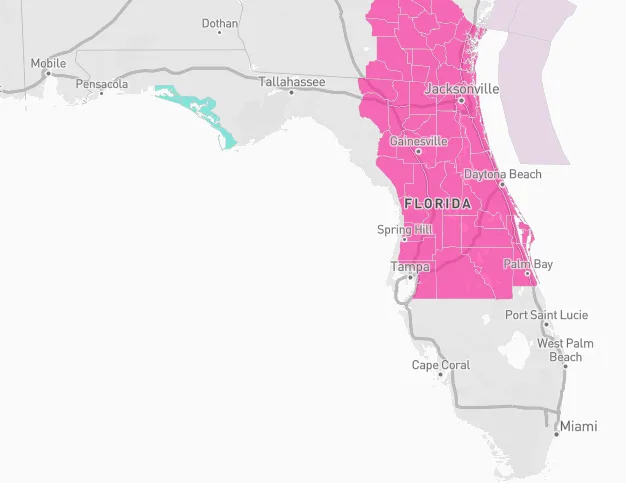
red flag warning is in effect for much of Florida today.

The warning is in effect for Northeast and Central Florida from noon to 7 p.m. In some locations, the warning is in effect until 8 p.m., according to the National Weather Service.

Low humidity, breezy winds and critically dry conditions prompted the warning.

Winds of 15 mph are expected to be out of the west today, with gusts up to 25 mph. Relative humidity is forecast to be 20 percent to 30 percent.

Giant mats lurk off Florida: Giant mats of sargassum are off Florida coast and have beached in spurts but will peak soon

What to know about sargassum: Sargassum seaweed being seen in Florida. Here’s where it’s going and when it will be worst

What is a red flag warning?
Much of Florida is under a red flag warning May 3, 2023.

A red flag warning means warm temperatures, very low humidity, and stronger winds are expected to combine to produce an increased risk of fire danger, according to the National Weather Service.

Conditions also can cause reignition of any smoldering fires started by recent lightning strikes.

What are the dangers with a red flag warning?

Wildfires can grow quickly under these conditions.

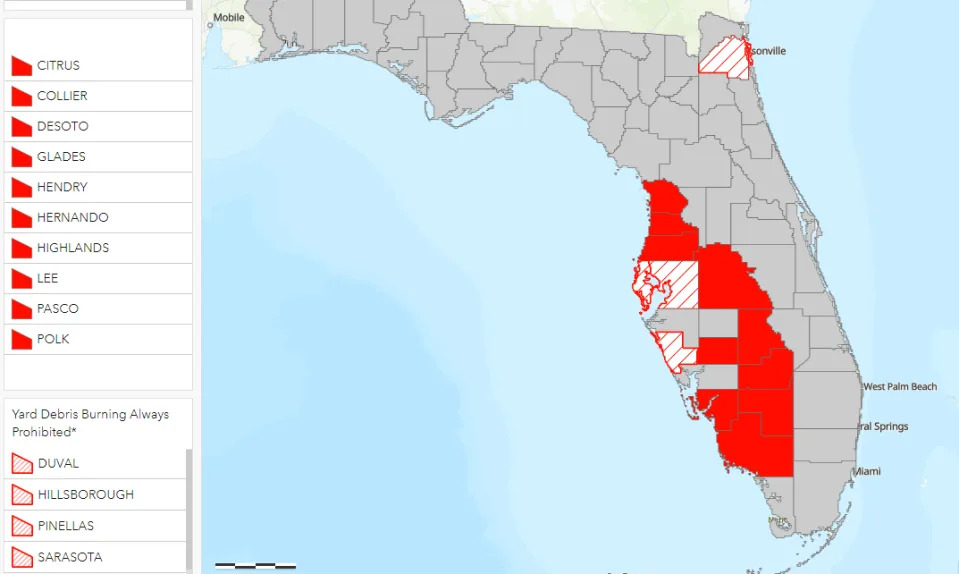
What Florida counties are under a burn ban?
Conditions in Florida prompted a red flag warning for much of the state May 3, 2023. Burn bans in effect.

The Florida Forest Service reports the following counties are under a burn ban as of May 1:

  • Citrus
  • Collier
  • Desoto
  • Glades
  • Hendry
  • Hernando
  • Highlands
  • Lee
  • Pasco
  • Polk

Burning of yard debris is prohibited year-round under county ordinance in these locations:

  • Duval
  • Hillsborough
  • Pinellas
  • Sarasota
How dry is it in Florida?
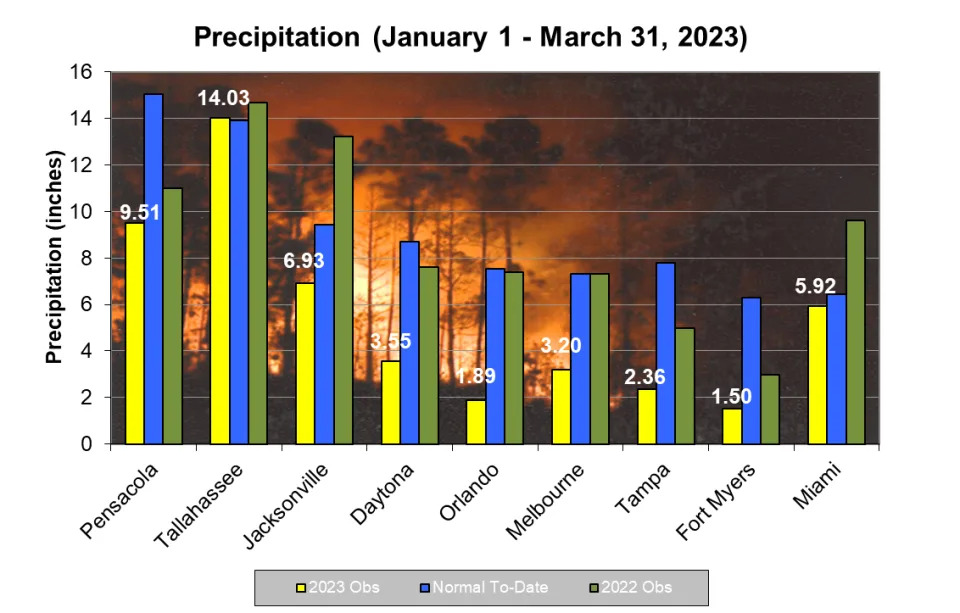
Florida rainfall around the state from Jan. 1 through March 31, 2023.

As La Niña  continues to make itself felt, for the southeastern U.S., that includes a dry and warm winter and a potentially active wildfire season for Florida, according to the Florida Forest Service.

A combination of above-average temperatures and below-average precipitation was in the forecast throughout all North Florida through March.

There may be good news on the horizon: The drought coverage and intensity may have peaked across Florida in recent past weeks, according to the Climate Prediction Center. 

What should you do when under a red flag warning?
  • If you are allowed to burn in your area, all burn barrels must be covered with a weighted metal cover, with holes no larger than 3/4 of an inch.
  • Do not throw cigarettes or matches out of a moving vehicle. They may ignite dry grass on the side of the road and become a wildfire.
  • Extinguish all outdoor fires properly. Drown fires with plenty of water and stir to make sure everything is cold to the touch. Dunk charcoal in water until cold. Do not throw live charcoal on the ground and leave it.
  • Never leave a fire unattended. Sparks or embers can blow into leaves or grass, ignite a fire, and quickly spread.
Where are active wildfires in Florida?

There are 42 active fires covering more than 5,000 acres currently across the state. The Florida Forest Service maintains a map showing the location, size and percentage contained of current wildfires.