Climate change is bad for everyone. But this is where it’s expected to be worst in the US.

USA Today

Climate change is bad for everyone. But this is where it’s expected to be worst in the US.

Dinah Voyles Pulver, USA TODAY – May 7, 2023

If you’re thinking about a long-term real estate investment or shopping for a place to settle down for 20 or 30 years, you might be wondering which cities or states could fare better than others in a changing climate.

“There are no winners in a world where climate change gets worse,” said Alex Kamins, director of regional economics at Moody’s Analytics and author of a recent study on climate risks in the United States.

Climate change is ramping up the long-term risk almost everywhere, said Kamins and others. Temperatures are increasing. Oceans are warming, and rising. And scientists say the heat and higher sea levels help make some natural disasters more extreme.

The impacts vary widely over time and space, so it’s difficult to make a definitive ranking that says “buy here, not there,” but a growing body of evidence helps highlight some general trends.

USA TODAY looked at data from First Street and Moody’s Analytics – two organizations examining future climate risk – to see what areas of the country are most at risk from these climate impacts over the next 30 years.

Insurers and mortgage companies are asking the same kinds of questions, Kamins said. Banks are being asked to “stress test their portfolios in preparation for the impact of climate change.”

While locations with the greatest risks seem obvious – think Florida – others might surprise you.

Here’s your guide to what, when and where you can expect climate change impacts to be the worst in the U.S.

Each region sees risks

Climate change will have uneven impacts on the U.S. in coming decades. Some areas may experience more heat, more flooding, more extreme storms, or more intense wildfires – or all of the above.

The U.S. won’t see any locations underwater or wiped off the map over the next 30 years, Kamins said, but access to fresh water and insurance premiums will become bigger challenges.

“Every year it becomes increasingly crystal clear, just the amount of risk that we face, whether it’s increasingly severe natural disasters or droughts and heat risk,” he said. “In some cases it’s creating renewed momentum or brand new momentum for governments and businesses that hadn’t been thinking seriously about the impact of climate change before.”

Everyone loses out if others are impacted, because we all rely on goods and services from other states and countries,  said climate scientist Michael Mann, director of the Penn Center for Science, Sustainability and the Media at the University of Pennsylvania. “It’s a domino effect.”

East Coast: Wind, flooding and sea level rise stack the deck against many counties and states, especially Florida and the Carolinas, Kamins said. Bustling economies and distance to the beach still attract people in droves, but at some point the tide literally will turn against communities along beaches and coastal rivers.

Southwest: Heat and fire bring increasing risks, particularly in Arizona, he said, even without factoring in the perils of a dwindling water supply.

Interior: Intense heat may affect these states the most in runaway warming scenarios, Mann said. Sudden downpours with unprecedented rain also are occurring more often, even though these states aren’t in hurricane-prone coastal areas. One study he co-authored showed some of the greatest risk of heat stress could be in urban areas in the Pacific Northwest and Great Lakes.

Idaho to Minnesota: A swath of states across the northern U.S. look better than most, with less-pronounced risks, Kamins said. Recent statistics on an influx of newcomers to Idaho and its burgeoning tech hub in Boise show people may be figuring that out. He expects Montana may be the next frontier within 10-20 years.

What are the causes of climate change? How can it be stopped?

What are the effects of climate change? Disasters, weather and agriculture impacts.

States that may face more climate change risk sooner

Texas – Its sheer size and geography means Texas has a lot of risk. First Street’s data shows some of its counties are at great risk of wildfire, some face higher potential losses from tropical cyclone winds and some have greater flood risks. The Lone Star State leads the nation in billion-dollar disasters, according to information from the National Oceanic and Atmospheric Administration. It averages 5.3 such events a year, double the number it experienced in the previous 20, even adjusted for inflation.

Florida – 8,346 miles of shoreline, surrounded on three sides by water. Need we say more? Rising sea levels and extreme rainfall fueled by warming oceans, with the potential for more intense hurricanes while more people crowd into densely populated areas, increase the risks. Florida has the most top spots on First Street’s list of counties that could see the biggest increases in the number of days with the very warmest temperatures they experience today.

New Jersey – The Garden State has counties among the top of First Street’s lists for potential increases in average annual wind losses, extreme fire risk and properties at risk of flooding. New Jersey suffered three hurricanes or their remnants in 2021-22, including Hurricane Ida, Hurricane Henri and the final vestiges of Hurricane Ian. Forecasts for higher winds from more tropical cyclones and hurricanes aren’t good news.

California – Over the past three years, the state has seen its largest wildfire season in history, its worst drought in 1,200 years and a string of record-setting atmospheric rivers. Golden State residents need no reminder of the risks they face, but First Street’s data shows some California counties high on its lists for most extreme fire risk and some cities with the greatest percentage of residential properties at risk of flooding.

Which states did Moody’s Analytics find face the greatest physical risks?

When it comes to weather-related events, hurricanes are literally the heavy hitters when accounting for acute physical risk. Climate change already is cranking up the rain in some tropical storms and hurricanes and could be slowing them down over land but that research is still underway, scientists say. Floods and wildfires also figured into Kamins’ assessment of physical risks. Here’s his list:

  • Florida
  • Louisiana
  • South Carolina
  • North Carolina
  • Delaware
  • Rhode Island
  • New Jersey
  • Virginia
  • Massachusetts
  • Connecticut

Other locations suffer from change happening over time rather than in single headline-grabbing events. Think the creep of rising sea levels or warmer nights and higher average temperatures.

San Francisco faces above average risk across these categories and more, and is the nation’s most exposed large city, Kamins said.

Brown pelicans fly in front of the San Francisco skyline on August 17, 2018 in San Francisco, California.

It’s one of those urban areas where residents aren’t used to temperature extremes and many homes don’t have air conditioning, he said. In a world where temperatures rise 5-10 degrees, unlike Floridians, San Francisco residents are ill-equipped for dealing with heat and it could be economically damaging.

Other cities with more gradually increasing risk on the Moody’s Analytics list are:

Southeastern metropolitan areas are particularly risky because they’re experiencing rising sea levels and higher temperatures, in addition to a parade of cyclones that could be growing more intense, according to Kamins’ study. The top 10:

  • Jacksonville, NC
  • New Bern, NC
  • Myrtle Beach, SC
  • Wilmington, NC
  • Greenville, NC
  • Charleston, SC
  • Punta Gorda, FL
  • Deltona, FL
  • San Juan, PR
  • Palm Bay, FL
  • Goldsboro, NC
Billion dollar disaster data helps point to states already paying the price as the climate changes.

If there’s any doubt about risks from future climate change, look no further than NOAA’s list of the weather and climate disasters that caused at least $1 billion in damages.

At least 37 states suffered twice the number of billion dollar disasters this century than during the previous 20-years.

Tornado activity appears to be expanding in the Mid-South, with more frequent outbreaks, and a USA TODAY investigation showed extreme rainfall events are occurring more often along the Mississippi River Valley. Scientists say both trends may be linked to the warming Gulf of Mexico.

USA TODAY Investigation How a summer of extreme weather reveals a stunning shift in the way rain falls in America.

But it’s not just weather events causing the disaster toll to rise, NOAA said. More extreme weather events take a greater toll when population and development increase in vulnerable areas.

“Where you live is important, but how you live is just as important,” said Stephen Strader, a meteorologist and associate professor at Villanova University. “There are things we can do to better prepare our current developments for climate change.”

Billion dollar disaster events per year since 2001 (More than 3):

  • Texas – 5.3
  • Illinois – 3.9
  • Georgia – 3.7
  • Oklahoma – 3.6
  • Missouri – 3.5
  • North Carolina – 3.4
  • Alabama – 3.3
  • Tennessee – 3.3
  • Virginia – 3.2
  • Kansas – 3.1
  • Mississippi – 3.1

More than 300% increase in billion dollar disaster events per year since 2000:

  • Arizona – 500%
  • Wyoming – 450%
  • Utah – 400%
  • New Mexico – 367%
  • Nevada – 335%
  • Nebraska – 320%
  • Colorado – 300%
  • Wisconsin – 300%

When considering future scenarios, it’s important to note much remains within the world’s control, Mann said.

With substantial action to hold warming below 3 degrees F, “we can limit the worsening of extreme weather events,” although sea level increases would already be locked in, he said. A lack of action would mean “impacts in the interior of our continent could be every bit as bad.”

How taking action could help On Earth Day, scientists tell us what 2050 could be like. Their answers might surprise you.

New cars, once part of the American dream, now out of reach for many

The Washington Post

New cars, once part of the American dream, now out of reach for many

Rachel Siegel and Jeanne Whalen – May 7, 2023

RICHMOND, CALIFORNIA – FEBRUARY 09: In an aerial view, a sign is posted in front of a Nissan dealership on February 09, 2023 in Richmond, California. Nissan reported better-than-expected 155 percent surge in third quarter operating profits of 133.1 billion yen compared to analyst expectations of 104.79 billion yen for the three months ending on Dec. 31. (Photo by Justin Sullivan/Getty Images) (Justin Sullivan via Getty Images)

Juan David Ramirez knows that his 2012 Nissan Juke SL is on its last legs. But buying a new car in the Orlando area these days reminds him of car buying in his home country in Colombia, where only the wealthy can afford new cars.

Ramirez, 33, and his wife Angelica Castro-Calle really want a new, small SUV with a little space for camping and paddle-boarding gear. But despite good jobs in finance and business contracting, the couple’s monthly loan payment would run around $700 for the $35,000 models they are looking at, before dealer markups.

So they plan to patch up the Nissan, which is paid off. He blames the manufacturers and dealers for charging so much for new cars.

“They’re going to price out a certain segment of the market and of the demographic,” Ramirez said. “But that’s something they’re probably okay with.”

Even as inflation is easing and global chip supply shortages are beginning to resolve, more Americans are being priced out of the nation’s new car market, industry and government data suggests. Spending on new cars by the lowest 20 percent of earners dropped to its lowest level in 11 years. Meanwhile, spending on new cars by the top 20 percent reached its highest level on record, going back to 1984, according to the most recent data from the 2021 Consumer Expenditure Survey, not adjusted for inflation.

“New vehicles were maybe never an everyman product in America,” Charles Chesbrough, senior economist at Cox Automotive, said at an automotive conference earlier this year. “We like to believe that they were, but they probably haven’t been for a long time. But certainly they are even less so today.”

The problems pushing new cars out of reach are twofold. On the demand side, rising interest rates have made car loans far more costly – the average monthly payment reached $686 in mid-2022, according to data from Edmunds. Last month, it hit $730.

But even if shoppers can snag a decent interest rate, the supply of cars available for purchase has been trending far more expensive, in part because manufacturers have been funneling resources into souped-up versions of pricey models and cutting back on cheaper options.

In late April, General Motors announced it would scrap production of its top-selling electric vehicle, the Chevy Bolt, wiping out one of the most affordable EVs in the United States by the end of the year. That continues a longtime trend. In 2017, for example, there were 11 models available on the U.S. market for less than $20,000, according to Cox data. By the end of 2022, there were four. Then, by March 2023, only 2.

The end result is a widening gap between those who can afford new cars and those who can’t. The average price of a new car in the United States hit $48,008 in March, up 30 percent from March 2020, according to Kelley Blue Book.

Automakers are selling fewer new vehicles in the U.S. than they did before the pandemic – about 13.9 million last year, versus 17 million in 2019. But their 2022 revenue were still $15 billion higher than in 2019, because the mix they are selling is more expensive, according to Cox Automotive.

A big reason auto manufacturers have leaned heavily into pricier vehicles is the global chip shortage. The dearth of the tiny electronic components, caused by pandemic-related gyrations in supply and demand, forced automakers to slash output, sending prices for new and used vehicles up. The scarcity forced carmakers to ration their components, which they did by reserving them for their most profitable, high-end vehicles.

Automakers have also faced steeper production costs, thanks to factory closures in China during the pandemic and ongoing labor shortages. Some of those troubles are easing. But manufacturers have started holding more parts in inventory to guard against future shortages, a strategy that raises their costs, said Ambrose Conroy, an automotive expert at the consultancy Seraph.

Meanwhile, the auto industry is investing big money to overhaul factories to produce electric vehicles, a major expense that also contributes to rising prices, Conroy added.

Those changes accelerated a years-long trend that was already squeezing affordable cars out of the U.S. market, as automakers shifted to producing more high-margin SUVs and trucks. For more than a decade, automakers cranked up U.S. advertising for pickup trucks and SUVs, which were more profitable to sell in the United States because a 25 percent import tariff protected many of them from foreign competition.

“Everybody seems to have been conditioned to drive an SUV these days,” Conroy said.

Among the cars discontinued last year was the Chevy Spark, the cheapest of which started at $13,600. Chevy sold more than 24,400 of those cars in 2021 – more than most luxury models can claim.

Now, Chevy’s cheapest models cost more than $20,000.

At the same time, the number of models selling for more than $60,000 keeps jumping: 61 in 2017, then 76 in 2021, then 90 in 2022. By March, the category grew to 94 models.

In Austin, Johnny Loredo and his wife paid $38,000 for a new Nissan Frontier truck two years ago. “I was in sticker shock … and it was a base model,” he said. If they hadn’t had a used Suburban to trade in, they wouldn’t have been able to afford it, he said.

“I think they have outpaced what people get paid,” said Loredo, a hotel manager. “When we’re doing raises here, we’re giving the basic two-, three-, four-percent increase, but that cannot maintain a new car. That’s why you’re seeing a lot of used cars and people are just fixing their cars.”

Manufacturers determine which cars get sent to dealerships, and typically won’t send new inventory until the current stock gets sold. In Maryland, where Andrea White has expensive cars sitting on her lot, she said she’s “just suffering through it.”

“We have some final edition Dodge Challengers for $80 or $90K,” White said. “We don’t even want another one.”

Dealers say manufacturers are lifting prices beyond what customers will go for, in some cases leaving dealers stuck with models they can’t sell. Earlier this spring, White had 76 new vehicles on the lot of her Annapolis, Md., car dealership. At the time, she had no takers on the $88,000 Jeep Wagoneer. The $115,000 Grand Wagoneer? Not budging. Many of her cars cost between $50,000 and $60,000.

“I’ve got a few that are so expensive, I would do anything to get them off the lot,” White said. “I’m just giving people prices so that we would just break even. That’s how desperate I am to dump this expensive stuff, because it’s hurting us.”

The mismatch also stems from automakers’ response to how consumers behaved at the height of the pandemic, when many Americans had more cash to spend on goods and were ordering new vehicles with lots of extra features.

“These big Suburbans and Yukons and Expeditions, they were loaded up. So when you look at some of these numbers, some of this was self-inflicted by the consumer,” Pete DeLongchamps, senior vice president at Group 1 Automotive, which owns 150 auto dealerships in the U.S., told a recent automotive conference. “But I think now as the rates have gone up and we’re seeing some of these monthly price points, there is some moderation going on.”

Auto manufacturing officials disagree that they are producing cars that are out of reach, adding that the models for sale reflect customer interests and demand for SUVs and trucks. In a statement, John Bozzella, president and chief executive of the Alliance for Automotive Innovation, said that “the beauty of the auto industry – and this has always been true – is that there’s literally something for everybody.”

“More than 400 models across different manufacturers, configurations, price points and now a choice of powertrains – conventional or electric,” he said. “Why are there so many pickup and utility vehicle models for sale? Because customers really like this category of vehicles.”

Straining shoppers’ budgets even more are rising monthly payments. That’s in large part because the Federal Reserve has been hiking interest rates for more than a year, moving at the fastest pace in decades to rein in inflation. This week, the central bank raised interest rates for the 10th time, bringing the Fed’s benchmark interest rate to between 5 and 5.25 percent. It’s unclear if they will hike it again.

Interest rate hikes ricochet through all kinds of lending to curb consumer demand. The goal is to get borrowing costs high enough that people shy away from buying cars, for example, until supply can catch up with demand.

But the side effect is a widening in the affordability gap. For years leading up to the pandemic, the average monthly payment for a new car hovered between $500 and $600. That quickly changed as the Fed started hiking rates in March 2022.

“When you do the math on what that means to a median household, it is basically pricing the median completely out of the new vehicle market, and leaving higher-income households that disproportionately have more wealth, better credit, and as a result, can afford even more expensive vehicles, so the migration even accelerates in those price points,” said Jonathan Smoke, chief economist at Cox Automotive.

That has economists and auto experts keeping a close watch on car repossession rates, which are approaching pre-pandemic levels. During the covid crisis, lenders became more lenient with late payments and stimulus checks helped people keep up. There seem to be few risks, so far, of a wave of car repossessions. But buffers are drying up, especially for lower-credit consumers who make up the subprime loan market. Their repossession rates now are higher than 2019, according to Kelley Blue Book.

Some dealers say they’re starting to see an uptick in delinquent loan payments, particularly among buyers with weak credit. “Especially at that lower FICO score we’re seeing a big spike in delinquencies today, all due to affordability,” DeLongchamps, the auto dealer, said.

He added that as customers try to lower their monthly payments, loan terms are getting longer – in some cases 72 or 73 months.

Andrew Van Dam contributed to this report.

Ukraine military says all 35 drones Russia launched overnight destroyed

Reuters

Ukraine military says all 35 drones Russia launched overnight destroyed

Reuters – May 7, 2023

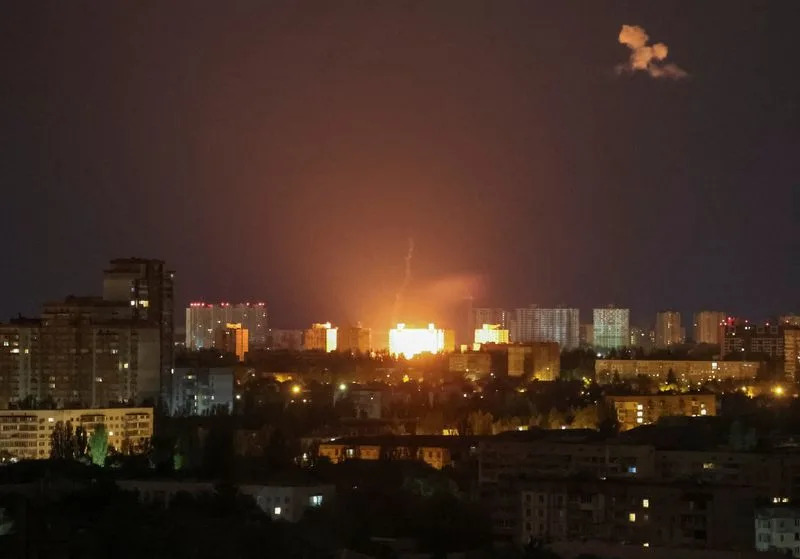
An explosion of a drone is seen in the sky over the city during a Russian drone strike in Kyiv

(Reuters) – Ukraine’s top military command said on Monday that its forces destroyed all 35 Iranian-made Shahed drones that Russia had launched overnight at different targets around the country.

“The Russian Federation (also) launched 16 missile strikes last night, in particular on the cities of Kharkiv, Kherson, Mykolaiv and Odesa regions,” the General Staff of Ukraine’s Armed Forces said in its daily update.

It added that in addition, 61 airstrikes and 52 attacks from the heavy rocket salvo fire systems were launched over the past day on the positions of Ukrainian forces and populated areas.

“Unfortunately, there are dead and wounded civilians, high-rise buildings, private homes and other civilian infrastructure were damaged,” it said.

Reuters was not able to independently verify the reports. Kyiv’s Mayor Klitschko said that at least five people were injured in the capital amidst damage done to buildings and infrastructure.

(Reporting by Lidia Kelly in Melbourne; Editing by Michael Perry)

Russia launches mass strikes on Ukraine ahead of May 9 Victory Day holiday

Reuters

Russia launches mass strikes on Ukraine ahead of May 9 Victory Day holiday

Valentyn Ogorenko and Gleb Garanich – May 7, 2023

An explosion of a drone is seen in the sky over the city during a Russian drone strike in Kyiv
An explosion of a drone is seen during a Russian drone strike in Kyiv

KYIV (Reuters) -Russia launched a large-scale wave of strikes on Kyiv and across Ukraine sowing destruction and injuries, officials said early on Monday, as Moscow prepares for its cherished Victory Day holiday that marks the anniversary of its defeat of Nazi Germany.

At least five people were injured due to Russian strikes on Kyiv, Ukrainian officials said, while Russian missiles set ablaze a foodstuff warehouse in the Black Sea city of Odesa and blasts were reported in several other Ukrainian regions.

The fresh attacks come as Moscow prepares for its Victory Day parade on Tuesday, a key anniversary for President Vladimir Putin who has evoked the spirit of the Soviet army that defeated Nazi German forces to declare that Russia would defeat a Ukraine supposedly in the grip of a new incarnation of Nazism.

Russia intensified shelling of Bakhmut hoping to take it by Tuesday, Ukraine’s top general in charge of the defence of the besieged city said, after Russia’s Wagner mercenary group appeared to ditch plans to withdraw from it.

Three people were injured in blasts in Kyiv’s Solomyanskyi district and two others were injured when drone wreckage fell onto the Sviatoshyn district, both west of the capital’s centre, Mayor Vitali Klitschko said on his Telegram messaging channel.

The Kyiv’s military administration said that drone wreckage fell on a runway of the Zhuliany airport, one of the two passenger airports of the Ukrainian capital, causing no fire, but emergency services were working on the site.

It also said that in Kyiv’s central Shevchenkivskyi district, drone debris seemed to have hit a two-storey building, causing damages. There was no immediate information about potential casualties.

Reuters’ witnesses said they had heard numerous explosions in Kyiv, with local officials saying that air defence systems were repelling the attacks. It was not immediately clear how many drones were launched on Kyiv.

Serhiy Bratchuk, spokesperson for the Odesa military administration, posted on his Telegram channel photos of a large structure fully engulfed in flames, in what he said was a Russian attack on a foodstuff warehouse, among others.

After air raid alerts blared for hours over roughly two-thirds of Ukraine, there were also media reports of sounds of explosions in the southern region of Kherson and in the Zaporizhzhia region in southeast.

Vladimir Rogov, a Russian-installed local official in Zaporizhzhia, said that Russian forces hit a warehouse and Ukrainian troops’ position in Orikhiv, a small city in the region. Reuters was not able to independently verify the report.

Separately, Russian forces shelled eight locations in Sumy region in northeastern Ukraine on Sunday, the regional military administration said in a Facebook post.

In the past two weeks, strikes have also intensified on Russian-held targets, especially in Crimea. Ukraine, without confirming any role in those attacks, says destroying enemy infrastructure is preparation for its long-expected ground assault.

Putin invaded Ukraine on Feb. 24, 2022, calling it a “special military operation” to defend Russia from neo-Nazis in Ukraine, but Kyiv and its allies say it was an unprovoked, land grab.

The invasion sparked the biggest conflict in Europe since World War Two and has killed thousands and forced millions to flee the country.

(Reporting by Valentyn Ogirenko, Gleb Garanich, Lidia Kelly and Elaine Monaghan; Writing by Lidia Kelly; Editing by Himani Sarkar and Michael Perry)

Ukraine downs Russian hypersonic missile with US Patriot

Associated Press

Ukraine downs Russian hypersonic missile with US Patriot

David Rising – May 6, 2023

FILE - Patriot missile launchers acquired from the U.S. last year are seen deployed in Warsaw, Poland, on Feb. 6, 2023. Ukraine’s defense minister said Wednesday April 19, 2023 his country has received U.S-made Patriot surface-to-air guided missile systems it has long craved and which Kyiv hopes will help shield it from Russian strikes during the war. (AP Photo/Michal Dyjuk, File)
Patriot missile launchers acquired from the U.S. last year are seen deployed in Warsaw, Poland, on Feb. 6, 2023. Ukraine’s defense minister said Wednesday April 19, 2023 his country has received U.S-made Patriot surface-to-air guided missile systems it has long craved and which Kyiv hopes will help shield it from Russian strikes during the war. (AP Photo/Michal Dyjuk, File)
FILE - Members of US 10th Army Air and Missile Defense Command stands next to a Patriot surface-to-air missile battery during the NATO multinational ground based air defence units exercise "Tobruq Legacy 2017" at the Siauliai airbase some 230 km. (144 miles) east of the capital Vilnius, Lithuania, on July 20, 2017. Ukraine’s defense minister said Wednesday April 19, 2023 his country has received U.S-made Patriot surface-to-air guided missile systems it has long craved and which Kyiv hopes will help shield it from Russian strikes during the war. (AP Photo/Mindaugas Kulbis, File)
Members of US 10th Army Air and Missile Defense Command stands next to a Patriot surface-to-air missile battery during the NATO multinational ground based air defence units exercise “Tobruq Legacy 2017” at the Siauliai airbase some 230 km. (144 miles) east of the capital Vilnius, Lithuania, on July 20, 2017. Ukraine’s defense minister said Wednesday April 19, 2023 his country has received U.S-made Patriot surface-to-air guided missile systems it has long craved and which Kyiv hopes will help shield it from Russian strikes during the war. (AP Photo/Mindaugas Kulbis, File)
People donate blood in Kyiv, Saturday, May 6, 2023. (AP Photo/Bernat Armangue)

KYIV, Ukraine (AP) — Ukraine’s air force claimed Saturday to have downed a Russian hypersonic missile over Kyiv using newly acquired American Patriot defense systems, the first known time the country has been able to intercept one of Moscow’s most modern missiles.

Air Force commander Mykola Oleshchuk said in a Telegram post that the Kinzhal-type ballistic missile had been intercepted in an overnight attack on the Ukrainian capital earlier in the week. It was also the first time Ukraine is known to have used the Patriot defense systems.

“Yes, we shot down the ‘unique’ Kinzhal,” Oleshchuk wrote. “It happened during the night-time attack on May 4 in the skies of the Kyiv region.”

Oleshchuk said the Kh-47 missile was launched by a MiG-31K aircraft from Russian territory and was shot down with a Patriot missile.

The Kinzhal is one of the latest and most advanced Russian weapons. The Russian military says the air-launched ballistic missile has a range of up to 2,000 kilometers (about 1,250 miles) and flies at 10 times the speed of sound, making it hard to intercept.

A combination of hypersonic speed and a heavy warhead allows the Kinzhal to destroy heavily fortified targets, like underground bunkers or mountain tunnels.

The Ukrainian military has previously admitted lacking assets to intercept the Kinzhals.

“They were saying that the Patriot is an outdated American weapon, and Russian weapons are the best in the world,” Air Force spokesman Yurii Ihnat said on Ukraine’s Channel 24 television. “Well, there is confirmation that it effectively works against even a super-hypersonic missile.” Ihnat said.

He said successfully intercepting the Kinzhal was “a slap in the face for Russia.”

Ukraine took its first delivery of the Patriot missiles in late April. It has not specified how many of the systems it has or where they have been deployed, but they are known to have been provided by the United States, Germany and the Netherlands.

Germany and the U.S. have acknowledged each sending at least one battery and the Netherlands has said it has provided two launchers, although it is not clear how many are currently in operation.

Ukrainian troops have received the extensive training needed to be able to effectively locate a target with the systems, lock on with radar, and fire. Each battery requires up to 90 personnel to operate and maintain.

Defense Minister Oleksii Reznikov said he first asked for Patriot systems when visiting the U.S. in August 2021, months before Russia’s full-scale invasion but seven years after Russia illegally annexed Ukraine’s Crimea peninsula.

He has described possessing the system as “a dream” but said he was told in the U.S. at the time that it was impossible.

The Patriot was first deployed by the U.S. in the 1980s. The system costs approximately $4 million per missile, and the launchers cost about $10 million each, according to analysts.

At such a cost, it was widely thought that Ukraine would only use the Patriots against Russian aircraft or hypersonic missiles.

In a Telegram post on Saturday, Valerii Zaluzhnyi, the commander-in-chief of Ukraine’s Armed Forces, said he had thanked U.S. Gen. Mark Milley, the chairman of the Joint Chiefs of Staff, for the ongoing American aid to Ukraine.

Zaluzhnyi said he also briefed Milley “about the situation at the front and preparations” for Ukraine’s counteroffensive against Russia.

Ukraine has not said when it might launch the counteroffensive, but it is widely anticipated this spring.

In an interview this week with Foreign Affairs magazine, Milley said he would not speculate on if or when it might come, but that with NATO assistance to help train and equip nine brigades’ worth of combined arms, armor and mechanized infantry, “the Ukrainians right now have the capability to attack.”

He also said that their capability to defend was “significantly enhanced from what they were just a year ago.”

“I don’t want to suggest that they may or may not conduct an offensive operation in the coming weeks,” he said. “That’ll be up to them. They’ve got a significant amount of planning and coordination and all of that to do, if they were to do an offensive operation. But they’re prepared to do offense or defense.”

In other developments, officials in both Russia and Ukraine said they had carried out another of their regular exchanges of prisoners of war.

The Russian Defense Ministry said it brought three military pilots back to Russia, and Ukrainian President Volodymyr Zelenskyy’s chief of staff, Andriy Yermak, said 45 fighters who defended the Azovstal steel mill in Mariupol had been returned to Ukraine.

Also on Saturday, Ukraine’s Special Operations Forces accused Russia of using phosphorus munitions in its attempt to wrest control of the eastern city of Bakhmut from Ukrainian forces.

Russian troops have been trying to take the city for more than nine months, but Ukrainian forces are still clinging to positions on the western outskirts.

On Saturday, the Ukrainska Pravda newspaper quoted military officials as saying that “the enemy used phosphorus and incendiary ammunition in Bakhmut in an attempt to wipe the city off the face of the earth.”

A photo accompanying the newspaper report showed an urban area lit up with fire in multiple places.

The allegations could not be independently verified.

Russian forces have not commented on the claim but have rejected previous accusations from Ukraine that they had used phosphorus.

International law prohibits the use of white phosphorus or other incendiary weapons — munitions designed to set fire to objects or cause burn injuries — in areas where there could be concentrations of civilians.

White phosphorous can also be used for illumination or to create smoke screens.

Follow AP’s coverage of the war in Ukraine at https://apnews.com/hub/russia-ukraine

Harlan Crow and Clarence Thomas Are About to Learn About Gift Taxes

Daily Beast

Harlan Crow and Clarence Thomas Are About to Learn About Gift Taxes

Martin Sheil – May 5, 2023

Photo Illustration by The Daily Beast / Getty

Gift taxes were probably not a topic discussed on the yacht or around the campfire during the Harlan Crow-subsidized luxury vacations for Supreme Court Justice Clarence Thomas and his wife, Ginni. But maybe they should have been.

Recent reports indicate that Crow provided Thomas’ grandnephew with tuition to a pricey boarding school in the 1990s. Thomas did not report this gift from Harlan Crow as required on his annual disclosure forms. But that is nothing new. ProPublica had previously reported on multiple luxury vacations provided to Justice Thomas and his wife via Crow’s yacht and jets—including an island-hopping junket in Indonesia that ProPublica valued at $500,000.

That Thomas has made multiple lapses in ethical judgment in not reporting the receipt of such valued largesse from Crow is something for him, SCOTUS, and now Congress to muse over.- ADVERTISEMENT -https://s.yimg.com/rq/darla/4-11-1/html/r-sf-flx.html

Clarence Thomas Has Some Obscenely ‘Generous’ Friends

But what about Crow’s judgment? Did he file gift tax returns and pay gift taxes on any of the gifts he provided to the Thomas family?

It is a reasonable question to ask, and Sen. Ron Wyden (D-OR) appears to have formally done so, with a reported due date of a response May 8. In lieu of gift taxes, did Crow expense the value of the trips and tuition provided the Thomases on either personal or business income tax returns? Wyden wants to know.

If Crow took business expense deductions for the above referenced “gifts,” then he can’t claim they were gifts. And if that’s the case, he wouldn’t have had to file gift tax returns which—given a potential tax rate of up to 40 percent—would represent a pretty price for the billionaire real estate magnate.

The criteria for what constitutes an untaxed gift that exceeds the limit to avoid paying tax vary by year. For example, the limit was $13,000 per recipient in 2013, but $17,000 in 2023. The Indonesian junket—valued at over $500,000 by ProPublica—would generate gift taxes of approximately $200,000 for Mr. Crow.

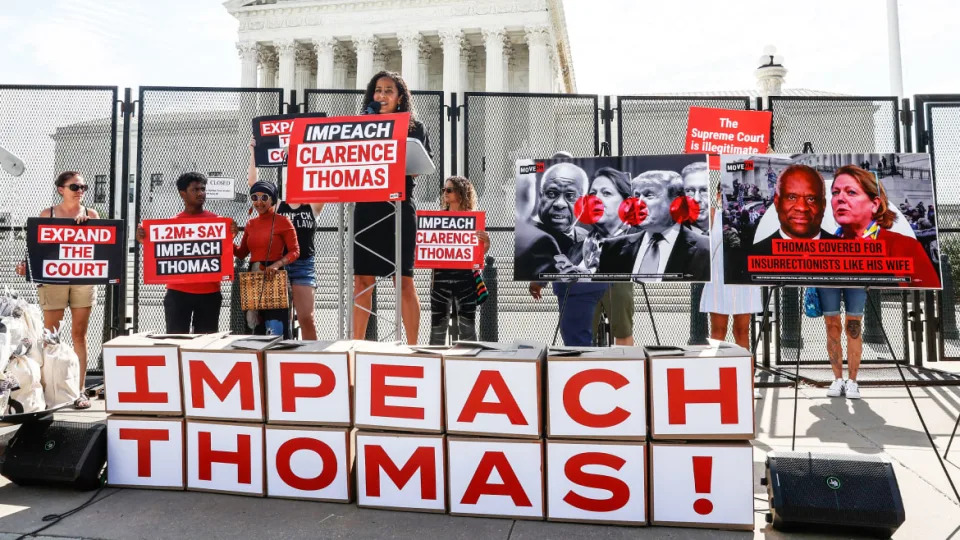
<div class="inline-image__caption"><p>Executive Director of MoveOn.org Rahna Epting speaks at a demonstration where MoveOn.org delivered over 1 million signatures calling for Congress to immediately investigate and impeach Clarence Thomas at the US Supreme Court on July 28, 2022 in Washington, D.C. </p></div> <div class="inline-image__credit">Jemal Countess / Getty </div>
Executive Director of MoveOn.org Rahna Epting speaks at a demonstration where MoveOn.org delivered over 1 million signatures calling for Congress to immediately investigate and impeach Clarence Thomas at the US Supreme Court on July 28, 2022 in Washington, D.C.Jemal Countess / Getty

Now, if Crow did take business deductions for the value of the luxury vacations provided to the Thomases, he would have opened up another can of worms for himself tax-wise. That’s because Crow has publicly stated he did not discuss any business before the court with Justice Thomas.

If that is true, then it is possible that Crow falsified his income tax returns by expensing the cost of the vacation provided the Thomases. It’s also possible the vacations provided the Thomas family could be viewed as income to Thomas—since he would be viewed as providing value to Crow through business discussions. To be very clear, this is speculative and none of this is proven, but the possibility alone makes it worth investigating.

What seems much more clear-cut is that Justice Thomas doesn’t seem to think he has to report gifts from wealthy businessmen, who also are generous corporate political donors, like Harlan Crow.

“Not reportable” is the phrase used by Thomas’ attorney/friend Mark Paoletta when he tweeted (incorrectly) about how the tuition payment by Crow to the school attended by the grandnephew was not reportable as a gift.

Oh my!

Now Would Be a Good Time to Investigate Ginni Thomas

Such an admission by Paoletta suggests knowledge of gift tax requirements by both Thomas and Crow going all the way back to the 1990s. It also raises additional questions. Was Justice Thomas motivated not to disclose valuable junkets provided to him and his family in order to abet his buddy Crow’s non-filing of gift tax returns and/or expensing of the value of the trips on his tax returns?

Oh me oh my!

Now, Mr. Crow may think he has insulated himself by procuring a golden passport from St. Kitts and Nevis—which is a notorious tax haven and money laundering refuge in the Caribbean. Then there’s the fact that Crow’s yacht, the Michaela Rose, has a registered ownership under an entity called Rochelle Marine Limited—a company domiciled in Guernsey, another notorious tax haven located just off the shores of the U.K.

Mr. Crow clearly has employed some clever tax accountants and lawyers over the years. And we all look forward to the answers he provides to the questions posed by Sen. Wyden but, clearly, Crow has exhibited a predisposition for tax avoidance behavior. Did he cross the line into tax fraud? That is something to contemplate and discuss around the campfire.

<div class="inline-image__caption"><p>Analilia Mejia of the Center for Popular Democracy, center, joins other activists calling for ethics reform in the U.S. Supreme Court, at the Capitol in Washington, Tuesday, May 2, 2023. Associate Justice Clarence Thomas has been criticized for accepting luxury trips nearly every year for more than two decades from Republican megadonor Harlan Crow without reporting them on financial disclosure forms.</p></div> <div class="inline-image__credit">J. Scott Applewhite / AP</div>
Analilia Mejia of the Center for Popular Democracy, center, joins other activists calling for ethics reform in the U.S. Supreme Court, at the Capitol in Washington, Tuesday, May 2, 2023. Associate Justice Clarence Thomas has been criticized for accepting luxury trips nearly every year for more than two decades from Republican megadonor Harlan Crow without reporting them on financial disclosure forms.J. Scott Applewhite / AP

But why is this question even significant?

It is murky as to whether any of Crow’s business dealings were ever subject to SCOTUS review—even indirectly. What is not unclear are the heavy-duty political campaign contributions made by Harlan Crow.

Has Mr. Crow donated to dark money PACs? We don’t know, because anonymity is the whole point of dark money PACs.

What about corporate political donations?

There is no limit to those given the Citizens United decision, wherein SCOTUS bestowed personhood on corporations and concluded that limiting corporate political contributions was tantamount to limiting freedom of speech—which was unconstitutional.

Clarence Thomas Shows Why Supreme Court Justices Cannot Be Above the Law

Might that issue have ever come up when Thomas was sailing on Crow’s yacht or flying on his corporate jet? Justice Thomas voted with the majority in Citizens United, which certainly had to make corporate executives everywhere in the U.S. pleased—even if it opened the door to contributions from overseas, and not just from Caribbean tax havens, and not just from dual passport holders.

That Justice Thomas was unethical in not disclosing receipt of luxury gifts provided to him is transparently obvious, though it seems inconsequential to date. But it does raise the question as to whether those who provide wealthy gifts to civil servants that hold positions of power should face any consequences, particularly when tax responsibilities are clear.

Should wealthy corporate executives who make large political donations to obtain results favorable to their business (or make luxury gifts to powerful people) be held accountable? Bottom line—does the wealth, power, and position of the wealthy insulate them from the consequences of their actions? (Normal tax-paying citizens would certainly face such a reckoning.)

These questions are bigger than just Thomas and Crow. They speak to the integrity of our political systems, and whether ordinary Americans should have to live by different rules than the wealthy and politically powerful.

“No mention of Ginni.’ Conservative activist directed money to wife of Justice Clarence Thomas

USA Today

“No mention of Ginni.’ Conservative activist directed money to wife of Justice Clarence Thomas

John Fritze, USA TODAY – May 5, 2023

WASHINGTON − A well-known conservative legal activist who has helped shape the modern Supreme Court arranged for the wife of Justice Clarence Thomas to receive tens of thousands of dollars for consulting work, according to a report Thursday in The Washington Post.

Leonard Leo, the former longtime vice president of the Federalist Society who helped President Donald Trump’s administration vet nominees for the high court, instructed Republican pollster Kellyanne Conway to bill a nonprofit called the Judicial Education Project and to pay Virginia “Ginni” Thomas $25,000, The Post reported. Leo made the request in 2012.

“No mention of Ginni, of course,” The Post quoted Leo instructing Conway.

The Post reported that Conway’s firm, the Polling Company, paid Ginni Thomas’s firm $80,000 between June 2011 and June 2012 and expected to pay $20,000 more before the end of 2012. It was not clear what the money was for, though Leo told The Post in a statement that it “involved gauging public attitudes and sentiment.”

The revelation was the latest in a series of reports in recent weeks about money and gifts Thomas and his family have received from outside interests. Earlier Thursday, ProPublica reported that GOP megadonor Harlan Crow had paid private school tuition for Thomas’s grandnephew. Last month, ProPublica revealed new details about private jet travel and luxury yacht trips Thomas also accepted from Crow.

In his statement to The Post, Leo explained his desire to keep Ginni Thomas’ name off the paperwork by asserting he has “always tried to protect the privacy of Justice Thomas and Ginni” because of how “disrespectful, malicious and gossipy people can be.”

Supreme Court Justice Clarence Thomas listens as President Donald Trump speaks before administering the Constitutional Oath to Amy Coney Barrett on the South Lawn of the White House in Washington, Monday, Oct. 26, 2020, after she was confirmed by the Senate earlier in the evening. (AP Photo/Patrick Semansky)

Thomas’s problems multiply at Supreme Court

The Hill

Clarence Thomas’s problems multiply at Supreme Court

 Al Weaver – May 5, 2023

Supreme Court Justice Clarence Thomas is facing a fresh round of scrutiny after the third blockbuster report in less than a month links him financially to GOP megadonor Harlan Crow.

ProPublica reported Thursday that Crow, a Dallas-based real estate developer, paid thousands of dollars in tuition to a private boarding school for Thomas’s great-nephew, whom Thomas has said he raised “as a son.”

Federal ethics laws require the justices to report gifts given to a “dependent child,” but that term is defined to only include the justices’ children or stepchildren. Thomas’s allies have insisted the payment doesn’t violate the disclosure law since it was for Thomas’s sister’s grandson.

But the revelation has only added to the increasing pressure from Democrats for the justices to adopt a binding code of ethics.

“Today’s report continues a steady stream of revelations calling Justices’ ethics standards and practices into question. I hope that the Chief Justice understands that something must be done—the reputation and credibility of the Court is at stake,” Senate Judiciary Committee Chair Dick Durbin (D-Ill.) said in a statement.

When asked during a SiriusXM interview about impeaching Thomas, however, Durbin said “no.” He noted that only one justice, Samuel Chase, had been impeached previously, and Chase was acquitted in the Senate in 1805.

“I don’t think an impeachment is in the works, particularly with the House in a political situation that it’s in today,” Durbin said on “The Briefing with Steve Scully.”

Sen. Richard Blumenthal (D-Conn.), a Judiciary Committee member, argued the matter should be referred to the Department of Justice.

“There’s a potential criminal violation in the misreporting or failure to report certain benefits, gifts and financial transactions. There’s just a drip, drip, drip of additional information that is gravely undermining the Court, but also creating the need for a full factual investigation,” Blumenthal said.

“If [the Justice Department] fails to do so, Congress definitely has a role,” he added.

Thomas did not return a request for comment through a court spokesperson.

Later on Thursday, The Washington Post reported that Leonard Leo, a conservative judicial activist who played a key role in the Supreme Court’s rightward shift, directed tens of thousands of dollars be paid to Thomas’s wife, Ginni, roughly a decade ago.

Leo requested that she not be named in the paperwork, according to the Post. Ginni Thomas, a conservative activist herself, has long insisted that she doesn’t talk about the court’s business with her husband.

Judiciary Committee Democrats have been hamstrung on taking action regarding the court, including on a potential subpoena for Chief Justice John Roberts. He declined an invitation from Durbin to appear at a Tuesday hearing on Supreme Court ethics, noting that it is “exceedingly rare” for a chief justice to give testimony.

That could change if Sen. Dianne Feinstein (D-Calif.), who has been absent for months due to shingles, returns and once again gives Democrats an 11-10 majority on the panel — though even then subpoenaing the chief justice of the Supreme Court would be an extraordinary step.

Thursday’s ProPublica report was the latest financial transaction involving Thomas and Crow to come to light. The investigative outlet last month reported Thomas had accepted luxury trips from Crow, including flying on his private jet, without disclosing the travels.

ProPublica also reported Crow had purchased real estate from Thomas’s mother that Thomas had an interest in.

“The definition of insanity is seeing the same Supreme Court justice violate ethics rules over and over again and expecting him to actually hold himself accountable,” Sarah Lipton-Lubet, president of Take Back the Court Action Fund, said in a statement. “How many more examples of Thomas flouting disclosure rules do our elected leaders need to see before they intervene? Thomas needs to answer for his misconduct. It’s time to subpoena him.”

Republicans, on the other hand, indicated little willingness to wade into the waters related to the justice who has served on the court for 32 years. They say this is an issue for the Supreme Court to deal with and not something that requires congressional oversight. Interfering, they argue, would go against the separation of powers.

“The Supreme Court … writes its own rules and if there is any policing of those rules to be done, I think it ought to be done by them,” Sen. John Thune (S.D.), the No. 2 Senate Republican, told reporters. “I assume the members of the Court, who I have a high level of confidence in, will make the right decisions for the justices on the Court and for the people who work at the Supreme Court in the same way as we make the rules for all members of Congress.”

Sen. Mitt Romney (R-Utah), who recently indicated that he was dismayed by reports of the ethical issues for Thomas, said the Court needs to make ethics changes.

“These revelations with regards to a number of justices, both those appointed by Republicans and by Democrats, suggest that the Court itself needs to evaluate what their disclosure rules are and ethics rules are and methods for enforcing those,” Romney said. “I presume that the chief justice will undertake that.”

Republicans have further portrayed the Thomas scrutiny as a double standard, taking aim at the ethics of the high court’s liberal justices.

They note that liberal Justice Ruth Bader Ginsburg accepted an award in 2010 from the Woman’s National Democratic Club.

They have also pointed to liberal Justice Sonia Sotomayor not recusing herself when the court considered taking up two cases involving book publisher Penguin Random House, despite disclosing payments from the conglomerate for her books. Conservative Justice Neil Gorsuch, who also received payments from the publisher for his book, similarly did not recuse.

‘We will keep killing Russians,’ Ukraine’s military intelligence chief vows

Yahoo! News

‘We will keep killing Russians,’ Ukraine’s military intelligence chief vows

Maj. Gen. Kyrylo Budanov, the head of Ukraine’s military intelligence agency, told Yahoo News that Russian forces no longer have the ability to launch a “serious offensive anywhere in Ukraine.”

Michael Weiss and James Rushton – May 5, 2023

Ukrainian soldiers
Ukrainian soldiers in Donetsk, April 24. (Muhammed Enes Yildirim/Anadolu Agency via Getty Images)

KIYV, Ukraine — The light is dim and the windows are sandbagged. Classical music plays on an unseen speaker somewhere. The man sitting at the large wooden desk, in this fortified bunker office on the Rybalsky Peninsula, on the edge of the Dnipro River, has a pistol holstered at his side.

“They’ve been trying to charge me with terrorism since 2016,” Maj. Gen. Kyrlo Budanov, the chief of the Main Directorate of Intelligence of the Ukrainian Ministry of Defense, said. “But I want to begin by saying that the things they call ‘terrorism,’ we call liberation. And this began not because I went mad and started killing people in Moscow. It happened because they invaded our country back in 2014.”

“They” refers to the Russian government. On April 21, just a few days before Yahoo News sat down with Ukraine’s most recognizable spymaster, the Lefortovo District Court of Moscow arrested Budanov in absentia. He stands accused of creating “a terrorist community,” the “illegal acquisition of weapons by a group of persons,” and “the illegal acquisition of explosive devices by a group of persons.”

Kyrylo Budanov, center
Chief of Ukrainian Intelligence Kyrylo Budanov, center, attending an event in Kyiv, March 10. (Yurii Stefanyak/Global Images Ukraine via Getty Images)

The implication is that Budanov’s intelligence service, more commonly known by its Ukrainian acronym HUR, was behind a string of audacious and lethal attacks inside Russian territory — or what the Kremlin considers to be Russian territory. These include the August car-bomb assassination of Daria Dugina, daughter of Russia’s notorious far-right theorist Aleksandr Dugin, in central Moscow, and the suspected truck bombing in October that partially dismantled the Kerch Bridge, Russia’s only direct link from the Black Sea to occupied Crimea.

U.S. intelligence has attributed Dugina’s killing to the Ukrainian government, although not specifically to the HUR. Asked about this allegation, Budanov said, “Don’t continue with that topic. All I will comment on is that we’ve been killing Russians and we will keep killing Russians anywhere on the face of this world until the complete victory of Ukraine.”

At 37, Budanov has a full face, dotted with light stubble and a slightly shorn forelock, possibly to raise his hairline in an effort to appear older. He is one of the youngest generals in modern Ukrainian history, and probably the youngest director the HUR has ever had — certainly the most famous. Memes of Budanov grinning or his eyes alight in bright red, à la Superman villain General Zod, routinely circulate online whenever something catches fire in Russia or goes badly wrong for Russian occupiers on the Ukrainian battlefield.

After a surprise Dec. 26 drone attack on the Engels-2 air base in Saratov, home to Russian strategic bombers, Budanov told an interviewer he expected to see more of its kind, “deeper and deeper” in enemy territory. According to the Washington Post, the CIA had to persuade Budanov to “postpone” HUR anniversary strikes on Russia on Feb. 24, including one proposed naval-borne TNT assault at the Black Sea port of Novorossiysk.

An oil tanker moored at the Sheskharis complex, one of the largest facilities for oil and petroleum products in southern Russia
An oil tanker moored at the Sheskharis complex, one of the largest facilities for oil and petroleum products in southern Russia. (AP)

Officially, the HUR claims no responsibility for any cross-border attacks, of which there have been many documented examples. It adopts a Mossad-like air of menacing ambiguity whenever they occur.

On some matters, though, Budanov is unambiguous. “As of today, Russia has no military, economic or political potential to create another attempt for a serious offensive anywhere in Ukraine,” he said. “Besides that, it is completely capable of waging serious defensive operations, and this is the very problem we are about to face,” referring to Ukraine’s anticipated counteroffensive.

Budanov believes that Russia’s supply of missiles are running low, almost to the point of exhaustion. “They are trying to accumulate certain stocks and have them ready in order to try to disrupt our offensive, but the truth is that they have taken their stocks almost to zero.”

As with Ukraine’s Defense Minister Oleksii Reznikov, Budanov declines to offer details of where and when that campaign will be. But he is equally confident that occupied Crimea “will be liberated because our victory is impossible without liberating Crimea.”

Policymakers in Washington have long fretted that a recapture of Crimea, assuming such a thing is even feasible, would be something Russian President Vladimir Putin could not tolerate and would prompt him to undertake a massive retaliation, possibly with weapons of mass destruction, but Budanov is not swayed by those fears.

Russian President Vladimir Putin
Russian President Vladimir Putin addressing the Federal Assembly, April 28. (Alexey Danichev/Sputnik/AFP via Getty Images)

“I’d like to underline here that it is unpleasant for me to recognize the following but it’s the truth,” Budanov said. “Unfortunately, the Russian Federation knows how to work with the information space. That is why any event — imagine a rocket that falls into the Kremlin — they will show it as a victory for Russia. They will claim that they’ve prevented the biggest catastrophe to mankind by having that rocket fall into the Kremlin, that this missile has actually demolished the building it was supposed to and has even helped them. It sounds like a joke, but indeed, Russian society is accepting of such stupidities.”

Yahoo News’ interview with Budanov took place on April 24, more than a week before two drones were recorded striking the Kremlin, lightly singeing its domed roof. The Russian government has blamed Ukraine for the attack, which it hyperbolically characterized as an assassination attempt on Putin. Ukrainian President Volodymr Zelensky denied his government’s involvement. “We don’t attack Putin or Moscow,” he said while on a trip to Finland. “We fight on our territory. We are defending our villages and cities.”

U.S. Secretary of State Antony Blinken said Washington could not validate reports of the drone attacks, adding, “I would take anything coming out of the Kremlin with a very large shaker of salt.”

Budanov is calculating and curt. He speaks English well enough to field questions in the language but prefers to answer more precisely in Ukrainian. Often he begins replying before the question has fully been articulated, and throughout the hour Yahoo News spent with him, he at times betrayed an impatience bordering on hostility.

Some of his more eyebrow-raising claims — that Putin is “terminally ill with cancer” and other ailments, or that the Putin shown in photographs or on television is a body double — have a whiff of psychological warfare to them. In that regard, they are hugely successful, fueling tabloid speculation to the point that even Western intelligence has had to sprinkle cold water on them.

“Back in 2021, there was a statement, I believe it was mine,” Budanov said, “that Putin is greatly sick with cancer. It has been two years since then and now everyone starts saying something might be wrong with him. Time will show who was right.” (Bill Burns, the CIA director, characterized Putin as “entirely too healthy” at a public event in July 2022.)

Whatever the veracity and intent of Budanov’s big assertions, there is no doubt he has at his disposal a vast intelligence-gathering capability, if not an extensive agent network operating inside Russia, as is obvious from what the HUR has managed to do. Behind his chair hangs a large portrait of an owl grasping a bat in its talons. This is in homage to the HUR’s official emblem, whose motto in Latin is sapiens dominabitur astris, “The wise man will rule the stars.” The nocturnal bird of prey was selected by a previous HUR director because the bat features in the emblem of the special forces of the GRU, Russia’s military intelligence agency and the HUR’s counterpart. “And owls eat bats,” that director said.

Oleksii Reznikov
Ukrainian Defense Minister Oleksii Reznikov. (Andre Pain/AFP via Getty Images)

About four months before the Russian invasion, one of his deputies showed Yahoo News a website HUR put together featuring the personal photographs, fake passports, even the results of a prostate ultrasound, all belonging to Maj. Gen. Andrey Averyanov, commander of Russian GRU Unit 29155. Also featured were the fake passports of the various young Russian women with whom Averyanov has traveled on “business trips” to Sochi and Crimea. Unit 29155 is an elite murder-and-sabotage squad that Western intelligence has blamed for poisoning GRU defector Sergei Skripal, along with his daughter Yulia, in Salisbury, England, in 2018; mounting a failed coup in Montenegro; and blowing up a series of weapons and ammunition facilities in the Czech Republic and Bulgaria.

How did the HUR manage to quite literally see up the backside of a senior Russian intelligence operative? This question prompted a rare bit of laughter from Budanov. “We are not a consuming body,” he said, “we are a collecting body. That is why everything we say oftentimes is very much different from what others say. We base our assessment on things that are real and some other people watch a lot of TV or just talk to other people and that’s how they build their assessments. The fact that we are geographically close to Russia — let’s put it this way: We have capabilities in the Russian Federation, quite powerful ones.”

Ukrainian soldiers
Ukrainian soldiers take part in military exercises outside Kyiv, April 20. (Sergei Supinsky/AFP via Getty Images)

Budanov was appointed to what became a crucial wartime intelligence role in August 2020 after having served a brief stint as deputy director of one of the departments of Ukraine’s foreign intelligence service. Before that, he was a HUR Spetsnaz or special forces commando dispatched behind enemy lines: Even now, he occasionally appears in selfies from the front, kitted out in full tactical gear, in what one senior HUR official said are no mere photo ops: “Budanov still takes part in special operations.”

In August 2016, so one story goes, he was part of a saboteur campaign in Crimea that killed a lieutenant colonel of Russia’s Federal Security Service, or FSB, one of the successor agencies of the Soviet KGB. Whatever Budanov got up to as a soldier, it was enough to merit receipt of Ukraine’s Order for Courage, roughly equivalent to the Medal of Valor. Russia has tried to assassinate Budanov ever since, including by blowing up his Chevrolet Evanda in 2019 (the bomb detonated too early).

There is a birdcage at one end of Budanov’s office with two chirping canaries. An apocryphal but plausible tale has it that they’re here to die — that is, provide an early-warning system in the event poison gas is ever deployed in this room. The truth is more mundane: They’re just pets, as is the frog frantically trying to climb the glass wall of its aquarium behind Budanov.

According to leaked Pentagon intelligence, Budanov played an instrumental part in fortifying the besieged city of Bakhmut, in eastern Ukraine. For months, the Russians have been devoting enormous resources and manpower into capturing the city, in itself of limited strategic significance, but symbolically a large prize for Moscow. Ukraine’s policy has been to bleed the Russians there for as long as possible in order to weaken their defensive capability when Kyiv presses its counteroffensive in the next few weeks.

A Ukrainian soldier on a destroyed Russian tank
A Ukrainian soldier on a destroyed Russian tank in Luhansk, Ukraine, June 9, 2022. (Diego Herrera Carcedo/Anadolu Agency via Getty Images)

The U.S. was highly skeptical of such a plan. It anticipated that Bakhmut would fall in January, and U.S. intelligence, as reported in the Pentagon leaks, cited Budanov describing conditions in the city as “catastrophic.” He personally ordered a Ukrainian special forces detachment, the so-called Kraken unit, to deploy to Bakhmut to help beat back the threat of Russian encirclement. It worked. Budanov, who correctly predicted the date and timing of Russia’s Feb. 24 full-scale invasion, is dismissive of those in the West who argued that the effort to save Bakhmut would fail or wasn’t worth the cost in untold Ukrainian lives.

“Whoever says this, and you just mentioned these leaks of U.S. materials — we can add to the statements of the Russian leadership at various levels,” he said. “They have been saying since June 2022 that they have almost captured Bakhmut. We are almost in May now and they are still capturing Bakhmut. It’s very easy to talk about territories you have no relation to. It happened in Syria, with people saying, ‘This can be given away, that can be taken.’ It happened in Chechnya. It happened also in Iraq.”

While Bakhmut remains contested, Russia has made unmistakable gains toward the center of the city, largely thanks to the Russian mercenary group Wagner, the vanguard fighting force that has suffered its own catastrophic losses. “It’s three times the number of killed in action that the United States faced on the Guadalcanal campaign in World War II, and that was over the course of five months,” White House National Security Council spokesman John Kirby said of Russian losses in Bakhmut on Monday. Nearly half of those killed in action since December, Kirby explained, were Wagner fighters.

A Ukrainian medic
A Ukrainian medic on the frontlines in Bakhmut, Ukraine. (John Moore/Getty Images)

Budanov esteems this enemy, now labeled by the U.S. as a transnational criminal organization, above all other Russian military formations. “Unlike the regular troops of the Russian military, Wagner engages in training,” Budanov said. “Even the convicts they recruit from Russian prisons are being trained to serve and that is why the results are a lot better than what normal regular army have. They are our enemy, but we need to admit that they are an enemy you’re not ashamed of. It’s incomparable to the level of regular troops. They are a lot higher.”

In yet another sign that the Bakhmut meat grinder has had serious repercussions in Russia, Yevgeny Prigozhin, founder of the Wagner Group, this week took to social media to denounce the Russian Ministry of Defense, general staff and “fat-bellied” bureaucrats in Moscow for what he alleges is their refusal to supply adequate ammunition to his guns for hire. “My lads will not be taking senseless and unjustified casualties in Bakhmut without ammo,” Prigozhin said, surrounded by dozens of masked Wagner mercenaries, in a video. Whether a theatrical ploy or something more serious, he threatened to withdraw all his forces from Bakhmut on May 10, a decision that would in effect mean a Russian abandonment of the city.

For Budanov, Prigozhin has played politics over his private army’s sacrifices in the war since last year because he has to. “His political future is directly linked to his physical survival because there are too many forces in the Russian Federation who want to eliminate him. He obviously will try to defend himself because for him it’s not even an issue of exile or prison; it’s an issue of life and death.”

Florida and Louisiana are borrowing hundreds of millions of dollars to cope with hurricane insurance claims

Quartz

Florida and Louisiana are borrowing hundreds of millions of dollars to cope with hurricane insurance claims

Aurora Almendral – May 4, 2023

In an emergency financial maneuver, the state-chartered insurance associations of Florida and Louisiana have been forced to borrow a combined $1.3 billion to cover insurance claims caused by worsening hurricanes.

The nonprofit insurance associations were already a backstop measure, stepping in after 2022’s Hurricane Ian drove insurance companies in the Gulf Coast into failure, causing the cancellation of tens of thousands of homeowners’ policies and leaving millions in unpaid claims.

But those unpaid claims were so high that the associations have had to turn to emergency borrowing of hundreds of millions of dollars at significant interest rates. “We’re currently in the midst of an insurance crisis,” Jim Donelon, Louisiana’s insurance commissioner, said in a news briefing. The crisis is “largely…a result of hurricane activity in our state the last couple of years.”

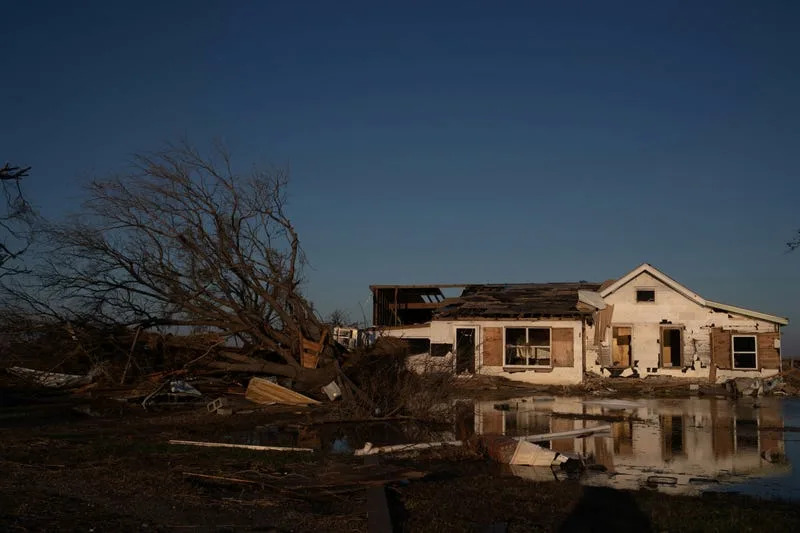
A home destroyed by Hurricane Delta in Louisiana.
Climate change is making insurance more expensive along the US Gulf Coast

As interest rates have risen over the past year, borrowing has become more expensive. Louisiana has taken on debt of $600 million to cover hurricane insurance claims, for instance, and will pay at least $275 million in interest between now and 2038 (pdf).

The increased burden of debt, including the high borrowing costs, will be shouldered by Florida and Louisiana residents in the form of higher premiums for homeowners’ insurance as well as higher costs for auto and theft insurance.

A study published in April confirmed that climate change is making hurricanes stronger, and will cause more catastrophic storms to hit the US East and Gulf Coasts in the coming decades.

“This is an extraordinary event for us,” John Wells, executive director of the Louisiana Insurance Guaranty Association, the state-chartered association, said of the emergency borrowing. “What everybody has to come to terms with is how much it takes to cover catastrophic losses.”

Climate change is causing property insurance markets to collapse

Insurance companies are built on their ability to predict loss. But worsening disasters are injecting more uncertainty into calculations, and insurers in the most climate-affected areas are struggling to cope with it.

Reinsurance companies, which help insurers deal with catastrophes, have been fleeing high-risk areas, particularly those prone to wildfires or flooding.

“Just as the US economy was overexposed to mortgage risk in 2008, the economy today is overexposed to climate risk,” Eric Andersen, president of Aon PLC, one of the world’s largest insurance brokers, said during a Senate hearing in March.

California’s wildfires are also driving an insurance crisis, causing higher premiums and lower coverage limits—if property owners can get coverage at all—as insurers withdraw from the market.

In the Gulf Coast, analysts are warning that more insurers could become insolvent before hurricane season starts again on June 1.