Putin’s Ugly War Has Believers Turning on Their Holy Men

Daily Beast

Putin’s Ugly War Has Believers Turning on Their Holy Men

Anna Nemtsova – April 18, 2022

KYIV—Vladimir Putin’s onslaught has pushed Tatiana Bondarenko, a 53-year-old Ukrainian Orthodox Christian, to her breaking point. First, she was forced to flee her home town in Donetsk in the 2014 war. Then, in March, she had to leave Mariupol after her husband died in crossfire shelling and the city was all but wiped out by Putin’s army. Her life, she says, is ruined, and her heart broken.

On Thursday, Bondarenko was weeping on the steps of Kyiv’s Pokrovsky Monastery, one of 12,000 Ukrainian Orthodox parishes still serving under the Moscow Patriarchate (UOC-MP) led by Russian Patriarch Kirill. She told The Daily Beast she still finds comfort being near the monastery, but her feelings about the institution and the leaders of the church have changed drastically since the start of the war.

Putin’s Holy Man Pushed for the ‘Eradication’ of Ukraine

Bondarenko says she doesn’t want her church to have anything to do with Russian Orthodox leader Kirill any longer. “Please, my God, Patriarch Kirill has blessed this war, he is not the one who has a moral right to tell us that ‘God is love,’” she said. “He has blessed Putin’s friend, commander Zolotov and the Russian soldiers to kill us, Orthodox believers of Ukraine,” Bondarenko added with tears welling in her eyes.

Photo Illustration by Thomas Levinson/The Daily Beast/Getty

She was referring to a recent ceremony in which the Russian Patriarch prayed with President Vladimir Putin’s ex-bodyguard, Victor Zolotov, who is now the commander of the Russian National Guard fighting in Ukraine. “Let it inspire the young warriors who take the oath, embark on the path of defending the Fatherland,” the patriarch said in the Moscow ceremony last month. Zolotov, in turn, complained to the Russian Orthodox Church leader that “not everything is going as fast as we would like.” The commander then expressed his wishes that the prayer would protect the Russian Army “and accelerate our victory.”

<div class="inline-image__caption"><p>Ukrainian worshippers gather to attend a mass at Church of the Most Holy Apostles Peter and Paul in Lviv, Ukraine on April 17, 2022.</p></div> <div class="inline-image__credit">Ozge Elif Kizil/Anadolu Agency via Getty Images</div>
Ukrainian worshippers gather to attend a mass at Church of the Most Holy Apostles Peter and Paul in Lviv, Ukraine on April 17, 2022.Ozge Elif Kizil/Anadolu Agency via Getty Images

The Russian Orthodox Church and its leader have played a huge role in garnering public support for Putin’s war in Ukraine, where about 10 million Orthodox believers still pray in Moscow Patriarchate-affiliated churches. Ukrainian Orthodox Christians whose lives have been upended by the war are left to grapple with the fact that the leader has all but condoned the murder of thousands of innocent civilians.

Now, the cracks are starting to show: More than 400 Ukrainian priests have spoken out against Patriarch Kirill for his support of the war, demanding he be put on trial by the Council of Eastern Patriarchs. Adding to that, scores of Orthodox parishes in Ukraine that have long been loyal to the Moscow Patriarchate have begun to withdraw from the UOC-MP, changing their jurisdictional affiliations to join the independent Ukrainian Orthodox Church instead.

Lonely Putin Is Losing Control of His Own Spiraling Minions

“Kirill has committed a crime: he blessed murders of innocent people,” Metropolitan Oleksandr, one of the most senior clerics of the independent Ukrainian Orthodox Church in Kyiv, told The Daily Beast. He was on his way to a parish that recently declared its independence from the UOC-MP.

“I understand their decision, the criminal Russian army killed thousands of innocent women, children, men in Ukrainian, my own relatives are in the occupied Mariupol, I don’t know if my godfather is alive. Last I heard he and his family were making food on fire outside their ruined house.” His voice cracked when he spoke about his family members.
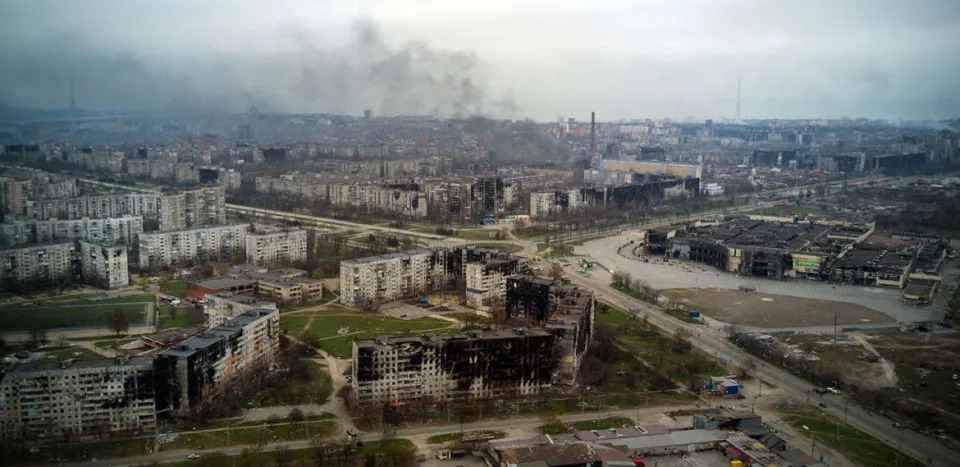
<div class="inline-image__caption"><p>An aerial view taken on April 12, 2022, shows the city of Mariupol, during Russia's military invasion launched on Ukraine.</p></div> <div class="inline-image__credit">Andrey Borodulin/AFP via Getty Images</div>
An aerial view taken on April 12, 2022, shows the city of Mariupol, during Russia’s military invasion launched on Ukraine.Andrey Borodulin/AFP via Getty Images

One Ukrainian priest and his wife, who belonged to a church in the separatist region of Luhansk that follows the Moscow Patriarchate, told The Daily Beast that the church’s guidelines were so jarring that they made the decision to leave it altogether.

“We were allowed to pray for Ukraine for eight years, while Luhansk was a breakaway republic but in February, when the war began, we were told we could not pray for Ukraine any longer, which was just against our beliefs,” the priest’s wife told The Daily Beast while on a bus to Lviv. “The Russian Orthodox Church made us make the decision to run away with our three children. There are more and more priests who disagree with the Moscow Orthodox Church in Ukraine.”

So far at least 16 dioceses out of 53 parishes loyal to the Moscow Patriarchate have stopped praying for Patriarch Kirill. Many are unhappy that the primate of the Ukrainian Orthodox Church, Metropolitan Onufriy, continues to pray for the Russian holy leader at Kyiv’s Pechersk Lavra, the most ancient monastery on the territory of Ukraine built in 1051.

“It is hard to imagine how Father Onufriy or any other priests are still praying for Patriarch Kirill… My 91-year-old grandmother, who has lived under German occupation during World War II and now under Russian occupation, tells me Russian soldiers looted homes, shops and killed three of her neighbors,” Metropolitan Oleksandr told The Daily Beast. “Moscow accuses us and other Orthodox believers of hate but we do not feel hate, we feel righteous anger… every priest who rejects the subordination of the Moscow Patriarchate gets condemned by them and banned from serving, soon they will ban us from breathing.”

By the evening on Thursday, four parishes from Chernihiv and Cherkasy regions requested Metropolitan Oleksandr to allow them to join the autonomous Ukrainian Orthodox Church.

“Just in one day today four parishes made a decision to quit the church of the Moscow patriarchate,” Metropolitan Oleksandr told The Daily Beast. “It is time for all parishes of the Ukrainian Orthodox Church to become independent from Moscow.”

Putin is planning a victory parade on May 9 — no matter what

Opinion: Putin is planning a victory parade on May 9 — no matter what

Opinion by Frida Ghitis – April 18, 2022

Frida Ghitis, a former CNN producer and correspondent, is a world affairs columnist. She is a weekly opinion contributor to CNN, a contributing columnist to The Washington Post and a columnist for World Politics Review. The views expressed in this commentary are her own.

(CNN)When Ukrainian forces repelled Russian troops aiming to capture the capital, Kyiv, they said they found some interesting baggage among the detritus of the Russian retreat — abandoned ammunition and armor, and inside the military vehicles, Russian parade uniforms. “They expected to get Kyiv in two days and then have a parade here,” said Oleksandr Hruzevych, the deputy chief of staff of Ukraine’s ground forces.

Russian President Vladimir Putin couldn’t get a parade in the Ukrainian capital, but a parade is coming soon to Moscow and, whatever happens on the battlefield, the Russian President is likely to declare victory during that event three weeks from now.

May 9 is when Russia marks one of its most important national holidays, Victory Day — the anniversary of Germany’s surrender at the end of World War II. The Kremlin has used that anniversary for more than 70 years to commemorate the successful heroism against the Nazis but, just as importantly, to proclaim to the Russian people and to the country’s friends and foes alike that Moscow’s leaders rule over a great and mighty power.h

Victory Day is all about military muscle, and when it comes in the middle of a war — even one that Russians are forbidden to call a “war” and one that state propaganda falsely claims is going perfectly according to plan — there’s almost no alternative but to use the occasion to boast of victory.

US intelligence assessments, Russian foreign policy analysts and common sense all indicate that Putin will use May 9 as a sort of self-imposed deadline in Ukraine. It’s not a deadline to win the war — that will likely not happen by then — but to pretend Russia has won something. Something major. Something important.

What form Putin's revenge against the US could take

What form Putin’s revenge against the US could take

The campaign over the next three weeks will focus sharply on Ukraine’s east, the Donbas region by the Russian border, where there’s a larger concentration of ethnic Russians and Russian speakers, and where Russian-backed separatists have been waging war against the Ukrainian state for eight years.

That’s where Putin will seek a face-saving success, a concrete victory he can take to the Russian people to tell them he is still the larger-than-life leader whose “special military operation,” with all the hardship it is causing for Russians — let alone the calamity it is inflicting on Ukraine — has been worth the price tag. Unfortunately, his desperation for a win likely means that next three weeks are sure to bring even worse death and destruction to Ukraine.Enter email to sign up for the CNN Opinion newsletter.

So far, Putin’s war has produced almost exactly the opposite of what he wanted — strengthening Ukraine’s sense of nationhood, fortifying and unifying NATO and the West, tarnishing the image of Russia’s military forces and strategists, and on and on. And yet, Putin has been mostly successful at concealing those facts from the Russian people, shutting down independent media and prompting Russia’s genuine journalists to flee the country. That has left almost all Russians consuming only state-controlled media, which is little more than propaganda.

But even dictators need to worry about their domestic standing. If the Russian people view Putin’s Ukrainian adventure as the disaster it has been so far, his hold on power could weaken.

Why the 'Battle of Donbas' will be a critical moment in the war's outcome

Why the ‘Battle of Donbas’ will be a critical moment in the war’s outcome

Even under state-controlled information, some facts can eventually become impossible to conceal. Soldiers will return home to tell their stories to friends and relatives. Thousands will not return. And a small segment of the population may still get its news from abroad. Meanwhile, the Russian people, suffering in dire straits due to sanctions and the departure of many foreign companies from their country, may soon reach an economic breaking point. Either way, slowly the truth will seep in.

That’s why Putin urgently needs to show his campaign as triumphant.

On May 9, Putin almost certainly will stand in Red Square, on a stage built in front of the mausoleum where Soviet leader Vladimir Lenin’s embalmed body has lain on display for more than 90 years, and pretend all is well on his Western front. He will ceremonially review the troops — however many the military can spare from the massive deployment in Ukraine.

We will see if Defense Minister Sergei Shoigu makes an appearance. Until last year, he played a major role, his chest bedecked with medals, resplendent after bloody victories in Syria and Chechnya. These days, he leads a humiliated force and persistent rumors of his demise refuse to die.

Russia was built on an empire of lies. That's the biggest hurdle to peace talks

Russia was built on an empire of lies. That’s the biggest hurdle to peace talks

On that day, Putin will likely announce something about Donbas. Perhaps he will declare it has been “liberated” from the “Nazis” whom he claims rule Ukraine (an absurdly false claim, given the Ukrainian President is Jewish himself). Maybe Russia will hold a phony referendum, as it did after it captured Ukraine’s Crimean Peninsula in 2014. If Russia releases a referendum showing most people in Donbas eager to join Russia, remember a recent independent survey does not support that claim.

Not long after the 2021 Victory Day parade, Putin released an article arguing that Russians and Ukrainians are the same people. It was an ominous sign that Putin would try to erase Ukrainian identity, nationhood and its very borders soon after. Most people in Donbas, the one area of Ukraine where one would expect sympathy for Putin’s historical analysis, soundly reject that view. In an exclusive CNN poll, fewer than one in five agreed that Russians and Ukrainians are “one people.” Still, that is a key element or rationale for Putin’s war.

Another strategic victory for Putin could come if the port city of Mariupol falls, as Russian forces try to establish a land corridor between the territories they control in Donbas and Crimea. That would strengthen Moscow’s control over a large segment of Ukraine, amounting to much more than a symbolic victory. It would be a moral, strategic and economic blow to Ukrainian sovereignty.

To resist the renewed onslaught, Ukraine needs even more help from the West. And Ukraine needs it fast. Putin’s desire to declare victory in three weeks will bring more suffering. But it has also put the Russian leader in potential peril. Whatever he announces on May 9 has to be credible. Otherwise, Putin knows he will become dangerously vulnerable.

After all, the parade is happening in Moscow, not in Kyiv.

Russia faces first foreign default since 1918 – here’s how it could complicate Putin’s ability to wage war in Ukraine

The Conservation

Russia faces first foreign default since 1918 – here’s how it could complicate Putin’s ability to wage war in Ukraine

Michael A. Allen, Associate Professor of Political Science, Boise State University and Matthew DiGiuseppe, Assistant Professor of International Relations, Leiden University – April 18, 2022

<span class="caption">Replacing ships like the Moskva will be pricey. The flagship of Russia’s Black Sea Fleet recently sank after suffering damage.</span> <span class="attribution"><a class=
Replacing ships like the Moskva will be pricey. The flagship of Russia’s Black Sea Fleet recently sank after suffering damage. Russian Defense Ministry Press Service via AP

Russia may be on the cusp of its first default on its foreign debt since the Bolsheviks ousted Czar Nicholas II a century ago.

On April 14, 2022, Moody’s Investors Service warned the country’s decision to make payments on dollar-issued debt in rubles would constitute a default because it violates the terms of the contract. A 30-day grace period allows Russia until May 4 to convert the payments to dollars to avoid default.

A default is one of the clearest signals that the sanctions imposed by the U.S. and other countries are having their intended effect on the Russian economy. But will it have any impact on Russia’s ability to wage war in Ukraine?– ADVERTISEMENT -https://s.yimg.com/rq/darla/4-10-1/html/r-sf-flx.html

We asked Michael Allen and Matthew DiGiuseppe, both experts on political economy and conflict, to explain the consequences of default and what it would mean for Russian President Vladimir Putin’s war.

Why did Russia default on its debt?

The Russian government has a total of US billion worth of debt in dollars and euros, half of which is owned by foreign investors. Russia had an April 4 deadline to pay about 0 million in interest and principle to the holders of two bonds issued in dollars.

Russia has plenty of cash – it collects the equivalent of over billion a day from its oil and gas deliveries alone – but has limited access to dollars because of sanctions imposed by the U.S. The Biden administration had been allowing Russia to use some of the foreign reserves it had previously frozen to make debt payments. The U.S. changed course on April 5, when it blocked Russia from using dollar reserves held at American banks to make the debt payments.

That gave Russia little choice but to try to make the payments in rubles, whose value has been very volatile since the invasion. If Russia doesn’t switch the payments to dollars by May 4, the government will be in default on its foreign obligations for the first time since 1918, when the Bolshevik revolutionaries took over Russia and refused to pay the country’s international creditors. Russia also defaulted in 1998 but only on its domestic debt.

<span class="caption">The last time Russia defaulted on foreign debt was during the Russian Revolution.</span> <span class="attribution"><a class=
The last time Russia defaulted on foreign debt was during the Russian Revolution. AP Photo
What are the consequences of default?

When a country defaults on a foreign loan, international investors typically become unwilling or unable to lend more money to it. Or they demand much higher interest rates.

Whether because of higher interest costs or an inability to borrow, this forces a country to cut spending. Less government spending reduces economic activityincreases unemployment and slows growth. While some of these effects, like weaker economic growth, are often short-lived, other consequences can haunt a country for years. Trade with other countries remains below normal for an average of 15 years after a default, while full exclusion from capital markets typically lasts just over eight years.

For example, when Argentina defaulted in 2001, the peso plunged, the economy shrank and inflation soaredRiots over food broke out all over the country, leading to the president’s resignation. Although Argentina’s economy had recovered by 2007, the country remained unable to borrow from foreign investors, which led to default again in 2014.

What does this mean for Russia? The country was already locked out of international borrowing markets because of sanctions. A government official recently said Russia would also avoid borrowing domestically, because a default would lead to “cosmic” interest rates.

But its significant revenue from sometimes-discounted sales of oil and gas may help offset the need for borrowing in the short term, especially if it can continue to find willing buyers like India and China. On April 14, 2022, Putin acknowledged sanctions were disrupting exports and raising costs.

Does Russia care if it defaults?

The Russian government has been trying hard to avoid default.

Until April 5, it was using its precious dollars to stay current on its bond payments. And before its invasion it had built up a significant reserve of foreign currency, in large part to allow it to continue to pay back debt borrowed in dollars and euros even amid sanctions. Russia has even threatened to take legal action if sanctions force it into default.

As odd as it may sound, Russia is likely worried about its reputation – at least among bond investors.

A default by a sovereign borrower establishes a bad reputation that can take years to rehabilitate, as Argentina’s experience shows.

And the long-term impact could be worse for Russia. The reason Russia is in this bind is because it chose to invade Ukraine, despite repeated warnings that doing so would result in severe economic and financial sanctions.

So creditors might wonder if Russia will always prioritize its foreign policy interests over the interests of creditors and raise borrowing costs permanently. If so, they may find it difficult to borrow for years to come.

Another risk is that a default may enable creditors to seize Russia’s overseas assets as a form of repayment. International sanctions have already enabled countries to seize or freeze Russian assets, which could be used to pay off outstanding debts.

One count suggests that 50% of creditors in recent sovereign debt cases have attempted to seize assets as an alternative to payment.

What does this mean for Russia’s war in Ukraine?

As long as there has been debt, governments have waged wars with other people’s money. In fact, debt has become so vital as a source of power that countries rarely fight without it.

Around 88% of wars from 1823 through 2003 have been at least partly financed with funds borrowed from banks and other investors. This reality even bleeds into fantasy worlds, like “Game of Thrones,” in which financing from the Iron Bank of Braavos is vital to financing the wars of Westeros.

Our own research has shown that countries that have defaulted on their debts or have poor credit ratings find it difficult to build military capacity and, consequently, are more reluctant to take up arms against other nations. Related work has found that countries with lower borrowing costs tend to win wars – though this effect is stronger for democracies.

One reason is that borrowing allows countries to overcome the guns-versus-butter trade-off: More money spent on the military means less for its citizens’ welfare, which can hurt a government’s ability to stay in power. Foreign loans can help overcome this problem, but losing access to credit forces a government to choose.
In the short term, however, a default is not likely to alter the outcome of Russia’s war – or force Putin to make any unpopular trade-offs – especially if Russia is able to achieve its new and more limited military objectives in the eastern Donbas region quickly.

This will change the longer the war goes on. The war was expected to last only a few days, but a stronger-than-expected Ukrainian defense has pushed the conflict into its eighth week. Early estimates found that a prolonged war could end up costing Russia over billion a day, including both direct and indirect expenses, like loss of economic output.

If Ukraine becomes a lengthy war of attritionas some analysts expect, then Russia’s inability to borrow money will weaken its ability to sustain, supply and reinforce its position in Ukraine – especially if oil prices fall or the European Union boycotts or reduces its dependence on Russian fuel.

Roman statesman Cicero wrote: “Nervos belli, infinitam pecuniam,” which loosely translates as “Successful war-waging capacity requires unlimited cash.”

And that means borrowed money. Wars usually end quickly without it.

Ukraine and Russia: What you need to know right now

Reuters

Ukraine and Russia: What you need to know right now

April 18, 2022

Funeral of Roman Vered, 53, who according to his family was killed by Russian soldiers, in Irpin
A local resident cooks food in a courtyard in Mariupol
Russia’s attack on Ukraine continues, in Donetsk region

(Reuters) – Ukraine said a Russian missile attack killed seven people in Lviv on Monday, the first civilian victims in the western city, and reported signs that Russia had started its anticipated new offensive in the east.

FIGHTING* Lviv governor Maksym Kozytskyy said preliminary reports suggested there had been four hits on Lviv — three strikes on warehouses that are not currently being used by the military, and another on a car service station.* Russia appears to have started its anticipated new offensive in the east of Ukraine, Ukraine’s top security official said.* The United States military expects to start training Ukrainians on using howitzer artillery in coming days, a senior U.S. defense official said. * Ukrainian forces in the besieged city of Mariupol are continuing to engage with the Russian military, Anton Herashchenko, an adviser to the interior minister, told national television on Monday.

* Major Serhiy Volyna, commander of Ukraine’s 36th marine brigade which is still fighting in Mariupol, appealed for help in a letter to Pope Francis, saying women and children were trapped among fighters in the city’s large steel plant.* Russia said it had launched mass strikes overnight on the Ukrainian military and associated military targets.

* Luhansk regional governor Serhiy Gaidai said that Russians advanced overnight and took the town of Kreminna.

DIPLOMACY* Ukrainian President Volodymyr Zelenskiy formally submitted a completed questionnaire on European Union membership to an envoy on Monday and said he believed this step would lead to his country gaining candidate status within weeks.* The Kremlin accused Ukraine of constantly changing its stance when it comes to issues that have already been agreed at peace talks.* Humanitarian ceasefires between Ukrainian and Russian forces in Ukraine are not on the horizon right now, but may be possible in a couple of weeks, the U.N. aid chief Martin Griffiths said.

ECONOMY* Russia’s invasion has damaged or destroyed up to 30% of Ukraine’s infrastructure at a cost of $100 billion, a Ukrainian minister said on Monday, adding reconstruction could be achieved in two years using frozen Russian assets to help finance it.

* Russia on Monday flagged a likely further cut in interest rates and more budget spending to help the economy adapt to biting western sanctions as it heads for its deepest contraction since 1994.

QUOTES

“This is what hell looks like on earth … It’s time (for) help not just by prayers. Save our lives from satanic hands,”

Ukrainian major Volyna in a letter to the pope, referring to the situation in Mariupol.

(Compiled by Robert Birsel, Alexandra Hudson and Keith Weir)

U.S. to start training Ukrainians on howitzers in coming days -official

Reuters

U.S. to start training Ukrainians on howitzers in coming days -official

Idrees Ali and Kanishka Singh – April 18, 2022

Ukrainian service members hold drills in the Kherson region

WASHINGTON (Reuters) -The United States military expects to start training Ukrainians on using howitzer artillery in coming days, a senior U.S. defense official said on Monday.

Last week, U.S. President Joe Biden announced an additional $800 million in military assistance to Ukraine, expanding the aid to include heavy artillery ahead of a wider Russian assault expected in eastern Ukraine.

So far, four flights of weapons have been sent by the United States as part of the new package.

The official, speaking on condition of anonymity, said the howitzer training would take place outside Ukraine.- ADVERTISEMENT -https://s.yimg.com/rq/darla/4-10-1/html/r-sf-flx.html

The United States is planning on teaching Ukrainian trainers on how to use some of the new batch of weapons such as howitzers and radars and then for the trainers to instruct their colleagues inside Ukraine.

The United States has previously trained Ukrainian forces on Switchblade drones.

Ukraine said a Russian missile attack killed seven people in Lviv on Monday, the first civilian victims in the western city, and the commander of Ukrainian forces holding out in the devastated southeastern port of Mariupol appealed to the pope for help.

It appeared that Russia was aiming at military targets in Lviv and the capital Kyiv in the north, the U.S. defense official said.

Mariupol was still contested as Russia appeared to have sent reinforcements into Ukraine in recent days, the official added.

“Our assessment is Mariupol is still contested … (it) remains under threat from the air but both from missile strikes as well as bombs from the air but even of course artillery,” the official said.

The official said there were roughly 76 Russian battalion tactical groups in southern and eastern Ukraine, an increase of about 11 in recent days.

Over the weekend, the Russian defense ministry said its anti-aircraft systems in the Odesa region shot down a Ukrainian transport plane delivering weapons supplied by Western governments.

The official said that the United States did not have any information to suggest that was true.

There were no indications that Russia was making any attempt to recover the warship Moskva, flagship of its Black Sea fleet, that sank on Thursday, the U.S. official said.

(Reporting by Idrees Ali and Kanishka Singh; editing by Grant McCool)

Latest U.S. weapons assistance arrives in Ukraine

CBS News

Latest U.S. weapons assistance arrives in Ukraine

Eleanor Watson – April 18, 2022

The first shipments of the latest round of U.S. military assistance to Ukraine, which includes heavier weapons systems, started arriving in the region over the weekend, according to the Pentagon.

The recently approved $800 million in security assistance includes Howitzer artillery systems, 40,000 artillery rounds, armored personnel vehicles and other weapons.

A senior U.S. defense official said Monday that four flights of shipments from the assistance package arrived in the region over the weekend with a fifth expected in the next 24 hours. The official did not detail which weapons from the recent package landed in the region first.

Pentagon spokesperson John Kirby in a press briefing said the Defense Department expects to start training Ukrainian trainers outside of Ukraine on how to use the U.S.-provided Howitzers in the coming days. The Ukrainian trainers will then return to Ukraine and train more troops.

FILE: Lightweight 155 mm Howitzer System / Credit: U.S. Army photo

According to Kirby, the training isn’t expected to take long since the Ukrainians already know how to use artillery systems and merely need to familiarize themselves with the American systems. The Ukrainians use 152mm artillery systems, and the U.S. is providing 155mm artillery systems.

The Russians have refocused on the Donbas region after failing to control Kyiv. The Pentagon assesses they are now conducting “staging operations,” which involves “setting the conditions for more aggressive, more overt and larger ground maneuvers” in the east, according to Kirby.

The impending fight in the east is expected to rely more on armored vehicles and artillery systems than in the north since the terrain in southeastern Ukraine is more flat and wide open.

“The artillery is a specific item the Ukrainians asked for because of the specific fighting they expect is going to occur in the Donbas,” Kirby said on Monday. “And we know the Russians also believe the same thing because we see them moving artillery units into the Donbas as well.”

The recently approved $800 million in assistance to Ukraine also includes Switchblade drones, more Javelin anti-tank missiles, and armored personnel carriers. Overall, the U.S. has provided $2.6 billion in security assistance to Ukraine since Russia invaded at the end of February.

Russia says it launched mass strikes on Ukrainian military overnight

Reuters

Russia says it launched mass strikes on Ukrainian military overnight

April 18, 2022

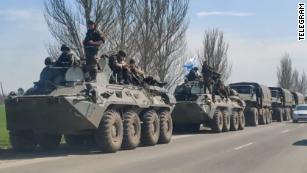
Tanks of pro-Russian troops drive along a road near Mariupol

(Reuters) -Russia said on Monday it had launched mass strikes overnight on the Ukrainian military and associated military targets, using its air force, missile forces, artillery and air defence systems to hit hundreds of targets across its southern neighbour.

The Russian defence ministry said in a statement that air-launched missiles had destroyed 16 Ukrainian military facilities overnight, including five command posts, a fuel depot and three ammunition warehouses, as well as Ukrainian armour and forces.

It said those strikes took place in the Kharkiv, Zaporizhzhia, Donetsk and Dnipropetrovsk regions and in the port of Mykolayiv, and that the Russian air force had launched strikes against 108 areas where it said Ukrainian forces and armour were concentrated.

The defence ministry accused Ukraine of planning “monstrous provocations” with mass civilian casualties designed to cast Russian forces in a bad light.

Specifically, it said Ukraine was plotting to shell Orthodox churches and cathedrals in various Ukrainian regions on the night of April 23, the eve of Orthodox Easter which is celebrated by most Ukrainians and Russians. It said it had evidence to back its assertions but did not provide any. There was no immediate response to the allegations from Ukraine.

Ukraine’s defence ministry did not immediately reply to a request for comment.

The Russian defence ministry also spoke of destroying 12 Ukrainian strike drones and tanks in other parts of Ukraine and of using Iskander missiles to destroy four arms and equipment depots in the Luhansk, Vinnytsia and Donetsk regions.

Russia, which sent troops into Ukraine on Feb. 24, has pledged to continue what it calls “a special military operation” to degrade the Ukrainian military and root out people it calls dangerous nationalists, until it has met all its objectives.

It is currently focused on trying to take full control of the Ukrainian port city of Mariupol, which has been besieged for weeks.

The defence ministry said Russian artillery had also struck 315 Ukrainian military targets overnight and that air defence systems had been used to bring down two MiG-29 fighters and one SU-25 plane.

(Reporting by Reuters; Editing by Raju Gopalakrishnan)

Ukraine: 7 dead, 11 injured after Russia’s military launched missiles into Lviv

Fox News

Ukraine: 7 dead, 11 injured after Russia’s military launched missiles into Lviv

Lawrence Richard – April 18, 2022

At least seven people have been killed and 11 others were injured in Lviv, Ukraine, Monday morning, after Russia’s military launched several missiles into the city, officials said.

Smoke rose over the Western city after four missiles hit three warehouses and also struck a civilian car tire service garage, where people were working, a Ukraine military spokesperson said.

The explosions severely injured three adults and a child suffered minor injuries.

UKRAINE PUSHES RUSSIA BACK FROM KHARKIV; SOLDIERS IN MARIUPOL RESIST KREMLIN ULTIMATUM

LVIV, UKRAINE - APRIL 18: Smoke rises after five aimed missile strikes hit Lviv, Ukraine on April 18, 2022. <span class="copyright">Photo by Ozge Elif Kizil/Anadolu Agency via Getty Images</span>
LVIV, UKRAINE – APRIL 18: Smoke rises after five aimed missile strikes hit Lviv, Ukraine on April 18, 2022. Photo by Ozge Elif Kizil/Anadolu Agency via Getty Images

West Air Command confirmed the missile attack, which also reportedly damaged infrastructure along train rails. The missiles were believed to be intended for a train station, the Ukrainian military spokesperson said.

Local authorities are still attempting to extinguish the flames and clear the rubble.

Lviv Mayor Andriy Sadovyi said the attack further proves that there are no safe places for civilians in Ukraine.

MARIUPOL WARNS RUSSIA IS PREPARING TO SHUT DOWN CITY TO ‘FILTER’ ALL MEN FOR FORCED SERVICE, LABOR

Across the country, Ukraine has vowed to “fight absolutely to the end” to keep Russia from capturing the port city of Mariupol, Ukrainian Prime Minister Denys Shmyhal said.

Last week, Russia’s military started a seemingly relentless siege of the city, which, if it falls, would be Russia’s biggest victory of the war.

A few thousand Ukrainian fighters reportedly remain in the city.

Capturing Mariupol would provide Russia direct access to the Sea of Azov, giving it routes to resupply and reignite its offensive strategy in Ukraine, specifically in the eastern Donbas region. It would also provide Russia a land corridor to the Crimean Peninsula, an area it seized from Ukraine in 2014.

During a nightly address Sunday, Ukrainian President Volodymyr Zelenskyy said his administration and military were “doing everything to ensure the defense” of his country.

Fox News’ James Levinson, Matt Finn, Jeff Paul and the Associated Press contributed to this report.

A single missile before dawn was the warning: Your city is in Russia’s firing line

Los Angeles Times

A single missile before dawn was the warning: Your city is in Russia’s firing line

Nabih Bulos – April 18, 2022

Kramatorsk, Ukraine-APRIL 18, 2022-A Ukrainian soldier digs up fragment left by the missile that struck the town of Kramatorsk early Monday morning, April 18, 2022. (Carolyn Cole / Los Angeles Times)
A Ukrainian soldier digs up fragments left by a missile in Kramatorsk early Monday. (Carolyn Cole / Los Angeles Times)

It came at exactly 3 a.m. Monday: A flash of light streaking over the city’s darkened streets, then the massive blast, shaking walls, rattling windows and waking those few who had managed an already-troubled sleep.

In the last couple of days, this city in eastern Ukraine had seen relatively few strikes, this despite the persistent sounds of artillery thudding somewhere in the distance, too far to tell from where but to which residents would almost hopefully say “nasha” — ours.

But the Monday morning explosion was another unnerving reminder (not that any was needed, with almost all shops shuttered; two hotels barely operating; most windows boarded up or shattered; and sirens wailing the same sustained note for hours) that Kramatorsk is firmly in the firing line of advancing Russian forces.

A Ukrainian soldier lays out missile fragments.
A Ukrainian soldier lays out fragments left by a missile that struck Kramatorsk early Monday. (Carolyn Cole / Los Angeles Times)

By the time the nightly curfew lifted a few hours later, residents woke to the news that an Iskander, a short-range Russian ballistic missile, had slammed dramatically but harmlessly into a field behind a hotel and a vocational school. It was unclear what it was targeting, but it sent the latest tremor of fear through the city even as Ukrainian President Volodymyr Zelensky warned hours later that the Russian offensive for the east had begun.

Standing in mud by the missile crater — 9 feet deep and triple that in width — was a policeman with a clipboard, flanked by another policeman and two soldiers, taking turns digging out missile fragments from the black chernozem soil and recording what serial numbers they could discern off the components they recovered.

Even before this war started, Kramatorsk was the lynchpin for the Ukrainian government’s earlier conflict against Moscow-backed separatists who tried to seize the city in April 2014 before they were ousted a few months later. For the almost eight years of that fight, Kramatorsk became the main resupply base for the Ukrainian army and the seat of power for the government’s Donetsk regional administration.

As Russia shifts its focus to taking the Donbas region, its forces are closing in from the north, east and south like a shark’s mouth ready to devour Kramatorsk along with the nearby city of Sloviansk. The prize of capturing both would underscore what Moscow wants to accomplish in the east while allowing Russian forces to encircle much of Ukraine’s army.

A man stands next to sandbags.
Kramatorsk Mayor Oleksandr Goncharenko in front of the reinforced city council building. (Carolyn Cole / Los Angeles Times)

Such a prospect has forced Mayor Oleksandr Goncharenko into action. In the weeks since the Russian invasion began, he’s reoriented the city to be on a war footing, stockpiling enough supplies to last a siege two to three months long.

The change is even reflected in the city council building. To enter, one has to go through the rear of the building, past guards and a sandbag bunker. The floor is obscured by boxes loaded with foodstuffs, including large jars of pickles, bags of rice as well as medicines.

It’s been tough, the mayor said, convincing the town’s last holdouts to leave.

A cluster munitions attack this month on the Kramatorsk train station, which left more than 50 people dead and scores wounded, had spurred people to flee. But judging by municipal trash collection levels, Goncharenko said, there were anywhere from 35,000 to 40,000 people still in the city. Evacuations on buses arranged by the municipality had dwindled to a single bus per day.

Many believe one motive for those staying is that a large percentage of the Donbas’ ethnic Russian population harbors pro-Moscow sentiments and would probably not oppose living under Russian rule. But Goncharenko suggested that two months of withering war had changed such allegiances.

“Eight years ago, for Kramatorsk, perhaps 60% were for the Russians. Today I don’t think it’s more than 10%. The mentality has changed,” he said.

“We have to thank Mr. Putin for that — that through this war he brought our people together. Ukrainians are more united now.”

He surmised most people have stayed because they have few options.

“It was the same in 2014. The ones who stay, they have only their house or flat, and they tell us, ‘What would we find in other cities?’ ” he said. “Their home for them is more precious than their own lives.”

That attitude seemed very much on display Monday morning. Though there had been no casualties, the shock wave from the explosion had shattered windows in a swath of eight residential buildings on Kramatorsk’s “Heroes of Ukraine” street, a few hundred yards away. Despite the gray weather, residents and municipal workers swept up the detritus, checked on homes and prepared to put up sheets of plastic to protect against the elements.

Helena, a 55-year-old social worker who gave only her first name for reasons of privacy, was sleeping when she heard the explosion, which destroyed her balcony. She blamed the attack on media coverage during a visit by former Ukrainian President Petro Poroshenko two days prior. He had come to Kramatorsk to distribute aid, she said, as she tried to shoo away visiting reporters for fear that the attention would spur another strike.

“All the locals asked Poroshenko not to do publicity here,” she said. “If he wanted to give us aid, just do that and leave.”

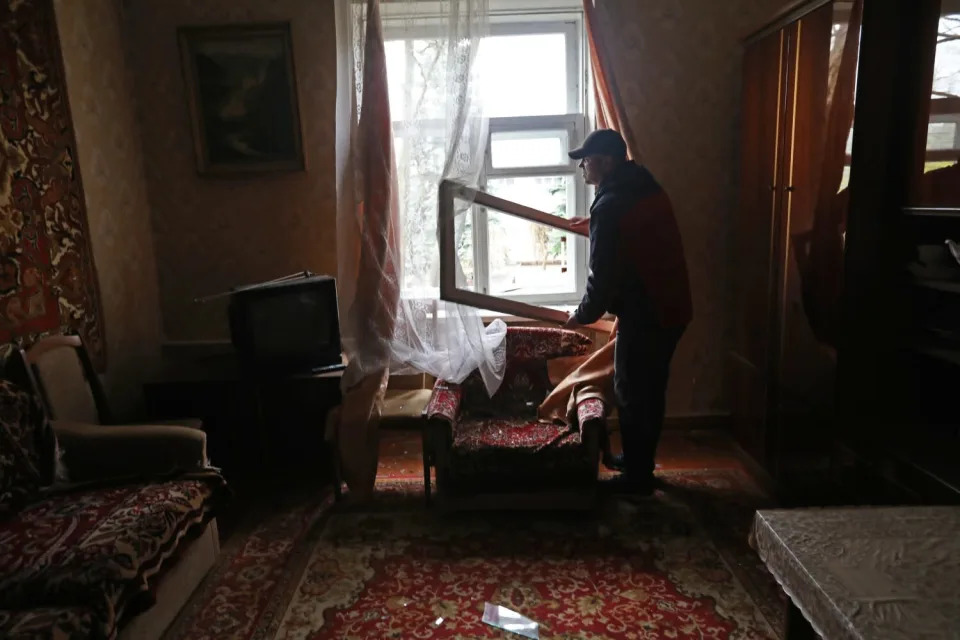
A man repairs a window.
Alexy Dyakov, 44, removes a window broken by a Russian missile strike across the street. He will not leave Kramatorsk because his mother can’t travel. (Carolyn Cole / Los Angeles Times)

Alexy Dyakov, a 44-year-old jeweler living in the nearby village of Lazurny, had come with his mother, Lyudmilla Anatolivna, an elegant, white-haired woman with a black and white fur cap, to see what happened to his apartment. The situation in Lazurny was getting worse — his home there was damaged from another shelling — and he decided to move to a place where he at least had a basement.

“Now I’m not so sure,” he said. He walked around the apartment, a musty two-bedroom that seemed to have been untouched since the Soviet era: display cabinets with tchotchkes and old china; thick carpeting and faded furniture; even an old rotary phone and an ancient TV with an aerial.

He detached the aerial as he spoke, using it to poke away shards of glass from a window pane.

Dyakov had already evacuated his wife and children to Poland, but he had come back to take care of his mother, who recently had heart surgery and wouldn’t survive the journey. She stood in the hallway, speaking calmly at first but breaking down as the sentences rushed out of her.

“He’s here because of me,” she said of her son, who looked at her not unkindly but said nothing.

“I’m guilty. His family left and he’s away from them.”

A elderly woman cries.
Lyudmilla Anatolivna breaks down in her son’s apartment. (Carolyn Cole / Los Angeles Times)

She added that the basement here was their only hope of protection, but it was no longer an option. She felt more vulnerable than ever: The recent blast near the other apartment they owned had damaged her hearing. She couldn’t hear the sirens now. She couldn’t even write her thoughts to calm herself.

“My hand shakes too much,” she said.

Her voice rasped with rage.

“Kill Putin! They say we’re brothers. But do brothers do this? All the time they say Ukrainians kill, but it’s them, those Russian bastards,” she said.

“My mother was Russian. Thank God she didn’t live to see this. Idiots! . . . If something give me a machine gun, I’d kill them just the way they kill our soldiers, our children, our women, everyone.”

Moments later, the siren that had been blaring for more than 30 minutes stopped. Anatolivna seemed not to notice.

Police say 269 bodies recovered in Ukraine’s war-torn Irpin

Reuters

Police say 269 bodies recovered in Ukraine’s war-torn Irpin

Zohra Bensemra and Joseph Campbell – April 18, 2022

View of new graves for people killed during Russia's invasion of Ukraine, in Irpin
View of new graves for people killed during Russia’s invasion of Ukraine, in Irpin
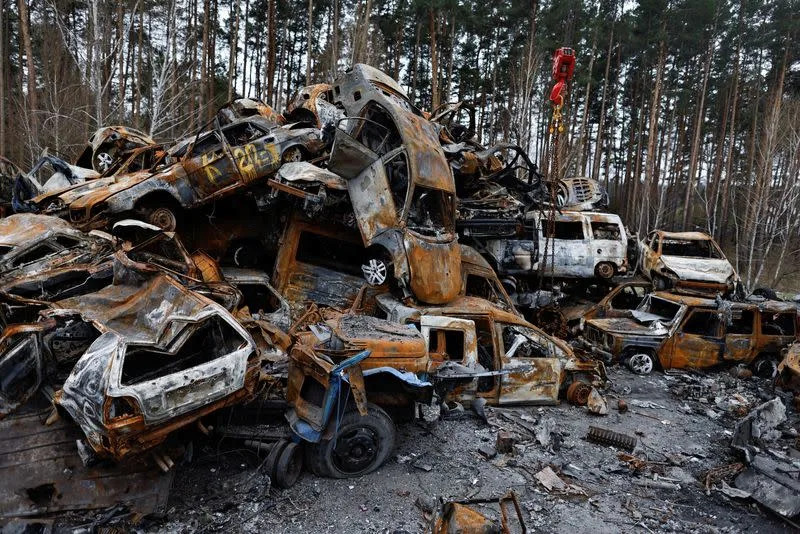
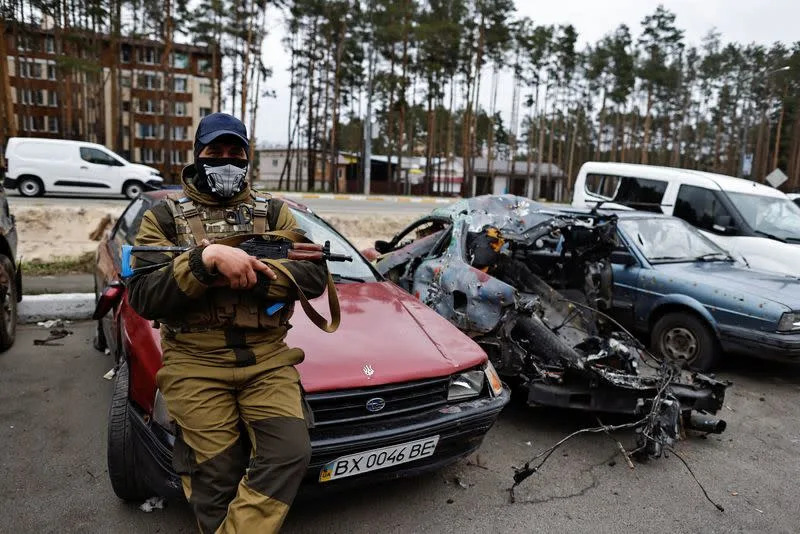
Cars destroyed amid Russia's attack on Ukraine are seen in Irpin
Cars destroyed amid Russia’s attack on Ukraine are seen in Irpin
A member of the Ukrainian Territorial Defence Forces sits next to a destroyed car, amid Russia's attack on Ukraine, in Irpin
A member of the Ukrainian Territorial Defence Forces sits next to a destroyed car, amid Russia’s attack on Ukraine, in Irpin

(Reuters) – Ukrainian investigators have examined 269 dead bodies in Irpin, near Kyiv, since the town was taken back from Russian forces in late March, a police official said on Monday, as workers dug fresh graves on its outskirts.

The town, which had a pre-war population of about 62,000, was one of the main hotspots of fighting with Russian troops before they pulled back from Ukraine’s northern regions to intensify their offensive in the east.

At a cemetery on the outskirts of Irpin, dozens of new graves have been dug and heaped with wreaths. Under the watch of a few tearful mourners, workers hurriedly shovelled the sandy earth into one grave on Monday.

“As of now, we have inspected 269 dead bodies,” said Serhiy Panteleyev, first deputy head of the police’s main investigation department, at an online briefing.

He said forensic work was ongoing to determine the cause of death for many of the victims, sharing photos of severely charred human remains.

He said seven sites in Irpin where civilians were allegedly shot have been inspected, without giving further details.

Russia denies targeting civilians and has dismissed allegations its troops committed war crimes in occupied areas of Ukraine.

(Additional reporting by Max Hunder; Writing by Alessandra Prentice; Editing by Jan Harvey)