Russian commanders angry at how long it’s taking to capture Mariupol, where Ukraine says it will fight to the end: UK intel
Kieran Corcoran – April 18, 2022
Charred buildings and destroyed cars in Mariupol on April 13, 2022.Leon Klein/Anadolu Agency/Getty Images
Mariupol, a port city in southern Ukraine, has seen the fiercest fighting of the Russian invasion.
Troops there have been surrounded and outnumbered, fighting in hellish conditions.
On Monday, UK officials said Russian leaders would be upset that the city was still unconquered.
Russian commanders will be unhappy with their troops’ inability to conquer the besieged city of Mariupol in Ukraine, British intelligence said Monday morning.
In a daily update on the fighting in Ukraine, officials wrote: “Russian commanders will be concerned by the time it is taking to subdue Mariupol. Concerted Ukrainian resistance has severely tested Russian forces and diverted men and materiel, slowing Russia’s advance elsewhere.” (Materiel is a catch-all term for military supplies.)
Mariupol, a port city on Ukraine’s southern coast, has been the scene of intense fighting for almost the entire duration of the 54-day invasion.
It has been surrounded for weeks, hit continuously by shelling and slowly advancing ground troops. Survivors who made it out of the city have repeatedly described it as a “hell on earth,” deprived of food, water, and heating.
Its mayor said 21,000 people there had been killed and that their bodies were “carpeted through the streets.”
Ukrainian fighters in the city have held out for weeks.
Reports from the Associated Press and Financial Times described a last stand by soldiers from Ukraine’s marine corps and its right-wing Azov Battalion paramilitary.
It said they were resisting from inside a bomb-outed Soviet steelworks and a series of tunnels. Some fighters there surrendered in recent days. These included Aiden Aslin, a British man serving as a marine, who featured in a Russian propaganda broadcast and appeared to speak under duress.
Captured soldier Aiden Aslin, a British man who joined the Ukrainian army in 2018, appeared to speak under duress during an interview with Russian state TV.IZ.RU
Ukraine’s prime minister, Denys Shmyhal, told ABC’s “This Week” that the troops in Mariupol “will fight until the end.”
Russian leaders have given no public statements of frustration with their progress in Mariupol.
But analysts and intelligence officials have said Russia’s President Vladimir Putin would have been enraged by a war effort that fell short of his apparent expectations of a swift victory.
After an unsuccessful advance on northern Ukraine and its capital of Kyiv, Russia announced a pivot in its strategy to focus its forces on the eastern Donbas region, which includes Mariupol.
To Push Back Russians, Ukrainians Hit a Village With Cluster Munitions
Thomas Gibbons-Neff and John Ismay – April 18, 2022
The remains of a destroyed Russian armored vehicle in a neighborhood damaged during the war in Husarivka, Ukraine. (Tyler Hicks/The New York Times) (NYT)
HUSARIVKA, Ukraine — It was in early March when the spent warhead of a cluster munition rocket landed next to Yurii Doroshenko’s home in eastern Ukraine, having dispensed its lethal bomblets over his village.
“They were shelling and it hit the street,” he said.
These types of internationally banned weapons have been repeatedly used by the Russian military since it invaded Ukraine in February. Human rights groups have denounced their use. Western leaders have linked their presence to a bevy of war-crimes allegations leveled at Moscow.
But the cluster munition that landed to next to Doroshenko’s house was not fired by Russian forces. Based on evidence reviewed by The New York Times during a visit to the area, it is very likely to have been launched by the Ukrainian troops who were trying to retake the area.
Nobody died in that strike in Husarivka, an agricultural hamlet surrounded by wheat fields and natural-gas lines, though at least two people were killed as Ukrainian forces shelled it for the better part of month, targeting Russian forces.
As the war approaches its eighth week, both sides have relied heavily on artillery and rockets to dislodge each other. But the Ukrainians’ decision to saturate their own village with a cluster munition that has the capacity to haphazardly kill innocent people underscores their strategic calculation: This is what they needed to do to retake their country, no matter the cost.
Cluster munitions — a class of weapon comprising rockets, bombs, missiles, mortar and artillery shells — split open midair and dispense smaller bomblets over a wide area. The hazard to civilians remains significant until any unexploded munitions have been located and properly disposed of by experts.
The Convention on Cluster Munitions, which took effect in 2010, bans their use because of the indiscriminate harm they can cause to civilians: Humanitarian groups have noted that 20% or more of antipersonnel submunitions fail to detonate on impact, yet they can explode later if they are picked up or handled.
More than 100 nations have signed the pact, though the United States, Ukraine and Russia have not.
“It’s not surprising, but it’s definitely dismaying to hear that evidence has emerged indicating that Ukraine may have used cluster munitions in this current conflict,” said Mary Wareham, advocacy director of the arms division at Human Rights Watch. “Cluster munitions are unacceptable weapons that are killing and maiming civilians across Ukraine.”
An adviser to the Ukrainian armed forces and the Ministry of Defense declined to comment.
Russian troops had seized Husarivka from Ukrainian units in the first few days of March, occupying buildings on its outskirts and near its center. The 220-millimeter Uragan artillery rocket that landed near Doroshenko’s home — fired from a truck-mounted launcher many miles away — struck on either March 6 or 7, said Doroshenko, the town’s informal leader.
By that point, the village was well under Russian control.
During a visit around the property and Doroshenko’s street Thursday, Times reporters viewed large pieces of the artillery rocket that dispensed the cluster munitions, confirming the type of weapon that had been fired. It landed near the Russian army’s makeshift headquarters in an adjacent farm workshop, residents said, meaning the Russian forces were almost certainly the target.
Throughout the occupation, Ukrainian forces incessantly shelled the Russian troops there, and at least two of the same type of cluster munition were lodged in a field by Doroshenko’s home, just a few hundred yards away from the Russians’ headquarters.
The rockets fell around a small neighborhood of a dozen or so single-story homes interspersed with small gardens.
As the rockets neared the farm, their warheads — probably carrying 30 antipersonnel bomblets apiece — would have separated from the weapons’ solid rocket motors, breaking open and casting their deadly cargo across the neighborhood.
These small munitions each contain the equivalent of about 11 ounces of TNT, slightly less than twice as much as a standard hand grenade.
The attack on the Husarivka farm appears to be the first use of a cluster munition by Ukrainian troops since the Russian invasion began Feb. 24. In 2015, Ukrainian forces used cluster munitions during the opening months of their war against Russian-backed separatists in the country’s east.
When confronted with the prospect that the Ukrainian military had shelled his village with cluster bombs, Doroshenko, 58, seemed indifferent.
“I don’t know,” he said. “The main thing is that after those rockets everybody comes out alive.”
The hazard posed by small undetonated munitions prevented Times reporters from closely examining all the weapons that landed. They visually verified from a distance two of the three rocket remnants as being Uragan cluster munitions, which leave behind the rocket’s nose cone followed by a long skeletal metal frame that held the bomblets together in flight.
On April 8, the Times verified that a similar kind of Uragan rocket, loaded with anti-vehicle land mines, was fired by Russian troops in a strike against the town of Bezruky, a suburb of Kharkiv, once Ukraine’s second-largest city.
Much has been said about the Russian shelling of Ukrainian towns — frequent artillery barrages that wound and kill residents and push the ones who remain in these contested areas into basements or shelters. The danger to civilians is no different under the barrels of Ukrainian artillery, as their forces desperately try to retake the parts of the country under Russian control.
Lubov Dvoretska, 62, lost her husband, Olexandr, during the shelling of Husarivka by Ukrainian forces at the end of March, just days before Russian troops retreated from there.
“Ones are shooting this way, others another way,” she recounted. “My God, everything is thundering. And on March 10, it was said that half of Husarivka had left for Chepelivka. Pack up and leave because it will get worse. And then I left.”
Dvoretska fled, but her husband, Olexandr, stayed behind to tend their livestock. Later, residents told her that Olexandr was injured in a mortar strike on March 22 and most likely died the next day.
“He was discovered dead in the house on the 23rd, and on the 24th they could barely reach me on the phone to notify me,” she said. “Just as he was, in the same clothes, he was buried inhumanly, like an animal.”
Another man, Volodymyr Strokov, was killed during the shelling March 22, residents said.
Before the war, Husarivka had a population of just over 1,000. It is now down to around 400, after hundreds packed what they could and left. Ukrainian forces retook the village around March 26. Now, the village — about 3 miles from the front line near the eastern city of Izyum — is attacked daily by both Russian artillery and aircraft, residents said.
Through tears, Dvoretska pointed to where her neighbors had buried her husband in a raised dirt grave in their backyard, marked with a homemade wooden cross.
“I never thought it would happen this way,” she yelled. “It never got in my head that I will be left alone at my old age. Alone.”
Paratroopers with the 173rd Airborne Brigade fire live Stinger missiles in Croatia
Rachel Nostrant – April 18, 2022
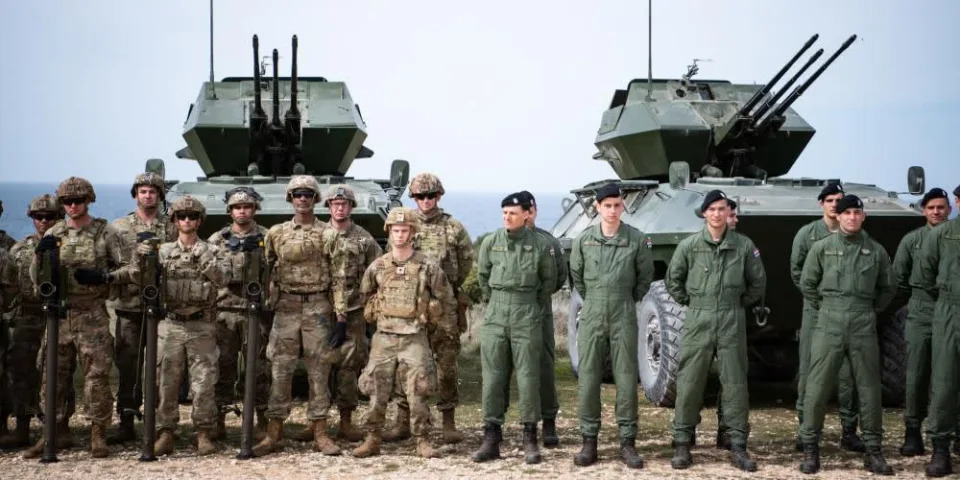
U.S. paratroopers with the Italy-based 173rd Airborne Brigade live-fired the FIM-92 Stinger man-portable air-defense system for the first time on April 9.
The missiles were shot as part of Exercise Shell 22 in Croatia.
Soldiers from 1st and 2nd Battalion, 503rd Parachute Infantry Regiment, based in Vicenza, Italy, fired a dozen of the surface-to-air missiles in two-man squads.
Each missile costs about $38,000. The 173rd Airborne Brigade has only previously fired replica Stinger rounds, Stars and Stripes reported.
Each squad was comprised of a team chief and a gunner. The soldiers fired the missiles toward a small target with a flare, brigade spokesperson Capt. Rob Haake told Stripes. The missiles landed in the Adriatic Sea, he said.
According to Haake, “every single [soldier] walked away with a big smile” after firing their missiles. “Everyone felt very fulfilled. They said it was an amazing experience.”
Paratroopers assigned to the 173rd Airborne Brigade fire an FIM-92 Stinger during an air defense live-fire exercise near Medulin, Croatia, on April 9, 2022. (Staff Sgt. John Yountz/Army)
Exercise Shell 22, which was held alongside Croatian forces, also marked the first time the Croatian Air Defense Regiment had conducted a live-fire exercise with U.S. troops.
Also included in the exercise were training events involving airspace control, deconfliction and surveillance.
“We get to cross-train with them, and they get the same with us. My favorite part wasn’t even the live fire; it was seeing our soldiers interact with the Croatians,” Chief Warrant Officer Mark Giauque, the lead coordinator of the exercise told Stripes. “You see them working together and exchanging patches, and you just see the overall camaraderie build over the training.”
U.S. paratroopers stand alongside soldiers with the Croatian Air Defense Regiment as part of Exercise Shield 22 near Medulin, Croatia, on April 9, 2022. (Staff Sgt. John Yountz/Army)
Haake told Stripes that around 300 troops from the 173rd Airborne Brigade are currently deployed in Latvia in response to the ongoing Russia-Ukraine war.
The 173rd Airborne Brigade is the U.S. Army’s contingency response force in Europe, meaning it provides rapidly deployable paratroopers to combatant commanders in Europe, Africa and the Middle East.
Longtime MSNBC Analyst Malcolm Nance Leaves to Fight Russia in Ukraine
Alex Weprin – April 18, 2022
A longtime MSNBC on-air terrorism and national security analyst is now fighting Russians in Ukraine.
Malcolm Nance, a former naval intelligence officer who became executive director of The Terror Asymmetrics Project on Strategy, Tactics and Radical Ideologies after leaving the service, appeared on Joy Reid’s 7 PM program Monday from a “secure location,” where he revealed that he had joined the “International Legion of Territorial Defense of Ukraine,” essentially a Ukrainian version of the French Foreign Legion.
Nance has been an MSNBC analyst since 2007, according to his LinkedIn page, appearing on a number of shows to discuss intelligence, insurgency and national security-related topics.
An MSNBC spokesperson told The Hollywood Reporter Monday that Nance “is not a contributor” with the cable news channel, though it is not clear when he parted ways with the network. He was identified as an MSNBC analyst on-air as recently as February 28, after Russia’s invasion of Ukraine had already begun.
On Reid’s show Monday, Nance appeared on-air in full camo, wearing body armor bearing the Ukrainian and American flags, and holding an assault rifle.
“The more I saw of the war going on, the more I thought, ‘I’m done talking, all right? It’s time to take action here,’” Nance told Reid. “I am here to help this country fight what essentially is a war of extermination. This is an existential war and Russia has brought it to these people and they are mass murdering civilians, and there are people here like me who are here to do something about it.”
Putin’s suspected purge of his inner circle was fueled by a misinformation bubble he created
Erin Snodgrass and Kelsey Vlamis – April 18, 2022
Russian President Vladimir Putin.Photo by Kay Nietfeld/picture alliance via Getty Images Putin’s suspected purge of his inner circle was fueled by a misinformation bubble he created
Reports say Russian President Vladimir Putin blames high-level officials for failings in Ukraine.
But experts told Insider Putin is responsible for creating a culture that allows misinformation.
“That only happened because he didn’t want to hear the truth,” said Russia expert Robert English.
When his country’s forces first invaded Ukraine in the early hours of February 24, Russian President Vladimir Putin was, by many accounts, anticipating a certain and speedy victory.
Reports suggest that the longtime leader was expecting to roll into the neighboring territory, flatten a modest resistance, and be met by scores of grateful Ukrainians bearing bread and salt, the traditional Ukrainian greeting custom.
“I think that he is lashing out and scapegoating people whom he thinks probably misled him,” said Simon Miles, an assistant professor at Duke University’s Sanford School of Public Policy and a historian of the Soviet Union and US-Soviet relations.
In mid-March, Ukrainian media reported that Putin fired Roman Gavrilov, the deputy chief of the Russian national guard, while Russian reports claimed Gavrilov had resigned. The cause of Gavrilov’s departure was not immediately clear, with one source telling the outlet Bellingcat that his dismissal was due to “leaks of military info that led to loss of life,” while two others said it was for “wasteful squandering of fuel.”
Days later, reports emerged claiming Putin had placed under house arrest two senior officials with the FSB, Russia’s security service, over intelligence failings in Ukraine. One such official has since been sent to Lefortovo prison, an infamous FSB jail on the outskirts of Moscow, according to Andrei Soldatov, a Russian journalist and leading expert on Russian intelligence.
But experts told Insider that if Putin is upset with the information or advice he’s gotten from advisors, the longtime president himself is responsible for creating an autocratic culture of fear that allowed misinformation to filter directly to him.
“That only happened because he didn’t want to hear the truth,” said Robert English, a professor at the University of Southern California who studies Russia, the Soviet Union, and Eastern Europe. “It happened because he was more comfortable surrounding himself with yes-men and sycophants instead of intelligent, independent people who would challenge his prejudice.”
A Ukrainian serviceman walks amid destroyed Russian tanks in Bucha, on the outskirts of Kyiv, on April 6, 2022.AP Photo/Felipe Dana, File
Putin thought taking Ukraine would be easy. He was wrong.
Soldatov told The New Yorker in March that some of the firings in Russia’s intelligence community may be a result of failed political warfare within Ukraine, his sources have suggested.
He said the foreign-intelligence branch of the FSB was likely tasked with setting up networks of pro-Kremlin political groups within Ukraine before the invasion, but those groups failed to materialize.
The cause of these Russian missteps, according to experts, is likely flawed or overinflated information delivered to Putin from the country’s intelligence apparatus and his advisors.
“They probably told him that they had much more extensive networks and penetration of Ukraine’s government – that they had laid the groundwork for a much more effective internal opposition to Zelenskyy, which would be triggered by Russian troops coming across the border,” Miles said. But that, “as we know, didn’t materialize at all.”
Putin may have also overestimated opposition within Ukraine to President Volodymyr Zelenskyy, which was “not completely crazy,” said Daniel Treisman, a professor at the University of California, Los Angeles, whose work focuses on Russian politics and economics.
“Opinion polls suggested Zelenksyy wasn’t very popular,” Treisman told Insider. Though Zelenskyy has received overwhelming support from around the world and in Ukraine, prior to the war, his approval rating was about 30%, while the Ukrainian Parliament’s was even lower.
“Putin believed that a much larger part of the Ukrainian population felt tied to Russia and alienated by the Ukrainian government administration,” Treisman said, adding that he was “probably given a very misleading view of the Ukraine public opinion” by those around him.
Vladimir Putin.Pool Sputnik, AP
Bad news doesn’t filter up in autocratic regimes
Last month, a US official said Putin’s top advisors are purposely feeding him bad information about the war, because they are “too afraid to tell him the truth.”
When all state power lies in the hands of a single individual, advisors and employees have an outsize incentive to prove their value to the man in charge — even at the expense of accuracy and accountability, Miles told Insider.
“I would suspect that he was getting very overly inflated stories from those figures in the FSB who are now allegedly under house arrest,” Miles said, referring to Russia’s early military failures in Ukraine. “And when his intelligence services gave him information, they let him believe that they did so with high confidence.”
Miles added that bad news does not filter up very well in authoritarian regimes.
“No one wants to own responsibility for saying things are not going well,” Miles said. “Also, no one wants to own the risk of proposing the alternative way to do it.”
Putin’s reputation for firing those who disagree with him goes back years. In 2004, weeks before his reelection, the first-term president abruptly fired Russian Prime Minister Mikhail Kasyanov and the rest of his cabinet. Though publicly loyal to Putin, Kasyanov had challenged Putin’s approach to dealing with oil industry oligarchs, The Washington Post reported at the time.
More recently, a viral video taken days before the invasion showed Putin pressing Russia’s spy chief to clearly say “yes or no” on whether he supported recent actions by Russia in Ukraine. Sergei Naryshkin, chief of Russia’s Foreign Intelligence Service, stammered and appeared to stumble over his words as Putin cut him off multiple times, providing a rare glimpse into the internal dynamics of the Kremlin.
“He got the bad advice that he asked for, even if he didn’t realize he was asking for it,” English said of Putin.”He was, because he fired independent thinkers, he pushed aside people who disagreed with him, and he gradually promoted people who fed his ego, who fed his pride.”
Putin’s isolation is decades in the making
Putin’s misinformation problem lies not only with the individual people in his circle but with the circle itself — in particular, its shrinking size. Much post-invasion reporting has remarked on Putin’s increasing isolation in the months leading up to Russia’s assault on Ukraine.
But his shift toward isolation has actually been building for decades, experts said.
“When he started out in the early 2000s, he had a broad range of different types of advisors with different views,” Treisman said. “Now it’s narrowed down to this hard-line, Russian nationalist friends and advisors.”
In recent years, Putin’s social isolation turned physical as well. For much of Putin’s reign, he has lived at the suburban presidential compound located an hour outside of Moscow, Miles said. Lately, Putin rarely went into the Kremlin except for official business.
“So the isolation is not new. And I think that that isolation was a key role in his decision to launch this,” Miles said, referring to the war.
Russia’s President Vladimir Putin holds a meeting of the Russian Security Council at the Kremlin.Alexei Nikolsky\TASS via Getty Images
A simple, timeless tale
Putin’s apparent confidence, and miscalculation, going into the invasion of Ukraine was reminiscent of a prior era in Russia’s history. Soviet Union intelligence and military officials were initially reluctant to invade Afghanistan in 1979, a conflict that would ultimately contribute to the fall of the USSR. The officials understood what would happen as a result of the invasion, English said.
“In the end, they were ignored, and a small group, four senior figures, kind of impulsively decided, and they did it in a kind of delusion that seems somewhat similar to Putin’s delusion,” English said.
Soviet leaders decided to go to war despite many indications they could fail, not unlike Putin. Some even believed that when the Soviets invaded Afghanistan they would be welcomed as liberators, similar to Putin’s expectation in Ukraine. Neither happened.
The regimes of both the USSR and Russia today suffered from a fear of stepping too far out of line, which led to bad or incomplete information reaching the top, according to English.
“You don’t rise up through the Communist Party system if you’re an independent, critical thinker and you don’t rise up through the Putin administration if you’re an independent, critical thinker either,” he said.
English added that both cases illustrate that bad things happen “when autocrats with their egos and their prejudices get in power and they don’t have anyone to check them.”
And when things go wrong the leader blames the people around them — even though they didn’t really have a choice because they were afraid, protecting their careers and their families by telling the person in charge what they want to hear, according to English, who said such a dynamic is far from unique to Russia.
“It happened in Soviet times, it happened in ancient times,” English said. “It’s a simple, timeless tale.”
84 percent of GOP voters say the world would be better off if Biden weren’t in office. 83 percent say the same of Putin.
Brigid Kennedy, Staff Writer – April 18, 2022
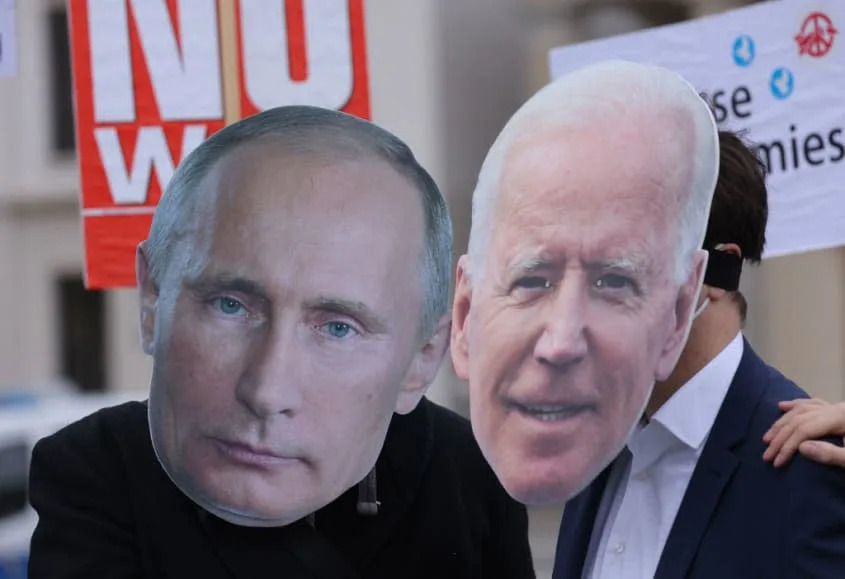
Putin and Biden cardboard cutouts. Sean Gallup/Getty Images
Republican voters are almost equally as likely to say the world would be better off without President Biden as they are to say the same about Russian President Vladimir Putin, a new Morning Consult poll has found.
Though an overwhelming majority of U.S. voters (83 percent) believe the absence of a Putin presidency would be a global benefit, the results on a partisan level appear much less kind: 84 percent of GOP voters think the world would be a better place without a Biden presidency, while a near-equivalent 83 percent say the same of a Putin presidency.
In fact, when asked if the world would be a better or worse place without a certain prominent leader in office, Republican voters were more likely to say Biden than they were to say North Korean leader Kim Jong Un (81 percent) or Chinese leader Xi Jinping (64 percent), Morning Consult found.
Seventy-four percent of Democrats, however, said the world would be a worse place without a President Biden. They were relatively aligned with Republicans on the effects of Putin’s leadership — 86 percent said the world would benefit if the Russian leader weren’t in power.
Meanwhile, 64 percent of all U.S. voters said the world would be worse off without President Volodymyr Zelensky leading Ukraine — which, when analyzed by party, breaks down to 72 percent of Democrats and 64 percent of Republicans.
Morning Consult surveyed 2,005 registered U.S. voters from April 9-11, 2022. Results have a margin of error of 2 percentage points.
Shocking images and video capture the burning Russia flagship Moskva before it sank
Julie Coleman – April 18, 2022
The Russian missile cruiser Moskva sank on April 14 from damages after it was struck by Ukrainian missiles.Russian Defense Ministry Press Service via AP Shocking images and video capture the burning Russia flagship Moskva before it sank
The images and video show the ship tilting to its port side with large plumes of thick black smoke billowing upward.
The Pentagon confirmed that the Moskva sunk after being hit with a Ukrainian missile.
The Moskva weighed 12,000 tons and was more than 600 feet long, with a crew of 500.
New images show the Russian warship Moskva burning shortly before it sank into the Black Sea.
The images and video show the ship tilting to its port side with large plumes of black smoke billowing upward. Experts say the photos and video are of the Moskva, according to the Guardian, but their origin is unknown.
The Pentagon confirmed last week that Ukrainian forces sank the Moskva with at least one Neptune anti-sink missile on Thursday, lending credence to Ukrainian forces’ version of events.
Russia and Ukraine agree that the Moskva was damaged after ammunition detonated on board, but have different accounts of what led to the ship’s sinking. Russian officials claimed the ammunition exploded due to a fire on board whose cause was being investigated, while Ukrainian officials said it had struck the Moskva with Neptune anti-ship missiles causing “serious damage.”
The Moskva weighed 12,000 tons and was more than 600 feet long, with a crew of 500. The sinking of the warship named for the Russian capital is a huge blow to Russian morale, and is unlikely to be easily explained away by Russian officials to their population.
Russia’s defense ministry claimed on April 14 that all crew members had been evacuated from the ship, and the Pentagon saw Russian sailors leaving the damaged ship in lifeboats, according to the Washington Post. But the mother of one surviving sailor told the Novaya Gazeta Europe that about 40 people had died during the incident and many were wounded and missing, the Post reported.
“There are dead, there are wounded, there are missing. My son called me when they were given phones. They left their documents and [their personal] phones on the [ship]. He calls me and cries from what he saw. It was scary. It is clear that not everyone survived,” the anonymous mother said.
US military aid to Ukraine surpasses $3 billion under Biden. Here’s what’s been provided
Joey Garrison, USA TODAY – April 17, 2022
WASHINGTON – More than 1,400 Stinger anti-aircraft systems. About 5,500 Javelin missiles. More than 7,000 small arms. And 50 million rounds of ammunition.
Vowing to “stand with Ukraine,” President Joe Biden and his administration have committed nearly $2.6 billion in U.S. military aid to Ukraine since Russia’s invasion Feb. 24, supplying a range of weapons for Ukraine’s defense against Russian aggression.
The latest round, $800 million, was authorized Wednesday. Since August, nearly $2.8 billion has been specifically allocated for military assistance, but the White House said the total amount of aid is closer to $3.2 billion since Biden took office. That would include money from a $13.6 budget bill Biden signed in March that contained money to arm Ukrainians.
There’s also been indirect assistance to allies such as a Patriot missile system the United States repositioned to Slovakia after its government agreed to supply an S-300 air defense system to Ukraine.
“We won’t be able to advertise every piece of security we give because our allies and partners are supplying to Ukraine through us,” Biden said last week, “but advanced weapons and ammunition are flowing in every single day.”
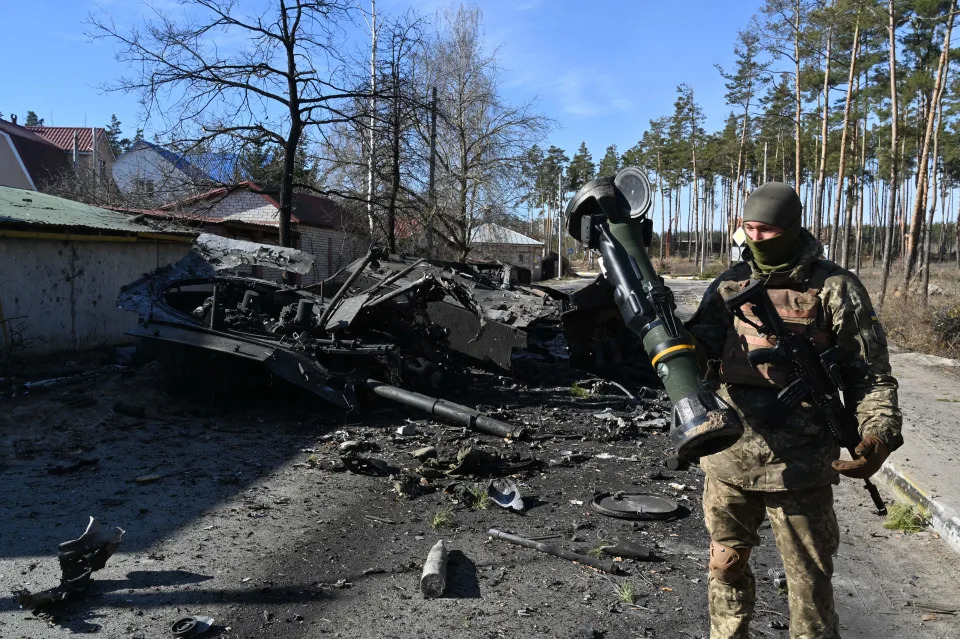
A Ukrainian soldier holds a Next Generation Light Anti-tank Weapon (NLAW) that was used to destroy a Russian armored personnel carrier (APC) in Irpin, north of Kyiv, on March 12, 2022.
Most of the assistance has been authorized through the Foreign Assistance Act. Biden has rebuffed Ukrainian President Volodymyr Zelenskyy’s calls to implement a “no-fly” zone over Ukraine and a proposal from Poland to send fighter jets to a U.S. air base in Germany to facilitate their transfer to Ukraine.
Zelenskyy has repeatedly pushed Western allies, particularly the United States, to provide more aid amid allegations that Russian President Vladimir Putin directed war crimes and genocide.
“Without additional weapons, this war will turn into an endless bloodbath that will spread misery, suffering and destruction. Mariupol, Bucha, Kramatorsk – the list goes on,” Zelenskyy tweeted this week. “No one will stop Russia except Ukraine with heavy weapons.” He ended with the hashtag “#ArmUkraineNow.”
A Ukrainian serviceman fires an NLAW anti-tank weapon during an exercise in the Joint Forces Operation, in the Donetsk region, eastern Ukraine.
Here’s a timeline of Biden’s infusion of aid:
April 13 – $800 million
The Biden administration authorized $800 million in additional security assistance to Ukraine after a call between Biden and Zelenskyy. Russia concentrates attacks in the eastern Donbas region after retreating from the Ukrainian capital of Kyiv.
New weapons and machinery – 18 155mm Howitzers (long-range cannons), 40,000 artillery rounds and 200 M113 armored personnel carriers – are meant to expand Ukraine’s military capabilities for a drawn-out fight. The new round of aid provided 500 Javelin missiles and anti-armor systems, adding to the supply the United States has already provided.
The package includes 10 AN/TPQ-36 counter-artillery radars, two AN/MPQ-64 Sentinel air surveillance radars, 300 switchblade tactical unmanned aerial systems, 11 helicopters and 100 armored multipurpose vehicles. Other equipment included “unmanned coastal defense vessels,” though the Department of Defense did not elaborate.
“Responsible nations have to come together to hold these perpetrators accountable” for war crimes in Ukraine, President Joe Biden tells the North America’s Building Trades Unions (NABTU) conference in Washington on April 6.
April 6 – $100 million
Biden authorized $100 million in security assistance to support Ukraine, providing Javelin missiles for Ukrainian forces.
Pentagon spokesman John Kirby said Javelin anti-armor systems are an “urgent Ukraine need,” and they’ve been used effectively against Russian forces.
“We know they’re using them,” he said. “You can see the evidence for yourself when you look at the videos and the images on TV of these burnt-out tanks and burnt-out trucks and armored personnel carriers.”
April 1 – $300 million
The Biden administration authorized $300 million in aid to Ukraine to fill many of the requests Zelenskyy has made. The package came via the Defense Department’s Ukraine Security Assistance Initiative – which involves new contracts rather than the U.S. military’s stocks.
April 1 – $300 million
The Biden administration authorized $300 million in aid to Ukraine to fill many of the requests Zelenskyy has made. The package came via the Defense Department’s Ukraine Security Assistance Initiative – which involves new contracts rather than the U.S. military’s stocks.
The package included laser-guided rocket systems, armed drones, armored vehicles, machine guns, commercial satellite imagery services, medical supplies, night-vision devices, thermal imagery systems and tactical secure communication systems.
March 16 – $800 million
Biden authorized $800 million in military aid for Ukraine, hours after Zelenskyy made an impassioned appeal for help during a virtual address to U.S. Congress. It marked the single-largest military funding provision at the time, later matched by the infusion of aid on April 13.
The package included 800 Stinger anti-aircraft systems, 2,000 Javelin missiles, 1,000 light anti-armor weapons, 6,000 AT-4 anti-armor systems, 100 Tactical Unmanned Aerial Systems, 100 grenade launchers, 5,000 rifles, 1,000 pistols, 400 machine guns, 400 shotguns and 25,000 sets of body armor and helmets.
Ukrainian President Volodymyr Zelenskyy delivers a virtual address to Congress by video at the Capitol in Washington, Wednesday, March 16, 2022.
March 12 – $200 million
A little more than two weeks into Russia’s war in Ukraine, the Biden administration authorized $200 million for Ukraine. Secretary of State Antony Blinken said the aid would help Ukraine “meet the armored, airborne and other threats it is facing.”
The package included an assortment of small arms, anti-tank and anti-aircraft weapons, as well as military services, education and training.
Feb. 26 – $350 million
The infusion of U.S. military aid came two days after Russia’s invasion: $350 million toward Javelin missiles, Stinger anti-aircraft missiles, small arms and ammunition.
“It is another clear signal that the United States stands with the people of Ukraine as they defend their sovereign, courageous and proud nation,” Blinken said about 48 hours after Russia’s invasion of Ukraine.
A Ukrainian serviceman surveys the damage to an apartment building shelled in the city of Chuhuiv, Ukraine, on April 8.
December – $200 million
As the White House ramped up warnings about a Russian invasion of Ukraine, the Biden administration confirmed on Jan. 19 that it authorized $200 million in military aid in late December.
The package, which came as Moscow military forces were building up on the Ukraine border, included Javelin and other anti-armor systems, grenade launchers, munitions, and nonlethal equipment. It arrived in Ukraine on Jan. 25.
August – $60 million
Coinciding with a White House meeting between Biden and Zelenskyy, the White House committed $60 million in military aid to Ukraine on Aug. 31 as Russia increased its military presence around Ukraine.
The package included Javelin anti-armor systems and other lethal and nonlethal defense capabilities.
“Russia’s buildup along the Ukrainian border has highlighted capability shortfalls in the Ukrainian military’s ability to defend against a Russian incursion,” the White House said in a notification to Congress. “Ukraine’s significant capability gaps must be urgently addressed to reinforce deterrence in light of the current Russian threat.”
$13.6 billion in humanitarian, security aid in budget bill
Biden signed a $1.5 trillion government spending bill March 15 that included $13.6 billion in humanitarian and military aid to Ukraine.
The White House said the funds would “augment” other aid to provide defense equipment for Ukraine, humanitarian assistance and U.S. troop deployments to neighboring countries.
About half the $13.6 billion was to arm Ukraine and cover the Pentagon’s costs for sending U.S. troops to surrounding Eastern European nations. The remainder went toward humanitarian and economic assistance, strengthening regional allies’ defenses and protecting their energy supplies and cybersecurity needs.
Anguish, fury and grief: One woman recounts rape by Russian soldier
Molly Hunter, Mariia Ulianovska and Lawahez Jabari – April 17, 2022
BUCHA, Ukraine — The countdown to the rape began on the day she was wounded in a Russian airstrike, Olena says.
On Day One, a scalding piece of shrapnel embedded itself in her chest after an attack near her home in Hostomel, a suburb of Kyiv.
“I thought I was dying. It was extreme pain,” Olena, 28, said this week. “It was burning like a fire.”
Pointing just under her left breast, Olena said the shrapnel left a slash mark about three-quarters of an inch wide. She showed NBC News the navy hooded sweatshirt she had been wearing, torn in the same place. She said she didn’t remember the exact date but it was roughly mid-March. It still hurts.
The next day, Day Two,she badly needed a bandage changed and, despite that her village was already occupied by the Russian troops, she went out searching for medical help.
Two soldiers offered to help, she said.
One administered first aid while the other stood guard in a nearby apartment.
On her way out, the second soldier, smoking a cigarette casually on the street, offered a warning: “Go home, it’s for your own safety.”
Different Russian soldiers changed the dressings on Day Three, and Olena’s calendar passed without any major issues.
Olena is thin, with a slight build. NBC News isn’t using her last name to protect her privacy. She and her husband, Sasha, a truck driver, were poor even before the war broke out, and they have a 7- year-old daughter who lives nearby with relatives.
After the Russians withdrew and when the couple fled to this area of Bucha, volunteers pointed them to an abandoned cabin where they could stay. The red front door doesn’t fully close, and there is no lock. It is as cold inside as it was outside, but there is a fireplace, Olena said.
As she spoke in the abandoned cabin, Olena sipped tea from a cracked teacup. Taking long pauses, she wrapped her hands around the cup, even though it was no longer hot.
Olena was raped by the Russian soldiers who captured her in early March and held hostage for two days. (NBC News)
On Olena’s Day Four, three soldiers came to her house dressed in civilian clothes. She had no idea how they knew she was wounded. One of them — he looked around 40 years old — offered to take a look at her wound upstairs.
“He inspected me,” she said. “But didn’t provide any medical aid.”
He had no bandages, medical kit or antiseptic cream, she said.
When she walked back downstairs, she found her husband lying in a pool of blood. She hadn’t heard a commotion from upstairs and she started screaming at them to leave. Sasha later said the soldiers had asked him to drive trucks for the Russian troops and when he refused, they beat him, breaking at least one rib.
“They wanted to finish him,” Olena said, weeks later. Sasha still has a hard time sitting up.
But the next day, Day Five, one of the soldiers returned — the same soldier who had taken Olena upstairs to supposedly look at her wound.
This time, he was alone.
“He grabbed my arm and pushed me into the car,” Olena said, adding that it all happened very quickly.
Image: Hostomel (Alexey Furman / Getty Images)
After an hour in the car, Olena recognized the building they were approaching. Before Olena was wounded, she had already encountered Russian troops in the town of Gostomel. Out looking for water in early March, Russian troops had detained her, she said, and held her captive for 48 hours.
At that time, about 40 other people were being held in a small apartment, including a pregnant woman. There was only one bathroom. She described the panicked escape when they realized their captors had become distracted.
So on this day with her new captor, they arrived at the same building. It was mostly deserted and had been bombed, she said. The Russian troops had looted everything.
“I didn’t even try screaming, because there was no one around,” Olena said, shaking her head. “I thought whatever happens, happens.”
The apartment was sparsely furnished, with an old table, she remembered. After being forced to undress, she said she stood there, naked with her bandage still on her left breast. He rummaged around the room to find a bra, not hers, she said, to cover her wound.
“He didn’t want to see it,” she said.
She described the rape in short details.
“I was crying. He quickly did whatever he wanted,” Olena said.
She only thought about “how to stay alive.”
When he finished, she escaped. Her attacker was distracted and she grabbed her shoes and started running, she said. Leaving her T-shirt behind, she tripped as she ran and kept going as he screamed after her.
She ran all the way home, arriving in tears. The couple decided to leave town and, in the middle of the night, came to the abandoned cabin in Bucha.
About two and a half weeks later, Olena didn’t raise her voice when she said: “God will judge him. Only God will judge him.”
Celebrity Chef José Andrés’ Non-Profit World Central Kitchen Destroyed By Russian Missile, Workers Wounded
Tom Tapp – April 17, 2022
Russian missiles raining down on central Kharkiv, Ukraine yesterday killed two people and injured 18. Among the latter group were workers at celebrity chef José Andrés’ World Central Kitchen, a charitable effort which has fanned out across the country to feed those effected by the war there.
WCK CEO Nate Mook announced the terrible news on Twitter writing, “An update I hoped I’d never have to make. I’m at a @WCKitchen restaurant in Kharkiv, where less than 24 hours ago I was meeting with their amazing team. Today, a missile stuck. 4 staff were wounded. This is the reality here—cooking is a heroic act of bravery.”
Kharkiv, Ukraine’s second-largest city, has been hammered by Russian shelling all week with dozens killed, including at least three children.
Amid the destruction, Andrés himself posted an update on the WCK staff: “To everyone caring and sending good wishes to the team in Kharkiv, thank you, the injured are fine, and everyone is ready and willing to start cooking in another location.”
He ended with, “Many ways to fight, we do it with food!”
On Sunday, Mook posted video of the organization’s staff already rebuilding in that other Kharkiv location.
“The work doesn’t stop! Today, the restaurant team is moving all food products & non-damaged equipment to another kitchen location in Kharkiv,” wrote Mook. “The injured staff are doing well—and all the team here wants to continue cooking. Truly in awe at the bravery of our @WCKitchen partners!”
Also on Sunday the Executive Director of the U.N’s World Food Programme, David Beasley, told Face the Nation of seeing food depots and warehouses blown up — facilities that contain nothing else but food.
“There is no question that food is being used as a weapon of war in many different ways [in Ukraine],” he added.