Washington’s Newest Worry: The Dangers of Cornering Putin

The New York Times

Washington’s Newest Worry: The Dangers of Cornering Putin

David E. Sanger – March 4, 2022

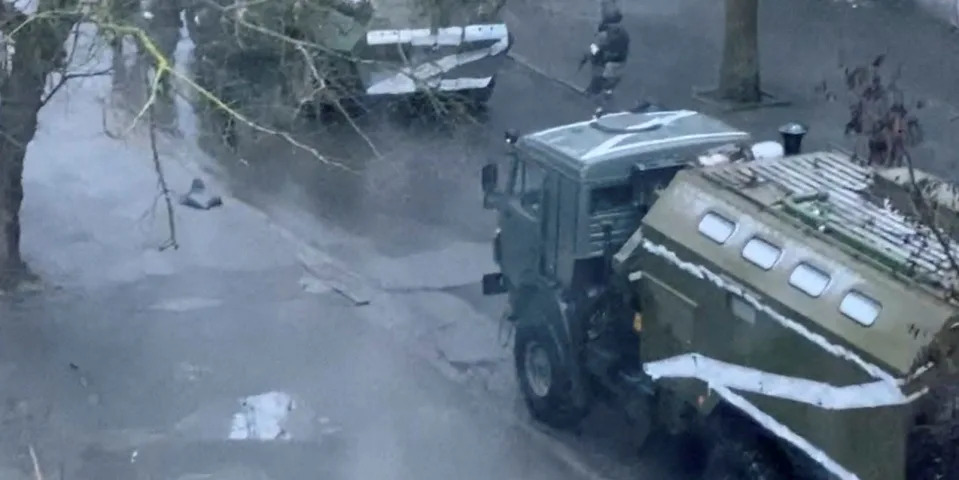
The Ukrainian village of Dachne, March 2, 2022. (Tyler Hicks/The New York Times)

WASHINGTON — Senior White House officials designing the strategy to confront Russia have begun quietly debating a new concern: that the avalanche of sanctions directed at Moscow, which has gained speed faster than they imagined, is cornering President Vladimir Putin and may prompt him to lash out, perhaps expanding the conflict beyond Ukraine.

In Situation Room meetings in recent days, the issue has come up repeatedly, according to three officials. Putin’s tendency, U.S. intelligence officials have told the White House and Congress, is to double down when he feels trapped by his own overreach. So they have described a series of possible reactions, ranging from indiscriminate shelling of Ukrainian cities to compensate for the early mistakes made by his invading force, to cyberattacks directed at the U.S. financial system, to more nuclear threats and perhaps moves to take the war beyond Ukraine’s borders.

The debate over Putin’s next moves is linked to an urgent reexamination by intelligence agencies of the Russian leader’s mental state, and whether his ambitions and appetite for risk have been altered by two years of COVID-19 isolation.

Those concerns accelerated after Putin’s order Sunday to place the country’s strategic nuclear weapons on a “combat ready” alert to respond to the West’s “aggressive comments.” (In the ensuing days, however, national security officials say they have seen little evidence on the ground that Russia’s nuclear forces have actually moved to a different state of readiness.)

It was a sign of the depth of U.S. concern that Defense Secretary Lloyd Austin announced Wednesday that he was canceling a previously scheduled Minuteman nuclear missile test to avoid escalating direct challenges to Moscow or giving Putin an excuse to once again invoke the power of the country’s nuclear arsenal.

“We did not take this decision lightly, but instead, to demonstrate that we are a responsible nuclear power,” Pentagon press secretary John Kirby said Wednesday. “We recognize at this moment of tension how critical it is that both the United States and Russia bear in mind the risk of miscalculation, and take steps to reduce those risks.”

Nonetheless, Putin’s reaction to the initial wave of sanctions has provoked a range of concerns that one senior official called the “Cornered Putin Problem.” Those concerns center on a series of recent announcements: the pullout of oil companies like Exxon and Shell from developing Russia’s oil fields, the moves against Russia’s central bank that sent the ruble plunging, and Germany’s surprise announcement that it would drop its ban on sending lethal weapons to Ukrainian forces and ramp up its defense spending.

But beyond canceling the missile test, there is no evidence that the United States is considering steps to reduce tensions, and a senior official said there was no interest in backing off sanctions.

“Quite the contrary,’’ said the official, who, like other U.S. officials interviewed for this story, asked for anonymity to discuss the internal debates among Biden’s advisers.

In fact, President Joe Biden announced expanded sanctions Thursday, aimed at Russia’s oligarch class. Many of those named — including Dmitry Peskov, Putin’s spokesperson and one of his close advisers — rank among his most influential defenders and the beneficiaries of the system he has created.

Biden, reading a statement and taking no questions, said the sanctions have had “a profound impact already.”

A few hours after he spoke, S&P dropped Russia’s credit rating to CCC-, the credit rating agency said in a statement. That is far below the junk bond levels Russia was ranked at a few days after the invasion and just two notches above a warning that the country was going into default.

It suggested that Putin’s effort to “sanctions-proof” his economy had largely failed. And at least for now, there is no discernible off-ramp for the Russian leader short of declaring a cease-fire or pulling back his forces — steps he has so far shown no interest in taking.

At a news briefing at the White House on Thursday afternoon, press secretary Jen Psaki said that she knew of no efforts to show Putin a way out. “I think right in this moment, they are marching toward Kyiv with a convoy and continuing to take reportedly barbaric steps against the people of Ukraine. So now is not the moment where we are offering options for reducing sanctions.”

Yet a senior State Department official, asked about the debates inside the administration on the risks ahead, said there were nuances in the administration’s approach that point to possible outs for the Russian leader.

Biden’s policy, the official said, was not one of seeking regime change in Russia. The idea, he said, was to influence Putin’s actions, not his grip on power. And the sanctions, the official noted, were designed not as a punishment, but as leverage to end the war. They will escalate if Putin escalates, the official said. But the administration would calibrate its sanctions, and perhaps reduce them, if Putin begins to de-escalate.

And the official said that because Putin has now exerted such control over Russian media, closing down the last vestiges of independent news organizations, he could spin some kind of de-escalation into a victory.

Yet that hope collides with the assessments of Putin’s instincts, many of which are based on open, unclassified observations.

CIA Director William Burns was an early advocate of the view that the Russian leader planned to invade and was not massing troops around Ukraine simply to gain leverage in some kind of bargaining game.

“I would never underestimate President Putin’s risk appetite on Ukraine,” Burns, a former U.S. ambassador to Moscow, who has dealt with Putin for more than two decades, said in December.

Putin’s views on Ukraine are fiercely held. He seems unlikely to accept any result that does not achieve his goal of bringing Ukraine closer to the Russian fold. And, especially after the Russian military’s poor performance in the first week of the war, he may be concerned that any whiff of failure could weaken his hold on power.

Putin’s strategy in coming weeks, some other U.S. officials have warned in closed meetings since the crisis accelerated, could be to redirect the conflict toward Washington, hoping to distract from the Russian forces’ attacks on civilians in Ukraine and rouse a nationalistic response to the actions of a longtime adversary.

If Putin wants to strike at the U.S. financial system, as Biden has struck at his, he has only one significant pathway in: his well-trained army of hackers and an adjacent group of criminal ransomware operators, some of whom have publicly pledged to help him in his battle.

Tatyana Bolton, the policy director for cybersecurity and emerging threats at the R Street Institute, expressed confidence Thursday that the financial industry was ready.

“The JPMorgans of the world spend more on cybersecurity than many government agencies,’’ said Bolton, a former senior official in the Department of Homeland Security whose family emigrated from Russia.

But she was concerned about the possibility that Putin would finally activate “pre-positioned malware in the energy sector as a means of getting back at the United States.”

Members of Congress have also raised concerns that Putin could unleash Moscow’s network of criminal hackers, who have conducted ransomware attacks that have shut down hospitals, meat processing plants and the Colonial Pipeline network that carried nearly half of the gasoline, diesel and jet fuel on the East Coast.

“If the situation escalates further, I think we are going to see Russian cyberattacks against our critical infrastructure,” said Rep. Mike Gallagher, R-Wis., a member of the House Intelligence Committee who was co-chair of an influential cyberspace commission.

Another possibility is that Putin will threaten to push farther into Moldova or Georgia, which, like Ukraine, are not members of NATO — and thus territory that the U.S. and NATO forces would not enter. Secretary of State Antony Blinken is making Moldova one of his stops on a reassurance tour that began Thursday.

There are larger worries, involving potential nuclear threats. On Sunday, as the fighting accelerated, Belarus passed a referendum that amended its constitution to allow for nuclear weapons to be based, once again, on its territory. U.S. officials are expecting that President Alexander Lukashenko may well ask Putin to place tactical weapons in his country, where they would be closer to European capitals. And Putin has shown, twice this week, that he is ready to remind the world of the powers of his arsenal.

But the next move for Putin is likely to further intensify his operations in Ukraine, which would almost certainly result in more civilian casualties and destruction.

“It wasn’t a cakewalk for Putin, and now he has no choice but to double down,” said Beth Sanner, a former top intelligence official. “This is what autocrats do. You cannot walk away or you look weak.”

© 2022 The New York Times Company

Democrat wants Biden to defy Putin by staging a Berlin-like airlift to save Kyiv

Yahoo! News

Democrat wants Biden to defy Putin by staging a Berlin-like airlift to save Kyiv

Michael Isokoff and Daniel Klaidman – March 4, 2022

WASHINGTON — The United States should start planning for a Berlin airlift-style operation to save the people of Kyiv from Russian encirclement and start considering the deployment of NATO troops to western Ukraine, said Rep. Tom Malinowski, D-N.J., a member of the House Foreign Affairs Committee and a former assistant secretary of state for human rights under former President Barack Obama.

“We are going to have to face some tough choices in the coming weeks,” Malinowski said in an interview on the Yahoo News “Skullduggery” podcast. “We need to be bold. It’s a new world.” Malinowski acknowledged that such actions would be “very, very risky,” especially the introduction of NATO troops — a move that could lead to a direct confrontation with the Russian military. And yet, Malinowski said, the alternative might well be Russian troops on the border of Poland, Romania and Hungary as well as “the complete elimination of the Ukrainian state.”

What follows is an edited transcript of Malinowski’s conversation with “Skullduggery” hosts Michael Isikoff and Daniel Klaidman.

Michael Isikoff: So we have all been watching in horror the savagery of the Russian attack on Ukraine. The question at this juncture — after the bombing of the nuclear reactor, the use of cluster bombs targeting civilians — are we doing enough to stop Vladimir Putin?

Tom Malinowski: I don’t know if he can be stopped. I know that he can be made to lose, I know that we can ensure that, as terrible as this is, he and his regime and what he stands for come out of this defeated and that the United States and our allies come out stronger and more united. I had a list for the Biden administration of a whole bunch of things I wanted them to do two weeks ago, one week ago. They’ve done most of those things. … But we are also going to have to face some tough choices in the coming weeks. There are some decisions we haven’t made yet that Putin might force us to make as this gets worse and worse.

Daniel Klaidman: So what are some of those tough choices?

Malinowski: Imagine Kyiv is totally surrounded in the coming days and weeks. Right now, we’re getting supplies in and out, food, ammunition, everything else. But if it’s completely blockaded, do we launch something like the [1948] Berlin airlift, where American military aircraft are flying in supplies to the people who are defending that city? It would be consistent with Biden’s policy. It wouldn’t be shooting at the Russians, it would be daring them to shoot at us, though, and of course it would be very, very risky.

Klaidman: Why wouldn’t they shoot at us under those circumstances, if they have Kyiv surrounded and they’re trying to cut off supplies going into the city and we start flying them in?

Malinowski: They didn’t shoot at us when we were flying stuff into Berlin because that would have been starting the war. … The rules of the road between the United States and Russia set during the Cold War are that we can fight each other with proxies but we don’t fight each other directly because that would trigger potentially a catastrophic, potentially nuclear war. … I think we need to be bold. If you look at the history of the Berlin airlift, it was successful in a practical sense. It got food to people in Berlin who needed it, but it was also a huge moral and psychological victory for the United States in the Cold War.

Klaidman: Do you know if the Biden administration is actively considering that?

Malinowski: I think they’re aware that we may face this kind of circumstance. I raised it in a hearing at the Foreign Affairs Committee a couple days ago with Deputy Secretary of State Wendy Sherman. … We need to be bold. It’s a new world.

Tom Malinowski
Rep. Tom Malinowski, D-N.J,, at a Foreign Affairs Committee hearing in September 2020. (Stefani Reynolds/Pool via Reuters)

Isikoff: Is Putin a rational actor at this point?

Malinowski: If you’d asked me a few years ago, maybe even a few months ago, I would have said that the man is evil, but rational. Ruthless, but not disconnected from reality. I’m having second thoughts about that [laughs] right now because he seems to have deceived himself about what Ukraine has become over the last 10 years, how united the people of Ukraine are in believing in their own national identity and independence and European path, how even the Russian speaking population of Ukraine hates the idea of this Russian aggression and, of course, how fiercely Ukrainians would resist a Russian invasion. He seems to have believed his propaganda in this case, with disastrous consequences for himself and for his country.

Isikoff: So if he’s not a rational actor, how does that change the calculus about what we do?

Malinowski: He certainly wants us to believe right now that he’s capable of anything and he wants us, with that possibility in mind, to hesitate in taking certain steps to protect Ukraine. And I think it would be irresponsible for us not to take into account the possibility that he might do incredibly dangerous things. And yet, at the same time, I don’t think he starts a nuclear war over humanitarian aid deliveries or even deliveries of ammunition.

Klaidman: You said that this is a new world. For Americans who may say, “Well, this is happening half a world away from me, it doesn’t really affect my life,” what would you tell them?

Malinowski: When Hitler seized part of Czechoslovakia in 1938, it was a small country half a world away, it didn’t affect any of our lives, but I think we understand today that it opened a Pandora’s box — that once you establish that big countries can swallow up small countries, that aggressive dictatorships can change borders with tanks, then all hell breaks loose in the world. Every single border in the world is artificial. And once borders are up for grabs, once borders can be erased by whoever has the power to do it, we’re back in the world that led to the Second World War.

Russian President Vladimir Putin
Russian President Vladimir Putin in Moscow on Wednesday. (Mikhail Klimentyev/Sputnik/Kremlin via Reuters

Isikoff: You were recently in Ukraine, shortly before the invasion, and you met with President Zelensky. As you have watched events unfold over the last 10 days, have you been surprised by the way the Russians have gone in and the strength of the Ukrainian resistance led by Zelensky?

Malinowski: I’m impressed. I’m inspired. I’m not surprised. Every Ukrainian I spoke to when we were in Kyiv a month ago said they would fight and it didn’t seem like false bravado to me. It felt very real. They are motivated. They’re protecting their homes. They’re protecting their freedom. They’re protecting their families. I’m not surprised that the Russians are disorganized and demoralized. When Putin lies to his generals, his generals have to lie to their officers and the officers have to lie to their frontline troops. No one was in a position to tell those Russian soldiers that they were going to a foreign country that would resist them and fight for every single inch.

Isikoff: Is that just really bad intelligence by the Russians to not know the ferocity of the resistance they would face or they were just afraid to tell the truth to Vladimir Putin?

Malinowski: It’s just a lie. It’s what happens when you have a government that is based on lies. There’s no process in the Kremlin where the dictator gets intelligence briefings from people who tell him what he doesn’t want to hear. This is a one-man dictatorship. And, by the way, Russia’s not had a one-man dictatorship since Stalin.

Klaidman: How concerned were you about the attack on the nuclear plant?

Malinowski: It seems to me they could have destroyed it fairly easily with an artillery barrage. So maybe it was a deliberate attempt to terrorize us and the Ukrainians by getting close to the plant.

Isikoff: If Putin is in fact as you say the most powerful dictator in Russia since Stalin, it does raise the question, can he be deposed?

Malinowski: Putin’s behavior is driven by the knowledge that he can be deposed. This is why he fears Ukraine because Ukraine is the country closest to Russia in history and culture and geography where the people did depose a corrupt and authoritarian leader. He hates the example that the Ukrainians set for the Russian people. This is why he wants to crush the place. So he’s paranoid about it. But it is incredibly hard.

Klaidman: If Russia succeeds in taking over the country, then the war against a sovereign nation might be over. But an insurgency will just be starting. What role should the U.S. play in that effort? Should we be training insurgents on the ground in Ukraine or is that too dangerous for us?

Malinowski: So two things here. No. 1, the Russians may be able to, probably will be able to defeat the Ukrainian army in the cities that they’re attacking, but there’s no way that they can hold and govern these places. They may have had the fantasy of installing a puppet government in Kyiv, but who the heck is gonna follow that government? Who — civil servants aren’t going to go into their offices. There’s no police or military force in Ukraine that can enforce the orders of such a government. So that means the Russians will have to stay in force, and if they stay in force, they will be targets because they’re hated overwhelmingly by pretty much everybody there.

Now, what do we do about it? One of the big question marks right now is what happens to western Ukraine. The assumption of the Western policymakers was that at the beginning of this was that the worst-case scenario was Putin takes Kyiv and Kharkiv and southern Ukraine, but that he was not going to even try to go as far as Western Ukraine, the city of Lviv [near] the Polish border. Because this is the most Western-oriented, nationalistic, non-Russian-speaking part of the country. I think all bets are off right now. I think he, Putin, right now wants to take the whole damn thing. … And if he is planning to go for it, I think it does raise more serious questions about a Western military intervention. A no-fly zone would require the United States to shoot at Russians from the get-go. But would we consider, for example, preemptively with NATO allies putting a force in western Ukraine, drawing a line and saying, “You’re not crossing that line. We’re gonna have a divided Ukraine like East and West Germany, North and South Korea during the Cold War.”

Journalists visit the site of a rocket attack launched by Russian invaders
Journalists visit the site of a rocket attack launched by Russian invaders that hit the Vasylkiv Professional College in northern Ukraine. (Ukrinform/Future Publishing via Getty Images)

Isikoff: Are you urging such a course right now?

Malinowski: I think it’s something we have to be thinking about.

Isikoff: To put in U.S. military troops on the ground in western Ukraine to deter the Russians?

Malinowski: I think we do need to at least think through the potential risks and benefits of having a NATO force, not necessarily U.S. troops, but obviously it would have to be guaranteed if we did this by U.S. air power in that portion of Ukraine.

Klaidman: So that’s an area where the Russians currently are not present at all, so there would be no risk of a shooting war?

Malinowski: Imagine they do take Kyiv and even Odessa. They’re going to be battered. They’re not going to be in much of a position to take on a Western military or any military after that. All they will have is the nuclear option. And of course that’s the scary part. Would they initiate such a war under those circumstances is the question that policy makers would have to ask.

Isikoff: That seems like a pretty big risk to take if we’re talking about whether the Russians might initiate a nuclear war.

Malinowski: It is perhaps a very big risk. On the other hand, the alternative might be the Russian army on the Polish border, on the Romanian border, on the Hungarian border, the complete elimination of the Ukrainian state.

Former National Security Advisor John Bolton says ‘Putin was waiting’ for Trump to withdraw the United States from NATO in his second term

Insider

Former National Security Advisor John Bolton says ‘Putin was waiting’ for Trump to withdraw the United States from NATO in his second term

Bryan Metzger – March 4, 2022

Former President Donald Trump shakes hands with Russian President Vladimir Putin during a joint press conference in Helsinki, Finland, on July 16, 2018.
Former President Donald Trump shakes hands with Russian President Vladimir Putin during a joint press conference in Helsinki, Finland, on July 16, 2018.Xinhua/Lehtikuva/Jussi Nukari via Getty Images
  • Former National Security Advisor John Bolton said Putin was “waiting” for Trump to withdraw the US from NATO.
  • He previously warned that Trump would have withdrawn from the alliance if he’d won a 2nd term.
  • Bolton also said Trump’s “main interest” in Ukraine was trying to “find Hillary Clinton’s computer server.”

Former National Security Advisor John Bolton said on Friday that Russian President Vladimir Putin was waiting for former President Donald Trump to withdraw the United States from the North Atlantic Treaty Organization if he had won a second term.

Bolton made the remarks during a virtual event with the Washington Post on the Russian invasion of Ukraine, where Bolton mostly offered critiques of current President Joe Biden’s foreign policy in the region. At the end of the event, he was asked by the Post’s Michael Duffy about how close Trump came to withdrawing the country from NATO, a translantic security alliance that includes the United States, Canada, and most of Europe.

“I thought he put his foot over it, but at least he didn’t withdraw then,” said Bolton, who wrote in his memoir about Trump’s consideration of withdrawing from NATO in 2018. “In a second Trump term, I think he may well have withdrawn from NATO. And I think Putin was waiting for that.”

Trump viewed NATO as a liability during his presidency, believing that European countries were not paying enough of their fair share of the burden of providing defense to the alliance. Bolton, a State Department official during the George W. Bush administration, was brought on to be Trump’s national security advisor in 2018 only to be ousted a year and a half later.

Bolton’s latest comments come just days after he told Newsmax that Trump “barely knew where Ukraine was,” pushing back on a host who said the former president had been “tough on Russia.”

Asked whether he was satisfied by how the Trump administration handled Ukraine, Bolton criticized his former boss.

“I think it went very badly,” said Bolton. “It was hard to have discussions on geostrategic issues when the president’s main interest was getting… Rudy Giuliani in to see [Ukrainian President Volodymyr] Zelensky so they could go find Hillary Clinton’s computer server.

He added that Ukraine’s position in the “maelstrom of American presidential politics” in the last few years made it difficult for Zelensky to establish a proper relationship with the United States, which Bolton said was Ukraine’s “potentially most important supporter.”

Trump was impeached for the first time over his withholding of $400 million in military aid to Ukraine in order to pressure Zelensky to launch an investigation into Biden and his son Hunter over allegations of corruption.

Bolton said on Friday that former Secretary of State Mike Pompeo and former Defense Secretary Mark Esper were concerned by Trump’s behavior at the time. “All of us felt that we needed to bolster Ukraine’s security, and were appalled at what Trump was doing,” he said.

Trump Feared Only What He Himself Had To Lose With ‘Murderous’ Election Move: Witness

HuffPost

Trump Feared Only What He Himself Had To Lose With ‘Murderous’ Election Move: Witness

Mary Papenfuss – March 4, 2022

Donald Trump reportedly wasn’t concerned about pulling what was described to him as a national political “murder-suicide” move by upending the 2020 presidential election. What he wanted to know was if he had anything to lose, former Acting Deputy Attorney General Richard Donoghue told the House select committee investigating the U.S. Capitol riot.

Former White House counsel Pat Cipollone and Justice Department officials met with Trump in the Oval Office and railed against a post-election plan from Assistant Attorney General Jeffrey Clark, a Trump supporter who was also in the meeting. Clark wanted to distribute letters to state legislatures falsely saying that the election may have been stolen and urging them to reconsider their certified election results, according to Donoghue’s account of the conversation.

“That letter that this guy [Clark] wants to send — that letter is a murder-suicide pact,” Cipollone told Trump, according to a transcript of Donoghue’s interview with the Jan. 6 committee. “It’s going to damage everyone who touches it. And we should have nothing to do with that letter.”

The startling account was included in the committee’s response Thursday to a lawsuit from Trump’s “coup memo” lawyer John Eastman, who is seeking to withhold documents from the committee.

Trump seemed unfazed by the warning and was worried only about himself, according to Donoghue. He was seriously considering replacing then-Acting Attorney General Jeffrey Rosen with Clark so Clark could carry out his plan. Rosen had recently replaced William Barr, who had resigned as attorney general amid his own dispute with Trump over the election results.

“The president said something to the effect of: ‘What do I have to lose? If I do this, what do I have to lose?’” Donoghue recounted to the House committee.

Donoghue said he replied: “Mr. President, you have a great deal to lose. Is this really how you want your administration to end? You’re going to hurt the country.”

Donoghue also attacked Clark as being someone who was woefully unqualified to be attorney general and who was grabbing half-baked election fraud theories off the internet to peddle to Trump.

“I made the point that Jeff Clark is not even competent to serve as the Attorney General,” Donoghue told the committee, according to the transcript. “He’s never been a criminal attorney. He’s never conducted a criminal investigation in his life. He’s never been in front of a grand jury, much less a trial jury.”

The Jan. 6 committee argued in its response to Eastman’s lawsuit that it has a right to the documents because it has a “good-faith basis for concluding that the President and members of his Campaign engaged in a criminal conspiracy to defraud the United States,” it wrote in a filing submitted in a U.S. District Court in California.

The filing argues that Trump knew the presidential election was legitimate yet took action to overturn the results.

Man in Kherson, the first major Ukrainian city Russia seized, says stores are empty and he only has enough food to last until tomorrow

Business Insider

Man in Kherson, the first major Ukrainian city Russia seized, says stores are empty and he only has enough food to last until tomorrow

Sinéad Baker – March 4, 2022

Russian military vehicles with "Z" markings are seen on the street in Kherson, amid Russia's invasion of Ukraine March 1, 2022,
Russian military vehicles with “Z” markings are seen on the street in Kherson, amid Russia’s invasion of Ukraine March 1, 2022,REUTERS
  • A Ukrainian man said he couldn’t find food in stores and that he has only one day of food for his family.
  • He lives in Kherson, the first major city captured by Russia in its invasion.
  • Reports say food is also running low in other parts of Ukraine.

A Ukrainian man living in the first major Ukrainian city captured by Russia told Insider he can’t find food in stores and he only has enough food at home to last his family until tomorrow.

Stanislav, who lives near the center of the city with his wife and nine-year-old child, told Insider on Friday that he had food “only for tomorrow.”

Stanislav — who asked only to be identified by his first name for his safety — said he had some potatoes, some flour, and around half a loaf of bread in his home.

He said he went into stores on Friday to try and buy food, but that shelves were empty: “There is simply no food in supermarkets.”

“For now I am okay, but what will happen tomorrow, I don’t know. Of course, I hope for a safe life,” he told Insider.

Leaving the apartment to look for food is scary, Stanislav said.

He added that on Friday the city was relatively quiet as Russia was bringing in aid, but that he heard some shooting in the street.”

Russia has delivered some humanitarian aid to Ukraine since it invaded. But Stanislav said he would not eat the food for fear it has been poisoned, though he did not offer evidence to show the fears were justified.

Stanislav said that he would continue his search for food on Saturday, and hope to find something: “I don’t know. Maybe I’ll find [food] somewhere, I’m not sure.”

Kherson was the first city to be captured by Russian troops in its invasion of Ukraine.

Other residents of the city have said they are concerned about food shortages, the Independent reported. One man in the city told the PA news agency, “this town is going to starve if nothing comes.”

Ukrainian officials also say that the city of Mariupol is running low on food as Russia attacks it, according to the Financial Times. On Wednesday, Al Jazeera reported that food was running low in supermarkets in Kyiv.

Stanislav said on Friday that his apartment building was currently safe, but that he was afraid as Russians have hit residential buildings.

Stanislav previously spoke to Insider on March 2 before Kherson fell to Russian troops, when he said he was trying not to go outside for fear that he could be targeted by Russian troops.

“We are blocked in my city. The Russian soldiers are everywhere, even in the city. They have blocked the city, you cannot pass from one area to walk to another area because they shoot people.”

‘We were built for this mission.’ About 300 soldiers from Fort Knox to be deployed to Europe

Lexington Herald-Leader

‘We were built for this mission.’ About 300 soldiers from Fort Knox to be deployed to Europe

Karla Ward – March 4, 2022

The Associated Press

As Russia’s war on Ukraine continues, about 300 soldiers stationed at Fort Knox are being deployed to Germany and Poland, and one of the goals of the deployment is to “deter further Russian aggression,” the Army says.

In support of the United States’ NATO allies, the Army said it is deploying the main headquarters of its Victory Corps, or V Corps, which was set up at Fort Knox in 2020. The corps already has soldiers stationed at an operational command post in Poznan, Poland.

The Army said Thursday that the additional deployment will “build readiness, improve interoperability, reinforce allies and deter further Russian aggression.”

“Victory Corps is ready and prepared to support the orders of the President, and demonstrate our commitment to our NATO allies,” V Corps’ commanding general, Lt. Gen. John S. Kolasheski, said in the release. “As America’s Forward Deployed Corps, we were built for this mission.”

In a separate media advisory Friday, the Army said V Corps soldiers will be ready to move out Monday, transitioning the corps’ headquarters from Fort Knox to Europe.

“The V Corps main headquarters will complement the forward headquarters located in Poland,” the advisory stated. “This will provide a more robust presence in Europe and enable the Corps to synchronize current contingency operations, support the ongoing mission to reinforce NATO’s eastern flank and coordinate multinational exercises across the continent.”

The effort is being coordinated with the governments of Germany and Poland, and once deployed, the soldiers will be under the command of U.S. Army Europe and Africa, the Army said.

“Throughout our unit’s history, we have stood as guardians of peace in Europe and we once again proudly answer the nation’s call,” Kolasheski said in the release.

The V Corps was founded during World War I and served in France. In World War II, its soldiers took part in the D Day invasion and helped liberate Europe. The Army says the corps “defended Western Europe during the Cold War” and served in the Balkans, Iraq and Afghanistan.

When the Army announced in 2020 that V Corps was being reactivated with headquarters at Fort Knox, it said the corps would have about 635 soldiers, about 200 of whom would be rotating through the post in Europe.

NATO brings Finland, Sweden on board for all Ukraine conflict discussions

Defense News

NATO brings Finland, Sweden on board for all Ukraine conflict discussions

Vivienne Machi – March 4, 2022

JOHN THYS

STUTTGART, Germany – From now on, NATO is sharing all information pertaining to the ongoing war in Ukraine with close partners Sweden and Finland, Secretary-General Jens Stoltenberg announced Friday.

“In response to Russia’s aggression, we have decided to strengthen our coordination and information-sharing with Finland and Sweden,” Stoltenberg said at a press conference in Brussels, adding, “Both countries are now taking part in all NATO consultations about the crisis.”

The briefing occurred just before foreign ministers from NATO’s 30 member-nations gathered to discuss Russia’s war on Ukraine, with leaders from Helsinki, Stockholm, and the European Union also in attendance.

Stoltenberg’s announcement comes as calls have mounted for the two Nordic countries to formally join the alliance. Finland and Sweden are two of six Enhanced Opportunity Partners with NATO, representing the closest partnership a nation can have with the alliance without being a member. The other four EOPs are Australia, Georgia, Jordan, and Ukraine – the latter being selected in 2020.

Helsinki and Stockholm have been considered to be in a tier of their own within the EOPs. That’s thanks to “the sophistication of their militaries, the stability of their democratic political systems, and their critical geography of the Baltic Sea bridging NATO’s Nordic and Baltic countries,” analysts Anna Wieslander and Christopher Skaluba wrote in a March 3 report for the Atlantic Council.

The two nations have traditionally walked a fine line between lauding their close relationship to NATO, while maintaining that their citizens want to keep out of the alliance. But the report cites recent polls showing that up to 53 percent of Finns now support joining NATO – compared to only 19 percent in support in 2017. Meanwhile, Swedes are now 41 percent in support of joining the alliance, compared to 35 percent since the Russian annexation of Crimea in 2014.

“Events on the ground in Ukraine will likely dictate whether and how soon Sweden and Finland apply for NATO membership, and how readily the alliance might admit them,” Wieslander and Skaluba wrote. “But with the contours of European security irrevocably altered since Russia’s invasion of Ukraine, the direction of thinking in both countries – especially Finland – is getting clearer by the day.”

Stoltenberg also shared that the NATO member-nations are now contemplating a more long-term increase to their military presence along the Eastern flank.

The alliance has dedicated a considerable presence in countries including Poland, Romania, and Estonia in response to Russian aggression towards Ukraine, with over 130 fighter jets and over 200 ships positioned to protect the 1 billion citizens across its 30 member states from potential attack, he added.

“We are now seriously considering a significant increase of our presence, both in more troops, [and] with more air defense,” he said. That discussion began Friday during the foreign ministers meeting, and will continue when NATO defense ministers meet on March 16.

“We have some time – not a lot, but some time – to make that more long-term decision,” he said.

The alliance also wants to step up its support for Georgia and Bosnia-Herzegovina, after determining that these two nations are, like Ukraine, at risk of “even more intervention, subversion or even attack by the Russian Armed Forces,” Stoltenberg said. The “broad agreement” to increase support could include more joint activities and exercises, and scaling up support for national defense and security institutions.

Stoltenberg restated that NATO is not seeking a war with Russia, and said foreign ministers on Friday rejected the idea to establish a no-fly zone over Ukraine.

“Our core task is to keep our 30 nations safe,” he said. “We are not part of this conflict, and we have a responsibility to ensure it does not escalate and spread beyond Ukraine. Because that would be even more devastating and more dangerous.”

Fear of martial law sparks Russian exodus


Axios

Fear of martial law sparks Russian exodus

Zachary Basu – March 4, 2022

Thousands of Russians are rushing to flee the country ahead of this weekend, as rumors swirl that Vladimir Putin could soon declare martial law, close the borders and crack down even harder on domestic dissent.

Why it matters: For as devastating as the humanitarian situation in Ukraine has become, widespread suffering is rapidly arriving at Russia’s own doorstep.

More than 8,000 people have already been detained at anti-war protests since Feb. 24, according to the independent monitor OVD-Info.

  • Russia’s Duma has passed a law making the spread of “fake news” about the Russian military punishable by up to 15 years in prison.
  • The last pillars of Russia’s already-limited independent press were forced to close under pressure from the Kremlin this week.
  • Russia’s state communications watchdog blocked the websites of the BBC, Voice of America, Radio Free Europe/Radio Liberty, Deutsche Welle and other foreign media outlets for spreading “fake” information.

What to watch: Russia’s second-largest airline announced it will cease all international flights from tomorrow, as Russia’s upper house of parliament meets for an emergency session that many fear could mark the descent of a new Iron Curtain.

Pentagon: ‘Vast majority’ of $350M in lethal aid to Ukraine has been delivered

The Hill

Pentagon: ‘Vast majority’ of $350M in lethal aid to Ukraine has been delivered

March 4, 2022

The “vast majority” of a $350 million military aid package the U.S. promised to send Ukraine has reached the country, with most of the rest to be delivered within the next week, a senior U.S. defense official said Friday.

The package, approved by the White House on Feb. 26, two days after the Russian invasion, was fast-tracked after it was categorized as “a presidential drawdown,” a label that allows it to forego congressional notification, the official said.

About $240 million worth of the package has made it to Ukraine, including “the most-needed capabilities, like anti-armor capabilities,” they said.

The rest should arrive within days or weeks “but not longer,” the official added.

Washington is sending Kyiv equipment that it has also sent in the past so that the Ukrainians can use it “proficiently,” without any new training.

“I think all of us have been tremendously impressed by how effectively the Ukrainian Armed Forces have been using the equipment that we’ve provided them,” the official said, noting that “Kremlin watchers have also been surprised by this, and how they have slowed the Russian advance and performed extremely well on the battlefield.”

The U.S. has contributed more than $1 billion to help Ukraine’s military over the past year and has pledged more as Russia’s violent attack on the country drags on.

Washington has reportedly sent hundreds of Stinger missiles as part of the $350 million package, while the White House on Wednesday asked Congress to authorize an additional $10 billion in security, humanitarian and economic assistance for the country.

Another 14 countries have also contributed lethal aid to Kyiv since Moscow launched the incursion last week. The official said U.S. European Command has been coordinating the delivery of that assistance from other countries “to ensure that we are using our resources to maximum efficiency to support the Ukrainians in an organized way.”

A second defense official told reporters the weapons were getting into Ukraine through “multiple venues.”

“There are multiple venues through which the support is getting to the Ukrainians on the ground,” they said. “I really don’t want to get more specific than that. We want to be able to continue to help the Ukrainians as much and for as long as we can … so we’re going to be very careful about how we talk about how that support is getting into their hands.”

The second official also said the package is “the highest single drawdown authority in our history.”