Biden Quietly Casts Trump As The New Face Of Putin In America

HuffPost

Biden Quietly Casts Trump As The New Face Of Putin In America

S.V. Date – March 4, 2022

(Photo: Scott Olson via Getty Images)

SUPERIOR, Wisc. – President Joe Biden failed to bring up the Jan. 6 assault on the Capitol incited by his predecessor in his State of the Union speech, but less than a day later essentially made Donald Trump, without ever mentioning his name, the American face of Russia’s dictator.

“Vladimir Putin was counting on being able to split up the United States,” Biden said, and proceeded to describe the Trump-inspired mob that attacked the Capitol with the goal of overturning the 2020 election.

“Look, how would you feel if you saw crowds storm and break down the doors of the British Parliament, kill five cops, injure 145 ― or the German Bundestag or the Italian Parliament? I think you’d wonder,” he said. “Well, that’s what the rest of the world saw. It’s not who we are. And now, we’re proving, under pressure, that we are not that country. We’re united.”

The little-noticed remarks at the University of Wisconsin-Superior student union came just 18 hours after Biden did not mention the Jan. 6 attack at all in his hourlong State of the Union address to Congress and the nation.

Polls show that Americans are no longer as concerned about the attempt to forcibly keep Trump in power as they were immediately afterward. Indeed, Americans generally, and more so Republicans and independents, are also less inclined to believe that Trump was responsible for the attack than they were a year ago.

Republican pollster Neil Newhouse said that if Biden is hoping to stoke interest in Jan. 6, it is not likely to work.

“The Jan. 6 events are already baked into voters’ minds, and I have a hard time believing that any new revelations will impact attitudes one way or another,” he said. “That’s especially true when Americans are focused on other current event and issues, like Ukraine, inflation, crime and the economy.”

Perhaps appreciating where public sentiment is today, Biden actually drew an explicit link between Jan. 6 and Putin’s invasion of Ukraine. He said Putin assumed that his long efforts to sow division in the West, including the United States, would let him get away with seizing Russia’s neighbor.

“We were able to make sure we kept Europe united and the free world united,” Biden said. “In my view, he did what he did because he thought he could split NATO, split Europe, and split the United States. We’re going to demonstrate to the whole world no one can split this country.”

Deputy White House press secretary Karine Jean-Pierre, when asked why Biden had not talked about Jan. 6 in his State of the Union, told reporters Wednesday that he has spoken about it many times, including a lengthy speech on the first anniversary of the attack earlier this year.

One White House official said on condition of anonymity that Biden would continue to discuss Jan. 6 as needed. And press secretary Jen Psaki on Thursday, responding to a question about the House Jan. 6 committee, repeated Biden’s previous statements that Jan. 6 was a uniquely dangerous event in the nation’s history caused by the sitting president at the time, and needed to be treated as such.

Trump, who now is under investigation in multiple jurisdictions for his post-election actions, was elected with the open help of Putin in 2016. The Russian leader’s intelligence agencies stole documents from the campaign of Democratic nominee Hillary Clinton and made them available. Trump used that material daily during the final month before Election Day, even though he knew it had been stolen for him by Putin’s spies.

Putin also mounted a propaganda campaign using social media to generate false stories about Clinton with the goal of depressing Democratic turnout, according to both Special Counsel Robert Mueller as well as the Senate Intelligence Committee.

Four years later, Russia was again working for Trump, and then after his loss helped amplify his lies that the election had been “stolen” from him ― lies that fomented the anger among Trump’s followers that culminated in the violent attack on Jan. 6.

Since then, Russian state media, “troll farms” and even Putin himself have been spreading Trump’s claims that the supporters who were arrested for their participation that day are “political prisoners” and are being unfairly persecuted.

Trump, despite losing the election by 7 million votes nationally and 306-232 in the Electoral College, became the first president in more than two centuries of elections to refuse to hand over power peacefully. His incitement of the Jan. 6 assault on the Capitol ― his last-ditch attempt to remain in office ― led to the deaths of five people, including one police officer, injured another 140 officers and led to four police suicides.

That attempt to remain in power notwithstanding his loss has sparked both state and federal investigations.

The district attorney in Fulton County, Georgia, has impaneled a special grand jury just to focus on Trump’s attempt to coerce state officials to “find” enough votes to overturn his loss of that state to Biden in 2020.

And the House Jan. 6 committee has been subpoenaing more and more former and current Trump aides to determine his precise role in that day’s events, while the Department of Justice has confirmed that it is investigating at least one element of Trump’s scheme to remain in power: the submission of fake Trump “electors” in states that Biden won.

This week, the Jan. 6 committee filed a lengthy brief in federal court in California in a lawsuit filed by a pro-Trump lawyer who wrote a memo arguing that Vice President Mike Pence had the unilateral ability to declare Trump the winner. That lawyer, John Eastman, is now trying to block the release of his emails on the topic. In the 221-page document, the committee told the judge that the lawyer cannot cite attorney-client privilege because of, among other reasons, the “crime-fraud” exception to that rule.

“The select committee … has a good-faith basis for concluding that the president and members of his campaign engaged in a criminal conspiracy to defraud the United States,” the committee’s lawyers wrote.

In response, Trump has asked his followers to stage “the biggest protests we have ever had in Washington, D.C., in New York, in Atlanta and elsewhere” if prosecutors come after him, “because our country and our elections are corrupt.”

Despite this, Trump remains the dominant figure in the Republican Party and is openly speaking about running for the presidency again in 2024.

Mayor of Kharkiv says Russian military is ‘purposefully’ targeting residential buildings

The Week

Mayor of Kharkiv says Russian military is ‘purposefully’ targeting residential buildings

Catherine Garcia, Night editor – March 4, 2022

The aftermath of shelling in Kharkiv, Ukraine.
The aftermath of shelling in Kharkiv, Ukraine. Sergey Bobok/AFP via Getty Images

The mayor of Kharkiv, Ukraine’s second largest city, believes that Russian forces are “intentionally trying to eliminate Ukrainian people” by targeting civilian areas, he told CNN on Friday.

Mayor Ihor Terekhov said that since Russian troops arrived in the city, “the situation has been extremely difficult.” Kharkiv “has been hard impacted by continuous bombardment,” he continued. “Planes are flying constantly, [rockets] are being launched, grenades are launched, and residential houses are being hit.”

Ukrainian troops are not being housed or stationed in residential areas, Terekhov said, which means Russia is “purposefully hitting” civilian buildings. Since the siege began in Kharkiv this week, “a great number” of civilians have been killed, and many more wounded, Terekhov said. Ukraine’s State Emergency Service released numbers on Thursday, saying in 24 hours, 34 civilians were killed and 285 injured.

Why Russian oil can’t find buyers even as crude soars above $100 a barrel

MarketWatch – Market Extra

Why Russian oil can’t find buyers even as crude soars above $100 a barrel

By Willian Watts – March 4, 2022

‘Market participants are simply refusing to deal in Russian oil’: economist
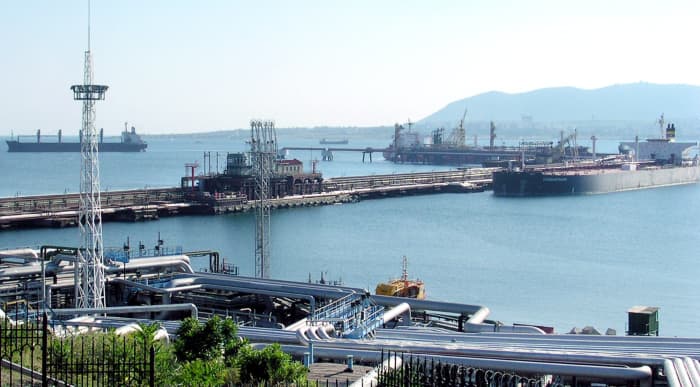
The oil harbor in Novorossiysk on the Black Sea, Russia’s largest port. LUCIE GODEAU/AGENCE FRANCE-PRESSE/GETTY IMAGES

Call it a “buyers strike” or “self-sanctioning,” but Russian crude is being shunned in the physical market even as a scramble for barrels sends oil futures to their highest levels in years.

“The current central bank sanctions and selective SWIFT action is causing major risk aversion by key market participants,” said Helima Croft, head of global commodity strategy at RBC Capital Markets, in a Thursday note.

The U.S. and its allies have imposed tough sanctions on major Russian banks, blocking them from the crucial SWIFT interbank messaging service, and have also targeted the nation’s central bank. The efforts are aimed at effectively ejecting Russia from the global financial system in response to Vladimir Putin’s decision to invade Ukraine.

However, they have so far included carve-outs for Russia’s energy exports amid worries over surging inflation.

Nevertheless, energy companies, trading houses, shipping companies, and banks have all backed away from the Russian energy business, Croft noted, adding that the country’s “already staggering” export losses could hit 3 million to 4 million barrels a day if Western powers follow through and impose the sort of energy-focused “secondary sanctions” that were aimed at Iran.

News reports have noted the struggle to clear Russian crude in the physical market. Bloomberg reported Thursday that commodity-trading giant Trafigura Group offered to sell a cargo of Russia’s flagship Urals crude at a record discount of $22.70 to Dated Brent, a global benchmark for physical oil transactions, but received no bids.

Oil futures ended lower Thursday after the U.S. benchmark CL.1, -0.59% hit a nearly 14-year intraday high of $116.57 a barrel in early trade. Brent crude BRN00, -0.05% also finished lower after hitting a session high at $119.84 a barrel, its highest since 2014.

Meanwhile, a growing premium for nearby oil futures contracts over later months — a phenomenon known as backwardation in commodities trading lingo — underlines how worried traders are about the ability to secure crude in the near term.

The premium for May Brent over the contract for delivery nine months later temporarily topped $20 a barrel, a level not seen since the 1990s, noted Edoardo Campanella, an economist at UniCredit Bank in Milan.

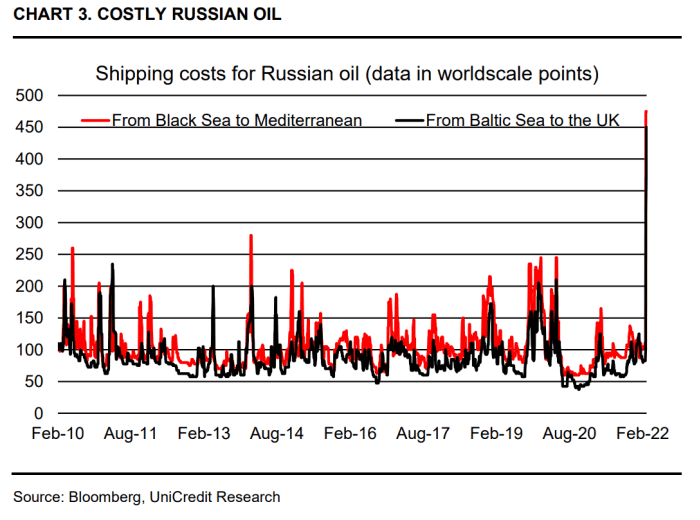
That geopolitical risk premium takes into account not only the risk of damage to oil facilities due to military action or potential Western sanctions, but also reflects soaring insurance costs to ship Russian oil. He observed that freight rates for oil coming out of both the Black Sea and Baltic sea more than tripling over the space of a few days as crude-oil buyers struggled to find shippers willing to send vessels into Russian ports (see chart below).

UNICREDIT

“This is part of a broader phenomenon of ‘self-sanctioning,’” he wrote. “Market participants are simply refusing to deal in Russian oil, even if Western governments allow it within the sanctions they have imposed on Russia in response to its invasion of Ukraine.”

The possibility of energy-specific sanctions, meanwhile, can’t be ruled out as the war rages on, said RBC’s Croft.

Read: As U.S. lawmakers push to ban Russian oil, analyst sees ‘limited impact’ on prices for Americans

“Such punitive measures would curtail buying by India and China, with their refiners being forced to choose between accessing U.S. capital markets and doing business with Russia,” she said. “Though concerns about inflation are running extremely high in Washington, we believe the energy carve-outs could soon prove untenable as the Russian conduct of the war grows more gruesome and the civilian toll climbs.”

‘They’re scared’: Wealthy Russians look to sell U.S. real estate everywhere from Fisher Island to Billionaires’ Row

Fortune

‘They’re scared’: Wealthy Russians look to sell U.S. real estate everywhere from Fisher Island to Billionaires’ Row

Lance Lambert – March 4, 2022

President Joe Biden had a crystal clear message for Russian oligarchs: We’re coming for your assets.

“The United States Department of Justice is assembling a dedicated task force to go after the crimes of the Russian oligarchs. We’re joining with European allies to find and seize their yachts, their luxury apartments, their private jets. We’re coming for your ill-begotten gains,” Biden said Wednesday during the State of the Union. Just hours after that speech, French authorities announced they had seized a yacht linked to Russian oligarch Igor Sechin.

But it isn’t just Russian oligarchs who are on edge. Wealthy non-oligarch Russians are also fretting asset seizure. In the decades since the Soviet Union collapsed, rich Russians have poured gobs of money into American real estate. Now they’re worried they could get caught in the crossfire as the U.S. goes after Vladimir Putin’s allies.

Dolly Lenz, one of the most sought-after luxury real estate brokers in America, tells Fortune she’s getting inundated with inquiries from Russian clients who are considering selling their U.S. real estate holdings. Those luxury units—with a lot worth over $10 million—are in some of Miami’s and New York City’s most exclusive neighborhoods, including Billionaires’ Row in Manhattan.

“The heat is up. They’re scared that they’re going to have their real estate seized or potentially seized. Or linked to someone who is seized. They’re scared to death of [guilt] by association,” Lenz says. While she has yet to see a flood of Russian-owned luxury real estate hit the market, she says it’s on the horizon. “There are already more inquiries, and that’s how it starts. That’s how we know [a flood of listings by Russians] is coming.”

Not only are more ultrawealthy Russians looking to sell their properties, Lenz says, many want to cancel upcoming real estate projects and business deals, even if it means losing their deposit.

“We know of several deals where [Russian] buyers had put down money on new development—with significant deposits. And are deciding to not go through with the deal. That’s pretty bad…They told us they will walk away from the deposit if the climate stays this way,” Lenz says. In some cases, she says, they’d lose a deposit upwards of $15 million if they go through with exiting the real estate development deals.

Lenz also has Russian clients who are interested in off-loading property they own on Fisher Island. Located just off the shore of Miami, the island, which is dotted with luxury condominiums, has become an absolute hotbed for Russian billionaires and oligarchs. In 2017, a Russian buyer snagged the largest penthouse at Fisher Island’s Palazzo del Sol—a luxury condominium where Russian billionaire Aras Agalarov used to have a residence—for $31 million. Just last month, Russian hockey star Ilya Kovalchuk bought a $8.5 million condo at Fisher Island’s Palazzo Della Luna. Those two buildings, along with the island’s Palazzo Del Mare—where Russian businessman Igor Olegovich Nesterenko sold his five-bedroom unit last month for $21 million—in particular, are known for being sought-after by wealthy Russians.

But not everyone Fortune spoke with is seeing an influx of Russian luxury sellers. Stuart Siegel, global head of private office at Engel & Völkers Americas, says it’s too early to tell if the Ukraine invasion will correspond with a wave of Russians selling their U.S. real estate holdings. He says economic and political instability in Russia could even encourage some Russians—at least those who aren’t on federal watch lists—to cling to their American real estate holdings.

“In times of global turmoil, American real estate has always been viewed as a safe harbor,” Siegel says.

Russian billionaire warns the country has ‘never faced such a challenge’ as Western sanctions ramp up

Business Insider

Russian billionaire warns the country has ‘never faced such a challenge’ as Western sanctions ramp up

Phil Rosen – March 3, 2022

People stand in line to withdraw money from an ATM of Alfa Bank in Moscow, Russia, Sunday, Feb. 27, 2022.
People stand in line to withdraw money from an ATM in Moscow on Feb. 27.Victor Berzkin/Associated Press
  • The West’s sanctions will create a crisis that’s three times worse than Russia’s meltdown in 1998, warned Oleg Deripaska.
  • “The crisis will be most severe for a minimum of three years,” he said at an economic conference.
  • To avoid further economic turmoil, Russia needs to achieve peace with Ukraine and end the fighting, he said.

The economic pressure Western sanctions are putting on Russia is worse than anything the country has encountered before and will have lasting repercussions, said billionaire Russian oligarch Oleg Deripaska.

“The crisis will be most severe for a minimum of three years,” he said at an economic conference Thursday, according to reports. “Take the 1998 crisis and multiply it by three.”

Deripaska, who founded the aluminum giant Rusal, added Russia has “never faced such a challenge,” the Washington Post reported.

In 1998, the ruble crashed and Moscow defaulted on its debt, prompting a rescue package from the International Monetary Fund and the World Bank.

But now, Russia faces a hostile global response to its invasion of Ukraine. Western sanctions have shut out Russia’s banks and currency reserves from the rest of the world, while companies rush to exit the country and governments look to seize the assets of elites tied to President Vladimir Putin. And more sanctions are on the way.

The effects have been immediate and dramatic. The ruble collapsed to less than a penny, and Russian stocks have been deemed “uninvestable.” Moody’s and Fitch also cut Russia’s credit rating to “junk” status. Russia’s 21 wealthiest individuals have collectively lost $84 billion, according to the Bloomberg Billionaires index.

The current sanctions form a new Iron Curtain, cutting off Russia from the Western world, said Deripaska, who is worth $2.9 billion in Forbes’ latest tally. To prevent further economic crisis, Russia must end the fighting in Ukraine and agree to a ceasefire, he added.

“The main and first step is achieving peace on a compromise basis,” Deripaska said.

Ukrainian Forces Are Using Their Home-Turf Knowledge to Stymie Russia, Top U.S. General Says

The New York Times

Ukrainian Forces Are Using Their Home-Turf Knowledge to Stymie Russia, Top U.S. General Says

Helene Cooper – March 3, 2022

Ukrainian soldiers in a tank exercise in the Donetsk Oblast of Ukraine, Feb. 17, 2022. (Tyler Hicks/The New York Times)

STUTTGART, Germany — The Ukrainian military is conducting a hugely effective and “mobile” defense, using its innate knowledge of its home turf to stymie Russian forces on multiple fronts, Gen. Mark Milley, the top military adviser to President Joe Biden, said early Thursday.

Although the strategic city of Kherson fell to Russia on Wednesday, officials said that Ukrainian forces were mounting battles up and down the Russian lines with what they described as a resourcefulness and creativity that could trip up Russian troops for weeks or months to come.

Milley, chair of the Joint Chiefs of Staff, said the tactics employed by Ukrainian troops included using mobile weapons systems to bedevil the Russians wherever they could. Ukraine’s troops, he said, are “fighting with extraordinary skill and courage against Russian forces.”

In standing up to an invading country that dwarfs their own and demonstrating their willingness to die to protect it, “fighting Ukrainian people have become the eyes and ears of the world,” Milley said.

The public comments, made to reporters traveling with him to meet with European officials at NATO, were Milley’s first since President Vladimir Putin of Russia began his brutal efforts to seize Ukraine and topple the democratically elected government of President Volodymyr Zelenskyy.

Milley met with NATO’s secretary-general, Jens Stoltenberg, in Brussels before traveling to Stuttgart to confer with U.S. European Command.

Stoltenberg said the Ukrainian military, which has been backed in recent days with arms shipments from NATO countries, was “performing better and putting up more resistance than most experts expected, and surely more than Russia expected.”

Here Are the Russian Oligarch Superyachts That Have Been Seized

Esquire

Here Are the Russian Oligarch Super-yachts That Have Been Seized

Jack Holmes – March 3, 2022

Photo credit: NICOLAS TUCAT - Getty Images
Photo credit: NICOLAS TUCAT – Getty Images

For years, many in the West lamented Russia’s system of kleptocratic oligarchy while Western governments happily welcomed in the oligarchs and their gobs of cash. New York City is home to a flock of “ghost buildings,” where elites from Russia—and beyond—have pied-a-terres that are seldom lit up at night because nobody is ever there. Entire neighborhoods in London were oligarched over the years, along with one of the city’s flagship soccer teams, Chelsea, when Roman Abramovich bought the club in 2003. But that all began to change, slowly, in 2014, as Russia engaged in naked aggression towards Ukraine. And now, with Vladimir Putin’s campaign of violent terror against that country, it’s all begun to come apart.

The headline-grabber in the sweeping sanctions regime imposed on Russia’s elite class is the ritual seizing of the yachts. Rich people of every national origin love a big boat, but one could make the case the Russian bigwigs love a boat most of all. And some of these things are, in addition to a gross exhibition of resource-hoarding, fairly impressive feats of engineering and design. So here’s a list of the oligarch superyachts that have changed hands since Putin truly crossed the line.

CNBC reports many oligarchs have begun moving their yachts to the Maldives and elsewhere in an attempt to shield them from European Union sanctions. We’ll update this if any others see new ownership.

Al Raya, Alisher Usmanov

Photo credit: Anadolu Agency - Getty Images
Photo credit: Anadolu Agency – Getty Images

Formerly known as Dilbar, this thing is reportedly 512 feet long and weighs 15,917 tons, making it the world’s largest motor yacht by weight. Forbes tells us it usually hosts a crew of 96 people. It has two helipads, a beauty salon, a gym, and 12 suites, along with the largest swimming pool ever put on a boat at 82 feet. A custom job, it reportedly took German shipbuilder Lürssen 52 months to build. Usmanov paid $600 million for it. Forbes reports that German authorities seized the vessel from a shipyard in Hamburg, where it was undergoing some renovations. Tough luck for Usmanov, an Uzbek-born mining magnate who’s held stakes in telecom companies and Facebook. He’s also got extensive real-estate holdings, and was once a major shareholder in London’s Arsenal Football Club, adversary to fellow oligarch Abramovich’s Chelsea.

Amore Vero, (allegedly) Igor Sechin

Photo credit: NICOLAS TUCAT - Getty Images
Photo credit: NICOLAS TUCAT – Getty Images

Reuters reports French authorities are the captain now of this 280-foot vessel, the name of which translates to “True Love” from Italian. The crew was reportedly preparing a hasty departure from La Ciotat, a town near Marseille in the Cote d’Azur, when French customs officers took over management. This one also has a beauty salon and a gym, and France24 reports it hosts a swimming pool that turns into a helipad. The French say that the yacht is owned by a holding company in which Igor Sechin is a the main shareholder. Sechin has been the CEO of Rosneft, the Russian state oil firm, since 2012, and is one of Putin’s closest friends and advisors.

Photos: Ukraine’s civilian forces grow as more enlist in the fight against Russia

NPR – The Picture Show

Photos: Ukraine’s civilian forces grow as more enlist in the fight against Russia

Marco Storel – March 4, 2022

Editor’s note: Graphic content

Yevghen Zbormyrsky, 49, runs in front of his burning home after it was shelled in the city of Irpin, Ukraine, outside the country’s capital of Kyiv, on Friday, March 4.Aris Messinis/AFP via Getty Images

Russian military forces have invaded Ukraine.

The wide-scale incursion began on Thursday, Feb. 24. Ukraine’s military has claimed that Russia has faced steep casualties as a result of fierce fighting; the Russian Defense Ministry acknowledged Wednesday, March 2, that 498 Russian troops had been killed and another 1,597 injured in the “special military operation.”
Oksana is hugged by her son, Dmytro, during a funeral for her husband, Volodymyr Nezhenets, in the city of Kyiv, Ukraine, on Friday, March 4. A small group of reservists buried their comrade after Nezhenets was one of three killed on Saturday, Feb. 26, in an ambush Ukrainian authorities say was caused by Russian “saboteurs.”Emilio Morenatti/AP

Since Russia’s invasion of Ukraine began, an estimated 1 million have fled to neighboring E.U. states, according to the United Nations. Tens of thousands have also enlisted in the military in the week since Russia’s invasion began. Ukraine’s defense ministry reported Thursday, March 3, that they’d get help from roughly 16,000 military volunteers, too.

EUROPE
A closer look at the volunteers who are signing up to fight the Russians

Russian and Ukrainian leaders held cease-fire negotiations on Monday, Feb. 28, but they ended with no breakthrough to end the fighting. A second round of talks Thursday, March 3, ended with an agreement to hold a third round “very soon.”

The head of Russia’s delegation said the countries had agreed to establish humanitarian corridors for the evacuation of civilians and agreed on the “possibility” of a temporary ceasefire during humanitarian operations.

U.S. officials had said for weeks that a Russian invasion of Ukraine was imminent, a warning that Russia, in turn, dismissed as scaremongering. U.S. President Joe Biden warned of a “catastrophic loss of life and human suffering.”Sponsor Message

The U.S. has joined international partners in levying heavy new sanctions against Russia’s military and economy in the days since the invasion began. President Biden has said that Russian President Vladimir Putin and his country would bear the costs of the attack.

A bus is riddled with holes from a machine gun after an ambush in Kyiv, Ukraine, on Friday, March 4. Emilio Morenatti/AP

Ukrainian artillerymen keep position in the Luhansk region on Wednesday, March 2. Anatolii Stepanov/AFP via Getty Images

Ukrainian President Volodymyr Zelensky gestures as he speaks during a press conference in Kyiv on March 3, 2022. Ukraine President Volodymyr Zelensky called on the West on March 3, 2022, to increase military aid to Ukraine, saying Russia would advance on the rest of Europe otherwise. “If you do not have the power to close the skies, then give me planes!” Zelensky said at a press conference. Sergei Supinsky/AFP via Getty Images

A child learns how to use an AK-47 assault rifle during a self-defense course for civilians in the outskirts of Lviv, in western Ukraine, on Friday, March 4. Daniel Leal/AFP via Getty Images

People remove personal belongings from a burning house after being shelled in the city of Irpin, Ukraine, outside the country’s capital of Kyiv, on Friday, March 4. Aris Messinis/AFP via Getty Images

Women and children try to get onto a train bound for Lviv, Ukraine, at Kyiv’s train station Thursday, March 3. Ukrainian men have been conscripted to fight in the war while hundreds of thousands of women and children flee the country to seek refuge in neighboring nations that are members of the EU. Emilio Morenatti/AP

Stanislav, 40, says goodbye to his son, David, 2, and his wife, Anna, 35, on a train to Lviv, Ukraine, at Kyiv’s train station Thursday, March 3. Stanislav was staying to fight while his family was leaving the country to seek refuge in a neighboring country. Emilio Morenatti/AP

A newborn baby is seen in the bomb shelter of a maternity hospital Tuesday, March 2, in Kyiv, Ukraine. Chris McGrath/Getty Images

A woman sits in a tent as people take shelter in a subway station turned into a bomb shelter Wednesday, March 2, in Kyiv, Ukraine. Chris McGrath/Getty Images

Members of a territorial defense unit prepare to deploy to various parts of the city on Tuesday, March 2, in Kyiv, Ukraine. Chris McGrath/Getty Images

A Ukrainian serviceman walks past as fire and smoke rises over a damaged logistics center after being shelled Thursday, March 3, in Kyiv, Ukraine. Efrem Lukatsky/AP

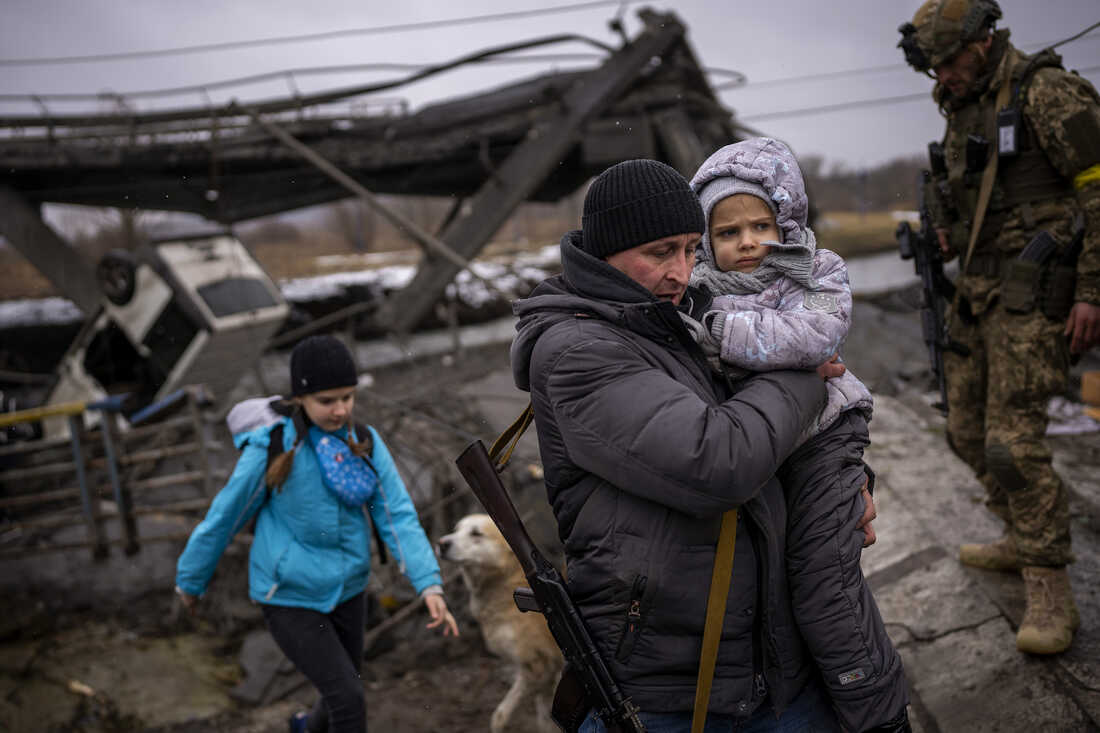
Local militiaman Valery, 37, carries a child as he helps a fleeing family across a bridge destroyed by artillery on the outskirts Kyiv, Ukraine, on Wednesday, March 2. Emilio Morenatti/AP

A boy uses a tablet sitting in a metro car at an underground station being used as bomb shelter in Kyiv, Ukraine, on Wednesday, March 2. On the seventh day of fighting in Ukraine, Russia claimed to control the southern port city of Kherson, street battles raged in Ukraine’s second-largest city, Kharkiv, and Kyiv braced for an expected assault by a nearby convoy of Russian forces. Genya Savilov/AFP via Getty Images

A woman cries as she leaves a house damaged by a Russian airstrike, according to locals, in Gorenka, Ukraine, just outside the country’s capital of Kyiv on Wednesday, March 2. Vadim Ghirda/AP

A group of women and a boy walk to the train station as they try to leave Kyiv, Ukraine, on Wednesday, March 2. Emilio Morenatti/AP

A blast is seen engulfing a TV tower in Kyiv, Ukraine, amid Russia’s continuing invasion Tuesday, March 1. Carlos Barria/Reuters

An armed man stands by the remains of a Russian military vehicle in Bucha, Ukraine, close to the nation’s capital of Kyiv, on Tuesday, March 1. Serhii Nuzhnenko/AP

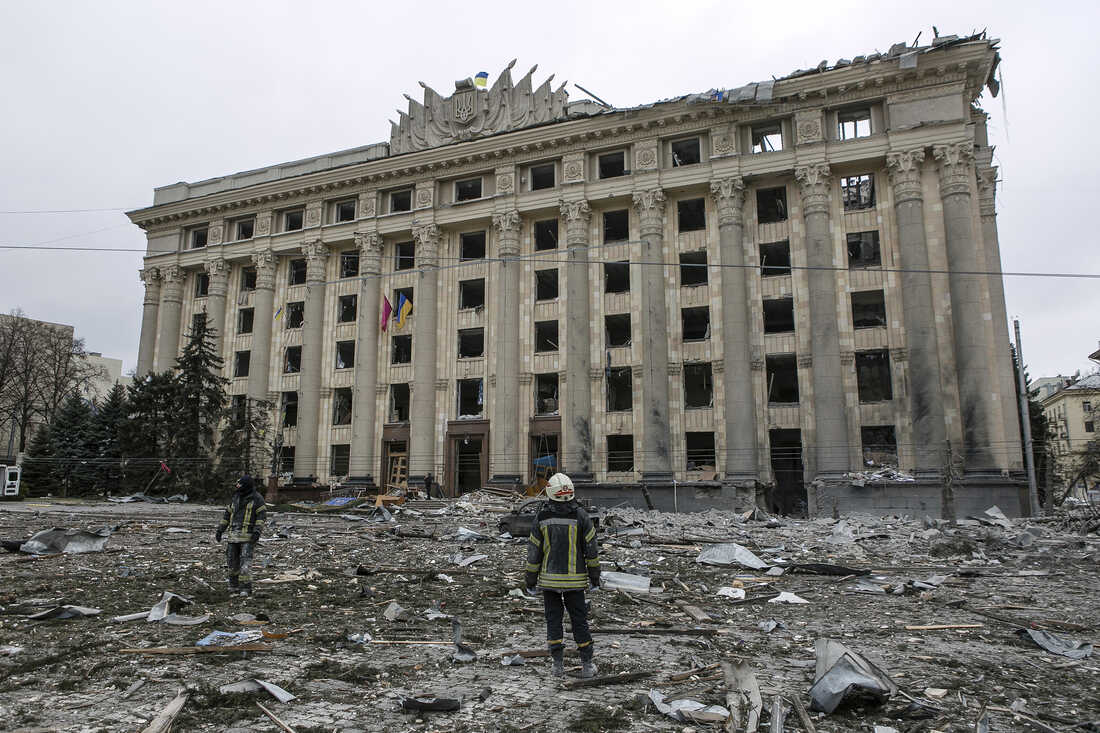
A member of the Ukrainian Emergency Service surveys damage to Kharkiv’s City Hall in the city’s central square following shelling Tuesday, March 1. Russian strikes pounded the square in the country’s second-largest city — in addition to other civilian sites Tuesday — in what the country’s president condemned as a blatant campaign of terror by Moscow. Pavel Dorogoy/AP

Members of a Ukrainian civil defense unit pass new assault rifles to the opposite side of a blown up bridge on Kyiv’s northern front on Tuesday, March 1. Satellite photos showed a Russian convoy stretching for about 40 miles and advancing slowly toward the capital Tuesday. Aris Messinis/AFP via Getty Images

A girl draws at a table set up in the bomb shelter at the Okhmadet Children’s Hospital in Kyiv, on Tuesday, March 1. Chris McGrath/Getty Images

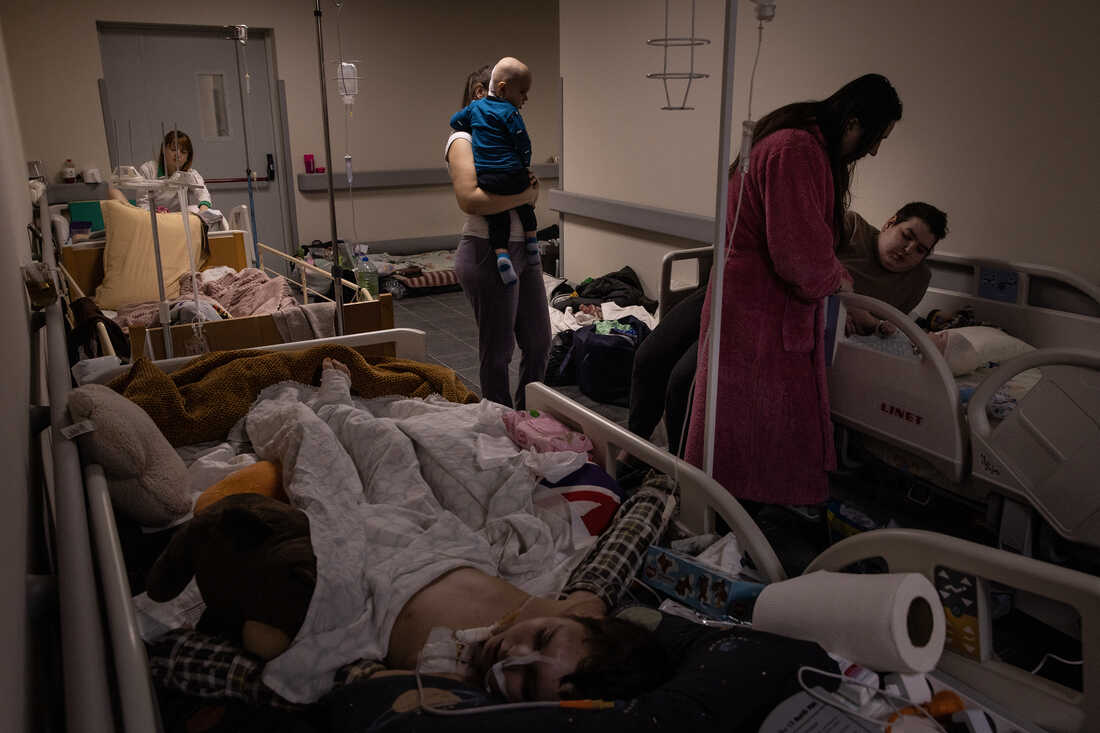
Mothers tend to their children undergoing cancer treatments on Saturday, Feb. 28, in the bomb shelter of the oncology ward at Okhmatdyt Children’s Hospital in Kyiv, Ukraine. Chris McGrath/Getty Images

German citizen Boris carries his baby Josephine to a train evacuating residents to western regions of Ukraine on Monday, Feb. 28, in Kyiv, Ukraine. Josephine was born two days ago from a Ukrainian surogate mother in Kyiv. Boris and his wife, Margarete, said they were registered on the German embassy’s evacuation list. Pierre Crom/Getty Images

Ukrainian volunteers sort donated clothes for later distribution to the local population in Lviv, western Ukraine, on Wednesday, March 2. Bernat Armangue/AP

A man looks at the gutted remains of Russian military vehicles on a road in the town of Bucha, close to the capital Kyiv, Ukraine, Tuesday, March 1, 2022. Serhii Nuzhnenko/AP

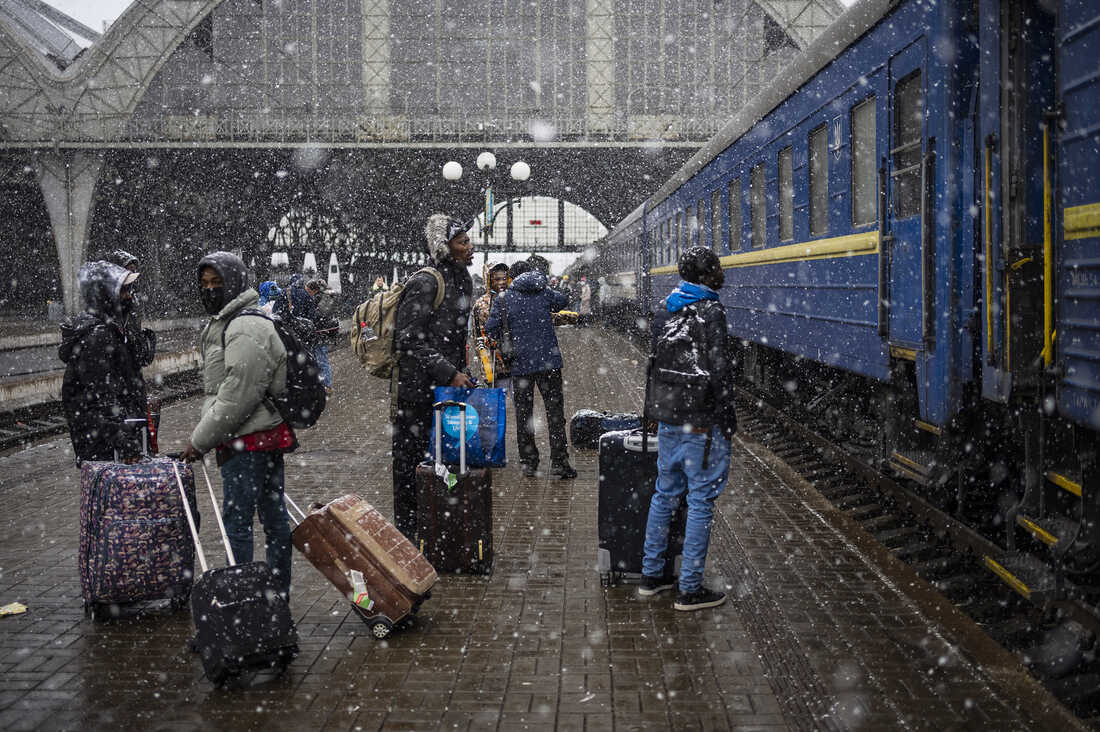
Nigerian students in Ukraine wait at the platform in Lviv’s railway station on Sunday, Feb. 27. Thousands of people massed at Lviv’s main train station on Sunday, attempting to board trains to leave Ukraine. Bernat Armangue/AP

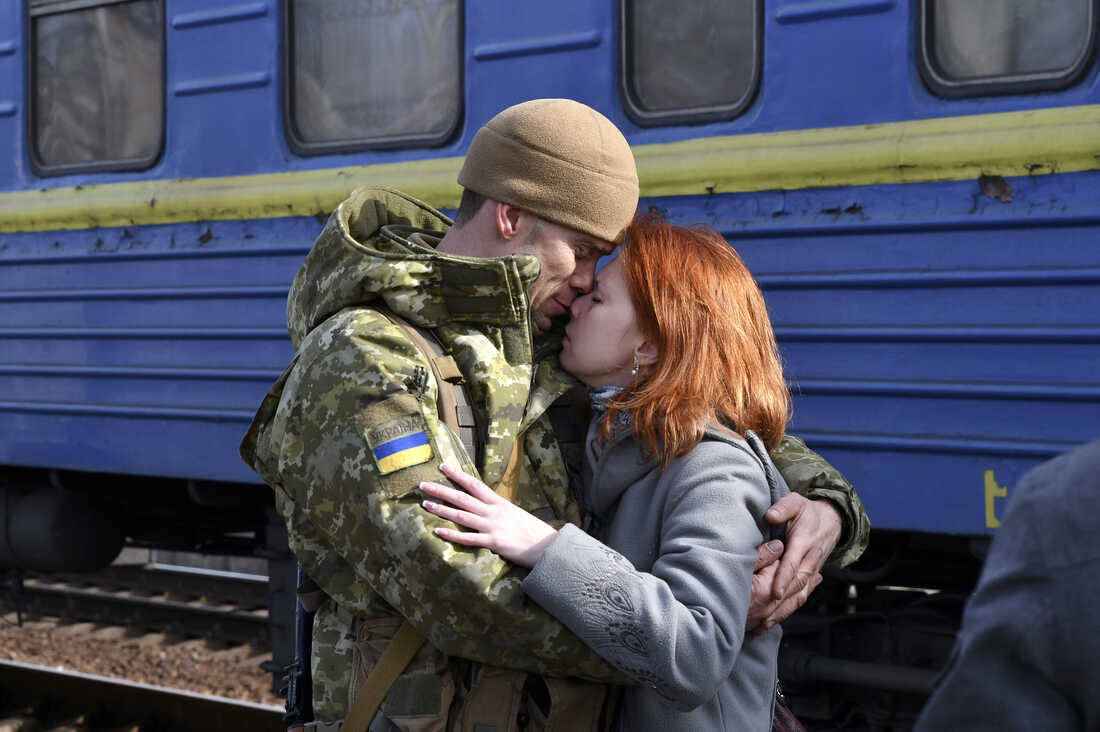
A couple embraces before the woman boards a train leaving for western Ukraine, at the railway station in Kramatorsk, eastern Ukraine, on Sunday. The U.N. refugee agency says nearly 120,000 people have so far fled Ukraine into neighboring countries in the wake of the Russian invasion. Andriy Andriyenko/AP

Transfer three A-10 aircraft squadrons to Ukraine now

Defense News

Transfer three A-10 aircraft squadrons to Ukraine now

Everett Pyatt – March 3, 2022

Tech. Sgt. Gregory Brook

“Give us the tools, and we will finish the job,“ spoke U.K. Prime Minister Winston Churchill in February 1941. Following this powerful speech, U.S. President Franklin Roosevelt proposed and Congress approved the lend-lease program. This provided the U.K. equipment and access to United States production capacity. This action was essential to stopping the Nazi advances.

History often rhymes. Now, Ukrainian President Volodymyr Zelenskyy is making the same plea for equipment necessary to stop the advance of the Russian autocratic Army. Now is the time for another lend-lease program supporting Ukraine.

Congress is acting in a supportive manner, but details are important. Russia must face a military defeat to enforce sanctions. The history of sanctions supports the conclusion that they do not change policy, but rather make conduct of business far more difficult while imposing distress on the economy as shown in Iraq, Iran, North Korea and others.

Sanctions must be accompanied by military success.

Zelenskyy has requested weapons and support in line with Churchill’s philosophy. Ukrainian soldiers have proved their courage and bravery. There is one more step that could be decisive: the transfer of three squadrons of A-10 aircraft to the Ukrainian Air Force.

This aircraft and its gun system were designed to counter an armored assault in Europe. They proved effective in Desert Storm’s target-rich environment, quite similar to the current advancing Russian force. They also became the infantry’s friend in close-air support missions.

The United States Air Force has deployment packages ready to go. The whole transfer to the Ukrainian Air Force could be completed in days after congressional authorization.

Firepower is needed to defeat the coming onslaught of armored forces. Other weapons are necessary for ground forces, but air power will be decisive. The A-10 has proven this ability and was designed for this purpose.

Zelenskyy asked NATO for air support. This request was declined by NATO. That is an appropriate decision since Russia has not attacked NATO.

However, that decision leaves each country an opportunity to decide based on its own moral compass. Many, including the United States, have decided to provide and have already supplied lethal aid necessary to slow the Russian advance. Some effects are notable, but military analysts agree that the long-term outlook for Ukraine’s survival is not good. One predicts a continuing resistance war for decades.

Zelenskyy is right in requesting air power support. It is necessary to slow or stop the oncoming juggernaut of Russian armored forces. The United States has the most effective weapon for this role — the U.S. Air Force’s A-10 aircraft. It is available since the service wants to retire most of the 30-year-old fleet. The airplane was designed to operate in Europe from ill-prepared facilities. Pilot retraining is minimal. All that is needed is painting Ukrainian insignia and delivering the aircraft. This could be done in days.

Each day is critical to slowing the momentum of Russia’s invading force. It is time to implement the United States’ moral compass and add the A-10 to the list of weapons already scheduled. Failure to add defensive capability to current Ukraine forces, while sanctions develop, weakens the potential impact of sanctions. They are complementary actions.

Everett Pyatt is a former assistant secretary of the U.S. Navy for shipbuilding and logistics.

Ukrainian colonel says Russian troops are ‘hungry, without fuel, demoralized’ as 40-mile-long convoy near Kyiv is stalled for days

Business Insider

Ukrainian colonel says Russian troops are ‘hungry, without fuel, demoralized’ as 40-mile-long convoy near Kyiv is stalled for days

Sinéad Baker – March 3, 2022

Ukrainian colonel says Russian troops are ‘hungry, without fuel, demoralized’ as 40-mile-long convoy near Kyiv is stalled for days
40 mile-long Russian convoy
Satellite imagery of a 40-mile long Russian military convoy seen north of Kyiv earlier this week.Satellite image ©2022 Maxar Technologies
  • Russian troops are struggling without food and fuel, a Ukrainian colonel told The Wall Street Journal.
  • It comes as the US and UK say the 40-mile-long Russian military convoy bearing down on Kyiv is stalled.
  • UK intelligence said it was “delayed by staunch Ukrainian resistance, mechanical breakdown and congestion.”

The 40-mile-long Russian military convoy bearing down on Ukraine’s capital city appears to have been stalled for days, and a Ukrainian colonel said Russian troops were running low on supplies and morale.

The Ukrainian colonel told The Wall Street Journal: “The Russians thought they could break through and be in Kyiv in a couple of days. They didn’t realize that we have learned how to wage war in the past eight years.”

“Now they sit there, hungry, without fuel, demoralized, and we just come in every little while and pop them off. And every day, we are pushing them back.”

The remarks come as the US and UK said the military convoy, which was spotted in Sunday satellite images apparently approaching Kyiv, had made little progress.

The UK Ministry of Defence said on Thursday the convoy was about 30 kilometers (19 miles) from Kyiv’s center and struggling with issues including resistance from Ukrainians. Since last week’s invasion, ordinary Ukrainians have been taking up arms to fend off Russian forces.

“The main body of the large Russian column advancing on Kyiv remains over 30km from the centre of the city having been delayed by staunch Ukrainian resistance, mechanical breakdown and congestion. The column has made little discernible progress in over three days,” it said.

A senior US defense official also told reporters on Wednesday: “We believe that the convoy is stalled.”

NPR reported that the convoy includes tanks, armored vehicles, artillery and supplies.

Civilians participate in a Kyiv Territorial Defence unit training session on January 29, 2022 in Kyiv, Ukraine.
Civilians participate in a Kyiv Territorial Defence unit training session on January 29, 2022.Photo by Chris McGrath/Getty Images

A senior US defense official told reporters on Tuesday that some of the Russian forces in Ukraine were “literally out of gas” and are “having problems feeding their troops,” Insider’s Abbie Shull reported.

It is not clear if the official was talking about the convoy near Kyiv, or other Russian operations in Ukraine.

The official said that Russians “face greater resistance than they thought, that they have experienced fuel and logistics challenges.”

But the official warned that Russia may have decided to pause its operations as “they are possibly regrouping, rethinking, reevaluating.”