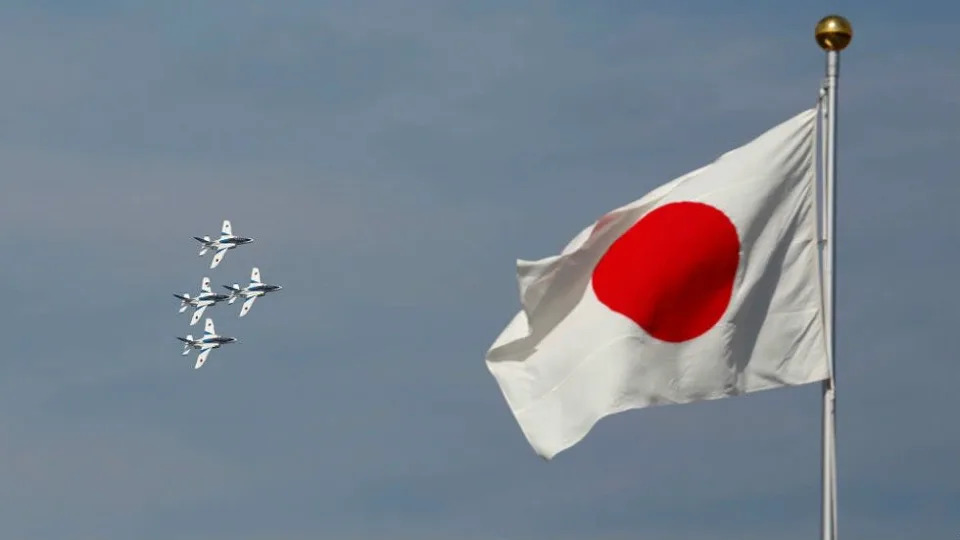
Japan says it spotted Russian amphibious ships heading toward Europe
March 17, 2022
Japan said on Thursday it spotted four Russian amphibious ships in waters close to its shores on Wednesday.
The Japanese military said the four ships sailed in the Tsuruga Strait that separates Japan’s Honshu island and Hokkaido island, an unusual move for Russia, Reuters reported.
The ships are able to hold military equipment, including tanks, and hundreds of troops.
Japan’s defense ministry released pictures of the ships that appeared to have military trucks on at least one of them, according to Reuters.
When a defense ministry spokesperson was asked if the equipment could be going to Ukraine, he said “it is possible.”
Russia’s invasion of Ukraine has killed thousands and destroyed hundreds of buildings over the past three weeks.
Russia has targeted hospitals, movie theaters and residential buildings, although the Kremlin denies doing so.
Ukrainian officials have decried alleged Russian war crimes and continue to push for a no-fly zone over Ukraine.
Western countries have resisted the move but have provided military aid to Ukraine to defend its country.
Russia continues to falsely claim their presence in Ukraine is a “special military operation” to liberate the people from a “neo-Nazi” government.
More than 3 million Ukrainians have been displaced due to the fighting.
Russia warns United States: we have the might to put you in your place
March 17, 2022
LONDON (Reuters) -Russia warned the United States on Thursday that Moscow had the might to put the world’s pre-eminent superpower in its place and accused the West of stoking a wild Russophobic plot to tear Russia apart.
Dmitry Medvedev, who served as president from 2008 to 2012 and is now deputy secretary of Russia’s Security Council, said the United States had stoked “disgusting” Russophobia in an attempt to force Russia to its knees.
“It will not work – Russia has the might to put all of our brash enemies in their place,” Medvedev said.
Since Russia invaded Ukraine on Feb. 24, the United States and its European and Asian allies have slapped sanctions on Russian leaders, companies and businessmen, cutting off Russia from much of the world economy.
President Vladimir Putin says that what he calls the special military operation in Ukraine was necessary because the United States was using Ukraine to threaten Russia and Russia had to defend against the “genocide” of Russian-speaking people by Ukraine.
Ukraine says it is fighting for its existence and that Putin’s claims of genocide are nonsense. The West says claims it wants to rip Russia apart are fiction.
Russia says that despite sanctions it can fare well without what it casts as a deceitful and decadent West led by the United States. It says its bid to forge ties with the West after the 1991 fall of the Soviet Union is now over and that it will develop ties with other powers such as China.
Koch Industries to stay in Russia, says exiting does ‘more harm than good’
Andrew Jeong and Adela Suliman – March 17, 2022
Charles Koch, chief executive of Koch Industries, in Colorado Springs in 2019. (David Zalubowski/AP) (AP)
Koch Industries, the American manufacturing giant that employs 122,000 people across the world, said Wednesday it would not exit its operations in Russia because doing so would put its “employees there at greater risk and do more harm than good.”
The multinational conglomerate’s presence in Russia is relatively small, its president and chief operating officer, Dave Robertson, said in a statement Wednesday. It has about 600 workers at its Guardian Industries subsidiary operating two glass-manufacturing facilities in Russia and an additional 15 people working outside Guardian but in the country, he said. “We have no other physical assets in Russia,” Robertson added.
Guardian Industries and its family of companies employ over 14,000 people in 26 countries and have bases in Rostov and Ryazan in Russia, according to its website.
Koch’s decision was disclosed after more than 400 global companies publicly announced plans to withdraw, suspend and scale back their operations in Russia because of its invasion of neighboring Ukraine. Consumer and social media campaigns to boycott such things as Russian vodka, classical music concerts and soccer have also added to public pressure on companies.
However, according to a list compiled by Yale management professor Jeffrey Sonnenfeld and his research team, Koch Industries is one of about 30 companies described as “digging in” and “defying demands” for an exit or reduction of activities in Russia. Others on the list include Reebok, Cargill, Halliburton, LG Electronics and food brands such as Cinnabon and Subway.
Oil companies including Shell, BP and ExxonMobil were among the first to cut ties with Russia, along with some banking firms and tech companies such as Apple and Google. Others, including McDonald’s and Coca-Cola, followed.
“The horrific and abhorrent aggression against Ukraine is an affront to humanity,” said Robertson, the Koch executive. “Principles always matter, and they matter most when they are under pressure.”
Robertson said Koch “will not walk away from our employees there or hand over these manufacturing facilities to the Russian government so it can operate and benefit from them.” He added: “Doing so would only put our employees there at greater risk and do more harm than good.”
The company is complying with sanctions, he said, and will continue to provide financial assistance to employees and their families from Ukraine along with “humanitarian aid to those affected in neighboring countries.”
In an address to Congress on Wednesday, Ukrainian President Volodymyr Zelensky said: “Peace is more important than income.”
“All American companies must leave Russia . . . leave their market immediately, because it is flooded with our blood.” He urged American lawmakers to “take the lead” and “make sure that the Russians do not receive a single penny that they use to destroy our people in Ukraine.”
The war is posing a corporate quandary and testing the mettle of some of the world’s most powerful brands, as well as the long-held theory of international relations that countries that trade together don’t wage wars against each other.
Koch is among corporations such as Cargill, LG Electronics and Subway that have decided to stay in Russia. Many of those companies have issued statements expressing concern over the conflict, but Koch is one of the few that have opted both to stay and openly condemn the Russian government.
Koch Industries, based in Wichita, is the second-largest privately held company in the United States and has broad operations, including in energy, chemicals and electronic technologies. It is run and partly owned by Charles Koch, known for the millions he donated to conservative causes with his brother David Koch, who died in 2019.
U.S. says Russian troops “killed 10 people standing in line for bread”
Tucker Reals – March 16, 2022
Firefighters are seen at the site as smoke rises from a damaged building after Russian attacks hit residential buildings in Chernihiv, Ukraine, March 13, 2022. / Credit: State Emergency Service of Ukraine/Handout/Anadolu Agency/Getty (State Emergency Service of Ukraine/Handout/Anadolu Agency/Getty)
The U.S. Embassy in Ukraine said Russian troops “shot and killed 10 people standing in line for bread” on Wednesday in the decimated northeast Ukrainian city of Chernihiv. The embassy did not cite what evidence it had of the attack in a statement posted on its official Twitter account.
“Such horrific attacks must stop,” the Embassy said in the tweet, adding that the U.S. government was “considering all available options to ensure accountability for any atrocity crimes in Ukraine.”
With each day, the cost in human lives and suffering of Russia’s war on Ukraine rises. The United Nations human rights office has registered about 600 civilian deaths, but the U.N. acknowledges the real toll is certain to be far higher. Ukrainian officials say thousands have been killed — more than 2,000 in the besieged southern city of Mariupol alone.
Video: A look at the treatment of Ukrainian refugees at border crossings
Scroll back up to restore default view.
There was little information on the alleged attack on civilians lining up for food in Chernihiv, but video posted to social media showed the purported aftermath, with a number of bodies on the ground.
One of those to post the video was Oleksandr Merezhko, deputy head of the Verkhovna Rada, Ukraine’s parliament, and chair of its Foreign Affairs Committee.
In Chernigiv Russians have killed more than ten people who were standing in line to buy some bread. pic.twitter.com/sy2yGN1BAw
“Russians have killed more than ten people who were standing in line to buy some bread,” he said in his tweet.
The alleged attack came a day after Ukraine’s general prosecutor’s office said a Russian artillery strike had hit a university and open-air market in Chernihiv on Monday, killing 10. It was one of many strikes to hit the city over the last three weeks.
The governor of the region said Wednesday that electricity had been cut to Chernihiv city and some surrounding towns and villages, but the Reuters news agency quoted Governor Viacheslav Chaus as saying Ukraine’s armed forces were dealing “powerful blows on the Russian enemy every hour.”
Firefighters are seen at the site as smoke rises from a damaged building after Russian attacks hit residential buildings in Chernihiv, Ukraine, March 13, 2022. / Credit: State Emergency Service of Ukraine/Handout/Anadolu Agency/Getty
On Tuesday, Reuters interviewed Mykola Vasylinko in Kyiv, who said he had just fled to the capital from Chernihiv, where the situation was “much worse.”
“This is no Chernihiv,” he told Reuters. “They [Russian forces] have tried to erase [it] from the Earth’s surface. They bomb residential areas, they specifically target residential buildings.”
Chernihiv is one of several large cities very close to Ukraine’s northeast border with Russia that have come under blistering artillery fire since Vladimir Putin ordered the invasion and air war against Ukraine to start on February 24.
Russian troops opened fire on people waiting for food in Chernihiv, killing 10 people, local reports said
Rebecca Cohen – March 16, 2022
People carrying a person to a vehicle in the aftermath of the shooting in Chernihiv.Suspilne
Russian troops opened fire on Ukrainian civilians waiting for bread in Chernihiv, reports said.
The attack killed 10 people, the Ukrainian public broadcaster Suspilne said.
The US Embassy in Kyiv said it would “ensure accountability for any atrocity crimes in Ukraine.”
Russian troops killed at least 10 people after opening fire on a group waiting in line for food in Chernihiv, Ukraine, a local report said.
A video posted to Telegram by the Ukrainian public broadcaster Suspilne appeared to show multiple blurred-out bodies on the ground in the city, which is under attack by Russian forces.
Suspilne reported that the soldiers opened fire in the residential area at about 10 a.m. local time on Wednesday as people “stood in line for bread.”
A man can be heard screaming “help” as bystanders carry a person who appears to be wounded to a car after the attack. At the end of the clip, an ambulance drives up to the scene.
The US Embassy in Kyiv accused Russian forces of the assault in a tweet on Wednesday.
“Today, Russian forces shot and killed 10 people standing in line for bread in Chernihiv,” the embassy said. “Such horrific attacks must stop. We are considering all available options to ensure accountability for any atrocity crimes in Ukraine.”
Russian troops first invaded Ukraine on February 24. In the weeks since, Russian forces have shelled towns across the Eastern European country, hitting multiple civilian targets, including a maternity hospital.
Ukrainian President Volodymyr Zelenskyy has called these civilian attacks war crimes.
The United Nations’ human-rights office said on Tuesday that at least 691 civilians had been killed in Ukraine since Russia’s invasion began, but it believed the true death toll was “considerably higher.”
“Most of the civilian casualties recorded were caused by the use of explosive weapons with a wide impact area, including shelling from heavy artillery and multiple-launch rocket systems, and missile and air strikes,” the agency said.
Ukraine v. Russia: Court ruling against Putin could ‘undermine his power’
Alexis Keenan, Reporter – March 16, 2022
The International Court of Justice on Wednesday ordered Russia to stop all military actions in Ukraine tied to its February invasion of the country, and to revoke its claim that Ukrainian citizens requested Russia’s military support.
In a 13-2 ruling, the court found it had jurisdiction over Ukraine’s allegations that Russia falsely accused Ukraine of genocide to justify waging war on the former member of the Soviet Union. The court’s judges voted 13-2 on the ruling.
“The court is profoundly concerned about the use of force by the Russian Federation in Ukraine, which raises very serious issues of international law,” ICJ president Joan Donoghue said Wednesday during the announcement of the court’s decision.
Donoghue emphasized that the court took into account Ukraine’s “extremely vulnerable” civilian population, and “significant material damage” to property caused by Russia’s invasion.
“Many persons have no access to the most basic foodstuffs, potable water, electricity, essential medicines, or heating. A very large number of people are attempting to flee from the most affected cities, under extremely insecure conditions,” she said.
While the order will likely have political consequences for Russia, experts say it will do little to force Russia’s retreat.
The emergency request reveals the multitude of challenges that Ukraine faces as it tries to fend off Russia, which invaded on Feb. 24 and prompted Western nations to impose harsh economic sanctions against President Vladimir Putin’s regime. While the international court has no power to enforce its own order, Ukrainian officials nonetheless moved forward with the legal claim.
“Here, there’s nothing really that the court can do to enforce its own order,” Milena Sterio, professor of international law at Cleveland-Marshall College of Law, said prior to the court’s ruling.
But, she added, “The court’s order would carry a lot of weight in terms of further tarnishing the Russian reputation…it would add to the political and diplomatic pressure that’s mounting against Russia.”
In its application to the court — an emergency request to stop irreparable harm — Ukraine asked the court to order Russia to immediately suspend military operations in Ukraine, to cease planning further operations, and to require Russia to file periodic compliance reports. So far, Russia’s representatives have neither answered Ukraine’s claims, nor participated in the court’s proceedings.
The court declined to grant Ukraine’s request to direct Russia to file compliance reports.
Anton Korynevych, Permanent Representative of the President of Ukraine in the Autonomous Republic of Crimea and Oksana Zolotaryova, Director, International Law Department, Ministry of Foreign Affairs of Ukraine at the International Criminal Court, where Ukraine took Russia to the top United Nations court over alleged breaches of the genocide convention, talk to the media in The Hague, Netherlands, March 7, 2022. Phil Nijhuis/Pool via REUTERS
“Even if Russia refuses to comply, the court’s judgment stands against it for the world to see,” Rebecca Hamilton, associate professor of law at American University, explained, prior to the ruling. “If decisions like this can penetrate through his lies, that will begin to undermine his power.”
Hamilton anticipates Russia to ignore the court’s ruling. Nonetheless, she says, other world leaders will take the decision into account.
“Just because President Vladimir Putin ignores international law does not mean that the law goes away,” she said. “The court’s decision can and will be used by those working diplomatic channels to try to bring an end to Russia’s invasion of Ukraine.”
‘A clever argument’
Before the ruling, Sterio said she expected the court to grant at least some of Ukraine’s requests because it would be politically difficult for the court to rule against a country that’s currently being invaded on false pretenses. Still, she raised questions about the strength of Ukraine’s broader claims involving Russia’s repeated assertions that Ukraine is killing its own people.
Ukraine, she explained, has made a “clever” argument under the Convention on the Prevention and Punishment of the Crime of Genocide. Both Ukraine and Russia are parties to the treaty, which gives the court jurisdiction over cases between member states that allege that one state is committing acts of genocide against another. However, Ukraine’s argument doesn’t make that claim.
“No matter how horrible and horrific the invasion is, there’s very little evidence that Russian troops are actually committing genocide,” Sterio said. To get around that, Ukraine argued that Russia must stop tarnishing Ukraine’s reputation by claiming that Ukraine is committing genocide.
Donoghue noted the unsettled jurisdictional issue saying that at the current emergency stage, the court “need not satisfy itself in a definitive manner that it has jurisdiction…” The main issues raised by Ukraine’s allegations, she said, could be properly addressed if the case moves forward.
“This is a horrible lie. Putin lies, and Ukrainians, our citizens, die,” Anton Korynevych, Ukraine President Volodymyr Zelenskyy’s envoy to the Autonomous Republic of Crimea, told the court during arguments on March 7. “With its false claim of genocide, Russia uses one pillar of modern international legal order to destroy the other.”
This story was updated to include the ICJ’s ruling issued on Wednesday.
Alexis Keenan is a legal reporter for Yahoo Finance.
Russian forces bombed a theater in the city of Mariupol on Wednesday, according to Ukrainian officials.
The building was serving as a shelter for hundreds of refugees in the embattled city.
New satellite images show the word “CHILDREN” written largely in Russian outside the theater.
The theater in Mariupol, Ukraine, targeted in an alleged Russian attack on Wednesday had the word “CHILDREN” written largely in Russian on the pavement outside, according to satellite images.
The theater was serving as a shelter for hundreds of civilian refugees, including many children, in the embattled city of Mariupol, which has been left without water, heat, and food for several days amid Russia’s escalating attack.
The total deaths resulting from the attack are currently unknown, but a city official said more than 1,000 people had been hiding in the building.
Maxar satellite images of the theater show the word “CHILDREN” written in large, white, Cyrillic letters on two sides of the building — a possible attempt to alert Russian forces to the presence of young civilians hiding inside.
The type of weapon that damaged the theater was not immediately known but is consistent with an air-dropped bomb, Ukrainian officials said. Russia is denying responsibility for the attack, and President Vladimir Putin suggested without evidence that a Ukrainian ground force element could be responsible.
A post from the city council shared on Telegram said the theater suffered “severe damage” as a result of the attack.
City officials accused Russian troops of “purposefully and cynically” destroying the theater, according to CNN.
This story is breaking. Please check back for updates.
The United Kingdom’s Ministry of Defense on Tuesday announced that Russia’s military has sought to call in reinforcements as the country has faced “continued personnel losses” during its ongoing invasion of Ukraine.
“Russia is increasingly seeking to generate additional troops to bolster and replace its personnel losses,” the ministry stated in a public intelligence assessment, according to CNN.
The ministry also suggested that the call for more troops could be due to the strong resistance that Ukraine has managed to present since the invasion first began, the news outlet noted.
“It is likely Russia is struggling to conduct offensive operations in the face of sustained Ukrainian resistance,” the ministry reportedly added in its assessment.
Russia has also been reassigning troops from “its Eastern Military District, Pacific Fleet and Armenia” as well as calling on “private military companies, Syrians, and other mercenaries” to fight in Ukraine, CNN reported.
“Russia will likely attempt to use these forces to hold captured territory and free up its combat power to renew stalled offensive operations,” the British assessment reportedly said.
The Ukrainian Ministry of Defense on Tuesday announced that more than 13,500 Russian personnel have been lost since the start of the invasion. The ministry also said that Russia has reportedly lost 1,279 armored combat vehicles and 404 tanks.
It also stated that both sides still maintain about 90 percent of their combat power.
3 Ukrainian women describe their lives as volunteer fighters in the Russia-Ukraine war
Julia Beil, Nathan Rennolds, Business Insider Deutschland – March 16, 2022
From left to right: Mila Makarova, Marharyta Ruvchachenko, Olga Kharchenko.
Three women spoke to Insider about serving in Ukraine’s volunteer Territorial Defense Forces.
Mila Makarova and Marharyta Ruvchachenko are in the capital, Kyiv.
Olga Kharchenko trains fighters in first-aid medical care in Lviv in the west.
Marharyta Ruvchachenko, 25
Ruvchachenko said her PR experience has been useful to her in the military.
It’s hard being single in war, said Marharyta Ruvchachenko. She often feels alone, saying she wants “that special” support” which sometimes only a partner or family can provide.
She joined the army when the war began, working as a paramedic and helping to coordinate a supply of medicine for Kyiv’s soldiers. She also helps the army to arrange the transport of helmets, bulletproof vests, and binoculars.
“I’m constantly on the phone,” she said, “with helpers from Ukraine, from abroad, with soldiers.” Sometimes she even drives to the soldiers herself to deliver what they need.
Ruvchachenko has no medical training — only a first-aid course four years ago when she was a student studying literature at Kharkiv.
She’s a writer and is enrolled in journalism at university in Kyiv. She also works for a Ukrainian newspaper and several PR agencies.
She didn’t expect the war, she said, “but I also didn’t have time to think long. I’m standing by because I’m needed.”
Her PR experience has been useful to her in the military, she said. “Communication I can do.”
She writes to well-known business people and founders to ask for donations or other help across social media channels. “I know that suits me better than others here.”
All the work distracts her from her anxiety, she said. “I’m not a scared woman now, I’m a strong woman. That helps me survive.”
Her family is still in her hometown of Kharkiv in eastern Ukraine — her parents, grandparents, and 17-year-old sister. She’s afraid for them, “but I think they’re safe,” she added.
She said her parents are worried for her since she joined Kyiv’s Territorial Defense Forces, but added: “They understand my decision.”
Since making the decision to stay in Kyiv, Ruvchachenko has carried a Kalashnikov rifle.
“I never held a gun before the war, I never want to use it,” she said. “I don’t want to shoot at anyone. I really don’t.”
Nor has she had to yet. She’s only seen or heard the Russian tanks, missiles, and explosions from a few miles away.
She said the city resembles a ghost town in parts but there are still signs of life. “Kyiv is alive,” she said, “this isn’t Gotham City.
“Yesterday I saw a family walking on the street with their little daughter. And in a café next to the hospital, you can still get coffee to go.”
She’s certain that Kyiv will return to normal soon, stressing that she believed in her people, in their president Volodymyr Zelenskyy, and in the soldiers. “We must not give in to our fear,” she said.
After the war, Ruvchachenko wants to open her own PR agency, travel to South America, and write about the stories of people around the world as a journalist. She also wants to get married and have children.
Mila Makarova, 36
Makarova works as a medic for the Ukrainian army in Kyiv.
Normally, Mila Makarova said she’d feel terrible if she hadn’t jogged in two weeks. Keeping fit has always been important to her.
Makarova is no longer worried about her fitness, but about how long she’ll stay healthy enough to provide medical care to others. “I hope I stay alive,” said Makarova, who works as a medic for the Ukrainian army in Kyiv.
There, she and her brigade are awaiting the Russian army. “They’re getting closer and closer,” Makarova said. “And we’re realistic.”
They’re preparing for a situation similar to the one in Irpin, a town on the outskirts of Kyiv, which has endured continuous shelling by the Russian army for days.
“We don’t expect anything good,” Makarova said of Kyiv. “The Russians could come any hour, any minute.”
Makarova has given first aid to traumatized and wounded people, people injured from shell or bomb fragments. She said she expected that she’d soon have to treat much more serious injuries.
“I think that we’re dealing with a completely psychopathic group of people who have decided to use all the military ‘toys’ at their disposal. They fire them at peaceful people,” she said.
Makarova once wanted to become a tour guide, guiding tourists through European cities.
“I love traveling,” she said. Before the war, she’d been to Africa, Asia, and many European countries.
The war put an end to this, however — a war that she believes really began in 2014, the year Vladimir Putin sent his troops to Crimea.
These events radically changed Makarova’s life. Instead of traveling the world, she’s been deeply involved with life in Ukraine instead.
She’s a member of various civil society initiatives, worked with international journalists as a translator in eastern Ukraine, trained as a paramedic, and now joined the military.
She said everyone can see how strong Ukrainian society is, how closely everyone stands together and cares for one another.
“But the price for us is high,” she added. Many of her good friends have already died, she said. “Wonderful, smart people.”
She really hopes to stay alive. “But I know that’s not certain.”
Still, she won’t run away — she’s needed in Kyiv. “But I’m scared.”
Makarova’s boyfriend is on the other side of Kyiv’s Dnepr River and is also part of the Territorial Defense Forces.
“It is possible to get across the river, but it takes a long time,” Makarova said.
Her commander is extremely reluctant to let her and her colleagues go that far — if the Russian army moved in, they wouldn’t be able to get back.
It would take “hard steps” to stop Russia. Why are people in the West afraid of risking a third world war, she asked. For Ukrainians, she said, it began long ago.
Olga Kharchenko, 36
Kharchenko served in the army before, from 2016 to 2019.
A Cat, a dog, and weapons were the main things Olga Kharchenko’s parents packed in when they moved two weeks ago from their apartment in Kyiv to their workplace, the National Academy of Arts of Ukraine.
The two now live, sleep, and work there. Kharchenko’s mother cooks in the academy for art students and soldiers from Kyiv’s Territorial Defense Forces, while her father guards the building outside, armed with a Kalashnikov.
Olga Kharchenko’s mother and father (second and third from the left) in Kyiv.
Their daughter is a medic about 342 miles to the west, in Lviv.
“Here in Lviv, I’m far from the front lines, so we don’t have any wounded to care for right now,” she said.
Instead, she’s currently filling masses of first aid kits for servicemen and women. Kharchenko is also an instructor, giving courses in “Tactical Combat Casualty Care” to the volunteer fighters, showing them how to provide first aid during a firefight.
Getting up early, lining up, being disciplined are nothing new for Kharchenko, who served in the army before, from 2016 to 2019.
She had a very different life before the Russian invasion.
She studied art history in the academy – where her parents are now staying – and has worked as a game designer, a freelance journalist, and volunteered for an organization fighting for LGBTQ rights in Ukraine.
Kharchenko rejoined the Territorial Defense Forces on February 28, four days after the invasion.
The problems in Lviv are different to those in Kyiv.
“Rents here have skyrocketed,” Kharchenko said, as hundreds of thousands of refugees have flocked to Lviv from all over the country, pushing the city in western Ukraine to the edge of its capacity.
Her landlord has not increased her monthly rent, however, and even allowed her to have a key made to her apartment for all her friends. “My apartment has become a kind of camp for people who want to go further west because of that.” Right now, two relatives of a friend were living with her.
Kharchenko had expected that Putin would attack Ukraine before the invasion, she said. Together with her father, she convinced her little sister early on to leave her home in Kyiv.
“She fled to Prague on February 18,” Kharchenko said. “My sister didn’t believe until the very end that the war would come to Kyiv.”
When asked whether she felt prepared, she said no one can ever fully prepare for war, adding: “War always means shock, pain, and anger.”
Kharchenko didn’t want to make a prediction about what would happen, but added: “We will not give up.”
This is a translation of an article that originally appeared on Business Insider Deutschland on March 12, 2022. It has been edited for length.
Why Russia’s attempt to bend Ukraine to its will could have the opposite effect
A divided Ukraine appears to be becoming more united in opposition to Russia.
Zeeshan Aleem, MSNBC Opinion Columnist – March 16, 2022
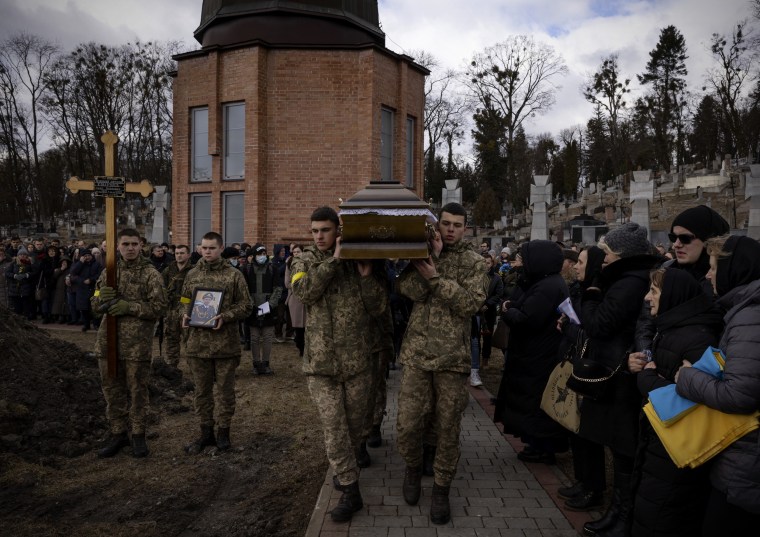
A funeral service for two Ukrainian soldiers in Lviv on March 8.Dan Kitwood / Getty Images
While the precise scope of Russian President Vladimir Putin’s military operation in Ukraine is unclear, experts like Thomas Graham, a former senior director for Russia on the National Security Council staff between 2004 and 2007, believe he’s seeking regime change and the destruction of Ukraine’s military infrastructure in a bid to bring Kyiv back under the influence of Moscow.
But reports documenting a deepening bitterness toward Putin across Ukraine are a reminder that the fury and suffering he’s generating with his brutal invasion could undermine his plans to control the country.
According to a recent New York Times report, the “one overriding emotion gripping Ukraine right now … is hate.” It said:
Billboards have gone up along roadsides in gigantic block letters, telling Russians in profanity-laced language to get out. Social media posts in spaces often shared by Russians and Ukrainians have been awash in furious comments.
The article described how the backlash against the invasion — which has targeted civilian infrastructure, appears to be using indiscriminate cluster bombs and has already displaced millions of Ukrainians — is not just driving hatred of Putin, but hatred of Russian society more broadly.
“Yuri Makarov, the chief editor of the Ukrainian national broadcasting company and the head of a national literature and arts award committee, said the war had driven a deep wedge between the Ukrainian and Russian societies that will be hard to heal,” the Times reported. “Russians, he said, have become Ukrainians’ ‘collective enemies.’”
This kind of shift in national sentiment undermines the idea that this invasion could serve as a straightforward way for Moscow to bring Kyiv back under its control after years of Kyiv drifting toward Western influence. Instead, it’s looking like the operation could backfire by intensifying anti-Russian attitudes and laying the groundwork for a potential long-term insurgency.
Experts like Ben Judah, a senior fellow at the Atlantic Council, have noted that Putin appears to be surrounded by yesmen who may want to confirm the assumptions that underlie his own worldview. That may have included an unwillingness among his advisers to point out that some of his assumptions about Ukrainian identity and Russia’s ability to intervene militarily without much resistance were out of touch with reality.
“I think, in general,” Graham told me in an interview shortly after the invasion began, “senior people in the Kremlin underestimate the degree of unity among the Ukrainian people at this point — and that’s Ukrainian speakers and Russian speakers.”
“They have underestimated the consequences of their annexation of Crimea and what they’ve done in the Donbas over the past eight years and how that has changed attitudes towards Russia,” he added, referring to Russia’s support for separatist rebels in Ukraine’s southeastern region since 2014.
Ukraine has a mix of Ukrainian and Russian speakers, with the eastern regions of the country being more Russian-speaking and historically more receptive to or susceptible to Russian political influence. But it seems that Putin is providing a stronger force for fostering a more coherent and strongly held Ukrainian national identity than could’ve ever emerged from within the country itself in the short to medium term.
As civilians organize resistance, take up arms or leave the country out of fear, we could be seeing the birth of the very kind of united anti-Russian sentiment and action that Putin constantly seemed to fear before his invasion. He may have just created his own worst nightmare.
Zeeshan Aleem is a writer and editor for MSNBC Daily. Previously, he worked at Vox, HuffPost and Politico, and he has also been published in The New York Times, The Atlantic, The Nation and elsewhere.


 Scroll back up to restore default view.