Paul Ryan abandons key boast on Republican tax cut plan

MSNBC

Paul Ryan abandons key boast on Republican tax cut plan

http://www.msnbc.com/sites/msnbc/files/styles/ratio--3-2--1_5x-1245x830/public/paul_ryan_maddowblog_0517.jpg?itok=xAsseH9lepa05969869 Republican Speaker of the House Paul Ryan speaks to the media about President Trump’s disclosure of classified information to the Russians, along..       JIM LO SCALZO

By Steve Benen          November 10, 2017

House Speaker Paul Ryan (R-Wis.), desperate to approve a massive tax-cut package, spent much of the week making a specific boast: the GOP plan, Ryan told several conservative media outlets, delivers “a tax cut for everybody.” Who’ll benefit? “Every single person,” he said.

At face value, that doesn’t even make sense. Even if we put aside the independent assessments that show millions of Americans would pay more in taxes under the House Republican proposal, the whole point of tax reform is to shift burdens in such a way that some would pay less and others would pay more.

To hear Ryan tell it, GOP officials have come up with a way to cut taxes for literally “everyone” who pays taxes in this country. That’s clearly wrong, and an ostensible budget wonk should know better.

So why did the Speaker keep repeating a claim that obviously isn’t true? The Washington Post contacted his office and Ryan’s spokesperson said the Wisconsin congressman “misspoke.” Indeed, he tried to clarify the claim with reporters yesterday:

“When you take the thing all in its totality, what the analysis shows us, whether it’s analysis from [Joint Committee on Taxation], from the Tax Foundation, or even [the Tax Policy Center], that the average households at every income level see a tax cut.”

It’s an interesting shift. “A tax cut for everybody” is a Republican rallying cry, while “analyses show that the average households at every income level see a tax cut” isn’t quite as inspiring.

If we set the bar for honesty very low, I’ll give Ryan some credit for changing his talking point. If it were Donald Trump and his team, it’s likely they’d simply pretend their version of reality is true and insist that their “alternative facts” are of equal value to actual facts. The Speaker obviously shouldn’t have repeated the bogus claim over and over again, but at least he didn’t stick to it when confronted with the truth.

The trouble, though, is that Ryan is dealing with a nagging and uncomfortable detail: under his proposal, millions of Americans really will pay more than they’re paying now. His office can craft various talking points based on income-level averages, but when push comes to shove, Republicans are trying to approve a tax blueprint that increase many families’ tax bills.

As the Post’s fact-check piece added, “In the case of married families with children – whom Republicans are assiduously wooing as beneficiaries of their plan – about 40 percent are estimated to receive tax hikes by 2027, even if the provisions are retained. That would be a nasty surprise for folks who had heard Ryan’s less-precise spin.”

Republicans can tell these folks about averages and the “trickle-down” effects of their tax hike paying for a corporate tax break, but I have a hunch they won’t be impressed.

Trump’s nominee to lead his environmental council isn’t sure if water expands as it warms

Washington Post

Democracy Dies in Darkness

Trump’s nominee to lead his environmental council isn’t sure if water expands as it warms

By Philip Bump            November 9, 2017

https://img.washingtonpost.com/wp-apps/imrs.php?src=https://arc-anglerfish-washpost-prod-washpost.s3.amazonaws.com/public/A2RR3OS6KI7VTIE3RYKWMKQRNI.JPG&w=600President Trump walks out after an announcement about the Paris climate agreement in the Rose Garden of the White House in Washington on June 1. (Andrew Harrer/Bloomberg)

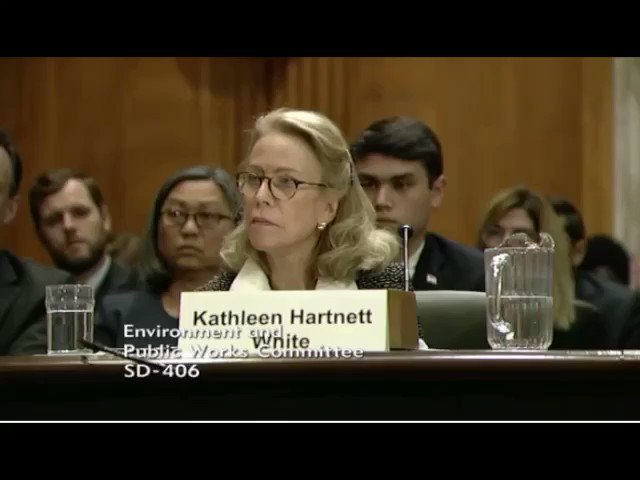
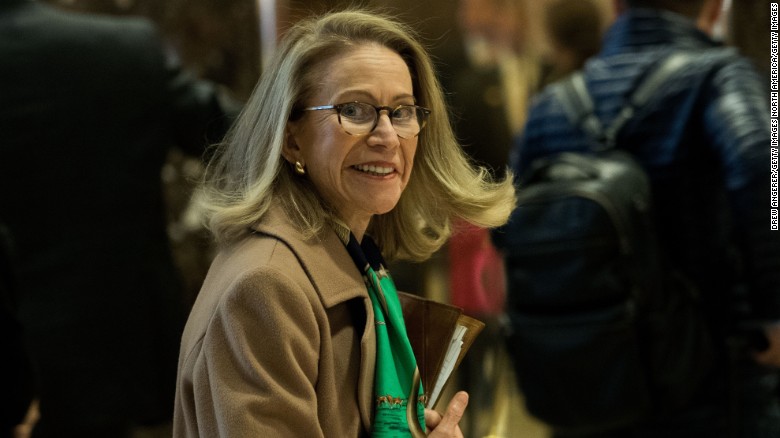
Kathleen Hartnett White was nominated by President Trump last month to lead his Council on Environmental Quality, the top environmental position within the White House. Under Barack Obama, the council’s initiatives included implementing sustainability efforts throughout the executive branch and establishing systems for addressing climate change.

Based on her testimony Wednesday during a confirmation hearing, it’s safe to assume that Hartnett White will not continue similar efforts.

Our Chris Mooney articulated the various ways in which Hartnett White was pressed on the issue of climate change, including her insistence that, while human activity probably contributes to the warming climate, the extent of that contribution is “very uncertain.”

That’s not the view of the vast majority of climate scientists, of course. Climate scientists agree that the burning and extraction of fossil fuels releases tons of gases into the atmosphere — carbon dioxide and methane, for example — that serve as a blanket (or the glass in a greenhouse, if you will), preventing heat from escaping. This is, for the time being, still the position of the Environmental Protection Agency.

Hartnett White’s position is a political one. From the outset of the modern debate over climate change, uncertainty has been the watchword of those who weren’t interested in addressing greenhouse-gas emissions. That asserted uncertainty once centered on whether warming was happening. Then it focused on whether humans were involved. Now, in the Hartnett White iteration, it centers on how much humans are involved. (This was the position Trump espoused in an interview with the New York Times during the campaign.)

In the case of Hartnett White, that insistence that there’s uncertainty — again, a view not widely held in the scientific community, as NASA points out —  leads to some difficult rhetorical dead ends.

Consider this exchange from Wednesday, in which Hartnett White is questioned by Sen. Sheldon Whitehouse (D-R.I.).

https://pbs.twimg.com/ext_tw_video_thumb/928437200655667200/pu/img/pLcW25WHByxxOz-L.jpg

Sheldon Whitehouse   @SenWhitehouse

I don’t even know where to begin with  @realdonaldtrump’s CEQ nominee Kathleen Hartnett White—she outright rejects basic science.

Whitehouse asks two questions. The first is whether Hartnett White is aware of the extent to which oceans trap heat. This is a complicated question that is probably outside the awareness of a layperson. Whitehouse seems to believe that such a question — not a complicated one in the context of the issue of climate change — should be understood by the nominee to serve in the top White House environmental position.

In short, research suggests that as much as 90 percent of the heat trapped by the atmosphere ends up being stored in the Earth’s oceans. That has an expected consequence: Ocean water temperatures are higher now than they used to be.

https://img.washingtonpost.com/wp-apps/imrs.php?src=https://arc-anglerfish-washpost-prod-washpost.s3.amazonaws.com/public/KLGD7V2AXY6KDFJSFJC2J4GQVU.png&w=600

Those warmer water temperatures have some perhaps unexpected consequences, too. It’s shifted the habitats of sea animals and endangered other sea life. The environmental effects, in other words, are not insignificant.

Notice, though, that Hartnett White doesn’t say that she knows whether more than 50 percent of the heat trapped in the atmosphere has been stored in the oceans (the correct answer, of course, being that far more than 50 percent has). All she knows is that, whatever the answer, it’s contested. How it’s contested isn’t clear; all she knows is that it is. Her knowledge of the issue is limited to one data point: Uncertainty exists. We’ll note that that data point is not supported by any available evidence.

We noted some unexpected effects of a warming ocean above. But anyone who’s ever tried to boil water on a stove is aware of another effect of warming water: It expands. Fill a saucepan to the brim with water and crank up the heat — you know what happens next.

But when Whitehouse asks that question — does water expand when it’s warmer? — Hartnett White won’t answer.

This is important in the context of climate change. Warmer seas mean higher sea levels, and higher sea levels mean more flooding and more damage to coastal real estate. Melting ice due to global warming will raise sea levels, but hotter seas will expand by themselves.

It’s likely that Hartnett White knows that water expands as it warms. Most humans do. What she’s doing is offering a political answer to a question asked in a political context. The question, then, is why she sees it as politically valuable to avoid acknowledging that water expands as it warms.

The answer goes back to our point at the outset. Hartnett White was probably nominated to run the CEQ because she’s willing to brush aside the scientific consensus on climate change, not in spite of it. If that means that an awkward video trickles out over social media for one day, so be it.

Philip Bump is a correspondent for The Post based in New York City.

Here’s a rundown of the Trump donors keeping their money offshore

ThinkProgress

Here’s a rundown of the Trump donors keeping their money offshore

Because nothing says patriotism like stashing your cash overseas to avoid taxes.

Luke Barnes          November 9, 2017

 https://i0.wp.com/thinkprogress.org/wp-content/uploads/2017/11/872040428.jpg?resize=1280%2C720px&ssl=1U.S. President Donald Trump attends a state dinner at the Great Hall of the People on November 9, 2017 in Beijing, China. Trump is on a 10-day trip to Asia. (CREDIT: Thomas Peter – Pool/Getty Images)

One year ago, Donald Trump stood in front of an adoring crowd in New York City, proclaiming victory for the forgotten Americans over the elitist, globalist campaign of Hillary Clinton.

“Ours was not a campaign, but rather an incredible and great movement,” he said. “It was made up of millions of hard-working men and women who love their country and want a better, brighter future for themselves.”

But now, a new series of revelations from the Paradise Papers show just how hollow those promises were. The leaked papers show that a number of Trump’s biggest financial backers were the same billionaire globalists that Trump decried at rallies across the country — and that’s in addition to the tax-dodging globalists currently sitting in his cabinet. The leaks reveal that these men stashed away parts of their fortunes, valued in the tens of billions, to avoid public scrutiny. From there, they could funnel more than $60 million into super PACs supporting Trump’s presidency.

Here’s a rundown on some of the key donors exposed so far by the Paradise Papers:

Sheldon G. Adelson

Who is he and how is he connected to Trump? 

Sheldon Adelson is a casino mogul worth an estimated $35 billion who owns properties in Las Vegas, Macau, and Singapore — as well as the publication the Las Vegas Review Journal. Adelson shelled out more than $82 million in 2016 for Republican candidates, according to the International Consortium for Investigative Journalists. During the election he and his wife Miriam donated around $45 million to Trump’s presidential campaign, as well as down ballot Republican races. Adelson also gave $5 million to the committee that organized Trump’s inauguration festivities — the largest amount ever given. He has lobbied fiercely to outlaw internet gambling and is known for his far-right views on a range of political issues, from U.S. foreign policy towards Israel to the legalization of marijuana.

What did he do? 

The Paradise Papers have revealed that Adelson is the president of Interface Bermuda, which provides private planes, including two Boeing 747 Jumbo Jets, to the Las Vegas Sands Corporation, Adelson’s casino company. According to the Securities Exchange Commission, Las Vegas Sands transferred tens of millions of dollars to Interface Bermuda between 2010 and 2016. By doing so, Adelson was effectively setting up a pot of cash in a jurisdiction not subject to U.S. tax laws.

The Koch Brothers

Who are they and how are they connected to Trump? 

Charles and David Koch together run Koch Industries, a massive conglomerate and the second largest private company in the United States with an annual revenue of more than $100 billion. The Koch brothers have a long history of supporting right-wing causes, having previously helped finance the Tea Party movement. The two brothers initially declined to back Trump, but warmed to him after his election, and in May launched a multi-million-dollar campaign in support of Trump’s tax plan.

What did they do? 

The Paradise Papers reveal how the Koch brothers took the paper and pulp company Georgia-Pacific and made it private, relocating millions of its dollars from high-tax environments to havens like Bermuda, according to the Guardian. A subsidiary company, Georgia-Pacific Britain Ltd., was established in Bermuda. Then loans of more than $500 million were made by Koch companies in the United States to the subsidiary Bermuda company. Essentially, the Koch’s created a “black box” of subsidiaries and shell companies that would allow them to transfer their money from heavily-taxed regions to offshore havens.

https://i0.wp.com/thinkprogress.org/wp-content/uploads/2017/11/koch-brothers.jpg?w=798&crop=0%2C0px%2C100%2C501px&ssl=1The Koch Brothers were heavily involved with financing the Tea Party during Obama’s Presidency (CREDIT: MSNBC)

Robert Kraft

Who is he and how is he connected to Trump? 

The owner of New England Patriots and worth an estimated $5.2 billion, Robert Kraft is an ally of Trump. He previously donated more than $1 million to Trump’s inaugural fund, and also gave the president his own diamond-encrusted Superbowl ring after the Patriots triumphed over the Atlanta Falcons.

What did he do? 

According to the Guardian, Kraft was one of several sports team owners who stashed their money in tax havens like Bermuda, where Appleby, the firm at the center of the Paradise Papers, is based. Kraft had a company with Appleby for more than two decades and was labelled a “Politically Exposed Person” on internal communications, meaning his affairs needed to be handled with particular care. It is unknown how much Kraft stored offshore, but he is listed as the owner of 12,000 shares of a Bermuda company. It is extremely possible that Kraft used this company to avoid paying U.S. taxes.

Paul Singer

Who is he and how is he connected to Trump? 

Singer manages the hedge fun Elliott Management Corporation, which specializes in distressed debt acquisition. What this means is that his hedge fund will buy off debt from countries and then aggressively pursue re-payments — with interest. Singer’s company has a reputation for ruthlessness — it once seized an Argentinean naval ship in Ghana because it claimed that Argentina was not keeping up with its debt repayments. Although initially a “Never Trumper,” Singer donated $1 million to Trump’s inaugural fund and was described by Trump as a “very strong ally.”

What did he do? 

Singer’s offshore sins show how tax havens can be used as gray areas to reach business and legal deals which deserve public scrutiny. One of Singer’s offshore firms was a Cayman-Islands-based company known as Kensington International, which had bought $57 million of debt from the Republic of the Congo. The country didn’t keep up with its payments so Kensington sued the country — in the British Virgin Islands. In 2007, attorneys from the Republic of Congo asserted that Kensington was an “opaque offshore entity that appears to be used to shield Elliot Associates.” The country eventually agreed to settle the debt for an undisclosed sum.

Why all this matters

It would be unfair to claim that only the Trump supporting mega-rich used advantage of the tax-dodging techniques outlined in the Paradise Papers. Obama’s former commerce secretary Penny Pritzker, is detailed for instance, as are private-equity funds controlled by Democratic donor George Soros. Even Bono and Madonna are revealed to have taken part. But the connections Trump’s donors and cabinet members have to these offshore havens show just how removed the president is from the right-wing, populist messaging of his campaign. Even the president’s economic adviser, Gary Cohn brushed aside the Paradise Paper revelations. “I’m not embarrassed at all,” he said. “This is the way the world works.” Cohn seems to be admitting that, despite all the promises to re-build the American Dream, Trump and his cronies are perfectly happy with the world operating as an “international oligarchy”.

Pebble Mine is a poison pill for Alaska’s wild salmon

Los Angeles Times – Op-Ed

Pebble Mine is a poison pill for Alaska’s wild salmon

http://www.trbimg.com/img-5a0391f9/turbine/la-1510183412-qeoz584el2-snap-image/1150/1150x647An employee of Northern Dynasty Mines Inc. mans a drilling rig in the Pebble Mine East site near the village of Iliamna, Alaska on June 6, 2007. (Los Angeles Times)

By Carl Safina, Joel Reynolds      November 9, 2017

The Bristol Bay watershed, in southwest Alaska, comprises 40,000 square miles of bogs and evergreen forests, rimmed by distant mountains and shimmering with rivers and feeder streams. In these waterways, miracles happen. Together they sustain the largest remaining salmon fishery on Earth.

For more than a decade, a Canadian mining company, Northern Dynasty Minerals, has wanted to gouge one of the world’s largest gold and copper mines into the heart of the watershed, putting its rivers on a centuries-long poison drip. The company has failed to move forward with the project, known as Pebble Mine, due to intense and sustained opposition. It has also been burdened by proposed restrictions recommended by the Obama-era Environmental Protection Agency — the result of a four-year review.

But President Trump’s EPA administrator, Scott Pruitt, has rejected his agency’s review and moved to withdraw its proposal to impose restrictions on the mine, thereby reviving the company’s prospects for federal permitting. Pruitt is poised to take this action imminently, showing a flagrant disregard for the public’s overwhelming opposition.

Now, in what could very well be the most important land-use decision in North America in our time, an essentially eternal supply of food is pitted against an essentially eternal supply of poison.

Alaskans understand that the Pebble Mine is a death wish: 65% of the state’s residents oppose it.

If Pruitt wins, we all lose. The Bristol Bay watershed generates half the world’s remaining wild salmon, including five species: the scarlet sockeyes, the hard-charging kings, the silver coho, the humpbacked pinks and the placid chums. Together the salmon support 14,000 jobs and generate $1.5 billion annually.

Last year alone, 60 million wild salmon surged into the watershed, drawn to its many rivers by faintly remembered scents. This year, on two separate occasions, fishermen caught more than a million fish in a single day. Records were shattered, and several boats became so overloaded that they actually sank.

Nowhere else in the modern world does the landscape grant so much food. You’d think everyone would realize the place is sacred. To Native people, it is — literally.

Salmon perform a kind of alchemy. Although they live most of their lives in the ocean, hundreds of miles from the coastline, they shelter their young from the open sea by hiding them in rivers. In so doing, they bring the nutrients of the ocean to us. Those that get past the fishing nets bring nourishment further uphill, against gravity, to feed eagles and bears and fertilize the forests that shade the streams, which in turn produce more salmon, supporting more communities.

This embarrassment of riches could last an additional few thousand years, or it could be destroyed. Alaskans understand that the Pebble Mine is a death wish: 65% of the state’s residents oppose it; in the Bristol Bay region, that number grows to more than 80%. The opposition includes recreational fishermen, owners of tourist lodges, the Bristol Bay Native Corporation, which is the largest private landowner in the region, and most commercial fishing communities.

It took the Obama administration EPA four years to study the question of how the Pebble Mine would affect the Bristol Bay watershed, ultimately concluding that putting an open-pit mining operation there would be profoundly reckless. The EPA said the mine would produce billions of tons of toxic waste that could not be reliably contained; that it would remain poisonous to water and wildlife for centuries; that it would pose “catastrophic” risks to salmon and other seafood; and that the generative value of the watershed exceeded the value of the mine. The agency proposed significant restrictions. Northern Dynasty’s corporate partners abandoned the project, and the company’s stock plunged 90%. Yet it took Pruitt only one hour with the CEO behind the mine, Tom Collier, to decide last May that the EPA should scrap its review.

We have already destroyed what had previously been the largest salmon complex in the world, the Columbia River system. Global warming, dams, the logging industry and pollution are continuing to debilitate salmon. Farms in British Columbia breed Atlantic salmon, which infest young native salmon with lethal parasites. The resident killer whales of the Pacific Northwest are starving because of salmon destruction.

All that has been lost along the coastline south of Alaska remains fully functioning in the Bristol Bay watershed. There is no simple route to stopping the Pebble Mine — it will take lawsuits, activism and sustained opposition at the state and federal levels — but it must be stopped. It sacrifices too much. The Bristol Bay watershed needs to be protected, its rivers and salmon unspoiled.

Carl Safina is a professor of journalism at Stony Brook University and the founder and president of the Safina Center. Joel Reynolds is western director and senior attorney at the Natural Resources Defense Council.

Trump environmental pick pressed at Senate hearing for comparing belief in climate change to paganism

CNN     KFILE

Trump environmental pick pressed at Senate hearing for comparing belief in climate change to paganism

By Andrew Kaczynski and Chris Massie, CNN    November 9, 2017

http://cdn.cnn.com/cnnnext/dam/assets/171019152555-kfile-kathleen-white-exlarge-169.jpg

Story highlights

  • Democratic Sen. Jeff Merkley from Oregon pressed White about her past comments at her confirmation hearing to be chair of the White House’s Council on Environmental Quality.
  • “I believe those words, senator, with all due respect, have been taken out of context,” White responded.

(CNN)President Donald Trump’s nominee to be the White House’s senior environmental adviser told a Senate committee Wednesday that controversial comments she made, including comparing the belief in global warming to paganism, were taken out of context but added there could have been some mistakes in her writings.

CNN’s KFile previously reported that in 2016, Kathleen Hartnett White described the belief in global warming as a “kind of paganism” for “secular elites.” She also said the goal of climate activists and the United Nations was an all powerful one-world government and “planetary management.”

Democratic Sen. Jeff Merkley from Oregon pressed White about her past comments at her confirmation hearing to be chair of the White House’s Council on Environmental Quality.

“When you say that those who are concerned about global warming are paganists, and totalitarianists, and Marxists, when you say that, do you believe Oregon’s farmers, who are concerned about three worst-ever droughts with the impact of climate changes are Marxists, or totalitarians, or pagans?” Merkley asked.

“I believe those words, senator, with all due respect, have been taken out of context,” White responded.

“Well, they’re words directly from your writings,” Merkley responded.

Merkley then noted that there are multiple quotes from White “calling environmentalists Marxist, and those who are concerned about climate change as pagans.”

“I think I submitted about 100 pages of either commentaries or research studies that I have done. In that entire corpus there may be some mistakes,” White responded.

White did not immediately respond to questions from CNN asking which quotes she believed were taken out of context.

Later in the exchange, White said she did believe the planet was getting warmer but did not believe carbon dioxide levels had gone up dramatically.

Arkansas pushes ahead with summertime ban on Monsanto, BASF weed killers

Reuters  Business

Arkansas pushes ahead with summertime ban on Monsanto, BASF weed killers

http://s2.reutersmedia.net/resources/r/?m=02&d=20171108&t=2&i=1209010129&r=LYNXMPEDA71YH&w=1920FILE PHOTO: Monsanto logo is displayed on a screen where the stock is traded on the floor of the New York Stock Exchange (NYSE) in New York City, U.S., May 9, 2016. REUTERS/Brendan McDermid/File Photo

By Tom Polansek, Reuters         November 9, 2017

CHICAGO (Reuters) – An Arkansas regulatory body voted on Wednesday to bar the use of a weed killer critical to Monsanto Co’s seed sales for a second consecutive summer, ratcheting up a standoff after the company sued the state to prevent restrictions on the product.

The Arkansas State Plant Board plans to prohibit sprayings of products containing a chemical known as dicamba between April 16 and Oct. 31, 2018, after an estimated 3.6 million acres of U.S. crops suffered damage linked to the herbicides this year.

A state legislative subcommittee must approve the ban before it becomes official.

The United States has faced a weed-killer crisis this year caused by new versions of herbicides with dicamba, which farmers and weed experts say harm crops because they evaporate and drift away from where they are applied.

Monsanto and BASF SE, which also manufactures a dicamba-based weed killer, say the products are safe when properly applied.

“These new tools need to be available as choices for these growers,” Scott Partridge, Monsanto’s vice president of global strategy, said by telephone after addressing the board at a meeting in Arkansas.

BASF said the ban would be a step backwards for Arkansas farmers.

The companies’ herbicides are designed to be sprayed during the summer over soybeans and cotton that Monsanto engineered to resist dicamba.

Monsanto is banking on its dicamba-resistant soybean seeds to replace seeds that withstand glyphosate, a herbicide used for decades but which is becoming less effective as weeds develop resistance. The dicamba-resistant soybeans also resist glyphosate.

Monsanto’s net sales jumped 8 percent in fiscal year 2017 due partly to increased sales of dicamba-resistant soybean seeds. The company, which is being acquired by Bayer AG for $63.5 billion, also has invested more than $1 billion in a Louisiana dicamba production facility.

Arkansas previously prevented farmers from using Monsanto’s dicamba herbicide in 2017 because the company did not submit studies the state wanted on volatility, or the product’s tendency to evaporate.

On Tuesday, Monsanto provided the board with three binders of data on dicamba, Partridge said, part of a wider attempt to convince U.S. regulators its herbicide is safe.

Monsanto in September questioned the objectivity of two weed experts in Arkansas who said dicamba could drift and last month sued state officials to stop the proposed summertime ban.

Last week, the company asked the plant board to disqualify a member named Terry Fuller from considering the proposal. The board allowed Fuller to participate in Wednesday’s meeting, but he recused himself from voting.

(Reporting by Tom Polansek; Editing by Tom Brown)

Maine governor’s last ditch effort to keep Medicaid from 70,000 people

ThinkProgress

Maine governor’s last ditch effort to keep Medicaid from 70,000 people

The governor said Wednesday that he will block the expansion, keeping 70,000 from accessing affordable health insurance.

Addy Baird         November 8, 2017

 https://i0.wp.com/thinkprogress.org/wp-content/uploads/2017/11/ap_17265540399529.jpg?resize=1280%2C720px&ssl=1Maine Gov. Paul LePage attends a meeting with Vice President Mike Pence CREDIT: AP Photo/Andrew Harnik

Voters in Maine elected overwhelmingly on Tuesday night to expand Medicaid coverage to nearly 70,000 uninsured citizens in a monumental referendum that would make the state the first to expand the health insurance program via the ballot box.

That is, unless Gov. Paul LePage has anything to do with it. The Maine state legislature has voted to expand Medicaid on five separate occasions, and each time, LePage has vetoed it.

Now, voters in the state have done the same, but in a statement Wednesday morning, LePage said he would block the expansion anyway.

“My administration will not implement Medicaid expansion until it has been fully funded by the legislature at the levels [Maine’s Department of Health and Human Services] has calculated,” his statement said.

While that almost sounds like LePage is leaving the door open, he adds that he won’t support it unless the legislature funds the expansion without increasing taxes or using the state’s rainy day fund.

But Maine’s constitution makes clear that, despite LePage’s resistance, the law will go into effect 45 days after the legislature convenes again next January.

According the state constitution, “any measure which entails expenditure in an amount in excess of available and unappropriated state funds shall remain inoperative until 45 days after the next convening of the Legislature in regular session.”

“The governor, despite what he may think or say, is not above the law or the constitution of the state,” David Farmer, a spokesperson for Mainers for Health Care, the group behind the ballot initiative, told ThinkProgress Wednesday morning. “He doesn’t get to pick and choose which laws he implements.”

Farmer explained that the way the initiative was structured, it would mean that, if the law simply went into effect 45 days after the legislature reconvenes next January, people should be able to enroll in coverage by mid-August of 2018. And, at that point, if LePage simply refuses to enact and enforce the law, the group will take action.

“Political games, partisan politics aside, the voters have spoken,” Farmer said. “We will do everything that we can to ensure that this law is implemented…. If that means that we need to go to court then we will go to court.”

The vote in Maine, which passed with nearly 60 percent of the vote, comes just weeks after another attempt by Republicans in the Senate to repeal and replace the Affordable Care Act. Time and time again, Sen. Susan Collins (R-ME) has been a pivotal vote against the repeal bills, citing concerns about Medicaid cuts.

Tuesday’s vote to expand Medicaid in Collins’ state is, among other things, a message to the senator that her constituents want her to keep it up.

“The reason [repeal and replace] failed is pretty straightforward,” Farmer said Wednesday. “Voters did not like it, they did not want it…. We put that question on the ballot and put it to the ultimate test.”

While Medicaid expansion passed the test in the ballot box, whether it will pass the LePage test is up in the air. The governor has a history of trying to block progressive ballot measures that demonstrate just how far he might be willing to take this.

Just last week, for instance, LePage vetoed a bill that would have implemented a marijuana legalization initiative that passed last year, claiming that it “required [him] to flout federal law.” (It didn’t.) Earlier this year, LePage also tried to block a referendum question that raised taxes on the wealthy to provide additional funding for schools. It ultimately led to a short government shutdown.

Why the Line 5 Oil Pipeline Threatens the Great Lakes

EcoWatch

National Wildlife Federation     November 8, 2017

Why the Line 5 Oil Pipeline Threatens the Great Lakes

https://resize.rbl.ms/simage/https%3A%2F%2Fassets.rbl.ms%2F13603489%2Forigin.jpg/1200%2C630/sIOTDjwm0%2BPtFPhU/img.jpgA diver with the National Wildlife Federation examines Line 5, Enbridge’s oil and gas pipeline running along the bottom-lands of the Straits of Mackinac. National Wildlife Federation

An aging oil pipeline moves 23 million gallons of oil and natural gas liquids per day along the bottom-lands of the Straits of Mackinac, where Lake Michigan and Lake Huron crash into each other in the heart of the Great Lakes.

This pipeline—Line 5, built in 1953—is operated by the same company responsible for one of the largest inland oil spills in North American history: Enbridge. During that pipeline rupture, previously known cracks formed into a 6 foot gash which spilled more than 840,000 gallons of oil into the Kalamazoo River in 2010.

https://assets.rbl.ms/13603367/980x.jpgEndangered piping plovers nest along the Great Lakes shorelines which would be impacted by a Line 5 oil spill.Vince Cavalieri / USFWS

What’s Wrong with the Pipeline?

There are numerous places along the underwater section of the pipeline where protective coating is missing, and for much of the history of the pipeline, sections of pipe were not properly supported on the Lake Michigan lakebed—where it gets pummeled by oscillating currents. In fact, those supports were not replaced until video from a National Wildlife Federation dive inspection revealed they were lacking. Recently, Enbridge itself confirmed that part of its outer protection coating was missing from sections of the pipeline, and revealed in October 2017 that it has known about missing sections of coating since 2014 but failed to report the easement violation to state officials.

An April 2017 National Wildlife Federation report revealed that the land-based sections of Line 5 have leaked at least 29 times since 1968, spilling more than 1 million gallons of oil. We cannot risk a spill in the Straits, which a 2016 University of Michigan study estimates could put up to 700 miles of shoreline at risk depending on current and weather conditions, with up to 150 miles impacted in any one spill, risking a 17,000-square mile spill zone.

Additionally, the pipeline has been operating without an adequate spill response plan, as required by the Clean Water Act. Due to this, the National Wildlife Federation sued the U.S. Department of Transportation and the Pipeline and Hazardous Materials Safety Administration in January 2017, challenging this illegal operation of the pipeline.

What’s at Stake?

At risk are the fish and wildlife of the Great Lakes, the drinking water relied upon by citizens, and the region’s recreation and tourism economy which supports the northern Michigan way of life. So it should be no surprise that two-thirds of Michiganders oppose the continued operation of the pipeline under the Straits, as reported by a 2016 EPIC-MRA poll commissioned by the National Wildlife Federation.

Of particular note is the threat to the endangered piping plover shorebird. Piping plovers nest in the summer along the sandy beaches of the Great Lakes, and the U.S. Fish and Wildlife Service has designated critical habitat for piping plovers which falls within the spill zone risk identified by the University of Michigan.

What’s Being Done About It?

The State of Michigan released a report on alternatives to Line 5 on June 29, while the week before it scrapped a risk analysis due to a conflict of interest arising from an employee of the firm hired to do the analysis also working on a separate project for Enbridge.

In September, Michigan’s Pipeline Safety Advisory Board authorized a panel of academic experts from Michigan’s universities, led by Dr. Guy Meadows of Michigan Technological University, to resume the risk analysis.

“This is a positive step in getting the state the actionable information it needs to decommission Line 5,” said Mike Shriberg, executive director of the National Wildlife Federation’s Great Lakes Regional Center, and a member of the Pipeline Safety Advisory Board when the academic study was approved. “Engaging top academic minds will ensure that Michigan’s residents and resources will be prioritized.”

Demand Michigan Gov. Rick Snyder act to keep the Great Lakes safe!

Trump’s choice for No. 2 at EPA admitted he saw coal baron’s action plan to dismantle agency

ThinkProgress

Trump’s choice for No. 2 at EPA admitted he saw coal baron’s action plan to dismantle agency

Lobbyist attended meetings on Rick Perry proposal to subsidize coal plants.

Mark Hand           November 8, 2017

https://i1.wp.com/thinkprogress.org/wp-content/uploads/2017/11/andrew-wheeler.jpg?resize=1280%2C720px&ssl=1Andrew Wheeler, President Donald Trump’s nominee for deputy administrator at the Environmental Protection Agency, testifies at his confirmation hearing on November 8, 2017. CREDIT: screenshot/Senate EPW committee

President Donald Trump’s nominee for deputy administrator at the Environmental Protection Agency (EPA) admitted he viewed a plan developed by a top coal producer to roll back environmental regulations at the agency and attended meetings on Energy Secretary Rick Perry’s proposal to subsidize coal and nuclear plants.

Testifying at his confirmation hearing Wednesday before the Senate Environment and Public Works Committee, Andrew Wheeler said Murray Energy was one of his lobbying clients while working at the law firm Faegre Baker Daniels. But Wheeler said he de-registered himself as a Murray Energy lobbyist in August.

Sen. Sheldon Whitehouse (D-RI), in his questioning of Wheeler, said Robert Murray, the head of Murray Energy, “has said that he has a three-page plan that is being implemented by Scott Pruitt at the EPA. He said they’re already through the first page.”

Wheeler, who previously worked on the staff of a top congressional climate science denier, Sen. Jim Inhofe (R-OK), acknowledged seeing a copy of Murray’s “action plan” earlier this year. Murray said he provided the plan to Trump in January to help the struggling coal industry. “I did not work on that [plan] or have a copy of that memo,” Wheeler said. “I saw it briefly at the beginning of year but don’t have possession of it. I looked at it.”

Whitehouse contended it’s significant if the CEO of a coal company “has given his regulator a three-page plan” and “takes credit for having gotten through the first page of it already.”

This coal baron has Trump’s ear. What he says is utter nonsense.

PBS gave Robert Murray a platform to say climate change is a gambit to enrich Democrats, not a crisis for humanity.


With Wheeler’s nomination, “We have a candidate for deputy administrator who said he’s seen it and can confirm it exists. I think the American people are entitled to an EPA that is not following a coal company’s three-page plan but is following wherever the best interests of the American people lead,” Whitehouse said.

Since Trump took office, Murray has repeatedly met with administration officials, including at least three times with EPA Administrator Scott Pruitt. Murray has also met with Perry, whom Murray pressed for an executive order to keep coal plants from closing.

Wheeler told the Senate panel that he met with the Department of Energy on behalf of Murray a few months ago about Perry’s proposal to subsidize coal and nuclear plants. He said he also participated in a Capitol Hill meeting on the proposal, which Perry sent to the Federal Energy Regulatory Commission for implementation.

Politico reported Monday that Perry’s proposal to change the nation’s electricity markets would provide a windfall for a small group of companies, including Murray Energy. The narrowly written plan would mostly aid power plants in a part of the Midwest and Northeast where Murray Energy is the primary coal supplier, according to Politico.

The Sierra Club said it strongly opposes Wheeler’s nomination to the No. 2 position at the EPA. “Wheeler was not only a key D.C. advocate for the coal industry, but also a former aide for outspoken climate-denying senator James Inhofe,” Matthew Gravatt, Sierra Club’s associate legislative director, said in a statement Wednesday.

Patriotic Millionaire Uses His Tax Returns to School Fox News Host

Democratic Coalition Against Trump shared Patriotic Millionaires‘s video.

Patriotic Millionaire Uses His Tax Returns to Destroy Fox Host

Take action against the GOP tax scam: visit taxactioncenter.com

Posted by Patriotic Millionaires on Tuesday, November 7, 2017

Take action against the GOP tax scam: visit taxactioncenter.com