GOP lawyer: ‘My party is destroying itself on the Altar of Trump’

MSNBC – MaddowBlog

GOP lawyer: ‘My party is destroying itself on the Altar of Trump’

The nation’s leading Republican election lawyer is publicly warning his GOP brethren about the dangers of their misguided partnership with Donald Trump.
A gavel sits on a desk inside the Court of Appeals at the new Ralph L. Carr Colorado Judicial Center, which celebrated its official opening on Monday Jan. 14, 2013, in Denver.

A gavel sits on a desk inside the Court of Appeals at the new Ralph L. Carr Colorado Judicial Center, which celebrated its official opening on Monday Jan. 14, 2013, in Denver.Brennan Linsley / AP

Election lawyers are generally not widely recognized by the public. That’s not surprising: they tend to do their work in courtrooms and boardrooms, far from the public spotlight, so these attorneys rarely become household names.

With this in mind, the typical American voter probably has no idea who Ben Ginsberg is, though it’s also probably fair to say Republican officials know him and his work extremely well.

Remember the Bush v. Gore case? Ginsberg was the Bush campaign’s general counsel. Remember the Swiftboat vets who smeared John Kerry in 2004? Ginsberg helped lead their legal team, too. Remember the Franken-Coleman Senate contest in Minnesota that took months to resolve in 2009? Ginsberg was the Republican incumbent’s lawyer. Remember Mitt Romney’s 2012 campaign? Ginsberg was his lawyer, too.

I mention this pedigree to provide some context to the GOP attorney’s latest efforts. Because when the nation’s preeminent Republican election attorney publicly condemns his party’s antics, it’s best not to look past his concerns too quickly.

One of the first hints that Ginsberg was displeased with his party’s anti-voting efforts came in early September, when he wrote a Washington Post op-ed, criticizing Donald Trump’s unsubtle attempts to “undermine confidence in the credibility of election results,” and explaining that recent GOP claims about voter fraud are baseless.

Three weeks later, Ginsberg wrote another Washington Post op-ed, arguing that Trump’s refusal to commit to a peaceful transfer of power was problematic for everyone, including members of his own party.

Last week, Ginsberg co-authored another Washington Post op-ed, defending the U.S. electoral system from Trump’s attacks, and arguing, “[T]he president’s attempt to undermine the election is a self-serving assault on a fundamental American system. It should be condemned across party lines.”

And for good measure, Ginsberg has yet another Washington Post op-ed in today’s print edition, which is arguably the hardest hitting opinion piece to date.

President Trump has failed the test of leadership. His bid for reelection is foundering. And his only solution has been to launch an all-out, multimillion-dollar effort to disenfranchise voters — first by seeking to block state laws to ease voting during the pandemic, and now, in the final stages of the campaign, by challenging the ballots of individual voters unlikely to support him. This is as un-American as it gets.

The piece went on to argue that the incumbent president’s re-election strategy is increasingly built on a foundation of “disenfranchising” just enough voters to win.

Ginsberg concludes, “My party is destroying itself on the Altar of Trump. Republican elected officials, party leaders and voters must recognize how harmful this is to the party’s long-term prospects. My fellow Republicans, look what we’ve become. It is we who must fix this. Trump should not be reelected. Vote, but not for him.”

Remember, this isn’t just some random GOP attorney who’s worked for a few candidates. We’re talking about the nation’s leading Republican election lawyer for decades, publicly warning his GOP brethren about the dangers of their misguided partnership with Donald Trump.

I’ve spent months marveling at the number of Republicans who’ve stepped up to denounce Trump, endorse Joe Biden, or both. Seeing Ben Ginsberg join the ranks is among the most surprising to date.

John Oliver Delivers Damning Indictment Of Trump Just Hours Before Election

John Oliver Delivers Damning Indictment Of Trump Just Hours Before Election

Ed Mazza, Overnight Editor, HuffPost            

John Oliver can’t believe there are still voters willing to give President Donald Trump the benefit of the doubt about his handling of the coronavirus pandemic despite the United States having the most cases and most deaths.

With less than 36 hours to go before the start of the election, the “Last Week Tonight” host delivered a 21-minute indictment of many of the ways the Trump administration has failed the nation throughout the crisis. He also highlighted one moment that revealed Trump’s “borderline sociopathic” inability to show any degree of empathy for victims and survivors.

As first responders gathered in the Oval Office, Ernest Grant ― president of the American Nurses Association ― told Trump about the post-traumatic stress those working on the frontlines of the pandemic were experiencing. Trump barely listened, then started passing out commemorative pens to everyone in the room.

“I know after four years it is hard for anything Trump does to shock you anymore but it is worth making sure that that still does,” Oliver said. “…He wasn’t even listening. He was just sitting there, waiting for his turn to speak so he could do his pen thing.”

Oliver added:

“Is there anything more grim than that? I mean I guess you could’ve not offered them pens. But would that have been worse? Better? It’s honestly difficult to say. It’s even more difficult to write a joke of.”

Then Oliver offered a message for those who think Trump’s been a boon for entertainers such as himself.

″‘Oh, Trump must be great for you comedians, right?’” he said. “Yeah, not really. This has been a fucking nightmare!”

Traveling with Trump is a cognitive dissonance carnival

Traveling with Trump is a cognitive dissonance carnival

Eli Stokols                     November 1, 2020
President Donald Trump gestures as he is introduced by first lady Melania Trump during a campaign rally Thursday, Oct. 29, 2020, in Tampa, Fla. (AP Photo/Chris O'Meara)
President Trump gestures as he is introduced by First Lady Melania Trump at a campaign rally Thursday in Tampa, Fla. (Associated Press)


The rhythms seem routine, but for those in the “pool,” the small, rotating group of White House reporters who shadow the president, it’s important to note them all.

Air Force One takes off, then lands; a pool report is emailed to other reporters. President Trump takes the stage and says all kinds of things. Then he dances — dances? — as “Y.M.C.A.” plays at max volume. More pool reports. We take off again, and it all repeats somewhere else.

After five years of covering Donald Trump, setting my alarms to his tweets, watching and wondering about him from the 2015 Iowa State Fair to the Oval Office, from New Delhi to Detroit, I was back in the bubble with Trump last week for a final, frenzied campaign swing — three days, six rallies, seven states and almost seven hours of speeches — as he fights for reelection.

Even one hour with Trump can be dizzying. His speeches ramble, his staff frequently is clueless as to his plans, and normal functions often veer towards chaos. The sensory overload can become disorienting, a vaudevillian alternative-reality show — Cognitive Dissonance, the Musical.

Crowds cheer and jeer every incendiary claim, eager to act as props and amplifiers. As he excoriated the media at an event in Lansing, Mich., I looked up to see a woman staring into our enclosure with a mask emblazoned with the words, “The Media is the Virus.” At least she wore a mask.

When you’re surrounded by thousands of euphoric red-hatted supporters, it’s easier to doubt polls that show Trump trailing or tied with Joe Biden in battleground states.

After hearing the same incendiary rally speech six times, it’s easier to grow inured to Trump’s ho-hum denials of a pandemic that has killed more than 230,000 people, his angry calls to stop Americans from voting, the raucous chants to lock his opponents up.

And when you get home, you can’t get “Y.M.C.A.” — the 1970s gay cruising anthem turned global disco hit and now Trump anthem — out of your head.

We started Tuesday in cold rain in Lansing, finishing that night in even more frigid Omaha, where thousands of rally-goers waited hours for buses after we were wheels-up for Las Vegas. Seven people, police said, were hospitalized for hypothermia.

Before returning to Washington late Thursday, we stopped in steamy Tampa, Fla., where more than a dozen people who’d come to cheer Trump suffered from heatstroke and collapsed as he railed on stage about Hunter Biden’s laptop and supposedly dishonest media.

Metaphors, if you’re looking for them, are often more abundant than masks. Less than half of Trump rally attendees, always crowded closely together, usually wear them.

Supporters appear to accept Trump’s breezy assurances that if he could recover from COVID-19 — thanks, he would note, to 12 doctors overseeing his care in the presidential wing at Walter Reed National Military Medical Center and an experimental drug cocktail unavailable to the public — they could too.

His apocalyptic renderings of a Biden presidency, replete with lost jobs and urban unrest, sounded a lot like the current reality for millions of Americans.

“If you vote for Biden, it means no kids in school, no graduations, no weddings, no Thanksgiving, no Christmas and no Fourth of July together,” Trump said Wednesday in Goodyear, Ariz. “Other than that, you have a wonderful life.”

The Trump supporters in these crowds don’t care about the gaping holes in his arguments. They don’t mind his coarse behavior. They revel as he toggles between full-throated rage and offhanded sarcasm, exhorting and chuckling, taking selfies and videos, the consummate performer.

Trump’s glib flattery — his campaign only sets up big video monitors at important rallies, he fibs at every stop — is as authentic as professional wrestling. But crowds roar with approval at his jibes and insults, ready to deliver their lines on cue: “Four more years!” “Lock her up!” “CNN sucks!”

When White House reporters take him literally, as we must, we become the butt of the joke, too dense to understand the president’s bond to his supporters — a bond based on identity more than ideology, raw emotion over reason and one that may be unbreakable.

But it goes both ways. When Trump’s at a rally, his hermetically sealed world and the feedback loop it creates gives as much affirmation to the president as he delivers to his fans.

Leaving the stage, he struts across the tarmac to the plane in cold rain or sweltering heat, pumping his fists, determined to look strong. He eschews a ride in the Beast, the black presidential limousine rolling beside him, just in case.

The press pool walks a few feet away, cameras snapping and rolling. The images are a big reason why he still holds large rallies in a pandemic — more powerful in Trump’s view than any tut-tutting from Biden, who speaks to smaller crowds at greater distance, chiding Trump for acting irresponsibly.

Trump is determined to re-create the come-from-behind triumph of the 2016 campaign, visiting as many states as he can, shouting until he is hoarse, even as a majority of voters view his rallies as potential super-spreader events for the coronavirus.

He plans to hold 10 rallies in seven states in the final 48 hours before Tuesday, when voting ends. (Good luck to that pooler.)

Trump has worked assiduously to engineer a last-minute game-changer that might shift attention from the pandemic. It won’t be easy: Half a million coronavirus cases were recorded last week, 99,000 on Friday alone, the most since the pandemic began, and hospitalizations for COVID-19 soared in state after state.

But when the pool got aboard Air Force One on Tuesday, handouts had been placed in our seats promoting an imminent Fox News interview with Hunter Biden’s former business associate, Tony Bobulinski. Each handout was scrawled in thick, black marker: “MUST SEE TV!”

As we flew from La Crosse, Wis., to Omaha, Press Secretary Kayleigh McEnany popped her head into the press cabin and pointed to TV monitors as the interview aired. “You guys should watch,” she said.

But White House efforts to manufacture a scandal around Hunter Biden’s business dealings have fallen flat, mainly due to the lack of credible evidence that Joe Biden was involved.

On Wednesday morning, the pool was ushered into a small ballroom in Trump’s Las Vegas hotel. There was no event on our official schedule, and White House aides said they didn’t know what to expect. Given Trump’s penchant for the big reveal, would he show up with Bobulinski?

But then seven local business representatives walked in, summoned simply to endorse Trump and praise his economic record.

It was a standard event for any other campaign, one with a policy focus and validators for local TV. But it was highly unusual for Trump, who tends to obliterate calibrated messages with real-time reactions to headlines and the bombast he knows will excite a crowd.

As he stumped that afternoon in Arizona at Bullhead City and Goodyear, he ripped Biden as the leader of a “crime family” and complained that the unsubstantiated scandal wasn’t getting enough attention.

On Thursday in Tampa, he ranted about Miles Taylor, the former Homeland Security chief of staff who’d just outed himself as the anonymous administration official who wrote a 2018 New York Times column blistering the president.

“It’s like a horrible, treasonous, horrible thing that you can do this and you can get away with it,” Trump said about a U.S. citizen exercising his constitutional right to criticize the government.

Reading off the teleprompter, Trump touted the positive news that the nation’s gross domestic product had shot up in the third quarter, a partial recovery from the pandemic-induced economic crash last spring. But he couldn’t stick with it.

“Weekly jobless claims — this is boring, but it’s really good — just hit a seven-month low,” he said.

Polls show Trump has lost many of the suburban women who backed him in 2016, partly over his handling of the pandemic. But his sexism is rarely far below the surface.

Although millions of women lost their jobs, or saw their family finances upended in the pandemic, Trump reassured women in Lansing: “We’re getting your husbands back to work.”

A day later in Goodyear, he called GOP Sen. Martha McSally on stage to make her case for reelection, but needled her as she rushed up the steps, almost apologizing to the crowd for offering time to a lawmaker whose potential defeat could cost his party its Senate majority.

“Just come up fast. Fast. Fast. Come on. Quick,” Trump said. “You got one minute! One minute, Martha! They don’t want to hear this, Martha. Come on. Let’s go. Quick, quick, quick. Come on.”

He placed no time restraints on the three men who followed McSally at the microphone.

Trump’s final, frantic surge of rallies underscore how little the former reality TV star has changed in the White House. These carnivals of passion sustain him emotionally, but may not be enough to sustain his presidency. The narcissism could be self-defeating.

After five years of following Trump, I can hear the frustration in his words, thinly veiled by his anger and professions of confidence, the fear that he may soon become what he hates most of all — a loser.

He’s upset about having to run against Biden, the Democrat who worried him so much that he tried to pressure Ukraine’s leader last year to announce a bogus investigation. That led to Trump’s impeachment by the House, a permanent stain on his presidency.

Leaning against the lectern, Trump tries to chip away at his opponent’s affability, perhaps his main political asset, with brusque, bitter words.

“He’s not a nice guy,” Trump insists, spinning a story about how Biden won the Democratic nomination thanks to help from other candidates determined to bring Trump down, and not because Biden is popular.

“He shouldn’t even be the candidate,” the president groused, seemingly aware there are realities even he is powerless to change.

Randy Rainbow’s ‘Enchanted’ Closing Argument for the 2020 Campaign Asks ‘How Will You Vote?’

Randy Rainbow’s ‘Enchanted’ Closing Argument for the 2020 Campaign Asks ‘How Will You Vote?’ — WATCH

Andy Towle      October 30, 2020

randy rainbow vote

No, you can’t pull the lever for Randy Rainbow when you enter the voting booth on Tuesday because this princess is not on your ballot.

But, if you’re still undecided (god help us), Rainbow’s dulcet melodies and blood-curdling screams in the video below will assist you in making the only choice.

Joe. That’s how you know. P.S. – Randy is performing a pre-election Halloween special tomorrow night if you’re officially locked down from trick or treating.

New Video: ‘Trump’s Deadly Sins’

MeidasTouch

October 30, 2020

New Video: ‘Trump’s Deadly Sins’

One of the biggest farces in this clown show administration is when Trump and his handlers try and position him as a religious man. Trump’s connection with religion is like his connection with reality – it is nonexistent and he assaults it everyday.

We created #TrumpsDeadlySins to compare the Ten Commandments with Trump’s actions. Trump has viciously violated all Commandments through his cheating, his killing, his crimes and his lies. Trump has never had moral authority because he is immoral and he sacrificed America’s moral leadership in the world. Trump has sought to destroy and deconstruct the values that made America a beacon of liberty and freedom.

We created this video to remind Americans that we cannot return to normalcy and be a respected country so long as Trump who disrespects the most basic principles of decency remains.

Soldiers for trump’s war on the virus MIA !

The New York Times

Celebrity Vetting and ‘Helping the President’ to Defeat Coronavirus Despair

Noah Weiland and Sharon LaFraniere                 October 29, 2020

WASHINGTON — A $265 million public campaign to “defeat despair” around the coronavirus was planned partly around the politically tinged theme that “helping the president will help the country,” according to documents released Thursday by House investigators.

Michael R. Caputo, the assistant secretary for public affairs at the Department of Health and Human Services, and others involved envisioned a star-studded campaign to lift American spirits, but the lawmakers said they sought to exclude celebrities who had supported gay rights or same-sex marriage or who had publicly disparaged President Donald Trump. Actor Zach Galifianakis, for instance, was apparently passed over because he had declined to have Trump on his talk show “Between Two Ferns.” (Galifianakis did have President Barack Obama on the irreverent show.)

Ultimately, the campaign collapsed in late September amid recriminations and investigation.

Democrats on the House Oversight and Reform Committee and the select subcommittee on the coronavirus crisis released the records, declaring that “these documents include extremely troubling revelations.” They accused Alex Azar, the secretary of health and human services, of “a cover-up to conceal the Trump administration’s misuse of hundreds of millions of taxpayer dollars for partisan political purposes ahead of the upcoming election.”

Caputo, a fierce ally of Trump, had drawn attention to the public relations campaign last month during an extended rant on Facebook, claiming that the president had personally put him in charge of the project and that career government scientists were engaging in “sedition” to undermine the president. He is now on medical leave battling cancer.

That public relations effort is now in shambles. The celebrities picked to promote the campaign, including actor Dennis Quaid, have pulled out. Azar ordered a review of whether the initiative served “important public health purposes.” Top health department officials have privately tried to distance themselves from the project.

“The plan has always been to only use materials reviewed by a department-wide team of experts,” a department spokeswoman said in a statement.

The new documents indicate that Quaid stood out mainly because he got through the vetting. Documents show that contractors involved in the public relations effort researched the political views and backgrounds of at least 274 celebrities in what appeared to be an effort to root out anti-Trump sentiment that could inflect the initiative.

Galifianakis “refused to host President Trump on talk show,” one notation reads. Bryan Cranston, the antihero of the television program “Breaking Bad,” “called out Trump’s attacks on journalists during his Tony Awards speech in 2019.” Actor Jack Black was “known to be a classic Hollywood liberal.”

Singer Christina Aguilera “is an Obama-supporting Democrat and a gay-rights supporting liberal.” Adam Levine of the band Maroon 5 “fights for gay rights.” Justin Timberlake “supports gay marriage.”

Dakota Johnson, the actress, once “wore a pin to support Planned Parenthood.” And Sarah Jessica Parker, the actress, was tagged as an “LGBTQ supporter including marriage equality.”

In the end, only 10 of hundreds of potential celebrities considered for the campaign were approved, the documents suggest.

The new documents deal with a $15 million contract awarded to Atlas Research and indicate that government officials successfully urged the company to hire three little-known subcontractors with no obvious expertise to join the bigger campaign.

When Mark H. Chichester, the president of Atlas, tried to research those subcontractors, he discovered “small shops with little on them in the public domain,” according to documents the committee released.

One was a one-person operation run by a state-level Republican pollster, Chichester wrote. Another appeared to be “a small — perhaps one-man” operation.

A third was a “platform owned by Den Tolmor, a Russian-born business associate of Caputo’s,” Chichester said.

In a September meeting with one subcontractor, Caputo suggested “taglines” for the effort, some of which had a distinctly partisan tone, such as “helping the president will help the country,” according to notes released by the lawmakers. Caputo said that theme “would appeal to his base in terms of wearing a mask, vaccine,” the notes state.

Caputo appeared to be trying to shore up support from Trump’s followers who might be skeptical of wearing masks or getting a vaccine by linking those activities with supporting the president. The main contractor, Atlas Research, could not be immediately reached for comment. A person familiar with Caputo’s version of events, who spoke on the condition of anonymity, said that Caputo was never in business with Tolmor, the subcontractor, and did not try to improperly intervene in the contracting process.

But in a 2018 press release and in at least two media reports that year, Caputo was described as the chief marketing officer for a film and video company co-founded by Tolmor. And the documents released by congressional investigators suggest that contract officials with the Food and Drug Administration, a part of the Department of Health and Human Services, were so concerned about Caputo&aposs involvement in the process that one removed him from an email chain and warned Atlas executives that only contract officers could advise the company about how to fulfill its government obligations.

The public relations campaign became politically toxic even to those who signed up for it. Quaid recently backed out after recording an interview with Dr. Anthony Fauci, the government’s top infectious disease expert, saying in an Instagram post that his role was not an endorsement of Trump, and that he was “feeling some outrage and a lot of disappointment” after public reports on the campaign. Singer CeCe Winans also dropped out.

Democratic lawmakers have questioned the campaign’s funding after Dr. Robert Redfield, the director of the Centers for Disease Control and Prevention, testified in September that $300 million had been steered from his agency’s budget to Caputo’s office, and that the CDC was given no role in the campaign, which aimed to “defeat despair.”

The federal government awarded the campaign’s biggest contract to the Fors Marsh Group, a research company in Northern Virginia. A department official said the award, for $250 million, was competitively bid and Caputo had “nothing to do” with it.

On Sunday, The Wall Street Journal reported that as part of that same campaign, Caputo had offered early access to a coronavirus vaccine to a group of performers who play Santa Claus, Mrs. Claus and elves. In recordings obtained by The Journal, Caputo said that the campaign would feature regional events with “beautiful educational films,” and that the Santas would participate in dozens of cities. Health department officials said the Santa plan was discarded. Caputo also did not have the power to grant special access to a vaccine.

In their letter dated Wednesday, the Democrats scolded Azar for not turning over contract documents, including those related to Atlas. They wrote that it was “completely inappropriate to frame a taxpayer-funded ad campaign around ‘helping’ President Trump in the weeks and days before the election.”

The letter was signed by three committee leaders: Reps. Carolyn B. Maloney of New York, James E. Clyburn of South Carolina and Raja Krishnamoorthi of Illinois.

Caputo was especially aggressive in putting the president’s sanguine spin on the pandemic. He and a onetime adviser he hired at the department, Dr. Paul Alexander, repeatedly tried to interfere with weekly bulletins published by the CDC about the latest research on the pandemic, lashing out at career officials for perceived opposition to Trump. Caputo asked CDC officials for the names of the authors of the reports in an attempt to locate potential anti-Trump political bias in their biographies, according to two former senior health officials.

How GDP Growth Under Trump Compares To Clinton, Obama And Other Presidents

Benzinga

How GDP Growth Under Trump Compares To Clinton, Obama And Other Presidents

Wayne Duggan                         October 29, 2020


With the presidential election less than a week away, Americans are weighing the two presidential candidates and choosing which is best for the country over the next four years —if they haven’t already voted.

One way they can do that is by looking back on the first term of President Donald Trump and comparing the impact his policies have had on the country to previous administrations.

Trump’s GDP Numbers: Trump has campaigned as the best choice for the U.S. economy. Trump often uses the stock market as a scorecard for his policies, but the best representation of the real U.S. economy is gross domestic product.

Here’s a look at annual U.S. GDP growth during Trump’s presidency. The 2020 estimate comes from the Federal Reserve:

  • 2017: +2.3%
  • 2018: +3%
  • 2019: +2.2%
  • 2020: -3.7%

How Trump Compares: Overall, U.S. GDP growth has averaged about 0.95% during Trump’s first term in office. Here’s a look at how that GDP growth stacks up to his predecessor, President Barack Obama:

  • 2009: -2.5%
  • 2010: +2.6%
  • 2011: +1.6%
  • 2012: +2.2%
  • 2013: +1.8%
  • 2014: +2.5%
  • 2015: +3.1%
  • 2016: +1.7%

In his eight years in office, U.S. GDP growth averaged 1.62% under Obama, about 70% higher than Trump’s growth rate.

Here’s a look at average GDP growth rates under the last six U.S. presidents:

  • Jimmy Carter (D): 3.25%
  • Ronald Reagan (R): 3.48%
  • George H.W. Bush (R): 2.25%
  • Bill Clinton (D): 3.88%
  • George W. Bush (R): 2.2%
  • Barack Obama (D): 1.62%
  • Donald Trump (R): 0.95%

In his first four years in office, Trump has had by far the lowest average U.S. GDP growth rate of any of the last seven U.S. presidents.

Overall, U.S. GDP growth was highest under Clinton and Reagan in this group. GDP growth was lowest under Trump and Obama.

‘Binded by blood,’ split over election: Asian American family embodies generational shift in politics

NBC News

‘Binded by blood,’ split over election: Asian American family embodies generational shift in politics

Rima Abdelkader and Shako Liu and Soumya Shankar – October 27, 2020
'Binded by blood,' split over election: Asian American family embodies generational shift in politics

Four years ago, Louie Tan Vital received an invitation from her 81-year old grandmother, an immigrant, to join a prayer rally for whom she hoped would be the next president of the United States, Donald Trump.

To be respectful, Vital attended, but she didn’t actively participate. “I was incredibly uncomfortable. And I remember talking to my grandmother later,” Vital told NBC News over Zoom from her home in Washington, D.C.

Vital, 25, identifies as a Democrat and considers herself a progressive activist, while her grandmother Estrella Pada Taong identifies as conservative and a Republican. She remembered asking her grandma for her views on Trump then and learning her grandma felt he’s religious and “a good Christian.” Vital said she chose not to respond further so as not to get too upset.

“My opinion is that he is not a religious man, nor would I say he conveys any traditionally Christian values, respecting women and family and all of that,” Vital said.

Like many immigrant groups, Asian Americans and Pacific Islanders experience generational splits among voters. Vital, who was born in the United States, and her grandmother Taong, who was born in the Philippines, reflect these differences — some of which can be explained by their age and where they grew up.

Sixty-six percent of Asian Americans, 18 to 34 years old, would vote for Democratic presidential nominee Joe Biden, compared to 20 percent of those more than 50 years old, according to the most recent Asian American Voter Survey.

“What we find is that, where Asian Americans live doesn’t make as much of a difference in terms of which party they identify with or who they’re going to vote for, as much as age and nativity,” according to Karthick Ramakrishnan, director of the Asian American Voter Survey and founder of AAPI Data.

Ramakrishnan said that younger voters identify more with the Democratic Party and as progressive on issues such as health care, the citizenship process, protecting the environment, gun control, abortion and in their support for the Black Lives Matter movement and having a heightened sensitivity to matters like racial discrimination whereas older voters tend to not be as progressive.

Ramakrishnan explains that while party affiliation and identity politics vary among different Asian American groups when comparing younger and older voters, younger voters still tend to be more progressive.

Organizing for ‘the exact opposite beliefs’

As the 2020 U.S. presidential election approaches, conversations surrounding political beliefs and dissent with family could get difficult to navigate. Vital’s intergenerational Filipino American voting family found it’s more about understanding one another’s upbringings and life experiences than to center on disagreement.

“It’s interesting that I’m over here on this side of the country doing community organizing. I’m fighting in politics and fighting for progressive policies. And on the complete other end of the country, my grandma is also out here community organizing for the exact opposite beliefs,” Vital said.

Vital said when she visits her family in Hawaii, the time spent is not about discussing politics but “cooking together, just hanging out, watching movies, just everyday family stuff.”

“I’m not authentically myself in the presence because I know that my political views might come between us and I’m actively choosing sometimes to not address that,” she explained.

Alex Ly, a registered associate marriage and family therapist in Fremont, California, says a family member choosing to disengage from a political disagreement happens and suggests ways families could communicate their views.

“When that person feels understood, they are more open to a different perspective,” Ly said.

Ly, who sees around 10 to 15 clients per week including Asian Americans, suggests bringing “a level of curiosity” to the conversation, considering intention and outcome, and understanding not only the person’s position but also the story behind it.

Explaining splits in subgroups such as Indian Americans and Vietnamese Americans

AAPI Data shows that Vietnamese Americans are the only Asian American subgroup that identify more as Republican at 38 percent, compared to Democratic at 27 percent and 29 percent identify as independent. The explanation as to why includes nuances such as refugee trauma and its past colonial history. One of the main factors is how Vietnamese communities were affected in the aftermath of the Vietnam War, according to Nick Nguyen, a research lead at VietFactCheck.org, a project formed by PIVOT, a progressive Vietnamese American nonprofit social justice organization.

Many Vietnamese Americans formed political opinions following the Vietnam War, when the lives of the Vietnamese people were upended and once-stable families became refugees, Nguyen said from Palo Alto, California. He said that a belief had emerged that the Republican Party held an anti-communist agenda rather than a peacenik view which reflected views from these communities at the time and carried over since then. To add, that political affiliation, he said, could also be explained by more Vietnamese people feeling much more welcomed by that party in being accepted into the United States and because of other reasons like religiosity.

“We didn’t go through the trauma they went through,” Nguyen, 44, said, adding, “I’m very empathetic towards elders and why they feel the way they feel.”

Nguyen, who is a second-generation Vietnamese American, credits his family who came to the United States as refugees and became naturalized citizens with providing him with security and enfranchisement through their sacrifices.

“Because we didn’t grow up under all this sort of stress that can really affect your outlook on the world and on life, we have the luxury of really looking outward at problems that we think will snowball into bigger problems and we want to solve them,” he said.

Nguyen said he grew up as a Republican due to his family’s influence and past history but later identified as Democratic at age 25 when he developed his own political views from his personal and professional experiences.

Another reason could be Trump’s tough talk on China, a communist country that once ruled over Vietnam. For elderly Vietnamese Americans, that appears to be a favorable factor in their support for the incumbent, because it harkens back to former president Ronald Reagan’s anti-communist approach, according to Dr. Anh – Thu Bui, who is directing election strategy at PIVOT, a nonprofit working to increase voter participation among Vietnamese Americans.

Within the Asian American voting bloc, naturalized immigrants are the biggest sources of growth for eligible voters.  Of the group, Indian Americans are among the fastest growing and have doubled in size in the recent past.

About 89 percent of Indian Americans who refer to themselves as Democratic are planning to vote for Biden compared to 80 percent of those who identify as Republican who are planning to vote for Trump, according to the Carnegie Endowment For Peace citing the 2020 Indian American Attitudes Survey. Those who were born in the United States tend to identify more as a Democrat, representing 64 percent, compared to naturalized U.S. citizens at 48 percent, according to the same report.

“I’m very connected to India through my family but I have to focus on what the U.S. government does vis a vis the economy,” said Khyati Joshi, a professor of education at Fairleigh Dickinson University in New Jersey. “Most second-gen Indians like me, however, are looking at health care, economy and social justice issues here.”

Some experts explain one contributing factor in this split could be Trump’s alliance with India’s Prime Minister Narendra Modi, given the large portion of the U.S. community born in India. While a total of 14 percent of the U.S. population is foreign born, among Indian Americans, that number is 71 percent.

In 2019, Modi and Trump hosted a rally to address Indian American supporters in Houston. The “Howdy Modi” event drew 50,000 people and the two leaders appeared together on stage. In February, they held a joint rally in India, during which they praised one another in front of over 110,000 people.

Still, other issues, like Trump’s order to curb H-1B visas that have been temporarily blocked by a district judge until the end of the year have affected Indians working in the United States who have received half of all H-1B visas, widely given to tech workers with specialty skills since 2001.

Other experts explain any differences within the community as a matter of perspective. Pawan Dhingra, a sociologist and professor of American studies at Amherst College in Massachusetts, said immigrants tend to think that “we need to pay our dues and so, tend to accept certain kinds of inequalities.” Their children, however, he noted, are less likely to conform. “The second gen feels that we, as U.S. citizens, are raised here and deserve equal rights.”

Choosing to understand one another

Taong, who works as a mortgage loan officer in Honolulu, said she became politically active with other Filipino Americans when Trump ran for president in the previous election. She recognizes that her political views differ from her granddaughter’s and chooses to understand why.

“What I only do is I have to understand, I have to understand her present situation, her present place, the culture she is now. I have to understand her. I have to understand her peers, the school she goes, the training she gets from the school,” Taong said over Zoom from Honolulu.

Unlike her granddaughter, Taong said she grew up with strict parents in the Philippines whom she said she could not disagree with.

“We cannot go anything against what our parents would say. If I were on that, like what Louie had been doing, I’m sure my parents would say, as what I said, that do not join the activist group. As a child, I have to follow,” Taong said.

Her granddaughter said she has participated in marching for the Black Lives Matter movement and has been vocal on being a progressive activist since her undergraduate and graduate educations at the University of Washington.

Third Andresen, a part-time lecturer at the University of Washington who teaches courses on ethnic studies and critical race theory, remembered teaching Vital as a student in his study abroad course in the Philippines and said she excelled in her studies.

Andresen also remembered Vital seeking his advice as a student on how to handle disagreements with family.

“Be prepared to be uncomfortable. If you’re not ready, you might want to keep practicing until you’re ready,” Andresen said he tells his students.

Taong recalls her granddaughter’s passion for being an activist as a student and not being in acceptance of it at the time, but found a way to understand and respect it.

“I respect her opinion, because I believe that she’s a little bit mature enough to think what is good for herself. And the only thing that I can help her is to pray for her, pray for her safety and pray that her plans are well accepted by the world,” she explained.

Taong shared that she based her guidance from having lived in the Philippines and seeing a different view of activism that sometimes left people hurt and unsafe and being fearful of that for Vital.

Even among the differences, Taong pursued higher education like her granddaughter. She said she obtained a doctoral degree in administration and supervision in the Philippines. She said there are a few different factors that shape viewpoints.

“It’s through culture, family background and training and educational background and the influence of the environment,” she explained. “What we got from our parents, we transcended, we transfer it to our next generation, next siblings.”

It’s a sentiment echoed by her daughter Lucky Tan Tasato, 49, who said she raised Vital to be free to “decide and choose.”

“I have my own set of beliefs. I am driven by my own values and morality basically. And when it comes to Louie, I do encourage her to stand for what she thinks is right,” Tasato said over Zoom from Honolulu.

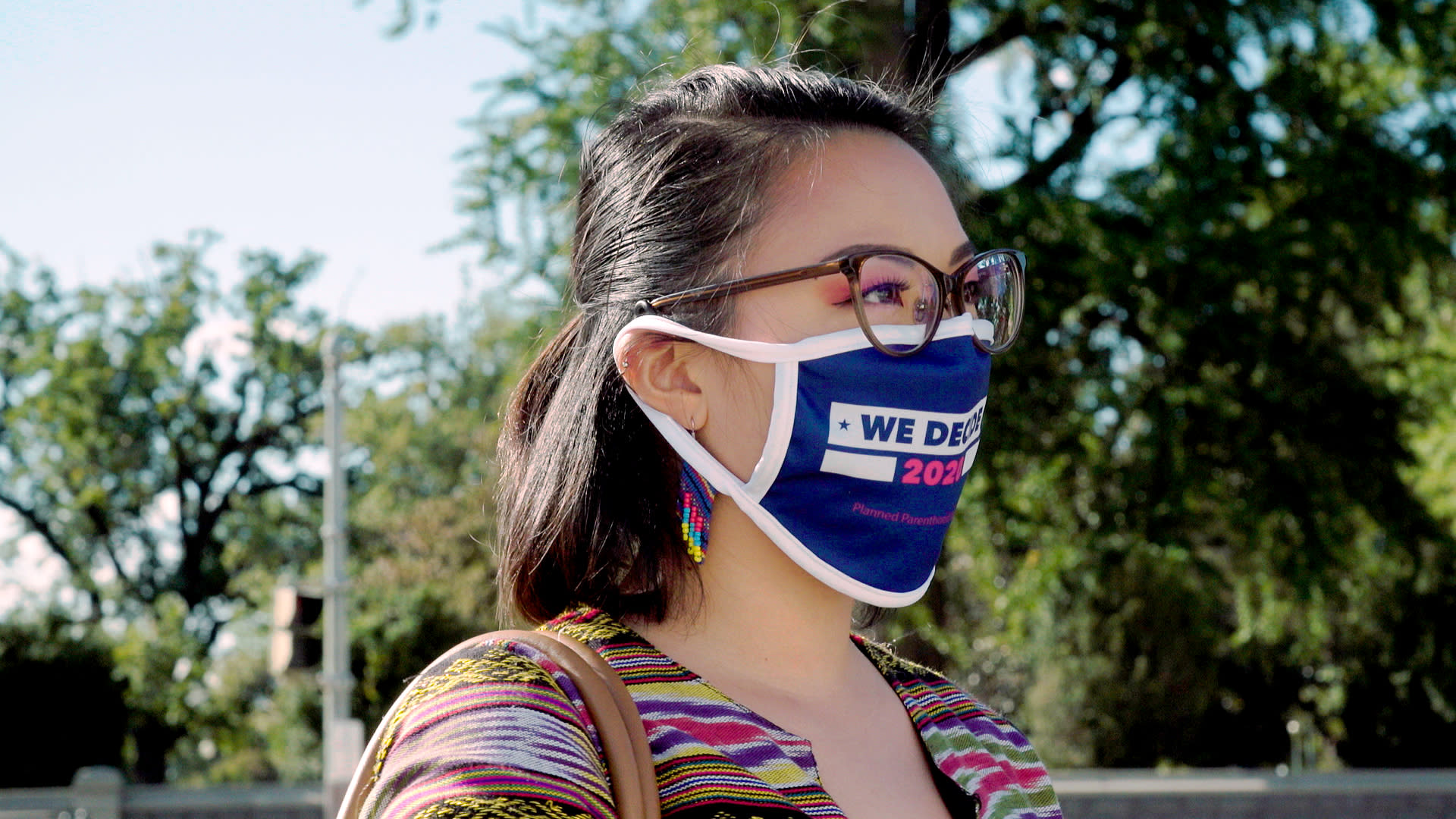
Vital’s mother remembered when her daughter sported a mask that read, “We decide” on the day she voted. “And I told her, you’re right, you are part of the we,” she said.

“We can be on the left, on the right and the middle. But in the end, we’re still binded by blood,” Tasato said. “So, we still have to show respect to one another, and respect the fact that we’re free to express ourselves quite vocally or maybe not even vocally of our political affiliation.”

Household incomes grew more slowly in a majority of states under Trump – even before COVID-19

USA Today

Household incomes grew more slowly in a majority of states under Trump – even before COVID-19

Jessica Goodheart and Danny Feingold, Capital & Main – October 26, 2020
Household incomes grew more slowly in a majority of states under Trump – even before COVID-19

Even before the U.S. economy was slammed by a pandemic, the typical American household’s income grew at a slower pace in more than half of the states under Donald Trump than in the years leading up to his presidency, according to a new Capital & Main analysis of U.S. Census data.

Those states include several key battlegrounds, undercutting one of Trump’s central campaign themes: that before COVID-19 his actions led to an economy he has described as “the best it has ever been.”

Pennsylvania saw its typical household’s income growth slow from 6.2% in Obama’s last three years to 4.7% in Trump’s first three years, while median household income growth in Wisconsin declined from 7.1% to 6%.

In New Hampshire typical household income growth slowed from 7.2% between 2013 and 2016 to 3.1% from 2016 to 2019, while in Iowa it slowed from 4.5% to 3%.

Nationally, median family income growth in Trump’s first three years was almost identical to the rate of growth in the three years prior to his presidency, according to one of the two main Census surveys. A second Census survey shows that median household income growth actually slowed in Trump’s first three years to 2.1% annually compared with 2.6% annually during Obama’s last three years.

The President has said that, before COVID-19, he oversaw an economy that was "the best it has ever been.”
The President has said that, before COVID-19, he oversaw an economy that was “the best it has ever been.”


Defenders of the president point to other indicators such as family income, which does not include households with single people and unrelated people living together. Family income, they point out, grew faster in Trump’s first three years than in the years before he took office.

Measured by median household income, however, 26 states saw slower growth under Trump even before the pandemic – including in half of the 2020 battleground states identified by The Cook Political Report, a nonpartisan newsletter that analyzes campaigns and elections. They include Georgia, North Carolina and Ohio, along with Iowa, New Hampshire, Pennsylvania and Wisconsin. In addition, two states with battleground districts, Maine and Nebraska, saw median household income growth slow in real terms.

In the hotly contested 2016 race between Trump and Hillary Clinton, sixteen of the 26 states where household income growth slowed in the ensuing years supported Trump. Seven of those 16 are considered battlegrounds in the current presidential race.

The slowing income growth in most states during the Trump years came despite the fact that the president inherited a strong economy, unlike his predecessor, who took office during the worst downturn since the Great Depression.

“Obama was carrying us out of a very deep and long recession, and Trump inherited that. If anything, it’s notable that real income didn’t rise any faster under Trump than it did under Obama, despite the stimulus that his tax cuts were supposed to provide,” said Nari Rhee, director of the retirement security program at the University of California, Berkeley’s Center for Labor Research and Education.

The coronavirus downturn, President Donald Trump says, means he'll have to rebuild the U.S. economy a second time.
The coronavirus downturn, President Donald Trump says, means he’ll have to rebuild the U.S. economy a second time.


The analysis of the latest American Community Survey data by Capital & Main, a nonprofit news organization, was conducted in conjunction with the UC Berkeley Labor Center. It compares two periods of economic expansion: Obama’s last three years in office (2014 to 2016) to the first three years of the Trump presidency (2017 to 2019). In each case, the income reported in the prior years (2013 and 2016) allows growth to be measured over the subsequent years.

Trump has repeatedly promised that he can return the economy to its pre-pandemic heights. But the Capital & Main analysis shows that, even before the pandemic, the rate of income growth for the typical household was geographically uneven.

Stephen Moore, Trump’s former economic adviser and a senior fellow at the Heritage Foundation, has recently argued that Trump rescued an economy in serious financial trouble.

“Family incomes surged to record-high levels in 2017, 2018 and 2019 as deregulation and tax cuts fueled a powerful engine,” Moore wrote in an editorial earlier this month.

Stephen Moore, Donald Trump’s former economic adviser, argues that Trump rescued an economy in serious financial trouble.


Yet, for the first half of the Trump administration, during 2017 and 2018, real income growth for the typical household grew at less than half the rate it did in the two years before he took office, according to a previous analysis by Capital & Main and the Economic Policy Institute.

All but two states experienced a trend of slower growth in median household income for the first two years of Trump’s presidency compared to the prior two years. The poorest households also saw slower income growth in Trump’s first two years compared with Obama’s last two years.

It was only in 2019 that the picture brightened for many Americans. The low unemployment rate and prolonged expansion likely led to rising incomes as more people found jobs in a tight labor market, says David Cooper of the Economic Policy Institute.

However, Cooper gives little credit to Trump’s economic policy for the growth in household incomes in 2019, saying he “squandered every opportunity to lift up ordinary Americans.”

“The data are a good reminder that the Trump administration inherited one of the best economies in (a) generation. But they did nothing in their first three years that meaningfully altered the overall trajectory of the economy during that time,” he said.

“Despite all the rhetoric, companies continue to offshore jobs, the trade deficit with China continues to grow. (Trump’s) signature economic policy was a massive tax cut that overwhelmingly benefited the rich.”

Cooper does not dispute that family incomes did grow at a faster pace under Trump than under Obama, but he credits the fact that the country was eight years into an economic expansion, not Trump’s tax cuts or deregulatory agenda. The austerity measures pushed by a Republican-controlled Congress and state legislatures prevented family incomes from rising more under Obama, according to Cooper.

Of course, what’s foremost on people’s minds right now is a pandemic and a recession that has erased economic progress made under Obama and Trump alike.

The employment gains made since the Great Recession have been wiped out by COVID-19-related job losses. Its impact on the typical household in battleground states and elsewhere will be more fully understood when the U.S. Census Bureau releases its income data next September, long after the election.

Capital & Main is a nonprofit publication that reports on economic, environmental and social issues.

Trump Says He’s Kept ‘Every Single One’ Of His Promises. CNN Shows Why That’s Another Lie.

Trump Says He’s Kept ‘Every Single One’ Of His Promises. CNN Shows Why That’s Another Lie.

Lee Moran ·Reporter, HuffPost                        

President Donald Trump’s boast about keeping “every single one” of the promises he made on the 2016 campaign trail was swiftly debunked on Tuesday’s broadcast of CNN’s “Outfront.”

CNN correspondent Tom Foreman took less than three minutes to show why the president’s bombastic claim was yet another of Trump’s lies. Trump has told more than 22,000 untruths during his time in office, according to The Washington Post.

Foreman pointed out six examples of Trump reneging on his word ― from his vow that Mexico would pay for a “great, great wall” on the southern border to his promise to repeal the Affordable Care Act and replace it with something better.

Check out the video here: