Top Obama Lawyer Hits Republican National Committee With Damning New Nickname
Lee Moran – February 9, 2022
MSNBC political analyst Neal Katyal, who served as acting solicitor general in the Obama White House, on Tuesday branded the Republican National Committee with a new nickname.
Katyal, appearing on “The Last Word,” repurposed the acronym RNC to mean “Republican National Conspiracy” as he slammed GOPers seeking to whitewash, downplay and cover up the deadly U.S. Capitol riot.
“I suppose Trump has had stressful work experiences,” Katyal told anchor Lawrence O’Donnell, likening Trump to a “toddler.”
“It must have been frustrating for him to stroll into the White House at 3 p.m. on any given day and find somebody covered his desk with more of that paper with the strange squiggles on it,” he added. “But, you know, you can’t tear it up.”
‘Utterly Humiliating’: Chris Hayes Spots Sen. Ted Cruz’s Latest Embarrassing Moment
Ed Mazza – February 10, 2022
MSNBC’s Chris Hayes tore into Sen. Ted Cruz (R-Texas) for again downplaying the Jan. 6 assault on the U.S. Capitol.
Hayes said it’s all because of an “utterly humiliating” appearance on Fox News in which Cruz had to “beg for forgiveness” from Tucker Carlson for calling the assault a “terrorist attack.”
Carlson, on the other hand, has aired wild conspiracy theories about Jan. 6 and defended the attackers.
Now, Hayes noted, Cruz is going even further to please Carlson.
“Today, he is, of course, out attacking Mitch McConnell, which is the point of all of this conditioning that those folks are up to, hoping Trump or Tucker’s watching, and will tell him that he’s a good boy,” he said.
This week, McConnell described the Jan. 6 attack as “a violent insurrection.” Cruz, in turn, accused McConnell of repeating “the political propaganda of Democrats.”
Texas might be a red state now, but the Lone Star State is turning blue right before our eyes
Chris Chu de León – February8, 2022
Deep in the heart of Texas – somewhere between the starry desert nights of El Paso and the blooming sage of Beaumont – is the steady beat of profound contradictions.
Despite the fact that people of color made up 95% of the population growth in the past decade, the state’s halls of power remain almost exclusively in the hands of old, white male lawmakers. Although Texas is on the cusp of turning blue, these same lawmakers banned abortion after about six weeks and restricted voting rights, culminating in possibly the most conservative legislative session in a generation.
As a result, Texas might seem like a lost cause to Democrats across the nation. There has never been a more urgent moment, however, for Democrats to organize and fight for transformative change in the Lone Star State.
Importantly, the majority of Texans oppose recent conservative priorities. Just 32% of Texans want to make abortion laws stricter, yet Republicans banned up to 90% of abortions, primarily affecting women of color. Only 19% of Texas voters believe there is frequent voter fraud, yet lawmakers cemented Texas’ status as the hardest place to vote in the country by restricting early voting options and empowering partisan poll watchers.
Not only are these laws antithetical to the popular will of constituents, they also disproportionately harm people of color like my family.
Reasons for hope in Texas politics
I was born in Houston to immigrants from Hong Kong and Mexico. Despite improbable journeys across two countries distant shores away, my parents collectively believed – they collectively hoped – that America’s Lone Star State would give them and their future children a shot at success.
We settled down in southwest Houston – a community filled with signs written in Chinese characters, the rhythmic sizzle of al pastor on the grills of dueling taco trucks, and the low vibration of chopped and screwed bass pulsing from car speakers. Our house was steeped in the melodic hum of Spanish, Cantonese and English, hushed only by the sound of the front door slamming as my parents shuffled out for work. My dad would often come home from work shortly before my mom headed out for her late-night shift as a nurse.
Chris Chu de León
They worked, tirelessly, so my brother and I could have opportunities they never had. My work as a community organizer in Texas, a soldier and a graduate student at Harvard are just as much their achievements as they are mine.
Texas opened doors for my family, but Republicans who hold all statewide offices and both U.S. Senate seats are now trying to slam the door shut, lock it and throw away the key. Through gerrymandering, they reduced the number of majority-Black and Latino congressional districts and split up Asian communities – significantly diluting political power for the Texans of color who have driven population growth.
There is, however, reason to be hopeful. Reason to keep organizing, knocking doors, making phone calls, sending texts and persuading Texans from every corner of the state to vote. Reason to act now, else risk losing generations of progress made in enfranchising Black and brown communities.
While Texas Democrats still face daunting historical odds – having not carried the state in a presidential election since 1976 or won statewide since 1994 – parallels can be drawn to Arizona, another border state where Republicans’ hold has eroded.
As the progressive wing of the party ascends nationally, everyday Texans are moving in lockstep. The state was fewer than 5 percentage points away from picking Bernie Sanders as its 2020 Democratic presidential nominee. Following the primary, the Texas Democratic Party adopted the most progressive platform in state history, including planks of Sanders’ most transformative policies like Medicare for All and a Green New Deal.
Moreover, the stakes are too high to lose faith. Texas’ 40 electoral votes are on the table. To put the state’s seismic political weight into perspective, based on the current electoral map, Democrats could lose Arizona, Florida, Michigan, Ohio, Pennsylvania and Wisconsin – and still take the White House if they won Texas.
America’s future is Texas. The state’s rapid diversification and leftward lurch in politics are emblematic of broader trends across the nation, which could end up looking like Texas sooner rather than later. The people in power, however, would rather not have you know that.
But the Texas I know is Black and brown, with more than 50% of the state’s population being Black, Latino or Asian.
The Texas I know is young, with nearly half of the state being younger than 35.
The Texas I know is worth fighting for.
Chris Chu de León is a native Texan and community organizer. He is a graduate student at Harvard University, where he’ll commission as a U.S. Army officer.
Is this the beginning of the end for Trumpism or the Republican Party?
Jill Lawrence, USA TODAY – February 9, 2022
It was a Republican National Committee meeting that will live in infamy, and perhaps in history. The RNC’s decision Friday to rebrand deadly mob violence at the U.S. Capitol as “legitimate political discourse” and censure two GOP House members investigating the attack has exposed a party so divided against itself that, as Abraham Lincoln told his fellow Republicans in 1858, it cannot stand.
Back then he presented the existential choice as preserving slavery or preserving the Union. Today, the choice is between preserving Trumpism or preserving the Republican Party.
There is increasing evidence that they cannot co-exist. The resolution adopted by the RNC in Salt Lake City has unleashed a torrent of protest from Republicans and former Republicans including, as of Tuesday, sharp comments from Senate GOP Leader Mitch McConnell.
They want to move on – from lies, from 2020, from Donald Trump.
‘Condoning conspiracies, lies, violence’
They can read the polls. Most Republicans say they have a favorable view of Trump, but nationally overall, he scored a 42% favorable in one recent poll and high 20s in two others. A new Associated Press poll found that 44% of Republicans don’t want him to run for president in 2024. And 56% of Republicans in a recent NBC News poll said they are more a supporter of their party than of Trump. Only 36% said the reverse.
Rep. Adam Kinzinger (R-IL) and Rep. Liz Cheney (R-WY).
The list of signers is eclectic – Never Trumpers and no-longer Trumpers, conservatives and moderates, strategists and onetime public servants, former senators and House members, and former Govs. Mark Sanford of South Carolina, Christie Todd Whitman of New Jersey and William Weld of Massachusetts.
“How could we be here, where what is the obvious truth by any measure is being conveyed as non-truth by a governing body of a major political party?” Sanford wondered. The censure of Cheney and Kinzinger, he told me in an interview, is like “something out of George Orwell or a really bad sci-fi movie.”
GOP dissent over censure mounts
Chris Christie, another former governor, declared flatly on ABC News’ This Week: “January 6th was a riot that was incited by Donald Trump in an effort to intimidate Mike Pence and the Congress into doing exactly what he said in his own words last week, overturn the election.”
The RNC won congratulations from Trump for censuring the two Jan. 6 renegades on a voice vote. But there were dissidents at that meeting from several states. There were dissidents on Twitter. And there were dissidents on Capitol Hill, notably McConnell and Utah Sen. Mitt Romney, the GOP’s 2012 presidential nominee.
It is not the RNC’s job to single out Republican lawmakers who hold minority views, McConnell said, and he reiterated that Jan. 6 was “a violent insurrection” – not legitimate political discourse. Romney was particularly harsh given that the RNC is chaired by his niece. “Shame falls on a party that would censure persons of conscience, who seek truth in the face of vitriol,” he tweeted.
In “Two Roads Diverged,” a book Sanford published last summer, the former South Carolina governor and House member said he’ll never understand how he could have been elected to Congress in 2013, 2014 and 2016 after a sensational extramarital affair, yet go on to lose his 2018 GOP primary for “not bowing to Trump.”
In addition to tracing his personal mistakes, Sanford – who mounted a brief primary challenge to Trump in 2019 – suggests ways to mend his party. Republicans, he writes, should reembrace truth, reason, science, math and accountability, get serious about term limits, rediscover humility, recognize the value of diversity, and trade hypocrisy for consistency.
Trump electoral wreckage is coming
The unanswered question is how Republicans get from here to there, or if that’s even possible. The party is “in the process of self-igniting and I don’t know what the wreckage will look like,” Sanford said.
He was encouraged Monday when a real estate broker in his 70s, a lifelong Republican voter and an active party donor, told him: “I don’t care who is on the ballot, I’m voting for anybody but Trump.” But the next day, Tuesday, the same Trump ally who defeated Sanford four years ago jumped into a primary race against GOP Rep. Nancy Mace, who was critical of Trump after the Jan. 6 Capitol attack.
“She sold out President Trump,” Katie Arrington says in her announcement video. “In Congress, I’ll be a proud pro-Trump conservative.”
Rejection by voters – call it electoral wreckage – might be the only path out of Trump cultism. Maybe Arrington will lose this primary to Mace or, as in 2018, she’ll win it then lose to a Democrat. Maybe Trump will run for president in 2024 and lose the GOP primary, or maybe he’ll win it and then, as in 2020, lose the White House. Maybe he will, as Sanford fears, claim again that the election was stolen – and even more Americans will come to believe the dangerous idea that “elections are no longer real.”
Or, thanks to the RNC’s stunning obtuseness, we can hope for a tipping point. More and more Republicans and conservatives are fed up. Trump’s claims to have won Arizona are “an outright lie,” Fox News host Brian Kilmeade said Monday on his radio show.
I am confident that he spoke for millions across the political spectrum when he told Trump to stop wasting people’s time because “nobody cares about 2020.”
Appointments and interpretation won’t fix the Supreme Court
Samuel Goldman, National correspondent – February 9, 2022
John Roberts. Illustrated | AP Images, Getty Images, iStock
It’s a busy season for the Supreme Court. The justices are now deep into an annual docket that includes major cases on abortion, religious education, gun rights, state secrets, and unintentional discrimination — and just this week, a preliminary ruling on congressional redistricting. With the pending retirement of Stephen Breyer, they also face a looming confirmation battle. Through it all, there’s a backbeat of criticism from progressives who fear the court’s slant to the right since the Trump Administration.
These conditions don’t quite add up to a crisis. Even so, the pressure is rising in judicial politics. That’s a headache for Chief Justice Roberts, who’s tried to keep the court above the political fray. But it’s also an opportunity for the rest of us to confront recurring paradoxes that seem inextricable from the court’s very design.
The first issue involves representation. In other words: who serves on the Supreme Court and why. In January, President Biden provoked a minor controversy when he announced that he would make good a campaign promise and appoint a Black woman to replace Breyer. Critics argue that means sacrificing merit to demography. “The irony is the Supreme Court, at the very same time, is hearing cases about this sort of affirmative racial discrimination and while adding someone who is the beneficiary of this sort of quota,” Sen. Roger Wicker (R-Miss.) told a Mississippi radio show.
The trouble with Wicker’s argument is that party loyalty, coalition management, and symbolism have always been part of the selection process. With so few seats on the court and so many plausible nominees, it’s inevitable that presidents will choose nominees who promote their political interests, including satisfying important constituencies. Democrats who defend Biden’s announcement emphasize Ronald Reagan’s campaign pledge that he would appoint the first woman to the court. But there are older precedents, including informal commitments to maintaining a “Jewish seat” and a “Catholic seat” in the 20th century and a preference for geographic balance in the 19th century.
This kind of selection doesn’t necessarily lead to great judges. In 1965, President Lyndon B. Johnson maneuvered Arthur Goldberg out of the “Jewish seat” in order to replace him with Abe Fortas. A career Democratic operative and Johnson crony, Fortas maintained unusually close relations with his patron in the White House. Although Fortas’ friendship with the president was tolerated when he was just one of nine judges, it became controversial when Johnson unsuccessfully attempted to elevate him to chief justice. Fortas was later forced to resign altogether due to financial improprieties.
The reaction against the politicization and cronyism represented by Fortas encouraged a rival vision of Supreme Court justices as academically-trained technocrats. Few judges represented that vision better than Breyer, who clerked for Goldberg before proceeding through the Justice Department, Harvard Law School, and the U.S. Court of Appeals. A former member of the Watergate special prosecutor’s task force and protegée of Sen. Ted Kennedy, Breyer couldn’t be regarded as entirely non-partisan. Still, his 1994 nomination to the Supreme Court was approved by a Senate vote of 87-9 — a level of unanimity that’s almost unimaginable now but Breyer shared with most contemporary nominees.
But that degree of legislative consensus was premised on an expectation of judicial consensus. You can’t expect agreement on Supreme nominations when so much rides on their outcomes. Robert Bork and Clarence Thomas were exceptions to the relative harmony of late 20th century nominations because they challenged the ideal of anodyne competence. Both believed the Constitution had been wrongly interpreted for decades — or possibly centuries. And they aimed to set things right.
But the rise of originalist jurisprudence is a consequence rather than a cause of the second paradox of the Supreme Court. Even if it has de facto representative features, the Court is not supposed to be a legislative body. Instead, it wields veto power over actions by other institutions of government.
But what distinguishes the exercise of that power from arbitrary interference? And when does preventing unconstitutional uses of government power cross the line into undemocratic manipulation? For conservatives, the ostensible modesty and elegant jurisprudential technique prized by Breyer was a way of retrospectively legitimizing earlier generations of judicial partisans and activists, who showed no such restraint about promoting liberal goals.
Reliance on the original meaning of the Constitution is supposed to counteract such tendencies without relying on the personal or ideological preferences of the court’s lineup at any given time. The difficulty is that it’s not so easy to determine what the Constitution meant, to whom, or at what specific historical moment. For some conservatives, moreover, the appeal of originalism always had as much to do with its anticipated results than with the promise of an ideologically-neutral method.
Last week, Harvard Law professor Adrian Vermeule intervened in this simmering debate with a challenging essay in The New York Times. Arguing that the currently dominant schools of jurisprudence are intellectually and politically bankrupt, he proposes an alternative approach. Progressives assume the constant, leftward evolution of morality while conservatives appeal to a dubious historical consensus, Vermeule argues. Instead, judges should try to rule in ways that promote a shared understanding of the common good including “stable families, material security, dignified work and a sense of social harmony.”
Although it’s less incendiary than previous statements of his position (you have to click through the links to get the full picture), it’s hard to believe that the adoption of Vermeule’s strategy would reduce the partisanship and polarization of the court that he, too, laments. One reason is that he defines the common good so generally as to avoid serious disagreements about definitions, priorities, and the correct means to given ends. Vermeule contends that constitutional language like “due process of law” and “free speech” is too vague to guide judicial decisions. But it’s hard to understand how “dignified work” or “a sense of social harmony” is any better.
That’s not a reason to dismiss such concepts as irrelevant or incoherent. The fundamental problem is that Vermeule’s argument, like the alternatives it rejects, counts on constitutional interpretation to resolve political disputes. We can and should expect elected legislators and executives to express and promote their preferred conceptions of the common good. That’s because we have the freedom to vote for or against them, depending on whether we agree. The combination of presidential appointment, life tenure, and a final say on legislation, by contrast, makes that influence attenuated, at best.
The reason the Supreme Court faces increasing challenges to its legitimacy isn’t that either it’s composed of the wrong personnel or that the justices have adopted the wrong interpretive strategies. It’s that they’ve acquired a degree of influence over basic questions of law and policy that cannot be held immune from electoral and ideological considerations.
If we want appointments and decisions to be less controversial, we’d need to reduce the court’s power. But that requires looking beyond the criteria for nomination or meaning of the constitutional text and considering the more basic questions about the meaning of self-government.
Joe Manchin is being ground into the dust of history by just one man, and it’s Joe Manchin
Mark Sumner – February 08, 2022
Guess who will not have a statue in the hall?
There’s a moment early in the film version of Lawrence of Arabia where the inexperienced T. E. Lawrence, in a burst of pure racism, describes the Arabic peoples as, “A little people, a silly people, greedy barbarous, and cruel.” It’s a description that might perfectly define Sen. Joe Manchin, and the person making that charge is … Sen. Joe Manchin.
On Tuesday, Politico described the lengths to which Manchin has gone to legislate around his family coal business—a business that sells what is literally the worst kind of coal, both environmentally and practically, and has managed to hang on despite a tumbling market. A sooty miracle.
But that’s not the astounding thing about Manchin. Neither is how he drove away from refusing to extend child credit payments in his Maserati, or how he scornfully waved off environmental concerns from the aft deck of his yacht. What’s most frustrating about Manchin, what’s so utterly baffling, is how much he seems to hate Joe Manchin. How much he seems to want “little” and “silly” to be his epitaph. Because faced with an unprecedented opportunity to generate a lasting legacy, Manchin instead chose—nothing.
Drive almost any distance at all in West Virginia, and your trip will involve going along some part of the Robert C. Byrd Appalachian Highway System. Cross the state line between Huntington, West Virginia, and Chesapeake, Ohio, and you’ll do so on the Robert C. Byrd Bridge. Cruise the streets of any larger town in the state, and it won’t be long before you come across a Byrd Drive, or Byrd Street, or Byrd Avenue, or Byrd Boulevard.
Depending on where you live in the state, you could easily attend Robert C. Byrd Elementary or Robert C. Byrd High School on your way to studying at the Robert C. Byrd Center for Legislative Studies, or Robert C. Byrd Center for Pharmacy Education, or Robert C. Byrd National Aerospace Education Center. You might work at one of the half dozen Robert C. Byrd Manufacturing Technology Centers, or the Robert C. Byrd Cancer Research Laboratory, or any of the 34 other centers, clinics, and facilities named for Robert C. Byrd.
If someone tells you to go to the Robert C. Byrd Federal Courthouse, you’ll have to ask, “Which one?”
There are no fewer than nine medical facilities named for Erma Ora Byrd, the senator’s wife.
To say the real life Sen. Robert C. Byrd was a mixed bag is putting it mildly. This is, after all, not just a guy who once joined the KKK, but a guy who organized a Klan chapter and used it to launch his political career. Though Byrd later said he had apologized a thousand times, fought against the Klan, and claimed to know how wrong his actions were, he still participated in a filibuster of the Civil Rights Act and was offering up racist statements right into the 2000s—by which time he was fighting against LGBTQ rights. On the other hand, Byrd was involved in almost an infinite number of important bills that expanded social programs and was involved in a number of admirable actions across more than 18,000 votes—not least of all his failed attempt to lead a filibuster against George W. Bush’s war on Iraq,
But the one thing that was consistent across Byrd’s 56-year career in the Senate was that he constantly, constantly, constantly sought to bring something home for the people of his state. The price for Byrd’s support could always be found somewhere in more promises of infrastructure, more funding for education, or in a guarantee of good jobs by siting some part of a federal agency in his state. Byrd built a legacy that is still roaring along a decade after his death, one that makes him a towering figure in his state and enshrines him as someone whose accomplishments, even if deeply tarnished, won’t be forgotten.
The length of Byrd’s career means that it’s unlikely anyone would ever be in a similar position to do so much for their state—unless, say, that person was the pivotal vote on a bill that’s desperately needed to save his party and the nation at a time of general crisis. Such a theoretical senator might expect to wrest some absolutely enormous concessions from their fellow legislators with which they could carve a blazing legacy at a stroke. Move the FBI headquarters to Charleston? Why not. Turn the struggling Grant Town power plant near Morgantown, West Virginia, into the National Experimental Coal Facility and prop it up with billions in support for every fluid bed combustion/onsite liquification/solid sequestration/underground storage dream ever dreamed so that’s the last coal plant running long after the others are gone? That’s practically a given.
Instead, real life Manchin seems to have decided that the most important thing to him is to be the man who stopped anything from happening. Congratulations, Morgantown, he’s the guy who stopped you from having a new research center. Tip your hat, Charleston, to the man who made sure you won’t get that new headquarters. Raise them up across the state for all the hospitals, research centers, schools, highways, and parks that won’t be built thanks to Your Man in Washington.
Over all that, Manchin seems to prefer the attention he gets from being the guy at the center of the snarl. Which is a position that will evaporate, completely, the moment there is one more, or one less, Democratic senator. He’s the guy who throw it all away for the nation’s most publicized snit.
Manchin is carving out a legacy as lasting as yesterday’s weather forecast. It’s not that he’ll be a footnote in the history books—he won’t be worth a footnote. No one, ever, will get to study at the Joe Manchin Center for F#cking Up a Golden Opportunity. Though it would be perfectly fitting if they did.
Oh, yeah, and according to that Politico article, Manchin has made a lot of carve-outs in legislation to carefully protect his own cash flow from that filthy little coal salvage operation feeding the dirtiest coal in the nation to the plant he keeps propping up. Which is something you can expect to end the moment someone gets a chance to “reward” Manchin for his obstinance.
Those guys will probably pop a brew or two to Manchin when he’s gone. And laugh.
This is a short blurb about Daily Kos. Please read it. It’s important:
Media outlets shed 28,637 jobs last year alone. That’s not just journalists, but fact-checkers, editors, and administrative staff. Advertising dollars have been gobbled up by Big Tech and cash-strapped outlets are being bought and sold to the highest bidder. Daily Kos is different. We don’t have corporate backers that are only in it for the bottom line. We are primarily accountable to readers like you because donations from readers like you are our biggest source of income. Want to keep it that way? Click here to donate $3 now.
These 4 Untested Weapons Could Be Crucial If Russia Pushes Beyond Ukraine
Kyle Mizokami – February 8, 2022
Photo credit: U.S. Army photo by Sgt. John Yountz
In its attempt to buttress NATO allies and Ukraine in anticipation of a potential Russian invasion, the Biden Administration announced last week the deployment of 1,700 troops of the 82nd Airborne Division from Fort Bragg, North Carolina, to Poland, and the deployment of a squadron of the Germany-based 2nd Cavalry Regiment to Romania. The units, as well as those from the 4th Infantry Division (Mechanized) at Fort Carson, Colorado, still on standby, are full of new weapons and technology.
Here are four untested on the battlefield weapons that could hold the line if Russia pushes beyond Ukraine… or U.S. forces intervene in Kyiv’s behalf.
FGM-148 Javelin Anti-Tank Missile
Photo credit: U.S. Army photo by Markus Rauchenberger
A lot has been made about the Javelin missile and U.S. shipments of missiles to Ukraine, and for good reason: the 30–year–old medium range anti-tank guided missile was tailor made to confront Soviet, and now Russian, armor formations—exactly the kind massing on Ukraine’s borders.
Here’s a video from the New Zealand Army that breaks down the Javelin missile system and shows an actual launch.https://www.youtube.com/embed/s–9W-4R9aI?v=s–9W-4R9aI&start=0
Javelin was originally deployed in the 1990s, and its 2,187 yard range, infrared targeting, and fire-and-forget launch system were miles ahead of its predecessor, the unfortunate Dragon missile. Javelin was used to destroy bunkers, buildings, and other fortified structures in the post 9/11 era in Afghanistan and Iraq but rarely in the tank-killing role it was originally meant for.
Among troops currently deployed to or deploying to Europe, Javelin will be a key weapon system. Half of the Stryker Infantry Carrier Vehicles used by the 2nd Cavalry are equipped with remote controlled Javelin launchers, and the squadron deployed to Romania might be equipped with as many as 25 Javelins. The unit of the 82nd Airborne Division deploying to reinforce NATO ally Poland is likely a battalion of airborne infantry with attached combat support troops. It would typically be equipped with 18 Javelins missile systems and eight of the heavier, more powerful, longer ranged TOW anti-tank missile systems.
In the mid-2010s the U.S. Army made the decision to augment the Germany-based 2nd Cavalry Regiment’s firepower. One decision was to upgrade half of the unit’s Stryker vehicles with Javelin missiles, to improve the regiment’s anti-armor capability. The other was the addition of an unmanned turret equipped with a 30-millimeter auto-cannon, creating the Infantry Carrier Vehicle-Dragoon (ICV-D), or Stryker Dragoon. Stryker Dragoons make up the other half of the Stryker vehicles assigned to the 2nd Cavalry.
Stryker Dragoon’s XM-813 30-millimeter cannon is designed to engage enemy light armored vehicles, including Russian BMP-2 and BMP-3 infantry fighting vehicles and BTR-80 wheeled armored vehicles. In combat against a highly mechanized foe, Strykers fitted with Javelins would engage enemy tanks while Stryker Dragoons would engage accompanying scouts and infantry carriers. The XM-813 auto-cannon can fire Mk. 258 Armor Piercing Fin-Stabilized Discarding Sabot-Tracer (APFSDS-T) against armored vehicles and the Mk. 238 High Explosive Incendiary–Tracer (HEI-T) round against trucks, other unarmored targets, and dismounted infantry.
Although the XM-813 arms a diverse variety of weapon systems, including the AC-130W gunship and Zumwalt-class destroyer, Stryker Dragoon has never been in combat.
Infantry Squad Vehicle (ISV)
Photo credit: GM Defense
One of the Army’s fastest new equipment acquisitions in recent years is the Infantry Squad Vehicle (ISV). The ISV is a no-frills vehicle designed to quickly move light infantry troops, particularly airborne infantry, across the battlefield. The ISV is still in testing and is not confirmed to deploy to Eastern Europe, but bringing it along would help the foot-mobile 82nd Airborne quickly deploy across Poland. Poland, a NATO ally that borders Ukraine, is anxious to receive American boots on the ground in case Russian tanks enter its eastern neighbor and just keep going.
The ISV is an unarmored battle truck based on the Chevy Colorado mid–sized truck with the ZR2 off–road package. The ISV is designed to carry nine soldiers, fit inside a CH-47 Chinook helicopter, and be air-droppable along with airborne troops. The vehicle trades armor for light weight and speed, allowing it to get soldiers to their objectives faster. GM Defense could build as many as 2,065 ISVs for the 82nd Airborne and infantry brigade combat teams.
The vehicle is not without controversy. The Pentagon’s Director of Operational Test and Evaluation (DOT&E) recently slammed the ISV in its latest report as “not being operationally effective” in military exercises. The DOT&E complained test vehicles failed to complete reliability testing due to issues such as, “steering capability, cracked and bent seat frames, and engine cracks and overheating.” Still, while the ISV undoubtedly has kinks to work out, there is no real alternative, and the 82nd will have trouble getting around Poland without it.
F-35 Joint Strike Fighter
Photo credit: NurPhoto – Getty Images
Last week’s deployment covers ground forces, but any future air power deployment will almost certainly include Air Force F-35A Joint Strike Fighter. The F-35A is a multi-role fighter that can capably handle air-to-air and air-to-ground mission. Unlike its predecessor, the F-16 Fighting Falcon, the F-35 is built from the ground up as a stealthy, low-observable fighter. Most Air Force F-35 units are based in the continental United States with one squadron, the 495th Fighter Squadron (“Valkyries”), based at RAF Lakenheath in the United Kingdom.
The F-35 has already seen combat in Afghanistan and against the Islamic State in Syria and Iraq, but in both cases strikes went unopposed against enemies lacking air defenses. The F-35 has not flown against a peer adversary operating advanced air defense systems and fighter jets like Russia.
Russia’s Tor, Buk, and S-400 surface to air missile systems are some of the most deadly in the world, while Russian Aerospace Forces MiG-29, Su-30, and Su-35 Flanker-E fighters are formidable threats in the air.
Ohio Rep. Jim Jordan, who now serves as the lead Republican on the House Judiciary Committee, fumed that “Hillary Clinton gets treated different than anybody else.” Another member of the panel stated, “This is the reason for this hearing – the sloppiness, the messiness, and the ability for a secretary of State to do something that shouldn’t have been done.” Another Republican weighed in, “I want to know about the destruction – the hammering of BlackBerrys.” The panel’s chairman at the time, Jason Chaffetz, who can now be seen espousing self-righteous nonsense of Fox News, attacked Clinton, “The secretary had a choice. She chose to not abide by the rules of the State Department.”
Taping Trump’s documents back together
And yet, here we are, in 2022 and we have:
The New York Times: “Trump Gives Documents Improperly Taken from White House to Archives.”
The Washington Post: “National Archives had to retrieve Trump White House records from Mar-a-Lago.”
And just for good measure, we have this gem from 2018 via Politico, “Meet the guys who tape Trump’s papers back together,” and this piece from The Times in 2019: “Jared Kushner and Ivanka Trump Use Private Accounts for Official Business, Their Lawyer Says.”
Former President Donald Trump at a rally in Florence, Ariz. on Jan. 15, 2022.
That’s right, from the same forces that brought you the chorus of “Hillary’s emails” and the smash hit “Lock Her Up” comes a new spin on an old song, “Do As I Say, Not As I Do.”
As reported by The Post, “The National Archives and Records Administration last month retrieved 15 boxes of documents and other items from former president Donald Trump’s Mar-a-Lago residence because the material should have been turned over to the agency when he left the White House, Archives officials said Monday. … The Archives has struggled to cope with a president who flouted document retention requirements and frequently ripped up official documents, leaving hundreds of pages taped back together – or some that arrived at the Archives still in pieces.”
The Times reporting added, “More recently, in response to the House select committee investigation into the Jan. 6 assault on the Capitol, Mr. Trump’s former chief of staff, Mark Meadows, provided hundreds of pages of documents, some of which came from his personal cellphone. The committee said it had questions about why Mr. Meadows had used a personal cellphone, a Signal account and two personal Gmail accounts to conduct official business, and whether he had properly turned over all records from those accounts to the National Archives.”
Bombshell revelations
Given these bombshell revelations, coupled with their concern for federal government record-keeping compliance, you would think Republicans would be foaming at the mouth, chanting “Lock Him Up” and calling for an immediate series of hearings and subpoenas to be issued to anyone who was a part of the Trump White House.
And yet, nothing. Crickets. Silence.
Jim Jordan isn’t grand-standing on Fox News calling Donald Trump incompetent or a liar or “absolutely wrong.”
The very Republicans who led the charge for investigations into Clinton’s emails don’t have a damn thing to say about what Trump and other senior administration officials did in apparent violation of the Presidential Records Act (PRA).
The ball now falls into the court of congressional Democrats, specifically, those at the House Committee on Oversight and Reform, which has jurisdiction over the PRA. They may be inclined to just sit this one out and allow for the work of the Jan. 6 committee to unfold. But it is worth noting that at one point in time, Republicans in Congress had half a dozen committees investigating Clinton. They flooded the zone and held a tsunami of hearings over the course of five years. All of which was designed to injure the political fortunes of the Democratic front-runner for president.
During the Obama years, Republicans were fond of beginning their oversight hearings by reciting a mission statement: “Our solemn responsibility is to hold government accountable to taxpayers, because taxpayers have a right to know what they get from their government. We will work tirelessly, in partnership with citizen-watchdogs, to deliver the facts to the American people and bring genuine reform to the federal bureaucracy.”
I for one think it’s time Democrats used Republicans’ own words against them and went to work.
Kurt Bardella is a member of USA TODAY’s Board of Contributors. He is an adviser to both the Democratic National Committee and the Democratic Congressional Campaign Committee and a former senior adviser for Republicans on the House Oversight Committee.
Ginni and Clarence Thomas draw questions about Supreme Court ethics
Devin Dwyer, Gabriella Abdul-Hakim – February 8, 2022
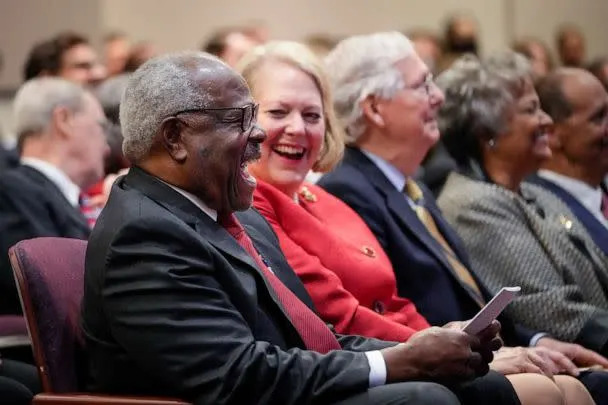
Clarence Thomas, the U.S. Supreme Court’s most senior justice, long celebrated by conservatives and reviled by liberals, is facing renewed scrutiny for potential conflicts of interest as he helms the court’s newly empowered conservative majority and as public opinion of the court slumps to a historic low.
Independent ethics watchdogs have raised new questions about the activism of Clarence Thomas’ wife of 34 years, Virginia “Ginni” Thomas, a longtime political consultant who lobbies for some of the same conservative causes — around abortion, gun rights and religious freedom — that are before the high court.
PHOTO: Supreme Court Justice Clarence Thomas and his wife Virginia Thomas arrive at the Heritage Foundation, Oct. 21, 2021, in Washington, D.C. (Drew Angerer/Getty Images)
A New Yorker magazine report last month documented a web of associations between Ginni Thomas and “conservative pressure groups that have either been involved in cases before the Court or have had members engaged in such cases.”
Thomas sits on the advisory board of a group opposing affirmative action that filed a Supreme Court amicus brief in cases the justices recently agreed to take up. She has also been highly critical in public of the congressional committee investigating the Jan. 6 attack, whose business has also come before the court.
Recently released emails obtained by the nonpartisan watchdog group American Oversight, first reported by Politico, also suggest close ties between the Thomases and Republican Gov. Ron DeSantis of Florida, who has challenged federal COVID mandates before the high court. In a June 2021 message, not independently verified by ABC News, Ginni Thomas seeks the governor’s participation in a private gathering of activists, noting that Clarence Thomas had been in contact with DeSantis “on various things of late.”
PHOTO: Gabe Roth, executive director of Fix The Court, a nonpartisan ethics watchdog, has been pressing the Supreme Court to adopt a new, enforceable ethics code. (ABC News)
Neither Clarence nor Ginni Thomas responded to ABC News’ request for comment about the reports or claims of potential conflicts.
“Ginni Thomas’ activities are different from any other spouse in the history of the U.S. Supreme Court,” said Gabe Roth, executive director of Fix The Court, a nonpartisan ethics group. “She is more activist in political causes than any other spouse. She has more relationships with organizations that have cases that come before the justices than any spouse before.”
Ginni Thomas’ personal website says she’s “battled for conservative principles” for more than three decades, regularly advising fellow activists through her private firm, Liberty Consulting, and at conservative conferences.
“America is in a vicious battle for its founding principles,” Ginni Thomas told a gathering of the Council for National Policy, a conservative advocacy group, in 2018, according to video obtained by the investigative site Documented. “May we all have guns and concealed carry to handle what’s coming.”
PHOTO: Supreme Court Justice Clarence Thomas and his wife Virginia, July 18, 2005. (The Washington Post via Getty Images)
In a 2010 interview with ABC’s “Good Morning America,” Ginni Thomas spoke about her work to oppose the Affordable Care Act. “I think the clear focus is to stop the Obama agenda,” she said at the time. (The ACA would later face three existential challenges at the Supreme Court. It survived each.)
On Jan. 6, 2021, before violence broke out at the Capitol, Ginni Thomas — who had a direct access to the Trump White House — was cheering the president’s supporters challenging the electoral vote count, writing on Facebook that morning “GOD BLESS EACH OF YOU STANDING UP or PRAYING.”
While 733 Americans now face federal charges for their alleged conduct later that day, Ginni Thomas joined an open letter in December calling congressional investigation of the attack by a Democrat-led committee a “political persecution.”
PHOTO: Kate Shaw, an ABC News Supreme Court analyst and Cardozo Law professor, says the justices could shore up public confidence by taking steps to improve transparency and ethics enforcement. (ABC News)
Eight days after publication of the letter, former President Donald Trump asked the Supreme Court to block the committee’s request for his records. Last month, the court declined over the objection of only one justice: Clarence Thomas.
“There were some eyebrows raised when Justice Thomas was that lone vote,” said Kate Shaw, ABC News Supreme Court analyst and Cardozo Law professor. “But he did not explain himself, so we don’t actually know why he wished to take up the case.”
There are no explicit ethics guidelines that govern the activities of a justice’s spouse, experts say, but there are rules about justices avoiding conflicts of interest. Federal law requires federal judges to recuse from cases whenever their “impartiality might reasonably be questioned.”
Roth notes, however, that there is no independent enforcement mechanism in place; it’s entirely up to the individual justice.
PHOTO: Supreme Court Justice Byron White swears in new Justice Clarence Thomas, with his wife Virginia Thomas and President George H.W. Bush and First Lady Barbara Bush, outside of the White House, Oct. 18, 1991. (Dirck Halstead/Getty Images)
“There’s this, you know, the court of public opinion,” he said. “But the only way to punish a Supreme Court justice is through impeachment and removal, and no justice has ever been impeached and removed.”
While there is precedent of justices recusing due to family members’ involvement or association with a given case, Clarence Thomas has never recused over his wife’s political activities.
With public approval of the Supreme Court sliding to a historic low, scrutiny of the justices’ potential financial or political conflicts in cases has been growing.
PHOTO: Carrie Severino, a former clerk to Justice Clarence Thomas and president of the conservative Judicial Crisis Network, says liberal groups are trying to intimidate the Thomases with demands for recusal. (ABC News)
Ginni Thomas is not named in any case on the court’s docket, nor is any group of which she’s known to be part. The Thomas’ supporters see a double standard in the scrutiny of their relationship.
“There’s always attempts on the left to manufacture grounds to recuse conservative justices from cases. This strikes me as just another round of those attempts,” said Carrie Severino, a former Clarence Thomas clerk and president of the Judicial Crisis Network, a conservative legal advocacy group.
In 2011, Federal Appeals Court Judge Stephen Reinhardt, a top liberal jurist, declined to recuse himself from a case involving California’s ban on same-sex marriage despite the fact that his wife was a leader at the ACLU, which had filed an amicus brief challenging the ban.
Reinhardt defended his decision at the time, writing, “her views regarding issues of public significance are her own.”
PHOTO: Virginia Thomas and Clarence Thomas walk to the microphones for a news conference to acknowledge the vote of the Senate Judiciary Committee confirming his nomination as Judge to the Supreme Court in Alexandria Va., Oct. 15, 1991. (Corbis via Getty Images)
“I think we live in a world where women are [and] should be able to be strong, be active and be participants in public discourse,” said Severino. “And that shouldn’t be viewed as something that necessarily reflects on exactly what their husband thinks or how he’s going to behave as well.”
For the most part, spouses of the justices have tended to steer clear from the work of the court. “My wife does not give me any advice about cooking, and I do not give her any advice about the law,” Martin Ginsburg, the late husband of former Justice Ruth Bader Ginsburg and a longtime tax lawyer, joked in a joint appearance at Wheaton College in 1997.
But when the justices take up a major case on affirmative action later this year, they’ll consider the views of the National Association of Scholars, a conservative nonprofit that opposes the use of race in college admissions. Ginni Thomas sits on its advisory board.
“It’s absolutely OK that Justice Breyer’s wife worked at the Dana-Farber Cancer Institute. It’s absolutely OK that Jane Roberts is a legal recruiter during Chief Justice Roberts’ tenure. And it’s totally fine, too, that Ginni Thomas has a political consulting firm,” said Roth. “But we need to look again at those closest to the justices.”
“If you appear to be against someone or something, then you shouldn’t be judging that someone or something,” he said.
PHOTO: Supreme Court Justice Clarence Thomas sits with his wife Virginia Thomas while he waits to speak at the Heritage Foundation, Oct, 21, 2021, in Washington, D.C. (Drew Angerer/Getty Images)
ABC News has learned Roth’s group, Fix the Court, has asked the Supreme Court clerk to strike the National Association of Scholars brief from the record because of the apparent conflict with Ginni Thomas.
The clerk has not yet acted on that request.
A new ABC/Ipsos poll finds more Americans, 43%, believe partisan political views rather than the basis of law (38%) are driving the justices’ decisions.
Members of Congress and outside experts say new enforceable ethics rules for the court are needed now more than ever. Even Chief Justice John Roberts acknowledged in his 2021 year-end report that “public trust is essential, not incidental” to the court’s function.
But Roberts opposes outside efforts to impose a new ethics code.
“I do think it could help the justices regain a little bit of the lost public trust and credibility just to say, look, you know, we ourselves are bound by some ethical guidelines that another body has imposed on us,” said Shaw. “So far, the court as an institution has been unwilling to sign on to that.”
Sidney Powell asks for sanctions order to be reversed, saying the judge unfairly portrayed her team as ‘dangerous lunatics’
Mia Jankowicz – February 8, 2022
Sidney Powell.Ben Margot/AP Photo
In August, a judge criticized Powell over abuses of the legal system in failed election-fraud cases.
Powell asked a court to reverse the punishment against her in a Monday filing.
She said the judge portrayed her team as “overwrought, dangerous lunatics.”
Sidney Powell, the pro-Trump lawyer who was sanctioned over lawsuits that said the 2020 election was rigged, has asked for her punishments to be reversed, saying the federal judge unfairly painted her team as “overwrought, dangerous lunatics.”
Powell and eight of her cocounsels were sanctioned last August over joint election-rigging claims that the judge called a “historic and profound abuse” of the legal system. The move came with a referral to disciplinary boards, with the potential for disbarment.
Powell, who promised to “release the Kraken” through lawsuits that alleged election fraud, had her claims dismissed in court multiple times.
One central claim — which mobilized an unfounded conspiracy theory about the voting-technology companies Smartmatic and Dominion — landed Powell with a $1.3 billion defamation suit. Powell countersued in September.
In her order, Linda V. Parker, a federal judge in Michigan, said Powell failed in her due diligence, used “speculation, conjecture, and unwarranted suspicion” in place of evidence-backed claims, and continued pursuing the cases long after they failed.
Parker said the case wasn’t about election integrity — it was “about undermining the People’s faith in our democracy and debasing the judicial process to do so.”
Powell was initially part of former President Donald Trump’s election-litigation team, but he later distanced himself from Powell.
But Powell continues to pursue her allegations. In a 97-page appeal brief filed on Monday, which Insider viewed, she called the punishment “intemperate” and requested the case be reassigned to a different judge.
Parker did “everything possible to make Appellants seem overwrought, dangerous lunatics,” Powell said.
In sanctioning Powell and her cocounsels, the order had “the clear purpose of depriving them of their livelihoods,” Powell said.
In response to Parker’s comment that she had relied on hearsay in her lawsuits, Powell said that cases were routinely processed “all on nothing more than a single person’s sworn say-so.”
The Monday filing also drew on some literary references, quoting Shakespeare and Voltaire.
“The District Court has improved upon Voltaire’s observation that ‘[t]yrants have always some slight shade of virtue; they support the laws before destroying them,'” it said. “It managed to shred the Constitution at the very same time it wrapped itself in the flag.”
Referring to a plot to kill Henry VI, Powell also quoted: “The first thing we do, let’s kill all the lawyers.”
“Shakespeare knew that lawyers were the primary guardians of individual liberty in democratic England,” she said.