Selling Trump: A Profitable Post-Presidency Like No Other

The New York Times

Selling Trump: A Profitable Post-Presidency Like No Other

Shane Goldmacher and Eric Lipton – February 12, 2022

An entrance to Trump Tower in Manhattan on the eve of the election, Nov. 2, 2020. (John Taggart/The New York Times)

In early December, Donald Trump put on a tuxedo and boarded the private jet of a scrap-metal magnate and crypto-miner for a short flight across Florida, touching down at an airport in Naples. There, a long red carpet marked the pathway into a Christmas-decorated hangar filled with supporters of Trump who had paid $10,000 to $30,000 for the privilege of attending a party and taking a photo with him.

The event had all the trappings of a typical high-end fundraiser: a giant American flag, a lectern, chandeliers and an open bar. Frank Stallone’s band provided the music; an anti-Biden “Let’s Go Brandon” banner hung from the rafters.

But the money raised did not go to Trump’s political operation. Instead, Trump’s share of the evening’s proceeds went straight into his pocket, according to a person familiar with the arrangement.

Multiple attendees said they bought their tickets from a private company, Whip Fundraising, whose founder, Brad Keltner, has asserted that “the lion’s share” went to charity. But the website advertising the event listed no charitable cause. And Keltner, reached by phone, declined to discuss how money was distributed.

In the year since Trump has left the White House, he has undertaken a wide-ranging set of moneymaking ventures, trading repeatedly on his political fame and fan base in pursuit of profit. Much as he did while in the White House, Trump has thoroughly blurred the lines between his political ambitions and his business interests.

He has gone on an arena tour with former Fox News host Bill O’Reilly, where a backstage “VIP package” sold for more than $7,500. He has published a $75 coffee-table book, after being paid a multimillion-dollar advance by a new publishing company co-founded by his eldest son. He has turned an online Trump store into a MAGA merchandiser, with his company sending marketing missives to people on his 2020 campaign’s email list.

That store is now selling red “Make America Great Again” hats for $50 each — a $20 markup from the price currently offered by his political action committee — with all proceeds going to a Trump-owned company.

His wife, Melania, has gotten into the act, too, auctioning off online collectibles and scheduling her own big-ticket event in Naples this April, a “tulips and topiaries high tea,” with VIP packages reaching $50,000 and an undisclosed portion going to charity.

For Trump, the monetization of his post-presidency represents a return to his roots. He expertly leveraged his celebrity as the host of “The Apprentice” and his image as a decisive businessman to build credibility when he first entered politics. Now, he is executing the same playbook, only in reverse: converting a political following that provided hundreds of millions of dollars in small campaign contributions into a base of consumers for all things branded Trump.

There are grandiose enterprises, such as a fledgling social-media company, whose billion-dollar market capitalization is largely predicated on Trump’s direct personal involvement. And there are smaller ones, like remodeling the lobby bar of Trump Tower in Manhattan and renaming it the 45 Wine and Whiskey Bar — where specialty cocktails range in price up to, yes, $45 (that one comes with two “American beef sliders”) and can be sipped in dark velvet chairs surrounded by Trump’s black-and-white presidential portraits and paraphernalia.

“You come here, you drink Trump,” said Daniel Popescu, a 79-year-old architect and a bar regular, whose typical order is a $20 glass of Trump Blanc de Blanc sparkling wine. He hailed Trump on a recent evening as “the best president this country has ever had.”

“For a billionaire to give up his life to do good for the country,” Popescu said, with a shake of his head and a sip, “it’s unbelievable.”

Other past presidents have cashed in financially after leaving the White House. Barack and Michelle Obama reportedly sold a joint book deal for $65 million. Bill and Hillary Clinton’s speechmaking after leaving the White House was estimated to have netted them $153 million by the spring of 2015, when Hillary Clinton announced her own run for president. George W. Bush has been a mainstay on the speaking circuit, too.

But no former president has been more determined to meld his business interests — from chocolate bars to real estate to a tech startup — with a continuing political operation and capitalize on that for personal gain.

Taylor Budowich, a spokesperson for Trump, noted that Trump had been wealthy before seeking public office. “After sacrificing considerably to lead our nation, there continues to be unprecedented demand for President Trump, his thoughts and his products, unlike anything politics has ever seen,” Budowich said.

Eric Trump, the executive vice president of the Trump Organization, added that direct consumer sales and Trump’s public appearances were worth a modest amount of money compared with the organization’s real estate deals and other major ventures.

“We have had an exceptional year as a company,” he said.

Blurred lines between profit and politics

Any division between Trump’s business and his political operation can be hard to discern.

At his first campaign-style rallies of 2022, in Arizona and Texas, giant television screens paid for by Trump’s PAC advertised his $75 picture book. His political operation has also promoted the book in emails to his supporters, as has his official post-presidential office, which also issued a recent statement (“Check it out!”) promoting a Trump property in Miami.

Lawrence Noble, former general counsel at the Federal Election Commission, said that the combination of ways that Trump had monetized his life after the White House, while remaining intimately involved in Republican politics and a possible future candidate himself, had created ethical questions unlike any post-presidency in modern times.

“The thing that is different about Trump is the making-money part seems to have permeated everything,” Noble said. “There is this appearance, at least, that he is always thinking: How can I make a profit off of this?”

Trump faced similar questions while president, as he frequently promoted, patronized and profited from his private properties, including internationally. Watchdogs who worried then about his selling access remain concerned.

“It is wrong for influence and power in this country to be sold for personal profit,” Noble said.

Out of office, Trump faces few formal limits on his business dealings, though if he were to run again in 2024, some of his financial activity would be revealed on future disclosures. His political action committees have even fewer constraints than his reelection campaign account did.

In 2021, Trump’s political committees spent more than $600,000 on Trump properties for rent, meals, meeting expenses and hotel stays, records show. His PAC continued to make monthly $37,541.67 rent payments to Trump Tower Commercial LLC.

The roughly $375,000 the PAC paid in Trump Tower rent was more than the total of $350,000 that Trump’s group donated to the scores of federal and state-level political candidates he endorsed in 2021.

Many of those candidates, in turn, redirected funds back to Trump, holding lavish events at his properties. Herschel Walker, the former football player whom Trump recruited to run for Senate in Georgia, spent more than $135,000 at Mar-a-Lago, Trump’s private Florida club. The Republican National Committee forked over $175,000 for a fundraiser there in the spring.

Trump’s PAC made two $1 million donations to conservative nonprofits in 2021: the America First Policy Institute and the Conservative Partnership Institute. Both also hosted big events at Mar-a-Lago.

Marketing MAGA to the masses

After years of slapping his name, for a price, on everything from steaks to water bottles to golf courses, Trump has found a big new market for lower-priced goods like hats, T-shirts and books.

The new push to capitalize on Trump’s name and brand echoes what he has done for decades with his real estate company, whose holdings now include six hotels in the United States and more than a dozen golf clubs.

The real estate business has, for the most part, been shrinking, with the Trump family selling off, terminating or being pushed out of hotel contracts in Washington, Toronto, New York City, Vancouver and Panama in recent years.

As Trump left office, his company was going through a challenging time, with a bad year at its remaining hotels because of the coronavirus pandemic and the decision by several blue-chip vendors — including its law firm, real estate broker and two banks — to stop doing business with the family after the Jan. 6 attack on the Capitol.

But the golf business has benefited from a surge in play during the pandemic, with revenues even at the Trump golf course near Los Angeles, a Democratic stronghold, jumping by 50% since 2019, according to tax records.

Trump’s business practices are the subject of investigations in New York by the Manhattan district attorney and the state attorney general’s office, inquiries that Eric Trump says are politically motivated.

In an interview, the younger Trump accused Democratic politicians like Attorney General Letitia James of New York of seeking political power by promising to go after his father.

“​Letitia James campaigned on the promise of harassing and suing Donald Trump,” he said. “It’s prosecutorial misconduct and it’s something you would find in a third world country.”

In Miami, the Trump family has announced plans to expand the Trump National Doral, long one of its biggest sources of revenue, by adding high-rise luxury condos.

On a far bigger scale, the Trump Media & Technology Group, which is behind the new social media company, has raised more than $1 billion. Bankers for the company dangled an unusual perk: Invest at least $100 million, get a phone call from the former president. Later, the price of such a call came down to $50 million.

But for the most part, since Trump left office, his business has focused on appealing to Middle America, not buyers of luxury condos or multimillionaire investors.

His four-stop tour with O’Reilly sought to fill arenas at $100 a ticket. O’Reilly pushed back on reports of empty seats by disclosing that “gross receipts” on the first show alone were $2 million. A tour organizer did not respond to requests for comment.

On sale at the events was Trump’s coffee-table book, which the former president has said is nearing 250,000 copies sold. His multimillion-dollar advance from the publishing company, first reported by The Washington Post, was confirmed by a person familiar with the arrangement; The Post also reported that Trump has delivered paid speeches since leaving office.

The book’s sales are scarcely spectacular: The tell-all from his niece, Mary Trump, had sold 950,000 copies by the day it went on sale. But Trump’s picture book is priced far higher. Signed copies went for $229.99 and quickly sold out.

Sergio Gor, a co-founder of Winning Team Publishing with Donald Trump Jr., called the book a success and said he was “in discussions” to acquire the rights to the former president’s next one.

Winning Team Publishing announced its second author this week: Charlie Kirk, the leader of Turning Point USA, a conservative youth group that holds its winter gala at Mar-a-Lago. Tax records for the most recent year available show the group spent nearly $280,000 there on food and beverages.

Trump’s for-profit store, meanwhile, has added a “MAGA collection,” and sells items like a $95 Mar-a-Lago Christmas ornament, that it is marketing to supporters of Trump’s 2020 campaign through email lists rented from the Trump political operation and maintained by Brad Parscale, Trump’s former campaign manager.

Donald Trump Jr., for his part, operates another online store, selling proudly provocative clothes, like shirts that say, “Guns Don’t Kill People / Alec Baldwin Kills People” — a reference to the actor’s movie-set shooting last year. After the acquittal of Kyle Rittenhouse, the teen who shot and killed two people during the unrest in Kenosha, Wisconsin, the store briefly promoted a new sweatshirt: “In a World Full of Alecs, Be a Kyle.”

Collectibles and ‘high tea’

Melania Trump, too, has found ways to monetize her ties to her husband, including through a series of online sales. In January, she put up for auction a digital portrait of her by a French artist, a print of the portrait and a white hat she once wore at the White House while meeting the president of France.

Her plan to maximize the sales price by accepting payments only in cryptocurrency appears to have backfired, however: The crash in cryptocurrency prices in January reduced the planned opening-bid price of $250,000 to about $170,000 on the final day of the auction.

The auction drew just seven bids, according to electronic records, which also suggest that the winning bid was made by the auction’s sponsors.

Shortly before the auction, Melania Trump joined the conservative social-media site Parler. Her first posts were about Pearl Harbor Day and deadly tornadoes in Kentucky, but she began frequently posting about the online auction.

On Wednesday, Parler announced a deal with Melania Trump whose financial terms were not disclosed. In a statement, she said she would provide the site exclusive content “to inspire others” and promote a series of future online auctions of “collectibles” like the hat she wore at the White House.

She is now selling tickets to the April “high tea,” with organizers saying that some of the profits will benefit an initiative of her “Be Best” endeavor called “Fostering the Future,” meant to provide computer-science scholarships to young people who have been in foster care.

There was no indication of how much of the proceeds Melania Trump herself intended to pocket. Florida requires any organization that raises charitable contributions in the state to register. No charity with the name “Fostering the Future” or “Be Best” is registered in Florida.

Asked about the solicitation, officials at the Florida agency that oversees charitable fundraising said they also could not find evidence of the required state registration and had opened an inquiry as a result.

“Consumer Services Division is currently investigating whether this event involves an entity operating in violation of Chapter 496, Florida Statutes,” Erin Moffet, an agency spokesperson, said in a statement, referring to the state law requiring charities to register before soliciting money.

Melania Trump did not respond to questions about the state requirements.

The company behind the “high tea” event, Whip Fundraising, also organized Donald Trump’s holiday party in Naples, Florida, in December, where several attendees said that guests were asked to put their phones in small magnetic pouches while Trump spoke to limit the shooting of unauthorized videos or photos.

Beyond the ticket price, the event generated revenue from an auction of items including a bottle of Pappy Van Winkle bourbon with a portrait of Trump painted on the label, and a signed photograph of Trump holding a Bible across the street from the White House after the police cleared protesters from the area in June 2020.

Keltner said that events like the one in Naples raised large sums for charity but declined to discuss the specifics of any events with Trump.

It was Keltner who arranged the flight for Trump to Naples, on the plane of Adam Weitsman, a crypto-mining investor who also owns a scrap-metal company in New York. Weitsman said he flew Trump and the former first lady as a “favor” to Keltner.

He said he did not have to pay for the privilege.

“I just gave them a ride,” Weitsman said, adding that the Trumps were very nice and respectful.

Russian false-flag plan prompts U.S. to plan for worst in Ukraine

CBS News

Russian false-flag plan prompts U.S. to plan for worst in Ukraine

Margaret Brennan – February 12, 2022

New granular detail about the planning of a false flag attack in Ukraine by Russia was among the intelligence items discussed in the Situation Room on Thursday night in an emergency meeting, U.S. officials confirmed to CBS News.

That detail was just part of what two U.S. officials described as a broad mosaic of information that has been building since the fall and which has led to the Biden administration’s planning for the worst-case scenario of a multi-axis, simultaneous attack on Ukraine by the Russian military.

The Washington Post was the first to report, on Friday, that a false flag operation was among the data points in the new intelligence.

National Security Adviser Jake Sullivan told reporters Friday that the U.S. is firmly convinced that Russia is looking hard at the creation of a false-flag operation to justify an invasion, “something that they generate and try to blame on the Ukrainians as a trigger for military action.” Sullivan said that any subsequent attack would likely begin with “aerial bombing and missile attacks” ahead of “the onslaught of a massive force.”

Russian forces are already positioned to send troops pouring across Ukraine’s northern border with Belarus and launch a maritime assault from the Black Sea. Moscow is also capable of sending troops over Ukraine’s eastern border.

U.S. officials have said Russia already has intelligence operatives on the ground that could create a pretext for an invasion by assisting in creating a false flag. Last month, U.S. officials said this could involve Russian operatives “trained in urban warfare and in using explosives to carry out acts of sabotage against Russia’s own proxy forces.”

Weather conditions that freeze the ground would allow heavy Russian military equipment including tanks to advance more easily. But ground troops are not the only option that Russian President Vladimir Putin could use.

U.S. officials do not have evidence that Putin has decided to deploy these assets to launch an invasion but emphasize that he is now capable of making the decision to execute with very little warning. On Friday, Politico was the first to report that the U.S. had intelligence indicating that Russian military leaders had been told to be ready by February 16.

The cumulative picture of Moscow’s planning triggered the U.S. on Saturday to pull out U.S. military advisers, withdraw some embassy staff from Kyiv and move staff to a makeshift consular post in Lviv, a city in western Ukraine. Sullivan said Friday that “prudence demands” planning — even though the U.S. does not know exactly what is going to happen.

Privately, U.S. and Western officials say it is entirely possible that this could be an incredibly dangerous and expensive bluff on Putin’s part, but they argue that it is the responsibility of their leaders to weigh the risk.

Three Western officials from allied governments expressed skepticism that Putin would take action as extreme as putting 100,000 soldiers on the march and risk a state-on-state conflict, or be willing to take on the occupation of a country that has resisted Russian aggression for the past eight years. Yet all three acknowledged that intelligence indicates the Russian military is definitely planning for that option.

Camilla Schick contributed reporting.

A blue Texas, Donald Trump vs. Republicans, Canadian truckers, overdose deaths: ICYMI

USA Today

A blue Texas, Donald Trump vs. Republicans, Canadian truckers, overdose deaths: ICYMI

USA TODAY – February 12, 2022

Marc Siegel – American physician and writer

In today’s fast-paced news environment, it can be hard to keep up. For your weekend reading, we’ve started in-case-you-missed-it compilations of some of the week’s top USA TODAY Opinion pieces. As always, thanks for reading, and for your feedback.

— USA TODAY Opinion editors

1. Is this the beginning of the end for Trumpism or the Republican Party?

By Jill Lawrence

“It was a Republican National Committee meeting that will live in infamy, and perhaps in history. The RNC’s decision Friday to rebrand deadly mob violence at the U.S. Capitol as “legitimate political discourse” and censure two GOP House members investigating the attack has exposed a party so divided against itself that, as Abraham Lincoln told his fellow Republicans in 1858, it cannot stand.”

2. Texas might be a red state now, but the Lone Star State is turning blue right before our eyes

By Chris Chu de León

“Despite the fact that people of color made up 95% of the population growth in the past decade, the state’s halls of power remain almost exclusively in the hands of old, white male lawmakers. Although Texas is on the cusp of turning blue, these same lawmakers banned abortion after about six weeks and restricted voting rights, culminating in possibly the most conservative legislative session in a generation.”

3. From Canadian truckers to European protests, the world is fed up with COVID crackdowns

By James Bovard

“If hypocrisy were a panacea, the coronavirus would have been banished from earth long ago. Politicians and government officials have brazenly violated the COVID-19 edicts they impose on everyone else. But after two years of prohibitions designed to placate fears rather than protect public health, can oppressed citizens around the globe compel their rulers to end absurd restrictions vexing their daily lives?”

Don Landgren, USA TODAY Network
4. Wolves have walked with us for centuries. States are weakening their protections.

By Deb Haaland

“For centuries, wolves have been exploited for their furs, killed in the name of protecting people, livestock and game species and nearly eliminated through government-sponsored actions. Decades of hard work by states, tribes and stakeholders on the ground, along with federal protections, successfully recovered gray wolves after two centuries of decline to the brink of extinction.”

5. Dr. Marc Siegel: I can see the end of the COVID pandemic on the horizon

By Dr. Marc Siegel

“This is the fear version of reality, the message the news media use to stoke us into a frenzy. They know how to probe our weak points, know how to keep us in a state of alarm, know that we will continue to hide behind our masks as we walk alone along the dark cold streets, nervously looking for signs that an interloper harboring omicron BA.2 may be nigh.”

Marc Murphy, USA TODAY Network
6. Where are the detailed Pentagon reports like the one on the Kabul bombing for civilian casualties?

By Sarah H. Yager

“I have never seen an official Pentagon report on civilian casualties as detailed as the one I watched Friday. In the 20 years since the beginning of the U.S. global counterterrorism campaign, Human Rights Watch has investigated at least 27 incidents of the U.S. killing civilians, and other organizations have documented many more. As far as we know, U.S. military officials were held responsible in only one of them, when a Doctors Without Borders was hit in Kunduz, Afghanistan. Most of the time, mourning families received no acknowledgement of their loved one’s death and no explanation for why it happened.”

7. Fentanyl kills more young Americans than COVID. The underlying causes should worry us all.

By Henna Hundal

“But while we work to stop the bleeding, we also have to probe its source. Why are thousands of young American lives entangled in such tragedy? What – more upstream than the fentanyl itself – is fueling the uptick in addictions and overdoses? In an era where, from social activism to scientific research, it’s plain to see how “sharp and astute and tolerant and thoughtful and entrepreneurial our young people are,” as former President Barack Obama once put it, why are overdoses taking a front-row seat?”

Andy Marlette/USA TODAY Network
8. Afghan women and kids we abandoned are in crisis, but it’s not hopeless if we act quickly

By Natalie Gonnella-Platts

“First, the global community can’t look away. You can’t identify as a feminist and remain silent on what’s happening in Afghanistan. Afghan women are fighting for their existence. And amid the catastrophic circumstances in country, women and children are shouldering most of the burden of hunger and poverty. Some parents have already faced the unimaginable choice of selling their organs and their children just to feed their families.”

9. Ice-shanty prostitutes? Or a publicity-seeking mayor who embarrasses his town again? You decide.

By Connie Schultz

“Hello from northeast Ohio, where womenfolk are worrying about what their ice-fishing husbands are up to, now that we know their ice shanties can be magnets for prostitution. Kidding, kidding. Nobody believes this is happening, except for Craig Shubert, the mayor of Hudson, Ohio. He apparently is imagining sturdy ice fishermen in padded parkas casting aside their poles as they coo, ‘Come to Daddy, you Carhartt-clad vixen.'”

10. Amir Locke’s death proves we learned nothing from Breonna Taylor about no-knock warrants

By Ben Crump

“It is a fact not only of Black history but also of our present that encounters with police are more dangerous for us. Black Americans are three times more likely than white Americans to be killed by police, according to a study published in 2020 from the Harvard T.H. Chan School of Public Health. And in the urban area of Chicago, that rate is 6.5 times higher. No-knock warrants, which are disproportionately used against Black Americans, contribute to those sobering statistics.”

Guest Opinion: Uncle Sam needs you to stand against the enemy within

Bucks County Courier Times

Guest Opinion: Uncle Sam needs you to stand against the enemy within

Steve Nolan – February 12, 2022

Recently an old college friend was offended that I made an analogy between Adolph Hitler and Donald Trump. He correctly and redundantly reminded me that we have no concentration camps, our neighbors are not being carted off in cattle cars — truthful, logical arguments that prevent us from solving problems before they get out of hand.

Charlottesville and January 6 were the handwriting on the wall. People we would have to disqualify from military service due to anti-Constitutional beliefs, were called “fine people“. We had witnessed this perversion before, when the president told America that he and Kim Jong Un, a human rights monster cited by the United Nations for crimes against humanity, “fell in love”; and when the president helped a Saudi Prince cover up the murder and mutilation of a journalist.

Days ago the RNC censured Liz Cheney and Adam Kinzinger for their opposition to “legitimate political discourse.” Here are the facts: on Jan. 6 an army attacked law enforcement to breach our Capitol; 140 police officers were assaulted and injured, five would die. It was a lawless coup attempt, not legitimate discourse, and Republicans who prefer the truth to a lie are being targeted. The big lie, as Goebbels said, is more believable than the smallest and we are witnessing proof of that obscenity.

Here’s another fact: a Christian nation once threw 6 million human beings into ovens and followed a leader screaming about his struggle (Mein Kampf) and the Luggenpresse (German mainstream media). Charles Dickens, in “A Christmas Carol,” has a ghost tell Scrooge that mankind should have been his business not the pursuit of wealth. In America today millions of people who claim to have dedicated themselves to following a master of love and forgiveness have turned themselves over to a person of cruelty and selfishness.

And my college buddy and I are the perfect example of Putin’s strategic accomplishments. The DOJ, Senate and House investigations into Russian cyber warfare informed us that Putin’s main objectives were to divide the American people and make us lose faith in the electoral process. With the widespread belief in “The Big Steal” it is mission accomplished for an enemy state (with the main agent being Donald Trump). There is no way to sugarcoat treason. We let the former president get away with it once before in Helsinki, where Donald Trump told the world he had confidence “in both parties,” meaning U.S. intelligence and the enemy’s denial. This prompted Senator John McCain to respond and recoil that the president of the United States abased himself in front of a tyrant. As a career military officer it would be a betrayal for me not to voice the same truths (especially since the Soviet Union/Russia was enemy number one my entire career).

The genius of our federal oath of office is that it says we will defend against all enemies, foreign and domestic. We are used to enemies being foreign, as my parents experienced in WWII, my brothers in Vietnam and me in Afghanistan. But Abraham Lincoln told us that this great nation could only fall to an enemy that would rise up within our own shores. Robert Mueller told Congress that his findings deserved the attention of every American, the threat as serious as any he’d seen in his career. Defending our country and our Constitution is the duty of every citizen of the United States. Uncle Sam needs us, every one of us.

Steve Nolan, Major, U.S. Air Force retired, career military and Afghanistan veteran, is a resident of Newtown.

Boris Johnson Reiterates Support for Ukraine in the Face of Russian Aggression

National Review

Boris Johnson Reiterates Support for Ukraine in the Face of Russian Aggression

Caroline Downey – February 10, 2022

United Kingdom prime minister Boris Johnson reiterated his nation’s commitment to preventing a Russian incursion into Ukraine in a Wall Street Journal op-ed published Wednesday evening.

In the piece, Johnson emphasized Ukraine’s rights to sovereignty and self-determination, and signaled that NATO would stand up for the threatened eastern European state.

“If I may adapt some famous words: All nations are created equal, they are endowed by international law with certain inalienable rights, and first among these is the right not to have their territory seized, or their foreign policy dictated at gunpoint, by a powerful neighbor,” wrote Johnson.

While Russia continues to signal that an invasion is imminent, mounting forces at its border with Ukraine, Johnson touted the UK’s massive investments into collective security.

“We have the biggest military budget in Europe and the second-largest in NATO. We are the only NATO member that commits the whole of its nuclear deterrent and an aircraft carrier to the alliance,” he noted.

“We have contributed more troops than any other ally to NATO’s ‘enhanced forward presence’ in the Baltic states and Poland. The British army leads NATO’s battle group in Estonia, and we are preparing to double the size of this contingent,” continued Johnson. “We have deployed more than 600 soldiers to Poland, with more on standby to aid the response to any crisis.”

In addition to projecting British military strength, Johnson also pointed out that the U.K. has made an effort to bolster Ukraine’s own fighting force, training 22,000 Ukrainian soldiers and supplying 2,000 antitank missiles.

Recapping his meeting with Ukrainian President Volodymyr Zelensky last week, Johnson warned Russia that the U.K. would “impose heavier economic sanctions on Moscow than ever before” if it proceeds with an assault. Critics have argued that stricter sanctions contingent on invasion, which President Joe Biden and congressional Democrats are championing in legislation, are an ineffective deterrent. To supplement its warnings, the U.K. has been engaging Russia in diplomacy.

Johnson’s firm statement of solidarity with Ukraine comes a few weeks after President Biden seemed to accidentally encourage a Russian incursion into the country, indicating that NATO members have not readied a unified response.

Invoking the United Nations Charter, the prime minister wrote that the U.K. did not seek to antagonize Russia, but would protect the interests of all independent nations, including Ukraine.

“I say that with confidence for the simple reason that NATO has no intention of strategically encircling or threatening Russia. On the contrary, we share a profound respect for the Russian nation and a vivid memory of fighting side by side against fascism,” declared Johnson.

“If we combine strong deterrence with patient diplomacy, I believe we can find our way through this crisis. At stake are the rules that protect every nation—big as well as small,” he concluded.

The UK government says it’ll crack down on the fortunes of Putin’s supporters. Experts say it needs to go much further.

Insider

The UK government says it’ll crack down on the fortunes of Putin’s supporters. Experts say it needs to go much further.

Thomas Colson – February 11, 2022

Russian President Vladimir Putin looks on during a press conference after meeting with French President in Moscow, on February 7, 2022. - International efforts to defuse the standoff over Ukraine intensified with French President holding talks in Moscow and German Chancellor in Washington to coordinate policies as fears of a Russian invasion mount.
Russian President Vladimir Putin looks on during a press conference after meeting with French President in Moscow, on February 7, 2022.THIBAULT CAMUS/POOL/AFP via Getty Images
  • The UK has promised to crack down on Putin’s allies — but that’s complicated by London’s reputation as a “laundromat”.
  • The city is a haven of Russian dirty money, undermining plans to impose sanctions, experts say.
  • Oligarchs are drawn to London due to its free-flowing financial markets, lavish houses, and international standing.

Boris Johnson’s government has taken a tough line on Moscow in recent weeks as Russian President Vladimir Putin masses hundreds of thousands of his troops on the Ukrainian border.

So far, the UK has sent more than troops to the countries neighboring Ukraine and sent thousands of anti-tank weapons to Kiev while other European powers including Germany were accused of floundering.

Earlier this week Johnson flew to Kiev in a show of solidarity and warned that any such incursion would be “disastrous”, while his Foreign Secretary Liz Truss held a press conference with her counterpart Sergey Lavrov that was remarkably frosty.

Johnson’s government broke ranks with other European powers to accuse Moscow of a plot to install a puppet leader in Ukraine. Meanwhile ministers on Thursday tabled new legislation designed to beef up the sanctions regime against Russia if Putin does re-invade Ukraine, with Defence Secretary Ben Wallace warning on Friday of the “economic impact” that Russia would face if it did provoke a war.

But there’s a contradiction at the heart of the UK’s ostensibly muscular new position: London’s own reputation as a playground for Russian oligarchs, some of whom are alleged by MPs to have close links with Putin himself.

Hundreds of wealthy Russians have made their home in the UK in recent years, drawn to the expensive townhouses of Belgravia and Mayfair, the UK’s exclusive private schools, and London’s reputation as a cultural hub. Russians also use London’s debt market to raise billions of pounds a year, and there are 23 Russian companies listed on the London Stock Exchange, The Wall Street Journal reported.

Such is the scale of the issue Roman Borisovich, an anti-corruption campaigner, has run guided bus tours around London pointing out lavish homes owned by former ministers and wealthy friends of Putin.

Many of the wealthy Russians living in London have made their fortunes entirely legitimately. But lawmakers and campaigners say a significant portion of the Russian money flowing into London and being used to buy up lavish properties across the UK is suspicious.

In 2018 Transparency International identified 176 properties worth £4.4 billion that had been bought with suspicious wealth, over a fifth of which came from Russian individuals. This figure was “the tip of the iceberg” when it comes to London property, the anti-corruption charity said.

But it’s not just property that has been infiltrated. A 2020 report by the Intelligence and Security Committee (ISC) described London as a “laundromat” for dirty money and found that “there are a lot of Russians with very close links to Putin who are well integrated into the UK social and business scene, and accepted because of their wealth.”

Those same figures launder their reputations, as well as their fortunes, through London, said Thomas Mayne, a corruption expert at Chatham House.

“When you have these Russians who have loyalty to the Kremlin in the UK, that money can be used for a variety of malign purposes, for a variety of types of influencing that may be detrimental to British democracy and British society as a whole. If they’re funding disinformation campaigns or funding pro-Russian think-tanks.”

The UK has actively cultivated its reputation as a haven for foreign capital in recent decades. “Ever since the collapse of empire, we’ve made our money by servicing rich foreigners in all sorts of ways,” said Edward Lucas, a senior fellow at the Center for European Policy Analysis.

Lucas, who gave evidence to parliament’s Intelligence and Security Committee for its 2020 report on Russian influence in the UK, added: “We pioneered the whole idea of lightly regulated global finance, and it basically keeps this country afloat.”

The UK is making renewed efforts to crack down on the inflow of illicit Russian money to the UK.

As well as a beefed-up sanctions regime, the government has promised to bring forward an Economic Crime bill which contains measures designed help expose and stem the inflow of illicit Russian money to the UK.

Liberal Democrat peers are also pushing to crack down on a loophole to stop ports which have been designated as post-Brexit “freeports” from being used to launder money.

The new sanctions legislation announced on Thursday substantially broadens the criteria for Russian sanctions, which could allow officials to cause greater damage to the Kremlin, including by targeting any individual deemed to be “obtaining a benefit from or supporting the Government of Russia”.

But the UK already has many of the anti-corruption tools needed to target individuals with links to the Kremlin, said Tom Keatinge, an expert in finance crime and security at the Royal United Services Institute, in an interview before the new legislation was published.

The government last year rolled out the UK’s version of the Magnitsky Act, which allows it to sanction individuals linked to corruption. The UK could also make use of Unexplained Wealth Orders or asset-freezing orders which were introduced specifically to deal with dirty money in the UK.

“A very great many of the oligarchs [Truss] would have in her sights could probably be targeted by the anti-corruption sanctions that were introduced in 2021,” he told Insider.

However, targeting individual oligarchs with links to Putin may not be nearly enough to dissuade Putin from military aggression, Keatinge said.

“If we’re going to have a war in Europe, going after the oligarchs to my mind is a bit like using a peashooter,” Keatinge said. “You need to be going after the banks, the energy companies [with ties in the UK.] You need to be going after the Russian economy, not after the individuals.”

Many experts have questioned why it has taken the threat of war in Ukraine for the UK government to step up its activity against illicit Russian money in the UK.

“I think it’s very clear that the UK government — and UK society as a whole — has been quite happy to accept this money without thinking of consequences down the line,” said Thomas Mayne, a corruption expert at Chatham House, during a Twitter Spaces event with Insider last week.

“Russia’s done some pretty bad stuff in the past, but only now are we thinking about cracking down on some of this Russian money flowing into the UK from Russia.”

The question of tackling dirty money in London may ultimately be a question of will on the UK government’s part.

Labour MP Chris Bryant, a member of the UK’s Foreign Affairs committee, on Thursday accused the government of being “lazy” in bringing forward new sanctions measures compared to other countries, adding: “We are Johnny-come-latelies when it comes to sanctions in this area.”

Diplomats in Washington have grown frustrated at the UK’s perceived lack of interest in tackling the problem. The Centre for American Progress, which has close links to the Biden administration, said in January that perceived lack of action was compounded by “close ties between Russian money and the United Kingdom’s ruling conservative party, the press, and its real estate and financial industry.”

Lucas argues that the government needs to go much further to make the UK less hospitable to illicit money, including by introducing sweeping reform to Companies House, the UK’s registrar of private companies which he described as a “black hole” for illicit finance.

“There’s a vast agenda of very overdue, boring, important stuff to do which is a world away from the tabloid headlines, but without that nothing else we do will be serious. If you don’t know who owns stuff, you don’t really know how to apply the sanctions,” he said.

The Reason Putin Would Risk War

The Reason Putin Would Risk War

By Anne Applebaum, The Atlantic Column –  February 3, 2022

The Reason Putin Would Risk War

There are questions about troop numbers, questions about diplomacy. There are questions about the Ukrainian military, its weapons, and its soldiers. There are questions about Germany and France: How will they react? There are questions about America, and how it has come to be a central player in a conflict not of its making. But of all the questions that repeatedly arise about a possible Russian invasion of Ukraine, the one that gets the least satisfactory answers is this one: Why?

Why would Russia’s president, Vladimir Putin, attack a neighboring country that has not provoked him? Why would he risk the blood of his own soldiers? Why would he risk sanctions, and perhaps an economic crisis, as a result? And if he is not really willing to risk these things, then why is he playing this elaborate game?

[Anne Applebaum: The U.S. is naive about Russia. Ukraine can’t afford to be.]

To explain why requires some history, but not the semi-mythological, faux-medieval history Putin has used in the past to declare that Ukraine is not a country, or that its existence is an accident, or that its sense of nationhood is not real. Nor do we need to know that much about the more recent history of Ukraine or its 70 years as a Soviet republic—though it is true that the Soviet ties of the Russian president, most notably his years spent as a KGB officer, matter a great deal. Indeed, many of his tactics—the use of sham Russian-backed “separatists” to carry out his war in eastern Ukraine, the creation of a puppet government in Crimea—are old KGB tactics, familiar from the Soviet past. Fake political groupings played a role in the KGB’s domination of Central Europe after World War II; sham separatists played a role in the Bolshevik conquest of Ukraine itself in 1918.

Putin’s attachment to the old U.S.S.R. matters in another way as well. Although he is sometimes incorrectly described as a Russian nationalist, he is in fact an imperial nostalgist. The Soviet Union was a Russian-speaking empire, and he seems, at times, to dream of re-creating a smaller Russian-speaking empire within the old Soviet Union’s borders.

But the most significant influence on Putin’s worldview has nothing to do with either his KGB training or his desire to rebuild the U.S.S.R. Putin and the people around him have been far more profoundly shaped, rather, by their path to power. That story—which has been told several times, by the authors Fiona Hill, Karen Dawisha, and most recently Catherine Belton—begins in the 1980s. The later years of that decade were, for many Russians, a moment of optimism and excitement. The policy of glasnost—openness—meant that people were speaking the truth for the first time in decades. Many felt the real possibility of change, and they thought it could be change for the better.

[Kori Schake: Russia’s aggression against Ukraine is backfiring]

Putin missed that moment of exhilaration. Instead, he was posted to the KGB office in Dresden, East Germany, where he endured the fall of the Berlin Wall in 1989 as a personal tragedy. As the world’s television screens blared out the news of the Cold War’s end, Putin and his KGB comrades in the doomed Soviet satellite state were frantically burning all of their files, making calls to Moscow that were never returned, fearing for their lives and their careers. For KGB operatives, this was not a time of rejoicing, but rather a lesson about the nature of street movements and the power of rhetoric: democracy rhetoric, antiauthoritarian rhetoric, anti-totalitarian rhetoric. Putin, like his role model Yuri Andropov, who was the Soviet ambassador to Hungary during the 1956 revolution there, concluded from that period that spontaneity is dangerous. Protest is dangerous. Talk of democracy and political change is dangerous. To keep them from spreading, Russia’s rulers must maintain careful control over the life of the nation. Markets cannot be genuinely open; elections cannot be unpredictable; dissent must be carefully “managed” through legal pressure, public propaganda, and, if necessary, targeted violence.

But although Putin missed the euphoria of the ’80s, he certainly took full part in the orgy of greed that gripped Russia in the ’90s. Having weathered the trauma of the Berlin Wall, Putin returned to the Soviet Union and joined his former colleagues in a massive looting of the Soviet state. With the assistance of Russian organized crime as well as the amoral international offshore-money-laundering industry, some of the former Soviet nomenklatura stole assets, took the money out of the country, hid it abroad, and then brought the cash back and used it to buy more assets. Wealth accumulated; a power struggle followed. Some of the original oligarchs landed in prison or exile. Eventually Putin wound up as the top billionaire among all the other billionaires—or at least the one who controls the secret police.

This position makes Putin simultaneously very strong and very weak, a paradox that many Americans and Europeans find hard to understand. He is strong, of course, because he controls so many levers of Russia’s society and economy. Try to imagine an American president who controlled not only the executive branch—including the FBI, CIA, NSA—but also Congress and the judiciary; The New York Times, The Wall Street Journal, The Dallas Morning News, and all of the other newspapers; and all major businesses, including Exxon, Apple, Google, and General Motors.

Putin’s control comes without legal limits. He and the people around him operate without checks and balances, without ethics rules, without transparency of any kind. They determine who can be a candidate in elections, and who is allowed to speak in public. They can make decisions from one day to the next—sending troops to the Ukrainian border, for example—after consulting no one and taking no advice. When Putin contemplates an invasion, he does not have to consider the interest of Russian businesses or consumers who might suffer from economic sanctions. He doesn’t have to take into account the families of Russian soldiers who might die in a conflict that they don’t want. They have no choice, and no voice.

And yet at the same time, Putin’s position is extremely precarious. Despite all of that power and all of that money, despite total control over the information space and total domination of the political space, Putin must know, at some level, that he is an illegitimate leader. He has never won a fair election, and he has never campaigned in a contest that he could lose. He knows that the political system he helped create is profoundly unfair, that his regime not only runs the country but owns it, making economic and foreign-policy decisions that are designed to benefit the companies from which he and his inner circle personally profit. He knows that the institutions of the state exist not to serve the Russian people, but to steal from them. He knows that this system works very well for a few rich people, but very badly for everyone else. He knows, in other words, that one day, prodemocracy activists of the kind he saw in Dresden might come for him too.

Putin’s awareness that his legitimacy is dubious has been on public display since 2011, soon after his rigged “reelection” to a constitutionally dubious third term. At that time, large crowds appeared not only in Moscow and St. Petersburg but several dozen other cities as well, protesting electoral fraud and elite corruption. Protesters mocked the Kremlin as a regime of “crooks and thieves,” a slogan popularized by the democracy activist Alexei Navalny; later, Putin’s regime would poison Navalny, nearly killing him. The dissident is now in a Russian jail. But Putin wasn’t just angry at Navalny. He also blamed America, the West, foreigners trying to destroy Russia. The Obama administration had, he said, organized the demonstrators; Secretary of State Hillary Clinton, of all people, had “given the signal” to start the protests. He had won the election, he declared with great passion, tears seeming to well up in his eyes, despite the “political provocations that pursue the sole objective of undermining Russia’s statehood and usurping power.”

In his mind, in other words, he wasn’t merely fighting Russian demonstrators; he was fighting the world’s democracies, in league with enemies of the state. Whether he really believed that crowds in Moscow were literally taking orders from Hillary Clinton is unimportant. He certainly understood the power of democratic language, of the ideas that made Russians want a fair political system, not a kleptocracy controlled by Putin and his gang, and he knew where they came from. Over the subsequent decade, he would take the fight against democracy to Germany, France, Italy, and Spain, where he would support extremist groups and movements in the hope of undermining European democracy. Russian state-controlled media would support the campaign for Brexit, on the grounds that it would weaken Western democratic solidarity, which it has. Russian oligarchs would invest in key industries across Europe and around the world with the aim of gaining political traction, especially in smaller countries like Hungary and Serbia. And, of course, Russian disinformation specialists would intervene in the 2016 American election.

[David Frum: Fox News abandons the GOP on Russia]

All of which is a roundabout way of explaining the extraordinary significance, to Putin, of Ukraine. Of course Ukraine matters as a symbol of the lost Soviet empire. Ukraine was the second-most-populous and second-richest Soviet republic, and the one with the deepest cultural links to Russia. But modern, post-Soviet Ukraine also matters because it has tried—struggled, really—to join the world of prosperous Western democracies. Ukraine has staged not one but two prodemocracy, anti-oligarchy, anti-corruption revolutions in the past two decades. The most recent, in 2014, was particularly terrifying for the Kremlin. Young Ukrainians were chanting anti-corruption slogans, just like the Russian opposition does, and waving European Union flags. These protesters were inspired by the same ideals that Putin hates at home and seeks to overturn abroad. After Ukraine’s profoundly corrupt, pro-Russian president fled the country in February 2014, Ukrainian television began showing pictures of his palace, complete with gold taps, fountains, and statues in the yard—exactly the kind of palace Putin inhabits in Russia. Indeed, we know he inhabits such a palace because one of the videos produced by Navalny has already shown us pictures of it, along with its private ice-hockey rink and its hookah bar.

Putin’s subsequent invasion of Crimea punished Ukrainians for trying to escape from the kleptocratic system that he wanted them to live in—and it showed Putin’s own subjects that they too would pay a high cost for democratic revolution. The invasion also violated both written and unwritten rules and treaties in Europe, demonstrating Putin’s scorn for the Western status quo. Following that “success,” Putin launched a much broader attack: a series of attempted coups d’état in Odessa, Kharkiv, and several other cities with a Russian-speaking majority. This time, the strategy failed, not least because Putin profoundly misunderstood Ukraine, imagining that Russian-speaking Ukrainians would share his Soviet imperial nostalgia. They did not. Only in Donetsk, a city in eastern Ukraine where Putin was able to move in troops and heavy equipment from across the border, did a local coup succeed. But even there he did not create an attractive “alternative” Ukraine. Instead, the Donbas—the coal-mining region that surrounds Donetsk—remains a zone of chaos and lawlessness.

It’s a long way from the Donbas to France or the Netherlands, where far-right politicians hang around the European Parliament and take Russian money to go on “fact-finding missions” to Crimea. It’s a longer way still to the small American towns where, back in 2016, voters eagerly clicked on pro-Trump Facebook posts written in St. Petersburg. But they are all a part of the same story: They are the ideological answer to the trauma that Putin and his generation of KGB officers experienced in 1989. Instead of democracy, they promote autocracy; instead of unity, they try constantly to create division; instead of open societies, they promote xenophobia. Instead of letting people hope for something better, they promote nihilism and cynicism.

Putin is preparing to invade Ukraine again—or pretending he will invade Ukraine again—for the same reason. He wants to destabilize Ukraine, frighten Ukraine. He wants Ukrainian democracy to fail. He wants the Ukrainian economy to collapse. He wants foreign investors to flee. He wants his neighbors—in Belarus, Kazakhstan, even Poland and Hungary—to doubt whether democracy will ever be viable, in the longer term, in their countries too. Farther abroad, he wants to put so much strain on Western and democratic institutions, especially the European Union and NATO, that they break up. He wants to keep dictators in power wherever he can, in Syria, Venezuela, and Iran. He wants to undermine America, to shrink American influence, to remove the power of the democracy rhetoric that so many people in his part of the world still associate with America. He wants America itself to fail.

These are big goals, and they might not be achievable. But Putin’s beloved Soviet Union also had big, unachievable goals. Lenin, Stalin, and their successors wanted to create an international revolution, to subjugate the entire world to the Soviet dictatorship of the proletariat. Ultimately, they failed—but they did a lot of damage while trying. Putin will also fail, but he too can do a lot of damage while trying. And not only in Ukraine.

Putin’s Army Forces Ukraine’s Frontliners Into ‘Fight or Flight’ Hell

Daily Beast

Putin’s Army Forces Ukraine’s Frontliners Into ‘Fight or Flight’ Hell

Stefan Weichert, Emil Filtenborg, Noor Ibrahim and Allison Quinn

February 11, 2022

Emil Filtenborg
Emil Filtenborg

PERVOMAIS’KE, Ukraine—The torturous, months-long “will he, won’t he” guessing game that Vladimir Putin has forced upon the world may soon end in bloodshed and devastation, as there is now little doubt that the Russian president will make the earth-shattering decision to invade neighboring Ukraine, according to multiple reports citing NATO and U.S. officials that emerged on Friday.

With Russian aggression along Ukraine’s border escalating at lightning speed, U.S. National Security Adviser Jake Sullivan said on Friday that though the White House has not definitively concluded that Putin has already ordered an invasion, the threat is now “a very, very distinct possibility” that could take place as early as next week, and encouraged all U.S. citizens to leave the country within the next 48 hours.

Military Exercises Feared to Be Cover for Putin’s Secret Weapons Plan

Meanwhile, in the Eastern Ukrainian town of Pervomais’ke, which is only a couple of kilometers from the frontlines, thousands anxiously await what’s to come—whatever that may be—with no option to leave. That includes 28-year-old handyman Evgeny Linkin, who spoke with The Daily Beast this week in between scattered gunfire and sudden explosions in the distance.

“If Russia wanted to take all of this, I think that it would be very easy,” Linkin told The Daily Beast, as he stood next to his rusty old bicycle on a snow-covered field on his way back from work. If an invasion does take place, Linkin said, “I will fight to protect my home.”

<div class="inline-image__caption"><p>28-year-old Evgeny Linkin says that he would leave this place if he could, but that he doesn’t know how.</p></div> <div class="inline-image__credit">Emil Filtenborg</div>
28-year-old Evgeny Linkin says that he would leave this place if he could, but that he doesn’t know how.Emil Filtenborg

The real-life consequences of the Russia-Ukraine conflict are painfully visible here in the outskirts of Pervomais’ke. Countless residents have been displaced and over 14,000 killed since 2014, when war broke out between Ukraine and Russia-backed separatists in the Eastern Donbas region. Residents now fear another escalation on a scale the world has not seen in decades.

“I think that we should do anything to stop the war,” said Linkin, even if that means giving into Putin’s demands that Ukraine never joins NATO or the E.U. “It is really hard to live here. There is almost nothing.”

Russia has more than 100,000 thousand soldiers stationed near the Ukrainian border, the largest number since the 1990s. With them, a terrifying supply of artillery, tanks, and missiles that have raised alarm bells in Europe and across the Atlantic Ocean. Given that Moscow’s troops are stationed along the south, east, and northern parts of Ukraine, a strike could come from virtually any direction. The threat is so imminent that U.S President Joe Biden has deployed some 3,000 troops to Eastern Europe to protect the region. Roughly 1,700 will go to Poland. Others will go to Romania.

During the intense fighting in Pervomais’ke back in 2014 and 2015, 54-year-old Aleksij Savgira knew that it was just a matter of time before his house would get hit. One early morning back in 2015, when he was asleep with his family, it finally happened. A mortar hit a house nearby and fragments penetrated his house and destroyed his roof, but spared him and his family.

“It wasn’t any surprise,” Savgira, who has no plans to evacuate, told The Daily Beast. “I have my family here, my mother lives here. I was born here, so why should I leave? I have nowhere to go,” he said. “I really hope that no new invasion will happen, but if it does, I will stay here. I don’t want Russia to take this place, it would be really difficult to live here if they do, but I will have no choice but to stay.”

<div class="inline-image__caption"><p>Aleksij Savgira says that he will fight the Russians if they come, but he cannot win, he will try to get on with his life the best that he can.</p></div> <div class="inline-image__credit">Emil Filtenborg</div>
Aleksij Savgira says that he will fight the Russians if they come, but he cannot win, he will try to get on with his life the best that he can.Emil Filtenborg

Like many others near the frontline, Savgira cannot grasp “what it is that Russia would want from this poverty-stricken city.” “My neighbor has very good tomatoes in the summer. I can go to him and ask for a few, even propose to buy a few from him, but I don’t go and steal them,” he told The Daily Beast. “I cannot understand that Russia did this. You don’t just go and invade.”

Meanwhile, the U.S. and its allies have been working on getting “the mother of all sanctions” ready to deter Russia from an invasion. It is still unclear what exactly these measures will look like, but they’re expected to include personal sanctions against Russian President Vladimir Putin and his innermost circle, as well as the closure of the Nord Stream 2 pipeline in Europe.

Through all the turmoil, Putin has denied plans to go into Ukraine, even as Western intelligence agencies accused Russia of planning a false-flag operation to use as a pretext for an invasion. Instead, Moscow has labeled NATO the provocateur, demanding the alliance adhere to its list of security demands, which include a guarantee that NATO will limit its military activity in Eastern Europe and a cast-iron commitment that Ukraine will never join.

The U.S. and NATO have staunchly refused to give in to those demands, leading to a dangerous stalemate that—despite the efforts of French President Emmanuel Macron and other Western leaders who tried to talk down Putin this week—might soon erupt into all-out war.

As war began to seem more and more likely on Friday night, Russia’s foreign ministry took things up a notch by accusing Western journalists of being in on a worldwide “conspiracy” to stoke tensions in Ukraine.

In a lengthy diatribe on its official website, the foreign ministry claimed there was a “conspiracy by authorities of Western countries and the media to escalate artificial tension around Ukraine” by publishing “fake” stories about an impending Russian invasion. The claim, which flies in the face of the tens of thousands of Russian forces surrounding Ukraine’s borders, risks putting journalists on the frontlines in the crosshairs, much like similar propaganda did in the early days of the conflict in the Donbas.

Back in Pervomais’ke, 42-year-old Ekaterina Shulgina heads one of only two kiosks in the city. When asked why she remains in the city, Shulgina repeats a common phrase heard all over Eastern Ukraine’s frontline: “I have nowhere to go,” she told The Daily Beast.

“This was a good town before. We had buses going to Donetsk every day and everyone had work. Now, we have one bus every 14 days, taxis are too expensive, so we are just stuck here,” said Shulgina, the mother of a 4-year-old son.

<div class="inline-image__caption"><p>A broken tank stands in the outskirts of Pervomais'ke as a memory of the Ukrainian soldiers who lost their lives here. The text on the tank says “They gave their life for Ukraine.”</p></div> <div class="inline-image__credit">Emil Filtenborg</div>
A broken tank stands in the outskirts of Pervomais’ke as a memory of the Ukrainian soldiers who lost their lives here. The text on the tank says “They gave their life for Ukraine.”Emil Filtenborg

Shulgina wants peace even if it means giving concessions to Russia, like granting autonomy to territories held by the separatists. According to her, the people who argue that peace can only be achieved through sheer military might are often the ones who live “far away from here.” “They should come here and see for themselves. Experience how it is to live here,” she said.

Pervomais’ke was taken under separatist control back in 2014 for a few months. Shulgina recalls waking up one day to separatists driving into the city, telling her that this is now Russian territory. Back then, she just kept on with her life, the same way she did when the Ukrainian army later claimed the area.

That is also her plan this time around. “I will do the same if Russia attacks,” she told The Daily Beast. “Hide until the fighting is over, and then go back to my life.”

Why is Vladimir Putin threatening Ukraine? Respect, fear, power at play in Russian leader’s motivations

USA Today

Why is Vladimir Putin threatening Ukraine? Respect, fear, power at play in Russian leader’s motivations

Maureen Groppe, USA TODAY – February 12, 2022

WASHINGTON – Steven Pifer has a vivid recollection of his conversation with Russia’s deputy foreign minister after the 1991 breakup of the Soviet Union.

Pointing to his head, the Russian official said he understood that Ukraine was now an independent country. Pointing to his heart, the official said it would take awhile to get used to that reality.

Pifer, who was ambassador to Ukraine from 1998 to 2000, sees echoes of that sentiment in Russian President Vladimir Putin’s threats against Ukraine, with one big difference.

“I don’t think Vladimir Putin has ever reconciled himself to that,” Pifer said of the loss of Ukraine, which has sought to align itself with the West since declaring independence from the Soviet Union.

With U.S. officials warning that a Russian invasion of Ukraine could be imminent,Putin’s designs on Russia’s neighbor goes beyond nostalgia.

It’s also about bolstering Putin’s standing on the world stage – and inside Russia. It’s about testing the United States and dividing Europe. It’s about protecting Russia’s sphere of influence and staving off perceived security threats.

Putin’s next move is fraught with risk – for himself and for the rest of the world.

The brinkmanship is “probably the most sensitive and dangerous crisis we’ve gone through in Europe since the end of the Cold War,” said Russian expert George Beebe, director of studies at the Center for the National Interest.

Here’s a look at the dynamics motivating Putin, a former KGB officer who has jailed his opponents and cemented his grip on the Kremlin.

Putin ‘won’t stop’ with Ukraine: Why Americans should care about Russia’s aggression against its neighbor

A woman in Ukrainian national dress welcomes Russian President Vladimir Putin with bread and salt in Zaporizhye airport, some 568 kilometers (352 miles) west of Ukraine's capital Kiev, on Oct. 6, 2002. Russia's present demands are based on Putin's purported long sense of grievance and his rejection of Ukraine and Belarus as truly separate, sovereign countries but rather as part of a Russian linguistic and Orthodox motherland.
A woman in Ukrainian national dress welcomes Russian President Vladimir Putin with bread and salt in Zaporizhye airport, some 568 kilometers (352 miles) west of Ukraine’s capital Kiev, on Oct. 6, 2002. Russia’s present demands are based on Putin’s purported long sense of grievance and his rejection of Ukraine and Belarus as truly separate, sovereign countries but rather as part of a Russian linguistic and Orthodox motherland.
Boosting Putin’s world stature

President Joe Biden has surmised that Putin seeks to regain the stature Russia lost after the collapse of the Soviet Union.

“He is trying to find his place in the world between China and the West,” Biden said during a Jan. 19 news conference, his most extensive remarks about the standoff.

As the United States increasingly focuses on China as its top rival, Putin is eager to show Russia is still one of the world’s biggest players, experts say.

“The core driver of much of this, the background to this crisis, is that he wants the West to treat Russia as if it were the Soviet Union, that is to say, a great power to be respected and to be feared,” said Angela Stent, a former national intelligence officer for Russia and Eurasia.

Alexandra Vacroux, executive director of the Davis Center for Russian and Eurasian Studies at Harvard University, said that Russians do not feel they’ve been taken seriously since the end of the Cold War and that “enough is enough.”

“They have everybody’s attention now,” she said. “I think they’re not necessarily interested in owning Ukraine, but they are interested in being taken seriously as kind of the big power on the European continent.”

Seth Jones, director of the Transnational Threats Project at the Center for Strategic and International Studies, sees the moves on Ukraine as an extension of Russia’s power plays in recent years that have included seizing Crimea, establishing a large footprint in Syria and building a naval base in Sudan.

“There has definitely been an expansion of Russian power and influence in a range of countries,” he said. “They don’t have the economic might of the Chinese or certainly the U.S., but they’re back as a major power.”

Opinion: U.S. can still stop the horror of Putin’s war in Ukraine. But time is running out.

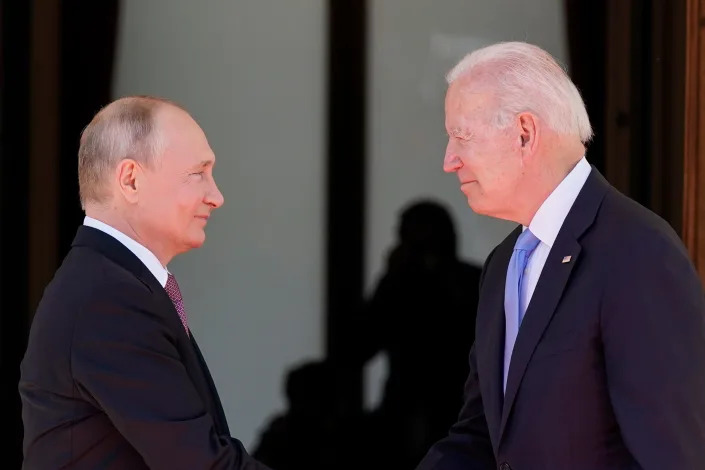
President Joe Biden and Russian President Vladimir Putin, arrive to meet at the 'Villa la Grange', on June 16, 2021, in Geneva, Switzerland.
President Joe Biden and Russian President Vladimir Putin, arrive to meet at the ‘Villa la Grange’, on June 16, 2021, in Geneva, Switzerland.
Keeping spheres of influence

Russia has always seen the ring of countries around it, which used to be part of the Soviet Union, as a buffer zone between Russia and countries that might invade, Vacroux said.

“Russia has a history of being invaded and feeling encircled by enemies,” she said. “And so one of the arguments (for Russia’s actions) is that Putin is basically reestablishing a kind of buffer between Russia and its enemies.”

Putin is not trying to reconstitute the Soviet Union, according to George Breslauer, a veteran Russian scholar at the University of California, Berkeley. But he is asserting that independent states in Russia’s neighborhood cannot be turned against Moscow because that poses an unacceptable security threat.

He also wants those buffer countries to be friendly to Russia and Russian businesses interests and to defer to Moscow on major geopolitical decisions, said Pifer, a William Perry fellow at Stanford University.

“After the collapse of the Soviet Union, Russia lost essentially almost all of its sphere of influence,” Jones said. The Baltic states became members of NATO, as did members of the Warsaw Pact collective defense treaty.

Russia has long complained that NATO and the U.S. promised at the end of the Cold War that their security alliance would not extend beyond the borders of the former East Germany, Vacroux said.

“So I think Putin sees this as one of the last things that he hasn’t fixed about the 1990s, which is pushing NATO back from Russia’s border,” she said.

Russia’s demands include blocking Ukraine from joining NATO. Putin also wants to keep NATO missiles from being in striking distance and stop the alliance from deploying forces in former Soviet bloc countries that joined NATO after 1997.

Sen. Chris Murphy, D-Conn., a member of the Senate Foreign Relations Committee, said Putin’s top goal is not putting the Soviet Union back together but destroying NATO and the transatlantic alliance.

“I think that’s really important to understand as we decide how to react to his threatened invasion,” Murphy said. “Because if NATO splits up over our response to the threatened invasion, that is a big win for Putin.”

What is NATO? Military alliance in spotlight as Russia tries to forbid Ukraine membership

People rallying in patriotic support of Ukraine hold a 500 meter long ribbon in the colors of the Ukrainian flag outside St. Michael's Golden-Domed Monastery on Unity Day on January 22, 2022 in Kyiv, Ukraine.
People rallying in patriotic support of Ukraine hold a 500 meter long ribbon in the colors of the Ukrainian flag outside St. Michael’s Golden-Domed Monastery on Unity Day on January 22, 2022 in Kyiv, Ukraine.
Boosting Putin’s domestic popularity

Russia’s unstable economy means Putin must look elsewhere to remain popular at home, according to M. Steven Fish, an expert on authoritarianism at the University of California, Berkley. Fish notes that Putin’s stock was highest after he annexed Crimea and took over parts of eastern Ukraine in 2014.

Thomas Pickering, who was ambassador to Russia from 1993 to 1996, called Putin’s domestic political calculations a significant factor in his recent actions.

“Much of what he has propounded, either in red lines or charges against the U.S. and the West, is something which can appeal to the nationalism that has always been present in Russia,” Pickering said. “While he goes up and down in public popularity, a certain amount of this activity, on his part, is orchestrated, I think, at critical times for him to reinforce it.”

Russian President Vladimir Putin in Moscow, Russia, Tuesday, Jan. 25, 2022.
Taking advantage of a ‘weakened’ US

Putin may also be trying to take advantage of Biden’s domestic troubles.

“I think the Russians also have sensed, whether rightly or wrongly, that the U.S. is weak right now after the withdrawal from Afghanistan (and) political polarization in the U.S.,” Jones said. “I think from Putin’s perspective, this is about as good a time as any to make a move in Ukraine.”

Fiona Hill, a former national intelligence officer for Russia and Eurasia, said Putin is trying to give the U.S. “a taste of the same bitter medicine Russia had to swallow in the 1990s” when it was in a weakened position at home and in retreat abroad.

“All Moscow’s moves are directed against Washington,” Hill wrote in an op-ed for The New York Times.

Murphy, however, rejects the idea that Putin’s timing is connected to a calculation that the Biden administration will have difficulty responding. Former President Donald Trump, Murphy said, was always “bending knee” to Putin.

“If Putin was making his decision on when to invade Ukraine based upon the most likely time for a weak response from the U.S. government,” Murphy said, “he would have invaded during the Trump administration.”

What are Joe Biden’s options in Ukraine?: That all depends on Putin’s next move.

Members of Ukraine's volunteer military units  train in a city park in Kyiv on Jan. 22, 2022.
Members of Ukraine’s volunteer military units train in a city park in Kyiv on Jan. 22, 2022.
Putin sees Ukraine as part of Russia

Now to the nostalgia factor.

In Russian, Ukraine is called “Malorossiya” – or “small Russia.”

The history and culture of Russia and Ukraine are “thoroughly intertwined,” according to Pifer.

“This actually goes back 1,000 years,” he said.

Putin elaborated on his often-repeated assertion that Russians and Ukrainians are “one people” in a lengthy essay the Kremlin posted in Russian, Ukrainian and English in July.

“I said that Russians and Ukrainians were one people – a single whole,” Putin wrote. “These words were not driven by some short-term considerations or prompted by the current political context. It is what I have said on numerous occasions and what I firmly believe.”

The fact that Putin made the essay compulsory reading for the Russian military, including the soldiers lining up on Ukraine’s border, means it’s “pretty serious,” said Jones, of the Center for Strategic and International Studies.

“It is designed, in part, not just to influence external audiences,” Jones said, “but also internal ones that may fight and die in Ukraine for the Russian cause.”

Ukraine has been moving further and further away from Russia over the past eight years – much to Putin’s consternation, according to Murphy.

“And everything short of a full-scale invasion that Putin has tried, in order to win back Ukraine to the Russian orbit, hasn’t worked,” the senator said.

Visual explainer: How US and its allies could respond to Russian invasion of Ukraine

People rallying in patriotic support of Ukraine hold a 500 meter long ribbon in the colors of the Ukrainian flag on Unity Day on January 22, 2022 in Kyiv, Ukraine.
Risky strategy

Putin’s moves come with huge risks.

If he sends 100,000 troops into Ukraine, they will need extremely long supply lines that will be hard to support, Vacroux said.

“It’s possible that … it’s not a quick operation and then they’re bogged down in Ukraine, and that’s just going to be a huge mess,” she said. “It’s especially messy if Ukraine gets more than supportive words and defensive weapons from NATO, and from the United States, which is all they’ve gotten so far.”

Biden has threatened severe sanctions intended to seriously damage Russia’s economy should Putin attack. And the U.S. president said he was considering personal sanctions targeting the Russian leader’s own pocketbook as well.

“On a scale of 1 to 10, in terms of sanctions on Russia, I think we’re at about a 3 now,” Pifer said. “So they could ratchet it up.”

And some Russian parents have expressed concerns on social media about their sons being sent to fight, and possibly die, in Ukraine, said Rose Gottemoeller, former deputy secretary general of NATO who is now at Stanford University.

In Ukraine, by contrast, one recent poll showed a third of the country saying they would be willing to take up arms if Russia invaded. So even though Russia has much greater military might, they could take heavier casualties than anticipated.

“I can see Putin’s ideal scenario, but I can also see that it goes badly for him,” Pifer said.

And Putin’s fears about NATO encroachment could become a self-fulfilling prophecy. Any invasion of Ukraine would be met with a buildup of NATO forces along the Russian border, Jones said. The Pentagon has announced the deployment of several thousand U.S. troops to Germany, Poland and Romania amid the crisis.

On the other hand, if NATO’s response isn’t forceful and if China helps Russia get around sanctions, Putin may be able to annex at least a large portion of Ukraine.

That, Jones said, would send a very clear message to any country in Eastern Europe or Central Asia “that this is what happens if you even think about joining” NATO.

Maureen Groppe has covered Washington for nearly three decades and is now a White House correspondent for USA TODAY. 

Sen Paul and the repub’s who want to end American Democracy, Belong in Russia

The Courier Journal

‘I hope they clog up cities’: Sen. Rand Paul hopes Canada trucker protest spreads to US

Lucas Aulbach, Louisville Courier Journal – February 11, 2022

Sen. Rand Paul has watched the protests in Canada over coronavirus restrictions shut down several blocks in Ottawa for weeks and bring traffic along key nearby crossings to a halt.

Now, he’s ready to roll out the welcome wagon for the protesters in the U.S.

In an interview Thursday with the Daily Signal, a conservative media site, the U.S. senator from Kentucky said “it’d be great” if the protests spread to Washington, D.C., when asked about his thoughts on the protests and how the nation’s capital would react if they spread south across the border.

“The thing is, it wouldn’t shut the city down because the government workers haven’t come to work in two years anyway, so I don’t know if it’d affect D.C.,” Paul joked. “It’d be nice change. We’d actually have some traffic.”

Just under 25% of office workers in Washington, D.C., were working out of their offices as of September 2021, according to a survey from the DowntownDC Business Improvement District, as more employees opted to work from home amid the pandemic, which has frequently closed schools and upended child care options.

The protests in Canada, referred to as the “Freedom Convoy” by supporters, are set to enter their third consecutive weekend. Led by a group of truck drivers who started in British Columbia and drove to Ottawa, the country’s capital, protesters involved have called for the government to put an end to a mandate approved by Prime Minister Justin Trudeau that requires truckers entering the Canada from the U.S. to have been fully vaccinated or face additional quarantining and testing.

The protesters have set up camp in downtown Ottawa, shutting down several city blocks and disrupting day-to-day life in the city’s core, with Mayor Jim Watson at one point calling a state of emergency due to “serious danger and threat to the safety and security of residents.” A separate state of emergency was put in place for the entire province of Ontario by Premier Doug Ford on Friday as three border crossings have been closed due to the demonstrations.

Paul, a frequent critic of U.S. COVID policies, told the Daily Signal that the protests were an example of civil disobedience – a “time-honored tradition in our country.”

“I hope the truckers do come to America, and I hope they clog up cities,” Paul said. “We’re seeing a break in the dam now. Several Democratic governors are finally sort of relinquishing. What they’re finding is moms and dads are upset about this, they’re not just Republicans. Everybody is upset about this.”

Paul might just get his wish.

The Super Bowl is set to take place Sunday in Los Angeles, and the Department of Homeland Security warned state and local law enforcement departments Tuesday that protests could potentially begin in California before convoying through the U.S. to make it to the nation’s capital by March 1, the day President Joe Biden is set to give his State of the Union address.

“While there are currently no indications of planned violence, if hundreds of trucks converge in a major metropolitan city, the potential exists to severely disrupt transportation, federal government operations, commercial facilities, and emergency services through gridlock and potential counterprotests,” the memo said, according to USA TODAY.

Paul’s office did not immediately respond to an email seeking comment Friday.