On August 23, 1989, about 2 million people from Latvia, Estonia and Lithuania formed a human chain that united all 3 countries to show the world their desire to escape the Soviet Union and the communism that brought only suffering and poverty. This power stretched 600 km.
How big is Ukraine’s military compared to Russia’s? How long could Ukrainians hold off an attack?
Michael Collins, USA TODAY – February 12, 2022
WASHINGTON – This time, it won’t be so easy.
Russia had no problem getting past Ukraine’s military forces when it orchestrated a bloodless takeover of the Crimean Peninsula in 2014. Russian President Vladimir Putin even boasted that not a single shot was fired during the assault.
But Russian troops will face a far more formidable adversary if Putin invades Ukraine again now. Ukraine’s military is better trained, better equipped and more battle-tested than it was eight years ago, experts say.
“They are not what they were in 2014,” said Jim Townsend, a former U.S. deputy assistant secretary of defense.
Fears have sharply escalated in recent weeks that Russia could invade its smaller neighbor. On a call Saturday, President Joe Biden warned Putin that an invasion of Ukraine would result in “swift and severe costs for Russia.”
A senior Biden administration official said the call resulted in “no fundamental change in the dynamics that have been unfolding now for several weeks.”
The White House has now warned that a Russian invasion of Ukraine could be imminent, perhaps before the conclusion of the Beijing Winter Olympics, which end Feb. 20.
“In collaboration with reservists, civil society, and volunteers, they can make any attempted invasion a miserable experience for Russia,” the group concluded in a recent report.
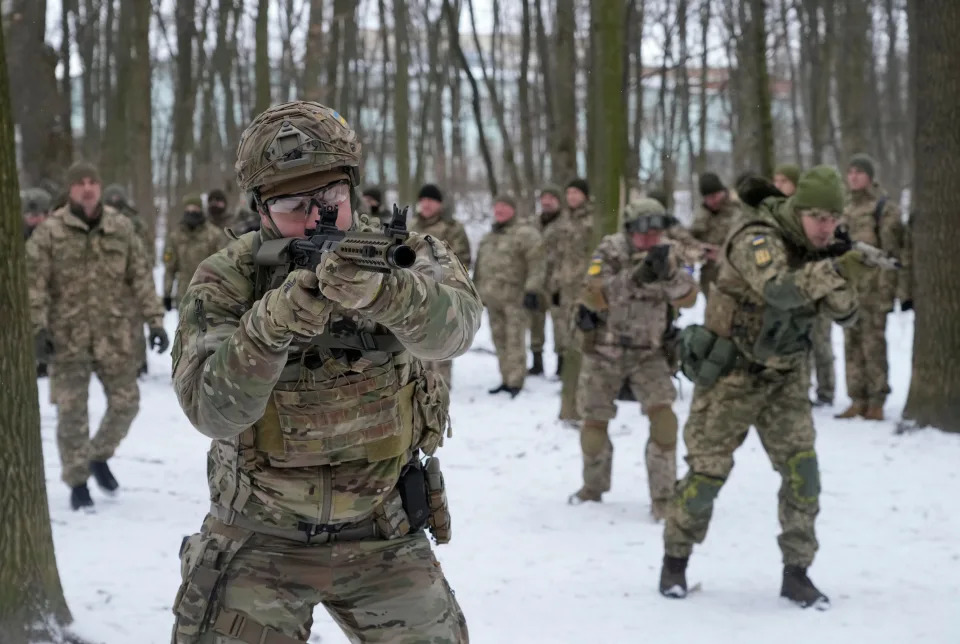
Members of Ukraine’s volunteer military units train in a city park in Kyiv on Jan. 22, 2022.
How big is Ukraine’s military?
Ukraine has 250,000 active-duty troops, plus another 290,000 reserve personnel and 50,000 paramilitary units that could be activated in a conflict with Russia. In 2014, by comparison, Ukraine had just 140,000 troops, and only 6,000 of those were ready for combat.
How big is Russia’s military?
Russia has more than 1 million active-duty personnel, more than four times Ukraine’s force strength. Russia also has 378,000 reserve personnel and 250,000 paramilitary troops that it could call up in a conflict with its neighbor.
Who has the most weapons?
Russia, hands down.
In terms of land power, Russia prevails, with more than 12,000 tanks (compared with 2,500 for Ukraine), 30,000 armored vehicles (Ukraine has 12,000) and 12,000 self-propelled artillery (Ukraine has just a little over 1,000).
Russia also dominates in airpower, with more than 700 fighter aircraft (compared with around 70 for Ukraine), more than 700 attack aircraft (Ukraine has fewer than 30), more than 500 attack helicopters (Ukraine has 34) and 1,500 helicopters (Ukraine has a little over 100).
At sea, Russia rules with 15 destroyers, 70 submarines, 11 frigates and nearly 50 mine warfare vessels. Ukraine has no destroyers or submarines, just one frigate and one mine warfare vessel.
The U.S. has already spent billions of dollars to help Ukraine build up its military defenses, an investment that’s likely to escalate dramatically if Russia invades.
Though Biden has said the U.S. would not send troops to help defend Ukraine against Russian forces, he said the U.S. probably would send more American forces to other European countries, including Poland and Romania. The Pentagon announced on Monday it is putting 8,500 U.S. troops on “heightened alert” for possible deployment to Eastern Europe amid the crisis.
And in January, the White House said it will give an additional $200 million in defensive military equipment to Ukraine. The package reportedly includes anti-armor missiles, ammunition and other items.
The U.S. is sending weapons to Ukraine through third-party transfers, in which NATO members provide U.S.-made weapons. The transfers include javelin anti-tank weapons from Estonia, stinger air defense systems from Lithuania and Latvia and anti-tank missiles from the United Kingdom.
Ukraine was completely unprepared for war when Russia invaded Crimea in 2014.
Its armed forces were not manned, equipped or trained to meet Russian aggression, and its logistic stockpiles were essentially non-existent, with the exception of weapons and ammunition mostly from the Soviet period, according to the Atlantic Council.
Ukraine has made modernizing its military a priority over the past seven years but decades of neglect have been difficult to overcome, the council reported.
Ukraine’s military still has several strategic vulnerabilities, including gaps in key operational and combat capabilities. Corruption remains a problem, funding is limited because of the general economic conditions in the country, and many important weapons purchases have been placed on the back burner – not because of a lack of will but because of a lack of funding, the council’s analysis concluded.
Russia would probably attack Ukraine from different directions, forcing Ukraine to split up its forces to confront the advancing troops, Townsend said.
“They’re going to have to defend Ukraine from a number of different avenues of approach,” he said, “so it just makes their inferiority even worse because they’re going to be thin.”
On top of that, Russia would likely engage in cyberattacks against Ukraine’s military and civilian society, which from the outset could degrade the country’s electrical grid and telecommunications systems, Townsend said.
“I don’t think you’re going to see the Ukraine being able to stop the Russians for a long period of time,” he said.
Michael Collins covers the White House. Follow him on Twitter @mcollinsNEWS.
Contributing: Joey Garrison, Karina Zaiets, Stephen J. Beard, Javier Zarracina and George Petras
Trump had such a distinct ripping style that aides instantly knew when he was the one who had ravaged a document: report
Yelena Dzhanova – February 13, 2022
Former President Donald Trump.Evan Vucci/AP
Trump aides instantly knew when the former president tore up documents, the Washington Post reported.
His ripping style — clean tears horizontally and vertically — became so recognizable to aides.
The former president is facing renewed scrutiny into the preservation of historical and important documents.
Former Trump administration aides instantly knew when a document had been torn by the former president, according to a report from The Washington Post.
Donald Trump had such a distinct style of ripping that became familiar to his aides, the Post reported. He would tear each document twice — once down the middle horizontally and once vertically — leaving the paper in four quarters. When the aides saw these documents torn up in this manner, according to the Post, they immediately knew Trump had done it.
The former president would then leave the documents scattered across desks and in trash cans all over the White House, the Post reported. Documents were also strewn across floors, and aides found them in the Oval Office and aboard Air Force One, the report said.
Scrutiny into the preservation of documents under the Trump administration started partly after New York Times correspondent Maggie Haberman revealed in a forthcoming book that the president had clogged a toilet by flushing torn pieces of paper down it.
Trump, denied the report, slamming it as a “fake story.” It’s “categorically untrue and simply made up by a reporter in order to get publicity for a mostly fictitious book,” Trump said.
Recently, the National Archives and Records Administration, a US agency responsible for the preservation and documentation of government and historical records, said Trump had taken several boxes of official White House records to his Mar-a-Lago resort upon vacating office. Under the Presidential Records Act, he should have turned the records over to the agency upon leaving office.
In a statement from earlier this week, the agency said it has “arranged” transport for 15 boxes of documents from Mar-a-Lago.
The items that Trump improperly took to Florida with him include correspondence from North Korean dictator Kim Jong Un, with whom Trump said he exchanged “beautiful” love letters while in office, and a letter that former President Barack Obama left Trump in 2017, according to the Post.
The National Archives has subsequently asked the Justice Department to investigate if Trump broke the law by doing so, the Post reported.
Insider’s Grace Panetta contributed to this report.
Republicans suffering from auto-immune syndrome | Opinion
Chuck McMurry – February 13, 2022
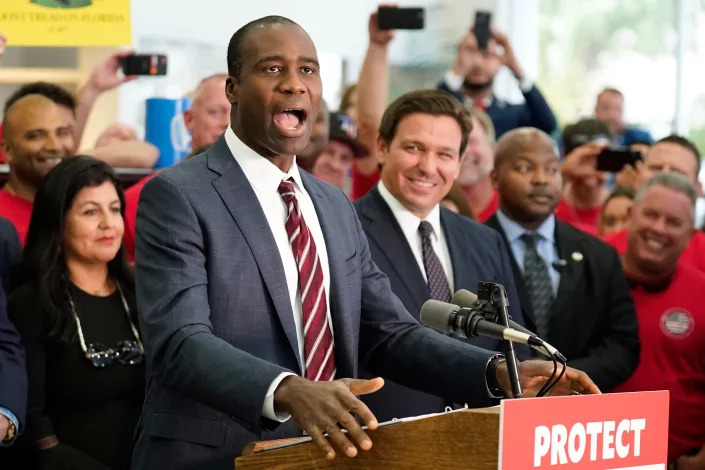
Florida Surgeon Gen. Dr. Joseph A. Ladapo before a bill signing by Gov. Ron DeSantis Thursday, Nov. 18, 2021, in Brandon, Fla. (AP Photo/Chris O’Meara)
Republican politician’s solutions to problems like COVID are similar to an auto-immune reaction in your body. Instead of fighting against a known intruder, the body fights against itself, somehow triggered by false information that there is a problem.
This is what we have seen in Florida, as demonstrated by our Governor’s response to the pandemic. Instead of enacting measures to help fight and reduce the threat, he takes the opposite approach and proposes laws and regulations that perpetuate and exacerbate the problem. No masks required in schools and the hiring of an anti-establishment doctor to lead the state over the cliff with more infections and deaths.
All in the name of getting re-elected.
Florida law requires that children wishing to enter schools must receive vaccines for diphtheria, tetanus, polio, measles, mumps, and rubella, to name a few. Who in their right mind would not want to protect their children from disease? Why would you fight to stop your child from getting the vaccine or wearing a mask?
Well, DeSantis, and like-minded Republicans, have discovered that the basket of deplorables spoken of by Hillary Clinton, represents a sizable number of truly ignorant voters, who if excited enough will support politicians who pander to anti-establishment, anti-authoritarian ideas that spit in the face of conformity.
These folks reject government in most forms and cheer on the likes of Trump, thumbing his nose law and order, and encouraging the total disruption of the established norms of our society.
Imagine if, after the bombing of Pearl Harbor, the Republicans had pushed back on the idea of declaring war on Japan. People don’t like war, so let’s just try to disrupt this whole response and make a wedge issue out of it.
Supporters of former President Donald Trump attack the U.S. Capitol in an effort to overturn the results of the 2020 election on Jan. 6, 2021, in Washington, D.C. (Kent Nishimura/Los Angeles Times/TNS) ORG XMIT: 33028519W
We could attract anyone who did not want to get drafted into the army to vote pro Republican. Or in the present scenario we have our ex-El Presidente, claiming he would pardon all the rioters who attacked the capital because they are true pat-riots, fighting against the fraud of the last election.
Do we really want anti common-sense leaders? Do we want politicians who can turn issues like gun control into a choice between upholding a Second Amendment right crafted several centuries ago, or the safety of our children to be free from being shot at school?
Mass internet media and 24-hour news cycles has become an Orwellian dream come true, because like every sporting contest you must have competing teams to sell tickets. Our politics today makes no attempt to stand for what is right or wrong, only to support what can get you re-elected.
If it is important to have open and free elections, then the other side will somehow say the system needs to be restricted to prevent fraud- whether there is any proof of such problems.
What we are seeing with this modern wave of Republicans is an attempt to destroy our country by creating issues to attract that minority of knuckle draggers who worship “professional” wrestling, and NASCAR pileups.
The true Republicans are dragged along for fear of losing, whether their candidate has a whit of integrity or leadership. Mainstream Republicans need to distance themselves from the party and reject this auto-immune syndrome by charting a different course.
GOP Rep. Adam Kinzinger says the Republicans who support Putin have an ‘affection for authoritarianism’
Matthew Loh – February 13, 2022
Rep. Adam Kinzinger again blasted Republican political figures who support Russia’s goals for Ukraine.
He said said an “affection for authoritarianism” has led some Republicans to advocate for Vladimir Putin.
Kinzinger said Putin is seen as a person defending the “culture of the past.”
GOP Rep. Adam Kinzinger of Illinois said on Sunday that a growing number of Republican political figures are showing an “affection for authoritarianism” by voicing support for Russian President Vladimir Putin’s campaign to stop Ukraine from joining NATO.
In an interview with CBS’ “Face The Nation,” Kinzinger was asked about the segment of the Republican Party who asked President Joe Biden not to interfere with Putin’s goal. The congressman said this group isn’t “a huge portion” of his party, but that “it’s way too big and it’s growing.”
In the interview, Kinzinger cited “having an affection for authoritarianism” as one of the possible reasons why some party members have taken Putin’s side. He also put the blame on people being naive about foreign policy and Putin’s public image.
Rep. Adam Kinzinger of Illinois said Russian leader Vladimir Putin is seen as a person defending the “culture of the past.”Alex Wong/Getty Images
“And I think Vladimir Putin has done a decent job of engaging in culture battles and culture war, and he is seen as the person defending, in essence, the culture of the past. And so it’s very frightening,” he told CBS’ Margaret Brennan.
Kinzinger added that “any Republican that has affection for Vladimir Putin has no understanding of what our party stands for or what our country stands for.”
During the interview, he also singled out Fox News host Tucker Carlson, who has repeatedly sided with Putin over Ukraine-Russia tensions and thrown doubts at Washington’s backing of Ukraine.
Carlson in January shrugged off claims that he was a “pawn of Putin,” calling the idea “stupid.” At the time, he had just commented that Russia’s amassing of more than 100,000 troops on the Ukrainian border was due to Putin wanting to “keep his western borders secure” — rhetoric that’s also been used by the Kremlin.
Kinzinger’s comments also come as Carlson continues to build a working relationship with Hungarian far-right leader Viktor Orbán, who has regularly been called an authoritarian by political commentators and NGOs.
A vocal critic of former President Donald Trump, Kinzinger has previously slammed US political figures for supporting Putin. On February 3, he tweeted that Senator John Hawley was “one of the worst human beings” and a “con artist” for calling on Biden to block Ukraine from joining NATO.
When Hawley called Kinzinger’s outburst “weird,” the Illinois representative accused Hawley of being “more interested in pleasing Tucker and playing to worst instincts than leading.”
This month, the Republican National Committee voted to censure Kinzinger and GOP Rep. Liz Cheney for their participation in the January 6 House Committee. Kinzinger had announced earlier that he wouldn’t seek re-election this year, and has hinted — but not confirmed — that he may run for governor instead.
Puzzle in Ukraine Crisis: Where’s the U.S. Ambassador?
Michael Crowley – February 12, 2022
A photograph shows the US Embassy building in Kyiv, on January 24, 2022 – Ukraine on January 24 said it was “premature” of the United States to evacuate the families of its diplomatic staff in Kyiv due to fears of a looming Russian invasion. (Photo by Sergei Supinsky / AFP) (Photo by SERGEI SUPINSKY/AFP via Getty Images) (SERGEI SUPINSKY via Getty Images)
WASHINGTON — It is a puzzle at the heart of the crisis over Russia’s threat to invade Ukraine: Why has President Joe Biden, more than one year into his presidency, failed to name an ambassador to Kyiv?
Neither the Biden administration nor Ukraine’s government is providing a clear explanation for a delay that career diplomats say would be baffling and inexcusable even in ordinary times, never mind at a moment when the U.S. relationship with Ukraine is as consequential as it has ever been.
Experts say that the presence of a full-time ambassador could help to smooth awkward relations that have emerged between the Biden administration and the government of President Volodymyr Zelenskyy despite Ukraine’s heavy reliance on Washington for its defense against Russia. But it is also unclear how eager the Ukrainians are to receive an envoy from Biden, who submitted a candidate to Kyiv for approval weeks ago.
The position comes with an extra dose of intrigue, given that it has remained empty since 2019, when former President Donald Trump removed its last full-time occupant, Marie Yovanovitch. That action, which is the subject of a federal investigation, contributed to Trump’s first impeachment by Congress on charges that he abused his foreign policy leverage over Ukraine for political purposes.
U.S. officials do not dispute reports, which emerged two months ago, that Biden intends to nominate a career diplomat, Bridget Brink, the current U.S. ambassador to Slovakia. The United States sent Brink’s name to Ukraine’s government last month for customary review and approval by the host government, in a diplomatic custom known by the French term agrément, and Biden officials are eager for Kyiv’s clearance so they can submit her to the Senate for confirmation. During a visit to Kyiv on Jan. 19, Secretary of State Antony Blinken said he “would anticipate that a nomination will be forthcoming very shortly.”
It is unclear why Ukraine’s government has not signed off on Brink. While it is not unusual for a host government to spend a few weeks vetting a potential ambassador, the timeline is frequently shorter, and diplomats say they would expect Ukraine to welcome more high-level American attention.
Representatives of Ukraine’s foreign ministry and its embassy in Washington, D.C., did not respond to requests for comment. Last week, the 112 Ukraine television channel reported that the country’s foreign minister, Dmytro Kuleba, had confirmed that his government was considering her candidacy.
If Russia begins a full-scale invasion of Ukraine that threatens Kyiv, of course, it is possible that U.S. Embassy personnel would be evacuated from the country, leaving any new ambassador without a safe destination — and potentially fueling regrets that one had not been installed months earlier.
In place of a senior diplomat in Kyiv with Biden’s seal of approval, the U.S. Embassy is run by its chargé d’affaires, Kristina Kvien. Diplomatic veterans said Kvien is highly regarded within the Foreign Service and in Ukraine. But she by definition lacks the stature of a White House-appointed and Senate-confirmed emissary.
“It’s a perception problem,” said Steven Pifer, a U.S. ambassador to Kyiv during the Clinton administration who praised Kvien’s performance. “The Ukrainians are wondering, ‘Why is there no American ambassador here?’”
Having an ambassador in place would help the two capitals coordinate their views and public messages, said Eric Rubin, the president of the American Foreign Service Association, the union and professional group that represents U.S. diplomats.
In recent weeks, Ukrainian officials have repeatedly diverged from or contradicted key U.S. talking points. Mindful of the need to avoid panic, for instance, they have disputed Washington’s dire warnings that a full-scale invasion could be “imminent,” leading Biden officials to temporarily agree to stop using that word before escalating their warnings again Friday.
“The absence of not just a U.S. ambassador to Ukraine but even a nominee to be ambassador to Ukraine at a time of crisis is worrisome and regrettable,” said Rubin, who worked at the U.S. Embassy in Kyiv in the 1990s.
In general, Rubin said, “not sending an ambassador to a country can be taken as a signal that we don’t care.”
Biden has yet to nominate ambassadors to more than two dozen countries, but few if any are as significant as Ukraine, and diplomats and experts say they are mystified as to why he took so long to decide on a putative nominee. Administration officials have declined to discuss the source of the delay.
Some diplomats and experts speculated that the White House had little appetite for a Senate confirmation hearing that could devolve into a debate about Nord Stream 2, a natural gas pipeline between Russia and Germany that members of both parties have criticized Biden for not opposing more vigorously. Republicans might also use a confirmation hearing to dredge up the past business activities in Ukraine of Biden’s son, Hunter, although one Senate Republican official said he was aware of no plans to do so.
Also unclear is why Ukraine might not have immediately signed off on Brink, a Foreign Service officer for more than two decades who has been posted in two other former Soviet republics, Uzbekistan and Georgia.
Zelenskyy’s office has consolidated much of its foreign policy activity with his chief of staff, Andriy Yermak, who speaks regularly to Biden’s national security adviser, Jake Sullivan, in what has become the center of gravity of the U.S.-Ukrainian relationship. It is possible the Ukrainians prefer to keep it that way.
Ukrainian officials in recent years have also seen American ambassadors as patronizing scolds who continually issue statements and call meetings to reprimand Ukrainian elites over insider dealing and good governance failures.
And then there is the memory of the Trump years, and the dismissal of Yovanovitch. In the events leading to his impeachment, Trump, hoping to damage Biden before the 2020 election, leveraged U.S. military aid to pressure Zelenskyy to investigate Hunter Biden’s work for a Ukrainian energy company, according to testimony during the impeachment hearings.
In April 2019, Trump’s personal lawyer Rudy Giuliani persuaded the president to remove Yovanovitch from the position after she opposed Giuliani’s efforts there to dig up dirt on Hunter Biden. (No evidence of wrongdoing was found on the part of Hunter Biden or his father. Trump denied doing anything improper and was acquitted in his Senate trial.)
In a reminder that the position can get tangled in Ukraine’s contentious domestic politics, some Ukrainian officials encouraged Giuliani’s opposition to Yovanovitch because her focus on anti-corruption initiatives threatened their interests. The country’s top prosecutor at the time, Yuriy Lutsenko, referred to Yovanovitch in a text message to an associate as an “idiot,” according to evidence released during the impeachment proceedings.
It was Yermak, then in a different government role, who tried to smooth the situation and create a Ukrainian strategy for responding, including a plan to work directly with the White House, when possible.
Rubin, of the Foreign Service officers’ association, noted that Ukraine is just one of dozens of U.S. ambassadorial posts that remain unfilled. While Senate Republicans, led by Sen. Ted Cruz of Texas, have stalled many of Biden’s nominees for months, the White House has yet to submit candidates to lead nearly 30 U.S. embassies.
Biden only just last month nominated Jane Hartley, a Democratic Party donor and Carter administration aide, as his pick for ambassador to Britain. Her nomination is pending. His selection in July of an ambassador to Germany, the former president of the University of Pennsylvania, Amy Gutmann, was confirmed by the Senate on Feb. 8.
And as the United States conducts tense diplomacy with Russia to prevent an assault on Ukraine, Biden has yet to name an ambassador to Moscow. The role is still held by John Sullivan, who was appointed by Trump.
‘MAGA Olympics’? Jim Acosta Floats Idea of the Ted Cruz ‘Tequila Luge,’ a Tonya Harding-Like Marjorie Taylor Greene (Video)
Rosemary Rossi – February 12, 2022
CNN’s Jim Acosta finds sport in poking fun at the Republican party but Saturday, he did it literally, tossing out the idea of a “MAGA Olympics,” with some of the GOP’s “major players” competing in games with a unique twist.
“Trump and his buddies should consider hosting their own Winter Games,” Acosta said, even suggesting a few of the GOP’s finest for specific events. “There are some major players to watch.”
Cut to a clip of House Minority Leader Kevin McCarthy literally sprinting down a Capitol corridor attempting to dodge ABC congressional correspondent Rachel Scott’s questions on the run.
“Like Kevin McCarthy speed-skating about the RNC labeling January 6th as ‘legitimate political discourse,’” Acosta said. “And then there’s the Tonya Harding of the House GOP, Marjorie Taylor Greene, who discovered a fly in her canned talking points,” referring to the Georgia representative erroneously calling the brutal Nazi police force known as the Gestapo, “gazpacho,” which is a classic Spanish soup.
“As some observers noted, first Gazpacho Police. What’s next? Sangria Law?” Acosta joked.
“Perhaps Ted Cruz could compete,” Acosta went on. “Yes, it’s true, Cancun is probably too warm for the Winter Games — unless there’s a Tequila Luge.”
“But the far-right Olympic Games would fit right in with its autocratic tendencies,” Acosta continued. “The MAGA Olympics could follow the lead set by China with its freestyle skiing competition at a dystopian-looking Beijing industrial park, not to mention its appalling human rights record.”
Although Russia received a two-year ban from the World Anti-Doping Agency, banning Russia at the Olympics, Paralympics or World Championships between Dec. 17, 2020 and Dec. 17, 2022, with no athlete representing Russia. Instead, Russian athletes who passed drug tests can compete under the “Olympic Athletes from Russia” banner.
“No wonder Russia thinks it can get away with bullying Ukraine. It’s not even punished for cheating in sports,” Acosta said. “As for our own cheater-in-chief back here in the U.S., Trump does not seem very worried as if his punishment is being decided by the Olympic committee rather than the Justice Department.”
He went on: “Perhaps in 2024, Trump could run under the TIC — the Trump Insurrection Committee. He could bring home yet another gold toilet.”
Anti-vaxxers head to a new life in a remote colony in Paraguay founded by ‘conservative free thinkers’ who want to escape the ‘matrix,’ say reports
Bethany Dawson – February 13, 2022
People take part in a demonstration against COVID-19 vaccines in front of the Health Ministry in Asuncion, on January 11, 2022.
A colony in Paraguay has seen an influx of arrivals due to COVID-19 skepticism.
The community claims it is free from “5G, chemtrails, fluoridated water, mandatory vaccinations, and healthcare mandates.”
They have said that the pandemic which has killed 5.6 million people is “non-existent.”
Immigrants have settled in Paraguay’s poorest region of Caazapá, creating a colony designed as a refuge from “socialist trends of current economic and political situations worldwide” – as well as “5G, chemtrails, fluoridated water, mandatory vaccinations, and healthcare mandates,” according to its website.
El Paraiso Verde was started in 2016 with the dream of a better life and future outside of the “matrix” and is “a refuge for “‘conservative free thinkers,'” states its website.
It is mainly populated German, Austrian and Swiss natives, many of whom are escaping COVID-19 restrictions, The Guardian reported. On the El Paraíso Verde website, Annau says he is eager to attract more settlers from the US.
In a video on the colony’s YouTube channel, German-speaking residents explaining their move was driven by skepticism about the COVID-19 virus and vaccines.
Another video shows a teenage resident of the colony describing the COVID-19 restrictions in her native Germany as “madness.”
A map showing the location of El Paraíso Verde in Southern Paraguay
The community is set on 4,000 acres of fenced land with security guards. Videos show well-spaced homes, residents enjoying yoga classes, a school, a lake, and a patch of jungle. According to its publicity, El Paraíso Verde is planned as a settlement for 6,000 people with several “villages” and a city, possibly expanding to more than 20,000 people.
The El Paraíso Verde project currently has some 150 mostly Austrian, German, and German-speaking Swiss residents, say reports. Caazapá saw a jump from four German residents in 2019 to over 100 in 2020 as the pandemic unfolded, according to official figures cited by The Guardian.
A German who knows the settlement well told the Guardian its residents want to flee the “deep state and one world order.” The community was attracting older residents who believe many people are dying in care homes [after vaccination],” and “others, in their 40s, are trying to bring their children over here to escape.”
The pandemic has hit the Latin American country hard, with Paraguay having the world’s highest daily proportion of Covid deaths in June 2021, according to The Guardian.
The community of COVID skeptics has concerned local health authorities with Dr. Nadia Riveros, Caazapá’s head of public health, telling The Guardian how painful the pandemic was for the area, which has no ICU beds and a single ambulance.
“We don’t want to go through that again. I think foreigners, wherever they’re from, should have to get vaccinated before entering the country,” she told The Guardian.
Annau, the colony’s leader, has also been accused of making Islamophobic comments in a 2017 speech to members of the Paraguayan government. He said: “Islam is not part of Germany. We are enlightened Christians, and we are concerned about our daughters. We see the Qur’an as [containing] an ideology of political domination, which is not compatible with democratic and Christian values,” per The Guardian.
El Paraíso Verde did not reply when contacted by Insider on Friday.
In a February 5 statement on the El Paraíso Verde website, Annau wrote: “We are not anti-vaccination, but advocates of the right of choice over the substances someone gets into their body. Everyone must do their own research to determine if they want to accept the vaccinations currently being offered into their body.”
Watch: GOP rep. says Americans must own enough weapons to overthrow the government if 30-40% agree on ‘tyranny’
Gage Skidmore, David Badash and The New Civil Rights Movement
February 13, 2022
A U.S. Congressman is calling on Americans to own “sufficient” weaponry to overthrow the government, suggesting they should do so “if 30 to 40 percent agree” the nation is living under “tyranny.”
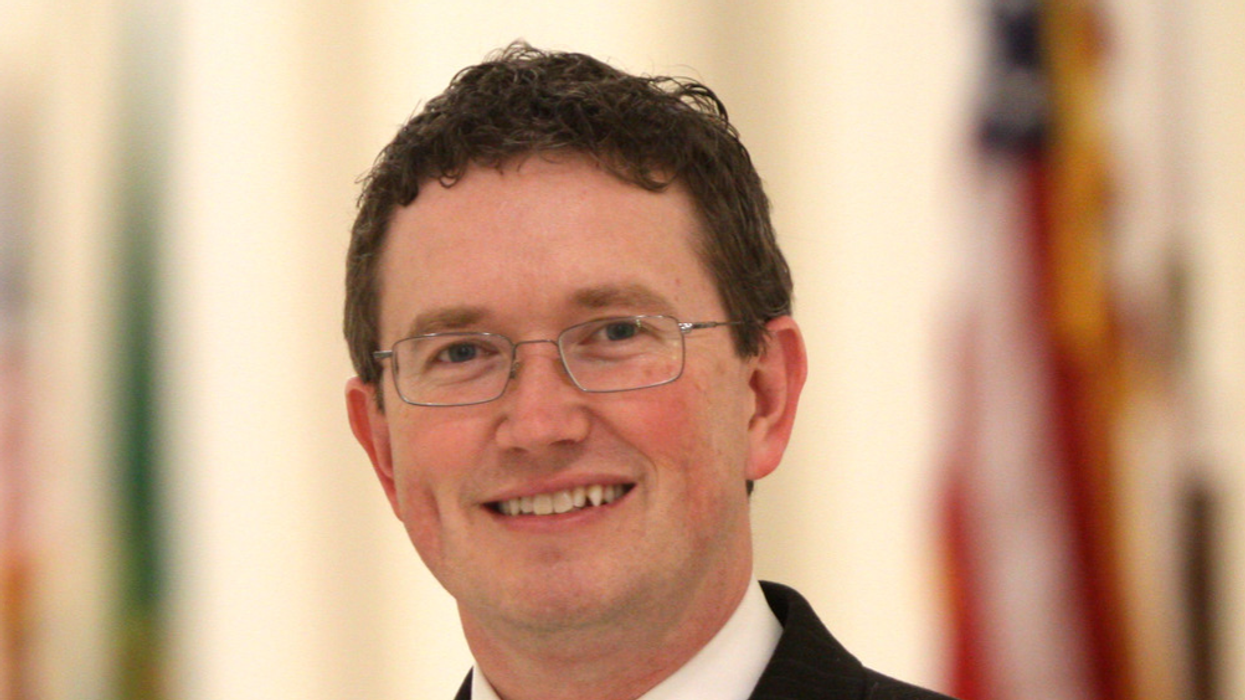
“If 30 to 40 percent could agree that this was legitimate tyranny and it needed to be thrown off they need to have sufficient power without asking for extra permission – it should be right there and completely available to them in their living room in order to effect the change,” U.S. Rep. Thomas Massie (R-KY) said in a video (below) posted by Right Wing Watch.
Pool’s videos get “millions” of views each day, according to The Daily Beast, which adds he “has racked up more than a billion views and millions in earnings while dangerously whitewashing the far right.”
During Pool’s show, according to Right Wing Watch, the YouTuber added that he believes the Second Amendment entitles Americans to own nuclear and biological weapons.
The spark for a wider war? Why Americans should care about Russia’s aggression against Ukraine
Michael Collins, USA TODAY – February 12, 2022
WASHINGTON – President Joe Biden warned his Russian counterpart Saturday that an invasion of Ukraine would cause “widespread human suffering,” as the U.S. and its allies scrambled to stave off a possible war in Europe.
Biden’s remarks, made in a phone call with Vladimir Putin amid fears that a Russian attack on its neighbor is imminent, offered a grim assessment of what U.S. officials believe could be the most consequential military conflict since World War II.
And it highlights, in stark terms, why Americans should care about the fate of an eastern European nation that’s roughly the size of Texas and is known for golden sunflowers, the Chernobyl nuclear disaster and being the spark for President Donald Trump’s first impeachment saga.
The current conflict is rooted in Putin’s desire to reestablish the influence that Russia wielded under the Soviet empire, foreign policy experts say. The U.S., in turn, wants to keep Russian aggression in check while working to strengthen a struggling democracy that has become more closely aligned with the West.
The U.S. has already spent billions of dollars to help Ukraine build up its military defenses, an investment that’s likely to escalate dramatically if Russia invades. The U.S. had about 160 National Guard troops in Ukraine advising the country’s military, but Defense Secretary Lloyd Austin ordered their withdrawal on Saturday amid signs of an imminent Russian invasion.
Though Biden has said the U.S. would not send troops to help defend Ukraine against Russian forces, his administration has already sent American forces to other eastern European countries. On Friday, the Pentagon ordered 3,000 U.S. soldiers from Fort Bragg, North Carolina, to Poland, to reinforce NATO’s eastern flank. And the National Guard troops withdrawing from Ukraine will be sent elsewhere in Europe.
A Ukrainian soldier walks on the line of separation from pro-Russian rebels, Donetsk region, Ukraine, Monday, Jan. 10, 2022. President Joe Biden has warned Russia’s Vladimir Putin that the U.S. could impose new sanctions against Russia if it takes further military action against Ukraine
Since Ukraine declared its independence from the Soviet Union in 1991, it has served as a buffer between Russia and the West, one whose security and stability could have ramifications for Europe and beyond.
“In many ways, Ukraine tells us about the future of the international system,” said Heather Conley, president of the German Marshall Fund, which promotes cooperation and understanding between North America and Europe.
If Russia is allowed to invade, occupy and annex its neighbor, “that’s an inherently very unstable international system, which will affect America’s security and its prosperity,” Conley said.
A Ukrainian government minister warned Britain’s Sky News in December that a full invasion of Ukraine would spread conflict around Europe and could even trigger World War III.
“It is unpredictable as to what will happen,” said William Taylor, former U.S. ambassador to Ukraine. He noted that throughout history, conflicts often start small with an assassination or a strike on one country that then spreads to other parts of the world.
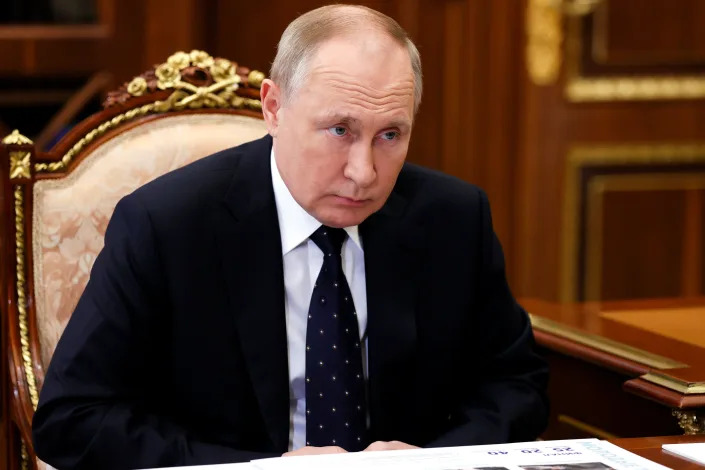
Russian President Vladimir Putin listens during a meeting in the Kremlin, in Moscow, Russia, Tuesday, Jan. 18, 2022.
Russia ‘won’t stop’ with Ukraine
A Russian invasion of Ukraine would spread fear across the region and has already led to a further buildup of NATO forces in other eastern European countries.
“If the Russians succeed in reestablishing a sphere of influence or of dominating Ukraine, they won’t stop there. They will continue,” Taylor said. “The Poles and the Romanians, the Czechs will be very concerned as they see Russian tanks coming west from Russia into Ukraine toward them, and they will ask for reinforcements from the United States.”
A successful invasion of Ukraine, Taylor said, could embolden Russia to be more aggressive in other arenas – such as cyberattacks, election meddling and influence campaigns designed to undermine Western democracies.
Other U.S. adversaries also will be watching to see whether the Biden administration and its NATO allies will follow through on their warnings to answer a Russian invasion with devastating economic sanctions and additional shipments of weapons to Ukraine and other eastern European countries.
“NATO and the U.S. credibility are on the line,” said Will Pomeranz, acting director of the Wilson Center’s Kennan Institute, a think tank dedicated to Russian and Eurasia research. “And if they fail, that will be taken by China and other adversaries as an unwillingness by the West to defend its interests.”
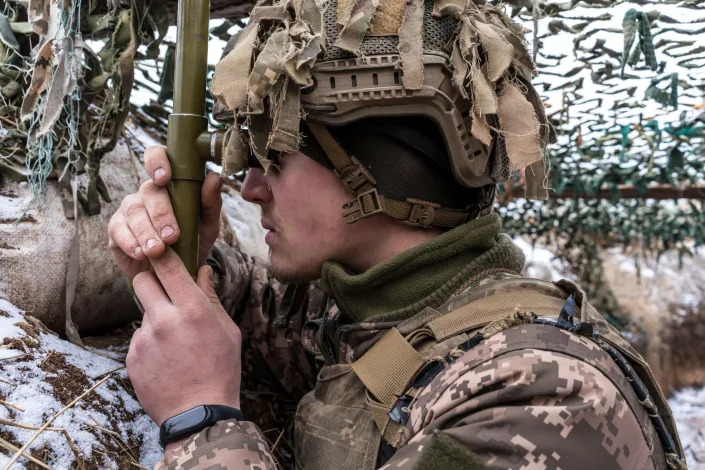
A Ukrainian soldier uses a hand-held periscope to view the positions of Russian-backed troops in a trench near the front line on Jan. 17, 2022 in the village of New York, formerly known as Novhorodske, Ukraine.
Putin’s power and legitimacy
Tensions between Russia and Ukraine have erupted frequently in the three decades since Ukraine declared its independence.
Ukraine, which has a population of 44 million, has deep historical and cultural ties to Russia. The two countries share a 1,200-mile border. Many Ukrainians work in Russia. By some estimates, one-third or more of Ukrainians speak Russian as well as the country’s official language, Ukrainian. Russian companies are among the largest investors in Ukraine.
But Ukraine has forged closer ties to the West since the fall of the Soviet Union. In 2008, it sought – and was promised – membership in the NATO alliance. Though that membership has never been granted, the prospect of a bigger, stronger NATO has rattled Putin, who still sees Ukraine as a part of Russia.
Ukraine, Putin insists, must never be granted NATO membership.
In 2014, Russia annexed the Crimean Peninsula, a swath of Ukraine territory between the Black Sea and the Sea of Azov. Russian operatives and separatist fighters have since launched attacks on eastern Ukraine, and the Kremlin continually works to undermine the country’s sovereignty militarily and in other ways.
The U.S. and its allies view the annexation as illegal and imposed sanctions in response. Last year, the U.S. sent more than $400 million in military aid to Ukraine; since 2014, the U.S. has provided about $2.5 billion in assistance to the country.
The stage for the latest clash was set late last year when Russia deployed more than 100,000 troops along Ukraine’s eastern border. Russian forces are now preparing to conduct major drills in the Black and Azov seas in the coming days and have engaged in other military exercises, raising alarms that another invasion could come within days.
Putin has repeatedly denied he is plotting to invade the country again. On Saturday, the Kremlin accused the West of engaging in “provocative speculations” about Russia’s intentions. The U.S. and its NATO allies do not believe those denials, citing Putin’s long history of refusing to accept Ukraine’s sovereignty.
Analysts say Ukraine poses no defensive threat to Russia, so Putin’s designs on the country have more to do with his long-held ambitions of expanding Russia’s influence and returning to what he views as the greatness of the Soviet empire.
As Zbigniew Brzezinski, who was President Jimmy Carter’s national security adviser, once said: “Without Ukraine, Russia ceases to be an empire. But with Ukraine suborned and then subordinated, Russia automatically becomes an empire.”
“This is all about Mr. Putin’s power, his legitimacy and maintaining it,” Conley said.
Putin’s legacy would be much more secure if he created a modern, thriving economy that benefited all Russians, Conley said. Instead, he has presided over a decade of steady economic decline in his country.
“While he has hypersonic cruise missiles, the Russian people are not getting the services and the standard of living that they deserve,” Conley said.
What Putin fears most, she said, is that Russians will see the Ukrainian people living in a free, democratic society where the results of elections aren’t predetermined and citizens are allowed to speak their minds.
“The greatest threat to Russia is a free and thriving Ukraine,” Conley said. “Because if Ukrainian people can experience it, why can’t the Russian people experience it?”