Zelensky says Ukraine has ‘reached a strategic turning point’ in its fight against Russia
Dylan Stableford, Senior Writer – March 11, 2022
Ukrainian President Volodymyr Zelensky on Friday urged the people of his nation to be patient as they continue to defend their country against Russia’s military invasion, which has now entered its 16th day.
“I know that many people have started to feel tired. I understand. Impatient. I understand,” Zelensky said in a video posted online. “This is life. When we mobilize, when we see our victories and the loss of the enemy on the battlefield, we expect the struggle to end sooner. We expect the invaders to fall faster. But this is life, this is war. This is a struggle. Time is still needed. Patience is still needed.”
A defiant Zelensky insisted Ukraine will prevail despite reports of Russian forces striking near airports in the western part of Ukraine for the first time while its troops were attempting to encircle the Ukrainian capital, Kyiv.
“It is impossible to say for how many more days we must liberate our Ukrainian land. But it is possible to say we will do it,” Zelensky said, according to an English translation of his remarks by Ukraine’s U.N. mission. “Because we have already reached a strategic turning point. We are already moving toward our goal, toward our victory.”
Ukrainan President Volodymyr Zelensky during an address to the nation from Kyiv on Friday. (Ukrinform/Future Publishing via Getty Images)
“This is a patriotic war against an obstinate enemy which doesn’t pay attention to thousands of their own soldiers dead,” he added.
“This is a humanitarian catastrophe,” Zelensky said. “Humanitarian catastrophe — two words that have become fully synonymous with the other two words: the Russian Federation.”
The attack was widely condemned by world leaders, including Vice President Kamala Harris, who said the U.S. would work with its allies to investigate Russia for possible war crimes.
President Biden spoke with Zelensky on Friday morning before announcing new U.S. sanctions against Russia, including a ban imports of Russian alcohol, seafood and diamonds.
Ukrainian Defense Minister Oleksii Reznikov said on Friday that Russian forces invading Ukraine have killed more Ukrainian civilians than soldiers.
At least 549 Ukrainian civilians, including 41 children, have been killed, according to the United Nations. But the agency believes the actual death toll is likely much higher.
According to the U.N., more than 2.5 million refugees have fled Ukraine since Feb. 24, when Russia’s invasion began.
Zelensky implored those who have stayed to “hold on.”
“Be sure to fight. Be sure to give your all strength,” he said. “It will not be easy with such a neighbor. But with us, it will not be easy too.”
The future of warfare could be a lot more grisly than Ukraine
Steven Zeitchik, The Washington Post – March 11, 2022
A man walks with a bicycle in a street damaged by shelling in Mariupol, Ukraine, Thursday, March 10, 2022. Some experts worry that if autonomous weapons take hold, future conflict will be even more violent than the Russian invasion in Ukraine. (AP Photo/Evgeniy Maloletka) (AP)
Amid the stately beiges of Geneva’s Palais de Nations this week, United Nations diplomats from Ukraine and Russia were launching strikes.
“What we could see in this hall in the course of the two last days is nothing else than the blackmailing of all of us by the Russian representative,” the Ukrainian diplomat said Tuesday.
The Russian delegate fired back a moment later: “There is discrimination suffered by my country because of restrictive measures against us.”
Ukraine was chastising Russia not over the country’s ongoing invasion but a more abstract topic: autonomous weapons.
The comments were a part of the Convention on Certain Conventional Weapons, a U.N. gathering at which global delegates are supposed to be working toward a treaty on Lethal Autonomous Weapons Systems, the charged realm that both military experts and peace activists say is the future of war.
But citing visa restrictions that limited his team’s attendance, the Russian delegate asked that the meeting be disbanded, prompting denunciations from Ukraine and many others. The skirmish was playing out in a kind of parallel with the war in Ukraine – more genteel surroundings, equally high stakes.
Autonomous weapons – the catchall description for algorithms that help decide where and when a weapon should fire – are among the most fraught areas of modern warfare, making the human-commandeered drone strike of recent decades look as quaint as a bayonet.
Proponents argue that they are nothing less than a godsend, improving precision and removing human mistakes and even the fog of war itself.
The weapons’ critics – and there are many – see disaster. They note a dehumanization that opens up battles to all sorts of machine-led errors, which a ruthless digital efficiency then makes more apocalyptic. While there are no signs such “slaughterbots” have been deployed in Ukraine, critics say the activities playing out there hint at grimmer battlefields ahead.
“Recent events are bringing this to the fore – they’re making us realize the tech we’re developing can be deployed and exposed to people with devastating consequences,” said Jonathan Kewley, co-head of the Tech Group at high-powered London law firm Clifford Chance, emphasizing this was a global and not a Russia-centric issue.
While they differ in their specifics, all fully autonomous weapons share one idea: that artificial intelligence can dictate firing decisions better than people. By being trained on thousands of battles and then having its parameters adjusted to a specific conflict, the AI can be onboarded to a traditional weapon, then seek out enemy combatants and surgically drop bombs, fire guns or otherwise decimate enemies without a shred of human input.
The 39-year-old CCW convenes every five years to update its agreement on new threats, like land mines. But AI weapons have proved its Waterloo. Delegates have been flummoxed by the unknowable dimensions of intelligent fighting machines and hobbled by the slow-plays of military powers, like Russia, eager to bleed the clock while the technology races ahead. In December, the quinquennial meeting did not result in “consensus” (the CCW requires it for any updates), forcing the group back to the drawing board at an another meeting this month.
“We are not holding this meeting on the back of a resounding success,” the Irish delegate dryly noted this week.
Activists fear all these delays will come at a cost. The tech is now so evolved, they say, that some militaries around the world could deploy it in their next conflict.
“I believe it’s just a matter of policy at this point, not technology,” Daan Kayser, who lead the autonomous weapons project for the Dutch group Pax for Peace, told The Post from Geneva. “Any one of a number of countries could have computers killing without a single human anywhere near it. And that should frighten everyone.”
Russia’s machine-gun manufacturer Kalashnikov Group announced in 2017 that it was working on a gun with a neural network. The country is also believed to have the potential to deploy the Lancet and the Kub – two “loitering drones” that can stay near a target for hours and activate only when needed – with various autonomous capabilities.
Advocates worry that as Russia shows it is apparently willing to use other controversial weapons in Ukraine like cluster bombs, fully autonomous weapons won’t be far behind. (Russia – and for that matter the United States and Ukraine – did not sign on to the 2008 cluster-bomb treaty that more than 100 other countries agreed to.)
But they also say it would be a mistake to lay all the threats at Russia’s door. The U.S. military has been engaged in its own race toward autonomy, contracting with the likes of Microsoft and Amazon for AI services. It has created an AI-focused training program for the 18th Airborne Corps at Fort Bragg – soldiers designing systems so the machines can fight the wars – and built a hub of forward-looking tech at the Army Futures Command, in Austin.
The Air Force Research Laboratory, for its part, has spent years developing something called the Agile Condor, a highly efficient computer with deep AI capabilities that can be attached to traditional weapons; in the fall, it was tested aboard a remotely piloted aircraft known as the MQ-9 Reaper. The United States also has a stockpile of its own loitering munitions, like the Mini Harpy, that it can equip with autonomous capabilities.
China has been pushing, too. A Brookings Institution report in 2020 said that the country’s defense industry has been “pursuing significant investments in robotics, swarming, and other applications of artificial intelligence and machine learning.”
A study by Pax found that between 2005 and 2015, the United States had 26% of all new AI patents granted in the military domain, and China, 25%. In the years since, China has eclipsed America. China is believed to have made particular strides in military-grade facial recognition, pouring billions of dollars into the effort; under such a technology, a machine identifies an enemy, often from miles away, without any confirmation by a human.
The hazards of AI weapons were brought home last year when a U.N. Security Council report said a Turkish drone, the Kargu-2, appeared to have fired fully autonomously in the long-running Libyan civil war – potentially marking the first time on this planet a human being died entirely because a machine thought they should.
All of this has made some nongovernmental organizations very nervous. “Are we really ready to allow machines to decide to kill people?” asked Isabelle Jones, campaign outreach manager for an AI-critical umbrella group named Stop Killer Robots. “Are we ready for what that means?”
Formed in 2012, Stop Killer Robots has a playful name but a hellbent mission. The group encompasses some 180 NGOs and combines a spiritual argument for a human-centered world (“Less autonomy. More humanity”) with a brass-tacks argument about reducing casualties.
Jones cited a popular advocate goal: “meaningful human control.” (Whether this should mean a full-on ban is partly what’s flummoxing the U.N. group.)
Military insiders say such aims are misguided.
“Any effort to ban these things is futile – they convey too much of an advantage for states to agree to that,” said C. Anthony Pfaff, a retired Army colonel and former military adviser to the State Department and now a professor at U.S. Army War College.
Instead, he said, the right rules around AI weapons would ease concerns while paying dividends.
“There’s a powerful reason to explore these technologies,” he added. “The potential is there; nothing is necessarily evil about them. We just have to make sure we use them in a way that gets the best outcome.”
Like other supporters, Pfaff notes that it’s an abundance of human rage and vengefulness that has led to war crimes. Machines lack all such emotion.
But critics say it is exactly emotion that governments should seek to protect. Even when peering through the fog of war, they say, eyes are attached to human beings, with all their ability to react flexibly.
Military strategists describe a battle scenario in which a U.S. autonomous weapon knocks down a door in a far-off urban war to identify a compact, charged group of males coming at it with knives. Processing an obvious threat, it takes aim.
It does not know that the war is in Indonesia, where males of all ages wear knives around their necks; that these are not short men but 10-year-old boys; that their emotion is not anger but laughter and playing. An AI cannot, no matter how fast its microprocessor, infer intent.
There may also be a more macro effect.
“Just cause in going to war is important, and that happens because of consequences to individuals,” said Nancy Sherman, a Georgetown professor who has written numerous books on ethics and the military. “When you reduce the consequences to individuals you make the decision to enter a war too easy.”
This could lead to more wars – and, given that the other side wouldn’t have the AI weapons, highly asymmetric ones.
If by chance both sides had autonomous weapons, it could result in the science-fiction scenario of two robot sides destroying each other. Whether this will keep conflict away from civilians or push it closer, no one can say.
It is head-spinners like this that seem to be holding up negotiators. Last year, the CCW got bogged down when a group of 10 countries, many of them South American, wanted the treaty to be updated to include a full AI ban, while others wanted a more dynamic approach. Delegates debated how much human awareness was enough human awareness, and at what point in the decision chain it should be applied.
And three military giants shunned the debate entirely: The United States, Russia and India all wanted no AI update to the agreement at all, arguing that existing humanitarian law was sufficient.
This week in Geneva didn’t yield much more progress. After several days of infighting brought on by the Russia protest tactics, the chair moved the substantive proceedings to “informal” mode, putting hope of a treaty even further out of reach.
Some attempts at regulation have been made at the level of individual nations. The U.S. Defense Department has issued a list of AI guidelines, while the European Union recently passed a comprehensive new AI Act.
But Kewley, the attorney, pointed out that the act offers a carve-out for military uses.
“We worry about the impact of AI in so many services and areas of our lives but where it can have the most extreme impact – in the context of war – we’re leaving it up to the military,” he said.
He added: “If we don’t design laws the whole world will follow – if we design a robot that can kill people and doesn’t have a sense of right and wrong built in – it will be a very, very high-risk journey we’re following.”
Putin says Russia to use Middle East volunteer fighters against Ukraine
Guy Faulconbridge – March 11, 2022
FILE PHOTO: Russian President Vladimir Putin attends a meeting with government members via a video link in Moscow
LONDON (Reuters) – Russian President Vladimir Putin gave the green light on Friday for up to 16,000 volunteers from the Middle East to be deployed alongside Russian-backed rebels to fight in Ukraine, doubling down an invasion that the West says has been losing momentum.
The move, just over two weeks since Putin ordered the invasion, allows Russia to deploy battle-hardened mercenaries from conflicts such as Syria without risking additional Russian military casualties.
At a meeting of Russia’s Security Council, Defence Minister Sergei Shoigu said there were 16,000 volunteers in the Middle East who were ready to come to fight alongside Russian-backed forces in the breakaway Donbass region of eastern Ukraine.
“If you see that there are these people who want of their own accord, not for money, to come to help the people living in Donbass, then we need to give them what they want and help them get to the conflict zone,” Putin said from the Kremlin.
Shoigu also proposed that Western-made Javelin and Stinger missiles that were captured by the Russian army in Ukraine should be handed over to Donbass forces, along other weaponry such as man-portable air-defense systems, known as MANPADS, and anti-tank rocket complexes.
“As to the delivery of arms, especially Western-made ones which have fallen into the hands of the Russian army – of course I support the possibility of giving these to the military units of the Lugansk and Donetsk people’s republics,” Putin said.
“Please do this,” he told Shoigu. The exchange was shown on Russian state television.
Putin says the “special military operation” in Ukraine is essential to ensure Russia’s security after the United States expanded NATO up to its borders and supported pro-Western leaders in Kyiv.
Ukraine says it is fighting for its existence while the United States, and its European and Asian allies have condemned the Russian invasion. China has called for calm.
Shoigu said the operation was all going to plan before requesting Putin’s approal for the use of fighters from the Middle East.
U.S. intelligence chiefs told lawmakers on Thursday that Russia had been surprised by the strength of Ukrainian resistance, which had deprived the Kremlin of a quick victory it thought would have prevented the United States and NATO from providing meaningful military aid.
That was causing concern in Beijing, Central Intelligence Agency Director William Burns said.
“I do believe that the Chinese leadership, President Xi (Jinping) in particular, is unsettled,” Burns said. “By what he’s seen, partly because his own intelligence doesn’t appear to have told him what was going to happen.”
Shoigu said Western arms were flowing into Ukraine in an “absolutely uncontrolled” way and that the Russian military planned to strengthen its Western border after what he said was a build up of Western military units on Russia’s border.
“The general staff is working on, and has almost finished, a plan to strengthen our Western borders, including, naturally, with new modern complexes,” Shoigu said.
Putin said the question of how to react to moves by NATO countries need a separate discussion.
Don’t take Russia back to 1917, Russian metals king Potanin warns
Guy Faulconbridge – March 11, 2022
LONDON (Reuters) -Confiscating the assets of companies that have fled Russia since the invasion of Ukraine would shatter investor confidence for decades and take Russia back to the calamitous days of the 1917 Bolshevik revolution, metals magnate Vladimir Potanin has said.
Potanin, president and biggest shareholder of Norilsk Nickel, the world’s largest producer of palladium and refined nickel, said Russia should respond with pragmatism to its exclusion from swathes of the global economy.
“We should not try to ‘slam the door’ but endeavour to preserve Russia’s economic position in those markets which we spent so long cultivating,” Potanin, 61, said on the Telegram messaging app.
Potanin, one of the most prominent Russian billionaires who is not sanctioned by the West, said confiscating assets from companies that had left would put Russia out in the cold for decades, as far as investors were concerned:
“It would take us back 100 years to 1917. And the consequences – a global lack of confidence in Russia from investors – we would feel for many decades.”
Russia’s economy is facing the gravest crisis since the 1991 fall of the Soviet Union after the West imposed sweeping sanctions across Russia’s financial and corporate sectors following Moscow’s Feb. 24 invasion of Ukraine.
Prime Minister Mikhail Mishustin said on Thursday that the government proposed putting companies that had left Russia into external administration.
The exact mechanisms of that are unclear, though there is a fierce debate within the Russian elite about how severe Moscow’s reaction to Western sanctions should be, officials and businessmen said.
Putin said Russia would remain open for business and did not intend to close itself off from those who still wanted to do business.
But many do not – at least for now.
BP said last month it was abandoning its stake in Russian oil producer Rosneft while companies ranging from McDonald’s and Coca-Cola Co to Toyota and IKEA have shuttered their businesses in Russia.
‘WE MUST BE WISER’
Potanin’s upbringing as the son of a high-ranking Soviet trade official and an education at Moscow’s elite diplomatic academy have always set him slightly apart from other oligarchs who rose from rags to riches in the chaos of the 1990s.
The privatisation deals under President Boris Yeltsin gave Potanin and other oligarchs control over some of the best assets of a former superpower, though their clout was eroded under Putin as a new group of former spies put some of Russia’s biggest oil production units under state control.
Besides being the world’s largest producer of palladium and high-grade nickel, MMC Norilsk Nickel is a major producer of platinum and copper. It also produces cobalt, rhodium, silver, gold, iridium, ruthenium, selenium, tellurium and sulphur.
Potanin said some countries used sanctions as a way to edge out competition, urging Moscow to consider its moves carefully.
He also urged Moscow to remove restrictions on servicing Russia’s foreign currency debt, which he said totalled $480 billion. He said a technical default on interest payments could trigger demands for the full principal to be paid.
“This fully applies to major public companies,” Potanin said. Russia said on Sunday that sovereign bond payments will depend on sanctions.
“We see that the West’s own economies have suffered by imposing sanctions against Russia. So we must be wiser and avoid a scenario under which our sanctions hit us,” Potanin said.
Putin says the “special military operation” in Ukraine is essential to ensure Russian security after NATO admitted members up to Russia’s borders and Western countries supported pro-Western leaders in Kyiv.
Ukraine says it is fighting for its existence and the United States and its European and Asian allies have condemned the Russian invasion. China has called for calm.
The war effort has seen civilians take up arms against Russian troops, while the country has also been supplied with a significant amount of weapons from the West.
One of the most important aspects of this has been the thousands of anti-tank weapons that have poured into the country, but what are they and have they made a difference?
Which anti-tank weapons are being used?
Numerous allies – including the UK, Germany, France, US and Denmark – have supplied Ukraine with anti-tank weapons since the start of the conflict.
Each missile costs around £130,000, but that is nowhere near as expensive as the tanks they are fired at.
Numerous different types of anti-tank weapons have been handed to Kyiv, including Javelins and Next Generation Light Antitank Weapons (NLAWs).
A Ukrainian service member fires a NLAW supplied by Britain during drills in January. (Reuters)
Generally, the Americans have been supplying Javelins, while the Europeans have been providing NLAWs.
They are significantly more advanced than the basic RPGs the Ukrainians were equipped with in 2014.
How do anti-tank weapons work?
The basic premise of a modern anti-tank weapon is a small guided missile held by a single-use launcher.
The launcher has an advanced targeting computer attached to it and targets specific weak spots on tanks.
The computer does 95% of the work for the soldier, meaning all they have to do is pull the trigger and then get into cover.
Watch: Ukraine war: Drone footage shows Russian tank column retreat after artillery ambush
The weak spot is usually the turret or the area between the turret and the main body of the tank.
The armour-piercing missile usually completely disables a tank with a single shot.
Javelin missiles fire straight up into the air before arcing back down to hit the top of the tank and have a much longer range than NLAWs (4.5km compare to 1km).
They weigh around 12kg, which is carriable for a single soldier, but once the missile has been fired, the huge launcher is then useless.
The weapons reportedly do not take a long time to learn how to use. (Reuters)
NLAW’s are also designed to be able to be taught how to use weapon to learn to use, reportedly taking around an hour.
With the fact they can be operated by one or two soldiers they have significantly advanced ground combat, making tanks’ previous dominance much reduced.
Have they made a difference in Ukraine?
Although hard facts are difficult to confirm in such a fluid situation, it appears the supply of anti-tank weapons to Ukraine has caused significant damage to the Russian advance.
Numerous videos of the targeted missiles being shot at Russian armour have appeared on social media.
Even more pictures of destroyed tanks have circulated around the internet.
Russia has the largest number of tanks in the world, although many of these are fairly old Soviet models.
Ukraine claims to have destroyed 465 heavy vehicles (tanks, armoured fighting vehicles, infantry fighting vehicles, armoured personnel carriers) since the start of fighting.
A Russian tank destroyed by the Ukrainian forces on the side of a road in Lugansk. (Getty)
Has Russia tried to counter this?
Although the Russians are losing lots of armour, videos in recent days appear to show them employing weapons to counter anti-tank missiles.
Several Russian tanks have been pictured with wire and steel “cope cages” attached to their turrets.
The purpose of these is to force the missile to explode just before impacting the actual turret itself, hopefully mitigating the damage.
The effectiveness of these cages is not yet known.
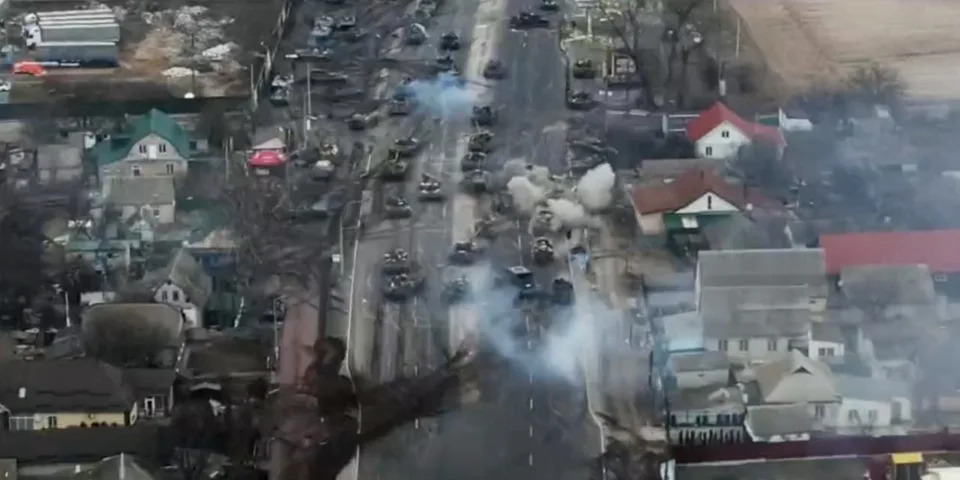
Video shows Ukraine ambushing Russian tank convoy featuring a thermobaric weapon, forcing a retreat
Mia Jankowicz – March 11, 2022
Footage released by Ukraine on March 10, 2022 showing a strike at the head of a column of Russian tanks in in Skybyn.Ukraine Defense Intelligence Agency
Ukraine released drone footage of an ambush on a Russian armored convoy near Kyiv Thursday.
At least 21 Russian military vehicles, including a thermobaric weapon, were caught in the attack.
The ambush forced a humiliating retreat, according to a Sky News analysis of the footage.
Ukraine’s Defense Intelligence Agency released a video on Thursday showing the destruction and retreat of a Russian column of tanks near Kyiv, in footage verified by several news agencies.
Ukraine claimed that the Russian regiment’s commander, Colonel Andrei Zakharov, was killed in the operation, though this has not been independently confirmed.
The 45-second edited montage of footage was filmed by drone and, according to the DIA, shows Russian tank movements in the suburb of Skybyn, around 20 miles from central Kyiv.
In the footage, two tanks — of indeterminate nationality — are seen approaching Skybyn, according to a Sky News analysis. The investigative collective Bellingcat also confirmed the location.
Video: New footage shows mass grave in Ukraine after Russian attacks
Scroll back up to restore default view.
Further shots show Russian tanks on the side of the road, per Sky News. They are later seen on fire.
This is intercut with footage of a long column of tanks heading south into the village. Among them is a vehicle Sky identified as a TOS-1A thermobaric rocket launcher.
Footage released by Ukrainian authorities on March 10, 2022 showing a seemingly destroyed Russian tanks on a road in Skybyn, near Kyiv.Ukraine Defense Intelligence Agency
In another shot, at least 21 Russian military vehicles, including tanks, armored personnel carriers and the TOS-1A, are seen in the village. Tread marks on the road indicate they have changed direction.
Footage released by Ukrainian authorities on March 10, 2022, showing chaos among Russian military vehicles in Skybyn, near Kyiv.Ukraine Defense Intelligence Agency
Two plumes of smoke and fire then mark Ukrainian strikes at either end of the column:
The TOS-1A then appears to fire at a target out of frame.
Footage released by Ukrainian authorities on March 10, 2022 showing a strike at the foot of a column of Russian tanks in in Skybyn, near Kyiv.Ukraine Defense Intelligence Agency
Footage released by Ukraine on March 10, 2022 showing a strike at the head of a column of Russian tanks in in Skybyn.Ukraine Defense Intelligence Agency
The video then shows everal other Russian vehicles being hit. Whilst still under fire the convoy is seen moving back north.
The footage is overlaid with audio said to be of a Russian officer reporting the attack, The Guardian reported.
Footage released by Ukrainian authorities on March 10, 2022 showing a Russian TOS-1A apparently firing in Skybyn, near Kyiv.Ukraine Defense Intelligence Agency
“Sixth regiment lost,” the officer says, per The Guardian. “I cannot report about the 6th regiment. I’m collecting data. Lots of losses. They waited for us. Head of the convoy got into the ambush. Regiment commander killed in action.”
Military experts speaking to the paper described the video as credible.
Ukraine has published a series of such videos as part of a public relations effort to keep international and local attention on apparent military successes against Russia.
The overall military picture remains bleak for Ukraine, however.
In briefings on Tuesday and Wednesday, a Pentagon official said that about 90 to 95% of Russian combat power remains intact, despite the widely-viewed examples of Ukrainian defense.
Authorities released similar aerial footage of strikes on military vehicles dated March 8, which was confirmed by Insider as being shot outside of the village of Borodyanka, on a key road to Kyiv.
A US official estimated Wednesday that Russian forces have sustained 5-6,000 losses since the war began, per CBS News.
Putin’s Paranoid, Isolated, and Trying to Bluff His Way Through
The Daily Beast – March 11, 2022
Photo Illustration by The Daily Beast/Getty
In a jam-packed new episode of The New Abormal, co-host Molly Jong-Fast rips into the “contingent of very stupid Republican congresspeople” who don’t want the U.S. aiding Ukraine before building a border wall here, which makes sense since “the country of Mexico is shelling Texas and they’re using cluster bombs and stud missiles—Oh wait… There is no war at our southern border, but no one has told Rep. Doug Collins.”
“This is part of a larger picture where the right is a little confused by the state of the world as it actually is, as opposed to how they had been describing it for the past six years or whatever, where Putin was a good guy and the kind of guy we should look up to. Now, they’re doing their best carnival contortionists to act to try and pretend like they never said all of that,” says co-host Andy Levy. While some Republicans have come around, Levy says, “others are not anti Putin, they’re anti–anti-Putin. They’ll do a lot of blaming America for this war…
“They keep saying, ‘This didn’t happen under President Trump. Well, no, because Trump was openly talking about pulling out of NATO and stuff like that. And if you’re Vladimir Putin, you don’t want to do anything to upset that. So you sit back and let Trump destroy NATO by himself and make things even easier for Putin,” says Levy. “But instead you get, ‘Well, this didn’t happen when he was president.’”
Plus, Melissa Moss of the 65 Project explains how that was “set up to protect democracy, by holding accountable lawyers who bring bogus lawsuits to overturn legitimate election results” to account, and breaks down the three sorts of lawyers her group is going after.
And The Atlantic’s Tom Nichols considers Putin:
“This guy is not a good strategist. He blunders into things… and bluffs his way out, or tries to murder his way out. I don’t know how this ends, if he were the strategist that everybody thinks he is, he would find an off-ramp.”
But since Putin is not the strategist people think he is, says Nichols, “I’m very worried about the reports that he’s gonna try and up the ante by using chemical weapons, because now he has a problem at home” with “thousands of people in jail” and millions of Russians looking at each other and saying (of him), ‘What the hell were you doing?’ while the Russian military apparently is having some serious morale trouble because they don’t want to kill their brothers and sisters. So in that circumstance, maybe he would try to create a false-flag chemical attack to say, ‘You see, now, now I’m fighting for the soul of Russia.’ I mean, he’s improvising. And when you have a paranoid, isolated, not very bright guy, improvising bad things can happen.”
ABC News’s Jonathan Karl accuses Tucker Carlson of ‘plagiarism of Vladimir Putin’
Stephen Proctor – March 11, 2022
ABC News chief Washington correspondent Jonathan Karl appeared Thursday on Deadline: White House, where he joined the growing chorus of people claiming Fox News opinion host Tucker Carlson is parroting Russian propaganda. Carlson has been accused of doing so multiple times in the past, this time coming the day after Carlson pushed the false Russian narrative that the U.S. military has secret bioweapons labs in Ukraine. Carlson opened his show Wednesday night propagating that exact message.
“He was giving credence to what the Russians are now saying, a really classic propaganda claim that the United States is manufacturing, or has been manufacturing chemical, biological weapons in Ukraine,” Karl said. “And Tucker Carlson used the segment to echo that claim, saying that he was at first skeptical about it, but now he’s convinced that there’s credence to it.”
Just an hour after Carlson’s segment aired, Fox News national security correspondent Jennifer Griffin appeared on Hannity where she contradicted what Carlson had said about the biolabs, stating the fact that they are neither secret, nor do they produce bioweapons.
On Thursday, Karl posted a tweet highlighting other pieces of Russian propaganda that Carlson has pushed.
“He says as just an aside that the United States encouraged Russia to invade Ukraine,” Karl said. “In what universe is that true? Only if you’re sitting in Moscow and watching Russian television because it’s exactly, again, what Vladimir Putin is saying.”
Karl went on to accuse Carlson of flat-out plagiarizing Putin.
“What is sort of inexplicable here is that what is being said is almost a plagiarism of Vladimir Putin,” Karl said. “It’s almost word for word what Vladimir Putin has been saying, not just now, but again, for several years, and what he has said in making the argument to justify what’s happening in Ukraine.”
And Karl wondered if Russia’s excuse for its deadly bombing of a Ukrainian maternity ward might be the next piece of Russian propaganda that Carlson pushes.
“Today, Russian propaganda is saying that that maternity ward that was bombed was somehow a military facility,” Karl said. “I mean, is that gonna be echoed next? It is inexplicable. I can’t explain it.”
Watch Fox News’s Jennifer Griffin contradict Tucker Carlson’s coverage of a Russian conspiracy: at Fox News, appeared on “Hannity” Wednesday,
China Has Tools to Help Russia’s Economy. None Are Big Enough to Save It.
Alexandra Stevenson and Keith Bradsher – March 11, 2022
A border crossing with Russia in Manzhouli, China, marked by two arches and divided on the Chinese side by a green wire fence that stretches for hundreds of miles, on Dec. 7, 2018. (Lam Yik Fei/The New York Times)
When the United States and its allies declared a financial war on Russia after its invasion of Ukraine, the world turned to see what China would do.
As a growing global power, one of the ways China has extended its influence is by establishing close financial ties with countries unwilling to follow rules dictated by the United States and other Western powers. Surely, the thinking went, China would do the same for Russia.
There is just one big problem: money. Specifically, China’s money.
To help Russia evade sanctions, China would have to offer a viable substitute to the American dollar. But Chinese money — the renminbi — is barely used outside of China. Only 3% of the world’s business is done using the redback. Even Russia and China conduct their trade mostly in U.S. dollars and euros.
What’s more, the risks of helping Russia avoid economic ruin may be greater for China than any possible reward. Much of China’s own economy depends on the U.S. dollar and the financial edifice that underpins it. Chinese companies are active around the globe, using the U.S. financial system to pay employees, buy materials and make investments. China is the world’s largest exporter, and is paid for its goods mainly in dollars.
Should Beijing run afoul of the sanctions against Russia, China’s own financial stability would be put at risk at a time when its leaders have emphasized caution. And besides, the few lifelines that Chinese leaders could feasibly offer Russia would not be strong enough to help the country survive a financial blackout from the United States and its allies.
It could facilitate cross-border transactions — allowing China to continue to sell to Moscow many of the goods it makes for the rest of the world. It could make investments in Russian energy firms on the cheap. It could let Russia’s central bank cash in some of the $140 billion it holds in Chinese bonds. Beijing could even set up a rogue bank to help move Russian money around like it has done for Iran and North Korea.
None of these measures would be enough to counterbalance the sanctions against Russia, which have included cutting off Russia’s biggest banks from the global financial system and a ban on oil and gas imports by the United States.
“China will not save the sinking boat of the Russian economy,” said Eswar Prasad, a Cornell University economist. But, he added, it could “perhaps allow it to float a little longer and sink a little more slowly.”
A deepening friendship between Xi Jinping, the leader of China, and President Vladimir Putin of Russia has helped bring the countries closer together than they have been since the 1950s, when Mao cooperated closely with Josef Stalin and then Nikita Khrushchev. The warming of diplomatic ties was built on a shared desire to put an end to what China and Russia see as America’s economic and geopolitical hegemony.
When Xi and Putin met on the eve of the Beijing Olympic Games, they declared that the bond between the two countries had “no limits.” Russia’s invasion of Ukraine, days after the Games ended, led the U.S. and other industrialized nations to impose waves of sanctions aimed at devastating the Russian economy.
China has repeatedly criticized the moves. Premier Li Keqiang did so again on Friday at his annual news conference, saying that, “Relevant sanctions will hurt the world’s economic recovery, it is in no one’s interest.”
But criticizing sanctions is one thing. Choosing to go against the global financial order and risk inviting sanctions at home is another. Beijing has already given some indication that it isn’t willing to do the latter. The Chinese-led Asian Infrastructure Investment Bank — an investment bank that Washington sees as a World Bank rival — last week said it would put its lending to Russia and Belarus on hold over the war in Ukraine. Some Chinese banks have cut back on the financing of Russian commodities.
“Chinese banks are trying to cut their exposure to Russia,” said Raymond Yeung of ANZ Bank. “You can tell that the theory of China offering a financial alternative to Russia remains questionable.”
China’s top banking regulator said last week that banks would not necessarily sever their ties with Russian counterparts. “We will not participate in such sanctions, and we continue to maintain normal economic and trade and financial exchanges with relevant parties,” said Guo Shuqing, the chairman of the China Banking and Insurance Regulatory Commission.
As sanctions are piled on, maintaining those economic ties will become harder without taking on more risk, and China’s options to help Russia are dwindling. Western countries have locked Russia out of the Swift financial messaging and payments system, effectively excluding Russian banks from international transactions.
China has been developing an alternative messaging service for financial institutions to communicate cross-border transactions. But that service operates on a tiny scale and relies partly on technology tangled up in sanctions.
After Visa and Mastercard stopped their operations in Russia, several Russian banks turned to China’s UnionPay, which offers payment options in some 180 countries. For China to offer its own payment processing, transactions must not be in dollars in order to avoid punishment.
Then there is the money that Russia has sitting in China. Through central bank reserves, government investments and a longstanding loan agreement, Russia can quickly raise in China the equivalent of more than $160 billion, or about 16 months’ worth of Russian sales of oil and natural gas to the European Union and the United States.
A large part of that money — around $140 billion — is tied up in bonds and denominated renminbi. The rest is tied up in agreements between the two countries’ central banks that commit each to short-term, interest-free loans worth $24 billion in case of an emergency.
A more diplomatically risky option would be for China to launder money for Russia through a small Chinese bank set up specifically to evade sanctions. This is what China National Petroleum Corp. did in 2009 when it bought a small bank in China’s northwestern province of Xinjiang and renamed it Bank of Kunlun. The bank helped Iran conduct hundreds of millions of dollars worth of transactions.
In a similar scenario, a Chinese oil company could pay a shell company and its corporate officers in China a very large “consulting fee” to trade oil on its behalf, instead of paying a Russian oil company directly for crude oil. Eventually, though, such an operation would likely be shut down. That is what happened with Bank of Kunlun after the U.S. Treasury sanctioned it in 2012.
In another scenario, Chinese companies with state backing could scoop up the West’s stakes in some of Russia’s biggest oil and gas companies. American and European giants like Shell and BP have announced that they will exit their joint ventures in Russia over the invasion, but there are not a lot of obvious buyers other than Chinese state-owned enterprises.
“You’ve got some of the most valuable energy companies in the world now trading at mere fractions of their real value,” said Taylor Loeb, an analyst at Trivium, a consulting firm. “Developed countries won’t touch these companies. That basically only leaves China. It might be really bad PR, but the price may just be too good.”
Even as Beijing contemplates just how far it is willing to go to maintain its “no limit” friendship with Russia, there is one harsh reality: The renminbi cannot save Russia’s own currency, the ruble. The ruble is plunging and has already erased much of the country’s wealth. The only way for Russia to shore it up? Buy U.S. dollars.
Russia makes claims of US-backed biological weapon plot at UN
Fears claims of plot to use birds to spread disease could be pretext for biological attack by Russia itself
Julian Borger, Jennifer Rankin and Martin Farrer – March 11, 2022
The UN building in New York. The security council met at the request of Russia to discuss Moscow’s unfounded claims. Photograph: Carlo Allegri/Reuters
Russia has accused Ukraine and the US at the UN security council of a plot to use migratory birds and bats to spread pathogens, raising alarm among other council members that the accusations could be intended to provide cover for future Russian use of biological weapons.
The Russian permanent representative to the UN, Vasily Nebenzya, delivered a lengthy account of the alleged biological weapons plot, and said the birds, bats and insects supposedly intended to spread disease would cross Ukraine’s western border.
“We call upon you to think about a very real biological danger to the people in European countries, which can result from an uncontrolled spread of bio agents from Ukraine,” Nebenzya said. “And if there is a such a scenario then all Europe will be covered.
“The risk of this is very real given the interests of the radical nationalist groups in Ukraine are showing towards the work with dangerous pathogens conducted together with the ministry of defence of the United States.”
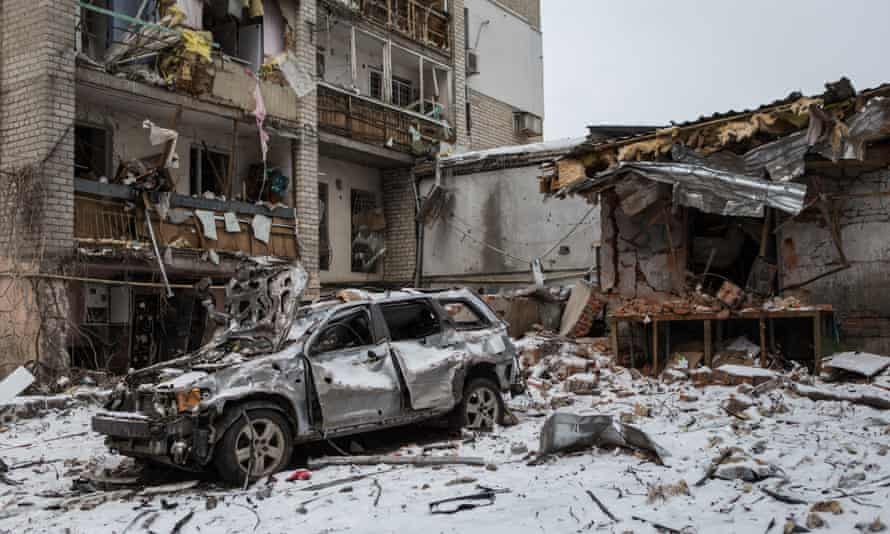
The remains of buildings and vehicles in Kharkiv as Russian attacks continue. Photograph: Anadolu Agency/Getty Images
The United Nations high representative for disarmament, Izumi Nakamitsu, said the UN was “not aware of any biological weapons programs” in Ukraine, and pointed out there was an official channel for governments to raise any concerns about violations of the biological and toxin weapons convention banning their use.
In response to Nebenzya’s claims, several member states on the security council warned that it could be a disinformation campaign ahead of a planned Russian attack inside Ukraine.
“The intent behind these lies seems clear and it is deeply troubling,” said Linda Thomas-Greenfield, the US ambassador to the UN. “We believe Russia could use chemical or biological agents for assassinations as part of a false flag incident or to support tactical military operations.”
Before the UN session, the Ukrainian president, Volodymyr Zelenskiy, expressed similar concerns.
“Allegedly, we are preparing a chemical attack,” Zelenskiy said in a video address on Thursday. “This makes me really worried, because we’ve been repeatedly convinced: if you want to know Russia’s plans, look at what Russia accuses others of.”
Russian forces have continued their advance into Ukraine, bombing cities in the west of the country, including Lviv, Lutsk and Ivano-Frankivsk.
Elsewhere, satellite photos appeared to show a massive convoy outside Kyiv had largely dispersed and redeployed. The US space technology company Maxar said its pictures showed armoured units had fanned out through towns and forests in the area, with artillery moved into potential firing positions.
In Moscow, Vladimir Putin announced 16,000 foreign “volunteers” from the Middle East were ready to fight with Russian-backed forces in eastern Ukraine to “help” the people living in the Donbas region. In a meeting with Russia’s defence minister, Sergei Shoigu, Putin also said western-made weapons including Javelin and Stinger missiles that were captured by the Russian army would be handed to Donbas forces.West’s weapons are seeing action in Ukraine – but it is unlikely to be enoughRead more
As heavy shelling continued across eastern Ukraine’s towns and cites, Ukrainian authorities reported Russia had killed more civilians than soldiers. Russian forces were also reported to have hit a psychiatric hospital near Izyum, a town in the Kharkiv region. The regional governor, Oleh Synegubov, called it a “war crime against civilians [and] genocide against the Ukrainian nation”. He said 330 people had been in the hospital at the time, including wheelchair users and people unable to move. The exact number of casualties is still to be established.
In the besieged port city of Mariupol conditions remain desperate, with people trapped inside indoor shelters with no heat, electricity and little or no food. More than 1,300 people had died in the 10-day siege, said Ukraine’s deputy prime minister Iryna Vereshchuk. “They [Russia] want to destroy the people of Mariupol. They want to make them starve. It’s a war crime,” she said.
The Associated Press spoke to an exhausted-looking resident as he pulled a cart loaded with bags down an empty street flanked by damaged buildings in the port city. “I don’t have a home any more. That’s why I’m moving,” Aleksander Ivanov said. “It doesn’t exist any more. It was hit, by a mortar.”
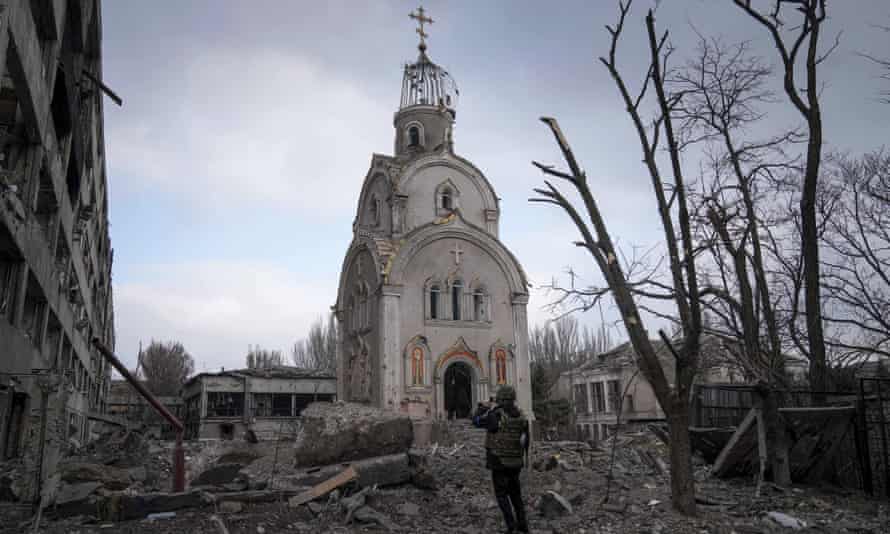
A member of the Ukrainian armed forces takes a photograph of a damaged church after shelling in Mariupol on Thursday. Photograph: Evgeniy Maloletka/AP
More than 400,000 people remain trapped in Mariupol, which is surrounded by Russian forces, and basic supplies are running out. About 200,000 are believed to want to leave amid continuous Russian bombardment but have not been able to do so despite the daily declaration of humanitarian corridors.
A UN spokesperson said there were credible reports of Russians using cluster munitions in populated areas. Cluster munitions, which scatter small bombs over a large area, are banned by more than 100 countries, including the UK, but not Russia, Ukraine or the US.
More than 2.5 million people have fled Ukraine and a further 2 million are internally displaced, UNHCR, the UN refugee agency, said on Friday. The grim toll for Ukrainian civilians comes amid growing fears that Russia could stage a chemical attack, as senior Russian officials recycled old conspiracy theories about alleged western-made biological weapons.
The head of the Russian military’s radiation, chemical and biological protection troops, Igor Kirillov, said on Thursday that US-backed labs in Kyiv, Kharkiv and Odesa were working on pathogens custom-designed to target Russians and other Slavs. According to Russian-state media, Kirillov alleged the US planned to exploit Ukraine’s “unique geographical position” by sending migratory birds carrying deadly diseases into Russia.
The Russian foreign minister, Sergei Lavrov, made a similar claim on Thursday, alleging that US-backed labs in Ukraine were working to “develop ethnically targeted biological weapons”. The director of the CIA, William Burns, told the US Senate intelligence committee that Russia could be laying the groundwork for a chemical or biological attack, which it would then blame on the US or Ukraine in a “false flag operation”.
“This is something, as all of you know very well, [that] is very much a part of Russia’s playbook,” he said. “They’ve used these weapons against their own citizens, they’ve at least encouraged the use in Syria and elsewhere, so it’s something we take very seriously.”



 Scroll back up to restore default view.