AP PHOTOS: Day 18: Images capture widespread destruction
The Associated Press – March 13, 2022
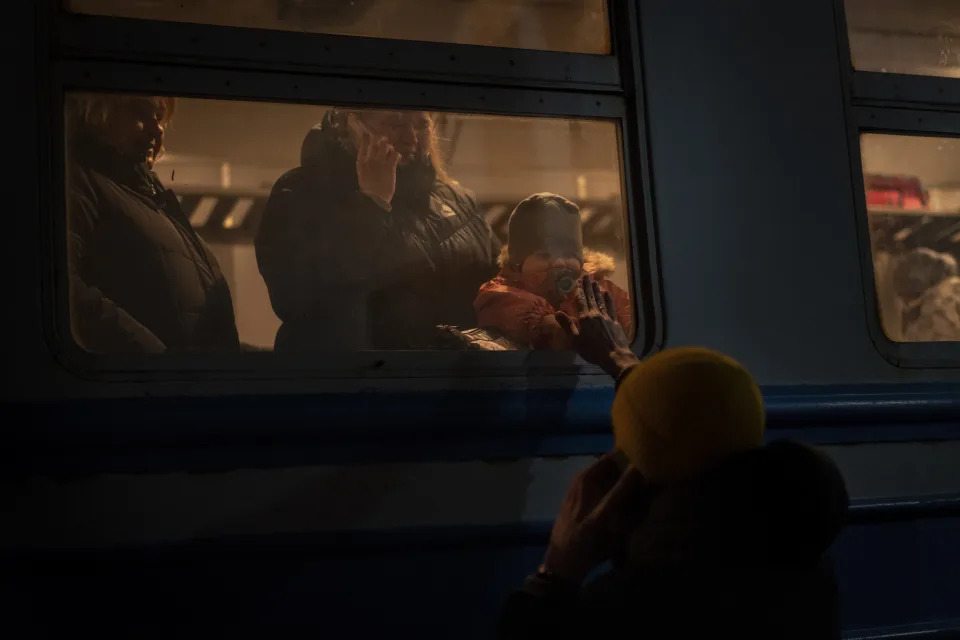
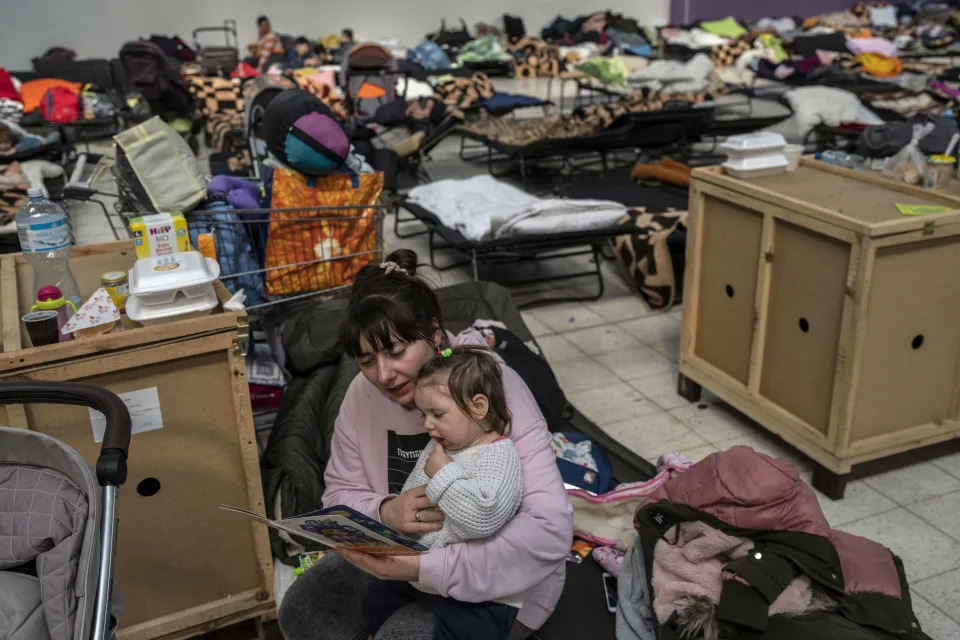
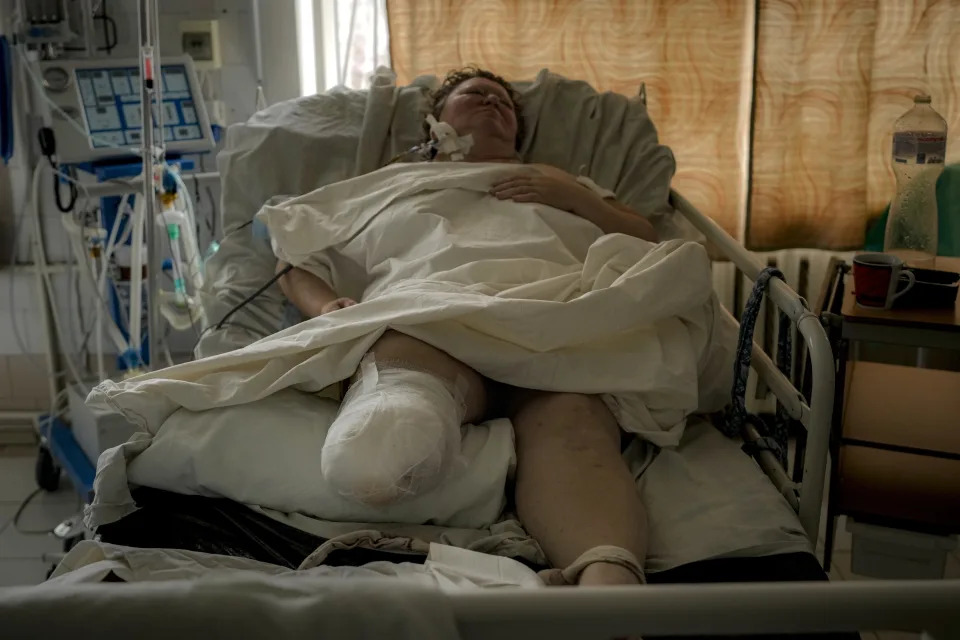
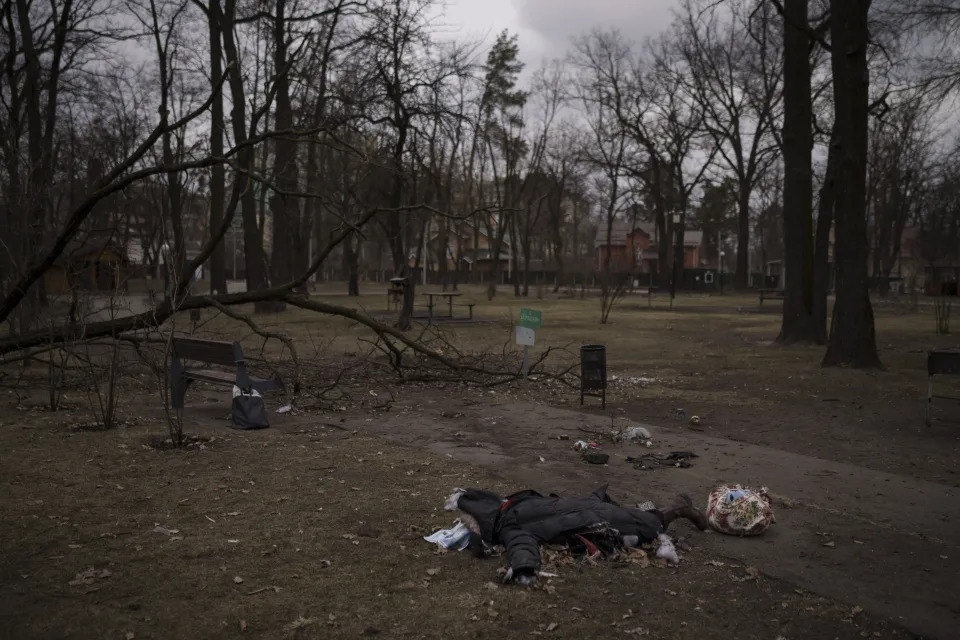
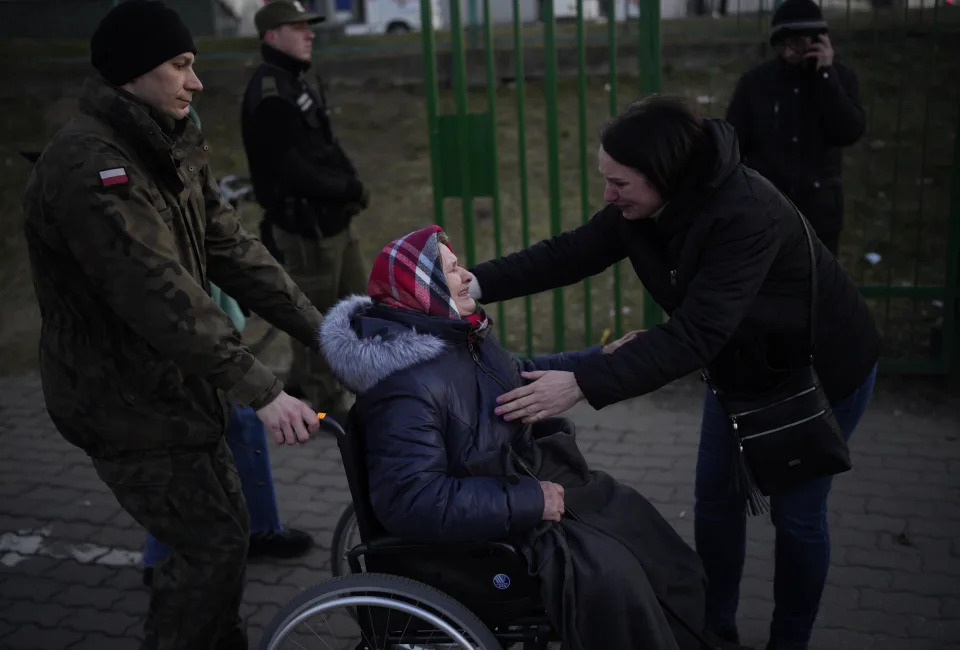
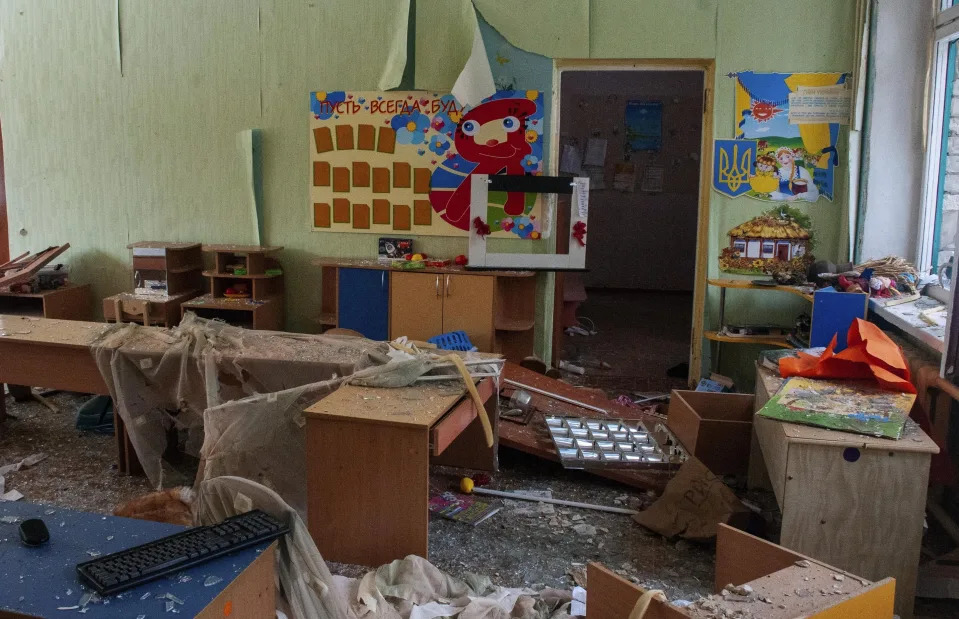
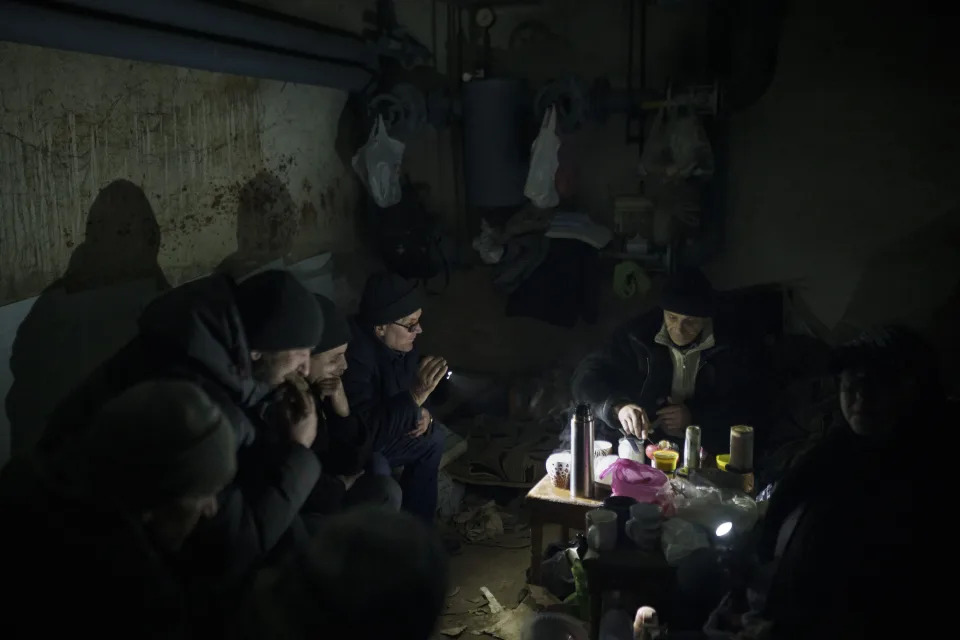
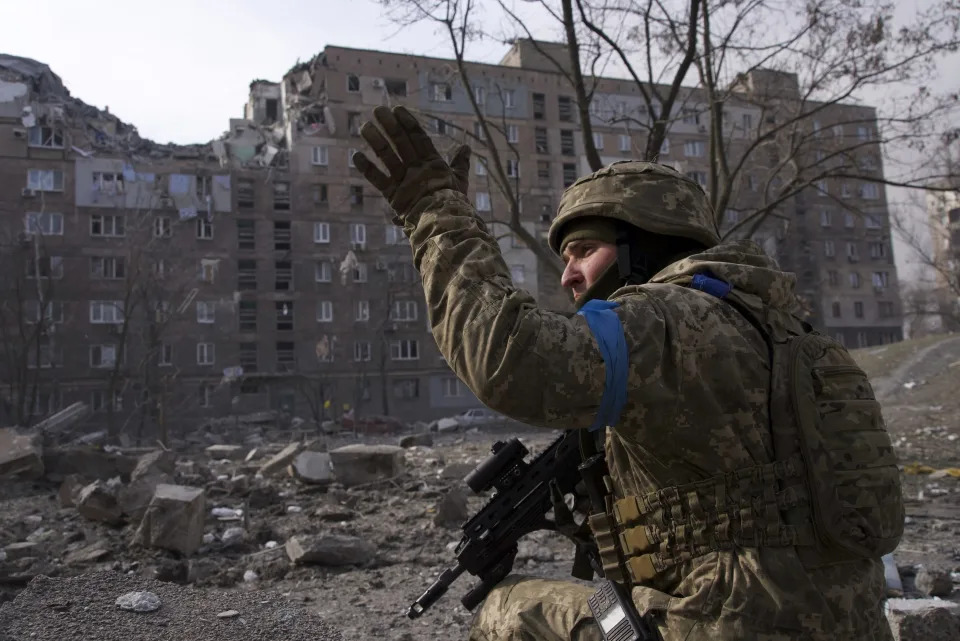
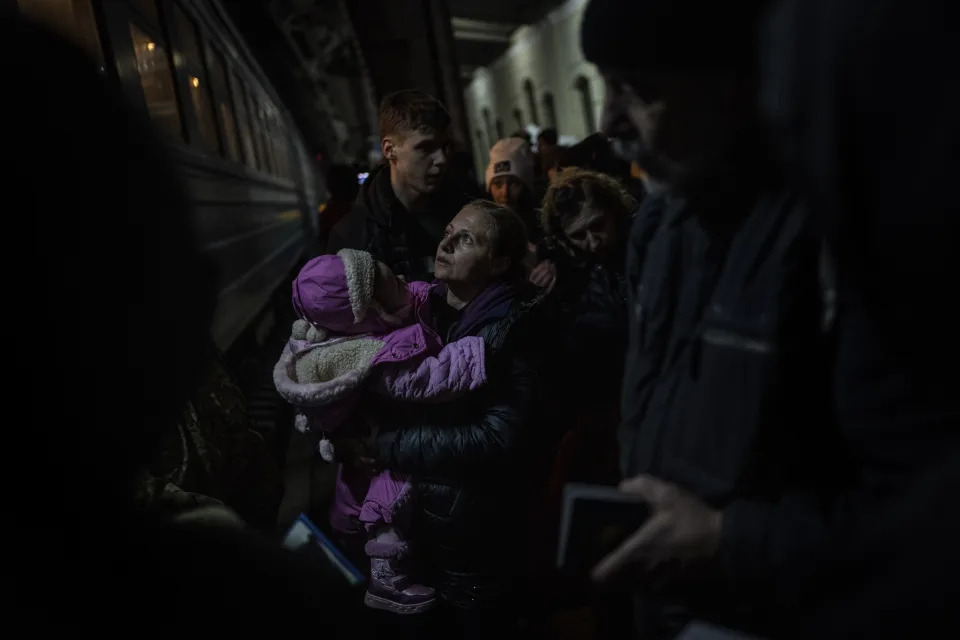
Ukrainian soldiers take cover from incoming artillery fire in Irpin, the outskirts of Kyiv, Ukraine, Sunday, March 13, 2022. (AP Photo/Felipe Dana)ASSOCIATED PRESSDisplaced Ukrainians on a Poland bound train bid farewell in Lviv, western Ukraine, Sunday, March 13, 2022. (AP Photo/Bernat Armangue)ASSOCIATED PRESSA woman walks past building damaged by shelling, in Kharkiv, Ukraine, Sunday, March 13, 2022. (AP Photo/Andrew Marienko)ASSOCIATED PRESSKate, who fled Ukraine, reads a story to her daughter Dianna in a refugee center in Korczowa, Poland, on Sunday, March 13, 2022. (AP Photo/Petros Giannakouris)ASSOCIATED PRESSA woman whose leg had to be amputated after she suffered gunshot wounds in a village currently under the control of the Russian military, lies in an intensive care unit at a hospital in Brovary, north of Kyiv, Ukraine, Sunday, March 13, 2022. (AP Photo/Vadim Ghirda)ASSOCIATED PRESSA woman with her belongings and food, sits on a chair in an improvised shelter in a subway while a train passes by in Kyiv, Ukraine, Sunday, March 13, 2022. (AP photo/Efrem Lukatsky)ASSOCIATED PRESSA Ukrainian firefighter drags a hose inside a large food products storage facility which was destroyed by an airstrike in the early morning hours on the outskirts of Kyiv, Ukraine, Sunday, March 13, 2022. (AP Photo/Vadim Ghirda)ASSOCIATED PRESSThe body of a woman lies at a park in Irpin, on the outskirts of Kyiv, Ukraine, Sunday, March 13, 2022. (AP Photo/Felipe Dana)ASSOCIATED PRESSAn older woman, who has fled Ukraine is reunited after arriving at the border crossing in Medyka, Poland, Sunday, March 13, 2022. (AP Photo/Daniel Cole)ASSOCIATED PRESSDebris scatters a kindergarten that was damaged by shelling, in Kharkiv, Ukraine, Sunday, March 13, 2022. (AP Photo/Andrew Marienko)ASSOCIATED PRESSA Ukrainian family who fled the war waits at the train station in Przemysl, southeastern Poland, on Sunday, March 13, 2022. (AP Photo/Petros Giannakouris)ASSOCIATED PRESSResidents prepare tea as they sit in a basement being used as a bomb shelter in Irpin, outskirts of Kyiv, Ukraine, Sunday, March 13, 2022. (AP Photo/Felipe Dana)ASSOCIATED PRESSTymur Samolevska, 12, a Ukrainian internally displaced from Zaporizhya, puts together a puzzle inside a dorm in Novoiavorisk, near Lviv, western Ukraine, Sunday, March 13, 2022. (AP Photo/Bernat Armangue)ASSOCIATED PRESSMedics attend to a man who suffered serious injuries after the vehicle he was fleeing in from a village currently under the control of the Russian military hit a mine, at a hospital in Brovary, north of Kyiv, Ukraine, Sunday, March 13, 2022. (AP Photo/Vadim Ghirda)ASSOCIATED PRESSA Ukrainian firefighter drags a hose inside a large food products storage facility which was destroyed by an airstrike in the early morning hours in Brovary, north of Kyiv, Ukraine, Sunday, March 13, 2022. (AP Photo/Vadim Ghirda)ASSOCIATED PRESSA Ukrainian soldier digs a foxhole in Irpin, outskirts of Kyiv, Ukraine, Sunday, March 13, 2022. (AP Photo/Felipe Dana)ASSOCIATED PRESSElderly residents cross a destroyed bridge while fleeing Irpin, outskirts of Kyiv, Ukraine, Sunday, March 13, 2022. (AP Photo/Felipe Dana)ASSOCIATED PRESSAn elderly woman hides in a basement for shelter, with no electricity, in Irpin, on the outskirts of Kyiv, Ukraine, Sunday, March 13, 2022. (AP Photo/Felipe Dana)ASSOCIATED PRESSA group of people, who fled Ukraine, arrive at the border crossing in Medyka, Poland, Sunday, March 13, 2022. (AP Photo/Daniel Cole)ASSOCIATED PRESSA Ukrainian serviceman guards his position in Mariupol, Ukraine, Saturday, March 12, 2022. (AP Photo/Mstyslav Chernov)ASSOCIATED PRESSA family walks out of a basement used as shelter during an air-raid alarm in Novoiavorisk, western Ukraine, Sunday, March 13, 2022. (AP Photo/Bernat Armangue)ASSOCIATED PRESSAn injured man is wheeled on a stretcher at a local hospital in Novoiavorisk, western Ukraine, Sunday, March 13, 2022. (AP Photo/Bernat Armangue)ASSOCIATED PRESSDisplaced Ukrainians wait to board a Poland bound train in Lviv, western Ukraine, Sunday, March 13, 2022. (AP Photo/Bernat Armangue)ASSOCIATED PRESSTurkish imam Mehmet Yuce walks down the steps after evening pray in a mosque in Mariupol, Ukraine, Saturday, March 12, 2022. The Ukrainian Embassy in Turkey says a group of 86 Turkish nationals, including 34 children, are among those sheltering in a mosque in the besieged city of Mariupol. (AP Photo/Evgeniy Maloletka)ASSOCIATED PRESS
As Russian shells hit Irpin, on the outskirts of Ukraine’s capital, two Ukrainian soldiers took cover against a wall Sunday, heads down on the bare ground. Another soldier dug a foxhole.
In an Irpin park, a woman’s body lay amid downed trees and debris. Underground, many people sheltered in basements without electricity.
Irpin is also where Russian troops on Sunday opened fire on the car of U.S. video journalist Brent Renaud, killing him and wounding a colleague.
AP photographers captured scenes of devastation in Irpin and around Ukraine on Sunday, the 18th day of the war. The shells of bombed-out buildings and a damaged kindergarten classroom in Kharkiv. Rubble in besieged Mariupol. Firefighters trying to douse flames in a ruined food storage facility in the capital, Kyiv.
Since their invasion, Russian forces have struggled in their advance across Ukraine, and have besieged several cities, pummeling them with strikes and leading to a series of humanitarian crises.
In a hospital in Brovary, the photos show doctors and nurses working on people who were injured and lost limbs.
Other images showed life for refugees in shelters in western Ukraine and in neighboring countries. A boy worked on a puzzle; a family huddled behind a pile of suitcases; a mother read to her young child in a room crowded with beds.
Here’s What Putin Doesn’t Want You to Know About What’s Happening Inside Russia Right Now
From Russia With Love:
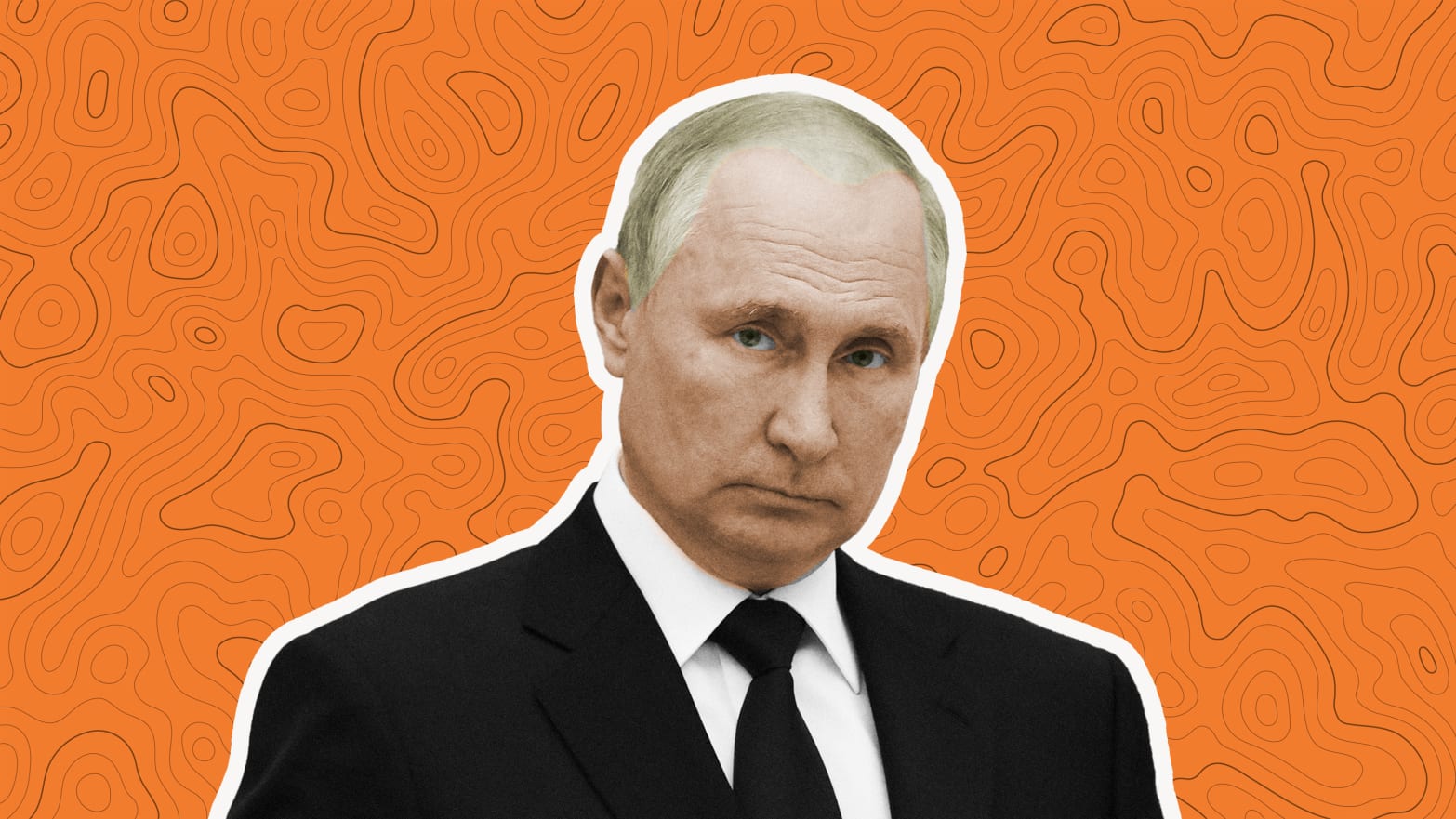
President Putin has effectively banned foreign correspondents reporting on Russia during his war in Ukraine. This is what he doesn’t want you to know.
Craig Copetas – March 12, 2022
Listen to article15 minutes
Vladimir Putin’s invasion of Ukraine has done more than leave the ruble without a cause. “I don’t have enough to take a shit,” gripes Vadim fumbling for the 60 rubles, about 44 cents, needed to unlock the pay toilet at the Khoroshevo railway station.
Three weeks into the war, Russia’s financial constipation is unmistakable. The West first sanctioned the country’s banking sector. The global financial system then took command and gridlocked practically every money thoroughfare between Russia and the rest of the world. Visa and Mastercard evaporated. Google and Apple shut off their digital payment systems. Insurance policies vanished. The Big Mac is no more.
And now, in St. Petersburg, Sveta—whose name has been changed for her safety like everyone in this story—is seeking blossoms imported from the Netherlands.
“No Dutch flowers?” the 30-year-old woman asks Olga, the florist in the lobby of the Gostinyi Dvor Metro station, site of many of the anti-war demonstrations and where at least 1,000 protesters so far have been arrested. “How are you going to stay open without Dutch flowers?”
“Fuck them,” replies the seventy-something flower-seller. “I’ll head back to my village and grow the fucking flowers in the garden.”
Sveta, a lawyer who owns a business consultancy, laments that Putin’s ham-fisted control of Russian media has twisted a majority of the country’s 145 million people into generations of Olgas. “The number of young people who support Putin’s madness is terrifying,” she explains. “We’re all upset about the related bans, like Netflix and Spotify, which only reinforce the suppression of freedom of speech. With no information, Putin’s zombification of Russia will accelerate.”
Yet tapping into Russia’s fondness for dark humor, Sveta adds, “we cannot force McDonald’s to stay, and we may even emerge healthier for it.”
Nearby, outside the Cherneshevskaya Metro Station, a Molotov cocktail’s throw from Putin’s childhood neighborhood, two middle-aged women are having a conversation.
“If Putin didn’t go to the Ukraine they would be on our doorstep this year,” says the first woman. “America were going to send thousands of Nazis into Russia.”
“True,” her friend agrees. “Someone from the Ukraine was writing to me, terrorizing me on my phone. I erased all the messages. That’s how the Ukrainian secret police tracks us.”
“What’s the difference for us,” says the first. “We had kasha, potatoes and herring, and we will still have kasha, potatoes and herring. I don’t need parmesan cheese.”
“We live fine,” is the second woman’s verdict. “Let everyone in Russia live like us.”
Back in Moscow, there’s an argument going on between two old friends in an apartment. They’re reading an article on Russian military actions in Ukraine as described in the popular ultra-nationalist newspaper Zavtra, which is owned by the 84-year-old novelist and Putin pal Alexander Prokhanov.
The headline blares: Going Forward, the Town of Izyum is Liberated. Nazis are Killing the Un-Loyal. We Liquidate Military Criminals.
“Putin’s propaganda has turned us into bastards, monsters,” says Boris, a 65-year-old translator.
“The President is protecting us from a Nazi invasion,” fires back his life-long friend Nikolai, a doctor and frequent visitor to Miami. “Why do you not support him? On every particular point, Putin’s position is concrete.”
Boris scoffs: “There’s no way to measure that under a totalitarian regime where all the polls are rigged.”
Across Moscow, at the hipster Dada Cafe, Volodya slides the right side of his palm across his throat, an old Russian sekir baska or “axe-head” gesture that signals: “I’m fed up with this” to his companion. Volodya lowers his voice to barely a whisper. “This scum, Putin, should be crushed,” he adds. Volodya then raises his voice for others in the café to hear. “I officially support the operation conducted by the President of Russia Vladimir Putin.”
A woman at the adjoining table stiffly nods her head. “NATO is making dirty bombs in the Ukraine,” she says. “They’re all Nazis.”
“What’s most horrifying,” Boris wrote in his last message from Moscow, “is the efficiency of Putin’s propaganda. We are caught in a shitload of fish.”
Russian culture is rich in off-color expressions and double entendres, this one makes it plain that the average Russian has been ensnared in Putin’s shit and there’s nothing anyone can do to escape.
Many of the expressions favored in these parts reflect the great gulf between dreams of what might be and the reality of what is.
Perhaps the illustration that best describes what Putin has created is a line taken from the film version of Mikhail Bulgakov’s satirical novella The Heart of a Dog, the story of a professor who transplants the testicles of a freshly dead, drunken apparatchik into a spotted puppy named Sharik.
The result is Sharikov, an uncontrollable fascist whose lying and thievery makes everyday life in Russia unbearable. “What have I done?” the professor moans. “I’ve turned a perfectly nice little dog into a son of a bitch.”
The professor ultimately manages to neuter Sharikov, much in the same manner the West is using sanctions to spay Putin’s totalitarian regime. For the moment, however, the economic surgery is in large part limited to removing imported Italian cheese from the pasta and Starbucks beans from the iced lattes. That will change soon enough.
Russia’s economy ‘in crisis’ as banks formally cut out of Swift
Tim Wallace – March 12, 2022
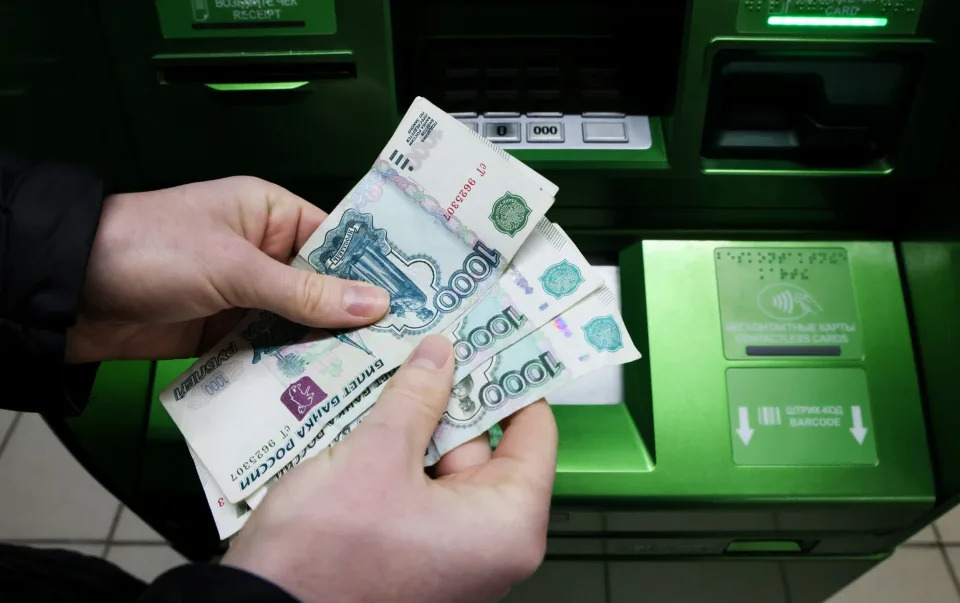
Cashpoint – Dmitry Feoktistov/TASS via Getty Images
Russia is braced for more economic chaos as seven banks are formally been blocked from the Swift messaging system which is a core part of the international payments mechanism, as EU sanctions come into force today.
Western institutions had already been scrambling to cut back dealings with Russian institutions following a wave of restrictions aimed at isolating Vladimir Putin’s regime and crippling the country’s economy over its invasion of Ukraine.
It has instantly cast Russia’s economy into a deep hole, said a top economist at an international group who asked not to be named.
“It is clear Russia is in a deep financial and economic crisis, the only question is how much its economy will contract and how great the damage will be. It could well be worse than what happened in 1998 when they defaulted. It is a very, ery severe crisis for Russia,” the economist said.
“For at least five years it has been trying to develop its economy so it has greater resilience and independence from the west in terms of building up foreign exchange reserves, reducing its deficit, and reorienting trade away from western Europe precisely for this day.
“My suspicion is they didn’t expect sanctions to be as far-reaching as they have proved to be.”
Russia’s central bank has extended the closure of the Moscow exchange until at least 18 March. It had previously said trading on the stock market would recommence on Monday 14 March, following the closure which began on 25 February.
The Institute for International Finance estimates GDP could plunge by as much as 30pc by the end of this year, which compares to the World Bank’s estimates that its economy shrank by 3pc in 2020 and by almost 8pc in 2009’s global financial crisis.
The EU has ordered Swift to disconnect Bank Otkritie, Novikombank, Promsvyazbank, Bank Rossiya, Sovcombank, Vnesheconombank and VTB Bank, though other institutions including Gazprombank and Sberbank are still able to use the messaging system as they are needed for European nations to buy oil and gas from Russia.
Ratings agency Standard and Poor’s has said kicking banks off Swift helps “reinforce” the sanctions, as Russia has only limited means to make payments through alternative channels.
“Alternative systems have emerged in the past decade. For instance, Russian authorities have supported the development of what is known as SPFS, while Chinese authorities have developed the Cross-Border Interbank Payment System. However, these aren’t commonly used for US dollar and euro transactions, nor are they as globally accepted as Swift,” the agency said when the Swift decision was announced.
“Moreover, although Russian banks could switch to these alternative systems, their counterparties might not be as willing to participate. Another alternative is for Russian banks cut off from Swift to use intermediaries that are still connected to Swift or establish bespoke processes. However, the other sanctions already imposed on these seven banks materially reduce the practicality of these alternatives for a large number of counterparts.”
Analysts expect the sanctions to prompt other nations including China to investigate further the possibility of setting up alternative systems alongside their allies in further efforts to reduce their vulnerability from the global system which was in large part established by the western powers in the second half of the 20th century, giving democracies significant economic leverage over dictatorships.
It comes as German lender Commerzbank said it is cutting back links to the Russian economy.
“We have stopped new business in Russia and we are winding down existing transactions,” said a spokesman for the bank. “Of course we’re complying with sanctions.”
Bill Maher slams both parties for playing partisan politics with the war in Ukraine
Grayson Quay, Weekend editor – March 12, 2022
Real Time host Bill Maher wrapped up his show Friday night by slamming both parties for using Russia’s invasion of Ukraine to score partisan points, Fox News reports.
“New rule: don’t make World War III all about you,” Maher said. The only conclusion anyone seems to be drawing from the war in Ukraine, he continued, is that “everything proves what we already believed, and everything goes back to the thing we already hate.”https://www.youtube.com/embed/mXdzAZvid0E
Maher pointed out headlines that showed Republicans blaming President Biden for the war and Democrats blaming former President Donald Trump. He also quoted Biden’s comparison of the invasion to the Jan. 6 Capitol riot and Trump’s insistence that the crisis was caused by the “rigged” 2020 U.S. presidential election.
On March 2, Biden suggested Russian President Vladimir Putin may have been emboldened to invade Ukraine after watching the events of Jan. 6. “Putin was counting on being able to split up the United States. Look, how would you feel if you saw crowds storm and break down the doors of the British Parliament and kill five cops?” Biden said.
Trump made the comments to which Maher alluded on Feb. 24 as the Russian invasion of Ukraine was beginning. Putin, Trump told Fox News host Laura Ingraham, “was going to be satisfied with a piece [of Ukraine], and now he sees the weakness and the incompetence and the stupidity of this administration.” Trump added that “it all happened because of a rigged election,” repeating his baseless claim that he was the true winner of the 2020 election.
“Kanye thinks less about Pete Davidson than Trump thinks about the rigged election,” Maher quipped. He also asked why, “if Putin thought Trump was really that supportive of him … didn’t he invade when Trump was in office?”
Russia intensifies assault, warns U.S. weapons sent to Ukraine are ‘legitimate targets’
Nabih Bulos, Jenny Jarvie – March 12, 2022
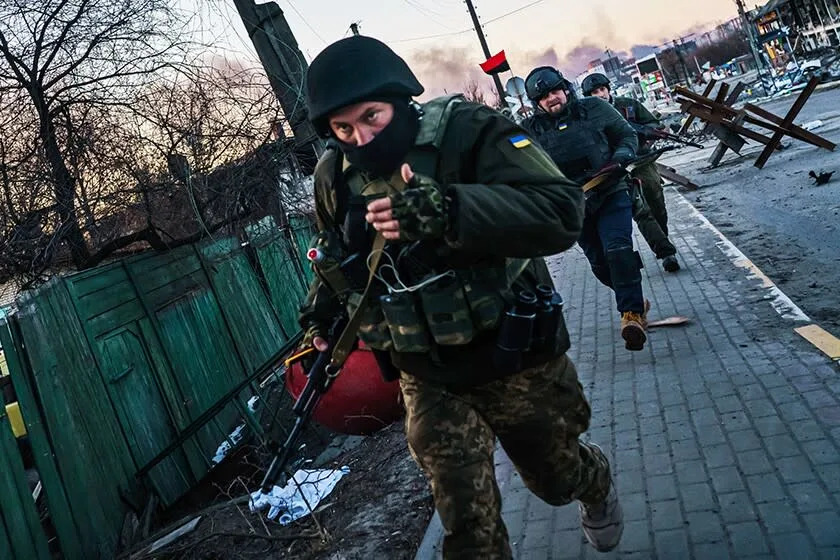
Ukrainian soldiers run toward safety Thursday after battling Russian forces in Irpin, just outside the capital of Kyiv. Fierce fighting in Irpin continued Saturday. (Marcus Yam / Los Angeles Times)
Russian forces kept up their bombardment of cities across Ukraine on Saturday, capturing the eastern outskirts of a key southern port and waging an increasingly violent campaign with an eye to encircling the capital even as they sought to bring a political veneer to their occupation in cities they have captured.
The moves come as the White House announced it would send an additional $200 million in arms and equipment for Ukraine. That announcement came hours Moscow signaled it could soon expand the war to embroil Kyiv’s allies, warning the U.S. that it would consider convoys carrying weapons to Ukraine to be “legitimate targets.”
While wide-scale Russian bombing campaigns intensified in cities including Mariupol, Mykolaiv, Kharkiv and Chernihiv, Russian forces plan to conduct a referendum that would turn the city of Kherson — the first major city captured by Russian forces earlier this month — into a vassal breakaway republic, said Ukrainian Foreign Minister Dmytro Kuleba.
“Given zero popular support, it will be fully staged,” he wrote on Twitter, warning that it was a repeat of Russia’s playbook in 2014, when Russian-backed separatists held a referendum that led to the creation of the so-called Donetsk and Luhansk people’s republics in eastern Ukraine.
“Severe sanctions against Russia must follow if they proceed. Kherson is & will always be Ukraine.”
Sergey Khlan, a deputy in the Kherson Regional Council, said in a post on Facebook on Saturday that Russian authorities were contacting deputies and asking for their cooperation in holding the referendum to create a putative Kherson People’s Republic.
“The creation of Kherson People’s Republic will turn our region into a hopeless hole without life and future,” Khlan wrote.
“Do not give them a single vote! Do not give them any opportunity to legitimize [the Kherson People’s Republic]… Enter the history of Ukraine not as traitors whom nobody wants, but truly as citizens whose names will be remembered by the next generations.”
Meanwhile, in Moscow, Deputy Foreign Minister Sergei Ryabkov said Saturday that shipments of Western weapons to Ukraine could be attacked by Russian forces, according to Russia’s ITAR-TASS news agency. Western nations’ “thoughtless transfer” of portable air defense and antitank missile systems to Kyiv, Ryabkov said, demonstrated “the escalatory component of Washington’s policy.”
The White House announced Saturday it approved an additional $200 million in arms and equipment for Ukraine, on top of $350 million President Biden approved last month.
“We have warned the U.S. that the U.S.-orchestrated inundation of Ukraine with weapons from some countries is not just a dangerous move, but also an action that makes these convoys legitimate targets,” Ryabkov said. The Russian diplomat did not say whether Russian forces would target such convoys in Poland or Romania, NATO countries that border Ukraine.
The tough talk came on a day that Russian forces sustained “heavy losses in manpower and equipment” in areas northeast of Kyiv and were prevented from regaining a foothold on previously captured frontiers, according to the Ukrainian military.
Northwest of the capital, the bulk of Russian ground forces were gathered Saturday about 15 miles from the city center, according to the U.K.’s Ministry of Defense. Parts of the large Russian column north of Kyiv had dispersed, the ministry said, either in an effort to encircle the city or limit its risk of Ukrainian counterattacks.
Early in the morning, loud explosions reverberated near the capital. Rumbles — louder and closer than the booms of previous days — could be heard throughout the day and well into the night in Kyiv. They served as the calling card of the twin Russian pincers stretching toward the capital from its northeastern and northwestern flank.
Despite holding off enemy forces from the capital, Ukrainian officials admitted a bitter defeat, acknowledging that Russia had seized part of Mariupol, a strategic city in the southeastern Donetsk region that could allow it to build a land corridor from pro-Moscow enclaves in the east to Russian-annexed Crimea in the south. Russian shelling of the city hit a mosque sheltering more than 80 people, including children, and repeated efforts to evacuate 430,000 residents have failed as their convoys come under artillery fire. Dozens of buses loaded with humanitarian supplies were reported to be attempting to reach the city.
“Let’s see whether this one gets here or not,” Mariupol Deputy Mayor Serhiy Orlov said in an interview with the BBC, noting that six previous attempts to bring food, water and medicine to his beleaguered city were unsuccessful.
“The convoys were not let through,” he said. “They were bombed, the road was mined, there was shelling in the town.”
In Mykolaiv, another major Black Sea port and shipbuilding center about 300 miles west of Mariupol, Mayor Olexandr Senkevitch claimed in a video posted Saturday on Instagram that eight civilians were injured and more than 160 houses, three hospitals and 11 educational institutions were damaged overnight.
“We will definitely repair and restore everything,” he said. “We heal the wounded. And defeat these damn orcs” referring to the Ukrainian nickname for Russian forces.
With those forces assembled about 15 miles outside Kyiv, Ukrainian President Volodymyr Zelensky struck a confident tone from inside the capital, where citizen militias are armed with missiles, machine guns and Molotov cocktails.
“We know 100% there will be a victory,” he said in a news conference.
Since the beginning of the Russian invasion, Zelensky said, about 1,300 soldiers of the Armed Forces of Ukraine had died — a fraction of the 12,000 Russians that he claimed had died. The numbers could not be independently verified.
“One in 10,” he said.
Asked if Russian troops could enter Kyiv, Zelensky said it was theoretically possible.
“If they carry out a carpet bombing and simply decide to erase the historical memory of the whole region, the history of Kyivan Rus’, the history of Europe, they will enter Kyiv,” he added. “If they destroy all of us, they will enter Kyiv. If this is the goal, they will enter and will have to live on this land alone, without us. They will not find friends among us here.
Zelensky urged Ukrainians to keep fighting.
“The resistance of the entire Ukrainian people against these invaders has already gone down in history,” Zelensky said. “But we have no right to reduce the intensity of defense. No matter how difficult it is. We have no right to reduce the energy of resistance.”
In Melitopol, 120 miles west of Mariupol hundreds gathered on the streets Saturday to demand the release of the southern city’s mayor, Ivan Fedorov, whom the Ukrainian government has said was kidnapped from a government office Friday by Russian forces.
“Fedorov!” the crowd chanted. “Free the mayor!”
After accusing Russia on Saturday of “switching to a new stage of terror” in trying to “physically eliminate” elected officials, Zelensky praised the protesters for their open resistance.
“The invaders must see that they are strangers on our land, on all our land of Ukraine, and they will never be accepted,” he said in a video broadcast.
In telephone conversations with German Chancellor Olaf Scholz and French President Emmanuel Macron, Zelensky said he urged them to push for Fedorov’s release.
“The demand is simple: to release him from captivity immediately,” he said. “We expect them, the world leaders, to show how they can influence the situation. How they can do a simple thing: free one person. A person who represents the entire Melitopol community, Ukrainians who do not give up.”
Russia’s intensified assault on the cities and villages of Ukraine came as the United States continued to insist that diplomacy still had a role in the conflict.
But prospects of a resolution looked dim after Scholz and Macron unsuccessfully tried in a lengthy telephone call Saturday to persuade Russian President Vladimir Putin to agree to an immediate cease-fire or diplomatic talks.
Russia’s ITAR-TASS news agency also reported Saturday that Ryabkov, Russia’s deputy foreign minister, said in an interview that Moscow and Washington were not negotiating or consulting on Ukraine.
Meanwhile, in the disputed Donbas region, the self-appointed head of the Luhansk People’s Republic, Leonid Pasechnik, issued a decree Saturday saying the borders of the state would correspond to those declared in May 2014. (Ukrainian forces had clawed back two-thirds of the Donbas before a ceasefire later in 2014.)
The move aims to formalize gains in recent days after Russian forces — backed by separatists — have advanced into government-held areas of Luhansk province. A day earlier, Pasechnik issued another decree restoring names of streets that had been changed after the Ukrainian government’s so-called de-communization drive.
US intelligence officials believe a $700 million superyacht that’s docked in Italy could belong to Russian President Vladimir Putin, reports say
Zahra Tayeb – March 12, 2022
The Scheherazade, one of the largest superyachts in the world, pictured in Turkey in 2020.Photo by Osman Uras/Anadolu Agency via Getty Images
US officials say a superyacht docked in Italy could belong to Russian President Vladimir Putin.
People briefed on the intelligence, however, said no set conclusions have been made, per The NYT.
The $700 million superyacht is currently docked on the Tuscan coast of Italy.
US authorities believe a $700 million superyacht that’s docked in Italy could belong to Russian President Vladimir Putin.
The New York Times reported the news, citing several people briefed on the information.
The superyacht, called the Scheherazade, which is currently situated on the Tuscan coast of Italy first came to light after The Times reported Tuesday that Italian authorities were examining the 459-foot-long vessel.
While some believed it could belong to a Russian oligarch, locals told The Times they nicknamed it “Putin’s yacht.”
US intelligence officials have not concluded who owns the Scheherazade but said they found initial indications that it was associated with Putin, per The Times.
The people with knowledge of the matter would not describe what information led them to believe the superyacht was linked to the Russian President, according to the publication.
The ship’s captain, Guy Bennett-Pearce, told reporters earlier this week that Putin was not the owner of the ship and that he had never been on the yacht. He didn’t, however, rule out the possibility of the owner being Russian.
Meanwhile, the US and the other countries are doubling down on efforts to confiscate oligarchs’ high-end assets.
“We are joining with our European allies to find and seize your yachts, your luxury apartments, your private jets,” President Joe Biden said in his State of The Union address on March 1. “We are coming for your ill-begotten gains.”
Some oligarchs have scrambled to try and escape the sanctions against them, taking their private jets and ships to places like Dubai and the Maldives.
The Scheherazade has been undergoing repairs since June 2020 in the small Italian town of Marina di Carrara. Its features include a helicopter landing pad, a large pool, a cinema, and a drone crashing system, according to Superyacht Fan.
Klitschko brothers say Kyiv supply lines open, residents returning to fight
Omer Berberoglu – March 11, 2022
Mayor of Kyiv Vitali Klitschko visits a checkpoint of the Ukrainian Territorial Defence Forces in Kyiv
KYIV (Reuters) -Kyiv mayor and former heavyweight boxing champion Vitali Klitschko said on Friday that he believed there were nearly 2 million people still left in the city, which is being squeezed by advancing Russian forces on several fronts.
He said the Ukrainian capital, normally with a population of 3.5 million, had enough vital provisions to last a couple of weeks, and that supply lines in and out remained open for now.
His brother Wladimir, also a heavyweight boxing star, added in a joint interview that some men and women who had accompanied their families to the relative safety of the west of the country were returning to take part in the city’s defense.
“We guess close to 2 million people are still in Kyiv and it’s very important to give services to people,” Vitali told Reuters at a logistics centre in Kyiv where he and aides were coordinating food and medicine supplies to stores and people stranded at home.
“We have right now electricity, heating, gas, we have water,” he added, speaking in English.
He thanked countries for sending supplies to Ukraine, and estimated that Kyiv had enough vital goods to last another two weeks.
Russia’s military is already close to Kyiv to the west and northwest, where there has been heavy fighting, and has tried to move closer to the east and northeast.
Ukrainian officials say that its ultimate aim is to surround the city with a view to seizing it.
On Friday Russian forces were regrouping in the northwest, satellite pictures showed, in what Britain said could be preparation for an assault on the city within days.
“The target (of the Russian invasion) is the capital of Ukraine, the target is Kyiv,” Vitali said. “We are ready to defend our city.”
SOME RESIDENTS RETURN
Hundreds of thousands of Kyiv residents have fled westwards as the fighting neared the city’s outskirts, joining millions of others forced to leave homes behind by sometimes fierce bombardment.
Wladimir Klitschko, who has enlisted in Ukraine’s reserve army, said some of the men and women who had got their families to safety were now returning to the capital.
“Yes there are a lot of refugees who left west, but a lot are coming back. A lot of men and women … coming back to defend the country. This is our home. We are staying here. We are not leaving anywhere,” he said.
Across Ukraine, thousands of civilians have joined local defence units to support regular troops.
Russia calls its actions in Ukraine a “special military operation” to disarm and “de-Nazify” the country. It denies targeting civilians.
Ukraine and its allies accuse Moscow of an invasion that has caused a humanitarian catastrophe in which hundreds of civilians have been killed and millions more displaced.
In Brovary, just to the east of Kyiv, residents out shopping for food remained defiant.
Dramatic footage released on Thursday showed a column of Russian tanks outside the town coming under artillery fire which appeared to strike some of the vehicles and forced others to retreat.
“There is no panic,” said Brovary resident Larisa Ugviy after packing her shopping into a car with her husband.
“We try to calm down – cook something, do the cleaning, take care of the pets, walk them. So everything is alright. Life goes on, nobody panics, nobody. Trust me.”
(Reporting by Omer Berberoglu; Writing by Mike Collett-White; Editing by Alison Williams)
A Ukrainian company that manufacturers medieval armor for sport is now using its materials to produce “caltrops” — or “sharp, six-inch spikes that date back to ancient wars” — in service of the war effort against Russia, The Washington Post reports.
Art of Steel in western Ukraine used to make items like “silver chain mail, helmets, and other armor for reenactments and show,” but has instead in the past two weeks produced hundreds of caltrops, which are being chained together and “placed at checkpoints around Rivne, a city about 210 miles west of Kyiv,” writes the Post. The intent is for the devices, also called “hedgehogs,” to stop or slow Russian vehicles should they try to enter the city, since the metal can pierce tires.
“Ukrainians [are] united in this war,” an Art of Steel official told the Post. “Absolutely everyone is trying to help in the fighting places and in the rear. Therefore, any materials are somehow used.”
“With proper use,” the caltrops “will help stop [a] column of vehicles or at least delay them for a while,” the official added.
The Art of Steel hedgehogs are just one example of homegrown weaponry Ukrainians are using to defend themselves from Russian aggression. Some volunteers, for example, have begun packing bottles with the materials needed to make Molotov cocktails.
The spiky weapons are now at every checkpoint in Rivne, Art of Steel said, per the Post. The company is also making plates for body armor.
Russia’s bioweapon conspiracy theory finds support in US
David Klepper and Angelo Fichera – March 11, 2022
Russia’s baseless claims about secret American biological warfare labs in Ukraine are taking root in the U.S. too, uniting COVID-19 conspiracy theorists, QAnon adherents and some supporters of ex-President Donald Trump.
Despite rebuttals from independent scientists, Ukrainian leaders and officials at the White House and Pentagon, the online popularity of the claims suggests some Americans are willing to trust Kremlin propaganda over the U.S. media and government.
Like any effective conspiracy theory, the Russian claim relies on some truths: Ukraine does maintain a network of biological labs dedicated to research into pathogens, and those labs have received funding and research support from the U.S.
But the labs are owned and operated by Ukraine, and the work is not secret. It’s part of an initiative called the Biological Threat Reduction Program that aims to reduce the likelihood of deadly outbreaks, whether natural or manmade. The U.S. efforts date back to work in the 1990s to dismantle the former Soviet Union’s program for weapons of mass destruction.
“The labs are not secret,” said Filippa Lentzos, a senior lecturer in science and international security at King’s College London, in an email to the Associated Press. “They are not being used in relation to bioweapons. This is all disinformation.”
That hasn’t stopped the claim from being embraced by some on the far-right, by Fox News hosts, and by groups that push debunked claims that COVID-19 is a bioweapon created by the U.S.
The day of Russia’s invasion of Ukraine, an early version appeared on Twitter — in a thread espousing the idea that Russia’s offensive was targeting “US biolabs in Ukraine” — and was soon amplified by the conspiracy theory website Infowars. It has spread across mainstream and lower-profile social platforms, including Telegram and Gab, that are popular with far-right Americans, COVID-19 conspiracy theorists and adherents of QAnon, the baseless hoax that Satan-worshipping pedophiles secretly shape world events.
Many of the accounts posting the claim are citing Russian propaganda outlets as sources. When Kremlin officials repeated the conspiracy theory on Thursday, saying the U.S. was developing bioweapons that target specific ethnicities, it took a few minutes for their quotes to show up on American social media.
Several Telegram users who cited the comments said they trusted Russian propaganda over independent American journalists, or their own democratically elected officials.
“Can’t believe anything our government says!” one poster wrote.
Others cited the claim while parroting Russia’s talking points about the invasion.
“It’s not a “war,” it’s a much needed cleansing,” wrote a member of a Telegram group called “Patriot Voices” that is popular with supporters of Trump. “Ukraine has a ton of US govt funded BioWeapons Labs that created deathly pathogens and viruses.”
Television pundits and high-profile political figures have helped spread the claim even further. Fox News host Tucker Carlson devoted segments on his shows on Wednesday and Thursday to promoting the conspiracy theory. On Wednesday, Donald Trump Jr. said conspiracy theories around the labs were proven to be a “fact” in a tweet to his 7.3 million followers.
Both Carlson and Trump misrepresented congressional testimony from a State Department official saying the U.S. was working with Ukraine to secure material in the biological labs, suggesting that indicated the labs were being used for illegitimate purposes.
It’s not surprising that a biological research center would contain potentially hazardous material, however. The World Health Organization said Thursday that it has asked Ukraine to destroy any samples that could pose a threat if released, either intentionally or accidentally.
While the disinformation poses a threat on its own, the White House warned this week that the Kremlin’s latest conspiracy theory could be a prelude to a chemical or biological attack that Russia would blame on the U.S. or Ukraine.
“Frankly, this influence campaign is completely consistent with longstanding Russian efforts to accuse the United States of sponsoring bioweapons work in the former Soviet Union,” U.S. Director of National Intelligence Avril Haines said Thursday during testimony before the Senate Intelligence Committee. “So this is a classic move by the Russians.”
The conspiracy theory has also been picked up by Chinese state media, and was further amplified this week by China’s Foreign Ministry, which repeated Russia’s claim and called for an investigation.
Milton Leitenberg, an arms control expert and senior research associate at the Center for International & Security Studies at the University of Maryland, noted that Russia has a long history of such disinformation. In the 1980s, Russian intelligence spread the conspiracy theory that the U.S. created HIV in a lab.
Leitenberg said numerous Russian scientists had visited a similar public health lab in the republic of Georgia, but that Russia continued to spread false claims about that facility.
“There’s nothing they don’t know about what’s taking place there, and they know that nothing of what they claim is true,” Leitenberg said. “The important thing is that they know that, unquestionably.”
While gaining traction in the U.S., the claims about bioweapons are likely intended for a domestic Russian audience, as a way to increase support for the invasion, according to Andy Carvin, senior fellow and managing editor at the Atlantic Council’s Digital Forensic Research Lab, which is tracking Russian disinformation.
Carvin noted the Kremlin has also spread hoaxes about Ukrainian efforts to obtain nuclear weaponry.
“It’s a rinse-and-repeat cycle to hammer home these narratives, particularly to domestic audiences,” Carvin said.
Klepper reported from Providence, R.I. Fichera reported from Philadelphia. Associated Press reporter Nomaan Merchant contributed to this report from Washington.