Elon Musk Says “We Cannot Let Putin Take Over Ukraine”

The Street

Elon Musk Says “We Cannot Let Putin Take Over Ukraine”

Tesla CEO urges NATO not to let Putin win the war in Ukraine, praises Biden administration’s efforts since conflict began.

Luc Olinga – March 27, 2022

Elon Musk, the charismatic CEO of Tesla, admits it himself: Russia’s invasion of Ukraine changed him. He is no longer simply a businessman leading different companies, but also a boss who knows that he has a responsibility, that of using all his weight in the conduct of world affairs.

“With knowledge, products and services, Elon Musk is almost a strategic weapon in modern warfare. How do you see your role in that context?” Mathias Döpfner, the CEO of Business Insider’s parent company, Axel Springer, asked Musk during a recent interview.

“I think I can be helpful in conflicts,” the tech tycoon responded. “I try to take a set of actions that are most likely to improve the probability that the future will be good. And obviously, sometimes I make mistakes in this regard.”

“I do whatever I think is most likely to ensure that the future is good for humanity. Those are the actions that I will take.”

‘This Is Crazy’

The billionaire whose personality has gone far beyond Silicon Valley and auto industry circles has become very vocal about the Ukrainian crisis. He was one of the first multinational CEOs to publicly show his support for Ukraine, defying traditions that companies remain neutral on geopolitical and political issues. In doing so, Musk helped inspire other CEOs to follow suit. 

A little over a month after the start of Russian fire and bombing in Ukraine, the list of major companies announcing their support for Ukraine has continued to grow. Beyond that, Musk went so far as to propose a duel between him and Russian President Vladimir Putin to end the conflict. Moscow has still not responded to the proposal. 

Many might have expected it to stop there, but Musk seems to think that’s not enough. Without calling for regime change in Russia, he urges NATO governments not to let Putin win.

“Volodymyr Zelenskyy put it very clearl,” Döpfner said, referring to the Ukrainian president. “I need ammunition, not a ride”. Europe, particularly Germany, struggled a long time. How about the American government?”

“I think the American government has done more than people may realize,” Musk responded. “But it is just not been very public.”

And then he makes a statement that few, if any, other CEO would ever venture to make.

“But it is important to do something serious. We cannot let Putin take over Ukraine. This is crazy.”

President Biden appeared to call for Putin’s ouster in a speech Saturday, saying the Russian president’s invasion of Ukraine had ignited a “new battle for freedom” between democracies and autocracies.
Ukraine Russia Lead JS
Pierre Crom/Getty Images
Musk Is Ready for Russian Cyberattacks

In this interview, Musk agreed that Putin is a dictator and explained that he was convinced from the start that the Russian president clearly had plans to annex part of Ukraine and that nothing would prevent him from doing so.

“My best guess was that he would seek to capture the Eastern third of the country. Frankly, if you just listened to the rhetoric, then it is clear that he was going after at least portions of Ukraine that have a significant percentage of Russian speakers,” the tech tycoon said. “He did that already in Georgia,”, another neighboring country of Russia.

Two days after the unprovoked Russian invasion of Ukraine, Musk made the decision to send Starlink terminals, the satellite internet service offered by SpaceX. The billionaire explained that it was not really a surprise because he had prepared very early to help.

“We did think that Starlink might be needed, and we took some preemptive actions to ensure that it could be provided quickly”, Musk said. “When the request came, we acted very rapidly.”

“It is worth noting that the satellite internet connectivity of Ukraine was taken offline by a cyberattack on the day of the invasion permanently. The cell towers are either being blown up or they are being jammed. There is a major fiber backbone that the Russians are aware of. It was quite likely that they will sever that fiber link. This would leave Ukraine with very few connections open. So Starlink might be, certainly in some parts of Ukraine, the only connection,” Musk explained.

He also reiterated that SpaceX was prepared to ward off Russian cyberattacks against its Starlink terminals, which are used by Ukrainian government officials for communications. Putting Starlink out of the game would allow Russia to master the communication war.

“If you attempt to take out Starlink, this is not easy because there are 2000 satellites. That means a lot of anti-satellite missiles,” Musk said. “I hope we do not have to put this to a test, but I think we can launch satellites faster than they can launch anti-satellites missiles.”
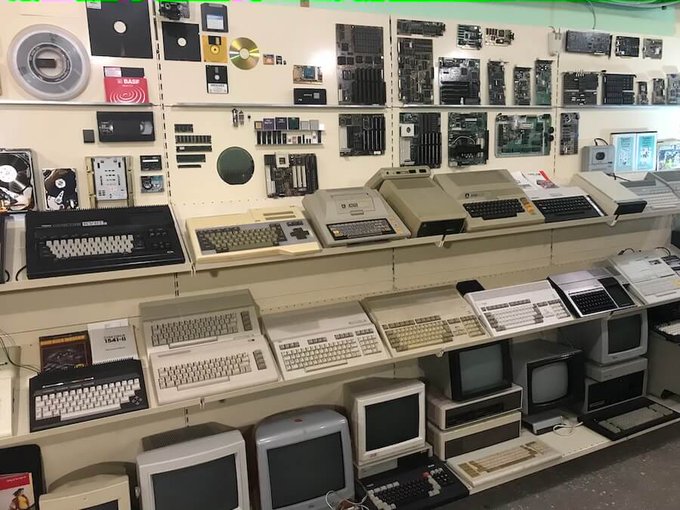
Russia’s invasion of Ukraine has destroyed a historic computer museum

Endgadget

Russia’s invasion of Ukraine has destroyed a historic computer museum

Igor Bonifacic, Contributing Writer – March 27, 2022

Club 8-bit

Earlier this week, Club 8-bit, one of Ukraine’s largest privately-owned computer museums, was destroyed during the siege of Mariupol. Kotaku spotted news of the event after its owner, Dmitry Cherepanov, took to Facebook to share the fate of Club 8-bit.

Image

“That’s it, the Mariupol computer museum is no longer there,” he said on March 21st. “All that is left from the collection that I have been collecting for 15 years are just fragments of memories on the FB page, website and radio station of the museum.”

Club 8-bit’s collection included more than 500 pieces of computer history, with items dating from as far back as the 1950s. Gizmodo visited the museum in 2018, describing it at the time as “one of the largest and coolest collections” of Soviet-era computers to be found anywhere in the world. It took Cherepanov more than a decade to collect and restore many of the PCs on display at Club 8-bit. What makes the museum’s destruction even more poignant is that it documented a shared history between the Ukrainian and Russian people.

Thankfully, Cherepanov is alive, but like many residents of Mariupol, he has lost his home. If you want to support Cherepanov, he has opened a PayPal account accepting donations to help him and other Ukrainians affected by Russia’s invasion of Ukraine. Since the start of the war, nearly 10 million people have been displaced by the conflict, making it the fastest-growing refugee crisis since the second world war.

Another Russian quagmire: Putin and the shadow of Afghanistan

CBS News

Another Russian quagmire: Putin and the shadow of Afghanistan

CBS News – March 27, 2022

Long before Russia invaded Ukraine, long before you ever heard of Vladimir Putin, Russia invaded Afghanistan. It was Christmas of 1979, and Michael Vickers was working for the CIA. “Nobody gave the Afghans a chance in 1979,” he said.

And yet, “It was the only time the Red Army had been defeated in its history.”

It’s only a month into Putin’s invasion of Ukraine and already what was supposed to be a cakewalk has turned into a bloody slog. Vickers said, “Putin’s in a, probably even a tougher box than the Soviets were then.”

An Afghan guerrilla stands atop a damaged Soviet-built armored vehicle left behind by the Red Army and Afghan Communist troops at the Chawni garrison outside Jail, in Afghanistan's eastern Paktia province, May 24, 1988. / Credit: Don North/AP
An Afghan guerrilla stands atop a damaged Soviet-built armored vehicle left behind by the Red Army and Afghan Communist troops at the Chawni garrison outside Jail, in Afghanistan’s eastern Paktia province, May 24, 1988. / Credit: Don North/AP

“Tougher box, how?” asked CBS News national security correspondent David Martin.

“His economy is being destroyed. You have to look at this and see Russian power being destroyed, you know, both militarily and economically, and its international position,” said Vickers. “How long are you going to let this go on?”

“Well, how long? The Soviets are in Afghanistan for ten years. Is that the kind of time frame we’re looking at for Ukraine?”

“I think the time frame is shorter,” Vickers replied. “I don’t see how Russia takes the pain over a sustained period of time.”

Russia’s war in Ukraine: How it came to this Why Russia’s tank war stalled in Ukraine (“Sunday Morning”)Ukraine vs. Russia: A modern-day David vs. Goliath story (“Sunday Morning”)Defending against “a dictator on the prowl” (“Sunday Morning”)

The Kremlin sent 100,000 troops into Afghanistan, 150,000 into Ukraine.

“Soviet army, as bad as it performed in a lot of cases in Afghanistan in the eighties, did a lot better than the Russians are doing in Ukraine,” Vickers said.

Putin has been unable to achieve his initial goal of seizing the capital of Kyiv and overthrowing the Zelensky government, although he is expected to regroup and try again.

The Russian army has suffered tremendous losses in manpower and materiel in Ukraine, and has so far failed to capture and hold major cities.  / Credit: CBS News
The Russian army has suffered tremendous losses in manpower and materiel in Ukraine, and has so far failed to capture and hold major cities. / Credit: CBS News

Martin asked, “When people talk about Putin doubling down, what can he double down with?”

“He’s really doubled down on this population destruction strategy, the scorched-earth strategy,” Vickers replied. “I mean, that’s really all he’s got left.”

“If Putin succeeds in seizing Kyiv and installing a puppet regime, what happens next?”

“I don’t think a puppet regime could survive at all. The Russian army really can’t pacify the country. The population hates them.”

The parallels between the wars in Afghanistan and Ukraine are striking, with one glaring difference: In 1985, when the Red Army was mired in Afghanistan, the man at the top in the Kremlin was the reform-minded Mikhail Gorbachev. “He said, ‘All right, we’re going to try to win this war one last time. I’ll give you more troops, but you’ve got a year or two to win it,'” Vickers said.

“Gorbachev, in effect, doubled down?”

“He did double down, and then by early ’86 he started looking for an exit.”

In the months and years after, the Berlin Wall came down, and the Soviet Union collapsed.

Martin asked, “Could Ukraine bring about the collapse of Putin’s Russia?”

“I think for the first time in 22 years his continued rule is more of a question mark,” said Vickers. “Even if he survives, the Russian state is likely to be severely weakened.”

Weakened by an invasion intended to restore the Russian empire.

“What does he do when you’re losing for the first time?” Vickers asked. “He had won smaller victories, and now you’re losing big? What do you do?”

Turkey says world cannot ‘burn bridges’ with Moscow

Reuters

Turkey says world cannot ‘burn bridges’ with Moscow

March 27, 2022

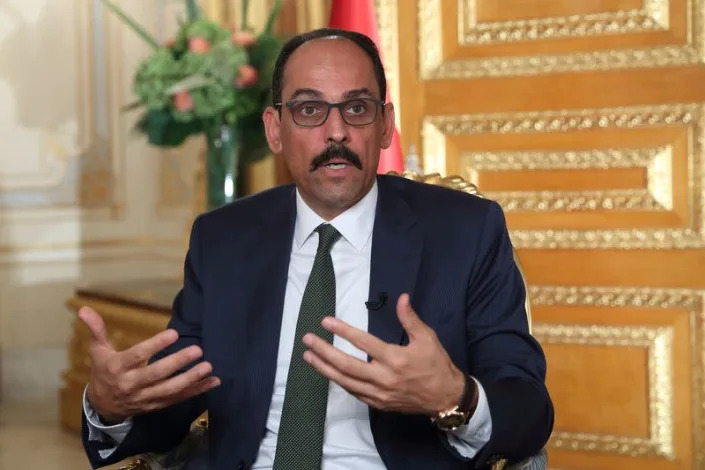
FILE PHOTO: Turkish President Erdogan’s spokesman Ibrahim Kalin is pictured during an interview in Istanbul

DOHA (Reuters) – Turkey and other nations must still talk to Russia to help end the war in Ukraine, Turkey’s presidential spokesman said on Sunday, adding that Kyiv needed more support to defend itself.

NATO member Turkey has good relations with both Russia and Ukraine and has sought to mediate in the month-long conflict.

“If everybody burns bridges with Russia then who is going to talk to them at the end of the day,” Ibrahim Kalin told the Doha international forum.

“Ukrainians need to be supported by every means possible so they can defend themselves … but the Russian case must be heard, one way or the other,” so that its grievances could be understood if not justified, Kalin added.

Ukrainian President Volodymyr Zelenskiy has urged the West to give his country tanks, planes and missiles to fend off Russian forces. The West has responded to Russia’s invasion by slapping sweeping economic sanctions on Moscow.

Ankara says Russia’s invasion is unacceptable but opposes the Western sanctions on principle and has not joined them.

Turkey’s economy, already strained by a December currency crisis, relies heavily on Russian energy, trade and tourism, and since the war began on Feb. 24 thousands of Russians have arrived in Turkey, seeing it as a safe haven from the sanctions.

Ahmet Burak Daglioglu, head of Turkey’s investment office, told the forum separately that some Russian companies were relocating operations to Turkey.

Asked on a panel about Turkey doing business with any people which could be of benefit to President Vladimir Putin, he said: “We are not targeting, we are not chasing, we are not pursuing any investment or capital that has a question mark on it.”

Two superyachts linked to Russian billionaire Roman Abramovich have docked in Turkish resorts.

Western governments have targeted Abramovich and several other Russian oligarchs with sanctions as they seek to isolate Putin and his allies over Moscow’s invasion of Ukraine.

(Reporting by Ghaida Ghantous, Andrew Mills and Jonathan Spicer; Editing by Edmund Blair and Gareth Jones)

Syrian eyewitness details crimes against humanity

CBS News

Syrian eyewitness details crimes against humanity

Guest Author – March 27, 2022

A key eyewitness to Syrian crimes against humanity is speaking out for the first time on CBS News, describing the atrocities he witnessed at a pivotal moment — as the West sounds alarms about civilian deaths in war-torn Ukraine.

“The Gravedigger,” a codename he is using because of ongoing threats against him and his family, described in an interview the wrenching details of the Russian-backed assaults on the Syrian population, and said they provide worrying indications of what is to come.

“I see the news coming out of Ukraine, my heart hurts because I know what Russia has done in Ukraine — what it can do — because I know what it’s done in Syria,” he said.

Russia’s support has been critical for years in keeping the government of Syrian President Bashar Al-Assad in power. The human cost of the more than decadelong civil war has been staggering: United Nations estimates put the number of Syrians dead at 400,000 in the conflict that followed the peaceful Arab Spring pro-democracy movement.

“As far as Putin and Assad are concerned, they should go to the trash bin of history for what they’ve done in the world,” the eyewitness told CBS News.

Earlier this month, he spoke to committees on Capitol Hill about the heinous crimes in Syria, including the dumping of thousands of bodies in mass graves. CBS News has learned that he also briefed officials at the White House and the State Department. He is working with the advocacy group, the Syrian Emergency Task Force.

In a landmark decision in January, a German court found former Syrian colonel Anwar Raslan guilty of crimes against humanity, based on the Gravedigger’s account and other evidence.

“Twice a week, multiple trailer trucks would come and each truck would have upwards of 100 to 400 or more bodies,” he said. “They were tortured to death, you could see clearly the signs of torture on their bodies. … This was a systematic machinery of death.”

At one point during the interview, he put his head in his hands, saying one prisoner dumped at the mass grave was not yet dead.

“When the intelligence officer saw that this person was alive, he ordered the bulldozer driver to drive over the body and killed him on the spot,” he said.

He pointed CBS News to a site called Al Qutayfah near the Syrian capital, where satellite images show its transformation from a barren field to a series of trenches.

“Everything that was going on, the mass graves, were systematic and were part of what the Assad regime wanted to do,” he said.

Watch more of this interview and how Russian President Vladimir Putin’s playbook for Ukraine was written in Syria on Monday on “CBS Mornings.”

Thousands of Russians in Prague protest against war in Ukraine

Reuters

Thousands of Russians in Prague protest against war in Ukraine

Jason Hovet – March 26, 2022

Prague's Russian community protests against war in Ukraine, in Prague

PRAGUE (Reuters) – Thousands of Russians marched through Prague on Saturday, waving the white-blue-white flag that has become a symbol of protests against Moscow’s invasion of Ukraine.

Carrying signs that read “Killer” over a picture of President Vladimir Putin and chanting “No to War”, protesters walked from Prague’s Peace Square through the centre of the Czech capital. Police put the number of marchers at about 3,000.

“We are against Putin,” said Alexander Sibrimov, a 19-year-old student who attended the protest with his father.

“We don’t agree with his politics. This is a way to show the world that the things happening in Ukraine are not right.”

Moscow calls its actions in Ukraine a “special military operation” to demilitarise and “denazify” its neighbour, and denies targeting civilians. Ukraine and its Western allies have called that a baseless pretext for an unprovoked invasion.

The Czech Republic is home to 45,000 Russians, the fourth largest foreign community in the former communist-ruled country.

Nearly 200,000 Ukrainians lived in the Czech Republic – making them the biggest foreign community – before Russia’s invasion of Ukraine on Feb. 24.

The Czech government estimates 300,000 Ukrainians have fled to the country.

“This is an act to show the Czech Republic and the Czech people that Russians (are) against Putin,” protest organiser Anton Litvin said.

The protesters in Prague said they believed they were reflecting what many people in Russia feel but are unable to say.

“Just because we are Russians doesn’t mean we are automatically for the war. We are against the war,” said protester Oleg Golopyatov, a former soldier who has lived in Prague for 15 years. “Ukraine is a normal country. It is terrible (what is happening there).”

(Reporting by Jason Hovet, Writing by Michael Kahn, Editing by Timothy Heritage)

Ukraine captures one of Russia’s most advanced electronic warfare systems, which could reveal military secrets, reports say

Business Insider

Ukraine captures one of Russia’s most advanced electronic warfare systems, which could reveal military secrets, reports say

Alia Shoaib – March 26, 2022

A Russian Krasukha-4 electronic warfare system.
A Russian Krasukha-4 electronic warfare system.Mil.ru/Wikimedia Commons/Attribution
  • Ukraine has seized the command module of a Krasukha-4, one of Russia’s most advanced electronic warfare systems.
  • The hi-tech unit was found abandoned on the outskirts of Kyiv.
  • Western spy agencies will examine it, say reports.

Ukrainian forces have seized part of one of Russia’s most advanced electronic warfare systems, which could reveal its military secrets, reports say.

The Krasukha-4 command module was found abandoned on the outskirts of Kyiv partly damaged but otherwise intact, The Times of London reported.

Photos of the unit posted on social media appear to show the container containing the module covered in tree branches, possibly in a hasty camouflage attempt by retreating Russian forces.

—🇺🇦 Ukraine Weapons Tracker (@UAWeapons) March 22, 2022

The system is designed to jam low-orbit satellites, drones, and missiles, but it is also believed to be able to track NATO aircraft, The Times said.

A complete Krasukha-4 is a two-part system consisting of a command post module and an electronic warfare system, mounted separately on two trucks.

It is believed that a Krasukha-4 system was used against Turkish Bayraktar TB2 drones in Syria, interfering with their control signal and causing them to crash, according to The Telegraph.

The highly-rated Bayraktar TB2 drones are among those used by Ukrainian forces, used to destroy Russian tanks, armor, and truck convoys.

The seized unit will be examined by Western spy agencies, The Telegraph reported, adding that it would likely be taken by road to the US Air Force’s Ramstein Air Base in Germany, before being flown to the US.

Examining the unit could reveal secrets of how it works, which could help Ukraine and Western allies render it useless on the battlefield.

Justin Crump, a military veteran and CEO of risk analysis consultancy Sibylline, told The Times that the seizure was among “lots of goodies that have been recovered on the battlefield.”

“It shows how scattered the fighting is and the lack of communications on the Russian side,” Crump told the paper.

Biden summons history in sweeping call for renewed alliance of democracies

The Guardian

Biden summons history in sweeping call for renewed alliance of democracies

Jessica Glenza – March 26, 2022

In a speech in Poland on Russia’s invasion of Ukraine, Joe Biden indicated his intent to re-position the US as a leader in global affairs after four years of disengagement during the Trump administration.

It is not a task many thought Biden would so firmly take on when he took office in 2021. Initially, Biden focused on healing domestic wounds following four chaotic years of the Trump administration and the emergence of the Covid-19 pandemic.

But Biden’s speech in Poland appeared designed to signal a shift in US policy and a generational call to arms for democratic countries to unite against autocracy in a years-long foreign policy project, with the US at its head.

Related: Biden: ‘butcher’ Putin cannot be allowed to stay in power–

“In this battle, we need to be clear eyed,” said Biden. “This battle will not be won in days or months, either. We need to steel ourselves for the long fight ahead.”

That unity, Biden signaled, would need to include democracies that have at times been at odds with one another.

The sweeping speech ended with a call for “a different future, a brighter future rooted in democracy and principle, hope and light”.

The president used the speech to draw historical parallels between the war in Ukraine, which began a month ago when Russian forces invaded, to the second world war; moments symbolic of freedom including the fall of the Berlin Wall; and the words of Pope John Paul II, who was Polish and who told the world: “Be not afraid.”

In its sweep and scope, the speech had echoes of other major foreign policy addresses given by US presidents on European soil, such as Ronald Reagan’s “tear down this wall” speech in Berlin in 1987 and John F Kennedy’s Ich bin ein Berliner call in 1963.

“All of us, including here in Poland, must do the hard work of democracy each and every day – in my country as well. That’s why I came to Europe again this week,” said Biden. “For all freedom-loving nations, we must commit now to be in this fight for the long haul.”

Biden highlighted the US commitment to Ukraine and Nato, including a pledge to defend “every inch of Nato territory with the full force of our collective power”. The US and allies “maintain absolute unity – we must, among the world’s democracies”, he said.

biden shakes hands with person as crowd gathers around him
Biden meets with Ukrainian refugees and humanitarian aid workers during a visit to PGE Narodowy Stadium in Warsaw on Saturday. Photograph: Evan Vucci/AP

“This is the task of our time. The task of this generation,” the president said about the fight against autocracy.

The speech was a far cry from one of Biden’s earliest foreign policy decisions – to follow through with the withdrawal of troops from Afghanistan after 20 years of war. In August 2021, the administration began an urgent evacuation of Americans and Afghan allies, after the capital, Kabul, fell to the Taliban in a matter of days.

Related: Russia’s invasion crystallises divide between west and rest of world

“I was not going to extend this forever war, and I was not extending a forever exit,” Biden said in August 2021.

Biden also used the speech to highlight commitments he said showed “the people of Ukraine can count on the United States”, including accepting 100,000 refugees and providing $300m in humanitarian aid and thousands of tons of food, water and medicine.

Biden called Vladimir Putin a “tyrant” and appealed directly to the Russian people. He invoked the struggles of the second world war, including the siege of Leningrad, which would be “fresh in the memory of many grandparents”.

“You, the Russian people, are not our enemy,” said Biden. “I refuse to believe you welcome the killing of innocent children and grandparents, or that you accept hospitals, schools, maternity wards – for God’s sake – being pummeled with Russian missiles and bombs.”

“These are not memories past,” said Biden. “This is exactly what the Russian army is doing to Ukraine right now.”

Market giants Larry Fink and Howard Marks say the Ukraine conflict will end globalization.

Business Insider

Market giants Larry Fink and Howard Marks say the Ukraine conflict will end globalization. Here are 3 key takeaways for investors.

Harry Robertson – March 26, 2022

Larry Fink BlackRock
BlackRock boss Larry Fink thinks the end of globalization is here.Taylor Hill/Getty Images
  • BlackRock’s Larry Fink and Oaktree’s Howard Marks have predicted that globalization is coming to an end.
  • The Russia-Ukraine war and COVID-19 are making companies and countries rethink their reliance on others, they said.
  • Deglobalization would have dramatic consequences for the economy, and for investors used to a highly integrated world.

Globalization has shaped the world for the last 30 years, but it’s now coming to an end. That’s the view of two of the world’s best-known investors, BlackRock chief Larry Fink and Oaktree chair Howard Marks.

“The Russian invasion of Ukraine has put an end to the globalization we have experienced over the last three decades,” Fink wrote in his latest letter to shareholders last week.

A day earlier, Marks had shared a similar sentiment in one of his well-read memos. He said the war had made companies and governments realize how they’d become reliant on others.

“The recognition of these negative aspects of globalization has now caused the pendulum to swing back toward local sourcing,” he said.

But what exactly is globalization? Economists at the Peterson Institute define it as the growing interdependence of the world’s economies, people and cultures. It’s brought about by crossborder trade in goods and services, as well as by flows of investment, people and information.

An end to the process would have dramatic consequences, not least for investors, who have become used to a highly integrated world.

Here are three areas where the end of globalization — if it comes — could have a profound impact.

Global energy markets

Russia’s invasion of Ukraine has had a dramatic impact on the global economy and markets. No where is that more clear than in surging commodities prices. Brent crude oil, which stood at around $64 a barrel a year ago, is now trading at more than $110.

In Fink’s view, higher fossil-fuel prices will help drive the transition to green energy. That means the prospects for renewable energy companies could be bright in the medium term.

“More than ever, countries that don’t have their own energy sources will need to fund and develop them – which for many, will mean investing in wind and solar power,” Fink wrote.

Yet the BlackRock boss was less optimistic about the short term. A need to cut back on Russian oil has driven countries like the US to increase their own fossil-fuel production.

Many investors have pivoted toward energy companies and commodities, which plenty believe are set to keep rising over the next year as the war plays out.

Inflation

Closely linked to energy is the question of inflation. It’s above 5% in Europe and the UK, and has surged to a 40-year high in the US.

An end to globalization is likely to make things worse, Fink and Marks warned.

Marks highlighted how “offshoring” — in which companies use cheap foreign labor to produce their products — has led to a sharp fall in the cost of goods.

The end of that process could give working-class communities in the US and Europe a boost. But it could also drive up prices, simply because Western workers are more expensive.

“A large-scale reorientation of supply chains will inherently be inflationary,” Fink wrote. “Central banks must choose whether to live with higher inflation, or slow economic activity and employment to lower inflation quickly.”

Crypto and other opportunities

BlackRock’s Fink, who previously suggested bitcoin might be worthless, now thinks digital currencies may have a role to play in a deglobalizing world. He said the war will force countries to reconsider their currency dependency.

“A global digital-payment system, thoughtfully designed, can enhance the settlement of international transactions while reducing the risk of money laundering and corruption.”

Marks went into fewer specifics, but ended his memo on a hopeful note.

“After many decades of globalization and cost minimization, I think we’re about to find investment opportunities in the swing toward reliable supply,” he said.

Russia ‘losing more ground’ as Ukrainians ‘reclaim towns and positions near Kyiv’

Yahoo! News

Russia ‘losing more ground’ as Ukrainians ‘reclaim towns and positions near Kyiv’

Ellen Manning – March 25, 2022

Ukrainian soldiers search for bodies in the debris at the military school hit by Russian rockets the day before, in Mykolaiv, southern Ukraine, on March 19, 2022. - Ukrainian media reported that Russian forces had carried out a large-scale air strike on Mykolaiv, killing at least 40 Ukrainian soldiers at their brigade headquarters. (Photo by BULENT KILIC / AFP) (Photo by BULENT KILIC/AFP via Getty Images)
Ukraine has managed to reoccupy towns and defensive positions up to 21 miles (35 kilometres) east of Kyiv, according to the Ministry of Defence (MoD). (Getty)

Russian forces are losing ground in Ukraine, allowing the country’s own forces to reclaim certain key towns and positions just 20 miles from Kyiv, according to the UK’s Ministry of Defence (MoD).

Ukrainian counter-attacks and issues with Russian supply lines are both allowing Ukraine to retake towns and defensive positions up to 21 miles (35km) east of Kyiv, the MoD said in an intelligence update.

After invading Ukraine a month ago, Russia has so far failed to capture a single major city.

Despite warnings that the war could see a quick Russian victory, its armoured columns are moving much slower than expected, with forces taking heavy casualties and running low on supplies.

The MoD shared its latest intelligence update on Twitter. (Twitter/MoD)
Russian invasion of Ukraine - territory believed to be controlled by Russia. (PA)
Russian invasion of Ukraine – territory believed to be controlled by Russia. (PA)

Read more: Moscow ‘plotting to seal off Crimea’ to stop ‘panicking Russians’ from fleeing

In its intelligence update posted on Twitter on Friday (25 March), the MoD said: “Ukrainian counter-attacks, and Russian forces falling back on overextended supply lines, has allowed Ukraine to reoccupy towns and defensive positions up to 35 kilometres east of Kyiv.

“Ukrainian forces are likely to continue to attempt to push Russian forces back along the north-western axis from Kyiv towards Hostomel Airfield.

“In the south of Ukraine, Russian forces are still attempting to circumvent Mykolaiv as they look to drive west towards Odesa, with their progress being slowed by logistic issues and Ukrainian resistance.”

Russian President Vladimir Putin has continued to claim the invasion is going to plan, but as well as unflinching opposition from Ukrainian forces, he is also said to face issues on home turf, with widespread protests in Russian cities and the risk of being ousted in a coup led by his own security services.

Watch: Kyiv mayor Vitali Klitschko says he cries ‘every day’ at destruction Putin has caused. https://s.yimg.com/rx/martini/builds/42201637/executor.html

Exiled Russian human rights activist, Vladimir Osechkin, said information from an unnamed source within Russia’s Federal Security Service (FSB) suggested unrest is growing within the service.

Osechkin, who is wanted in Russia for his work exposing abuse in Russia’s prisons, told The Times Putin is being blamed for Russia’s inability to claim Ukraine, and senior figures are beginning to become disillusioned with the war over increasingly oppressive sanctions brought in by the West which are biting at the lives of ordinary Russians.