Democratic star, says it’s time to answer conservative culture war attacks

Yahoo! News

Mallory McMorrow, rising Democratic star, says it’s time to answer conservative culture war attacks

Alexander Nazaryan, Senior W. H. Correspondent – June 1, 2022

WASHINGTON — It is fair to say that until last month, Michigan state Sen. Mallory McMorrow was not a figure of national political prominence. That changed on April 19, when she delivered an impassioned speech countering Republican accusations that Democrats like she were “groomers” for supporting the rights of gay and trans students.

The four-minute broadside immediately roused Democrats who had been huddled in a defensive crouch for months; one circulating version has been viewed more than 15 million times

“I’m going to start talking that way,” Democratic consultant James Carville told the Washington Post.

“A role model for the midterms,” read a headline in the New Yorker.

Michigan state Sen. Mallory McMorrow.
Michigan state Sen. Mallory McMorrow at the state Capitol in Lansing, Mich. (Al Goldis/AP)

The speech came after months of charges from politicians like Ron DeSantis, the ambitious Republican Florida governor, that teachers who wanted to discuss sexuality and gender were, in fact, trying to indoctrinate children. The charges were baseless but effective, and books like “Gender Queer” suddenly became the targets of national bans.

“There was a hesitancy to want to talk about things, at least for me,” McMorrow told Yahoo News during a recent visit to Washington, D.C.

That changed on April 13, when Republican state Sen. Lana Theis gave an arresting invocation to open the Michigan State Senate session. “Dear Lord, across the country we’re seeing in the news that our children are under attack,” Theis said. “That there are forces that desire things for them other than what their parents would have them see and hear and know. Dear Lord, I pray for Your guidance in this chamber to protect the most vulnerable among us.”

McMorrow walked out of the legislative chamber along with two other Democrats, seeing Theis’s concern as a thinly disguised reference to the “grooming” line of attack. She did not think much of her response to what had seemed like intentional political provocation, a local Republican trying to replicate the rhetoric of Fox News.

“I guess she took offense to that,” McMorrow said of Theis.

Five days later, Theis sent out a fundraising email that seemed to confirm as much. “These are the people we are up against,” the email said. “Progressive social media trolls like Senator Mallory McMorrow (D-Snowflake) who are outraged they … can’t groom and sexualize kindergarteners or that 8-year-olds are responsible for slavery.”

Michigan state Sen. Lana Theis.
Michigan state Sen. Lana Theis. (Senator Lana Theis via Facebook)

McMorrow said she was stunned to find herself a target of such attacks. “She’s a mom, I’m a mom, and being accused of, let’s be honest, befriending children for the purpose of molesting them, is horrific,” McMorrow recalled.

She and Theis were not exactly friends, but they had been friendly. “I have gone out for coffee in her district. We talked about our families, and she asks about my baby all the time,” McMorrow told Yahoo News.

“She likes my truck,” adds her husband Ray Wert, who accompanied McMorrow to Washington and is the former editor of automotive website Jalopnik. (Theis did not answer a request for comment from Yahoo News.)

The fundraising email had gone out on a Monday. On Tuesday came McMorrow’s response.

“I am the biggest threat to your hollow, hateful scheme,” McMorrow said from the statehouse floor.

Describing herself as “a straight, white, Christian, married, suburban mom,” the 35-year-old New Jersey native and Notre Dame graduate positioned herself as precisely the kind of suburban voter whom the GOP “grooming” attacks were trying to court.

She addressed not only Republican attacks on gay and trans kids but also charges that schools were imposing divisive racial justice ideas that are broadly (and often inaccurately) deemed Critical Race Theory.

A group of people hold signs reading I am not an oppressor, and Children should learn to see people for who they are — not what they look like.
People hold up signs during a rally against “critical race theory” (CRT) being taught in schools at the Loudoun County Government center in Leesburg, Virginia on June 12, 2021. (Andrew Caballero-Reynolds/AFP via Getty Images)

“No child alive today is responsible for slavery,” McMorrow said in her viral speech. “No one in this room is responsible for slavery. But each and every single one of us bears responsibility for writing the next chapter of history.”

Dismaying as it had been to be labeled a pedophile, McMorrow says she tried to imagine what it was like to be gay or Black in a climate she described as relentless “fearmongering” by Republicans. “You are targeted and marginalized,” she said. “Just for existing.”

Coming amid increasingly downbeat predictions for Democrats in next fall’s congressional midterms, McMorrow’s rebuttal proved a welcome surprise at a time when Democrats were still reeling from discontent over pandemic-related school closures, not to mention the gender- and race-related attacks that followed.

In Virginia, suburban frustrations helped power the Republican business executive Glenn Youngkin to an upset victory over Democratic candidate and former governor Terry McAuliffe in that state’s gubernatorial race last fall. The suburbs hugging the Potomac — the same ones that had voted for Biden only months before — provided the crucial difference.

“Suburban moms who have left the Republican Party in big numbers came back,” a jubilant Bob McDonnell — Virginia’s last Republican governor before Youngkin — told the Washington Post after the latter’s unlikely win over McAuliffe.

Virginia Gov. Glenn Youngkin.
Virginia Gov. Glenn Youngkin on Feb. 3. (Robb Hill for The Washington Post via Getty Images)

In McMorrow’s Michigan and across the Midwest, Republicans now control nearly all of the state legislatures. Democrats in Washington have found their messages about a post-pandemic economic renewal unconvincing to a suburban and rural electorate uneasy about social issues like education and crime.

Democrats need to reawaken those voters’ sense of moral responsibility, McMorrow believes, while acknowledging the challenges they face. “Moms are tired after the past few years with COVID, with school closures, trying to balance work and school, and I’ve seen attempts to take advantage of that exhaustion,” she told Yahoo News. “What I try to say, specifically to other white suburban moms, is this is a moment to decide to take our own identity and back fight for the types of communities we want.”

Perhaps precisely because she is herself a straight, white suburbanite, McMorrow has served to remind Democrats of what they stood for when they marched in the summer of 2020 for social justice, what they hoped for when they voted for Biden that fall. “I think I felt the same way a lot of people did on Inauguration Day, which was, we all worked so hard in 2020 to help President Biden get elected,” she says. “And it felt like we could breathe a sigh of relief. And I don’t think that was naive.”

Despite a promising start, new variants of the coronavirus spoiled Biden’s promised “summer of freedom,” and a sort of pandemic malaise has settled in. A messy withdrawal from Afghanistan added foreign policy woes to domestic ones. Biden’s infrastructure plan passed, but his more ambitious raft of social spending programs, known as Build Back Better, didn’t. Inflation climbed ever higher, making it increasingly difficult for many people to afford groceries and gas.

President Biden speaks at a lectern.
President Biden speaks during a Memorial Day address. (Michael Reynolds/EPA/Bloomberg via Getty Images)

McMorrow saw some of her conservative constituents give over to Trump’s false claims that the election had been stolen from him. That conspiracy theory has melded with a resistance to coronavirus safety measures and fears of demographic change to fuel a pervasive feeling of grievance and threat.

She describes herself as wanting to speak for other suburban moms: perhaps the ones who put up Black Lives Matter and Hate Has No Home Here signs in their yards, but have, in the last two years, grown successively more exhausted with school closures, reports of rising crime and inflation.

“The signs are a wonderful signal and reminder of who we are and what kind of community and country we want our kids to grow up in,” McMorrow told Yahoo News of front yard progressivism. “But the devastating reality is that Republicans are actively trying to dismantle that vision, and a sign isn’t enough without action. Because they’ll win unless we stop them.”

Almost exactly two years before she gave her now-famous speech, McMorrow watched as heavily armed anti-lockdown protesters invaded the Michigan statehouse.

“When you saw the photo of the four men and guns, what you don’t see is I’m right below them. Like literally,” she says of that day’s iconic image. “They were above our heads, taunting us. You know, fingers on triggers.”

“There’s ordinary Republican voters who see it as bulls***,” she says, even as she worries that many of them have bought into a strident and often false narrative about the country. “I’ve got a woman in my district who calls our office fairly regularly and leaves voicemails, and you can hear her voice like she’s genuinely upset. She believes the election was stolen,” she recalled. “She asks how I, as a woman, could support ‘biological men’ playing in women’s sports. When you know in Michigan, there’s two kids per year who apply for the waiver for getting to play on a team to match their gender.”

After the massacre of 19 children and two adults in Uvalde, Texas, last week, Republicans in the Michigan State Senate ended sessions early, in order, state Democrats said, to prevent a genuine discussion of gun policy.

Flowers and crosses surround the sign at Robb Elementary school in a makeshift memorial to the students and teachers who were killed there in a mass shooting.
A memorial surrounds the sign outside Robb Elementary School in Uvalde, Texas, following the mass shooting there. (Brandon Bell/Getty Images)

In response, McMorrow recorded a video from her office. She asked parents to dispense with the notion of a school shooting as “unimaginable” and to instead imagine the horror of their own children caught in the terrifying chaos

“Your phone rings. It’s the school,” They need you to come down to give a DNA sample,” a tearful McMorrow says into the camera. “The bodies are too mutilated to identify. So mutilated that they don’t even know how many kids there are.”

The video garnered hundreds of thousands of views, more evidence that McMorrow was hitting raw political nerves. Even before the new message, liberal commentator Keith Olbermann was touting her as a presidential candidate in 2024, positing a run with Texas gubernatorial candidate Beto O’Rourke. It was less a realistic ticket than a recognition that many Democrats feel that they need new people to say new things — and to say them more bluntly than their party elders have.

For the record, McMorrow said she isn’t going to seek the White House — at least not in 2024. “We’re in this mess because Republicans have known for decades to work from the bottom up,” she told Yahoo News. “What happens in the states is the most consequential thing on the ballot.”

The U.S. is sending Ukraine advanced rocket systems. Here’s why that artillery is so crucial.

NBC News

The U.S. is sending Ukraine advanced rocket systems. Here’s why that artillery is so crucial.

Patrick Galey and Erin McLaughlin and Dan De Luce – June 1, 2022

Russia is advancing in the east behind a barrage of artillery that has strained Ukrainian defenses and Western unity over support for a protracted war.

The United States’ much-anticipated decision to send Kyiv long-range missile systems that will allow its forces to fire farther and faster has likely come too late to save two key cities in the Donbas region that has become the focal point of the fighting.

But delivery of the weapons after months of urging from Ukrainian officials will help the country’s military face the next, potentially decisive stage of the conflict — as the Kremlin perhaps hinted at in response, accusing the U.S. of “deliberately pouring oil on the fire.”

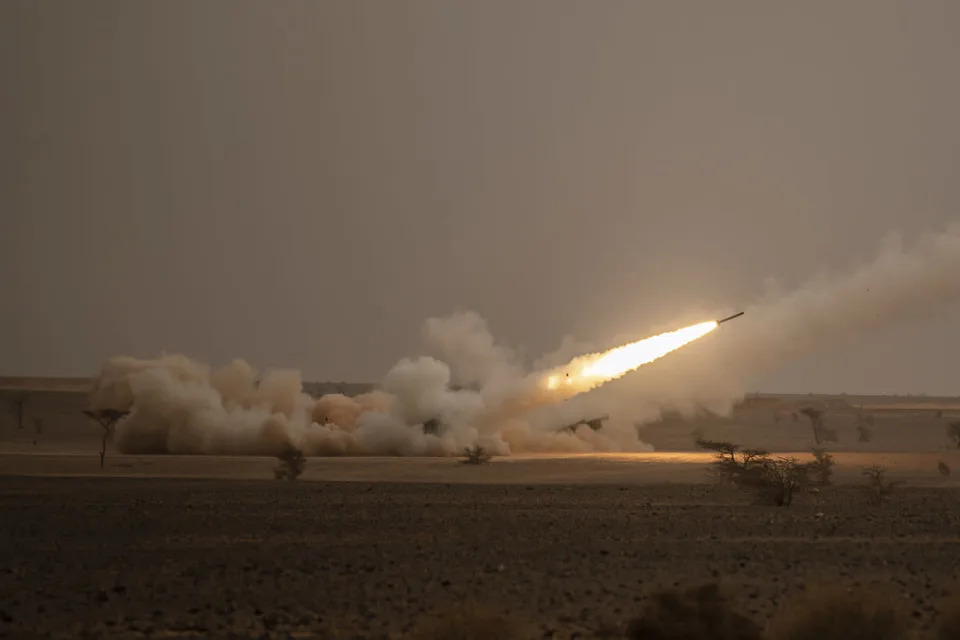
President Joe Biden announced Wednesday that the U.S. would be sending Ukraine the high mobility artillery rocket system, or HIMARS. “This new package will arm them with new capabilities and advanced weaponry, including HIMARS with battlefield munitions, to defend their territory from Russian advances,” he said in a statement.

The HIMARS is a variant of the longer-range multiple-launch rocket system, or MLRS. The U.S. is sending four of the rocket launch systems to Ukraine.

A senior Ukrainian official told NBC News after the announcement that he remained “very much worried… particularly since they have committed only a small battery of MLRSs, meaning they yet won’t make a large difference.”

MLRS missiles typically have a range of up to 40 miles, and can be equipped with GPS-guided missiles. This would be a significant upgrade of the Ukrainian artillery’s current range, which tops out at around 20 miles with the M777 howitzers its allies have so far provided.

The systems have the added benefit of being self-propelled, meaning they can be fired and moved fast enough to avoid enemy response salvos.

Phil Wasielewski, a fellow at the Philadelphia-based Foreign Policy Research Institute, said the systems would aid Ukrainian forces in the Donbas, where the battle has “turned into an artillery duel.”

He said that combined with their targeting capacity aided by commercial drones and counter battery radars, the systems would provide a “distinct qualitative and quantitative improvement” to Ukraine’s combat capability.

“These rocket artillery systems can destroy Russian cannon artillery systems and not be touched by them.”

Ukraine’s allies are slowly stepping up their exports of heavy weaponry, with Germany promising Wednesday to supply Ukraine with modern anti-aircraft missiles and radar systems.

However they are unlikely to arrive in time to save swaths of the country’s east from being battered and overrun.

The Russian assault in Ukraine’s industrial heartland has edged toward capturing two key cities, with the mayor of Sievierodonetsk — one of the last urban areas under Ukrainian control in Luhansk province and a key target of the Kremlin’s Donbas offensive — saying Wednesday that Russian forces now control around 80 percent of the ruined city.

A Donetsk People's Republic militia's multiple rocket launcher fires from its position not far from Panteleimonivka, in territory under the government of the Donetsk People's Republic, eastern Ukraine, on May 28, 2022. (Alexei Alexandrov / AP)
A Donetsk People’s Republic militia’s multiple rocket launcher fires from its position not far from Panteleimonivka, in territory under the government of the Donetsk People’s Republic, eastern Ukraine, on May 28, 2022. (Alexei Alexandrov / AP)

Lacking long-range missile capability, Ukrainian forces are experiencing heavy losses, with President Volodymyr Zelenskyy saying that up to 100 soldiers could be dying in battle each day in the east.

“The combination of artillery barrage, airstrikes and missile strikes is what we expected from Russia from the beginning of the war and they are grinding the Ukrainians down,” said William Alberque, director of strategy, technology and arms control at the International Institute for Strategic Studies.

In comments earlier this week, he said that if Ukrainian forces had the MLRS during Russia’s advance, they would have had a “better chance of breaking up Russian advances with little risk of destruction.”

Speaking before the announcements from Washington and Berlin, the senior Ukrainian official said his country had long been communicating to the U.S. and its allies what it needed to win the war.

“This is about long-range firearms, howitzers, MLRS, air defense,” the official told NBC News.

“This is an active artillery war. A war in which you need long-range firepower,” the official said. “This war is about shooting and moving. Who can shoot the longest and fastest wins.”

Dating back to before the Russian invasion, the Ukrainian government and its supporters in Congress have appealed to the Biden administration repeatedly for certain weapons, and the White House initially declined or it has taken weeks or months before approving the delivery of items such as anti-aircraft Stinger missiles and drones.

A man walks away from a burning house garage after shelling in the city of Lysytsansk in the eastern Ukrainian region of Donbas on May 30, 2022. (Aris Messinis / AFP - Getty Images)
A man walks away from a burning house garage after shelling in the city of Lysytsansk in the eastern Ukrainian region of Donbas on May 30, 2022. (Aris Messinis / AFP – Getty Images)

U.S. officials have grappled for weeks over sending the MLRS to eastern Ukraine, largely due to the systems’ extended ranges, which could potentially allow Ukrainian forces to fire directly into Russian territory.

Biden on Monday told reporters that the U.S. would not “send to Ukraine rocket systems that can strike into Russia.” A senior administration official said Ukraine has agreed not to use them to launch rockets into Russia.

Echoing Kremlin spokesman Dmitry Peskov’s comments, Russian Deputy Foreign Minister Sergei Ryabkov warned Wednesday that any arms supplies “increase the risks of a direct collision between Russia and the United States,” according to the state-owned RIA Novosti news agency.

Moscow’s messaging over the long-range weapons systems showed it “knows exactly how to play on the West’s doubts and fear of a direct NATO-Russia confrontation,” said Michael A. Horowitz, a geopolitical and security analyst who is the head of intelligence at the consultancy Le Beck International.

He said that it wasn’t too late for the weapons to help Ukrainian forces defend positions and stanch further Russian advances in the Donbas.

“But each day the West hesitates is a day Russian artillery rules the battlefield. Russian advances are preceded by massive fire. Each city lost by Ukraine is a city leveled to the ground, making each retreat even more painful,” Horowitz said.

Mark Cancian, senior adviser at the Center for Strategic and International Studies, said another Western concern was overloading Ukrainian forces with myriad new weapons systems, all of which require time for soldiers to be trained to use and maintain.

“The West has already given them artillery, armored personnel carriers, anti-artillery radars,” he said.

“If the Ukrainians had two years to absorb all this, that would be no problem. But they’re doing this in real time. We’re asking the Ukrainians to do in a couple of weeks what it would take us several months to do.”

A defense official said Tuesday that the Defense Department believes it can get the training for Ukrainian troops down to a week or two for basic operations and that there will be longer training courses for maintenance of the system.

Hundreds of Russian soldiers have deserted or refused to fight in Ukraine, compounding major losses in the war, report says

Business Insider

Hundreds of Russian soldiers have deserted or refused to fight in Ukraine, compounding major losses in the war, report says

Kelsey Vlamis – June 1, 2022

Russian Spetsnaz troops military parade
Russian Spetsnaz troops march through Red Square in a Victory Day military parade, May 9, 2021.Mikhail Svetlov/Getty Images
  • Russian troops have suffered major losses since invading Ukraine in February.
  • Hundred of soldiers have also refused to fight, according to military documents obtained by the WSJ.
  • Reports have also emerged of low morale among Russian troops in Ukraine.

Hundreds of Russian soldiers have refused to fight or fled their posts since the war in Ukraine began, according to report published Wednesday by The Wall Street Journal.

“So many people don’t want to fight,” Russian lawyer Mikhail Benyash told the outlet. Benyash is representing a dozen service members of Russia’s National Guard, which typically stamps out protests in Russia, who were dismissed after refusing to take part in the invasion of Ukraine.

The Guardian reported last week that at least 115 Russian national guardsmen said they were fired for refusing to fight. The lawsuit they brought challenging their dismissals was rejected by a Russian court when the judge found their firings justified for “refusing to perform an official assignment.”

Benyash told The Journal soldiers who refuse to fight have been dismissed but not criminally charged because Russia has not formally declared war against Ukraine. Russian President Vladimir Putin has instead described the invasion as a “special military operation.”

Benyash also said he received requests for legal help from more than 1,000 service members and employees of the Russian agency that oversees domestic policing. He said many had either refused to fight in Ukraine or quell protests in occupied towns.

Agora, a Russian human rights group, also told The Journal upwards of 700 Russian service members contacted the group for legal assistance in relation to refusing orders.

The desertions and refusals to fight have compounded the heavy losses Russian troops have experienced in Ukraine and a shortage of boots on the ground. The UK’s defense ministry said last month Russia had likely lost one-third of its its invading ground combat forces in Ukraine since February.

Reports have also emerged of low morale among Russian troops, including going to desperate lengths to get sent home from the war. One Russian soldier said his commander shot himself in the leg just so he could leave, according to intercepted audio published by Ukraine officials.

A Russian soldier who didn’t want to fight in Ukraine and went into hiding after fleeing his post says ‘none of us wanted this war’

Business Insider

A Russian soldier who didn’t want to fight in Ukraine and went into hiding after fleeing his post says ‘none of us wanted this war’

Kelsey Vlamis – June 1, 2022

Russian troops Ukraine tensions
Russia invaded Ukraine in February.Russian Defense Ministry Press Service/Associated Press
  • Hundreds of Russian soldiers have deserted or refused to fight the war in Ukraine, The WSJ reported.
  • One soldier said he fled his base the morning of the invasion and went into hiding.
  • Russian ground forces have also experienced heavy losses in Ukraine.

A Russian soldier who went into hiding to avoid the war in Ukraine said most soldiers, like him, didn’t want to go.

“None of us wanted this war,” Albert Sakhibgareev told The Wall Street Journal.

The 24-year-old was stationed at a military base in Russia near the border with Ukraine in February. On the morning of February 24, the day Russia launched its full-scale invasion, shelling landed within two miles from his location and military aircraft in the sky appeared to be heading to Ukraine, The Journal reported. When Sakhibgareev saw a headline on Telegram that said “Russia Invades Ukraine” he panicked and left the base.

He’s one of hundreds of Russian soldiers who have deserted or refused to fight since the war in Ukraine began, according to the report published by The Journal on Wednesday. At least 115 Russian national guardsmen said they were fired after refusing to fight, according to The Guardian.

The unwillingness to fight has been compounded by the heavy losses Russian troops have experienced in Ukraine. The UK’s defense ministry said last month Russia had likely lost one-third of its ground combat forces in Ukraine since the invasion began.

After months of setbacks, including getting pushed out of Kyiv and Kharkiv, Russian forces have made recent gains in the Donbas region after shifting their focus to eastern Ukraine. Analysts told Insider’s Bill Bostock the advances for Russia marked a reversal from earlier stages of the war, but that the momentum may not last long.

Sakhibgareev was eventually contacted by Russian military officials, who convinced him to come back but allowed him to instead go to a base that was further from battle, The Journal reported. Sakhibgareev’s lawyer, Almaz Nabiev, told the outlet the military could still decide to press charges against him for desertion.

Reports of low morale among Russian soldiers have also emerged throughout the war. One Russian soldier said his commander shot himself in the leg just so he could go home, according to intercepted audio released by Ukrainian officials.

Ukraine’s Muslim Crimea battalion yearns for lost homeland

Reuters

Ukraine’s Muslim Crimea battalion yearns for lost homeland

Max Hunder June 1, 2022

Ukraine's Crimea battalion yearn for lost homeland

YASNOHORODKA, Ukraine (Reuters) – Standing amid the charred remains of a roadside hotel on a major highway near Kyiv, Isa Akayev explained what drove him to build his Muslim volunteer unit and fight for Ukraine.

“I just want to return home, to Crimea,” said Akayev, 57, a gently-spoken father of 13 who sports a long greying beard and shaven head.

When Russia annexed his home region from Ukraine in 2014, Akayev moved to Kyiv and formed the Crimea battalion, a small unit dominated by Crimean Tatars, the Muslim Turkic group indigenous to the Black Sea peninsula.

Following Russia’s invasion of Ukraine on Feb. 24, his unit’s 50 men took part in battles around the Kyiv region but are now seeking to be deployed to the southern front to fight in the Kherson region bordering Crimea.

Their eventual goal of recapturing Crimea looks harder than ever after much of the Kherson region fell under Russian control early in the war, pushing Ukrainian forces back more than 100 km (60 miles) from the peninsula.

But it is enough to rally the Tatars – and their Muslim Russian allies in the unit – behind the cause of Ukraine, which needs all the manpower it can muster as the war grinds towards its 100th day and Moscow’s forces make slow but steady progress.  – In Ukraine’s Eastern Donbass region, 
Scroll back up to restore default view.

ANNEXATION

Many Tatars opposed Moscow’s annexation of Crimea, which had followed the overthrow of a pro-Kremlin Ukrainian president amid mass street protests.

Their suspicion of Moscow has deep roots. Soviet dictator Josef Stalin ordered the mass deportation of Crimea’s Tatars – Akayev’s grandparents among them – in 1944, accusing them of collaboration with Nazi Germany.

They were only allowed to return with their descendants in the 1980s – as Akayev did from Uzbekistan in 1989 – and many welcomed the 1991 collapse of the Soviet Union as a liberation.

Fearing a new wave of repression under Moscow’s rule, Akayev moved to Kyiv in 2014, where he was initially rebuffed by Ukraine’s security forces.

“It was very difficult, many people didn’t trust Muslims, and especially Crimean Tatars. Everyone thought we would be the separatists, not someone else,” he said.

But when Russian-backed separatists took up arms against Ukraine in its eastern Donbas region in 2014, all that changed.

His group was allowed to register as a volunteer unit under Ukraine’s interior ministry and fought in the ensuing conflict, with three of its men being wounded. Last month they signed contracts to become a fully-fledged unit of Ukraine’s army.

Dozens of other volunteer battalions sprang up in 2014 and began helping Ukraine’s unprepared regular army to fight in the Donbas. They included two Chechen units, a Georgian one, and several with a right-wing nationalist ethos. Some have since disarmed while others have joined the regular army.

Russia has been scathing about such units. Foreign Minister Sergei Lavrov said on the eve of the war that providing shoulder-held anti-aircraft missiles to former volunteer battalions was evidence of a “militaristic psychosis”.

A Ukrainian presidential envoy said in March that such volunteer battalions now numbered more than 100. Ukraine’s government celebrates them as heroes, celebrating their exploits on an annual volunteers’ day.

TATAR IDENTITY

Just over half of Akayev’s battalion are Crimean Tatars, who make up about 15% of Crimea’s population.

“The core (of the unit) is Crimean because they want to liberate their peninsula, but they don’t have a rule that it should only be Crimeans,” said Serhiy, a Ukrainian who converted to Islam in 2004 and is the unit’s imam.

The Crimean cause provides a focus for the unit, which includes a number of Russian citizens. Its few non-Muslim members are required to follow certain rules, including a ban on alcohol.

“The Crimean Tatars… suffered more under Russian occupation, and so they feel closer to us,” says Muaz, an ethnic Kabardian from Russia’s North Caucasus who joined the battalion a year ago.

A United Nations report in 2017 accused Russia of committing “grave” human rights violations in Crimea, including subjecting the Tatars to intimidation, house searches and detentions.

Moscow, which in 2016 banned the Mejlis, a body representing Crimean Tatars, rejected the report’s findings. It says a March 2014 referendum legitimised its “incorporation” of Crimea.

The Crimea battalion performed reconnaissance against Russian forces around Yasnohorodka, a village 25km west of Kyiv, and later in nearby Motyzhyn, Akayev said.

“The residents here were initially very scared when they saw us because they didn’t know who we were. We had to shout ‘we are Ukrainian’… then people started slowly coming out of their homes and they gave us tea.”

Nearby, the burnt-out hotel bears a special significance for Akayev.

“We wanted to buy this place, to build a Crimean Tatar school and a mosque here… It didn’t come to anything, and then this happened,” Akayev said, gesturing at the building’s charred remains which he said was the result of Russian shelling.

“I (still) dream about this project, but really I just want to return home to Crimea.”

(Editing by Conor Humphries and Gareth Jones)

Top Russian lawmaker makes ridiculous claim Russian troops aren’t really dying in Ukraine amid reports of staggering losses

Insider

Top Russian lawmaker makes ridiculous claim Russian troops aren’t really dying in Ukraine amid reports of staggering losses

John Haltiwanger – June 1, 2022

A Russian soldier
on April 13, 2022, a Russian soldier stands guard at the Luhansk power plant in the town of Shchastya.Alexander Nemenov/Getty Images
  • A top Russian lawmaker claimed that Russian soldiers have essentially stopped dying in Ukraine.
  • Russia has not provided an updated official death toll from the war in Ukraine since March.
  • Russia is estimated to have lost 15,000 troops since the war began in late February.

Russia is estimated to have lost as many as 15,000 soldiers, if not more, in the war in Ukraine so far. It is a staggering death toll by any standard, particularly given the conflict started just a few months ago in late February. But according to a top Russian lawmaker, its soldiers have essentially stopped dying in the war, even as the fighting rages on with no end in sight.

Andrey Kartapolov, head of Russia’s rubber-stamp parliament’s defense committee and former Russian military officer who previously served as the deputy defense minister, said on Wednesday that “we have practically ceased to lose people,” according to Moskovskij Komsomolets, a Moscow-based paper. “Currently, of course, there are wounded, but there are no such number of dead,” Kartapolov added, stating this is why the government had not provided an updated death toll in awhile.

The outlandish claim, which echoes Kremlin talking points that have been contradicted by a slew of other reports, reflects Moscow’s extraordinary efforts to hide the true scale of the Russian military’s losses in Ukraine from the Russian public.

According to the Russian government’s latest official numbers — which were released back in late March — 1,351 troops have been killed in Ukraine. Western intelligence agencies have placed the Russian death toll somewhere between 7,000 and 15,000. Ukraine’s official numbers put the Russian death toll as high as 30,000.

A recent report from the independent Russian website IStories that was based on an analysis of open source data found that over 3,000 Russian soldiers have been killed in Ukraine. Similarly, an investigation from the BBC’s Russian Service published this week found that 3,052 Russian troops have died since the war began. Both reports underscored that the true Russian death toll is likely far higher, but these were the deaths that could be confirmed based on available information.

The legs of a dead Russian soldier
A fallen Russian soldier lying on the road on March 5, 2022 in Sytniaky, Ukraine.Anastasia Vlasova/Getty Images

Russian President Vladimir Putin’s propaganda machine has worked overtime to keep Russians in the dark on how poorly the war has gone.

Beyond statements from government officials, Russian state news constantly churns out bombastic claims on the Ukraine war, assuring Russians that the conflict is going well while reiterating the Kremlin’s baseless assertions that Russian troops are fighting neo-Nazis.

In reality, Russia has struggled to make major gains in its unprovoked war in Ukraine, failing to take the country’s two biggest cities — Kyiv and Kharkiv. The Russian military has made incremental progress in the east, where its focus turned after its unsuccessful campaign to seize the Ukrainian capital, but overall, top analysts widely agree that the war has been disastrous for Russia thus far.

Trump Policies Sent U.S. Tumbling in a Climate Ranking

The New York Times

Trump Policies Sent U.S. Tumbling in a Climate Ranking

Maggie Astor – May 31, 2022

President Donald Trump walks towards a lectern to announce his decision to withdraw the U.S. from the Paris Climate Agreement, in the Rose Garden of the White House in Washington, June 1, 2017. (Doug Mills/The New York Times)

For four years under President Donald Trump, the United States all but stopped trying to combat climate change at the federal level. Trump is no longer in office, but his presidency left the country far behind in a race that was already difficult to win.

A new report from researchers at Yale and Columbia universities shows that the United States’ environmental performance has tumbled in relation to other countries — a reflection of the fact that, while the United States squandered nearly half a decade, many of its peers moved deliberately.

But, underscoring the profound obstacles to cutting greenhouse gas emissions rapidly enough to prevent the worst effects of climate change, even that movement was insufficient. The report’s sobering bottom line is that, while almost every country has pledged by 2050 to reach net-zero emissions (the point where their activities no longer add greenhouse gases to the atmosphere), almost none are on track to do it.

The report, called the Environmental Performance Index, or EPI, found that, based on their trajectories from 2010 through 2019, only Denmark and Britain were on a sustainable path to eliminate emissions by midcentury.

Namibia and Botswana appeared to be on track with caveats: They had stronger records than their peers in sub-Saharan Africa, but their emissions were minimal to begin with, and the researchers did not characterize their progress as sustainable because it was not clear that current policies would suffice as their economies develop.

The 176 other nations in the report were poised to fall short of net-zero goals, some by large margins. China, India, the United States and Russia were on track to account for more than half of global emissions in 2050. But even countries like Germany that have enacted more comprehensive climate policies are not doing enough.

“We think this report’s going to be a wake-up call to a wide range of countries, a number of whom might have imagined themselves to be doing what they needed to do and not many of whom really are,” said Daniel C. Esty, the director of the Yale Center for Environmental Law and Policy, which produces the EPI every two years.

A United Nations report this year found that there is still time, but not much, for countries to change course and meet their targets. The case of the United States shows how gravely a few years of inaction can fling a country off course, steepening the slope of emissions reductions required to get back on.

The 2022 edition of the index, provided to The New York Times before its release Wednesday, scored 180 countries on 40 indicators related to climate, environmental health and ecosystem vitality. The individual metrics were wide-ranging, including tree-cover loss, wastewater treatment, fine-particulate-matter pollution and lead exposure.

The United States ranked 43rd overall, with a score of 51.1 out of 100, compared with 24th place and a score of 69.3 in the 2020 edition. Its decline is largely attributable to the bottom falling out of its climate policy: On climate metrics, it plummeted to 101st place from 15th and trailed every wealthy Western democracy except Canada, which was 142nd.

The climate analysis is based on data through 2019, and the previous report was based on data through 2017, meaning the change stems from Trump-era policies and does not reflect President Joe Biden’s reinstatement or expansion of regulations.

American emissions did fall substantially over the full 10-year period examined, which also included most of the Obama administration and its efforts to regulate emissions, and the nation continues to outperform other major polluters.

But the pace of reduction has been insufficient given the United States’ extremely high starting point. The U.S. is the second largest emitter of greenhouse gases, behind China. If current trajectories held, it would be the third largest in 2050, behind China and India, the lowest-ranked country in the overall index.

At the other end of the spectrum is Denmark, ranked No. 1 on climate and overall, whose parliament has made a binding commitment to reduce emissions 70% below 1990 levels by 2030. The country gets about two-thirds of its electricity from clean sources, and its largest city, Copenhagen, aims to reach carbon neutrality in the next three years.

Denmark has hugely expanded wind energy, set a date to end oil and gas exploration in the North Sea, taxed carbon dioxide emissions and negotiated agreements with leaders in transportation, agriculture and other sectors. Its economy has grown as emissions have fallen.

“This is such a comprehensive transformation of our entire society that there’s not one tool that you can use, one policy you can use overall, and then that will just solve the problem,” said Dan Jorgensen, the Danish climate minister. Denmark showed “it is possible to make this transformation in a way that doesn’t hurt your societies,” he said.

“It’s not something that makes you less competitive,” Jorgensen said. “Actually, it’s the opposite.”

The report’s methodology distinguishes between countries like Denmark that are intentionally transitioning to renewable energy and countries like Venezuela whose emissions are dropping only as a side effect of economic collapse.

One piece of good news it found was that many countries, including the United States, have begun to “decouple” emissions from economic growth, meaning their economies no longer directly depend on the amount of fossil fuels they burn.

Broadly, wealthier countries still emit much more than poorer ones. But two countries with similar GDPs can have very different emissions levels.

“The main take-home right now is that policy does matter, and there are specific pathways toward a more carbon-neutral and climate-friendly future,” said one of the report’s co-authors, Alexander de Sherbinin, associate director and senior research scientist at Columbia’s Center for International Earth Science Information Network. “But it really takes high-level policy agreement.”

The report is the first edition of the EPI to estimate future emissions, and its methodology has limitations. Most obviously, because it relies on data through 2019, it does not factor in more recent actions. Nor does it account for the possibility of removing already-emitted carbon from the air; such technology is limited now but could make a significant difference down the line. And it reflects only what would happen if countries continued to reduce their greenhouse gas emissions at the same rate, rather than enacting stronger policies or, conversely, losing steam.

That accounts for a striking disagreement between the EPI researchers, who found Britain on track, and Britain’s independent Climate Change Committee, which advises the British government and has said current policies are insufficient. (There is also a technical distinction: In addition to domestic emissions, the committee considers what other countries emit in producing goods that Britain imports, and the EPI doesn’t.)

Britain’s recent reductions came largely from switching from coal to natural gas, and the Climate Change Committee is “somewhat pessimistic that the trend will continue now that the low-hanging fruit has been picked,” said Martin Wolf, the EPI’s project director. “I see the rapid expansion of renewable energy capacity in the U.K. as a sign that the country is still on track.”

Tanja Srebotnjak, director of the Zilkha Center for Environmental Initiatives at Williams College and an expert in environmental statistics, said she viewed the projection methodology as “a reasonable first attempt” that could be refined later.

How best to extrapolate current trends is a matter of debate, said Srebotnjak, who has worked on past EPI editions but was not involved in this year’s report or in developing the new metric. But she added, “I think it will help policymakers have another tool in their toolbox for tracking how they’re doing and for comparing themselves with peers, to maybe learn from each other.”

Biden agrees to provide Ukraine with longer range missiles

Reuters

Biden agrees to provide Ukraine with longer range missiles

Jeff Mason and Steve Holland – May 31, 2022

WASHINGTON (Reuters) – U.S. President Joe Biden has agreed to provide Ukraine with advanced rocket systems that can strike with precision at long-range Russian targets as part of a $700 million weapons package expected to be unveiled on Wednesday.

The United States is providing Ukraine with high mobility artillery rocket systems that can accurately hit targets as far away as 80 km (50 miles) after Ukraine gave “assurances” they will not use the missiles to strike inside Russia, senior administration officials said.

In a New York Times op-ed published Tuesday, Biden said Russia’s invasion of Ukraine will end through diplomacy but the United States must provide significant weapons and ammunition to give Ukraine the highest leverage at the negotiating table.

“That’s why I’ve decided that we will provide the Ukrainians with more advanced rocket systems and munitions that will enable them to more precisely strike key targets on the battlefield in Ukraine,” Biden wrote.

The package also includes ammunition, counter fire radars, a number of air surveillance radars, additional Javelin anti-tank missiles, as well as anti-armor weapons, officials said.

Ukrainian officials have been asking allies for longer-range missile systems that can fire a barrage of rockets hundreds of miles away, in the hopes of turning the tide in the three-month-long war.

Biden on Tuesday told reporters that “we’re not going to send to Ukraine rocket systems that strike into Russia.”

He did not rule out providing any specific weapons system, but instead appeared to be placing conditions on how they could be used. Biden wants to help Ukraine defend itself but has been opposed to providing weapons that Ukraine could use to attack Russia.

Thousands of people have been killed in Ukraine and millions more displaced since the Russian invasion on Feb. 24, which Moscow calls a “special military operation” to “denazify” its neighbor. Ukraine and its Western allies call this a baseless pretext for a war to seize territory.

The West has been increasingly willing to give Ukraine longer-range weaponry, including M777 howitzers, as its force battle Russians with more success than intelligence officials had predicted.

But U.S. intelligence has also warned about growing risks, particularly given a mismatch between Russian President Vladimir Putin’s apparent ambitions and the performance of his military.

Ukraine has started receiving Harpoon anti-ship missiles from Denmark and self-propelled howitzers from the United States, Ukrainian Defence Minister Oleksiy Reznikov said on Saturday.

(This story refiles to add dropped word “includes” in the fifth paragraph)

(Reporting by Jeff Mason, Steve Holland and Jarrett Renshaw; editing by Grant McCool and Lincoln Feast.)

U.S. agrees to send advanced rockets to Ukraine

Reuters

U.S. agrees to send advanced rockets to Ukraine

Pavel Polityuk and Max Hunder – May 31, 2022

KYIV (Reuters) -Russian troops fought to take complete control of the eastern industrial city of Sievierodonetsk on Wednesday as the United States said it will provide Ukraine with advanced rockets to help it force Moscow to negotiate an end to the war.

President Joe Biden said the United States would provide Ukraine with more advanced rocket systems and munitions so it can “more precisely strike key targets on the battlefield”.

“We have moved quickly to send Ukraine a significant amount of weaponry and ammunition so it can fight on the battlefield and be in the strongest possible position at the negotiating table,” Biden wrote in an opinion piece in the New York Times.

A senior Biden administration official said weaponry provided would include the M142 High Mobility Artillery Rocket System (HIMARS), which Ukraine’s armed forces chief said a month ago was “crucial” to counter Russian missile attacks.

Addressing concerns that such weapons could draw the United States into a direct conflict with Russia, senior administration officials said Ukraine gave assurances the missiles would not be used to strike inside Russia.

“These systems will be used by the Ukrainians to repel Russian advances on Ukrainian territory, but they will not be used on targets in Russian territory,” the U.S. official told reporters.

Shortly after the U.S. decision was announced, the Russian defence ministry said Russia’s nuclear forces were holding drills in the Ivanovo province, northeast of Moscow, the Interfax news agency reported.

Some 1,000 servicemen were exercising in intense manoeuvres using more than 100 vehicles including Yars intercontinental ballistic missile launchers, it cited the ministry as saying.

There was no mention of the U.S. decision to supply new weapons in the Interfax report.

The latest U.S. pledge of weapons for Ukraine – on top of billions of dollars worth of equipment already provided including anti-aircraft missiles and drones – came as Russia pressed its assault to seize the eastern Donbas region, having abandoned its earlier thrust toward Kyiv from the north.

Russian troops have now taken control of most of the eastern industrial city of Sievierodonetsk in Luhansk, one of two provinces in the Donbas, regional Governor Serhiy Gaidai on Tuesday.

Nearly all critical infrastructure in Sievierodonetsk had been destroyed and 60% of residential property damaged beyond repair, he said. Russian shelling had made it impossible to deliver aid or evacuate people.

A Russian victory in Sievierodonetsk and its twin city of Lysychansk across the Siverskyi Donets river would bring full control of Luhansk, one of two eastern provinces Moscow claims on behalf of separatists.

A pro-Moscow separatist leader said Russian proxies had advanced slower than expected to “maintain the city’s infrastructure” and exercise caution around its chemical factories.

“We can say already that a third of Sievierodonetsk is already under our control,” Russia’s TASS state news agency quoted Leonid Pasechnik, the leader of the pro-Moscow Luhansk People’s Republic, as saying.

Gaidai warned Sievierodonetsk residents not to leave bomb shelters due to what he said was a Russian air strike on a nitric acid tank.

The Luhansk People’s Republic’s police force said Ukraine’s forces had damaged it. Ukraine and Russian-backed separatists traded accusations over a similar incident in April.

Jan Egeland, secretary general of the Norwegian Refugee Council aid agency which had long operated out of Sievierodonetsk, said he was “horrified” by its destruction.

Up to 12,000 civilians remain caught in crossfire, without sufficient access to water, food, medicine or electricity, Egeland said.

“The near-constant bombardment is forcing civilians to seek refuge in bomb shelters and basements, with only few precious opportunities for those trying to escape,” he said.

WEAPONS PACKAGE

Ukraine says weapons sent by the United States and other countries since the beginning of the invasion have helped fend off Russian gains.

The high mobility artillery rocket systems are part of a $700 million weapons package expected to be unveiled by the United States on Wednesday.

The package includes ammunition, counter fire radars, a number of air surveillance radars, additional Javelin anti-tank missiles, as well as anti-armour weapons, officials said.

Ukrainian President Volodymyr Zelenskiy has called for more weapons while lambasting the European Union, which agreed on Monday to cut imports of Russian oil, for not sanctioning energy from Russia sooner.

The EU said it would ban imports of Russian oil by sea. Officials said that would halt two-thirds of Russia’s oil exports to Europe at first, and 90% by the end of this year.

Responding to the EU oil embargo, Russia widened its gas cuts to Europe, pushing up prices and ratcheted up its economic battle with Brussels.

Putin launched his “special operation” in February to disarm and “denazify” Ukraine. Ukraine and its Western allies call this a baseless pretext for a war to seize territory.

Ukraine accuses Russia of war crimes on a huge scale, flattening cities and killing and raping civilians. Russia denies the accusations.

(Reporting by Reuters bureaux; Writing by Stephen Coates; Editing Grant McCool and Lincoln Feast.)

Biden: U.S. will provide precision rockets to Ukraine

Politico

Biden: U.S. will provide precision rockets to Ukraine

Lara Seligman and Paul McLeary – May 31, 2022

Mosa’ab Elshamy/AP Photo

The U.S. will provide Ukraine with more advanced rocket systems and precision-guided munitions that will give them an edge on the battlefield, President Joe Biden wrote in an opinion article in the New York Times published Tuesday.

But Kyiv has given the United States assurances that the new weapons will be used in Ukraine and not against targets in Russia, senior administration officials told reporters after Biden’s op-ed was published.

“America’s goal is straightforward: We want to see a democratic, independent, sovereign and prosperous Ukraine with the means to deter and defend itself against further aggression,” Biden wrote. “We do not seek a war between NATO and Russia.”

Ukrainian officials have been clamoring for advanced, longer-range rocket systems for weeks, but Washington has been concerned with the range of the weapons. Officials worried that sending weapons that could reach targets in Russia could provoke President Vladimir Putin into committing further atrocities or escalating the conflict by using chemical or nuclear weapons.

The High Mobility Artillery Rocket System (HIMARS) that the U.S. is sending is a mobile rocket launcher that can strike targets from 40 to over 300 miles away, depending on the type of rocket it is outfitted with. The rockets that the administration has decided to send are on the shorter end, reaching up to 48 miles, the officials said.

Along with the HIMARS, the U.S. will send “munitions that will enable the Ukrainians to more precisely strike targets on the battlefield from a greater distance,” according to one of the officials.

The officials stressed that the new rockets will be used solely to strike targets on the battlefield in Ukraine, not into Russia.

“We are not encouraging or enabling Ukraine to strike beyond its borders,” the official said.

In his op-ed, Biden addressed worldwide concerns about the conflict sparking a nuclear war. The U.S. currently sees “no indication that Russia has intent to use nuclear weapons in Ukraine,” Biden said though he stressed that Moscow’s “occasional rhetorical to rattle the nuclear saber is itself dangerous and extremely irresponsible.”

“Let me be clear: Any use of nuclear weapons in this conflict on any scale would be completely unacceptable to us as well as the rest of the world and would entail severe consequences,” Biden wrote.

The HIMARS and its munitions are part of a new $700 million aid package for Ukraine, which will be announced on Wednesday, the officials said. The package also includes counterfire radars, a number of air surveillance radars, additional Javelin anti-tank missiles, anti-armor weapons, additional artillery rounds, helicopters, additional tactical vehicles and spare parts, the second official said.

While there are limitations placed on their range, the HIMARS is a vastly more modern weapons system than anything the Ukrainians, or the Russians, can currently put on the battlefield. The vehicle-mounted launchers can fire volleys of six guided rockets at a time that land within several feet of their intended target, an accuracy unmatched in the artillery duels taking place across the Donbas in Eastern Ukraine. The vehicle carrying the launchers can also travel at more than 50 miles per hour.

The system can be reloaded within minutes and a new target can be digitally entered into the fire control system. The Russian and Ukrainian multiple-rocket systems currently in the fight can fire more rockets — a dozen to several dozen at a time — but each volley takes longer to load, and a new target must be physically resighted and the launchers redirected using cranks. Such a slow, labor-intensive process makes the vehicles juicy targets for the counter-battery radar systems the U.S. has rushed to Ukraine.

Only a few countries other than the United States operate the system: Jordan, the United Arab Emirates, Singapore and Romania. Poland and Australia have each ordered 20 HIMARS systems in recent years but have not yet taken delivery.