Time is running out for Russia, German economy minister says
June 2, 2022
BERLIN (Reuters) – Germany must work harder to reduce its energy-dependence on Russia but Western sanctions in response to Moscow’s invasion of Ukraine are still taking a heavy toll on the Russian war machine, German Economy Minister Robert Habeck said on Thursday.
“The Russian economy is collapsing,” Habeck told lawmakers, adding that Germany had played its part here by reducing exports to Russia in March by 60%, with an even sharper fall expected in April.
Across the allied countries participating in the sanctions, exports to Russia fell by 53% over previous months, while the drop among neutral or pro-Russian states was 45%, according to the minister.
“Putin is still getting money but … time is not working for Russia, it is working against Russia,” he said.
As a result of the sanctions, Moscow had lost access to parts crucial to its ability to fight the war, Habeck said, such as “security updates for airplanes, with the result that the planes will soon be grounded”.
(Reporting by Rachel More; Editing by Madeline Chambers and Maria Sheahan)Our goal is to create a safe and engaging place for users to connect over interests and passions. In order to improve our community experience, we are temporarily suspending article commenting.
Related: Bloomberg
Sanctions Will Break Russia’s Economy in the End, Germany Says
Iain Rogers – June 2, 2022
(Bloomberg) — Russia’s economy has been dealt a severe blow by international sanctions imposed following the invasion of Ukraine and that damage will become increasingly clear, according to Germany’s vice chancellor.
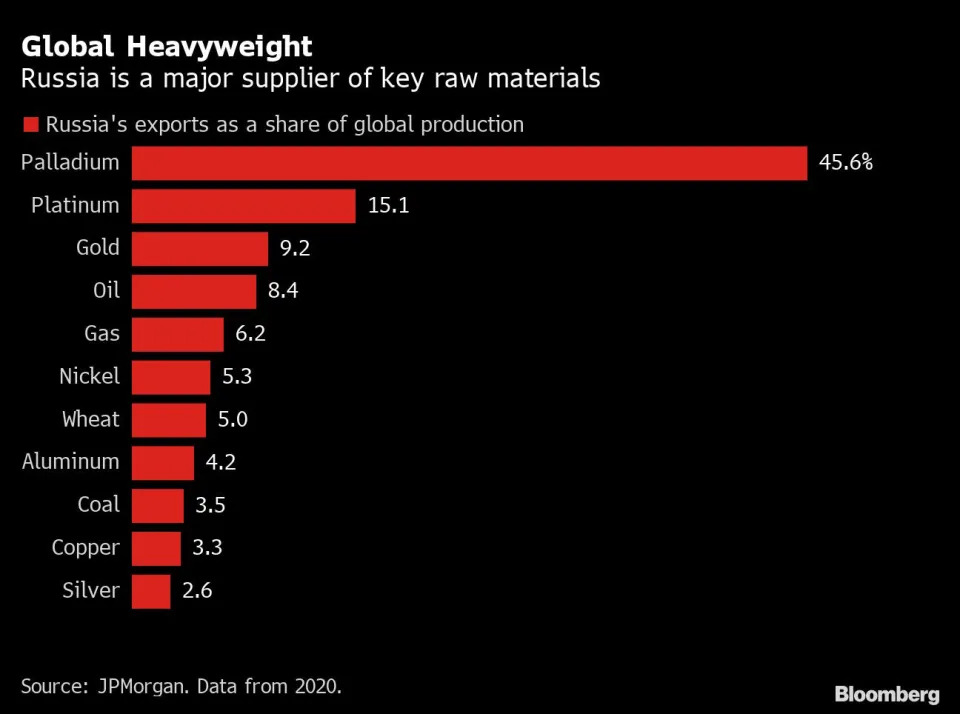
The revenue Russia receives from commodities like oil and gas is “painful,” Robert Habeck, who is also the economy minister, said Thursday in a speech to parliament. But that doesn’t accurately reflect the pressure President Vladimir Putin is under because the country can “barely spend any of it,” he said.
Habeck said that a shortage of software security updates for aircraft will soon lead to planes being grounded while a lack of high-tech equipment will “lead to production processes being destroyed.”
“He can’t keep going much longer,” Habeck told lawmakers in the Bundestag in Berlin. “Time is not working in favor of Russia, it’s working against Russia, it’s working against the Russian economy.”
Even with Germany and other countries halting or phasing out Russian energy imports, Moscow’s oil-and-gas revenue will be about $285 billion this year, up by more than a fifth compared with 2021, according to estimates from Bloomberg Economics based on Economy Ministry projections. Including other commodities, it more than makes up for the $300 billion in foreign reserves frozen by sanctions.
With the war in Ukraine now into a fourth month, there is little evidence that sanctions are forcing Putin to abandon his military campaign.
“We’re not doing this for fun,” Habeck told lawmakers. “We’re doing it to hurt Putin’s economy and make our economic policy contribution to bringing an end to this war at some point. We’re looking to cut the Russian economy to the quick.”
U.K. to send rocket systems to Ukraine after report that Boris Johnson sought U.S. approval
Niamh Cavanagh, Producer – June 2, 2022
Army soldiers fire a rocket from an M270 multiple launch rocket system at the Grafenwoehr Training Area in Germany in 2021. (Joe Bush/U.S. Army/ZUMA Press)
LONDON — The U.K. is set to send multiple launch rocket systems to the Ukrainian military in a bid to help counter Russia’s brutal attacks.
According to a statement by the British Foreign Office, reports CNN, the U.K. will provide Ukraine with M270 launchers, which can strike targets over 49 miles away. The advanced medium-range rocket systems will offer “a significant boost in capability for the Ukrainian forces.”
Ukrainian soldiers will be trained in the U.K. on how to use the weapons system.
Ben Wallace, Britain’s defense secretary, said Wednesday: “The U.K. stands with Ukraine and has taken a leading role in supplying its heroic troops with the vital weapons they need to defend their country.
As Russia’s “tactics change, so must our support to Ukraine,” he added. “These highly capable multiple launch rocket systems will enable our Ukrainian friends to better protect themselves against Russia’s brutal use of long-range artillery, which [Russian President Vladimir] Putin’s forces have used indiscriminately to flatten cities.”
The gift was “coordinated closely” with the U.S., the report said.
The weapons package comes as Russia’s war against its smaller neighbor has transformed into a city-by-city grind in Ukraine’s eastern region. Artillery has become a dominant weapon for both sides, and the range of more advanced rocket systems is a key advantage.
A missile is fired using a multiple launch rocket system during a joint drill between the U.S. and South Korea in 2017. (South Korean Defense Ministry via Getty Images)
The U.K. reportedly asked the Biden administration to sign off on a plan to send the American-made launchers to Ukraine. According to a source cited by Politico, British Prime Minister Boris Johnson spoke with President Biden about transferring the weapons.
Meanwhile, Washington confirmed that it would send similar advanced weapons as part of a new $700 million military assistance package for Ukraine. The package includes High Mobility Artillery Rocket Systems and ammunition, the Defense Department said.
As part of the announcement, Ukraine promised the Biden administration that it would not use those rocket systems to hit targets located inside Russia. Secretary of State Antony Blinken said that Kyiv had “given us assurances that they will not use these systems against targets on Russian territory.”
The Kremlin said that the weapons would discourage Ukraine from rejoining peace talks that have been stalled. “We believe that the United States is purposefully and diligently adding fuel to the fire,” spokesman Dmitry Peskov said. Sergey Lavrov, Russia’s foreign minister, said that the assistance would risk a “third country” being drawn into the war.
What Are ‘Artillery Rockets,’ and Why Is the U.S. Sending Them to Ukraine?
John Ismay – June 2, 2022
An M142 HIMARS rocket launcher at the 2021 Dubai Airshow. (Getty Images) (Getty Images)
As the fighting in eastern Ukraine turns into an artillery duel, the Pentagon announced that it would send its most advanced artillery rocket launcher and munitions to the Ukrainian military in the hope of giving it an edge over Russia.
Here’s how the system works, and what it could potentially do, as the war stretches into a fourth month.
What is an artillery rocket?
An artillery rocket is a weapon that is typically propelled by a solid-fuel motor and can carry a variety of warheads. During the Cold War, most artillery rockets were unguided and imprecise when fired at greater distances.
In the 1970s, the United States invested in a new weapon it called MLRS, for Multiple Launch Rocket System, designed for use in the event that Russian armored vehicles massed for World War III on the border of Western Europe.
The M270 MLRS launcher was an armored vehicle that could carry two “pods” of munitions. Each pod held either six cluster-weapon rockets that could fly about 20 miles, or a single, larger guided missile, called ATACMS, for Army Tactical Missile System, that could fly about 100.
The 23-ton launcher moved on treads, at speeds up to 40 mph.
Years later, the Pentagon introduced a more easily transportable version called HIMARS, for High Mobility Artillery Rocket System, which is based on a wheeled truck that is much lighter. Unlike its predecessor, the M142 HIMARS truck carries only one pod of munitions, but it can move much faster on and off-road, and can be shipped on a C-130 cargo plane.
Has the United States used these weapons?
Yes. During Operation Desert Storm, government records show that the U.S. Army fired more than 17,200 unguided MLRS rockets and 32 of the larger ATACMS guided missiles at Iraqi forces. The submunitions carried by those rockets had a high failure rate, and the duds left behind killed and wounded many U.S. troops.
In 2005, the Army fired a new guided rocket, known as a GMLRS, in combat in Iraq for the first time. That rocket has a range of more than 40 miles, more than twice that of the older rockets, and its navigation is aided by GPS signals.
Since the invasion, the Pentagon has provided Ukraine with 108 M777 howitzers, the most lethal weapons the West has delivered so far. But the range of the GMLRS is more than twice that of the 155 mm shells fired by howitzers.
The Pentagon has spent approximately $5.4 billion to buy more than 42,000 of the GMLRS since 1998, according to a report published by the Congressional Research Service last year, and commanders in Iraq and Afghanistan used them frequently.
What’s the difference between a rocket and a missile in this context?
The nomenclature can be confusing sometimes, but generally the word “rocket” is used in a military context to refer to relatively inexpensive unguided weapons powered by solid-fuel motors, while “missile” is generally shorthand for “guided missiles,” more expensive and complicated weapons that use movable fins to steer themselves to their targets and can fly much farther.
The Pentagon has already sent short-range, inexpensive and unguided anti-tank weapons that are classified as rockets to Ukraine, like the AT-4, and the longer-range Javelin, which is a guided missile.
That delineation worked well in the past with the MLRS and ATACMS weapons, but in more recent years the military has built weapons it calls “guided rockets” — like GMLRS — which are often older rocket designs upgraded to have guidance systems and movable fins on their nose to steer them.
The money part still holds true, though. GMLRS rockets remain far less expensive than the old ATACMS and the Precision Strike Missiles being developed to replace them.
How powerful are these rockets?
Using the HIMARS and GMLRS together can offer an amount of firepower that is similar to an airstrike — all from a mobile platform.
The upgrade in explosive power for the Ukrainian military will be profound. The warhead in each M31 GMLRS rocket contains a single charge of about 200 pounds of high explosives, while the 155 mm shells fired by howitzers contain about 18 pounds.
Howitzers like the M777 can fire at a rate of about two to three rounds per minute. The GMLRS rockets can be fired singly or in a ripple of all six in just seconds, rivaling the power of an airstrike dropping guided bombs.
Does Russia have anything similar?
The Russian military has primarily used three types of unguided artillery rockets during the war in Ukraine.
The largest, the 300 mm Smerch, can fire a guided rocket, which makes it more accurate, and has a range similar to the GMLRS, although few have been seen in photos of the war. Most Smerch launches in Ukraine are unguided rockets, many containing cluster weapon warheads.
Do the U.S. rockets have other advantages?
There’s one major advantage to the MLRS and HIMARS launchers: They can be fully reloaded within minutes.
Both vehicles have a winch that allows them to lower an empty pod to the ground, pick up a new, loaded pod, and pull it into place. The Russian launchers must be manually loaded, tube by tube.
Why hasn’t the U.S. sent longer-range ATACMS missiles to Ukraine?
President Joe Biden said in an essay published Tuesday in The New York Times that the White House was “not encouraging or enabling Ukraine to strike beyond its borders.”
While reporting on the war, a senior defense official who served in field artillery and was not authorized to speak publicly about Pentagon war planning, told me that the Army has comparatively few ATACMS missiles remaining in its inventory, and those that it does have are earmarked for use in dire contingencies like a war with North Korea or an effort to defend Taiwan from a Chinese invasion.
Sometimes, though, the U.S. Army launches an ATACMS missile to send a message, as it did just more than a week ago during military exercises with South Korea, after North Korea had tested a suspected intercontinental ballistic missile.
Russian troops control about a fifth of Ukraine after nearly 100 days of war, Zelenskyy says
Jake Epstein – June 2, 2022
In this image from video provided by the Ukrainian Presidential Press Office and posted on Facebook early Saturday, March 12, 2022, Ukrainian President Volodymyr Zelenskyy speaks in Kyiv, Ukraine.Ukrainian Presidential Press Office via Associated Press Russian troops control about a fifth of Ukraine after nearly 100 days of war, Zelenskyy says
Ukrainian leader Volodymyr Zelenskyy says Russian troops control about a fifth of Ukraine.
In an address to the Luxembourgish parliament, Zelenskyy said Russia controls about 125,000 square kilometers.
Fighting has been concentrated in Ukraine’s eastern Donbas region for weeks now.
After 99 days of war, Russian forces now control about a fifth of Ukrainian territory, Ukrainian President Volodymyr Zelenskyy said on Thursday.
In an address to the Luxembourgish parliament, Zelenskyy said about “20 percent of our territory is under the control of the occupiers,” or around 125,000 square kilometers — an area larger than Belgium, Luxembourg, and the Netherlands combined.
Russia’s occupation includes a stretch of land that goes as north and east as Ukraine’s second-largest city Kharkiv, and as south as Mykolaiv. Zelenskyy said the war’s frontline, where “constant fighting” takes place, stretches for about 1,000 kilometers.
The occupied area Zelenskyy referred to also includes the Crimean region, which Russian forces invaded and annexed in 2014.
Major Russian advances in the first few weeks of the war — including a failed attempt to seize the capital city Kyiv — were answered with strong counter-resistance as Ukrainian forces slowly reclaimed the territory it lost.
Russia’s retreat revealed grisly scenes of civilian life under occupation, including evidence of mass executions and torture of innocent bystanders.
Fighting is now concentrated in Ukraine’s eastern Donbas region, where Russia has bombarded Ukrainian cities and attacked civilian areas as President Vladimir Putin’s troops try to progress deeper into Ukraine.
“The Russian army has already destroyed almost the entire Donbas,” Zelenskyy said, “city after city.”
But Zelenskyy recently vowed that Ukraine won’t cede any of its territory to Russia, and said there won’t be peace until Putin agrees to return areas seized by Russia back to 2014 — like the annexed Crimean peninsula or the Moscow-backed separatist-controlled regions of Donetsk and Luhansk.
Despite fighting being concentrated in eastern Ukraine, the impact of the war continues to be felt across the country. Zelenskyy said Ukraine “suffers” from Russian air strikes every day — weathering thousands of missiles since the war began in late February.
There are also about 300,000 square kilometers “bestrewn with mines and unexploded ordnance,” he added.
Putin clings to semblance of normality as his war grinds on
Mark Trevelyan – June 2, 2022
* Kremlin leader projects image of business as usual
* No sign that Putin seeks exit from war he started
* Russia builds momentum in Donbas but U.S. steps up arms to Kyiv
* Putin may hope for growing splits and war fatigue in West
By Mark Trevelyan
LONDON, June 2 (Reuters) – Approaching the 100-day mark in a war that he refuses to call by its name, Russian President Vladimir Putin is a man intent on conveying the impression of business as usual.
As his army fought its way into the Ukrainian city of Sievierodonetsk this week, Putin was making awkward small talk in a televised ceremony to honour parents of exceptionally large families.
Since the start of May, he has met – mostly online – with educators, oil and transport bosses, officials responsible for tackling forest fires, and the heads of at least a dozen Russian regions, many of them thousands of miles from Ukraine.
Along with several sessions of his Security Council and a series of calls with foreign leaders, he found time for a video address to players, trainers and spectators of the All-Russian Night Hockey League.
The appearance of solid, even boring routine is consistent with the Kremlin’s narrative that it is not fighting a war – merely waging a “special military operation” to bring a troublesome neighbour to heel.
For a man whose army has heavily underperformed in Ukraine and been beaten back from its two biggest cities, suffering untold thousands of casualties, Putin shows no visible sign of stress.
In contrast with the run-up to the Feb. 24 invasion, when he denounced Ukraine and the West in bitter, angry speeches, his rhetoric is restrained. The 69-year-old appears calm, focused and fully in command of data and details.
While acknowledging the impact of Western sanctions, he tells Russians their economy will emerge stronger and more self-sufficient, while the West will suffer a boomerang effect from spiralling food and fuel prices.
KEEPINGUP APPEARANCES
But as the war grinds on with no end in sight, Putin faces an increasing challenge to maintain the semblance of normality.
Economically, the situation will worsen as sanctions bite harder and Russia heads towards recession.
Militarily, Putin’s forces have gradually advanced in eastern Ukraine but the United States and its allies are stepping up arms supplies to Kyiv, including a U.S. promise this week of advanced rocket systems.
Should Russia’s offensive falter, Putin could be forced into declaring a full-scale mobilisation of reserves to bolster his depleted forces, Western defence experts say.
“This would involve more than a million people in Russia, and then of course it will be visible for those whose who have not yet realised that Russia is in a full war,” said Gerhard Mangott, an Austrian academic who has met and observed Putin over many years.
That would be a hard sell to a Russian public which is mainly reliant on state media loyal to the Kremlin and has therefore been kept in ignorance of the scale of Russian setbacks and casualties.
Yet Russia is still not at that point, Mangott said, and Putin may draw some encouragement from signs of Western fatigue with the war. Divisions are emerging between Ukraine’s most hawkish backers – the United States, Britain, Poland and the Baltic states – and a group of countries including Italy, France and Germany which are pressing to bring an end to the war.
“Putin is counting that the longer this war drags on, the more conflicts and frictions within the Western camp will appear,” he said.
Meanwhile peace talks with Ukraine stalled weeks ago, and Putin shows absolutely no sign of seeking a diplomatic exit. “He still thinks there is a good military solution to this problem,” said Olga Oliker, program director for Europe and Central Asia at Crisis Group.
Putin preserves the option to claim victory at any point because his stated objectives – what he called the demilitarisation and denazification of Ukraine – “were always goals that you could declare accomplished because they were never clearly defined and were always somewhat ridiculous”, Oliker said.
The words “war” and “Ukraine” were never spoken during Putin’s 40-minute video encounter on Wednesday with the prolific families, including Vadim and Larisa Kadzayev with their 15 children from Beslan in the North Caucausus region.
The closest he came to acknowledging the war was in a pair of references to the plight of children in Donbas and the “extraordinary situation” there.
Russia had many problems but that was always the case, he said as he wrapped up the online meeting. “Nothing unusual is actually happening here.” (Reporting by Reuters; Editing by Nick Macfie)
Russia Goes After British MP’s Son for Killing of Chechen Commander in Ukraine
Allison Quinn – June 2, 2022
Russia’s National Guard has confirmed that a Chechen commander was killed in a bloody firefight with foreign volunteers in Ukraine—and they singled out the son of a British lawmaker as one of those responsible.
Ben Grant, a 30-year-old former Royal Marine and the son of Helen Grant, a Conservative MP and Prime Minister Boris Johnson’s special envoy on girls’ education, joined British and U.S. servicemen fighting Russian forces in Ukraine back in March, telling British media at the time that he felt compelled to act after seeing footage of Russian troops bombing a home as a child screamed.
“I just want to make that clear, completely off my own back, I decided to do this. I didn’t even tell my mum, but it is what it is,” he said.
Viral footage of fighting in the Kharkiv region published by The Daily Telegraph last week captured Grant and other Western volunteers, part of a Ukrainian counteroffensive to force Russian troops out of the region, under heavy Russian fire as they rescued a wounded fellow volunteer.
“We’ve got to move now or we’re gonna die!” Grant can be heard shouting.
The harrowing video, filmed by a helmet-mounted camera, then shows as they turned the tables to ambush a Russian armored vehicle, striking it with a shoulder-mounted rocket launcher.
“Shoot it now!” a man identified as Grant yells as the weapon is fired.
Russia’s National Guard says Sgt. Adam Bisultanov, the commander of a separate operational brigade of the North Caucasus District of the National Guard, was killed in the “attack” on Russian forces by the “group of mercenaries from Great Britain and the U.S.”
“During protective fire, the armored personnel carrier in which [Bisultanov] was located took three hits from a grenade launcher and was wrecked,” the National Guard said in a statement Tuesday.
“The GoPro camera captured footage of the attack and one of the fighters of the mercenary group, the son of British MP Ben Grant,” the statement said, adding that the video will be provided to military investigators. Russia’s Investigative Committee announced this week that it was investigating Grant for his role “leading” the ambush.
Bisultanov had taken part in the war in Ukraine since Vladimir Putin launched an all-out invasion on Feb. 24. In light of his death and news of Grant’s alleged role in it, some Russian media reports floated the idea of him facing the “death penalty” in Russian-occupied Donetsk.
“He will have to run for the rest of his life,” Komsomolskaya Pravda wrote of Grant, noting that Bisultanov had been born in Chechnya, “where the principle of blood feud or vendetta is not empty words.”
Two states aim to arm teachers despite opposition from educators and experts
Phil McCausland – June 2, 2022
George Frey
Two state legislatures are considering measures that would permit teachers and other school staff to carry arms in the aftermath of the Texas elementary school shooting that killed 19 children last month, despite opposition from gun safety advocates, teachers’ groups and school security experts.
While the idea isn’t new — many Republican-controlled legislatures considered similar legislation after the 2018 Parkland, Florida, shooting — it is a growing talking point as the country has witnessed a number of mass killings in the past few weeks. Two states, Ohio and Louisiana, are now considering either decreasing the requirements to arm school staff or permitting employees to carry a firearm after fulfilling the required training.
It’s a popular talking point in conservative circles. Texas Attorney General Ken Paxton, a Republican, said in an interview on Fox News on the day of the Uvalde school shooting that the state, which already allows teachers to be armed, should go further to ensure school employees have firearms.
Seth Garza pays his respects with his daughter Lilly at a memorial on May 31, 2022, dedicated to the 19 children and two adults killed in the mass shooting at Robb Elementary School in Uvalde, Texas. (Brandon Bell / Getty Images)
“We can’t stop bad people from doing bad things,” he said. “We can potentially arm and prepare and train teachers and other administrators to respond quickly because the reality is that we don’t have the resources to have law enforcement at every school.”
At least 28 states, including Texas, currently allow teachers or school staff to be armed in the classroom under varying conditions, according to a 2020 RAND Corporation study. It is unclear how effective that has been at undermining a school shooting threat and critics note research that shows that adding firearms to a situation only increases the risk of gun violence.
Video: Former FBI agent turned teacher addresses proposal to arm teachers
0:09 5:19 Scroll back up to restore default view.
“These bills are about rhetoric and distraction — they’re not about solutions,” said Rob Wilcox, federal legal director at Everytown for Gun Safety. “If you were to introduce guns into schools, not only is it ineffective, but you’re introducing more risk. How will guns be stored? How will folks be trained? When will guns be used? How do you ensure kids won’t get access to them? How do you ensure a gun isn’t used in a tense situation at school? These are all critical questions about this type of legislation that never gets answered.”
The National Education Association and the American Federation of Teachers have long expressed their opposition to arming teachers as a solution to gun violence at schools, and many have also shared concerns about the heightened risk of legal liability for teachers and schools.
School security experts also shared frustration that many of these programs provide limited training as a cost-saving measure for security, as it appeared to show a lack of commitment to safety.
“You can tell me all you want with your rhetoric that school safety is a priority, but I will know whether it is when I look at your budget, your actions and your leadership,” said Kenneth Trump, who has served as an expert for civil litigation trials after shootings and serves as the president of Ohio-based National School Safety and Security Services. “One thing I’ve learned in 30 years of working with schools is that it becomes a priority when the parents are outraged or when there’s media attention.”
Ohio’s and Louisiana’s pushes to arm teachers
The bill headed to Ohio Gov. Mike DeWine’s desk from the state’s Republican-controlled legislature would lessen the threshold for carrying a weapon.
DeWine said in a statement that he called on the Ohio General Assembly last week to pass the bill that would allow school districts to “designate armed staff for school security and safety.” He said he looked forward to “signing this important legislation.”
“My office worked with the General Assembly to remove hundreds of hours of curriculum irrelevant to school safety and to ensure training requirements were specific to a school environment and contained significant scenario-based training. House Bill 99 accomplishes these goals, and I thank the General Assembly for passing this bill to protect Ohio children and teachers.”
Ohio state Sen. Cecil Thomas, a Democrat from Cincinnati, said “the bank of common sense is bankrupt in the Ohio legislature, noting that he’s been pushing for new regulations aimed at preventing gun violence since a 2019 mass shooting in Dayton, Ohio, left nine dead and 17 wounded.
“Since then, the most we got in the legislature is to put more guns out there and made it easier to have access to firearms,” said Thomas, who served on the Cincinnati Police Department for 27 years.
A teacher puts on a bulletproof vest during a live fire training session in Thistle, Utah, on Saturday, Oct. 5, 2019. (George Frey / Bloomberg via Getty Images file)
The measure to arm teachers is heading to the governor’s desk as Ohio also prepares, in two weeks, to formally lift the requirement that gun owners have a concealed carry license as the state’s “Constitutional Carry” law goes into effect.
While those laws have passed easily in the Republican-controlled legislature, Thomas said he’s had no luck getting a hearing for legislation he’s written to limit the procurement of arms, such as red flag laws, universal background checks, background checks for the transfer of firearms, increasing age requirements for firearm purchases to 21 and more.
In Louisiana, state Sen. Eddie Lambert, a pro-gun Republican, amended a controversial gun bill passed by the statehouse on Wednesday, stripping the legislation of a measure that would allow permitless concealed carry, to pursue a similar idea. Because it is too late to introduce new bills into the legislative session, which ended Monday, his changes would delete the original concept of permitless concealed carry.
In place of the old language, he added text that would give school districts the authority to designate school administrators or teachers who could carry a gun and serve as “school protection officers” after they took a training course and obtained a permit that allowed them to carry weapons in schools. He said they would receive training similar to that provided to police officers.
“You don’t want anybody who is not fully trained in this situation: this is not for just some Joe Blow,” he said, adding that teachers would have to keep the concealed gun “on them at all times” and out of reach of children.
Lambert said the original bill — a copy of legislation vetoed by Democratic Gov. John Bel Edwards last year — had no chance of passing. This “common sense” law did, however, and he said he felt it necessary to include the language after reading about the Tulsa hospital shooting and the attack on the elementary school in Uvalde, Texas.
“You’re going to have some of the gun rights people criticize me for that,” he said, explaining that some were upset with him for changing the bill. “You know what? I’m just going to do what can be done to protect people.”
Bel Edwards’ office said it had not changed its position on permitless concealed carry since the governor, a gun owner, vetoed the bill last year, but added that it was too early to comment on legislation that hadn’t yet passed the Senate and would have to be voted on again in the House.
Teachers not enthusiastic about being armed
The question is, however, do teachers want to be armed in the classroom?
In the past they’ve said, no. A 2019 national survey of 2,926 teachers, including more than 450 gun owners, conducted in the aftermath of the Parkland shooting found that more than 95 percent of educators did not believe teachers should be carrying a gun in the classroom.
Only about 6 percent said they would be comfortable using a gun to stop a shooter.
Texas is one of the states that has allowed teachers and other school employees to be armed, but it’s not a particularly popular program, either.
Under its “school marshal” program, Texas has licensed certain school employees to carry a firearm since 2013. After an 80-hour course, a psychological exam and a $35 fee, school staff members can be approved to pack heat in schools. But in nine years, the state has only licensed 256 marshals in 62 of the state’s 1,029 school districts, according to the Texas Commission on Law Enforcement.
NEA President Becky Pringle said in a statement that “teachers need more resources, not revolvers.”
“Educators and parents overwhelmingly reject the idea of arming school staff,” she added. “Rather than arming educators with guns, we need to be giving them the tools needed to inspire their students. Rather than putting the responsibility on individual teachers, our elected leaders need to pass laws that protect children from gun violence and bring an end to senseless and preventable killings.”
Intercepted audio shows 2 Russian officers cursing out Putin and other commanders in charge of the Ukraine invasion
Joshua Zitser – June 2, 2022
Russian President Vladimir Putin at the Novo-Ogaryovo residence outside Moscow, Russia, on June 1, 2022.Mikhail Metzel, Sputnik, Kremlin Pool Photo via AP
Audio shows Russian officers bad-mouthing the leaders of the invasion of Ukraine.
They use harsh curse words to describe Vladimir Putin, Sergei Shoigu, and Alexander Dvornikov.
The audio was obtained by Ukrainian intelligence and passed to to US-funded Radio Svoboda.
Intercepted recordings shows Russian military officers cursing out Russian President Vladimir Putin and other leaders in charge of the invasion of Ukraine.
The audio recordings come from an unspecified Ukrainian intelligence agency, which intercepted the phone calls, and were provided to the Radio Svoboda investigative project “Schemes.”
In the audio, a senior Russian officer can be heard bad-mouthing Russia’s minister of defense Sergei Shoigu. Shoigu, a close ally of Putin, was one of the few Kremlin insiders who made the decision to invade Ukraine, Bloomberg reported in April.
“Shoigu is completely fucking incompetent,” he says in the recording. “Just a fucking showman, for fuck’s sake,” he adds.
According to the investigation, the officer was Lieutenant Colonel Vladimirovich Vlasov.
Vlasov also calls Gen. Alexander Dvornikov, Russia’s top commander in Ukraine, a “complete and utter imbecile” and a “brainless fucking idiot” in the recordings.
Vlasov was speaking to a Russian military medic, Colonel Vitaliy Kovtun, according to Radio Svoboda. Kovtun, per the recordings, refers to both Shoigu and Putin as a “fucking cunt.”
Radio Svoboda contacted both men for comment.
Kovtun took the phone call and responded by calling the journalist a “fucking cunt” and threatening to report him to Russia’s FSB security agency.
Vlasov answered the phone call but declined to offer a comment. He refused to answer follow-up calls, according to Radio Svoboda.
20 wounded on board, and we were hit by air defence missile – pilot describes his missions to Azovstal
Iryna Balachuk – June 2, 2022
SCREENSHOT FROM THE VIDEO
A helicopter pilot, who carried out missions to deliver supplies and evacuate the wounded from Azovstal, recounts how they prepared for the missions, what risks were involved, how Russian occupiers shot down the helicopter of his comrade-in-arms, and how he was able to fly with one engine not working to the landing site and thus save the 20 people on board.
Source: Land Forces of the Armed Forces of Ukraine, on Facebook
Quote from the pilot, whose identity is not disclosed: “The main difficulty was that it was necessary to deliver the cargo into the depth of the enemy-held area, which was larger than 100 km. The enemy’s air defence was very dense throughout this area, and it was not only difficult – it was almost impossible to achieve. But practice has shown that it is possible, and we achieved it.”
Details: According to the pilot, at the landing zone at “Azovstal” alone there were three different anti-aircraft missile systems. Therefore, the pilots tried not to enter the area within reach of those systems. To achieve this, it was important to be aware of all the natural and man-made obstacles along the way.
The pilot added that when the task was assigned, the whole crew understood that in 90% of cases they would not return, but at the same time everyone realised that delivering supplies and picking up people was essential, so they decided to take these chances.
According to him, the greatest anxiety was felt when they walked to the helicopter before the launch; once underway, everyone understood that it’s just a job and you’ve got to do what you’ve got to do.
Quote: “But once [we arrived] in Mariupol, when the cargo was being unloaded, the feeling was one of euphoria. It seemed to us that since we succeeded in arriving and standing here – within reach of three anti-aircraft missile systems – and we were unloading, we are like kings of the world, we had already won, and everything would be fine.
But on the way back, at the 6th kilometre – three minutes after take-off – my helicopter was hit by a Man-portable air-defence missile – and one engine failed. Another helicopter behind me was less fortunate, it crashed and the entire crew was killed. “
Details: He explained that each pilot has written guidance that it is their own decision to take off and land, so when his helicopter was hit by a missile, he chose to fly to the landing site.
Quote: “After the missile hit, we had an adrenaline rush – and we just did what we had to do. There were 20 wounded on board, and we understood that if we were to land somewhere in the field, how would they be picked up and evacuated further? Another helicopter would be needed, and this would become an unplanned operation – so we just flew to the landing site.”
Later, the founder and first commander of the Azov Regiment, Andriy Biletskyi, noted the exceptional heroism of the helicopter crews that delivered reinforcements, weapons, medicine and other essentials to the defenders of Mariupol blockaded by the Russian Federation.
Denmark Just Reversed 30 Years of Euroskeptic Defense Policy—Thanks to Russia
Charlie Campbell / London – June 1, 2022
DENMARK-EU-UKRAINE-RUSSIA-CONFLICT-REFERENDUM
Danish Prime Minister Mette Frederiksen and her husband Bo Tengberg cast their ballots at a polling station in Vaerloese near Copenhagen, Denmark, on Jun. 1, 2022, as traditionally euroskeptic Denmark votes in a referendum on whether to overturn its opt-out on the EU’s common defence. Credit – Ritzau Scanpix—AFP via Getty Images
Denmark on Wednesday voted to overturn its opt-out of the E.U.’s common defense policy, reversing three decades of Euroskepticism regarding security matters. The move is the latest sign of the West coalescing in response to Russia’s invasion of Ukraine.
Some 66.9% of voters cast referendum ballots in favor of abandoning the opt-out—first negotiated in 1992—meaning Danish officials can now participate in E.U. defense discussions and the country’s armed forces can deploy on E.U. military operations.
“We now have an even stronger foundation for close Nordic security cooperation in #EU & NATO,” tweeted Danish Foreign Minister Jeppe Kofod in response to the result.
Although Denmark has been an E.U. member since 1973, the nation of 5.8 million has been one of the most hesitant participants. The country has opted out of the euro single currency and common bloc policies on justice and home affairs—as well as, until now, defense—that Danes believed would undermine their sovereignty.
But Russian President Vladimir Putin’s aggression has spurred a rethink. Danish Prime Minister Mette Frederiksen called the referendum just two weeks after Russia’s Feb. 24 full-scale invasion of Ukraine—and despite her Euroskeptic government previously supporting the opt-out and deeming it a significant part of Danish identity.
In the end, 11 of Denmark’s 14 parties—representing more than three-quarters of parliament—urged voters to say “yes” to reverse the opt-out.
“Unfortunately we are looking forward to a time that will be even more unstable than what we experience now,” Danish Prime Minister Mette Frederiksen told reporters after casting her ballot. “I believe it is the right thing for Europe, I believe it is the right thing for Denmark, believe it is the right thing for our future.”
The move comes as Nordic neighbors Finland and Sweden have applied to join NATO, abandoning 75 and 200 years of military neutrality, respectively. Denmark, by contrast, was a founding member of NATO and has long adopted a hawkish military posture, frequently engaging in joint military drills and joining the U.S.-led wars in Afghanistan and Iraq. In this sense, Wednesday’s referendum is closer to correcting an aberration than the momentous U-turns of Finland and Sweden.
“Sweden and Finland applying to join NATO is a move of a different magnitude,” says Christine Nissen, a researcher with the Danish Institute for International Studies. “Though the [Denmark referendum] is part of the same story of greater European unity.”
The symbolism is important but there are substantive elements as well. For one, Denmark can now participate in PESCO, or Permanent Structured Cooperation, an enhanced E.U. security framework established in 2017 to enable member states to develop defense capabilities, collaborate on shared projects (including weapons systems), and boost the operational readiness and potency of their armed forces. Still, there’s no obligation for Denmark or any member state to partake in E.U. military operations under the common defense policy.
Denmark has already been a significant contributor to Ukraine’s defense through NATO, even sending heavy weapons such as Harpoon anti-ship missiles. The missiles use active radar homing and fly just above the water to evade defenses—and many consider these weapons offensive rather than strictly defensive. “Basically, everything that can move within the Danish armed forces is deployed as part of the NATO response to bolster the defense on the eastern flank,” says Kristian Soby Kristensen, deputy head of the Centre for Military Studies at the University of Copenhagen.
Much of the debate around the referendum concerned whether closer alignment with the E.U. on defense might come at the expense of cherished military ties to the U.S., U.K., and NATO. “NATO is the guarantor of Denmark’s security,” Morten Messerschmitt, head of the right-wing Danish People’s Party, who was against dropping the opt-out, argued during a televised debate Sunday “[Denmark’s defensive posture] would be totally different if it were decided in Brussels.”
However, Finland and Sweden’s decision to apply to join NATO reflect the fact that the two blocs are increasingly aligned. Another spur for Denmark to fall in with the E.U. on security was the decision by Germany—Denmark’s closest ally other than the U.S.—to increase its defense spending to 2% of GDP. “Now that Germany is likely to play a much larger role in European security, the perspective is that it will also materialize into a stronger role for the E.U.” says Nissen. “And so, there’s a wish to be a part of that.”
Separate to the referendum, Denmark in March agreed to increase its defense budget to 2% of GDP by 2033.
Of course, removing the opt-out drives a deeper wedge between Copenhagen and Moscow, and risks antagonizing Putin, though that appears of little consequence to either Denmark’s government or people. “It’s gone beyond that—opposition to Russia is strong and heartfelt,” says Kristensen. “The fact that a large country can use its military force to blatantly attack another country goes against everything that Danish foreign and security policy has been built upon for the last 70 years.”



 Scroll back up to restore default view.