Russian general killed in Ukraine after personally leading an attack, in sign that Russia is running out of colonels to do it, state journalist says
Sinéad Baker – June 6, 2022
A Ukrainian soldier speaks on his smartphone outside a residential building damaged by a missile on February 25, 2022 in Kyiv, Ukraine.Pierre Crom/Getty Images Russian general killed in Ukraine after personally leading an attack, in sign that Russia is running out of colonels to do it, state journalist says
A Russian general was killed in Ukraine, a Russian state-media journalist and Ukraine’s military said.
The general had led an attack himself “as if” there was no colonel to do it, the journalist said.
Russia has lost a high number of generals in the three months since it invaded Ukraine.
Another Russian general was killed in the fighting in Ukraine, a Russian state journalist and Ukraine’s military said.
Alexander Sladkov, a journalist with Russian state-owned media, reported Maj. Gen. Roman Kutuzov’s death in a Sunday Telegram post. Sladkov did not say when or where it happened.
Ukraine’s military also said that Kutuzov was killed, but did not provide any details, the BBC reported.
Sladkov said: “The general had led soldiers into attack, as if there are not enough colonels,” according to a translation by the BBC. “On the other hand, Roman was the same commander as everyone else, albeit a higher rank.”
The BBC reported that Sladkov is a reporter with the state-owned Russia 1. Reuters and the The Moscow Times reported that he works for a Russian state-owned outlet, but they did not specify which one.
Russia’s military has neither commented on Kutuzov nor confirmed if he died.
Russia has lost a high number of generals in its invasion of Ukraine.
James Stavridis, a former NATO supreme allied commander for Europe, said on May 1: “In modern history, there is no situation comparable in terms of the deaths of generals … Here, on the Russian side, in a two-month period, we’ve seen at least a dozen, if not more, Russian generals killed.”
It is not clear exactly how many Russian generals have been killed, and Russia has only acknowledged the deaths of a few generals.
The UK’s defense ministry said last month that senior Russian commanders had been drawn into the battlefield due to the problems Russia’s army has faced in its invasion.
“Difficulties in command and control, as well as faltering Russian performance on the front line, have drawn senior commanders onto the battlefield, likely to take personal leadership of operations,” it said.
Experts also told Agence France-Presse in March that generals may have been taking a more active role, and hence putting themselves at more risk, in a bid to motivate their troops as Russia’s invasion stalled.
Ukrainian students hold graduation dance in front of the ruins of their school destroyed by Russian strikes
Jake Epstein – June 6, 2022
Ukrainian students dance in front of the remains of their school.Ukrainian Foreign Ministry / Suspilne / Twitter Ukrainian students hold graduation dance in front of the ruins of their school destroyed by Russian strikes
Ukraine’s foreign ministry shared a video of students performing a “prom waltz” during the war.
The dance took place on a basketball court in front of a bombed-out school in Kharkiv.
Russian troops previously used the school as an outpost, Ukraine’s foreign ministry said.
With a backdrop of shattered windows and scorched walls, a handful of Ukrainian students stood in front of the rubble of their school — and danced.
In a 45-second-long video taken by Ukraine’s public broadcaster and posted to Twitter on Monday by Ukraine’s foreign ministry, students could be seen performing “their prom waltz” in front of their bombed-out school in the country’s second-largest city Kharkiv.
The students could be seen in the video doing a coordinated dance to a slow song. Behind them, a Ukrainian military vehicle sits next to a collection of troops.
Onlookers standing on the court could be seen using their phones to film and take photos before the footage cuts to a close-up view of the demolished school.
Students of School #134, Kharkiv, danced their prom waltz against the backdrop of the ruins of their Alma mater. Heavily damaged days after #Russia’s full-scale invasion of Ukraine in February, the school later became the last outpost for #Russian occupiers in Kharkiv. 🎥Suspilne pic.twitter.com/de7yYQy1Mt
The school was destroyed just days after Russia invaded Ukraine in late February and later became an “outpost” for Russian troops, the foreign ministry said in its tweet.
“Today, #Ukrainian alumni in #Kharkiv should happily celebrate their prom. Instead, they danced a graduation dance in the courtyard of their school, which was destroyed by the #russian MLRS,” Inna Sovsun, a member of Ukraine’s parliament and the country’s former deputy education minister, said in a tweet.
Throughout Russia’s 14-week-long war against Ukraine, President Vladimir Putin’s forces have routinely targeted schools — among other civilian areas like hospitals and shelters — across the country.
Russian forces left piles of excrement in every office of the Chernobyl nuclear plant before they retreated, Ukrainian workers say
Taiyler Simone Mitchell – June 6, 2022
Russian forces left piles of excrement in every office of the Chernobyl nuclear plant before they retreated, Ukrainian workers sayUkrainian soldiers sit on top of a military vehicle parked outside the hotel in Prypiat, Ukraine on February 4.Volodymyr Tarasov/Ukrinform/Future Publishing via Getty Image
Russian forces began their withdrawal from the 1986 Chernobyl disaster site in March.
But Ukrainian workers are now discovering what they left behind — including human feces.
“The poop was the icing on the cake,” the deputy director of the Chernobyl Ecocenter, said.
Hundreds of Ukrainian workers were held hostage for weeks throughout the Russian occupation. Now workers are moving to clean up the site following the Russian troops’ withdrawal in late March after being affected by “significant doses of radiation.“
Aleksandr Barsukov, the deputy director of the Chernobyl Ecocenter, told The Journal that they have found spray-painted conference rooms, smashed computer screens, and 100 liters of high-quality vodka.
“The poop was the icing on the cake,” Barsukov said.
Chernobyl, the site of the 1986 Soviet nuclear disaster, was seized on the first day of the war for a total of five weeks.
After disturbing the soil, soldiers “panicked at the first sign” of radiation illness, which “showed up very quickly,” Ukrainian state power company Energoatom told The Guardian. The outlet reported that the panic led to the troops pulling out of the region.
“When the invasion started, the front guards got a call to fall back because a huge flow of Russian troops were coming,” said Julia Bezdizha, a spokeswoman for the plant, told WSJ. “They fled mainly because it was very dangerous to stay and engage in heavy combat because of the heavy radiation.”
The exact impact on Russian soldiers is currently unknown, but troops were reported to have dug trenches in radioactive soil and moved about the plant without protective gear.
Radiation exposure can impact an individual’s health in many different ways — including acute radiation syndrome, cancer, and mental distress — according to The Centers for Disease Control and Prevention.
Yevhen Kramarenko, head of the State Agency of Ukraine on Exclusion Zone Management, said at a press conference in April that it’s unclear how radiation levels in the area have been impacted by the Russian forces.
But, he adds, “we believe very soon [the Russians] will feel the consequences of radiation that they have received. Some of them will feel it in months, some of them in years.”
“But anyway, all of the servicemen who were there will feel it at some point,” Kramarenko continued.
Russian President Vladimir Putin’s unprovoked war against Ukraine began on February 24 and is ongoing.
The Chernobyl Nuclear Power Plant did not immediately respond to Insider’s request for comment.
I prosecuted Nazis at Nuremberg. Here’s how to go after Putin and his thugs.
Ben Ferencz – June 5, 2022
Russia’s full-scale invasion of Ukraine has caused immeasurable suffering and destruction. Already, extensive documentation indicates the Russian military is responsible for widespread war crimes and crimes against humanity.
Indiscriminate attacks on civilians, sexual and gender-based violence, executions and other international crimes committed in Bucha, Mariupol, Kharkiv, Chernihiv and many other locations are now being investigated so that the direct perpetrators and architects of these crimes can be prosecuted.
Ukraine’s prosecutor general has taken prompt action, opening 15,000 investigations so far into these atrocities. The international community’s response toward justice and accountability has also been swift and focused, with the International Criminal Court (ICC) and war crimes prosecutors in at least 10 countries making significant efforts to open investigations.
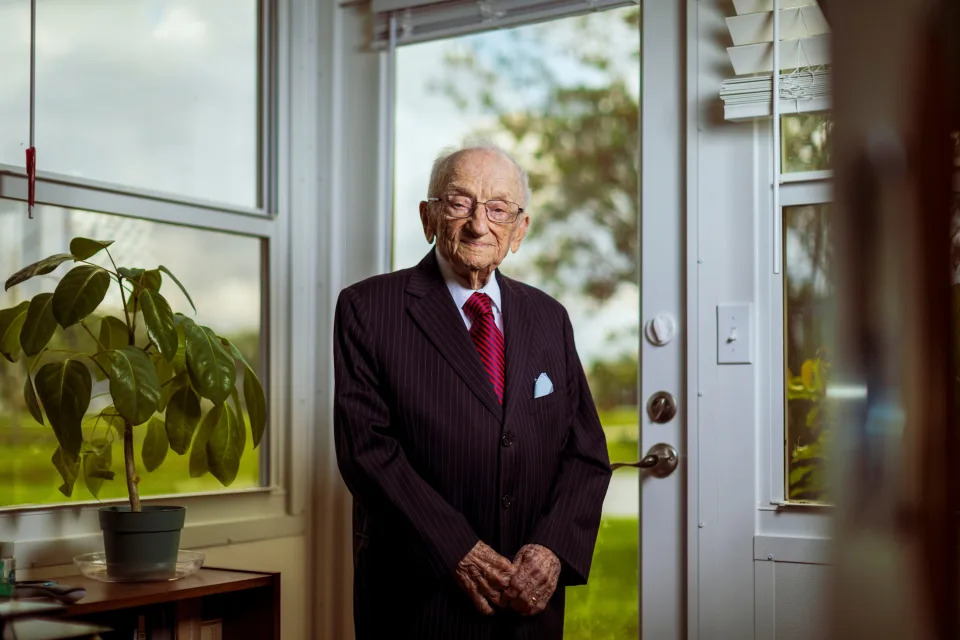
Benjamin Ferencz, 102, the last surviving prosecutor of the Nuremberg trials, at home in Delray Beach, Fla., on June 1, 2022.
I know firsthand of the magnitude of efforts required to put war criminals on trial. Seventy-five years ago, I put 22 Nazi officers on the stand for their role in killing more than a million men, women and children in cold blood in towns and villages across Eastern Europe.
The legacy of Nuremberg – of which I am the last living prosecutor – is to have shown the world that it is possible to form a court that prosecutes heads of states, who are often immune to the rule of law, for extreme, wide-scale crimes.
I have spent my life working to deter atrocities
Before heading to Nuremberg, I served as a sergeant in the U.S. Army Infantry, and I was sent to the concentration camps as American forces were liberating them, to collect evidence of the war crimes.
The ground was covered with dead bodies and people almost dead, their eyes pleading for help. It was horror. Sadly, the evils that I saw there, and that I sought to correct at Nuremberg, are still with us today.
Print photo copies of Benjamin Ferencz, while he served as a prosecutor during the Nuremberg trials, on a table at his home in Delray Beach, Fla., on June 1, 2022.
My life’s work has consisted of trying to deter the types of atrocities I prosecuted in Nuremberg. This is why I believe that, in addition to prosecuting war crimes and crimes against humanity, it is also critically important to prosecute the crime that was called “the supreme international crime” by the International Military Tribunal, which tried 21 of the most important surviving leaders of Nazi Germany: the crime of aggression.
Russia’s unprovoked military attack on Ukraine is the clearest and most egregious instance of the crime of aggression in decades, and building a solid case against President Vladimir Putin and other senior Russian officials is feasible, as shown by a model indictment published by the legal advocacy group Open Society Justice Initiative.
This is also the most straightforward basis on which to prosecute Putin because the crime of aggression focuses on state leaders, whereas in cases of war crimes or crimes against humanity, prosecutors must prove the linkage between the crimes carried out on the ground in Ukraine and faraway commanders in Moscow.
To prosecute Putin, we need a unique court
Ukraine announced a joint investigation team with prosecutors from Ukraine, Lithuania and Poland that focuses, in part, on gathering evidence toward Russia’s crime of aggression. Estonia, Latvia and Slovakia joined the JIT as well.
While the ICC has joined the JIT and opened an investigation into crimes committed in Ukraine, because of a limitation in its statute, the ICC does not have jurisdiction over the crime of aggression committed by Russian nationals.
Prosecuting the crime of aggression will require a unique court capable of handling such a trial, characterized by two crucial features:
First, it must be capable of circumventing legal immunities that could apply to Putin and other top officials. This would be the case for international courts and those formed with the support of the international community, where such immunities do not apply. Experts supporting the formation of a tribunal rightly prioritize options for an internationally backed court to prosecute Russia’s crime of aggression.
Second, such a court must have substantive real and perceived legitimacy. An internationally backed tribunal, such as through the United Nations General Assembly, would bolster impartiality and independence, which could be reinforced by ensuring that Ukrainian and international prosecutors and judges play a meaningful role. Such a tribunal could also include a broader mandate to cover war crimes and crimes against humanity cases not handled by the ICC.
That is why states must come together to join the Ukrainian government in supporting the creation of a special tribunal to prosecute Putin and his inner cadre for the crime of aggression. This would provide a powerful demonstration of the international community’s resolve to condemn Russia’s invasion of Ukraine and to insist that acts of aggression be prosecuted.
Ben Ferencz, 102, is the last living prosecutor at Nuremberg. He was chief prosecutor for the United States in the Einsatzgruppen case, which charged 22 Nazi officers with murdering more than a million people across Eastern Europe. The Associated Press called it “the biggest murder trial in history.”
Russia says strikes on Kyiv destroyed tanks donated by West
Associated Press – June 5, 2022
AP Photo/Natacha Pisarenko
KYIV, Ukraine — Russia’s defense ministry said a barrage of airstrikes on Ukraine’s capital destroyed tanks donated by the West and other armor in an attack on Sunday that shattered five weeks of eerie calm in Kyiv, as President Vladimir Putin warned the West about supplying long-range rocket systems to Ukraine.
Putin said that Moscow would hit targets “we haven’t yet struck” if it went ahead with such deliveries. It wasn’t immediately clear if Putin was referring to new targets within or outside Ukraine’s borders.
Russian forces pounded railway facilities and other infrastructure early Sunday in the capital, Kyiv. Ukraine’s nuclear plant operator, Energoatom, said one cruise missile buzzed the Pivdennoukrainsk nuclear plant, about 350 kilometers (220 miles) to the south, on its way to the capital — citing the dangers of such a near miss.
There was no immediate confirmation from Ukraine that the Russian airstrikes had destroyed tanks.
Kyiv hadn’t faced any such strikes since the April 28 visit of U.N. Secretary-General António Guterres. The early morning attack triggered air raid alarms and showed that Russia still had the capability and willingness to hit at Ukraine’s heart since abandoning its wider offensive across the country to instead focus its efforts in the east.
The strikes appeared aimed at thwarting the resupplying of Ukrainian fighters, a rising concern in Moscow.
In a posting on the Telegram app, the Russian Defense Ministry said high-precision, long-range air-launched missiles were used. It said the strikes destroyed on the outskirts of Kyiv destroyed T-72 tanks supplied by Eastern European countries and other armored vehicles located in buildings of a car-repair business.
Russia’s invasion of Ukraine on Feb. 24 has led to untold tens of thousands of civilian and troop deaths, driven millions from their homes, sparked vast sanctions against Putin’s government and allies, and strangled exports of critical wheat and other grains from Ukraine through Black Sea ports — limiting access to bread and other products in Africa, the Middle East and beyond.
In a television interview on Sunday, Putin lashed out at Western deliveries of weapons to Ukraine, saying they aim to prolong the conflict.
“All this fuss around additional deliveries of weapons, in my opinion, has only one goal: To drag out the armed conflict as much as possible,” Putin said, alluding to U.S. plans to supply multiple launch rocket systems to Kyiv. He insisted such supplies were unlikely to change much for the Ukrainian government, which he said was merely making up for losses of rockets of similar range that they already had.
If Kyiv gets longer-range rockets, he added, Moscow will “draw appropriate conclusions and use our means of destruction, which we have plenty of, in order to strike at those objects that we have not yet struck.”
The missiles hit Kyiv’s Darnytski and Dniprovski districts, Mayor Vitali Klitschko said on the Telegram messaging app, punctuating the Kremlin’s recently reduced goal of seizing the entire Donbas region in the east. Moscow-backed separatists have fought Ukrainian forces for eight years in the Donbas and established self-proclaimed republics.
In recent days, Russian forces have focused on capturing the city of Sievierodonetsk.
A billowing pillar of smoke filled the air with an acrid odor in Kyiv’s eastern Darnystki district, and the charred, blackened wreckage of a warehouse-type structure was smoldering. Police near the site told an Associated Press reporter that military authorities had banned the taking of images. Soldiers also blocked off a road in a nearby area leading toward a large railway yard.
The sites struck included facilities for the state rail company, Ukrzaliznytsia, said Serhiy Leshchenko, an adviser in President Volodymyr Zelenskyy’s office, on Telegram.
Energoatom said a Russian cruise missile came dangerously close to the Pivdennoukrainsk nuclear power plant at 5:30 a.m., seemingly tearing toward Kyiv. It said the missile “flew critically low” and that Russian targeters “still do not understand that even the smallest fragment of a missile that can hit a working power unit can cause a nuclear catastrophe and radiation leak.”
Russian strikes have repeatedly targeted railway facilities, seemingly aimed at slowing the provision of weapons to Ukrainian forces on the front lines. The cruise missiles appeared to have been launched from a Tu-95 bomber flying over the Caspian Sea, the Air Force Command said on Facebook. It said air defense units shot down one missile.
Elsewhere, Russian forces continued their push to take ground in eastern Ukraine, with missile and airstrikes carried out on cities and villages of the Luhansk region, with the war now past the 100-day mark.
Luhansk governor Serhiy Haidai said on Telegram that “airstrikes by Russian Ka-52 helicopters were carried out in the areas of Girske and Myrna Dolyna, by Su-25 aircraft – on Ustynivka,” while Lysychansk was hit by a missile from the Tochka-U complex.
A total of 13 houses were damaged in Girske, and five in Lysychansk. Another airstrike was reported in the eastern city of Kramatorsk by its mayor Oleksandr Goncharenko. No one was killed in the attack, he said, but two of the city’s enterprises sustained “significant damage.”
On Sunday morning, Ukraine’s General Staff accused Russian forces of using phosphorus munitions in the village of Cherkaski Tyshky in the Kharkiv region. The claim couldn’t be independently verified.
The update also confirmed strikes on Kyiv, which occurred in the early hours of Sunday. It wasn’t immediately clear from the statement which infrastructure facilities in Kyiv were hit.
The General Staff said Russian forces continue assault operations in Sievierodonetsk, one of two key cities left to be captured in the Luhansk region of the Donbas. The Russians control the eastern part of the city, the update said, and are focusing on trying to encircle Ukrainian forces in the area and “blocking off main logistical routes.”
The U.K. military said in its daily intelligence update that Ukrainian counterattacks in Sieverodonetsk were “likely blunting the operational momentum Russian forces previously gained through concentrating combat units and firepower.” Russian forces previously had been making a string of advances in the city, but Ukrainian fighters have pushed back in recent days.
The statement also said Russia’s military was partly relying on reserve forces of the Luhansk region.
“These troops are poorly equipped and trained, and lack heavy equipment in comparison to regular Russian units,” the intelligence update said, adding that “this approach likely indicates a desire to limit casualties suffered by regular Russian forces.”
Far from the battlefield, Ukraine’s national soccer players are hoping to secure a World Cup spot when the team takes on Wales later Sunday in Cardiff.
On the diplomatic front, Russian Foreign Minister Sergey Lavrov was heading to Serbia for talks with President Aleksandar Vucic early this week, followed by a visit to Turkey on Tuesday, where the Russian envoy is expected to discuss Ukraine with his Turkish counterpart.
Turkey has been trying to work with U.N. and the warring countries to help clear the way for Ukrainian grain to be exported to Turkish ports, though no deal on the issue appeared imminent.
A Ukrainian presidential adviser urged European nations to respond with “more sanctions, more weapons” to Sunday’s missile attacks.
Mykhailo Podolyak referenced remarks Friday by French President Emmanuel Macron, who said Putin had made a “historic error” by invading Ukraine, but that world powers shouldn’t “humiliate Russia” so that a diplomatic exit could be found when the fighting stops.
“While someone asks not to humiliate, the Kremlin resorts to new insidious attacks,” Podolyak tweeted. “Each of such terrorist attacks must face a tough response from European capitals: more sanctions, more weapons.”
Ukrainian officials have denounced the remark, and have criticized France and some other European countries for continuing to speak to Putin and talking about diplomatic solutions instead of working to push Russia out of Ukraine militarily.
Trump’s Ukraine impeachment shadows war, risks GOP response
Lisa Mascaro – June 5, 2022
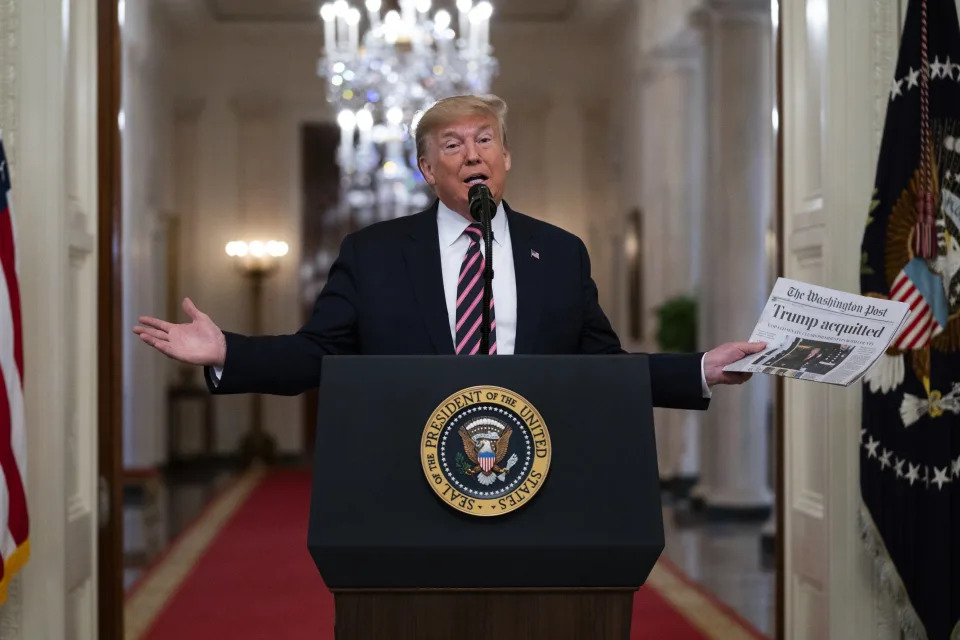
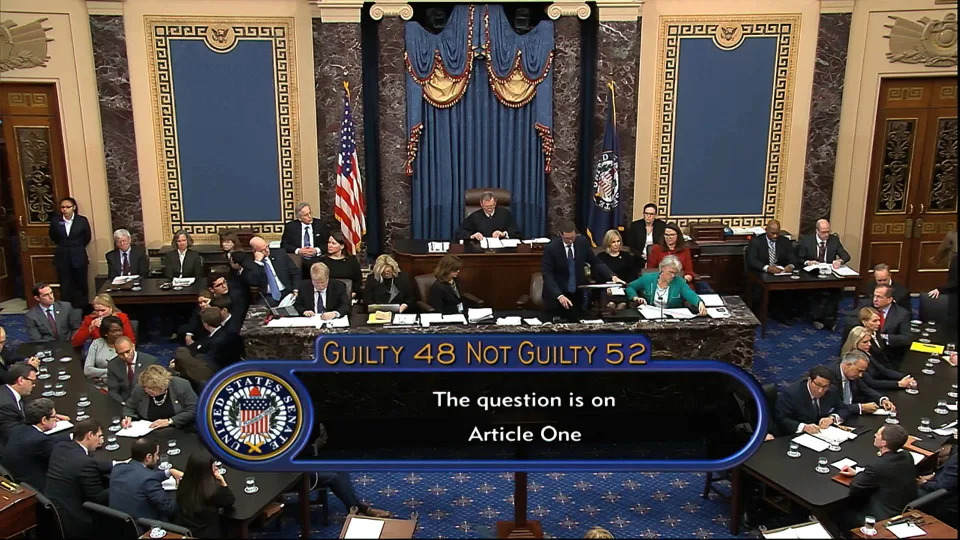
President Donald Trump holds up a newspaper with a headline that reads “Trump acquitted” during an event celebrating his impeachment acquittal, in the East Room of the White House, Feb. 6, 2020, in Washington. The impeachment investigation, sparked by a government whistleblower’s complaint over Trump’s call, swiftly became a milestone, the first in a generation since Democrat Bill Clinton faced charges over an affair with a White House intern. (AP Photo/Evan Vucci, File)Ukrainian President Volodymyr Zelenskyy answers media questions during a press conference in a city subway under a central square in Kyiv, Ukraine, April 23, 2022. Zelenskky had just been elected when he asked then-President Donald Trump during a July 25, 2019, phone call for a meeting to strengthen U.S.-Ukraine relations and ensure military aid, according to a transcript released by Trump’s White House. (AP Photo/Efrem Lukatsky, File)Senate Majority Leader Mitch McConnell, R-Ky., leaves the chamber after leading the impeachment acquittal of President Donald Trump, at the Capitol in Washington, Feb. 5, 2020. When Trump was impeached after pressuring Ukraine’s leader for “a favor,” all while withholding $400 million in military aid to fight Russia, even the most staunch defense hawks in the Republican Party stood virtually united by Trump’s side. (AP Photo/J. Scott Applewhite, File)In this image from video, the vote total, 52-48 for not guilty, on the first article of impeachment, abuse of power, is displayed on screen during the impeachment trial against President Donald Trump in the Senate at the U.S. Capitol in Washington, Feb. 5, 2020. The impeachment investigation, sparked by a government whistleblower’s complaint over Trump’s call, swiftly became a milestone, the first in a generation since Democrat Bill Clinton faced charges over an affair with a White House intern. (Senate Television via AP, File) In this image from video, a video is displayed as House impeachment manager Rep. Jason Crow, D-Colo., speaks during the impeachment trial against President Donald Trump in the Senate at the U.S. Capitol in Washington, Jan. 24, 2020. The impeachment investigation, sparked by a government whistleblower’s complaint over Trump’s call, swiftly became a milestone, the first in a generation since Democrat Bill Clinton faced charges over an affair with a White House intern.(Senate Television via AP, File)
WASHINGTON (AP) — When President Donald Trump was impeached in late 2019 after pressuring Ukraine’s leader for “a favor,” all while withholding $400 million in military aid to help confront Russian-backed separatists, even the staunchest defense hawks in the Republican Party stood virtually united by Trump’s side.
But as Russian President Vladimir Putin’s military marched toward Kyiv this February, threatening not only Ukraine but the rest of Europe, Republicans and Democrats in Congress cast aside impeachment politics, rallied to Ukraine’s side and swiftly shipped billions to President Volodymyr Zelenskyy’s defense.
The question ahead, as Ukrainians battle Russia’s grinding invasion now past its 100th day, is whether the rare bipartisanship on Capitol Hill is resilient enough to withstand Trump’s isolationist influences on his party or whether Republicans who yielded to Trump’s “America First” approach will do so again, putting military and humanitarian support for Ukraine at risk.
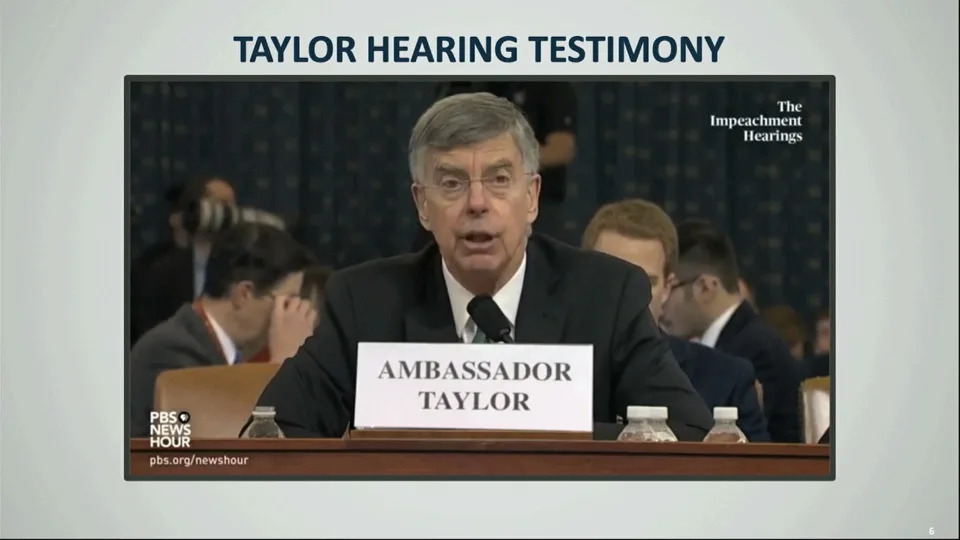
“Maybe there is a recognition on both Republican side and Democratic side that this security assistance is very important,” said Bill Taylor, a former ambassador to Ukraine, in a recent interview with The Associated Press.
“And maybe neither side is eager to crack that coalition.”
The fraught party politics comes at a pivotal moment as the Russian invasion drags on and the United States gets deeper into the conflict before the November elections, when lawmakers face voters with control of Congress at stake.
While Congress mustered rare and robust bipartisan support to approve a $40 billion Ukraine package, bringing total U.S. support to a staggering $53 billion since the start of the war, opposition on the latest round of aid came solely from the Republican side, including from Trump.
That is a warning sign over the sturdiness of the bipartisan coalition that the top Republican in Congress, Sen. Mitch McConnell of Kentucky, tried to shore up when he led a delegation of GOP senators to stand by Zelenskyy’s side in a surprise trip to Kyiv last month.
“There is some isolationist sentiment in my party that I think is wrongheaded, and I wanted to push back against it,” McConnell told a Kentucky audience this past week, explaining his Ukraine visit.
The divisions within the GOP over Ukraine are routinely stoked by Trump, who initially praised Putin’s invasion of Ukraine as a “genius” negotiating strategy. Trump has repeatedly lashed out against the U.S. aid to Ukraine, including last weekend at a rally in Wyoming. Before the Senate vote on the $40 billion in assistance, Trump decried the idea of spending abroad while America’s “parents are struggling.”
As Trump considers whether to run for the White House in 2024, the persistence of his “America First” foreign policy approach leaves open questions about the durability of his party’s commitment to U.S. support for a democratic Ukraine. Senators are poised this summer to vote to expand NATO to include Sweden and Finland, but Trump has repeatedly criticized U.S. spending on Western military alliance.
Sen. Josh Hawley of Missouri, among 11 Republican senators who voted against the Ukraine package, called the tally an “astronomical number” at a time when foreign policy should be focused elsewhere, including on China.
“That is nation-building kind of number,” Hawley said in an interview. “And I think it’s a mistake.”
Zelenskky, a comedian turned politician, had just been elected when he asked Trump during a July 25, 2019, phone call for a meeting to strengthen U.S.-Ukraine relations and ensure military aid, according to a transcript released by Trump’s White House.
“We are almost ready to buy more Javelins from the United States for defense purposes,” Zelenskyy told Trump, referring to anti-tank weaponry Ukraine relies on from the West.
Trump asked Zelenskyy to investigate Joe Biden, a chief Democratic rival to Trump at the time and now the American president, and Biden’s son Hunter, who served on the board of a Ukrainian gas company.
The impeachment investigation, sparked by a government whistleblower’s complaint over Trump’s call, swiftly became a milestone, the first in a generation since Democrat Bill Clinton faced charges over an affair with a White House intern.
During weeks of impeachment proceedings over Ukraine, witnesses from across the national security and foreign service sphere testified under oath about the alarms that were going off in Washington and Kyiv about Trump’s conversation with Zelenskyy.
Yet American opinions over the gravity of the charges against Trump were mixed, polling at the time by the AP showed.
Trump was impeached by the Democratic-led House and acquitted by the Senate, with just one Republican, Sen. Mitt Romney of Utah, joining Democrats to convict.
“The allegations were all horse hockey,” said Rep. Morgan Griffith, R-Va., recalling his decision not to impeach.
Sen. Marco Rubio, R-Fla., brushed back questions about whether Trump’s actions then played any role in Russia’s decision to invade Ukraine this February.
“It wasn’t like Putin invaded right after. It’s been almost two years,” Rubio said.
Republicans are quick to remind that Trump was, in fact, the first president to allow lethal arms shipments to Ukraine — something Barack Obama’s administration, with Biden as vice president, declined to do over worries of provoking Putin.
Sen. Rob Portman, R-Ohio, the co-chair of the Senate’s Ukrainian Caucus who persuaded Trump in a phone call to ultimately release the $400 million in aid, stood by his decision not to convict Trump over the delay of that assistance.
“As long as it was done,” Portman said about the outcome.
But Romney said people need to remain “clear-eyed” about the threat Putin poses to the world order. “I did the right thing at the time, and I haven’t looked back,” he said.
Democrats are blistering in their criticism of Republicans over the impeachment verdict.
“It’s a shame,” said Sen. Bob Menendez, D-N.J., chairman of the Senate Foreign Relations Committee.
“Every single Republican who voted in support of Donald Trump’s geopolitical shakedown and blackmail of Volodymyr Zelenskky and the Ukrainian people should be ashamed of themselves,” said Rep. Hakeem Jeffries, D-N.Y., “because the consequences of Donald Trump’s actions were understood to us then, and now the world understands.”
Russian general killed in eastern Ukraine, Russian state media reporter says
June 5, 2022
LONDON, June 5 (Reuters) – A Russian general was killed in eastern Ukraine, a Russian state media journalist said on Sunday, adding to the string of high-ranking military casualties sustained by Moscow.
The report, published on the Telegram messaging app by state television reporter Alexander Sladkov, did not say precisely when and where Major General Roman Kutuzov was killed.
There was no immediate comment from the Russian defence ministry.
Russian forces have intensified attacks to capture Sievierodonetsk, a key city in Ukraine’s eastern Donbas region that Moscow is targeting after failing to take the capital Kyiv early in the war.
Russia already classifies military deaths as state secrets even in times of peace and has not updated its official casualty figures in Ukraine since March 25, when it said that 1,351 Russian soldiers had been killed since the start of its military campaign on Feb. 24.
Russia says it is carrying out “special military operation” designed to demilitarise Ukraine and rid it of nationalists threatening the Russian-speaking population. Ukraine and Western countries dismiss Russia’s claims as a pretext to invade.
Britain’s defense ministry said on Monday that Russia appeared to have suffered significant losses amongst mid- and junior-ranking officers in Ukraine. (Reporting by Reuters; editing by Guy Faulconbridge and Nick Zieminski)
Russian general killed in eastern Ukraine, Russian state media reporter says
June 5, 2022
FILE PHOTO: A view shows destroyed military vehicles in Rubizhne
LONDON (Reuters) – A Russian general was killed in eastern Ukraine, a Russian state media journalist said on Sunday, adding to the string of high-ranking military casualties sustained by Moscow.
The report, published on the Telegram messaging app by state television reporter Alexander Sladkov, did not say precisely when and where Major General Roman Kutuzov was killed.
There was no immediate comment from the Russian defence ministry.
Russian forces have intensified attacks to capture Sievierodonetsk, a key city in Ukraine’s eastern Donbas region that Moscow is targeting after failing to take the capital Kyiv early in the war.
Russia already classifies military deaths as state secrets even in times of peace and has not updated its official casualty figures in Ukraine since March 25, when it said that 1,351 Russian soldiers had been killed since the start of its military campaign on Feb. 24.
Russia says it is carrying out “special military operation” designed to demilitarise Ukraine and rid it of nationalists threatening the Russian-speaking population. Ukraine and Western countries dismiss Russia’s claims as a pretext to invade.
Britain’s defence ministry said on Monday that Russia appeared to have suffered significant losses amongst mid- and junior-ranking officers in Ukraine.
(Reporting by Reuters; editing by Guy Faulconbridge and Nick Zieminski)
As Ukraine loses troops, how long can it keep up the fight?
John Leicester and Hanna Arhirova – June 4, 2022
An Ukrainian serviceman mourns during the a funeral of Army Col. Oleksander Makhachek in Zhytomyr, Ukraine, Friday, June 3, 2022. According to combat comrades Makhachek was killed fighting Russian forces when a shell landed in his position on May 30. (AP Photo/Natacha Pisarenko)Relatives of Army Col. Oleksander Makhachek mourn during his funeral in Zhytomyr, Ukraine, Friday, June 3, 2022. According to combat comrades Makhachek was killed fighting Russian forces when a shell landed in his position on May 30. (AP Photo/Natacha Pisarenko)Ukrainian servicemen carry the coffin with the remains of Army Col. Oleksander Makhachek during his funeral in Zhytomyr, Ukraine, Friday, June 3, 2022. According to combat comrades Makhachek was killed fighting Russian forces when a shell landed in his position on May 30. (AP Photo/Natacha Pisarenko)The mother of Army Col. Oleksander Makhachek cries during his funeral in Zhytomyr, Ukraine, Friday, June 3, 2022. According to combat comrades Makhachek was killed fighting Russian forces when a shell landed in his position on May 30. (AP Photo/Natacha Pisarenko)The mother, right, and sister of Army Col. Oleksander Makhachek mourn over the coffin with his remains during a funeral service in Zhytomyr, Ukraine, Friday, June 3, 2022. According to combat comrades Makhachek was killed fighting Russian forces when a shell landed in his position on May 30. (AP Photo/Natacha Pisarenko)
ZHYTOMYR, Ukraine (AP) — As soon as they had finished burying a veteran colonel killed by Russian shelling, the cemetery workers readied the next hole. Inevitably, given how quickly death is felling Ukrainian troops on the front lines, the empty grave won’t stay that way for long.
Col. Oleksandr Makhachek left behind a widow, Elena, and their daughters Olena and Myroslava-Oleksandra. In the first 100 days of war, his grave was the 40th dug in the military cemetery in Zhytomyr, 90 miles (140 kilometers) west of the capital, Kyiv.
He was killed May 30 in the Luhansk region of eastern Ukraine where the fighting is raging. Nearby, the burial notice on the also freshly dug grave of Viacheslav Dvornitskyi says he died May 27. Other graves also showed soldiers killed within days of each other — on May 10, 9th, 7th and 5th. And this is just one cemetery, in just one of Ukraine’s cities, towns and villages laying soldiers to rest.
Related video: Ukraine’s President Zelensky visits wounded soldiers
President Volodymyr Zelenskyy said this week that Ukraine is now losing 60 to 100 soldiers each day in combat. By way of comparison, just short of 50 American soldiers died per day on average in 1968 during the Vietnam War’s deadliest year for U.S. forces.
Among the comrades-in-arms who paid respects to the 49-year-old Makhachek at his funeral on Friday was Gen. Viktor Muzhenko, the Ukrainian Armed Forces’ chief of general staff until 2019. He warned that losses could worsen.
“This is one of the critical moments in the war, but it is not the peak,” Muzhenko told The Associated Press. “This is the most significant conflict in Europe since World War II. That explains why the losses are so great. In order to reduce losses, Ukraine now needs powerful weapons that match or even surpass Russian weaponry. This would enable Ukraine to respond in kind.”
Concentrations of Russian artillery are causing many of the casualties in the eastern regions that Moscow has focused on since its initial invasion launched Feb. 24 failed to take Kyiv.
Retired Lt. Gen. Ben Hodges, the former commanding general of U.S. Army forces in Europe, described the Russian strategy as a “medieval attrition approach” and said that until Ukraine gets promised deliveries of U.S., British and other weapons to destroy and disrupt Russian batteries, “these kinds of casualties are going to continue.”
“This battlefield is so much more lethal than what we all became accustomed to over the 20 years of Iraq and Afghanistan, where we didn’t have numbers like this,” he said in an AP phone interview.
“That level of attrition would include leaders, sergeants,” he added. “They are a lot of the brunt of casualties because they are the more exposed, constantly moving around trying to do things.”
Makhachek, a military engineer, led a detachment that laid minefields and other defenses, said Col. Ruslan Shutov, who attended the funeral of his friend of more than 30 years.
“Once the shelling began, he and a group hid in a shelter. There were four people in his group, and he told them to hide in the dugout. He hid in another. Unfortunately, an artillery shell hit the dugout where he was hiding.”
Ukraine had about 250,000 men and women in uniform before the war and was in the process of adding another 100,000. The government hasn’t said how many have died in more than 14 weeks of fighting.
Nobody really knows the number of Ukrainian civilians who have been killed or how many combatants have died on either side. Claims of casualties by government officials — who may sometimes exaggerate or lowball their figures for public relations reasons — are all but impossible to verify.
Western analysts estimate far higher Russian military casualties, in the many thousands. Still, as Ukraine’s losses mount, the grim mathematics of war require that it find replacements. With a population of 43 million, it has manpower.
“The problem is recruiting, training and getting them on the front line,” said retired U.S. Marine Col. Mark Cancian, a senior adviser at the Center for Strategic and International Studies in Washington.
“If the war is now moving into a long-term attrition struggle, then you have to build systems to get replacements,” he said. “This has been a difficult moment for every army in combat.”
Muzhenko, the Ukrainian general, said Zelenskyy’s admission of high casualties would further galvanize Ukrainian morale and that more Western weaponry would help turn the tide.
“The more Ukrainians know about what is happening at the front, the more the will to resist will grow,” he said. “Yes, the losses are significant. But with the help of our allies, we can minimize and reduce them and move on to successful offensives. This will require powerful weapons.”
Yuras Karmanau contributed to this report from Lviv.
Are AR-15’s weapons of war? Here’s what a former Fort Benning commander had to say
Mona Moore – June 4, 2022
A former Fort Benning commander took a stand in the country’s ongoing debate on gun control with a thread of tweets posted Thursday evening.
“Let me state unequivocally — For all intents and purposes, the AR-15 and rifles like it are weapons of war,” retired Army Maj. Gen. Paul Eaton wrote on Twitter.
The retired major general went on to write the AR-15 was the civilian version of the M16, a close relation to the M4 rifles currently used by the military.
“It is a very deadly weapon with the same basic functionality that our troops use to kill the enemy,” Eaton wrote.
Eaton broke down the differences between the M16, M4 and AR-15 in the thread of seven tweets. He said those opposed to assault weapon bans were playing with semantics, when they claimed any meaningful difference existed between military weapons and AR-15 rifles.
“…The AR-15 is ACCURATELY CALLED a ‘weapon of war.’ … Don’t take the bait when anti-gun-safety folks argue about it,” he wrote. “They know it’s true. Now you do too.”
The tweets came on the heels of one of the country’s deadliest weeks in recent history. In the days since the Uvalde, Texas shooting, 20 mass shootings have claimed the lives of 17 people and injured 88 others, according to Gun Violence Archive. The researchers defined a mass shooting as any shooting with four or more victims shot, either injured or killed.