Ukraine and Navalny’s allies share ‘common enemy’, says Kremlin foe
Max Hunder – June 9, 2022
* Aide to jailed Kremlin critic on visit to Ukraine
* Says Navalny will stay in jail as long as Putin in power
* Dismisses Russian polls showing Ukraine invasion popular
KYIV, June 9 (Reuters) – Top Kremlin critic Alexei Navalny will remain in prison as long as Vladimir Putin is in power and Russia’s opposition and Ukraine share a “common enemy” in the Russian president, one of Navalny’s top lieutenants said.
Ivan Zhdanov, a close ally of Putin’s pre-eminent domestic critic, spoke in an interview in Kyiv. He said he had come to Ukraine to see for himself the impact of Moscow’s invasion and to be able to report a true picture back to Russians.- ADVERTISEMENT -https://s.yimg.com/rq/darla/4-10-1/html/r-sf-flx.html
“Putin is a common enemy for us, and we have already been fighting against him for many years,” Zhdanov, head of Navalny’s embattled Anti-Corruption Foundation, told Reuters on a central square in the Ukrainian capital.
He said Navalny’s team were interested in striking up a dialogue with the Ukrainian government.
Navalny, already serving a jail term of two and half years, received a new nine-year sentence in March for fraud and contempt of court. He said last week he had been charged in a new criminal case and could face up to 15 more years in prison.
Zhdanov delivered a bleak assessment of Navalny’s chances of being released, linking his lengthening jail sentence and new charge to the Russian invasion.
“He will stay in prison as long as Putin is in power, as long as Putin’s circle is in power,” he said.
“If Navalny was free right now…, he would be saying all the time that this war must be stopped immediately. Does Putin need such a person right now?”
Despite the huge stakes of the war in Ukraine and the Kremlin’s spiralling confrontation with the West, Putin looks politically unassailable at home for now. The Kremlin leader, in power since the turn of the century, turns 70 this October.
Zhdanov, 33, left Russia last year during a sweeping Kremlin crackdown on associates of Navalny, whose nationwide political network was declared extremist and banned.
Zhdanov heads Navalny’s exiled Anti-Corruption Foundation, which continues to produce YouTube investigations about alleged graft in Russia and helped Western governments compile sanctions lists of individuals associated with the Kremlin.
“There is no court right now, but the sanctions mechanism is a mechanism for accountability,” said Zhdanov, who is now based in the Lithuanian capital Vilnius.
RUSSIAN SENTIMENT
Despite his bleak outlook, Zhdanov dismissed as “absolutely untrue” polling figures from March suggesting that 81% of Russians support the actions in Ukraine.
He said a huge portion of Russians simply fear answering the polls honestly: “In fact, the figures are much lower.”
Zhdanov estimated that around 25-30% of people actively support the war, while 40-50% avoid taking a strong position. More than 20% are clearly opposed, he said.
The Kremlin says it is carrying out a “special military operation” in Ukraine to rid it of threats to Russian security. Ukraine and its Western supporters call it an unprovoked war to grab territory.
“Russia will be carrying the cost of this war for many decades. Reputationally, financially, and in lots of other ways,” Zhdanov said.
He said he believed that Russia’s actions in Ukraine constituted genocide, citing allegations of Russian war crimes in formerly occupied towns near Kyiv. Moscow denies the allegations and has accused Ukraine of staging a “provocation”.
“In Bucha, people didn’t die from artillery or mortar fire. People died there after they were arrested in the street, tied up, interrogated, and then taken to be shot. How is that not genocide?” said Zhdanov. (Reporting by Max Hunder Writing by Tom Balmforth Editing by Mark Heinrich)
War will cost Russia 15 years of economic gains; UN says ‘global cost-of-living crisis’ worsening: Live updates
John Bacon and Jorge L. Ortiz, USA TODAY – June 8, 2022
The ripple effects of Russia’s audacious invasion of Ukraine will wipe out 15 years of economic gains by the end of 2023, a global banking trade group reported Wednesday.
The Institute of International Finance estimated the Russian economy will shrink by 15% this year and another 3% in 2023. Historically high oil and and natural gas prices have provided some protection from global sanctions, and the Russian central bank has raised interest rates and imposed capital controls to keep money from fleeing the country.
But the institute said the sanctions, partly by encouraging foreign companies to abandon Russia, “are unraveling its economy, wiping out more than a decade of economic growth, and some of the most meaningful consequences have yet to be felt.’’
Ukraine President Volodymyr Zelenskyy said this week that sanctions have failed to deter Russia’s military ambitions in his country. But sanctions have yet to reach the “top rung of the escalation ladder,” the report says.
“Western allies could take additional steps in coming weeks and months to keep up pressure on the Russian government,” the report says.
Debris hangs from a residential building heavily damaged in a Russian bombing in Bakhmut, eastern Ukraine. Fighting has raged around Lysychansk and neighboring Sievierodonetsk, the last major cities under Ukrainian control in Luhansk region.
Latest developments:
►President Joe Biden plans to visit European allies Germany and Spain in late June as he tries to hold together the coalition opposing Russia’s invasion of Ukraine. The White House said Biden will attend a Group of Seven summit June 25 in the Bavarian Alps and a meeting of NATO countries June 28 in Madrid.
►Russia has restored fresh-water supply from southern Ukraine to Crimea through the North Crimean Canal, Defense Minister Sergei Shoigu said in a statement, a significant step toward Moscow’s goal of connecting territory it controls to the peninsula it annexed in 2014.
►Almost 30% of Poles favor allowing Ukrainians fleeing the war to settle in Poland permanently and another 64% support providing protection until they can return home, according to a University of Warsaw survey.
►Slovakia’s government has approved a long-term plan to modernize and to increase the number of troops in its armed forces. The NATO member with a population of 5.5 million people should have 22,000 service members by 2035, up from 14,100 this year.
War curtails efforts to end extreme poverty as prices of food, energy soar
The U.N.’s goal of ending extreme poverty globally by 2030 is taking a major hit from the war in Ukraine, which has contributed to a steep rise in food and energy prices, according to a report the organization released Wednesday.
The report by the U.N. Global Crisis Response Group says the war “has exacerbated a global cost-of-living crisis unseen in at least a generation.” With much of the world still dealing with the impacts of the coronavirus pandemic and climate change, the war has made conditions nearly untenable for millions of people not directly involved in it.
“The war’s impact on food security, energy and finance is systemic, severe and speeding up,” U.N. Secretary-General Antonio Guterres said.
The U.N. is trying to arrange a deal that would allow grain exports from Ukraine through the Black Sea and unimpeded access to world markets for Russian food and fertilizers. Guterres said hundreds of millions of people in developing countries could face severe hunger without such an agreement.
European Commission chief Ursula von der Leyen on Wednesday accused Russian President Vladimir Putin of weaponizing food supplies by preventing Ukraine from exporting more than 22 million tons of grain. “This is a cold, callous and calculated siege by Putin on some of the most vulnerable countries and people in the world,” she said.
‘Elite’ Russian regiment routed, but Ukraine struggles in Donbas
The Ukraine military claims it routed an elite Russian regiment in the Donbas region amid conflicting reports on the fate of the crucial city of Sievierodonetsk. The “invaders” were trying to cut through a strategically important highway in eastern Ukraine when paratroopers from Ukraine’s 80th Brigade halted the advance, the brigade said in a Facebook post.
“The enemy has not gotten through! Units of the 80th separate paratrooping brigade of the Armed Forces of Ukraine continue to inflict losses on Russian occupants,” the post claimed. “This ‘striped elite’ retreated, leaving in the forest the bodies of their dead.”
The Russians made their own claims of success, saying they have restored railways, roads and a canal to connect territory they control in southern Ukraine with the Crimean Peninsula, which they illegally annexed in 2014.
The focus of the war has turned to the eastern Donbas, which includes the Luhansk and Donetsk territories. Russia claims to control 97% of Luhansk. Sievierodonetsk is one of just two Luhansk cities not yet completely under Russian control. Luhansk Gov. Serhiy Haidai told the Associated Press that “maybe we will have to retreat, but right now battles are ongoing in the city.” Haidai suggested that positions across the river, in Lysychansk, could be easier to defend.
But in a social media post, Haidai wrote that “nobody is going to surrender Sievierodonetsk!”
In Mariupol, an ‘endless caravan of death’
A search of the bombed-out high-rises in the port city of Mariupol has yielded between 50 and 100 bodies in each, prompting workers to carry them to morgues and landfills in what a mayoral aide called an “endless caravan of death.”
Petro Andryushchenko said on the Telegram app that about two-fifths of the damaged buildings in the heavily shelled city have been searched.
Ukrainian authorities estimate at least 21,000 civilians were killed and hundreds of buildings destroyed during a weekslong Russian siege of Mariupol. Reports have surfaced of mass graves holding thousands of bodies.
Mariupol fell to the Russians in May, but not before several weeks of dogged resistance from fighters holed up in a sprawling steel mill that came to symbolize the Ukrainian spirit of defiance against a larger foe.
Ribbons in the colors of the Ukraine flag are tied to a building destroyed by attacks in Gorenka, on the outskirts of Kyiv, Ukraine, Wednesday, June 8, 2022. (AP Photo/Natacha Pisarenko) ORG XMIT: XNP504
British soldiers held by Russian separatists could face death penalty
The families of two British soldiers held captive and possibly facing execution at the hands of Russian separatists in Ukraine say the men are not mercenaries and should be treated as prisoners of war.
Aiden Aslin, 28, and Shaun Pinner, 24, had brief court appearances this week in the self-proclaimed Donetsk People’s Republic. They could face the death penalty if convicted on charges of commission of crime by a group, violent seizure of power or retention of power by force, mercenarism and training for terrorist activity. Both families say they are working with the British and Ukraine governments in hopes of winning release.
Denis Pushilin, president of the Donetsk People’s Republic, told Russian TV “the crimes they committed were monstrous.”
“Aiden is a much-loved man and very much missed,” his family statement said. “We hope that he will be released very soon.”
Sides clash over efforts to begin shipping Ukraine grain
Turkish Foreign Minister Mevlut Cavusoglu said Wednesday that his nation was willing to provide security for a shipping corridor for Ukrainian agricultural products. An estimated 22 million tons of grains are sitting in silos in Ukraine, aggravating food shortages across much of the developing world.
Russia says commercial shipping could resume in the Black Sea if Ukraine removes mines from the area near the port of Odesa – and pledged not to use any cleared corridor to attack Ukraine. Kyiv has voiced doubt about that promise. Ukrainian Grain Union chief Serhiy Ivashchenko said Wednesday it was the Russians who mined the area and that it would take 3 to 4 months to remove sea mines.
“Turkey doesn’t have enough power in the Black Sea to guarantee security of cargo and Ukrainian ports,” he said.
Russia suspends fishing deal with Japan as their relations turn sour
Russia’s relationship with Japan continues to deteriorate because of the war in Ukraine. A day after Japan agreed to increased military cooperation with NATO, Russia said it would suspend a deal that allowed Japanese boats to fish in waters near disputed islands in exchange for payment.
The fishing agreement in place since 1998 permits Japanese fishing around the Russian-held Kurils, which Japan also claims and calls the Northern Territories. Japan has joined the U.S., the European Union and others in imposing sanctions over the invasion of Ukraine, and the deal’s suspension appears to be retribution for that and the closer military ties with NATO.
Chief Cabinet Secretary Hirokazu Matsuno said it was “regrettable that Russia one-sidedly announced it is suspending the cooperation in this manner.”
WNBA star Griner’s freedom could be linked to another American
WNBA star Brittney Griner remains locked in a Russian prison, her case tangled up with that of lesser-known American Paul Whelan. He has been held in Russia since his December 2018 arrest on espionage charges he and the U.S. government say are false. Whelan was left out of a prisoner exchange in April that brought home yet another detainee, Marine veteran Trevor Reed. That has escalated pressure on the Biden administration to avoid another one-for-one swap that does not include Whelan in favor of Griner, an Olympic gold medalist whose case has drawn global attention.
“It’s still very raw,” Whelan’s sister, Elizabeth Whelan, said of her brother being excluded from the Reed deal. “And to think we might have to go through that again if Brittney is brought home first is just terrible.”
Western artillery already making difference for Ukraine -regional governor
June 8, 2022
Russia’s attack on Ukraine continues, in Donetsk region
MYKOLAIV, Ukraine (Reuters) – Western-supplied artillery systems are already making a difference on the ground for Ukraine and it is “just a question of time” before its forces win back significant ground in the south, the governor of the Mykolaiv region said on Wednesday.
Governor Vitaliy Kim, whose region is partially occupied by Russia but remains just one of two that retains significant access to the Black Sea, told Reuters that Ukrainian forces had “some success” in recent weeks in a counterattack in the neighboring Kherson region.
Asked when Western weapons would start to make a difference on the ground against Russian forces that invaded the country on Feb. 24, he said: “It is already happening … and we will have (more) success.”
“We are talking about artillery,” he said. “It is already working in our region.” He declined to say what specific Western artillery systems were working there.
While both Russia and Ukraine have focused much of their resources in recent weeks on the fight for control of the eastern industrial Donbas region, the fate of Ukraine’s remaining Black Sea coastline in Odesa and Mykolaiv is crucial to ensure the country’s economic future.
To make significant breakthroughs in the south of the country, like taking back the pocket of Kherson Region controlled by Russia above the Dnipro River, Ukraine will likely need more manpower – either by freeing up forces in the east or through additional mobilization, Kim said.
And Kyiv realizes there is still a risk that Russia will make a fresh assault on major cities Mykolaiv and Zaporizhzhia.
“In the coming months, I think they have some opportunities to attack on Zaporizhzhia and Mykolaiv. But for now we don’t see any regrouping, any big armies to attack,” Kim said.
While things are moving very slowly at present, “the situation could move very fast,” he said.
(Writing by Conor Humphries; editing by Grant McCool)
House Republican leaders told their members to vote against 8 gun-safety bills, citing opposition from the NRA and Gun Owners of America
Bryan Metzger – June 8, 2022
House Minority Leader Kevin McCarthy and other GOP members at a press conference on Capitol Hill on March 1, 2022.Tom Williams/CQ-Roll Call via Getty Images House Republican leaders told their members to vote against 8 gun-safety bills, citing opposition from the NRA and Gun Owners of America
The House is set to vote Wednesday on a package of gun-related bills dubbed the “Protect Our Kids Act.”
GOP leaders told members to vote against the package, calling it the “Unconstitutional Gun Restrictions Act.”
The notice sent to GOP offices included links to talking points from the NRA and Gun Owners of America.
House Republicans are poised to vote against eight bills aimed at preventing gun violence on Tuesday, in part due to opposition from powerful pro-gun groups on the right.
House Democratic leaders have scheduled votes for Wednesday evening on the “Protecting Our Kids Act” — a package of seven gun violence-related measures that includes raising the age for legal purchase of semiautomatic rifles and shotguns to 21, closing the “bump stock” loophole, and other measures aimed at preventing the illegal trafficking of guns.
The House will also vote on the “Federal Extreme Risk Protection Order Act,” a federal “red flag” bill that would allow family members and law enforcement officials to temporarily block firearm access to those who a court determines pose a danger to themselves or others.
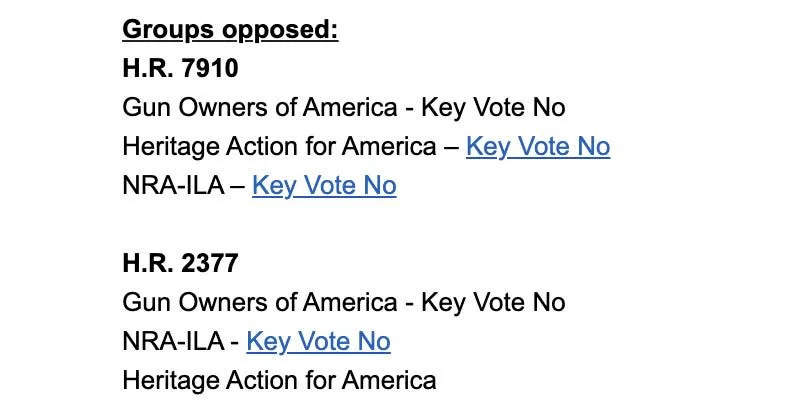
In a “whip notice” sent to rank-and-file members on Tuesday afternoon, House GOP leadership urged a “no” vote on all eight bills, referring to the seven-bill package as the “Unconstitutional Gun Restrictions Act.” They wrote that House Democrats had “thrown together this reactionary package comprised of legislation that egregiously violates law-abiding citizens’ 2nd Amendment rights and hinders Americans’ ability to defend and protect themselves and their families.”
The email also noted the opposition of the National Rifle Association and Gun Owners of America, including links to talking points from the NRA about both the gun package and the red flag law. Leaders also noted the opposition of Heritage Action for America, an advocacy group tied to the conservative Heritage Foundation.
“Due to the importance of this issue, votes on this legislation will be considered in future candidate ratings and endorsements by the NRA Political Victory Fund,” declares one of the memos shared by party leaders.
Screenshot of the end of the June 7th whip notice, including links to talking points from the NRA and Heritage Action for America.House Republican Whip Steve Scalise
It’s not uncommon for party leaders to note the opposition of outside groups to major pieces of legislation. For example, in a February whip notice urging Republicans to vote against a major piece of legislation aimed at boosting the US semiconductor industry, GOP leaders noted the opposition of the Federation for American Immigration Reform, National Taxpayers Union, and Americans for Prosperity.
But the two gun groups’ inclusion — and the NRA’s threat to downgrade candidate ratings or withhold endorsements should any Republicans back the measures — underscores the enduring influence of pro-second amendment groups on the right, despite the NRA’s recent financial troubles and shrinking membership.
NRA talking points distributed by House GOP leadership, including a warning that candidate ratings and endorsements are at stake.National Rifle Association
Meanwhile, Democrats are planning to stage a striking visual contrast to Republicans — House Speaker Nancy Pelosi asked her caucus members on Tuesday to be present on the House floor for debate on the gun measures on Wednesday, when the floor would otherwise be empty.
“On behalf of the survivors of gun violence, and out of respect for those who lost their lives, I am asking all Members of our Caucus to be present on the Floor of the House for the two hours of debate, which should begin at approximately 2:30 p.m. following the vote on the Rule,” she said.
Climate-driven flooding poses well water contamination risks
Michael Phillis and John Flesher – June 8, 2022
Homes are surrounded by floodwaters from Tropical Storm Harvey in Spring, Texas, Tuesday, Aug. 29, 2017. Experts say more intense storms driven by climate change are boosting contamination risks for privately-owned drinking water wells. (AP Photo/David J. Phillip, File)This photo provided by Stefanie Johnson shows Johnson’s private well in Blandinsville, Ill. Her well was contaminated during major flooding in 2013. Johnson’s family was without drinking water for nearly two months. She says contaminated wastewater likely drained in through the top, causing her well to test positive for E. coli. (Stefanie Johnson via AP)Neil and Bea Jobe pose in their home March 8, 2022, in Primm Springs, Tenn., which sits near Lick Creek. Several times a year, when there is heavy rain and a nearby creek floods, their well water turns “dingy,” Bea Jobe said. While estimates vary, roughly 53 million U.S. residents, about 17% of the population, rely on private wells, according to a study done in part by Environmental Protection Agency researchers. (AP Photo/Mark Humphrey) ASSOCIATED PRESSAn oil sheen drifts between a sunken shrimp boat and pieces of a destroyed home along Bayou Pointe au Chien in the aftermath of Hurricane Ida in Pointe-aux-Chenes, La., on Sept. 14, 2021. Experts say more intense storms driven by climate change are boosting contamination risks for privately-owned drinking water wells. (AP Photo/Gerald Herbert, File)n this photo taken in September 2017, Sandy Wynn-Stelt, of Belmont, Mich., stands in a wooded area near her home where industrial wastes containing PFAS chemicals were dumped for many years. High levels of the toxic compounds later were detected in drinking water from her well. While estimates vary, studies say roughly 53 million U.S. residents rely on private wells. While many provide safe water, experts say some are vulnerable to contamination from bacteria or other impurities from floodwaters or from groundwater tainted with PFAS or other pollutants. (Nic Antaya/The Grand Rapids Press via AP)
ST. LOUIS (AP) — After a record-setting Midwestern rainstorm that damaged thousands of homes and businesses, Stefanie Johnson’s farmhouse in Blandinsville, Illinois, didn’t have safe drinking water for nearly two months.
Flood water poured into her well, turning the water a muddy brown and forcing Johnson, her husband and their two young children to use store-bought supplies. Even after sediment cleared, testing found bacteria — including E. coli, which can cause diarrhea. The family boiled water for drinking and cooking. The YMCA was a refuge for showers.
“I was pretty strict with the kids,” said Johnson, who works with a private well protection program at the local health department. “I’d pour bottled water on their toothbrushes.”
Though estimates vary, roughly 53 million U.S. residents — about 17% of the population — rely on private wells, according to a study conducted in part by Environmental Protection Agency researchers. Most live in rural areas. But others are in subdivisions near fast-growing metro regions or otherwise beyond the reach of public water pipes.
While many private wells provide safe water, the absence of regulation and treatment afforded by larger municipal systems may expose some users to health risks, from bacteria and viruses to chemicals and lead, studies have found.
Risks are elevated after flooding or heavy rainfall, when animal and human feces, dirt, nutrients such as nitrogen and other contaminants can seep into wells. And experts say the threat is growing as the warming climate fuels more intense rainstorms and stronger and wetter hurricanes.
“Areas that hadn’t been impacted are now. New areas are getting flooded,” said Kelsey Pieper, a Northeastern University professor of environmental engineering. “We know the environment is shifting and we’re playing catch-up, trying to increase awareness.”
Pieper is among scientists conducting well testing and education programs in storm-prone areas. After Hurricane Harvey caused widespread flooding along the Texas coast in 2017, sampling of more than 8,800 wells in 44 counties found average E. coli levels nearly three times higher than normal, she said.
Sampling of 108 wells in Mississippi following Hurricane Ida in 2021 produced a similar bump in E. coli readings. Other studies turned up higher levels in North Carolina after Hurricane Florence in 2018.
The following year, above-average snowfall and a March storm unleashed flooding in Nebraska. Levees and dams were breached. Fremont, a city of more than 25,000, turned into an island when the nearby Platte and Elkhorn rivers overflowed.
The municipal system continued to supply drinking water but some nearby private wells were damaged or contaminated. Julie Hindmarsh’s farm was flooded for three days, and it took months to make the well water drinkable again. At times, the cleanup crew wore protective suits.
“They didn’t know what was in that floodwater,” she said.
CONTAMINATION RISK
Groundwater is often a cleaner source than surface supplies because soil can provide a protective buffer, said Heather Murphy, an epidemiologist at the University of Guelph in Canada. But she said that can give well owners a false sense of security, leading them to forgo testing, maintenance and treatment.
“There’s a big misconception that it’s underground, therefore it’s safe,” said Murphy, who estimates 1.3 million cases of acute gastrointestinal illness in the U.S. are caused annually by drinking untreated water from private wells.
Old, poorly maintained wells are especially vulnerable to floodwaters entering through openings at the top. “It just runs right in and it’s full of bacteria,” said Steven Wilson, a well expert at the University of Illinois.
It doesn’t always take a flood or hurricane to pollute wells. Industrial contamination can reach them by seeping into groundwater.
Around 1,000 residential wells in Michigan’s Kent County were tainted for decades with toxic per- and polyfluoroalkyl substances, or PFAS, in landfill sludge from footwear company Wolverine World Wide. The pollution, discovered in 2017, spurred lawsuits and a $69.5 million settlement with the state that extended city water lines to affected houses.
“We thought we were getting this pristine, straight-from-nature water and it would be much better for us,” said Sandy Wynn-Stelt, who has lived across from one of the dump sites since the early 1990s.
She said tests detected high levels of PFAS chemicals in her water and blood, leaving her fearful to drink or even brush her teeth with well water. In a suit later settled, she blamed the contamination for her husband’s 2016 death from liver cancer. She was diagnosed with thyroid cancer four years later.
LITTLE REGULATION FOR WELL OWNERS
While many well owners don’t have the option of hooking up to a public water system, others are happy with well water. They might favor the taste or want to avoid monthly bills and government regulation.
“What I hear from people is freedom,” said Jesse Campbell, private well coordinator for the Midwest Assistance Program Inc., which addresses rural water needs.
Private well owners are responsible for them. While public water systems must meet federal safety standards, those rules don’t apply to wells that have fewer than 15 connections or serve fewer than 25 people.
State and local standards usually involve only construction and design, although some states set tougher rules.
New Jersey requires water quality testing before sales of property with private wells. Rhode Island requires testing when new wells are built and when property with a well is sold.
But many states rely on public outreach and voluntary action to protect private well users.
“There’s an overall lack of education,” Campbell said. He meets with well owners from Montana to Missouri, providing free inspections and advice.
A lot of harm can be prevented if owners make sure the well’s top keeps out debris and that the pump is turned off before a storm to keep out floodwaters. Experts recommend testing after a flood and decontaminating wells with chlorine if a problem is found.
“People aren’t regularly testing,” said Riley Mulhern, an environmental engineer at the research group RTI International.
Indiana’s health department offers testing for bacteria, lead, copper, fluoride and other contaminants. Some land-grant universities and private labs provide similar services.
While many owners know how to maintain their wells, others ignore problems even if the water isn’t sanitary. Water that tastes fine can still be contaminated.
“I wish I had a nickel for everyone who’s walked into a workshop and said, ‘I’ve been drinking this water forever and it’s fine,’” said Jason Barrett, who directs a Mississippi State University program that educates well owners.
It provides free testing. But where such assistance isn’t available, costs can run to a few hundred dollars, according to experts. Some owners avoid testing because they are concerned it will reveal an expensive problem.
Johnson, the Illinois resident whose well was fouled by the 2013 downpour that killed four people and caused $465 million in flood damage, paid about $3,500 for repairs and upgrades.
“Luckily, none of us became ill,” she said.
Even ordinary rainstorms can carry diseases into groundwater, said Mark Borchardt, a microbiologist formerly with the U.S. Department of Agriculture.
“A lot of times people say, ‘Well, no one got sick,’” Borchardt said. “It’s hard to see when people get sick unless it is a huge outbreak.”
Bea and Neil Jobe live in Primm Springs, Tennessee, an hour’s drive from Nashville. Several times a year, when there is heavy rain and a nearby creek floods, their well water turns “dingy,” Bea Jobe said.
The discoloration disappears after a few days but Jobe takes precautions such as keeping bottled water available.
Severodonetsk becomes a huge mass grave for Russian army and Kadyrovites
June 7, 2022
A road to Severodonetsk, Luhansk Oblast
International observer Ivan Yakovina shared with Radio NV on June 6 what happened on the Luhansk axis over the past week, and how Russians have reacted to these developments. The following is an edited transcript of his briefing.
Putin needs a propaganda win, and therefore he wants his army to capture Lysychansk and Severodonetsk as soon as possible.
Since their encirclement (of Ukraine’s Joint Forces Operation) failed, Russia threw all its troops into a frontal assault, first on Severodonetsk.
This attack was quite successful. A few days ago, it was announced that 70-80% of Severodonetsk was captured, that the Ukrainian army was retreating, that it was evacuating across the Siverskyi Donets River to Lysychansk.
On June 4, reports began to appear that everything was not as bad as it seemed. And the day after, it became clear that the Ukrainian army had prepared an ambush there.
Ukrainian troops had prepared for the siege of Severodonetsk for a very long time, and roughly understood in which directions the attackers would go, they prepared — maybe they laid mines, maybe they set up ambushes.
The attackers were allowed into the city, and then this trap was snapped shut – and there they were all killed, and annihilated.
At first I didn’t really believe in this story, I thought it sounded too good to be true. However, I read [former FSB colonel, terrorist] Igor Girkin (Strelkov), and he says that the Ukrainian counter-offensive in Severodonetsk is indeed successful and developing. He said, “I don’t want to talk about the scale of the problems.” Obviously, the scale is quite serious.
Now the Russians are retreating from Severodonetsk in a panic. The Kadyrovites (the personal troops of Chechen warlord Ramzan Kadyrov) are suffering heavy losses because they were let in for the first time… It was so important for Putin to capture Severodonetsk that he even let the Kadyrovites, whom he usually does not risk, who usually shoot only video clips — he let them fight. They suffered enormous losses there.
Generally speaking, it was a crushing defeat for the Russian army there.
Interestingly. Girkin said on June 5 that the “mopping up” of Severodonetsk was coming to an end, but now — “no, no, no.” He claims that the counter-offensive in Severodonetsk was organized by Polish and American troops. He claims: “It was Polish, American speech on the air.”
They cannot believe that the Ukrainians can organize such a serious offensive. They decided that it would not be so shameful for them to say that it was the Americans who annihilated them. Why would there be so many Americans? Of course, these are Ukrainians.
However, the fact remains that in urban conditions, the Ukrainian counterattack in Severodonetsk is going very well.
I don’t know what will happen next. I think that at some stage Severodonetsk will still have to be abandoned because it is located on the left bank of the Siverskyi Donets. It is really difficult to defend it, especially when the bridges are broken; it is very difficult to send reinforcements there. Therefore, I think that it will have to be left in order to save the army.
But considering that the garrison in Severodonetsk let the Russian troops along with the Kadyrovites have it with both barrels, because they were defeated there — this sounds very cool. Let’s hope it’s all true.
The very fact that Severodonetsk has become a huge mass grave for the Russian army cannot but arouse some interest. An absolutely amazing, heroic story.
Here we see one very important nuance. Where the advantage of the Russian Federation dwindles in artillery, where artillery is not so important (artillery is used less in urban conditions, because you can hit your own people, and Russian artillery is not very accurate), the ability to conduct combat operations in urban conditions becomes important — with a machine gun, pistol, grenade launcher.
Under these conditions, we see that the Ukrainians are much more successful than the Russians. The Russians retreat and scatter.
This is important because with American supplies of artillery, the Russian advantage in it will soon come to naught. I think that will take a couple of months. And then a serious war will begin: soldier against soldier in settlements where the invaders stand no chance.
Home affordability has ‘collapsed’ in 2022. What to expect next, according to B of A
Is a housing crash brewing? Not likely, says B of A
Joy Wiltermuth – June 7, 2022
U.S. new home sales plunged 16.6% in April, even as prices continued to climb, according to government data released on May 24. AFP/GETTY IMAGES
B of A Global sees annual home-price growth as near a peak, not home prices overall. Also, low affordability likely hurts demand, not supply.
The double whammy of surging mortgage rates and skyrocketing home prices has led to “collapsed” housing affordability in America, according to Chris Flanagan’s team at B of A Global Research.
The situation has gotten so bad that it now compares to the “historically low affordability readings” in the fourth quarter of 1987 and the first quarter of 2005, according to the B of A team.
Existing home sales tumbled 33% in the wake of the 1987 crash and 45% in the aftermath of the subprime mortgage debacle. “In this cycle, we think a 35% peak-to-trough existing-home-sales decline is plausible,” Flanagan’s team wrote, in a weekly client note.
The cost of a 30-year fixed mortgage nearly doubled to about 5.25% in May from 2.75% last winter. The move higher came as the Federal Reserve began fleshing out plans to raise interest rates and trim its nearly $9 trillion balance sheet in a bid to tackle inflation that recently hit a near 40-year high.
While home prices have continued to climb this year, household wealth tied up in stocks and bonds has suffered, with the S&P 500 index SPX, +0.95% off 14% from its Jan. 3 closing high through Monday and the Nasdaq Composite Index COMP, +0.94% nearly 24% below its peak, according to FactSet data.
However, even in a somewhat “draconian” scenario, where the demand “side for housing is meaningfully altered by reduced affordability, the supply side remains exceptionally supportive” for home price appreciation, Flanagan’s team wrote.
Why? Blame the subprime mortgage mess and decades of underbuilding. Those catalysts led to record low supply of existing homes (see chart), which will take time to “normalize.
Housing crunch likely persists, even if demand dwindles. B OF A GLOBAL
Home supply was tight before the pandemic made it worse, as many families looked for bigger houses outside of big cities to adapt to remote work. That remains a key factor in B of A’s forecast for home prices to climb 15% for 2022 and 5% for 2023.
“Shelter is still scarce and residential real estate is still a good inflation hedge: To the extent there is any distress in housing, and forced sellers emerge, we think owner-occupied or non-owner-occupied buyers will be there to at least partially absorb the sales,” they said.
Russia’s war in Ukraine is upending the global arms industry.
As the U.S. and its allies pour significant sums of money into arming Ukraine and Russia bleeds tanks and personnel, countries across the world are rethinking defense budgets, materiel needs and military relationships. Countries that historically have had low levels of defense spending such as Japan and Germany are bulking up, while nations that purchase most of their weapons from Russia are questioning their reliability and future delivery.
My research in this area suggests that, however this war eventually ends, the repercussions for the global defense industry, and for the countries whose companies dominate this sector, will be enormous. Here are four takeaways.
1. Russia will be the biggest loser
Russia’s general sales pitch for its weapons has been they’re “cheaper and easier to maintain than Western alternatives.” This is why Russia accounted for 19% of the world’s arms exports from 2017 to 2021, second only to the U.S., which had 39% of the market.
To date, the U.S. estimates Russia has lost almost a thousand tanks, at least 50 helicopters, 36 fighter-bombers and 350 artillery pieces, according to Business Insider. Thousands of Russian soldiers have been killed, with estimates ranging from about 15,000 to as high as 30,000, and Russia is still unable to control Ukraine’s airspace.
The situation has become so dire that there are reports that commanders are trying to preserve equipment by forbidding troops from using them to evacuate wounded soldiers or to support units that have advanced too far.
Russia’s offensive weapons have also proved disappointing. Its missile failure rate – the share that either failed to launch, malfunctioned mid-flight or missed their target – may be as high as 50% to 60% due to design flaws and outdated or inferior equipment.
These problems, along with the Russian military’s slow progress achieving any of President Vladimir Putin’s stated objectives, have raised serious doubts among the country’s traditional customers for weapons exports. Russia sells almost 90% of its weapons to just 10 countries, including India, Egypt and China.
What’s more, Russia’s ability to replace these equipment losses has been hampered by economic sanctions, which bars key foreign components like circuit boards. And Russia will almost certainly need to replace its own military hardware before it exports anything abroad.
That means that even countries that want to keep buying Russian tanks and fighter jets will have to wait in line or turn elsewhere to fulfill their defense needs.
2. Russia’s loss is China’s gain
The country that will likely see the greatest gains from Russia’s displacement as a major arms supplier is China.
In recent years, the country has taken a 4.6% share of the global arms trade, putting it in fourth place behind France’s 11%. At the same time, seven of the top 20 global defense companies in terms of revenues earned from defense sales are Chinese, signaling the sector’s big ambitions.
Currently, the Chinese government buys most of its weapons and vehicles from these domestic arms makers, but China has the capacity to export more military products abroad.
For example, China is already the world’s largest shipbuilder, so exporting more naval ships is a natural next step. The country is expanding its niche role in drone technology and attempting to leverage modernizing its air force with domestically built aircraft to increase exports.
At the moment, only three of the world’s 40 biggest arms importers – Pakistan, Bangladesh and Myanmar – buy a majority of their weapons from China. That could change if China takes advantage of Russian weakness to position itself as a reliable national security, economic and political partner – a core feature of its Belt and Road Initiative.
China is not capable of supplanting U.S. and European weapons, which are considered “top shelf” because of their high quality and price. But China may well fill the market niche that Russian arms makers dominated, thereby increasing Beijing’s role as a major weapons exporter – and gaining the political and economic benefits that accompany that.
One of China’s biggest challenges will involve proving that its weapons work well in live combat situations.
U.S. weapons manufactures dominate the global arms industry. The Ukraine war will likely ensure this stays that way for some time.
The world’s five largest arms companies are all American: Lockheed Martin, Raytheon, Boeing, Northrop Grumman and General Dynamics. In fact, half of the top 100 producers of arms are based in the U.S. Twenty are European. Only two are Russian – despite the country being the world’s second-largest source of arms.
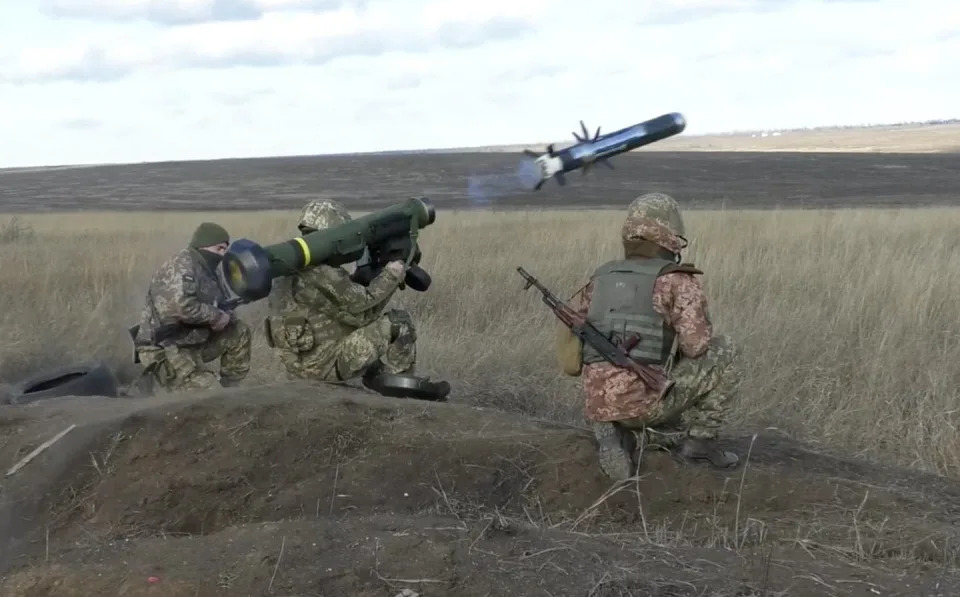
The massive amounts of weapons being transferred from the U.S. to Ukraine will keep American arms makers busy for some time to come. For example, the U.S. has transferred about one-third of its stock of Javelin anti-tank missiles to Ukraine, and it will take three to four years for the Raytheon-Lockheed Martin joint venture to replace them. The US$40 billion aid package recently signed by President Joe Biden includes $8.7 billion to replenish U.S. weapons stocks.
The companies’ soaring stock prices are a sign investors believe profitable days are ahead. Lockheed Martin’s stock price is up over 12% since the invasion began – with most of the gains occurring in its immediate aftermath. Northrop Grumman has jumped 20%. At the same time, the broader stock market as measured by the S&P 500 has slumped about 4%.
4. More countries will become arms makers
The flipside to this is that some countries that relied on others for their defense needs may seek to become more self-sufficient.
India, which relied on Russia for almost half of its weapons imports in recent years, is realizing that Russia will need most or all of its production capacity to replace tanks, missiles, aircraft and other weapons used or lost in Ukraine, with less leftover for export.
That means India will need to either source spare parts for vehicles and weapons from other former Russia arms customers such as Bulgaria, Georgia and Poland, or build up its own defense industry. In April, India announced it would ramp up production of helicopters, tank engines, missiles and early airborne warning systems to offset any potential reduction in Russian exports.
Brazil, Turkey and other emerging market countries have also been developing their own defense industries over the past two decades to reduce their reliance on arms imports. The Ukraine war will accelerate this process.
Putin likely didn’t expect to shake up the global arms market with his effort to annex Ukraine – or cause the decline of his country’s weapons sector. But that’s just one more way his war is causing a geopolitical earthquake.
Uvalde gunman threatened rapes and school shootings on social media app Yubo in weeks leading up to the massacre, users say
Daniel A. Medina, Isabelle Chapman, Jeff Winter and Casey Tolan
May 28, 2022
CNN: Salvador Ramos told girls he would rape them, showed off a rifle he bought, and threatened to shoot up schools in livestreams on the social media app Yubo, according to several users who witnessed the threats in recent weeks.
But those users – all teens – told CNN that they didn’t take him seriously until they saw the news that Ramos had gunned down 19 children and two adults at an elementary school in Uvalde, Texas, this week.
Three users said they witnessed Ramos threaten to commit sexual violence or carry out school shootings on Yubo, an app that is used by tens of millions of young people around the world.
The users all said they reported Ramos’ account to Yubo over the threats. But it appeared, they said, that Ramos was able to maintain a presence on the platform. CNN reviewed one Yubo direct message in which Ramos allegedly sent a user the $2,000 receipt for his online gun purchase from a Georgia-based firearm manufacturer.
“Guns are boring,” the user responded. “No,” Ramos apparently replied.
In a statement to CNN, a Yubo spokesperson said “we are deeply saddened by this unspeakable loss and are fully cooperating with law enforcement on their investigation.” Yubo takes user safety seriously and is “investigating an account that has since been banned from the platform,” the spokesperson said, but declined to release any specific information about Ramos’ account.
Use of Yubo skyrocketed during the coronavirus pandemic, as teens trapped indoors turned to the app for a semblance of in-person interactions. The company says it has 60 million users around the world – 99% of whom are 25 and younger – and has trumpeted safety features including “second-by-second” monitoring of livestreams using artificial intelligence and human moderators.
Despite those safety features, the users who spoke to CNN said Ramos made personal and graphic threats. During one livestream, Amanda Robbins, 19, said Ramos verbally threatened to break down her door and rape and murder her after she rebuffed his sexual advances. She said she witnessed Ramos threaten other girls with similar “acts of sexual assault and violence.”
Robbins, who said she lives in California and only ever interacted with Ramos online, told CNN she reported him to Yubo several times and blocked his account, but continued seeing him in livestreams making lewd comments.
“[Yubo] said if you see any behavior that’s not okay, they said to report it. But they’ve done nothing,” Robbins said. “That kid was allowed to be online and say this.”
Robbins and other users said they didn’t take Ramos’ comments seriously because troll-like behavior was commonplace on Yubo.
Hannah, an 18-year-old Yubo user from Ontario, Canada, said she reported Ramos to Yubo in early April after he threatened to shoot up her school and rape and kill her and her mother during one livestream session. Hannah said Ramos was allowed back on the platform after a temporary ban.
Hannah, who requested CNN withhold her last name to protect her privacy, said Ramos’ behavior turned increasingly brazen in the last week. In one livestream, she said, Ramos briefly turned his webcam to show a gun on his bed.
The users said they didn’t make recordings of Ramos’ threats during the livestreams.
Yubo’s community guidelines tell users not to “threaten or intimidate” others, and ban harassment and bullying. Content that “promotes violence such as violent acts, guns, knives, or other weapons” is also banned.
Just a week before the Uvalde attack, Yubo announced an expanded age verification process that involves users taking a photo of themselves and the app using artificial intelligence to estimate their age. The platform only allows people 13 and older to sign up, and doesn’t allow users 18 and older to interact with those under 18.
Yubo, which is based in Paris, has attracted controversy since it launched in 2015 under the name Yellow, with some local law enforcement officials warning about the possibility of abuse. Police have arrested men in Kentucky, New Jersey and Florida who allegedly used Yubo to meet or exchange sexually explicit messages with kids. Last month, Indiana police investigating the 2017 murder of two teenage girls said they were seeking information about a Yubo user who had solicited nude photos of underage girls on other social media platforms.
Ramos’ disturbing social media interactions didn’t only take place on Yubo. One user, a girl from Germany who met Ramos on Yubo, said she had some troubling interactions with him via text and FaceTime. The 15-year-old said she received text messages from him shortly after he shot his grandmother and before his assault at the elementary school, as CNN previously reported.
The girl said she thought any violent or strange comments Ramos made were in jest.
But after the shooting, she said, “I added everything up and it made sense now… I was just too dumb to notice all the signals he was giving.”
Russian auto sales plunge 83.5% in May, another historic dive
Reuters – June 6, 2022
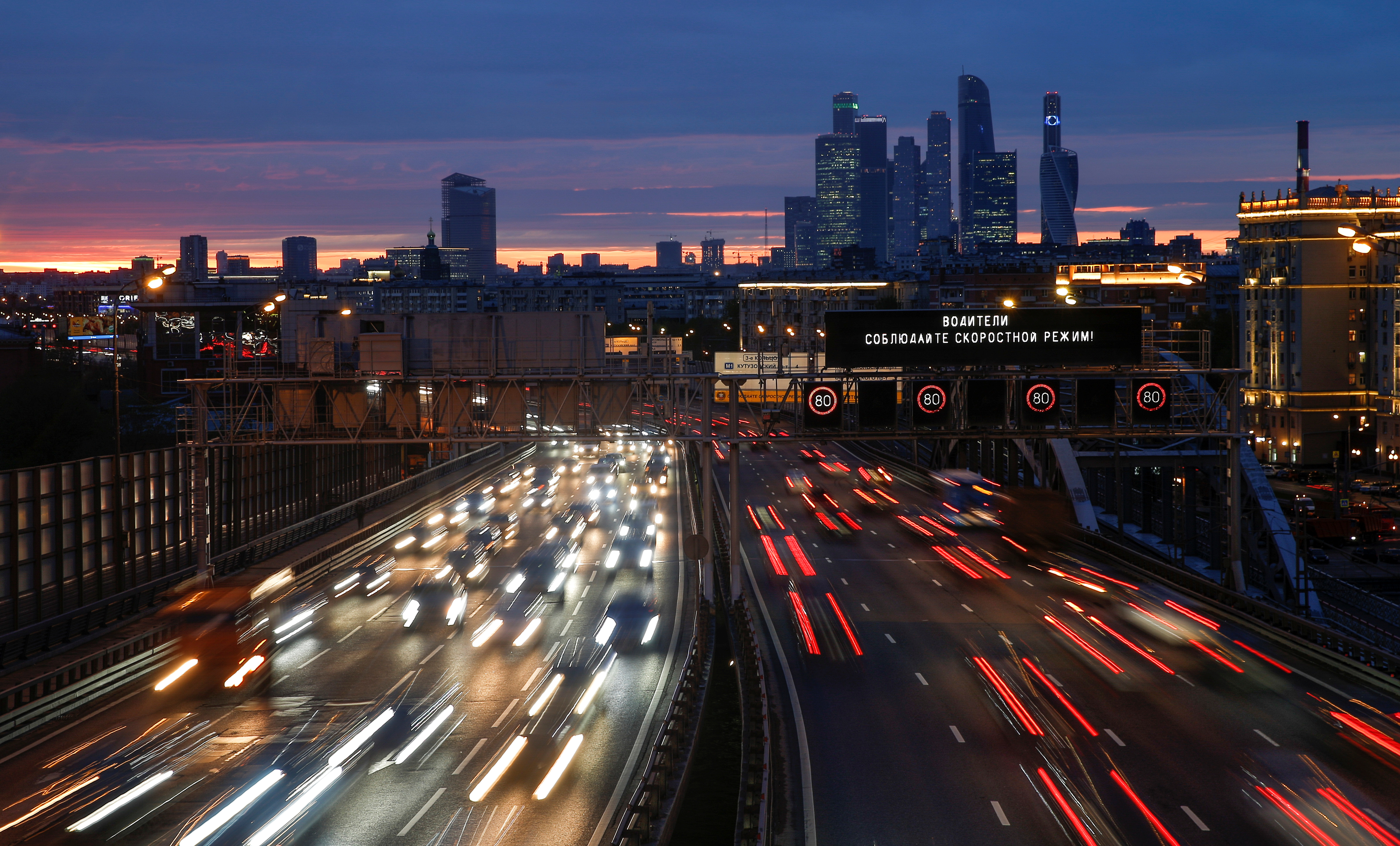
Cars drive along a highway in Moscow, Russia, May 17, 2017 with Moscow International Business Center also known as “Moskva-City” in the background. REUTERS/Maxim Shemetov
June 6 (Reuters) – Car sales in Russia plunged 83.5% in May to another historic low, the Association of European Businesses (AEB) said on Monday, as Western sanctions have decimated Russia’s auto industry with parts shortages and spiralling prices.
Russia sent troops to Ukraine on Feb. 24, and sales of new cars have been falling since March as sanctions blocked main supply chains. Last month, only 24,268 vehicles were sold, AEB said. A year earlier, sales were six times greater.
Top western carmakers led by Renault (RENA.PA) either suspended operations or left Russia since sanctions took effect. The country’s car industry depends on global supplies, and the shortage of parts has shrunk production volumes several times since Feb. 24.
According to Russian statistic agency Rosstat, car prices have jumped nearly 50% since the start of the year, slamming demand in a country where household incomes have declined while inflation has been hovering near 20-year highs.Advertisement · Scroll to continue
AEB did not provide a forecast for the Russian auto market performance this year. In April, it forecast new car sales in Russia to fall by at least 50% in 2022.